Rethinking Pain, Movement, Fascia, and the Nervous System with Morgan Rojas
Most of us were taught to think about the body in fairly simple terms.
If a muscle feels tight, stretch it. If something feels weak, strengthen it. If it hurts, rest it. If your mobility is limited, work on flexibility.
Sometimes those things do indeed help. But for any of you out there who are like me, and have dealt with recurring tightness, old injuries, stubborn pain, or a movement that just never feels quite right knows that the body doesn’t always behave that neatly.
That is part of what drew me to the work of Morgan Rojas, a Licensed Massage Therapist with a master’s degree in Sport & Exercise Science and the founder of Find Aligned.
Morgan’s work asks us to look beyond isolated muscles and start thinking about the larger system: muscle, fascia, the nervous system, sensory information, previous injuries, movement patterns, and (perhaps most importantly) adaptation.
In her book, Align What Your Body Misunderstands, she writes:
“The body is not reacting randomly. It is adapting based on previous experiences, learned patterns, and the expectations it has developed over time.”
That idea immediately clicked for me because we talk about adaptation constantly when discussing metabolism.
If someone chronically diets, drastically restricts calories, or repeatedly exposes the body to the same stressor, the body responds. It adjusts to the environment it has been given.
Movement is no different.
Your body is continually learning from what you do repeatedly: how you sit, walk, lift, train, compensate after an injury, carry tension, favor one side, or avoid movements that once hurt.
Morgan continues:
“Something within the system—whether structural, neurological, or perceptual—is shaping how that moment is processed. While these responses may initially feel unpredictable, they begin to make sense when viewed through the lens of adaptation. What once seemed random becomes patterned, and what felt out of control becomes something that can be observed, understood, and eventually changed.”
That changes the question.
Instead of only asking, “What is wrong with this muscle?”, we can start asking:
“What has my body adapted to?”
Adaptation is not the same thing as optimal function
The body is remarkably good at finding ways to accomplish what we ask of it.
But that doesn’t necessarily mean it has found the most efficient strategy.
Morgan puts it simply:
“The body will always adapt to the demands placed on it, but adaptation does not guarantee optimal function. It simply reflects what the system has been repeatedly exposed to. Without awareness, those adaptations may reinforce patterns that are inefficient or incomplete.”
That distinction matters.
An old ankle injury may change how you load one leg. A painful shoulder may teach you to move your shoulder blade differently. Years of sitting may influence how you organize movement through the hips and pelvis.
The original reason for an adaptation may even be long gone while the movement strategy remains.
That doesn’t mean the body has failed.
It means the body learned.
And something that can be learned can potentially be reorganized.
Pain and movement involve more than muscles
One of the most fascinating parts of Morgan’s work is her use of sensory input.
We rarely think about vision, smell, touch, pressure, balance, or body position when talking about knee pain or mobility. But the nervous system is constantly gathering information from the environment and the body and deciding how to respond.
Morgan sometimes changes a sensory input (such as visual information or smell) and then retests someone’s movement or symptoms.
The interesting question isn’t simply whether someone feels different.
It is: Why would changing seemingly unrelated information change the experience of pain or movement at all?
That opens a much larger conversation about how the nervous system interprets information, how movement is organized, and why pain is not always a simple measurement of tissue damage.
“I should be able to do this”
Most people have experienced a movement that technically should be possible but somehow feels wrong.
Maybe one side feels coordinated and the other feels clumsy.
Maybe your squat feels restricted until you warm up.
Maybe you have enough strength to perform an exercise, but the movement still feels unstable.
Morgan describes movement as something that is not defined solely by how it looks but by how it is organized.
That means strength and flexibility are only pieces of the puzzle.
How the nervous system is processing information, how force is being distributed, and whether the body is relying more heavily on certain tissues or strategies can all influence the experience.
Where fascia fits in
Fascia has become one of the trendiest words in the fitness and wellness world, sometimes to the point that it starts sounding mystical.
Morgan’s framework offers a more practical way to understand it.
Rather than treating fascia and muscle as completely separate systems, her work explores how different bodies may rely on them differently when creating movement, stability, and force.
That can help explain why two people performing the same exercise may experience it completely differently.
It also raises an interesting question many of us have probably never considered:
Are you trying to force your body to move according to a strategy that doesn’t actually match how your body tends to organize itself?
Becoming curious instead of immediately trying to “fix” yourself
The point of this conversation isn’t to teach everyone to diagnose their own pain.
It is almost the opposite.
It is an invitation to become more observant.
When something repeatedly feels tight, painful, unstable, or restricted, instead of immediately attacking that area with stretching, foam rolling, or strengthening, we might first get curious.
When does it happen?
Does it change after warming up?
Is one side different from the other?
Does the movement feel different depending on position, speed, load, or environment?
What previous injuries or habits might have shaped the way the body is approaching that task?
Patterns become much easier to understand when we stop treating every symptom as an isolated event.
In this episode of Taste0fTruth Tuesdays, Morgan and I explore sensory input, fascia and muscle, movement organization, chronic pain, old injuries, and the many ways our bodies adapt to what we repeatedly ask of them.
Because sometimes what feels like a body behaving unpredictably may actually be a body doing exactly what it has learned to do. Looking forward to hearing your thoughts, feedback and questions!
When I first turned to Christianity, I wanted to do it right.
I did not wander casually into church, absorb a few inspirational sermons, call myself a Christian for six months, and wander back out again. I read through a roughly 1,600-page Wayne Grudem systematic theology book for fun, then I read another 600-page theology book. I read the Bible twice in two and a half years. I took Bible-study courses. I went to church. I participated in online study groups. I studied doctrine because I genuinely wanted to understand what (the fuck) I had committed myself to.
So, I find it deeply offensive when people approach me (or leave a comment here on Substack) now as though the reason I reject Christianity must be that I simply have not encountered the right version yet.
“Oh, but Megan, what about early Christianity?”
“But what about the mystical gnostic tradition?”
“But have you considered this alternative interpretation of the Hebrew scriptures?”
“But ancient and medieval Christianity had a strong pagan current.”
“But the division between Abrahamic and pagan cultures isn’t really that clean.”
I know.
I understand the reinterpretation. I reject the substrate.
This is exactly what I have written about in my work on Jesus as a literary construction: modern spirituality seems constitutionally incapable of allowing Jesus (or Christianity itself) to remain historically particular. Jesus is endlessly reinvented as an Aryan, enlightened teacher, universal sage, revolutionary, mystic, some ascended master or cosmic Christ, pagan-adjacent philosopher, psychological archetype, or whatever else is necessary to rescue him from the religious architecture that produced him.
The rough edges are continually sanded away until Christianity becomes something the modern interpreter already wanted to believe.
And frankly, it is not my fault that you are still high on copium.
It is not my fault that you cannot face the reality of the Mosaic distinction. By this I mean what the Egyptologist Jan Assmann identified as a profound transformation in the history of religion: the emergence of a theological distinction between true and false religion. In many ancient polytheistic worlds, foreign gods could be translated, compared, identified with one another, or incorporated into an existing religious landscape without requiring the conclusion that everyone else’s gods were simply unreal. The Mosaic distinction introduces a fundamentally different logic: there is a true God and false gods, legitimate worship and idolatry, revelation and error. Religious difference is no longer merely difference; it become theological falsehood.
It is not my fault that you have not wrestled seriously with histories like The Darkening Age, or with the long destruction, suppression, absorption, and replacement of the classical knowledge and religious worlds that existed before Christian domination. Whatever debates remain over individual episodes or interpretations, the Christianization of the Roman world was not simply a peaceful exchange of ideas in which one spiritual option organically prevailed. Temples were closed and often destroyed, pagan sacrifices were prohibited, traditional cults lost legal and political protection, sacred spaces were appropriated, and older practices were reclassified as superstition, idolatry, or demonic error. Pagan traditions did not merely “blend” with Christianity on equal terms; increasingly, they barely survived within a political and theological order that denied them equal legitimacy.
It is not my fault if the ancient historical spirit (the memory of the Roman people, the pagan peoples, our ancestors) has been lulled to sleep beneath generations of theological and psychological conquering. By that I mean the loss of cultural memory that occurs when the worldview of the victor becomes so normalized that people begin interpreting the defeated traditions through the categories of the religion that displaced them. Gods become “myths,” ancestral rites become “superstitions,” sacred places become curiosities, and Christian reinterpretations are treated as the natural culmination of what came before. After enough generations, conquest no longer feels like conquest because its assumptions have become the background architecture of thought itself. We are still burdened by Abrahamic supremacy through its metaphysical assumptions, its ontological lies and its corrupt theology.
That is why I am not interested in being told that Christianity contained a “strong pagan current,” as though the survival of pagan material somehow dissolves the distinction between the traditions. Cultural absorption is not the same thing as theological continuity, and syncretism under conditions of unequal power is not evidence that the conquered worldview survived intact. Sometimes the pagan residue inside Christianity tells us less about Christianity’s openness than about how extraordinarily difficult Europe’s older religious worlds were to erase.
And I am certainly not obligated to crawl back into the framework because someone has discovered a more mystical way of decorating it.
Of course, history is complex.
Of course, cultures interact.
Of course, Christianity absorbed enormous amounts of pagan philosophy, imagery, customs, sacred geography, ritual, and symbolism.
That does not make Christianity pagan.
And pointing to the pagan material Christianity absorbed after centuries of conquest is not the devastating rebuttal some people seem to imagine it is. In many cases, it proves the opposite: pagan culture was so deeply rooted that it could not simply be erased. It had to be absorbed, renamed, subordinated, and Christianized.
Interaction does not erase difference.
Syncretism does not erase domination.
And complexity is not a solvent that magically dissolves every meaningful distinction.
This endless need to redeem Christianity is precisely what I am exhausted by.
People hear me say, “I reject this framework,” and somehow translate it into, “Please introduce me to a more sophisticated version.”
No.
I have studied the scriptures, the doctrines, the apologetics, and the internal arguments.
Walking away was not an easy feat.
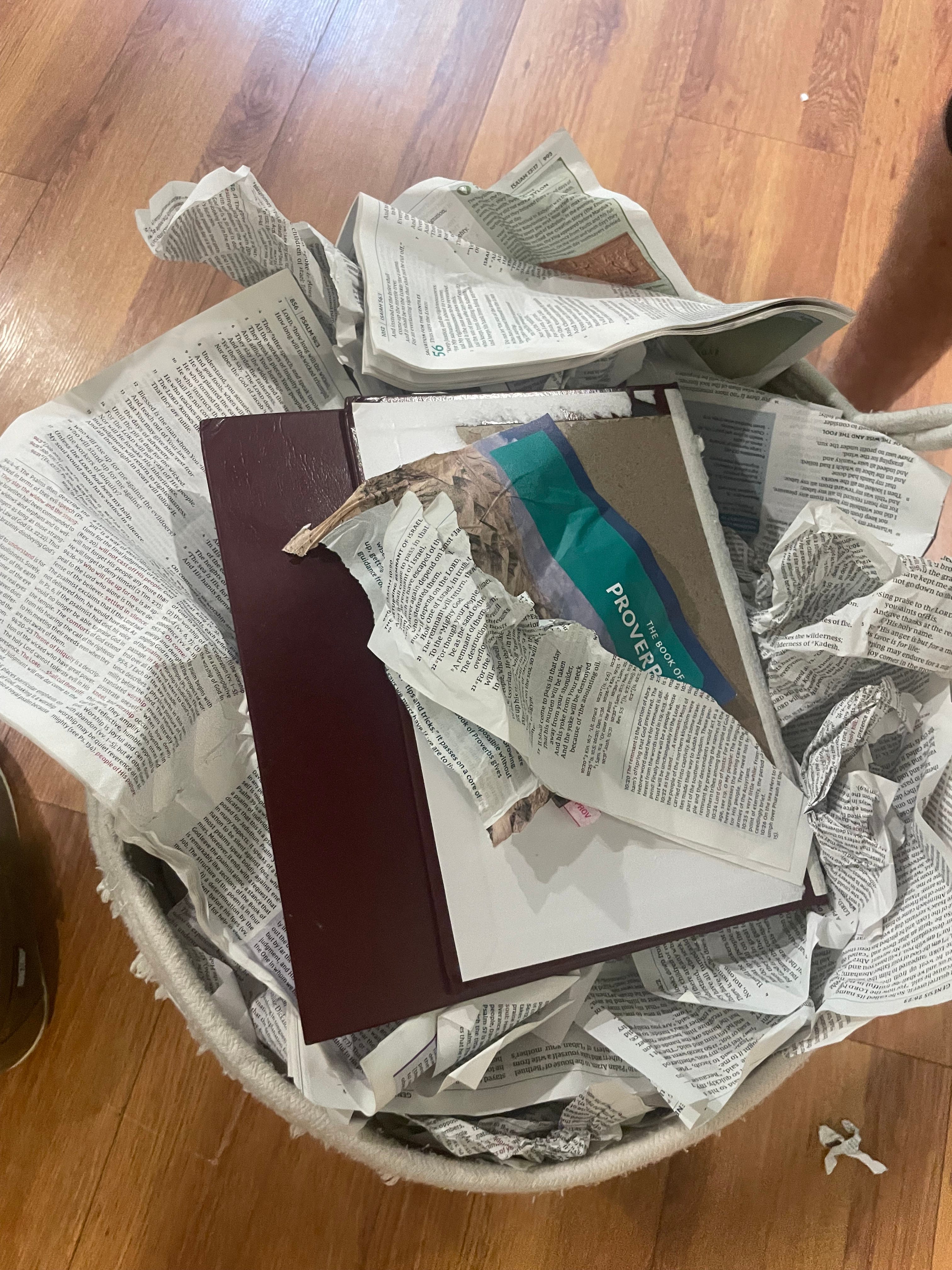
This photograph is my enormous systematic theology book and my Bibles ripped apart and thrown away means something very different to me than it probably does to you. Deconstruction was not an intellectual parlor game. The pain of walking away from the Church was beyond anything I expected. I had physical, visceral responses. I was covered in hives. I gained weight. The psychological torture reached down into my soul at a depth I still struggle to explain.
I had built a world inside that framework.
Then I followed the broken threads of its doctrine until I found my way back out of the Abrahamic framework altogether.
That process cost me something.
So no, I do not appreciate (not even an ounce) when somebody who has not bothered to understand who I am, what I studied, what I believed, or what it cost me to leave decides to waste my fucking time explaining that Christianity is actually much deeper, more mystical, more pagan, more esoteric, or more sophisticated than I realize.
You are not revealing the hidden level of the game to me.
You are reenacting the exact mechanism I am criticizing.
The assumption underneath all of these conversations is that Christianity must remain redeemable. If I reject the obvious form, someone produces the mystical form. If I reject the mystical form, someone produces the historical nuance. If I reject that, someone dissolves the categories altogether: perhaps “Abrahamic” and “pagan” were never really so different.
Anything except allowing the possibility that I understand the tradition and still find its underlying architecture unacceptable.
That is the spiritual hamster wheel.
There must always be another interpretation.
Another layer.
Another secret teaching.
Another version of Jesus.
Another way to salvage the thing you cannot bear to relinquish.
But I have already relinquished it.
My Heathenry does not require me to turn Christianity into disguised paganism so I can make peace with it. I do not want to make peace with my enemies. I do not need Jesus reconstructed as Dionysus, a universal consciousness, or an esoteric solar principle. I do not need the Hebrew scriptures alchemized into some secret perennial wisdom before I am permitted to judge what I actually find there.
And I can study the differences without compulsively collapsing them into some universal spiritual soup.
Perhaps that is what some people find intolerable.
Because once you stop insisting that every tradition secretly teaches the same thing, you have to make judgments. You have to admit that religions contain competing metaphysics, competing moral visions, competing conceptions of humanity, competing relationships to divinity, nature, ancestry, authority, and the sacred.
And then you might have to choose.
I chose.
So, when I tell you that I have no interest in Christianity, and in fact I have a burning blood memory full of hatred for it, believe me the first time.
I do not need the deeper version.
I do not need the mystical version.
I do not need the pagan-friendly version.
I do not need Christianity rescued from Christianity.
I understand the reinterpretation.
I reject the substrate.
Sources and Further Reading
The authors below do not represent a single school of thought, nor do they necessarily agree with every conclusion I draw. Together, however, their work informs my analysis of Jesus as a literary construction, the scriptural formation of biblical narratives, the Mosaic distinction, and the suppression and absorption of Europe’s pre-Christian religious worlds.
Jesus Mythicism and the Literary Construction of Christ
Paul-Louis Couchoud, The Creation of Christ: An Outline of the Beginnings of Christianity, translated by C. Bradlaugh Bonner, 2 vols. (London: Watts & Co., 1939).Originally published in two volumes, Couchoud’s work traces the development of Christ from an apocalyptic and prophetic heavenly figure into the increasingly historicized Jesus of the written Gospels. The second volume also contains his essay “The Historicity of Jesus.” These are the two PDF volumes I recently had printed for further study.
Richard Carrier, On the Historicity of Jesus: Why We Might Have Reason for Doubt (Sheffield Phoenix Press, 2014).
Earl Doherty, Jesus: Neither God nor Man—The Case for a Mythical Jesus (Age of Reason Publications, 2009).
Robert M. Price, The Christ-Myth Theory and Its Problems (American Atheist Press, 2011).
Biblical Narrative, Myth, and Scriptural Construction
Thomas L. Thompson, The Mythic Past: Biblical Archaeology and the Myth of Israel (Basic Books, 1999). Published in the United States as The Bible in History: How Writers Create a Past.
Thomas L. Thompson, The Messiah Myth: The Near Eastern Roots of Jesus and David (Basic Books, 2005).
Thompson’s work is especially important to my understanding of biblical characters and messianic narratives as literary products shaped by older Near Eastern traditions, recurring royal motifs, and scriptural patterns. Thompson should not simply be collapsed into the modern Jesus-mythicist movement; his work addresses the literary and mythic construction of biblical figures through a distinct scholarly framework.
Monotheism and the Mosaic Distinction
Jan Assmann, Moses the Egyptian: The Memory of Egypt in Western Monotheism (Harvard University Press, 1997).
Jan Assmann, The Price of Monotheism, translated by Robert Savage (Stanford University Press, 2010).
Assmann’s concept of the Mosaic distinction describes the revolutionary division between true and false religion introduced by biblical monotheism. This distinction altered how religious difference could be understood: other gods and forms of worship were no longer merely foreign or different, but false, illegitimate, idolatrous, or demonic.
Christianization and the Classical World
Catherine Nixey, The Darkening Age: The Christian Destruction of the Classical World (Macmillan, 2017).
Freedom, Moral Formation, and Philosophy as a Rite of Rebirth
This is Part Two of The Ancient Hunger Beneath Modern Life, a series about participation, belonging, embodied wisdom, and what modern life has taught us to forget. Please note, this post will be truncated in some emails, please click “Read more” to access the entire essay.
When the Circle Closes
There is something unsettling about returning to a version of your life that once felt permanent.
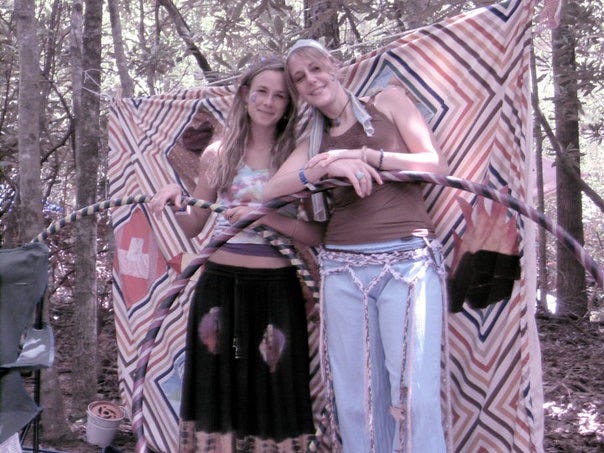
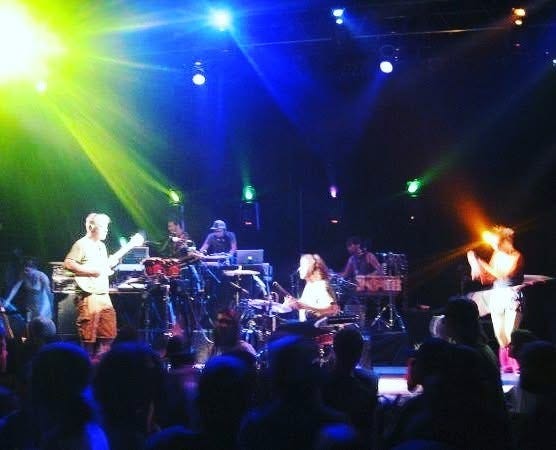
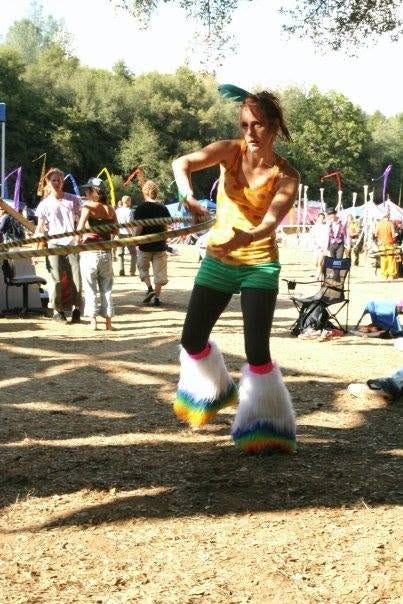
Going back through these old photographs and blog posts, I could almost step inside that world again: the music, the movement, the friendships, the long drives, and the feeling of being recognized across a crowded field. For years, these people and places had helped me understand who I was. They were not simply hobbies or acquaintances orbiting an otherwise separate life. They were part of the world in which I had learned what freedom, community, individuality, and belonging were supposed to feel like.
That is what made revisiting it unexpectedly tender.
But memory changes when you know what came later.
Many of the same people I had associated with self-expression and the freedom to live differently would eventually turn on me when I expressed convictions they did not share. The upheavals of 2020 exposed something I had not wanted to see: there was tremendous room to be eccentric, spiritual, sexual, artistic, and unconventional, but considerably less room to question the moral and political assumptions holding the group together.
I first felt the circle closing while sitting on the couch in our military housing at Camp Zama in Japan, watching events unfold back home from the other side of the world.
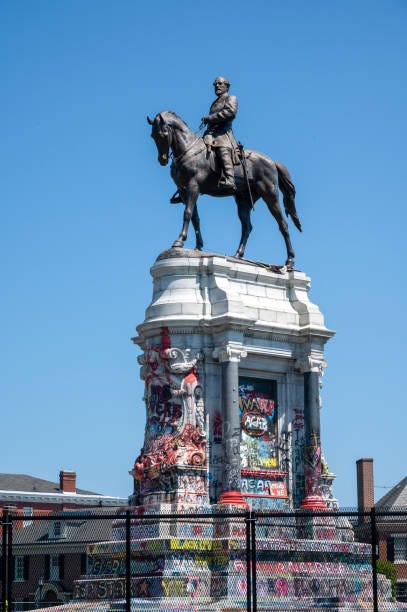
I watched people tear down and destroy historical monuments in Richmond, Virginia, not far from where I grew up. By then I was living inside a military community, surrounded by a very different language of service, duty, order, and sacrifice. I was geographically removed from the social atmosphere many of my old friends still inhabited, and perhaps that distance allowed me to see what was happening differently.
I remember the reaction in my body before I had fully worked out the argument in my head. My stomach tightened. My palms began to sweat. I felt disgust and a strange embarrassment that this was happening so close to the place I still considered home.
My old communities began demanding allegiance to what increasingly felt like a single political script. I no longer recognized the friends and so called “tribe” which I had built so much of my identity around.
And by this point, social media was not incidental to my life.
Becoming a military spouse had physically separated me from many of the friends and communities I had accumulated over the years. Facebook and Instagram were how I stayed connected to people scattered across different cities and states. They were also where I worked. I had built my career as an online personal trainer and coach there, and my multilevel marketing business depended heavily on the same platforms. Friendship, professional identity, income, visibility, and reputation had all become strangely entangled inside the same digital space.
So what people thought of me online mattered more than I would like to admit now. These apps were not simply places I went to waste time scrolling. They had become the room where much of my social and professional life still existed.
You may think my initial reaction to being bullied online sounded absurd…and maybe it would be if you’re thinking of these as merely apps.
To me, they were not.
They were where years of photographs and memories lived, and where a public identity I had spent years constructing was suddenly being turned against me. A space that had once connected me to music, travel, friendship, and community had become somewhere I entered expecting humiliation.
The disagreement itself was not what hurt most. It was watching people who knew me join in so easily, as if my dignity stopped mattering the moment I landed on the wrong side of an issue.
The dogpile confirmed something I had felt for years: maybe I had never been held as securely inside these communities as I wanted to believe. Even during my years in Portland, I often hovered near the edges of friendship circles instead of living at their center. I remember lonely days off, knowing people were heading to the coast, the hot springs, or some other adventure I had not been invited to join.
The community gave me real friendship, joy, beauty, and belonging. I refuse to rewrite those years as though none of it mattered. I can also still admit how often I adjusted myself to remain acceptable.
Once I admitted that, I had a choice. I could stay quiet, repeat what I was expected to believe, and let other people decide the boundaries of acceptable thought. Or I could accept what might happen if I refused to perform agreement.
I chose the loneliness.
At first, it felt almost like social suicide. It also created tension in my closest relationships. The people who loved me wanted to protect me from what seemed to happen every time I spoke publicly about something controversial. From their perspective, the solution was simple: stay quiet. If no one knew what I believed, I would stop giving people reasons to turn against me.
But silence did not feel neutral to me. It felt like one more way to abandon myself.
I do not regret speaking. When I imagine looking back on my life as an old woman, I know I will be grateful that I said something when I believed it mattered.
Still, there was a cost.
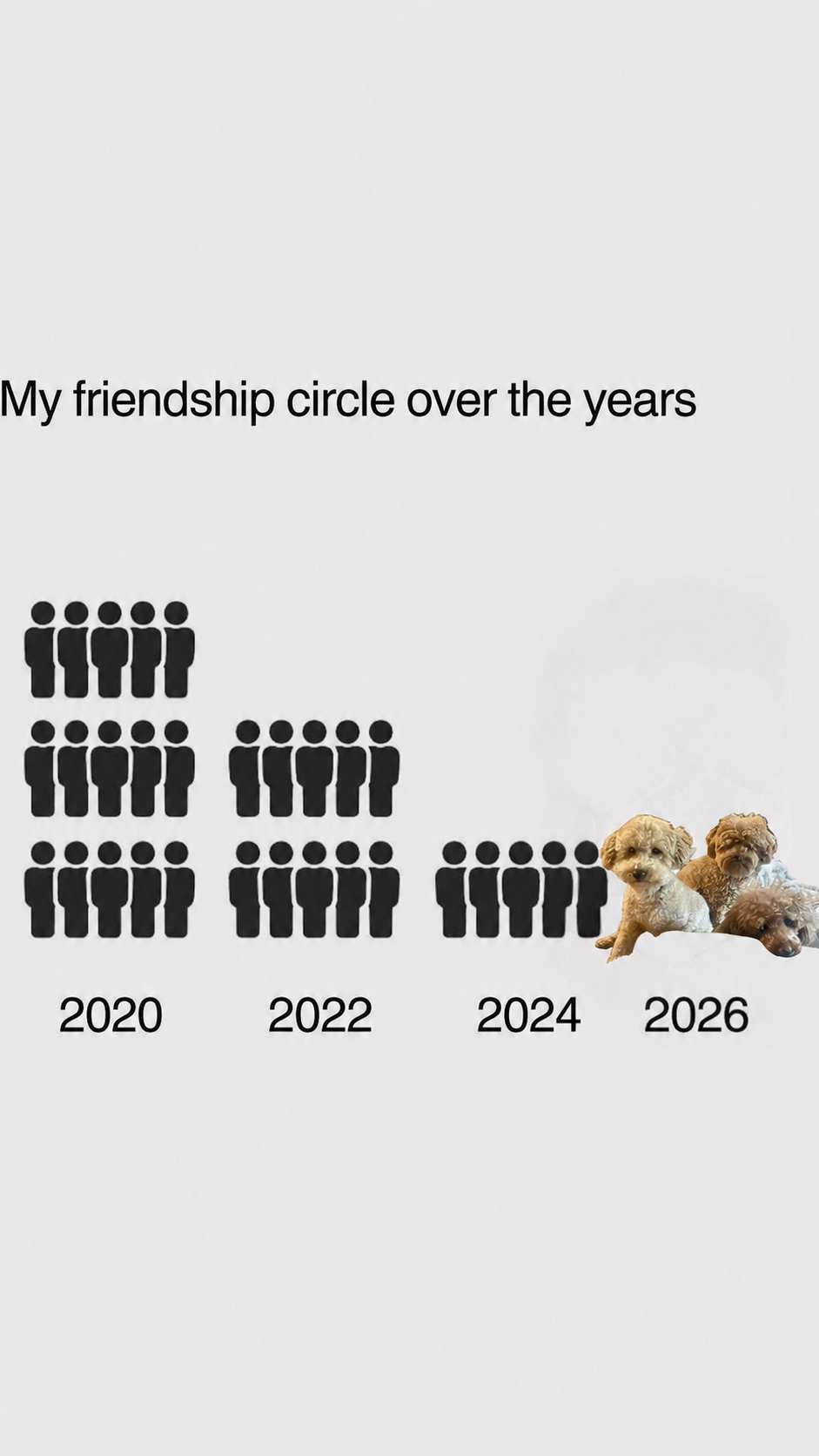
These photographs remind me how many people were once in my life and how much smaller my social world has become. I know what a community can give us. I also know what happens when belonging depends upon hiding the parts of ourselves a group has decided not to tolerate.
I am no longer willing to purchase belonging that way.
If your sense of belonging depends on one-sided ideological conformity, with no room for nuance or freedom of thought, you are not part of a community. You are a cog in a crude machine—and that machine will discard you the moment you fall outside its range of tolerance. —Olympia Mahr
Festival culture was not the only place where I encountered this pattern. Around the same time, I began recognizing how much of my identity had been tied to Isagenix and the multilevel-marketing world. That community had given me encouragement, certainty, recognition, and the feeling that many people knew my name. When I spoke openly about the ways I believed the system had exploited me, plenty of people did not want to hear it. Some seemed unable to understand why I could not just admit that I knew better now and move on.
Leaving one system does not automatically heal the hunger that drew us into it.
The loss left an enormous hole, and Christianity entered through it.
At first, Christianity seemed to offer everything I had been craving: forgiveness, certainty, moral order, love, healing, and the promise that all the chaos of my life could finally be gathered into one coherent story. I wanted to do it correctly. I studied theology intensely and moved deeper into Reformed doctrine because I believed one of those competing systems had to be right. I just needed to find it and submit myself fully enough.
Then I encountered doctrinal triage, the sorting of beliefs into matters Christians could disagree about and matters that determined whether someone remained fully acceptable inside the community.
I had originally been baptized in the name of Jesus alone by a Oneness Pentecostal group. After joining a Reformed church, I was told that my baptism did not count because it had not been Trinitarian. I could no longer receive the Lord’s Supper, even though I had already taken it during my first weeks there.
The message felt familiar: belonging had conditions I had not understood when I entered.
When I lined up these chapters of my life—festival culture, Portland progressivism, multilevel marketing, diet culture, bodybuilding, and Christianity—I saw the same needs being met again and again: identity, certainty, recognition, moral language, and belonging. The worlds themselves were radically different. The risk of questioning their boundaries felt familiar.
I am not looking for a community without convictions. I do not believe every moral disagreement is trivial, and I have no interest in manufacturing intimacy with people whose vision of life is fundamentally incompatible with my own. I want like-minded people around me. I want enough shared moral ground that we can actually build something together.
I also need room for hard questions, intellectual honesty, and disagreement without humiliation. A community can have boundaries without coercing or degrading people who ask difficult questions. I want to be around people with convictions who do not immediately turn disagreement into dogpiling. And I will not betray myself just to remain welcome.
Ancient ideas have always fascinated me, of course, but curiosity was not the only reason I turned toward the old understanding of philosophy as a rite of rebirth. I was trying to figure out what parts of me remained after an entire social, spiritual, and moral identity collapsed. How was I supposed to rebuild without handing my conscience over to another system?
Freedom Without Formation
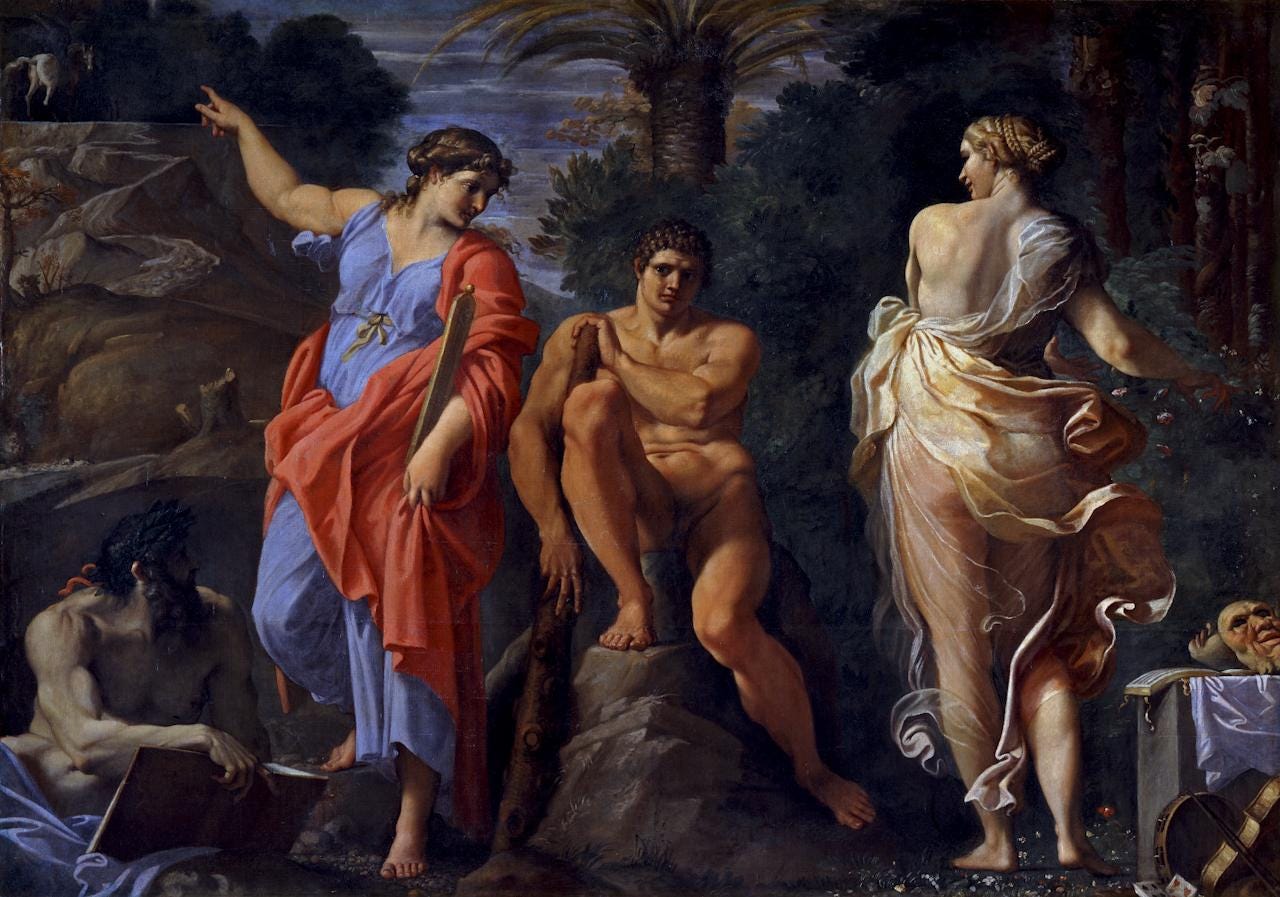
Hercules at the Crossroads Freedom is not merely the existence of choice, but the formation of character capable of choosing well.
After so many systems had promised to transform me, I began asking what transformation even meant.
I had changed my body, diet, politics, spiritual language, beliefs, and social circles. I kept entering new worlds hoping this one might finally make me whole. Each came with its own authorities, practices, taboos, vocabulary, and picture of who I could become if I followed the program correctly.
I eventually had to admit how easy it is to change identities without changing the pattern underneath. We can carry the same wounds, compulsions, and hunger for approval into a completely different community, learn all the right words, and mistake the intensity of conversion for wisdom because everything feels new.
That forced me to reconsider one of the most persistent moral slogans of modern life:
You do you.
For years, those words sounded compassionate and enlightened to me. I believed refusing judgment was the same thing as kindness. What someone did with their body, sexuality, money, health, or private life was presumed to be no one else’s concern as long as everyone involved consented and no immediate harm could be demonstrated.
Freedom meant removing constraints. The individual was sovereign, self-defining, and entitled to follow whatever desires arose from within.
I no longer believe any of us are that isolated.
Our desires do not appear in a vacuum. Families, wounds, friendships, industries, technologies, institutions, incentives, and the surrounding moral atmosphere all help shape them. We imitate what is modeled. We learn what is normal from what receives approval. Long before we have the judgment to examine any of it, we are absorbing ideas about liberation, beauty, sexuality, success, and fulfillment.
Even the self we call “authentic” has a history.
Culture does more than permit behavior. It helps form people. When an industry profits from a particular vision of empowerment, its financial incentives can disappear behind the language of individual choice. Once a behavior is publicly celebrated as liberation, questioning it begins to look like cruelty. Enough supposedly private decisions can change expectations, relationships, and the moral imagination of an entire society.
My own life makes it impossible for me to keep this argument abstract.
I once understood sex work almost entirely through the language of autonomy and empowerment. The people around me treated it as normal, even enviable. My mother told me she wished she had done it when she was younger. My sister was successful at it. My friends offered no meaningful resistance. Portland handed me an entire vocabulary through which commodifying sexuality could be framed as bold, liberated, and transgressive.
I made those choices. I own that.
I also know the person making them had been shaped by her family, her need for approval, her relationship with her body, the promise of money, and a culture that treated freedom as overcoming shame and refusing restraint. Owning my decisions does not require me to lie about the conditions surrounding them.
Years later, as a wife trying to build an enduring life with another person, I understood the consequences differently. Choices once praised as empowering had left marks on my ability to trust, attach, and understand intimacy. The language available to me at the time had plenty to say about my freedom to choose. It said very little about the person those choices might slowly form me into.
That question followed me through bodybuilding, multilevel marketing, New Age spirituality, and Christianity. Did the practices I submitted to actually make me freer? Bodybuilding fed my compulsions. The MLM world exploited my need to be seen. Other teachings encouraged me to treat struggle as evidence that I had not surrendered enough. Christianity gave me moral certainty for a while, but it also trained me to distrust my own questions.
Simply choosing something does not mean it increases our freedom.
The slogan assumes the self already knows what is good. Desire is treated as trustworthy because it feels personal. Yet desire can be trained by injury, appetite, commercial manipulation, social pressure, and the desperate need to belong. Sometimes the choice that feels most authentic is an old wound repeating itself in a new form.
This brought me back to the argument I explored in The Fragility of Freedom. A free society cannot survive through laws and procedures alone. It needs people capable of judgment, restraint, responsibility, courage, loyalty, and concern for something beyond immediate appetite. A republic can guarantee rights and limit government. It cannot legislate the character required to use freedom well.
So the political question cannot end with, What should people be legally permitted to do? We also have to ask what kind of person is capable of exercising that freedom without being ruled by appetite, compulsion, resentment, propaganda, commercial incentives, or the approval of the crowd.
Aristotle understood virtue as a capacity formed through repeated practice. Courage, temperance, generosity, responsibility, and sound judgment become part of us through habit. Anything that can be cultivated can also be neglected, distorted, or lost.
Political disagreements can therefore reach far beneath policy. People draw upon care, fairness, loyalty, authority, liberty, and the sacred, but we do not all weigh those concerns the same way. Sometimes we are not merely reaching different conclusions. We are measuring reality with different moral frameworks.
A culture organized almost entirely around liberation from constraint eventually loses the language to explain why restraint can be good. Discipline begins to look like repression. Every limit starts to resemble oppression, and we stop asking what the limit was meant to protect in the first place.
“The ancients held that there is nothing that cannot be cured by philosophy and theurgy.”
—Philosophy as a Rite of Rebirth by Algis Uždavinys
The Older Purpose of Philosophy
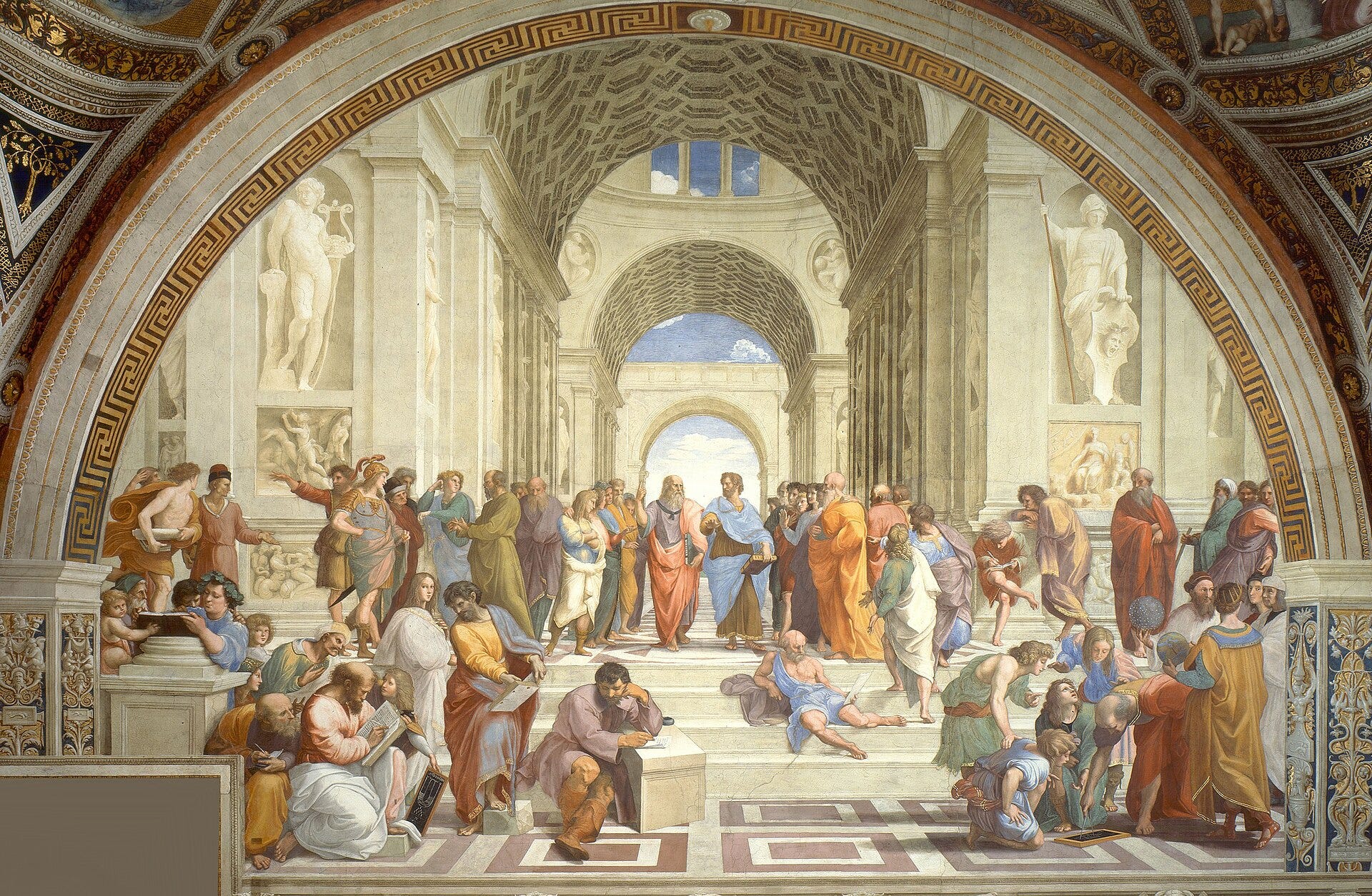
Raphael’s School of Athens.
That question of formation sent me looking for an older understanding of philosophy.
After Christianity, the last thing I wanted was another belief system demanding my allegiance. What I found in the work of Algis Uždavinys was a completely different account of what philosophy had once been for.
Uždavinys argues that the modern world has largely lost the participatory understanding of reality found in ancient philosophy. In his account, the Protestant legacy and the emergence of modernity helped move truth into the isolated individual mind. Philosophy became preoccupied with the solitary thinker questioning, doubting, analyzing, and trying to establish with certainty that anything outside the mind existed at all.
For Plato, Plotinus, Iamblichus, and the traditions that followed them, philosophy was concerned with what the pursuit of wisdom did to the soul. Reality was sacred, ordered, hierarchical, and meaningful. The soul was not sealed inside a private psychological world. It could participate in realities beyond its immediate appetites, opinions, fears, and social conditioning.
Philosophy involved contemplation, purification, discipline, initiation, sacred rites, and a change in one’s entire way of living. Knowing more was not enough. The philosopher was supposed to become capable of seeing and living differently.
My friend Brado approaches this through the concept of mediation: everything that stands between us and direct experience. Words, explanations, arguments, and even the thoughts inside our own heads can communicate something real, but they are still representations of an experience.
As he writes:
“This type of knowledge then, as it cannot be verbalized, it similarly cannot be rationalized either. As existence is surely affected by this type of knowledge rather than the other type we discussed—the knowledge mediated by discursive intellect—it can be jarring to consider that the knowing we attain from reading a word on a page or thinking a thought in our head is not the same as the knowing [we] receive from experience.”
This does not make reason useless. Discursive thought allows us to analyze, compare, question, build, and communicate. It simply cannot deliver every kind of knowing by itself.
Brado distinguishes between wisdom acquired as information and wisdom that must be received through encounter. We may prepare through study, discipline, and reflection. At some point, however, the idea has to become lived reality.
That was the philosophical form of something my body had already taught me through music, injury, repetition, and movement. Certain things cannot be transferred intact from one mind to another. They have to be entered.
Philo-sophia (the love of wisdom) was an art of seeing, loving, understanding, and living. Its purpose was not merely to construct arguments, master technical language, or accumulate information about what earlier philosophers had believed. It was a discipline of transformation that shaped perception, character, conduct, and one’s relationship with death. Wisdom had to be practiced until it became embodied. The measure of philosophy was the kind of life it produced.
Uždavinys describes its telos as a radical transformation of thought and existence in pursuit of wisdom.
The Platonic and Aristotelian traditions did not assume every desire represented the authentic self. They asked whether our desires were ordered toward what was genuinely good, beautiful, and life-giving. Freedom included liberation from confusion, compulsion, false appearances, and domination by the lower parts of ourselves.
That is far more demanding than telling me to express myself. It asks what kind of self I am becoming. Are my desires making me more lucid, courageous, capable of love, and responsible to the living world around me? A choice can be legal and sincerely felt and still lead me away from wisdom.
Adopting one more ideology could never answer that question for me. I did not need a new identity to perform or a collection of ancient ideas decorating the same unexamined life. I needed practices capable of changing how I perceived, desired, judged, and lived.
“Therefore, a philosophical journey is the mimetic and ritual-like journey of the hero, like Heracles and Orpheus, to the Netherworld, the Egyptian Duat, where all the opposites meet. This is the process of ‘dying before death’ and resurrection.”
—Algis Uždavinys, Philosophy as a Rite of Rebirth
What Must Die
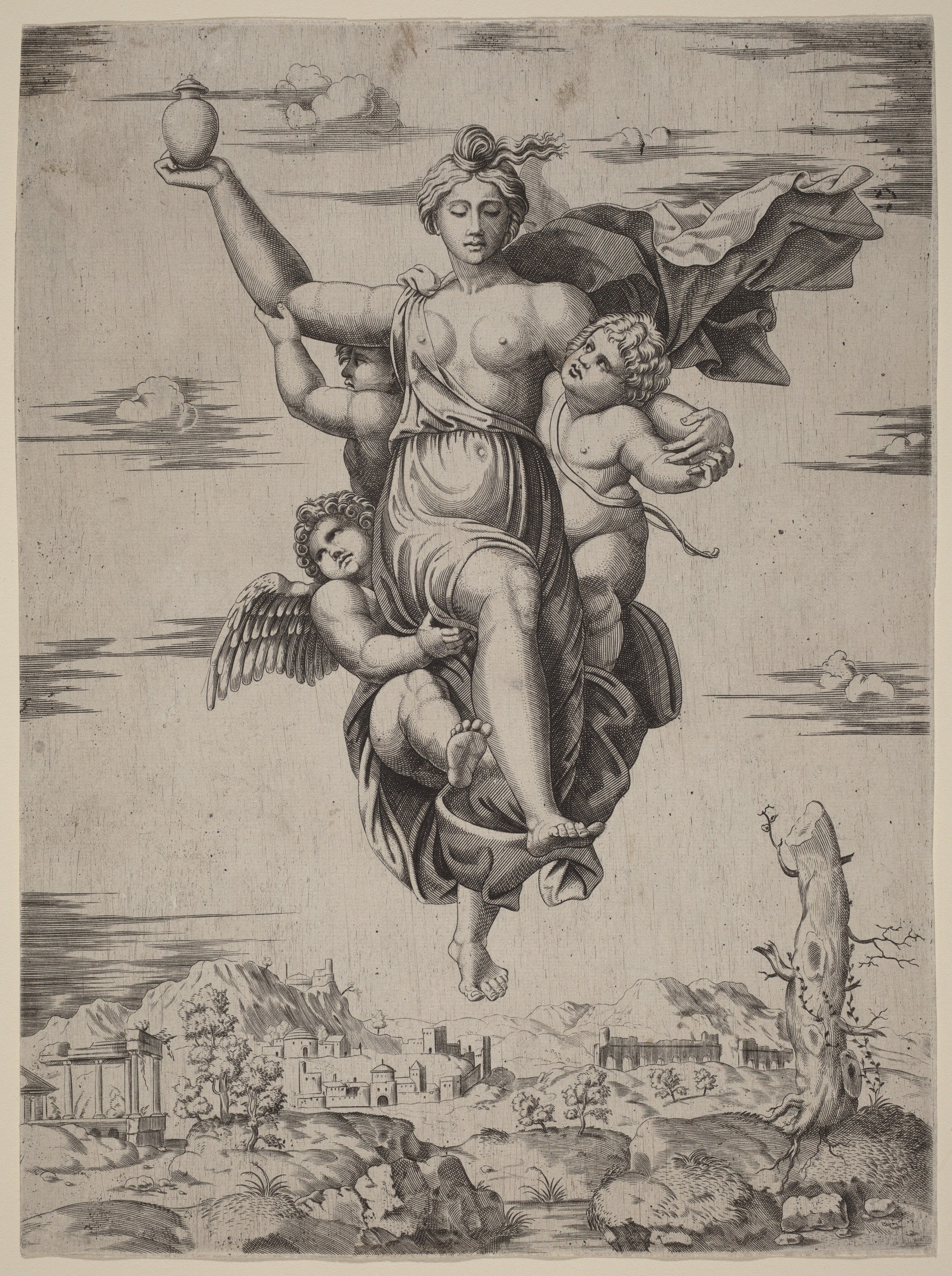
Psyche Carried to Olympus Follower of Marcantonio Raimondi after Raphael
When I think about rebirth in my own life, I do not imagine becoming an entirely different person. I think about the gradual death of the person I constructed in order to survive.
Growing up inside an authoritarian household, I learned early that parental love could be conditional, discipline could mean pain, and trust could leave me exposed. I became self-reliant because I had to. That kind of self-reliance has a cost.
“I believe, toxic shame is a type of emotional flashback in which we view ourselves with the same disgust we saw reflected in our parents’ faces whenever they acted as if they were repulsed by us. Toxic shame freezes us in the fear, mortification, and hopelessness of our most traumatic times in childhood. To the degree, that our parents acted as if they couldn’t stand the side of us, to that same degree are we prone to toxic shame, attacks of feeling bad, worthless, and ugly. Parents routinely use toxic shame to dismiss children’s needs and to extinguish their ability to assert themselves and protest (or even notice) abuse and neglect.” —Pete Walker, The Tao of Fully Feeling—Harvesting forgiveness out of blame
The need for control, the drive for perfection, the desperate desire to become good enough to earn love—these were not random personality traits. They were ways of navigating a world in which I never felt securely seen, safe, or understood.
They followed me into adulthood. I tried to control my body through eating disorders and bodybuilding. I tried to control how other people perceived me through achievement, performance, and reinvention. Certainty felt like safety, so I entered communities that promised it. Again and again, I hoped that if I became the right kind of person, the old feeling of not being securely loved might finally disappear.
And so what I have learned… is my intensity does not have to die. Neither does my capacity to feel deeply or my desire for beauty, discipline, belonging, and meaning. I need to let go of the fantasy that I can fill that old absence by becoming impressive enough, obedient enough, beautiful enough, spiritually correct enough, politically acceptable enough, or perfectly understood.
There is a useful name for another illusion wrapped up in this: the end-of-history illusion. We can look backward and recognize how profoundly we have changed while imagining that the person we are now is somehow the finished version.
I can see it all through my own life. Each new world felt like an arrival. This is it. The right body. The right community. The right politics. The right spiritual vocabulary. The explanation that would finally gather every scattered piece of my life together.
I knew I had changed dramatically before arriving there. Somehow I still believed this newest self was the one I had been moving toward all along.
Of course she was not finished. I am not finished now either.
That does not mean every change is positive growth or that our values should be endlessly disposable. It means the direction of our formation matters because we are never standing still.
I can now see a difference between conversion and transformation. Conversion can change our vocabulary very quickly. Transformation is slower, less glamorous, and much harder to perform for an audience.
It shows up in steadier values, discernment, self-command, courage, and the ability to remain rooted when someone disagrees. It allows me to listen without disappearing and stand firmly without needing everyone around me to confirm that I am standing in exactly the right place.
I no longer imagine the performed self dying in one grand initiatory moment. It dies in small decisions: when I refuse to punish myself, trust what I have actually observed, remain honest despite the possibility of rejection, or stay in relationship without abandoning myself inside it.
In the Platonic language that has helped me understand this, rebirth changes perception. The frightened, grasping, passion-bound self loses its absolute claim over us, making room for something more lucid to participate in a greater order of reality.
For me, philosophy is the work of becoming able to see.
I went into the inner death and saw that outer dying is better than inner death. And I decided to die outside and live within.
– C.G. Jung, The Red Book
Divine Madness
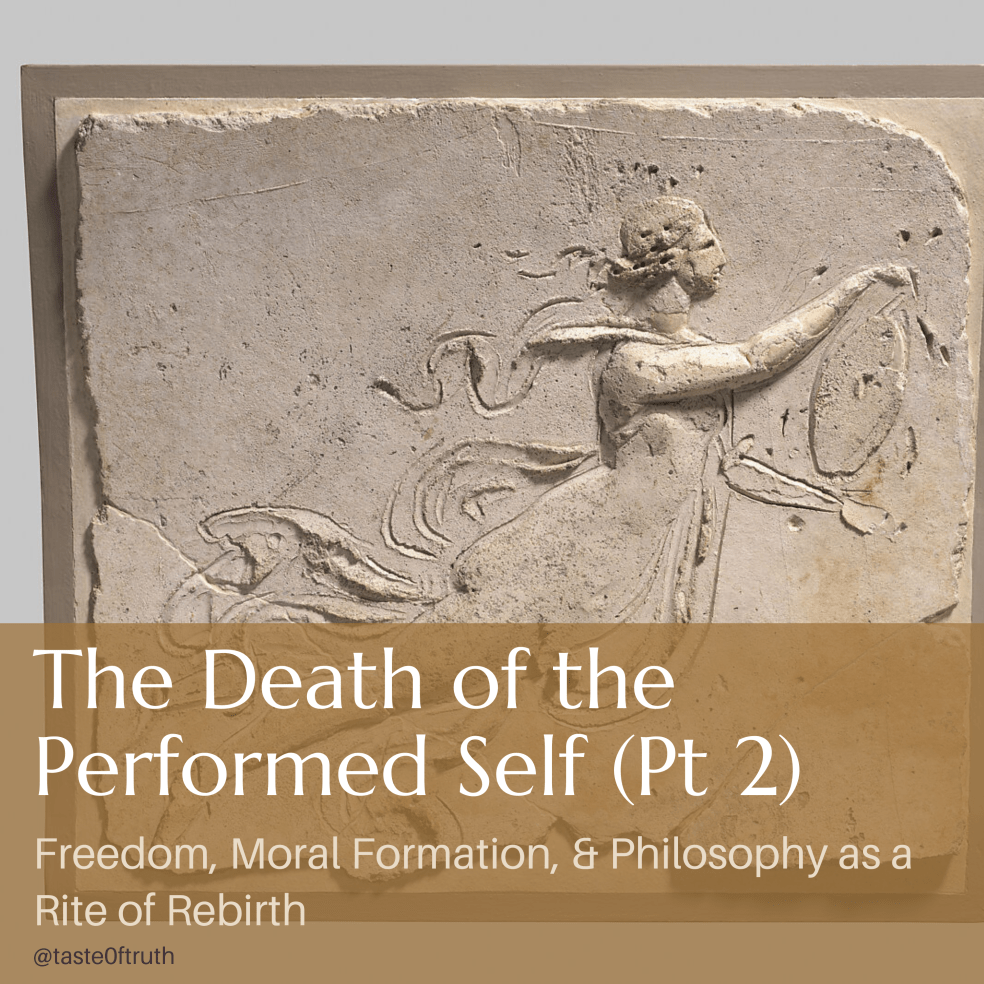
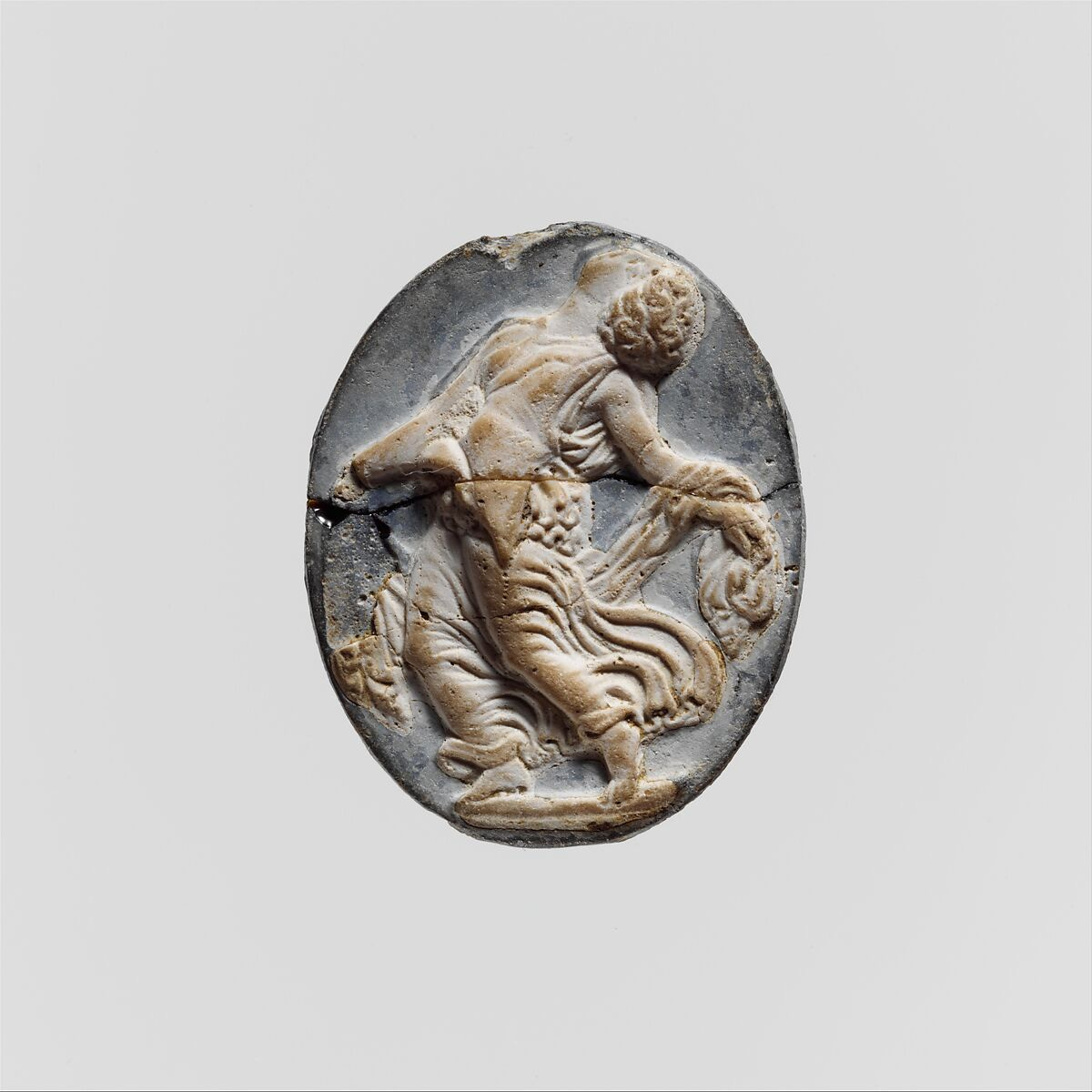
“Divine Madness”: Roman cameo of a dancing maenad, 1st century CE.
In Part One, I wrote about learning through the body—about the moment a hula hoop stops being something you are consciously controlling and becomes something your body simply knows how to move with.
For years, ecstatic dance gave me access to another kind of knowing. The ritual container could create the conditions for something to happen, but it could not guarantee that it would. Music, ceremony, movement, and community could prepare the ground. Some Sundays remained simply joyful afternoons of dancing. Others opened into something I still struggle to describe.
Participation is not a vending machine for transcendence. Ritual can orient us toward an experience without forcing the experience to occur.
I could go week after week and have a beautiful time dancing, sweating, moving, seeing friends, and being carried by good music. Then there were certain Sundays when something else happened.
I still cannot fully explain what made the difference.
Sometimes it seemed to be the DJ or the particular arc of the music. Sometimes it was the combination of people who gathered that day. Anyone who has spent enough time in spaces like this knows the people in the room change the room. The energy could build on itself until I could no longer separate my individual experience from whatever was happening collectively.
Sociology gives us the term collective effervescence for the heightened energy that can emerge when people gather in shared ritual, movement, rhythm, and attention.
From a Heathen perspective, I also think about megin: power or vitality that does not belong only to an isolated individual, but can gather and move through relationship and communal participation.
Whatever language I use, I know the difference between having a wonderful time and entering a genuinely ecstatic state.
In those moments, ordinary self-consciousness fell away. I stopped experiencing music as something coming toward me from outside. My body was no longer selecting a sequence of movements. At a certain point, I was not listening to the music anymore. I was inside it.
My body knew what to do before I could think about it.
Those experiences come closest to what Plato described as divinely inspired madness.
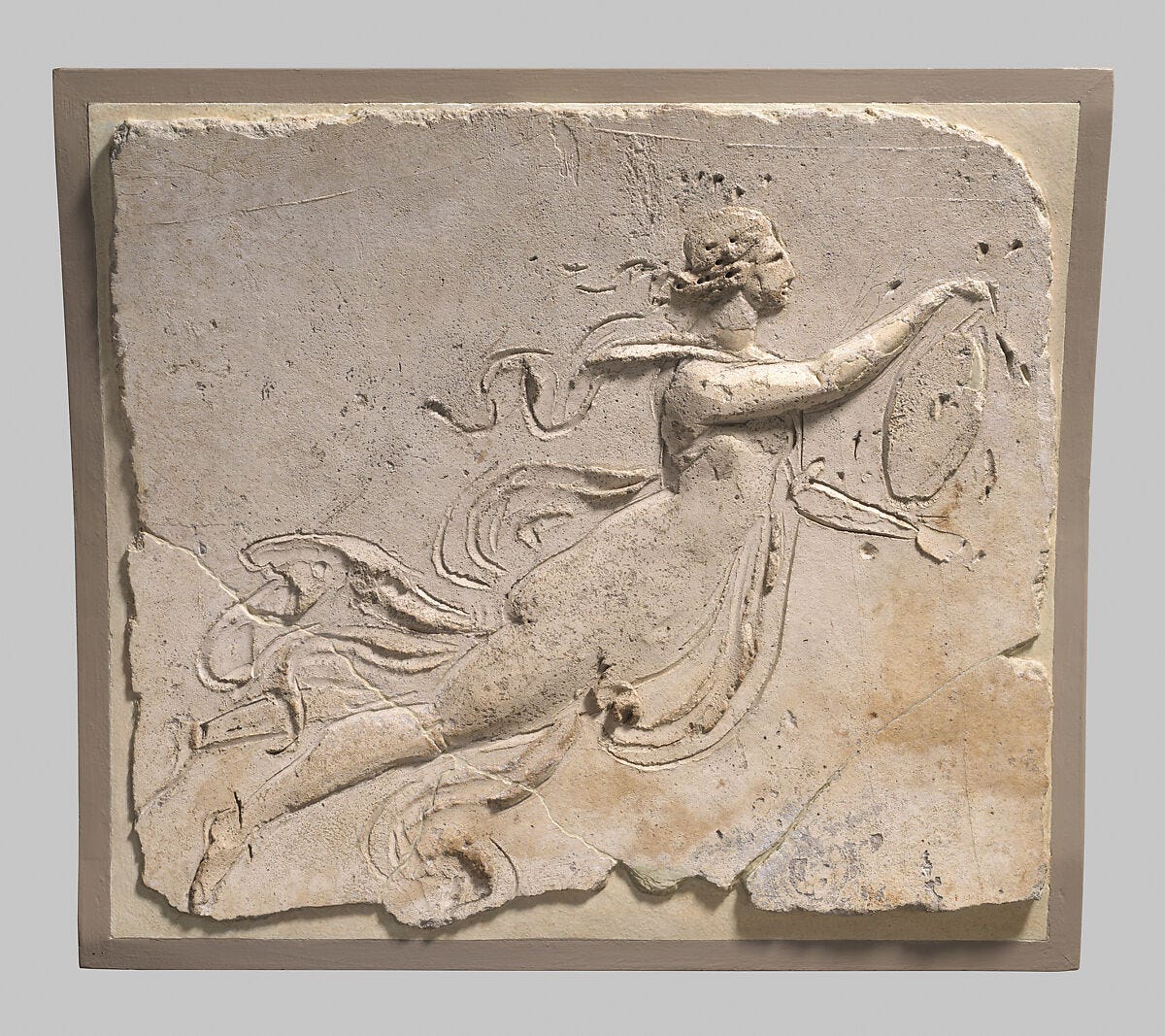
Roman stucco relief of a maenad with a tympanum.
By madness, I am not talking about chaos for its own sake or the idea that anything erupting spontaneously from within us must be authentic and sacred. Plato was describing a state in which the ordinary calculating mind loosens its grip and another way of knowing becomes possible.
The ritual container mattered.
We opened together.
We danced together.
We closed together.
The room, the music, the people, the repetition of returning Sunday after Sunday, and the shared expectation that we had gathered to move instead of watch gave form to something I could not have produced alone.
Sometimes afterward I took the microphone and tried to describe what had happened. I can see now that part of that impulse came from my lifelong desire to be seen and understood. I have always had big feelings and a powerful need to give those feelings somewhere to go.
But that was not all of it.
I was trying to bring something back.
Something had happened through participation, and I wanted words for it. The words always came second.
What the Word Can Carry
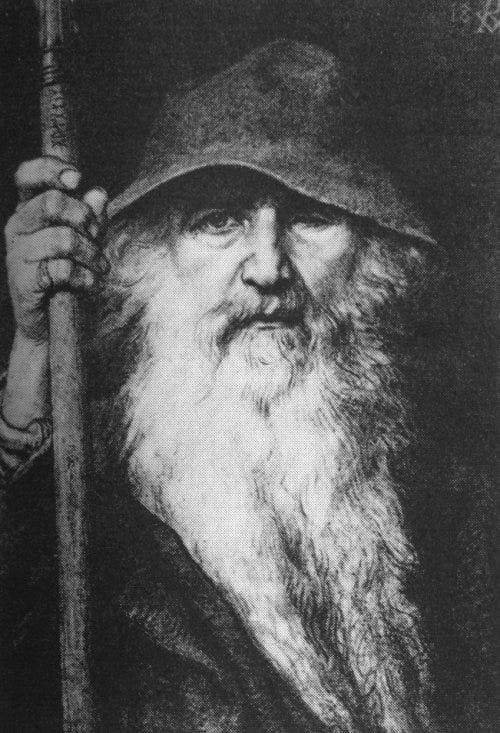
Georg von Rosen, Odin as Wanderer (1886).
Writing has become one of the primary ways I make sense of my life. It takes something living as memory, sensation, grief, confusion, or half-formed insight and gives it enough shape for me to encounter it from another angle. It creates distance without necessarily cutting me off from what happened.
The writing is still not the experience.
Recently, a friend reminded me that writing does not have to be merely confessional or testimonial. It can function as external memory, a way of placing meaning outside ourselves so we can meet it again later and discover that we have changed.
The story of Odin and the runes captures something similar. Odin is not simply handed information. He hangs for nine nights upon the tree, wounded by a spear, “myself to myself,” without food or drink. Only through the ordeal does he perceive and take up the runes.
“Then I began to quicken and be wise, and to grow and to prosper; one word from another word found a word for me, one deed from another deed found a deed for me.”
—Hávamál, stanza 141, in The Poetic Edda, translated by Carolyne Larrington (2nd ed., Oxford University Press, 2014), p. 32.
The marks themselves can be inscribed. They can exist outside the person, carried across distance and time. But the story does not confuse possession of the symbol with possession of wisdom. Odin has to become capable of knowing what the symbol contains.
At this point of the essay, I must say it is a little ridiculous to be writing an essay on forms of knowledge that cannot be contained inside of it.
I can tell you about ecstatic dance. I can describe the DJ, the sweat, the ceremony, the people moving beside me, and those strange days when something emerged from the group that no single person brought into the room.
I cannot put that experience inside your body.
Anyone I have ever taught to hoop eventually reaches the limit of my instructions. I can demonstrate, adjust their stance, point to their feet, and explain how to shift their weight. Eventually their body has to find it.
And then, suddenly, the hoop stays up.
They know.
That is the wisdom of participation I was reaching toward in Part One. Some things become knowable only from inside the act itself.
This is also why I continue to write. I can preserve memory, notice patterns between experiences that happened decades apart, and leave markers for myself. I can return later and understand the same words differently because I am different.
Good writing may even point another person toward an experience they have to enter for themselves.
Maybe it’s that the best words can do, is to show us where to look.
“If we cannot give a true account of ourselves and our doings it will mean that our actions have been ‘as you like it’, reckless and informal rather than to the point and in good form.” *
Becoming More Alive
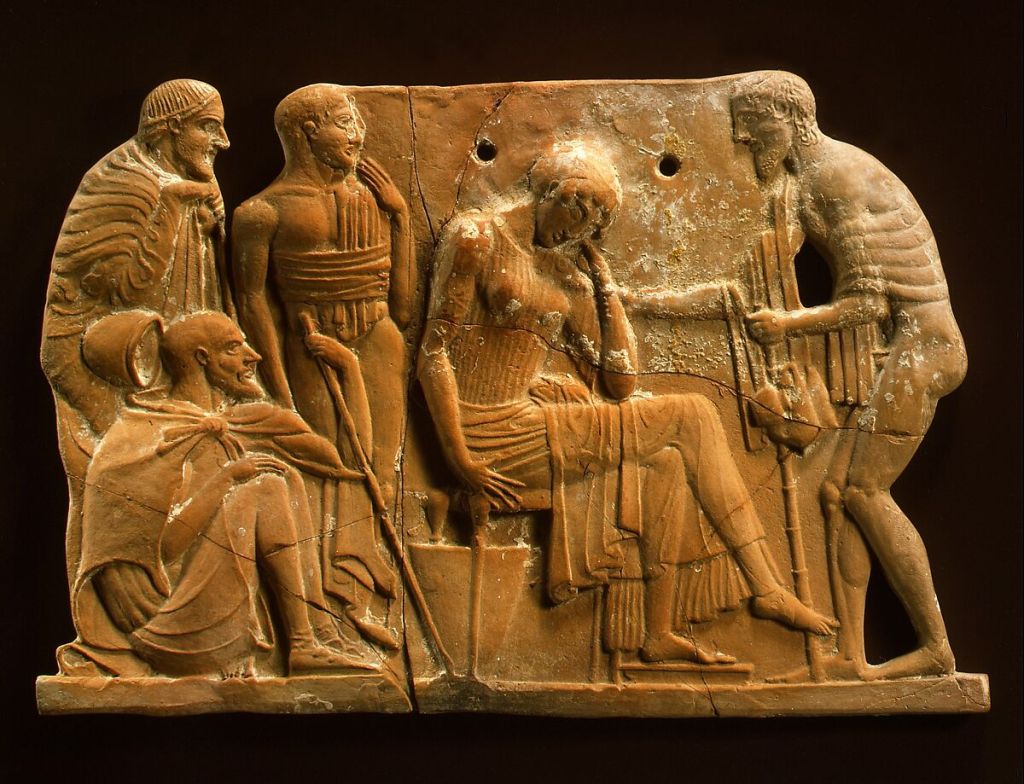
Odysseus returning to Penelope, Greek terracotta plaque, ca. 460–450 BCE — after ordeal and wandering, the final movement is not escape but return.
If becoming more alive is the goal, then I still have to ask what kind of life is worth building.
If I no longer believe you do you is an adequate moral philosophy, but I also refuse to surrender my conscience to another authority simply because it promises certainty, how do I decide what is good?
An older understanding of wisdom makes that question more demanding. In much of classical philosophy, to know was to be. Wisdom was not something one simply possessed because one had encountered the correct argument, read the correct book, or even undergone an extraordinary experience. The knower had to be changed.
That shifts the question. It is not only, What do I know? It is, What kind of person am I becoming through what I claim to know?
I keep returning to this particular distinction: a life shaped merely by preference versus a life given form.
Freedom cannot mean that I never have to account for what I choose. If anything, freedom places a greater responsibility on me to ask whether my actions have direction, coherence, and some relationship to what is actually good.
So now I ask what a belief, practice, or way of living does to a person over time. Does it agree with biological and material reality, or does it ask me to deny what is plainly there? What happens when it is repeated for years instead of experienced for an afternoon? What kind of relationships does it produce? Who bears the consequences? Does it cultivate courage, responsibility, reciprocity, restraint, loyalty, honesty, and care for something beyond immediate appetite?
I have also started to value tradition. That does not make everything inherited good. It means I no longer assume one isolated mind can reconstruct a wise way of life from scratch. Traditions can carry generations of observation about human nature, family, obligation, reciprocity, sex, death, community, and meaning. We should understand what they are protecting before we casually discard them.
Tradition is not an infallible oracle either. I look toward biology, history, anthropology, sociology, lived consequences, virtue, and human flourishing. None can relieve me of judgment. Together, they demand far more than asking whether something feels authentic in the moment.
Lately, becoming more alive has looked almost embarrassingly ordinary. It means doing the dishes while actually inhabiting the moment instead of treating the task as an obstacle between me and whatever comes next. Walking slowly enough to notice what is around me. Preparing food with gratitude. Tending living things. Keeping a promise. Paying attention to the season. Putting my hands into the earth. Moving my body. Writing something true.
It also means learning what my body needs when I am overwhelmed. Sometimes I do not need another explanation. It’s somatic engagement like pressure, warmth, touch, or breathwork. I am learning how to remain honorable in relationship when it would be easier to punish, manipulate, withdraw, or perform.
There was a time when I searched for transformation through intensity. A new body. A new community. A new spiritual identity. A new doctrine. A new explanation that could make everything that hurt finally make sense.
I also found aliveness somewhere else too. As I wrote in Part One:
“We planned entire summers around gathering beneath stages and temporary tents. We drove for days to arrive somewhere that would exist for only a weekend, then disappear almost as quickly as it had formed.”
Those temporary worlds gave me music, movement, friendship, collective energy, and a kind of belonging I often struggled to find elsewhere. All of that was real. I would never diminish it.
There was an escapist edge to it too.
If the place where I felt most at home existed only for a weekend, what did that make the rest of my life?
Normal life could become the grind between festivals. Work, chores, obligations, and ordinary days were things to get through so I could afford the next tour, the next gathering, the next temporary return to myself.
What startled me while rereading my old blogs was finding a younger version of myself already wrestling with this exact problem. In 2010, after writing about staying sober at festivals, struggling with hip pain, and realizing how much I loved my work and routine, I blurted out:
“I realized that I am happier after having a great workout than I am at a music festival. whoa-wait-WHAT? I am happier living my normal routine of working as a personal trainer and teaching Hoop Classes?? How blessed am I? My real life is so incredible, i don’t need to run away for 4-5 days, indulge in drug consumption to feel happy?! wow.”
Reading that now almost made me laugh. I was already saying this back then! A younger me could feel this in her body before I had the philosophical language to explain it.
Knowing something once does not mean we know how to build an entire life around it. I lost and rediscovered that lesson through bodybuilding, multilevel marketing, Christianity, illness, political rupture, and every other identity I tried to make into a permanent home.
Now I think rebirth may be much less dramatic than another conversion. It may be the slow formation of a life I can actually inhabit.
I do not want to organize my life around the next escape. I want to bring participation, beauty, ritual, and aliveness into the days I once thought I had to get through. I want to return to my body and ordinary life, perceive what is already sacred here, and participate in relationship without abandoning myself.
That brings me back to the hunger underneath this entire series.
I thought I was writing about hooping. Then it was writing about festivals, ritual, community, religion, philosophy, and the strange succession of selves I have inhabited.
Underneath all of it was the same question:
How do we become fully present participants in our own lives?
I am no longer looking for a system that will tell me exactly who I must become. I am trying to become capable of meeting life, in all of its beauty, obligations, grief, mystery, pleasure, limits, and loss, with enough discernment and courage to participate in it fully.
Maybe rebirth has nothing to do with leaving this world for another one. Maybe it means returning to this one more alive.
Thank you so much for reading or listening! The audio always includes a few extra nuggets that aren’t in the written version, so give it a listen when you can. I’d love to hear your thoughts in the comments!
Taste of Truth is a reader-supported publication. To receive new posts and support my work, consider becoming a free or paid subscriber.
*Ananda K. Coomaraswamy Atmayajna: Self-Sacrifice: Selected Papers. Metaphysics, ed. Roger Lipsey, Princeton: Princeton University Press, 1987, p.137
Articles mentioned or that influenced this series:
“Truth can be both our shield and sword in the battle of life.”
There are people who influence us not only through what they teach, but through the manner in which they live what they teach.
Over the last several months, my friend Torna Braggison has offered me a remarkable degree of openness, patience, friendship, and spiritual guidance. He has answered my many questions, challenged me to think more deeply, and helped me better understand a Heathen worldview that cannot be reduced to symbolism, abstract belief, or solitary spiritual consumption.
Torna is the author of Power Through Truth, an exploration of the relationship between sacred breath, truthful speech, oath-keeping, honor, and spiritual power within the Heathen tradition.
His guidance has continually returned me to something more demanding: conduct.
How do we speak?
What do we promise?
Do our actions uphold our words?
Can the people closest to us trust what comes out of our mouths?
What happens to us (personally, socially, and spiritually) when they cannot?
What if truth is not merely something we believe, but something we breathe, speak, promise, remember, and live?
Ask and Embla, Robert Engels, 1919. Odin’s gift of Ond—the sacred breath that gives life and carries the spoken word.
Truth Is Not Merely an Idea
Modern people are accustomed to treating truth primarily as a matter of intellectual agreement.
We ask whether a proposition is correct, whether a doctrine is factual, or whether someone possesses the proper beliefs. Religion often becomes a matter of assenting to particular claims. Politics becomes a competition between competing narratives. Online identity becomes a collection of publicly declared values.
But declaring a value is not the same as embodying it.
A person can speak endlessly about compassion while behaving cruelly. Someone can build an identity around authenticity while lying to the people closest to them. A spiritual leader can speak of love, healing, transcendence, and divine truth while refusing accountability for the damage caused by their conduct.
Words alone do not prove character.
Within the framework Torna presents, however, words are not inconsequential. They are not merely sounds, opinions, or disposable expressions. They are carried upon the sacred breath and given force through the character and intention of the speaker.
Torna describes Ond as the sacred breath of life, the divine spark gifted by Odin. Our words ride upon that breath, and when we speak, we give those words a kind of life. Their quality is connected to the truth, intention, and honor of the person speaking them.
Speech therefore becomes more than communication.
It becomes participation.
We breathe something of ourselves into the world.
The Breath Behind the Word
In Völuspá, Odin’s gift to Ask and Embla includes Ond—the animating breath without which they do not yet fully possess life. Torna connects this sacred breath to speech, creativity, ecstatic power, ritual, galdr, and the ability to shape reality through will and expression.
This does not mean that every passing sentence is a magical incantation in the theatrical or New Age sense.
It means that speech carries consequences.
Words can establish trust or destroy it. They can bind people together, orient a community, transmit memory, establish obligation, inspire courage, or leave another person spiritually and emotionally disoriented. A truthful word spoken at the right moment can restore someone’s sense of reality. A deliberate lie can make another person doubt their own perception.
Our words affect the world because other people must live inside the reality those words help create.
This is one reason truth matters so deeply to me.
I do not want truth to remain an attractive principle I discuss in essays or podcasts. I want the people in my life to know that my word means something. I want to follow through when I make a commitment. I want to be honest even when honesty is uncomfortable. I want to recognize when my conduct contradicts what I have claimed and accept the responsibility of repairing what I can.
That is not always easy.
Truth as lived accountability demands more than being “right.” It demands self-examination, restraint, memory, courage, and humility. It may require us to admit that we have behaved dishonorably. It may force us to stop protecting the version of ourselves we would prefer others to believe.
Truth can defend us, but it can also cut through our own self-deception.
It is both shield and sword.
Words in the Well
One of the most compelling ideas in Torna’s article is that some words carry more weight than others.
He distinguishes between common or everyday speech, words placed “in the well” through intimate or sacred relationships, and the giving of formal oaths. Each carries a different degree of personal, communal, and spiritual consequence.
We all understand this intuitively.
Telling a cashier that we are “fine” when we are having a terrible day does not carry the same moral weight as lying to a spouse, deceiving a close friend, betraying a confidant, or breaking a solemn vow.
The closer the relationship, the more of ourselves we place behind the word.
Words spoken to those who trust us become part of a shared memory. They shape how another person understands us, themselves, and the relationship between us. Words spoken during ritual enter the memory of the group. Stories told by the skald or bard help shape a people’s understanding of their ancestors, heroes, virtues, and obligations.
These are words placed into the well.
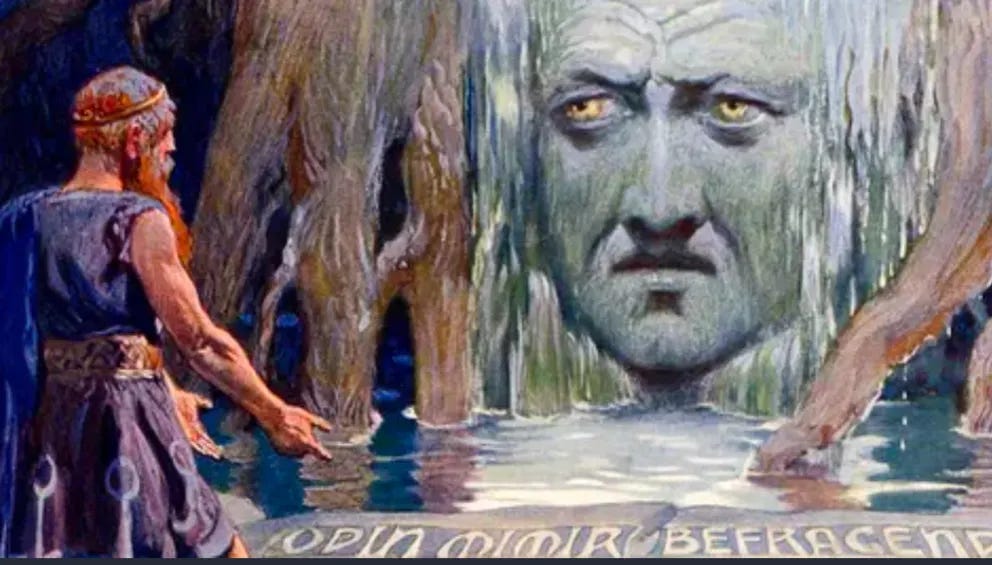
The well can be understood as Mímir’s well, ancestral memory, cultural memory, or the accumulated memory of the community. What is spoken does not simply disappear after the vibration leaves the air. It continues through consequence, reputation, story, recollection, and relationship.
A truthful word can strengthen the speaker and those who hear it.
A dishonest word can poison the well.
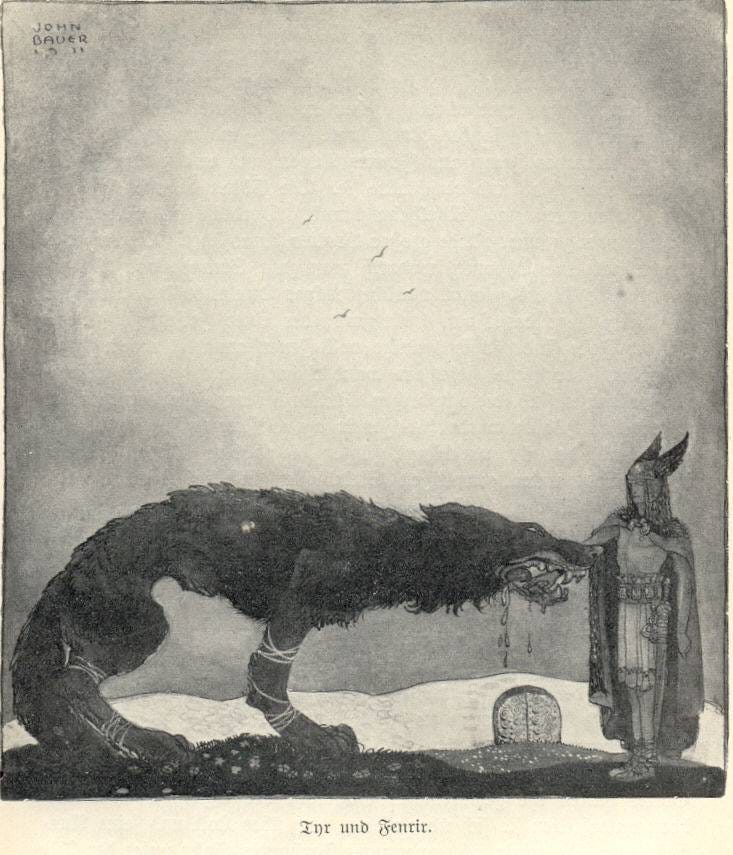
“The Spiritual Weight of an Oath”: John Bauer, Tyr and Fenrir
The Spiritual Weight of an Oath
An oath carries the greatest weight because an oath is not merely a prediction about what we hope to do.
It is an act of binding.
Torna describes an oath as something given life through sacred breath and powered by the will. The oath involves not only the person who gives it, but the recipient, the witnesses, the place, and the spiritual powers invoked or present. Until it is fulfilled or broken, the oath continues to possess force.
This is almost incomprehensible within a culture of casual promises.
We say, “I’ll call you tomorrow,” “I’ll always be there,” “You can trust me,” or “I swear I’ll change,” often with little awareness of the weight those statements carry for the person receiving them.
Our society encourages constant speech while teaching very little discipline of speech.
We post immediate reactions. We make dramatic declarations. We promise more than we can deliver. We publicly perform virtues we have not yet cultivated privately. We use language to manage how others perceive us, then become resentful when we are held accountable to the identity we presented.
A Heathen understanding of oath asks us to become more careful.
Do not promise lightly.
Do not offer your word merely to relieve the discomfort of the present moment.
Do not invoke trust when you are unwilling to behave in a trustworthy manner.
The answer is not to become silent, emotionally unavailable, or terrified of commitment. It is to understand that a promise contains part of the self. When we repeatedly keep our word, we become someone whose speech possesses weight. When we continually break it, our words become thin and useless.
Eventually, no one believes us… and that isn’t because they are cruel, but because we have taught them not to.
Honor Is Accumulated
Torna connects the keeping of oaths with Hamingja, a concept often translated as luck but also associated with honor, power, fortune, and the accumulated strength of the self.
This is not luck imagined as random cosmic favor.
It is closer to luck that has been cultivated.
A person who consistently acts with integrity develops trusted relationships, a dependable reputation, communal support, and an internal sense of coherence. Their words and actions reinforce each other. They become spiritually and socially substantial.
Keeping one’s word strengthens the whole self, while dishonorable conduct weakens it.
We might recognize this even without using explicitly spiritual language.
A trustworthy person is often surrounded by people willing to help them because they have proven that help will not be wasted. Their reputation opens doors. Their community remembers their conduct. When hardship comes, they are not entirely alone.
This is not always fair or perfectly reciprocal. Honorable people can still be betrayed, harmed, or abandoned. But the larger principle remains: character accumulates.
So does dishonor.
Every promise kept or broken becomes part of the person we are becoming.
Truth as Communal Participation
Truth is often framed as an individual possession: my truth, my beliefs, my authenticity.
But Torna’s article presents truth as profoundly relational.
As a bard and skald, he writes that believing in the moral truth of a story allows the teller to connect with those listening. Honest words can create a communal experience in which teller, listener, folk, hero, deity, moral teaching, place, and ancestral memory are brought into relationship.
Truth does not merely sit inside the mind.
It passes between people.
It is sung, remembered, witnessed, and enacted.
This is where the concept becomes essential to The Wisdom of Participation. Traditional cultures did not generally understand humans as isolated consumers of spiritual information. People gathered. They sang. They told stories. They made vows before witnesses. They remembered their dead. They carried inherited obligations. They participated in the maintenance of a shared moral world.
The skald did not simply deliver “content.”
The community did not merely observe.
Everyone present became part of the remembering.
This is radically different from a spirituality centered on private revelation, personal vibration, or self-created metaphysical truth. The well does not belong to the isolated ego. It contains the memory of relationships—between the living, the dead, the Gods, the land, and those yet to come.
What we place into that well matters.
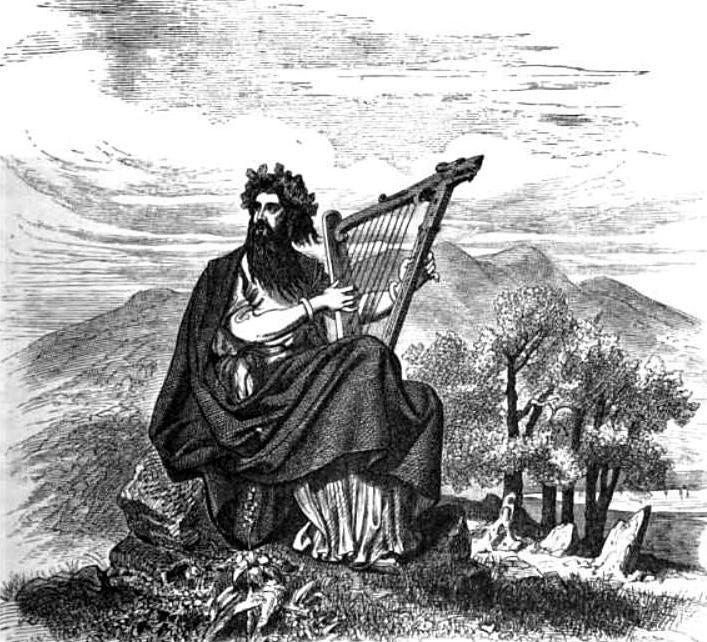
Bragi, Carl Emil Doepler, 1882. Bragi, the Norse god of poetry and eloquence, represents speech as sacred craft: words shaped through memory, rhythm, truth, and responsibility. The skald does not merely entertain, but gives voice to the stories and values through which a people remembers itself. Public domain.
No One Can Embody Truth on Our Behalf
Christianity famously places the words “I am the way, the truth, and the life” into the mouth of Jesus.
In that worldview, truth is ultimately embodied in and accessed through a singular salvific figure. The believer is asked to place faith in that figure and the theological claims made about him.
The Heathen framework explored here places the emphasis elsewhere.
Truth is not merely a person to profess belief in. It is a standard we must demonstrate through conduct.
No savior can keep our promises for us.
No doctrine can repair the trust we have broken.
No spiritual identity can substitute for honest speech.
No declaration of belief can transform dishonorable behavior into honorable behavior.
Truth must be renewed each time we speak carefully, fulfill a commitment, admit a wrong, make recompense, resist convenient deception, or allow our actions to bear the weight of what we have claimed.
It must be breathed and lived.
The Question Before Us
My upcoming conversation with Torna Braggison will explore the relationship between Ond, speech, oath, honor, memory, galdr, storytelling, and spiritual power.
But beneath the terminology lies a deeply human question.
What kind of person does my speech reveal me to be?
Do my words give life, orientation, and trust to the people around me?
Do I make promises carelessly?
Have I confused saying the right things with becoming an honorable person?
Have I demanded truth from others while excusing dishonesty in myself?
And when I fail, am I willing to make recompense rather than simply inventing a more flattering story about what happened?
Truth is not merely the absence of false information.
It is the alignment of breath, speech, memory, promise, and deed.
It is the weight accumulated when we repeatedly prove that our words can be trusted.
It is what we place into the well.
It is what others will remember.
And it is what remains when every attractive spiritual claim has been stripped away and only our conduct is left to speak for us.
The Lessons of Asgard– WorldTree Publications, 36pgs. Completely revised, with original kennings to the Gods by Torna Braggison. An introductory study of the principle Gods & Goddesses in the lore.
Flow Arts, Festival Ritual, and the Lost Wisdom of Participation
Hey hey, welcome back to Taste of Truth, this essay is much different than what I normally write, I hope you enjoy this trip down memory lane with me.
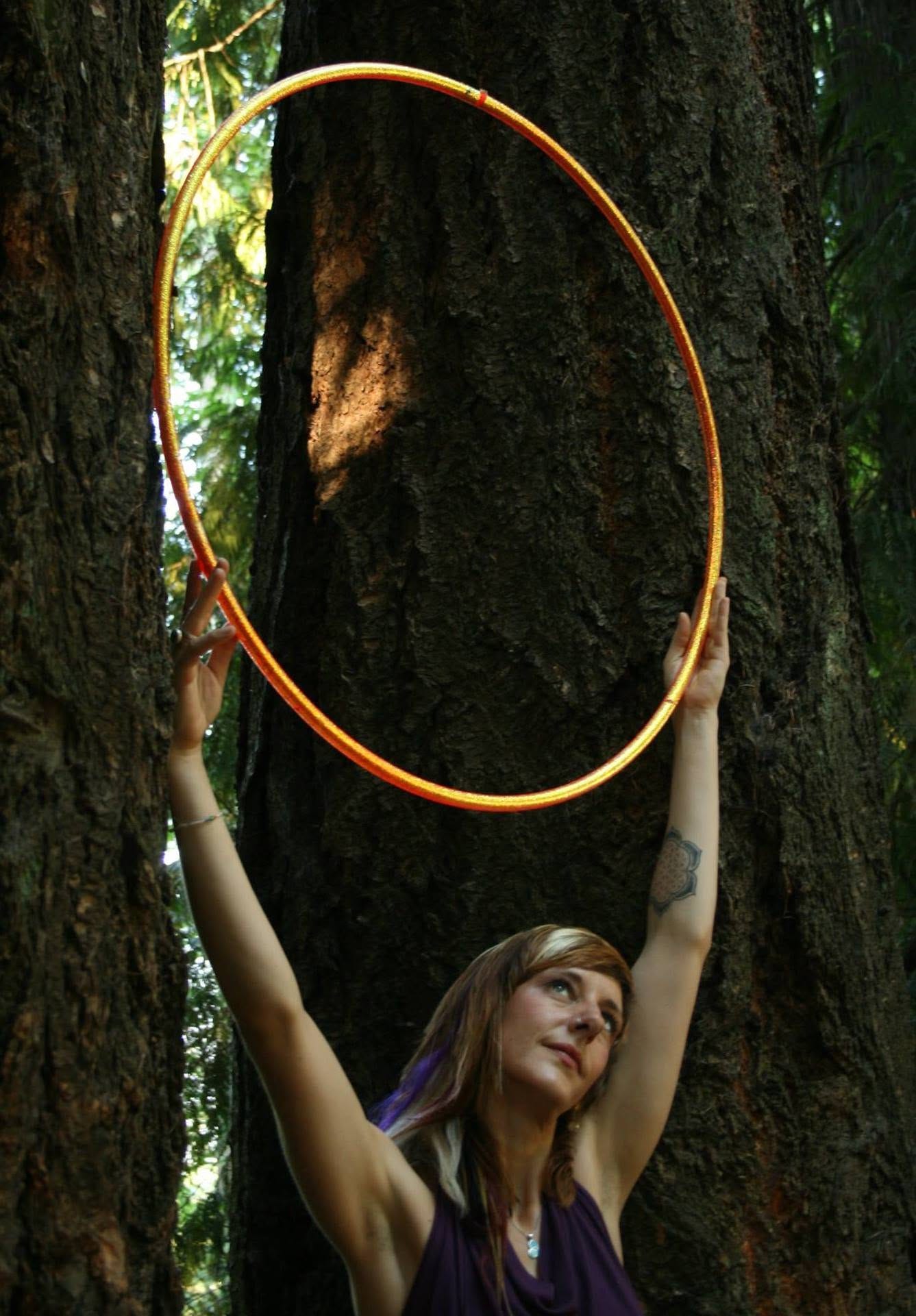
For years, strangers would see me walking through an airport, across a college campus, or into a music venue carrying an enormous circle of plastic and ask the same question:
“Is that a hula hoop? What do you do with that thing?”
I usually smiled.
There was no quick way to explain what the hoop had already done with me.
By then, it had bruised my hips, taken over my living room, earned me the nickname “hula-hoop girl” around my college campus, and sent me driving and flying across the country in search of music, teachers, festivals, and other people who understood why it was impossible to put the thing down.
It had carried me onto stages I was terrified to enter. It had introduced me to women I first knew only by their YouTube names and later came to know as teachers, collaborators, friends, and soul sisters. It had given me a language for my body at a time when I was still deeply self-conscious inside it.
At the time, I thought I was learning tricks.
I was learning how to float the hoop from my waist above my head. How to reverse its current. How to move in both directions. How to toss, pause, break, roll, and recover. How to follow a drum solo until movement and music stopped feeling like separate things.
All of that was true.
But something much deeper was happening
This is the first part of a series I have been circling around for a long time, though I didn’t fully realize it at first.
I thought I was writing about hoop dance, festival culture and the importance of ritual.
Then philosophy.
Then paganism.
Then neuroscience.
The deeper I followed the thread, the more I realized they were all pointing toward the same question:
What happens to human beings when participation is replaced by spectatorship?
I keep returning to the difference between knowing about life and actually participating in life.
Modern people are drowning in information about health, spirituality, community, nervous system regulation, trauma, meaning, embodiment, and connection. We have the podcasts, the books, the frameworks, and an ever-expanding vocabulary. We can analyze our attachment styles, map our trauma responses, name our nervous system states, and explain exactly why we feel disconnected.
And yet, so many of us are still lonely….
Still disembodied.
Still watching life through glass.
Still trying to think our way into something the body may only truly recover through embodiment, through rhythm, movement, expression, shared presence, and practice.
This piece is about that hunger.
The ancient hunger beneath modern life.
Not merely the hunger to believe something, but the hunger to belong to a living world again.
For a long time, I thought my years in flow arts were simply a chapter of my life—a beautiful one, but ultimately behind me. Looking back now, I see something different.
Long before I studied philosophy, mythology, neuroscience, religion, or ancestral traditions, my body was already being introduced to a way of knowing that none of those books could have given me.
It had to be practiced. Repeated. Failed. Felt. Shared.
It had to be participated in.
Before philosophy gave me language for participation, my body had already spent years practicing it.
Long before I studied mythology, ritual, paganism, or the neuroscience of embodiment, I had already encountered something those traditions were trying to describe.
I knew it through music. Through movement. Through repetition. And most importantly through community.
By the simple act of showing up, again and again, until something inside me changed.
I no longer interpret every part of those years the way I did in my twenties.
But I trust the experience more than I trust all the language I once wrapped around it.
And that is where this story really begins.
Long before I studied heathenry/paganism,
I danced it.
The First Forms of Participation
Before there was a circle of plastic spinning around my waist, there were trees to climb, horses to ride, ponds to swim in, and twenty-six acres that gave my body somewhere to go. Some of my earliest memories are not of sitting still and thinking about the world, but of moving through it—crossing the dam, wandering the property, climbing high enough to see everything differently.
There was one enormous oak tree that had fallen and become something like a fort. I would retreat there after arguments with my mother, disappearing into its branches and hollows until I felt like myself again. I would not have called that nervous-system regulation. I would not have called it ritual, grounding, or communion with place. I only knew that the tree could hold something I did not yet know how to carry.
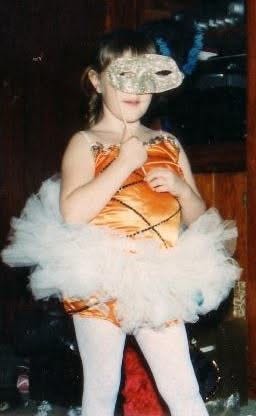
Movement was also part of my life in more formal ways. I took ballet, tap, and jazz, although jazz was the form I loved most. Ballet often made me painfully aware of my body—how tall I was, how much space I occupied, how unlike the smaller girls I sometimes felt. Jazz gave me more room. There was something about the music, the costumes, and the freedom of the movement that allowed me to step outside that self-consciousness for a while.
Music offered another kind of participation. I played piano and violin, but orchestra was where something larger began to reveal itself. Practicing alone mattered, but it was never the whole point. The real experience happened when everyone entered together: dozens of separate parts becoming one piece of music that none of us could have made alone.
I did not have words for why that felt so powerful. I only knew the difference between playing a part by myself and feeling it take its place inside a living whole.
The tree was not merely scenery.
The orchestra was not merely a collection of individuals.
Movement was not merely exercise.
Each required me to enter into a relationship—with a place, a rhythm, a group of people, or the limits of my own body. I could not understand any of them from the outside. I had to climb the branches, learn the music, miss the step, lose my place, and begin again.
Looking back, I can see that I was learning the same lesson in different forms: the world became more alive when I participated in it.
I did not yet know that this was a kind of knowledge. I only knew that I felt most like myself when I was moving, making, playing, or contributing one small part to something larger.
The hoop would eventually gather all of this into a single practice—movement, rhythm, repetition, music, play, place, and community.
It did not create the longing.
It gave the longing a shape.
The Circle Opens
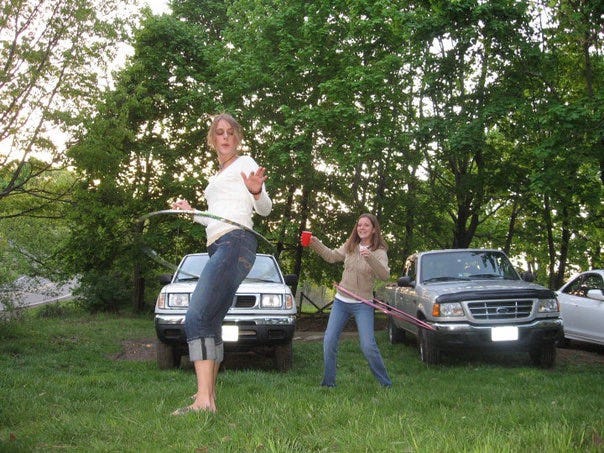
One of my roommates and I, playing around with those rinky-dink store-bought hula hoops.
That shape arrived rather unceremoniously in the winter of 2005: a cheap, store-bought hula hoop that I could barely keep spinning around my waist.
At first, it was mostly frustrating. The hoop fell almost as quickly as I could lift it, clattering against the floor while I tried again. Eventually, though, my body found the rhythm. I carried it back to college, where I practiced in the living room while my roommates laughed, none of us realizing what had begun.
That first hoop was a toy. The real initiation came the following summer at Smilefest, a music festival held at Deerfields in North Carolina.
There, I picked up what hoopers called a “real” hoop—large, heavy, handmade, and nothing like the lightweight plastic circle I had been struggling with. I could feel the difference immediately. Its weight slowed the movement enough for my body to follow. For the first time, the hoop did not seem like an object I was trying to control. It felt like something I could enter into conversation with.
I practiced until dark bruises spread across both hips.
Then I strapped the enormous hoop to the roof of the car and brought it home.
Something had taken hold of me.
I began carrying the hoop everywhere. I practiced alone in backyards and parking lots, using my car stereo for music. I watched early YouTube videos of hoopers like Hoopalicious, Spiral, Christabel Zamor, and the Hoopnotica dancers, calling my roommates into the room whenever someone performed a movement I could not imagine being possible.
“Look at this. How does she do that?”
There were tutorials, but no explanation could place the movement inside my body. I could watch someone perform a trick dozens of times. I could study the position of her hands, the angle of the hoop, and the direction of its current. None of that meant I could do it. The knowledge had to travel another route.
I had to pick up the hoop.
I had to drop it.
I had to feel where the movement broke down, make some tiny adjustment I could barely name, and try again.
One of the clearest memories I have from that period is standing in the front yard during my junior year of college, listening to the same music over and over while trying to raise the hoop from my knees back toward my waist. I had watched other people do it. I understood, in theory, what was supposed to happen.
But my body did not know yet.
Then, after what felt like endless repetition, something shifted. The hoop caught. My knees and hips found the pulse. The circle began to rise.
I could not have explained what I had done differently.
My body simply understood.
That moment opened a door. Once I felt the movement happen, I knew the other tricks were possible too because I had experienced the difference between knowing what a movement looked like and then knowing it from within.
The Circle Widens
That question did not remain private for long.
In March 2007, only about a year after I first began seriously hooping, I found myself waiting beside a stage in Boulder, Colorado, preparing to perform with EOTO for the first time.
For weeks, I had told everyone how excited I was. I was going to hoop onstage with Jason Hann and Micheal Travis—two musicians from String Cheese Incident (the jam band I had spent the previous summer following across the country.) Until that moment, the whole thing had felt thrilling and almost unreal.
Then it was time to walk onto the stage.
The excitement dropped straight into the pit of my stomach.
Holy shit. I’m really getting up there.
At that very moment, Jamie Janover, one of the other musicians came over, he had noticed how nervous I was and gave me a piece of advice I have never forgotten:
“Just go up there when you’re feeling the groove and get off when you’re done. It’s simple.”
He was right, although it did not feel simple while I was standing there.
There was no choreography to memorize and no fixed sequence waiting for me. EOTO was an improv jam band. The musicians were listening and responding to one another in real time. The audience was responding to the music. To join them, I had to stop thinking about how I looked, listen with my entire body, and enter the moment already unfolding.
I could not calculate my way into it.
I had to feel when to step forward.
For the first time, I was no longer simply hooping to music.
I was moving inside it.
Inside the Music
Once I crossed that threshold, the road opened quickly.
Music was not something playing quietly in the background while life happened elsewhere. It organized our movements, our travel, our friendships, and our sense of time. We planned entire summers around gathering beneath stages and temporary tents. We drove for days to arrive somewhere that would exist for only a weekend, then disappear almost as quickly as it had formed.
For those few days, however, we were not merely an audience.
People danced, cooked, camped, taught, performed, built installations, traded food, shared supplies, carried one another’s equipment, and stayed awake until sunrise. Musicians improvised with one another onstage while dancers responded from the crowd. The boundary between performer and participant was more porous than it appeared.
Symbiosis Music Festival 2007
When there was room, I stepped onto the stage with my hoop. Other times, I danced in the field among everyone else. Both experiences were deeply impactful in my dance practice. Whether hundreds of people were watching me or no one was, I was learning to respond to rhythm rather than impose myself upon it.
The music moved, so I moved.
The hoop changed direction, so I followed.
The crowd surged, softened, shouted, or fell quiet, and the whole atmosphere changed with it.
At its best, it felt less like a performance than a conversation occurring through bodies.
Over time, the women I had once watched with awe became people I practiced beside. Some became teachers, troupe members, collaborators, and friends. I moved to Portland at the end of 2007 and joined Kaivalya Hoop Dancers, entering a community that took the practice seriously while still preserving its sense of play.
I spent Portland’s rainy season obsessively practicing reverse currents. I wanted to move comfortably in both directions, even though one side initially felt completely unnatural. I repeated barrel rolls, breaks, pauses, and reversals until the awkward side slowly became less foreign.
Then severe back pain forced the practice to change again.
At twenty-three, there were days when preparing food or standing for longer than twenty minutes felt nearly impossible. I worried that I would lose the thing that had given my life so much momentum. I could no longer rely on constant waist hooping or the larger, more physically demanding movements that had once filled my practice.
But limitation created another kind of education.
I began exploring pauses, tosses, reversals, off-body movement, and smaller gestures that did not aggravate my back as severely. What initially felt like an interruption became a new creative vocabulary. The hoop was still teaching me, but now the lesson was adaptation.
Participation did not mean forcing myself through pain. It meant listening closely enough to remain in relationship with the practice as my body changed.
Hoop Dance Workshops from all over the country
Eventually, I began teaching more.
At festivals and community gatherings, I watched people pick up hoops with the same awkward uncertainty I had once felt. Some were convinced they could not do it. Others laughed the moment the hoop dropped. I learned that teaching movement required more than explaining where to place the feet or how to push the hips.
Sometimes I demonstrated.
Sometimes I offered a small correction.
Sometimes the most useful thing I could do was give someone enough room to fail without feeling embarrassed.
The moment when a movement finally entered another person’s body was unmistakable. Their face changed. The effort briefly disappeared. What had seemed impossible became available to them from the inside.
At EmergNsee Music Gathering (2008) in Oregon, I taught a HoopYoga and hoop-dance workshop attended by Meghan the Kat, one of the performers who had inspired me during my earliest years following String Cheese Incident. There was something beautifully disorienting about teaching a person I had once watched from a distance.
The hierarchy I had imagined between teacher and student dissolved.
She had given something to me through her movement. I had taken it into my own body, practiced it, altered it, combined it with what I had learned elsewhere, and now I was returning something to her.
Knowledge moved in a circle.
As I wrote at the time:
“It’s so beautiful how we all learn from each other, one hooper heart to the next.”
That sentence is covered in the earnestness of my early twenties, but I still believe what I was trying to say.
The practice did not belong to any one teacher, performer, or school. It passed between us. We learned through watching, imitating, experimenting, teaching, and being corrected. Every person carried the movement differently because every body was different. What one person offered was never reproduced perfectly; it was received, transformed, and passed onward.
By the time I attended Hoop Camp in California in 2008, that circulating exchange had become a culture of its own.
Hoop Camp Retreat 2008
For years, I had known many hoopers primarily through grainy online videos, usernames, festival sightings, and brief encounters on tour. (I can’t help but to hear “This one time…at Band Camp”, if you grew up in the early 2000s, you’ll get this. )
The people I had admired from across the country were suddenly gathered in one place. We practiced together during the day, exchanged ideas in workshops, ate together, laughed together, and filled the darkness with glowing hoops at night.
I was surrounded by women who had shaped my imagination before they ever knew my name, alongside childhood friends, college friends, troupe members, and the people who had become my chosen family on the road.
I described myself afterward as channeling “true Unicorn energy”—nonstop hooping, smiling, laughing, and learning. The language makes me laugh now, but the joy was real.
So was the sense that something larger than individual skill was taking place.
During the opening ceremony, we gathered around a prayer hoop and placed our intentions inside it. One by one, people spoke about what the hoop had done in their lives: the confidence it had restored, the friendships it had created, the grief it had carried, the joy it had unlocked, and the selves it had allowed them to discover.
In my blog afterward, I wrote:
“All of us have been changed by the hoop. It’s impacted our lives, brought us together, shown us ourselves, given us bliss, given us confidence…”
I would describe some of those experiences differently today. I no longer interpret every ecstatic weekend, meaningful coincidence, or intense connection through the same spiritual vocabulary I used then.
But I do not dismiss what happened simply because my language has changed.
We gathered around a shared practice.
We moved together.
We taught one another.
We placed hopes and prayers inside a circle.
And through repetition, rhythm, attention, and communal presence, many of us experienced real transformation.
What had begun as a cheap plastic toy had become a language through which we recognized one another.
A movement became a practice.
A practice became a community.
And somewhere along the way, community began to resemble ritual.
The Hunger We Keep Trying to Name
A movement became a practice.
A practice became a community.
And somewhere along the way, community began to resemble ritual.
I did not yet know the language of moral psychology or sociology. I had never heard Émile Durkheim’s phrase collective effervescence: the strange charge that can arise when people gather, move, sing, mourn, celebrate, and direct their attention toward something together.
I did not know Jonathan Haidt’s idea of the “hive switch”—the human capacity to loosen, temporarily, the boundaries of the individual self and become part of an emergent whole. Haidt has suggested that people sometimes need precisely these experiences of self-transcendence, and that music, dancing, communal worship, and local festivals can offer places where isolated individuals become participants in something larger.
I only knew what it felt like.
I knew the sensation of entering a field where hundreds of people were responding to the same rhythm. I knew what happened when musicians improvised, dancers answered, and the distance between performer and audience became briefly porous. I knew the feeling of looking across a dark campground and seeing circles of light moving through the trees.
I knew what it was to become less preoccupied with myself without disappearing entirely.
The experience was not one of erasing the individual. It was the experience of becoming an individual in relationship—one moving body inside a larger pattern.
Research on communal music and movement suggests that this feeling is not merely sentimental. Singing together can accelerate feelings of closeness among people who begin as strangers, while synchronized and physically demanding dance can deepen social bonding.
None of that proves that every festival is sacred, every crowd is healthy, or every ecstatic experience is transformative. Collective energy can be commercialized, manipulated, and turned toward destructive ends just as easily as generous ones. The same human capacity that allows people to lose themselves in music can also make groups tribal, conformist, or cruel.
But the possibility of misuse does not erase the underlying need.
We are creatures shaped for more than private thought.
We learn through imitation. We regulate one another through voice, expression, touch, and presence. We create attachment through repeated encounters. We remember through songs, meals, places, stories, gestures, and practices carried from one body into another.
And yet modern life increasingly offers us the image of these things without requiring our participation in them.
We can stream concerts without entering a crowd.
Watch other people dance without moving.
Order food without cooking or eating with anyone.
Read about ritual without belonging to a ritual community.
Listen to conversations about friendship while sitting alone.
Learn the vocabulary of embodiment while barely inhabiting our bodies.
We are connected to more people than previous generations could have imagined, yet much of that connection asks almost nothing of us beyond attention.
And attention is not the same as belonging.
Recognition is not reciprocity.
Watching is not participating.
A feed is not a feast.
The distinction matters because loneliness is not simply the absence of people. It can also be the absence of roles, obligations, shared places, repeated practices, and the experience of being meaningfully woven into other lives.
We have become very skilled at diagnosing the resulting ache.
We speak of trauma responses, dopamine, attachment styles, nervous-system dysregulation, depression, social anxiety, and burnout. These frameworks can be genuinely helpful. Naming an experience can make it less frightening and give us a place to begin.
But sometimes I wonder whether we are still trying to think our way out of conditions that cannot be changed through thought alone.
A widely shared passage attributed to Jay LeSoleil puts the mismatch much more sharply:
“You feel depressed and crazy because in every historical human culture known to anthropology, people sang together, danced together, and ate food together—and you don’t sing, you don’t dance, and you eat alone in the dark.
You are a singing ape, and you are meant to know fifty dances by heart, which hilltops are sacred, and the names of every plant it is possible to eat.”
The passage is deliberately sweeping. Depression cannot be reduced to a lack of communal dancing, and no single poetic statement can represent every historical culture.
But it lands because it names something our clinical language often misses.
The problem may not be only what is happening inside the isolated individual.
The problem may also be the world in which the individual is being asked to live.
A world where community has become optional, ritual has become content, food has become fuel, music has become background noise, and places are valued primarily for what can be extracted or built upon them.
A world in which we are encouraged to construct an identity but given fewer durable ways to belong.
Perhaps that is why our hunger attaches itself so easily to substitutes.
We mistake stimulation for aliveness.
Visibility for intimacy.
Agreement for community.
Intermittent attention for belonging.
We search for the feeling of being carried beyond ourselves through fandoms, online movements, romantic fixation, political tribes, spiritual consumerism, and endless streams of other people’s lives. Some of these can produce real relationships and genuine meaning. But they can also leave the body sitting in the same room, staring through the same glass, still longing to be somewhere it is needed.
When I look back now, I do not think I miss only the performances, the festivals, or the person I was at twenty-three.
I miss having a practice that placed me inside a living network of people, music, places, responsibilities, and shared memory.
I knew which songs could shift the energy of an entire field.
I knew who would help me carry my hoops.
I knew where people gathered after the music ended.
I had teachers, students, collaborators, and friends.
I had something to offer the gathering, and the gathering had something to ask of me.
That is different from being observed.
It is different from being liked.
It is different from being included in a group chat.
It is participation.
In 2014, I tried to describe this in a short poem:
Grateful for Dance
Portal to divine connection A form of sacred expression Of outward shining expansion Here I am, calling to attention
It’s time to move It’s time to be free It’s time to prove Your non-complacency
So please follow me Down this path of dance divinity It’s time we realize It’s not you and me, it’s we.
Some of the language makes me smile now. But that final line contains an intuition I still trust. It was never only about what happened to me inside the hoop.
It was about what became possible between us.
This does not mean we need to recreate the past, abandon technology, or spend our lives at music festivals. Nor does it mean every older community was nurturing. Communities can constrain, exclude, punish, and demand conformity. Nostalgia can make us forget that belonging has often come at a cost.
The question is not how to return to an imaginary golden age.
The question is what forms of participation human beings still need—and how we might create them honestly now.
Where can we sing without needing to be singers?
Dance without needing to perform?
Prepare food that will be eaten by more than one person?
Learn the names of the plants and animals around us?
Create rituals that give grief, gratitude, transition, and memory somewhere to live outside our private minds?
Practice something regularly enough that it changes us?
Modern people are drowning in information about how to become healthier, happier, more regulated, more spiritual, and more connected. But information cannot substitute for the meal, the chorus, the dance, the garden, the ceremony, the friendship, or the repeated practice.
Some wisdom can only be received through participation.
And perhaps some forms of loneliness cannot be solved by understanding ourselves more perfectly. Perhaps they require becoming part of something that does not begin and end with the self.
That is the ancient hunger beneath modern life.
Not merely the hunger to believe something.
The hunger to belong to a living world again.
And we may not be able to think our way back into that world.
What if strength training wasn’t simply about building muscle?
What if stepping beneath a barbell could become an act of devotion?
In this episode, I sit down with Awen of Primal Druidry, whose approach to physical training challenges many of our modern assumptions about both fitness and spirituality.
For her, the gym isn’t merely a place to improve health or appearance. It becomes sacred space—a place where discipline becomes ritual, physical hardship becomes offering, and strength training becomes a way of cultivating relationship with the divine.
Throughout our conversation, we explore questions like:
What is Primal Druidry, and what makes it a living tradition rather than an attempt to recreate the ancient past?
Why has strength training become such a central part of her spiritual practice?
What changes when exercise becomes ritual instead of self-improvement?
How does physical discipline shape character, devotion, and spiritual life?
What does she mean when she describes receiving guidance through training?
How do we think carefully about deeply personal spiritual experiences without dismissing them…or accepting them uncritically?
One aspect of our discussion that I found especially compelling is the challenge it poses to a very modern assumption: that the body is simply a vehicle for the mind. Throughout history, many religious and philosophical traditions have understood bodily practices (whether fasting, pilgrimage, martial arts, dance, or manual labor) as capable of shaping the soul.
This conversation asks whether lifting weights might belong in that lineage.
Even if you don’t share her theology or spiritual framework, I think the deeper questions are worth exploring.
Can repeated physical practice become a form of prayer?
Can discipline become devotion?
Can the body become a place where meaning is discovered rather than simply performed?
Those are the questions at the heart of this conversation.
As always, the goal isn’t to tell you what to believe. It’s to explore ideas with curiosity, ask better questions, and think more deeply about the relationship between body, mind, and the search for the sacred.
Thank you for taking the time to listen/watch, comment and share. Looking forward to hearing your thoughts.
Hey Hey, Welcome back to Taste0ftruth Tuesdays. In today’s episode we are sitting down with Tina K. of The Rune Shack to explore runes, esotericism, and Norse-Germanic spirituality, alongside my own path through New Age spirituality, Christianity, and deconstruction.
For years, I was searching.
I wandered through wellness culture, festival communities, New Age spirituality, psychedelic conversations, evangelical Christianity, and eventually the long road of deconstruction. Every step taught me something. Every community offered language for experiences that often felt deeply meaningful.
But over time, I began to wonder:
How do we know when spirituality is making us more grounded—and when it is simply helping us escape reality?
Modern spirituality often promises awakening, healing, manifestation, higher consciousness, hidden knowledge, or secret wisdom. Sometimes those ideas genuinely encourage reflection and personal growth. Other times, they can become substitutes for the harder work of living honestly, accepting limits, grieving loss, cultivating discipline, and remaining accountable to reality and to other people.
This conversation isn’t a rejection of mystery. Far from it.
I believe human beings need myth, ritual, symbol, beauty, and experiences that remind us life is deeper than material reductionism alone can explain.
The challenge for me has been learning to distinguish between mystery and manipulation.
That distinction is one reason I wanted to invite Tina K. from The Rune Shack onto the podcast. Rather than centering on a single article, this conversation explores a broader landscape of ideas:
What is heathen spirituality?
What are runes beyond their popular image?
What does esotericism actually mean?
Why can spiritual authority become dangerous?
What makes New Age spirituality appealing and where can it become escapist?
Why do so many modern spiritual movements continue to reinterpret Jesus through ideas like the cosmic Christ or Christ consciousness?
And perhaps the deepest question of all:
What does real spirituality actually require?
I don’t approach these questions as someone who has everything figured out.
I ask them as someone who has lived inside several different spiritual worlds and has become increasingly interested in discernment rather than certainty.
My hope is to encourage more thoughtful questions about the stories we inherit, the authorities we trust, and the practices that shape our lives.
I hope you’ll join us for the conversation. Please let me know your thoughts.
A conversation with Jay Feldman on bioenergetic health, stress physiology, and what mainstream fitness culture misses
This week I have a really exciting interview for you with Jay Feldman of Jay Feldman Wellness, and this conversation felt like such a natural continuation of everything we’ve been unpacking lately around calories, metabolism, stress, food, fitness culture, and what happens when the body finally says, enough.
If you listened to the episode I dropped a couple weeks ago, Calories In, Common Sense Out, this conversation with Jay is the perfect next step.
That episode laid the groundwork for something I keep coming back to: the body is not a calculator. Yes, calories matter. But the way modern fitness culture talks about calories often strips the body of important context: stress, hormones, thyroid function, energy production, sleep, recovery, nervous system load, and years of restriction.
Jay and I both come from backgrounds where we have done restrictive dieting, pushed hard, and learned the hard way that the body eventually keeps the score. That shared history is part of what made this conversation so good. We’re not talking about metabolism from a detached, abstract place. We’re talking about what happens when people spend years under-eating, overtraining, living on caffeine, pushing through exhaustion, and then wondering why their body no longer responds the way it used to.
In this episode, we talk about Jay’s approach to bioenergetic health, which starts with cellular energy rather than just calories, macros, or “discipline.” Instead of asking only, “How do I lose weight?” we ask a deeper question:
Does the body have enough energy to do what we keep demanding from it?
A lot of my audience includes current or former athletes, military and veteran types, fitness-minded people, chronic dieters, and folks who are used to pushing through pain. Many have spent years being praised for discipline while quietly feeling cold, exhausted, anxious, inflamed, underfed, over-caffeinated, and metabolically stuck.
We get into the difference between looking fit and actually being healthy. Can someone look lean, disciplined, or high-performing while internally running on stress hormones? How can you tell the difference between real energy and survival energy? Are cold hands and feet, waking at night, cravings, low libido, anxiety, or needing caffeine just to function clues that something deeper is going on?
We also talk about one of the most frustrating places people end up:
“If I eat more than 1,500 calories, I gain weight.”
That is such a common fear, especially for people who have dieted for years. And this is where the conversation gets really practical. We talk about metabolic adaptation, why the body may resist weight loss after long periods of restriction, and why eating more can feel terrifying even when it may be part of the long-term solution.
This also ties into something I’ve talked about before in my Earn Your Right to Diet episode: sometimes the next step is not another fat-loss phase. Sometimes the next step is rebuilding. That can mean a slow, strategic reverse diet—gradually adding calories back in, supporting thyroid and metabolic function, reducing stress load, and spending time at maintenance before asking the body to diet again.
Reverse dieting is not “just eat everything and hope for the best.” It is a methodical process of giving the body more energy while watching biofeedback: temperature, sleep, digestion, mood, training recovery, hunger, cravings, cycle health, libido, and overall energy.
Toward the end of the episode, Jay gives tangible advice on how people can start making sure they are eating enough food.
We talk about using basic calorie-needs charts as a starting point, especially because many adults are eating amounts that are closer to what a child or sedentary teenager might need… then wondering why they feel awful.
I also share some visuals during the episode, including examples of what 1,800, 2,000, and 2,200 calories can actually look like across three meals and two snacks. Because sometimes people hear those numbers and assume it means massive amounts of food, when in reality it can look pretty normal, nourishing, and manageable.
This episode is for anyone who feels like their body is betraying them after years of trying to do everything “right.”
We talk about:
bioenergetic health and cellular energy
the limits of “eat less, move more” advice
chronic dieting and weight-loss resistance
stress physiology and caffeine-driven energy
the difference between discipline and health
former athletes, veterans, and burned-out high-achievers
reverse dieting and rebuilding metabolic capacity
why the body may need more food before it can safely lose fat again
This is not a conversation about abandoning personal responsibility or pretending calories do not matter. It is a conversation about restoring much needed nuance and context.
Because sometimes the problem is not that you need more willpower.
Sometimes the problem is that your body has been running on fumes for far too long.
And that’s all I have for you folks, I’d love to hear your thoughts, leave me a comment or shoot me a private message to share them. If you appreciate this kind of work, please share and subscribe—that would mean a lot to me!
Jesus, Scripture, and the Mythmaking Machinery of the Abrahamic World
Listen here
One of the most successful ideas in modern spirituality is the belief that Jesus represented a radical break from the religious world that produced him.
The problem is not merely that modern people have misunderstood Jesus. It is that the Gospel texts themselves are capable of generating multiple, even contradictory versions of him: compassionate teacher, apocalyptic judge, mystic, revolutionary, cosmic redeemer. That textual instability is one reason Christianity has proven so endlessly adaptable. Readers can extract the Jesus they want and then present that selection as the essence.
Whether presented as an enlightened teacher, a cosmic Christ, a universal sage, or simply a wise moral reformer, Jesus is often portrayed as transcending the tribalism, judgment, and exclusivity associated with the covenantal and apocalyptic world of the Hebrew scriptures. In popular imagination, he stands opposed to the harshness of the Old Testament: a teacher of love replacing a god of wrath, compassion overcoming law, and universal brotherhood replacing ancient tribal loyalties.
Later philosophical and spiritual movements took that elasticity and pushed it even further. Nineteenth- and twentieth-century currents such as Theosophy, New Thought, Western esotericism, and Rudolf Steiner’s spiritual reinterpretations recast Christ as a universal principle rather than a figure embedded in a specifically Jewish apocalyptic and covenantal world. “Christ” becomes less a messianic title rooted in Jewish expectation and more a symbol of inner divinity, cosmic consciousness, or spiritual evolution.
I reject that rescue attempt entirely. The modern “cosmic Christ” is not a recovery of some hidden essence. It is one more extraction from a set of texts already structurally open to reinterpretation. The same flexibility that allows one reader to find a gentle moral teacher allows another to find a figure of judgment, exclusion, and cosmic authority.
And that harsher figure is not hidden in some obscure corner of the tradition. Jesus speaks of judgment. He divides humanity into the saved and the condemned. He warns of outer darkness, weeping and gnashing of teeth, eternal punishment, and destruction for those who reject his message. Paul speaks of everlasting destruction. Revelation culminates in divine wrath, cosmic warfare, and the final defeat of God’s enemies.
This is not a departure from the older scriptural framework. It is its expansion.
What if the New Testament did not abandon the worldview of the Hebrew scriptures, but carried its deepest assumptions forward in universalized form?
That is the argument I want to follow here. The New Testament did not discard the basic structure of the Hebrew scriptures. It expanded it. Covenant became salvation history. Chosenness became a global saved-versus-condemned framework. Messianic expectation became cosmic kingship. Scripture became biography. On this reading, Christianity was not a liberation from the older framework, but its Gentile-facing sequel.
Representative examples of New Testament passages in which Jesus is portrayed not only as a moral teacher, but as a figure of exclusive authority, judgment, division, and ultimate rule.
Research from the Copenhagen School, along with scholars such as Russell Gmirkin, Jan Assmann, Yonatan Adler, and Thomas Thompson, has challenged assumptions many of us once took for granted. Their work points toward a far more dynamic process of literary construction, cultural memory, reinterpretation, and retrospective claims to antiquity behind the Hebrew scriptures. Some of that scholarship presses the issue further still, raising the unsettling possibility that Jesus himself may belong in the same larger scriptural problem-set as other biblical figures whose historicity has been asserted far more confidently than it has been demonstrated.
In previous episodes of my Jesus Myth series, I argued that the Gospels should not be treated as straightforward eyewitness biographies. Archaeology can illuminate the world of first-century Judea, but it does not confirm the Jesus of the Gospels. Paul’s letters give us a cosmic, scriptural Christ rather than a detailed memory of a recent Galilean teacher. The early Christian movement appears fragmented from the beginning, with competing visions of Christ long before later orthodoxy cleaned up the story.
This essay begins where that argument left off.
If the Gospels are not simple biography, then what are they? And if the Jesus figure is shaped so deeply by earlier scripture, then an even more unsettling question follows:
What kind of scripture was doing the shaping?
Because once we begin examining the New Testament closely, an extraordinary pattern emerges. The Jesus of the Gospels does not merely quote scripture. He is a product of it. The story begins to look less like the fulfillment of ancient history than the continuation of an ongoing literary tradition.
And if that scriptural world could generate covenant, chosenness, law, and sacred history, the possibility that it could also generate a messiah is no longer so easy to dismiss.
God giving the Tablets of the Law to Moses, from a manuscript attributed to Chrétien Legouais, 1325 CE. Image source: gallica.bnf.fr / Bibliothèque municipal de Rouen.
Not Influence but Scaffolding
The claim that the Gospel writers drew from Jewish scripture is not controversial. Virtually every New Testament scholar acknowledges that the evangelists quoted, interpreted, and reworked earlier biblical texts. The real question is what kind of borrowing we are dealing with.
Some modern writers argue that the Gospels are fundamentally Greek in character, shaped by Hellenistic literary conventions such as heroic archetypes, divine signs, dramatic climaxes, and narrative form recognizable to a Greek-speaking audience. There is truth in that observation. The Gospels were written in Greek, circulated in a Hellenistic world, and emerged from a culture saturated with literary adaptation and symbolic storytelling. But that framing can miss something more concrete. The density of engagement with Jewish scripture in the Gospels is not merely thematic or stylistic. It is textual, structural, and relentless.
Dozens of explicit citations appear across the texts. Beneath them lies a much larger web of allusions, echoes, narrative patterns, and character templates drawn from the Hebrew Bible. Counted conservatively, these parallels number in the dozens. Traced more fully, they run into the hundreds. Entire scenes are shaped by earlier passages. Entire narrative arcs follow scriptural precedent. By comparison, proposed parallels to Greek myth or pagan figures are usually broader, more conceptual, and far less anchored in specific texts. My aim is not to deny Greco-Roman influence, but to put it in proportion. The Gospels may speak Greek, but they think in Hebrew scripture.
This framing is not idiosyncratic; volumes such as Is This Not the Carpenter? place the question of Jesus’ historicity alongside Paul, intertextuality, and the “rewritten Bible,” showing how difficult it is to separate later “biography” from scriptural rewriting and theological construction.
One example of that scriptural-political matrix appears in the star and scepter imagery attached to messianic expectation.
Star, Scepter, and Political Theology
Long before Christianity, certain biblical oracles had already been charged with political and eschatological force. Numbers 24:17, “a star shall come out of Jacob, a scepter shall rise out of Israel,” was read in the Dead Sea Scrolls as prophecy of a coming Davidic ruler. Matthew places a star over Bethlehem. Revelation has Jesus call himself the bright Morning Star. This imagery stood at the crossroads of Jewish expectation and the wider symbolic world of antiquity, where heavenly signs marked kingship, divine favor, and world-changing rule. Early Christians did not invent that language. They seized it and redirected it toward Jesus.
Matthew tells us that the holy family’s return from Egypt fulfills Hosea’s words, “Out of Egypt I called my son.” In its original context, Hosea was speaking about Israel, not a future messiah. The passage is not simply cited. It is repurposed. And that pattern repeats across the Gospels.
The crucifixion sharpens the problem because it is often treated as the most historically secure element of the Gospel tradition. Yet when we look closely, the scene does not read like a bare report of an execution. It reads like a carefully arranged scriptural drama. Psalm 22 is especially central. “My God, my God, why have you forsaken me?” appears in the Gospels as Jesus’ cry from the cross. The mocked sufferer, the taunts of the crowd, and the casting of lots for garments all appear in the passion narrative. Isaiah 53 adds the rejected and afflicted servant who is silent before his accusers and numbered among transgressors. Psalm 69 contributes the sour wine. Zechariah supplies the struck shepherd and pierced figure. Even the Wisdom of Solomon describes a righteous man mocked for calling God his father and condemned to a shameful death. Taken one by one, these parallels can be treated as interpretation. Taken together, they stop looking incidental and start looking compositional.
At minimum, the evangelists are constructing the meaning of Jesus’ death through inherited texts. At maximum, some of the scene’s most memorable details may have been generated by those texts.
The same dynamic extends beyond individual scenes into the wider narrative structure. Joseph is betrayed by his brothers, sold for silver, stripped, cast into a pit, and later exalted. Jesus is betrayed by Judas, sold for silver, stripped, entombed, and exalted. Jonah spends three days in the belly of the fish; Jesus predicts three days in the heart of the earth. Moses escapes a ruler bent on killing Hebrew infants, emerges from exile, ascends a mountain, and mediates a covenant. Jesus follows the same symbolic arc: threatened by a murderous ruler, called out of Egypt, tested in the wilderness, teaching from a mountain, and inaugurating a renewed covenant. This is not random resemblance. It reflects a world in which earlier stories functioned as templates.
Ancient Jewish authors did not treat scripture as a static archive of facts. They treated it as a living body of tradition that could be revisited, reinterpreted, and applied to new circumstances.
One key technique is typology recognized recurring patterns across time: Moses could become a template for a future deliverer, and Israel’s exile could foreshadow restoration. Midrash explored hidden meanings, tensions, and new applications within older texts. Pesher, attested in the Dead Sea Scrolls, treated scripture as containing encoded meanings that spoke directly to the interpreter’s own time.
By the time we arrive at early Christianity, scripture is no longer functioning merely as a record of the past. It is functioning as a codebook. The first Christians did not read the Hebrew scriptures as neutral background material for a life that had already happened. They searched them for hidden patterns, veiled prophecies, typological correspondences, and Spirit-guided meanings. A passage did not have to be about Jesus in its original context in order to become about Jesus through inspired interpretation. Israel could become Jesus. The suffering righteous man could become Jesus. The rejected servant could become Jesus. A sign given to an ancient king could become Jesus. The text became a map, and Christ was the figure readers were trained to find within it.
That is crucial because it shows how scripture was actually being used. Early Jewish readers were not passively receiving texts as fixed records of the past. They were searching them, recombining them, and uncovering patterns that could be applied to their own historical moment. As Richard Carrier and others have noted, this kind of scriptural decoding was not marginal. It was widespread. The New Testament writers emerged directly out of this world. They were Jews steeped in a tradition where scripture was not treated as a flat archive of past events, but as a living body of meaning to be searched, reread, and reapplied. When early Christians portrayed Jesus, they were not simply recording a life in the modern biographical sense. They were rereading the Hebrew scriptures to interpret his life, death, mission, and cosmic significance. That is why so much of the Gospel narrative appears to fulfill older texts. The authors were not recording events and then attaching verses afterward. They were crafting a theological portrait through inherited techniques of scriptural interpretation.
This is visible even in the words attributed to Jesus. What later readers encounter as the “red-letter” sayings are not free-floating teachings dropped into history untouched by tradition. They are deeply embedded in a scriptural world. When asked about the greatest commandment, Jesus answers by quoting Deuteronomy 6 and Leviticus 19. His warning that “the stone the builders rejected has become the cornerstone” comes from Psalm 118. Even his cry from the cross is lifted from Psalm 22. He does not stand outside the tradition commenting on it from a distance. He speaks from within it.
Once the literary architecture of the Gospels becomes visible, a more difficult question comes into focus. Are the evangelists taking a real remembered life and interpreting it through scripture, or are they using scripture itself to shape the narrative they present? Those are not small variations of the same idea. They are rival explanations. One begins with a historical figure and treats scriptural patterning as interpretation. The other begins with a scriptural tradition and understands the figure as emerging from it. The more densely these patterns appear, the harder it becomes to maintain a clear boundary between the person being described and the literary tradition doing the describing.
The Foundation Is Younger Than It Appears
Most readers imagine the Hebrew scriptures as ancient deposits of sacred memory stretching deep into the past. Moses belongs to remote antiquity. The prophets stand centuries before Jesus. The New Testament then appears as the culmination of an immense and venerable arc.
But that inherited picture is much shakier than people like to admit.
Biblical minimalists associated with the Copenhagen School, including Thomas L. Thompson, Niels Peter Lemche, and Philip Davies, challenged the assumption that the Hebrew Bible gives us transparent access to early Israelite history. Their argument was not that nothing existed before the texts, but that the biblical story of Israel may be less a record of national origins than a later literary construction of those origins.
Elephantine Temple reconstruction petition, 5th century BCE. The Elephantine papyri preserve evidence of a Jewish/Judean military community in southern Egypt that worshiped Yahweh and maintained a temple outside Jerusalem — a striking challenge to the assumption that Torah-centered Judaism was already universally organized around Jerusalem by this period.
The Elephantine Problem
The Elephantine papyri make that problem hard to ignore. In the fifth century BCE, a Jewish/Judean military community in southern Egypt worshiped Yahweh, maintained its own temple, practiced sacrifice, and remained in contact with Jerusalem. Yet this community does not clearly reflect the fully formed Torah-centered Judaism later projected backward into Israel’s past. There is no obvious evidence of an exclusive Jerusalem cult, a centralized Pentateuchal legal order, or the religious system later treated as ancient and universal. That does not prove no Pentateuchal traditions existed in any form, but it does make the traditional timeline look far less secure.
Archaeology adds more pressure. The patriarchal age, the Exodus, the conquest, and the grandeur of the united monarchy have all been heavily challenged. Egyptian records do not confirm the biblical Exodus. Archaeology has not vindicated the conquest of Jericho in the form the Bible presents it. Even early Israelite religion appears messier than later monotheistic memory allows, with inscriptions invoking Yahweh alongside Asherah. The issue is not merely that the Bible contains embellishment. The issue is that some of its foundational stories may be retrospective national myths written as ancient history.
Plato, Moses, and the Making of Sacred Antiquity
This is where Russell Gmirkin pushes the argument further. He argues that the Pentateuch reached final form around 273–272 BCE, in the Alexandrian and Ptolemaic world of the third century BCE, close to the Septuagint project and the intellectual culture of the Great Library. On this model, the Torah was not merely translated into Greek at Alexandria. It may have been composed or finalized there.
Gmirkin’s argument is controversial, but it is not random. He points to literary dependence: Genesis 1–11 drawing on Berossus’ Babylonian history, Exodus engaging Manetho’s Egyptian history, and the Torah’s legal materials reflecting Greek, especially Platonic, models of law, constitution, and national foundation. Philippe Wajdenbaum develops a similar comparison, arguing that the Hebrew Bible resembles Greek literature, especially Plato’s Laws, in its construction of a people around a lawgiver, sacred land, twelve tribes, and a divinely authorized legal order.
This changes the way Moses looks. In Gmirkin’s reading, Moses is not simply a prophet. He resembles an oikist, a founder figure: the one who organizes a people, distributes land, establishes institutions, and anchors political order in a sacred origin story. The Torah, in turn, begins to look less like a loose bundle of ancient laws and more like a charter myth. It tells a people who they are, where they came from, why their laws are sacred, and why obedience to that order is obedience to God.
That is where the real trick lies. Once law is placed in the mouth of Moses and projected backward into sacred antiquity, it stops looking like legislation and begins to look like revelation.
This also helps explain later apologetic reversals. By the time we reach writers such as Philo and Josephus, the direction of influence has been flipped. Greek thinkers are now said to have borrowed from Moses, not the other way around. The issue was never merely content. It was priority. The Bible’s authority depended not only on what it said, but on when people believed it had been said. The Letter of Aristeas belongs to the same machinery of sacred self-presentation: Jewish antiquity staged for the Greek world as though ancient wisdom were simply being translated, rather than emerging from a competitive Hellenistic culture of literary production and historical self-invention.
Yonatan Adler adds one final complication. The question is not only when these texts were written, but when they became socially real. Adler argues that widespread Torah observance becomes clearly visible much later than tradition claims, especially in the Hasmonean period. A text can exist before it rules. A law can be written before it governs a people.
The implications of that compressed timeline are enormous.
The implications are enormous. If the Pentateuch reached final form around 273–272 BCE, and the Gospels were written between roughly 70 and 100 CE, then the scriptures supposedly being “fulfilled” by the Gospel writers may be only three or four centuries older than the Gospels themselves.
That does not make the connection less Jewish. It makes it look less like the unfolding of immemorial revelation and more like literary tradition building on literary tradition.
And once that compressed timeline is taken seriously, the next question is no longer simply how old the tradition was supposed to be. It is how sacred antiquity itself was made.
The Library of Alexandria in Egypt: the intellectual crossroads of the Hellenistic world, where texts were collected, translated, and rewritten. Building on comparative studies and source criticism, Russell Gmirkin argues that the Pentateuch may have taken shape in this environment in the third century BCE, drawing on Greek histories, legal traditions, and philosophical works.
From Failed Kingdom to Spiritual Messiah
This is the missing hinge. Jewish messianic hope did not arise in a vacuum. It was forged in the long shadow of conquest, exile, humiliation, and imperial domination. From Assyria and Babylon to the Greeks and Romans, Jewish life was repeatedly shaped by foreign rule. It is not difficult to see why restoration, divine justice, and the dream of an anointed deliverer became so central. A people under pressure will search its own sacred memory for the pattern of rescue.
By the first century, that hope had become unstable. Second Temple Judaism was not a unified religion serenely awaiting fulfillment. It was a fractured landscape of rival sects, competing scriptural interpretations, anti-Temple resentment, apocalyptic expectation, and bitter disagreement about where Israel had gone wrong. Some blamed foreign occupation on sin. Some blamed corrupt elites. Some rejected the legitimacy of the Temple leadership altogether. In that environment, scripture was not merely read. It was mined for survival strategies.
This is where Carrier’s point becomes useful. As he writes, “The traditional messianic hope (of a conclusive military victory over all of Israel’s neighbors) was a doomed hope, and that would have been obvious to at least some Jews.” A warrior-king who would visibly crush Rome was precisely the kind of messiah history kept refusing to produce. A spiritual messiah, by contrast, could not be falsified so easily. He could conquer Satan rather than Caesar, the heavens rather than the earth, sin rather than empire. Defeat could be reinterpreted as hidden victory. Political disappointment could be absorbed into myth.
That shift matters. A suffering, dying, or heavenly messiah fits prolonged subjugation far better than a triumphant Davidic conqueror who never arrives. Christianity did not solve the Roman problem by overthrowing Rome. It solved it by changing the terms of victory. The kingdom became “not of this world.” The struggle moved from flesh and blood to cosmic powers. The messiah no longer needed to raise an army from Jerusalem if he could instead be enthroned in heaven.
And that made Christianity exportable. The movement that emerged did not require Gentiles to become Jews in the full covenantal sense. It offered a way for Gentiles to worship the God of Israel without circumcision, kosher law, or full Torah observance. Acts 15 is the obvious flashpoint. The Jerusalem leadership approves Gentile inclusion through a reduced set of obligations, allowing the biblical framework to expand beyond ethnic Judaism without dissolving its theological core. The God remains the God of Israel. The scriptures remain Jewish scriptures. The messiah remains the Jewish messiah. What changes is access.
That is one of the most important transformations in religious history. Christianity became, in effect, Judaism for Gentiles: a way of universalizing Israel’s God, Israel’s scriptures, Israel’s messianic story, and Israel’s eschatological framework without requiring the nations to become Jews. The old covenantal architecture was not abandoned. It was scaled.
And once that is clear, the next question presses harder than ever. If this new messiah emerged from scriptural reinterpretation, apocalyptic disappointment, sectarian fragmentation, and theological adaptation to empire, then the issue is no longer merely what early Christians believed about him.
It is whether there was ever a stable historical figure there in the first place.
The Last Firewall: “But Surely Jesus Was Historical”
By this point in the argument, a familiar fallback usually appears. The miracles may be myth. The resurrection may be theology. The birth stories may be literary invention. The passion narrative may be scriptural construction. The speeches may be later compositions. The chronology may be artificial. Fine. Grant all that, people say. But surely there was still a man underneath it all.
I no longer accept that assumption, and I do not think it deserves to be treated as intellectually safe merely because it is familiar.
Once literary and theological construction has been conceded at nearly every level of the tradition, the so-called “historical Jesus” begins to look less like a demonstrated figure than like a residue, a placeholder left standing after everything obviously mythic has been stripped away. The problem is not that a historical core has been disproved in some crude, absolute sense. The problem is that it is constantly assumed, while the evidence for it remains astonishingly thin.
Where, exactly, is this man supposed to be found?
There is no contemporary, independent, non-Christian evidence for Jesus as a historical person. There is no inscription, no administrative record, no eyewitness account, no Roman report from his lifetime, no Jewish source from his lifetime, no archaeological evidence identifying him, no surviving text from anyone who actually met him. What we possess are Christian theological writings.
And our earliest source, Paul, does not give us a remembered Galilean teacher wandering around first-century Judea. He gives us a revealed, cosmic, scriptural Christ known through visions, revelation, scripture, death, resurrection, and heavenly significance. Paul does not preserve a stable earthly biography. He does not narrate Bethlehem, Nazareth, Galilee, Judas, Mary Magdalene at the tomb, Pilate’s trial scene, or the sermon material that later becomes central to the Gospel portrait. That absence is not a trivial inconvenience. It is a structural problem.
Even 2 Peter is revealing on this point. “For we did not follow cleverly devised myths when we made known to you the power and coming of our Lord Jesus Christ, but we were eyewitnesses of his majesty.” The denial is telling. It does not prove invention by itself, but it does show that early Christian claims could be heard as mythic, visionary, or constructed. And the response is instructive. The author does not answer by providing a grounded earthly biography. He answers with prophecy, revelation, glory, and Spirit-soaked authority.
The Gospels themselves do not rescue the situation. They are anonymous literary-theological compositions written decades after the alleged events, in Greek, through dense scriptural patterning. They do not read like independent eyewitness memory. They read like sacred narrative built from older texts, typology, apocalyptic expectation, and theological necessity.
The supposed external witnesses do not solve the problem. Josephus is late, textually disputed, and preserved through Christian transmission. Tacitus is later still and tells us, at most, what Christians in his own time believed about their origins. These are not contemporary confirmations of Jesus’ life. They are later references to a movement that already existed. They tell us Christianity happened. They do not securely tell us that the Gospel figure at its center was historical in the way readers are encouraged to imagine.
The same goes for the phrases in Paul that are endlessly hauled out as if they settle the matter. “Born of a woman,” “seed of David,” “brother of the Lord” — these are not granite biographical anchors. They can function as incarnation language, messianic credentialing, or intra-community title. They do not give us a recoverable historical Jesus standing solidly behind the later narratives. They give us phrases. The heavy lifting is done by prior belief.
This is why I reject the polite compromise that says, “Of course the Gospel Jesus is mythologized, but there must have been a real preacher behind him.” Must there? Why? Because modern scholars feel more respectable keeping one sandal planted on the ground? Because the imagination panics at the thought that the whole figure may be literary from the start? Because once the miracles, fulfillment scenes, speeches, chronology, passion details, and resurrection appearances are recognized as constructed, people still want one final reassuring object left?
To me, this often functions less like an argument than a psychological reflex.
And this is precisely where Gmirkin’s work ceases to be merely interesting and becomes a consistency test.
If we are willing to follow biblical minimalism when it exposes the Pentateuch as a late literary-theological construction, why should the inquiry suddenly stop at Christianity? If the Hebrew scriptures can be composed, adapted, borrowed, and projected backward into sacred antiquity, why is Jesus protected from the same analysis? Why is the critique allowed to dismantle Moses, law, covenant, and national memory, only to halt politely at the Messiah as if some invisible velvet rope had been lowered around him?
That exemption makes no sense.
Christianity does not escape the biblical matrix. It depends on it. It preserves the God of Israel, the prophets, the covenants, the messianic framework, the chosen-people logic, and the eschatological expectation that history moves toward divine judgment and final rule. Its dispute with Judaism is not over the structure. It is over who gets to occupy the central role within it. Christianity is not the grand liberation from the older framework that its admirers like to imagine. It is the sequel.
And once that is admitted, the next step is not radical at all. It is obvious.
If scripture can generate Moses, covenant, law, land, chosenness, and sacred national memory, then scripture can also generate Jesus, fulfillment, cross, resurrection, judgment, and cosmic kingship. If a literary-theological tradition can manufacture sacred antiquity, why should it suddenly lose that power when it reaches the first century? If the old stories can produce a founder, a people, a law, and a history, why should they not also produce a messiah?
Christianity does not begin, in our earliest sources, with a stable man later decorated with myth. It begins with a revealed Christ known through scripture and visions. The earthly biography comes later, and when it appears, it arrives already saturated with literary design.
If that is true, then the task is no longer to keep exhausting ink and paper trying to peel a “real Jesus” out of layers of literary construction. The more urgent question becomes: what were the earliest apostles, visionaries, and authors actually doing? What experiences did they think they were having? What apocalyptic expectations drove them? What rhetorical and mythical work were the later stories performing? Once the data about Jesus comes to us primarily through scripture, revelation, and literary invention rather than recent biography, the center of gravity shifts. The real subject is no longer a recoverable Galilean teacher hiding behind the text, but the motives, methods, and imaginative world of the people who produced the text.
The Gospel Jesus is not history remembered and then embellished. He is scripture personified, given narrative form, furnished with a recent setting, and made to walk through a world already prepared for him by text. At that point, Christianity begins to look less like a movement built around a misremembered man and more like a movement built around visionary claims, apocalyptic expectation, scriptural decoding, and later literary elaboration. What demands explanation is not how a historical teacher was gradually mythologized, but how a mythic and scriptural Christ was gradually narrativized.
That is the last firewall. Once readers are willing to concede literary construction everywhere else, Jesus becomes the one figure they are still expected to protect. Not because the evidence suddenly improves, but because the emotional and institutional cost of following the argument any further becomes too high. And if that protection finally collapses, then a great deal of Jesus studies will have to admit that it has been spending enormous effort on the wrong pursuit. The real work would no longer be reconstructing a man behind the myths, but reconstructing the interpretive practices, sectarian motives, visionary experiences, and literary intentions that produced the myth in the first place.
And that is exactly where Jan Assmann becomes useful.
The resistance here is not just intellectual. It is civilizational. By the time people reach Jesus, they are no longer defending one ancient figure among others. They are defending a memory-world: a moral vocabulary, a theory of suffering, a structure of hope, a story about history, and often the emotional architecture through which they understand themselves. That is why the argument suddenly feels so charged. It is no longer just about evidence. It is about what happens when literature hardens into memory and memory hardens into reality.
Mnemohistory: When Literature Becomes Memory
“Mnemohistory,” a term coined by Jan Assmann, refers not simply to the past, but to the way societies remember the past. That sounds academic. In practice, it is far more destabilizing than it first appears.
I was first introduced to Assmann’s work through my friend Brado, and once the idea clicked, a great deal of human behavior stopped looking mysterious. One of the hardest things to swallow is realizing how much of what people confidently call “history” is not history in the plain sense at all, but mnemohistory: emotionally charged civilizational storytelling repeated so often that it hardens into something psychologically untouchable.
A society does not merely pass down facts. It passes down stories about origins, suffering, enemies, rescue, chosenness, betrayal, exile, return, and destiny. Those stories do not simply describe the past. They train perception. They teach people what to love, what to fear, whom to trust, whom to blame, and what future to desire. After a while, people are no longer defending a memory. They are defending the world that memory built for them.
That is why historical arguments go feral so quickly. You are never just disputing an event. You are touching the memory structure through which a group recognizes itself. The Exodus is one of the clearest examples. It is not merely a story to be remembered, but a story about remembering: bondage, liberation, divine rescue, covenant, promised land. It turns memory into identity and identity into destiny. The past is ritualized so that it can keep governing the present.
This is also where Neil Van Leeuwen’s distinction between factual belief and religious credence becomes clarifying. A factual belief is supposed to track reality across contexts. Religious credence works differently. It behaves less like stable fact-tracking and more like an imaginative, identity-bound commitment activated in specific social and ritual settings. A church can gather in a gymnasium and everyone still knows they are sitting on bleachers under fluorescent lights. Yet within that setting, the space becomes sacred. The credence does not erase ordinary reality. It overlays it and reorganizes meaning.
That helps explain why apologetics so often feels impervious to evidence. It is not primarily a truth-seeking enterprise, but a credence-maintenance system. Doubt is framed as danger, questions are met with prefabricated responses, and rituals, narratives, and authorities work together to protect identity rather than expose it to risk. As Van Leeuwen argues, when an attitude is rooted in group identity, truth can easily take a back seat.
Once you see that, a great deal of Christian apologetics becomes easier to understand. Its stubbornness is not a bug. It is the design. It is not really trying to investigate whether the historical Jesus can bear the weight placed on him. It is trying to prevent the collapse of the cognitive and social world built around him.
That is why arguments about Jesus’ historicity so often feel like Groundhog Day. One side keeps asking what the evidence can actually support. The other keeps reasserting the figure as though familiarity itself were proof. By the time people reach Jesus, they are no longer just defending one ancient claim among others. They are defending a moral universe, a structure of consolation, a theory of suffering, a promise of justice, a spiritual identity, and often an entire social world.
This is how Christianity became one of history’s most successful Trojan horses. It entered the Roman world clothed in humility, forgiveness, self-denial, and the sanctification of suffering. But that moral vocabulary was tailor-made for rule. A religion that teaches obedience, glorifies submission, and casts suffering as meaningful does not merely coexist with empire. It serves it. Constantine did not have to distort Christianity into something authoritarian. Its authoritarian potential was already there, waiting to be scaled.
The reason this matters is not that ancient people wrote sacred stories. Humans have always done that. The reason it matters is that some sacred stories do not stay on the page. They become political grammar. They teach civilizations how to imagine enemies, destiny, land, obedience, suffering, and war.
Modern Consequences: When Sacred Story Becomes Political Machinery
And this is where the conversation is no longer academic or safely trapped in antiquity.
In the modern West, and especially in the United States, support for Israel is often presented not merely as a strategic choice but as a moral and even spiritual duty. For millions of Christians, conflict in the Middle East is not simply geopolitics. It is part of a sacred script. Apocalyptic language has not remained tucked away in pulpits and prophecy conferences. It has drifted upward into policy, media, lobbying, diplomacy, and war.
And the problem is larger than American evangelicalism.
What is now sold as “Judeo-Christian friendship” increasingly functions as a transnational political package. Israel is marketed not simply as a nation-state but as a symbol of “the West,” biblical truth, anti-communism, anti-Islamism, anti-woke moral order, technological modernity, and civilizational resolve. That is why gatherings such as the JNS International Policy Summit in Jerusalem and the Judeo-Christian Zionist Congress matter. They are not quaint interfaith exercises. They are strategy rooms in which theology, media, diplomacy, philanthropy, and security discourse are braided together and sent back out as political messaging.
Latin America makes the pattern especially visible. As evangelical and Pentecostal Christianity grows as a political force, Israel is increasingly recoded as a sacred-political emblem of order, family values, anti-left resistance, and biblical destiny. The Isaac Accords are a perfect example. They are presented in the language of democratic values, innovation, security, and cooperation, but the emotional engine underneath them is older and hotter than that. Israel becomes a proof-text. Foreign policy becomes catechism by other means. The old Abrahamic machinery has simply evolved to speak the language of diplomacy, branding, and strategic partnership.
This is why the usual dismissals fail. We are not dealing with private religious sentiment lingering harmlessly at the margins. We are dealing with inherited apocalyptic structures that shape how nations imagine enemies, allies, legitimacy, time, and destiny. When political leaders, religious institutions, military personnel, media ecosystems, and ordinary citizens inherit stories about Israel, Iran, final battles, messiahs, Armageddon, and divine destiny, the line between prophecy and policy begins to blur. Conflict stops looking contingent. It starts looking prewritten.
The Cybernetic Culture Research Unit coined the term hyperstition for ideas that bring themselves into existence because people believe them strongly enough to act on them. That concept belongs here. A prophecy does not have to be true to become dangerous. It only has to recruit enough believers willing to organize behavior around it. Once that happens, old stories stop functioning as symbolic expectation and begin operating as strategic motivation.
Judaism, Christianity, and Islam all carry end-times narratives organized around the same theological lore: messianic figures, final conflict, cosmic judgment, and the Middle East.
A revealing example appears in the Qur’an’s treatment of Jesus. In Surah 3:45, Jesus is called al-Masīḥ — the Messiah. Islam does not use that title in the Christian sense: Jesus is not divine, not the Son of God, and not a crucified savior. But the messianic category remains.
The traditions are not identical, and their details often conflict sharply. But they share enough inherited narrative architecture to be significant here.
Maimonides makes the continuity unusually explicit, and his wording matters because he was no fringe oddball. He was one of the most important Jewish legal and philosophical authorities in history. In Mishneh Torah, Laws of Kings 11:4, frames Jesus and Muhammad as figures who, within divine providence, helped spread knowledge of messianic expectation and the God of Israel among the nations.
That is the blueprint: a shared body of theological lore, a transmitted narrative architecture that persists even as details are revised. Its logic is self-reinforcing. Prophecy validates scripture, scripture is reread as fulfilled prophecy, and each new crisis is folded back into the old frame as confirmation. The game works not because the texts reliably predict history, but because they are endlessly reinterpreted, retrofitted, and made to certify one another.
And that is why literary origins matter. If sacred histories are constructed, revised, projected backward, and then defended as untouchable truth, they do not remain harmless. They shape borders, justify wars, license alliances, sanctify violence, and train populations to see obedience as virtue and confrontation as destiny. The danger is not simply that people believe old stories. The danger is that these stories still command institutions, budgets, media systems, electorates, intelligence networks, and weapons.
Entire populations become characters in someone else’s sacred drama. Human beings become pieces on an apocalyptic chessboard. War ceases to be merely war. It becomes fulfillment.
Voltaire’s warning still bites: those who can make you believe absurdities can make you commit atrocities.
This is why I do what I do with such fierce passion. I believe the Abrahamic traditions are built on layers of fabrication, borrowed myths, retroactive claims to antiquity, and sacred stories whose origins are rarely examined with the seriousness they deserve. To me, it is an insult to wisdom, curiosity, and the pursuit of knowledge that so much of our culture remains shaped by narratives that are historically unstable, morally suspect, and fiercely defended as untouchable truth.
Questioning these stories is not hatred. It is not divisive. It is intellectual self-defense. It is spiritual self-defense. It is the work of reclaiming the human mind from inherited scripts that have too often taught people to sanctify obedience, suffering, conquest, and fear.
If sacred stories can shape civilizations, then examining them is not a niche academic exercise. It is necessary work.
Resources and Further Reading
Laurent Guyénot — “Russell Gmirkin and the Biblical Con” (Substack series) Jan Assmann: Moses the Egyptian: The Memory of Egypt in Western Monotheism Jan Assmann: Cultural Memory and Early Civilization Richard B. Hays: Echoes of Scripture in the Gospels Dale C. Allison Jr.: The New Moses: A Matthean Typology E.P. Sanders: The Historical Figure of Jesus Geza Vermes: Jesus the Jew Bart D. Ehrman: Did Jesus Exist? Yonatan Adler: The Origins of Judaism: An Archaeological-Historical Reappraisal Russell Gmirkin: Berossus and Genesis, Manetho and Exodus Russell Gmirkin: Plato and the Creation of the Hebrew Bible Philippe Wajdenbaum: Argonauts of the Desert Thomas L. Thompson: The Mythic Past Philip R. Davies: In Search of “Ancient Israel” Ze’ev Herzog: “Deconstructing the Walls of Jericho” (Haaretz, 1999) David Skrbina: The Jesus Hoax Richard Carrier: On the Historicity of Jesus, The Obsolete Paradigm of a Historical Jesus Thomas L. Thompson and Thomas S. Verenna, eds., Is This Not the Carpenter? The Question of the Historicity of the Figure of Jesus
On metabolism, nourishment, food reverence, and the systems that shape what feeds us
Welcome back to Taste0fTruth Tuesdays. Today, we are mixing things up with a subject that is very near and dear to my heart: nutrition, metabolism, and our increasingly distorted relationship with food in our modern world.
This episode covers a lot of ground. We are moving from diet culture and my own history with restriction into metabolism, morality, industrial food, local agriculture, and the growing technological control of our food systems. It may sound like several different conversations, but they are all part of the same story.
This episode will also lay some of the groundwork for an upcoming interview at the end of the month with Jay Feldman Wellness.
Jay is a health coach, independent health researcher, and host of The Energy Balance Podcast. His work explores bioenergetic health and nutrition, including ideas influenced by biologist Ray Peat—principles I have found myself returning to, on and off, for the last several years.
But before we get there, I need to explain why this conversation is so personal for me.
As many of you know, I have spent more than 20 years in the health and fitness world. I have also written openly about how intense and complicated that journey has been.
I came of age during the late 1990s and early 2000s, an era saturated with diet magazines, celebrity weight-loss stories, low-fat everything, Special K commercials, “bikini body” workouts, and television programs that treated shrinking the body as both entertainment and moral achievement.
And those cultural messages did not exist in isolation.
I grew up in a household where my body was not simply noticed. It was scrutinized, compared, and commented on.
Those kinds of comments do not disappear with time. They become part of the architecture of how you see yourself. They follow you into mirrors, fitting rooms, photographs, swimming pools, doctors’ offices, and every room where you become aware that other people can see your body.
They teach you that the body must be managed and monitored.
They plant the belief that remaining small is the price of safety.
I grew up believing that if I could control my body well enough, I could avoid humiliation. I could avoid becoming the punchline. I could avoid being seen in the wrong way.
For a while, I turned that fear into something our culture rewards: discipline.
But fear does not stop being fear simply because it learns the vocabulary of health and fitness.
In high school, I followed plans like the Special K diet. I relied on Carnation Instant Breakfast instead of complete meals. I skipped classes to work out before heading to my afterschool job. My protein intake was low. My fear of gaining weight was high.
Restriction became familiar.
And because restriction was praised as willpower, I did not always recognize it as deprivation.
That is the background I bring into this conversation. I am not critiquing calorie culture because I have never understood its appeal. I understand it intimately.
Numbers can feel safe.
Numbers feel objective. They offer the illusion that if you calculate carefully enough, track consistently enough, and exert enough control, the body will become predictable. Calories give food a score. The scale gives the body a verdict. And when you have learned to fear your own appetite, arithmetic can feel more trustworthy than sensation.
I have lived through periods in which weight loss looked like success from the outside while my body was becoming increasingly undernourished, stressed, depleted, and disconnected from its own signals.
So when I say that weight loss and health are not synonymous, trust me: I learned that lesson the hard way.
That is why I am interested in the bioenergetic perspective. Rather than asking only, “How little can I eat to make the number on the scale decrease?” it asks a more useful question:
How well is the body actually producing and using energy?
This episode is not intended to settle every claim made within bioenergetic nutrition. That is part of what I want to explore with Jay during our upcoming conversation.
Today, I want to lay the groundwork by examining the difference between consuming calories and producing usable cellular energy; between losing weight and becoming healthy; and between treating food as a number and understanding it as biological information, ecological relationship, and participation in a living system.
Because the body is not simply a furnace. Food is not merely a number.
And losing weight is definitely not proof that a person is nourished or healthy while doing so.
Modern nutrition has flattened food into arithmetic while removing almost everything that makes it meaningful.
SAD is the perfect acronym for the Standard American Diet because, whew, it really is sad what modern food culture has become.
And I do not just mean sad in the obvious “everyone is eating ultra-processed food and wondering why they feel terrible” kind of way. I mean sad in the deeper sense.
Sad as in spiritually impoverished.
Sad as in disconnected from land, animals, seasons, labor, gratitude, death, and actual nourishment.
Sad as in we have managed to turn food (one of the most intimate relationships a human being has with the living world) into a bland, plastic-wrapped transaction between a lonely person and a microwave, or a vehicle going to a fast food drive thru window.
That sounds dramatic.
But is it really?
We live in a culture that calls ultra-processed food “good enough,” celebrates weight loss regardless of how it was achieved, and then treats anyone who questions that framework as judgmental, elitist, or unnecessarily intense.
But that is exactly the problem.
Our culture has reduced food to numbers while stripping it of meaning. Calories. Macros. Points. Deficits. Cheat meals. Protein hacks. Low-cal swaps. “If It Fits Your Macros.” (I lived and breathed that lifestyle) We talk about food like it is accounting, not relationship. Like the human body is a calculator.
Of course, calories matter. I am not pretending energy balance is fake. But if your entire health philosophy begins and ends with calorie math, you are missing the human being attached to the equation.
Food is not only fuel. Food is information. Food sends a signal. Food affects insulin, thyroid output, leptin, ghrelin, cortisol, digestion, gut signaling, inflammation, mitochondrial function, cell communication, mood, cravings, satiety, sleep, fertility, and gene expression. A Hot Pocket and a grass-fed steak may both contain calories, but they do not speak the same biological language once they enter the body.
The lie of “calories in, calories out” must die.
Not because energy does not matter. It does. But because reducing food to calorie math is one of the dumbest things modern nutrition culture has done to the human body.
A calorie is a unit of energy, but the number printed on a label cannot tell us how effectively a food will be digested, absorbed, converted into ATP, or allocated among the body’s competing demands. That process requires minerals, vitamins, enzymes, hormones, functioning mitochondria, adequate protein, and a body that is not constantly underfed, inflamed, stressed, or depleted.
This is where the “just eat less” crowd loses the plot.
Most people are not building truly nutrient-dense meals, even when they think they are. They may be tracking protein, counting calories, or hitting some macro target, while still missing the deeper nourishment their body needs to actually turn food into energy. If someone is living on refined grains, muscle meats only, no seafood, low mineral intake, low variety, and almost no traditional foods, they can be “hitting their calories” while still undersupplying some of the micronutrients and cofactors involved in energy metabolism, tissue repair, and hormonal function.
But producing energy is only part of the story.
The body must also decide where that energy goes.
Mitochondrial psychobiologist Martin Picard and his colleagues have proposed an emerging framework called the Energy Constraint model. Their central idea is that the body operates with a limited but dynamic energy budget that must continually be allocated across cells, organs, systems, and behaviors.
Everything costs energy.
Neurons firing costs energy. Producing proteins costs energy. Mounting an immune response costs energy. Digestion, movement, cognition, reproduction, tissue repair, and communication between cells all carry energetic costs.
Nothing is free in biology.
Hierarchy of Energy Needs. From @martinpicard, “Energy Constraint on Health,” based on the Energy Constraint framework developed by Alexander Behnke, Evan Shaulson, Herman Pontzer, Chris Kempes, Martin Picard, and colleagues. Reproduced with permission from Martin Picard. Original article and primary paper linked here.
In their framework, the body’s energetic demands can be divided into three broad categories: vital functions; stress responses; and growth, maintenance, and repair.
At the base are the vital functions necessary to sustain life in the immediate term: breathing, heart activity, brain function, membrane potential, ion exchange, and basic metabolism. These processes receive priority because they are necessary for survival over minutes, hours, and days.
The next category includes stress-related demands. Exercise is a stressor. So are infection, inflammation, toxins, psychological distress, injury, sleep loss, and activation of the sympathetic nervous system. All of these require the body to spend energy responding and adapting.
At the top are growth, maintenance, and repair. These processes may not be essential for surviving the next several minutes, but they are essential for healing, resilience, muscle maintenance, reproduction, cognition, motivation, vitality, and long-term health.
When the body’s total demands become difficult to sustain, energy is not distributed evenly. More urgent vital and stress-related processes may be prioritized while investment in growth, maintenance, and repair becomes compressed.
In other words, the body may preserve what is necessary to keep you alive while reducing what is available to help you recover, reproduce, think clearly, maintain muscle, and feel fully alive.
This does not mean these higher functions simply switch off in a rigid order. It means the body makes trade-offs.
And duration matters.
Not every stressor is harmful. Exercise itself temporarily redirects energy, but when it is appropriately dosed and followed by sufficient nourishment, sleep, and recovery, the body can adapt and become more resilient.
The deeper problem is stress that becomes excessive, chronic, or inescapable.
When energetic demands continue for weeks, months, or years—whether from illness, infection, psychological stress, overtraining, sleep disruption, undernourishment, or some combination of pressures—the body may repeatedly postpone the repair work that was supposed to happen later.
This framework helps explain how someone can technically be eating enough calories (or even losing weight successfully) while experiencing fatigue, poor recovery, low libido, disrupted cycles, reduced motivation, brain fog, loss of muscle, or declining resilience.
It does not mean every one of those symptoms has a single energetic cause. But it gives us a much richer way of understanding health than simply asking whether someone stayed within a calorie target.
The body is not failing to obey an equation.
It is adapting to competing demands.
Nutrient status is only one part of this energetic landscape, but it is an important one. The body’s ability to produce, allocate, and use energy is also shaped by sleep, illness, stress, activity, mitochondrial function, recovery, and the cumulative demands being placed upon it.
This is why vitamins and minerals matter so much. They are not little bonus points sprinkled on top of a diet. They are part of the machinery that turns food into usable energy. They help build hormones and neurotransmitters, repair tissue, maintain immune function, support the liver, regulate the nervous system, and keep the organs doing their jobs.
Or said more simply: macronutrients burn on the flame of micronutrients.
That is the part calorie math misses. A Hot Pocket and a mineral-rich, protein-rich, whole-food meal may both contain calories, but they do not offer the body the same tools. One delivers energy potential wrapped in industrial convenience. The other provides the raw materials the body needs to actually build, repair, signal, regulate, and produce real cellular energy.
So when people say “it’s just calories in, calories out,” what I hear is a worldview that has confused potential with function.
A body is not helped by potential alone. It needs conversion. It needs nourishment. It needs signal. It needs minerals, protein, fats, carbohydrates, vitamins, salt, sunlight, rest, and rhythm.
Food is not just a number entering a furnace. Food is a set of instructions entering a living system. And if the instructions are poor, incomplete, synthetic, depleted, or chaotic, the body will respond accordingly.
This is where the lazy appeal to “thermodynamics” becomes almost comical. Yes, the laws of thermodynamics exist. Congratulations. But the human body is not a closed metal box in a lab. It is a living, adaptive, self-regulating organism. Inputs change outputs. Food changes appetite, energy expenditure, hormones, cravings, sleep, mood, metabolic rate, and behavior. The “calories out” side is not fixed. It responds to the quality, timing, and composition of what we eat.
Rupert Sheldrake has criticized the way modern science can harden living systems into dead-mechanistic models, and that critique fits here. The calorie model treats the body like a machine. But we are not machines. We are organisms. Food is not merely burned. It is received, interpreted, metabolized, stored, signaled, and woven into the body.
So yes, calories matter. But “calories in, calories out” as a complete theory of health is basically nutritional kindergarten, and it’s time to grow out of that.
But calorie reductionism is only one way modern food culture disconnects us from the complexity of nourishment.
We also have a tendency to turn eating into a moral identity. Foods become clean or dirty, virtuous or shameful. Diets promise not only better health, but innocence: a way to eat without exploitation, suffering, contradiction, or death.
I understand the appeal of that promise because I lived inside it.
I was vegetarian for years. At the time, I genuinely believed it was both the healthier and more ethical choice. I cared about animals. I still do—deeply. I did not want to participate in harm if I could avoid it.
But eventually, health-wise, vegetarianism stopped working for me. My body was not thriving. Practitioners I trusted encouraged me to reconsider whether I was receiving enough protein and nourishment, and over time I began incorporating animal foods again. That transition gradually led me toward a more pro-metabolic, ancestral approach to food.
I am not as critical of vegetarianism as I am of veganism because vegetarian diets can still include many traditional, deeply nourishing foods: eggs, butter, cheese, milk, yogurt, cream, and honey. These foods can still connect us to animals, farms, fermentation, older foodways, and the forms of nourishment on which human communities have relied for generations.
Veganism is different. I understand the moral impulse behind it. But modern veganism often depends heavily on the very industrial food system it imagines itself resisting.
It often depends upon global supply chains, fortified products, industrial monocrops, protein isolates, seed oils, and laboratory-like replacements for foods that once came directly from local land, animals, kitchens, and communities.
That does not describe every vegan meal or every person who avoids animal foods. But veganism as a widely accessible modern lifestyle has been made possible, in large part, by the industrialization and globalization of food. It became easier to imagine a diet detached from local ecology only after the modern food system detached nearly everyone from local ecology.
Before supermarket abundance, refrigerated transport, synthetic supplementation, and year-round imports, diets were far more directly shaped by region, climate, labor, animals, seasons, preservation, and survival.
This is what troubles me about the moral certainty that can surround veganism. Morality can bind us around compassion, but it can also blind us to costs outside the frame we have chosen. A person may avoid animal foods while remaining dependent upon monocropping, habitat loss, exploited labor, heavily processed substitutes, and corporations with no meaningful relationship to the land being depleted.
The suffering has not necessarily disappeared.
It has moved out of sight.
An ethical identity can become so focused on the visible animal that it loses sight of soil, insects, wildlife, farmers, rural communities, and the ecological relationships required to sustain human life.
This is why I keep thinking about survival programs like Alone. You do not typically see people in genuine survival conditions adhering to rigid dietary identities made possible by modern abundance. They eat the carbohydrates they can gather. They fish, hunt, forage, trap, and preserve whatever food the environment makes available.
A television program does not settle the ethical debate. But it does expose how much our modern food identities depend upon stability, infrastructure, supplements, supermarkets, and global abundance.
Most of us have no idea what we would actually eat if supermarkets, refrigeration, restaurants, and global supply chains disappeared.
It is easy to construct an identity around dietary purity while standing beneath fluorescent lights in a store containing food from every climate on Earth.
Survival has a way of stripping ideology down to appetite, ecology, and availability.
The point I’m trying to make here, is the deeper problem is not simply meat. It is our total disconnection from food itself.
The Standard American Diet is not built around reverence. It is built around convenience, profit, shelf life, hyper-palatability, and perpetual consumption. It is often high in refined carbohydrates and industrial fats, low in nutrient density, easy to overeat, and engineered to override the body’s natural signals.
It keeps people fed but not nourished.
Full but not satisfied. Stimulated but depleted.
I do not blame meat itself for the sickness of modern food culture. I blame the collapse of small and local food systems. I blame industrial agriculture and the consolidation of food production. I blame ultra-processed convenience food. I blame the severing of people from land, seasons, animals, kitchens, skills, and community.
I blame a culture in which people no longer know where their food comes from, what it took to produce it, or what kind of life and death made it possible.
Because that is the uncomfortable truth: death is always involved in food.
Neither vegetarianism nor veganism remove death from the food system. Fields are cleared. Habitats are displaced. Soil life is disrupted. Insects, birds, rodents, snakes, rabbits, and countless unseen creatures are killed through large-scale crop production. Farm workers are exploited. Water is diverted. Communities are transformed to serve distant markets.
Even a plate composed entirely of plants carries a cost.
That does not mean all dietary choices are morally equivalent. It means purity is not available to us. The moral task is not to imagine that we have escaped the web of life and death. It is to become more conscious of how we participate in it.
Nature is a total system, and within that totality it is not morally tidy.
We often use the word “natural” as if it means good, pure, balanced, or morally clean. But nature does not produce constant perfection. Nature produces totality. Beauty and monstrosity. Strength and weakness. Flourishing and failure. Healthy forms, botched forms, failed adaptations, extinction, decay, renewal.
Food belongs to that same uncomfortable order. There is no pure way to eat outside of life, death, appetite, cost, and consequence. The fantasy of a morally spotless diet is just another modern escape hatch from reality.
Morality works in a similar way. It is not merely a list of rules imposed from above. It is an energy-management system. It curbs violence, lust, greed, vengeance, ambition, and appetite so a group can maintain some version of peace. Morality contains the passions so they do not destroy the social body.
At both the personal and social level, morality determines which appetites may be expressed, which must be restrained, and which costs remain visible.
And maybe this is why modern food culture feels so spiritually sick. It has stopped containing appetite. It does not discipline desire. It engineers it. It stimulates it. It tells us we can eat industrially manufactured, hyper-palatable food and reduce the whole thing to calorie math, as if the body is not receiving signals, adapting, craving, storing, resisting, inflaming, and remembering.
Food is energy, yes. But not in the dead mechanical sense. Food is energy moving through a living moral and biological system.
That is why “calories in, calories out” feels so thin. It treats food as if it enters a furnace. But food enters a body. And bodies are not furnaces. Bodies are fields of signal, memory, hunger, restraint, ancestry, hormone, and meaning.
I completely understand the discomfort around eating conscious animals. I have read so many stories from first-time farmers who raise animals with love and then struggle deeply when it is time for slaughter. That pain means something. I respect it. Honestly, I trust that pain more than the numbness of the average grocery store shopper tossing factory-farmed meat into a cart with no thought at all.
The pain shows there is still reverence there.
And maybe that is what we have lost most.
We have been removed from the reality of food for so long that we tend to swing between two false extremes. On one side, we sentimentalize animals from a distance and pretend we can opt out of the death cycle entirely. On the other hand, we consume without thought, without gratitude, without responsibility, without even a pause. Both are forms of disconnection.
The more honest path, at least for me, is not pretending death can be removed from food. It is learning to approach food with more gratitude, humility, and responsibility.
That means caring about how animals are raised. It means caring about soil. It means caring about farmers. It means caring about local food systems. It means asking whether our food builds health or slowly drains it from us. It means understanding that “cheap” food often has hidden costs paid somewhere else, by animals, by land, by farm workers, by our own bodies, by our children, and by our communities.
And yes, it also means having higher standards.
I am tired of the cultural pressure to pretend that all food choices are basically the same as long as the calories work out. They are not. A calorie deficit may lead to weight loss, but weight loss is not the same as nourishment. You can lose weight while eating foods that do very little to support your metabolism, hormones, digestion, mood, or long-term health. You can shrink a body while starving it of what it actually needs.
Real nourishment asks more of us.
It asks us to pay attention. It asks us to recover old skills. It asks us to cook, to preserve, to source better when we can, and to know the difference between food shaped by land, animals, microbes, seasons, and human hands—and food assembled in a factory to survive for months in a freezer.
This is where food becomes spiritual for me.
Not spiritual in the vague influencer sense. Not “raise your vibes with an açai smoothie bowl” nonsense.
I mean spiritual in the older, more connected to earth sense: eating is an act of dependence, participation, and transformation.
Rudolf Steiner once approached nutrition through the idea that eating is never merely mechanical. Whatever one makes of his more esoteric language, I think there is something valuable in the underlying insight: food does not simply enter the body and disappear into a calorie ledger. The body must meet it, break it down, transform it, and incorporate it into the self.
What was once sunlight, soil, rain, grass, grain, fruit, milk, muscle, mineral, or microbial life becomes blood, tissue, hormone, neurotransmitter, heat, thought, movement, and memory.
Eating is one of the most literal ways the world becomes us.
That alone should make the act feel less trivial.
We are not floating minds temporarily renting bodies. We are dependent creatures. We require soil, water, sunlight, animals, plants, microbes, farmers, bees, rain, death, decay, and renewal. Every meal places us inside a web of relationships whether we acknowledge them or not.
And this means that food may shape more than our body weight.
What we eat can influence energy, mood, cognition, resilience, inflammation, digestion, and the clarity with which we move through the world. I do not mean that one perfect diet produces spiritual enlightenment, or that illness reflects moral or spiritual failure. Food is not a purity test.
But neither is it neutral.
The quality of what we repeatedly take into the body helps shape the material conditions through which we think, feel, recover, create, and relate to others.
Modern food culture wants us to forget all of this.
It wants food to be easy, cheap, fast, addictive, and morally weightless. It wants us to believe that a frozen pocket of refined flour, industrial oils, modified starches, sodium, flavoring agents, and processed ham is simply another option.
Just calories.
Just convenience.
Just people doing their best.
But I do not believe “doing our best” means lowering our standards until nothing matters. Nor do I believe the answer is to shame ordinary people for choosing the foods that our economic and agricultural systems have made cheap, available, familiar, and nearly effortless.
It is easy to preach ancestral nourishment from a well-stocked kitchen.
A serious food ethic must also account for price, time, disability, geography, cooking knowledge, working conditions, and access. Reverence that only the wealthy can afford is not reverence.
That does not mean pretending a Hot Pocket and a nutrient-dense meal are biologically or spiritually interchangeable. They are not.
It means directing our anger beyond the individual shopper and toward a system that has made industrial convenience easier to obtain than genuine nourishment—and then taught us to call that arrangement freedom.
But reverence cannot remain an individual lifestyle choice.
Our relationship with food is shaped by the systems surrounding us: what is affordable, what is available, what is subsidized, what is processed, what is imported, and what people realistically have the time and energy to prepare.
It is one thing to tell people to eat closer to the land. It is another to live inside an economy that has made industrial food cheaper, faster, and more accessible than the local, nutrient-dense food we claim to value.
So, this is not only a question of personal responsibility.
It is also a question of access, power, and who controls the conditions under which nourishment is produced and distributed.
As of May 2026, grocery prices were 2.7 percent higher than they had been one year earlier. Fruits and vegetables were up 6.1 percent. Food away from home was up 3.5 percent. Meanwhile, overall energy prices had risen 23.5 percent over the same period. These increases are layered on top of years of cumulative inflation, and they shape what families can realistically put on the table. U.S. Bureau of Labor Statistics. “Consumer Price Index Summary—May 2026.” June 10, 2026.
At the same time, the infrastructure surrounding American agriculture is becoming increasingly centralized and digitized.
In February 2026, the USDA announced its “One Farmer, One File” initiative, which is intended to create a single record following each farmer across the Farm Service Agency, Natural Resources Conservation Service, and Risk Management Agency. The department says the system will reduce duplicated paperwork, retire outdated technology, improve program delivery, and be completed in 2028.
“Protecting America’s farmland is protecting America itself, and this work gives USDA the visibility and speed needed to safeguard our food supply,” said USDA Chief Information Officer Sam Berry.
The government presents this as modernization: faster services, stronger cybersecurity, reduced fraud, better disaster response, and greater protection of American farmland and the food supply. Some of those goals are understandable. Farmers should not have to enter the same information into a dozen broken government systems. Disaster assistance should not be trapped behind obsolete technology. Modernization is not inherently sinister.
But neither is it irrational to ask questions when enormous amounts of agricultural information are consolidated through a company deeply involved in defense, intelligence, surveillance, and government analytics.
Who controls the data? Who is permitted to access it? How is that access audited?
Can information gathered for one purpose later be used for another?
What happens when one private contractor becomes embedded deeply enough in public infrastructure that removing it becomes nearly impossible?
How are farmers protected from political misuse, commercial exploitation, cybersecurity failures, or policies imposed by people who understand data models far better than they understand soil, weather, livestock, and living ecosystems?
Food is not merely another sector to be optimized.
Agriculture is biological, regional, unpredictable, and rooted in relationships that cannot be fully represented on a dashboard. Technology may assist farmers. Data may make government programs more efficient. But efficiency and resilience are not the same thing, and greater visibility from the top does not automatically create greater security on the ground.
A resilient food system requires more than centralized information.
It requires independent farmers, healthy soil, regional processing facilities, seed diversity, local knowledge, accessible markets, functioning supply chains, and communities that retain some capacity to feed themselves. It requires people who know how to grow something, preserve something, cook something, and recognize nourishment before a corporation packages and markets it back to them.
That is why the spiritual, biological, economic, and political dimensions of food cannot be separated.
The same reductionist worldview that treats the body as a furnace can treat the farm as a data point.
The same culture that reduces nourishment to calories can reduce agriculture to output.
The same system that tells us a calorie is a calorie can tell us that control is merely efficiency and dependence is merely convenience.
I reject both forms of reductionism.
A body is not a furnace to be calculated.
A farm is not a monocrop to be optimized or a data file to be controlled.
Food is not merely fuel, inventory, content, or data.
It is soil transformed by sunlight. It is water, labor, death, digestion, memory, culture, and life passing into life. To control food is to touch the most intimate point of contact between the individual body, the community, and the living world.
So, the question is no longer only whether we can eat without forgetting.
It is whether we can remember soon enough to reclaim some agency over what feeds us.