
When I first turned to Christianity, I wanted to do it right.
I did not wander casually into church, absorb a few inspirational sermons, call myself a Christian for six months, and wander back out again. I read through a roughly 1,600-page Wayne Grudem systematic theology book for fun, then I read another 600-page theology book. I read the Bible twice in two and a half years. I took Bible-study courses. I went to church. I participated in online study groups. I studied doctrine because I genuinely wanted to understand what (the fuck) I had committed myself to.
So, I find it deeply offensive when people approach me (or leave a comment here on Substack) now as though the reason I reject Christianity must be that I simply have not encountered the right version yet.
“Oh, but Megan, what about early Christianity?”
“But what about the mystical gnostic tradition?”
“But have you considered this alternative interpretation of the Hebrew scriptures?”
“But ancient and medieval Christianity had a strong pagan current.”
“But the division between Abrahamic and pagan cultures isn’t really that clean.”
I know.
I understand the reinterpretation. I reject the substrate.
This is exactly what I have written about in my work on Jesus as a literary construction: modern spirituality seems constitutionally incapable of allowing Jesus (or Christianity itself) to remain historically particular. Jesus is endlessly reinvented as an Aryan, enlightened teacher, universal sage, revolutionary, mystic, some ascended master or cosmic Christ, pagan-adjacent philosopher, psychological archetype, or whatever else is necessary to rescue him from the religious architecture that produced him.
The rough edges are continually sanded away until Christianity becomes something the modern interpreter already wanted to believe.
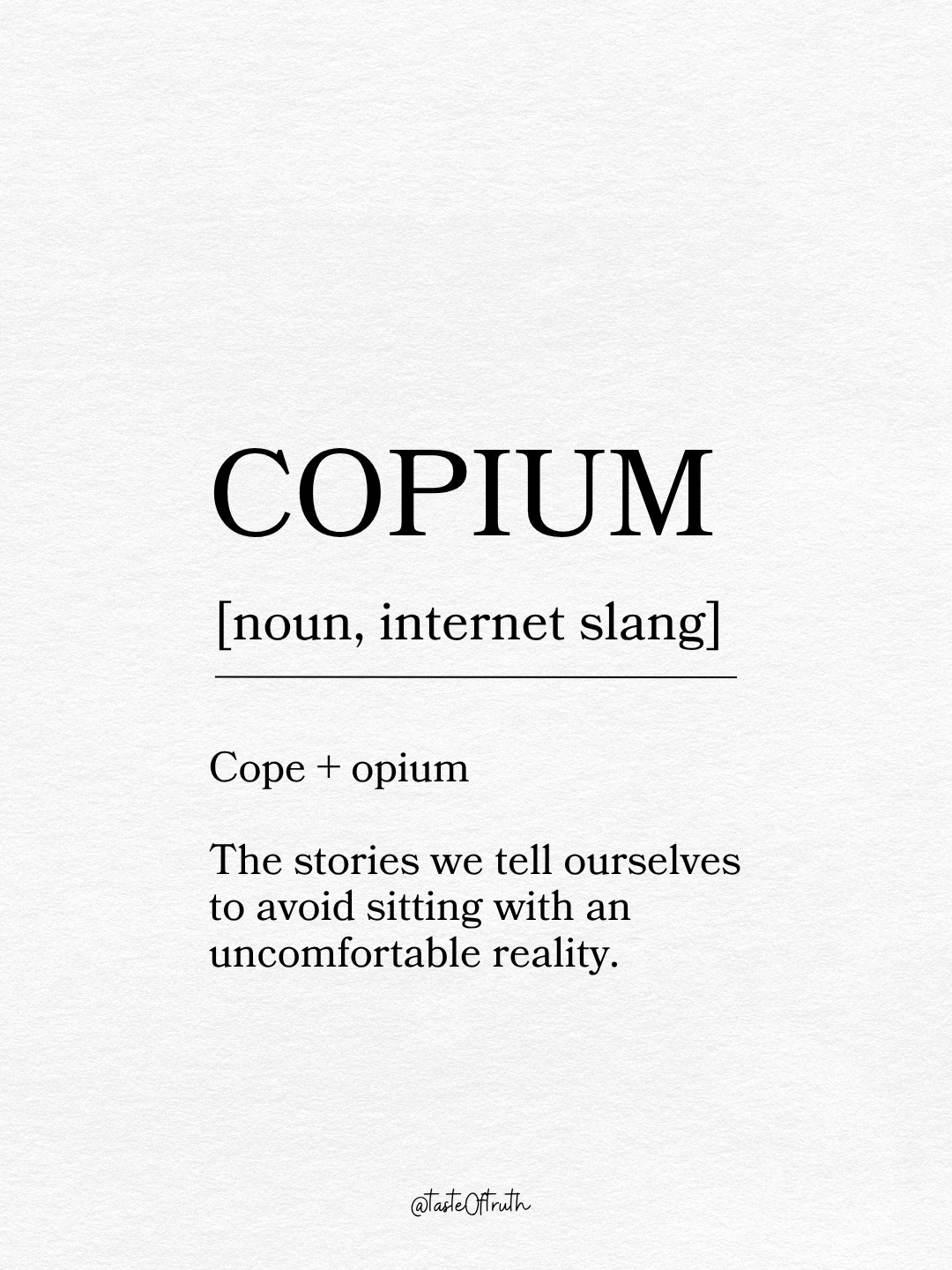
And frankly, it is not my fault that you are still high on copium.
It is not my fault that you cannot face the reality of the Mosaic distinction. By this I mean what the Egyptologist Jan Assmann identified as a profound transformation in the history of religion: the emergence of a theological distinction between true and false religion. In many ancient polytheistic worlds, foreign gods could be translated, compared, identified with one another, or incorporated into an existing religious landscape without requiring the conclusion that everyone else’s gods were simply unreal. The Mosaic distinction introduces a fundamentally different logic: there is a true God and false gods, legitimate worship and idolatry, revelation and error. Religious difference is no longer merely difference; it become theological falsehood.
It is not my fault that you have not wrestled seriously with histories like The Darkening Age, or with the long destruction, suppression, absorption, and replacement of the classical knowledge and religious worlds that existed before Christian domination. Whatever debates remain over individual episodes or interpretations, the Christianization of the Roman world was not simply a peaceful exchange of ideas in which one spiritual option organically prevailed. Temples were closed and often destroyed, pagan sacrifices were prohibited, traditional cults lost legal and political protection, sacred spaces were appropriated, and older practices were reclassified as superstition, idolatry, or demonic error. Pagan traditions did not merely “blend” with Christianity on equal terms; increasingly, they barely survived within a political and theological order that denied them equal legitimacy.
It is not my fault if the ancient historical spirit (the memory of the Roman people, the pagan peoples, our ancestors) has been lulled to sleep beneath generations of theological and psychological conquering. By that I mean the loss of cultural memory that occurs when the worldview of the victor becomes so normalized that people begin interpreting the defeated traditions through the categories of the religion that displaced them. Gods become “myths,” ancestral rites become “superstitions,” sacred places become curiosities, and Christian reinterpretations are treated as the natural culmination of what came before. After enough generations, conquest no longer feels like conquest because its assumptions have become the background architecture of thought itself. We are still burdened by Abrahamic supremacy through its metaphysical assumptions, its ontological lies and its corrupt theology.
That is why I am not interested in being told that Christianity contained a “strong pagan current,” as though the survival of pagan material somehow dissolves the distinction between the traditions. Cultural absorption is not the same thing as theological continuity, and syncretism under conditions of unequal power is not evidence that the conquered worldview survived intact. Sometimes the pagan residue inside Christianity tells us less about Christianity’s openness than about how extraordinarily difficult Europe’s older religious worlds were to erase.
And I am certainly not obligated to crawl back into the framework because someone has discovered a more mystical way of decorating it.
Of course, history is complex.
Of course, cultures interact.
Of course, Christianity absorbed enormous amounts of pagan philosophy, imagery, customs, sacred geography, ritual, and symbolism.
That does not make Christianity pagan.
And pointing to the pagan material Christianity absorbed after centuries of conquest is not the devastating rebuttal some people seem to imagine it is. In many cases, it proves the opposite: pagan culture was so deeply rooted that it could not simply be erased. It had to be absorbed, renamed, subordinated, and Christianized.
Interaction does not erase difference.
Syncretism does not erase domination.
And complexity is not a solvent that magically dissolves every meaningful distinction.
This endless need to redeem Christianity is precisely what I am exhausted by.
People hear me say, “I reject this framework,” and somehow translate it into, “Please introduce me to a more sophisticated version.”
No.
I have studied the scriptures, the doctrines, the apologetics, and the internal arguments.
Walking away was not an easy feat.

This photograph is my enormous systematic theology book and my Bibles ripped apart and thrown away means something very different to me than it probably does to you. Deconstruction was not an intellectual parlor game. The pain of walking away from the Church was beyond anything I expected. I had physical, visceral responses. I was covered in hives. I gained weight. The psychological torture reached down into my soul at a depth I still struggle to explain.
I had built a world inside that framework.
Then I followed the broken threads of its doctrine until I found my way back out of the Abrahamic framework altogether.
That process cost me something.
So no, I do not appreciate (not even an ounce) when somebody who has not bothered to understand who I am, what I studied, what I believed, or what it cost me to leave decides to waste my fucking time explaining that Christianity is actually much deeper, more mystical, more pagan, more esoteric, or more sophisticated than I realize.
You are not revealing the hidden level of the game to me.
You are reenacting the exact mechanism I am criticizing.
The assumption underneath all of these conversations is that Christianity must remain redeemable. If I reject the obvious form, someone produces the mystical form. If I reject the mystical form, someone produces the historical nuance. If I reject that, someone dissolves the categories altogether: perhaps “Abrahamic” and “pagan” were never really so different.
Anything except allowing the possibility that I understand the tradition and still find its underlying architecture unacceptable.
That is the spiritual hamster wheel.
There must always be another interpretation.
Another layer.
Another secret teaching.
Another version of Jesus.
Another way to salvage the thing you cannot bear to relinquish.
But I have already relinquished it.
My Heathenry does not require me to turn Christianity into disguised paganism so I can make peace with it. I do not want to make peace with my enemies. I do not need Jesus reconstructed as Dionysus, a universal consciousness, or an esoteric solar principle. I do not need the Hebrew scriptures alchemized into some secret perennial wisdom before I am permitted to judge what I actually find there.
And I can study the differences without compulsively collapsing them into some universal spiritual soup.
Perhaps that is what some people find intolerable.
Because once you stop insisting that every tradition secretly teaches the same thing, you have to make judgments. You have to admit that religions contain competing metaphysics, competing moral visions, competing conceptions of humanity, competing relationships to divinity, nature, ancestry, authority, and the sacred.
And then you might have to choose.
I chose.
So, when I tell you that I have no interest in Christianity, and in fact I have a burning blood memory full of hatred for it, believe me the first time.
I do not need the deeper version.
I do not need the mystical version.
I do not need the pagan-friendly version.
I do not need Christianity rescued from Christianity.
I understand the reinterpretation.
I reject the substrate.

Sources and Further Reading
The authors below do not represent a single school of thought, nor do they necessarily agree with every conclusion I draw. Together, however, their work informs my analysis of Jesus as a literary construction, the scriptural formation of biblical narratives, the Mosaic distinction, and the suppression and absorption of Europe’s pre-Christian religious worlds.
Jesus Mythicism and the Literary Construction of Christ
- Paul-Louis Couchoud, The Creation of Christ: An Outline of the Beginnings of Christianity, translated by C. Bradlaugh Bonner, 2 vols. (London: Watts & Co., 1939).Originally published in two volumes, Couchoud’s work traces the development of Christ from an apocalyptic and prophetic heavenly figure into the increasingly historicized Jesus of the written Gospels. The second volume also contains his essay “The Historicity of Jesus.” These are the two PDF volumes I recently had printed for further study.
- Richard Carrier, On the Historicity of Jesus: Why We Might Have Reason for Doubt (Sheffield Phoenix Press, 2014).
- Earl Doherty, Jesus: Neither God nor Man—The Case for a Mythical Jesus (Age of Reason Publications, 2009).
- Robert M. Price, The Christ-Myth Theory and Its Problems (American Atheist Press, 2011).
Biblical Narrative, Myth, and Scriptural Construction
- Thomas L. Thompson, The Mythic Past: Biblical Archaeology and the Myth of Israel (Basic Books, 1999). Published in the United States as The Bible in History: How Writers Create a Past.
- Thomas L. Thompson, The Messiah Myth: The Near Eastern Roots of Jesus and David (Basic Books, 2005).
Thompson’s work is especially important to my understanding of biblical characters and messianic narratives as literary products shaped by older Near Eastern traditions, recurring royal motifs, and scriptural patterns. Thompson should not simply be collapsed into the modern Jesus-mythicist movement; his work addresses the literary and mythic construction of biblical figures through a distinct scholarly framework.
Monotheism and the Mosaic Distinction
- Jan Assmann, Moses the Egyptian: The Memory of Egypt in Western Monotheism (Harvard University Press, 1997).
- Jan Assmann, The Price of Monotheism, translated by Robert Savage (Stanford University Press, 2010).
Assmann’s concept of the Mosaic distinction describes the revolutionary division between true and false religion introduced by biblical monotheism. This distinction altered how religious difference could be understood: other gods and forms of worship were no longer merely foreign or different, but false, illegitimate, idolatrous, or demonic.
Christianization and the Classical World
- Catherine Nixey, The Darkening Age: The Christian Destruction of the Classical World (Macmillan, 2017).

