“Truth can be both our shield and sword in the battle of life.”
There are people who influence us not only through what they teach, but through the manner in which they live what they teach.
Over the last several months, my friend Torna Braggison has offered me a remarkable degree of openness, patience, friendship, and spiritual guidance. He has answered my many questions, challenged me to think more deeply, and helped me better understand a Heathen worldview that cannot be reduced to symbolism, abstract belief, or solitary spiritual consumption.
Torna is the author of Power Through Truth, an exploration of the relationship between sacred breath, truthful speech, oath-keeping, honor, and spiritual power within the Heathen tradition.
His guidance has continually returned me to something more demanding: conduct.
How do we speak?
What do we promise?
Do our actions uphold our words?
Can the people closest to us trust what comes out of our mouths?
What happens to us (personally, socially, and spiritually) when they cannot?
What if truth is not merely something we believe, but something we breathe, speak, promise, remember, and live?
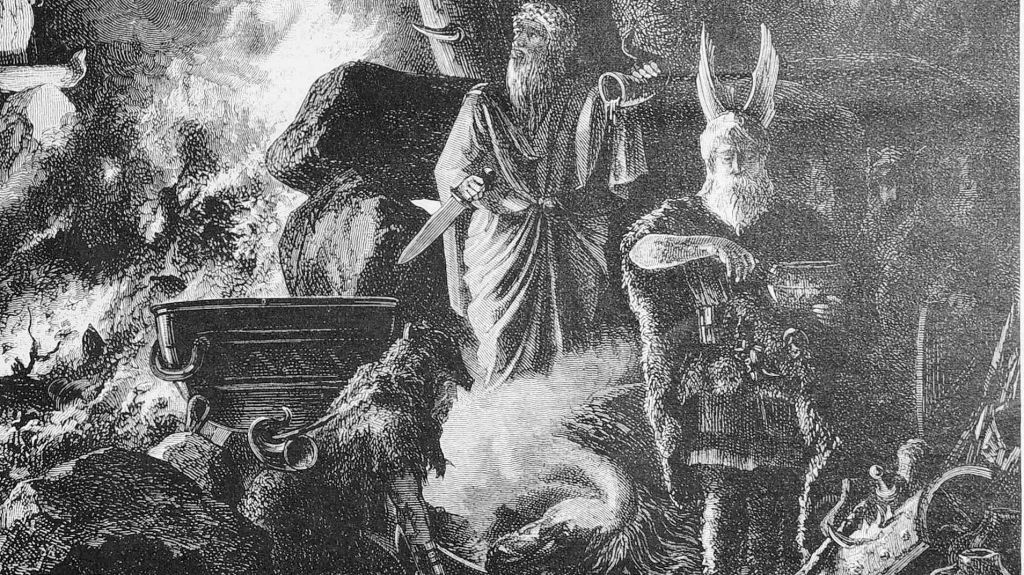
Ask and Embla, Robert Engels, 1919. Odin’s gift of Ond—the sacred breath that gives life and carries the spoken word.
Truth Is Not Merely an Idea
Modern people are accustomed to treating truth primarily as a matter of intellectual agreement.
We ask whether a proposition is correct, whether a doctrine is factual, or whether someone possesses the proper beliefs. Religion often becomes a matter of assenting to particular claims. Politics becomes a competition between competing narratives. Online identity becomes a collection of publicly declared values.
But declaring a value is not the same as embodying it.
A person can speak endlessly about compassion while behaving cruelly. Someone can build an identity around authenticity while lying to the people closest to them. A spiritual leader can speak of love, healing, transcendence, and divine truth while refusing accountability for the damage caused by their conduct.
Words alone do not prove character.
Within the framework Torna presents, however, words are not inconsequential. They are not merely sounds, opinions, or disposable expressions. They are carried upon the sacred breath and given force through the character and intention of the speaker.
Torna describes Ond as the sacred breath of life, the divine spark gifted by Odin. Our words ride upon that breath, and when we speak, we give those words a kind of life. Their quality is connected to the truth, intention, and honor of the person speaking them.
Speech therefore becomes more than communication.
It becomes participation.
We breathe something of ourselves into the world.
The Breath Behind the Word
In Völuspá, Odin’s gift to Ask and Embla includes Ond—the animating breath without which they do not yet fully possess life. Torna connects this sacred breath to speech, creativity, ecstatic power, ritual, galdr, and the ability to shape reality through will and expression.
This does not mean that every passing sentence is a magical incantation in the theatrical or New Age sense.
It means that speech carries consequences.
Words can establish trust or destroy it. They can bind people together, orient a community, transmit memory, establish obligation, inspire courage, or leave another person spiritually and emotionally disoriented. A truthful word spoken at the right moment can restore someone’s sense of reality. A deliberate lie can make another person doubt their own perception.
Our words affect the world because other people must live inside the reality those words help create.
This is one reason truth matters so deeply to me.
I do not want truth to remain an attractive principle I discuss in essays or podcasts. I want the people in my life to know that my word means something. I want to follow through when I make a commitment. I want to be honest even when honesty is uncomfortable. I want to recognize when my conduct contradicts what I have claimed and accept the responsibility of repairing what I can.
That is not always easy.
Truth as lived accountability demands more than being “right.” It demands self-examination, restraint, memory, courage, and humility. It may require us to admit that we have behaved dishonorably. It may force us to stop protecting the version of ourselves we would prefer others to believe.
Truth can defend us, but it can also cut through our own self-deception.
It is both shield and sword.
Words in the Well
One of the most compelling ideas in Torna’s article is that some words carry more weight than others.
He distinguishes between common or everyday speech, words placed “in the well” through intimate or sacred relationships, and the giving of formal oaths. Each carries a different degree of personal, communal, and spiritual consequence.
We all understand this intuitively.
Telling a cashier that we are “fine” when we are having a terrible day does not carry the same moral weight as lying to a spouse, deceiving a close friend, betraying a confidant, or breaking a solemn vow.
The closer the relationship, the more of ourselves we place behind the word.
Words spoken to those who trust us become part of a shared memory. They shape how another person understands us, themselves, and the relationship between us. Words spoken during ritual enter the memory of the group. Stories told by the skald or bard help shape a people’s understanding of their ancestors, heroes, virtues, and obligations.
These are words placed into the well.
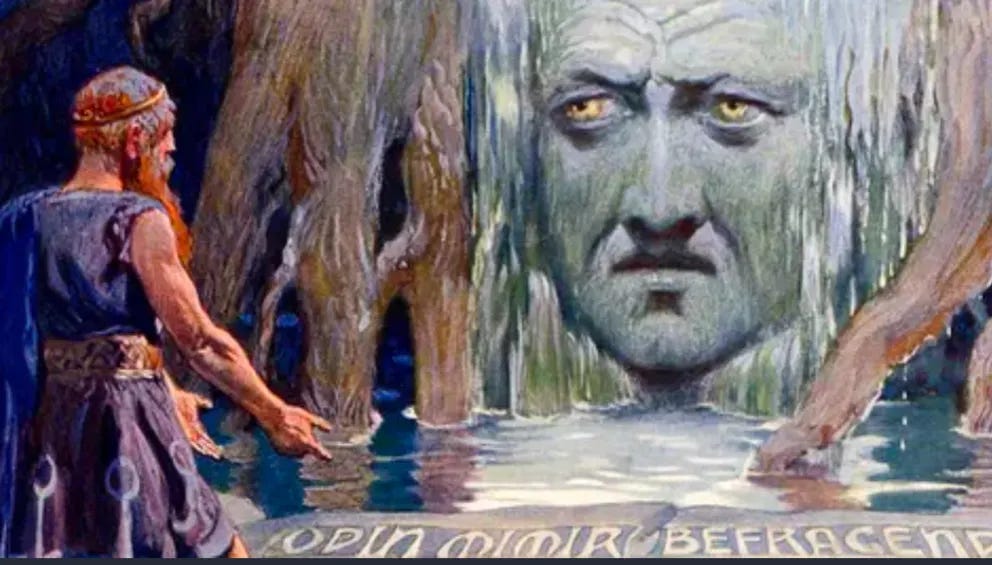
The well can be understood as Mímir’s well, ancestral memory, cultural memory, or the accumulated memory of the community. What is spoken does not simply disappear after the vibration leaves the air. It continues through consequence, reputation, story, recollection, and relationship.
A truthful word can strengthen the speaker and those who hear it.
A dishonest word can poison the well.
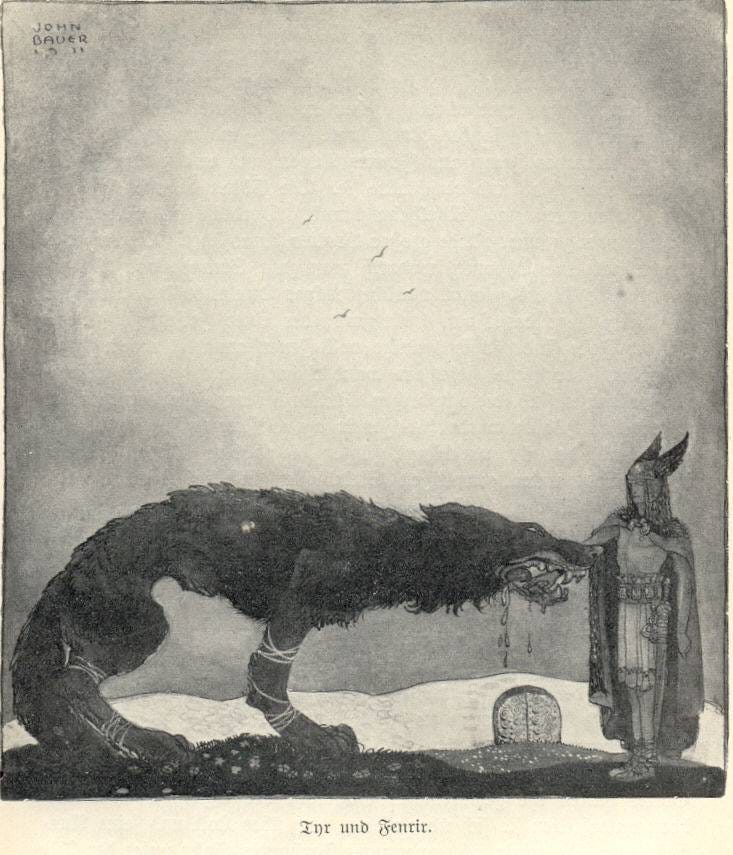
“The Spiritual Weight of an Oath”: John Bauer, Tyr and Fenrir
The Spiritual Weight of an Oath
An oath carries the greatest weight because an oath is not merely a prediction about what we hope to do.
It is an act of binding.
Torna describes an oath as something given life through sacred breath and powered by the will. The oath involves not only the person who gives it, but the recipient, the witnesses, the place, and the spiritual powers invoked or present. Until it is fulfilled or broken, the oath continues to possess force.
This is almost incomprehensible within a culture of casual promises.
We say, “I’ll call you tomorrow,” “I’ll always be there,” “You can trust me,” or “I swear I’ll change,” often with little awareness of the weight those statements carry for the person receiving them.
Our society encourages constant speech while teaching very little discipline of speech.
We post immediate reactions. We make dramatic declarations. We promise more than we can deliver. We publicly perform virtues we have not yet cultivated privately. We use language to manage how others perceive us, then become resentful when we are held accountable to the identity we presented.
A Heathen understanding of oath asks us to become more careful.
Do not promise lightly.
Do not offer your word merely to relieve the discomfort of the present moment.
Do not invoke trust when you are unwilling to behave in a trustworthy manner.
The answer is not to become silent, emotionally unavailable, or terrified of commitment. It is to understand that a promise contains part of the self. When we repeatedly keep our word, we become someone whose speech possesses weight. When we continually break it, our words become thin and useless.
Eventually, no one believes us… and that isn’t because they are cruel, but because we have taught them not to.
Honor Is Accumulated
Torna connects the keeping of oaths with Hamingja, a concept often translated as luck but also associated with honor, power, fortune, and the accumulated strength of the self.
This is not luck imagined as random cosmic favor.
It is closer to luck that has been cultivated.
A person who consistently acts with integrity develops trusted relationships, a dependable reputation, communal support, and an internal sense of coherence. Their words and actions reinforce each other. They become spiritually and socially substantial.
Keeping one’s word strengthens the whole self, while dishonorable conduct weakens it.
We might recognize this even without using explicitly spiritual language.
A trustworthy person is often surrounded by people willing to help them because they have proven that help will not be wasted. Their reputation opens doors. Their community remembers their conduct. When hardship comes, they are not entirely alone.
This is not always fair or perfectly reciprocal. Honorable people can still be betrayed, harmed, or abandoned. But the larger principle remains: character accumulates.
So does dishonor.
Every promise kept or broken becomes part of the person we are becoming.
Truth as Communal Participation
Truth is often framed as an individual possession: my truth, my beliefs, my authenticity.
But Torna’s article presents truth as profoundly relational.
As a bard and skald, he writes that believing in the moral truth of a story allows the teller to connect with those listening. Honest words can create a communal experience in which teller, listener, folk, hero, deity, moral teaching, place, and ancestral memory are brought into relationship.
Truth does not merely sit inside the mind.
It passes between people.
It is sung, remembered, witnessed, and enacted.
This is where the concept becomes essential to The Wisdom of Participation. Traditional cultures did not generally understand humans as isolated consumers of spiritual information. People gathered. They sang. They told stories. They made vows before witnesses. They remembered their dead. They carried inherited obligations. They participated in the maintenance of a shared moral world.
The skald did not simply deliver “content.”
The community did not merely observe.
Everyone present became part of the remembering.
This is radically different from a spirituality centered on private revelation, personal vibration, or self-created metaphysical truth. The well does not belong to the isolated ego. It contains the memory of relationships—between the living, the dead, the Gods, the land, and those yet to come.
What we place into that well matters.
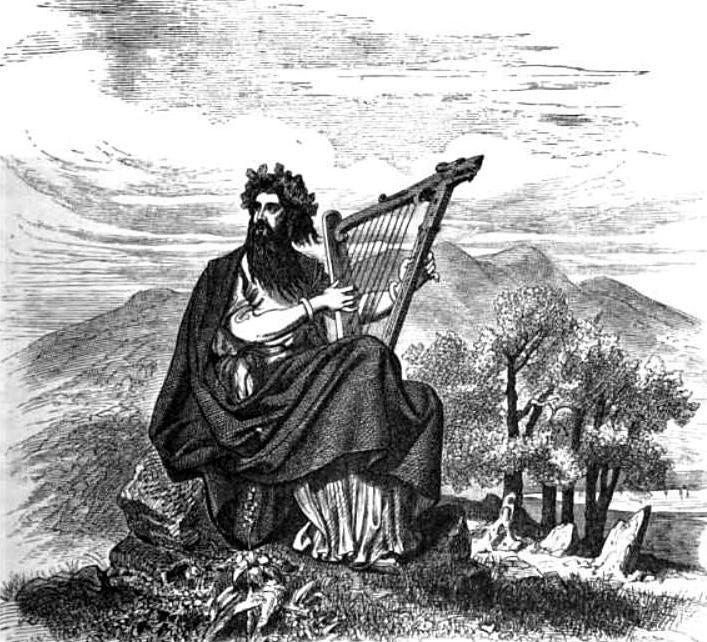
Bragi, Carl Emil Doepler, 1882. Bragi, the Norse god of poetry and eloquence, represents speech as sacred craft: words shaped through memory, rhythm, truth, and responsibility. The skald does not merely entertain, but gives voice to the stories and values through which a people remembers itself. Public domain.
No One Can Embody Truth on Our Behalf
Christianity famously places the words “I am the way, the truth, and the life” into the mouth of Jesus.
In that worldview, truth is ultimately embodied in and accessed through a singular salvific figure. The believer is asked to place faith in that figure and the theological claims made about him.
The Heathen framework explored here places the emphasis elsewhere.
Truth is not merely a person to profess belief in. It is a standard we must demonstrate through conduct.
No savior can keep our promises for us.
No doctrine can repair the trust we have broken.
No spiritual identity can substitute for honest speech.
No declaration of belief can transform dishonorable behavior into honorable behavior.
Truth must be renewed each time we speak carefully, fulfill a commitment, admit a wrong, make recompense, resist convenient deception, or allow our actions to bear the weight of what we have claimed.
It must be breathed and lived.
The Question Before Us
My upcoming conversation with Torna Braggison will explore the relationship between Ond, speech, oath, honor, memory, galdr, storytelling, and spiritual power.
But beneath the terminology lies a deeply human question.
What kind of person does my speech reveal me to be?
Do my words give life, orientation, and trust to the people around me?
Do I make promises carelessly?
Have I confused saying the right things with becoming an honorable person?
Have I demanded truth from others while excusing dishonesty in myself?
And when I fail, am I willing to make recompense rather than simply inventing a more flattering story about what happened?
Truth is not merely the absence of false information.
It is the alignment of breath, speech, memory, promise, and deed.
It is the weight accumulated when we repeatedly prove that our words can be trusted.
It is what we place into the well.
It is what others will remember.
And it is what remains when every attractive spiritual claim has been stripped away and only our conduct is left to speak for us.
The Lessons of Asgard– WorldTree Publications, 36pgs. Completely revised, with original kennings to the Gods by Torna Braggison. An introductory study of the principle Gods & Goddesses in the lore.
Flow Arts, Festival Ritual, and the Lost Wisdom of Participation
Hey hey, welcome back to Taste of Truth, this essay is much different than what I normally write, I hope you enjoy this trip down memory lane with me.
For years, strangers would see me walking through an airport, across a college campus, or into a music venue carrying an enormous circle of plastic and ask the same question:
“Is that a hula hoop? What do you do with that thing?”
I usually smiled.
There was no quick way to explain what the hoop had already done with me.
By then, it had bruised my hips, taken over my living room, earned me the nickname “hula-hoop girl” around my college campus, and sent me driving and flying across the country in search of music, teachers, festivals, and other people who understood why it was impossible to put the thing down.
It had carried me onto stages I was terrified to enter. It had introduced me to women I first knew only by their YouTube names and later came to know as teachers, collaborators, friends, and soul sisters. It had given me a language for my body at a time when I was still deeply self-conscious inside it.
At the time, I thought I was learning tricks.
I was learning how to float the hoop from my waist above my head. How to reverse its current. How to move in both directions. How to toss, pause, break, roll, and recover. How to follow a drum solo until movement and music stopped feeling like separate things.
All of that was true.
But something much deeper was happening
This is the first part of a series I have been circling around for a long time, though I didn’t fully realize it at first.
I thought I was writing about hoop dance, festival culture and the importance of ritual.
Then philosophy.
Then paganism.
Then neuroscience.
The deeper I followed the thread, the more I realized they were all pointing toward the same question:
What happens to human beings when participation is replaced by spectatorship?
I keep returning to the difference between knowing about life and actually participating in life.
Modern people are drowning in information about health, spirituality, community, nervous system regulation, trauma, meaning, embodiment, and connection. We have the podcasts, the books, the frameworks, and an ever-expanding vocabulary. We can analyze our attachment styles, map our trauma responses, name our nervous system states, and explain exactly why we feel disconnected.
And yet, so many of us are still lonely….
Still disembodied.
Still watching life through glass.
Still trying to think our way into something the body may only truly recover through embodiment, through rhythm, movement, expression, shared presence, and practice.
This piece is about that hunger.
The ancient hunger beneath modern life.
Not merely the hunger to believe something, but the hunger to belong to a living world again.
For a long time, I thought my years in flow arts were simply a chapter of my life—a beautiful one, but ultimately behind me. Looking back now, I see something different.
Long before I studied philosophy, mythology, neuroscience, religion, or ancestral traditions, my body was already being introduced to a way of knowing that none of those books could have given me.
It had to be practiced. Repeated. Failed. Felt. Shared.
It had to be participated in.
Before philosophy gave me language for participation, my body had already spent years practicing it.
Long before I studied mythology, ritual, paganism, or the neuroscience of embodiment, I had already encountered something those traditions were trying to describe.
I knew it through music. Through movement. Through repetition. And most importantly through community.
By the simple act of showing up, again and again, until something inside me changed.
I no longer interpret every part of those years the way I did in my twenties.
But I trust the experience more than I trust all the language I once wrapped around it.
And that is where this story really begins.
Long before I studied heathenry/paganism,
I danced it.
The First Forms of Participation
Before there was a circle of plastic spinning around my waist, there were trees to climb, horses to ride, ponds to swim in, and twenty-six acres that gave my body somewhere to go. Some of my earliest memories are not of sitting still and thinking about the world, but of moving through it—crossing the dam, wandering the property, climbing high enough to see everything differently.
There was one enormous oak tree that had fallen and become something like a fort. I would retreat there after arguments with my mother, disappearing into its branches and hollows until I felt like myself again. I would not have called that nervous-system regulation. I would not have called it ritual, grounding, or communion with place. I only knew that the tree could hold something I did not yet know how to carry.
Movement was also part of my life in more formal ways. I took ballet, tap, and jazz, although jazz was the form I loved most. Ballet often made me painfully aware of my body—how tall I was, how much space I occupied, how unlike the smaller girls I sometimes felt. Jazz gave me more room. There was something about the music, the costumes, and the freedom of the movement that allowed me to step outside that self-consciousness for a while.
Music offered another kind of participation. I played piano and violin, but orchestra was where something larger began to reveal itself. Practicing alone mattered, but it was never the whole point. The real experience happened when everyone entered together: dozens of separate parts becoming one piece of music that none of us could have made alone.
I did not have words for why that felt so powerful. I only knew the difference between playing a part by myself and feeling it take its place inside a living whole.
The tree was not merely scenery.
The orchestra was not merely a collection of individuals.
Movement was not merely exercise.
Each required me to enter into a relationship—with a place, a rhythm, a group of people, or the limits of my own body. I could not understand any of them from the outside. I had to climb the branches, learn the music, miss the step, lose my place, and begin again.
Looking back, I can see that I was learning the same lesson in different forms: the world became more alive when I participated in it.
I did not yet know that this was a kind of knowledge. I only knew that I felt most like myself when I was moving, making, playing, or contributing one small part to something larger.
The hoop would eventually gather all of this into a single practice—movement, rhythm, repetition, music, play, place, and community.
It did not create the longing.
It gave the longing a shape.
The Circle Opens
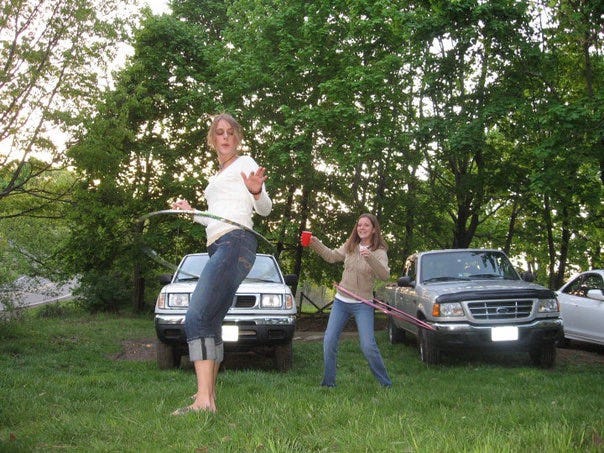
One of my roommates and I, playing around with those rinky-dink store-bought hula hoops.
That shape arrived rather unceremoniously in the winter of 2005: a cheap, store-bought hula hoop that I could barely keep spinning around my waist.
At first, it was mostly frustrating. The hoop fell almost as quickly as I could lift it, clattering against the floor while I tried again. Eventually, though, my body found the rhythm. I carried it back to college, where I practiced in the living room while my roommates laughed, none of us realizing what had begun.
That first hoop was a toy. The real initiation came the following summer at Smilefest, a music festival held at Deerfields in North Carolina.
There, I picked up what hoopers called a “real” hoop—large, heavy, handmade, and nothing like the lightweight plastic circle I had been struggling with. I could feel the difference immediately. Its weight slowed the movement enough for my body to follow. For the first time, the hoop did not seem like an object I was trying to control. It felt like something I could enter into conversation with.
I practiced until dark bruises spread across both hips.
Then I strapped the enormous hoop to the roof of the car and brought it home.
Something had taken hold of me.
I began carrying the hoop everywhere. I practiced alone in backyards and parking lots, using my car stereo for music. I watched early YouTube videos of hoopers like Hoopalicious, Spiral, Christabel Zamor, and the Hoopnotica dancers, calling my roommates into the room whenever someone performed a movement I could not imagine being possible.
“Look at this. How does she do that?”
There were tutorials, but no explanation could place the movement inside my body. I could watch someone perform a trick dozens of times. I could study the position of her hands, the angle of the hoop, and the direction of its current. None of that meant I could do it. The knowledge had to travel another route.
I had to pick up the hoop.
I had to drop it.
I had to feel where the movement broke down, make some tiny adjustment I could barely name, and try again.
One of the clearest memories I have from that period is standing in the front yard during my junior year of college, listening to the same music over and over while trying to raise the hoop from my knees back toward my waist. I had watched other people do it. I understood, in theory, what was supposed to happen.
But my body did not know yet.
Then, after what felt like endless repetition, something shifted. The hoop caught. My knees and hips found the pulse. The circle began to rise.
I could not have explained what I had done differently.
My body simply understood.
That moment opened a door. Once I felt the movement happen, I knew the other tricks were possible too because I had experienced the difference between knowing what a movement looked like and then knowing it from within.
The Circle Widens
That question did not remain private for long.
In March 2007, only about a year after I first began seriously hooping, I found myself waiting beside a stage in Boulder, Colorado, preparing to perform with EOTO for the first time.
For weeks, I had told everyone how excited I was. I was going to hoop onstage with Jason Hann and Micheal Travis—two musicians from String Cheese Incident (the jam band I had spent the previous summer following across the country.) Until that moment, the whole thing had felt thrilling and almost unreal.
Then it was time to walk onto the stage.
The excitement dropped straight into the pit of my stomach.
Holy shit. I’m really getting up there.
At that very moment, Jamie Janover, one of the other musicians came over, he had noticed how nervous I was and gave me a piece of advice I have never forgotten:
“Just go up there when you’re feeling the groove and get off when you’re done. It’s simple.”
He was right, although it did not feel simple while I was standing there.
There was no choreography to memorize and no fixed sequence waiting for me. EOTO was an improv jam band. The musicians were listening and responding to one another in real time. The audience was responding to the music. To join them, I had to stop thinking about how I looked, listen with my entire body, and enter the moment already unfolding.
I could not calculate my way into it.
I had to feel when to step forward.
For the first time, I was no longer simply hooping to music.
I was moving inside it.
Inside the Music
Once I crossed that threshold, the road opened quickly.
Music was not something playing quietly in the background while life happened elsewhere. It organized our movements, our travel, our friendships, and our sense of time. We planned entire summers around gathering beneath stages and temporary tents. We drove for days to arrive somewhere that would exist for only a weekend, then disappear almost as quickly as it had formed.
For those few days, however, we were not merely an audience.
People danced, cooked, camped, taught, performed, built installations, traded food, shared supplies, carried one another’s equipment, and stayed awake until sunrise. Musicians improvised with one another onstage while dancers responded from the crowd. The boundary between performer and participant was more porous than it appeared.
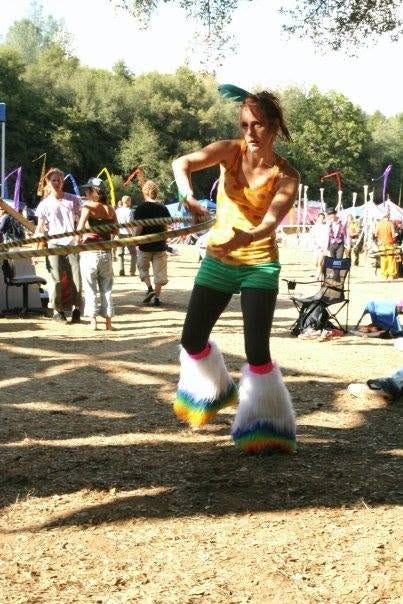
Symbiosis Music Festival 2007
When there was room, I stepped onto the stage with my hoop. Other times, I danced in the field among everyone else. Both experiences were deeply impactful in my dance practice. Whether hundreds of people were watching me or no one was, I was learning to respond to rhythm rather than impose myself upon it.
The music moved, so I moved.
The hoop changed direction, so I followed.
The crowd surged, softened, shouted, or fell quiet, and the whole atmosphere changed with it.
At its best, it felt less like a performance than a conversation occurring through bodies.
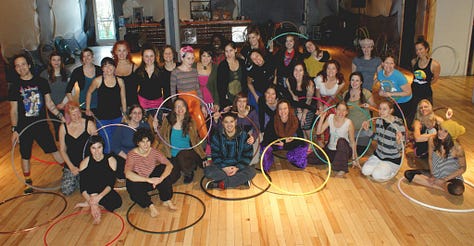
Over time, the women I had once watched with awe became people I practiced beside. Some became teachers, troupe members, collaborators, and friends. I moved to Portland at the end of 2007 and joined Kaivalya Hoop Dancers, entering a community that took the practice seriously while still preserving its sense of play.
I spent Portland’s rainy season obsessively practicing reverse currents. I wanted to move comfortably in both directions, even though one side initially felt completely unnatural. I repeated barrel rolls, breaks, pauses, and reversals until the awkward side slowly became less foreign.
Then severe back pain forced the practice to change again.
At twenty-three, there were days when preparing food or standing for longer than twenty minutes felt nearly impossible. I worried that I would lose the thing that had given my life so much momentum. I could no longer rely on constant waist hooping or the larger, more physically demanding movements that had once filled my practice.
But limitation created another kind of education.
I began exploring pauses, tosses, reversals, off-body movement, and smaller gestures that did not aggravate my back as severely. What initially felt like an interruption became a new creative vocabulary. The hoop was still teaching me, but now the lesson was adaptation.
Participation did not mean forcing myself through pain. It meant listening closely enough to remain in relationship with the practice as my body changed.
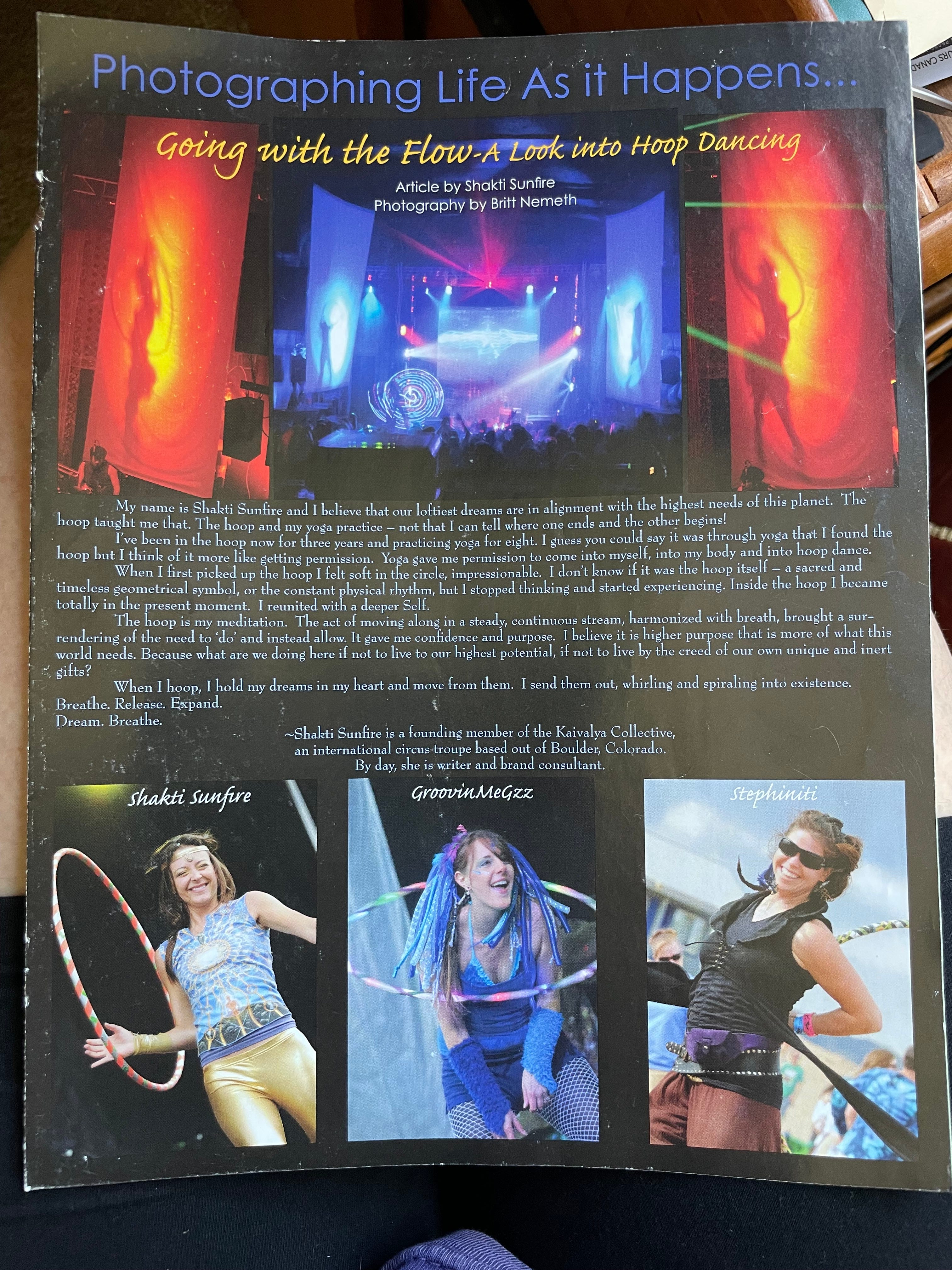
Hoop Dance Workshops from all over the country
Eventually, I began teaching more.
At festivals and community gatherings, I watched people pick up hoops with the same awkward uncertainty I had once felt. Some were convinced they could not do it. Others laughed the moment the hoop dropped. I learned that teaching movement required more than explaining where to place the feet or how to push the hips.
Sometimes I demonstrated.
Sometimes I offered a small correction.
Sometimes the most useful thing I could do was give someone enough room to fail without feeling embarrassed.
The moment when a movement finally entered another person’s body was unmistakable. Their face changed. The effort briefly disappeared. What had seemed impossible became available to them from the inside.
At EmergNsee Music Gathering (2008) in Oregon, I taught a HoopYoga and hoop-dance workshop attended by Meghan the Kat, one of the performers who had inspired me during my earliest years following String Cheese Incident. There was something beautifully disorienting about teaching a person I had once watched from a distance.
The hierarchy I had imagined between teacher and student dissolved.
She had given something to me through her movement. I had taken it into my own body, practiced it, altered it, combined it with what I had learned elsewhere, and now I was returning something to her.
Knowledge moved in a circle.
As I wrote at the time:
“It’s so beautiful how we all learn from each other, one hooper heart to the next.”
That sentence is covered in the earnestness of my early twenties, but I still believe what I was trying to say.
The practice did not belong to any one teacher, performer, or school. It passed between us. We learned through watching, imitating, experimenting, teaching, and being corrected. Every person carried the movement differently because every body was different. What one person offered was never reproduced perfectly; it was received, transformed, and passed onward.
By the time I attended Hoop Camp in California in 2008, that circulating exchange had become a culture of its own.
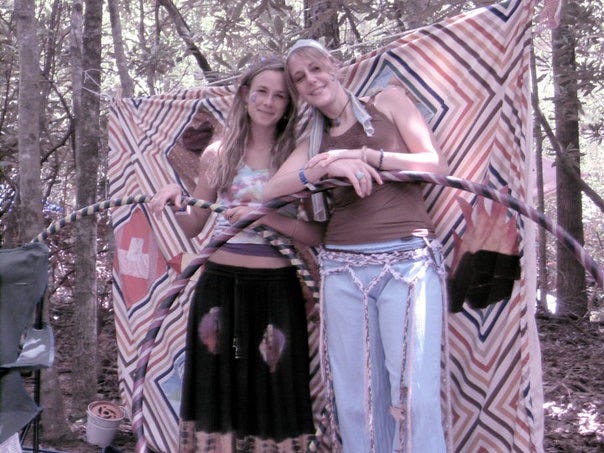
Hoop Camp Retreat 2008
For years, I had known many hoopers primarily through grainy online videos, usernames, festival sightings, and brief encounters on tour. (I can’t help but to hear “This one time…at Band Camp”, if you grew up in the early 2000s, you’ll get this. )
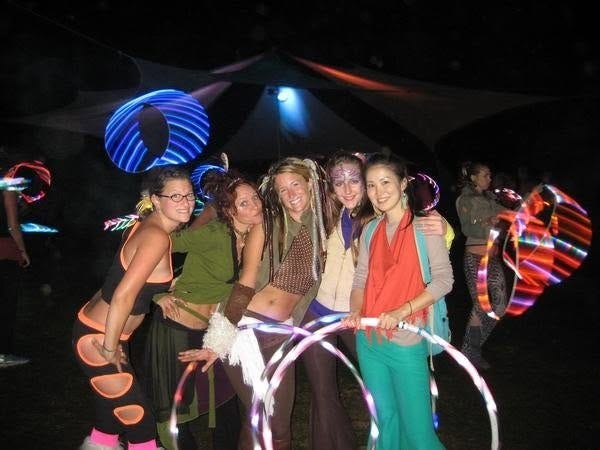
The people I had admired from across the country were suddenly gathered in one place. We practiced together during the day, exchanged ideas in workshops, ate together, laughed together, and filled the darkness with glowing hoops at night.
I was surrounded by women who had shaped my imagination before they ever knew my name, alongside childhood friends, college friends, troupe members, and the people who had become my chosen family on the road.
I described myself afterward as channeling “true Unicorn energy”—nonstop hooping, smiling, laughing, and learning. The language makes me laugh now, but the joy was real.
So was the sense that something larger than individual skill was taking place.
During the opening ceremony, we gathered around a prayer hoop and placed our intentions inside it. One by one, people spoke about what the hoop had done in their lives: the confidence it had restored, the friendships it had created, the grief it had carried, the joy it had unlocked, and the selves it had allowed them to discover.
In my blog afterward, I wrote:
“All of us have been changed by the hoop. It’s impacted our lives, brought us together, shown us ourselves, given us bliss, given us confidence…”
I would describe some of those experiences differently today. I no longer interpret every ecstatic weekend, meaningful coincidence, or intense connection through the same spiritual vocabulary I used then.
But I do not dismiss what happened simply because my language has changed.
We gathered around a shared practice.
We moved together.
We taught one another.
We placed hopes and prayers inside a circle.
And through repetition, rhythm, attention, and communal presence, many of us experienced real transformation.
What had begun as a cheap plastic toy had become a language through which we recognized one another.
A movement became a practice.
A practice became a community.
And somewhere along the way, community began to resemble ritual.
The Hunger We Keep Trying to Name
A movement became a practice.
A practice became a community.
And somewhere along the way, community began to resemble ritual.
I did not yet know the language of moral psychology or sociology. I had never heard Émile Durkheim’s phrase collective effervescence: the strange charge that can arise when people gather, move, sing, mourn, celebrate, and direct their attention toward something together.
I did not know Jonathan Haidt’s idea of the “hive switch”—the human capacity to loosen, temporarily, the boundaries of the individual self and become part of an emergent whole. Haidt has suggested that people sometimes need precisely these experiences of self-transcendence, and that music, dancing, communal worship, and local festivals can offer places where isolated individuals become participants in something larger.
I only knew what it felt like.
I knew the sensation of entering a field where hundreds of people were responding to the same rhythm. I knew what happened when musicians improvised, dancers answered, and the distance between performer and audience became briefly porous. I knew the feeling of looking across a dark campground and seeing circles of light moving through the trees.
I knew what it was to become less preoccupied with myself without disappearing entirely.
The experience was not one of erasing the individual. It was the experience of becoming an individual in relationship—one moving body inside a larger pattern.
Research on communal music and movement suggests that this feeling is not merely sentimental. Singing together can accelerate feelings of closeness among people who begin as strangers, while synchronized and physically demanding dance can deepen social bonding.
None of that proves that every festival is sacred, every crowd is healthy, or every ecstatic experience is transformative. Collective energy can be commercialized, manipulated, and turned toward destructive ends just as easily as generous ones. The same human capacity that allows people to lose themselves in music can also make groups tribal, conformist, or cruel.
But the possibility of misuse does not erase the underlying need.
We are creatures shaped for more than private thought.
We learn through imitation. We regulate one another through voice, expression, touch, and presence. We create attachment through repeated encounters. We remember through songs, meals, places, stories, gestures, and practices carried from one body into another.
And yet modern life increasingly offers us the image of these things without requiring our participation in them.
We can stream concerts without entering a crowd.
Watch other people dance without moving.
Order food without cooking or eating with anyone.
Read about ritual without belonging to a ritual community.
Listen to conversations about friendship while sitting alone.
Learn the vocabulary of embodiment while barely inhabiting our bodies.
We are connected to more people than previous generations could have imagined, yet much of that connection asks almost nothing of us beyond attention.
And attention is not the same as belonging.
Recognition is not reciprocity.
Watching is not participating.
A feed is not a feast.
The distinction matters because loneliness is not simply the absence of people. It can also be the absence of roles, obligations, shared places, repeated practices, and the experience of being meaningfully woven into other lives.
We have become very skilled at diagnosing the resulting ache.
We speak of trauma responses, dopamine, attachment styles, nervous-system dysregulation, depression, social anxiety, and burnout. These frameworks can be genuinely helpful. Naming an experience can make it less frightening and give us a place to begin.
But sometimes I wonder whether we are still trying to think our way out of conditions that cannot be changed through thought alone.
A widely shared passage attributed to Jay LeSoleil puts the mismatch much more sharply:
“You feel depressed and crazy because in every historical human culture known to anthropology, people sang together, danced together, and ate food together—and you don’t sing, you don’t dance, and you eat alone in the dark.
You are a singing ape, and you are meant to know fifty dances by heart, which hilltops are sacred, and the names of every plant it is possible to eat.”
The passage is deliberately sweeping. Depression cannot be reduced to a lack of communal dancing, and no single poetic statement can represent every historical culture.
But it lands because it names something our clinical language often misses.
The problem may not be only what is happening inside the isolated individual.
The problem may also be the world in which the individual is being asked to live.
A world where community has become optional, ritual has become content, food has become fuel, music has become background noise, and places are valued primarily for what can be extracted or built upon them.
A world in which we are encouraged to construct an identity but given fewer durable ways to belong.
Perhaps that is why our hunger attaches itself so easily to substitutes.
We mistake stimulation for aliveness.
Visibility for intimacy.
Agreement for community.
Intermittent attention for belonging.
We search for the feeling of being carried beyond ourselves through fandoms, online movements, romantic fixation, political tribes, spiritual consumerism, and endless streams of other people’s lives. Some of these can produce real relationships and genuine meaning. But they can also leave the body sitting in the same room, staring through the same glass, still longing to be somewhere it is needed.
When I look back now, I do not think I miss only the performances, the festivals, or the person I was at twenty-three.
I miss having a practice that placed me inside a living network of people, music, places, responsibilities, and shared memory.
I knew which songs could shift the energy of an entire field.
I knew who would help me carry my hoops.
I knew where people gathered after the music ended.
I had teachers, students, collaborators, and friends.
I had something to offer the gathering, and the gathering had something to ask of me.
That is different from being observed.
It is different from being liked.
It is different from being included in a group chat.
It is participation.
In 2014, I tried to describe this in a short poem:
Grateful for Dance
Portal to divine connection A form of sacred expression Of outward shining expansion Here I am, calling to attention
It’s time to move It’s time to be free It’s time to prove Your non-complacency
So please follow me Down this path of dance divinity It’s time we realize It’s not you and me, it’s we.
Some of the language makes me smile now. But that final line contains an intuition I still trust. It was never only about what happened to me inside the hoop.
It was about what became possible between us.
This does not mean we need to recreate the past, abandon technology, or spend our lives at music festivals. Nor does it mean every older community was nurturing. Communities can constrain, exclude, punish, and demand conformity. Nostalgia can make us forget that belonging has often come at a cost.
The question is not how to return to an imaginary golden age.
The question is what forms of participation human beings still need—and how we might create them honestly now.
Where can we sing without needing to be singers?
Dance without needing to perform?
Prepare food that will be eaten by more than one person?
Learn the names of the plants and animals around us?
Create rituals that give grief, gratitude, transition, and memory somewhere to live outside our private minds?
Practice something regularly enough that it changes us?
Modern people are drowning in information about how to become healthier, happier, more regulated, more spiritual, and more connected. But information cannot substitute for the meal, the chorus, the dance, the garden, the ceremony, the friendship, or the repeated practice.
Some wisdom can only be received through participation.
And perhaps some forms of loneliness cannot be solved by understanding ourselves more perfectly. Perhaps they require becoming part of something that does not begin and end with the self.
That is the ancient hunger beneath modern life.
Not merely the hunger to believe something.
The hunger to belong to a living world again.
And we may not be able to think our way back into that world.
What if strength training wasn’t simply about building muscle?
What if stepping beneath a barbell could become an act of devotion?
In this episode, I sit down with Awen of Primal Druidry, whose approach to physical training challenges many of our modern assumptions about both fitness and spirituality.
For her, the gym isn’t merely a place to improve health or appearance. It becomes sacred space—a place where discipline becomes ritual, physical hardship becomes offering, and strength training becomes a way of cultivating relationship with the divine.
Throughout our conversation, we explore questions like:
What is Primal Druidry, and what makes it a living tradition rather than an attempt to recreate the ancient past?
Why has strength training become such a central part of her spiritual practice?
What changes when exercise becomes ritual instead of self-improvement?
How does physical discipline shape character, devotion, and spiritual life?
What does she mean when she describes receiving guidance through training?
How do we think carefully about deeply personal spiritual experiences without dismissing them…or accepting them uncritically?
One aspect of our discussion that I found especially compelling is the challenge it poses to a very modern assumption: that the body is simply a vehicle for the mind. Throughout history, many religious and philosophical traditions have understood bodily practices (whether fasting, pilgrimage, martial arts, dance, or manual labor) as capable of shaping the soul.
This conversation asks whether lifting weights might belong in that lineage.
Even if you don’t share her theology or spiritual framework, I think the deeper questions are worth exploring.
Can repeated physical practice become a form of prayer?
Can discipline become devotion?
Can the body become a place where meaning is discovered rather than simply performed?
Those are the questions at the heart of this conversation.
As always, the goal isn’t to tell you what to believe. It’s to explore ideas with curiosity, ask better questions, and think more deeply about the relationship between body, mind, and the search for the sacred.
Thank you for taking the time to listen/watch, comment and share. Looking forward to hearing your thoughts.
Hey Hey, Welcome back to Taste0ftruth Tuesdays. In today’s episode we are sitting down with Tina K. of The Rune Shack to explore runes, esotericism, and Norse-Germanic spirituality, alongside my own path through New Age spirituality, Christianity, and deconstruction.
For years, I was searching.
I wandered through wellness culture, festival communities, New Age spirituality, psychedelic conversations, evangelical Christianity, and eventually the long road of deconstruction. Every step taught me something. Every community offered language for experiences that often felt deeply meaningful.
But over time, I began to wonder:
How do we know when spirituality is making us more grounded—and when it is simply helping us escape reality?
Modern spirituality often promises awakening, healing, manifestation, higher consciousness, hidden knowledge, or secret wisdom. Sometimes those ideas genuinely encourage reflection and personal growth. Other times, they can become substitutes for the harder work of living honestly, accepting limits, grieving loss, cultivating discipline, and remaining accountable to reality and to other people.
This conversation isn’t a rejection of mystery. Far from it.
I believe human beings need myth, ritual, symbol, beauty, and experiences that remind us life is deeper than material reductionism alone can explain.
The challenge for me has been learning to distinguish between mystery and manipulation.
That distinction is one reason I wanted to invite Tina K. from The Rune Shack onto the podcast. Rather than centering on a single article, this conversation explores a broader landscape of ideas:
What is heathen spirituality?
What are runes beyond their popular image?
What does esotericism actually mean?
Why can spiritual authority become dangerous?
What makes New Age spirituality appealing and where can it become escapist?
Why do so many modern spiritual movements continue to reinterpret Jesus through ideas like the cosmic Christ or Christ consciousness?
And perhaps the deepest question of all:
What does real spirituality actually require?
I don’t approach these questions as someone who has everything figured out.
I ask them as someone who has lived inside several different spiritual worlds and has become increasingly interested in discernment rather than certainty.
My hope is to encourage more thoughtful questions about the stories we inherit, the authorities we trust, and the practices that shape our lives.
I hope you’ll join us for the conversation. Please let me know your thoughts.
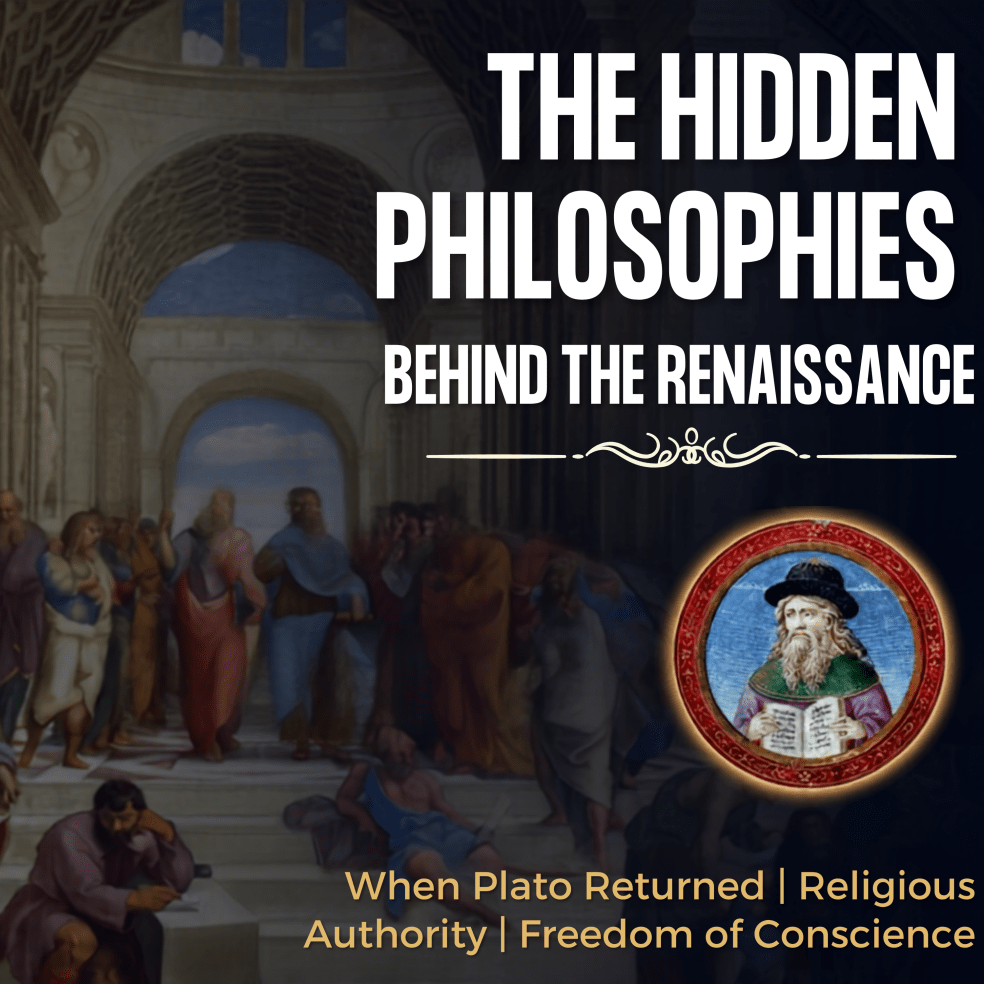
When Plato Returned, Religious Authority, and the Birth of Freedom of Conscience
This week I sat down with fellow Virginian Collin Conkwright of American Esoteric to discuss a topic that has deeply fascinated me: the pagan, Platonic, and esoteric currents that helped shape the Italian Renaissance.
Most of us inherit a fairly simple story. Christianity triumphs, paganism fades away, and the Renaissance eventually arrives as an artistic and cultural flowering. But history is rarely that neat.
One reason these questions interest me is because of Jan Assmann’s idea of the “Mosaic Distinction.” You’ll hear me mention this concept several times throughout the interview, so I wanted to offer more clarification here.
In simple terms, Assmann argued that many ancient religions could accommodate multiple gods, cults, and local traditions, while the Jewish Torah tradition introduced a much sharper distinction between true religion and false religion, orthodoxy and error. A topic we discuss often here, is what happens when competing worldviews are no longer seen as different paths, but as rivals in a struggle over truth itself? That tension sits quietly beneath much of what we discussed in this episode.
Our conversation centered on figures like Gemistos Plethon, the Byzantine scholar who helped reintroduce Plato to Renaissance Italy, and the remarkable recovery of ancient philosophical traditions that many assumed had long vanished. We discussed everything from Neoplatonism and intermediary spiritual beings to the preservation, destruction, and transmission of ancient texts.
One of the themes that kept resurfacing was memory. How much of the ancient world actually survived? How much was lost? And how much of what survives comes to us through institutions that may have opposed the very ideas they were preserving?
The destruction of Plethon’s Book of Laws became a particularly fascinating example. It raises a question I’ve found myself returning to often: when we’re trying to understand antiquity, are we seeing the ancient world itself, or are we seeing the ancient world through the lens of those who copied, edited, condemned, and preserved it?
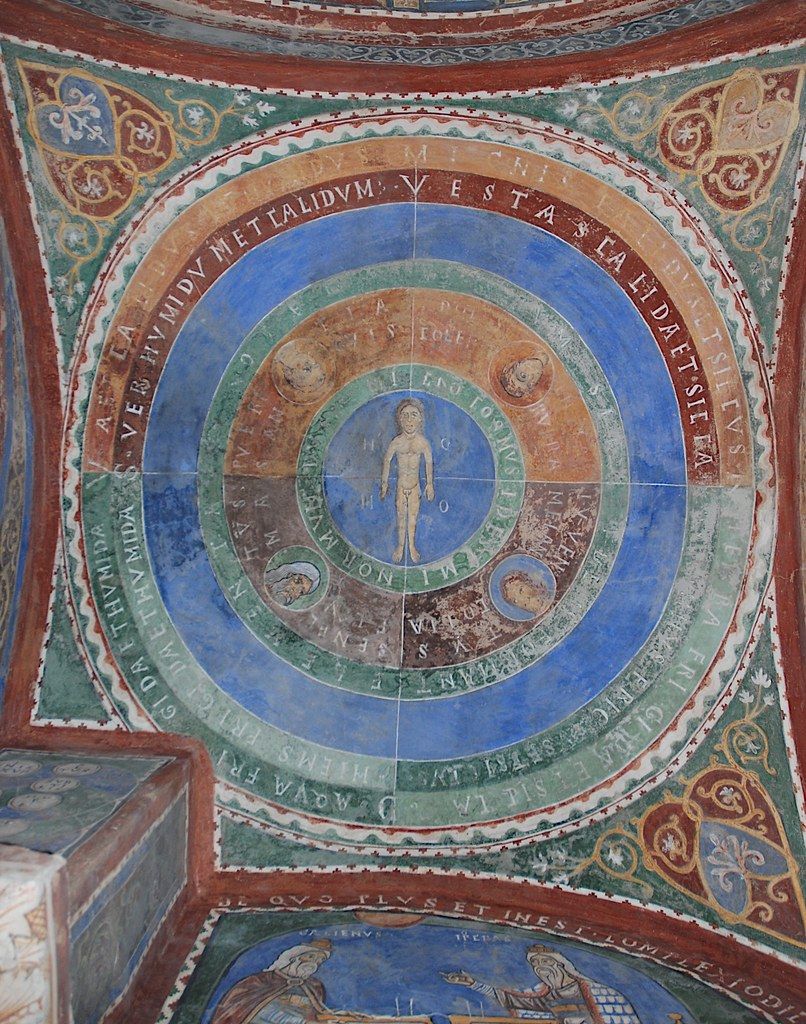
A fresco in Anagni Cathedral C.1250, illustrating the theme of Plato’s Timaeus. At the centre of the universe, the macrocosm, is a human figure, the microcosm. The surrounding circles represent the ages of man, the seasons and the four humours.
We also explored the strange relationship between Christianity and Greek philosophy. The Renaissance recovery of Plato wasn’t entirely foreign to Christian thought. Figures like Philo of Alexandria had already fused Jewish and Platonic ideas centuries before the formal development of Christian theology. In many ways, the Renaissance reopened conversations that had never fully gone away.
This is where the story becomes especially interesting to me.
The Logos language that became so central to Christianity did not emerge from nowhere. It moved through Hellenistic Judaism, and through a world already shaped by Greek philosophical categories.
For me, the broader pattern is difficult to ignore, Christianity positioned itself as transcending both Judaism and paganism while carrying important elements of both within its own intellectual framework. The irony is striking, dontcha think? The later Christian West often came to fear the return of pagan philosophy, even though portions of its own theological architecture had been built from those exact materials centuries earlier.
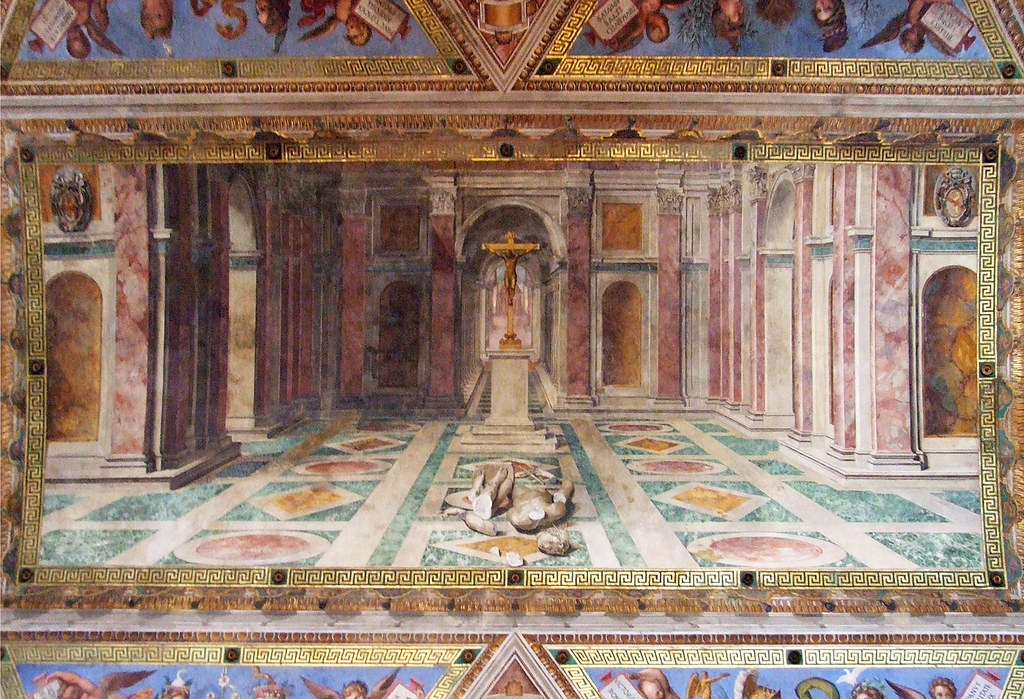
The Triumph of Christianity Over Paganism, by Tommaso Laureti 1585
As Laurent Guyénot puts it, perhaps too sharply for some readers, this represented
“a turning point in Western intellectual history—a Jewish coup on the Gentile mind.”
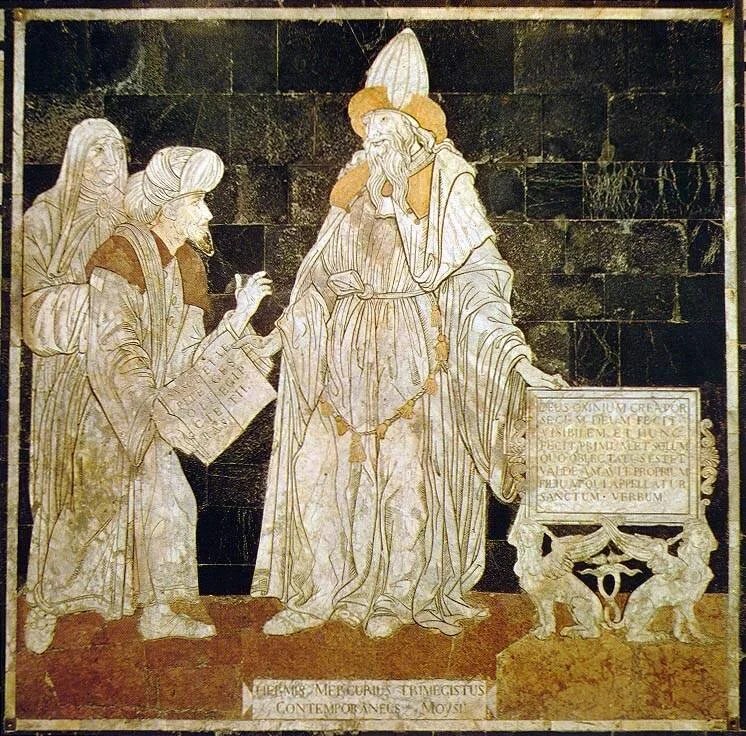
Hermes Trismegistus passing ancient wisdom to the Greeks and Egyptians. Renaissance thinkers increasingly believed that forgotten truths could be recovered through philosophy, mysticism, and ancient texts.
One unexpected moment in the conversation led to a friendly scholarly disagreement between Collin and me. We began discussing Christianity’s relationship to power and empire, and whether the alliance between Christianity and imperial authority represented a corruption of the original movement or something more deeply rooted in the tradition itself.
Collin suggested that he couldn’t imagine Jesus signing off on the imperial structures that later developed around Christianity. My immediate reaction was that I’m not entirely convinced the divide is that clean. The language of kingship, authority, judgment, obedience, dominion, and universal truth claims seems deeply embedded within both the Old and New Testaments. For me, the harder question is not whether Christianity became attached to power, but whether some of those impulses were already present from the beginning.
We didn’t solve that debate, and honestly I’m glad we didn’t.
It’s one of those conversations where reasonable people can look at the same texts and arrive at very different conclusions. I’d be curious to hear where listeners land on that question after hearing the episode.
One reason I loved Collin’s video on Thomas Jefferson and Virginia’s fight for religious freedom is because it reminds us that Americans were not merely inheriting a tidy Christian political order. They were actively trying to disentangle state power from enforced religious authority.
The “Christian nation” narrative becomes much harder to sustain once you start looking at Enlightenment thought, classical influence, religious pluralism, and Virginia’s own struggle over conscience. Early American liberty imagery drew heavily from Greece and Rome while existing within a broadly Christian culture. The Virginia Statute for Religious Freedom and Madison’s arguments against religious assessments did not emerge from nowhere. They emerged from centuries of debate over authority, conscience, philosophy, and the proper relationship between religion and the state.
In many ways, that’s what makes the Renaissance relevant to this conversation.
The recovery of ancient philosophy helped reopen intellectual space. Competing traditions could once again be examined. Older assumptions could be questioned. The monopoly of a single inherited worldview became increasingly difficult to maintain.
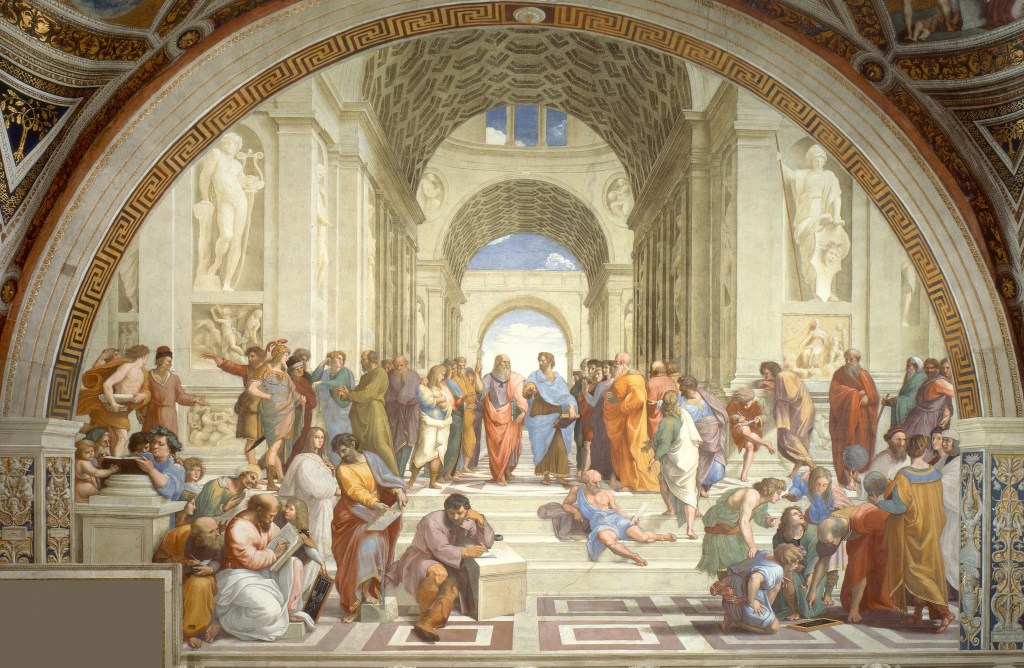
Raphael’s School of Athens places Plato and Aristotle at the center of the ancient intellectual world. Plato points upward toward transcendent realities, eternal forms, and truths beyond the material world, while Aristotle gestures downward toward observation, experience, and the world around us. The painting captures one of the great tensions in Western thought: revelation and reason, idealism and empiricism, the eternal and the earthly. The Renaissance did not merely rediscover classical art. It reopened an entire philosophical conversation that had been unfolding for nearly two thousand years.
The Renaissance itself was, in many ways, an act of remembering. Forgotten texts resurfaced. Ancient philosophers returned to the conversation. Assumptions that had gone unquestioned for centuries were examined again.
Whether we’re talking about Plato, Plethon, Christianity, paganism, religious freedom, or the preservation of knowledge itself, the same questions keep appearing. What do we inherit from the past? What do we forget? What gets preserved, and what gets lost? And perhaps most importantly, who gets to decide?
I hope you enjoy this conversation with Collin Conkwright as much as I did. As always, I’d love to hear your thoughts, especially on our friendly disagreement about Christianity, empire, and whether those two worlds were destined to collide from the beginning or simply converged through the circumstances of history.
Until then, maintain your curiosity, embrace skepticism, and keep tuning in! 🎙️🔒
SOURCES: Adams, John. A Defense of the Constitutions of Government of the United States of America. London: C. Dilly, 1787–1788.
Buckley, Thomas J. Establishing Religious Freedom. Charlottesville: University of Virginia Press, 2013.
Freneau, Philip. On the Universality and Other Attributes of the God of Nature. In Poems Written Between the Years 1768 & 1794, 395–396. Monmouth, NJ: Printed at the press of the author, 1795.
Holmes, David L. The Faiths of Our Founding Fathers. New York: Oxford University Press, 2006.
Jefferson, Thomas. Notes on the State of Virginia. Philadelphia: Prichard and Hall, 1788.
Jefferson, Thomas. The Statute for Religious Freedom. 1777–1786. Manuscript, Virginia.
Madison, James. Memorial and Remonstrance Against Religious Assessments. 1785. Manuscript, Virginia.
Paine, Thomas. Age of Reason. London: J. Watson, 1794–1807.
What Christianity Absorbed, Built, and Left Behind
Listen as you read here!
People say this all the time.
That the West got its ideas about pluralism, tolerance, and liberty from Christianity. That without it, there would be no concept of human dignity, no rights, no freedom in the modern sense. And that if those things feel unstable now, the solution is simple: return to the source.
The claim that pluralism, tolerance, and liberty are direct inheritances of Christianity is not just oversimplified. It reverses the historical pattern.
In Part 1, I pushed back on the idea that Christianity “founded the West” in any clean or singular sense, or that returning to it offers an obvious path forward. In Part 2, I stepped back and looked at something more fundamental: the fragility of freedom itself. Not as an abstract ideal, but as a social order that depends on limits, restraint, and a population capable of sustaining it. More importantly, I looked at how quickly that order begins to break down when those conditions are no longer present.
Across the responses to both pieces, there was a shared sense that something is not working. Not just politically, not just culturally, but at a deeper level that is harder to name.
One way to make sense of that is to stop looking for a single cause and start looking at how the whole inheritance fits together.
Western civilization did not develop along one track. It emerged through multiple layers operating at the same time. At a minimum, those layers include institutions, culture, and psychology.
Institutions include law, political authority, and the distribution of power. Culture includes religion, tradition, identity, and shared meaning. Psychology includes the moral instincts people use to interpret the world: instincts tied to fairness, loyalty, authority, purity, harm, belonging, and threat.
For long stretches of time, those layers reinforced one another. Institutions reflected shared values. Cultural traditions gave meaning to authority. Moral instincts were channeled through forms of life that provided both order and legitimacy.
But that fit was never permanent.
When those layers begin to pull apart, the result is not merely disagreement. It is instability.
That is the backdrop for this final piece.
The goal here is not to argue that Christianity caused the West, or that it deserves credit for everything people now associate with Western civilization. It is also not to reduce Christianity to a purely destructive force. Both approaches distort the picture in different ways.
The same problem appears in the phrase “Judeo-Christian values.” This often creates the impression of a smooth and unified inheritance, when the actual history is far more fractured. Judaism and Christianity are related, but they are not interchangeable. Christianity did not simply preserve Jewish covenantal thought. It reinterpreted it, universalized it, and claimed fulfillment over it. A tradition rooted in a particular people, law, land, and covenant was recast as a universal message for all mankind.
This repositioning changed the role of religion entirely. It no longer sits alongside other domains. It began to judge them.
It loosened religion from peoplehood and place. It made belief itself the primary marker of belonging. And once belief becomes the primary boundary, disagreement takes on a different moral weight.
Today’s article will address the harder question:
What did Christianity reorganize, what did it scale, and what did it leave unstable?
Because Christianity’s real inheritance was not simply compassion, liberty, or dignity. It reshaped how belief, authority, identity, and moral obligation functioned at a civilizational level. It expanded moral language in ways that could operate across large populations, but it also introduced sharper boundaries between true and false belief, salvation and error, belonging and exclusion.
That combination, expansion on one side and constraint on the other, is where the inheritance becomes complicated.
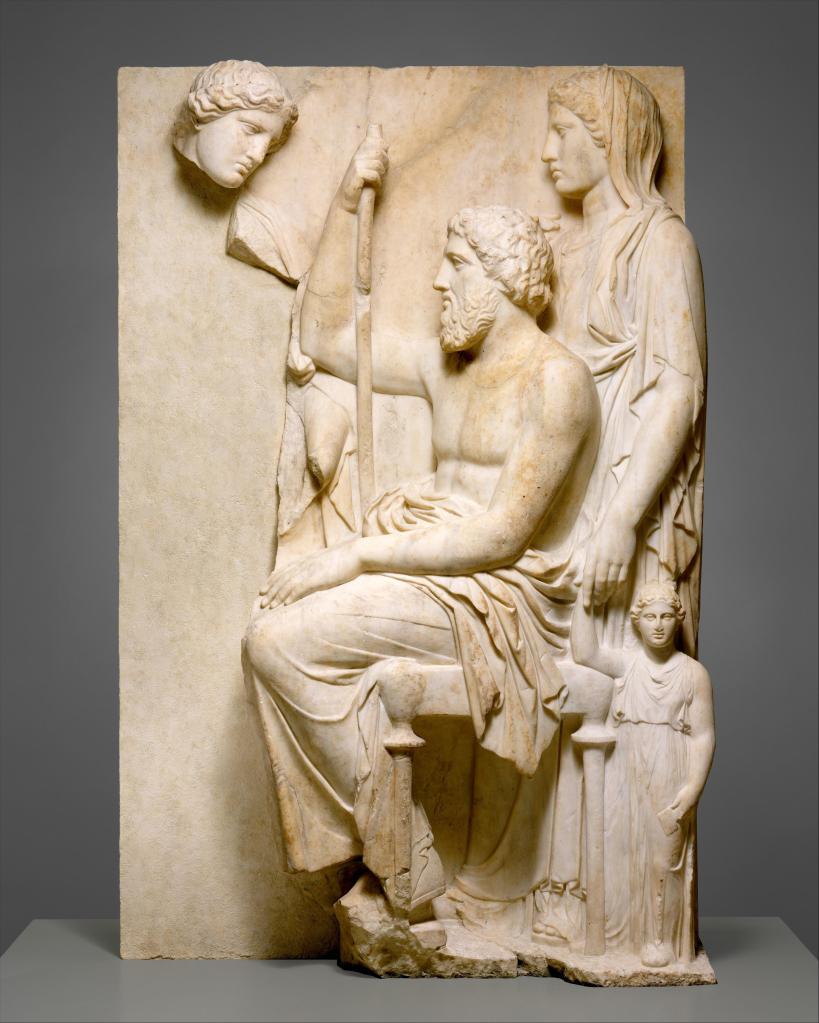
McClees, Helen and Christine Alexander. 1933. The Daily Life of the Greeks and Romans: As Illustrated in the Classical Collections, 5th ed. pp. 131, 133, fig. 159, New York: The Metropolitan Museum of Art.
SECTION I: THE GOOD What Christianity Absorbed and Reorganized
Before getting into what Christianity actually contributed, it’s worth being clear about what is usually attributed to it.
A moral framework. Stable family structures. The unification of fragmented tribal societies into something resembling a shared civilization. A sense of cohesion strong enough to hold large populations together.
Those developments did happen. The question is where they came from…
Because none of those things begin with Christianity. They depend on something older: stability across generations, shared practices, inherited obligations, and a way of life that binds people before it explains itself.
That is what tradition is.
The word itself comes from the Latin traditio: a handing over, a passing down, something delivered across generations. But that definition only gets you so far. Tradition is not just a set of ideas preserved in texts or doctrines. It is lived. It shows up in habits, rituals, inherited gestures, seasonal rhythms, family patterns, and the quiet repetition of things people do not always stop to explain but continue to do anyway.
It exists in the structure of daily life.
You see it most clearly in how societies deal with death.
Long before Christianity became dominant in Europe, burial practices already reflected a deep sense of connection between the living and the dead. In the Stone Age, communities used mass graves in caves or pits. Later, megalithic cultures constructed communal tombs that anchored memory to specific places. Indo-European groups developed barrows and cremation practices that changed over time while preserving the same underlying logic.
The dead were not discarded. They were placed, remembered, and integrated into the ongoing life of the community.
Tradition, in that sense, is not something invented at a particular moment. It is something carried forward, shaped and reshaped over time without losing its original intention.
Christianity enters into that world rather than creating it from scratch.
What changes is not the existence of tradition, but its scale and its organizing thought.
Earlier religious life was largely tied to local identity: tribe, land, household, ancestry, city, and people. Christianity expands beyond that. It speaks in universal terms and builds a shared symbolic order that can operate across regions and populations that do not share the same lineage, gods, rituals, or customs.
That increases the reach of the moral imagination.
Concern no longer stops at the boundary of immediate belonging. It extends outward, attaching value to individuals beyond their role within a specific family, tribe, or city. Over time, that broader vision feeds into developments people now associate with the Western inheritance: ideas about dignity, education, care for the poor, moral responsibility, and obligation toward those outside one’s immediate circle.
But this is typically where the story gets oversimplified.
Those impulses did not originate with Christianity. Traditions within the Greco-Roman world had already developed forms of civic responsibility, philanthropy, patronage, public works, and mutual obligation. Grain distributions, civic benefaction, philosophical ethics, and local forms of duty were not Christian inventions.
But even the Greco-Roman world was not self-contained. It had already absorbed influences from older and neighboring civilizations (Egyptian, Mesopotamian, Anatolian, and Phoenician) through trade, conquest, and cultural exchange. As scholars like Martin L. West and Walter Burkert have shown, Greek thought itself was shaped in part by these eastern traditions.
The ancient world was not morally empty before the church arrived. It was already layered, interconnected, and carrying forward inherited forms of order, obligation, and meaning.
You can see this clearly in Stoic thought. Christianity is often treated as if it introduced universal human concern into a cruel and indifferent ancient world. Stoicism already spoke in universal terms. It could describe human beings as participants in a shared moral order and extend concern beyond tribe, city, or immediate kinship.
But the structure was different.
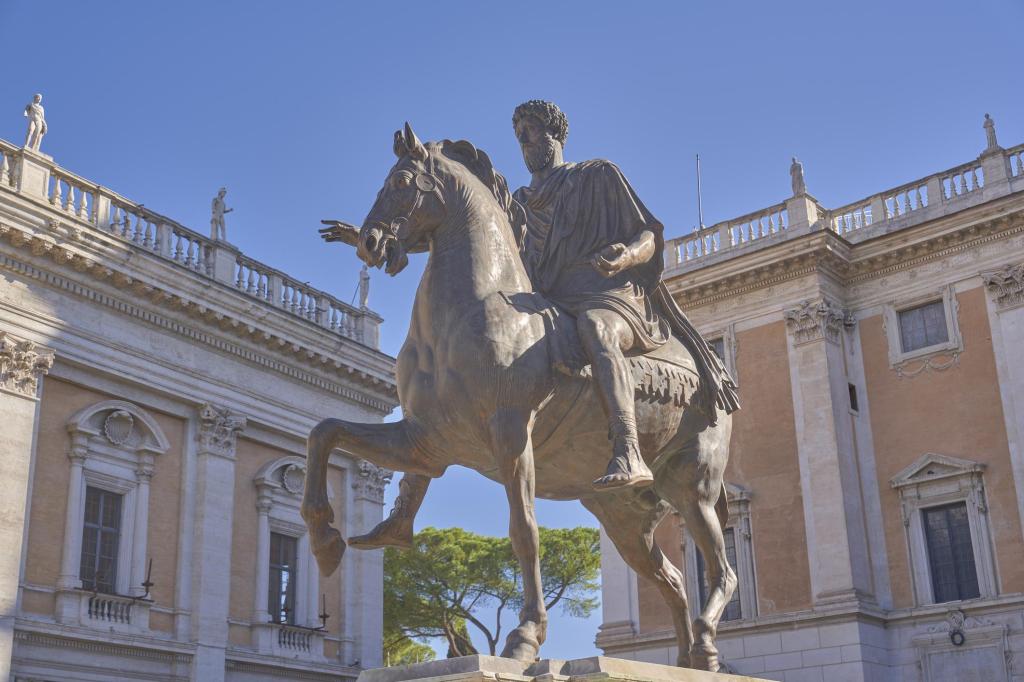
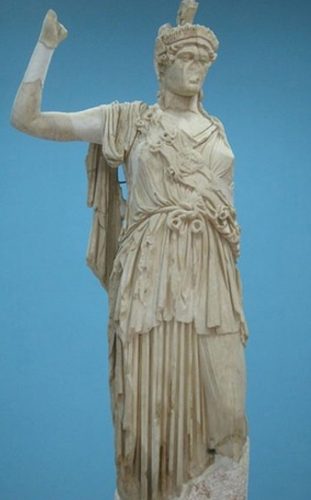
The bronze Equestrian Statue of Marcus Aurelius, Capitoline Hill, Rome.
Runar Thorsteinsson’s comparison of Roman Christianity and Roman Stoicism helps clarify the distinction. Stoicism could speak of universal humanity without making moral belonging depend on conversion to a saving truth. Early Christianity, by contrast, carried a universal message while also drawing a sharper boundary around religious adherence. Its moral vision expanded outward, but it did so through a division between those inside and outside the saving order.
Christianity did not invent universal concern but it did reorganize it.
It took older moral instincts, philosophical ideas, Jewish inheritance, Roman scale, and local traditions, then bound them into a universal religious narrative. It gave those instincts a broader scope, a more unified story, and a more durable institutional form.
But expansion alone does not explain why a civilization holds together.
A social order lasts when it fits the way people already experience the world.
People do not move through life as detached rational observers. They respond through instinct: loyalty and betrayal, fairness and injustice, authority and rebellion, purity and contamination, belonging and threat. These instincts do not operate on their own. They cluster.
In more traditional societies, moral intuitions tend to reinforce one another. Care, fairness, loyalty, authority, and a sense of the sacred operate together rather than pulling apart. Even when people disagree, they often draw from the same underlying moral vocabulary when interpreting what is happening around them.
That shared moral vocabulary gives a society stability.
Christianity operated at that level.
It did not simply present moral rules. It gave instinct narrative form and placed it inside a larger story about meaning, suffering, hierarchy, obligation, sin, redemption, and ultimate reality. It offered a way of interpreting the world itself.
For people living in unstable conditions, where political authority could be inconsistent and survival uncertain, that kind of story organized experience. It offered coherence in a world that might otherwise feel random. It placed individuals inside a larger order and gave meaning to suffering, duty, death, and loss.
Once that fit took hold between cultural meaning, institutional power, and moral instinct, it became difficult to dislodge.
At the same time, Christianity did not remain completely closed off to innovative thought. Even within a religious order that emphasized authority and inherited truth, there were moments where that inheritance was tested from within.
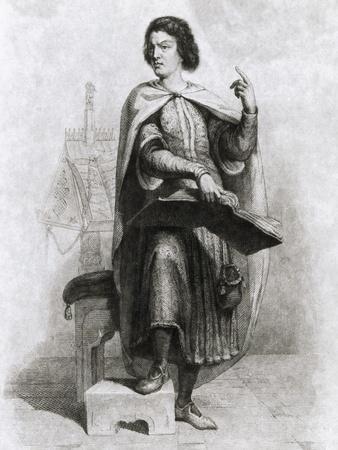
Peter Abelard represents one of those moments.
His importance lies less in the drama of his life and more in the method he applied to truth itself. The intellectual world he entered was structured around inherited authority. Figures like Augustine were treated as settled voices, and the role of the student was often to understand, organize, and transmit what had already been established.
Peter Abelard with Book Giclee
Reasoning had a place, but it operated within limits. It was expected to clarify, not destabilize.
Abelard did not reject the tradition from the outside. He worked within it and exposed its internal tensions. In Sic et Non, he placed authoritative statements side by side in a way that made contradiction difficult to ignore.
If these sources were meant to provide certainty, why did they diverge so sharply?
If truth had already been handed down in a unified form, why did it fracture under comparison?
He treated those questions as a starting point rather than a threat to avoid.
“For it is from doubt that we arrive at questioning, and in questioning we arrive at truth.”
That quote represents the change in intellectual posture.
Instead of beginning with certainty and using reason to defend it, Abelard begins with tension and uses reason to work through it. Authority alone no longer settles the issue. Claims must be examined, language clarified, and assumptions tested.
Once questioning becomes legitimate, authority can no longer rely on transmission alone. It now has to also persuade.
Abelard pushed beyond accepted limits. He applied reason to doctrines often treated as beyond rational explanation and placed greater emphasis on intention in moral evaluation. In doing so, he opened space for a more nuanced understanding of ethics, one not entirely bound to inherited categories.
The response to him was what you would expect from institutional power.
He was condemned. His works were burned. He was brought before councils that were less interested in exploring his arguments and more so in containing their implications. The reaction showed what was at stake. A religious order grounded in authority does not easily absorb a method that legitimizes doubt.
And yet the method persisted.
Even when his specific conclusions were rejected, the habit of inquiry he modeled proved difficult to suppress. The practice of setting opposing views side by side and working through contradiction became central to scholasticism. The intellectual tradition that later shaped medieval universities carried forward elements of an approach once treated as dangerous.
Abelard does not stand alone as the cause of a broader intellectual reopening. The recovery of classical texts, the reintroduction of Aristotle, contact with Islamic and Jewish scholarship, and the growth of educational institutions all played a role.
What his story represents is the shift in attitude.
Inherited knowledge no longer functions as a sealed inheritance. It became something that can be examined, refined, and, within limits, challenged.
Of course, those constraints never fully disappeared.
Abelard was allowed to question, but not indefinitely. He was permitted to reason, but not without consequence. The same religious culture that made his work possible also defined where it had to stop.
That tension between authority and inquiry did not remain confined to intellectual life. It also carried forward into the institutions that developed over time.
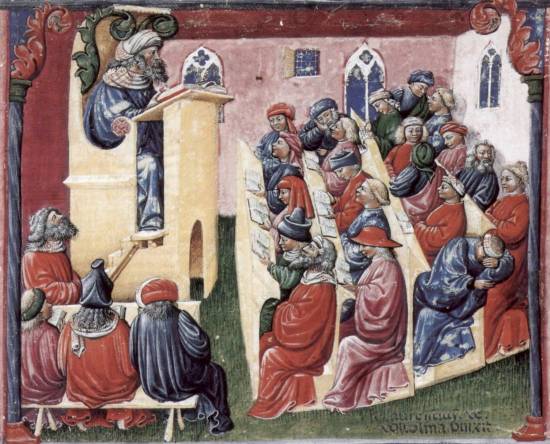
A university lecture (an illustration from the second half of the 14th century).
The medieval university is one of the clearest places to see this pattern at work. Often treated as a distinctly Christian achievement, it grew out of a much broader mix of influences.
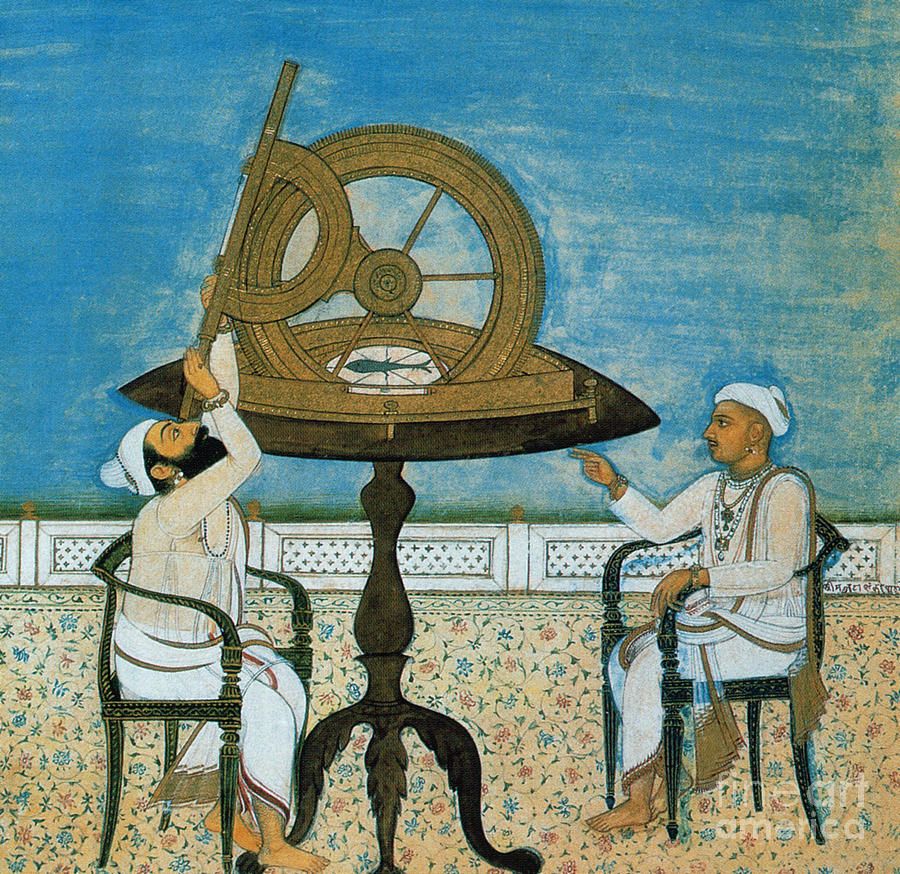
In Spain, Baghdad, and Cairo, Islamic schools, libraries, and observatories held resources far beyond anything available in much of Europe at the time. Arab, Jewish, and Christian scholars shared intellectual interests through expanding trade networks and translation movements. After the Christian capture of Toledo in 1085, that city became one of the key places where these worlds met, allowing texts to move across languages, traditions, and religious boundaries.
The Western reopening of inquiry did not happen because Europe simply looked inward and rediscovered itself.
It happened because knowledge traveled.
Averroes’ commentaries on Aristotle, translated into Latin, became essential sources for thirteenth-century Christian intellectuals, including Thomas Aquinas. That alone should complicate any idea that Christian scholarship developed in isolation. The university absorbed, translated, debated, and reorganized knowledge that had already passed through Greek, Arabic, Jewish, and Latin traditions.
Islamic Astronomers #1 is a photograph by Science Source
Even the structure of medieval universities reflects that broader inheritance. They developed their own corporate identities, governed collectively by masters, with distinct curricula and examination systems. By the late thirteenth century, Master of Arts could vastly outnumber Master of Theology. Historian Charles Freeman notes one example where 120 teachers of the arts were listed against only 15 Masters of Theology. That imbalance tells you what mattered most. The curriculum leaned heavily on classical texts, not purely Christian foundations.
Christian Europe helped institutionalize learning, but the material being organized was older, broader, and more cosmopolitan than the church-centered story suggests. The university becomes another example of Christianity’s larger pattern: it absorbed existing goods, gave them institutional form, and placed them inside its own theological horizon.
But the results did not move in one direction.
The same religious vision that could support care and dignity could also justify hierarchy and control. Because the tradition depended on scriptural interpretation, and interpretation depended on authority, very different conclusions could emerge from the same source material.
That instability is not only a matter of later interpretation. It is already present in the texts themselves.
The Gospels do not present a single, unified account. They offer overlapping portraits that do not fully align.
In Gospel of Matthew and Gospel of Mark, Jesus cries out, “My God, my God, why have you forsaken me?” while in Gospel of John, he concludes, “It is finished.” The tone shifts from abandonment to completion.
The timeline shifts as well, with the Synoptic Gospels placing the final meal at Passover, while John places the crucifixion before it begins.
Even the ethical posture is not entirely consistent: in Matthew, Jesus teaches “turn the other cheek,” while in Luke, he tells his followers, “Let the one who has no sword sell his cloak and buy one.”
Taken together, these are not minor discrepancies. They open space for fundamentally different readings of what the tradition demands.
Christianity persists not as a fixed form, but as a tradition capable of producing multiple, competing forms while still claiming continuity.
This becomes especially clear in debates over slavery.
Christians were involved in abolition movements, and that history is part of the record. The language of universal moral equality played a real role in mobilizing opposition to slavery and reshaping moral expectations.
But that is not the whole story.
The same texts were also used to defend slavery, reinforce it, and argue that existing social orders were divinely sanctioned.
That contradiction is not incidental. It reveals something important about the Christian inheritance itself.
A religious order that combines universal moral language with authoritative texts creates the conditions for both expansion and constraint. It can push moral concern outward, but it can also bind that concern within approved categories. The outcome depends on who interprets the texts, which authorities prevail, and what social pressures shape the reading.
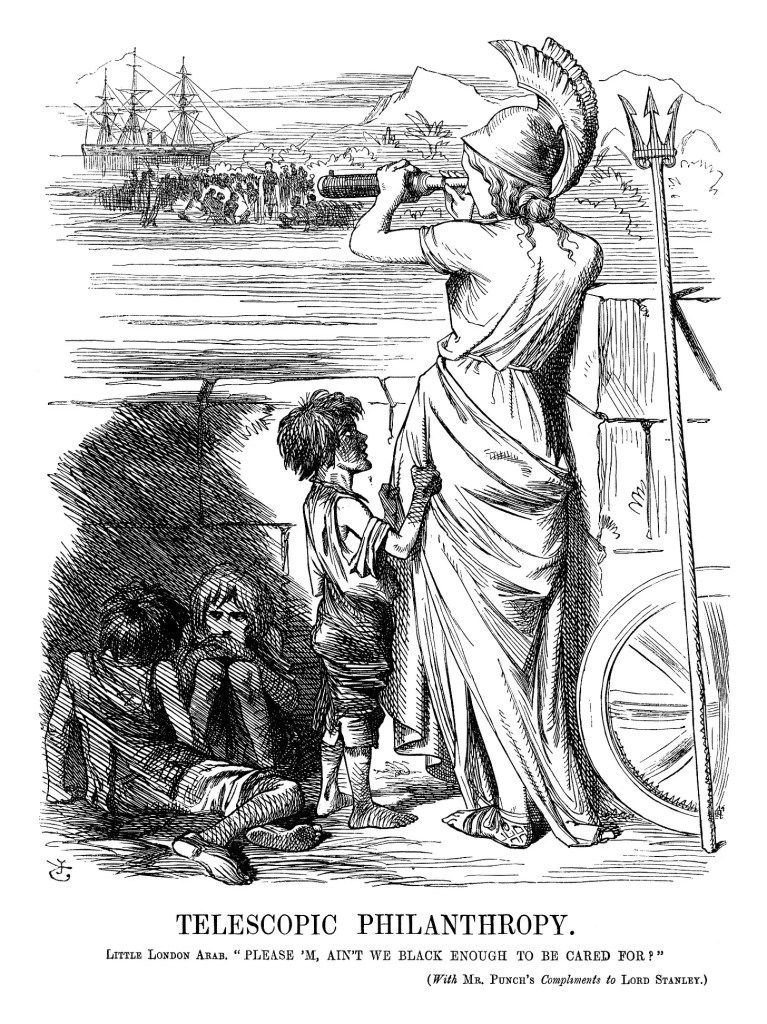
Critics of abolitionist movements, including Thomas Carlyle, argued that what they saw as abstract humanitarian concern could override more immediate obligations or practical realities. A contemporary political cartoon captured this dynamic under the phrase “telescopic philanthropy”—a tendency to focus moral concern at a distance while neglecting what is closer at hand.
The point I’m trying to make here is not that concern beyond one’s own group is inherently false or wrong.
The point is that moral expansion creates distance.
The farther a concern stretches, the easier it becomes to neglect concrete obligations close at hand: family, neighbors, local order, inherited duties, and the people one is actually responsible for. Abstract compassion can become morally flattering precisely because it asks less of the person expressing it.
Whether one agrees with those criticisms or not, they point to something very real.
A moral order that expands obligation beyond local belonging gains reach, but it also risks losing proportion. It can elevate the stranger while forgetting the neighbor. It can speak beautifully about mankind while failing the people right in front of it.
Christianity extended moral concern beyond tribe and built institutions that carried that vision forward. But it also introduced pressures around authority, interpretation, exclusion, and the limits of acceptable thought.
The good is real, but…so is the tension inside it.
Christianity’s inheritance was not simply compassion, dignity, or education. It was a moral architecture: universal in scope, institutional in form, inward in psychology, and unstable once detached from the cultural world that had once held it together.
That brings us to our next inquiry.
Not just what Christianity gave the West, but what kind of order made those outcomes possible.
SECTION II — THE BAD
Truth, Authority, and the Limits of Inquiry
At this point, the issue is not simply what happened when Christianity moved from the margins to power. I’ve explored that elsewhere: the suppression of rival systems, the narrowing of acceptable thought, and the long habit of treating competing worldviews not as alternatives to debate, but as errors to contain.
The deeper question here is more structural.
What kind of religious order produces those outcomes in the first place?
Because the shift was a reorganization of how truth operated, how disagreement was handled, and how legitimacy was defined.
Earlier Greco-Roman religious and philosophical life was not tolerant in the modern sense, but it was more comfortable with multiplicity. Rival schools, local cults, household gods, civic rituals, and philosophical traditions could coexist without requiring one totalizing creed to absorb or eliminate the rest. That did not make the ancient world peaceful or morally pure. It did mean that truth was not always treated as one fragile object that had to be protected from every rival.
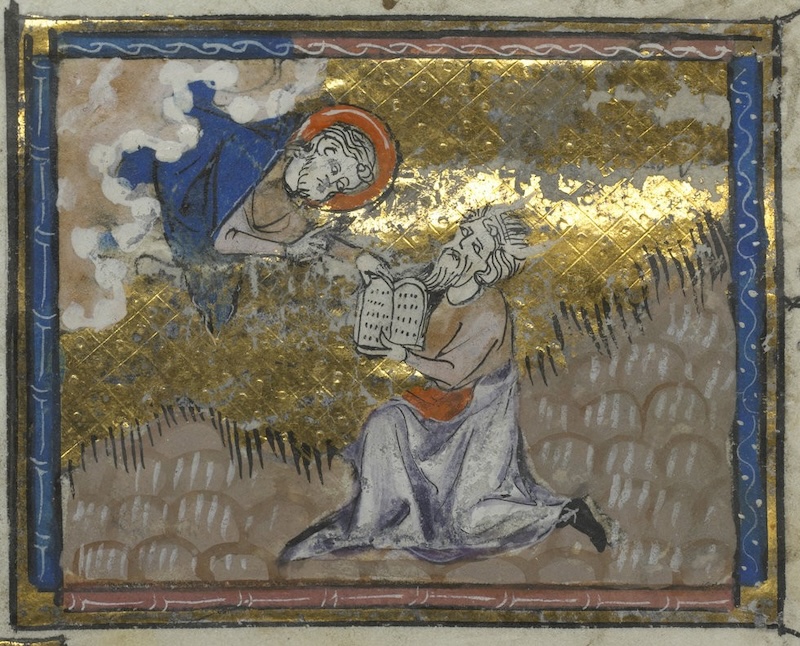
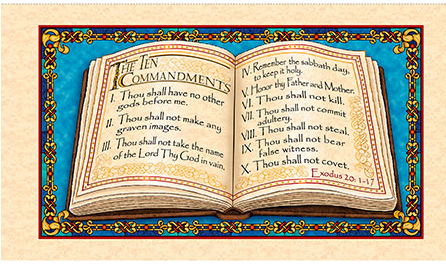
The Abrahamic worldview introduced something different, often called the “Mosaic distinction.”
God giving the Tablets of the Law to Moses, from a manuscript attributed to Chrétien Legouais, 1325 CE. Image source: gallica.bnf.fr / Bibliothèque municipal de Rouen
It drew a sharper line between true and false in a way that changed the stakes of disagreement. Belief was no longer simply one option among many. It became a dividing line. Once that line was drawn, alternative ways of seeing the world did not remain neutral. They became errors, and error began to carry drastic consequences beyond private belief.
If truth is singular and binding, then the religious order has to decide what to do with everything outside of it. Some ideas are absorbed. Some are tolerated for a time. Others are pushed out entirely. But none of them sit comfortably alongside it anymore. They exist in tension with the claim that one truth must govern above all others.
As we previously discussed, Christianity is often credited with preserving learning and building universities, and that claim is not false. Medieval universities became important institutions for intellectual training, debate, law, theology, medicine, and philosophy. They helped organize knowledge and gave scholastic inquiry a durable form.
But that achievement has to be kept in proportion.
The medieval university was an achievement, but it was not a recovery of classical freedom. It was classical inheritance under theological supervision.
Ancient philosophy could be studied, but it had to be reconciled with Christian doctrine. Aristotle could return, but not as Aristotle alone. He had to be interpreted through Christian categories, corrected where necessary, and placed beneath revealed truth. Reason was permitted, even sharpened, but it was not sovereign.
The medieval university did not represent inquiry on open ground. It represented inquiry inside boundaries. Reason could clarify doctrine, defend doctrine, organize doctrine, and reconcile contradictions within inherited authorities. But when reason pressed too far against the architecture of belief, the limits became quite visible.
That does not make medieval learning worthless. It makes it conditional.
And that conditionality is the point.
Christian Europe did not simply preserve the classical world. It received it, edited it, baptized it, and constrained it. What could be made useful to the Christian order survived more easily. What threatened that order did not.
This is the kind of intellectual narrowing later critics would recognize in Christianity’s relationship to philosophy. Heidegger’s critique of onto-theology is not aimed at Christianity alone, but it helps name the pattern: open-ended questioning becomes absorbed into a prior explanatory order. Instead of wonder remaining primary, inquiry is routed through established claims about creation, causality, divine order, sin, and salvation.
The question is no longer allowed to remain fully open.
It has to be answered inside the architecture of doctrine.
Once orthodoxy is established it operates within boundaries that have already been set, and stepping outside those boundaries starts to carry not just intellectual consequences, but social ones. Access to authority, education, and influence becomes tied, at least in part, to alignment.
At that point, belief is no longer just something people hold. It becomes something that moves outward, seeking to correct and expand.
SECTION III: THE UGLY
Universalism, Power, and the Moral Afterlife
By the time you reach the modern West, the question is no longer whether Christianity shaped it. That much is obvious. The deeper issue is what, exactly, it left behind, and what happens when the conditions that once sustained that inheritance begin to unravel.
Christianity did not simply introduce a set of beliefs and then fade as those beliefs weakened. It reorganized moral life at a level that persists long after doctrine loses its authority. It changed how individuals understood themselves, how they related to others, where moral responsibility resided, and how truth was expected to move through the world.
The ugly side of the Christian inheritance is not merely universalism. It is universalism with a missionary engine.
Christianity does not simply say, “This is true.” It says truth must be spread. Error must be corrected. The world must be brought into submission to the saving order. That structure changes the meaning of difference. A rival worldview is not merely foreign, local, or ancestral. It becomes spiritually demonic.
And once a difference becomes an error, correction can be justified as mercy.
The religious world Christianity emerges from was already in tension with the surrounding Greek and Roman order. Second Temple Judaism didn’t simply blend into Hellenistic life. Again and again, it resisted it—politically, culturally, religiously.
D. H. Lawrence saw this tendency clearly. In Apocalypse, he describes a fear-driven impulse within Christianity—a refusal to leave other ways of understanding the world intact. Not just disagreement, but the drive to overcome, absorb, or eliminate what stands outside the truth.
That instinct is already embedded in the apocalyptic world Christianity emerges from. Second Temple Judaism carries expectations of final judgment, cosmic conflict, and the ultimate victory of a single, rightful order-the coming of the Moshiach/Messiah.) Christianity inherits that framework and gives it a wider reach.
That is where Christianity’s relationship to Rome becomes essential. Christian universalism did not spread on its own. It moved through the late imperial Roman systems: roads, cities, law, administration, literacy, political centralization, and habits of governance already trained toward scale. The faith did not merely conquer Rome. It also inherited Rome’s machinery.
Rome gave Christianity infrastructure. Christianity gave Rome a sacred moral horizon. Together, they helped produce a form of power that could move across peoples, lands, languages, and customs while claiming to operate in the name of truth rather than mere domination.
This is also why Christianity receives too much credit for goods it did not invent.
One reason it’s treated as the source of Western morality is that it became dominant enough to absorb older goods and narrate them backward as Christian achievements. Care for the poor, philosophical inquiry, civic duty, moral discipline, education, and concern for the common good did not appear out of nowhere when Christianity entered history. Many of these were already present in Greek, Roman, Jewish, and local European worlds. Christianity reorganized them inside its own story.
That reorganization gave them reach.
But it also gave them a new master narrative.
Older traditions were often embedded in particular peoples, places, households, ancestors, cities, gods, calendars, and sacred landscapes. Religion was not just a private belief system. It was woven into the life of a people. Christianity altered that relationship by making belief portable. It could cross borders, override local cults, and create a community defined less by blood, land, or inherited custom than by shared confession.
That is one of the most consequential shifts in Western history.
Christianity weakened the older link between people, place, ancestors, and gods. It did not erase those attachments overnight, and in practice it often absorbed local festivals, sacred sites, and folk customs. But the deeper logic changed. The highest belonging was no longer rooted primarily in the local or ancestral. It was relocated into a universal religious identity.
Conversion, then, was not merely persuasion. It was the remaking of belonging.
A people could be separated from their gods, their rituals, their inherited calendar, their sacred places, and their ancestral memory, then folded into a new universal story that claimed to redeem them while also replacing the world that formed them.
Not every conversion was violent. That would be too simple. Some conversions were gradual, political, strategic, sincere, blended, or partial. But once that universal truth claim became tied to salvation, rival traditions do not remain equal neighbors. They become obstacles to be overcome, errors to be corrected, or remnants to be absorbed.
The First Crusade: Pope Urban II and Jerusalem vs. Diplomatic Unification
The crusades make this structure visible in its most explicit and militarized form.
They were not only political wars. They were religious wars shaped by sacred geography, penitential promise, and the belief that violence could be folded into a redemptive order.
The Crusades did not simply mobilize Europe—they redirected it toward Jerusalem, a sacred center that was not its own.
That does not mean every participant had the same motive, and it does not mean politics, land, wealth, status, and military ambition were irrelevant. Of course they mattered. But the crusading imagination reveals something specific: once warfare is placed inside a sacred story, conquest can be interpreted as obedience, purification, defense, or salvation.
That is the danger of missionary structure joined to power.
It sanctifies expansion.
And this is not confined to medieval history. The same basic pattern can reappear whenever politics inherits religious moral intensity. The opponent is no longer merely wrong about policy. He becomes a threat to truth, justice, salvation, progress, safety, democracy, equality, or whatever sacred term now carries the old theological weight.
At that point, disagreement becomes harder to contain.
The modern West inherited this moral intensity even as explicit Christian authority declined. Most people inherited a world in which Christianity had already begun to lose its grip, but nothing fully replaced it. The rituals became optional. The authority fractured. Yet many of the underlying assumptions remained intact.
What had once been explicitly theological was gradually translated into secular terms.
At the center of that structure is a form of universalism Christianity helped entrench: the idea that all people stand beneath one moral order, that identity is secondary to a broader human category, and that truth applies universally rather than locally. That assumption did not disappear with religious decline. It migrated.
Liberalism, in many of its modern forms, carries that template forward: the individual abstracted from place, lineage, inherited duty, and thick communal belonging, then positioned inside a universal framework of rights, equality, and moral expectation.
The language changes. The structure does not.
The West moved from Christian universalism to liberal universalism without seriously interrogating the universalism itself. It replaced theological justification with philosophical or political justification, but it retained the assumption that the highest moral order transcends particular identities rather than emerging from them.
And what carries forward is not only universal morality, but missionary mentality.
Salvation becomes progress. Sin becomes injustice. Heresy becomes hate. Evangelism becomes activism. The world must still be corrected. The morally backward must still be brought into line.
And the irony is hard to miss. The same people who pride themselves on rejecting religious dogma often reproduce its structure almost perfectly—moral certainty, heresy-hunting, and the impulse to correct and convert, just without calling it religion.
You can see this most clearly in the modern left, especially in its activist and radical edges. What presents itself as political theory often behaves like secularized salvation mythology. The infrastructure is unchanged: the world is broken and the masses need liberation. God is removed, but everything else remains. The heretics still need correction. Sin becomes hierarchy. Salvation becomes self-rule. The missionary doesn’t disappear—he just changes form.
It still sorts people into the righteous and the condemned. It still creates moral taboos. It still treats disagreement as contamination. It still imagines that the world can be redeemed if only the right moral order is imposed—with enough force, shame, education, policy, or institutional pressure.
That is not the absence of Christianity.
It is part of its afterlife.
Later European expansion, and even modern geopolitical projects, often operate within the same structure—intervention framed as liberation, reform, or progress.
Whenever universal moral claims are aligned with power and tied to the belief that truth must spread, action begins to feel necessary rather than optional.
To understand why it persists, and why it adapts so easily across different historical contexts, you have to look at what is happening at a deeper level. Not just in institutions or empires, but within the individual.
Because the most enduring change Christianity introduces is not only institutional.
It is psychological. It altered where morality is located.
In earlier classical traditions, especially in Aristotle, the moral life is oriented outward. The Greek conception of eudaimonia assumes that human beings can develop toward excellence. Flourishing is cultivated through practice, discipline, rational activity, and participation in the world. Character is formed through what one does, and the moral life is outward, embodied, and lived over time within a shared civic and social context.
Christianity, especially through Augustine of Hippo, redirects that focus inward.
The problem is no longer simply what a person does, but what a person is. Human nature itself becomes suspect, marked from the beginning. The doctrine of original sin reframes the individual not as someone developing toward excellence, but as someone starting already compromised. This is not just about isolated wrongdoing. It is about a baseline disorder built into human existence, transmitted across generations, shaping inclination before any conscious choice is made.
From that premise, morality reorganizes itself accordingly. If the problem lies within, then moral evaluation cannot remain limited to outward behavior. It extends inward, into thought, desire, intention, and impulse—the parts of life no one else sees but are still treated as morally significant.
Fra Angelico, The Conversion of St. Augustine (c. 1430−1435)
This becomes structured into daily practice. Monastic traditions classify internal states (temptation, pride, doubt, desire) as if they were items that could be named, tracked, and corrected. Authority expands beyond regulating behavior into defining what counts as acceptable thought, shaping not just action but the boundaries of the inner life itself.
Once it relocates inward, the primary site of regulation is no longer only the community. It is the individual mind, where conscience, guilt, confession, fear, and self-regulation operate continuously, often without any visible external enforcement.
You can see the implications of this in the conflict between Augustine and Pelagius. Pelagius emphasizes human capacity: the ability to choose, improve, and take responsibility for moral development. Augustine rejects that position, insisting on dependence—on God’s grace, on divine intervention, on something beyond human effort.
This is not only a theological disagreement.
It is also a question about agency.
If the individual cannot fully rely on their own capacity to move toward the good, then moral development becomes entangled with God’s authority. Responsibility does not disappear, but it no longer stands on its own. It becomes mediated, conditioned, and in some cases limited, as the individual is situated within a framework that places ultimate transformation outside of purely human reach.
Over time, that tension begins to shape intellectual life as well. Historians like Charles Freeman do not argue that inquiry simply disappeared, but that the conditions surrounding it changed. When belief becomes tied to salvation, and when error carries not only intellectual but spiritual consequences, curiosity itself begins to look different. Questions are no longer neutral exercises. They take on moral weight, and in certain contexts, they begin to carry risk.
Writers like Thomas Paine noticed this and pushed directly against the idea that truth can rest on inherited authority. In The Age of Reason, Paine argues that revelation, once it passes through human hands, can no longer function as unquestionable truth. What begins as divine claim becomes human interpretation, and therefore something that must be examined rather than simply accepted. That move cuts directly against the structure that treats questioning as risk. It reopens the possibility that belief itself should be subject to the same scrutiny as anything else.
Mark A. Noll describes a similar pattern in later Christian intellectual culture: a tendency to preserve belief rather than extend it. Questioning is not always welcomed as curiosity. It can be interpreted as disloyalty, a sign that alignment is weakening rather than deepening. The safest position, in that environment, becomes one of conformity rather than exploration.
The obedient mind is the secure mind.
This is not new. It is already visible earlier in the tradition. The same system that could produce figures like Abelard (where questioning began to reopen) also produces the conditions Noll is describing, where belief becomes something to preserve rather than extend.
The instinct to monitor thought, to moralize disagreement, to treat deviation as more than error—those habits do not emerge in a vacuum. They develop within specific historical conditions, and they persist even as the surrounding language changes.
This is why the internal reorganization matters.
It is not only about doctrine.
It is about how individuals learn to relate to themselves.
If Augustine relocates morality inward, Protestantism amplifies and personalizes that shift. The individual is placed in more direct relation to truth, expected to read, interpret, examine, and align himself without the same mediating structures that once guided that process. Authority does not vanish. It becomes more diffuse and more demanding.
The church hierarchy may weaken in some places, but new pressures emerge through scripture, sermon, household discipline, community surveillance, literacy, and conscience. The individual is made more responsible before God, but also more exposed.
The burden of interpretation moves further into the self.
Over time, that inward structure detaches from the communal and cultural worlds that once gave it shape. What remains is a society of individuals expected to interpret, justify, and regulate themselves inside a universal moral order, but without a shared culture capable of holding that process together.
That misalignment becomes visible in how people interpret conflict, identity, history, and political life.
In modern America, this can still be seen in forms of biblical literalism, dispensationalism, and end-times prophecy that shape how many Christians understand Israel, war, nationhood, and world events. These beliefs do not remain private. They influence political imagination. They affect how people interpret history, alliances, enemies, and what they believe is inevitable or divinely sanctioned.
In this context, belief stops being just belief. It starts shaping how everything else is seen.
That is the same mechanism operating in another key. The pattern that once defined orthodoxy and constrained variation does not disappear. It adapts as the cultural environment shifts. The language evolves, but the underlying habit remains… truth is singular, error is dangerous, and those outside the moral order must be corrected, converted, contained, or cast out.
What this reveals is not a simple story of progress or decline.
Christianity did not leave behind a stable moral foundation that the West either followed or abandoned. It left behind a set of interacting pressures: universalism and particular identity, internalized morality and external authority, individual responsibility and collective order, compassion and conquest, salvation and exclusion.
For a time, those pressures could be held in relative balance, but this fit no longer holds.
The institutions remain, but they no longer command the same trust. The moral instincts remain, but they are no longer guided by a shared tradition. The universal language remains, but it floats above increasingly fractured peoples, places, and loyalties.
Conflict becomes more moralized. Disagreement becomes harder to contain.
This is why the modern West feels both thin and volatile.
Thin, because inherited forms of continuity have weakened.
Volatile, because the moral pressure embedded in the inheritance remains, now operating without the older structures that once gave it proportion.
That is the condition the modern West has inherited.
CONCLUSION: Why the West Still Cannot Escape the Problem
The Christian inheritance of the West cannot be reduced to either gratitude or resentment.
It gave moral concern, meaning to suffering, durable institutions, and the preservation and transmission of knowledge, even as that knowledge was filtered through doctrine. It created a shared moral vocabulary capable of binding large populations together.
But it also changed the terms of belonging.
It loosened religion from peoplehood, place, ancestry, and local custom. It made belief portable. It turned truth into something singular and binding, making disagreement morally charged. Once rival traditions became errors rather than neighbors, the pressure to absorb, correct, or suppress them followed naturally.
The West did not abandon Christianity so much as carry its habits forward. The missionary impulse remained. The abstract individual remained. The suspicion of rooted identity remained. Social Justice became their new end times.
That is why a return to Christianity does not solve the problem. It would not restore a stable foundation but reassert one layer of the inheritance while leaving its tensions unresolved.
Secular liberalism does not solve it either. It often preserves the universalism while stripping away the cultural limits that once gave it proportion, asking people to live as abstract individuals inside a moral framework detached from place, memory, and inherited obligation.
What remains is not a coherent worldview, but a contradictory one.
From the beginning, the inheritance carried competing impulses. Early Christianity emerged from an apocalyptic environment while also developing moral and institutional frameworks for life within the world. Over time, those tensions were not resolved but reworked and emphasized in different ways.
Within Protestantism alone, some strands treated the world as something to be ordered and reformed, energizing movements like abolition, while others emphasized its corruption and eventual end, orienting life toward endurance and escape. The divergence is not a break from the tradition, but a difference in emphasis within it.
The result is a system that can point in opposite directions while still claiming the same foundation.
This is not a foundation a civilization can stand on.
A civilization needs moral scale, but also proportion. Compassion, but not so abstract that it forgets its own people. Rights, but not detached from duty. Inquiry, but not subordinated to sacred certainty. Space for disagreement, but enough shared identity to keep it from becoming civilizational warfare.
Above all, it needs rooted obligations.
A civilization cannot survive on abstract principles alone. It needs loyalty, shared memory, boundaries, place, and a people capable of recognizing what is theirs to preserve.
Because removing structure does not remove power. It removes the forms that make power visible and accountable. And when that happens, power does not disappear. It shifts—into forms that are harder to see and harder to resist.
We are not standing outside this inheritance.
We are still working within it.
And the task is not to romanticize Christianity, completely demonize it, or pretend we have escaped it, but to understand what it absorbed, what it built, what it destabilized, and what it left behind clearly enough to stop repeating its most destructive patterns.
Atkinson, Kenneth. “Judean Piracy, Judea and Parthia, and the Roman Annexation of Judea: The Evidence of Pompeius Trogus.” Electrum 29 (2022): 127–145. https://doi.org/10.4467/20800909EL.22.009.15779
Augustine. Confessions.
Augustine. The City of God.
Brown, Peter. Augustine of Hippo: A Biography. Berkeley: University of California Press, 2000
Burkert, Walter. The Orientalizing Revolution: Near Eastern Influence on Greek Culture in the Early Archaic Age. Cambridge, MA: Harvard University Press, 1992.
Doner, Colonel V. “Cognitive Dissonance of Political Activists, Or Whatever Happened to the Religious Right?” Chalcedon, July 1, 1999.
Freeman, Charles. The Closing of the Western Mind: The Rise of Faith and the Fall of Reason. London: Heinemann, 2002.
Freeman, Charles. The Reopening of the Western Mind: The Resurgence of Intellectual Life from the End of Antiquity to the Dawn of the Enlightenment. London: Head of Zeus, 2023.
Lawrence, D. H. Apocalypse. 1931.
Locke, John. A Letter Concerning Toleration. 1689.
MacCulloch, Diarmaid. Reformation: Europe’s House Divided, 1490–1700. London: Allen Lane, 2003.
Panpsychism, the Emergence Problem, and the Fractures Inside Mythicism with Dr. Skrbina
Today’s conversation isn’t just about whether Jesus existed.
It’s about something sitting underneath that entire debate.
Most mythicist conversations, meaning scholars and skeptics who argue that Jesus may be a literary or constructed figure, operate inside a philosophical framework called materialism.
Materialism in this sense doesn’t simply mean “trust science.” It’s a deeper metaphysical claim: that everything that exists is ultimately physical. Matter is fundamental, and consciousness is something the brain produces when matter is arranged in the right way.
Revisit a past episode where we discussed the dogma of materialism further
In that picture, mind comes after matter. Meaning comes after biology. Religion becomes a byproduct of social evolution.
But there’s a philosophical tension hiding inside that assumption.
Evolution can explain how biological bodies change. It can describe how organisms adapt and diversify. What it does not explain is something much more basic:
Why is there subjective experience at all? Why does pain actually hurt? Why does the color red look like something?
If matter is completely mindless at the ground level, how does experience suddenly appear?
Philosophers call this the emergence problem.
One alternative view (panpsychism) proposes that consciousness isn’t produced by matter at all. Instead, consciousness may be fundamental to reality itself.
That’s where philosopher Dr. David Skrbina enters the conversation.
His book Panpsychism in the West traces this idea across centuries of philosophical thought, showing that the notion of a mind-infused cosmos has appeared again and again throughout Western intellectual history.
But Skrbina has also stepped directly into the mythicist debate with his book The Jesus Hoax. More recently, he published a sharp response to criticism from fellow skeptics David Fitzgerald and Richard Carrier.
Add to that Adam Green’s recent book The Jesus Deception, which approaches early Christianity from yet another angle, and something interesting starts to appear:
Mythicism isn’t a unified theory. It’s fracturing into camps.
So, this conversation moves across several layers at once:
• consciousness and materialism • the emergence problem • whether panpsychism overlaps with Neoplatonism • Paul: historical strategist or literary construct? • and how The Jesus Hoax differs from The Jesus Deception
Let’s start with the philosophical ground beneath it all.
Consciousness and the Return of Panpsychism
Panpsychism is one of those philosophical ideas that sounds strange the first time you hear it but becomes harder to dismiss the more you think about the alternatives.
In plain terms, the idea is simple: mind or experience may exist at some level throughout reality.
That doesn’t mean rocks are thinking thoughts. Rather, it suggests that the basic constituents of the universe may possess extremely simple forms of experience.
The reason this idea keeps resurfacing across centuries of philosophy is precisely because of the emergence problem.
If consciousness appears only when matter becomes sufficiently complex, we still have to explain how completely mindless matter suddenly gives rise to subjective experience.
Panpsychism flips that question around. Instead of asking how consciousness emerges from matter, it proposes that matter itself may already possess proto-mental properties.
Skrbina’s historical work traces this idea from ancient Greek philosophy through early modern thinkers and into contemporary debates in philosophy of mind.
The interesting thing is that the idea never quite disappears. Even in periods dominated by strict materialism, it keeps resurfacing whenever philosophers run into the same problem: explaining how subjective experience arises from purely physical processes.
Materialism and the Emergence Problem
Materialism has been extraordinarily successful as a scientific framework.
It assumes that the universe is composed of physical entities governed by consistent laws. That assumption has allowed science to model everything from particle physics to molecular biology.
But when we apply that framework to consciousness, something unusual happens.
If matter is entirely mindless at the fundamental level, then at some point in the evolutionary process subjective experience must suddenly appear.
But where?
There’s no obvious “magic neuron” where awareness switches on. There’s no clear moment in development when matter transforms from non-experiencing to experiencing.
This is the emergence problem in its most basic form: explaining how subjective experience arises from purely physical systems.
Some scientists have attempted to address this by looking deeper into physics itself. Theories like Roger Penrose and Stuart Hameroff’s Orch-OR model propose that consciousness may be connected to quantum processes occurring inside neurons.
Whether or not those models succeed, they reveal something important: even within science, researchers are exploring ways to rethink the relationship between mind and matter.
Panpsychism is one such attempt.
Is Panpsychism Just Neoplatonism?
Because panpsychism proposes a cosmos infused with mind, people often assume it’s simply a modern version of Neoplatonism.
But the two traditions aren’t identical.
Neoplatonism describes reality as a hierarchical structure flowing from the One— a metaphysical unity that gives rise to intellect and soul. It carries strong teleological and ethical implications about how humans align themselves with the structure of reality.
Panpsychism, by contrast, is often framed as a metaphysical hypothesis about the nature of matter and consciousness, without necessarily including the moral or spiritual framework found in Neoplatonic thought.
Still, the overlap is hard to ignore. Both challenge the idea that the universe is purely mechanical.
Both suggest that mind and reality may be deeply intertwined.
The Mythicism Debate Fractures
Another interesting tension here is that some of the things Skrbina is criticized for aren’t that far from ideas that already exist in mythicist literature.
One of the central claims in The Jesus Hoax is that St Paul and a small cabal of early Christians may have functioned as a kind of non-military strategy within the Roman world. Instead of armed revolt, the movement theologically conquered by the spread through ideas, theology, and cultural influence.
Skrbina frames this as a kind of ideological or narrative strategy that could reshape behavior across the empire.
What makes the criticism somewhat puzzling is that a similar concept appears in Richard Carrier’s own work.
In Not the Impossible Faith, Carrier describes early Christianity as a movement that spread not through military rebellion but through cultural transformation. Rome could defeat armed revolts, but it could not easily suppress ideas that moved through communities, texts, and belief.
Carrier even characterizes this as a kind of revolutionary strategy. If Rome would always win a military conflict, the only rebellion that could succeed would be a cultural one— a war ofideas rather than armies. (Carrier, Not the Impossible Faith, Ch. 9).
In that sense, the notion that early Christianity functioned as a non-military cultural movement is not controversial. It is widely recognized that the early Jesus movement spread through persuasion, networks, and theology rather than organized violence.
Where the real disagreement emerges is over intent and origin.
Skrbina interprets this cultural transformation as something that may have been deliberately constructed or strategically shaped. His critics tend to view it as an organic religious development rather than a coordinated narrative project.
Another point raised in the exchange concerns the authorship of the gospels, particularly the question of whether Luke was a Gentile writer. Skrbina notes that even if certain details of authorship were revised, for example: if Luke were ultimately shown to be Gentile, the core structure of his argument would not collapse. It would simply require refinement.
That willingness to concede smaller points while maintaining the broader model is something he addresses repeatedly in his response.
The broader takeaway from this debate is that mythicism itself is not a single theory. It is a field where scholars often agree that the traditional gospel narrative is historically unreliable but disagree sharply about what actually replaced it.
One of the most important figures in this entire discussion is Paul of Tarsus.
Skrbina’s model treats Paul as a strategic actor who played a central role in shaping early Christian theology.
But other scholars have raised a more radical possibility: that the Pauline corpus itself may not represent a stable first-century historical figure at all.
Research such as Nina Livesey’s work on the Roman literary context of the Pauline letters suggests that some of these texts may reflect later second-century developments.
If Paul himself were partly a literary construct, it would reshape the debate considerably.
Yet even in that scenario, Skrbina argues, the broader thesis of deliberate narrative construction would not necessarily collapse. It would simply require revision.
Adam Green and the Midrashic Jesus
Adam Green’s recent book The Jesus Deception adds another dimension to the conversation.
Green emphasizes the possibility that the gospel narratives were crafted through midrashic techniques, weaving together Hebrew scriptures to construct the story of Jesus.
This raises a broader question about how religious narratives function historically.
Are they simply stories? Or do they operate as cultural scripts that shape behavior across entire societies?
Green invokes a concept from cultural theory called hyperstition: the idea that beliefs can begin to influence reality because people act as if those beliefs are true.
In other words, a prophecy doesn’t need to be literally true to become historically powerful.
It only needs to be believed strongly enough that people start behaving in ways that bring it about.
That possibility becomes particularly interesting when we look at modern geopolitics.
Some recent reports have suggested that military personnel have framed conflicts in the Middle East through apocalyptic biblical language, describing events as part of a divine plan leading toward Armageddon.
Whether or not such interpretations reflect official policy, they illustrate how powerful religious narratives can be in shaping political imagination.
For readers who want to explore the topics discussed in this episode more deeply, the following books and research have shaped the ideas discussed in this conversation. These works cover philosophy of consciousness, panpsychism, early Christianity, and the intellectual history of the ancient world.
Philosophy of Consciousness & Panpsychism
Panpsychism in the West – David Skrbina A comprehensive historical survey tracing the idea that mind or experience may be fundamental to reality across centuries of Western philosophy.
Science Set Free – Rupert Sheldrake A critique of the assumptions underlying modern scientific materialism and an exploration of alternative ways of thinking about nature, consciousness, and scientific inquiry.
The Emperor’s New Mind – Roger Penrose A physicist’s investigation into the nature of consciousness, the limits of artificial intelligence, and the possibility that consciousness is tied to deeper physical processes in the universe.
The Jesus Hoax – David Skrbina Explores the possibility that early Christian narratives functioned as a strategic cultural movement within the Roman world.
The Jesus Deception – Adam Green Argues that the story of Jesus may have been constructed through Jewish midrashic storytelling traditions.
Not the Impossible Faith – Richard Carrier Carrier’s argument that Christianity’s success in the Roman Empire was historically improbable given the cultural environment of the time.
The Letters of Paul in Their Roman Literary Context – Nina Livesey A scholarly examination of whether the Pauline letters reflect later Roman literary production and rhetorical conventions.
The Opening of the Western Mind – Charles Freeman A history of classical Greek and Roman intellectual traditions and the philosophical foundations of the ancient world.
The Closing of the Western Mind – Charles Freeman Examines how classical philosophical traditions were gradually replaced by Christian orthodoxy in late antiquity.
A historical documentary blended with a personal reckoning and a cultural warning
This one has been sitting with me for a long time.
Six months, maybe more. Notes in the book margins. Tons of screenshots. Quotes stacked in my notes folder. Books half-highlighted and folded pages revisited. Every time I thought I was ready to write it, I wasn’t…
Because this isn’t just about history. It’s about a story we keep repeating with confidence: that Christianity saved the West and what happens when you actually slow down to examine that claim.
The claim that Christianity civilized Europe. Christianity gave us human rights, pluralism, rational inquiry, restraint. And if Western civilization feels unstable today, the prescription is simple— return to Christian moral supremacy.
I find myself increasingly tired of hearing it.
Tired of watching “Judeo-Christian values” invoked as shorthand for liberty. Tired of hearing that our freedoms, our intellectual life, our legal architecture all flow directly from the Bible. Tired of the way paganism is casually used as a synonym for barbarism, ego, domination — while Christianity is cast as the moral counterweight, the conscience that civilizes power.
A recent example sharpened that fatigue. Leighton Woodhouse published an opinion piece in The New York Times titled Donald Trump, Pagan King. The framing was familiar and rhetorically smooth. Paganism was associated with appetite, force, and unchecked authority. Christianity appeared as restraint, humility, moral seriousness. The implication was subtle but unmistakable: whatever is broken in our politics represents a departure from Christian virtue.
The structure of this narrative is ancient. Pagan equals raw power. Christian equals moral discipline.
But that framing rests on an assumption that deserves far more scrutiny than it receives. It assumes that Christianity is the moral software of the West. Before it, there was chaos; after it, civilization.
The deeper I have gone into late antiquity, through Catherine Nixey’s The Darkening Age, Charles Freeman’s analysis of intellectual narrowing, Ramsay MacMullen’s documentation of coercive conversion, and through primary sources from both Christian and pagan voices— the more that tidy civilizational story begins to unravel.
Because when Christianity gained institutional dominance, what followed was not the natural flowering of pluralism and inquiry. It was very opposite.
And for us to truly understand, we have to begin this story before Christianity held power.
A World Before Monopoly
The Greco-Roman world was not a utopia. It had power structures, that were often violent, and deeply unequal. But it operated within a religious and intellectual framework that functioned very differently from exclusive monotheism.
Roman religion was additive rather than subtractive. One could honor household gods, civic gods, the imperial cult, foreign deities, and philosophical conceptions of the divine without renouncing the others. Orthopraxy mattered more than orthodoxy. What counted was correct ritual performance, not exclusive belief. The pax deorum (the peace with the gods) was maintained through observance, not doctrinal conformity.
Philosophically, multiplicity was the norm. Stoics, Epicureans, Skeptics, and Platonists argued openly about cosmology, ethics, and the nature of reality. Protagoras could admit uncertainty about the gods without being erased from the record. Cicero articulated natural law grounded in reason and universality long before Christianity gained political authority. Debate was public. Rhetorical training was a civic skill. Argument was like oxygen at the time.
Cicero
The Roman legal system developed sophisticated structures of administration and legislation that would profoundly shape Western law. None of this depended on exclusive revelation. It depended on human reasoning operating within a plural environment.
Rome suppressed what it perceived as politically dangerous. It was capable of cruelty. But structurally, it tolerated metaphysical competition. Truth was not framed as singular and jealous in the way later Christian orthodoxy would insist.
Christianity did not enter this world as one more school of thought among many. It entered with a different moral architecture. Not “add Christ to the pantheon.”
But “burn down the rest.”
That distinction is not merely cosmetic. It is foundational to understanding the real history.
The Architecture of Exclusivity
The Hebrew scriptures that Christianity inherited contain a recurring moral posture toward rival worship. Altars are to be broken down. Sacred groves burned. Idols smashed. “You shall have no other gods before me” is not a suggestion of preference; it is a declaration of exclusivity. Rival worship is not seen as a mere mistake; it is corrupting.
When confined to private devotion, this posture functions as identity formation. When fused with state power, it moves from conviction to coercion.
For the first three centuries of its existence, Christianity lacked imperial authority. It survived in the margins of society. The decisive shift came when Christianity aligned with imperial power under Constantine and his successors.
Estimates vary, but many scholars place Christians at roughly ten percent of the empire around the year 300. The exact percentage is debated (ancient demographic modeling is necessarily approximate) but the trajectory is clear. Within a few generations, that minority became the ruling faith. By the end of the fourth century, imperial law assumed Christianity as normative and increasingly treated rival ritual as illegal.
This demographic reversal was not merely theological. It was political.
Once exclusivist theology acquired enforcement capacity, differences in beliefs was no longer merely error. It was threat.
In the 380s and 390s, imperial edicts against non-Christian ritual multiplied. In 399, a Christian emperor issued a decree stating:
“If there should be any temples in the country districts, they shall be torn down without disturbance or tumult. For when they are torn down and removed, the material basis for all superstition will be destroyed.”
The language is bureaucratic. The effect was not.
These edicts provided legal cover for demolition. Bishops lobbied rulers for stricter laws. Congregations became demolition crews. Rival worship was framed as superstition whose material foundation had to be eradicated.
As Ramsay MacMullendemonstrates, once rival belief is conceptualized as spiritually dangerous, compromise becomes morally suspect. In a plural system, rivals are mistaken. In an exclusivist system, rivals are demonic. And demons are not debated. They are expelled.
This is the mechanism. And it becomes visible in stone.
Once theology fused with imperial authority, enforcement did not remain theoretical. It moved outward into public space. It moved into cities. It moved into stone.
Catherine Nixey opens The Darkening Age not with doctrine but with an image. The choice is deliberate. Arguments can be abstract. Statues cannot.
The Temple of Athena in Palmyra had stood for centuries. It was not a relic in a museum. It was part of a living civic landscape. Its columns had watched merchants pass through the city, soldiers march under banners, pilgrims move between worlds. Within it stood Athena— goddess of wisdom, of strategic intelligence, of disciplined thought. She represented more than devotion. She embodied the classical inheritance itself: philosophy, rhetoric, ordered reasoning, the cultivation of mind.
When the destroyers arrived, what they attacked was not simply stone.
Nixey describes a man entering the temple with a weapon and striking the back of Athena’s head with such force that the goddess was decapitated. The violence did not stop there. Her nose was sliced off. Her cheeks crushed. Her once composed face mutilated with intention.
And yet her eyes were left intact.
Those eyes still exist.
They look out from a ruined face that once symbolized wisdom.
This was not accidental vandalism. It was theology enacted physically. The old gods were not to be debated, not to be reinterpreted, not to be absorbed into new meaning. They were to be neutralized. Their presence was dangerous. Their very material existence was a threat to salvation.
The word often used for this period is triumph. Christianity triumphed over paganism. But triumph over what? Over multiplicity? Over a world in which philosophical disagreement could exist without annihilation? Over the idea that wisdom might not belong exclusively to one revelation?
The violence at Palmyra was not isolated. Temples across the empire were damaged, repurposed, stripped of ornament, or demolished. Some were converted into churches. Others were dismantled entirely. Sacred spaces that had structured civic and religious life for centuries were rendered spiritually illegitimate almost overnight.
What makes the image of Athena more destabilizing is its repetition.
In 2015, Islamic State militants bulldozed the ancient Assyrian city of Nimrud because it was deemed idolatrous. The reconstructed remnants of Athena were attacked again. Beheaded again. An arm sheared off again.
Different century. Different scripture. Different empire.
Same logic. When rival sacred presence is conceptualized as contamination, destruction becomes purification.
This is not about equivalence between traditions. It is about structure. When any Abrahamic framework defines truth as singular, exclusive, and threatened by proximity to rivals, pluralism becomes fragile. Once that framework acquires political power, fragility becomes enforcement.
And enforcement does not stop at statues.
Hypatia and the Enforcement of Certainty
If Athena represents symbolic erasure, Hypatia represents human cost.
Hypatia of Alexandria was not an obscure mystic. She was a philosopher, mathematician, and teacher in a city long known for intellectual life. Alexandria had been home to the great library and to competing schools of thought for centuries. Hypatia occupied a visible position within that tradition.
By the early fifth century, Alexandria was also home to a group known as the parabalani — often translated as “the reckless ones.” Officially devoted to acts of charity, they functioned in practice as muscle for ecclesiastical authority. By some estimates there were hundreds of them in the city. Roman legal documents describe them using the word terror.
Hypatia lived in the same civic space as these enforcers.
Her murder was not random street violence. It occurred within an atmosphere already shaped by escalating Christian authority and shrinking tolerance for rival influence. When exclusivist theology defines truth as singular and civic order as dependent upon that truth, intellectual figures outside that structure become destabilizing.
Hypatia was stripped, beaten, and killed by a mob associated with Christian zeal.
Her death did not mark the beginning of violence. It marked the normalization of it.
Once difference is framed as corruption and corruption as emergency, elimination becomes defensible.
This pattern appears again and again in late antiquity. Pagan philosophers were exiled. Schools were closed. Public debate narrowed. The emperor Justinian would eventually close the philosophical schools of Athens entirely. Inquiry did not vanish overnight, but the atmosphere changed. What had once been competition became suspicion.
And suspicion reshapes a civilization quietly before it reshapes it violently.
Fear as Teacher
One of the most revealing threads in the historical record is not the destruction itself but the emotional atmosphere that made it possible.
Demonology was not marginal superstition. It structured perception. Pagan temples were described as inhabited by malevolent spirits. Sacrifices were not merely mistaken rituals but demonic feasts. The world itself became morally charged terrain.
The Devil Belial before the Gates of Hell, from Das Buch Belial, published in Augsburg, 1473
Christians wrote anxious letters asking whether they could sit in places pagans had sat, use baths used on feast days, drink from wells near deserted temples, eat food that might have been associated with sacrifice. The fear was not symbolic. It was visceral.
Augustine’s response: that it was better to refuse contaminated food with Christian fortitude even if one starved, reveals a hierarchy of values. Survival could be negotiable. Purity could not.
John Chrysostom’s sermons described eternal punishment in sensory detail: rivers of fire, venomous worms, inescapable bonds, exterior darkness. Fear was not incidental rhetoric. It trained the imagination to view error as catastrophe and proximity to rival belief as existential threat.
When fear becomes formative, pluralism becomes psychologically intolerable.
And when that psychology is paired with law, narrowing becomes institutional.
The Disappearance of Thought
The destruction of statues is visible. The destruction of thought is quieter.
One of the most devastating aspects of late antique Christianization was not merely the smashing of temples but the narrowing of what was considered worth preserving.
The ancient Mediterranean world once contained the greatest concentration of written knowledge humanity had yet assembled. The Library of Alexandria, even allowing for scholarly debate about its exact size, symbolized an ambition toward accumulation. Knowledge was not singular. It was expansive. It was contradictory. It was messy.
Scholars selecting and reading scrolls in the Great Library of Alexandria hall
What remains of that intellectual inheritance is fragmentary.
By some estimates, only about one percent of Latin literature survives from antiquity. Entire authors are known only by name. Entire schools of philosophy survive only in hostile summaries written by opponents. Whole lines of speculation disappeared not because they were refuted but because they were not copied.
Copying is survival.
In the late antique world, the people doing the copying increasingly operated within Christian institutions.
And institutions preserve selectively.
“Stay clear of all pagan books!” reads the Apostolic Constitution. The warning is not casual. It reflects a moral anxiety about contamination. Texts are not neutral. They are spiritually charged. Exposure to the wrong argument is dangerous.
Celsus, one of the few pagan critics whose voice survives, accused Christians of discouraging inquiry. He mocked the posture: “Do not ask questions; just believe.” His tone is sharp, even sarcastic, but the anxiety is real. In Greek philosophy, reason was virtue. Inquiry was sacred. Faith, as unexamined assent, was the lowest epistemic posture.
Even Origen, writing within the Christian tradition, conceded the problem with striking bluntness, remarking that “the stupidity of some Christians is heavier than the sand of the sea.” The anti-intellectual reputation of early Christianity was not a later invention. It was noted by contemporaries.
The tragedy of Democritus crystallizes this narrowing.
Democritus — the philosopher often described as the father of atomic theory — wrote extensively across cosmology, mathematics, and ethics. He proposed a universe composed of atoms and void centuries before modern physics. And yet none of his works survive intact.
Not one.
What we know of his thought survives because it was partially preserved inside a single poem, Lucretius’s De Rerum Natura, which itself survived precariously through a single manuscript discovered in a German monastery centuries later.
The physicist Carlo Rovelli has called the total loss of Democritus’s writings “the greatest intellectual tragedy to ensue from the collapse of the old classical civilisation.”
An entire philosophical lineage survived by accident.
That should unsettle anyone who claims Christianity simply “preserved learning.”
Yes, monasteries copied texts. But copying is filtration. Texts deemed dangerous, frivolous, obscene, or spiritually corrupt were less likely to be preserved. When a civilization narrows its moral boundaries, its archive narrows with it.
Charles Freeman, in The Closing of the Western Mind, argues that the most significant shift was not physical destruction but the narrowing of acceptable modes of thought. Public philosophical debate gradually gave way to appeals to authority and revealed certainty. Disputes were settled by councils backed by imperial power. Orthodoxy was defined not by open inquiry but by boundary enforcement.
The world did not stop thinking overnight. But the conditions for free competition of ideas shifted.
And once intellectual diversity contracts, recovery takes centuries.
The Martyr Myth and Moral Insulation
The martyr narrative sits at the emotional center of Christian self-understanding. It does more than preserve memory. It defines identity.
The story is familiar: early Christians were persecuted by a pagan empire. They were imprisoned, tortured, executed for their faith. They endured without retaliation. They did not conquer. They survived.
There is truth in this. The Great Persecution under Diocletian was real and brutal. Scriptures were burned. Churches destroyed. Christians were imprisoned and executed. No serious historian denies that.
What modern scholarship questions is scale and continuity. The most severe empire-wide persecution lasted roughly a decade. Other persecutions were local, sporadic, and uneven across regions. They were not a continuous three-century campaign of systematic eradication.
Martyr literature itself expanded over time. Detailed analysis of saints’ calendars reveals duplication, embellishment, and narrative layering. Some figures appear under multiple names. Some accounts contain anachronisms or miraculous flourishes that complicate their historical reliability.
The historian G. E. M. de Ste. Croix observed that later martyr literature increasingly displayed what he called “a contempt for historicity.”
That line matters. Because it signals a shift: suffering was not only remembered. It was shaped.
And shaped suffering serves a purpose.
Martyrdom of Saint Sebastian is an Italian Renaissance Tempera Painting created by Andrea Mantegna in c.1480.
Once Christianity aligned with imperial authority, the martyr narrative did not recede. It hardened into interpretive insulation. The same tradition that now authorized temple closures and school shuttings still understood itself as historically persecuted.
The story generates moral asymmetry: whatever Christians do can be framed as response, not domination.
And the function of the martyr narrative did not end in late antiquity. In modern apologetics, it often operates as proof. The logic runs like this: the apostles would not have died for something they knew was false; early Christians endured torture rather than recant; therefore, their testimony must be true.
But willingness to suffer proves sincerity, not metaphysical accuracy. People across religions have died for beliefs that contradict one another. Martyrdom establishes conviction. It does not establish truth.
This is why the martyr story is so stabilizing. It allows a movement to wield authority while retaining the self-image ofinnocence. It transforms power into protection and critique into persecution.
When temples were outlawed and philosophical schools shuttered, the tradition exercising authority did not see itself as conqueror. It saw itself as guardian of truth under threat.
If you are always defending truth, enforcement feels righteous.
The Last Pleas for Coexistence
One of the tragedies of this period is that the archive becomes overwhelmingly Christian. The winners preserved their own voices. The losing side survives in fragments.
But some fragments remain.
Libanius, a pagan orator in the fourth century, watched as temples across the empire were damaged, repurposed, or destroyed. His speeches are not the rantings of a fanatic. They are the anxious observations of a man watching his world contract. He describes sacred spaces falling into ruin, rituals forbidden, property seized. He notes opportunists dividing temple lands for personal gain under the cover of piety. What Christian historians later frame as triumph, Libanius experiences as loss.
Then there is Symmachus.
In 382 CE, the Christian emperor Gratian ordered the removal of the Altar of Victory from the Roman Senate House. For centuries, senators had offered ritual observances there before conducting civic business. It was not merely religious decoration; it was part of Rome’s public identity.
Symmachus wrote an appeal for its restoration.
His language is remarkable for its restraint. He does not demand dominance. He does not threaten revolt. He argues for coexistence.
“We look on the same stars,” he writes. “The sky is common. The same world surrounds us. What difference does it make by what pains each seeks the truth? We cannot attain to so great a secret by one road alone.”
It is difficult to imagine a clearer articulation of pluralism in the ancient world.
He closes not with hostility but with humility: “We offer now prayers, not conflict.”
He lost. The altar was not restored. The plea for multiplicity was overridden by certainty.
This moment matters because it reveals a collision between two moral architectures. One sees truth as approached through many paths. The other sees truth as singular and threatened by rival proximity.
Symmachus represents not pagan decadence but civic pluralism. He is not asking to suppress Christianity. He is asking for coexistence.
The answer he receives is enforcement. The narrowing was not accidental. It was structural.
The Long Return of Pluralism
The narrowing of late antiquity did not permanently extinguish intellectual life. But it did change its conditions. For centuries, inquiry moved within theological boundaries defined by ecclesiastical authority. Councils determined orthodoxy. Deviation could be punished. Philosophical speculation survived, but often cautiously, often cloaked.
What we now call the Enlightenment did not arise as a natural extension of Christian supremacy. It arose within tension — sometimes quiet, sometimes explosive — with religious monopoly.
Beginning in the Renaissance, Europe experienced a gradual rediscovery of classical texts. Manuscripts long buried in monastic libraries re-entered circulation. Lucretius’s De Rerum Natura, preserving echoes of Democritus’s atomism, resurfaced. Greek philosophy was studied not merely as commentary on theology but as intellectual inheritance in its own right.
The recovery of classical thought did not instantly dissolve Christian authority. But it reintroduced plurality into the bloodstream of European intellectual life.
The Enlightenment sharpened that reintroduction.
Thinkers like John Locke articulated natural rights grounded not in revelation but in reason and shared human nature. Locke’s arguments for religious toleration did not emerge from biblical exclusivity; they emerged from a recognition that coercion in matters of belief corrupts both faith and civic peace.
Montesquieu analyzed the separation of powers not as a theological doctrine but as a structural safeguard against concentration of authority. His framework was explicitly concerned with preventing tyranny — whether monarchic or clerical.
These ideas did not descend seamlessly from medieval orthodoxy. They developed alongside, and often in resistance to, religious entanglement with state power.
When we reach the American founding, the tension becomes explicit.
The framers of the Constitution were deeply literate in classical thought. They read Cicero. They read Tacitus. They studied Roman republicanism. They were steeped in Enlightenment political theory. They feared concentrated power, including ecclesiastical power.
The Constitution contains no reference to Jesus Christ. It prohibits religious tests for office. The First Amendment forbids establishment of religion and protects free exercise. This was not a casual omission. It was intentional architecture.
The American experiment was not a biblical republic.
It was a republic designed to prevent religious monopoly.
Thomas Jefferson provides a particularly revealing case. Jefferson famously produced his own edited version of the Gospels, physically cutting out miracles and supernatural elements. The result, often referred to as the Jefferson Bible, retained ethical teachings while discarding divine intervention.
This was not the act of a man seeking to found a theocracy.
It was the act of a man separating moral philosophy from revealed absolutism.
Jefferson’s project reflects a broader Enlightenment impulse: to preserve ethical insight while disentangling it from exclusivist authority.
Roger Olson’s theological scholarship further complicates the claim that Christianity simply “gave us” pluralism. Olson emphasizes that Christianity was never doctrinally uniform in its early centuries. Orthodoxy was consolidated through contest, suppression, and boundary enforcement. The unity later invoked as civilizational foundation was itself the product of narrowing.
The Enlightenment did not grow naturally from that narrowing. It reopened debate.
It reintroduced skepticism as virtue.
It separated church and state not to destroy religion but to protect civic plurality.
If Christianity had already secured pluralism, the Enlightenment would have been unnecessary.
The fact that it was necessary tells us something profound.
Pluralism survived not because exclusivity reigned, but because exclusivity was restrained.
Did Christianity Give Us Human Rights?
At this point, the most common objection surfaces.
Even if there were excesses. Even if there was narrowing. Even if temples fell and texts disappeared. Christianity still gave us the concept of human dignity. Christianity laid the groundwork for human rights.
The claim sounds intuitive because Christian theology does contain a powerful moral idea: humans are made in the image of God. That idea has inspired reformers and abolitionists and activists. It matters.
But the existence of moral language is not the same thing as institutional pluralism.
The Stoics articulated a form of universal human rationality centuries before Christianity held power. Roman law developed ideas of legal personhood and universality that would influence later legal systems. Cicero’s natural law did not depend on revelation.
Christianity contributed to moral discourse. That is true.
But the institutional protection of dissent: the right to disagree publicly, to publish heterodox ideas, to worship differently without legal annihilation… did not emerge during periods of Christian monopoly. Those protections developed when religious authority was structurally limited.
Rights require restraint of power.
And historically, the moments when Christianity was most fused with state authority were not the moments when pluralism expanded.
What This Feels Like From the Inside
What unsettles me most about this history is not simply that it happened. It is that I recognize the mechanism.
I have lived the internal version of it.
Burn the books. Throw away the tarot cards. Remove your new age spirituality material. Avoid contamination of demonic entities. Guard the mind. Monitor the thoughts. Stay pure.
When you inhabit Christianity long enough, the anxiety internalizes. You become your own enforcer. You police your curiosity. You treat rival ideas not as intellectual challenges but as spiritual threats.
When I read about Christians in late antiquity asking whether they could sit where pagans had sat or drink from wells near deserted temples, it was too relatable.
The narrowing does not begin with demolition crews. It begins with fear.
Fear reshapes perception. Fear shrinks curiosity. Fear frames difference as danger.
Scale that fear across institutions and you have late antiquity.
Scale it across a nation and you have something far more consequential.
The Warning
This is why the rhetoric of Christian supremacy unsettles me.
Not because Christianity has contributed nothing to Western civilization. It has shaped art, music, law, charity, moral imagination. That is undeniable.
Much of this period is still narrated as civilizational triumph rather than suppression. As the academic John Pollini notes, “modern scholarship, influenced by a Judeo-Christian cultural bias, has frequently overlooked or downplayed such attacks and even at times sought to present Christian desecration in a positive light.”
But the claim that Christianity saved the West collapses complexity into myth. It erases the plural foundations of Greco-Roman thought. It erases the Enlightenment’s deliberate separation of church and state. It erases the long struggle to restrain religious monopoly.
Reformers like John Calvin did not argue for a secular state. In his Institutes, Calvin insisted that magistrates had a duty to suppress blasphemy and false worship.
Pluralism did not emerge from supremacy.
It survived by limiting it.
When modern commentators frame Christianity as the sole guardian of civilization and paganism as barbaric force, they repeat a frame older than they realize. They invoke a story in which exclusivity is equated with order and multiplicity with chaos.
History suggests something different.
Civilizations are stabilized not by monopoly but by constraint. Not by erasing rivals but by tolerating them. Not by conflating revelation with law but by separating the two.
If we forget that, if we mythologize exclusivity as the foundation of freedom, we risk mistaking that narrowing for renewal.
And that is not a mistake history makes gently.
aaaand that’s all I have for you today folks. If you’ve been here for a while, you know this is what Taste of Truth Tuesdays is about. Not tearing down for sport. Not defending tradition out of reflex. But slowing down long enough to ask: Is the story we’re repeating actually true?
and As always…
Maintain your curiosity. Embrace skepticism. And keep tuning in.
Endnotes
Leighton Woodhouse, “Donald Trump, Pagan King,” The New York Times, February 11, 2026. (Referenced as an example of contemporary framing of paganism versus Christianity.)
Catherine Nixey, The Darkening Age: The Christian Destruction of the Classical World (Boston: Houghton Mifflin Harcourt, 2017). Charles Freeman, The Closing of the Western Mind: The Rise of Faith and the Fall of Reason (New York: Knopf, 2002). Ramsay MacMullen, Christianizing the Roman Empire (A.D. 100–400) (New Haven: Yale University Press, 1984). See also Ramsay MacMullen, Christianity and Paganism in the Fourth to Eighth Centuries (New Haven: Yale University Press, 1997).
On Roman religion as orthopraxic and plural in structure, see: Mary Beard, John North, and Simon Price, Religions of Rome, Vol. 1 (Cambridge: Cambridge University Press, 1998). Jörg Rüpke, Religion of the Romans (Cambridge: Polity Press, 2007).
Cicero’s articulation of natural law appears in De Re Publica and De Legibus. See: Cicero, On the Republic and On the Laws, trans. James E. G. Zetzel (Cambridge University Press, 1999).
On late fourth-century anti-pagan legislation, see: Theodosian Code 16.10 (various edicts restricting sacrifice and authorizing temple closures). For analysis: Michele Renee Salzman, The Making of a Christian Aristocracy (Harvard University Press, 2002). Ramsay MacMullen, Christianizing the Roman Empire.
On the debated scope and frequency of early Christian persecutions: Candida Moss, The Myth of Persecution (HarperOne, 2013). G. E. M. de Ste. Croix, Christian Persecution, Martyrdom, and Orthodoxy (Oxford University Press, 2006). These works challenge the traditional narrative of continuous empire-wide persecution and note embellishment in later martyr literature.
On the parabalani and Hypatia: Socrates Scholasticus, Ecclesiastical History, Book VII. Christopher Haas, Alexandria in Late Antiquity (Johns Hopkins University Press, 1997). Edward J. Watts, Hypatia: The Life and Legend of an Ancient Philosopher (Oxford University Press, 2017). Roman legislation regulating the parabalani appears in Theodosian Code 16.2.42 and related laws.
On the Altar of Victory controversy and Symmachus: Symmachus, Relatio 3 (Petition for the Restoration of the Altar of Victory). Ambrose of Milan’s response in Epistle 17–18. See also: Michele Renee Salzman, The Making of a Christian Aristocracy.
On demonology and late antique Christian perceptions of paganism: Peter Brown, The Rise of Western Christendom (Blackwell, 1996). Catherine Nixey, The Darkening Age. Brown discusses the moralization of the inner life and late antique anxiety regarding contamination and spiritual danger.
On the survival rate of classical literature: It is widely acknowledged among classicists that only a small fraction of ancient literature survives. See: Anthony Grafton, The Footnote: A Curious History (Harvard University Press, 1997). James J. O’Donnell, Avatars of the Word (Harvard University Press, 1998). The exact percentage is debated, but the scale of loss is undisputed.
On Democritus and the loss of his works: Diogenes Laertius, Lives of Eminent Philosophers (Book IX). Carlo Rovelli, Reality Is Not What It Seems (Riverhead Books, 2016), where Rovelli refers to the loss of Democritus as a major intellectual tragedy. Lucretius, De Rerum Natura, as the principal ancient source preserving atomist philosophy.
On the closure of pagan philosophical schools under Justinian: Procopius, Secret History. Edward J. Watts, The Final Pagan Generation (University of California Press, 2015).
On Enlightenment political theory and religious toleration: John Locke, A Letter Concerning Toleration (1689). Montesquieu, The Spirit of the Laws (1748).
On Thomas Jefferson’s edited Bible: Thomas Jefferson, The Life and Morals of Jesus of Nazareth (commonly known as the Jefferson Bible), completed in 1820. See also: Edwin Gaustad, Sworn on the Altar of God: A Religious Biography of Thomas Jefferson (Eerdmans, 1996).
On early Christian theological diversity and consolidation of orthodoxy: Roger E. Olson, The Story of Christian Theology (InterVarsity Press, 1999). Bart D. Ehrman, Lost Christianities (Oxford University Press, 2003) (for broader context on early doctrinal diversity).
This episode isn’t about religion versus religion. It’s about power, fear, and what happens inside belief systems when conformity becomes more important than honesty.
In this conversation, I’m joined by Sigrin, founder of Universal Pagan Temple.
She’s a practicing Pagan, a witch, a public educator, and someone who speaks openly about leaving Christianity after experiencing fear-based theology, spiritual control, and shame. I want to pause here, because even as an agnostic, when I hear the word witch, my brain still flashes to the cartoon villain version. Green. Ugly. Evil. That image didn’t come from nowhere. It was taught.
One of the things we get into in this conversation is how morality actually functions in Pagan traditions, and how different that framework is from what most people assume.
She describes leaving Christianity not as rebellion, but as self-preservation. And what pushed her out wasn’t God. It was other Christians.
For many people, Christianity isn’t learned from scripture. It’s learned from other Christians.
The judgment. The constant monitoring. The fear of being seen as wrong, dangerous, or spiritually compromised.
In high-control Christian environments, conformity equals safety. Questioning creates anxiety. And the fear of social punishment often becomes stronger than belief itself.
When belonging is conditional, faith turns into survival.
What We Cover in This Conversation:
Paganism Beyond Aesthetics
A lot of people hear “Paganism” and immediately picture vibes, trends, or cosplay. We spend time breaking that assumption apart.
Sigrin explains that many beginners jump straight into ritual without actually invoking or dedicating to the divine.
She talks about the difference between aesthetic practice and intentional practice.
For people who don’t yet feel connected to a specific god or goddess, she offers grounded guidance on how to approach devotion without forcing it.
We talk about the transition she experienced moving from Christianity, to atheism, to polytheism.
We explore the role of myth, story, and symbolism in spiritual life.
She shares her experience of feeling an energy she couldn’t deny, even after rejecting belief entirely.
We touch on the wide range of ways Pagans relate to pantheons, including devotional, symbolic, ancestral, and experiential approaches.
The takeaway here isn’t “believe this.” It’s that Paganism isn’t shallow, trendy, or uniform. It’s relational.
No Holy Book, No Central Authority
One of the most misunderstood aspects of Paganism is the absence of a single text or governing authority.
Sigrin references a line she often uses: “If you get 20 witches in a room, you’ll have 40 different beliefs.”
We talk about how Pagan traditions don’t operate under enforced doctrine or centralized belief.
She brings up the 42 Negative Confessions from ancient Egyptian tradition as an example of ethical self-statements rather than commandments.
These function more like reflections on character than laws imposed from above.
We compare this to moral storytelling across different myth traditions rather than rigid rule-following.
She emphasizes intuition and empathy as core tools for ethical decision-making.
I add the role of self-reflection and introspection in systems without external enforcement.
This raises an important question: without a script, responsibility shifts inward.
Why This Can Be Hard After Christianity
We also talk honestly about why this freedom can be uncomfortable, especially for people leaving authoritarian religion.
Sigrin notes how difficult it can be to release belief in hell, even after leaving Christianity.
Fear doesn’t disappear just because belief changes.
When morality was once externally enforced, internal trust has to be rebuilt.
Pagan paths often require learning how to sit with uncertainty rather than replacing one authority with another.
This isn’t easier. It’s quieter. And it asks more of the individual.
That backdrop matters, because it shapes how Paganism gets misunderstood, misrepresented, and framed as dangerous.
The “Pagan Threat” Narrative
One of the reasons Pagan Threat has gained attention and sparked controversy is not just its content, but whose voice it carries and how it’s framed at the outset.
The book was written by Pastor Lucas Miles, a senior director with Turning Point USA Faith and author of other conservative religious critiques. The project is positioned as a warning about what Miles sees as threats to the church and American society. The foreword was written by Charlie Kirk, founder of Turning Point USA. His introduction positions the book as urgent for Christians to read.
From there, the book makes a striking claim:
It describes Christianity as a religion of freedom, while framing Paganism as operating under a hive mind or collective groupthink.
A key problem is which Paganism the book is actually engaging.
The examples Miles focuses on overwhelmingly reflect liberal, online, or activist-adjacent Pagan spaces, particularly those aligned with progressive identity politics.
That narrow focus gets treated as representative of Paganism as a whole.
Conservative Pagans, reconstructionist traditions, land-based practices, and sovereignty-focused communities are largely ignored.
As a result, “wokeness” becomes a kind of explanatory shortcut.
Modern political anxieties get mapped onto Paganism.
Gender ideology, progressive activism, and left-leaning culture get blamed on an ancient and diverse spiritual category.
Paganism becomes a convenient container for everything the author already opposes.
We also talk openly about political realignment, and why neither of us fits cleanly into the right/left binary anymore. I raise the importance of actually understanding Queer Theory, rather than using “queer” as a vague identity umbrella.
To help visualize this, I reference a chart breaking down five tiers of the far left, which I’ll include here for listeners who want context.
Next, in our conversation, Sigrin explains why the groupthink accusation feels completely inverted to anyone who has actually practiced Paganism.
Pagan traditions lack central authority, universal doctrine, or an enforcement mechanism.
Diversity of belief isn’t a flaw. It’s a defining feature.
Pagan communities often openly disagree, practice differently, and resist uniformity by design.
The “hive mind” label ignores that reality and instead relies on a caricature built from a narrow and selective sample.
“Trotter and Le Bon concluded that the group mind does not think in the restricted sense of the word. In place of thoughts, it has impulses, habits, and emotions. Lacking an independent mind, its first impulse is usually to follow the example of a trusted leader. This is one of the most firmly established principles of mass psychology.” Propaganda by Edward L. Bernays
We contrast this with Christian systems that rely on shared creeds, orthodoxy, and social enforcement to maintain cohesion.
Accusations of groupthink, in that context, often function as projection from environments where conformity is tied to spiritual safety.
In those systems, agreement is often equated with faithfulness and deviation with danger.
Globalism, Centralization, and Historical Irony
We end the conversation by stepping back and looking at the bigger historical picture.
The book positions Christianity as the antidote to globalism.
At the same time, it advocates coordinated religious unification, political mobilization, and cultural enforcement.
That contradiction becomes hard to ignore once you zoom out historically.
Sigrin points out that pre-Christian Pagan worlds were not monolithic.
Ancient polytheist societies were highly localized.
City-states and regions had their own gods, rituals, myths, and customs.
Religious life varied widely from place to place, even within the same broader culture.
I reference The Darkening Age by Catherine Nixey, which documents this diversity in detail.
Pagan societies weren’t unified under a single doctrine.
There was no universal creed to enforce across regions.
Difference wasn’t a problem to be solved. It was normal.
Christianity, by contrast, became one of the first truly globalizing religious systems.
A single truth claim.
A centralized authority structure.
A mandate to replace local traditions rather than coexist with them.
That history makes the book’s framing ironic.
Paganism gets labeled “globalist,” despite being inherently local and decentralized.
Christianity gets framed as anti-globalist, while proposing further consolidation of belief, power, and authority.
What This Is Actually About
This isn’t about attacking Christians as people. And it’s not about defending Paganism as a brand.
It is a critique of how certain forms of Christianity function when belief hardens into certainty and certainty turns into control.
Fear-based religion and fear-based ideology share the same problem. They promise safety. They demand conformity. And they struggle with humility.
That doesn’t describe every Christian. But it does describe systems that rely on fear, surveillance, and moral enforcement to survive.
What I appreciate about this conversation is the reminder that spirituality doesn’t have to look like domination, hierarchy, or a battle plan.
It can be rooted. Local. Embodied.
It can ask something of you without erasing you.
And whether someone lands in Paganism, Christianity, or somewhere else entirely, the question isn’t “Which side are you on?”
It’s whether your beliefs make you more honest, more grounded, and more responsible for how you live.
That’s what I hope people sit with after listening.
Ways to Support Universal Pagan Temple
Every bit of support helps keep the temple lights on, create more free content, and maintain our community altar. Thank you from the bottom of my heart!
Every December, the same argument erupts like clockwork.
“Christmas is pagan.” “No it isn’t, stop lying.” “Actually, it’s Saturnalia.” “Actually, it’s Jesus’ birthday.”
Christian Calling others out 😮
And honestly, the argument itself is the least interesting part.
Because Christmas didn’t replace older solstice traditions. It grew out of them.
Long before doctrine, people were already gathering at midwinter. Lighting fires. Sharing food. Hanging evergreens. Leaving offerings. Watching the sun closely. Trying to survive the longest night of the year.
Most of what we now call “Christmas spirit” (the lights, the feasting, the greenery, the warmth, even the winter gift-giver) is older than Christian theology by centuries.
And yet, when I converted to Christianity in 2022, none of that felt magical.
It felt dangerous.
My First Christian Christmas: Panic, Purging, and Fear
I was only a few months into my short-lived Christian phase when December arrived, and I suddenly found myself terrified that Christmas was pagan, demonic, or spiritually contaminated.
I burned books. I threw away crystals. I cleaned my home like I was preparing for divine inspection. I interrogated every decoration like it might open a portal.
I’m not exaggerating. I recently found an old document I wrote during that time, and reading it now is unsettling. It reads like I took an entire bucket of fundamentalist talking points, sprinkled in some Wikipedia conspiracies, and shook it like a snow globe.
Here are real lines I wrote in 2022:
“Christmas is a religious holiday. But it’s not Christian.” “Christmas is the birthday of the sun god Tammuz.” “Mistletoe came from druids who used it for demonic occult powers.” “Santa Claus is based on Odin and meant to deceive children.” “Jesus does not want you to celebrate Christmas.”
I believed every word of it.
Because fear-based Christianity works by shrinking your imagination. It makes symbols dangerous. History suspicious. The world a spiritual minefield.
That was my first clue this wasn’t JUST about theology. It was about fear. And the inability to hold layered meaning.
Why Winter Was Sacred Long Before Religion
For pre-industrial people, winter wasn’t cozy.
It wasn’t aesthetic. It wasn’t symbolic. It was dangerous.
Food stores ran low. Animals died. Illness spread. Darkness swallowed the day.
When the sun disappeared, it wasn’t metaphorical. It was existential.
That’s why midwinter mattered everywhere, not because cultures shared gods, but because they shared bodies, seasons, and risk.
Homes were built from thick logs, stone, and earth. Materials with thermal mass that held heat long after the fire dimmed. Hearths weren’t decorative. They were survival technology. Families and animals gathered together because warmth meant life.
This wasn’t primitive living. It was skilled living. And it shaped belief.
Seasonal rites weren’t abstract spirituality. They were instructions for how to endure.
This Isn’t Just Capitalism — It’s Cultural Amnesia
It’s tempting to blame modern capitalism for the way winter has been flattened into noise, urgency, and forced cheer. And capitalism absolutely accelerated the problem.
But that explanation skips a much older rupture.
Pre-Christian seasonal traditions already honored limits. Rest. Darkness. Slowness. Winter was understood as a time of contraction, not productivity. You didn’t push harder in December. You pulled inward. You conserved. You waited.
Those rhythms were disrupted long before department stores and advertising campaigns.
First came religious overwrite… seasonal intelligence reframed into theological narratives that demanded certainty and transcendence over embodiment. Then came industrialization, which severed daily life from land, daylight, and season entirely. Artificial light erased night. Clocks replaced the sun. Productivity became moral.
By the time capitalism arrived in its modern form, much of the damage was already done. Capitalism didn’t invent our disconnection from seasonal limits. It inherited it.
What we’re really dealing with isn’t just exploitation.
It’s amnesia.
We forgot how winter works. We forgot how rest works. We forgot how darkness functions as part of a healthy cycle. And once that memory was gone, it became easy to sell us endless brightness in the darkest part of the year.
What Yule Actually Was. Before Christianity Rewrote It
This is where the history gets interesting….
The earliest surviving written reference to Yule comes from the 8th century, recorded by the Christian monk Bede. Like much of what we know about pre-Christian traditions, it was documented after conversion had already begun. The traditions themselves are older, but the written record is fragmentary and filtered.
The Venerable Bede, an English monk and missionary, was among the earliest writers to record the existence of Yule.
That timing matters.
Like much of what we know about pre-Christian Europe, Yule was documented after conversion had already begun. Earlier traditions were primarily oral, and many were actively suppressed or destroyed, which means the written record is incomplete and filtered through Christian authors.
That does not mean the traditions were new.
It means Christianity arrived late to write them down.
Later sources, such as Snorri Sturluson in Heimskringla (12th–13th century), describe Yule as a midwinter feast involving communal drinking, oath-making, ceremonial meals, ancestor honoring, and celebrations lasting multiple days, often twelve. By the time Snorri was writing, Christianity had already reshaped much of Nordic life, yet the seasonal patterns he records remain strikingly consistent.
The record is not pristine. But it is consistent enough to tell us this: Yule was a land-based, seasonal response to winter, practiced long before Christianity and remembered imperfectly afterward.
So, when people talk about the “Twelve Days of Christmas,” they’re unintentionally echoing Yule, not the Gospels.
Yule Was Never One Thing — or One Date
There was never a single Yule and never a single calendar.
Some communities marked the solstice itself. Others observed the days before it. Others celebrated after, once the sun’s return was perceptible.
Yule could last days or weeks, depending on latitude, climate, and local conditions. This diversity wasn’t confusion. It was responsiveness.
Seasonal traditions bent to land, not doctrine. And that flexibility is one reason they survived so long.
Ancestors, Offerings, and the Household
Yule wasn’t only about gods. It was about the dead.
Midwinter was understood as a liminal time when ancestors drew near. The boundary between worlds thinned. Homes became places of hospitality not just for the living, but for those who came before.
Offerings were left. Food. Drink. Light. We still do this…. even if we pretend it’s just for children.
Milk and cookies for Santa didn’t come out of nowhere. They echo something far older: leaving nourishment overnight, acknowledging unseen visitors, participating in reciprocity.
The modern story makes it cute. The older story makes it sacred.
Before Santa, the Sky Was Crowded
Across Northern and Eastern Europe, winter solstice was associated with feminine figures of light, fertility, and renewal— many of whom traveled the sky.
In Baltic traditions, Saule carried the sun across the heavens. Among the Sámi, Beiwe rode through the winter sky in a sleigh pulled by reindeer, restoring fertility to the frozen land.
Darkness wasn’t evil. It was gestational.
The womb is dark. Seeds germinate underground. Transformation happens unseen. That imagery didn’t disappear.
It migrated.
Saule Goddess of the Sun By BasilBlake
🎄 Beaivi, Beiwe, Bievve, Beivve or Biejje
When Christmas Was Once Illegal
Here’s a part of the story that tends to surprise people.
Christmas was not always embraced by Christianity in America. In fact, it was once illegal.
In the mid-1600s, Puritan leaders in New England viewed Christmas as pagan, Catholic, and morally corrupt. Everything associated with it raised suspicion.
Evergreens were considered pagan. Feasting was considered pagan. Dancing, games, and excess were condemned. Even taking the day off work was seen as spiritually dangerous.
In 1659, the Massachusetts Bay Colony passed a law banning the celebration of Christmas outright. The statute read:
“Whosoever shall be found observing any such day as Christmas or the like, either by forbearing labour, feasting, or any other way… every such person so offending shall pay for every such offence five shillings.”
Celebrating Christmas was a finable offense.
The ban remained in effect until 1681. And even after it was repealed, many New England towns treated December 25th as an ordinary workday well into the 1700s.
Early American Christianity didn’t preserve Christmas.
It rejected it.
And yet, winter rituals have a way of surviving rejection.
How Christmas Quietly Returned
Christmas didn’t re-enter American life through theology or church decree.
It returned through households.
Throughout the 1700s and early 1800s, winter customs persisted in small, domestic ways. Evergreen branches were brought indoors. Candles were lit in windows. Food was shared. Stories of winter figures and gift-givers circulated quietly within families.
These practices weren’t organized or ideological. They were inherited.
Passed down the way people pass down recipes, songs, and seasonal habits, especially in communities tied to land, season, and home.
They survived because they worked.
They made winter bearable. They gave rhythm to darkness. They anchored people to memory and place.
Over time, these household customs accumulated. By the mid-1800s, Christmas re-emerged into public culture, not as a restored Christian holy day, but as a reassembled seasonal festival shaped by folklore, family practice, and winter necessity.
Only later was it fully absorbed, standardized, and commercialized.
That shift, from household memory to mass reproduction…. changed everything.
Santa Claus, Commercialism, and My Mom’s Coca-Cola Bathroom
Santa is one of the clearest examples of what happens when household tradition gives way to mass culture. Early versions of Santa look nothing like the modern mascot. Long robes. Staffs. Hoods. Sometimes thin. Sometimes eerie. Often dressed in green, brown, or deep red.
These figures echo older winter travelers. Odin riding the sky, spirits roaming during Yule, ancestors moving close. This transformation accelerated in the 1800s, when American illustrators and writers began merging European folklore with newly invented holiday imagery.
By then, Santa took shape again.
My husband and I recently found a reproduction Santa figure based on an 1897 illustration. He’s dressed in a long green robe with a staff in hand. This style was common in the 1800s, especially in Germanic and Scandinavian traditions where the winter gift-giver was closer to a folkloric spirit than a cozy grandfather. Seeing him in that deep forest green, with that hooded, old-world posture, makes it obvious how far the modern Santa has drifted from his roots.
By the 1900s, Coca-Cola standardized him. Red suit. White trim. Jolly. Brand-safe. Growing up, this wasn’t abstract for me.
My mom worked for Coca-Cola when the company was based in Richmond, Virginia, in the early 1980s. My first word was “Coke.” Coca-Cola wasn’t just a brand in our house, it was part of the atmosphere.
My mom loved Coca-Cola décor. We had Coca-Cola signs, collectibles, and even a full Coca-Cola bathroom. At the time, it just felt normal. Cozy, even. Americana. Tradition.
I didn’t realize until much later how completely my sense of “holiday spirit” had been shaped by corporate nostalgia rather than ancestral memory. What I thought of as timeless wasn’t old at all. It was manufactured, standardized, and sold back to us as heritage.
That doesn’t make it evil. But it does matter.
Because when branding replaces ritual, something gets flattened. The symbols remain, but the relationship is gone. What was once seasonal, local, and embodied becomes aesthetic. Consumable. Safe.
And for many of us, that’s the only version of winter we were ever given.
That’s not a judgment. It’s just reality. Most of us weren’t raised with ritual. We were raised with branding.
What was lost in that transformation wasn’t belief. It was relationship— to land, to season, to memory.
And the people who held onto that relationship longest were already labeled for it.
Why “Heathen” Never Meant Godless
The word heathen never originally meant immoral or evil.
It meant rural.
Its earliest known form, haithno, is feminine and means “woman of the heath” — the open, uncultivated land beyond cities and roads. From there it spread through Germanic languages: Anglo-Saxon hǣþen, Old Norse heidinn, Old High German heidan.
Clergy used heathen to describe those who kept ancestral customs while cities converted. The 8th-century monk Paulus Diaconus wrote of heidenin commane (the rural people) calling them “the wild heathen.”
Offerings to trees, springs, and stones were condemned as sacrilege. Over time, heathen merged with Latin paganus, meaning “rural dweller,” and gentilis, meaning “of another tribe.”
What began as a description of people who would not leave the wild became a moral accusation.
Later, the same language was exported outward… applied to colonized lands as uncivilized or heathen.
The fear was never really about gods. It was about land that refused to be controlled.
What Actually Happened, and Why the Old Ways Are Calling Back
The same patterns repeat across centuries: suppression, survival, absorption, and forgetting.
But we need to be honest about what that suppression looked like.
This was not a gentle handoff. It was not mutual exchange. It was not respectful evolution.
Christianity did not simply reinterpret older traditions. It destroyed them where it could.
This is not rhetoric. It is history.
Historian Catherine Nixey documents this process in The Darkening Age. Early Christianity treated pagan traditions not as ancestors, but as enemies. Temples were smashed. Statues were defaced. Sacred groves were cut down. Libraries were burned. Seasonal rites that had structured life for centuries were criminalized.
This destruction was not hidden or accidental. It was celebrated.
Christian writers praised the demolition of temples. They mocked the old gods as demons. Beauty, pleasure, ritual, and joy were reframed as moral danger. Festivals became obscene. Feasting became gluttony. The body itself became suspect.
What could not be eradicated outright was stripped, renamed, and absorbed, while its origins were denied.
The solstice became Christ’s birth. The returning sun became metaphor. Evergreens became safe symbols. Ancestor offerings were reduced to children’s fantasy.
This was not borrowing. It was conquest, followed by selective inheritance.
When that conquest met resistance in rural places, in households, and in women’s hands, it adapted. It waited. It layered itself over what remained.
That is why the seams still show. That is why Christmas has always felt haunted. Layered. Conflicted. Unstable.
What survived did so despite institutional Christianity, not because of it.
It survived in kitchens and hearths. In fields and forests. In winter nights and quiet ritual. In land-based people who refused to forget how the seasons worked.
Centuries later, capitalism finished what religion began. What remained was flattened into nostalgia, branding, and spectacle.
Not because the old ways were weak. But because they were powerful.
Why the Call Feels Loud Again
The pull people feel now toward solstice, ancestors, darkness, rest, and land is not aesthetic.
It is memory.
It is the body remembering rhythms it was trained to forget. It is the psyche rejecting constant light, constant productivity, constant cheer. It is old intelligence resurfacing after centuries of suppression.
The old gods were never gone. They were buried. Winter has a way of thawing buried things.
If something in you responds to the fire, the darkness, the offering, or the pause, that does not mean you are rejecting modern life or indulging fantasy.
It means you are responding to a pattern older than doctrine. Older than empire. Older than the fear that tried to erase it.
What was destroyed is stirring. What was taken is being remembered.
In a few days, I’ll be sitting down with Universal Pagan Temple for a conversation on pagan culture, ritual, history, and lived practice, with Sigrún Gregerson, Pagan priestess and educator. If this piece brought up questions for you, about Yule, Mother’s Night, ancestor work, or what reclaiming these traditions actually looks like, I’d love to carry them into that conversation. Feel free to leave your questions in the comments or send them my way.
This is how the old ways return. Quietly. Carefully. Through memory, practice, and conversation.