A Messiah Built from Scripture

Jesus, Scripture, and the Mythmaking Machinery of the Abrahamic World

Listen here

One of the most successful ideas in modern spirituality is the belief that Jesus represented a radical break from the religious world that produced him.

The problem is not merely that modern people have misunderstood Jesus. It is that the Gospel texts themselves are capable of generating multiple, even contradictory versions of him: compassionate teacher, apocalyptic judge, mystic, revolutionary, cosmic redeemer. That textual instability is one reason Christianity has proven so endlessly adaptable. Readers can extract the Jesus they want and then present that selection as the essence.

Whether presented as an enlightened teacher, a cosmic Christ, a universal sage, or simply a wise moral reformer, Jesus is often portrayed as transcending the tribalism, judgment, and exclusivity associated with the covenantal and apocalyptic world of the Hebrew scriptures. In popular imagination, he stands opposed to the harshness of the Old Testament: a teacher of love replacing a god of wrath, compassion overcoming law, and universal brotherhood replacing ancient tribal loyalties.

Later philosophical and spiritual movements took that elasticity and pushed it even further. Nineteenth- and twentieth-century currents such as Theosophy, New Thought, Western esotericism, and Rudolf Steiner’s spiritual reinterpretations recast Christ as a universal principle rather than a figure embedded in a specifically Jewish apocalyptic and covenantal world. “Christ” becomes less a messianic title rooted in Jewish expectation and more a symbol of inner divinity, cosmic consciousness, or spiritual evolution.

I reject that rescue attempt entirely. The modern “cosmic Christ” is not a recovery of some hidden essence. It is one more extraction from a set of texts already structurally open to reinterpretation. The same flexibility that allows one reader to find a gentle moral teacher allows another to find a figure of judgment, exclusion, and cosmic authority.

And that harsher figure is not hidden in some obscure corner of the tradition. Jesus speaks of judgment. He divides humanity into the saved and the condemned. He warns of outer darkness, weeping and gnashing of teeth, eternal punishment, and destruction for those who reject his message. Paul speaks of everlasting destruction. Revelation culminates in divine wrath, cosmic warfare, and the final defeat of God’s enemies.

This is not a departure from the older scriptural framework. It is its expansion.

What if the New Testament did not abandon the worldview of the Hebrew scriptures, but carried its deepest assumptions forward in universalized form?

That is the argument I want to follow here. The New Testament did not discard the basic structure of the Hebrew scriptures. It expanded it. Covenant became salvation history. Chosenness became a global saved-versus-condemned framework. Messianic expectation became cosmic kingship. Scripture became biography. On this reading, Christianity was not a liberation from the older framework, but its Gentile-facing sequel.
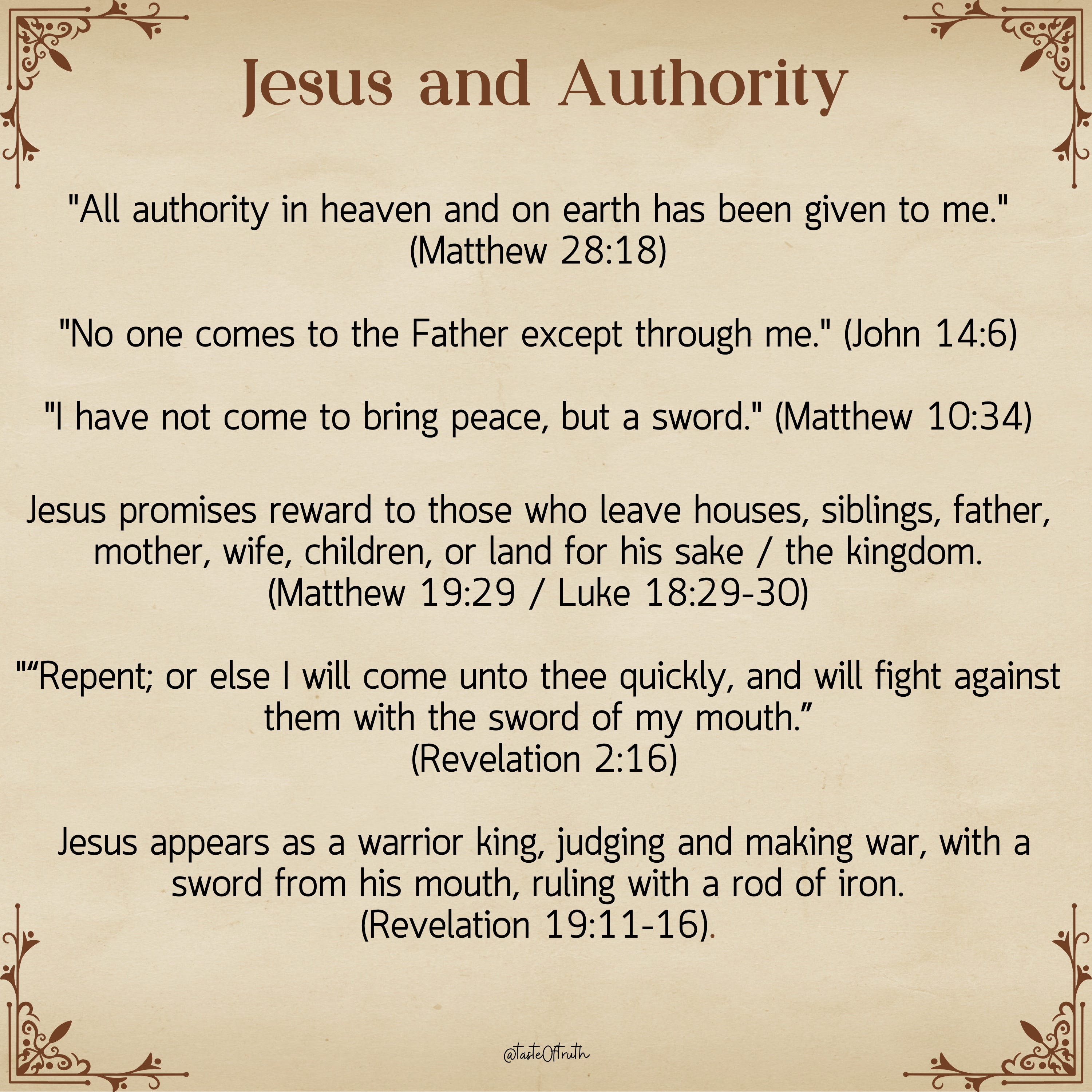
Representative examples of New Testament passages in which Jesus is portrayed not only as a moral teacher, but as a figure of exclusive authority, judgment, division, and ultimate rule.

Research from the Copenhagen School, along with scholars such as Russell Gmirkin, Jan Assmann, Yonatan Adler, and Thomas Thompson, has challenged assumptions many of us once took for granted. Their work points toward a far more dynamic process of literary construction, cultural memory, reinterpretation, and retrospective claims to antiquity behind the Hebrew scriptures. Some of that scholarship presses the issue further still, raising the unsettling possibility that Jesus himself may belong in the same larger scriptural problem-set as other biblical figures whose historicity has been asserted far more confidently than it has been demonstrated.

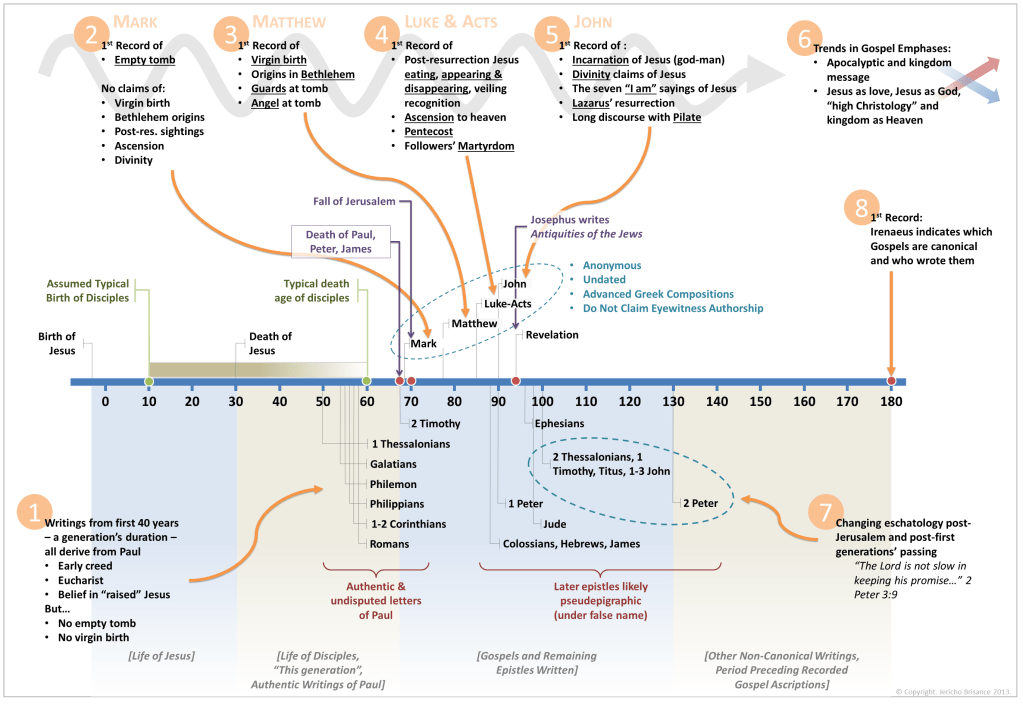
In previous episodes of my Jesus Myth series, I argued that the Gospels should not be treated as straightforward eyewitness biographies. Archaeology can illuminate the world of first-century Judea, but it does not confirm the Jesus of the Gospels. Paul’s letters give us a cosmic, scriptural Christ rather than a detailed memory of a recent Galilean teacher. The early Christian movement appears fragmented from the beginning, with competing visions of Christ long before later orthodoxy cleaned up the story.

This essay begins where that argument left off.

If the Gospels are not simple biography, then what are they? And if the Jesus figure is shaped so deeply by earlier scripture, then an even more unsettling question follows:

What kind of scripture was doing the shaping?

Because once we begin examining the New Testament closely, an extraordinary pattern emerges. The Jesus of the Gospels does not merely quote scripture. He is a product of it. The story begins to look less like the fulfillment of ancient history than the continuation of an ongoing literary tradition.

And if that scriptural world could generate covenant, chosenness, law, and sacred history, the possibility that it could also generate a messiah is no longer so easy to dismiss.
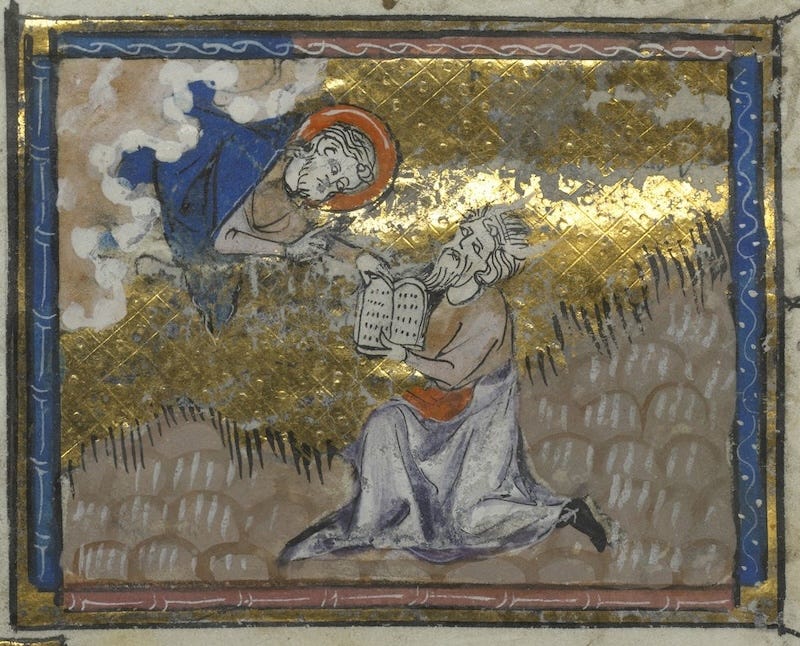

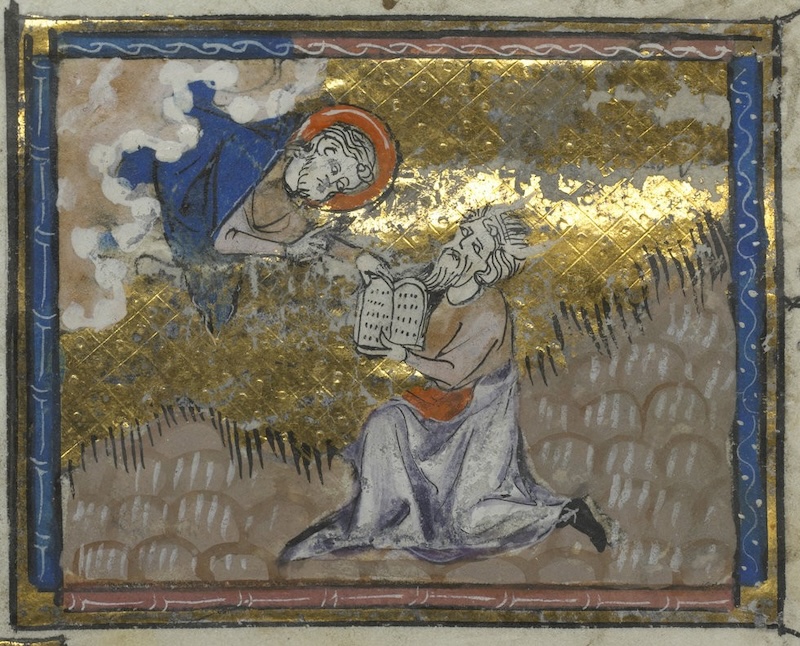
God giving the Tablets of the Law to Moses, from a manuscript attributed to Chrétien Legouais, 1325 CE. Image source: gallica.bnf.fr / Bibliothèque municipal de Rouen.

Not Influence but Scaffolding

The claim that the Gospel writers drew from Jewish scripture is not controversial. Virtually every New Testament scholar acknowledges that the evangelists quoted, interpreted, and reworked earlier biblical texts. The real question is what kind of borrowing we are dealing with.

Some modern writers argue that the Gospels are fundamentally Greek in character, shaped by Hellenistic literary conventions such as heroic archetypes, divine signs, dramatic climaxes, and narrative form recognizable to a Greek-speaking audience. There is truth in that observation. The Gospels were written in Greek, circulated in a Hellenistic world, and emerged from a culture saturated with literary adaptation and symbolic storytelling. But that framing can miss something more concrete. The density of engagement with Jewish scripture in the Gospels is not merely thematic or stylistic. It is textual, structural, and relentless.

Dozens of explicit citations appear across the texts. Beneath them lies a much larger web of allusions, echoes, narrative patterns, and character templates drawn from the Hebrew Bible. Counted conservatively, these parallels number in the dozens. Traced more fully, they run into the hundreds. Entire scenes are shaped by earlier passages. Entire narrative arcs follow scriptural precedent. By comparison, proposed parallels to Greek myth or pagan figures are usually broader, more conceptual, and far less anchored in specific texts. My aim is not to deny Greco-Roman influence, but to put it in proportion. The Gospels may speak Greek, but they think in Hebrew scripture.

This framing is not idiosyncratic; volumes such as Is This Not the Carpenter? place the question of Jesus’ historicity alongside Paul, intertextuality, and the “rewritten Bible,” showing how difficult it is to separate later “biography” from scriptural rewriting and theological construction.

One example of that scriptural-political matrix appears in the star and scepter imagery attached to messianic expectation.

Star, Scepter, and Political Theology

Long before Christianity, certain biblical oracles had already been charged with political and eschatological force. Numbers 24:17, “a star shall come out of Jacob, a scepter shall rise out of Israel,” was read in the Dead Sea Scrolls as prophecy of a coming Davidic ruler. Matthew places a star over Bethlehem. Revelation has Jesus call himself the bright Morning Star. This imagery stood at the crossroads of Jewish expectation and the wider symbolic world of antiquity, where heavenly signs marked kingship, divine favor, and world-changing rule. Early Christians did not invent that language. They seized it and redirected it toward Jesus.

Matthew tells us that the holy family’s return from Egypt fulfills Hosea’s words, “Out of Egypt I called my son.” In its original context, Hosea was speaking about Israel, not a future messiah. The passage is not simply cited. It is repurposed. And that pattern repeats across the Gospels.

The crucifixion sharpens the problem because it is often treated as the most historically secure element of the Gospel tradition. Yet when we look closely, the scene does not read like a bare report of an execution. It reads like a carefully arranged scriptural drama. Psalm 22 is especially central. “My God, my God, why have you forsaken me?” appears in the Gospels as Jesus’ cry from the cross. The mocked sufferer, the taunts of the crowd, and the casting of lots for garments all appear in the passion narrative. Isaiah 53 adds the rejected and afflicted servant who is silent before his accusers and numbered among transgressors. Psalm 69 contributes the sour wine. Zechariah supplies the struck shepherd and pierced figure. Even the Wisdom of Solomon describes a righteous man mocked for calling God his father and condemned to a shameful death. Taken one by one, these parallels can be treated as interpretation. Taken together, they stop looking incidental and start looking compositional.

At minimum, the evangelists are constructing the meaning of Jesus’ death through inherited texts. At maximum, some of the scene’s most memorable details may have been generated by those texts.

The same dynamic extends beyond individual scenes into the wider narrative structure. Joseph is betrayed by his brothers, sold for silver, stripped, cast into a pit, and later exalted. Jesus is betrayed by Judas, sold for silver, stripped, entombed, and exalted. Jonah spends three days in the belly of the fish; Jesus predicts three days in the heart of the earth. Moses escapes a ruler bent on killing Hebrew infants, emerges from exile, ascends a mountain, and mediates a covenant. Jesus follows the same symbolic arc: threatened by a murderous ruler, called out of Egypt, tested in the wilderness, teaching from a mountain, and inaugurating a renewed covenant. This is not random resemblance. It reflects a world in which earlier stories functioned as templates.

Ancient Jewish authors did not treat scripture as a static archive of facts. They treated it as a living body of tradition that could be revisited, reinterpreted, and applied to new circumstances.

One key technique is typology recognized recurring patterns across time: Moses could become a template for a future deliverer, and Israel’s exile could foreshadow restoration. Midrash explored hidden meanings, tensions, and new applications within older texts. Pesher, attested in the Dead Sea Scrolls, treated scripture as containing encoded meanings that spoke directly to the interpreter’s own time.

By the time we arrive at early Christianity, scripture is no longer functioning merely as a record of the past. It is functioning as a codebook. The first Christians did not read the Hebrew scriptures as neutral background material for a life that had already happened. They searched them for hidden patterns, veiled prophecies, typological correspondences, and Spirit-guided meanings. A passage did not have to be about Jesus in its original context in order to become about Jesus through inspired interpretation. Israel could become Jesus. The suffering righteous man could become Jesus. The rejected servant could become Jesus. A sign given to an ancient king could become Jesus. The text became a map, and Christ was the figure readers were trained to find within it.

That is crucial because it shows how scripture was actually being used. Early Jewish readers were not passively receiving texts as fixed records of the past. They were searching them, recombining them, and uncovering patterns that could be applied to their own historical moment. As Richard Carrier and others have noted, this kind of scriptural decoding was not marginal. It was widespread. The New Testament writers emerged directly out of this world. They were Jews steeped in a tradition where scripture was not treated as a flat archive of past events, but as a living body of meaning to be searched, reread, and reapplied. When early Christians portrayed Jesus, they were not simply recording a life in the modern biographical sense. They were rereading the Hebrew scriptures to interpret his life, death, mission, and cosmic significance. That is why so much of the Gospel narrative appears to fulfill older texts. The authors were not recording events and then attaching verses afterward. They were crafting a theological portrait through inherited techniques of scriptural interpretation.

This is visible even in the words attributed to Jesus. What later readers encounter as the “red-letter” sayings are not free-floating teachings dropped into history untouched by tradition. They are deeply embedded in a scriptural world. When asked about the greatest commandment, Jesus answers by quoting Deuteronomy 6 and Leviticus 19. His warning that “the stone the builders rejected has become the cornerstone” comes from Psalm 118. Even his cry from the cross is lifted from Psalm 22. He does not stand outside the tradition commenting on it from a distance. He speaks from within it.

Once the literary architecture of the Gospels becomes visible, a more difficult question comes into focus. Are the evangelists taking a real remembered life and interpreting it through scripture, or are they using scripture itself to shape the narrative they present? Those are not small variations of the same idea. They are rival explanations. One begins with a historical figure and treats scriptural patterning as interpretation. The other begins with a scriptural tradition and understands the figure as emerging from it. The more densely these patterns appear, the harder it becomes to maintain a clear boundary between the person being described and the literary tradition doing the describing.


The Foundation Is Younger Than It Appears

Most readers imagine the Hebrew scriptures as ancient deposits of sacred memory stretching deep into the past. Moses belongs to remote antiquity. The prophets stand centuries before Jesus. The New Testament then appears as the culmination of an immense and venerable arc.

But that inherited picture is much shakier than people like to admit.

Biblical minimalists associated with the Copenhagen School, including Thomas L. Thompson, Niels Peter Lemche, and Philip Davies, challenged the assumption that the Hebrew Bible gives us transparent access to early Israelite history. Their argument was not that nothing existed before the texts, but that the biblical story of Israel may be less a record of national origins than a later literary construction of those origins.
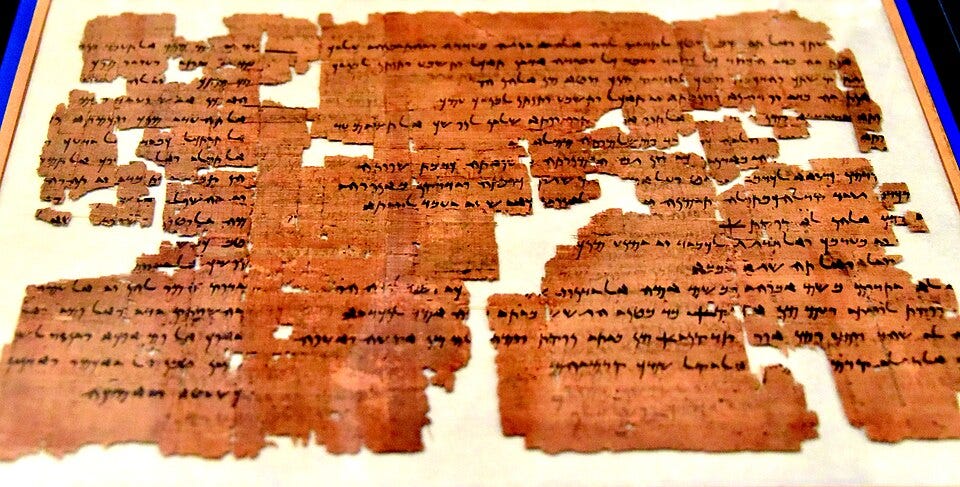

Elephantine Temple reconstruction petition, 5th century BCE. The Elephantine papyri preserve evidence of a Jewish/Judean military community in southern Egypt that worshiped Yahweh and maintained a temple outside Jerusalem — a striking challenge to the assumption that Torah-centered Judaism was already universally organized around Jerusalem by this period.

The Elephantine Problem

The Elephantine papyri make that problem hard to ignore. In the fifth century BCE, a Jewish/Judean military community in southern Egypt worshiped Yahweh, maintained its own temple, practiced sacrifice, and remained in contact with Jerusalem. Yet this community does not clearly reflect the fully formed Torah-centered Judaism later projected backward into Israel’s past. There is no obvious evidence of an exclusive Jerusalem cult, a centralized Pentateuchal legal order, or the religious system later treated as ancient and universal. That does not prove no Pentateuchal traditions existed in any form, but it does make the traditional timeline look far less secure.

Archaeology adds more pressure. The patriarchal age, the Exodus, the conquest, and the grandeur of the united monarchy have all been heavily challenged. Egyptian records do not confirm the biblical Exodus. Archaeology has not vindicated the conquest of Jericho in the form the Bible presents it. Even early Israelite religion appears messier than later monotheistic memory allows, with inscriptions invoking Yahweh alongside Asherah. The issue is not merely that the Bible contains embellishment. The issue is that some of its foundational stories may be retrospective national myths written as ancient history.

Plato, Moses, and the Making of Sacred Antiquity

This is where Russell Gmirkin pushes the argument further. He argues that the Pentateuch reached final form around 273–272 BCE, in the Alexandrian and Ptolemaic world of the third century BCE, close to the Septuagint project and the intellectual culture of the Great Library. On this model, the Torah was not merely translated into Greek at Alexandria. It may have been composed or finalized there.

Gmirkin’s argument is controversial, but it is not random. He points to literary dependence: Genesis 1–11 drawing on Berossus’ Babylonian history, Exodus engaging Manetho’s Egyptian history, and the Torah’s legal materials reflecting Greek, especially Platonic, models of law, constitution, and national foundation. Philippe Wajdenbaum develops a similar comparison, arguing that the Hebrew Bible resembles Greek literature, especially Plato’s Laws, in its construction of a people around a lawgiver, sacred land, twelve tribes, and a divinely authorized legal order.

This changes the way Moses looks. In Gmirkin’s reading, Moses is not simply a prophet. He resembles an oikist, a founder figure: the one who organizes a people, distributes land, establishes institutions, and anchors political order in a sacred origin story. The Torah, in turn, begins to look less like a loose bundle of ancient laws and more like a charter myth. It tells a people who they are, where they came from, why their laws are sacred, and why obedience to that order is obedience to God.

That is where the real trick lies. Once law is placed in the mouth of Moses and projected backward into sacred antiquity, it stops looking like legislation and begins to look like revelation.

This also helps explain later apologetic reversals. By the time we reach writers such as Philo and Josephus, the direction of influence has been flipped. Greek thinkers are now said to have borrowed from Moses, not the other way around. The issue was never merely content. It was priority. The Bible’s authority depended not only on what it said, but on when people believed it had been said. The Letter of Aristeas belongs to the same machinery of sacred self-presentation: Jewish antiquity staged for the Greek world as though ancient wisdom were simply being translated, rather than emerging from a competitive Hellenistic culture of literary production and historical self-invention.

Yonatan Adler adds one final complication. The question is not only when these texts were written, but when they became socially real. Adler argues that widespread Torah observance becomes clearly visible much later than tradition claims, especially in the Hasmonean period. A text can exist before it rules. A law can be written before it governs a people.
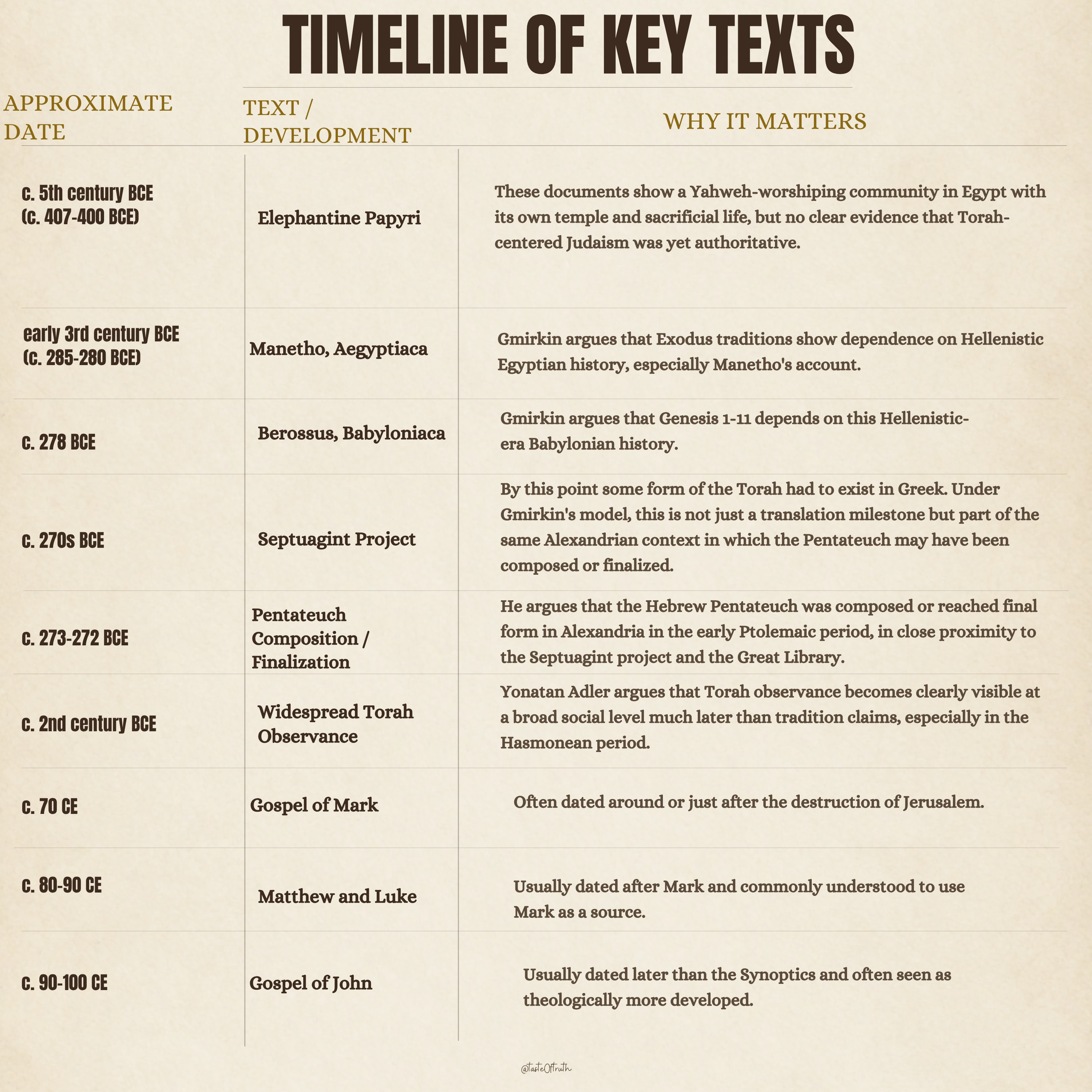
The implications of that compressed timeline are enormous.

The implications are enormous. If the Pentateuch reached final form around 273–272 BCE, and the Gospels were written between roughly 70 and 100 CE, then the scriptures supposedly being “fulfilled” by the Gospel writers may be only three or four centuries older than the Gospels themselves.

That does not make the connection less Jewish. It makes it look less like the unfolding of immemorial revelation and more like literary tradition building on literary tradition.

And once that compressed timeline is taken seriously, the next question is no longer simply how old the tradition was supposed to be. It is how sacred antiquity itself was made.
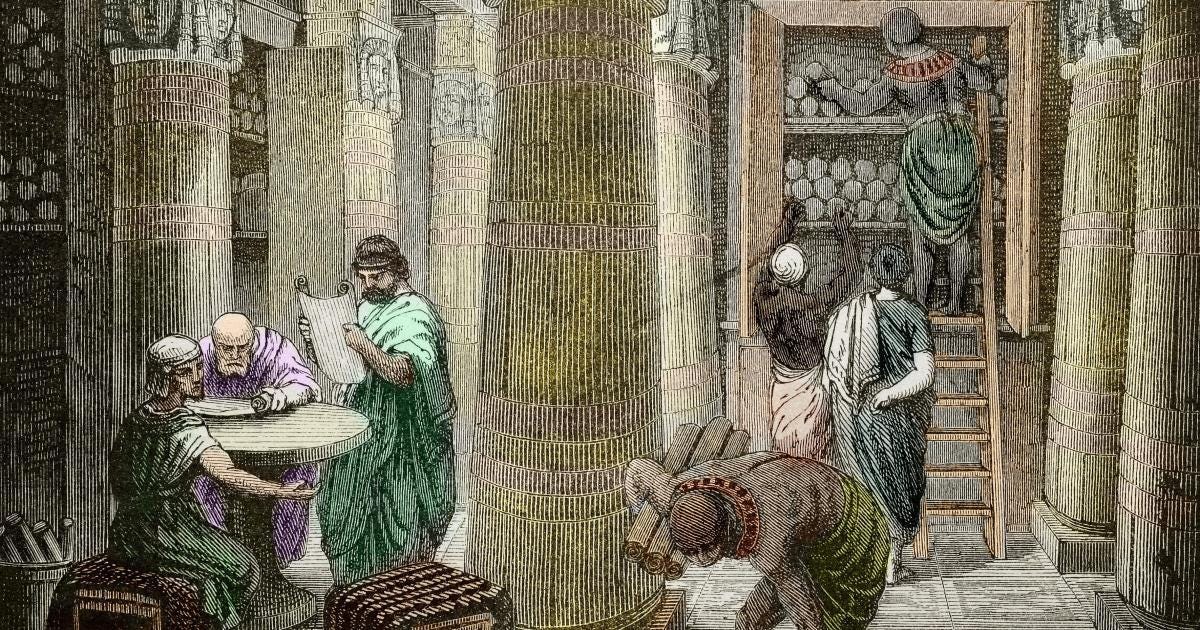

The Library of Alexandria in Egypt: the intellectual crossroads of the Hellenistic world, where texts were collected, translated, and rewritten. Building on comparative studies and source criticism, Russell Gmirkin argues that the Pentateuch may have taken shape in this environment in the third century BCE, drawing on Greek histories, legal traditions, and philosophical works.

From Failed Kingdom to Spiritual Messiah

This is the missing hinge. Jewish messianic hope did not arise in a vacuum. It was forged in the long shadow of conquest, exile, humiliation, and imperial domination. From Assyria and Babylon to the Greeks and Romans, Jewish life was repeatedly shaped by foreign rule. It is not difficult to see why restoration, divine justice, and the dream of an anointed deliverer became so central. A people under pressure will search its own sacred memory for the pattern of rescue.

By the first century, that hope had become unstable. Second Temple Judaism was not a unified religion serenely awaiting fulfillment. It was a fractured landscape of rival sects, competing scriptural interpretations, anti-Temple resentment, apocalyptic expectation, and bitter disagreement about where Israel had gone wrong. Some blamed foreign occupation on sin. Some blamed corrupt elites. Some rejected the legitimacy of the Temple leadership altogether. In that environment, scripture was not merely read. It was mined for survival strategies.

This is where Carrier’s point becomes useful. As he writes, “The traditional messianic hope (of a conclusive military victory over all of Israel’s neighbors) was a doomed hope, and that would have been obvious to at least some Jews.” A warrior-king who would visibly crush Rome was precisely the kind of messiah history kept refusing to produce. A spiritual messiah, by contrast, could not be falsified so easily. He could conquer Satan rather than Caesar, the heavens rather than the earth, sin rather than empire. Defeat could be reinterpreted as hidden victory. Political disappointment could be absorbed into myth.

That shift matters. A suffering, dying, or heavenly messiah fits prolonged subjugation far better than a triumphant Davidic conqueror who never arrives. Christianity did not solve the Roman problem by overthrowing Rome. It solved it by changing the terms of victory. The kingdom became “not of this world.” The struggle moved from flesh and blood to cosmic powers. The messiah no longer needed to raise an army from Jerusalem if he could instead be enthroned in heaven.

And that made Christianity exportable. The movement that emerged did not require Gentiles to become Jews in the full covenantal sense. It offered a way for Gentiles to worship the God of Israel without circumcision, kosher law, or full Torah observance. Acts 15 is the obvious flashpoint. The Jerusalem leadership approves Gentile inclusion through a reduced set of obligations, allowing the biblical framework to expand beyond ethnic Judaism without dissolving its theological core. The God remains the God of Israel. The scriptures remain Jewish scriptures. The messiah remains the Jewish messiah. What changes is access.

That is one of the most important transformations in religious history. Christianity became, in effect, Judaism for Gentiles: a way of universalizing Israel’s God, Israel’s scriptures, Israel’s messianic story, and Israel’s eschatological framework without requiring the nations to become Jews. The old covenantal architecture was not abandoned. It was scaled.

And once that is clear, the next question presses harder than ever. If this new messiah emerged from scriptural reinterpretation, apocalyptic disappointment, sectarian fragmentation, and theological adaptation to empire, then the issue is no longer merely what early Christians believed about him.

It is whether there was ever a stable historical figure there in the first place.

The Last Firewall: “But Surely Jesus Was Historical”

By this point in the argument, a familiar fallback usually appears. The miracles may be myth. The resurrection may be theology. The birth stories may be literary invention. The passion narrative may be scriptural construction. The speeches may be later compositions. The chronology may be artificial. Fine. Grant all that, people say. But surely there was still a man underneath it all.

I no longer accept that assumption, and I do not think it deserves to be treated as intellectually safe merely because it is familiar.

Once literary and theological construction has been conceded at nearly every level of the tradition, the so-called “historical Jesus” begins to look less like a demonstrated figure than like a residue, a placeholder left standing after everything obviously mythic has been stripped away. The problem is not that a historical core has been disproved in some crude, absolute sense. The problem is that it is constantly assumed, while the evidence for it remains astonishingly thin.

Where, exactly, is this man supposed to be found?

There is no contemporary, independent, non-Christian evidence for Jesus as a historical person. There is no inscription, no administrative record, no eyewitness account, no Roman report from his lifetime, no Jewish source from his lifetime, no archaeological evidence identifying him, no surviving text from anyone who actually met him. What we possess are Christian theological writings.

And our earliest source, Paul, does not give us a remembered Galilean teacher wandering around first-century Judea. He gives us a revealed, cosmic, scriptural Christ known through visions, revelation, scripture, death, resurrection, and heavenly significance. Paul does not preserve a stable earthly biography. He does not narrate Bethlehem, Nazareth, Galilee, Judas, Mary Magdalene at the tomb, Pilate’s trial scene, or the sermon material that later becomes central to the Gospel portrait. That absence is not a trivial inconvenience. It is a structural problem.

Even 2 Peter is revealing on this point. “For we did not follow cleverly devised myths when we made known to you the power and coming of our Lord Jesus Christ, but we were eyewitnesses of his majesty.” The denial is telling. It does not prove invention by itself, but it does show that early Christian claims could be heard as mythic, visionary, or constructed. And the response is instructive. The author does not answer by providing a grounded earthly biography. He answers with prophecy, revelation, glory, and Spirit-soaked authority.

The Gospels themselves do not rescue the situation. They are anonymous literary-theological compositions written decades after the alleged events, in Greek, through dense scriptural patterning. They do not read like independent eyewitness memory. They read like sacred narrative built from older texts, typology, apocalyptic expectation, and theological necessity.

The supposed external witnesses do not solve the problem. Josephus is late, textually disputed, and preserved through Christian transmission. Tacitus is later still and tells us, at most, what Christians in his own time believed about their origins. These are not contemporary confirmations of Jesus’ life. They are later references to a movement that already existed. They tell us Christianity happened. They do not securely tell us that the Gospel figure at its center was historical in the way readers are encouraged to imagine.

The same goes for the phrases in Paul that are endlessly hauled out as if they settle the matter. “Born of a woman,” “seed of David,” “brother of the Lord” — these are not granite biographical anchors. They can function as incarnation language, messianic credentialing, or intra-community title. They do not give us a recoverable historical Jesus standing solidly behind the later narratives. They give us phrases. The heavy lifting is done by prior belief.

This is why I reject the polite compromise that says, “Of course the Gospel Jesus is mythologized, but there must have been a real preacher behind him.” Must there? Why? Because modern scholars feel more respectable keeping one sandal planted on the ground? Because the imagination panics at the thought that the whole figure may be literary from the start? Because once the miracles, fulfillment scenes, speeches, chronology, passion details, and resurrection appearances are recognized as constructed, people still want one final reassuring object left?

To me, this often functions less like an argument than a psychological reflex.

And this is precisely where Gmirkin’s work ceases to be merely interesting and becomes a consistency test.

If we are willing to follow biblical minimalism when it exposes the Pentateuch as a late literary-theological construction, why should the inquiry suddenly stop at Christianity? If the Hebrew scriptures can be composed, adapted, borrowed, and projected backward into sacred antiquity, why is Jesus protected from the same analysis? Why is the critique allowed to dismantle Moses, law, covenant, and national memory, only to halt politely at the Messiah as if some invisible velvet rope had been lowered around him?

That exemption makes no sense.

Christianity does not escape the biblical matrix. It depends on it. It preserves the God of Israel, the prophets, the covenants, the messianic framework, the chosen-people logic, and the eschatological expectation that history moves toward divine judgment and final rule. Its dispute with Judaism is not over the structure. It is over who gets to occupy the central role within it. Christianity is not the grand liberation from the older framework that its admirers like to imagine. It is the sequel.

And once that is admitted, the next step is not radical at all. It is obvious.

If scripture can generate Moses, covenant, law, land, chosenness, and sacred national memory, then scripture can also generate Jesus, fulfillment, cross, resurrection, judgment, and cosmic kingship. If a literary-theological tradition can manufacture sacred antiquity, why should it suddenly lose that power when it reaches the first century? If the old stories can produce a founder, a people, a law, and a history, why should they not also produce a messiah?

Christianity does not begin, in our earliest sources, with a stable man later decorated with myth. It begins with a revealed Christ known through scripture and visions. The earthly biography comes later, and when it appears, it arrives already saturated with literary design.

If that is true, then the task is no longer to keep exhausting ink and paper trying to peel a “real Jesus” out of layers of literary construction. The more urgent question becomes: what were the earliest apostles, visionaries, and authors actually doing? What experiences did they think they were having? What apocalyptic expectations drove them? What rhetorical and mythical work were the later stories performing? Once the data about Jesus comes to us primarily through scripture, revelation, and literary invention rather than recent biography, the center of gravity shifts. The real subject is no longer a recoverable Galilean teacher hiding behind the text, but the motives, methods, and imaginative world of the people who produced the text.

The Gospel Jesus is not history remembered and then embellished. He is scripture personified, given narrative form, furnished with a recent setting, and made to walk through a world already prepared for him by text. At that point, Christianity begins to look less like a movement built around a misremembered man and more like a movement built around visionary claims, apocalyptic expectation, scriptural decoding, and later literary elaboration. What demands explanation is not how a historical teacher was gradually mythologized, but how a mythic and scriptural Christ was gradually narrativized.

That is the last firewall. Once readers are willing to concede literary construction everywhere else, Jesus becomes the one figure they are still expected to protect. Not because the evidence suddenly improves, but because the emotional and institutional cost of following the argument any further becomes too high. And if that protection finally collapses, then a great deal of Jesus studies will have to admit that it has been spending enormous effort on the wrong pursuit. The real work would no longer be reconstructing a man behind the myths, but reconstructing the interpretive practices, sectarian motives, visionary experiences, and literary intentions that produced the myth in the first place.

And that is exactly where Jan Assmann becomes useful.

The resistance here is not just intellectual. It is civilizational. By the time people reach Jesus, they are no longer defending one ancient figure among others. They are defending a memory-world: a moral vocabulary, a theory of suffering, a structure of hope, a story about history, and often the emotional architecture through which they understand themselves. That is why the argument suddenly feels so charged. It is no longer just about evidence. It is about what happens when literature hardens into memory and memory hardens into reality.


Mnemohistory: When Literature Becomes Memory

“Mnemohistory,” a term coined by Jan Assmann, refers not simply to the past, but to the way societies remember the past. That sounds academic. In practice, it is far more destabilizing than it first appears.

I was first introduced to Assmann’s work through my friend Brado, and once the idea clicked, a great deal of human behavior stopped looking mysterious. One of the hardest things to swallow is realizing how much of what people confidently call “history” is not history in the plain sense at all, but mnemohistory: emotionally charged civilizational storytelling repeated so often that it hardens into something psychologically untouchable.

A society does not merely pass down facts. It passes down stories about origins, suffering, enemies, rescue, chosenness, betrayal, exile, return, and destiny. Those stories do not simply describe the past. They train perception. They teach people what to love, what to fear, whom to trust, whom to blame, and what future to desire. After a while, people are no longer defending a memory. They are defending the world that memory built for them.

That is why historical arguments go feral so quickly. You are never just disputing an event. You are touching the memory structure through which a group recognizes itself. The Exodus is one of the clearest examples. It is not merely a story to be remembered, but a story about remembering: bondage, liberation, divine rescue, covenant, promised land. It turns memory into identity and identity into destiny. The past is ritualized so that it can keep governing the present.

This is also where Neil Van Leeuwen’s distinction between factual belief and religious credence becomes clarifying. A factual belief is supposed to track reality across contexts. Religious credence works differently. It behaves less like stable fact-tracking and more like an imaginative, identity-bound commitment activated in specific social and ritual settings. A church can gather in a gymnasium and everyone still knows they are sitting on bleachers under fluorescent lights. Yet within that setting, the space becomes sacred. The credence does not erase ordinary reality. It overlays it and reorganizes meaning.

That helps explain why apologetics so often feels impervious to evidence. It is not primarily a truth-seeking enterprise, but a credence-maintenance system. Doubt is framed as danger, questions are met with prefabricated responses, and rituals, narratives, and authorities work together to protect identity rather than expose it to risk. As Van Leeuwen argues, when an attitude is rooted in group identity, truth can easily take a back seat.

Once you see that, a great deal of Christian apologetics becomes easier to understand. Its stubbornness is not a bug. It is the design. It is not really trying to investigate whether the historical Jesus can bear the weight placed on him. It is trying to prevent the collapse of the cognitive and social world built around him.

That is why arguments about Jesus’ historicity so often feel like Groundhog Day. One side keeps asking what the evidence can actually support. The other keeps reasserting the figure as though familiarity itself were proof. By the time people reach Jesus, they are no longer just defending one ancient claim among others. They are defending a moral universe, a structure of consolation, a theory of suffering, a promise of justice, a spiritual identity, and often an entire social world.
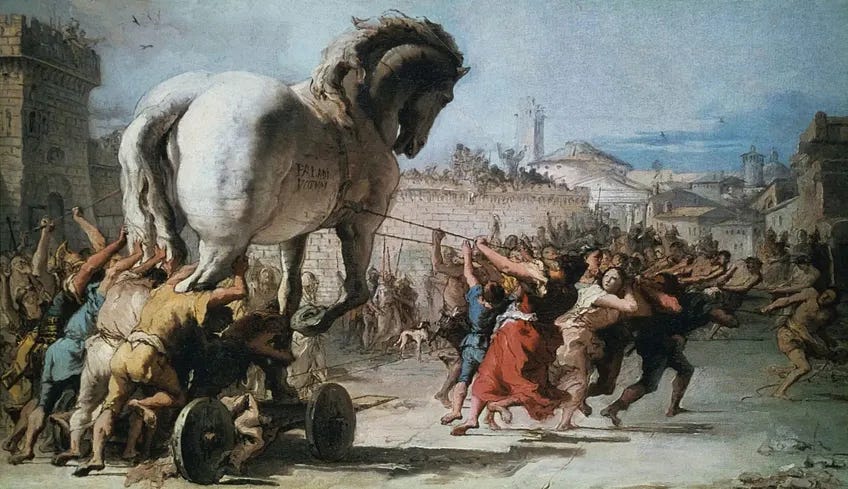
This is how Christianity became one of history’s most successful Trojan horses. It entered the Roman world clothed in humility, forgiveness, self-denial, and the sanctification of suffering. But that moral vocabulary was tailor-made for rule. A religion that teaches obedience, glorifies submission, and casts suffering as meaningful does not merely coexist with empire. It serves it. Constantine did not have to distort Christianity into something authoritarian. Its authoritarian potential was already there, waiting to be scaled.

The reason this matters is not that ancient people wrote sacred stories. Humans have always done that. The reason it matters is that some sacred stories do not stay on the page. They become political grammar. They teach civilizations how to imagine enemies, destiny, land, obedience, suffering, and war.

Modern Consequences: When Sacred Story Becomes Political Machinery

And this is where the conversation is no longer academic or safely trapped in antiquity.

In the modern West, and especially in the United States, support for Israel is often presented not merely as a strategic choice but as a moral and even spiritual duty. For millions of Christians, conflict in the Middle East is not simply geopolitics. It is part of a sacred script. Apocalyptic language has not remained tucked away in pulpits and prophecy conferences. It has drifted upward into policy, media, lobbying, diplomacy, and war.

And the problem is larger than American evangelicalism.

What is now sold as “Judeo-Christian friendship” increasingly functions as a transnational political package. Israel is marketed not simply as a nation-state but as a symbol of “the West,” biblical truth, anti-communism, anti-Islamism, anti-woke moral order, technological modernity, and civilizational resolve. That is why gatherings such as the JNS International Policy Summit in Jerusalem and the Judeo-Christian Zionist Congress matter. They are not quaint interfaith exercises. They are strategy rooms in which theology, media, diplomacy, philanthropy, and security discourse are braided together and sent back out as political messaging.
Latin America makes the pattern especially visible. As evangelical and Pentecostal Christianity grows as a political force, Israel is increasingly recoded as a sacred-political emblem of order, family values, anti-left resistance, and biblical destiny. The Isaac Accords are a perfect example. They are presented in the language of democratic values, innovation, security, and cooperation, but the emotional engine underneath them is older and hotter than that. Israel becomes a proof-text. Foreign policy becomes catechism by other means. The old Abrahamic machinery has simply evolved to speak the language of diplomacy, branding, and strategic partnership.

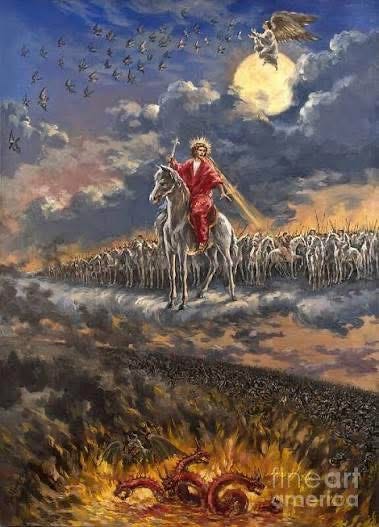
This is why the usual dismissals fail. We are not dealing with private religious sentiment lingering harmlessly at the margins. We are dealing with inherited apocalyptic structures that shape how nations imagine enemies, allies, legitimacy, time, and destiny. When political leaders, religious institutions, military personnel, media ecosystems, and ordinary citizens inherit stories about Israel, Iran, final battles, messiahs, Armageddon, and divine destiny, the line between prophecy and policy begins to blur. Conflict stops looking contingent. It starts looking prewritten.

The Cybernetic Culture Research Unit coined the term hyperstition for ideas that bring themselves into existence because people believe them strongly enough to act on them. That concept belongs here. A prophecy does not have to be true to become dangerous. It only has to recruit enough believers willing to organize behavior around it. Once that happens, old stories stop functioning as symbolic expectation and begin operating as strategic motivation.

Judaism, Christianity, and Islam all carry end-times narratives organized around the same theological lore: messianic figures, final conflict, cosmic judgment, and the Middle East.

A revealing example appears in the Qur’an’s treatment of Jesus. In Surah 3:45, Jesus is called al-Masīḥ — the Messiah. Islam does not use that title in the Christian sense: Jesus is not divine, not the Son of God, and not a crucified savior. But the messianic category remains.

The traditions are not identical, and their details often conflict sharply. But they share enough inherited narrative architecture to be significant here.

Maimonides makes the continuity unusually explicit, and his wording matters because he was no fringe oddball. He was one of the most important Jewish legal and philosophical authorities in history. In Mishneh Torah, Laws of Kings 11:4, frames Jesus and Muhammad as figures who, within divine providence, helped spread knowledge of messianic expectation and the God of Israel among the nations.

That is the blueprint: a shared body of theological lore, a transmitted narrative architecture that persists even as details are revised. Its logic is self-reinforcing. Prophecy validates scripture, scripture is reread as fulfilled prophecy, and each new crisis is folded back into the old frame as confirmation. The game works not because the texts reliably predict history, but because they are endlessly reinterpreted, retrofitted, and made to certify one another.

And that is why literary origins matter. If sacred histories are constructed, revised, projected backward, and then defended as untouchable truth, they do not remain harmless. They shape borders, justify wars, license alliances, sanctify violence, and train populations to see obedience as virtue and confrontation as destiny. The danger is not simply that people believe old stories. The danger is that these stories still command institutions, budgets, media systems, electorates, intelligence networks, and weapons.

Entire populations become characters in someone else’s sacred drama. Human beings become pieces on an apocalyptic chessboard. War ceases to be merely war. It becomes fulfillment.

Voltaire’s warning still bites: those who can make you believe absurdities can make you commit atrocities.

This is why I do what I do with such fierce passion. I believe the Abrahamic traditions are built on layers of fabrication, borrowed myths, retroactive claims to antiquity, and sacred stories whose origins are rarely examined with the seriousness they deserve. To me, it is an insult to wisdom, curiosity, and the pursuit of knowledge that so much of our culture remains shaped by narratives that are historically unstable, morally suspect, and fiercely defended as untouchable truth.

Questioning these stories is not hatred. It is not divisive. It is intellectual self-defense. It is spiritual self-defense. It is the work of reclaiming the human mind from inherited scripts that have too often taught people to sanctify obedience, suffering, conquest, and fear.

If sacred stories can shape civilizations, then examining them is not a niche academic exercise. It is necessary work.

Resources and Further Reading

Laurent Guyénot — “Russell Gmirkin and the Biblical Con” (Substack series)
Jan Assmann: Moses the Egyptian: The Memory of Egypt in Western Monotheism
Jan Assmann: Cultural Memory and Early Civilization
Richard B. Hays: Echoes of Scripture in the Gospels
Dale C. Allison Jr.: The New Moses: A Matthean Typology
E.P. Sanders: The Historical Figure of Jesus
Geza Vermes: Jesus the Jew
Bart D. Ehrman: Did Jesus Exist?
Yonatan Adler: The Origins of Judaism: An Archaeological-Historical Reappraisal
Russell Gmirkin: Berossus and Genesis, Manetho and Exodus
Russell Gmirkin: Plato and the Creation of the Hebrew Bible
Philippe Wajdenbaum: Argonauts of the Desert
Thomas L. Thompson: The Mythic Past
Philip R. Davies: In Search of “Ancient Israel”
Ze’ev Herzog: “Deconstructing the Walls of Jericho” (Haaretz, 1999)
David Skrbina: The Jesus Hoax
Richard Carrier: On the Historicity of Jesus, The Obsolete Paradigm of a Historical Jesus
Thomas L. Thompson and Thomas S. Verenna, eds., Is This Not the Carpenter? The Question of the Historicity of the Figure of Jesus

Adam Green: The Jesus Deception

Plato: Laws
Berossus: Babyloniaca (fragments)
Manetho: Aegyptiaca (fragments)
The Christian Inheritance of the West

What Christianity Absorbed, Built, and Left Behind

Listen as you read here!

People say this all the time.

That the West got its ideas about pluralism, tolerance, and liberty from Christianity. That without it, there would be no concept of human dignity, no rights, no freedom in the modern sense. And that if those things feel unstable now, the solution is simple: return to the source.

The claim that pluralism, tolerance, and liberty are direct inheritances of Christianity is not just oversimplified. It reverses the historical pattern.

In Part 1, I pushed back on the idea that Christianity “founded the West” in any clean or singular sense, or that returning to it offers an obvious path forward. In Part 2, I stepped back and looked at something more fundamental: the fragility of freedom itself. Not as an abstract ideal, but as a social order that depends on limits, restraint, and a population capable of sustaining it. More importantly, I looked at how quickly that order begins to break down when those conditions are no longer present.

Across the responses to both pieces, there was a shared sense that something is not working. Not just politically, not just culturally, but at a deeper level that is harder to name.

One way to make sense of that is to stop looking for a single cause and start looking at how the whole inheritance fits together.

Western civilization did not develop along one track. It emerged through multiple layers operating at the same time. At a minimum, those layers include institutions, culture, and psychology.

Institutions include law, political authority, and the distribution of power. Culture includes religion, tradition, identity, and shared meaning. Psychology includes the moral instincts people use to interpret the world: instincts tied to fairness, loyalty, authority, purity, harm, belonging, and threat.

For long stretches of time, those layers reinforced one another. Institutions reflected shared values. Cultural traditions gave meaning to authority. Moral instincts were channeled through forms of life that provided both order and legitimacy.

But that fit was never permanent.

When those layers begin to pull apart, the result is not merely disagreement. It is instability.

That is the backdrop for this final piece.

The goal here is not to argue that Christianity caused the West, or that it deserves credit for everything people now associate with Western civilization. It is also not to reduce Christianity to a purely destructive force. Both approaches distort the picture in different ways.

The same problem appears in the phrase “Judeo-Christian values.” This often creates the impression of a smooth and unified inheritance, when the actual history is far more fractured. Judaism and Christianity are related, but they are not interchangeable. Christianity did not simply preserve Jewish covenantal thought. It reinterpreted it, universalized it, and claimed fulfillment over it. A tradition rooted in a particular people, law, land, and covenant was recast as a universal message for all mankind.

This repositioning changed the role of religion entirely. It no longer sits alongside other domains. It began to judge them.

It loosened religion from peoplehood and place. It made belief itself the primary marker of belonging. And once belief becomes the primary boundary, disagreement takes on a different moral weight.

Today’s article will address the harder question:

What did Christianity reorganize, what did it scale, and what did it leave unstable?

Because Christianity’s real inheritance was not simply compassion, liberty, or dignity. It reshaped how belief, authority, identity, and moral obligation functioned at a civilizational level. It expanded moral language in ways that could operate across large populations, but it also introduced sharper boundaries between true and false belief, salvation and error, belonging and exclusion.

That combination, expansion on one side and constraint on the other, is where the inheritance becomes complicated.


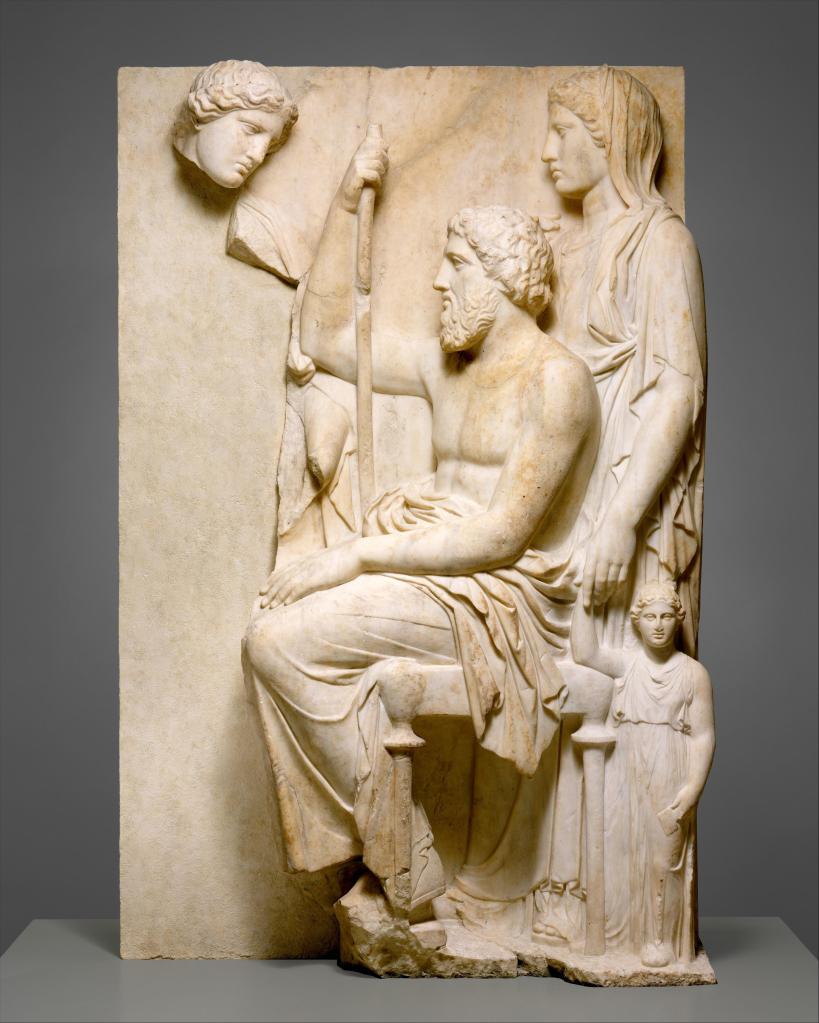
McClees, Helen and Christine Alexander. 1933. The Daily Life of the Greeks and Romans: As Illustrated in the Classical Collections, 5th ed. pp. 131, 133, fig. 159, New York: The Metropolitan Museum of Art.

SECTION I: THE GOOD
What Christianity Absorbed and Reorganized

Before getting into what Christianity actually contributed, it’s worth being clear about what is usually attributed to it.

A moral framework. Stable family structures. The unification of fragmented tribal societies into something resembling a shared civilization. A sense of cohesion strong enough to hold large populations together.

Those developments did happen. The question is where they came from…

Because none of those things begin with Christianity. They depend on something older: stability across generations, shared practices, inherited obligations, and a way of life that binds people before it explains itself.

That is what tradition is.

The word itself comes from the Latin traditio: a handing over, a passing down, something delivered across generations. But that definition only gets you so far. Tradition is not just a set of ideas preserved in texts or doctrines. It is lived. It shows up in habits, rituals, inherited gestures, seasonal rhythms, family patterns, and the quiet repetition of things people do not always stop to explain but continue to do anyway.

It exists in the structure of daily life.

You see it most clearly in how societies deal with death.

Long before Christianity became dominant in Europe, burial practices already reflected a deep sense of connection between the living and the dead. In the Stone Age, communities used mass graves in caves or pits. Later, megalithic cultures constructed communal tombs that anchored memory to specific places. Indo-European groups developed barrows and cremation practices that changed over time while preserving the same underlying logic.

The dead were not discarded. They were placed, remembered, and integrated into the ongoing life of the community.

Tradition, in that sense, is not something invented at a particular moment. It is something carried forward, shaped and reshaped over time without losing its original intention.

Christianity enters into that world rather than creating it from scratch.

What changes is not the existence of tradition, but its scale and its organizing thought.

Earlier religious life was largely tied to local identity: tribe, land, household, ancestry, city, and people. Christianity expands beyond that. It speaks in universal terms and builds a shared symbolic order that can operate across regions and populations that do not share the same lineage, gods, rituals, or customs.

That increases the reach of the moral imagination.

Concern no longer stops at the boundary of immediate belonging. It extends outward, attaching value to individuals beyond their role within a specific family, tribe, or city. Over time, that broader vision feeds into developments people now associate with the Western inheritance: ideas about dignity, education, care for the poor, moral responsibility, and obligation toward those outside one’s immediate circle.

But this is typically where the story gets oversimplified.

Those impulses did not originate with Christianity. Traditions within the Greco-Roman world had already developed forms of civic responsibility, philanthropy, patronage, public works, and mutual obligation. Grain distributions, civic benefaction, philosophical ethics, and local forms of duty were not Christian inventions.

But even the Greco-Roman world was not self-contained. It had already absorbed influences from older and neighboring civilizations (Egyptian, Mesopotamian, Anatolian, and Phoenician) through trade, conquest, and cultural exchange. As scholars like Martin L. West and Walter Burkert have shown, Greek thought itself was shaped in part by these eastern traditions.

The ancient world was not morally empty before the church arrived. It was already layered, interconnected, and carrying forward inherited forms of order, obligation, and meaning.

You can see this clearly in Stoic thought. Christianity is often treated as if it introduced universal human concern into a cruel and indifferent ancient world. Stoicism already spoke in universal terms. It could describe human beings as participants in a shared moral order and extend concern beyond tribe, city, or immediate kinship.

But the structure was different.

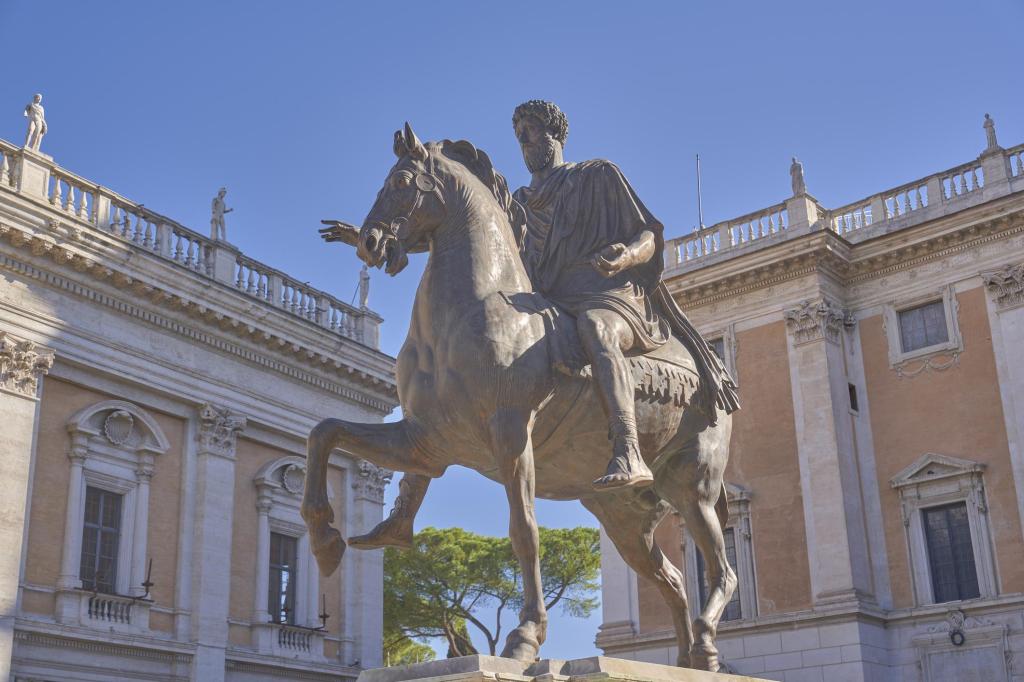
The bronze Equestrian Statue of Marcus Aurelius, Capitoline Hill, Rome.

Runar Thorsteinsson’s comparison of Roman Christianity and Roman Stoicism helps clarify the distinction. Stoicism could speak of universal humanity without making moral belonging depend on conversion to a saving truth. Early Christianity, by contrast, carried a universal message while also drawing a sharper boundary around religious adherence. Its moral vision expanded outward, but it did so through a division between those inside and outside the saving order.

Christianity did not invent universal concern but it did reorganize it.

It took older moral instincts, philosophical ideas, Jewish inheritance, Roman scale, and local traditions, then bound them into a universal religious narrative. It gave those instincts a broader scope, a more unified story, and a more durable institutional form.

But expansion alone does not explain why a civilization holds together.

A social order lasts when it fits the way people already experience the world.

People do not move through life as detached rational observers. They respond through instinct: loyalty and betrayal, fairness and injustice, authority and rebellion, purity and contamination, belonging and threat. These instincts do not operate on their own. They cluster.

In more traditional societies, moral intuitions tend to reinforce one another. Care, fairness, loyalty, authority, and a sense of the sacred operate together rather than pulling apart. Even when people disagree, they often draw from the same underlying moral vocabulary when interpreting what is happening around them.

That shared moral vocabulary gives a society stability.

Christianity operated at that level.

It did not simply present moral rules. It gave instinct narrative form and placed it inside a larger story about meaning, suffering, hierarchy, obligation, sin, redemption, and ultimate reality. It offered a way of interpreting the world itself.

For people living in unstable conditions, where political authority could be inconsistent and survival uncertain, that kind of story organized experience. It offered coherence in a world that might otherwise feel random. It placed individuals inside a larger order and gave meaning to suffering, duty, death, and loss.

Once that fit took hold between cultural meaning, institutional power, and moral instinct, it became difficult to dislodge.

At the same time, Christianity did not remain completely closed off to innovative thought. Even within a religious order that emphasized authority and inherited truth, there were moments where that inheritance was tested from within.

Peter Abelard represents one of those moments.

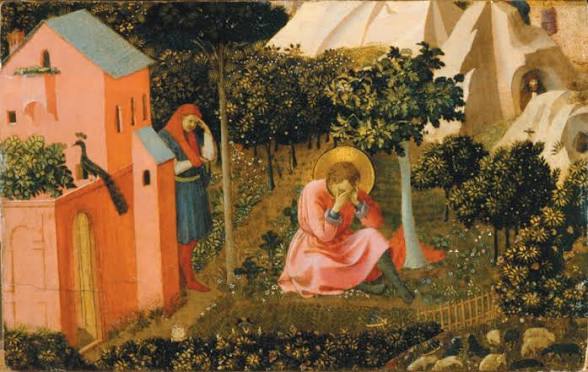
His importance lies less in the drama of his life and more in the method he applied to truth itself. The intellectual world he entered was structured around inherited authority. Figures like Augustine were treated as settled voices, and the role of the student was often to understand, organize, and transmit what had already been established.


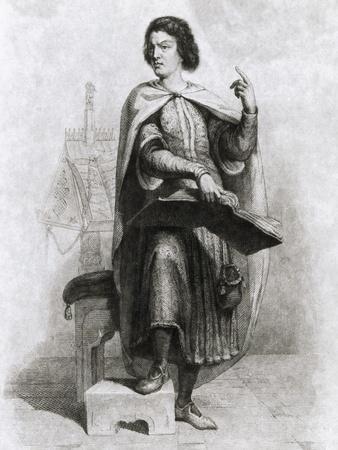
Peter Abelard with Book Giclee

Reasoning had a place, but it operated within limits. It was expected to clarify, not destabilize.

Abelard did not reject the tradition from the outside. He worked within it and exposed its internal tensions. In Sic et Non, he placed authoritative statements side by side in a way that made contradiction difficult to ignore.

If these sources were meant to provide certainty, why did they diverge so sharply?

If truth had already been handed down in a unified form, why did it fracture under comparison?

He treated those questions as a starting point rather than a threat to avoid.

“For it is from doubt that we arrive at questioning, and in questioning we arrive at truth.”

That quote represents the change in intellectual posture.

Instead of beginning with certainty and using reason to defend it, Abelard begins with tension and uses reason to work through it. Authority alone no longer settles the issue. Claims must be examined, language clarified, and assumptions tested.

Once questioning becomes legitimate, authority can no longer rely on transmission alone. It now has to also persuade.

Abelard pushed beyond accepted limits. He applied reason to doctrines often treated as beyond rational explanation and placed greater emphasis on intention in moral evaluation. In doing so, he opened space for a more nuanced understanding of ethics, one not entirely bound to inherited categories.

The response to him was what you would expect from institutional power.

He was condemned. His works were burned. He was brought before councils that were less interested in exploring his arguments and more so in containing their implications. The reaction showed what was at stake. A religious order grounded in authority does not easily absorb a method that legitimizes doubt.

And yet the method persisted.

Even when his specific conclusions were rejected, the habit of inquiry he modeled proved difficult to suppress. The practice of setting opposing views side by side and working through contradiction became central to scholasticism. The intellectual tradition that later shaped medieval universities carried forward elements of an approach once treated as dangerous.

Abelard does not stand alone as the cause of a broader intellectual reopening. The recovery of classical texts, the reintroduction of Aristotle, contact with Islamic and Jewish scholarship, and the growth of educational institutions all played a role.

What his story represents is the shift in attitude.

Inherited knowledge no longer functions as a sealed inheritance. It became something that can be examined, refined, and, within limits, challenged.

Of course, those constraints never fully disappeared.

Abelard was allowed to question, but not indefinitely. He was permitted to reason, but not without consequence. The same religious culture that made his work possible also defined where it had to stop.

That tension between authority and inquiry did not remain confined to intellectual life. It also carried forward into the institutions that developed over time.

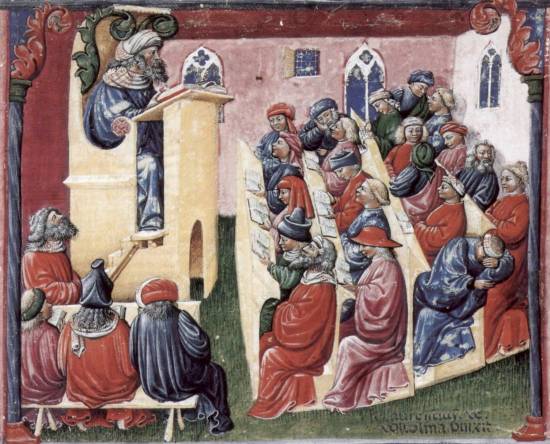
A university lecture (an illustration from the second half of the 14th century).

The medieval university is one of the clearest places to see this pattern at work. Often treated as a distinctly Christian achievement, it grew out of a much broader mix of influences.

In Spain, Baghdad, and Cairo, Islamic schools, libraries, and observatories held resources far beyond anything available in much of Europe at the time. Arab, Jewish, and Christian scholars shared intellectual interests through expanding trade networks and translation movements. After the Christian capture of Toledo in 1085, that city became one of the key places where these worlds met, allowing texts to move across languages, traditions, and religious boundaries.

The Western reopening of inquiry did not happen because Europe simply looked inward and rediscovered itself.

It happened because knowledge traveled.

Averroes’ commentaries on Aristotle, translated into Latin, became essential sources for thirteenth-century Christian intellectuals, including Thomas Aquinas. That alone should complicate any idea that Christian scholarship developed in isolation. The university absorbed, translated, debated, and reorganized knowledge that had already passed through Greek, Arabic, Jewish, and Latin traditions.

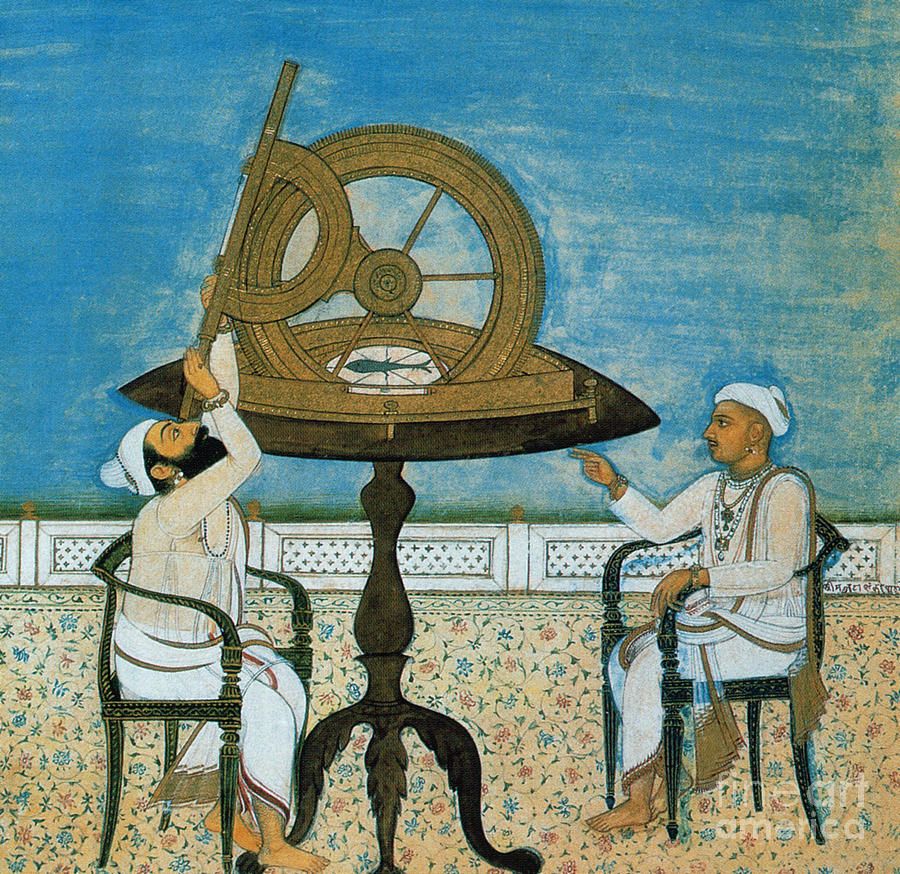
Islamic Astronomers #1 is a photograph by Science Source

Even the structure of medieval universities reflects that broader inheritance. They developed their own corporate identities, governed collectively by masters, with distinct curricula and examination systems. By the late thirteenth century, Master of Arts could vastly outnumber Master of Theology. Historian Charles Freeman notes one example where 120 teachers of the arts were listed against only 15 Masters of Theology. That imbalance tells you what mattered most. The curriculum leaned heavily on classical texts, not purely Christian foundations.

Christian Europe helped institutionalize learning, but the material being organized was older, broader, and more cosmopolitan than the church-centered story suggests. The university becomes another example of Christianity’s larger pattern: it absorbed existing goods, gave them institutional form, and placed them inside its own theological horizon.

But the results did not move in one direction.

The same religious vision that could support care and dignity could also justify hierarchy and control. Because the tradition depended on scriptural interpretation, and interpretation depended on authority, very different conclusions could emerge from the same source material.

That instability is not only a matter of later interpretation. It is already present in the texts themselves.

The Gospels do not present a single, unified account. They offer overlapping portraits that do not fully align.

In Gospel of Matthew and Gospel of Mark, Jesus cries out, “My God, my God, why have you forsaken me?” while in Gospel of John, he concludes, “It is finished.” The tone shifts from abandonment to completion.

The timeline shifts as well, with the Synoptic Gospels placing the final meal at Passover, while John places the crucifixion before it begins.

Even the ethical posture is not entirely consistent: in Matthew, Jesus teaches “turn the other cheek,” while in Luke, he tells his followers, “Let the one who has no sword sell his cloak and buy one.”

Taken together, these are not minor discrepancies. They open space for fundamentally different readings of what the tradition demands.

Christianity persists not as a fixed form, but as a tradition capable of producing multiple, competing forms while still claiming continuity.

This becomes especially clear in debates over slavery.

Christians were involved in abolition movements, and that history is part of the record. The language of universal moral equality played a real role in mobilizing opposition to slavery and reshaping moral expectations.

But that is not the whole story.

The same texts were also used to defend slavery, reinforce it, and argue that existing social orders were divinely sanctioned.

That contradiction is not incidental. It reveals something important about the Christian inheritance itself.

A religious order that combines universal moral language with authoritative texts creates the conditions for both expansion and constraint. It can push moral concern outward, but it can also bind that concern within approved categories. The outcome depends on who interprets the texts, which authorities prevail, and what social pressures shape the reading.

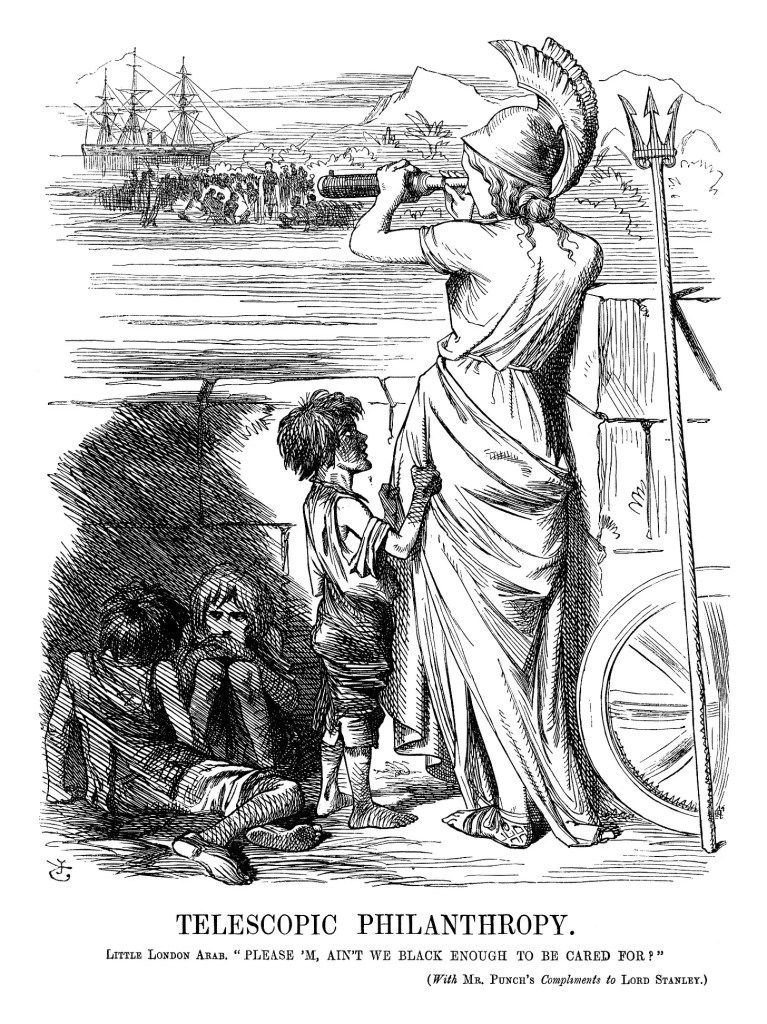
Critics of abolitionist movements, including Thomas Carlyle, argued that what they saw as abstract humanitarian concern could override more immediate obligations or practical realities. A contemporary political cartoon captured this dynamic under the phrase “telescopic philanthropy”—a tendency to focus moral concern at a distance while neglecting what is closer at hand.

The point I’m trying to make here is not that concern beyond one’s own group is inherently false or wrong.

The point is that moral expansion creates distance.

The farther a concern stretches, the easier it becomes to neglect concrete obligations close at hand: family, neighbors, local order, inherited duties, and the people one is actually responsible for. Abstract compassion can become morally flattering precisely because it asks less of the person expressing it.

Whether one agrees with those criticisms or not, they point to something very real.

A moral order that expands obligation beyond local belonging gains reach, but it also risks losing proportion. It can elevate the stranger while forgetting the neighbor. It can speak beautifully about mankind while failing the people right in front of it.

Christianity extended moral concern beyond tribe and built institutions that carried that vision forward. But it also introduced pressures around authority, interpretation, exclusion, and the limits of acceptable thought.

The good is real, but…so is the tension inside it.

Christianity’s inheritance was not simply compassion, dignity, or education. It was a moral architecture: universal in scope, institutional in form, inward in psychology, and unstable once detached from the cultural world that had once held it together.

That brings us to our next inquiry.

Not just what Christianity gave the West, but what kind of order made those outcomes possible.


SECTION II — THE BAD

Truth, Authority, and the Limits of Inquiry

At this point, the issue is not simply what happened when Christianity moved from the margins to power. I’ve explored that elsewhere: the suppression of rival systems, the narrowing of acceptable thought, and the long habit of treating competing worldviews not as alternatives to debate, but as errors to contain.

The deeper question here is more structural.

What kind of religious order produces those outcomes in the first place?

Because the shift was a reorganization of how truth operated, how disagreement was handled, and how legitimacy was defined.

Earlier Greco-Roman religious and philosophical life was not tolerant in the modern sense, but it was more comfortable with multiplicity. Rival schools, local cults, household gods, civic rituals, and philosophical traditions could coexist without requiring one totalizing creed to absorb or eliminate the rest. That did not make the ancient world peaceful or morally pure. It did mean that truth was not always treated as one fragile object that had to be protected from every rival.

The Abrahamic worldview introduced something different, often called the “Mosaic distinction.”

God giving the Tablets of the Law to Moses, from a manuscript attributed to Chrétien Legouais, 1325 CE. Image source: gallica.bnf.fr / Bibliothèque municipal de Rouen

It drew a sharper line between true and false in a way that changed the stakes of disagreement. Belief was no longer simply one option among many. It became a dividing line. Once that line was drawn, alternative ways of seeing the world did not remain neutral. They became errors, and error began to carry drastic consequences beyond private belief.

If truth is singular and binding, then the religious order has to decide what to do with everything outside of it. Some ideas are absorbed. Some are tolerated for a time. Others are pushed out entirely. But none of them sit comfortably alongside it anymore. They exist in tension with the claim that one truth must govern above all others.

As we previously discussed, Christianity is often credited with preserving learning and building universities, and that claim is not false. Medieval universities became important institutions for intellectual training, debate, law, theology, medicine, and philosophy. They helped organize knowledge and gave scholastic inquiry a durable form.

But that achievement has to be kept in proportion.

The medieval university was an achievement, but it was not a recovery of classical freedom. It was classical inheritance under theological supervision.

Ancient philosophy could be studied, but it had to be reconciled with Christian doctrine. Aristotle could return, but not as Aristotle alone. He had to be interpreted through Christian categories, corrected where necessary, and placed beneath revealed truth. Reason was permitted, even sharpened, but it was not sovereign.

The medieval university did not represent inquiry on open ground. It represented inquiry inside boundaries. Reason could clarify doctrine, defend doctrine, organize doctrine, and reconcile contradictions within inherited authorities. But when reason pressed too far against the architecture of belief, the limits became quite visible.

That does not make medieval learning worthless. It makes it conditional.

And that conditionality is the point.

Christian Europe did not simply preserve the classical world. It received it, edited it, baptized it, and constrained it. What could be made useful to the Christian order survived more easily. What threatened that order did not.

This is the kind of intellectual narrowing later critics would recognize in Christianity’s relationship to philosophy. Heidegger’s critique of onto-theology is not aimed at Christianity alone, but it helps name the pattern: open-ended questioning becomes absorbed into a prior explanatory order. Instead of wonder remaining primary, inquiry is routed through established claims about creation, causality, divine order, sin, and salvation.

The question is no longer allowed to remain fully open.

It has to be answered inside the architecture of doctrine.

Once orthodoxy is established it operates within boundaries that have already been set, and stepping outside those boundaries starts to carry not just intellectual consequences, but social ones. Access to authority, education, and influence becomes tied, at least in part, to alignment.

At that point, belief is no longer just something people hold. It becomes something that moves outward, seeking to correct and expand.


SECTION III: THE UGLY

Universalism, Power, and the Moral Afterlife

By the time you reach the modern West, the question is no longer whether Christianity shaped it. That much is obvious. The deeper issue is what, exactly, it left behind, and what happens when the conditions that once sustained that inheritance begin to unravel.

Christianity did not simply introduce a set of beliefs and then fade as those beliefs weakened. It reorganized moral life at a level that persists long after doctrine loses its authority. It changed how individuals understood themselves, how they related to others, where moral responsibility resided, and how truth was expected to move through the world.

The ugly side of the Christian inheritance is not merely universalism. It is universalism with a missionary engine.

Christianity does not simply say, “This is true.” It says truth must be spread. Error must be corrected. The world must be brought into submission to the saving order. That structure changes the meaning of difference. A rival worldview is not merely foreign, local, or ancestral. It becomes spiritually demonic.

And once a difference becomes an error, correction can be justified as mercy.

The religious world Christianity emerges from was already in tension with the surrounding Greek and Roman order. Second Temple Judaism didn’t simply blend into Hellenistic life. Again and again, it resisted it—politically, culturally, religiously.

D. H. Lawrence saw this tendency clearly. In Apocalypse, he describes a fear-driven impulse within Christianity—a refusal to leave other ways of understanding the world intact. Not just disagreement, but the drive to overcome, absorb, or eliminate what stands outside the truth.

That instinct is already embedded in the apocalyptic world Christianity emerges from. Second Temple Judaism carries expectations of final judgment, cosmic conflict, and the ultimate victory of a single, rightful order-the coming of the Moshiach/Messiah.) Christianity inherits that framework and gives it a wider reach.

That is where Christianity’s relationship to Rome becomes essential. Christian universalism did not spread on its own. It moved through the late imperial Roman systems: roads, cities, law, administration, literacy, political centralization, and habits of governance already trained toward scale. The faith did not merely conquer Rome. It also inherited Rome’s machinery.

Rome gave Christianity infrastructure. Christianity gave Rome a sacred moral horizon. Together, they helped produce a form of power that could move across peoples, lands, languages, and customs while claiming to operate in the name of truth rather than mere domination.

This is also why Christianity receives too much credit for goods it did not invent.

One reason it’s treated as the source of Western morality is that it became dominant enough to absorb older goods and narrate them backward as Christian achievements. Care for the poor, philosophical inquiry, civic duty, moral discipline, education, and concern for the common good did not appear out of nowhere when Christianity entered history. Many of these were already present in Greek, Roman, Jewish, and local European worlds. Christianity reorganized them inside its own story.

That reorganization gave them reach.

But it also gave them a new master narrative.

Older traditions were often embedded in particular peoples, places, households, ancestors, cities, gods, calendars, and sacred landscapes. Religion was not just a private belief system. It was woven into the life of a people. Christianity altered that relationship by making belief portable. It could cross borders, override local cults, and create a community defined less by blood, land, or inherited custom than by shared confession.

That is one of the most consequential shifts in Western history.

Christianity weakened the older link between people, place, ancestors, and gods. It did not erase those attachments overnight, and in practice it often absorbed local festivals, sacred sites, and folk customs. But the deeper logic changed. The highest belonging was no longer rooted primarily in the local or ancestral. It was relocated into a universal religious identity.

Conversion, then, was not merely persuasion. It was the remaking of belonging.

A people could be separated from their gods, their rituals, their inherited calendar, their sacred places, and their ancestral memory, then folded into a new universal story that claimed to redeem them while also replacing the world that formed them.

Not every conversion was violent. That would be too simple. Some conversions were gradual, political, strategic, sincere, blended, or partial. But once that universal truth claim became tied to salvation, rival traditions do not remain equal neighbors. They become obstacles to be overcome, errors to be corrected, or remnants to be absorbed.

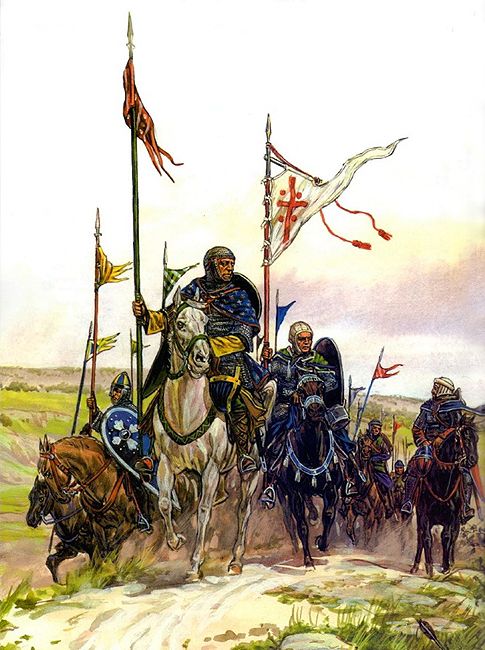
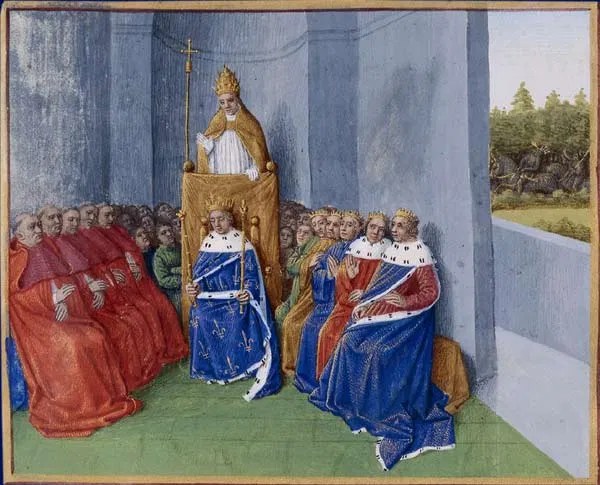
The First Crusade: Pope Urban II and Jerusalem vs. Diplomatic Unification

The crusades make this structure visible in its most explicit and militarized form.

They were not only political wars. They were religious wars shaped by sacred geography, penitential promise, and the belief that violence could be folded into a redemptive order.

The Crusades did not simply mobilize Europe—they redirected it toward Jerusalem, a sacred center that was not its own.

That does not mean every participant had the same motive, and it does not mean politics, land, wealth, status, and military ambition were irrelevant. Of course they mattered. But the crusading imagination reveals something specific: once warfare is placed inside a sacred story, conquest can be interpreted as obedience, purification, defense, or salvation.

That is the danger of missionary structure joined to power.

It sanctifies expansion.

And this is not confined to medieval history. The same basic pattern can reappear whenever politics inherits religious moral intensity. The opponent is no longer merely wrong about policy. He becomes a threat to truth, justice, salvation, progress, safety, democracy, equality, or whatever sacred term now carries the old theological weight.

At that point, disagreement becomes harder to contain.

The modern West inherited this moral intensity even as explicit Christian authority declined. Most people inherited a world in which Christianity had already begun to lose its grip, but nothing fully replaced it. The rituals became optional. The authority fractured. Yet many of the underlying assumptions remained intact.

What had once been explicitly theological was gradually translated into secular terms.

At the center of that structure is a form of universalism Christianity helped entrench: the idea that all people stand beneath one moral order, that identity is secondary to a broader human category, and that truth applies universally rather than locally. That assumption did not disappear with religious decline. It migrated.

Liberalism, in many of its modern forms, carries that template forward: the individual abstracted from place, lineage, inherited duty, and thick communal belonging, then positioned inside a universal framework of rights, equality, and moral expectation.

The language changes. The structure does not.

The West moved from Christian universalism to liberal universalism without seriously interrogating the universalism itself. It replaced theological justification with philosophical or political justification, but it retained the assumption that the highest moral order transcends particular identities rather than emerging from them.

And what carries forward is not only universal morality, but missionary mentality.

Salvation becomes progress. Sin becomes injustice. Heresy becomes hate. Evangelism becomes activism. The world must still be corrected. The morally backward must still be brought into line.

And the irony is hard to miss. The same people who pride themselves on rejecting religious dogma often reproduce its structure almost perfectly—moral certainty, heresy-hunting, and the impulse to correct and convert, just without calling it religion.

You can see this most clearly in the modern left, especially in its activist and radical edges. What presents itself as political theory often behaves like secularized salvation mythology. The infrastructure is unchanged: the world is broken and the masses need liberation. God is removed, but everything else remains. The heretics still need correction. Sin becomes hierarchy. Salvation becomes self-rule. The missionary doesn’t disappear—he just changes form.

It still sorts people into the righteous and the condemned. It still creates moral taboos. It still treats disagreement as contamination. It still imagines that the world can be redeemed if only the right moral order is imposed—with enough force, shame, education, policy, or institutional pressure.

That is not the absence of Christianity.

It is part of its afterlife.

Later European expansion, and even modern geopolitical projects, often operate within the same structure—intervention framed as liberation, reform, or progress.

Whenever universal moral claims are aligned with power and tied to the belief that truth must spread, action begins to feel necessary rather than optional.

To understand why it persists, and why it adapts so easily across different historical contexts, you have to look at what is happening at a deeper level. Not just in institutions or empires, but within the individual.

Because the most enduring change Christianity introduces is not only institutional.

It is psychological. It altered where morality is located.

In earlier classical traditions, especially in Aristotle, the moral life is oriented outward. The Greek conception of eudaimonia assumes that human beings can develop toward excellence. Flourishing is cultivated through practice, discipline, rational activity, and participation in the world. Character is formed through what one does, and the moral life is outward, embodied, and lived over time within a shared civic and social context.

Christianity, especially through Augustine of Hippo, redirects that focus inward.

The problem is no longer simply what a person does, but what a person is. Human nature itself becomes suspect, marked from the beginning. The doctrine of original sin reframes the individual not as someone developing toward excellence, but as someone starting already compromised. This is not just about isolated wrongdoing. It is about a baseline disorder built into human existence, transmitted across generations, shaping inclination before any conscious choice is made.

From that premise, morality reorganizes itself accordingly. If the problem lies within, then moral evaluation cannot remain limited to outward behavior. It extends inward, into thought, desire, intention, and impulse—the parts of life no one else sees but are still treated as morally significant.

Fra Angelico, The Conversion of St. Augustine (c. 14301435)

This becomes structured into daily practice. Monastic traditions classify internal states (temptation, pride, doubt, desire) as if they were items that could be named, tracked, and corrected. Authority expands beyond regulating behavior into defining what counts as acceptable thought, shaping not just action but the boundaries of the inner life itself.

Once it relocates inward, the primary site of regulation is no longer only the community. It is the individual mind, where conscience, guilt, confession, fear, and self-regulation operate continuously, often without any visible external enforcement.

You can see the implications of this in the conflict between Augustine and Pelagius. Pelagius emphasizes human capacity: the ability to choose, improve, and take responsibility for moral development. Augustine rejects that position, insisting on dependence—on God’s grace, on divine intervention, on something beyond human effort.

This is not only a theological disagreement.

It is also a question about agency.

If the individual cannot fully rely on their own capacity to move toward the good, then moral development becomes entangled with God’s authority. Responsibility does not disappear, but it no longer stands on its own. It becomes mediated, conditioned, and in some cases limited, as the individual is situated within a framework that places ultimate transformation outside of purely human reach.

Over time, that tension begins to shape intellectual life as well. Historians like Charles Freeman do not argue that inquiry simply disappeared, but that the conditions surrounding it changed. When belief becomes tied to salvation, and when error carries not only intellectual but spiritual consequences, curiosity itself begins to look different. Questions are no longer neutral exercises. They take on moral weight, and in certain contexts, they begin to carry risk.

Writers like Thomas Paine noticed this and pushed directly against the idea that truth can rest on inherited authority. In The Age of Reason, Paine argues that revelation, once it passes through human hands, can no longer function as unquestionable truth. What begins as divine claim becomes human interpretation, and therefore something that must be examined rather than simply accepted. That move cuts directly against the structure that treats questioning as risk. It reopens the possibility that belief itself should be subject to the same scrutiny as anything else.

Mark A. Noll describes a similar pattern in later Christian intellectual culture: a tendency to preserve belief rather than extend it. Questioning is not always welcomed as curiosity. It can be interpreted as disloyalty, a sign that alignment is weakening rather than deepening. The safest position, in that environment, becomes one of conformity rather than exploration.

The obedient mind is the secure mind.

This is not new. It is already visible earlier in the tradition. The same system that could produce figures like Abelard (where questioning began to reopen) also produces the conditions Noll is describing, where belief becomes something to preserve rather than extend.

The instinct to monitor thought, to moralize disagreement, to treat deviation as more than error—those habits do not emerge in a vacuum. They develop within specific historical conditions, and they persist even as the surrounding language changes.

This is why the internal reorganization matters.

It is not only about doctrine.

It is about how individuals learn to relate to themselves.

If Augustine relocates morality inward, Protestantism amplifies and personalizes that shift. The individual is placed in more direct relation to truth, expected to read, interpret, examine, and align himself without the same mediating structures that once guided that process. Authority does not vanish. It becomes more diffuse and more demanding.

The church hierarchy may weaken in some places, but new pressures emerge through scripture, sermon, household discipline, community surveillance, literacy, and conscience. The individual is made more responsible before God, but also more exposed.

The burden of interpretation moves further into the self.

Over time, that inward structure detaches from the communal and cultural worlds that once gave it shape. What remains is a society of individuals expected to interpret, justify, and regulate themselves inside a universal moral order, but without a shared culture capable of holding that process together.

That misalignment becomes visible in how people interpret conflict, identity, history, and political life.

In modern America, this can still be seen in forms of biblical literalism, dispensationalism, and end-times prophecy that shape how many Christians understand Israel, war, nationhood, and world events. These beliefs do not remain private. They influence political imagination. They affect how people interpret history, alliances, enemies, and what they believe is inevitable or divinely sanctioned.

In this context, belief stops being just belief. It starts shaping how everything else is seen.

That is the same mechanism operating in another key. The pattern that once defined orthodoxy and constrained variation does not disappear. It adapts as the cultural environment shifts. The language evolves, but the underlying habit remains… truth is singular, error is dangerous, and those outside the moral order must be corrected, converted, contained, or cast out.

What this reveals is not a simple story of progress or decline.

Christianity did not leave behind a stable moral foundation that the West either followed or abandoned. It left behind a set of interacting pressures: universalism and particular identity, internalized morality and external authority, individual responsibility and collective order, compassion and conquest, salvation and exclusion.

For a time, those pressures could be held in relative balance, but this fit no longer holds.

The institutions remain, but they no longer command the same trust. The moral instincts remain, but they are no longer guided by a shared tradition. The universal language remains, but it floats above increasingly fractured peoples, places, and loyalties.

Conflict becomes more moralized. Disagreement becomes harder to contain.

This is why the modern West feels both thin and volatile.

Thin, because inherited forms of continuity have weakened.

Volatile, because the moral pressure embedded in the inheritance remains, now operating without the older structures that once gave it proportion.

That is the condition the modern West has inherited.


CONCLUSION: Why the West Still Cannot Escape the Problem

The Christian inheritance of the West cannot be reduced to either gratitude or resentment.

It gave moral concern, meaning to suffering, durable institutions, and the preservation and transmission of knowledge, even as that knowledge was filtered through doctrine. It created a shared moral vocabulary capable of binding large populations together.

But it also changed the terms of belonging.

It loosened religion from peoplehood, place, ancestry, and local custom. It made belief portable. It turned truth into something singular and binding, making disagreement morally charged. Once rival traditions became errors rather than neighbors, the pressure to absorb, correct, or suppress them followed naturally.

The West did not abandon Christianity so much as carry its habits forward. The missionary impulse remained. The abstract individual remained. The suspicion of rooted identity remained. Social Justice became their new end times.

That is why a return to Christianity does not solve the problem. It would not restore a stable foundation but reassert one layer of the inheritance while leaving its tensions unresolved.

Secular liberalism does not solve it either. It often preserves the universalism while stripping away the cultural limits that once gave it proportion, asking people to live as abstract individuals inside a moral framework detached from place, memory, and inherited obligation.

What remains is not a coherent worldview, but a contradictory one.

From the beginning, the inheritance carried competing impulses. Early Christianity emerged from an apocalyptic environment while also developing moral and institutional frameworks for life within the world. Over time, those tensions were not resolved but reworked and emphasized in different ways.

Within Protestantism alone, some strands treated the world as something to be ordered and reformed, energizing movements like abolition, while others emphasized its corruption and eventual end, orienting life toward endurance and escape. The divergence is not a break from the tradition, but a difference in emphasis within it.

The result is a system that can point in opposite directions while still claiming the same foundation.

This is not a foundation a civilization can stand on.

A civilization needs moral scale, but also proportion. Compassion, but not so abstract that it forgets its own people. Rights, but not detached from duty. Inquiry, but not subordinated to sacred certainty. Space for disagreement, but enough shared identity to keep it from becoming civilizational warfare.

Above all, it needs rooted obligations.

A civilization cannot survive on abstract principles alone. It needs loyalty, shared memory, boundaries, place, and a people capable of recognizing what is theirs to preserve.

Because removing structure does not remove power. It removes the forms that make power visible and accountable. And when that happens, power does not disappear. It shifts—into forms that are harder to see and harder to resist.

We are not standing outside this inheritance.

We are still working within it.

And the task is not to romanticize Christianity, completely demonize it, or pretend we have escaped it, but to understand what it absorbed, what it built, what it destabilized, and what it left behind clearly enough to stop repeating its most destructive patterns.


Sources

Abelard, Peter. Sic et Non.

Aristotle. Nicomachean Ethics.

Aristotle. Politics.

Arktos Journal and Laurent Guyénot, The Crusading Civilisation: From the Middle Ages to the Middle East” (Substack, April 3, 2026).

Atkinson, Kenneth. “Judean Piracy, Judea and Parthia, and the Roman Annexation of Judea: The Evidence of Pompeius Trogus.” Electrum 29 (2022): 127–145. https://doi.org/10.4467/20800909EL.22.009.15779

Augustine. Confessions.

Augustine. The City of God.

Brown, Peter. Augustine of Hippo: A Biography. Berkeley: University of California Press, 2000

Burkert, Walter. The Orientalizing Revolution: Near Eastern Influence on Greek Culture in the Early Archaic Age. Cambridge, MA: Harvard University Press, 1992.

Carlyle, Thomas. “Occasional Discourse on the Negro Question.”

Doner, Colonel V. “Cognitive Dissonance of Political Activists, Or Whatever Happened to the Religious Right?” Chalcedon, July 1, 1999.

Freeman, Charles. The Closing of the Western Mind: The Rise of Faith and the Fall of Reason. London: Heinemann, 2002.

Freeman, Charles. The Reopening of the Western Mind: The Resurgence of Intellectual Life from the End of Antiquity to the Dawn of the Enlightenment. London: Head of Zeus, 2023.

Lawrence, D. H. Apocalypse. 1931.

Locke, John. A Letter Concerning Toleration. 1689.

MacCulloch, Diarmaid. Reformation: Europe’s House Divided, 1490–1700. London: Allen Lane, 2003.

MacMhaolain, Aodhan. The Transmission of Fire: How To Keep Tradition Burning. The Enchiridion, April 9, 2026.

Montesquieu, Charles de Secondat. The Spirit of the Laws. 1748.

Noll, Mark A. The Scandal of the Evangelical Mind. Grand Rapids: Eerdmans, 1994.

Paine, Thomas. The Age of Reason. 1794–1807.

Paine, Thomas. Common Sense. 1776.

Thorsteinsson, Runar M. Roman Christianity and Roman Stoicism: A Comparative Study of Ancient Morality. Oxford: Oxford University Press, 2010.

West, Martin L. The East Face of Helicon: West Asiatic Elements in Greek Poetry and Myth. Oxford: Clarendon Press, 1997.

Consciousness, Myth & the Power of Belief

Panpsychism, the Emergence Problem, and the Fractures Inside Mythicism with Dr. Skrbina

Today’s conversation isn’t just about whether Jesus existed.

It’s about something sitting underneath that entire debate.

Most mythicist conversations, meaning scholars and skeptics who argue that Jesus may be a literary or constructed figure, operate inside a philosophical framework called materialism.

Materialism in this sense doesn’t simply mean “trust science.” It’s a deeper metaphysical claim: that everything that exists is ultimately physical. Matter is fundamental, and consciousness is something the brain produces when matter is arranged in the right way.

Revisit a past episode where we discussed the dogma of materialism further

In that picture, mind comes after matter.
Meaning comes after biology.
Religion becomes a byproduct of social evolution.

But there’s a philosophical tension hiding inside that assumption.

Evolution can explain how biological bodies change. It can describe how organisms adapt and diversify. What it does not explain is something much more basic:

Why is there subjective experience at all? Why does pain actually hurt? Why does the color red look like something?

If matter is completely mindless at the ground level, how does experience suddenly appear?

Philosophers call this the emergence problem.

One alternative view (panpsychism) proposes that consciousness isn’t produced by matter at all. Instead, consciousness may be fundamental to reality itself.

That’s where philosopher Dr. David Skrbina enters the conversation.

His book Panpsychism in the West traces this idea across centuries of philosophical thought, showing that the notion of a mind-infused cosmos has appeared again and again throughout Western intellectual history.

But Skrbina has also stepped directly into the mythicist debate with his book The Jesus Hoax. More recently, he published a sharp response to criticism from fellow skeptics David Fitzgerald and Richard Carrier.

Add to that Adam Green’s recent book The Jesus Deception, which approaches early Christianity from yet another angle, and something interesting starts to appear:

Mythicism isn’t a unified theory. It’s fracturing into camps.

So, this conversation moves across several layers at once:

• consciousness and materialism
• the emergence problem
• whether panpsychism overlaps with Neoplatonism
• Paul: historical strategist or literary construct?
• and how The Jesus Hoax differs from The Jesus Deception

Let’s start with the philosophical ground beneath it all.


Consciousness and the Return of Panpsychism

Panpsychism is one of those philosophical ideas that sounds strange the first time you hear it but becomes harder to dismiss the more you think about the alternatives.

In plain terms, the idea is simple: mind or experience may exist at some level throughout reality.

That doesn’t mean rocks are thinking thoughts. Rather, it suggests that the basic constituents of the universe may possess extremely simple forms of experience.

The reason this idea keeps resurfacing across centuries of philosophy is precisely because of the emergence problem.

If consciousness appears only when matter becomes sufficiently complex, we still have to explain how completely mindless matter suddenly gives rise to subjective experience.

Panpsychism flips that question around. Instead of asking how consciousness emerges from matter, it proposes that matter itself may already possess proto-mental properties.

Skrbina’s historical work traces this idea from ancient Greek philosophy through early modern thinkers and into contemporary debates in philosophy of mind.

The interesting thing is that the idea never quite disappears. Even in periods dominated by strict materialism, it keeps resurfacing whenever philosophers run into the same problem: explaining how subjective experience arises from purely physical processes.


Materialism and the Emergence Problem

Materialism has been extraordinarily successful as a scientific framework.

It assumes that the universe is composed of physical entities governed by consistent laws. That assumption has allowed science to model everything from particle physics to molecular biology.

But when we apply that framework to consciousness, something unusual happens.

If matter is entirely mindless at the fundamental level, then at some point in the evolutionary process subjective experience must suddenly appear.

But where?

There’s no obvious “magic neuron” where awareness switches on. There’s no clear moment in development when matter transforms from non-experiencing to experiencing.

This is the emergence problem in its most basic form: explaining how subjective experience arises from purely physical systems.

Some scientists have attempted to address this by looking deeper into physics itself. Theories like Roger Penrose and Stuart Hameroff’s Orch-OR model propose that consciousness may be connected to quantum processes occurring inside neurons.

Whether or not those models succeed, they reveal something important: even within science, researchers are exploring ways to rethink the relationship between mind and matter.

Panpsychism is one such attempt.


Is Panpsychism Just Neoplatonism?

Because panpsychism proposes a cosmos infused with mind, people often assume it’s simply a modern version of Neoplatonism.

But the two traditions aren’t identical.

Neoplatonism describes reality as a hierarchical structure flowing from the One— a metaphysical unity that gives rise to intellect and soul. It carries strong teleological and ethical implications about how humans align themselves with the structure of reality.

Panpsychism, by contrast, is often framed as a metaphysical hypothesis about the nature of matter and consciousness, without necessarily including the moral or spiritual framework found in Neoplatonic thought.

Still, the overlap is hard to ignore. Both challenge the idea that the universe is purely mechanical.

Both suggest that mind and reality may be deeply intertwined.


The Mythicism Debate Fractures

Another interesting tension here is that some of the things Skrbina is criticized for aren’t that far from ideas that already exist in mythicist literature.

One of the central claims in The Jesus Hoax is that St Paul and a small cabal of early Christians may have functioned as a kind of non-military strategy within the Roman world. Instead of armed revolt, the movement theologically conquered by the spread through ideas, theology, and cultural influence.

Skrbina frames this as a kind of ideological or narrative strategy that could reshape behavior across the empire.

What makes the criticism somewhat puzzling is that a similar concept appears in Richard Carrier’s own work.

In Not the Impossible Faith, Carrier describes early Christianity as a movement that spread not through military rebellion but through cultural transformation. Rome could defeat armed revolts, but it could not easily suppress ideas that moved through communities, texts, and belief.

Carrier even characterizes this as a kind of revolutionary strategy. If Rome would always win a military conflict, the only rebellion that could succeed would be a cultural one— a war of ideas rather than armies. (Carrier, Not the Impossible Faith, Ch. 9).

In that sense, the notion that early Christianity functioned as a non-military cultural movement is not controversial. It is widely recognized that the early Jesus movement spread through persuasion, networks, and theology rather than organized violence.

Where the real disagreement emerges is over intent and origin.

Skrbina interprets this cultural transformation as something that may have been deliberately constructed or strategically shaped. His critics tend to view it as an organic religious development rather than a coordinated narrative project.

Another point raised in the exchange concerns the authorship of the gospels, particularly the question of whether Luke was a Gentile writer. Skrbina notes that even if certain details of authorship were revised, for example: if Luke were ultimately shown to be Gentile, the core structure of his argument would not collapse. It would simply require refinement.

That willingness to concede smaller points while maintaining the broader model is something he addresses repeatedly in his response.

The broader takeaway from this debate is that mythicism itself is not a single theory. It is a field where scholars often agree that the traditional gospel narrative is historically unreliable but disagree sharply about what actually replaced it.

David Fitzgerald’s Review of David Skrbina’s Amateur Jesus Hoax • Richard Carrier Blogs

When Propaganda Masquerades as Book Review: Reply to Fitzgerald and Carrier


Paul: Strategist or Literary Construct?

One of the most important figures in this entire discussion is Paul of Tarsus.

Skrbina’s model treats Paul as a strategic actor who played a central role in shaping early Christian theology.

But other scholars have raised a more radical possibility: that the Pauline corpus itself may not represent a stable first-century historical figure at all.

Research such as Nina Livesey’s work on the Roman literary context of the Pauline letters suggests that some of these texts may reflect later second-century developments.

If Paul himself were partly a literary construct, it would reshape the debate considerably.

Yet even in that scenario, Skrbina argues, the broader thesis of deliberate narrative construction would not necessarily collapse. It would simply require revision.


Adam Green and the Midrashic Jesus

Adam Green’s recent book The Jesus Deception adds another dimension to the conversation.

Green emphasizes the possibility that the gospel narratives were crafted through midrashic techniques, weaving together Hebrew scriptures to construct the story of Jesus.

This raises a broader question about how religious narratives function historically.

Are they simply stories? Or do they operate as cultural scripts that shape behavior across entire societies?

Green invokes a concept from cultural theory called hyperstition: the idea that beliefs can begin to influence reality because people act as if those beliefs are true.

In other words, a prophecy doesn’t need to be literally true to become historically powerful.

It only needs to be believed strongly enough that people start behaving in ways that bring it about.

That possibility becomes particularly interesting when we look at modern geopolitics.

Some recent reports have suggested that military personnel have framed conflicts in the Middle East through apocalyptic biblical language, describing events as part of a divine plan leading toward Armageddon.

Whether or not such interpretations reflect official policy, they illustrate how powerful religious narratives can be in shaping political imagination.

MRFF Inundated with Complaints of Gleeful Commanders Telling Troops Iran War is “Part of God’s Divine Plan” to Usher in the Return of Jesus Christ – Military Religious Freedom Foundation


Where the Debate Goes Next

In the end, the debate over Jesus may be downstream from something even deeper.

Our interpretation of religious history is shaped by our metaphysical assumptions.

If materialism is the only acceptable framework, religion must be explained as a social or psychological byproduct.

But if consciousness itself is fundamental to reality or if human beliefs can influence the unfolding of history the picture becomes far more complex.

The discussion of consciousness, myth, and belief may be one of the most important philosophical frontiers of our time.

And that conversation is just beginning.


Sources & Further Research

Books, News, Links | Univ of Michigan Dearborn | David Skrbina, PhD

Jesus Hoax website

Know More News-Adam Green with Dr. David Skrbina

For readers who want to explore the topics discussed in this episode more deeply, the following books and research have shaped the ideas discussed in this conversation. These works cover philosophy of consciousness, panpsychism, early Christianity, and the intellectual history of the ancient world.

Philosophy of Consciousness & Panpsychism

Panpsychism in the West – David Skrbina
A comprehensive historical survey tracing the idea that mind or experience may be fundamental to reality across centuries of Western philosophy.

Science Set Free – Rupert Sheldrake
A critique of the assumptions underlying modern scientific materialism and an exploration of alternative ways of thinking about nature, consciousness, and scientific inquiry.

The Emperor’s New Mind – Roger Penrose
A physicist’s investigation into the nature of consciousness, the limits of artificial intelligence, and the possibility that consciousness is tied to deeper physical processes in the universe.

The Jesus Hoax – David Skrbina
Explores the possibility that early Christian narratives functioned as a strategic cultural movement within the Roman world.

The Jesus Deception – Adam Green
Argues that the story of Jesus may have been constructed through Jewish midrashic storytelling traditions.

Not the Impossible Faith – Richard Carrier
Carrier’s argument that Christianity’s success in the Roman Empire was historically improbable given the cultural environment of the time.

The Letters of Paul in Their Roman Literary Context – Nina Livesey
A scholarly examination of whether the Pauline letters reflect later Roman literary production and rhetorical conventions.

The Opening of the Western Mind – Charles Freeman
A history of classical Greek and Roman intellectual traditions and the philosophical foundations of the ancient world.

The Closing of the Western Mind – Charles Freeman
Examines how classical philosophical traditions were gradually replaced by Christian orthodoxy in late antiquity.

The Historical Jesus Fact or Fiction?

Nailed: Ten Christian Myths That Show Jesus Never Existed at All

Today’s episode is one I’ve been looking forward to for a long time. I sat down with author and researcher David Fitzgerald, whose book Nailed: Ten Christian Myths That Show Jesus Never Existed at All has stirred up both fascination and controversy in both historical and secular circles.

Before anyone clutches their pearls — or their study Bible — this conversation isn’t about bashing belief. It’s about asking how we know what we think we know, and whether our historical standards shift when faith enters the equation.

Fitzgerald has spent over fifteen years investigating the evidence — or lack of it — surrounding the historical Jesus. In this first part of our series, we cover Myth #1 (“The idea that Jesus being a myth is ridiculous”) and Myth #4 (“The Gospels were written by eyewitnesses”). We also start brushing up against Myth #5, which explores how the Gospels don’t even describe the same Jesus.

We didn’t make it to Myth #7 yet — the claim that archaeology confirms the Gospels…. so, stay tuned for Part Two.

And for my visual learners!! I’ve got you. Scroll below for infographics, side-by-side Gospel comparisons, biblical quotes, and primary source references that make this episode come alive.

🧩 The 10 Myths About Jesus — According to Nailed

Myth #1: “The idea that Jesus was a myth is ridiculous!”
→ Fitzgerald argues that the assumption of Jesus’ historicity persists more from cultural tradition than actual historical evidence, and that questioning it isn’t fringe. It’s legitimate historical inquiry.

Myth #2: “Jesus was wildly famous — but somehow no one noticed.”
→ Despite claims that Jesus’ miracles and teachings drew massive crowds, there’s an eerie silence about him in the records of contemporaneous historians and chroniclers who documented far lesser figures.

Myth #3: “Ancient historian Josephus wrote about Jesus.”
→ The so-called “Testimonium Flavianum” passages in Josephus’ work are widely considered later Christian insertions, not authentic first-century testimony.

Myth #4: “Eyewitnesses wrote the Gospels.”
→ The Gospels were written decades after the events they describe by unknown authors relying on oral traditions and earlier written sources, not firsthand experience.

Myth #5: “The Gospels give a consistent picture of Jesus.”
→ Each Gospel portrays a strikingly different version of Jesus — from Mark’s suffering human to John’s divine Logos — revealing theological agendas more than biographical consistency.

Myth #6: “History confirms the Gospels.”
→ When examined critically, historical records outside the Bible don’t corroborate the key events of Jesus’ life, death, or resurrection narrative.

Myth #7: “Archaeology confirms the Gospels.”
→ Archaeological evidence supports the general backdrop of Roman-era Judea but fails to verify specific Gospel claims or the existence of Jesus himself.

Myth #8: “Paul and the Epistles corroborate the Gospels.”
→ Paul’s letters — the earliest Christian writings — reveal no awareness of a recent historical Jesus, focusing instead on a celestial Christ figure revealed through visions and scripture.

Myth #9: “Christianity began with Jesus and his apostles.”
→ Fitzgerald argues that Christianity evolved from earlier Jewish sects and mystery religions, with “Jesus” emerging as a mythologized figure around whom older beliefs coalesced.

Myth #10: “Christianity was totally new and different.”
→ The moral teachings, rituals, and savior motifs of early Christianity closely mirror surrounding pagan traditions and Greco-Roman mystery cults.


📘 Myth #1: “The Idea That Jesus Being a Myth Is Ridiculous”

This one sets the tone for the entire book — because it’s not even about evidence at first. It’s about social pressure.

Fitzgerald opens Nailed by calling out how the mythicist position (the idea that Jesus might never have existed) gets dismissed out of hand…even by secular historians. As he points out, the problem isn’t that the evidence disproves mythicism. The problem is that we don’t apply the same historical standards we would to anyone else.

Case in point: Julius Caesar crossing the Rubicon.

Julius Caesar crossing the Rubicon at the head of his army, 49 BC. Illustration from Istoria Romana incisa all’acqua forte da Bartolomeo Pinelli Romano (Presso Giovanni Scudellari, Rome, 1818-1819).

When historians reconstruct that event, we have:

  • Multiple contemporary accounts from major Roman historians like Suetonius, Plutarch, Appian, and Cassius Dio.
  • Physical evidence — coins, inscriptions, and monuments produced during or shortly after Caesar’s lifetime.
  • Political and military documentation aligning with the timeline.

In contrast, for Jesus, we have:

  • No contemporary accounts.
  • No archaeological or physical evidence.
  • Gospels written decades later by anonymous authors who never met him.

That’s the difference between history and theology.

Even historian Bart Ehrman, who does believe Jesus existed, has called mythicists “the flat-earthers of the academic world.” Fitzgerald addresses that in the interview (not defensively, but critically) asking why questioning this one historical figure provokes so much emotional resistance.

As he puts it, if the same level of evidence existed for anyone else, no one would take it seriously.


✍️ Myth #4: “The Gospels Were Written by Eyewitnesses”

We dive into the authorship problem — who actually wrote the Gospels, when, and why it matters.


🔀 Myth #5: “The Gospels Don’t Describe the Same Jesus”

⚖️ Contradictions Between the Gospels

1. Birthplace of Jesus — Bethlehem or Nazareth?

Matthew 2:1 – “Jesus was born in Bethlehem of Judea in the days of Herod the king.”
Luke 2:4–7 – Joseph travels from Nazareth to Bethlehem for the census, and Jesus is born there.
John 7:41–42, 52 – Locals say, “The Messiah does not come from Galilee, does he?” implying Jesus was known as a Galilean, not from Bethlehem.

🔍 Mythicist take:
Bethlehem was retrofitted into the story to fulfill the Messianic prophecy from Micah 5:2. In early Christian storytelling, theological necessity (“he must be born in David’s city”) trumps biographical accuracy.

2. Jesus’ Genealogy — Two Lineages, Zero Agreement

Matthew 1:1–16 – Jesus descends from David through Solomon.
Luke 3:23–38 – Jesus descends from David through Nathan.
Even Joseph’s father differs: Jacob (Matthew) vs. Heli (Luke).

🔍 Mythicist take:
Two contradictory genealogies suggest not historical memory but theological marketing. Each author tailors Jesus’ lineage to fit symbolic patterns — Matthew emphasizes kingship; Luke, universality.

3. The Timing of the Crucifixion — Passover Meal or Preparation Day?

Mark 14:12–17 – Jesus eats the Passover meal with his disciples before his arrest.
John 19:14 – Jesus is crucified on the day of Preparation — before Passover begins — at the same time lambs are being slaughtered in the Temple.

🔍 Mythicist take:
This isn’t a detail slip; it’s theology. John deliberately aligns Jesus with the Paschal lamb, turning him into the cosmic sacrifice — a theological metaphor, not an eyewitness timeline.

4. Jesus’ Last Words — Four Versions, Four Theologies

Mark 15:34 – “My God, my God, why have you forsaken me?” → human anguish.
Luke 23:46 – “Father, into your hands I commit my spirit.” → serene trust.
John 19:30 – “It is finished.” → divine completion.
Matthew 27:46 – Echoes Mark’s despair, but adds cosmic drama (earthquake, torn veil).

🔍 Mythicist take:
Each Gospel shapes Jesus’ death to reflect its theology — Mark’s suffering human, Luke’s faithful martyr, John’s omniscient divine being. This isn’t eyewitness diversity; it’s evolving mythmaking.

5. Who Found the Empty Tomb — and What Did They See?

Mark 16:1–8Three women find the tomb open, see a young man in white, flee in fear, tell no one.
Matthew 28:1–10Two women see an angel descend, roll back the stone, and tell them to share the news.
Luke 24:1–10Several women find the stone already rolled away; two men in dazzling clothes appear.
John 20:1–18Mary Magdalene alone finds the tomb, then runs to get Peter; later she meets Jesus himself.

🔍 Mythicist take:
If this were a consistent historical event, we’d expect some harmony. Instead, we see mythic escalation: from a mysterious empty tomb (Mark) → to heavenly intervention (Matthew) → to divine encounter (John).


6. The Post-Resurrection Appearances — Where and to Whom?

Matthew 28:16–20 – Jesus appears in Galilee to the eleven.
Luke 24:33–51 – Jesus appears in Jerusalem and tells them to stay there.
Acts 1:4–9 – Same author as Luke, now extends appearances over forty days.
Mark 16 (longer ending) – A later addition summarizing appearances found in the other Gospels.

🔍 Mythicist take:
The resurrection narrative grows with time — geographically, dramatically, and theologically. Early silence (Mark) gives way to detailed appearances (Luke/John), mirroring the development of early Christian belief rather than eyewitness memory.


🌿 Final Thought

Whether you end up agreeing with Fitzgerald or not, the point isn’t certainty… it’s curiosity. The willingness to look at history without fear, even when it challenges what we’ve always been told.

And here’s the fun part! David actually wants to hear from you. If you’ve got questions, pushback, or something you want him to unpack next time, drop it in the comments or send it my way. I’ll collect your submissions and bring a few of them into Part Two when we dig into Myth #7 — “Archaeology Confirms the Gospels.”

and as always, maintain your curiosity, embrace skepticism, and keep tuning in. 🎙️

📖 Further Reading 📖 

Foundational Mythicist Works:

  • Richard Carrier – On the Historicity of Jesus
  • Robert M. Price – The Christ-Myth Theory and Judaizing Jesus 
  • Earl Doherty – The Jesus Puzzle
  • Gospel Fictions – Randel Helms
  • The Fable of Christ – Joseph Wheless
  • The Pagan Christ – Tom Harpur
  • The Historical Jesus – William Benjamin Smith
  • The mythic past : biblical archaeology and the myth of Israel

Did Jesus Exist? Jacob Berman and Dr. Jack Bull Versus Dr. Aaron Adair and Neil Godfrey

Mainstream Scholarship & Context

  • Bart Ehrman – Did Jesus Exist?
  • Jonathan Haidt – The Righteous Mind Why Good People are Divided by Religion and Politics

Critiques of Bart Ehrman

Broader Philosophical & Cultural Context

  • Christianity before Christ  –  John G Jackson
  • The World’s Sixteen Crucified Saviors – Kersey Graves
  • The Christ Conspiracy – Acharya S (D.M. Murdock)


Sacred or Strategic? Rethinking the Christian Origin Story

The Bible Isn’t History and Trump Isn’t Your Savior

It’s Been a Minute… Let’s Get Real

Hey Hey, welcome back to Taste of Truth Tuesdays! it’s been over a month since my last episode, and wow—a lot has happened. Honestly, I’ve been doing some serious soul-searching and education, especially around some political events that shook me up.

I was firmly against Trump’s strikes on Iran. And the more I dug in, the more I realized how blind I’d been completely uneducated and ignorant about the massive political power Zionism holds in this country. And it’s clear now: Trump is practically bent over the Oval Office for Netanyahu. The Epstein files cover-up only confirms that blackmail and shadow control are the real puppet strings pulling at the highest levels of power. Our nation has been quietly occupied since Lyndon B. Johnson’s presidency and that’s a whole other episode I’ll get into later.

But what really cracked something in me was this:

In the 1990s, Trump sponsored Elite’s “Look of the Year” contest—a glitzy, global modeling search that lured teenage girls with promises of fame and fashion contracts. Behind the scenes, it was a trafficking operation. According to The Guardian’s Lucy Osborne and the BBC documentary Scouting For Girls: Fashion’s Darkest Secret, these girls weren’t being scouted—they were being sold to rich businessmen.

This wasn’t just proximity. Trump was part of it.

Once I saw that, the religious right’s worship of him stopped looking like misguided patriotism and started looking like mass delusion. Or complicity. Either way, I couldn’t unsee it.

And that’s when I started asking the bigger questions: What else have we mistaken for holy? What else have we accepted as truth without scrutiny?

For now, I want to cut to the heart of the matter: the major problem at the root of so much chaos: the fact that millions of Christians still believe the Bible is a literal historical document.

This belief doesn’t just distort faith-it fuels political agendas, end-times obsession, and yes, even foreign policy disasters. So, let’s dig into where this all began, how it’s evolved, and why it’s time we rethink everything we thought we knew about Scripture.

Thanks for reading Taste of Truth! Subscribe for free to receive new posts and support my work.

For most Christians, the Bible is more than a book-it’s the blueprint of reality, the inspired Word of God, infallible and untouchable. But what if that belief wasn’t original to Christianity? What if it was a reaction…. a strategic response to modern doubt, historical criticism, and the crumbling authority of the Church?

In this episode, we’re pulling back the veil on the doctrine of biblical inerrancy, the rise of dispensationalism, and the strange marriage of American politics and prophetic obsession. From the Scofield Bible to the belief that modern-day Israel is a fulfillment of God’s plan, we’re asking hard questions about the origins of these ideas.

As Dr. Mark Gregory Karris said when he joined us on a previous episode: “Can you imagine two different families? One, the Bible is the absolute inerrant word of God every.Word, every jot and title, so to speak, is meant to be in there due to the inspiration of God. And so every story you read, you know, God killing Egyptian babies and God flooding the entire planet and thinking, well yeah, there’s gonna be babies gasping for air and drowning grandmothers and all these animals. And that is seen as absolute objective truth. But then in another family, oh, these are, these are myths. These are sacred myths that people can learn from. No, that wasn’t like God speaking and smiting them and burning them alive because they touch this particular arc or now that this is how they thought given their minds at the time, given their understandings of and then like you talked about oh look at that aspect of humanity interesting that they portrayed god and not like it becomes like wow that’s cool instead of like oh my gosh i need 3-4 years of therapy because I was taught the bible in a particular way.”

Once you trace these doctrines back to their roots, it’s not divine revelation you find: it’s human agendas.

Let’s get uncomfortable. Was your faith formed by sacred truth… or centuries of strategic storytelling?

How Literalism Took Over

In the 19th century, biblical literalism became a kind of ideological panic room. As science, archaeology, and critical scholarship began to chip away at traditional interpretations, conservative Christians doubled down. Instead of exploring the Bible as a complex, layered anthology full of metaphor, moral instruction, and mythology, they started treating it like a divine press release. Every word had to be accurate. Every timeline had to match. Every contradiction had to be “harmonized” away.

The Myth of Inerrancy

One of the most destructive byproducts of this era was the invention of biblical inerrancy. Yes, invention. The idea that the Bible is “without error in all that it affirms” isn’t ancient…. it’s theological propaganda, most notably pushed by B.B. Warfield and his peers at Princeton. Rogers and McKim wrote extensively about how this doctrine was manufactured and not handed down from the apostles as many assume. We dive deeper into all that—here.

Inerrancy teaches that the Bible is flawless, even in its historical, scientific, and moral claims. But this belief falls apart under even basic scrutiny. Manuscripts don’t agree. Archaeological timelines conflict with biblical ones. The Gospels contradict each other. And yet this doctrine persists, warping believers’ understanding and demanding blind loyalty to texts written by fallible people in vastly different cultures.

That’s the danger of biblical inerrancy: it treats every verse as historical journalism rather than layered myth, metaphor, or moral instruction. But what happens when you apply that literalist lens to ancient origin stories?

📖 “Read as mythology, the various stories of the great deluge have considerable cultural value, but taken as history, they are asinine and absurd.” — John G. Jackson, Christianity Before Christ

And yet, this is the foundation of belief for millions who think Noah’s Ark was a literal boat and not a borrowed flood myth passed down and reshaped across Mesopotamian cultures. This flattening of myth into fact doesn’t just ruin the poetry-it fuels bad politics, end-times obsession, and yes… Zionism.

And just to be clear, early Christians didn’t read the Bible this way. That kind of rigid literalism didn’t emerge until centuries later…long after the apostles were gone. We’ll get to that.

When we cling to inerrancy, we’re not preserving truth. We’re missing it entirely.

Enter: Premillennial Dispensationalism

If biblical inerrancy was the fuel, C.I. Scofield’s 1909 annotated Bible was the match. His work made premillennial dispensationalism a household belief in evangelical churches. For those unfamiliar with the term, here’s a quick breakdown:

  • Premillennialism: Jesus will return before a literal thousand-year reign of peace.
  • Dispensationalism: History is divided into distinct eras (or “dispensations”) in which God interacts with humanity differently.

When merged, this theology suggests we’re living in the “Church Age,” which will end with the rapture. Then comes a seven-year tribulation, the rise of the Antichrist, and finally, Jesus returns for the ultimate battle after which He’ll rule Earth for a millennium. Sounds like the plot of a dystopian film, right? And yet, this became the dominant lens through which American evangelicals interpret reality.

The result? A strange alliance between American evangelicals and Zionist nationalism. You get politicians quoting Revelation like it’s foreign policy, pastors fundraising for military aid, and millions of Christians cheering on war in the Middle East because they think it’ll speed up Jesus’ return.

But here’s what I want you to take away from this episode today: none of this works unless you believe the Bible is literal, infallible, and historically airtight.

How This Shaped Evangelical Culture and Politics

The Scofield Bible didn’t just change theology. It changed culture. Dispensationalist doctrine seeped into seminaries like Dallas Theological Seminary and Moody Bible Institute, influencing generations of pastors. It also exploded into popular culture through Hal Lindsey’s The Late Great Planet Earth and the Left Behind series. Fiction, prophecy, and fear blurred into one big spiritual panic attack.

But perhaps the most alarming shift came in the political realm. Dispensationalist belief heavily influences evangelical support for the modern state of Israel. Why? Because many believe Israel’s 1948 founding was a prophetic event. Figures like Jerry Falwell turned theology into foreign policy. His organization, the Moral Majority, was built on an unwavering belief that supporting Israel was part of God’s plan. Falwell didn’t just preach this, he traveled to Israel, funded by its government, and made pro-Israel advocacy a cornerstone of evangelical identity.

This alignment between theology and geopolitics hasn’t faded. In the 2024 election cycle, evangelical leaders ranked support for Israel on par with anti-abortion stances. Ralph Reed, founder of the Faith and Freedom Coalition, explicitly said as much. Donald Trump even quipped that “Christians love Israel more than Jews.” Whether that’s true or not, it reveals just how deep this belief system runs.

And the propaganda doesn’t stop there…currently Israel’s Foreign Ministry is funding a week-long visit for 16 prominent young influencers aligned with Donald Trump’s MAGA and America First movements, part of an ambitious campaign to reshape Israel’s image among American youth.

But Let’s Talk About the Red Flags

This isn’t just about belief-it’s about control. Dispensationalist theology offers a simple, cosmic narrative: you’re on God’s winning team, the world is evil, and the end is near. There’s no room for nuance, no time for doubt. Just stay loyal, and you’ll be saved.

This thinking pattern isn’t exclusive to Christianity. You’ll find it in MLMs, and some conspiracy theory communities. The recipe is the same: create an in-group with secret knowledge, dangle promises of salvation or success, and paint outsiders as corrupt or deceived. It’s classic manipulation-emotional coercion wrapped in spiritual language.

And let’s not forget the date-setting obsession. Hal Lindsey made a career out of it. People still point to blood moons, earthquakes, and global politics as “proof” that prophecy is unfolding. If you’ve ever been trapped in that mindset, you know how addictive and anxiety-inducing it can be.

BY THE WAY, it’s not just dispensationalism or the Scofield Bible that fuels modern Zionism. The deeper issue is, if you believe the Bible is historically accurate and divinely orchestrated, you’re still feeding the ideological engine of Zionism. Because at its core, Christianity reveres Jewish texts, upholds Jewish chosenness, and worships a Jewish messiah. That’s not neutrality it’s alignment.

If this idea intrigued you, you’re not alone. There’s a growing body of work unpacking how Christianity’s very framework serves Jewish supremacy, whether intentionally or not. For deeper dives, check out Adam Green’s work over at Know More News on Rumble, and consider reading The Jesus Hoax: How St. Paul’s Cabal Fooled the World for Two Thousand Years. You don’t have to agree with everything to realize: the story you were handed might not be sacred it might be strategic.

Why This Matters for Deconstruction

For me, one of the most painful parts of deconstruction was realizing I’d been sold a false bill of goods. I was told the Bible was the infallible word of God. That it held all the answers. That doubt was dangerous. But when I began asking real questions, the entire system started to crack.

The doctrine of inerrancy didn’t deepen my faith… it limited it. It kept me from exploring the Bible’s human elements: its contradictions, its cultural baggage, and its genuine beauty. The truth is that these texts were written by people trying to make sense of their world and their experiences with the divine. They are not divine themselves.

Modern Scholarship Breaks the Spell

Modern biblical scholarship has long since moved away from the idea of inerrancy. When you put aside faith-based apologetics and look honestly at the evidence, the traditional claims unravel quickly:

  • Moses didn’t write the Torah. Instead, the Pentateuch was compiled over centuries by multiple authors, each with their own theological agendas (see the JEDP theory).
  • King David is likely a mythic figure. Outside of the Bible, there’s no solid evidence he actually existed, much less ruled a vast kingdom.
  • The Gospels weren’t written by Matthew, Mark, Luke, and John. Those names were added later. The original texts are anonymous and they often contradict each other.
  • John didn’t write Revelation. Not the Apostle John, anyway. The Greek and style are completely different from the Gospel of John. The real author was probably some unknown apocalyptic mystic on Patmos, writing during Roman persecution.

And yet millions still cling to these stories as literal fact, building entire belief systems and foreign policies on myths and fairy tales.


🧠 Intellectual Starvation in Evangelicalism

Here’s the deeper scandal: it’s not just that foundational Christian stories crumble under modern scrutiny. It’s that the church never really wanted you to think critically in the first place.

Mark Noll, a respected evangelical historian, didn’t mince words when he wrote:

“The scandal of the evangelical mind is that there is not much of an evangelical mind.”

In The Scandal of the Evangelical Mind, Noll traces how American evangelicalism lost its intellectual life. It wasn’t shaped by a pursuit of truth, but by populist revivalism, emotionalism, and a hyper-literal obsession with “the end times.” The same movements that embraced dispensationalism and biblical inerrancy also gutted their communities of academic rigor, curiosity, and serious theological reflection.

The result? A spiritually frantic but intellectually hollow faith—one that discourages questions, mistrusts scholarship, and fears nuance like it’s heresy.

Noll shows that instead of grappling with ambiguity or cultural complexity, evangelicals often default to reactionary postures. This isn’t just a relic of the past. It’s why so many modern Christians cling to false authorship claims, deny historical context, and accept prophecy as geopolitical fact. It’s why Revelation gets quoted to justify Zionist foreign policy without ever asking who actually wrote the book or when, or why.

This anti-intellectualism isn’t an accident. It was baked in from the start.

But Noll doesn’t leave us hopeless. He offers a call forward: for a faith that engages the world with both heart and mind. A faith that can live with tension, welcome complexity, and evolve beyond fear-driven literalism.

What Did the Early Church Actually Think About Scripture?

Here’s what gets lost in modern evangelical retellings: the earliest Christians didn’t treat Scripture the way today’s inerrantists do.

For the first few centuries, Christians didn’t even have a finalized Bible. There were letters passed around, oral traditions, a few widely recognized Gospels, and a whole lot of discussion about what counted as authoritative. It wasn’t until the fourth century that anything close to our current canon was even solidified. And even then, it wasn’t set in stone across all branches of Christianity.

Church fathers like Origen, Clement of Alexandria, and Irenaeus viewed Scripture as spiritually inspired but full of metaphor and mystery. They weren’t demanding literal accuracy; they were mining the texts for deeper meanings. Allegory was considered a legitimate, even necessary, interpretive method. Scripture was read devotionally and theologically, not scientifically or historically. In other words, it wasn’t inerrancy that defined early Christian engagement with Scripture, it was curiosity and contemplation.

For a deeper dive, check out The Gnostic Informant’s incredible documentary that uncovers the first hundred years of Christianity, a period that has been systematically lied about and rewritten. It reveals how much of what we take for granted was shaped by political and theological agendas far removed from the original followers of Jesus.

If you’re serious about understanding the roots of your faith or just curious about how history gets reshaped, this documentary is essential viewing. It’s a reminder that truth often hides in plain sight and that digging beneath the surface is how we reclaim our own understanding.

Protestantism: A Heretical Offshoot Disguised as Tradition

The Protestant Reformation shook things up in undeniable ways. Reformers like Martin Luther and John Calvin challenged the Catholic Church’s abuses and rightly demanded reform. But what’s often missed (or swept under the rug) is how deeply Protestantism broke with the ancient, historic Church.

By insisting on sola scriptura—Scripture alone—as the sole authority, the Reformers rejected centuries of Church tradition, councils, and lived community discernment that shaped orthodox belief. They didn’t invent biblical inerrancy as we know it today, but their elevation of the Bible above all else cracked the door wide open for literalism and fundamentalism to storm in.

What began as a corrective movement turned into a theological minefield. Today, Protestantism isn’t a single coherent tradition; it’s a sprawling forest of over 45,000 different denominations, all claiming exclusive access to “the truth.”

This fragmentation isn’t accidental…. it’s the logical outcome of rejecting historic continuity and embracing personal interpretation as the final authority.

Far from preserving the faith of the ancient Church, Protestantism represents a fractured offshoot: one that often contradicts the early Church’s beliefs and teachings. It trades the richness of lived tradition and community wisdom for a rigid, literalistic, and competitive approach to Scripture.

The 20th century saw this rigid framework perfected into a polished doctrine demanding total conformity and punishing doubt. Protestant fundamentalism turned into an ideological fortress, where questioning is treated as betrayal, and theological nuance is replaced by black-and-white dogma.

If you want to understand where so much of modern evangelical rigidity and end-times obsession comes from, look no further than this fractured legacy. Protestantism’s break with the ancient Church set the stage for the spiritual and intellectual starvation that Mark Noll so powerfully exposes.

Rethinking the Bible

Seeing the Bible as a collection of human writings about God rather than the literal word from God opens up space for critical thinking and compassion. It allows us to:

  • Study historical context and cultural influences.
  • Embrace the diversity of perspectives in Scripture.
  • Let go of rigid interpretations and seek core messages like love, justice, and humility.
  • Move away from proof-texting and toward spiritual growth.
  • Reconcile faith with science, reason, and modern ethics.

When we stop demanding that the Bible be perfect, we can finally appreciate what it actually is: a complex, messy, beautiful attempt by humans to understand the sacred.

This shift doesn’t weaken faith…. I believe it strengthens it.

It moves us away from dogma disguised as certainty and into something deeper…. something alive. It opens the door for real relationship, not just with the divine, but with each other. It makes space for growth, for disagreement, for honesty.

And in a world tearing itself apart over whose version of truth gets to rule, that kind of open-hearted spirituality isn’t just refreshing-it’s essential.

Because if your faith can’t stand up to questions, history, or accountability… maybe it was never built on truth to begin with.

Let’s stop worshiping the paper and start seeking the presence.

🔎 Resources Worth Exploring:

  • “The Jesus Hoax: How St. Paul’s Cabal Fooled the World for Two Thousand Years” by David Skrbina
  • “Christianity Before Christ” by John G. Jackson
  • The Scandal of the Evangelical Mind” by Mark Noll – A scathing but sincere critique from within the evangelical tradition itself. Noll exposes how anti-intellectualism, biblical literalism, and cultural isolationism have gutted American Christianity’s ability to engage the world honestly.
  • Check out Adam Green’s work at Know More News on Rumble for more on the political and mythological implications of Christian Zionism
  • And don’t miss my interview with Dr. Mark Gregory Karris, author of The Diabolical Trinity: Wrathful God, Sinful Self, and Eternal Hell, where we dive deep into the psychological damage caused by toxic theology

The Wounds We Don’t See: Betrayal, Recovery and Rebuilding Trust

Healing After Religious Abuse: A Conversation with Connie A. Baker

Religious abuse can leave deep scars—ones that don’t just fade with time but require intentional healing. In this week’s conversation, I sat down with Connie A. Baker, author of Traumatized by Religious Abuse, for an honest and heartfelt discussion about the journey of healing from spiritual trauma. Connie shares her own experiences, the painful realities of the “second wound,” and how survivors can reclaim their emotional autonomy after years of manipulation and control.

Why Healing Can’t Be Rushed

One of the most profound takeaways from our conversation was the reminder that healing isn’t something to bulldoze through. Connie calls herself a “recovering bulldozer,” always pushing to move forward as quickly as possible. But in trauma recovery, speed can be counterproductive. She embraces the mantra, slow is steady, and steady is fast. For survivors, learning to slow down and allow healing to unfold naturally is essential. Trying to rush past the pain often leads to setbacks, while true recovery requires patience, self-compassion, and time.

The Second Wound: Betrayal After Speaking Out

Connie describes how only 25% of the damage she endured came from the abuse itself—the remaining 75% came from the judgment, rejection, and betrayal she faced when she spoke out. This “second wound” is a devastating reality for many survivors who expect support but instead encounter disbelief, gaslighting, or outright hostility.

I resonated deeply with this. When I began speaking about my own experiences within the church, I was met with accusations of backsliding, manipulation, and spiritual rebellion. Survivors already carry the weight of their trauma, and the added burden of social ostracization can feel insurmountable.

So how do we heal from this betrayal? Connie shares practical steps, including:

  • Finding safe, validating spaces where your story is heard and honored.
  • Understanding that others’ disbelief or discomfort does not negate your truth.
  • Developing strong boundaries to protect yourself from further harm.

Naming Abuse and Embracing Spectrum Thinking

One of the most insidious aspects of religious abuse is the difficulty of naming it. Many survivors downplay their experiences, believing that if they weren’t physically harmed, it “wasn’t that bad.” But Connie emphasizes that minimizing abuse hinders healing.

Abuse exists on a spectrum—from coercive control and emotional manipulation to outright physical harm. Recognizing where an experience falls on that spectrum is crucial for understanding the impact and taking steps toward recovery. This applies beyond religion too—cults, MLMs, and even rigid ideological movements can exhibit the same coercive tactics found in high-control religious environments.

Developing spectrum thinking—moving away from rigid “all or nothing” perspectives—allows survivors to see the full picture. Instead of thinking, “I was never physically hurt, so it wasn’t abuse,” they can acknowledge, “This environment manipulated me, eroded my self-trust, and controlled my emotions. That was harmful.”

Reclaiming Emotional Autonomy

Spiritual abuse often hinges on emotional suppression. Survivors are told that negative emotions—anger, sadness, fear—are sinful or a sign of weak faith. Verses like “Rejoice in the Lord always” and “Be anxious for nothing” are weaponized to shame people into emotional denial.

But emotions provide vital information. Anger tells us when our boundaries have been crossed. Sadness signals loss and the need for healing. Anxiety can be a survival mechanism. Connie reminds us that full wisdom comes from embracing the entire spectrum of human emotions.

Learning to trust yourself again after years of emotional control is no small feat. Some practical steps include:

  • Allowing yourself to feel emotions without labeling them as good or bad.
  • Recognizing when religious conditioning is silencing your true feelings.
  • Using anger constructively—to set boundaries rather than self-destruct.

Wrestling with Worldview: From Spiritual to Materialist and Back Again

Many survivors of religious abuse go through a radical shift in their worldview. Some reject spirituality entirely, embracing a materialist perspective where only the tangible world is real. Others swing to the opposite extreme, seeking comfort in rigid new belief systems.

Connie highlights that this spectrum—from deeply spiritual to strictly materialist—is something many survivors navigate as they attempt to make sense of their experiences. Some turn to hedonism—“Eat, drink, and be merry”—while others find meaning in service, activism, or intellectual pursuits. What matters most isn’t where someone lands on the spectrum but rather the process of wrestling with meaning, truth, and autonomy after religious trauma.

Final Thoughts

Healing from religious abuse is not linear. It’s messy, painful, and often isolating. But as Connie’s journey shows, it’s possible. By embracing the full range of emotions, setting firm boundaries, and recognizing abuse for what it is, survivors can reclaim their autonomy and rebuild a life of freedom and self-trust.

If you’re in the midst of this journey, know that you are not alone. Whether you’re deconstructing, reconstructing, or simply trying to make sense of it all, your experiences are valid. And healing—real, lasting healing—is possible.

What part of this conversation resonated most with you? Drop a comment and let’s keep the discussion going.

And as always: Maintain your curiosity, embrace skepticism, and keep tuning in! 🎙️🔒

Resources:

Escaping Dogma or Trading It? The Risks of Deconstruction Culture

For many, the term “deconstruction” has come to represent a deeply personal process of questioning inherited beliefs, especially in the context of religion. While there’s no official “deconstruction community,” it has become a popular buzzword online, flourishing in spaces like Instagram, TikTok, and podcasts. (The New Evangelicals, Dr. Pete Enns (The Bible for Normal People), Eve was framed, Jesus Unfollower, Dr. Laura Anderson just to name a few.) These platforms provide room to question everything and dismantle rigid systems of belief—at least in theory.

But what happens when these communities become echo chambers of their own? Instead of fostering true intellectual freedom, the deconstruction movement often serves as a pipeline into new forms of dogma. Rather than encouraging critical thinking, it frequently replicates the same tribalism and groupthink that so many participants are trying to escape.

This is not growth. It’s trading one set of chains for another.


From Evangelicalism to Progressive Extremism

It’s ironic: people leave far-right evangelical Christianity believing they’ve found freedom, only to stumble into another extreme—progressive leftist ideologies. Why does this happen?

To understand this, we need to step back and look at human nature. Political scientists have found that public opinion is shaped far more by group identity than by self-interest. As Jonathan Haidt explains in The Righteous Mind, politics is deeply tribal. We’re hardwired to align with groups, not necessarily because they offer truth, but because they provide belonging.

This tribal impulse is magnified in the context of deconstruction. Many who leave evangelical Christianity are grappling with disillusionment, loss, and a hunger for community. For some, the progressive left offers a sense of safety and a clear moral framework, mirroring what they once found in their faith. The partisan brain, already trained to see the world in “us versus them” terms, naturally clings to another tribe rather than embracing the discomfort of uncertainty.

Research even suggests that extreme partisanship may be addictive. Our brains are rewarded for performing the mental gymnastics that protect us from beliefs we don’t want to confront. This dynamic—coupled with the fear of being ostracized by a new community—creates an environment where dissenting voices are silenced, and ideological purity becomes the new gospel.

Woke Ideology as a Secular Faith: A Closer Look

John McWhorter argues that wokeism functions like a full-fledged religion. It provides a moral framework that mirrors traditional religious beliefs. Instead of concepts like original sin, wokeism offers “privilege,” positioning those with it as morally compromised. In place of rituals like prayer, adherents perform acts like confessing their biases. And, similar to the salvation promised in traditional religions, salvation in wokeism comes through activism and striving for societal change. For McWhorter, this structure offers a sense of moral clarity and purpose, but the movement’s refusal to tolerate dissent makes it dangerous. He suggests, “What we’re seeing isn’t a quest for justice but a demand for unquestioning orthodoxy.”

Keep your eyes 👀out for that blog post, for it will be coming soon, and it will be called “Oh Woke night, The Sacred Beliefs of the Left”


Fragility and the “Three Great Untruths”

The allure of the deconstruction space isn’t just about leaving religion; it’s about embracing a new narrative. But narratives, like dogmas, can distort reality when they’re based on false premises. Greg Lukianoff and Jonathan Haidt explore this in their book The Coddling of the American Mind, identifying three “Great Untruths” that have come to dominate cultural discourse:

  1. “What doesn’t kill you makes you weaker.”
  2. “Always trust your feelings.”
  3. “Life is a battle between good people and evil people.”

These untruths encourage fragility, discourage critical thinking, and foster an “us versus them” mentality. They create a world where discomfort is seen as harmful, emotions override evidence, and disagreement is equated with moral failure.

Sound familiar? For anyone who grew up in evangelical circles, these patterns mirror the same rigidity and moral absolutism they left behind. And yet, these same traits are now pervasive in parts of the deconstruction space. This creates an ironic cycle: people flee one form of oppression, only to adopt another, packaged in new language but rooted in the same fear-based thinking.

For a deeper dive into the 3 Untruths check out this post/podcast: How the Quest for Truth Became a New form of Dogma


Reason Isn’t the Savior We Think It Is

One of the most seductive ideas in the deconstruction movement is the belief in reason as the ultimate guide to truth. On the surface, this sounds like an antidote to dogma. But here’s the catch: reason isn’t the unbiased tool we like to imagine.

French cognitive scientists Hugo Mercier and Dan Sperber argue that reasoning didn’t evolve to help us discover truth. Instead, it evolved for argumentation—to persuade others and protect our own beliefs. This explains why confirmation bias isn’t just a quirk of human psychology; it’s a feature of our argumentative minds.

As individuals, we’re not wired to produce open-minded, truth-seeking reasoning—especially when our identity or reputation is on the line. This is why intellectual and ideological diversity is so important in any truth-seeking community. Without it, reasoning becomes a tool for reinforcing tribal loyalty, not uncovering deeper truths.

The philosopher John Stuart Mill captured this in On Liberty, arguing that free speech and open debate are essential for discovering truth. Mill believed that truth isn’t static or simple; it emerges when differing perspectives clash, forcing ideas to be tested, refined, and strengthened. Worshiping reason as an infallible guide is, in itself, a kind of faith—one as flawed and potentially dangerous as religious dogmatism.


The Rise of the Fake Intellectual

2020 and the pandemic didn’t just disrupt our lives; it disrupted how we think about authority and expertise. Franklin O’Kanu, in his Substack UNORTHODOXY, describes the emergence of a new archetype: the “fake intellectual.”

These individuals position themselves as ultimate authorities, wielding data and studies to validate their perspectives. But often, their arguments lack intellectual rigor. They cherry-pick evidence, appeal to emotion, and create the illusion of expertise without true depth.

In the realm of public health and pharmaceuticals, there’s a well-documented phenomenon known as the “revolving door” between regulatory agencies and the pharmaceutical industry. This term refers to the cyclical movement of personnel between roles as regulators or policymakers and positions within the industries they oversee.

What Is the Revolving Door?

The revolving door concept highlights a pattern where high-ranking officials from organizations such as the CDC (Centers for Disease Control and Prevention) and the FDA (Food and Drug Administration) transition into influential roles within pharmaceutical companies, and vice versa. This fluid movement raises critical questions about the integrity and impartiality of regulatory oversight.

The deconstruction space is fertile ground for this phenomenon. Disillusioned individuals, hungry for guidance, are particularly vulnerable to voices that seem authoritative. But the rise of fake intellectuals doesn’t just mislead; it stifles genuine curiosity and critical thinking, replacing one form of blind faith with another.


A Call for Intellectual Diversity

If the goal of deconstruction is freedom, then it must embrace intellectual diversity. True growth happens when we allow our ideas to be challenged—when we resist the urge to label dissenters as enemies and instead engage with them in good faith.

This is why Mill’s defense of free speech is more important than ever. Truth isn’t found in the safety of ideological purity; it’s forged in the discomfort of debate. Communities that discourage dissent are not liberating—they’re suffocating.


Conclusion: Toward True Freedom

Deconstruction should be a crossroads, not a pipeline. It’s an opportunity to question everything—including the ideologies we’re tempted to adopt in place of the ones we’ve left behind.

To truly grow, we must embrace complexity, engage with opposing perspectives, and remain humble in the face of our own limitations. The path to freedom isn’t about finding the “right” tribe—it’s about stepping beyond tribes altogether and seeking truth with courage, curiosity, and an open mind.

From Burnout to Breakthrough:  Healing, Art, and Resilience with Katherine Spearing

🎙️ Welcome Back! Join me as I chat with Katherine Spearing, MA, CTRC — founder of Tears of Eden 🌸, a nonprofit supporting survivors of spiritual abuse, and former host of the groundbreaking Uncertain podcast 🎧. Katherine is also the host of Trauma & Pop Culture, a Certified Trauma Recovery Practitioner 🧠, and an expert in helping those who have survived cults, high-control environments, and sexual abuse 💔. She even offers specialized trauma-informed career coaching 💼!

In this episode, we discuss: 💡 The most impactful themes from Uncertain — including her powerful episode with Dr. Laura Anderson on anger 😡 and the concept of second-wave fundamentalism. 🎭 How creative arts therapies are aiding survivors of sexual abuse in their healing journey, and how these methods differ from traditional therapy 🎨. 🛑 Managing the emotional weight of working with spiritual abuse survivors and Katherine’s personal journey to avoid burnout 🧘‍♀️. 👩‍🎤 Challenging traditional gender roles in Christianity — how they’ve shaped perceptions of women’s worth and agency, and steps for creating more inclusive spaces 🚺. 🛡️ Building healthy community dynamics to protect against spiritual abuse while fostering authentic, supportive connections 🌱. 🔥 A sneak peek into Katherine’s upcoming book on spiritual abuse, including why the church is so obsessed with sex 💭.

Tune in now for an insightful conversation on healing, resilience, and challenging the status quo! 🗣️✨

Don’t miss out on Katherine’s wisdom and unique perspective. 🎧

Tears of Eden podcast episode we mentioned

Blog — Katherine Spearing

Tears of Eden: Supporting survivors of Spiritual Abuse and Religious Trauma

🙏 Please help this podcast reach a larger audience in hope to edify & encourage others! To do so: leave a 5⭐️ review and send it to a friend! Thank you for listening! I’d love to hear from you, find me on Instagram!⁠⁠⁠ @taste0ftruth⁠⁠⁠ or⁠⁠⁠ Pinterest! ⁠⁠ ⁠ 

The Convergence of Science, Religion, and Society: A Look at the Late 19th and Early 20th Centuries

The late 19th and early 20th centuries were a time of profound change, a period when the boundaries between science, religion, and society were continually reshaped. This era saw the emergence of groundbreaking technological innovations, the rise of new belief systems, and the popularization of ideas that were once considered fringe. These developments didn’t just redefine technological progress—they also deeply influenced the way people understood the world and their place in it. Let’s explore some of the key transformations that marked this fascinating period.

🏭 An Era of Transformation

The Second Industrial Revolution: Shaping the Modern World

The Second Industrial Revolution, which spanned from the late 19th to the early 20th century, was a time of explosive growth and innovation. The advent of new technologies and processes fundamentally changed industries and daily life. Key advancements included:

  • Steel Production: The Bessemer process revolutionized steel production, making it faster and more cost-effective. This development laid the groundwork for the expansion of railways, the construction of skyscrapers, and the growth of cities.
  • Electric Power: The introduction of electric lighting and power systems transformed urban landscapes, extending work hours and improving the quality of life in cities. Innovations in electrical engineering also paved the way for the modern electronics industry.
  • Mechanized Production: The rise of large-scale factories and mechanized production processes changed the face of manufacturing. These innovations increased productivity and lowered costs, contributing to the mass production of goods and the rise of consumer culture.

The Second Great Awakening: A Religious Revival with Social Impact

Running parallel to technological advancements was the Second Great Awakening, a religious revival movement that swept across the United States in the early 19th century. This movement was characterized by fervent enthusiasm, emotional sermons, and mass conversions. Key aspects include:

  • Personal Salvation: Leaders like Charles Finney emphasized personal salvation and a direct, emotional connection with God. This focus on individual spirituality led to the growth of various Christian denominations and movements.
  • Social Reform: The revivalist spirit of the Second Great Awakening also fueled social reform movements, including abolitionism, temperance, and women’s rights. Religious fervor became a driving force behind efforts to reshape society according to Christian principles.

The Intersection of Science and Religion

The Birth of the Scientist: A New Approach to Understanding the World

The term “scientist” was first coined by philosopher William Whewell in 1833, marking a significant shift in how knowledge was pursued. This period saw the establishment of scientific societies and the professionalization of research, laying the foundation for modern science. Key developments included:

  • Systematic Inquiry: The emergence of the “scientist” as a distinct profession reflected a growing commitment to systematic, empirical methods for understanding the natural world. This approach contrasted with earlier, more philosophical or speculative methods of inquiry.
  • Scientific Societies: The formation of scientific societies provided a platform for the exchange of ideas and the dissemination of research. These organizations played a crucial role in advancing scientific knowledge and fostering collaboration among researchers.

Charles Darwin’s Evolutionary Theory: A Paradigm Shift

One of the most significant scientific developments of this era was the publication of Charles Darwin’s On the Origin of Species in 1859. Darwin’s theory of natural selection revolutionized biology and had profound implications for religion and society. Key points include:

  • Natural Selection: Darwin proposed that species evolve over time through a process of natural selection, where organisms better adapted to their environment are more likely to survive and reproduce. This theory challenged traditional creationist views and sparked intense debate.
  • Impact on Religion: Darwin’s work provoked significant controversy, particularly among religious communities. The idea that life could evolve without direct divine intervention challenged established religious doctrines and forced a reevaluation of the relationship between science and faith.

A Period of Dynamic Change

The late 19th and early 20th centuries were a time of dynamic change, where the interplay between technological progress, religious revival, and scientific discovery reshaped society in profound ways. The advancements and debates of this era laid the groundwork for many of the intellectual and cultural developments that continue to influence us today. As we reflect on this period, it’s clear that the convergence of science, religion, and society was not just a backdrop to history—it was a driving force that shaped the modern world.

Crisco and the Industrialization of Food: A Public Health Dilemma

David Wesson’s Innovations: Paving the Way for Processed Fats

Before Crisco became a household name, a critical innovation by chemist David Wesson set the stage for the transformation of cottonseed oil into a viable commercial product. Wesson developed industrial bleaching and deodorizing techniques that removed impurities and odors from cottonseed oil, making it suitable for consumption. These innovations turned what was once considered a waste byproduct of the cotton industry into a popular ingredient in processed foods.

  • The Transformation of Cottonseed Oil: Prior to Wesson’s advancements, cottonseed oil was largely discarded due to its unpleasant taste and smell. However, his techniques made it possible to produce a neutral-tasting oil, paving the way for its widespread use in cooking and food manufacturing. This not only provided a new revenue stream for the cotton industry but also introduced a new type of fat into the American diet.
  • Setting the Stage for Crisco: Wesson’s innovations in refining cottonseed oil directly influenced the creation of Crisco. In 1911, Procter & Gamble capitalized on this now-viable oil by using it as the base for their new product, Crisco, the first hydrogenated vegetable oil. Crisco was marketed as a cleaner, healthier alternative to traditional animal fats, further embedding processed fats into the American diet.

of nutrition.

The Flexner Report: Redefining Medical Education and Marginalizing Nutrition

The Medicalization of Health

In 1910, Abraham Flexner, an educator commissioned by the Carnegie Foundation, published a report that would fundamentally reshape medical education in the United States. The Flexner Report criticized the state of medical schools at the time, advocating for a more scientific and rigorous approach to medical training. While this led to significant improvements in the quality of medical education, it also had unintended consequences that continue to affect the healthcare system today.

  • Pharmaceutical Focus: One of the key outcomes of the Flexner Report was the shift towards a model of medical education that heavily emphasized pharmaceutical treatments and the biomedical approach to disease. This focus on treating symptoms with drugs often sidelined other aspects of health, such as nutrition, lifestyle, and preventive care.
  • Marginalization of Nutrition: As medical education became more specialized and disease-focused, the role of nutrition in maintaining health was increasingly neglected. The curriculum in medical schools began to prioritize pharmacology and surgery over dietary interventions and holistic approaches to health. This trend has persisted, contributing to a healthcare system that often overlooks the importance of nutrition in preventing and managing chronic diseases.
  • Lasting Impact: The legacy of the Flexner Report is still evident in today’s healthcare system, where physicians receive minimal training in nutrition and preventive care. This has led to a disconnect between the medical profession and the growing body of evidence supporting the role of diet and lifestyle in health. Patients often find that their doctors are more likely to prescribe medication than to offer dietary advice, perpetuating a cycle where symptoms are treated rather than underlying causes.

Rockefeller’s Indirect Role in Crisco’s Creation

One of Rockefeller’s lesser-known ventures was cottonseed oil. Standard Oil was involved in refining oil, and as the company expanded, it ventured into agricultural byproducts like cottonseed oil, which had ties to industrial processes similar to those used in petroleum refining. Rockefeller’s influence in the oil refining industry paved the way for technologies that would later be used in the food industry, such as hydrogenation. Hydrogenation is a process that was originally developed in the oil industry—primarily petroleum.

Crisco and the Industrialization of Food: A Public Health Dilemma

The Rise of Crisco: From Industry to Kitchen

Just a year after the publication of the Flexner Report, Procter & Gamble introduced Crisco, a revolutionary new product that would transform the American diet. Crisco was the first hydrogenated vegetable oil, created through a process that turned cottonseed oil—a byproduct of the cotton industry—into a solid, shelf-stable fat. Marketed as a cleaner, healthier alternative to animal fats like lard and butter, Crisco quickly became a staple in kitchens across the country.

  • Industrialization of Food: Crisco’s success marked a significant step in the industrialization of the food supply. It was one of the first mass-produced food products that relied on industrial processes to create something entirely new, rather than simply refining or preserving traditional foods. This innovation paved the way for the widespread use of processed foods, which today dominate the American diet.
  • The Introduction of Trans Fats: The hydrogenation process that created Crisco also produced trans fats, which were largely unknown to the public at the time. For decades, trans fats were used extensively in processed foods due to their stability and low cost. However, research eventually revealed that trans fats are highly detrimental to health, significantly increasing the risk of heart disease, stroke, and other chronic conditions.
  • Public Health Consequences: The widespread adoption of Crisco and other hydrogenated oils contributed to a dramatic shift in the American diet, away from natural fats and towards processed, industrially produced fats. This shift has been linked to the rise in obesity, cardiovascular disease, and other diet-related health issues that continue to plague the population today.

The intersection of industry, medicine, and nutrition in the early 20th century had profound and lasting impacts on public health. Two significant events—the publication of the Flexner Report in 1910 and the introduction of Crisco in 1911—played pivotal roles in shaping the way we approach food, health, and medicine. These influences continue to resonate in modern healthcare and nutrition science, often to the detriment of public health. Let’s explore how these developments unfolded and the lasting effects they’ve had on our understanding of nutrition.

The Impact of Historical Influences on Nutrition: How the Flexner Report and Crisco Reshaped Public Health

The intersection of industry, medicine, and nutrition in the early 20th century had profound and lasting impacts on public health. Two significant events—the publication of the Flexner Report in 1910 and the introduction of Crisco in 1911—played pivotal roles in shaping the way we approach food, health, and medicine. These influences continue to resonate in modern healthcare and nutrition science, often to the detriment of public health.

The Influence of Religious Movements on Nutrition

Seventh-Day Adventism and Nutritional Reform

The Seventh-Day Adventist Church, founded in the mid-19th century, had a profound impact on American dietary practices. Ellen G. White, a key figure in the church, advocated for dietary restrictions based on her religious beliefs. Her recommendations included vegetarianism, the avoidance of stimulants like caffeine and alcohol, and a focus on holistic health. These recommendations were driven by religious beliefs rather than scientific evidence, leading to misleading dietary practices and a restrictive diet culture rather than genuinely beneficial health habits.

Her health reforms, which emphasized vegetarianism and whole foods, were institutionalized through health institutions like the Battle Creek Sanitarium and figures like Dr. John Harvey Kellogg. The sanitarium’s success and the dissemination of these dietary principles led to the establishment of the American Dietetic Association in 1917, which originally promoted many of these plant-based, whole-food principles. The Adventist emphasis on preventive health care and diet principles laid the groundwork for many modern dietary guidelines and continue to influence discussions around veganism.

Sylvester Graham and the Health Food Movement: A Critical Perspective

Sylvester Graham, a key figure in early American health reform, is often remembered for his influence on the health food movement and the creation of the Graham cracker. However, his dietary principles were deeply intertwined with his moral and religious views, particularly his beliefs about suppressing sexual urges.

The Man Behind the Movement

Sylvester Graham (1794–1851) was a Presbyterian minister whose health reform efforts were driven by more than just a desire for better nutrition. His dietary recommendations were rooted in his belief that physical health was closely linked to moral and spiritual purity. Graham’s ideas were based on the notion that a simpler diet, free from stimulants like caffeine and alcohol, would not only improve physical health but also help suppress sexual desires, which he and his contemporaries saw as a moral failing.

Dietary Principles and Moral Agenda

Graham’s health principles included:

  • Vegetarianism: He promoted a diet free from meat, believing it would enhance both physical health and moral restraint.
  • Avoidance of Stimulants: He advised against consuming caffeine and alcohol, which he associated with negative moral and physical effects.
  • Simplicity and Moderation: His diet emphasized plain, unprocessed foods and self-restraint.

Graham’s dietary reforms were part of a broader attempt to control what he saw as unhealthy and immoral behavior. He believed that a disciplined diet would help curb sexual urges, which he viewed as a major threat to individual and societal purity.

The Graham Cracker: A Tool for Reform

The Graham cracker, a product of Graham’s dietary reform, was created with the intention of supporting digestive health and satisfying cravings in a morally acceptable way. While it has become a popular snack, its creation was driven by Graham’s broader health and moral agenda. The cracker was designed to be a healthful alternative to more stimulating and indulgent foods.

Graham’s dietary principles were part of a larger movement that sought to reform not just food habits but also moral behavior. His ideas reflected a concern with maintaining moral purity through dietary control, a concept that influenced various health reform efforts of the time. However, it’s important to recognize that many of Graham’s claims were not based on rigorous scientific evidence but rather on his own beliefs and the prevailing moral attitudes of his era.

While Graham’s advocacy for dietary reform contributed to the development of health foods and the broader health movement, his ideas were also deeply entwined with his attempts to control sexual behavior. This connection reflects a historical context where dietary practices were often used as a means of enforcing moral and social norms.

The Graham cracker, though still a common snack, serves as a reminder of the complex interplay between health reform and moral ideologies. Today, it’s essential to approach such historical figures with a critical understanding of how their personal beliefs influenced their recommendations.

Sylvester Graham’s impact on the health food movement was significant, but it was also rooted in a broader moral agenda that sought to suppress sexual urges through dietary control. While his ideas helped shape dietary practices and health food development, they were not always grounded in scientific evidence. By understanding the historical context of Graham’s work, we can better appreciate the evolution of dietary reform and the need for evidence-based approaches to health.

Learning from History: Integrating Nutrition into Modern Health Practices

The historical narratives of the Flexner Report, Crisco, and influential dietary movements like Seventh-Day Adventism reveal the intricate connections between industry, religion, and health. The Flexner Report’s emphasis on pharmaceuticals and Crisco’s promotion of processed fats underscores significant shifts in health practices that have had lasting impacts on public health.

A Shift in Priorities: The Flexner Report’s focus on pharmaceuticals often came at the expense of a more holistic understanding of health, one that includes nutrition and lifestyle as key components. Similarly, the industrialization of food, exemplified by Crisco, introduced dietary patterns that are now recognized as harmful.

Learning from History: As we continue to navigate challenges in nutrition and healthcare, it’s crucial to reintegrate a holistic approach to health that includes both nutrition and preventive care. Recognizing the historical impacts of these developments helps us advocate for a healthcare system that values comprehensive care and a food industry that prioritizes public health over profit.

Reclaiming Health Through Nutrition

Ellen G. White’s health reforms, emphasizing vegetarianism and whole foods, were institutionalized by the Battle Creek Sanitarium and figures like Dr. John Harvey Kellogg. This led to the 1917 founding of the American Dietetic Association, initially promoting these principles. Meanwhile, the Flexner Report and Crisco’s introduction highlight historical forces shaping health and nutrition. These events underscore the need for a holistic health approach that integrates nutrition and addresses industrialization’s impacts. Moving forward, it’s crucial to advocate for a healthcare system focused on preventive care and a food industry that prioritizes public health.

As we wrap up our exploration of conspiracy chronicles this week, we’ve uncovered how the 20th century marked a pivotal shift in the rise of political paranoia and corporate influence. Powerful corporations, fueled by rapid technological and social changes during the Second Industrial Revolution, began to wield unprecedented control. From the Fletcher Report to the invention of Crisco and Ancel Keys’ flawed dietary research, lobbying and payoffs set the stage for policies that still impact public health today.

In fact, a 2020 study revealed that 95% of members on the Dietary Guidelines Advisory Committee have conflicts of interest with industry giants like Kellogg, General Mills, Kraft, and Dannon. These ties, whether through research funding or board memberships, call into question the impartiality of public health recommendations. With corporate agendas deeply embedded in sectors like food and pharmaceuticals, the guidelines shaping what we eat are under scrutiny, reminding us that the influence of these forces remains a pressing issue. Read more here.

📚 Further Reading

Dive deeper into these captivating topics with these resources:

Explore these intriguing developments and see how they continue to shape our understanding of health, religion, and science today. 🌟

If you’re looking to explore the topic of conflicts of interest in the U.S. food system, including the influence of corporate lobbying on dietary guidelines and public health, here are some credible resources:

  1. Marion Nestle’s Work
    Marion Nestle, a renowned nutritionist and public health advocate, has extensively written about the politics of food and how corporate interests shape food policies. Her book “Food Politics: How the Food Industry Influences Nutrition and Health” is a foundational resource that explores conflicts of interest in detail. She has also published several articles and blog posts that can be found on her website, Food Politics.
  2. The Center for Science in the Public Interest (CSPI)
    CSPI is a non-profit organization that advocates for public health and transparency in the food industry. They regularly publish reports and articles on how industry lobbyists influence dietary guidelines and public health policies. Visit their site for comprehensive resources: CSPI.
  3. The Journal of the American Medical Association (JAMA)
    JAMA has published several peer-reviewed articles on the conflicts of interest within the committees that develop dietary guidelines. You can access these studies through JAMA.
  4. The Union of Concerned Scientists (UCS)
    UCS focuses on the intersection of science, policy, and industry influence, and they have published reports on the food industry’s role in shaping guidelines. You can find their reports here: UCS Food System Work.
  5. Robert F. Kennedy Jr.’s Health Freedom Platform
    RFK Jr.’s organization, Children’s Health Defense, provides reports and articles on corporate influence in healthcare and the food system. While this source may reflect RFK Jr.’s specific views, it offers insights into his arguments and data regarding industry control. Children’s Health Defense.

🏷️ Tags

#saturatedfat #nutrition #podcast #fitness #conspiracies #nutritionhistory #historylesson #funfacts

Living Franciscan Spirituality: Embracing Love, Compassion, and Purposeful Living

Are you ready to unravel the layers of reality, challenge the narratives we’ve been fed, and embrace the journey toward deeper understanding? Welcome to this week’s episode of Taste of Truth Tuesdays, where curiosity is your compass and skepticism your guide. Our wonderful guest, Carie Moore, dives into the profound wisdom of St. Francis of Assisi, exploring how his teachings not only resonate with modern challenges but also empower us to live with intention, compassion, and an unyielding quest for truth.

Buckle up, because we’re about to explore a spiritual path that’s as relevant today as it was centuries ago.

In a world filled with complexity and challenges, finding a spiritual path that resonates with both ancient wisdom and modern realities can be a profound journey. The teachings of St. Francis of Assisi offer a unique perspective that blends a deep reverence for nature with a compassionate approach to faith, making Franciscan principles a valuable guide for our spiritual growth today. Let’s explore how these timeless ideas can address some of the pressing issues we face and enrich our spiritual lives.

Scripture as a Living Guide

Franciscan theology views scripture not merely as a static set of rules but as a dynamic, living guide that evolves with our understanding and experiences. This perspective encourages a more flexible and personal approach to faith, where scripture becomes a tool for reflection and growth rather than a rigid doctrine. By seeing scripture as alive, Franciscan wisdom invites us to continually engage with it, allowing its teachings to shape our journey in a way that is relevant to our current challenges and questions.

Nature as a Reflection of God’s Beauty

St. Francis is renowned for his deep connection to nature, seeing all of creation as a reflection of God’s beauty. This reverence for the natural world resonates strongly in today’s context, where environmental concerns and the pursuit of sustainable living are increasingly important. Gardening, growing our own food, and nurturing our health can be seen as spiritual practices in the Franciscan tradition, ways of honoring the divine in the everyday world around us. By cultivating a mindful relationship with nature, we align ourselves with the Franciscan view of creation as a sacred gift.

Embracing Original Goodness

In mainstream Western Christianity, the doctrine of Original Sin is a cornerstone of theological understanding. This belief, rooted in the Genesis account of Adam and Eve’s disobedience in the Garden of Eden, posits that humanity inherited a fallen, sinful nature as a result of this first transgression. According to this view, Original Sin not only taints every human being but also separates them from God. This inherent flaw necessitates redemption and salvation through Jesus Christ, emphasizing a view of human nature that is fundamentally flawed and in need of divine intervention for reconciliation with God.

This perspective on Original Sin often frames human beings as inherently imperfect and prone to moral failings, which can create a backdrop of guilt and shame. It underscores the need for a savior and reinforces a narrative of human inadequacy that is to be addressed through faith, repentance, and adherence to divine commands.

In contrast, Franciscan theology offers a refreshing and radically different perspective. St. Francis of Assisi and his followers emphasize the concept of Original Goodness rather than Original Sin. This approach reinterprets the story of humanity’s beginnings not as a tale of inherent sinfulness but as one that highlights the fundamental goodness with which humanity was created. According to Franciscan thought, while humanity has the capacity for error, it is fundamentally good and created in the image of God. This view shifts the focus from a narrative of inherent guilt and sinfulness to one of intrinsic worth and potential.

By embracing the idea of Original Goodness, Franciscan theology challenges us to view ourselves and others through a lens of inherent dignity and potential rather than judgment and condemnation. This perspective fosters a more compassionate and hopeful outlook on human nature. It encourages us to see beyond our flaws and recognize the divine spark within ourselves and others, promoting a mindset of acceptance and love rather than guilt and shame.

In a world often dominated by negativity, judgment, and the harshness of modern life, adopting the Franciscan view of Original Goodness can be profoundly liberating. It allows for deeper self-acceptance and a more loving approach to our interactions with others. By acknowledging the fundamental goodness in every person, we can cultivate a more nurturing and supportive environment, both within ourselves and in our relationships.

Thus, while mainstream Christianity’s focus on Original Sin highlights human imperfection and the need for redemption, Franciscan theology invites us to celebrate the inherent goodness in each person, leading to a more compassionate and hopeful approach to life and faith.

The Incarnation as a Divine Choice

The Incarnation: A Tale of Two Theologies

The Incarnation—the belief that God became human in the person of Jesus Christ—is a central doctrine in Christianity, but its interpretation can vary significantly between mainstream Western Christianity and Franciscan theology. Understanding these differences can offer profound insights into how we relate to God and perceive our own sense of purpose.

Mainstream Western Christianity: The Response to Sin

In mainstream Western Christianity, particularly within traditions influenced by Augustine and later theological developments, the Incarnation is often framed primarily as a response to the problem of sin. According to this view, God became human because humanity’s original sin created a chasm between God and creation. The divine act of becoming incarnate is seen as a necessary step to address and rectify this separation.

Here, the focus tends to be on Jesus’s role as the savior who redeems humanity from the consequences of sin and reconciles them with God. The Incarnation is thus viewed through the lens of necessity and redemption—a divine remedy to the human flaw of Original Sin. This perspective underscores the idea that the primary purpose of Christ’s coming was to offer salvation and atonement, highlighting human sinfulness and the need for divine intervention.

Franciscan Theology: A Choice of Love and Closeness

In contrast, Franciscan theology offers a more nuanced and profoundly relational interpretation of the Incarnation. According to Franciscan thought, the Incarnation was not merely a response to sin but a free and loving choice by God. This perspective emphasizes that God’s decision to become human was motivated by a deep desire to be intimately close to humanity, rather than solely to address the problem of sin.

St. Francis of Assisi and his followers believed that God’s incarnation represented an expression of divine love and a way to embrace the human experience fully. In this view, the Incarnation is seen as a gift of presence, revealing God’s profound love and willingness to share in human suffering, joy, and daily life. It is an act of divine solidarity that highlights the inherent worth and dignity of human life.

Implications for Our Relationship with God and Sense of Purpose

Understanding the Incarnation through the Franciscan lens can have significant implications for our personal relationship with God and our sense of purpose:

  1. A Loving Relationship: Viewing the Incarnation as an expression of God’s love rather than a mere solution to sin fosters a relationship with God that is centered on intimacy and mutual connection. It emphasizes that God’s presence in our lives is rooted in love and closeness, rather than just as a response to our shortcomings. This understanding can make our relationship with God feel more personal and nurturing, focusing on divine companionship rather than just divine intervention.
  2. Embracing Human Experience: Recognizing that God chose to become human and share in our experiences encourages us to embrace our own lives with a sense of purpose and dignity. It suggests that our daily experiences, struggles, and joys are deeply valued by God. This perspective can inspire us to live more fully and authentically, knowing that our human lives are part of a divine narrative of love and connection.
  3. Redefining Redemption: While redemption remains a crucial aspect of Christian faith, understanding it through the lens of God’s loving choice rather than solely as a response to sin can shift the focus from guilt and atonement to a broader view of spiritual growth and transformation. It invites us to see redemption as an ongoing process of deepening our relationship with God and living out the love and presence that the Incarnation signifies.
  4. Purposeful Living: Finally, this understanding of the Incarnation encourages us to find purpose in embodying the love and closeness that God demonstrated through becoming human. It inspires us to act with compassion, to engage with others in meaningful ways, and to approach life with a sense of divine purpose and connection.

By reflecting on the Franciscan view of the Incarnation, we gain a richer appreciation of God’s relationship with humanity and how that relationship can shape our own lives. It reminds us that our faith is not just about addressing sin but about embracing a profound and loving connection with the divine.

Walking in Christ’s Footsteps

Walking in the Footsteps of Christ: Franciscan Spirituality vs. Mainstream Christianity

In the heart of Franciscan spirituality lies a profound call to embody the teachings and life of Jesus Christ. St. Francis of Assisi’s invitation to “walk in the footsteps of Christ” is not just about personal piety or theological correctness; it’s about a holistic approach to living out one’s faith in every aspect of life. This call for transformative living extends beyond personal spiritual growth to include how we engage with and impact the world around us.

Franciscan Spirituality: Embodying Love and Compassion

For St. Francis and his followers, walking in Christ’s footsteps means living a life marked by radical love, compassion, and humility. This journey is deeply intertwined with how one interacts with others and the world:

  1. Acts of Service: Central to Franciscan spirituality is the practice of serving others selflessly. This involves reaching out to those in need, whether through direct acts of charity, social justice efforts, or simply offering a listening ear and a helping hand. By prioritizing service, Franciscans aim to mirror the compassion of Christ, who served and cared for the marginalized and downtrodden.
  2. Care for the Environment: St. Francis is famously known for his deep connection to nature, seeing all of creation as a reflection of God’s beauty. Walking in Christ’s footsteps, from a Franciscan perspective, involves stewardship of the environment. This includes advocating for sustainable practices, respecting the natural world, and recognizing the interconnectedness of all life. The care for creation reflects a commitment to honoring the divine gift of the world.
  3. Being Present with Others: Franciscan spirituality emphasizes being fully present with others, practicing active listening, and fostering genuine relationships. This presence is an expression of love and respect, reflecting the way Christ engaged with people during his ministry. By valuing and investing in personal relationships, Franciscans strive to embody the love and empathy exemplified by Christ.

Mainstream Christianity: Focus on Belief and Salvation

In contrast, mainstream Western Christianity often places significant emphasis on doctrinal correctness and salvation. This focus manifests in various ways:

  1. Protecting from Hell: A central concern in mainstream Christianity is ensuring that individuals are saved from eternal damnation. This focus often leads to a preoccupation with adherence to specific beliefs, confessions, and rituals designed to secure one’s place in heaven. The emphasis is on right belief and confession as the primary means of salvation.
  2. Belief and Confession: Theological correctness and confession of faith can become central to the Christian experience, sometimes overshadowing the practical aspects of living out one’s faith. There is a strong emphasis on believing the right things and making the correct confessions, which can lead to a focus on doctrinal purity rather than living out the teachings of Christ in daily life.

Carie Moore’s Insight: The Living Faith vs. Theoretical Faith

Carie Moore’s observation highlights a critical distinction between these approaches. While mainstream Christianity often focuses on ensuring that people hold the correct beliefs and are protected from hell, Franciscan spirituality challenges believers to focus on living like Christ. This living faith involves:

  • Authentic Application: Instead of merely adhering to doctrinal statements, Franciscan spirituality calls for the practical application of Christ’s teachings. This means living a life of love, humility, and service, embodying Christ’s example in tangible ways.
  • Transformational Living: Franciscan spirituality emphasizes that the true measure of faith is not just in correct beliefs but in how those beliefs translate into actions. It’s about personal transformation that leads to meaningful engagement with the world and others.
  • Holistic Faith: The Franciscan approach integrates spiritual beliefs with everyday actions, suggesting that a genuine walk with Christ involves living out one’s faith in all aspects of life—through service, environmental care, and compassionate presence.

Conclusion

In summary, while mainstream Christianity often emphasizes correct belief and salvation as its primary focus, Franciscan spirituality invites a broader and more integrated approach to faith. Walking in the footsteps of Christ, according to Franciscan teachings, is about embodying love, compassion, and humility in every action and interaction. Carie Moore’s insight points to a profound shift from a focus on theoretical correctness to a lived experience of faith, encouraging a holistic and impactful approach to embodying the teachings of Christ in our daily lives.

How does this call shape your spiritual journey and your interactions with the world?

The wisdom of St. Francis offers a rich and nuanced approach to spirituality that is deeply relevant to the challenges we face today. By embracing Franciscan principles, we can find new ways to grow spiritually, nurture our connection to nature, and engage with our faith in a dynamic and meaningful way. As you reflect on these questions, consider how Franciscan wisdom might illuminate your own spiritual path and inspire you to live with greater purpose and compassion.

To dive deeper into Franciscan spirituality, a variety of resources can provide valuable insights into the teachings and practices associated with St. Francis of Assisi and his followers. Here are some highly regarded books, articles, and online resources to help you explore Franciscan spirituality:

Books

  1. “The Little Flowers of St. Francis” by St. Francis of Assisi
    • This classic work offers a collection of stories about the life and teachings of St. Francis, providing a glimpse into his spiritual practices and his approach to living a Christ-like life.
  2. “Francis of Assisi: A Revolutionary Life” by Adrian House
    • A comprehensive biography that explores the life of St. Francis, his spiritual journey, and the impact of his teachings.
  3. “St. Francis and the Foolishness of God” by Richard Rohr
    • Richard Rohr, a contemporary Franciscan friar, provides a modern interpretation of St. Francis’s spirituality and its relevance to today’s world.
  4. “The Franciscan Journey: A Guide to Franciscan Spirituality” by Thomas of Celano
    • This book offers insights into Franciscan spiritual practices and the historical context of St. Francis’s life.
  5. “Daily Devotions with St. Francis of Assisi” by Susan Helen Wallace
    • A practical guide for integrating Franciscan spirituality into daily life through devotions and reflections.

Articles and Journals

  1. “Franciscan Spirituality and Its Influence” by William Short
    • An article exploring the historical development and impact of Franciscan spirituality within the Christian tradition.
  2. “The Spirituality of St. Francis of Assisi” by Richard Rohr
    • An article by Richard Rohr that delves into the key elements of Franciscan spirituality and how they can be applied to contemporary life.
  3. “Franciscan Spirituality: A Historical and Theological Overview” in the Journal of Franciscan Studies
    • Academic articles providing scholarly analysis of Franciscan spirituality and its theological implications.

Online Resources

  1. Franciscan Media (franciscanmedia.org)
    • A website dedicated to sharing information about Franciscan spirituality, including articles, podcasts, and resources related to St. Francis and his teachings.
  2. The Order of Friars Minor (OFM) (ofm.org)
    • The official website of the Franciscan Order provides resources on Franciscan spirituality, history, and contemporary practices.
  3. Richard Rohr’s Center for Action and Contemplation (cac.org)
    • Richard Rohr’s organization offers various resources, including articles, podcasts, and online courses on Franciscan spirituality and contemplative practices.
  4. St. Francis of Assisi Parish (stfrancisassisi.org)
    • Many parish websites include resources on Franciscan spirituality, including spiritual reflections, teachings, and community activities.
  5. Franciscan Spirituality on YouTube
    • Search for video resources and talks on Franciscan spirituality. Channels such as Franciscan Friars of the Renewal often provide videos on St. Francis and Franciscan practices.

These resources will help you gain a comprehensive understanding of Franciscan spirituality, its historical context, and its application to modern life.

#FranciscanWisdom #SpiritualGrowth #NatureAndFaith #TheologicalExploration #podcast