“Truth can be both our shield and sword in the battle of life.”
There are people who influence us not only through what they teach, but through the manner in which they live what they teach.
Over the last several months, my friend Torna Braggison has offered me a remarkable degree of openness, patience, friendship, and spiritual guidance. He has answered my many questions, challenged me to think more deeply, and helped me better understand a Heathen worldview that cannot be reduced to symbolism, abstract belief, or solitary spiritual consumption.
Torna is the author of Power Through Truth, an exploration of the relationship between sacred breath, truthful speech, oath-keeping, honor, and spiritual power within the Heathen tradition.
His guidance has continually returned me to something more demanding: conduct.
How do we speak?
What do we promise?
Do our actions uphold our words?
Can the people closest to us trust what comes out of our mouths?
What happens to us (personally, socially, and spiritually) when they cannot?
What if truth is not merely something we believe, but something we breathe, speak, promise, remember, and live?
Ask and Embla, Robert Engels, 1919. Odin’s gift of Ond—the sacred breath that gives life and carries the spoken word.
Truth Is Not Merely an Idea
Modern people are accustomed to treating truth primarily as a matter of intellectual agreement.
We ask whether a proposition is correct, whether a doctrine is factual, or whether someone possesses the proper beliefs. Religion often becomes a matter of assenting to particular claims. Politics becomes a competition between competing narratives. Online identity becomes a collection of publicly declared values.
But declaring a value is not the same as embodying it.
A person can speak endlessly about compassion while behaving cruelly. Someone can build an identity around authenticity while lying to the people closest to them. A spiritual leader can speak of love, healing, transcendence, and divine truth while refusing accountability for the damage caused by their conduct.
Words alone do not prove character.
Within the framework Torna presents, however, words are not inconsequential. They are not merely sounds, opinions, or disposable expressions. They are carried upon the sacred breath and given force through the character and intention of the speaker.
Torna describes Ond as the sacred breath of life, the divine spark gifted by Odin. Our words ride upon that breath, and when we speak, we give those words a kind of life. Their quality is connected to the truth, intention, and honor of the person speaking them.
Speech therefore becomes more than communication.
It becomes participation.
We breathe something of ourselves into the world.
The Breath Behind the Word
In Völuspá, Odin’s gift to Ask and Embla includes Ond—the animating breath without which they do not yet fully possess life. Torna connects this sacred breath to speech, creativity, ecstatic power, ritual, galdr, and the ability to shape reality through will and expression.
This does not mean that every passing sentence is a magical incantation in the theatrical or New Age sense.
It means that speech carries consequences.
Words can establish trust or destroy it. They can bind people together, orient a community, transmit memory, establish obligation, inspire courage, or leave another person spiritually and emotionally disoriented. A truthful word spoken at the right moment can restore someone’s sense of reality. A deliberate lie can make another person doubt their own perception.
Our words affect the world because other people must live inside the reality those words help create.
This is one reason truth matters so deeply to me.
I do not want truth to remain an attractive principle I discuss in essays or podcasts. I want the people in my life to know that my word means something. I want to follow through when I make a commitment. I want to be honest even when honesty is uncomfortable. I want to recognize when my conduct contradicts what I have claimed and accept the responsibility of repairing what I can.
That is not always easy.
Truth as lived accountability demands more than being “right.” It demands self-examination, restraint, memory, courage, and humility. It may require us to admit that we have behaved dishonorably. It may force us to stop protecting the version of ourselves we would prefer others to believe.
Truth can defend us, but it can also cut through our own self-deception.
It is both shield and sword.
Words in the Well
One of the most compelling ideas in Torna’s article is that some words carry more weight than others.
He distinguishes between common or everyday speech, words placed “in the well” through intimate or sacred relationships, and the giving of formal oaths. Each carries a different degree of personal, communal, and spiritual consequence.
We all understand this intuitively.
Telling a cashier that we are “fine” when we are having a terrible day does not carry the same moral weight as lying to a spouse, deceiving a close friend, betraying a confidant, or breaking a solemn vow.
The closer the relationship, the more of ourselves we place behind the word.
Words spoken to those who trust us become part of a shared memory. They shape how another person understands us, themselves, and the relationship between us. Words spoken during ritual enter the memory of the group. Stories told by the skald or bard help shape a people’s understanding of their ancestors, heroes, virtues, and obligations.
These are words placed into the well.
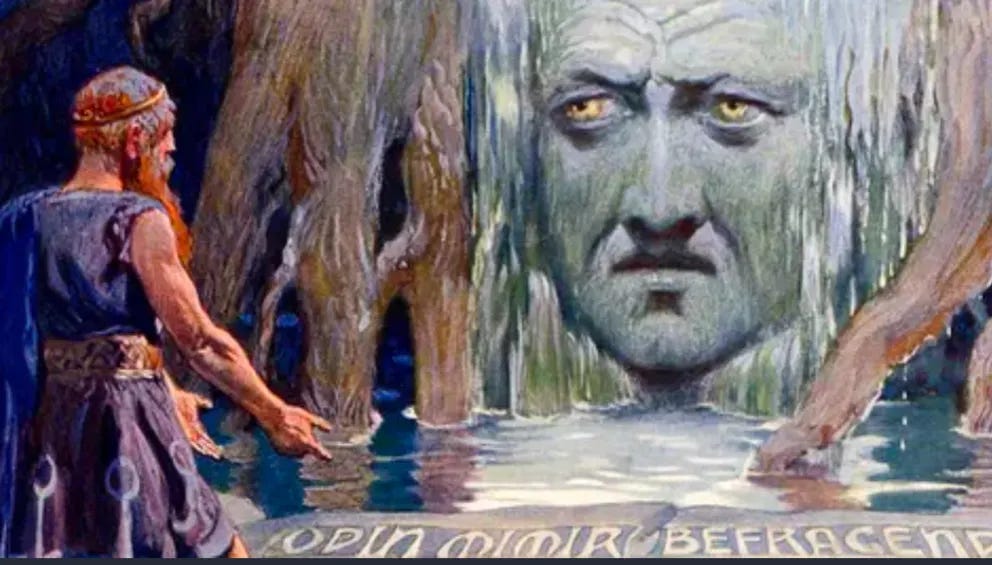
The well can be understood as Mímir’s well, ancestral memory, cultural memory, or the accumulated memory of the community. What is spoken does not simply disappear after the vibration leaves the air. It continues through consequence, reputation, story, recollection, and relationship.
A truthful word can strengthen the speaker and those who hear it.
A dishonest word can poison the well.
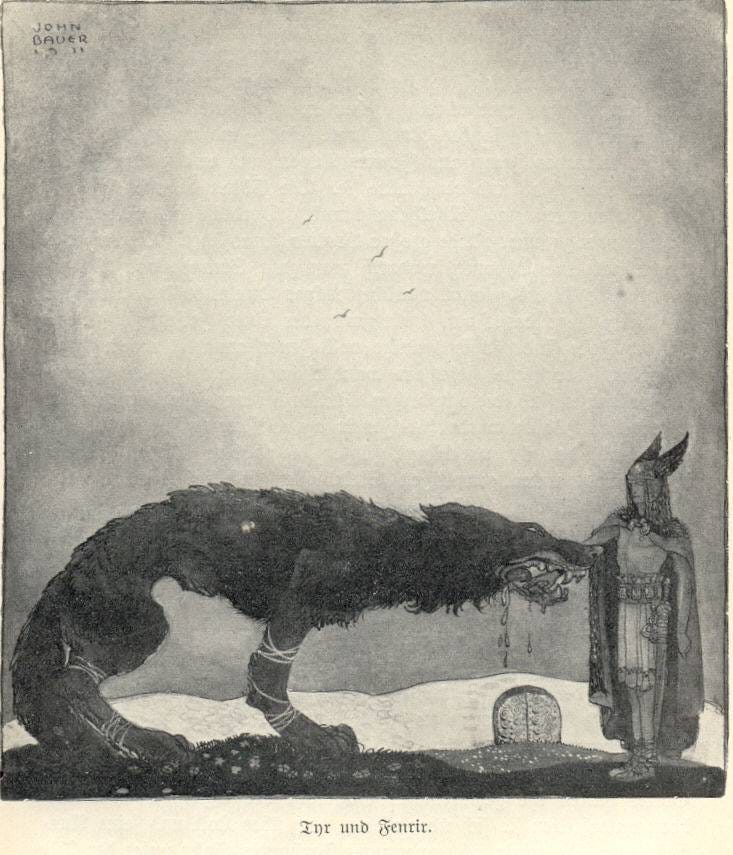
“The Spiritual Weight of an Oath”: John Bauer, Tyr and Fenrir
The Spiritual Weight of an Oath
An oath carries the greatest weight because an oath is not merely a prediction about what we hope to do.
It is an act of binding.
Torna describes an oath as something given life through sacred breath and powered by the will. The oath involves not only the person who gives it, but the recipient, the witnesses, the place, and the spiritual powers invoked or present. Until it is fulfilled or broken, the oath continues to possess force.
This is almost incomprehensible within a culture of casual promises.
We say, “I’ll call you tomorrow,” “I’ll always be there,” “You can trust me,” or “I swear I’ll change,” often with little awareness of the weight those statements carry for the person receiving them.
Our society encourages constant speech while teaching very little discipline of speech.
We post immediate reactions. We make dramatic declarations. We promise more than we can deliver. We publicly perform virtues we have not yet cultivated privately. We use language to manage how others perceive us, then become resentful when we are held accountable to the identity we presented.
A Heathen understanding of oath asks us to become more careful.
Do not promise lightly.
Do not offer your word merely to relieve the discomfort of the present moment.
Do not invoke trust when you are unwilling to behave in a trustworthy manner.
The answer is not to become silent, emotionally unavailable, or terrified of commitment. It is to understand that a promise contains part of the self. When we repeatedly keep our word, we become someone whose speech possesses weight. When we continually break it, our words become thin and useless.
Eventually, no one believes us… and that isn’t because they are cruel, but because we have taught them not to.
Honor Is Accumulated
Torna connects the keeping of oaths with Hamingja, a concept often translated as luck but also associated with honor, power, fortune, and the accumulated strength of the self.
This is not luck imagined as random cosmic favor.
It is closer to luck that has been cultivated.
A person who consistently acts with integrity develops trusted relationships, a dependable reputation, communal support, and an internal sense of coherence. Their words and actions reinforce each other. They become spiritually and socially substantial.
Keeping one’s word strengthens the whole self, while dishonorable conduct weakens it.
We might recognize this even without using explicitly spiritual language.
A trustworthy person is often surrounded by people willing to help them because they have proven that help will not be wasted. Their reputation opens doors. Their community remembers their conduct. When hardship comes, they are not entirely alone.
This is not always fair or perfectly reciprocal. Honorable people can still be betrayed, harmed, or abandoned. But the larger principle remains: character accumulates.
So does dishonor.
Every promise kept or broken becomes part of the person we are becoming.
Truth as Communal Participation
Truth is often framed as an individual possession: my truth, my beliefs, my authenticity.
But Torna’s article presents truth as profoundly relational.
As a bard and skald, he writes that believing in the moral truth of a story allows the teller to connect with those listening. Honest words can create a communal experience in which teller, listener, folk, hero, deity, moral teaching, place, and ancestral memory are brought into relationship.
Truth does not merely sit inside the mind.
It passes between people.
It is sung, remembered, witnessed, and enacted.
This is where the concept becomes essential to The Wisdom of Participation. Traditional cultures did not generally understand humans as isolated consumers of spiritual information. People gathered. They sang. They told stories. They made vows before witnesses. They remembered their dead. They carried inherited obligations. They participated in the maintenance of a shared moral world.
The skald did not simply deliver “content.”
The community did not merely observe.
Everyone present became part of the remembering.
This is radically different from a spirituality centered on private revelation, personal vibration, or self-created metaphysical truth. The well does not belong to the isolated ego. It contains the memory of relationships—between the living, the dead, the Gods, the land, and those yet to come.
What we place into that well matters.
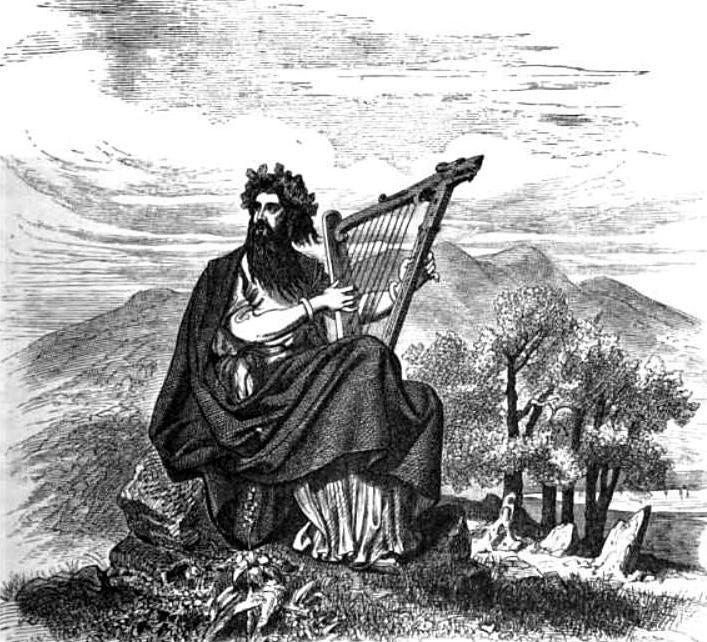
Bragi, Carl Emil Doepler, 1882. Bragi, the Norse god of poetry and eloquence, represents speech as sacred craft: words shaped through memory, rhythm, truth, and responsibility. The skald does not merely entertain, but gives voice to the stories and values through which a people remembers itself. Public domain.
No One Can Embody Truth on Our Behalf
Christianity famously places the words “I am the way, the truth, and the life” into the mouth of Jesus.
In that worldview, truth is ultimately embodied in and accessed through a singular salvific figure. The believer is asked to place faith in that figure and the theological claims made about him.
The Heathen framework explored here places the emphasis elsewhere.
Truth is not merely a person to profess belief in. It is a standard we must demonstrate through conduct.
No savior can keep our promises for us.
No doctrine can repair the trust we have broken.
No spiritual identity can substitute for honest speech.
No declaration of belief can transform dishonorable behavior into honorable behavior.
Truth must be renewed each time we speak carefully, fulfill a commitment, admit a wrong, make recompense, resist convenient deception, or allow our actions to bear the weight of what we have claimed.
It must be breathed and lived.
The Question Before Us
My upcoming conversation with Torna Braggison will explore the relationship between Ond, speech, oath, honor, memory, galdr, storytelling, and spiritual power.
But beneath the terminology lies a deeply human question.
What kind of person does my speech reveal me to be?
Do my words give life, orientation, and trust to the people around me?
Do I make promises carelessly?
Have I confused saying the right things with becoming an honorable person?
Have I demanded truth from others while excusing dishonesty in myself?
And when I fail, am I willing to make recompense rather than simply inventing a more flattering story about what happened?
Truth is not merely the absence of false information.
It is the alignment of breath, speech, memory, promise, and deed.
It is the weight accumulated when we repeatedly prove that our words can be trusted.
It is what we place into the well.
It is what others will remember.
And it is what remains when every attractive spiritual claim has been stripped away and only our conduct is left to speak for us.
The Lessons of Asgard– WorldTree Publications, 36pgs. Completely revised, with original kennings to the Gods by Torna Braggison. An introductory study of the principle Gods & Goddesses in the lore.
Flow Arts, Festival Ritual, and the Lost Wisdom of Participation
Hey hey, welcome back to Taste of Truth, this essay is much different than what I normally write, I hope you enjoy this trip down memory lane with me.
For years, strangers would see me walking through an airport, across a college campus, or into a music venue carrying an enormous circle of plastic and ask the same question:
“Is that a hula hoop? What do you do with that thing?”
I usually smiled.
There was no quick way to explain what the hoop had already done with me.
By then, it had bruised my hips, taken over my living room, earned me the nickname “hula-hoop girl” around my college campus, and sent me driving and flying across the country in search of music, teachers, festivals, and other people who understood why it was impossible to put the thing down.
It had carried me onto stages I was terrified to enter. It had introduced me to women I first knew only by their YouTube names and later came to know as teachers, collaborators, friends, and soul sisters. It had given me a language for my body at a time when I was still deeply self-conscious inside it.
At the time, I thought I was learning tricks.
I was learning how to float the hoop from my waist above my head. How to reverse its current. How to move in both directions. How to toss, pause, break, roll, and recover. How to follow a drum solo until movement and music stopped feeling like separate things.
All of that was true.
But something much deeper was happening
This is the first part of a series I have been circling around for a long time, though I didn’t fully realize it at first.
I thought I was writing about hoop dance, festival culture and the importance of ritual.
Then philosophy.
Then paganism.
Then neuroscience.
The deeper I followed the thread, the more I realized they were all pointing toward the same question:
What happens to human beings when participation is replaced by spectatorship?
I keep returning to the difference between knowing about life and actually participating in life.
Modern people are drowning in information about health, spirituality, community, nervous system regulation, trauma, meaning, embodiment, and connection. We have the podcasts, the books, the frameworks, and an ever-expanding vocabulary. We can analyze our attachment styles, map our trauma responses, name our nervous system states, and explain exactly why we feel disconnected.
And yet, so many of us are still lonely….
Still disembodied.
Still watching life through glass.
Still trying to think our way into something the body may only truly recover through embodiment, through rhythm, movement, expression, shared presence, and practice.
This piece is about that hunger.
The ancient hunger beneath modern life.
Not merely the hunger to believe something, but the hunger to belong to a living world again.
For a long time, I thought my years in flow arts were simply a chapter of my life—a beautiful one, but ultimately behind me. Looking back now, I see something different.
Long before I studied philosophy, mythology, neuroscience, religion, or ancestral traditions, my body was already being introduced to a way of knowing that none of those books could have given me.
It had to be practiced. Repeated. Failed. Felt. Shared.
It had to be participated in.
Before philosophy gave me language for participation, my body had already spent years practicing it.
Long before I studied mythology, ritual, paganism, or the neuroscience of embodiment, I had already encountered something those traditions were trying to describe.
I knew it through music. Through movement. Through repetition. And most importantly through community.
By the simple act of showing up, again and again, until something inside me changed.
I no longer interpret every part of those years the way I did in my twenties.
But I trust the experience more than I trust all the language I once wrapped around it.
And that is where this story really begins.
Long before I studied heathenry/paganism,
I danced it.
The First Forms of Participation
Before there was a circle of plastic spinning around my waist, there were trees to climb, horses to ride, ponds to swim in, and twenty-six acres that gave my body somewhere to go. Some of my earliest memories are not of sitting still and thinking about the world, but of moving through it—crossing the dam, wandering the property, climbing high enough to see everything differently.
There was one enormous oak tree that had fallen and become something like a fort. I would retreat there after arguments with my mother, disappearing into its branches and hollows until I felt like myself again. I would not have called that nervous-system regulation. I would not have called it ritual, grounding, or communion with place. I only knew that the tree could hold something I did not yet know how to carry.
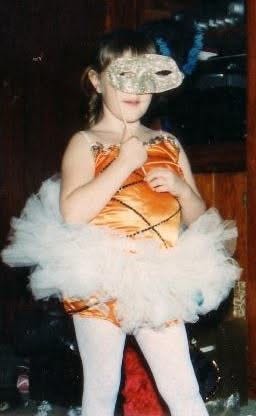
Movement was also part of my life in more formal ways. I took ballet, tap, and jazz, although jazz was the form I loved most. Ballet often made me painfully aware of my body—how tall I was, how much space I occupied, how unlike the smaller girls I sometimes felt. Jazz gave me more room. There was something about the music, the costumes, and the freedom of the movement that allowed me to step outside that self-consciousness for a while.
Music offered another kind of participation. I played piano and violin, but orchestra was where something larger began to reveal itself. Practicing alone mattered, but it was never the whole point. The real experience happened when everyone entered together: dozens of separate parts becoming one piece of music that none of us could have made alone.
I did not have words for why that felt so powerful. I only knew the difference between playing a part by myself and feeling it take its place inside a living whole.
The tree was not merely scenery.
The orchestra was not merely a collection of individuals.
Movement was not merely exercise.
Each required me to enter into a relationship—with a place, a rhythm, a group of people, or the limits of my own body. I could not understand any of them from the outside. I had to climb the branches, learn the music, miss the step, lose my place, and begin again.
Looking back, I can see that I was learning the same lesson in different forms: the world became more alive when I participated in it.
I did not yet know that this was a kind of knowledge. I only knew that I felt most like myself when I was moving, making, playing, or contributing one small part to something larger.
The hoop would eventually gather all of this into a single practice—movement, rhythm, repetition, music, play, place, and community.
It did not create the longing.
It gave the longing a shape.
The Circle Opens
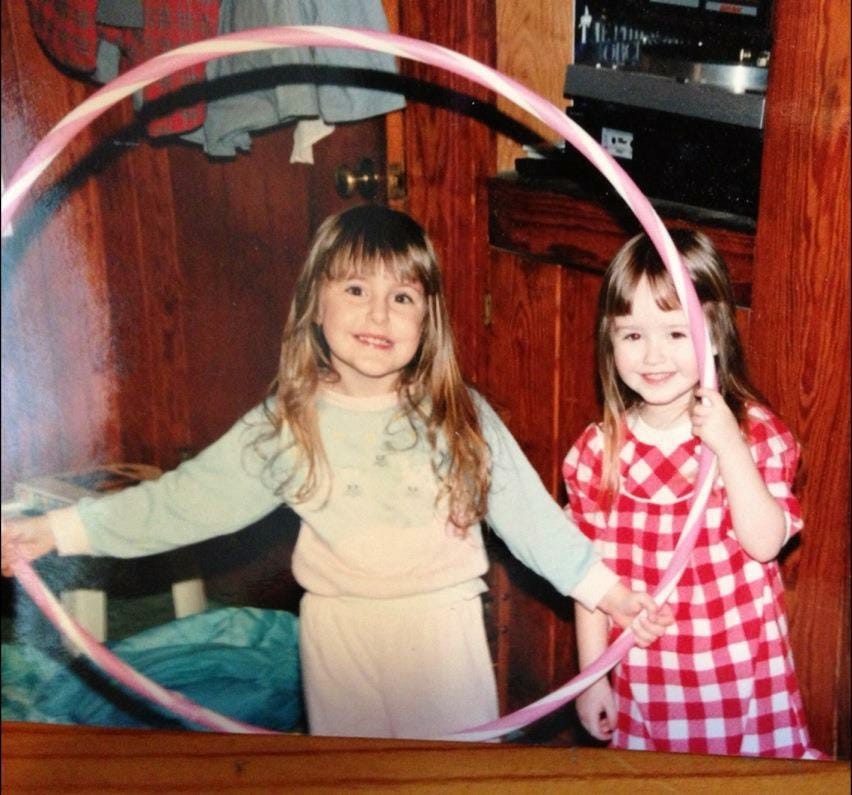
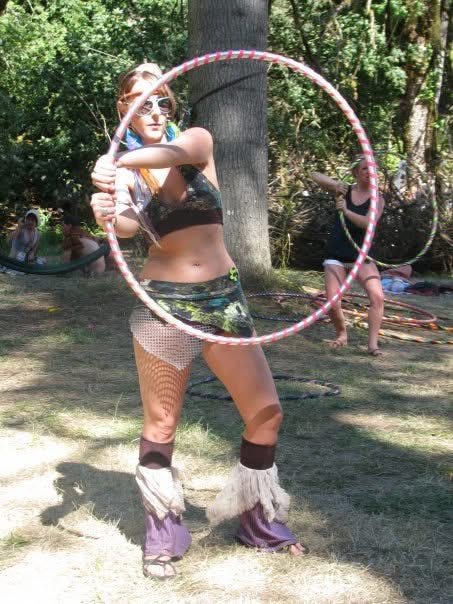
One of my roommates and I, playing around with those rinky-dink store-bought hula hoops.
That shape arrived rather unceremoniously in the winter of 2005: a cheap, store-bought hula hoop that I could barely keep spinning around my waist.
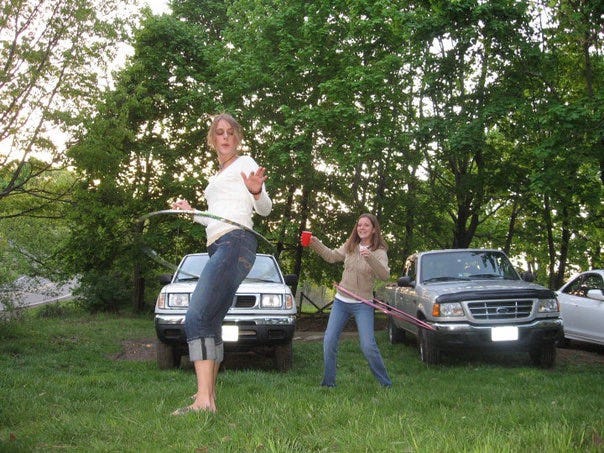
At first, it was mostly frustrating. The hoop fell almost as quickly as I could lift it, clattering against the floor while I tried again. Eventually, though, my body found the rhythm. I carried it back to college, where I practiced in the living room while my roommates laughed, none of us realizing what had begun.
That first hoop was a toy. The real initiation came the following summer at Smilefest, a music festival held at Deerfields in North Carolina.
There, I picked up what hoopers called a “real” hoop—large, heavy, handmade, and nothing like the lightweight plastic circle I had been struggling with. I could feel the difference immediately. Its weight slowed the movement enough for my body to follow. For the first time, the hoop did not seem like an object I was trying to control. It felt like something I could enter into conversation with.
I practiced until dark bruises spread across both hips.
Then I strapped the enormous hoop to the roof of the car and brought it home.
Something had taken hold of me.
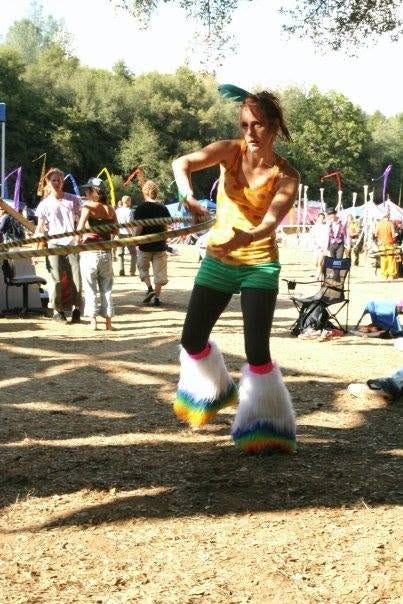
I began carrying the hoop everywhere. I practiced alone in backyards and parking lots, using my car stereo for music. I watched early YouTube videos of hoopers like Hoopalicious, Spiral, Christabel Zamor, and the Hoopnotica dancers, calling my roommates into the room whenever someone performed a movement I could not imagine being possible.
“Look at this. How does she do that?”
There were tutorials, but no explanation could place the movement inside my body. I could watch someone perform a trick dozens of times. I could study the position of her hands, the angle of the hoop, and the direction of its current. None of that meant I could do it. The knowledge had to travel another route.
I had to pick up the hoop.
I had to drop it.
I had to feel where the movement broke down, make some tiny adjustment I could barely name, and try again.
One of the clearest memories I have from that period is standing in the front yard during my junior year of college, listening to the same music over and over while trying to raise the hoop from my knees back toward my waist. I had watched other people do it. I understood, in theory, what was supposed to happen.
But my body did not know yet.
Then, after what felt like endless repetition, something shifted. The hoop caught. My knees and hips found the pulse. The circle began to rise.
I could not have explained what I had done differently.
My body simply understood.
That moment opened a door. Once I felt the movement happen, I knew the other tricks were possible too because I had experienced the difference between knowing what a movement looked like and then knowing it from within.
The Circle Widens
That question did not remain private for long.
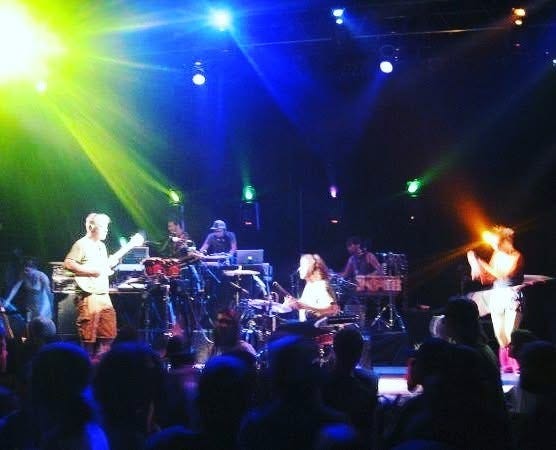
In March 2007, only about a year after I first began seriously hooping, I found myself waiting beside a stage in Boulder, Colorado, preparing to perform with EOTO for the first time.
For weeks, I had told everyone how excited I was. I was going to hoop onstage with Jason Hann and Micheal Travis—two musicians from String Cheese Incident (the jam band I had spent the previous summer following across the country.) Until that moment, the whole thing had felt thrilling and almost unreal.
Then it was time to walk onto the stage.
The excitement dropped straight into the pit of my stomach.
Holy shit. I’m really getting up there.
At that very moment, Jamie Janover, one of the other musicians came over, he had noticed how nervous I was and gave me a piece of advice I have never forgotten:
“Just go up there when you’re feeling the groove and get off when you’re done. It’s simple.”
He was right, although it did not feel simple while I was standing there.
There was no choreography to memorize and no fixed sequence waiting for me. EOTO was an improv jam band. The musicians were listening and responding to one another in real time. The audience was responding to the music. To join them, I had to stop thinking about how I looked, listen with my entire body, and enter the moment already unfolding.
I could not calculate my way into it.
I had to feel when to step forward.
For the first time, I was no longer simply hooping to music.
I was moving inside it.
Inside the Music
Once I crossed that threshold, the road opened quickly.
Music was not something playing quietly in the background while life happened elsewhere. It organized our movements, our travel, our friendships, and our sense of time. We planned entire summers around gathering beneath stages and temporary tents. We drove for days to arrive somewhere that would exist for only a weekend, then disappear almost as quickly as it had formed.
For those few days, however, we were not merely an audience.
People danced, cooked, camped, taught, performed, built installations, traded food, shared supplies, carried one another’s equipment, and stayed awake until sunrise. Musicians improvised with one another onstage while dancers responded from the crowd. The boundary between performer and participant was more porous than it appeared.
Symbiosis Music Festival 2007
When there was room, I stepped onto the stage with my hoop. Other times, I danced in the field among everyone else. Both experiences were deeply impactful in my dance practice. Whether hundreds of people were watching me or no one was, I was learning to respond to rhythm rather than impose myself upon it.
The music moved, so I moved.
The hoop changed direction, so I followed.
The crowd surged, softened, shouted, or fell quiet, and the whole atmosphere changed with it.
At its best, it felt less like a performance than a conversation occurring through bodies.
Over time, the women I had once watched with awe became people I practiced beside. Some became teachers, troupe members, collaborators, and friends. I moved to Portland at the end of 2007 and joined Kaivalya Hoop Dancers, entering a community that took the practice seriously while still preserving its sense of play.
I spent Portland’s rainy season obsessively practicing reverse currents. I wanted to move comfortably in both directions, even though one side initially felt completely unnatural. I repeated barrel rolls, breaks, pauses, and reversals until the awkward side slowly became less foreign.
Then severe back pain forced the practice to change again.
At twenty-three, there were days when preparing food or standing for longer than twenty minutes felt nearly impossible. I worried that I would lose the thing that had given my life so much momentum. I could no longer rely on constant waist hooping or the larger, more physically demanding movements that had once filled my practice.
But limitation created another kind of education.
I began exploring pauses, tosses, reversals, off-body movement, and smaller gestures that did not aggravate my back as severely. What initially felt like an interruption became a new creative vocabulary. The hoop was still teaching me, but now the lesson was adaptation.
Participation did not mean forcing myself through pain. It meant listening closely enough to remain in relationship with the practice as my body changed.
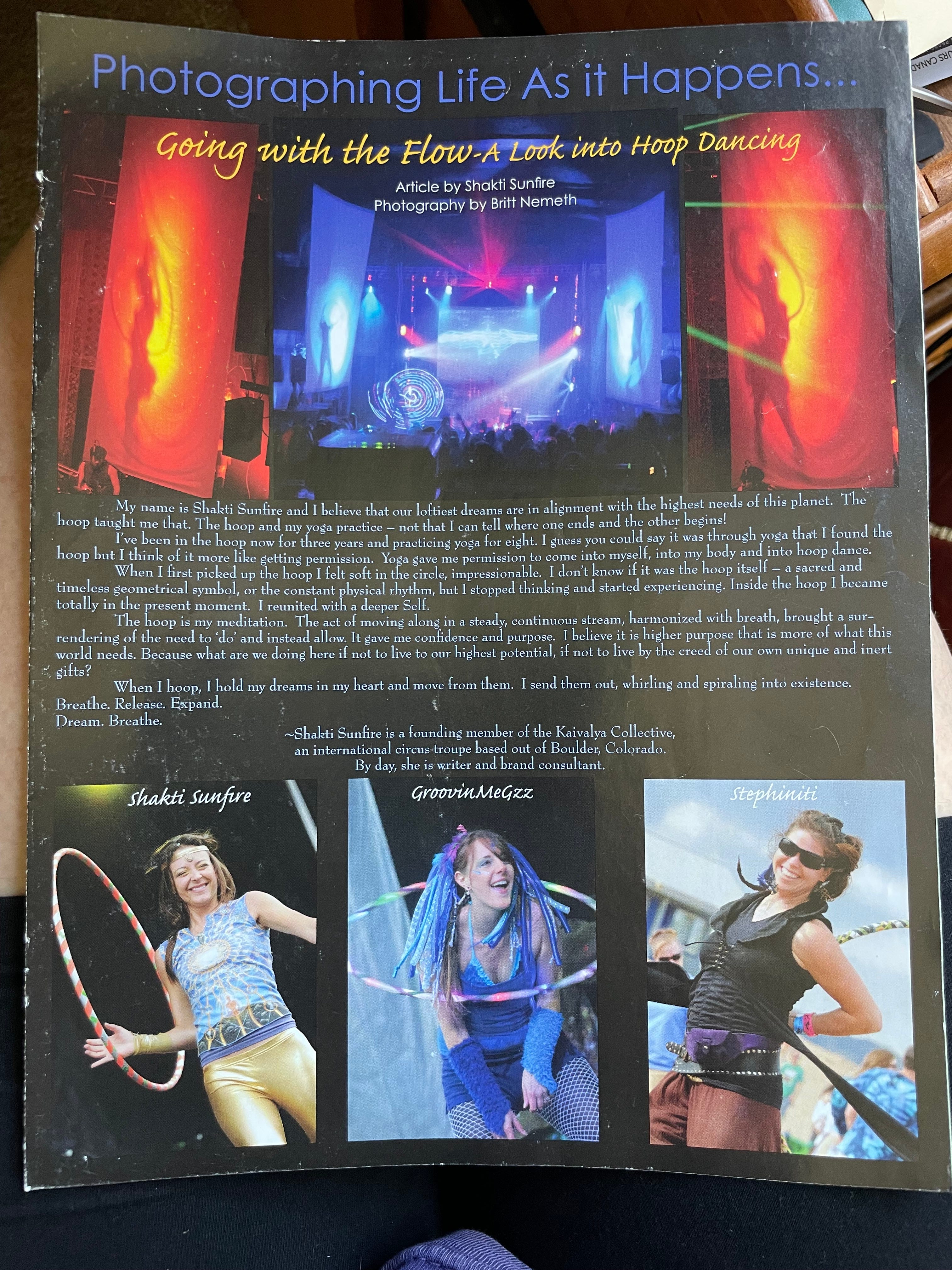
Hoop Dance Workshops from all over the country
Eventually, I began teaching more.
At festivals and community gatherings, I watched people pick up hoops with the same awkward uncertainty I had once felt. Some were convinced they could not do it. Others laughed the moment the hoop dropped. I learned that teaching movement required more than explaining where to place the feet or how to push the hips.
Sometimes I demonstrated.
Sometimes I offered a small correction.
Sometimes the most useful thing I could do was give someone enough room to fail without feeling embarrassed.
The moment when a movement finally entered another person’s body was unmistakable. Their face changed. The effort briefly disappeared. What had seemed impossible became available to them from the inside.
At EmergNsee Music Gathering (2008) in Oregon, I taught a HoopYoga and hoop-dance workshop attended by Meghan the Kat, one of the performers who had inspired me during my earliest years following String Cheese Incident. There was something beautifully disorienting about teaching a person I had once watched from a distance.
The hierarchy I had imagined between teacher and student dissolved.
She had given something to me through her movement. I had taken it into my own body, practiced it, altered it, combined it with what I had learned elsewhere, and now I was returning something to her.
Knowledge moved in a circle.
As I wrote at the time:
“It’s so beautiful how we all learn from each other, one hooper heart to the next.”
That sentence is covered in the earnestness of my early twenties, but I still believe what I was trying to say.
The practice did not belong to any one teacher, performer, or school. It passed between us. We learned through watching, imitating, experimenting, teaching, and being corrected. Every person carried the movement differently because every body was different. What one person offered was never reproduced perfectly; it was received, transformed, and passed onward.
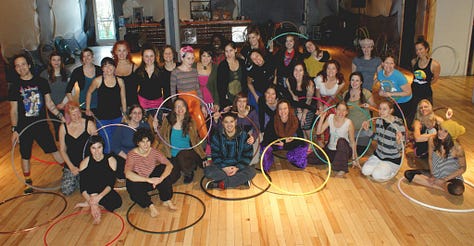
By the time I attended Hoop Camp in California in 2008, that circulating exchange had become a culture of its own.
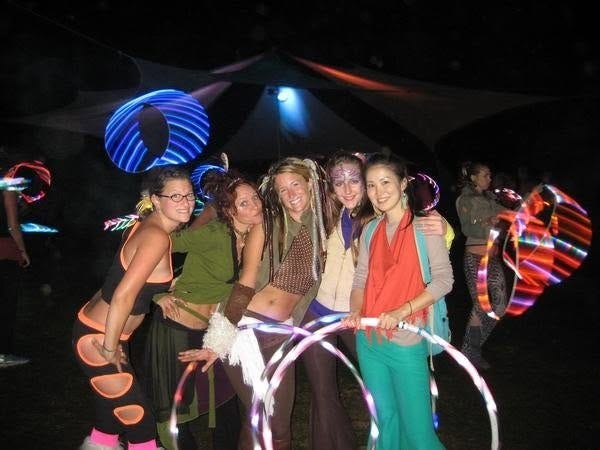
Hoop Camp Retreat 2008
For years, I had known many hoopers primarily through grainy online videos, usernames, festival sightings, and brief encounters on tour. (I can’t help but to hear “This one time…at Band Camp”, if you grew up in the early 2000s, you’ll get this. )
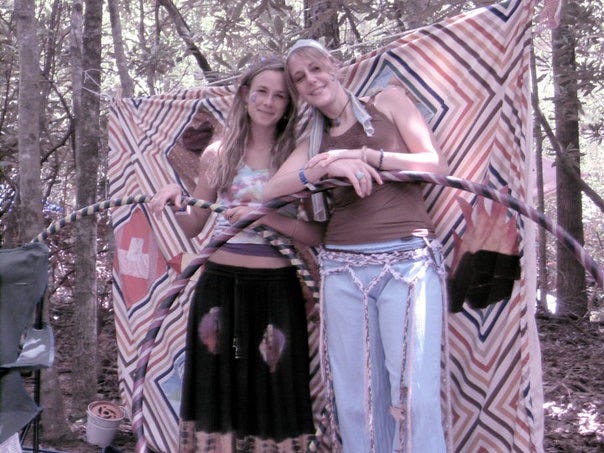
The people I had admired from across the country were suddenly gathered in one place. We practiced together during the day, exchanged ideas in workshops, ate together, laughed together, and filled the darkness with glowing hoops at night.
I was surrounded by women who had shaped my imagination before they ever knew my name, alongside childhood friends, college friends, troupe members, and the people who had become my chosen family on the road.
I described myself afterward as channeling “true Unicorn energy”—nonstop hooping, smiling, laughing, and learning. The language makes me laugh now, but the joy was real.
So was the sense that something larger than individual skill was taking place.
During the opening ceremony, we gathered around a prayer hoop and placed our intentions inside it. One by one, people spoke about what the hoop had done in their lives: the confidence it had restored, the friendships it had created, the grief it had carried, the joy it had unlocked, and the selves it had allowed them to discover.
In my blog afterward, I wrote:
“All of us have been changed by the hoop. It’s impacted our lives, brought us together, shown us ourselves, given us bliss, given us confidence…”
I would describe some of those experiences differently today. I no longer interpret every ecstatic weekend, meaningful coincidence, or intense connection through the same spiritual vocabulary I used then.
But I do not dismiss what happened simply because my language has changed.
We gathered around a shared practice.
We moved together.
We taught one another.
We placed hopes and prayers inside a circle.
And through repetition, rhythm, attention, and communal presence, many of us experienced real transformation.
What had begun as a cheap plastic toy had become a language through which we recognized one another.
A movement became a practice.
A practice became a community.
And somewhere along the way, community began to resemble ritual.
The Hunger We Keep Trying to Name
A movement became a practice.
A practice became a community.
And somewhere along the way, community began to resemble ritual.
I did not yet know the language of moral psychology or sociology. I had never heard Émile Durkheim’s phrase collective effervescence: the strange charge that can arise when people gather, move, sing, mourn, celebrate, and direct their attention toward something together.
I did not know Jonathan Haidt’s idea of the “hive switch”—the human capacity to loosen, temporarily, the boundaries of the individual self and become part of an emergent whole. Haidt has suggested that people sometimes need precisely these experiences of self-transcendence, and that music, dancing, communal worship, and local festivals can offer places where isolated individuals become participants in something larger.
I only knew what it felt like.
I knew the sensation of entering a field where hundreds of people were responding to the same rhythm. I knew what happened when musicians improvised, dancers answered, and the distance between performer and audience became briefly porous. I knew the feeling of looking across a dark campground and seeing circles of light moving through the trees.
I knew what it was to become less preoccupied with myself without disappearing entirely.
The experience was not one of erasing the individual. It was the experience of becoming an individual in relationship—one moving body inside a larger pattern.
Research on communal music and movement suggests that this feeling is not merely sentimental. Singing together can accelerate feelings of closeness among people who begin as strangers, while synchronized and physically demanding dance can deepen social bonding.
None of that proves that every festival is sacred, every crowd is healthy, or every ecstatic experience is transformative. Collective energy can be commercialized, manipulated, and turned toward destructive ends just as easily as generous ones. The same human capacity that allows people to lose themselves in music can also make groups tribal, conformist, or cruel.
But the possibility of misuse does not erase the underlying need.
We are creatures shaped for more than private thought.
We learn through imitation. We regulate one another through voice, expression, touch, and presence. We create attachment through repeated encounters. We remember through songs, meals, places, stories, gestures, and practices carried from one body into another.
And yet modern life increasingly offers us the image of these things without requiring our participation in them.
We can stream concerts without entering a crowd.
Watch other people dance without moving.
Order food without cooking or eating with anyone.
Read about ritual without belonging to a ritual community.
Listen to conversations about friendship while sitting alone.
Learn the vocabulary of embodiment while barely inhabiting our bodies.
We are connected to more people than previous generations could have imagined, yet much of that connection asks almost nothing of us beyond attention.
And attention is not the same as belonging.
Recognition is not reciprocity.
Watching is not participating.
A feed is not a feast.
The distinction matters because loneliness is not simply the absence of people. It can also be the absence of roles, obligations, shared places, repeated practices, and the experience of being meaningfully woven into other lives.
We have become very skilled at diagnosing the resulting ache.
We speak of trauma responses, dopamine, attachment styles, nervous-system dysregulation, depression, social anxiety, and burnout. These frameworks can be genuinely helpful. Naming an experience can make it less frightening and give us a place to begin.
But sometimes I wonder whether we are still trying to think our way out of conditions that cannot be changed through thought alone.
A widely shared passage attributed to Jay LeSoleil puts the mismatch much more sharply:
“You feel depressed and crazy because in every historical human culture known to anthropology, people sang together, danced together, and ate food together—and you don’t sing, you don’t dance, and you eat alone in the dark.
You are a singing ape, and you are meant to know fifty dances by heart, which hilltops are sacred, and the names of every plant it is possible to eat.”
The passage is deliberately sweeping. Depression cannot be reduced to a lack of communal dancing, and no single poetic statement can represent every historical culture.
But it lands because it names something our clinical language often misses.
The problem may not be only what is happening inside the isolated individual.
The problem may also be the world in which the individual is being asked to live.
A world where community has become optional, ritual has become content, food has become fuel, music has become background noise, and places are valued primarily for what can be extracted or built upon them.
A world in which we are encouraged to construct an identity but given fewer durable ways to belong.
Perhaps that is why our hunger attaches itself so easily to substitutes.
We mistake stimulation for aliveness.
Visibility for intimacy.
Agreement for community.
Intermittent attention for belonging.
We search for the feeling of being carried beyond ourselves through fandoms, online movements, romantic fixation, political tribes, spiritual consumerism, and endless streams of other people’s lives. Some of these can produce real relationships and genuine meaning. But they can also leave the body sitting in the same room, staring through the same glass, still longing to be somewhere it is needed.
When I look back now, I do not think I miss only the performances, the festivals, or the person I was at twenty-three.
I miss having a practice that placed me inside a living network of people, music, places, responsibilities, and shared memory.
I knew which songs could shift the energy of an entire field.
I knew who would help me carry my hoops.
I knew where people gathered after the music ended.
I had teachers, students, collaborators, and friends.
I had something to offer the gathering, and the gathering had something to ask of me.
That is different from being observed.
It is different from being liked.
It is different from being included in a group chat.
It is participation.
In 2014, I tried to describe this in a short poem:
Grateful for Dance
Portal to divine connection A form of sacred expression Of outward shining expansion Here I am, calling to attention
It’s time to move It’s time to be free It’s time to prove Your non-complacency
So please follow me Down this path of dance divinity It’s time we realize It’s not you and me, it’s we.
Some of the language makes me smile now. But that final line contains an intuition I still trust. It was never only about what happened to me inside the hoop.
It was about what became possible between us.
This does not mean we need to recreate the past, abandon technology, or spend our lives at music festivals. Nor does it mean every older community was nurturing. Communities can constrain, exclude, punish, and demand conformity. Nostalgia can make us forget that belonging has often come at a cost.
The question is not how to return to an imaginary golden age.
The question is what forms of participation human beings still need—and how we might create them honestly now.
Where can we sing without needing to be singers?
Dance without needing to perform?
Prepare food that will be eaten by more than one person?
Learn the names of the plants and animals around us?
Create rituals that give grief, gratitude, transition, and memory somewhere to live outside our private minds?
Practice something regularly enough that it changes us?
Modern people are drowning in information about how to become healthier, happier, more regulated, more spiritual, and more connected. But information cannot substitute for the meal, the chorus, the dance, the garden, the ceremony, the friendship, or the repeated practice.
Some wisdom can only be received through participation.
And perhaps some forms of loneliness cannot be solved by understanding ourselves more perfectly. Perhaps they require becoming part of something that does not begin and end with the self.
That is the ancient hunger beneath modern life.
Not merely the hunger to believe something.
The hunger to belong to a living world again.
And we may not be able to think our way back into that world.
Panpsychism, the Emergence Problem, and the Fractures Inside Mythicism with Dr. Skrbina
Today’s conversation isn’t just about whether Jesus existed.
It’s about something sitting underneath that entire debate.
Most mythicist conversations, meaning scholars and skeptics who argue that Jesus may be a literary or constructed figure, operate inside a philosophical framework called materialism.
Materialism in this sense doesn’t simply mean “trust science.” It’s a deeper metaphysical claim: that everything that exists is ultimately physical. Matter is fundamental, and consciousness is something the brain produces when matter is arranged in the right way.
Revisit a past episode where we discussed the dogma of materialism further
In that picture, mind comes after matter. Meaning comes after biology. Religion becomes a byproduct of social evolution.
But there’s a philosophical tension hiding inside that assumption.
Evolution can explain how biological bodies change. It can describe how organisms adapt and diversify. What it does not explain is something much more basic:
Why is there subjective experience at all? Why does pain actually hurt? Why does the color red look like something?
If matter is completely mindless at the ground level, how does experience suddenly appear?
Philosophers call this the emergence problem.
One alternative view (panpsychism) proposes that consciousness isn’t produced by matter at all. Instead, consciousness may be fundamental to reality itself.
That’s where philosopher Dr. David Skrbina enters the conversation.
His book Panpsychism in the West traces this idea across centuries of philosophical thought, showing that the notion of a mind-infused cosmos has appeared again and again throughout Western intellectual history.
But Skrbina has also stepped directly into the mythicist debate with his book The Jesus Hoax. More recently, he published a sharp response to criticism from fellow skeptics David Fitzgerald and Richard Carrier.
Add to that Adam Green’s recent book The Jesus Deception, which approaches early Christianity from yet another angle, and something interesting starts to appear:
Mythicism isn’t a unified theory. It’s fracturing into camps.
So, this conversation moves across several layers at once:
• consciousness and materialism • the emergence problem • whether panpsychism overlaps with Neoplatonism • Paul: historical strategist or literary construct? • and how The Jesus Hoax differs from The Jesus Deception
Let’s start with the philosophical ground beneath it all.
Consciousness and the Return of Panpsychism
Panpsychism is one of those philosophical ideas that sounds strange the first time you hear it but becomes harder to dismiss the more you think about the alternatives.
In plain terms, the idea is simple: mind or experience may exist at some level throughout reality.
That doesn’t mean rocks are thinking thoughts. Rather, it suggests that the basic constituents of the universe may possess extremely simple forms of experience.
The reason this idea keeps resurfacing across centuries of philosophy is precisely because of the emergence problem.
If consciousness appears only when matter becomes sufficiently complex, we still have to explain how completely mindless matter suddenly gives rise to subjective experience.
Panpsychism flips that question around. Instead of asking how consciousness emerges from matter, it proposes that matter itself may already possess proto-mental properties.
Skrbina’s historical work traces this idea from ancient Greek philosophy through early modern thinkers and into contemporary debates in philosophy of mind.
The interesting thing is that the idea never quite disappears. Even in periods dominated by strict materialism, it keeps resurfacing whenever philosophers run into the same problem: explaining how subjective experience arises from purely physical processes.
Materialism and the Emergence Problem
Materialism has been extraordinarily successful as a scientific framework.
It assumes that the universe is composed of physical entities governed by consistent laws. That assumption has allowed science to model everything from particle physics to molecular biology.
But when we apply that framework to consciousness, something unusual happens.
If matter is entirely mindless at the fundamental level, then at some point in the evolutionary process subjective experience must suddenly appear.
But where?
There’s no obvious “magic neuron” where awareness switches on. There’s no clear moment in development when matter transforms from non-experiencing to experiencing.
This is the emergence problem in its most basic form: explaining how subjective experience arises from purely physical systems.
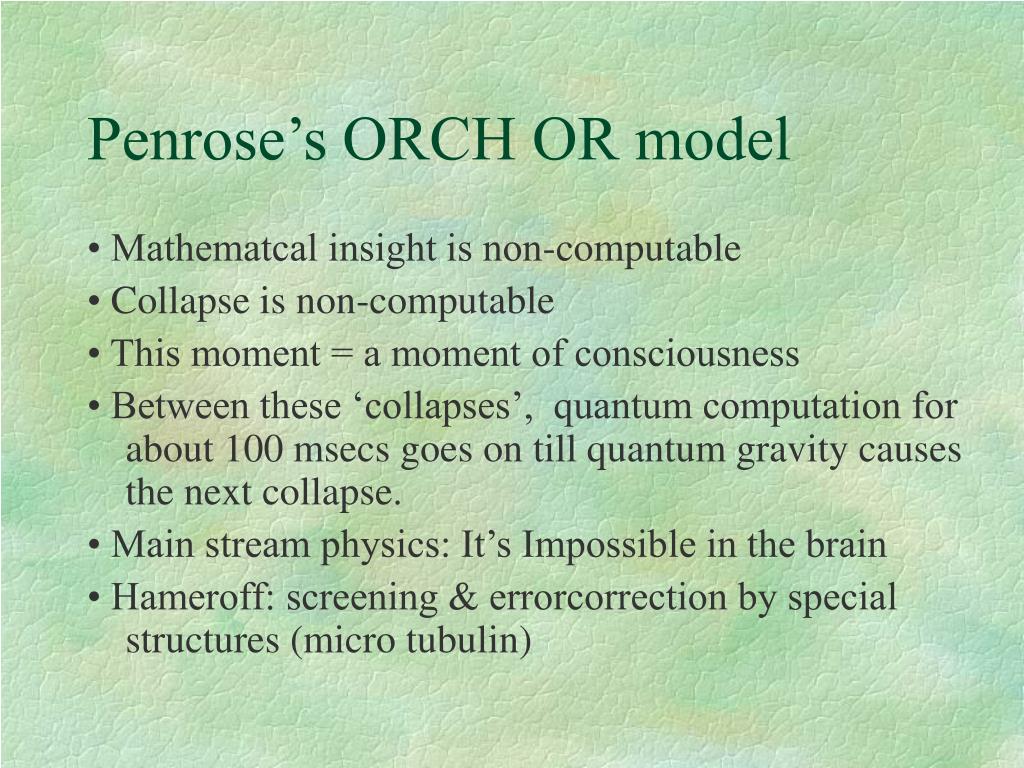
Some scientists have attempted to address this by looking deeper into physics itself. Theories like Roger Penrose and Stuart Hameroff’s Orch-OR model propose that consciousness may be connected to quantum processes occurring inside neurons.
Whether or not those models succeed, they reveal something important: even within science, researchers are exploring ways to rethink the relationship between mind and matter.
Panpsychism is one such attempt.
Is Panpsychism Just Neoplatonism?
Because panpsychism proposes a cosmos infused with mind, people often assume it’s simply a modern version of Neoplatonism.
But the two traditions aren’t identical.
Neoplatonism describes reality as a hierarchical structure flowing from the One— a metaphysical unity that gives rise to intellect and soul. It carries strong teleological and ethical implications about how humans align themselves with the structure of reality.
Panpsychism, by contrast, is often framed as a metaphysical hypothesis about the nature of matter and consciousness, without necessarily including the moral or spiritual framework found in Neoplatonic thought.
Still, the overlap is hard to ignore. Both challenge the idea that the universe is purely mechanical.
Both suggest that mind and reality may be deeply intertwined.
The Mythicism Debate Fractures
Another interesting tension here is that some of the things Skrbina is criticized for aren’t that far from ideas that already exist in mythicist literature.
One of the central claims in The Jesus Hoax is that St Paul and a small cabal of early Christians may have functioned as a kind of non-military strategy within the Roman world. Instead of armed revolt, the movement theologically conquered by the spread through ideas, theology, and cultural influence.
Skrbina frames this as a kind of ideological or narrative strategy that could reshape behavior across the empire.
What makes the criticism somewhat puzzling is that a similar concept appears in Richard Carrier’s own work.
In Not the Impossible Faith, Carrier describes early Christianity as a movement that spread not through military rebellion but through cultural transformation. Rome could defeat armed revolts, but it could not easily suppress ideas that moved through communities, texts, and belief.
Carrier even characterizes this as a kind of revolutionary strategy. If Rome would always win a military conflict, the only rebellion that could succeed would be a cultural one— a war ofideas rather than armies. (Carrier, Not the Impossible Faith, Ch. 9).
In that sense, the notion that early Christianity functioned as a non-military cultural movement is not controversial. It is widely recognized that the early Jesus movement spread through persuasion, networks, and theology rather than organized violence.
Where the real disagreement emerges is over intent and origin.
Skrbina interprets this cultural transformation as something that may have been deliberately constructed or strategically shaped. His critics tend to view it as an organic religious development rather than a coordinated narrative project.
Another point raised in the exchange concerns the authorship of the gospels, particularly the question of whether Luke was a Gentile writer. Skrbina notes that even if certain details of authorship were revised, for example: if Luke were ultimately shown to be Gentile, the core structure of his argument would not collapse. It would simply require refinement.
That willingness to concede smaller points while maintaining the broader model is something he addresses repeatedly in his response.
The broader takeaway from this debate is that mythicism itself is not a single theory. It is a field where scholars often agree that the traditional gospel narrative is historically unreliable but disagree sharply about what actually replaced it.
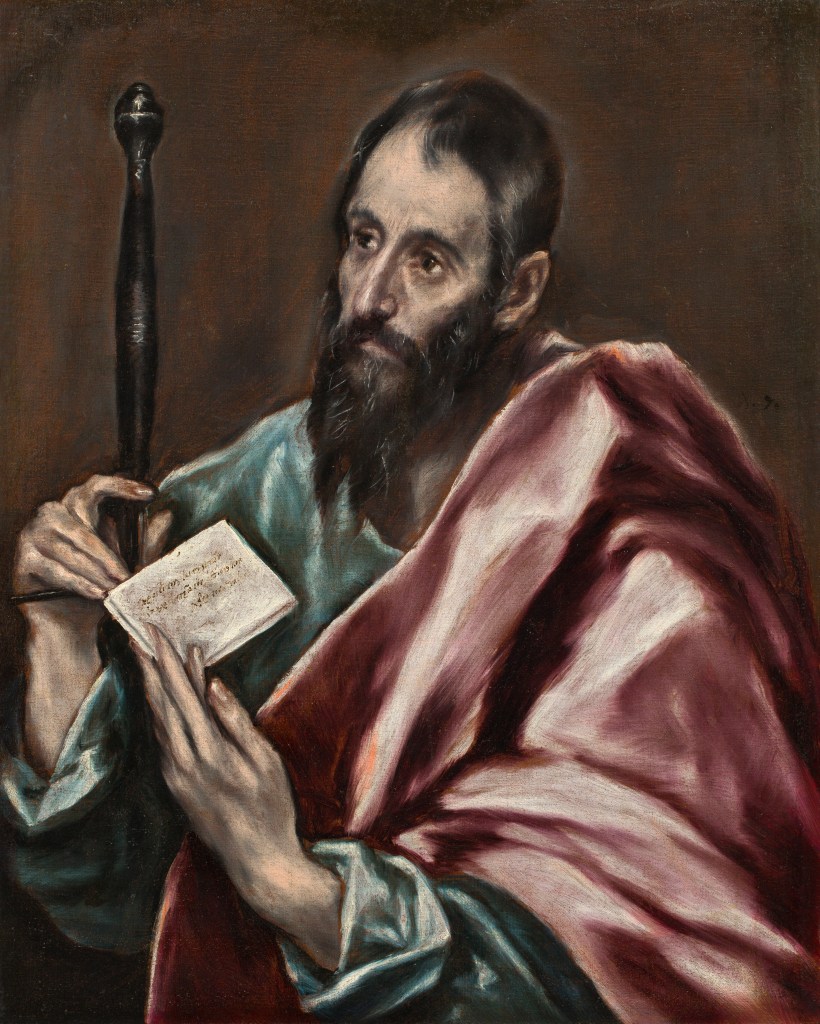
One of the most important figures in this entire discussion is Paul of Tarsus.
Skrbina’s model treats Paul as a strategic actor who played a central role in shaping early Christian theology.
But other scholars have raised a more radical possibility: that the Pauline corpus itself may not represent a stable first-century historical figure at all.
Research such as Nina Livesey’s work on the Roman literary context of the Pauline letters suggests that some of these texts may reflect later second-century developments.
If Paul himself were partly a literary construct, it would reshape the debate considerably.
Yet even in that scenario, Skrbina argues, the broader thesis of deliberate narrative construction would not necessarily collapse. It would simply require revision.
Adam Green and the Midrashic Jesus
Adam Green’s recent book The Jesus Deception adds another dimension to the conversation.
Green emphasizes the possibility that the gospel narratives were crafted through midrashic techniques, weaving together Hebrew scriptures to construct the story of Jesus.
This raises a broader question about how religious narratives function historically.
Are they simply stories? Or do they operate as cultural scripts that shape behavior across entire societies?
Green invokes a concept from cultural theory called hyperstition: the idea that beliefs can begin to influence reality because people act as if those beliefs are true.
In other words, a prophecy doesn’t need to be literally true to become historically powerful.
It only needs to be believed strongly enough that people start behaving in ways that bring it about.
That possibility becomes particularly interesting when we look at modern geopolitics.
Some recent reports have suggested that military personnel have framed conflicts in the Middle East through apocalyptic biblical language, describing events as part of a divine plan leading toward Armageddon.
Whether or not such interpretations reflect official policy, they illustrate how powerful religious narratives can be in shaping political imagination.
For readers who want to explore the topics discussed in this episode more deeply, the following books and research have shaped the ideas discussed in this conversation. These works cover philosophy of consciousness, panpsychism, early Christianity, and the intellectual history of the ancient world.
Philosophy of Consciousness & Panpsychism
Panpsychism in the West – David Skrbina A comprehensive historical survey tracing the idea that mind or experience may be fundamental to reality across centuries of Western philosophy.
Science Set Free – Rupert Sheldrake A critique of the assumptions underlying modern scientific materialism and an exploration of alternative ways of thinking about nature, consciousness, and scientific inquiry.
The Emperor’s New Mind – Roger Penrose A physicist’s investigation into the nature of consciousness, the limits of artificial intelligence, and the possibility that consciousness is tied to deeper physical processes in the universe.
The Jesus Hoax – David Skrbina Explores the possibility that early Christian narratives functioned as a strategic cultural movement within the Roman world.
The Jesus Deception – Adam Green Argues that the story of Jesus may have been constructed through Jewish midrashic storytelling traditions.
Not the Impossible Faith – Richard Carrier Carrier’s argument that Christianity’s success in the Roman Empire was historically improbable given the cultural environment of the time.
The Letters of Paul in Their Roman Literary Context – Nina Livesey A scholarly examination of whether the Pauline letters reflect later Roman literary production and rhetorical conventions.
The Opening of the Western Mind – Charles Freeman A history of classical Greek and Roman intellectual traditions and the philosophical foundations of the ancient world.
The Closing of the Western Mind – Charles Freeman Examines how classical philosophical traditions were gradually replaced by Christian orthodoxy in late antiquity.







 Taste0ftruth Tuesdays