
Jesus, Scripture, and the Mythmaking Machinery of the Abrahamic World
One of the most successful ideas in modern spirituality is the belief that Jesus represented a radical break from the religious world that produced him.
The problem is not merely that modern people have misunderstood Jesus. It is that the Gospel texts themselves are capable of generating multiple, even contradictory versions of him: compassionate teacher, apocalyptic judge, mystic, revolutionary, cosmic redeemer. That textual instability is one reason Christianity has proven so endlessly adaptable. Readers can extract the Jesus they want and then present that selection as the essence.
Whether presented as an enlightened teacher, a cosmic Christ, a universal sage, or simply a wise moral reformer, Jesus is often portrayed as transcending the tribalism, judgment, and exclusivity associated with the covenantal and apocalyptic world of the Hebrew scriptures. In popular imagination, he stands opposed to the harshness of the Old Testament: a teacher of love replacing a god of wrath, compassion overcoming law, and universal brotherhood replacing ancient tribal loyalties.
Later philosophical and spiritual movements took that elasticity and pushed it even further. Nineteenth- and twentieth-century currents such as Theosophy, New Thought, Western esotericism, and Rudolf Steiner’s spiritual reinterpretations recast Christ as a universal principle rather than a figure embedded in a specifically Jewish apocalyptic and covenantal world. “Christ” becomes less a messianic title rooted in Jewish expectation and more a symbol of inner divinity, cosmic consciousness, or spiritual evolution.
I reject that rescue attempt entirely. The modern “cosmic Christ” is not a recovery of some hidden essence. It is one more extraction from a set of texts already structurally open to reinterpretation. The same flexibility that allows one reader to find a gentle moral teacher allows another to find a figure of judgment, exclusion, and cosmic authority.
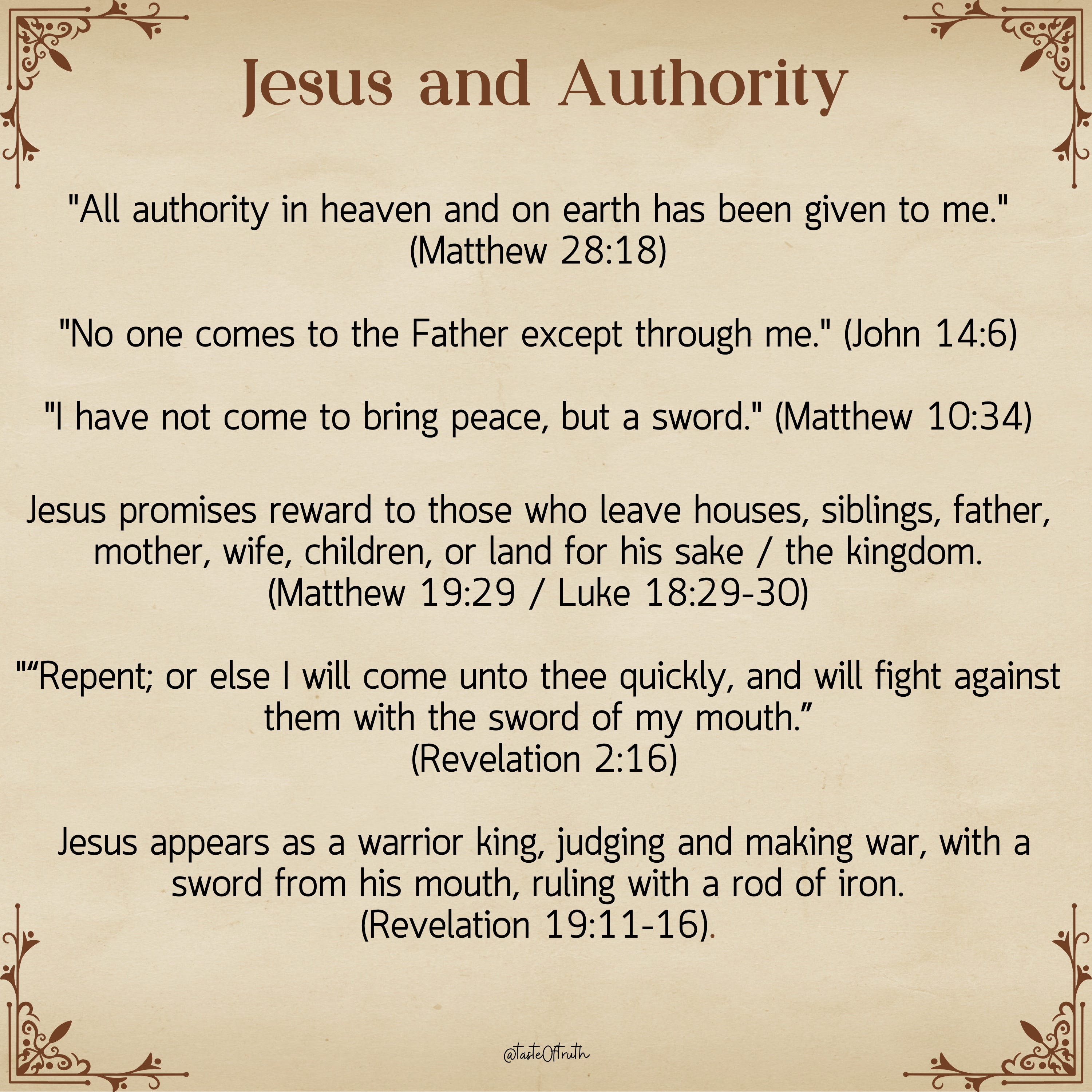
And that harsher figure is not hidden in some obscure corner of the tradition. Jesus speaks of judgment. He divides humanity into the saved and the condemned. He warns of outer darkness, weeping and gnashing of teeth, eternal punishment, and destruction for those who reject his message. Paul speaks of everlasting destruction. Revelation culminates in divine wrath, cosmic warfare, and the final defeat of God’s enemies.
This is not a departure from the older scriptural framework. It is its expansion.
What if the New Testament did not abandon the worldview of the Hebrew scriptures, but carried its deepest assumptions forward in universalized form?
That is the argument I want to follow here. The New Testament did not discard the basic structure of the Hebrew scriptures. It expanded it. Covenant became salvation history. Chosenness became a global saved-versus-condemned framework. Messianic expectation became cosmic kingship. Scripture became biography. On this reading, Christianity was not a liberation from the older framework, but its Gentile-facing sequel.
Research from the Copenhagen School, along with scholars such as Russell Gmirkin, Jan Assmann, Yonatan Adler, and Thomas Thompson, has challenged assumptions many of us once took for granted. Their work points toward a far more dynamic process of literary construction, cultural memory, reinterpretation, and retrospective claims to antiquity behind the Hebrew scriptures. Some of that scholarship presses the issue further still, raising the unsettling possibility that Jesus himself may belong in the same larger scriptural problem-set as other biblical figures whose historicity has been asserted far more confidently than it has been demonstrated.
In previous episodes of my Jesus Myth series, I argued that the Gospels should not be treated as straightforward eyewitness biographies. Archaeology can illuminate the world of first-century Judea, but it does not confirm the Jesus of the Gospels. Paul’s letters give us a cosmic, scriptural Christ rather than a detailed memory of a recent Galilean teacher. The early Christian movement appears fragmented from the beginning, with competing visions of Christ long before later orthodoxy cleaned up the story.
This essay begins where that argument left off.
If the Gospels are not simple biography, then what are they? And if the Jesus figure is shaped so deeply by earlier scripture, then an even more unsettling question follows:
What kind of scripture was doing the shaping?
Because once we begin examining the New Testament closely, an extraordinary pattern emerges. The Jesus of the Gospels does not merely quote scripture. He is a product of it. The story begins to look less like the fulfillment of ancient history than the continuation of an ongoing literary tradition.
And if that scriptural world could generate covenant, chosenness, law, and sacred history, the possibility that it could also generate a messiah is no longer so easy to dismiss.
Not Influence but Scaffolding
The claim that the Gospel writers drew from Jewish scripture is not controversial. Virtually every New Testament scholar acknowledges that the evangelists quoted, interpreted, and reworked earlier biblical texts. The real question is what kind of borrowing we are dealing with.
Some modern writers argue that the Gospels are fundamentally Greek in character, shaped by Hellenistic literary conventions such as heroic archetypes, divine signs, dramatic climaxes, and narrative form recognizable to a Greek-speaking audience. There is truth in that observation. The Gospels were written in Greek, circulated in a Hellenistic world, and emerged from a culture saturated with literary adaptation and symbolic storytelling. But that framing can miss something more concrete. The density of engagement with Jewish scripture in the Gospels is not merely thematic or stylistic. It is textual, structural, and relentless.
Dozens of explicit citations appear across the texts. Beneath them lies a much larger web of allusions, echoes, narrative patterns, and character templates drawn from the Hebrew Bible. Counted conservatively, these parallels number in the dozens. Traced more fully, they run into the hundreds. Entire scenes are shaped by earlier passages. Entire narrative arcs follow scriptural precedent. By comparison, proposed parallels to Greek myth or pagan figures are usually broader, more conceptual, and far less anchored in specific texts. My aim is not to deny Greco-Roman influence, but to put it in proportion. The Gospels may speak Greek, but they think in Hebrew scripture.
This framing is not idiosyncratic; volumes such as Is This Not the Carpenter? place the question of Jesus’ historicity alongside Paul, intertextuality, and the “rewritten Bible,” showing how difficult it is to separate later “biography” from scriptural rewriting and theological construction.
One example of that scriptural-political matrix appears in the star and scepter imagery attached to messianic expectation.
Star, Scepter, and Political Theology
Long before Christianity, certain biblical oracles had already been charged with political and eschatological force. Numbers 24:17, “a star shall come out of Jacob, a scepter shall rise out of Israel,” was read in the Dead Sea Scrolls as prophecy of a coming Davidic ruler. Matthew places a star over Bethlehem. Revelation has Jesus call himself the bright Morning Star. This imagery stood at the crossroads of Jewish expectation and the wider symbolic world of antiquity, where heavenly signs marked kingship, divine favor, and world-changing rule. Early Christians did not invent that language. They seized it and redirected it toward Jesus.
Matthew tells us that the holy family’s return from Egypt fulfills Hosea’s words, “Out of Egypt I called my son.” In its original context, Hosea was speaking about Israel, not a future messiah. The passage is not simply cited. It is repurposed. And that pattern repeats across the Gospels.
The crucifixion sharpens the problem because it is often treated as the most historically secure element of the Gospel tradition. Yet when we look closely, the scene does not read like a bare report of an execution. It reads like a carefully arranged scriptural drama. Psalm 22 is especially central. “My God, my God, why have you forsaken me?” appears in the Gospels as Jesus’ cry from the cross. The mocked sufferer, the taunts of the crowd, and the casting of lots for garments all appear in the passion narrative. Isaiah 53 adds the rejected and afflicted servant who is silent before his accusers and numbered among transgressors. Psalm 69 contributes the sour wine. Zechariah supplies the struck shepherd and pierced figure. Even the Wisdom of Solomon describes a righteous man mocked for calling God his father and condemned to a shameful death. Taken one by one, these parallels can be treated as interpretation. Taken together, they stop looking incidental and start looking compositional.
At minimum, the evangelists are constructing the meaning of Jesus’ death through inherited texts. At maximum, some of the scene’s most memorable details may have been generated by those texts.
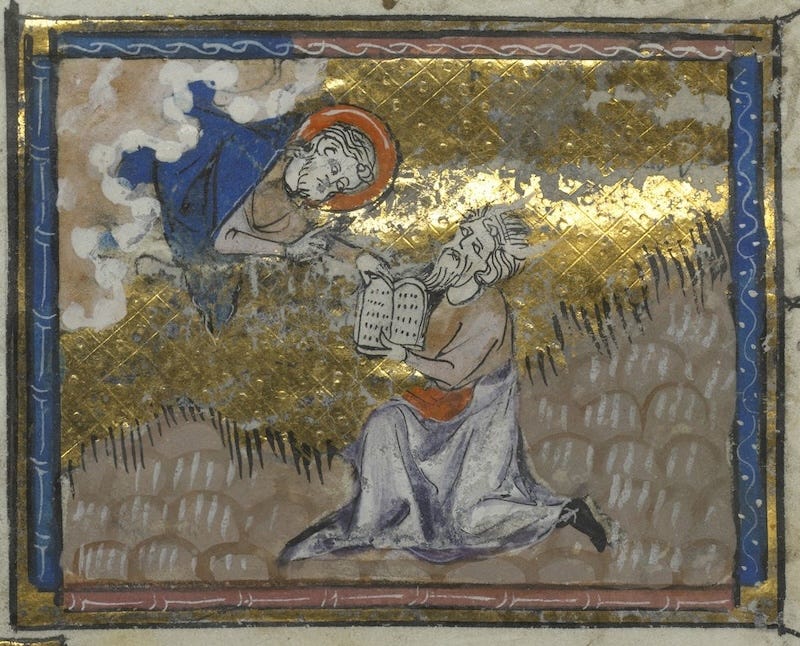
The same dynamic extends beyond individual scenes into the wider narrative structure. Joseph is betrayed by his brothers, sold for silver, stripped, cast into a pit, and later exalted. Jesus is betrayed by Judas, sold for silver, stripped, entombed, and exalted. Jonah spends three days in the belly of the fish; Jesus predicts three days in the heart of the earth. Moses escapes a ruler bent on killing Hebrew infants, emerges from exile, ascends a mountain, and mediates a covenant. Jesus follows the same symbolic arc: threatened by a murderous ruler, called out of Egypt, tested in the wilderness, teaching from a mountain, and inaugurating a renewed covenant. This is not random resemblance. It reflects a world in which earlier stories functioned as templates.
Ancient Jewish authors did not treat scripture as a static archive of facts. They treated it as a living body of tradition that could be revisited, reinterpreted, and applied to new circumstances.
One key technique is typology recognized recurring patterns across time: Moses could become a template for a future deliverer, and Israel’s exile could foreshadow restoration. Midrash explored hidden meanings, tensions, and new applications within older texts. Pesher, attested in the Dead Sea Scrolls, treated scripture as containing encoded meanings that spoke directly to the interpreter’s own time.
By the time we arrive at early Christianity, scripture is no longer functioning merely as a record of the past. It is functioning as a codebook. The first Christians did not read the Hebrew scriptures as neutral background material for a life that had already happened. They searched them for hidden patterns, veiled prophecies, typological correspondences, and Spirit-guided meanings. A passage did not have to be about Jesus in its original context in order to become about Jesus through inspired interpretation. Israel could become Jesus. The suffering righteous man could become Jesus. The rejected servant could become Jesus. A sign given to an ancient king could become Jesus. The text became a map, and Christ was the figure readers were trained to find within it.
That is crucial because it shows how scripture was actually being used. Early Jewish readers were not passively receiving texts as fixed records of the past. They were searching them, recombining them, and uncovering patterns that could be applied to their own historical moment. As Richard Carrier and others have noted, this kind of scriptural decoding was not marginal. It was widespread. The New Testament writers emerged directly out of this world. They were Jews steeped in a tradition where scripture was not treated as a flat archive of past events, but as a living body of meaning to be searched, reread, and reapplied. When early Christians portrayed Jesus, they were not simply recording a life in the modern biographical sense. They were rereading the Hebrew scriptures to interpret his life, death, mission, and cosmic significance. That is why so much of the Gospel narrative appears to fulfill older texts. The authors were not recording events and then attaching verses afterward. They were crafting a theological portrait through inherited techniques of scriptural interpretation.
This is visible even in the words attributed to Jesus. What later readers encounter as the “red-letter” sayings are not free-floating teachings dropped into history untouched by tradition. They are deeply embedded in a scriptural world. When asked about the greatest commandment, Jesus answers by quoting Deuteronomy 6 and Leviticus 19. His warning that “the stone the builders rejected has become the cornerstone” comes from Psalm 118. Even his cry from the cross is lifted from Psalm 22. He does not stand outside the tradition commenting on it from a distance. He speaks from within it.
Once the literary architecture of the Gospels becomes visible, a more difficult question comes into focus. Are the evangelists taking a real remembered life and interpreting it through scripture, or are they using scripture itself to shape the narrative they present? Those are not small variations of the same idea. They are rival explanations. One begins with a historical figure and treats scriptural patterning as interpretation. The other begins with a scriptural tradition and understands the figure as emerging from it. The more densely these patterns appear, the harder it becomes to maintain a clear boundary between the person being described and the literary tradition doing the describing.
The Foundation Is Younger Than It Appears
Most readers imagine the Hebrew scriptures as ancient deposits of sacred memory stretching deep into the past. Moses belongs to remote antiquity. The prophets stand centuries before Jesus. The New Testament then appears as the culmination of an immense and venerable arc.
But that inherited picture is much shakier than people like to admit.
Biblical minimalists associated with the Copenhagen School, including Thomas L. Thompson, Niels Peter Lemche, and Philip Davies, challenged the assumption that the Hebrew Bible gives us transparent access to early Israelite history. Their argument was not that nothing existed before the texts, but that the biblical story of Israel may be less a record of national origins than a later literary construction of those origins.

The Elephantine Problem
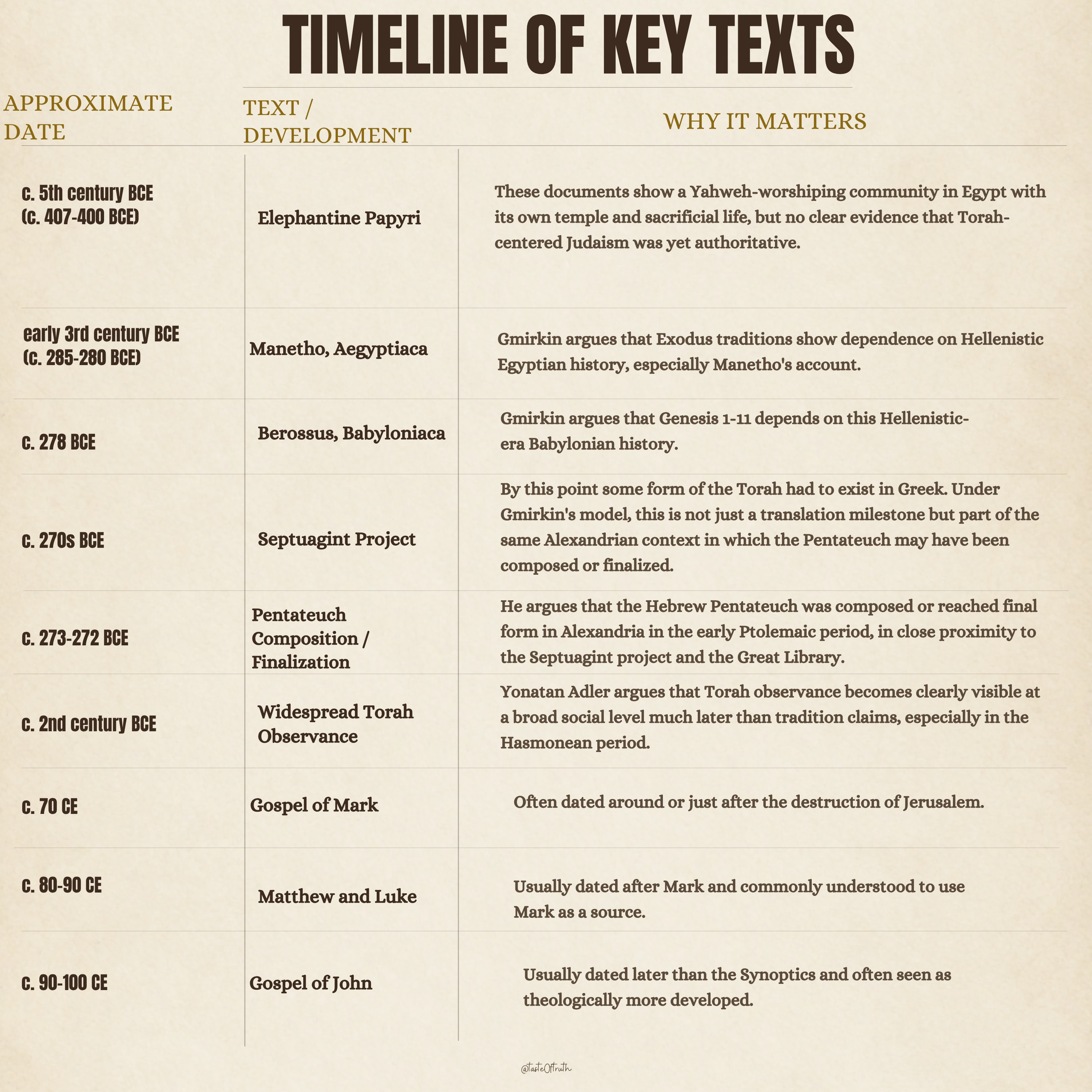
The Elephantine papyri make that problem hard to ignore. In the fifth century BCE, a Jewish/Judean military community in southern Egypt worshiped Yahweh, maintained its own temple, practiced sacrifice, and remained in contact with Jerusalem. Yet this community does not clearly reflect the fully formed Torah-centered Judaism later projected backward into Israel’s past. There is no obvious evidence of an exclusive Jerusalem cult, a centralized Pentateuchal legal order, or the religious system later treated as ancient and universal. That does not prove no Pentateuchal traditions existed in any form, but it does make the traditional timeline look far less secure.
Archaeology adds more pressure. The patriarchal age, the Exodus, the conquest, and the grandeur of the united monarchy have all been heavily challenged. Egyptian records do not confirm the biblical Exodus. Archaeology has not vindicated the conquest of Jericho in the form the Bible presents it. Even early Israelite religion appears messier than later monotheistic memory allows, with inscriptions invoking Yahweh alongside Asherah. The issue is not merely that the Bible contains embellishment. The issue is that some of its foundational stories may be retrospective national myths written as ancient history.
Plato, Moses, and the Making of Sacred Antiquity
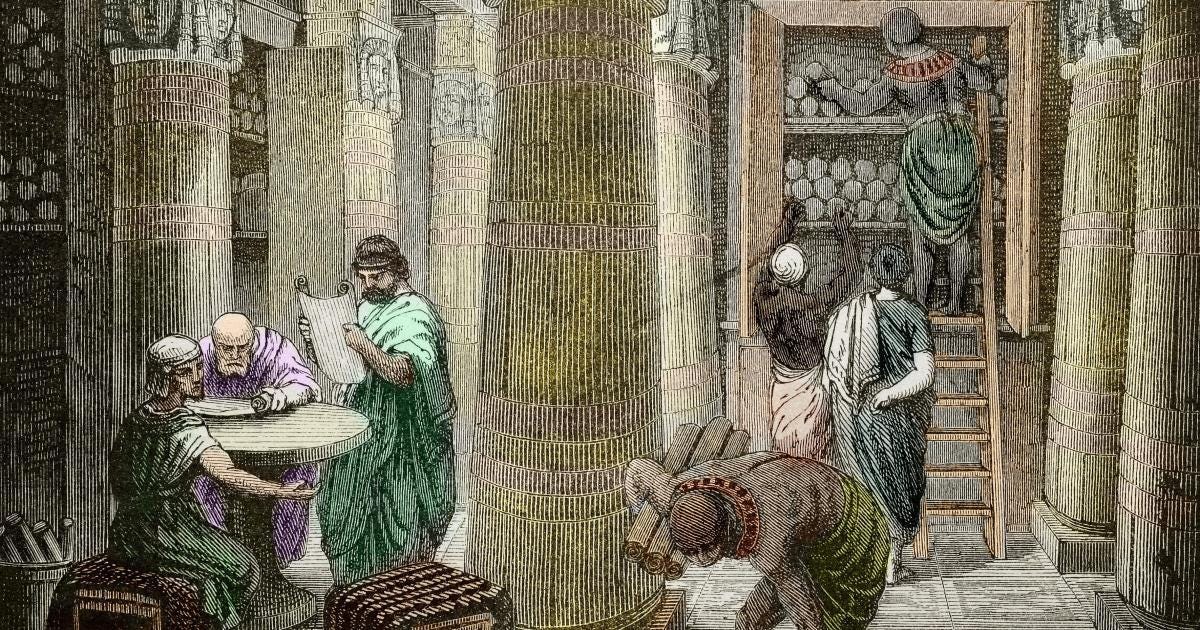
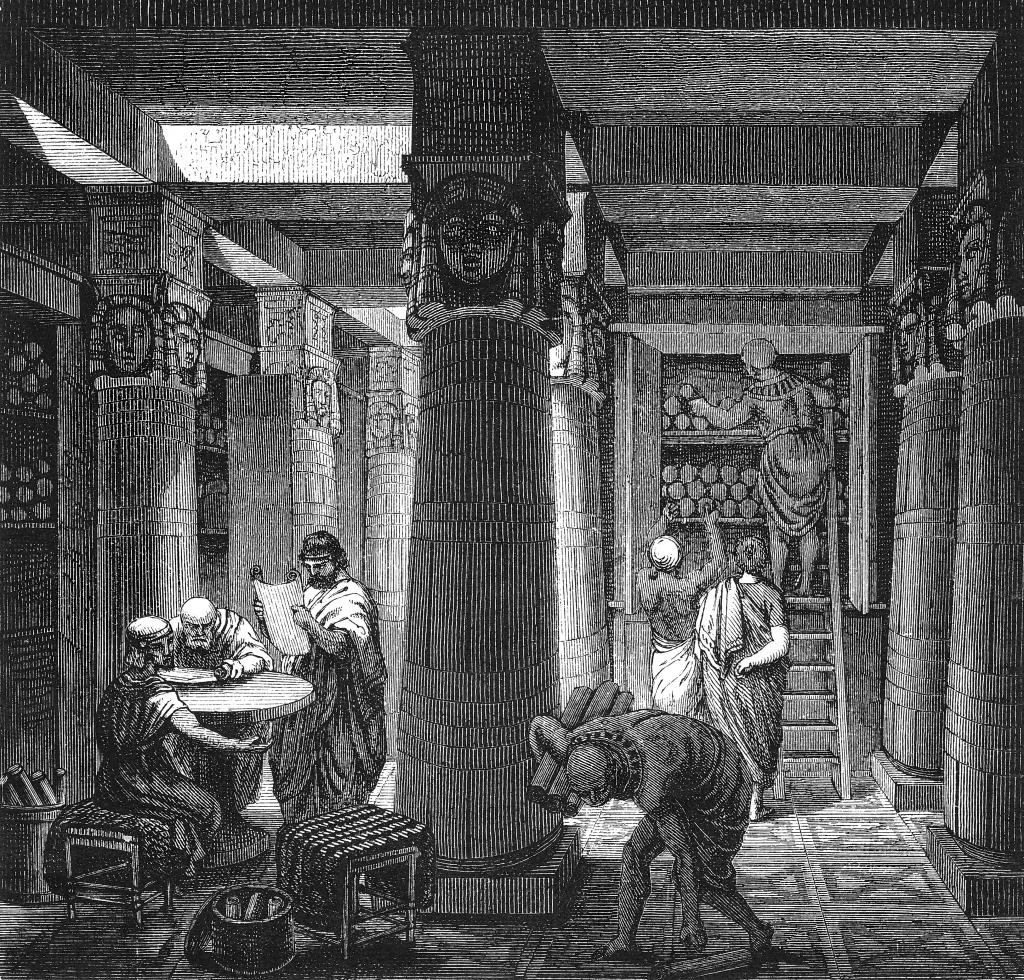
This is where Russell Gmirkin pushes the argument further. He argues that the Pentateuch reached final form around 273–272 BCE, in the Alexandrian and Ptolemaic world of the third century BCE, close to the Septuagint project and the intellectual culture of the Great Library. On this model, the Torah was not merely translated into Greek at Alexandria. It may have been composed or finalized there.
Gmirkin’s argument is controversial, but it is not random. He points to literary dependence: Genesis 1–11 drawing on Berossus’ Babylonian history, Exodus engaging Manetho’s Egyptian history, and the Torah’s legal materials reflecting Greek, especially Platonic, models of law, constitution, and national foundation. Philippe Wajdenbaum develops a similar comparison, arguing that the Hebrew Bible resembles Greek literature, especially Plato’s Laws, in its construction of a people around a lawgiver, sacred land, twelve tribes, and a divinely authorized legal order.
This changes the way Moses looks. In Gmirkin’s reading, Moses is not simply a prophet. He resembles an oikist, a founder figure: the one who organizes a people, distributes land, establishes institutions, and anchors political order in a sacred origin story. The Torah, in turn, begins to look less like a loose bundle of ancient laws and more like a charter myth. It tells a people who they are, where they came from, why their laws are sacred, and why obedience to that order is obedience to God.
That is where the real trick lies. Once law is placed in the mouth of Moses and projected backward into sacred antiquity, it stops looking like legislation and begins to look like revelation.
This also helps explain later apologetic reversals. By the time we reach writers such as Philo and Josephus, the direction of influence has been flipped. Greek thinkers are now said to have borrowed from Moses, not the other way around. The issue was never merely content. It was priority. The Bible’s authority depended not only on what it said, but on when people believed it had been said. The Letter of Aristeas belongs to the same machinery of sacred self-presentation: Jewish antiquity staged for the Greek world as though ancient wisdom were simply being translated, rather than emerging from a competitive Hellenistic culture of literary production and historical self-invention.
Yonatan Adler adds one final complication. The question is not only when these texts were written, but when they became socially real. Adler argues that widespread Torah observance becomes clearly visible much later than tradition claims, especially in the Hasmonean period. A text can exist before it rules. A law can be written before it governs a people.
The implications of that compressed timeline are enormous.
The implications are enormous. If the Pentateuch reached final form around 273–272 BCE, and the Gospels were written between roughly 70 and 100 CE, then the scriptures supposedly being “fulfilled” by the Gospel writers may be only three or four centuries older than the Gospels themselves.
That does not make the connection less Jewish. It makes it look less like the unfolding of immemorial revelation and more like literary tradition building on literary tradition.
And once that compressed timeline is taken seriously, the next question is no longer simply how old the tradition was supposed to be. It is how sacred antiquity itself was made.
From Failed Kingdom to Spiritual Messiah
This is the missing hinge. Jewish messianic hope did not arise in a vacuum. It was forged in the long shadow of conquest, exile, humiliation, and imperial domination. From Assyria and Babylon to the Greeks and Romans, Jewish life was repeatedly shaped by foreign rule. It is not difficult to see why restoration, divine justice, and the dream of an anointed deliverer became so central. A people under pressure will search its own sacred memory for the pattern of rescue.
By the first century, that hope had become unstable. Second Temple Judaism was not a unified religion serenely awaiting fulfillment. It was a fractured landscape of rival sects, competing scriptural interpretations, anti-Temple resentment, apocalyptic expectation, and bitter disagreement about where Israel had gone wrong. Some blamed foreign occupation on sin. Some blamed corrupt elites. Some rejected the legitimacy of the Temple leadership altogether. In that environment, scripture was not merely read. It was mined for survival strategies.
This is where Carrier’s point becomes useful. As he writes, “The traditional messianic hope (of a conclusive military victory over all of Israel’s neighbors) was a doomed hope, and that would have been obvious to at least some Jews.” A warrior-king who would visibly crush Rome was precisely the kind of messiah history kept refusing to produce. A spiritual messiah, by contrast, could not be falsified so easily. He could conquer Satan rather than Caesar, the heavens rather than the earth, sin rather than empire. Defeat could be reinterpreted as hidden victory. Political disappointment could be absorbed into myth.
That shift matters. A suffering, dying, or heavenly messiah fits prolonged subjugation far better than a triumphant Davidic conqueror who never arrives. Christianity did not solve the Roman problem by overthrowing Rome. It solved it by changing the terms of victory. The kingdom became “not of this world.” The struggle moved from flesh and blood to cosmic powers. The messiah no longer needed to raise an army from Jerusalem if he could instead be enthroned in heaven.
And that made Christianity exportable. The movement that emerged did not require Gentiles to become Jews in the full covenantal sense. It offered a way for Gentiles to worship the God of Israel without circumcision, kosher law, or full Torah observance. Acts 15 is the obvious flashpoint. The Jerusalem leadership approves Gentile inclusion through a reduced set of obligations, allowing the biblical framework to expand beyond ethnic Judaism without dissolving its theological core. The God remains the God of Israel. The scriptures remain Jewish scriptures. The messiah remains the Jewish messiah. What changes is access.
That is one of the most important transformations in religious history. Christianity became, in effect, Judaism for Gentiles: a way of universalizing Israel’s God, Israel’s scriptures, Israel’s messianic story, and Israel’s eschatological framework without requiring the nations to become Jews. The old covenantal architecture was not abandoned. It was scaled.
And once that is clear, the next question presses harder than ever. If this new messiah emerged from scriptural reinterpretation, apocalyptic disappointment, sectarian fragmentation, and theological adaptation to empire, then the issue is no longer merely what early Christians believed about him.
It is whether there was ever a stable historical figure there in the first place.
The Last Firewall: “But Surely Jesus Was Historical”
By this point in the argument, a familiar fallback usually appears. The miracles may be myth. The resurrection may be theology. The birth stories may be literary invention. The passion narrative may be scriptural construction. The speeches may be later compositions. The chronology may be artificial. Fine. Grant all that, people say. But surely there was still a man underneath it all.
I no longer accept that assumption, and I do not think it deserves to be treated as intellectually safe merely because it is familiar.
Once literary and theological construction has been conceded at nearly every level of the tradition, the so-called “historical Jesus” begins to look less like a demonstrated figure than like a residue, a placeholder left standing after everything obviously mythic has been stripped away. The problem is not that a historical core has been disproved in some crude, absolute sense. The problem is that it is constantly assumed, while the evidence for it remains astonishingly thin.
Where, exactly, is this man supposed to be found?
There is no contemporary, independent, non-Christian evidence for Jesus as a historical person. There is no inscription, no administrative record, no eyewitness account, no Roman report from his lifetime, no Jewish source from his lifetime, no archaeological evidence identifying him, no surviving text from anyone who actually met him. What we possess are Christian theological writings.
And our earliest source, Paul, does not give us a remembered Galilean teacher wandering around first-century Judea. He gives us a revealed, cosmic, scriptural Christ known through visions, revelation, scripture, death, resurrection, and heavenly significance. Paul does not preserve a stable earthly biography. He does not narrate Bethlehem, Nazareth, Galilee, Judas, Mary Magdalene at the tomb, Pilate’s trial scene, or the sermon material that later becomes central to the Gospel portrait. That absence is not a trivial inconvenience. It is a structural problem.
Even 2 Peter is revealing on this point. “For we did not follow cleverly devised myths when we made known to you the power and coming of our Lord Jesus Christ, but we were eyewitnesses of his majesty.” The denial is telling. It does not prove invention by itself, but it does show that early Christian claims could be heard as mythic, visionary, or constructed. And the response is instructive. The author does not answer by providing a grounded earthly biography. He answers with prophecy, revelation, glory, and Spirit-soaked authority.
The Gospels themselves do not rescue the situation. They are anonymous literary-theological compositions written decades after the alleged events, in Greek, through dense scriptural patterning. They do not read like independent eyewitness memory. They read like sacred narrative built from older texts, typology, apocalyptic expectation, and theological necessity.
The supposed external witnesses do not solve the problem. Josephus is late, textually disputed, and preserved through Christian transmission. Tacitus is later still and tells us, at most, what Christians in his own time believed about their origins. These are not contemporary confirmations of Jesus’ life. They are later references to a movement that already existed. They tell us Christianity happened. They do not securely tell us that the Gospel figure at its center was historical in the way readers are encouraged to imagine.
The same goes for the phrases in Paul that are endlessly hauled out as if they settle the matter. “Born of a woman,” “seed of David,” “brother of the Lord” — these are not granite biographical anchors. They can function as incarnation language, messianic credentialing, or intra-community title. They do not give us a recoverable historical Jesus standing solidly behind the later narratives. They give us phrases. The heavy lifting is done by prior belief.
This is why I reject the polite compromise that says, “Of course the Gospel Jesus is mythologized, but there must have been a real preacher behind him.” Must there? Why? Because modern scholars feel more respectable keeping one sandal planted on the ground? Because the imagination panics at the thought that the whole figure may be literary from the start? Because once the miracles, fulfillment scenes, speeches, chronology, passion details, and resurrection appearances are recognized as constructed, people still want one final reassuring object left?
To me, this often functions less like an argument than a psychological reflex.
And this is precisely where Gmirkin’s work ceases to be merely interesting and becomes a consistency test.
If we are willing to follow biblical minimalism when it exposes the Pentateuch as a late literary-theological construction, why should the inquiry suddenly stop at Christianity? If the Hebrew scriptures can be composed, adapted, borrowed, and projected backward into sacred antiquity, why is Jesus protected from the same analysis? Why is the critique allowed to dismantle Moses, law, covenant, and national memory, only to halt politely at the Messiah as if some invisible velvet rope had been lowered around him?
That exemption makes no sense.
Christianity does not escape the biblical matrix. It depends on it. It preserves the God of Israel, the prophets, the covenants, the messianic framework, the chosen-people logic, and the eschatological expectation that history moves toward divine judgment and final rule. Its dispute with Judaism is not over the structure. It is over who gets to occupy the central role within it. Christianity is not the grand liberation from the older framework that its admirers like to imagine. It is the sequel.
And once that is admitted, the next step is not radical at all. It is obvious.
If scripture can generate Moses, covenant, law, land, chosenness, and sacred national memory, then scripture can also generate Jesus, fulfillment, cross, resurrection, judgment, and cosmic kingship. If a literary-theological tradition can manufacture sacred antiquity, why should it suddenly lose that power when it reaches the first century? If the old stories can produce a founder, a people, a law, and a history, why should they not also produce a messiah?
Christianity does not begin, in our earliest sources, with a stable man later decorated with myth. It begins with a revealed Christ known through scripture and visions. The earthly biography comes later, and when it appears, it arrives already saturated with literary design.
If that is true, then the task is no longer to keep exhausting ink and paper trying to peel a “real Jesus” out of layers of literary construction. The more urgent question becomes: what were the earliest apostles, visionaries, and authors actually doing? What experiences did they think they were having? What apocalyptic expectations drove them? What rhetorical and mythical work were the later stories performing? Once the data about Jesus comes to us primarily through scripture, revelation, and literary invention rather than recent biography, the center of gravity shifts. The real subject is no longer a recoverable Galilean teacher hiding behind the text, but the motives, methods, and imaginative world of the people who produced the text.
The Gospel Jesus is not history remembered and then embellished. He is scripture personified, given narrative form, furnished with a recent setting, and made to walk through a world already prepared for him by text. At that point, Christianity begins to look less like a movement built around a misremembered man and more like a movement built around visionary claims, apocalyptic expectation, scriptural decoding, and later literary elaboration. What demands explanation is not how a historical teacher was gradually mythologized, but how a mythic and scriptural Christ was gradually narrativized.
That is the last firewall. Once readers are willing to concede literary construction everywhere else, Jesus becomes the one figure they are still expected to protect. Not because the evidence suddenly improves, but because the emotional and institutional cost of following the argument any further becomes too high. And if that protection finally collapses, then a great deal of Jesus studies will have to admit that it has been spending enormous effort on the wrong pursuit. The real work would no longer be reconstructing a man behind the myths, but reconstructing the interpretive practices, sectarian motives, visionary experiences, and literary intentions that produced the myth in the first place.
And that is exactly where Jan Assmann becomes useful.
The resistance here is not just intellectual. It is civilizational. By the time people reach Jesus, they are no longer defending one ancient figure among others. They are defending a memory-world: a moral vocabulary, a theory of suffering, a structure of hope, a story about history, and often the emotional architecture through which they understand themselves. That is why the argument suddenly feels so charged. It is no longer just about evidence. It is about what happens when literature hardens into memory and memory hardens into reality.
Mnemohistory: When Literature Becomes Memory
“Mnemohistory,” a term coined by Jan Assmann, refers not simply to the past, but to the way societies remember the past. That sounds academic. In practice, it is far more destabilizing than it first appears.
I was first introduced to Assmann’s work through my friend Brado, and once the idea clicked, a great deal of human behavior stopped looking mysterious. One of the hardest things to swallow is realizing how much of what people confidently call “history” is not history in the plain sense at all, but mnemohistory: emotionally charged civilizational storytelling repeated so often that it hardens into something psychologically untouchable.
A society does not merely pass down facts. It passes down stories about origins, suffering, enemies, rescue, chosenness, betrayal, exile, return, and destiny. Those stories do not simply describe the past. They train perception. They teach people what to love, what to fear, whom to trust, whom to blame, and what future to desire. After a while, people are no longer defending a memory. They are defending the world that memory built for them.
That is why historical arguments go feral so quickly. You are never just disputing an event. You are touching the memory structure through which a group recognizes itself. The Exodus is one of the clearest examples. It is not merely a story to be remembered, but a story about remembering: bondage, liberation, divine rescue, covenant, promised land. It turns memory into identity and identity into destiny. The past is ritualized so that it can keep governing the present.
This is also where Neil Van Leeuwen’s distinction between factual belief and religious credence becomes clarifying. A factual belief is supposed to track reality across contexts. Religious credence works differently. It behaves less like stable fact-tracking and more like an imaginative, identity-bound commitment activated in specific social and ritual settings. A church can gather in a gymnasium and everyone still knows they are sitting on bleachers under fluorescent lights. Yet within that setting, the space becomes sacred. The credence does not erase ordinary reality. It overlays it and reorganizes meaning.
That helps explain why apologetics so often feels impervious to evidence. It is not primarily a truth-seeking enterprise, but a credence-maintenance system. Doubt is framed as danger, questions are met with prefabricated responses, and rituals, narratives, and authorities work together to protect identity rather than expose it to risk. As Van Leeuwen argues, when an attitude is rooted in group identity, truth can easily take a back seat.
Once you see that, a great deal of Christian apologetics becomes easier to understand. Its stubbornness is not a bug. It is the design. It is not really trying to investigate whether the historical Jesus can bear the weight placed on him. It is trying to prevent the collapse of the cognitive and social world built around him.
That is why arguments about Jesus’ historicity so often feel like Groundhog Day. One side keeps asking what the evidence can actually support. The other keeps reasserting the figure as though familiarity itself were proof. By the time people reach Jesus, they are no longer just defending one ancient claim among others. They are defending a moral universe, a structure of consolation, a theory of suffering, a promise of justice, a spiritual identity, and often an entire social world.
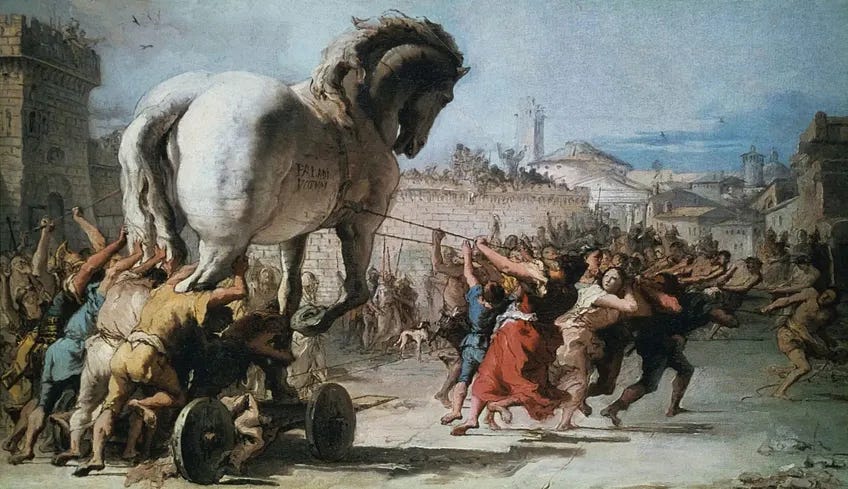
This is how Christianity became one of history’s most successful Trojan horses. It entered the Roman world clothed in humility, forgiveness, self-denial, and the sanctification of suffering. But that moral vocabulary was tailor-made for rule. A religion that teaches obedience, glorifies submission, and casts suffering as meaningful does not merely coexist with empire. It serves it. Constantine did not have to distort Christianity into something authoritarian. Its authoritarian potential was already there, waiting to be scaled.
The reason this matters is not that ancient people wrote sacred stories. Humans have always done that. The reason it matters is that some sacred stories do not stay on the page. They become political grammar. They teach civilizations how to imagine enemies, destiny, land, obedience, suffering, and war.

Modern Consequences: When Sacred Story Becomes Political Machinery
And this is where the conversation is no longer academic or safely trapped in antiquity.
In the modern West, and especially in the United States, support for Israel is often presented not merely as a strategic choice but as a moral and even spiritual duty. For millions of Christians, conflict in the Middle East is not simply geopolitics. It is part of a sacred script. Apocalyptic language has not remained tucked away in pulpits and prophecy conferences. It has drifted upward into policy, media, lobbying, diplomacy, and war.
And the problem is larger than American evangelicalism.
What is now sold as “Judeo-Christian friendship” increasingly functions as a transnational political package. Israel is marketed not simply as a nation-state but as a symbol of “the West,” biblical truth, anti-communism, anti-Islamism, anti-woke moral order, technological modernity, and civilizational resolve. That is why gatherings such as the JNS International Policy Summit in Jerusalem and the Judeo-Christian Zionist Congress matter. They are not quaint interfaith exercises. They are strategy rooms in which theology, media, diplomacy, philanthropy, and security discourse are braided together and sent back out as political messaging.
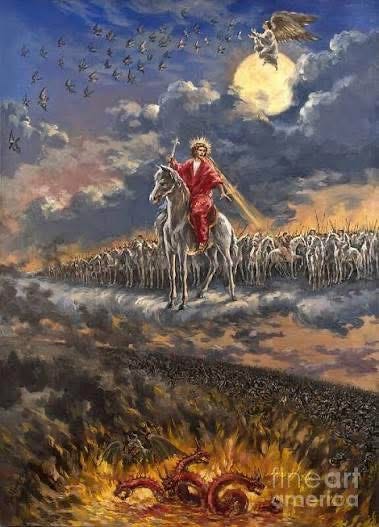
Latin America makes the pattern especially visible. As evangelical and Pentecostal Christianity grows as a political force, Israel is increasingly recoded as a sacred-political emblem of order, family values, anti-left resistance, and biblical destiny. The Isaac Accords are a perfect example. They are presented in the language of democratic values, innovation, security, and cooperation, but the emotional engine underneath them is older and hotter than that. Israel becomes a proof-text. Foreign policy becomes catechism by other means. The old Abrahamic machinery has simply evolved to speak the language of diplomacy, branding, and strategic partnership.
This is why the usual dismissals fail. We are not dealing with private religious sentiment lingering harmlessly at the margins. We are dealing with inherited apocalyptic structures that shape how nations imagine enemies, allies, legitimacy, time, and destiny. When political leaders, religious institutions, military personnel, media ecosystems, and ordinary citizens inherit stories about Israel, Iran, final battles, messiahs, Armageddon, and divine destiny, the line between prophecy and policy begins to blur. Conflict stops looking contingent. It starts looking prewritten.
The Cybernetic Culture Research Unit coined the term hyperstition for ideas that bring themselves into existence because people believe them strongly enough to act on them. That concept belongs here. A prophecy does not have to be true to become dangerous. It only has to recruit enough believers willing to organize behavior around it. Once that happens, old stories stop functioning as symbolic expectation and begin operating as strategic motivation.
Judaism, Christianity, and Islam all carry end-times narratives organized around the same theological lore: messianic figures, final conflict, cosmic judgment, and the Middle East.
A revealing example appears in the Qur’an’s treatment of Jesus. In Surah 3:45, Jesus is called al-Masīḥ — the Messiah. Islam does not use that title in the Christian sense: Jesus is not divine, not the Son of God, and not a crucified savior. But the messianic category remains.
The traditions are not identical, and their details often conflict sharply. But they share enough inherited narrative architecture to be significant here.
Maimonides makes the continuity unusually explicit, and his wording matters because he was no fringe oddball. He was one of the most important Jewish legal and philosophical authorities in history. In Mishneh Torah, Laws of Kings 11:4, frames Jesus and Muhammad as figures who, within divine providence, helped spread knowledge of messianic expectation and the God of Israel among the nations.
That is the blueprint: a shared body of theological lore, a transmitted narrative architecture that persists even as details are revised. Its logic is self-reinforcing. Prophecy validates scripture, scripture is reread as fulfilled prophecy, and each new crisis is folded back into the old frame as confirmation. The game works not because the texts reliably predict history, but because they are endlessly reinterpreted, retrofitted, and made to certify one another.
And that is why literary origins matter. If sacred histories are constructed, revised, projected backward, and then defended as untouchable truth, they do not remain harmless. They shape borders, justify wars, license alliances, sanctify violence, and train populations to see obedience as virtue and confrontation as destiny. The danger is not simply that people believe old stories. The danger is that these stories still command institutions, budgets, media systems, electorates, intelligence networks, and weapons.
Entire populations become characters in someone else’s sacred drama. Human beings become pieces on an apocalyptic chessboard. War ceases to be merely war. It becomes fulfillment.
Voltaire’s warning still bites: those who can make you believe absurdities can make you commit atrocities.
This is why I do what I do with such fierce passion. I believe the Abrahamic traditions are built on layers of fabrication, borrowed myths, retroactive claims to antiquity, and sacred stories whose origins are rarely examined with the seriousness they deserve. To me, it is an insult to wisdom, curiosity, and the pursuit of knowledge that so much of our culture remains shaped by narratives that are historically unstable, morally suspect, and fiercely defended as untouchable truth.
Questioning these stories is not hatred. It is not divisive. It is intellectual self-defense. It is spiritual self-defense. It is the work of reclaiming the human mind from inherited scripts that have too often taught people to sanctify obedience, suffering, conquest, and fear.
If sacred stories can shape civilizations, then examining them is not a niche academic exercise. It is necessary work.

Resources and Further Reading
Laurent Guyénot — “Russell Gmirkin and the Biblical Con” (Substack series)
Jan Assmann: Moses the Egyptian: The Memory of Egypt in Western Monotheism
Jan Assmann: Cultural Memory and Early Civilization
Richard B. Hays: Echoes of Scripture in the Gospels
Dale C. Allison Jr.: The New Moses: A Matthean Typology
E.P. Sanders: The Historical Figure of Jesus
Geza Vermes: Jesus the Jew
Bart D. Ehrman: Did Jesus Exist?
Yonatan Adler: The Origins of Judaism: An Archaeological-Historical Reappraisal
Russell Gmirkin: Berossus and Genesis, Manetho and Exodus
Russell Gmirkin: Plato and the Creation of the Hebrew Bible
Philippe Wajdenbaum: Argonauts of the Desert
Thomas L. Thompson: The Mythic Past
Philip R. Davies: In Search of “Ancient Israel”
Ze’ev Herzog: “Deconstructing the Walls of Jericho” (Haaretz, 1999)
David Skrbina: The Jesus Hoax
Richard Carrier: On the Historicity of Jesus, The Obsolete Paradigm of a Historical Jesus
Thomas L. Thompson and Thomas S. Verenna, eds., Is This Not the Carpenter? The Question of the Historicity of the Figure of Jesus
Adam Green: The Jesus Deception
Plato: Laws
Berossus: Babyloniaca (fragments)
Manetho: Aegyptiaca (fragments)




 Taste0ftruth Tuesdays