
On metabolism, nourishment, food reverence, and the systems that shape what feeds us
Welcome back to Taste0fTruth Tuesdays. Today, we are mixing things up with a subject that is very near and dear to my heart: nutrition, metabolism, and our increasingly distorted relationship with food in our modern world.
This episode covers a lot of ground. We are moving from diet culture and my own history with restriction into metabolism, morality, industrial food, local agriculture, and the growing technological control of our food systems. It may sound like several different conversations, but they are all part of the same story.
This episode will also lay some of the groundwork for an upcoming interview at the end of the month with Jay Feldman Wellness.
Jay is a health coach, independent health researcher, and host of The Energy Balance Podcast. His work explores bioenergetic health and nutrition, including ideas influenced by biologist Ray Peat—principles I have found myself returning to, on and off, for the last several years.
But before we get there, I need to explain why this conversation is so personal for me.
As many of you know, I have spent more than 20 years in the health and fitness world. I have also written openly about how intense and complicated that journey has been.
I came of age during the late 1990s and early 2000s, an era saturated with diet magazines, celebrity weight-loss stories, low-fat everything, Special K commercials, “bikini body” workouts, and television programs that treated shrinking the body as both entertainment and moral achievement.
And those cultural messages did not exist in isolation.
I grew up in a household where my body was not simply noticed. It was scrutinized, compared, and commented on.
Those kinds of comments do not disappear with time. They become part of the architecture of how you see yourself. They follow you into mirrors, fitting rooms, photographs, swimming pools, doctors’ offices, and every room where you become aware that other people can see your body.
They teach you that the body must be managed and monitored.
They plant the belief that remaining small is the price of safety.
I grew up believing that if I could control my body well enough, I could avoid humiliation. I could avoid becoming the punchline. I could avoid being seen in the wrong way.
For a while, I turned that fear into something our culture rewards: discipline.
But fear does not stop being fear simply because it learns the vocabulary of health and fitness.
In high school, I followed plans like the Special K diet. I relied on Carnation Instant Breakfast instead of complete meals. I skipped classes to work out before heading to my afterschool job. My protein intake was low. My fear of gaining weight was high.
Restriction became familiar.
And because restriction was praised as willpower, I did not always recognize it as deprivation.
That is the background I bring into this conversation. I am not critiquing calorie culture because I have never understood its appeal. I understand it intimately.
Numbers can feel safe.
Numbers feel objective. They offer the illusion that if you calculate carefully enough, track consistently enough, and exert enough control, the body will become predictable. Calories give food a score. The scale gives the body a verdict. And when you have learned to fear your own appetite, arithmetic can feel more trustworthy than sensation.
I have lived through periods in which weight loss looked like success from the outside while my body was becoming increasingly undernourished, stressed, depleted, and disconnected from its own signals.
So when I say that weight loss and health are not synonymous, trust me: I learned that lesson the hard way.
When Discipline Stops Working
·
Jan 20
That is why I am interested in the bioenergetic perspective. Rather than asking only, “How little can I eat to make the number on the scale decrease?” it asks a more useful question:
How well is the body actually producing and using energy?
This episode is not intended to settle every claim made within bioenergetic nutrition. That is part of what I want to explore with Jay during our upcoming conversation.
Today, I want to lay the groundwork by examining the difference between consuming calories and producing usable cellular energy; between losing weight and becoming healthy; and between treating food as a number and understanding it as biological information, ecological relationship, and participation in a living system.
Because the body is not simply a furnace. Food is not merely a number.
And losing weight is definitely not proof that a person is nourished or healthy while doing so.
Modern nutrition has flattened food into arithmetic while removing almost everything that makes it meaningful.
SAD is the perfect acronym for the Standard American Diet because, whew, it really is sad what modern food culture has become.
And I do not just mean sad in the obvious “everyone is eating ultra-processed food and wondering why they feel terrible” kind of way. I mean sad in the deeper sense.
Sad as in spiritually impoverished.
Sad as in disconnected from land, animals, seasons, labor, gratitude, death, and actual nourishment.
Sad as in we have managed to turn food (one of the most intimate relationships a human being has with the living world) into a bland, plastic-wrapped transaction between a lonely person and a microwave, or a vehicle going to a fast food drive thru window.
That sounds dramatic.
But is it really?
We live in a culture that calls ultra-processed food “good enough,” celebrates weight loss regardless of how it was achieved, and then treats anyone who questions that framework as judgmental, elitist, or unnecessarily intense.
But that is exactly the problem.
Our culture has reduced food to numbers while stripping it of meaning. Calories. Macros. Points. Deficits. Cheat meals. Protein hacks. Low-cal swaps. “If It Fits Your Macros.” (I lived and breathed that lifestyle) We talk about food like it is accounting, not relationship. Like the human body is a calculator.
Of course, calories matter. I am not pretending energy balance is fake. But if your entire health philosophy begins and ends with calorie math, you are missing the human being attached to the equation.
Food is not only fuel. Food is information. Food sends a signal. Food affects insulin, thyroid output, leptin, ghrelin, cortisol, digestion, gut signaling, inflammation, mitochondrial function, cell communication, mood, cravings, satiety, sleep, fertility, and gene expression. A Hot Pocket and a grass-fed steak may both contain calories, but they do not speak the same biological language once they enter the body.
The lie of “calories in, calories out” must die.
Not because energy does not matter. It does. But because reducing food to calorie math is one of the dumbest things modern nutrition culture has done to the human body.
A calorie is a unit of energy, but the number printed on a label cannot tell us how effectively a food will be digested, absorbed, converted into ATP, or allocated among the body’s competing demands. That process requires minerals, vitamins, enzymes, hormones, functioning mitochondria, adequate protein, and a body that is not constantly underfed, inflamed, stressed, or depleted.
This is where the “just eat less” crowd loses the plot.
Most people are not building truly nutrient-dense meals, even when they think they are. They may be tracking protein, counting calories, or hitting some macro target, while still missing the deeper nourishment their body needs to actually turn food into energy. If someone is living on refined grains, muscle meats only, no seafood, low mineral intake, low variety, and almost no traditional foods, they can be “hitting their calories” while still undersupplying some of the micronutrients and cofactors involved in energy metabolism, tissue repair, and hormonal function.
But producing energy is only part of the story.
The body must also decide where that energy goes.
Mitochondrial psychobiologist Martin Picard and his colleagues have proposed an emerging framework called the Energy Constraint model. Their central idea is that the body operates with a limited but dynamic energy budget that must continually be allocated across cells, organs, systems, and behaviors.
Everything costs energy.
Neurons firing costs energy. Producing proteins costs energy. Mounting an immune response costs energy. Digestion, movement, cognition, reproduction, tissue repair, and communication between cells all carry energetic costs.
Nothing is free in biology.
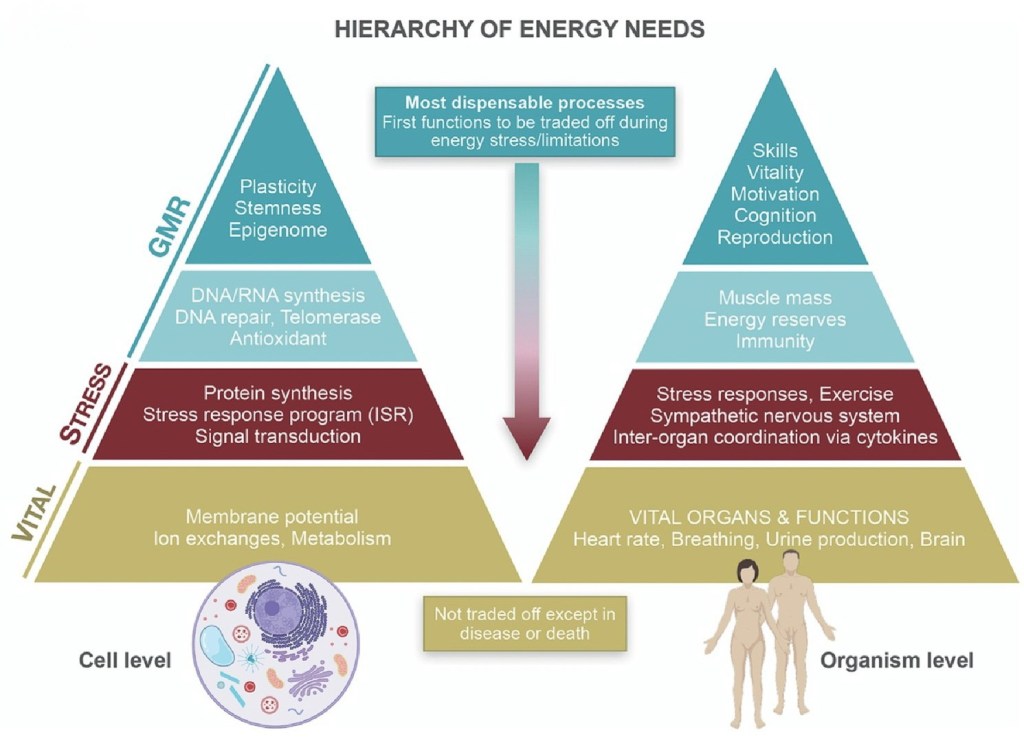
In their framework, the body’s energetic demands can be divided into three broad categories: vital functions; stress responses; and growth, maintenance, and repair.
At the base are the vital functions necessary to sustain life in the immediate term: breathing, heart activity, brain function, membrane potential, ion exchange, and basic metabolism. These processes receive priority because they are necessary for survival over minutes, hours, and days.
The next category includes stress-related demands. Exercise is a stressor. So are infection, inflammation, toxins, psychological distress, injury, sleep loss, and activation of the sympathetic nervous system. All of these require the body to spend energy responding and adapting.
At the top are growth, maintenance, and repair. These processes may not be essential for surviving the next several minutes, but they are essential for healing, resilience, muscle maintenance, reproduction, cognition, motivation, vitality, and long-term health.
When the body’s total demands become difficult to sustain, energy is not distributed evenly. More urgent vital and stress-related processes may be prioritized while investment in growth, maintenance, and repair becomes compressed.
In other words, the body may preserve what is necessary to keep you alive while reducing what is available to help you recover, reproduce, think clearly, maintain muscle, and feel fully alive.
This does not mean these higher functions simply switch off in a rigid order. It means the body makes trade-offs.
And duration matters.
Not every stressor is harmful. Exercise itself temporarily redirects energy, but when it is appropriately dosed and followed by sufficient nourishment, sleep, and recovery, the body can adapt and become more resilient.
The deeper problem is stress that becomes excessive, chronic, or inescapable.
When energetic demands continue for weeks, months, or years—whether from illness, infection, psychological stress, overtraining, sleep disruption, undernourishment, or some combination of pressures—the body may repeatedly postpone the repair work that was supposed to happen later.
This framework helps explain how someone can technically be eating enough calories (or even losing weight successfully) while experiencing fatigue, poor recovery, low libido, disrupted cycles, reduced motivation, brain fog, loss of muscle, or declining resilience.
It does not mean every one of those symptoms has a single energetic cause. But it gives us a much richer way of understanding health than simply asking whether someone stayed within a calorie target.
The body is not failing to obey an equation.
It is adapting to competing demands.
Nutrient status is only one part of this energetic landscape, but it is an important one. The body’s ability to produce, allocate, and use energy is also shaped by sleep, illness, stress, activity, mitochondrial function, recovery, and the cumulative demands being placed upon it.
This is why vitamins and minerals matter so much. They are not little bonus points sprinkled on top of a diet. They are part of the machinery that turns food into usable energy. They help build hormones and neurotransmitters, repair tissue, maintain immune function, support the liver, regulate the nervous system, and keep the organs doing their jobs.
Or said more simply: macronutrients burn on the flame of micronutrients.
That is the part calorie math misses. A Hot Pocket and a mineral-rich, protein-rich, whole-food meal may both contain calories, but they do not offer the body the same tools. One delivers energy potential wrapped in industrial convenience. The other provides the raw materials the body needs to actually build, repair, signal, regulate, and produce real cellular energy.
So when people say “it’s just calories in, calories out,” what I hear is a worldview that has confused potential with function.
A body is not helped by potential alone. It needs conversion. It needs nourishment. It needs signal. It needs minerals, protein, fats, carbohydrates, vitamins, salt, sunlight, rest, and rhythm.
Food is not just a number entering a furnace. Food is a set of instructions entering a living system. And if the instructions are poor, incomplete, synthetic, depleted, or chaotic, the body will respond accordingly.
This is where the lazy appeal to “thermodynamics” becomes almost comical. Yes, the laws of thermodynamics exist. Congratulations. But the human body is not a closed metal box in a lab. It is a living, adaptive, self-regulating organism. Inputs change outputs. Food changes appetite, energy expenditure, hormones, cravings, sleep, mood, metabolic rate, and behavior. The “calories out” side is not fixed. It responds to the quality, timing, and composition of what we eat.
Rupert Sheldrake has criticized the way modern science can harden living systems into dead-mechanistic models, and that critique fits here. The calorie model treats the body like a machine. But we are not machines. We are organisms. Food is not merely burned. It is received, interpreted, metabolized, stored, signaled, and woven into the body.
So yes, calories matter. But “calories in, calories out” as a complete theory of health is basically nutritional kindergarten, and it’s time to grow out of that.
But calorie reductionism is only one way modern food culture disconnects us from the complexity of nourishment.
We also have a tendency to turn eating into a moral identity. Foods become clean or dirty, virtuous or shameful. Diets promise not only better health, but innocence: a way to eat without exploitation, suffering, contradiction, or death.
I understand the appeal of that promise because I lived inside it.
I was vegetarian for years. At the time, I genuinely believed it was both the healthier and more ethical choice. I cared about animals. I still do—deeply. I did not want to participate in harm if I could avoid it.
But eventually, health-wise, vegetarianism stopped working for me. My body was not thriving. Practitioners I trusted encouraged me to reconsider whether I was receiving enough protein and nourishment, and over time I began incorporating animal foods again. That transition gradually led me toward a more pro-metabolic, ancestral approach to food.
I am not as critical of vegetarianism as I am of veganism because vegetarian diets can still include many traditional, deeply nourishing foods: eggs, butter, cheese, milk, yogurt, cream, and honey. These foods can still connect us to animals, farms, fermentation, older foodways, and the forms of nourishment on which human communities have relied for generations.
Veganism is different. I understand the moral impulse behind it. But modern veganism often depends heavily on the very industrial food system it imagines itself resisting.
It often depends upon global supply chains, fortified products, industrial monocrops, protein isolates, seed oils, and laboratory-like replacements for foods that once came directly from local land, animals, kitchens, and communities.
That does not describe every vegan meal or every person who avoids animal foods. But veganism as a widely accessible modern lifestyle has been made possible, in large part, by the industrialization and globalization of food. It became easier to imagine a diet detached from local ecology only after the modern food system detached nearly everyone from local ecology.
Before supermarket abundance, refrigerated transport, synthetic supplementation, and year-round imports, diets were far more directly shaped by region, climate, labor, animals, seasons, preservation, and survival.
This is what troubles me about the moral certainty that can surround veganism. Morality can bind us around compassion, but it can also blind us to costs outside the frame we have chosen. A person may avoid animal foods while remaining dependent upon monocropping, habitat loss, exploited labor, heavily processed substitutes, and corporations with no meaningful relationship to the land being depleted.
The suffering has not necessarily disappeared.
It has moved out of sight.
An ethical identity can become so focused on the visible animal that it loses sight of soil, insects, wildlife, farmers, rural communities, and the ecological relationships required to sustain human life.
This is why I keep thinking about survival programs like Alone. You do not typically see people in genuine survival conditions adhering to rigid dietary identities made possible by modern abundance. They eat the carbohydrates they can gather. They fish, hunt, forage, trap, and preserve whatever food the environment makes available.
A television program does not settle the ethical debate. But it does expose how much our modern food identities depend upon stability, infrastructure, supplements, supermarkets, and global abundance.
Most of us have no idea what we would actually eat if supermarkets, refrigeration, restaurants, and global supply chains disappeared.
It is easy to construct an identity around dietary purity while standing beneath fluorescent lights in a store containing food from every climate on Earth.
Survival has a way of stripping ideology down to appetite, ecology, and availability.
The point I’m trying to make here, is the deeper problem is not simply meat. It is our total disconnection from food itself.
The Standard American Diet is not built around reverence. It is built around convenience, profit, shelf life, hyper-palatability, and perpetual consumption. It is often high in refined carbohydrates and industrial fats, low in nutrient density, easy to overeat, and engineered to override the body’s natural signals.
It keeps people fed but not nourished.
Full but not satisfied. Stimulated but depleted.
I do not blame meat itself for the sickness of modern food culture. I blame the collapse of small and local food systems. I blame industrial agriculture and the consolidation of food production. I blame ultra-processed convenience food. I blame the severing of people from land, seasons, animals, kitchens, skills, and community.
I blame a culture in which people no longer know where their food comes from, what it took to produce it, or what kind of life and death made it possible.
Because that is the uncomfortable truth: death is always involved in food.
Neither vegetarianism nor veganism remove death from the food system. Fields are cleared. Habitats are displaced. Soil life is disrupted. Insects, birds, rodents, snakes, rabbits, and countless unseen creatures are killed through large-scale crop production. Farm workers are exploited. Water is diverted. Communities are transformed to serve distant markets.
Even a plate composed entirely of plants carries a cost.
That does not mean all dietary choices are morally equivalent. It means purity is not available to us. The moral task is not to imagine that we have escaped the web of life and death. It is to become more conscious of how we participate in it.
Nature is a total system, and within that totality it is not morally tidy.
We often use the word “natural” as if it means good, pure, balanced, or morally clean. But nature does not produce constant perfection. Nature produces totality. Beauty and monstrosity. Strength and weakness. Flourishing and failure. Healthy forms, botched forms, failed adaptations, extinction, decay, renewal.
Food belongs to that same uncomfortable order. There is no pure way to eat outside of life, death, appetite, cost, and consequence. The fantasy of a morally spotless diet is just another modern escape hatch from reality.
Morality works in a similar way. It is not merely a list of rules imposed from above. It is an energy-management system. It curbs violence, lust, greed, vengeance, ambition, and appetite so a group can maintain some version of peace. Morality contains the passions so they do not destroy the social body.
At both the personal and social level, morality determines which appetites may be expressed, which must be restrained, and which costs remain visible.
And maybe this is why modern food culture feels so spiritually sick. It has stopped containing appetite. It does not discipline desire. It engineers it. It stimulates it. It tells us we can eat industrially manufactured, hyper-palatable food and reduce the whole thing to calorie math, as if the body is not receiving signals, adapting, craving, storing, resisting, inflaming, and remembering.
Food is energy, yes. But not in the dead mechanical sense. Food is energy moving through a living moral and biological system.
That is why “calories in, calories out” feels so thin. It treats food as if it enters a furnace. But food enters a body. And bodies are not furnaces. Bodies are fields of signal, memory, hunger, restraint, ancestry, hormone, and meaning.
I completely understand the discomfort around eating conscious animals. I have read so many stories from first-time farmers who raise animals with love and then struggle deeply when it is time for slaughter. That pain means something. I respect it. Honestly, I trust that pain more than the numbness of the average grocery store shopper tossing factory-farmed meat into a cart with no thought at all.
The pain shows there is still reverence there.
And maybe that is what we have lost most.
We have been removed from the reality of food for so long that we tend to swing between two false extremes. On one side, we sentimentalize animals from a distance and pretend we can opt out of the death cycle entirely. On the other hand, we consume without thought, without gratitude, without responsibility, without even a pause. Both are forms of disconnection.
The more honest path, at least for me, is not pretending death can be removed from food. It is learning to approach food with more gratitude, humility, and responsibility.
That means caring about how animals are raised. It means caring about soil. It means caring about farmers. It means caring about local food systems. It means asking whether our food builds health or slowly drains it from us. It means understanding that “cheap” food often has hidden costs paid somewhere else, by animals, by land, by farm workers, by our own bodies, by our children, and by our communities.
And yes, it also means having higher standards.
I am tired of the cultural pressure to pretend that all food choices are basically the same as long as the calories work out. They are not. A calorie deficit may lead to weight loss, but weight loss is not the same as nourishment. You can lose weight while eating foods that do very little to support your metabolism, hormones, digestion, mood, or long-term health. You can shrink a body while starving it of what it actually needs.
Real nourishment asks more of us.
It asks us to pay attention. It asks us to recover old skills. It asks us to cook, to preserve, to source better when we can, and to know the difference between food shaped by land, animals, microbes, seasons, and human hands—and food assembled in a factory to survive for months in a freezer.
This is where food becomes spiritual for me.
Not spiritual in the vague influencer sense. Not “raise your vibes with an açai smoothie bowl” nonsense.
I mean spiritual in the older, more connected to earth sense: eating is an act of dependence, participation, and transformation.
Rudolf Steiner once approached nutrition through the idea that eating is never merely mechanical. Whatever one makes of his more esoteric language, I think there is something valuable in the underlying insight: food does not simply enter the body and disappear into a calorie ledger. The body must meet it, break it down, transform it, and incorporate it into the self.
What was once sunlight, soil, rain, grass, grain, fruit, milk, muscle, mineral, or microbial life becomes blood, tissue, hormone, neurotransmitter, heat, thought, movement, and memory.
Eating is one of the most literal ways the world becomes us.
That alone should make the act feel less trivial.
We are not floating minds temporarily renting bodies. We are dependent creatures. We require soil, water, sunlight, animals, plants, microbes, farmers, bees, rain, death, decay, and renewal. Every meal places us inside a web of relationships whether we acknowledge them or not.
And this means that food may shape more than our body weight.
What we eat can influence energy, mood, cognition, resilience, inflammation, digestion, and the clarity with which we move through the world. I do not mean that one perfect diet produces spiritual enlightenment, or that illness reflects moral or spiritual failure. Food is not a purity test.
But neither is it neutral.
The quality of what we repeatedly take into the body helps shape the material conditions through which we think, feel, recover, create, and relate to others.
Modern food culture wants us to forget all of this.
It wants food to be easy, cheap, fast, addictive, and morally weightless. It wants us to believe that a frozen pocket of refined flour, industrial oils, modified starches, sodium, flavoring agents, and processed ham is simply another option.
Just calories.
Just convenience.
Just people doing their best.
But I do not believe “doing our best” means lowering our standards until nothing matters. Nor do I believe the answer is to shame ordinary people for choosing the foods that our economic and agricultural systems have made cheap, available, familiar, and nearly effortless.
It is easy to preach ancestral nourishment from a well-stocked kitchen.
A serious food ethic must also account for price, time, disability, geography, cooking knowledge, working conditions, and access. Reverence that only the wealthy can afford is not reverence.
That does not mean pretending a Hot Pocket and a nutrient-dense meal are biologically or spiritually interchangeable. They are not.
It means directing our anger beyond the individual shopper and toward a system that has made industrial convenience easier to obtain than genuine nourishment—and then taught us to call that arrangement freedom.
But reverence cannot remain an individual lifestyle choice.
Our relationship with food is shaped by the systems surrounding us: what is affordable, what is available, what is subsidized, what is processed, what is imported, and what people realistically have the time and energy to prepare.
It is one thing to tell people to eat closer to the land. It is another to live inside an economy that has made industrial food cheaper, faster, and more accessible than the local, nutrient-dense food we claim to value.
So, this is not only a question of personal responsibility.
It is also a question of access, power, and who controls the conditions under which nourishment is produced and distributed.
As of May 2026, grocery prices were 2.7 percent higher than they had been one year earlier. Fruits and vegetables were up 6.1 percent. Food away from home was up 3.5 percent. Meanwhile, overall energy prices had risen 23.5 percent over the same period. These increases are layered on top of years of cumulative inflation, and they shape what families can realistically put on the table. U.S. Bureau of Labor Statistics. “Consumer Price Index Summary—May 2026.” June 10, 2026.
At the same time, the infrastructure surrounding American agriculture is becoming increasingly centralized and digitized.
In February 2026, the USDA announced its “One Farmer, One File” initiative, which is intended to create a single record following each farmer across the Farm Service Agency, Natural Resources Conservation Service, and Risk Management Agency. The department says the system will reduce duplicated paperwork, retire outdated technology, improve program delivery, and be completed in 2028.
Then, on April 22, the USDA and Palantir Technologies announced a $300 million multi-year blanket purchase agreement supporting that initiative and the National Farm Security Action Plan.
“Protecting America’s farmland is protecting America itself, and this work gives USDA the visibility and speed needed to safeguard our food supply,” said USDA Chief Information Officer Sam Berry.
The government presents this as modernization: faster services, stronger cybersecurity, reduced fraud, better disaster response, and greater protection of American farmland and the food supply. Some of those goals are understandable. Farmers should not have to enter the same information into a dozen broken government systems. Disaster assistance should not be trapped behind obsolete technology. Modernization is not inherently sinister.
But neither is it irrational to ask questions when enormous amounts of agricultural information are consolidated through a company deeply involved in defense, intelligence, surveillance, and government analytics.
Who controls the data? Who is permitted to access it? How is that access audited?
Can information gathered for one purpose later be used for another?
What happens when one private contractor becomes embedded deeply enough in public infrastructure that removing it becomes nearly impossible?
How are farmers protected from political misuse, commercial exploitation, cybersecurity failures, or policies imposed by people who understand data models far better than they understand soil, weather, livestock, and living ecosystems?
Food is not merely another sector to be optimized.
Agriculture is biological, regional, unpredictable, and rooted in relationships that cannot be fully represented on a dashboard. Technology may assist farmers. Data may make government programs more efficient. But efficiency and resilience are not the same thing, and greater visibility from the top does not automatically create greater security on the ground.
A resilient food system requires more than centralized information.
It requires independent farmers, healthy soil, regional processing facilities, seed diversity, local knowledge, accessible markets, functioning supply chains, and communities that retain some capacity to feed themselves. It requires people who know how to grow something, preserve something, cook something, and recognize nourishment before a corporation packages and markets it back to them.
That is why the spiritual, biological, economic, and political dimensions of food cannot be separated.
The same reductionist worldview that treats the body as a furnace can treat the farm as a data point.
The same culture that reduces nourishment to calories can reduce agriculture to output.
The same system that tells us a calorie is a calorie can tell us that control is merely efficiency and dependence is merely convenience.
I reject both forms of reductionism.
A body is not a furnace to be calculated.
A farm is not a monocrop to be optimized or a data file to be controlled.
Food is not merely fuel, inventory, content, or data.
It is soil transformed by sunlight. It is water, labor, death, digestion, memory, culture, and life passing into life. To control food is to touch the most intimate point of contact between the individual body, the community, and the living world.
So, the question is no longer only whether we can eat without forgetting.
It is whether we can remember soon enough to reclaim some agency over what feeds us.


 Taste0ftruth Tuesdays