When clients come to me saying they have a “slow metabolism” or a “broken” metabolism, often they think they need to eat even less or cut carbs to jumpstart weight loss. But let me flip the script: in many cases, it’s actually chronic under-eating and restrictive dieting that’s slowing down their metabolism. Chronic dieting, especially with very low calories, can lead to impaired thyroid function and ultimately disrupt how the body uses energy. Here’s how it happens and what you can do to restore balance.
What is the Thyroid and Why Does It Matter?
Your thyroid is a small gland in your neck that plays a massive role in regulating your body’s metabolism. Often called the “controller” of metabolic function, the thyroid works closely with the hypothalamus and pituitary glands in the brain to maintain your metabolic rate. This system allows your body to increase or decrease energy production based on its needs, influencing everything from how you process food to your body temperature.
The thyroid primarily produces two hormones:
T3 (Triiodothyronine) – the active hormone that your cells use.
T4 (Thyroxine) – the inactive hormone that must be converted into T3 before your body can use it.
The production and conversion of these hormones depend on a feedback loop that begins with TSH (Thyroid Stimulating Hormone), which signals the thyroid to produce and release T4. But when the body is stressed—especially due to chronic under-eating or extreme calorie restriction—this whole process can become disrupted.
How Chronic Dieting Wrecks Your Thyroid
Under-eating is a significant source of stress for the body. Dieting or calorie restriction triggers the HPA axis (Hypothalamic-Pituitary-Adrenal axis), leading to an increase in CRH (Corticotropin-Releasing Hormone) and cortisol, our primary stress hormone. High cortisol levels can interfere with thyroid function in the following ways:
Reduces TSH Production: Elevated cortisol inhibits TSH, lowering T4 production and decreasing the amount of thyroid hormone available for energy use.
Impairs T4-to-T3 Conversion: Chronic stress slows down the conversion of T4 (inactive) into T3 (active), reducing your body’s energy production.
Increases rT3 Levels: Instead of converting into T3, some T4 becomes reverse T3 (rT3), a hormone that blocks T3 from being used. This, in turn, reduces the sensitivity of your cells to thyroid hormones, further lowering metabolic function.
This is why individuals who chronically under-eat or yo-yo diet often experience symptoms of hypothyroidism, even without an official diagnosis.
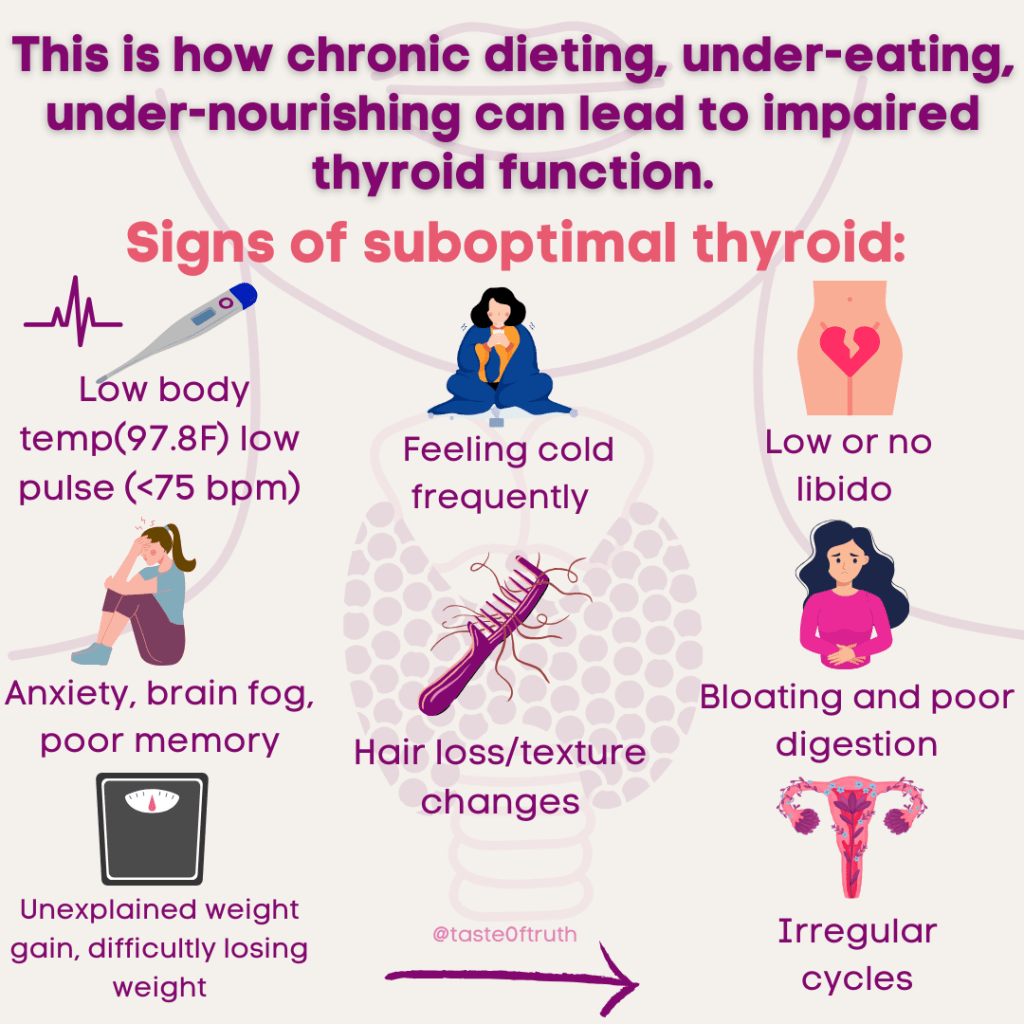
Symptoms of Suboptimal Thyroid Function
If your thyroid isn’t functioning optimally, you may notice some of the following symptoms:
Low body temperature (below 97.8°F)
Frequent feelings of cold, regardless of weather
Low or no libido
Anxiety, brain fog, or poor memory
Unexplained weight gain or difficulty losing weight
Bloating, poor digestion
Changes in hair texture or hair loss
Many clients experiencing these symptoms have been stuck in a calorie-deficit mindset for years, keeping their bodies in a constant state of stress. As a result, they’re often dealing with adrenal dysfunction, hypothyroidism, or even reproductive health issues, like extreme PMS, cycle loss, or low testosterone.
Restoring Your Thyroid Health—The First Steps
To begin improving thyroid health, our initial goal is to support both psychological and physiological balance, moving away from restrictive dieting and focusing on nourishment. Here’s a breakdown of the steps:
Stabilize Blood Sugar: Balanced blood sugar supports thyroid health and reduces stress on the body.
Maximize Nutrient Density: Prioritize whole, nutrient-rich foods to ensure your body receives adequate vitamins and minerals, especially selenium, zinc, and iodine, which are crucial for thyroid function.
Reduce Inflammation: Chronic inflammation can further stress the thyroid. Anti-inflammatory foods and lifestyle practices can help.
Incorporate Breathwork: Simple breathwork techniques can stimulate the vagus nerve, helping to regulate the HPA axis and reduce stress.
Avoid Dietary Triggers: Reduce foods that promote “leaky gut,” such as highly processed foods, sugar, and gluten, if sensitive. This protects your immune and thyroid health.
Manage Stress Proactively: Yoga, meditation, journaling, or spending time in nature can help keep cortisol in check.
Reduce Toxins and Pollutants: Environmental toxins can interfere with hormone health, so minimizing exposure can be a powerful step.
Prioritize Rest and Sleep: Quality sleep allows the body to recover and reset, which is essential for thyroid health.
The Bottom Line
Restrictive dieting isn’t the solution to a slow metabolism; it’s often the root cause. Chronic under-eating can lead to imbalances in your thyroid and adrenal glands, ultimately slowing down your metabolic rate and making it harder to achieve your fitness goals. Rebuilding a balanced, nourished body will not only help you feel better but will also lay the foundation for sustainable health.
This week, we’re talking all things thyroid health, and this post breaks down why breaking free from the dietary dogma of diet culture is crucial! Ever feel like your energy’s tanked, your minds in a fog, or your metabolism’s stuck in slow motion? 🧠✨ You’re not alone, and it could be your thyroid talking.
On this week’s Taste of Truth Tuesdays, we’re joined by Nicole, a holistic health advocate who’s here to shed light on how diet culture’s obsession with restriction can wreak havoc on your thyroid. From her own experience facing an autoimmune diagnosis to her advocacy for individualized nutrition, Nicole breaks down how restrictive dieting not only slows your metabolism but also impacts hormone balance, brain clarity, and overall well-being. Join us to learn how making friends with food (yes, even carbs!) might be the best way to support your thyroid and reclaim your energy.
Navigating the waters of community can feel like a tightrope walk, especially for those of us who’ve been through the storm of spiritual abuse. This week on Taste of Truth Tuesdays, I’m excited to welcome a guest who dives deep into the concept of “Group Mind”—the idea that a collective can elevate individual voices, creating a harmonious collaboration. While this concept sounds beautiful on the surface, having walked the line between healthy and toxic communities myself, I can’t help but question: What happens when “Group Mind” becomes a vessel for manipulation rather than a source of strength?
The Allure of Community
Let’s face it: we all crave connection. From childhood friendships to spiritual gatherings, our lives are woven into a fabric of social interactions. In healthy communities, each thread—each individual—contributes to the larger tapestry. Group Mind can be empowering when everyone contributes their unique strengths. Think of a brainstorming session, where different ideas build on each other to create something innovative. But in controlling groups, individuality is suppressed, and members are pressured to conform, stifling creativity and critical thinking.
The Double-Edged Sword of Group Mind
Our guest shares their experience in an improv class, where the idea of Group Mind became both a revelation and a source of anxiety. It’s fascinating how the language of community can feel welcoming yet be weaponized against those who seek authenticity. This mirrors the complexities of modern social dynamics, especially in the age of social media, where radicalization can happen at lightning speed.
In Episode 5 of my podcast, we tackled the “crunchy hippie to alt-right pipeline,” but now it’s time to shine a light on the radicalization of the left—a topic often overlooked. Why did I go from progressive circles to mingling with Trump supporters and Christians? This shift was marked by a range of events and trends reflecting broader changes within progressive movements and their impact on American politics and culture.
The Irony of the Deconstruction Space
As I navigated the deconstruction space, I noticed something ironic: when the deconstruction movement defines a cult and unintentionally describes their own playbook, the irony is hard to miss. Many who now identify as progressive or left leaning have simply swapped one form of fundamentalism for another. They may have shed their evangelical past, but the same dogmatic, ‘us vs. them’ tactics remain. It’s like they never fully untangled themselves from the rigid mindset they claim to oppose.
Social justice has become their new ‘End Times,’ and the tribalism is painfully obvious. Conformity, consequences for stepping out of line, leaders who set the narrative… sound familiar? 🙃
🔍 “It’s not your enemies, it’s the system.” We often fall into the trap of seeing our political landscape as a battle between two sides—one fighting for democracy, the other autocracy. But this binary thinking misses the larger issue: who really has power in shaping policies? Research, like the 2014 study by Gilens and Page, reveals that economic elites and organized interest groups wield far more influence over government decisions than the average citizen or voter. This isn’t about a single party; it’s about a systemic challenge that transcends partisan lines. 🧠
Instead of feeding into divisive narratives, maybe it’s time to ask: Who benefits from keeping us divided? 🤔 Progressive politics can impose control using a power/victim binary that’s reductive and lacks nuance, leveraging the fear of being labeled an oppressor as a tool for compliance. Reflecting on my journey of deconstruction and exploring progressive spaces, I’ve noticed a concerning trend: the lack of nuance and the prevalence of an ‘us vs. them’ mentality.
Even within progressive Christianity, there’s pressure to conform to certain social norms and ethical behaviors. Disagreement is often met with resistance, and group identity politics can dominate discussions. As I listened to a friend lecture me about the systems of whiteness and how white people are part of the problem, I couldn’t help but feel a visceral response in my body. Wasn’t she aware of how she was marginalizing voices that do not align with CRT principles and fostering division rather than unity?
It’s one thing to leave behind a belief system, but if you’re still using the same control tactics, are you really free? Or are you just in another form of groupthink? Many who now identify as progressive or left-leaning have simply swapped one form of radicalism for another.
In navigating my journey, I’ve discovered that while community can be a source of strength, it can also be stifling. Let’s strive for more open dialogue where diverse perspectives are valued.
“I have a dream that my four little children will one day live in a nation where they will not be judged by the color of their skin but by the content of their character.” — Martin Luther King Jr.
Seeking Authentic Community
This brings us back to the concept of Group Mind. While it has the potential to uplift and unite, we must critically assess the communities we choose to engage with. Are they empowering our individuality, or are they reinforcing a new set of dogmas?
As we explore these themes in this week’s podcast episode, I invite you to reflect on your own experiences with community—whether online or offline. Are you in a space that nurtures your authentic self, or have you found yourself caught in another web of control? Let’s challenge ourselves to seek genuine connections that celebrate our uniqueness, rather than merely conforming to the expectations of a collective.
Navigating Community Dynamics
One critical takeaway from my own experiences and the stories shared by others is the importance of asking ourselves the right questions. When evaluating any community—whether it’s a religious group, a social circle, or even an improv class—we should reflect on whether we’re being encouraged to grow into our full selves or if we’re being pressured to shrink into submission.
Key Questions to Consider:
Am I celebrated for my unique contributions, or do I feel like a cog in the machine?
Is my voice heard and valued, or am I met with silence (or worse) when I express dissent?
Does this community expand my horizons, or does it confine me to a narrow worldview?
The Importance of Individuality
One of the most powerful realizations is that a thriving community doesn’t demand the extinction of individualism; it nourishes it. Just as the author of the guest post observed in an improv competition, the true beauty of collaboration lies in the ability of individuals to bring their full selves to the table, enhancing the group dynamic rather than diminishing it.
In my journey, I’ve learned that safe communities are those that not only say, “Yes!” to your ideas but also invite you to share more, to dig deeper, and to embrace the weirdness that makes you unique. They celebrate individuality as an essential ingredient for collective success, transforming “Group Mind” from a potential source of control into a powerful tool for creativity and support.
The Path to Healing
For those of us recovering from spiritual abuse, the journey to find a healthy community can feel daunting. It requires us to sift through the rubble of past experiences, recognizing patterns that once suffocated our voices. But it also offers a chance for healing, a space where we can reclaim our identities and forge connections based on respect and authenticity.
Ultimately, the quest for community is about more than just belonging; it’s about finding spaces where we can be our true selves. It’s about navigating the complexities of connection with our eyes wide open, ready to discern the difference between a supportive group and one that seeks to control.
Conclusion
As we move through life, let’s remember that community can be a double-edged sword. For some of us, especially those healing from trauma or navigating complex PTSD, the journey may be best supported by solitary pursuits—like books, pets, and podcasts—before stepping into the vibrant chaos of group dynamics. We must be vigilant in recognizing when connection serves us and when it threatens to silence our individuality. Here’s to seeking out those communities that empower us, uplift us, and invite us to shine our light—together.
New Episode Alert: The Dark Side of MLMs and Coercive Control
🚨 This Week on Taste of Truth Tuesdays 🚨, we’re diving into the complex and manipulative world of multi-level marketing (MLM) companies—uncovering the coercive control tactics they use to keep people hooked. 🧠💸 MLMs don’t just sell products. They sell a dream—a dream of financial freedom, wealth, and unlimited success. The problem? That dream is often built on deceptive tactics that prey on vulnerability, foster magical thinking, and emotionally manipulate their members.
At first glance, MLMs seem like a golden opportunity. They promise wealth, freedom, and independence—targeting people who are seeking a way out of financial struggle or a traditional 9-to-5. But underneath those glittering promises are dangerous tactics that prey on human psychology, exploiting emotional weaknesses to create loyalty and blind devotion.
A key tactic MLMs use is magical thinking. This is the belief that positive thoughts and visualizations alone can bring success, wealth, or health. A 2019 study in Frontiers in Psychology revealed that many MLMs sell products—like supplements and essential oils—by making unverified claims about curing diseases, with little to no scientific evidence to back them up. 😳
Why Is Magical Thinking So Dangerous?
Magical thinking isn’t just harmless optimism. In the context of MLMs, it can lead people to make poor financial and health decisions. Here’s why it’s so dangerous:
🚫 False Sense of Control: Magical thinking tricks people into believing they can control outcomes simply by thinking positively. This false confidence can prevent them from taking real, actionable steps to improve their situation.
🚫 Health Risks: MLMs often push supplements and oils with promises of “miracle cures” for serious illnesses—without scientific validation. People may choose these products over actual medical treatments, putting their health in danger.
🚫 Emotional Manipulation: By convincing members that failure is due to their lack of belief or effort, MLMs shift the blame from the system to the individual. This creates a toxic cycle of guilt and shame, trapping people emotionally in the MLM.
Coercive Loyalty and Emotional Manipulation
Beyond magical thinking, MLMs use coercive control tactics to create a false sense of community and belonging. They foster an atmosphere of loyalty where members feel pressured to stay positive, constantly recruit new people, and never question the system.
💥 Coercive Loyalty: Members are often told that the reason they’re not successful is because they’re not trying hard enough, recruiting enough, or believing in themselves. This turns failure into a personal flaw, rather than a flaw in the business model.
💥 Community Pressure: MLMs thrive on social dynamics, where members are encouraged to pressure their friends and family into joining. This creates a network of dependency and makes it harder for people to leave, even when they start seeing the cracks in the system.
💥 Emotional Exploitation: Guilt, shame, and failure are powerful emotional tools used by MLMs. When people don’t succeed, they’re often made to feel as if they didn’t believe in the product or themselves enough. This emotional manipulation keeps members invested—financially, mentally, and emotionally—even when the odds are against them.
Breaking Free: Real Stories of Escaping MLMs
In this week’s episode, we also share real stories of individuals who have been trapped in MLMs and how they broke free. These stories highlight the emotional, financial, and mental toll that MLMs take on their members, and how difficult it can be to escape once you’re in the cycle. 😳
Why You Need to Listen
If you’ve ever been approached by someone pushing a “life-changing opportunity” or a “groundbreaking product,” this episode is for you. If you’ve been tempted to join an MLM—or know someone who has—this episode is essential listening. We’re unpacking the toxic blend of pseudoscience, community pressure, and emotional exploitation that keeps MLMs running, and sharing actionable tips on how to recognize the red flags before it’s too late. 🚩
Tune in to this week’s episode of Taste of Truth Tuesdays to learn how to protect yourself from the manipulative tactics of MLMs and avoid falling into their web of magical thinking and emotional control. Whether you’re considering joining an MLM or are currently involved, understanding these tactics is key to protecting your financial and emotional well-being.
Feeling stressed? 😩 Chronic stress can drain your energy, disrupt your sleep, and even increase the risk of serious health issues like cancer. This week on the podcast, we are diving deep into how stress impacts your body—and sharing real tips to fight back! 👊🏼 💥
In this powerful episode, I sit down with holistic healing expert Theresa Piela, @livingrootswellness to explore the deep connection between chronic stress and health. Theresa shares her personal story of hitting rock bottom in 2019, when chronic illness nearly led to organ failure. We dive into the guilt and exhaustion that comes with being chronically ill in a toxic world, and how healing techniques like Emotional Freedom Techniques (EFT) tapping can offer relief. 🌱✨
The Impact of Stress on the Body
Understanding Stress:Theresa breaks down the three stages of stress and how they manifest in our daily lives, leading to digestive issues and chronic illnesses. She sheds light on the silent havoc that prolonged stress wreaks on our gut health and overall bodily functions. Please review our earlier blog for more details!
Fuel & Nutrition: Supporting Your Body’s Adaptive Stress Response
Just as important as shifting your mindset is fueling your body with the right nutrients. A starved or inflamed system will struggle to adapt to stress, especially when trying to balance internal chaos. Proper nutrition is key to supporting the body’s stress response.
When the body isn’t fueled properly, persistent stress leads to harmful effects, such as blood sugar swings, hormonal dysregulation, and weakened immunity. To counteract this, we need to provide the body with the building blocks it needs to recover.
Here’s a high-level look at what your body requires for optimal function:
Proteins: Anti-inflammatory sources like grass-fed beef, broths, shellfish, and dairy.
Carbohydrates: Glucose and fructose from fruits, honey, maple syrup, and root vegetables.
Fats: Saturated fats are essential.
Vitamins & Minerals: Vitamin C, D, E, B1, B6, B12, calcium, magnesium, copper, sodium, potassium, selenium, and zinc.
I wanted to expand a BIT MORE on nutritional tips we may or may not have mentioned in this week’s discussion that are for sure helpful along your healing journey!
1️⃣Adrenal Elixirs-It’s a combination of sodium, potassium, and vitamin C—a perfect blend for your adrenals. Click here for recipes!
2️⃣Magnesium: During stressful times, your body burns through magnesium faster! Supplementing orally and using topical magnesium is helpful all the time, & increasing during times of stress can avoid future deficiency. Click here for a guide to Magnesium supplements!
3️⃣Boosting mineral-rich foods: Coconut water-rich in potassium. Potatoes, squash, fruit—also rich in potassium, Brewer’s yeast-rich in potassium, B vitamins, and many more nutrients (if you can handle the taste!) Cacao powder-rich in magnesium, Citrus & vitamin C rich foods-support adrenals and copper balance.
4️⃣Consistent timing for meals & snacks with proteins carbs and fats to help support blood sugar. Meal tips here!
5️⃣Prioritize Daily Routines with your non-negotiables like: Reading, meditation, walks, eating, movement, winding down time. Stay consistent! Research shows that it can take anywhere from 18 to 254 days for someone to form a new habit. Let’s talk more about morning and bedtime routines!
Morning Routine:
☀️ Morning person or not, having a set routine can be beneficial. First, a good morning starts the night before-am I right? Be sure to prioritize getting to bed at a decent time to support incorporating the new routine. ⏰ A great morning routine is the one that works for you. Not everyone will be able to have a lengthy routine due to time constraints or family obligations and that’s okay.
Here are some ideas:
Don’t pick up your phone right away: Scrolling Instagram and reading emails can wait. When you reach for your phone right after you wake up, you put yourself directly into reactive mode. This can cause you to lose focus and get stressed before you’ve even made it out of bed.
Making your bed takes about two minutes and it gives you a quick, easy sense of accomplishment right off the bat. Plus, it makes your room look neat and tidy even if the rest of your space is messy.
Eat Something Even if you’re not a big breakfast person, getting some nutrients in your body can really turn on your brain. Having a balanced meal can go a long way toward improving your mood and energy levels right off the bat. Whatever constitutes breakfast for you, just get some food into your body.
Do something for yourself each morning. Even if you just have five minutes, you can stretch, do a quick meditation, journal or work on a crossword puzzle while you drink your morning coffee. (Catching up on social media can also count as self care if this activity truly brings you joy. )
Write—or review—your daily to-do list and calendar Check over what’s on deck for the day so you don’t run into any surprises. You might even block off ten minutes or so to look over emails and address any messages that need to be taken care of right away. 📧
Bedtime Routine:
Sleep is consistently the most underrated aspect of any health & wellness journey. Creating & maintaining a bedtime routine is the best way to prioritize a good night’s sleep.
It’s best to be consistent with the time- set an alarm or notification on your phone. It will be a help signal that it’s time to unplug and start your bedtime routine.
The circadian rhythm regulates the body’s temperature, lowering the thermostat to 65 degrees is a good temperature for sleep. The body will adapt to the lower room temperature and you will begin to feel drowsy. Turning off or lowering bright lights can help with the process. As we know with screen time, exposure to bright lights before bedtime affects the circadian rhythm.
Screens from TVs, smartphones and laptops emit blue light that stimulates the body’s internal clock (circadian rhythm), keeping you buzzing long after it’s time to hibernate for the night. Sleep studies have shown that exposure to high amounts of blue light before bed can lower melatonin levels, resulting in sleeplessness and delayed REM sleep.
Journaling is good for mental health by reducing stress and helping you remember good ideas before sleep.
Using foam rolling and yoga for sleep will help relax your muscles and ground your mind before bed. They decelerate the mind and body, relieve tension and improve sleep quality.
Aromatherapy are used to help with stress management.
❔HOW LONG should my bedtime routine be? About 30 to 60 minutes. This will give you enough time to unwind without feeling rushed.
Okay back to the final aspect of today’s post for supporting your body during stressful times:
6️⃣TOXINS – Specific chemicals called halogens (bromine, chlorine, and fluorine) compete with iodine and bind to thyroid receptors, preventing thyroid hormones from working properly. Filtering fluoride and chloride out of your drinking and bath/shower water helps those with thyroid dysfunction. More Information here
Research says about 90% of cancers are a result of a lifetime of dysfunction: stress, poor nutrition, toxin exposure, chronic hormone imbalance etc. It is estimated that it takes up to 10 years for cancer to develop in the body. Every day our environment and personal choices provide information to cells, in a constant feedback loop. Research has shown us many factors that cause cancer cell development—we can use this information to optimize our environments, nutrition, hormones, etc, create a healthy terrain, and mitigate cancer risk. The body is always responding to us, and healing is possible! One of my favorite resources is here! Leigh Erin Connealy, M.D.
In summary
Addressing intestinal permeability, blood sugar imbalances, and other stress-induced dysfunctions through proper nutrition will help rebuild resilience. For those with severe gut issues, a nutrient-dense, elimination-style diet—like carnivore plus easy-to-digest carbs—may be necessary short-term to restore balance. In the end, listening to your body is critical. Experiment with what makes you feel good, trust yourself, and remember: you know best.
By shifting your mindset and supporting your body with proper fuel, you can navigate life’s stressors with resilience and strength.
🎙️ Tune in now to learn how to take control of your stress before it takes control of you!
Welcome back Wellness Warriors, and truth seekers!
As we have been discussing all of Season 2, Fundamentalist thinking doesn’t just reside in religious circles—it also permeates wellness and healing spaces. Just as high-control religions exploit human vulnerability, so does diet culture.
I’ve had my share of blindly following extreme health regimens recommended by practitioners, ignoring my own discomfort along the way. It became clear that fundamentalism can crop up in various aspects of life, and part of healing is about recognizing and addressing these tendencies within us.
We have discussed how high control religion and diet culture both capitalize on the brain’s tendency to interpret things in a binary black-and-white manner by presenting clear-cut rules, guidelines, and belief systems that simplify complex issues into easy-to-follow directives.
In this post, we’ll exploring deeper into how the brain’s craving for control and the dopamine boost it triggers can explain why people may transition into high-control environments or swing from one extreme to another. Such as moving from a loose, permissive belief system to a strict, rule-bound one, or from an unrestricted eating pattern to a rigid diet.
The Illusion of Control and Dopamine
The concept of the “illusion of control” ties deeply into our brain’s reward system, particularly through dopamine, a neurotransmitter crucial for motivation and learning. When individuals believe they have control over situations, even when that control is illusory, their brains can release dopamine. This release can provide a rewarding feeling, reinforcing the behavior or belief that leads to this sense of control.
The brain’s craving for control plays a crucial role in how individuals respond to structured systems, be it in religion, diet culture, or Multi-Level Marketing (MLM) schemes. When we encounter a belief system or set of teachings that offers clear, structured guidance, it triggers a sense of control, even if that control is illusory. This perceived control is neurologically rewarding because it leads to the release of dopamine, a neurotransmitter associated with motivation and the reinforcement of behaviors of control over one’s body and health, triggering dopamine release and creating a feedback loop that encourages continued adherence. Similarly, religious fundamentalism often offers clear-cut guidelines on how to live, providing the same sense of security and control, thus reinforcing the behavior.
This perspective not only sheds light on why people might gravitate towards fundamentalism or diet culture but also opens up a discussion on the broader implications of how our brains can be influenced by the promise of control, even when that control is more perceived than real.
What Causes the Illusion of Control
The illusion of control is driven by several factors and provides psychological benefits.
In health and wellness, people often adhere to strict diets or exercise routines, believing they control their weight or fitness, even though genetics and other factors also play a role. This illusion of control can be comforting and encourage adherence.
Similarly, in religion, individuals may follow rigid rules or rituals, thinking they control their spiritual outcomes or moral status, which provides a sense of security and boosts self-esteem.
When did the concept of the illusion of control originate?
The concept, first described by psychologist Ellen Langer in 1975, was initially seen as a way to maintain self-esteem by attributing success to oneself and distancing from failure. Recent research suggests it results from misjudged causality, where people’s sense of control is distorted by their actions rather than actual influence.
Fundamentalism and Structured Belief Systems
Fundamentalism, with its rigid doctrines and absolute truths, can offer a powerful sense of control, especially for those who have previously encountered ambiguity or lack of structure. These rules provide a clear framework for living, reducing the anxiety that comes with uncertainty, and delivering a dopamine-driven sense of reward that reinforces their commitment to the system. This appeal to control can be understood through several key aspects:
1. Structure and Certainty
Fundamentalism provides a clear and structured framework for understanding the world and one’s place within it. This structured approach often includes strict rules, definitive answers, and a well-defined moral code. For individuals who have experienced the fluidity and unpredictability of hyper-charismatic or New Age movements, the stability offered by fundamentalist systems can be particularly attractive.
In fundamentalist belief systems, every aspect of life is often governed by established doctrines. This comprehensive structure can reduce the anxiety associated with uncertainty and ambiguity, offering a predictable environment where individuals feel they know the correct course of action. This sense of predictability can be a significant source of comfort, as it replaces the confusion and complexity of previous experiences with clear-cut answers.
2. The Illusion of Control and Dopamine
The dopamine-driven reward system plays a crucial role in why fundamentalism is appealing. When individuals adhere to the strict rules and guidelines of fundamentalism, their brain releases dopamine, providing a sense of satisfaction and reinforcement. This dopamine release occurs because the rigid structure of fundamentalism offers a perceived sense of control over one’s life and environment.
This sense of control, even if illusory, can be neurologically rewarding. The anticipation and experience of control lead to the release of dopamine, which reinforces the behavior and belief that adherence to fundamentalist teachings is beneficial. Over time, this feedback loop strengthens individuals’ commitment to the belief system, as the dopamine-driven rewards make the structured environment feel more gratifying and secure.
3. Regaining a Sense of Agency
For those coming from less structured or more ambiguous belief systems, fundamentalism can represent a way to regain a sense of agency and direction. After experiencing a lack of clarity or guidance, individuals may find the definitive answers and rules provided by fundamentalism to be reassuring. The shift towards a more structured belief system can be seen as an effort to reassert control over one’s life and decisions.
Fundamentalism’s clear boundaries and absolute truths provide a stark contrast to the uncertainty that may have characterized previous experiences. This transition can be particularly appealing for individuals seeking to regain stability and predictability. The rigid nature of fundamentalism offers a form of control that feels tangible and dependable, even if it is ultimately based on a set of beliefs rather than empirical evidence.
4. Community and Belonging
Fundamentalist communities often emphasize conformity and collective adherence to their doctrines. This communal aspect can further reinforce the illusion of control by providing social validation and support. Being part of a group that shares the same rigid beliefs can enhance the sense of belonging and reinforce the perceived control individuals feel.
The social reinforcement within fundamentalist groups contributes to the illusion of control by making individuals feel supported and validated in their adherence to the teachings. This communal validation can strengthen their commitment to the belief system, as the positive feedback from the group further activates the brain’s reward system.
5. Cognitive Dissonance and Commitment
Once individuals have invested significant time and energy into a fundamentalist belief system, cognitive dissonance can make it challenging to question or abandon their beliefs. The discrepancy between their initial expectations and any potential contradictions or failures within the system can lead them to double down on their commitment.
The illusion of control provided by fundamentalism makes it psychologically difficult to admit that the system may not offer the promised stability or certainty. This cognitive dissonance drives individuals to reinforce their adherence to the system, as admitting any flaws would undermine the very control and certainty they sought to obtain.
The Illusion of Control in Multi-Level Marketing (MLM) Schemes
Similarly to fundamentalist belief systems, MLMs leverage the illusion of control by presenting themselves as opportunities for individuals to take charge of their own success. Participants are led to believe that their efforts directly determine their earnings and advancement within the company. This illusion can be highly appealing, giving people a sense that their hard work and decisions will lead to tangible rewards.
The prospect of achieving success and the belief that one’s actions are under their control can trigger dopamine release in the brain. When individuals see small successes or receive positive feedback, it reinforces their belief in their ability to control their destiny, making them more likely to continue participating despite setbacks.
MLMs often provide structured guidelines, training, and motivational materials that create a sense of control. Participants are given specific strategies to follow, which can make them feel like they have a roadmap to success. This structure reinforces the illusion that they are in control of their outcomes, even when success largely depends on recruitment and team performance.
MLMs frequently emphasize personal responsibility and self-improvement. They promote the idea that success is a result of individual effort and perseverance, subtly shifting blame for any failures onto the individual rather than the system itself. This reinforces the illusion of control by making participants believe that if they follow the system closely enough, they will succeed.
The social aspect of MLMs, including group meetings, motivational events, and social media communities, can amplify the illusion of control. Participants often see others achieving success and feel motivated by their peers, which can strengthen their belief in their own ability to control their outcomes.
Once individuals have invested time, money, and effort into an MLM, the illusion of control can make it difficult for them to step away. The cognitive dissonance created by the gap between their expectations and reality can lead them to double down on their commitment, further reinforcing their belief in their control over their situation.
The Role of Power in the Illusion of Control
Powerful individuals—including CEOs, politicians, religious leaders, and MLM leaders—often overestimate their control over events beyond their expertise. This inflated sense of control can lead to hubris, risky decisions, and an all-or-nothing approach. For example, a wellness guru who believes they can control all aspects of health through strict regimens may push extreme diets or unproven supplements, driven by the illusion of control. Similarly, a religious leader might impose rigid doctrines, believing they can control or influence every aspect of followers’ lives. This overconfidence and all-or-nothing mindset can result in extreme actions and decisions, as seen when individuals adopt overly restrictive health practices or dogmatic religious rules, ultimately leading them to lose touch with reality.
Appeal to Vulnerable Groups
Studies suggest that no one is immune to the illusion of control—under certain circumstances. Research shows that those who are personally involved in actions are among those most likely to overestimate their influence on the outcome. In addition, the behavior of pathological gamblers is driven by the belief that they can beat the odds of what is demonstrably determined purely by chance.
There are people known to be at low risk of susceptibility to illusory control: those who are depressed. Numerous studies show that depressed people are virtually invulnerable to the illusion of control. They have been found to have less distorted views than the non-depressed across a wide array of perceptions and judgments‑a state of mind that has been labeled depressive realism. They are more likely to see the futility of taking action to influence outcomes. When vulnerable individuals meet a group that offers definitive answers provides the certainty and structure these individuals crave, making them more likely to adopt and adhere to the teachings.
Effects of the Illusion of Control
A sense of control is an adaptive trait linked to better health outcomes, including reduced risk of mortality and diseases, improved physical and cognitive function, and higher life satisfaction. It promotes positive behaviors like exercise and good sleep and enhances optimism and a sense of purpose.
However, the illusion of control can also lead to magical thinking, poor decision-making, and risky behaviors such as gambling, as it may encourage unrealistic beliefs and prevent thorough analysis of situations.
In Summary
Reflect on how the illusion of control might be influencing their own choices and beliefs. Consider whether a sense of control is driving your decisions in areas like health, religion, or business ventures. Understanding this psychological mechanism can empower you to make more informed choices and break free from patterns that may not truly serve your well-being. Share your thoughts and experiences in the comments or join the conversation on our social media channels to explore these ideas further.
Plus, join us this week on the podcast, as we talk with @mburtwrites a talented author and advocate in children’s literature, about faith, parenting styles, and mental wellness. Share your thoughts or join the conversation—let’s explore the impact of the illusion of control together! 💭
🎧here
RESOURCES:
Books:
“The Illusion of Control: Why We Overestimate Our Ability to Control Events” by Ellen J. Langer
A foundational text by the psychologist who first described the illusion of control.
“Thinking, Fast and Slow” by Daniel Kahneman
This book delves into various cognitive biases and heuristics, including the illusion of control.
“The Power of Habit: Why We Do What We Do in Life and Business” by Charles Duhigg
Explores how habits form and the role of dopamine in reinforcing behaviors.
“The Dopamine Diet: The Complete Guide to Lose Weight, Boost Your Energy, and Live a Happier Life by Rebalancing Your Brain Chemistry” by Neil W. Dhingra
Focuses on how diet impacts dopamine levels and overall well-being.
Articles and Papers:
“Illusion of Control” | Psychology Today
An overview of the illusion of control and its psychological underpinnings. Read here
“The Truth About Dopamine and Your Brain” | Psychology Today
Explains dopamine’s role in motivation and reinforcement. Read here
“Biology of Motivation, Dopamine, and Brain Circuits That Mediate Pleasure” | SpringerLink
A scientific paper detailing dopamine’s role in motivation and reward. Read here
“The Illusion of Control in the Financial Markets” by E. J. Langer
Examines how the illusion of control affects decision-making in financial contexts. Read here
Online Resources:
TED Talks
Search for TED Talks on cognitive biases and the role of dopamine for accessible explanations and examples.
Coursera and edX
Look for courses on psychology, neuroscience, and behavioral economics that cover these topics in depth.
YouTube Channels
Channels like CrashCourse and Khan Academy often have videos on psychology and neuroscience that touch on related concepts.
These resources should provide a comprehensive understanding of how the illusion of control and dopamine influence behavior across different contexts.
Navigating the Intersection of Wellness and Ideology
Have you noticed this social trend New Age lifestyles to Jesus testimonies embracing far-right ideologies?
It’s a phenomenon influenced by social media algorithms and influencers who blend wellness with conspiracy theories and extreme views. What starts as an interest in yoga and herbal remedies can subtly transition into something much darker.
Understanding the Trad Wife and Stay-at-Home Girlfriend Movements
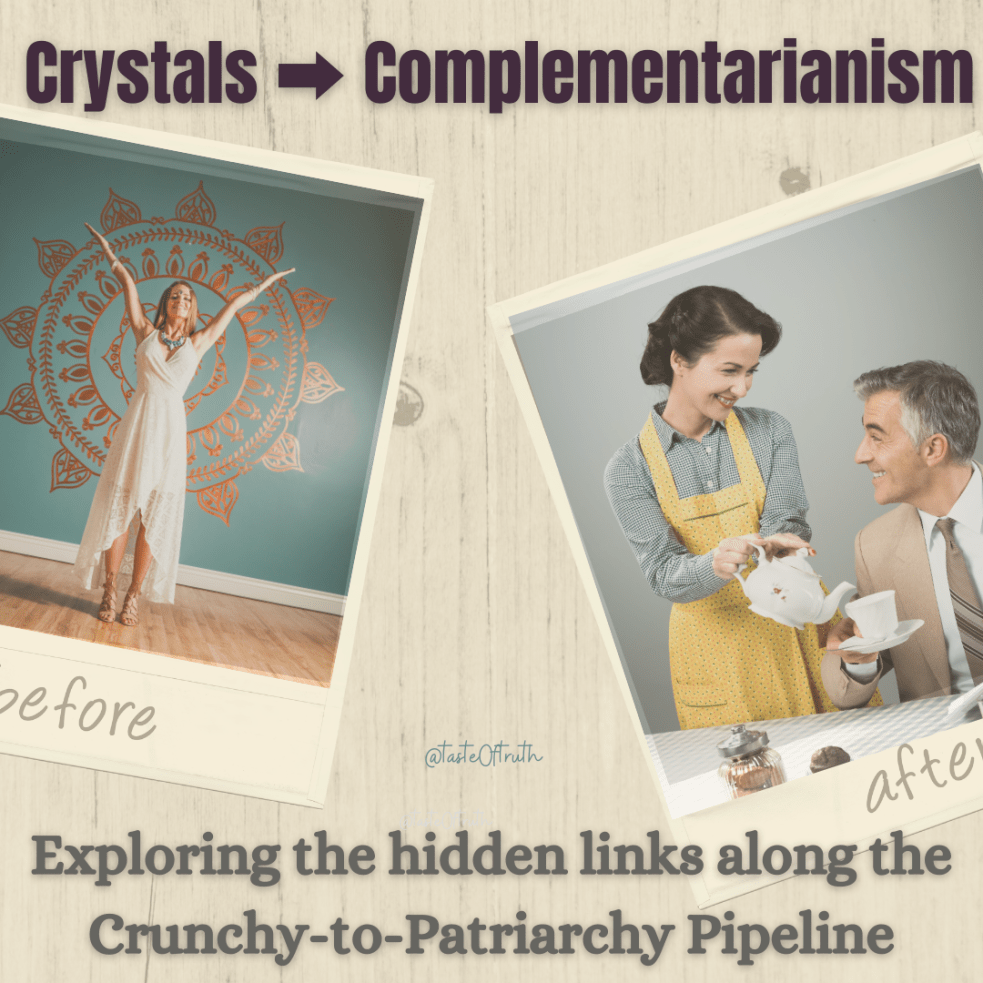
Enter the Trad Wife and Stay-at-Home Girlfriend movements—cultural trends advocating for traditional gender roles within relationships. Followers prioritize homemaking, submission to husbands, and nurturing domestic skills. This intersects with the Crunchy to Alt-Right Pipeline when online narratives blend wellness with conservative ideologies, portraying traditional roles as spiritual ideals.
Motivations Behind the Movements
Embracing Traditional Values: Supporters cite a desire to uphold stability and traditional family roles, believing in the importance of creating a nurturing home environment and supporting their partners as leaders of the household.
Rejecting Modern Feminism: Many within these movements view modern feminism as promoting anti-family agendas and undermining traditional values, preferring roles they see as empowering and fulfilling.
Cultural and Religious Influences: Cultural and religious beliefs play a significant role, with some viewing traditional roles as rooted in religious teachings or cultural heritage, finding validation in communities that promote these values.
Understanding Fear Tactics and Cultural Influences
Fear tactics are prevalent in online content that combines wellness with extreme ideologies. These tactics manipulate users into adopting the group’s beliefs by promoting fear of worldly dangers, apocalyptic scenarios, or spiritual consequences. For example, narratives within the “culture wars” often lead to anti-LGBTQ and anti-feminist sentiments. Influencers may use fear of societal collapse or moral decay to urge followers towards conservative values, portraying them as a defense against perceived threats to traditional lifestyles.
Historical Precedents: Satanic Panic and Moral Panics
Historically, movements like the “Satanic Panic” in the 1980s and ’90s stoked fears of occult influences on children and communities, leading to widespread moral panic. Similarly, today’s online narratives can exaggerate or fabricate threats to bolster ideological adherence. The fear of cultural shifts, such as evolving attitudes towards gender roles or LGBTQ rights, fuels narratives that paint progressive changes as morally corrupt or spiritually dangerous.
Example: Evangelical Fears and Pop Culture In recent years, evangelical communities have expressed fears over pop culture icons like Taylor Swift, attributing spiritual significance to her lyrics and persona. This illustrates how fear can be used to mobilize against perceived threats to traditional values, even in seemingly innocuous contexts.
Examples:
Harry Potter and Witchcraft: The “Harry Potter” book and film series sparked concerns among some evangelical groups who viewed the portrayal of magic and witchcraft as promoting occult practices and undermining Christian values. This led to debates and even bans on the series in some communities.
Rock and Roll Music: Throughout history, evangelical circles have expressed fears over the influence of rock and roll music on youth, believing it promotes rebellion, promiscuity, and anti-Christian values. This fear was particularly pronounced during the rise of rock music in the 1950s and continues in various forms today.
Secularization of Media: Evangelical fears often extend to broader secular media, with concerns over its perceived influence on moral values and religious beliefs. For instance, certain movies, TV shows, and music artists are scrutinized for their content and perceived impact on cultural norms.
Celebrity Influence: Pop culture icons like Taylor Swift, Lady Gaga, or Madonna have been subjects of evangelical concern due to their lyrics, imagery, or public personas, which some interpret as promoting values contrary to traditional Christian teachings. These concerns reflect broader anxieties about the influence of celebrity culture on moral standards.
Navigating Complexity
While these movements resonate with some as empowering choices, they also perpetuate outdated stereotypes and limit opportunities for autonomy and self-fulfillment outside traditional roles. Some narratives oversimplify complex societal issues, promoting a binary worldview of good versus evil and omitting nuances and alternative perspectives. It’s essential to critically evaluate such content and consider its broader implications on personal beliefs and societal attitudes.
Understanding the motivations and concerns behind these movements fosters dialogue about gender, family, and cultural norms in contemporary society.
Let’s discuss: Have you observed or encountered these dynamics in your online experiences? What are your thoughts on their impact on societal norms?
Over the last few weeks, we have been exploring the complex interplay between radicalization, conspiracies and religion. During the pandemic, I was one of those new-age rebels that was pumped into conspiracy and conversion to religion pipeline. I was one of those people seeking answers and meaning that was drawn to radical ideologies and conspiratorial narratives that promised belonging, purpose, and empowerment.
A huge aspect of my deconstruction process is realizing how I’ve been susceptible and caught up in cult-like dynamics for most of my adult life. I spent years entangled in an MLM (2016-2020), which only worsened my dis0rded eat1ng behaviors from high school. These products often promoting unrealistic body standards and fostering unhealthy relationships with food. Feeling lost without that community, I was drawn into pandem1c conspiracies and eventually into high-control religion.
The “crunchy hippie to alt-right pipeline” is a phenomenon where individuals initially attracted to alternative wellness and New Age practices become increasingly exposed to far-right ideologies.
This shift is facilitated by social media algorithms and influential figures who blend wellness content with conspiracy theories and extremist views. This shift is facilitated by social media algorithms and influential figures who blend wellness content with conspiracy theories and extremist views.
Key Points of the Pipeline:
Algorithmic Influence:
Social media platforms like YouTube and Instagram use algorithms that can gradually expose users to more extreme content. For instance, someone watching videos on natural health remedies might eventually receive recommendations for videos that include far-right conspiracy theories or anti-establishment rhetoric (Virginia Review of Politics).
Overlapping Values:
Certain aspects of New Age and wellness cultures, such as skepticism of mainstream medicine and government, overlap with the distrust and anti-establishment sentiments of far-right groups. This makes the transition smoother as the ideologies can appear to support each other (Cross Cultural Solidarity).
Influential Figures:
Wellness influencers who propagate conspiracy theories (like QAnon) help bridge the gap between New Age communities and far-right ideologies. They often present themselves as offering alternative truths, which can be appealing to those already disillusioned with conventional systems (Cross Cultural Solidarity).
Community Dynamics:
Online communities play a crucial role. Individuals often seek validation and a sense of belonging in these groups. Once part of a community that blends wellness with far-right views, it becomes easier to accept and internalize these extremist ideologies (Virginia Review of Politics) (Cross Cultural Solidarity).
Implications:
Radicalization: This pipeline can lead to the radicalization of individuals who initially joined wellness communities for benign reasons but gradually adopt extremist views.
Polarization: The spread of far-right ideologies within wellness spaces contributes to societal polarization and the mainstreaming of conspiracy theories.
Public Health Concerns:
Misinformation and Hesitancy towards “BigPharma” Social media platforms have been conduits for the dissemination of misinformation regarding 💉, leading to hesitancy. False claims about safety and conspiracy theories have undermined public health efforts.
Addressing these public health concerns requires a multi-faceted approach that includes combating misinformation, improving mental health services, addressing healthcare inequities, ensuring continuity of chronic disease management, strengthening public health infrastructure, and promoting evidence-based health practices. Public awareness and education, policy reforms, and community engagement are essential in tackling these challenges and improving overall public health outcomes
Conclusion:
Understanding this pipeline is essential for recognizing how seemingly unrelated interests in wellness and spirituality can be co-opted by extremist ideologies. It highlights the need for vigilance and critical thinking in online spaces, as well as the importance of promoting credible information and fostering inclusive communities. For more detailed discussions on this topic, you can refer to articles from sources like the Virginia Review of Politics and Cross Cultural Solidarity (Virginia Review of Politics) (Cross Cultural Solidarity).
Welcome back to Taste0ftruth Tuesdays Wellness Warriors and truth seekers!
Listen here 🎧
Fundamentalist thinking doesn’t just reside in religious circles—it also permeates wellness and healing spaces. Just as high-control religions exploit human vulnerability, so does diet culture.
I’ve had my share of blindly following extreme health regimens recommended by practitioners, ignoring my own discomfort along the way. It became clear that fundamentalism can crop up in various aspects of life, and part of healing is about recognizing and addressing these tendencies within us.
High control religion and diet culture both capitalize on the brain’s tendency to interpret things in a binary black-and-white manner by presenting clear-cut rules, guidelines, and belief systems that simplify complex issues into easy-to-follow directives.
Clear Rules and Regulations:
High Control Religion: Provides rigid doctrines, moral codes, and commandments that delineate right from wrong, good from evil, and righteous from sinful.
Diet Culture: Promotes strict dietary regimes, cleanses, and “good” vs. “bad” foods, categorizing eating behaviors as virtuous or detrimental.
In both of these contexts, this black-and-white thinking oversimplifies complex issues related to spirituality and health, offering a sense of clarity and control in exchange for individual autonomy and critical thinking.
I used to be fixated on healing, always chasing the next fix. When I later dove into a high-control religion, this perpetual quest for self-improvement morphed into the religious ritual of sanctification—an equally exhausting endeavor.
Healing should be about presence, connection, and truly living—not an endless pursuit of perfection.
Have you noticed this shift in your own or others’ healing journeys?
Here are some examples of fundamentalist thinking and behaviors found in both high-control religions and wellness/healing spaces:
Aspect
High-Control Religion
Wellness Spaces
Strict Rules and Regulations
Rigid doctrines and moral codes with severe consequences
Strict dietary regimes or detox plans with inflexible guidelines, labeling deviations as harmful or sinful
Authority Figures
Centralized figures with unquestionable teachings
Gurus or practitioners whose advice is taken as absolute truth
Us vs. Them Mentality
Clear divisions between the “righteous” and “sinful” outsiders
Labeling foods, behaviors, or people as “clean” or “toxic,” fostering an in-group/out-group mentality
Fear-Based Tactics
Fear of damnation or punishment to maintain control
Instilling fear of illness or toxins to enforce adherence to wellness practices
Exclusive Truth Claims
Belief that their interpretation of faith is the only truth
Claiming their diet or lifestyle is the only path to true health and well-being
Shame and Guilt
Using shame and guilt to enforce compliance
Shaming individuals for not adhering to specific diets or wellness protocols
Community Pressure
Intense pressure to conform within the community
Social pressure to adhere to specific wellness practices, with fear of ostracism for non-compliance
Promised Rewards
Promises of spiritual rewards or salvation for adherence
Promises of optimal health or purity through strict adherence to wellness practices
Fundamentalist thinking and behaviors found in both
Seeking Clarity during Stress
Gravitating towards fundamentalism after experiencing hyper-charismatic or new age movements can seem understandable. The strict rules and structure provide a perceived sense of safety. Particularly during times of stress and uncertainty, we can gravitate towards the need for a sense of control & structure. However, this rigidity and extreme control often lead to increased trauma over time.
As I deconstruct from the Christian faith, I am re-evaluating beliefs, questioning long-held doctrines, and confronting the challenges faced within spiritually abusive environments.
Fundamentalism’s rigid adherence to traditional beliefs and practices can create significant challenges, fostering environments that can stifle personal freedom, promote division, and sometimes lead to conflict and violence. We also see intolerance towards individuals or groups who hold different beliefs or lifestyles, leading to discrimination, ostracism, or even violence towards perceived “outsiders” or “heretics.”
This is due to the dogmatism, this fundamentalist ideology tends to promote rigid, inflexible interpretations of religious or ideological principles, discouraging questioning or exploration of ANY alternative viewpoints.
Fundamentalists are often resistant to change and innovation within religious doctrine or practice, viewing such developments as departures from true faith.
I recently shared a post on Instagram, reflecting on my journey of deconstruction and exploring progressive spaces, I’ve noticed a concerning trend: the lack of nuance and the prevalence of an ‘us vs. them’ mentality.
Even within progressive Christianity, there’s pressure to conform to certain social norms and ethical behaviors. Disagreement is often met with resistance, and group identity politics can dominate discussions.
Understanding these parallels helps us recognize and challenge fundamentalist thinking in all areas of life, promoting a more balanced and critical approach to wellness and healing, and JUST EXISTING!
Let’s move away from the dualistic thinking and judgment that these ideologies promote, and instead, embrace a more holistic and compassionate path forward.
That’s all I have for you today folks! Thanks again for listening/reading. Next week, we will continue the conversation breaking from Diet Culture and for future episodes:
•Dr. Mark Gregory Karris, author of The Diabiological Trinity Healing Religious Trauma from a Wrathful God, Tormenting Hell & a Sinful Self, Religious Refugees: (De)Constructing Toward Spiritual and Emotional Healing and more •@neilyvanneily is a philosopher and cognitive scientist known for his work in the intersection of religion, cognition, and culture. He holds a Ph.D. in philosophy from Princeton University. We will be discussing his new book- “Religion as Make-Believe,” which offers a thought-provoking analysis of the nature of religious belief and its role in human societies.
•@mburtwrites To discuss Biblical Counseling & a little bit of the evolution of Christian parenting, along with Kelsey McGinnis, they offer a comprehensive exploration of the historical, cultural, ideological, political, and social factors that have influenced Christian parenting over time.
@carielmoore to discuss Franciscan theology: which focuses on simplicity, poverty, and love for all. Inspired by Saint Francis, it’s about imitating Christ and caring for the marginalized. 🌿 she also explores parenting through the lens of spirituality, theology, and childhood liberation ✨
and MORE! Until then, maintain your curiosity, embrace skepticism, and keep tuning in! 🎙️🔒
Have a great week!
🙏 Please help this podcast reach a larger audience in hope to encourage others! To do so: leave a 5⭐️ review and send it to a friend! Thank you for listening! I’d love to hear from you, find me on Instagram! @taste0ftruth or Pinterest!






 Taste0ftruth Tuesdays