The MLM Illusion: Selling a Dream or a Trap?

New Episode Alert: The Dark Side of MLMs and Coercive Control

🚨 This Week on Taste of Truth Tuesdays 🚨, we’re diving into the complex and manipulative world of multi-level marketing (MLM) companies—uncovering the coercive control tactics they use to keep people hooked. 🧠💸 MLMs don’t just sell products. They sell a dream—a dream of financial freedom, wealth, and unlimited success. The problem? That dream is often built on deceptive tactics that prey on vulnerability, foster magical thinking, and emotionally manipulate their members.

At first glance, MLMs seem like a golden opportunity. They promise wealth, freedom, and independence—targeting people who are seeking a way out of financial struggle or a traditional 9-to-5. But underneath those glittering promises are dangerous tactics that prey on human psychology, exploiting emotional weaknesses to create loyalty and blind devotion.

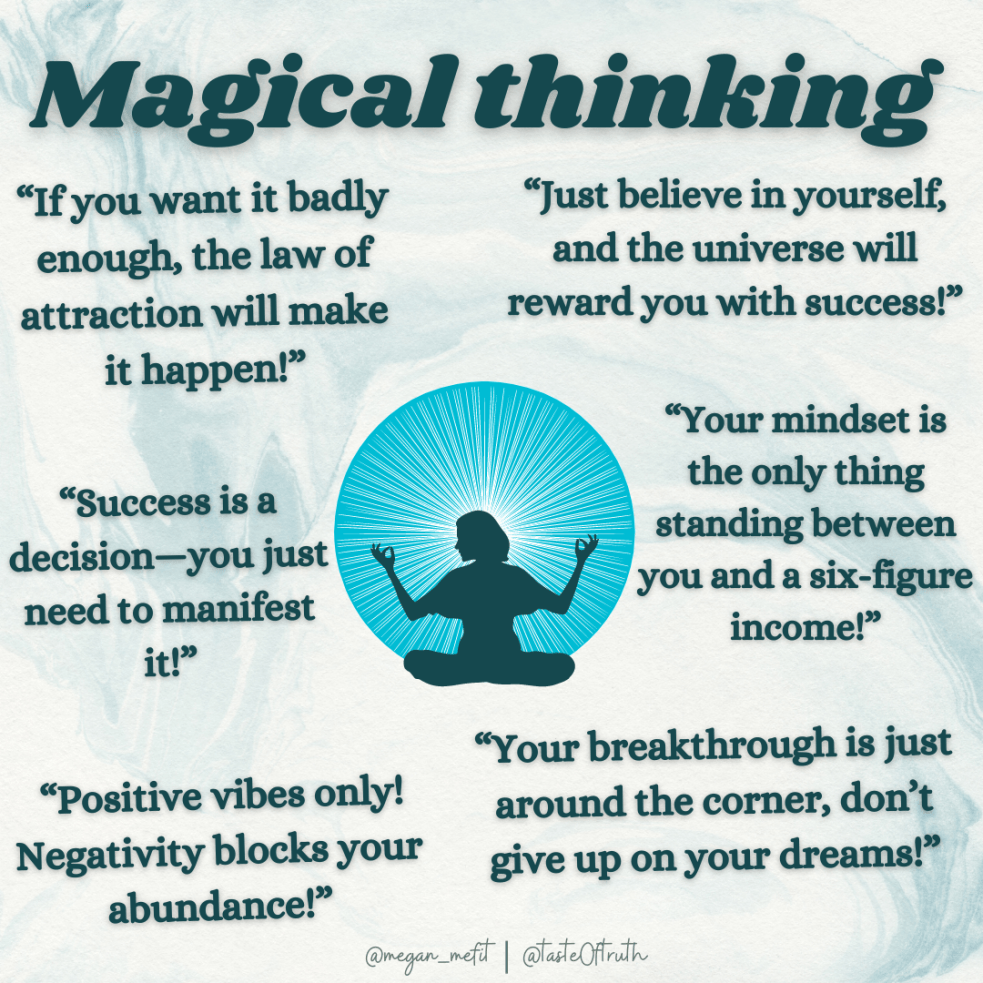
A key tactic MLMs use is magical thinking. This is the belief that positive thoughts and visualizations alone can bring success, wealth, or health. A 2019 study in Frontiers in Psychology revealed that many MLMs sell products—like supplements and essential oils—by making unverified claims about curing diseases, with little to no scientific evidence to back them up. 😳

Why Is Magical Thinking So Dangerous?

Magical thinking isn’t just harmless optimism. In the context of MLMs, it can lead people to make poor financial and health decisions. Here’s why it’s so dangerous:

🚫 False Sense of Control: Magical thinking tricks people into believing they can control outcomes simply by thinking positively. This false confidence can prevent them from taking real, actionable steps to improve their situation.

🚫 Health Risks: MLMs often push supplements and oils with promises of “miracle cures” for serious illnesses—without scientific validation. People may choose these products over actual medical treatments, putting their health in danger.

🚫 Emotional Manipulation: By convincing members that failure is due to their lack of belief or effort, MLMs shift the blame from the system to the individual. This creates a toxic cycle of guilt and shame, trapping people emotionally in the MLM.

Coercive Loyalty and Emotional Manipulation

Beyond magical thinking, MLMs use coercive control tactics to create a false sense of community and belonging. They foster an atmosphere of loyalty where members feel pressured to stay positive, constantly recruit new people, and never question the system.

💥 Coercive Loyalty: Members are often told that the reason they’re not successful is because they’re not trying hard enough, recruiting enough, or believing in themselves. This turns failure into a personal flaw, rather than a flaw in the business model.

💥 Community Pressure: MLMs thrive on social dynamics, where members are encouraged to pressure their friends and family into joining. This creates a network of dependency and makes it harder for people to leave, even when they start seeing the cracks in the system.

💥 Emotional Exploitation: Guilt, shame, and failure are powerful emotional tools used by MLMs. When people don’t succeed, they’re often made to feel as if they didn’t believe in the product or themselves enough. This emotional manipulation keeps members invested—financially, mentally, and emotionally—even when the odds are against them.

Breaking Free: Real Stories of Escaping MLMs

In this week’s episode, we also share real stories of individuals who have been trapped in MLMs and how they broke free. These stories highlight the emotional, financial, and mental toll that MLMs take on their members, and how difficult it can be to escape once you’re in the cycle. 😳

Why You Need to Listen

If you’ve ever been approached by someone pushing a “life-changing opportunity” or a “groundbreaking product,” this episode is for you. If you’ve been tempted to join an MLM—or know someone who has—this episode is essential listening. We’re unpacking the toxic blend of pseudoscience, community pressure, and emotional exploitation that keeps MLMs running, and sharing actionable tips on how to recognize the red flags before it’s too late. 🚩

Tune in to this week’s episode of Taste of Truth Tuesdays to learn how to protect yourself from the manipulative tactics of MLMs and avoid falling into their web of magical thinking and emotional control. Whether you’re considering joining an MLM or are currently involved, understanding these tactics is key to protecting your financial and emotional well-being.


🎧 Listen to the full episode now—


#MLMAwareness #MagicalThinking #CoerciveControl #PodcastAlert #HealthOverHype #EmotionalManipulation #CriticalThinking #MultiLevelMarketing #BreakFreeFromMLMs

Why MLMs Exploit Magical Thinking

Magical thinking is often presented as something harmless, quirky, or even empowering: believe hard enough, visualize the outcome, raise your vibration, and somehow reality will reorganize itself around your desires.

The right thoughts will attract the right life.
The right energy will attract money.
The right mindset will make the business work.
And if it still isn’t working? Well, apparently you need to believe harder.

This is where magical thinking stops being an innocent coping mechanism and becomes something far more manipulative.

There is nothing inherently wrong with imagination, hope, ritual, goal-setting, or trying to orient your mind toward possibility. The problem begins when thoughts are treated as though they possess direct causal power over circumstances—and when that belief is used to excuse exploitative systems, deny material reality, and blame people for outcomes they cannot fully control.

Multi-level marketing companies thrive inside this framework.

They rarely sell only skincare, supplements, leggings, essential oils, or some mysterious powdered substance promising to fix your hormones. They sell a total worldview: success is available to anyone, financial freedom is right around the corner, and your mindset is the only meaningful obstacle standing between you and the life you deserve.

It sounds liberating.

In practice, it becomes a remarkably effective form of narrative control.

The Manifestation-to-MLM Pipeline

Manifestation culture and MLM culture speak remarkably similar languages.

Both frequently suggest that your external circumstances are a reflection of your internal state. Wealth signals alignment. Success proves belief. Failure reveals fear, negativity, laziness, or some hidden subconscious block.

Within this worldview, structural explanations disappear.

The compensation plan is not the problem. Market saturation is not the problem. Recruitment-based growth is not the problem. The cost of inventory, conferences, subscriptions, samples, coaching, and social-media advertising is not the problem.

You are the problem.

You did not show up consistently enough.
You entertained doubt.
You listened to “negative people.”
You failed to embody your future self.
You did not want it badly enough.

This is one of the reasons magical thinking is so useful to high-pressure groups: it turns legitimate criticism into evidence of personal or spiritual deficiency.

The system never has to prove itself because its members are taught to endlessly prove themselves to the system.

Why Magical Thinking Becomes Dangerous

1. It Creates a False Sense of Control

Magical thinking offers certainty in an uncertain world. That is part of its appeal.

It tells people that they can control outcomes through the correct combination of intention, visualization, emotional regulation, disciplined optimism, and personal belief. In an MLM, that message becomes attached to a business opportunity: anyone can succeed as long as they follow the system and maintain the right mindset.

But real outcomes are shaped by countless factors: timing, money, health, geography, existing social networks, market conditions, family responsibilities, luck, and the structure of the business itself.

A person can work hard and still fail inside a bad system.

That truth is uncomfortable, especially for companies that need a constant stream of hopeful recruits. It is much more convenient to teach people that their thoughts determine their results.

The illusion of total control can actually make people less capable of evaluating reality. Instead of asking whether the opportunity is financially sound, they are taught to examine whether they have been sufficiently positive.

2. It Keeps People Spending Money

MLMs routinely frame additional spending as an investment in your future identity.

Buy the starter kit.
Purchase enough inventory to qualify for the next rank.
Attend the conference.
Pay for the leadership retreat.
Subscribe to the training platform.
Order samples for potential customers.
Invest in yourself.

And because magical thinking encourages people to interpret persistence as proof of faith, each new expense can feel like the final energetic or financial commitment required before the breakthrough arrives.

Success is always one more month away.

One more recruit.
One more product launch.
One more mindset shift.
One more payment on the credit card.

The vast majority of MLM participants do not earn a meaningful profit after expenses are considered. But individual success stories are repeatedly elevated as proof that the opportunity works for anyone.

The person at the top of the pyramid becomes a living vision board.

Her house, vacations, body, marriage, car, and carefully curated morning routine are presented as evidence of what is available to everyone—provided they remain loyal enough to the process.

3. It Spiritualizes Shame

This may be the most psychologically damaging part of the entire system.

When success is attributed to mindset, failure becomes a moral judgment.

You were too negative.
You doubted the process.
You allowed fear to win.
You did not protect your energy.
You lacked discipline.
You secretly did not believe you deserved success.

Instead of recognizing that they were recruited into an unsustainable model, people begin searching themselves for defects.

They feel ashamed of their bank account, embarrassed by their lack of progress, and guilty for disappointing the person who recruited them. They may hide losses from their spouse, distance themselves from skeptical friends, and become even more dependent on the MLM community for reassurance.

The emotional burden is transferred entirely onto the individual while the company remains untouched.

This is authority without accountability: the system claims the right to interpret your life, demand your loyalty, and define your failures, while accepting no responsibility for the harm it causes.

4. It Encourages Detachment from Reality

“Protecting your mindset” can sound like healthy emotional hygiene. Inside a high-control environment, however, it often means avoiding information that might interrupt belief.

Critical articles are dismissed as negativity. Former members are called bitter. Concerned family members are accused of having a scarcity mindset. Financial evidence is treated as less meaningful than testimonials, intuition, or the leader’s personal story.

Members may be encouraged to behave as though their desired reality already exists—even while debt increases, relationships fracture, and emotional exhaustion sets in.

This is not optimism. It is spiritual escapism.

Reality becomes something to override rather than something to examine.

And when acknowledging the truth threatens your identity, friendships, income fantasy, and sense of belonging all at once, leaving becomes much harder than simply quitting a side business.

Why MLMs Depend on Magical Thinking

It Produces Loyalty

MLMs create communities organized around shared belief.

Members are given a new vocabulary, a new vision for their future, new mentors, new rituals, and sometimes an entirely new social circle. Group calls, conventions, recognition ceremonies, rank advancements, and motivational speeches reinforce the feeling that participants are part of something larger than themselves.

The group is not merely selling products. It is changing lives.

Once that identity takes hold, criticism can feel deeply personal. Questioning the company becomes indistinguishable from questioning the friendships, dreams, and transformation attached to it.

Leaving may mean admitting financial loss, disappointing an upline, and losing an entire community.

This is why “just walk away” is rarely as simple as it sounds.

It Protects the Business Model from Criticism

Magical thinking provides an almost perfect shield against accountability.

When someone succeeds, the system gets the credit.

When someone fails, the individual gets the blame.

Success proves the opportunity works. Failure proves the participant did not work it correctly.

This makes the central claim effectively unfalsifiable. No amount of personal loss can disprove the system because loss itself is reinterpreted as evidence that the person lacked belief, effort, consistency, or alignment.

That is not a legitimate business evaluation. It is a closed belief system.

It Fuels Recruitment

“You can do this too” is one of the most powerful promises in MLM culture.

Recruitment depends on convincing ordinary people that extraordinary wealth is available without extraordinary privilege, timing, experience, or luck. The dream must appear universally accessible.

Manifestation language helps close the gap between fantasy and evidence.

You do not need to understand the compensation plan.
You need to trust your intuition.

You do not need to examine average earnings.
You need to stop limiting yourself.

You do not need to ask whether the market is saturated.
You need to believe there is abundance for everyone.

This reframing transforms reasonable skepticism into a character flaw. The recruit is not being cautious; she is “playing small.”

Red Flags to Watch For

Slogans That Replace Evidence

Be cautious when complicated financial or personal outcomes are reduced to phrases such as:

  • “Believe and achieve.”
  • “Your vibe attracts your tribe.”
  • “If you can see it, you can create it.”
  • “The only limits are the ones in your mind.”
  • “Other people’s negativity is blocking your success.”

A slogan is not a business plan. An affirmation is not an income disclosure.

Exceptional Stories Presented as Typical Outcomes

MLMs love personal testimony because stories are emotionally powerful.

The single mother who retired her husband.
The teacher who became a millionaire.
The woman who paid off all her debt from her phone.
The cancer survivor who found purpose through the product.

These stories may be real, embellished, incomplete, or financially misleading. But even when they are accurate, they do not reveal what usually happens.

A few highly visible winners cannot tell you whether the opportunity is financially viable for the average participant.

Pressure to Remain Relentlessly Positive

Healthy communities allow questions, disappointment, disagreement, and honest discussion of failure.

High-control communities interpret those things as contamination.

When people are expected to perform positivity at all times, the group is not protecting morale. It is protecting the narrative.

Watch what happens when someone asks about debt, low earnings, product claims, attrition, or the compensation structure. Are those questions answered directly, or is the person accused of lacking faith?

Anecdotes Treated as More Important Than Evidence

Personal experience can be meaningful, but it is not a substitute for reliable data.

MLMs often rely on transformation photos, testimonials, dramatic origin stories, and claims about what “worked for me.” The emotional impact of those stories can distract from questions about evidence, typical outcomes, expenses, health claims, and financial risk.

When facts threaten the fantasy, the facts are often dismissed as negative energy.

That should tell you everything.

The Difference Between Hope and Manipulation

Hope is not the enemy.

Neither are imagination, spiritual practice, ambition, or the desire to create a better life.

But genuine hope can survive contact with reality.

It does not require you to ignore evidence. It does not demand that you blame yourself for every disappointment. It does not isolate you from people who ask reasonable questions. And it does not insist that an exploitative system would work perfectly if only its victims were more spiritually disciplined.

That is not empowerment.

It is blame wearing a vision-board costume.

Magical thinking becomes dangerous when it teaches people that thoughts are more important than circumstances, that criticism is more dangerous than exploitation, and that every failure reveals a defect in the believer rather than a flaw in the belief system.

This is the thread connecting so much fake spirituality with MLM culture: both can turn uncertainty into certainty, desire into doctrine, and personal vulnerability into profit.

So when someone promises that the universe will reward you—as long as you purchase the starter kit, join the team, follow the mentor, raise your vibration, and stop listening to the “negative” people in your life—it is worth pausing.

Ask for the evidence.

Look at the actual numbers.

Listen to the people who left.

And pay very close attention to any system that promises you complete control over your destiny while taking absolutely no responsibility for the outcome.

Comparing Law of Attraction, High-Control Religion, and Diet Culture: Pitfalls Uncovered

Welcome back to Taste0ftruth Tuesdays, where today’s topic is Mindsets and Movements: Comparing Law of Attraction, High Control Religion, and Diet Culture

Ever wondered how MLMs thrive? Many of them tap into the power of teachings like the law of attraction—convincing you that your thoughts create your reality. It sounds empowering, right? 🤪

But behind the facade lies a darker truth. MLMs manipulate these beliefs to lure in dreamers, promising wealth and success through their products. 

So, what’s the scoop? The Law of Attraction says that what you focus on—whether positive vibes or the occasional grumpy thought—can actually manifest in your life. It’s all about tuning into those good vibrations and sending out positive signals to the universe.

Picture this: by visualizing your dreams, practicing gratitude like a pro, and keeping that vibe high, you’re supposedly paving the way for all those good things to come knocking on your door. 🚪

But hold up! It’s not all rainbows and sunshine. Just like dodging fad diets or harmful religious practices, there are pitfalls. 

Stay tuned as we uncover the highs, lows, and everything in between of this cosmic mind game. We’ll share some tips on how to keep your mental mojo balanced, whether you’re manifesting your dream job or just trying to stay chill in the chaos. 

Let’s walk that fine line between harnessing the power of our minds and falling into the traps of unrealistic expectations and self-blame. 

The law of attraction, diet culture, and high-control religions can promote all-or-nothing thinking in several ways:

1. Law of Attraction: This philosophy suggests that positive thoughts bring positive outcomes, and negative thoughts bring negative outcomes. This can lead people to believe that if they’re not constantly thinking positively, they’re attracting negativity into their lives. This binary thinking ignores the complexity of human emotions and experiences.

2. Diet Culture: Many diets promote strict rules about what foods are “good” or “bad,” fostering an all-or-nothing approach to eating. If someone deviates from the diet even slightly, they may feel like they’ve failed completely. This can contribute to unhealthy relationships with food and body image.

3. High-Control Religions (HCR): Some religions enforce rigid rules and beliefs, presenting a stark contrast between righteousness and sin. Followers may feel intense pressure to adhere perfectly to these standards, fearing severe consequences for any perceived transgression. 

This black-and-white thinking can create feelings of guilt, shame, or inadequacy.

In each case, the emphasis on absolutes and extremes discourages nuanced thinking and self-compassion. It can lead individuals to judge themselves harshly for perceived failures and to feel like they must constantly strive for unattainable ideals. 

The law of attraction mindset can be damaging to mental health and well-being, I know this from my past experiences prior to being converted into a high control religion. In my journey of deconstruction, I’ve been pondering how belief systems like the law of attraction, high-control religions, and diet culture wield their influence. 

Each of these ideologies promises transformative change through strict adherence to their principles, whether it’s manifesting positivity, spiritual purity, or a perfect body. 

But here’s the kicker – they all share several common threads 🧵 🪡 

  • 1. Belief in Control and Manifestation
  • 2. Promises of Transformation
  • 3. Blaming the Individual for Failure
  • 4. Emphasis on Discipline and Compliance
  • 5. Commercialization and Profit

While their specific goals vary, the law of attraction, high-control religions, and diet culture share fundamental similarities in their mechanisms of belief, control, promise of transformation, and their impact on adherents’ lives

Similarities in Their Harmful Effects:

1. Unrealistic Expectations:

  •    – Law of Attraction: Promises that positive thinking can manifest any desire, leading to unrealistic expectations about what can be achieved without effort or acknowledging external factors.
  •    – Diet Culture: Promotes the idea that a perfect body is achievable through strict adherence to specific diets or exercise regimens, often ignoring genetic, physiological, and lifestyle differences.
  •    – High Control Religion (HCR): Claims of absolute truths and moral perfection can create unattainable standards for behavior and belief, often leading to feelings of inadequacy or failure when individuals fall short.

2. Self-Blame and Guilt:

  •    – Law of Attraction: Encourages individuals to believe that any failure to achieve their desires is due to their own negative thinking, leading to self-blame and guilt.
  •    – Diet Culture: Instills guilt and shame in individuals who cannot maintain the prescribed diet or achieve the desired body image, blaming them for a lack of willpower or discipline.
  •    – HCR: Imposes strict moral codes and doctrines, where deviation is often seen as a personal failure or sin, leading to guilt and self-condemnation.

3. Emotional Manipulation:

  •    – Law of Attraction: Often exploits emotional vulnerability by selling the idea that happiness and success are just a thought away, leading to financial exploitation through self-help products and courses.
  •    – Diet Culture: Uses emotional manipulation to sell products, diets, and fitness programs, preying on insecurities about body image and societal standards of beauty.
  •    – HCR: Can manipulate emotions by promising eternal rewards or threatening eternal punishment, using fear and hope to control behavior and beliefs.

4. Avoidance of Complex Realities:

  •    – Law of Attraction: Simplifies complex life issues by attributing outcomes solely to individual thoughts, ignoring systemic, social, and external factors.
  •    – Diet Culture: Overlooks the complexities of human biology, metabolism, and mental health by promoting one-size-fits-all solutions to weight and health.
  •    – HCR: May offer simple answers to complex existential questions, discouraging critical thinking and exploration of diverse perspectives.

5. Promotion of Perfectionism:

  •    – Law of Attraction: Suggests that perfect thoughts can lead to a perfect life, fostering an unrealistic ideal of constant positivity.
  •    – Diet Culture: Advocates for an ideal body type and perfect eating habits, leading to obsessive behaviors and unhealthy relationships with food and self-image.
  •    – HCR: Can push for moral and spiritual perfection, creating pressure to conform to strict standards and leading to anxiety and fear of judgment.

Mental Health Concerns:

  • 1. Unrealistic Expectations:
    • Believing that thoughts alone can manifest reality may lead to unrealistic expectations and disappointment when desired outcomes don’t materialize. This can lead to frustration, self-blame, and decreased self-esteem.
  • 2. Ignoring Reality:
    • Overemphasis on positive thinking can sometimes lead to denial of real issues or avoidance of necessary actions. Individuals may neglect practical steps and problem-solving strategies, relying solely on mental strategies.
  • 3. Blame and Guilt:
    • When negative events occur, individuals might blame themselves for having “wrong” or “negative” thoughts. This self-blame can exacerbate feelings of guilt, anxiety, and depression.
  • 4. Mental Health Symptoms Exacerbation:
    • For individuals with certain mental health conditions, such as anxiety disorders or obsessive-compulsive disorder (OCD), the pressure to control thoughts can be particularly detrimental. Intrusive thoughts and the fear of their potential impact can intensify symptoms.
  • 5. Isolation:
    • If individuals feel their spiritual practices are misunderstood or dismissed by others, they may become isolated. Lack of social support can negatively impact mental health.

These ideologies promise transformative change through strict adherence to their principles, often promoting all-or-nothing thinking. But breaking free from this mindset is crucial for fostering balanced perspectives and personal growth.

Here are practical tips to challenge all-or-nothing thinking:

  • 1. Practice Mindfulness: Embrace techniques like meditation to become aware of thoughts without judgment, recognizing when you’re stuck in extremes.
  • 2. Identify Thought Patterns: Notice words like ‘always’ and ‘never,’ replacing them with ‘sometimes’ or ‘progress’ to introduce flexibility.
  • 3. Challenge Assumptions: Explore alternative perspectives and shades of gray instead of thinking in absolutes.
  • 4. Set Realistic Goals: Break down big goals into smaller steps, celebrating progress and effort along the way.
  • 5. Practice Self-Compassion: Be kind to yourself during setbacks, understanding that growth involves learning from mistakes.
  • 6. Seek Different Opinions: Discuss beliefs with trusted others to gain diverse viewpoints and broaden understanding.
  • 7. Use the 10% Rule: Aim for gradual improvement rather than perfection, reducing pressure and promoting sustainable progress.
  • 8. Keep a Thought Journal: Reflect on instances of all-or-nothing thinking to identify triggers and develop alternative interpretations.
  • 9. Practice Gratitude: Regularly acknowledge small positives to shift focus away from perfectionism.
  • 10. Educate Yourself: Learn about cognitive distortions to empower yourself in challenging and changing these patterns effectively.

By integrating these practices, we can cultivate resilience and a more balanced approach to life, moving beyond rigid belief systems toward authenticity and personal well-being.

And that’s all I have for you today, folks!

For upcoming episodes, we have Deconstructing Deception: MLMs, Exploitation & Online Influencers with my friend Jill, we dive into the murky waters of high control groups like MLMs, conspiracies and evangelicalism. We discuss about how exploitation is huge in these environments. And I share a bit more about my journey from MLM entanglement to pandemic conspiracies and high-control religion.

Next month: Equality in Focus: Reproductive Rights, Gender Norms, and Political Reform with my friend Emma and a lot more exciting interviews coming for you!

Until then, maintain your curiosity, embrace skepticism, and keep tuning in! 🎙️🔒

To deepen your understanding of the potential pitfalls of spiritual practices like the law of attraction, diet culture, and religious absolutism, as well as to develop critical thinking and emotional intelligence, consider exploring these high-quality resources across various formats:

  • Books:
    • “Bright-Sided: How Positive Thinking Is Undermining America” by Barbara Ehrenreich** – This book critiques the overemphasis on positive thinking and its societal impacts.
    • “Dietland” by Sarai Walker** – A fictional yet poignant critique of diet culture and societal beauty standards.
    • “The Body is Not an Apology: The Power of Radical Self-Love” by Sonya Renee Taylor** – Discusses body positivity and challenges diet culture.
    • “When Prophecy Fails” by Leon Festinger, Henry Riecken, and Stanley Schachter** – A classic work on cognitive dissonance, exploring how people react when prophecies or absolute religious claims fail.
  • Articles and Papers:
    • “The Trouble with the ‘Law of Attraction'” by Carolyn Gregoire** (HuffPost) – Discusses the psychological and practical issues with the law of attraction.
    • “The Harmful Effects of Diet Culture” by Taylor Wolfram** (Academy of Nutrition and Dietetics) – An article exploring the negative impacts of diet culture.
    • “The Perils of Positive Thinking” by Susan David** (Harvard Business Review) – Analyzes the downsides of relentless positivity in personal and professional settings.
  • Websites and Online Courses:
    • Intuitive Eating – A resource focusing on a balanced approach to food and body image, countering diet culture.
  • Coursera and edX – Provide courses on critical thinking, emotional intelligence, and psychology. Examples include:
    •  – “The Science of Well-Being” by Yale University (Coursera)
    •  – “Psychological First Aid” by Johns Hopkins University (Coursera)
  • Podcasts and Videos:
    • 1. “Maintenance Phase” – A podcast debunking wellness and diet culture myths.
    • “The Happiness Lab” by Dr. Laurie Santos** – Explores the science of well-being, addressing the limits of positive thinking.
  • TED Talks – Search for talks on critical thinking, the psychology of belief, and emotional intelligence. Notable example:
    • “The Danger of a Single Story” by Chimamanda Ngozi Adichie
  • Supportive Communities:
    • Body Positivity Groups** – Communities like “The Body Positive” offer support and resources to counteract diet culture.
    • Skeptics Societies – Organizations like The Skeptics Society promote scientific skepticism and critical thinking about various claims, including those related to spirituality and religion.
    • Religious Literacy Projects – Programs like Harvard’s Religious Literacy Project provide nuanced education on religion and its diverse expressions, promoting understanding and critical engagement.
  • Academic Journals:
    • Journal of Positive Psychology** – Offers research on the benefits and limitations of positive thinking and related practices.
    • International Journal for the Psychology of Religion** – Publishes research on the psychological aspects of religious beliefs and practices.

These resources can help you critically engage with the topics, develop a balanced perspective, and avoid the pitfalls associated with overly simplistic or manipulative practices.