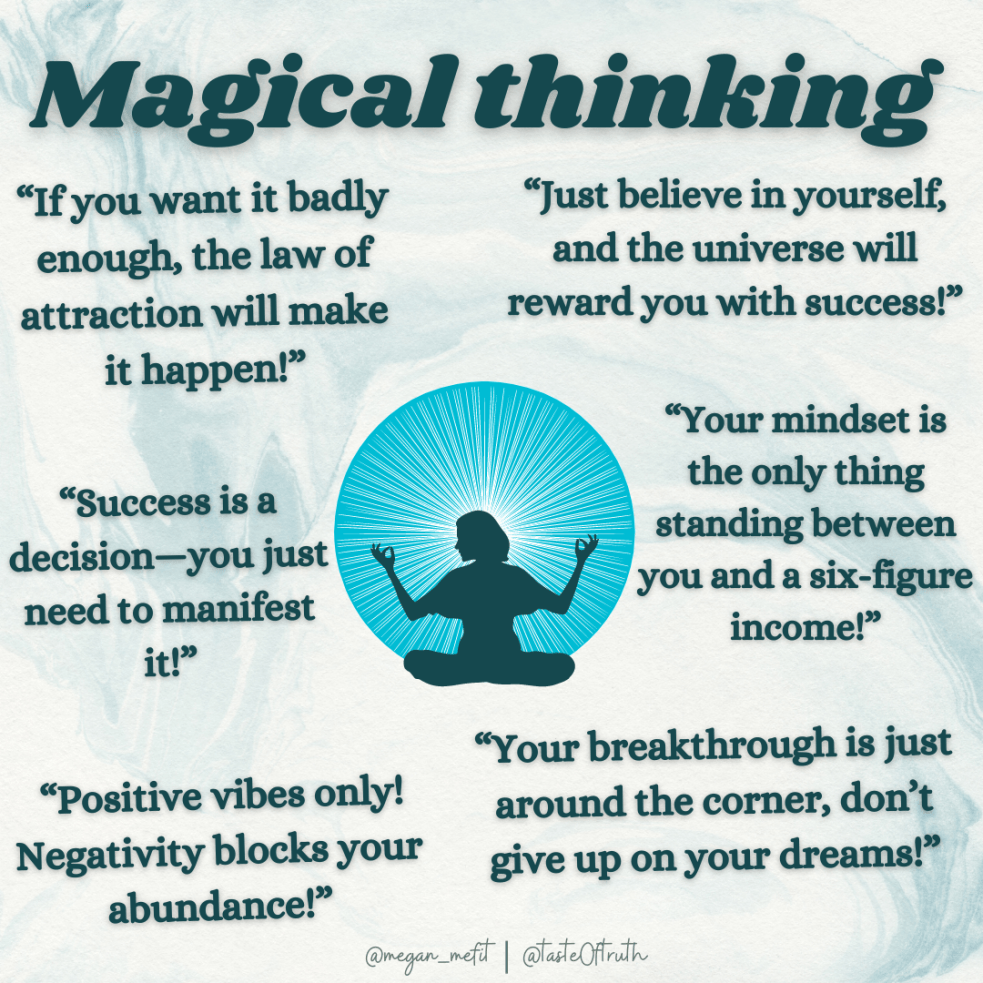
Why MLMs Exploit Magical Thinking

Magical thinking is often presented as something harmless, quirky, or even empowering: believe hard enough, visualize the outcome, raise your vibration, and somehow reality will reorganize itself around your desires.

The right thoughts will attract the right life.
The right energy will attract money.
The right mindset will make the business work.
And if it still isn’t working? Well, apparently you need to believe harder.

This is where magical thinking stops being an innocent coping mechanism and becomes something far more manipulative.

There is nothing inherently wrong with imagination, hope, ritual, goal-setting, or trying to orient your mind toward possibility. The problem begins when thoughts are treated as though they possess direct causal power over circumstances—and when that belief is used to excuse exploitative systems, deny material reality, and blame people for outcomes they cannot fully control.

Multi-level marketing companies thrive inside this framework.

They rarely sell only skincare, supplements, leggings, essential oils, or some mysterious powdered substance promising to fix your hormones. They sell a total worldview: success is available to anyone, financial freedom is right around the corner, and your mindset is the only meaningful obstacle standing between you and the life you deserve.

It sounds liberating.

In practice, it becomes a remarkably effective form of narrative control.

The Manifestation-to-MLM Pipeline

Manifestation culture and MLM culture speak remarkably similar languages.

Both frequently suggest that your external circumstances are a reflection of your internal state. Wealth signals alignment. Success proves belief. Failure reveals fear, negativity, laziness, or some hidden subconscious block.

Within this worldview, structural explanations disappear.

The compensation plan is not the problem. Market saturation is not the problem. Recruitment-based growth is not the problem. The cost of inventory, conferences, subscriptions, samples, coaching, and social-media advertising is not the problem.

You are the problem.

You did not show up consistently enough.
You entertained doubt.
You listened to “negative people.”
You failed to embody your future self.
You did not want it badly enough.

This is one of the reasons magical thinking is so useful to high-pressure groups: it turns legitimate criticism into evidence of personal or spiritual deficiency.

The system never has to prove itself because its members are taught to endlessly prove themselves to the system.

Why Magical Thinking Becomes Dangerous

1. It Creates a False Sense of Control

Magical thinking offers certainty in an uncertain world. That is part of its appeal.

It tells people that they can control outcomes through the correct combination of intention, visualization, emotional regulation, disciplined optimism, and personal belief. In an MLM, that message becomes attached to a business opportunity: anyone can succeed as long as they follow the system and maintain the right mindset.

But real outcomes are shaped by countless factors: timing, money, health, geography, existing social networks, market conditions, family responsibilities, luck, and the structure of the business itself.

A person can work hard and still fail inside a bad system.

That truth is uncomfortable, especially for companies that need a constant stream of hopeful recruits. It is much more convenient to teach people that their thoughts determine their results.

The illusion of total control can actually make people less capable of evaluating reality. Instead of asking whether the opportunity is financially sound, they are taught to examine whether they have been sufficiently positive.

2. It Keeps People Spending Money

MLMs routinely frame additional spending as an investment in your future identity.

Buy the starter kit.
Purchase enough inventory to qualify for the next rank.
Attend the conference.
Pay for the leadership retreat.
Subscribe to the training platform.
Order samples for potential customers.
Invest in yourself.

And because magical thinking encourages people to interpret persistence as proof of faith, each new expense can feel like the final energetic or financial commitment required before the breakthrough arrives.

Success is always one more month away.

One more recruit.
One more product launch.
One more mindset shift.
One more payment on the credit card.

The vast majority of MLM participants do not earn a meaningful profit after expenses are considered. But individual success stories are repeatedly elevated as proof that the opportunity works for anyone.

The person at the top of the pyramid becomes a living vision board.

Her house, vacations, body, marriage, car, and carefully curated morning routine are presented as evidence of what is available to everyone—provided they remain loyal enough to the process.

3. It Spiritualizes Shame

This may be the most psychologically damaging part of the entire system.

When success is attributed to mindset, failure becomes a moral judgment.

You were too negative.
You doubted the process.
You allowed fear to win.
You did not protect your energy.
You lacked discipline.
You secretly did not believe you deserved success.

Instead of recognizing that they were recruited into an unsustainable model, people begin searching themselves for defects.

They feel ashamed of their bank account, embarrassed by their lack of progress, and guilty for disappointing the person who recruited them. They may hide losses from their spouse, distance themselves from skeptical friends, and become even more dependent on the MLM community for reassurance.

The emotional burden is transferred entirely onto the individual while the company remains untouched.

This is authority without accountability: the system claims the right to interpret your life, demand your loyalty, and define your failures, while accepting no responsibility for the harm it causes.

4. It Encourages Detachment from Reality

“Protecting your mindset” can sound like healthy emotional hygiene. Inside a high-control environment, however, it often means avoiding information that might interrupt belief.

Critical articles are dismissed as negativity. Former members are called bitter. Concerned family members are accused of having a scarcity mindset. Financial evidence is treated as less meaningful than testimonials, intuition, or the leader’s personal story.

Members may be encouraged to behave as though their desired reality already exists—even while debt increases, relationships fracture, and emotional exhaustion sets in.

This is not optimism. It is spiritual escapism.

Reality becomes something to override rather than something to examine.

And when acknowledging the truth threatens your identity, friendships, income fantasy, and sense of belonging all at once, leaving becomes much harder than simply quitting a side business.

Why MLMs Depend on Magical Thinking

It Produces Loyalty

MLMs create communities organized around shared belief.

Members are given a new vocabulary, a new vision for their future, new mentors, new rituals, and sometimes an entirely new social circle. Group calls, conventions, recognition ceremonies, rank advancements, and motivational speeches reinforce the feeling that participants are part of something larger than themselves.

The group is not merely selling products. It is changing lives.

Once that identity takes hold, criticism can feel deeply personal. Questioning the company becomes indistinguishable from questioning the friendships, dreams, and transformation attached to it.

Leaving may mean admitting financial loss, disappointing an upline, and losing an entire community.

This is why “just walk away” is rarely as simple as it sounds.

It Protects the Business Model from Criticism

Magical thinking provides an almost perfect shield against accountability.

When someone succeeds, the system gets the credit.

When someone fails, the individual gets the blame.

Success proves the opportunity works. Failure proves the participant did not work it correctly.

This makes the central claim effectively unfalsifiable. No amount of personal loss can disprove the system because loss itself is reinterpreted as evidence that the person lacked belief, effort, consistency, or alignment.

That is not a legitimate business evaluation. It is a closed belief system.

It Fuels Recruitment

“You can do this too” is one of the most powerful promises in MLM culture.

Recruitment depends on convincing ordinary people that extraordinary wealth is available without extraordinary privilege, timing, experience, or luck. The dream must appear universally accessible.

Manifestation language helps close the gap between fantasy and evidence.

You do not need to understand the compensation plan.
You need to trust your intuition.

You do not need to examine average earnings.
You need to stop limiting yourself.

You do not need to ask whether the market is saturated.
You need to believe there is abundance for everyone.

This reframing transforms reasonable skepticism into a character flaw. The recruit is not being cautious; she is “playing small.”

Red Flags to Watch For

Slogans That Replace Evidence

Be cautious when complicated financial or personal outcomes are reduced to phrases such as:

  • “Believe and achieve.”
  • “Your vibe attracts your tribe.”
  • “If you can see it, you can create it.”
  • “The only limits are the ones in your mind.”
  • “Other people’s negativity is blocking your success.”

A slogan is not a business plan. An affirmation is not an income disclosure.

Exceptional Stories Presented as Typical Outcomes

MLMs love personal testimony because stories are emotionally powerful.

The single mother who retired her husband.
The teacher who became a millionaire.
The woman who paid off all her debt from her phone.
The cancer survivor who found purpose through the product.

These stories may be real, embellished, incomplete, or financially misleading. But even when they are accurate, they do not reveal what usually happens.

A few highly visible winners cannot tell you whether the opportunity is financially viable for the average participant.

Pressure to Remain Relentlessly Positive

Healthy communities allow questions, disappointment, disagreement, and honest discussion of failure.

High-control communities interpret those things as contamination.

When people are expected to perform positivity at all times, the group is not protecting morale. It is protecting the narrative.

Watch what happens when someone asks about debt, low earnings, product claims, attrition, or the compensation structure. Are those questions answered directly, or is the person accused of lacking faith?

Anecdotes Treated as More Important Than Evidence

Personal experience can be meaningful, but it is not a substitute for reliable data.

MLMs often rely on transformation photos, testimonials, dramatic origin stories, and claims about what “worked for me.” The emotional impact of those stories can distract from questions about evidence, typical outcomes, expenses, health claims, and financial risk.

When facts threaten the fantasy, the facts are often dismissed as negative energy.

That should tell you everything.

The Difference Between Hope and Manipulation

Hope is not the enemy.

Neither are imagination, spiritual practice, ambition, or the desire to create a better life.

But genuine hope can survive contact with reality.

It does not require you to ignore evidence. It does not demand that you blame yourself for every disappointment. It does not isolate you from people who ask reasonable questions. And it does not insist that an exploitative system would work perfectly if only its victims were more spiritually disciplined.

That is not empowerment.

It is blame wearing a vision-board costume.

Magical thinking becomes dangerous when it teaches people that thoughts are more important than circumstances, that criticism is more dangerous than exploitation, and that every failure reveals a defect in the believer rather than a flaw in the belief system.

This is the thread connecting so much fake spirituality with MLM culture: both can turn uncertainty into certainty, desire into doctrine, and personal vulnerability into profit.

So when someone promises that the universe will reward you—as long as you purchase the starter kit, join the team, follow the mentor, raise your vibration, and stop listening to the “negative” people in your life—it is worth pausing.

Ask for the evidence.

Look at the actual numbers.

Listen to the people who left.

And pay very close attention to any system that promises you complete control over your destiny while taking absolutely no responsibility for the outcome.

The Illusion of Control: Neuroscience of Fundamentalism and Diet Culture

Welcome back Wellness Warriors, and truth seekers!

As we have been discussing all of Season 2, Fundamentalist thinking doesn’t just reside in religious circles—it also permeates wellness and healing spaces. Just as high-control religions exploit human vulnerability, so does diet culture.

I’ve had my share of blindly following extreme health regimens recommended by practitioners, ignoring my own discomfort along the way. It became clear that fundamentalism can crop up in various aspects of life, and part of healing is about recognizing and addressing these tendencies within us.

We have discussed how high control religion and diet culture both capitalize on the brain’s tendency to interpret things in a binary black-and-white manner by presenting clear-cut rules, guidelines, and belief systems that simplify complex issues into easy-to-follow directives.

In this post, we’ll exploring deeper into how the brain’s craving for control and the dopamine boost it triggers can explain why people may transition into high-control environments or swing from one extreme to another. Such as moving from a loose, permissive belief system to a strict, rule-bound one, or from an unrestricted eating pattern to a rigid diet.

The Illusion of Control and Dopamine

The concept of the “illusion of control” ties deeply into our brain’s reward system, particularly through dopamine, a neurotransmitter crucial for motivation and learning. When individuals believe they have control over situations, even when that control is illusory, their brains can release dopamine. This release can provide a rewarding feeling, reinforcing the behavior or belief that leads to this sense of control.

The brain’s craving for control plays a crucial role in how individuals respond to structured systems, be it in religion, diet culture, or Multi-Level Marketing (MLM) schemes. When we encounter a belief system or set of teachings that offers clear, structured guidance, it triggers a sense of control, even if that control is illusory. This perceived control is neurologically rewarding because it leads to the release of dopamine, a neurotransmitter associated with motivation and the reinforcement of behaviors of control over one’s body and health, triggering dopamine release and creating a feedback loop that encourages continued adherence. Similarly, religious fundamentalism often offers clear-cut guidelines on how to live, providing the same sense of security and control, thus reinforcing the behavior.

This perspective not only sheds light on why people might gravitate towards fundamentalism or diet culture but also opens up a discussion on the broader implications of how our brains can be influenced by the promise of control, even when that control is more perceived than real.

What Causes the Illusion of Control

The illusion of control is driven by several factors and provides psychological benefits.

In health and wellness, people often adhere to strict diets or exercise routines, believing they control their weight or fitness, even though genetics and other factors also play a role. This illusion of control can be comforting and encourage adherence.

Similarly, in religion, individuals may follow rigid rules or rituals, thinking they control their spiritual outcomes or moral status, which provides a sense of security and boosts self-esteem.

When did the concept of the illusion of control originate?

The concept, first described by psychologist Ellen Langer in 1975, was initially seen as a way to maintain self-esteem by attributing success to oneself and distancing from failure. Recent research suggests it results from misjudged causality, where people’s sense of control is distorted by their actions rather than actual influence.

Fundamentalism and Structured Belief Systems

Fundamentalism, with its rigid doctrines and absolute truths, can offer a powerful sense of control, especially for those who have previously encountered ambiguity or lack of structure. These rules provide a clear framework for living, reducing the anxiety that comes with uncertainty, and delivering a dopamine-driven sense of reward that reinforces their commitment to the system. This appeal to control can be understood through several key aspects:

1. Structure and Certainty

Fundamentalism provides a clear and structured framework for understanding the world and one’s place within it. This structured approach often includes strict rules, definitive answers, and a well-defined moral code. For individuals who have experienced the fluidity and unpredictability of hyper-charismatic or New Age movements, the stability offered by fundamentalist systems can be particularly attractive.

In fundamentalist belief systems, every aspect of life is often governed by established doctrines. This comprehensive structure can reduce the anxiety associated with uncertainty and ambiguity, offering a predictable environment where individuals feel they know the correct course of action. This sense of predictability can be a significant source of comfort, as it replaces the confusion and complexity of previous experiences with clear-cut answers.

2. The Illusion of Control and Dopamine

The dopamine-driven reward system plays a crucial role in why fundamentalism is appealing. When individuals adhere to the strict rules and guidelines of fundamentalism, their brain releases dopamine, providing a sense of satisfaction and reinforcement. This dopamine release occurs because the rigid structure of fundamentalism offers a perceived sense of control over one’s life and environment.

This sense of control, even if illusory, can be neurologically rewarding. The anticipation and experience of control lead to the release of dopamine, which reinforces the behavior and belief that adherence to fundamentalist teachings is beneficial. Over time, this feedback loop strengthens individuals’ commitment to the belief system, as the dopamine-driven rewards make the structured environment feel more gratifying and secure.

3. Regaining a Sense of Agency

For those coming from less structured or more ambiguous belief systems, fundamentalism can represent a way to regain a sense of agency and direction. After experiencing a lack of clarity or guidance, individuals may find the definitive answers and rules provided by fundamentalism to be reassuring. The shift towards a more structured belief system can be seen as an effort to reassert control over one’s life and decisions.

Fundamentalism’s clear boundaries and absolute truths provide a stark contrast to the uncertainty that may have characterized previous experiences. This transition can be particularly appealing for individuals seeking to regain stability and predictability. The rigid nature of fundamentalism offers a form of control that feels tangible and dependable, even if it is ultimately based on a set of beliefs rather than empirical evidence.

4. Community and Belonging

Fundamentalist communities often emphasize conformity and collective adherence to their doctrines. This communal aspect can further reinforce the illusion of control by providing social validation and support. Being part of a group that shares the same rigid beliefs can enhance the sense of belonging and reinforce the perceived control individuals feel.

The social reinforcement within fundamentalist groups contributes to the illusion of control by making individuals feel supported and validated in their adherence to the teachings. This communal validation can strengthen their commitment to the belief system, as the positive feedback from the group further activates the brain’s reward system.

5. Cognitive Dissonance and Commitment

Once individuals have invested significant time and energy into a fundamentalist belief system, cognitive dissonance can make it challenging to question or abandon their beliefs. The discrepancy between their initial expectations and any potential contradictions or failures within the system can lead them to double down on their commitment.

The illusion of control provided by fundamentalism makes it psychologically difficult to admit that the system may not offer the promised stability or certainty. This cognitive dissonance drives individuals to reinforce their adherence to the system, as admitting any flaws would undermine the very control and certainty they sought to obtain.

The Illusion of Control in Multi-Level Marketing (MLM) Schemes

Similarly to fundamentalist belief systems, MLMs leverage the illusion of control by presenting themselves as opportunities for individuals to take charge of their own success. Participants are led to believe that their efforts directly determine their earnings and advancement within the company. This illusion can be highly appealing, giving people a sense that their hard work and decisions will lead to tangible rewards.

The prospect of achieving success and the belief that one’s actions are under their control can trigger dopamine release in the brain. When individuals see small successes or receive positive feedback, it reinforces their belief in their ability to control their destiny, making them more likely to continue participating despite setbacks.

MLMs often provide structured guidelines, training, and motivational materials that create a sense of control. Participants are given specific strategies to follow, which can make them feel like they have a roadmap to success. This structure reinforces the illusion that they are in control of their outcomes, even when success largely depends on recruitment and team performance.

MLMs frequently emphasize personal responsibility and self-improvement. They promote the idea that success is a result of individual effort and perseverance, subtly shifting blame for any failures onto the individual rather than the system itself. This reinforces the illusion of control by making participants believe that if they follow the system closely enough, they will succeed.

The social aspect of MLMs, including group meetings, motivational events, and social media communities, can amplify the illusion of control. Participants often see others achieving success and feel motivated by their peers, which can strengthen their belief in their own ability to control their outcomes.

Once individuals have invested time, money, and effort into an MLM, the illusion of control can make it difficult for them to step away. The cognitive dissonance created by the gap between their expectations and reality can lead them to double down on their commitment, further reinforcing their belief in their control over their situation.

The Role of Power in the Illusion of Control

Powerful individuals—including CEOs, politicians, religious leaders, and MLM leaders—often overestimate their control over events beyond their expertise. This inflated sense of control can lead to hubris, risky decisions, and an all-or-nothing approach. For example, a wellness guru who believes they can control all aspects of health through strict regimens may push extreme diets or unproven supplements, driven by the illusion of control. Similarly, a religious leader might impose rigid doctrines, believing they can control or influence every aspect of followers’ lives. This overconfidence and all-or-nothing mindset can result in extreme actions and decisions, as seen when individuals adopt overly restrictive health practices or dogmatic religious rules, ultimately leading them to lose touch with reality.

Appeal to Vulnerable Groups

Studies suggest that no one is immune to the illusion of control—under certain circumstances. Research shows that those who are personally involved in actions are among those most likely to overestimate their influence on the outcome. In addition, the behavior of pathological gamblers is driven by the belief that they can beat the odds of what is demonstrably determined purely by chance.

There are people known to be at low risk of susceptibility to illusory control: those who are depressed. Numerous studies show that depressed people are virtually invulnerable to the illusion of control. They have been found to have less distorted views than the non-depressed across a wide array of perceptions and judgments‑a state of mind that has been labeled depressive realism. They are more likely to see the futility of taking action to influence outcomes. When vulnerable individuals meet a group that offers definitive answers provides the certainty and structure these individuals crave, making them more likely to adopt and adhere to the teachings.

Effects of the Illusion of Control

A sense of control is an adaptive trait linked to better health outcomes, including reduced risk of mortality and diseases, improved physical and cognitive function, and higher life satisfaction. It promotes positive behaviors like exercise and good sleep and enhances optimism and a sense of purpose.

However, the illusion of control can also lead to magical thinking, poor decision-making, and risky behaviors such as gambling, as it may encourage unrealistic beliefs and prevent thorough analysis of situations.

In Summary

Reflect on how the illusion of control might be influencing their own choices and beliefs. Consider whether a sense of control is driving your decisions in areas like health, religion, or business ventures. Understanding this psychological mechanism can empower you to make more informed choices and break free from patterns that may not truly serve your well-being. Share your thoughts and experiences in the comments or join the conversation on our social media channels to explore these ideas further.

Plus, join us this week on the podcast, as we talk with @mburtwrites a talented author and advocate in children’s literature, about faith, parenting styles, and mental wellness. Share your thoughts or join the conversation—let’s explore the impact of the illusion of control together! 💭

🎧here

RESOURCES:

Books:

  1. “The Illusion of Control: Why We Overestimate Our Ability to Control Events” by Ellen J. Langer
    • A foundational text by the psychologist who first described the illusion of control.
  2. “Thinking, Fast and Slow” by Daniel Kahneman
    • This book delves into various cognitive biases and heuristics, including the illusion of control.
  3. “The Power of Habit: Why We Do What We Do in Life and Business” by Charles Duhigg
    • Explores how habits form and the role of dopamine in reinforcing behaviors.
  4. “The Dopamine Diet: The Complete Guide to Lose Weight, Boost Your Energy, and Live a Happier Life by Rebalancing Your Brain Chemistry” by Neil W. Dhingra
    • Focuses on how diet impacts dopamine levels and overall well-being.

Articles and Papers:

  1. “Illusion of Control” | Psychology Today
    • An overview of the illusion of control and its psychological underpinnings. Read here
  2. “The Truth About Dopamine and Your Brain” | Psychology Today
    • Explains dopamine’s role in motivation and reinforcement. Read here
  3. “Biology of Motivation, Dopamine, and Brain Circuits That Mediate Pleasure” | SpringerLink
    • A scientific paper detailing dopamine’s role in motivation and reward. Read here
  4. “The Illusion of Control in the Financial Markets” by E. J. Langer
    • Examines how the illusion of control affects decision-making in financial contexts. Read here

Online Resources:

  1. TED Talks
    • Search for TED Talks on cognitive biases and the role of dopamine for accessible explanations and examples.
  2. Coursera and edX
    • Look for courses on psychology, neuroscience, and behavioral economics that cover these topics in depth.
  3. YouTube Channels
    • Channels like CrashCourse and Khan Academy often have videos on psychology and neuroscience that touch on related concepts.

These resources should provide a comprehensive understanding of how the illusion of control and dopamine influence behavior across different contexts.