When Discipline Stops Working

What Women Were Never Told About Weight, Aging, and Control

The Science They Never Told Us

This is the first episode of 2026, and I wanted to start the year by slowing things down, getting a bit personal instead of chasing the latest talking points.

At the end of last year, I spent time reading a few books that genuinely stopped me in my tracks. Not because they offered a new diet or a new protocol, but because they challenged something much deeper: the story we’ve been told about discipline, control, and women’s bodies.

There is a reason women’s bodies change across the lifespan. And it has very little to do with willpower, discipline, or personal failure.

In Why Women Need Fat, evolutionary biologists William Lassek and Steven Gaulin make the case that most modern conversations about women’s weight are fundamentally misinformed. Not because women are doing something wrong, but because we’ve built our expectations on a misunderstanding of what female bodies are actually designed to do.

A major part of their argument focuses on how industrialization radically altered the balance of omega-6 to omega-3 fatty acids in the modern food supply, particularly through seed oils and ultra-processed foods. They make a compelling case that this shift plays a role in rising obesity and metabolic dysfunction at the population level.

I agree that this imbalance matters, and it’s a topic that deserves its own full episode. At the same time, it does not explain every woman’s story. Diet composition can influence metabolism, but it cannot override prolonged stress, illness, hormonal disruption, nervous system dysregulation, or years of restriction. In my own case, omega-6 intake outside of naturally occurring sources is relatively low and does not account for the changes I’ve experienced. That matters, because it reminds us that biology is layered. No single variable explains a complex adaptive system.

One of the most important ideas in the book is that fat distribution matters more than fat quantity.

Women do not store fat the same way men do. A significant portion of female body fat is stored in the hips and thighs, known as gluteofemoral fat. This fat is metabolically distinct from abdominal or visceral fat. It is more stable, less inflammatory, and relatively enriched in long-chain fatty acids, including DHA, which plays a key role in fetal brain development.

From an evolutionary standpoint, this makes sense. Human infants are born with unusually large, energy-hungry brains. Women evolved to carry nutritional reserves that could support pregnancy and lactation, even during times of scarcity. In that context, having fat on your lower body was not a flaw or a failure. It was insurance.

From this perspective, fat is not excess energy. It is deferred intelligence, stored in anticipation of future need. This is where waist-to-hip ratio enters the conversation.
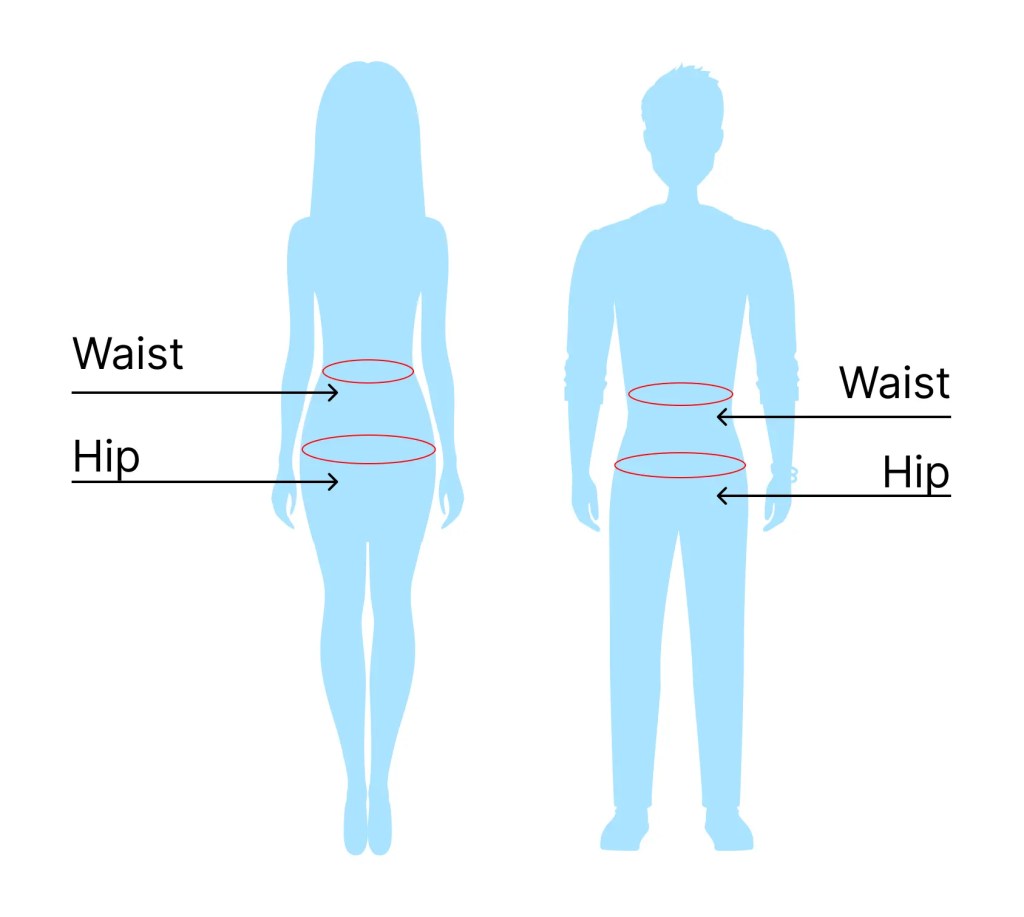
Across cultures and historical periods, a lower waist-to-hip ratio in women has been associated with reproductive health, metabolic resilience, and successful pregnancies. This is not about thinness, aesthetics, or moral worth. It is about fat function, not fat fear, and about how different tissues behave metabolically inside the body. It is about where fat is stored and how it functions.

And in today’s modern culture we have lost that distinction.

Instead of asking what kind of fat a woman carries, we became obsessed with how much. Instead of understanding fat as tissue with purpose, we turned it into a moral scoreboard. Hips became a problem. Thighs became something to shrink. Curves became something to discipline.

Another central idea in Why Women Need Fat is biological set point.
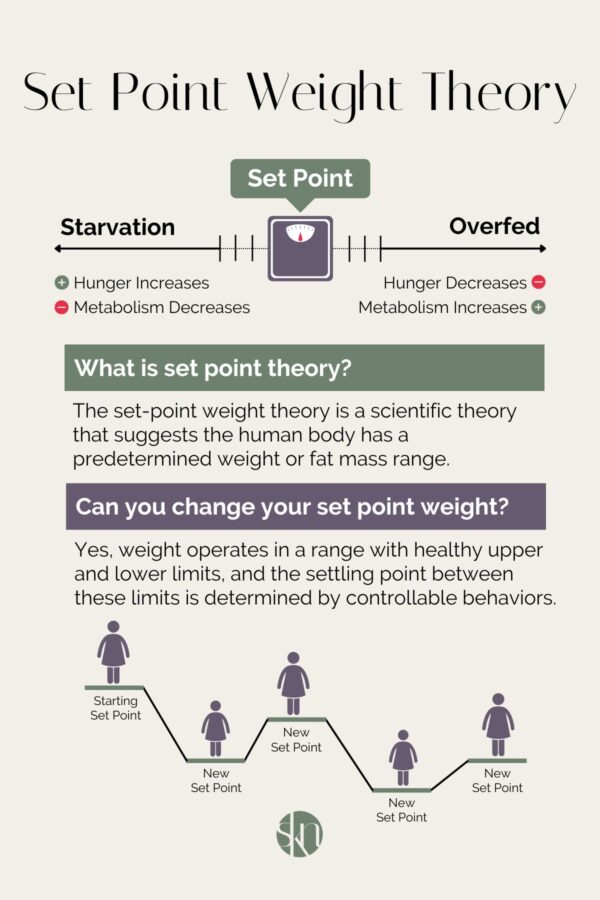
The authors argue that women’s bodies tend to defend a natural weight range when adequately nourished and not under chronic stress. When women remain below that range through restriction, over-exercise, or prolonged under-fueling, the body does not interpret that as success. It interprets it as threat.

Over time, the body adapts, not out of defiance, but out of protection.

Metabolism slows. Hunger and fullness cues become unreliable. Hormonal systems compensate. When the pressure finally eases, weight often rebounds, sometimes beyond where it started, because the body is trying to restore safety.

From this perspective, midlife weight gain, post-illness weight gain, or weight gain after years of restriction is not mysterious. It is not rebellion. It is regulation.

None of this is taught to women.

Instead, we are told that if our bodies change, we failed. That aging is optional. That discipline and botox should override biology. That the number on the scale tells the whole story.

So, before we talk about culture, family, trauma, or personal experience, this matters:

Women’s bodies are not designed to stay static.
They are designed to adapt.

Once you understand that, everything else in this conversation changes.


Why the Body Became the Battlefield
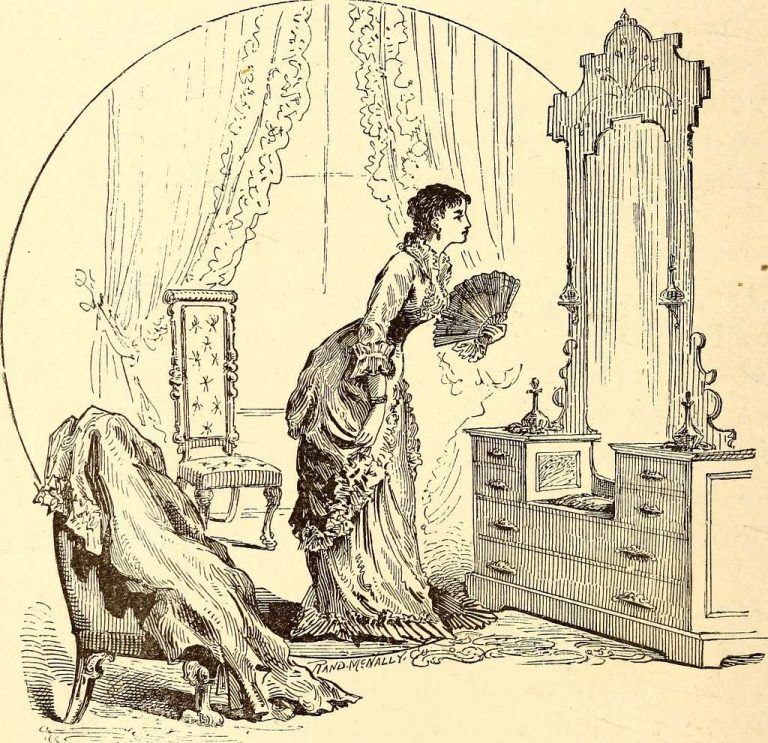
This is where historian Joan Jacobs Brumberg’s work in The Body Project: An Intimate History of American Girls, provides essential context, but it requires some precision.

Girls have not always been free from shame. Shame itself is not new. What has changed is what women are taught to be ashamed of, and how that shame operates in daily life.

Brumberg asks a question that still feels unresolved today:
Why is the body still a girl’s nemesis? Shouldn’t sexually liberated girls feel better about themselves than their corseted counterparts a century ago?

Based on extensive historical research, including diaries written by American girls from the 1830s through the 1990s, Brumberg shows that although girls today enjoy more formal freedoms and opportunities, they are also under more pressure and at greater psychological risk. This is due to a unique convergence of biological vulnerability and cultural forces that turned the adolescent female body into a central site of social meaning during the twentieth century.

In the late nineteenth and early twentieth centuries, girls did not typically grow up fixated on thinness, calorie control, or constant appearance monitoring. Their diaries were not filled with measurements or food rules. Instead, they wrote primarily about character, self-restraint, moral development, relationships, and their roles within family and community.

One 1892 diary entry reads:

“Resolved, not to talk about myself or feelings. To think before speaking. To work seriously. To be self-restrained in conversation and in actions. Not to let my thoughts wander. To be dignified. Interest myself more in others.”

In earlier eras, female shame was more often tied to behavior, sexuality, obedience, and virtue. The body mattered, but primarily as a moral symbol rather than an aesthetic project requiring constant surveillance and correction.

That changed dramatically in the twentieth century.

Brumberg documents how the mother-daughter connection loosened, particularly around menstruation, sexuality, and bodily knowledge. Where female relatives and mentors once guided girls through these transitions, doctors, advertisers, popular media, and scientific authority increasingly stepped in to fill that role.
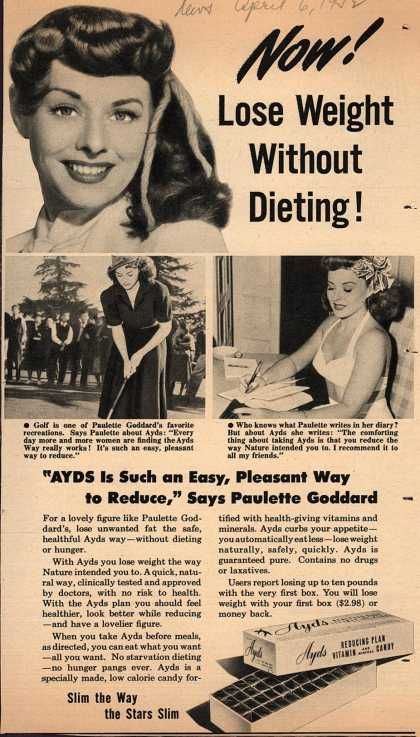
At the same time, mass media, advertising, film, and medicalized beauty standards created a new and increasingly exacting ideal of physical perfection. Changing norms around intimacy and sexuality also shifted the meaning of virginity, turning it from a central moral value into an outdated or irrelevant one. What replaced it was not freedom from scrutiny, but a different kind of pressure altogether.

By the late twentieth century, girls were increasingly taught that their bodies were not merely something they inhabited, but something they were responsible for perfecting.

A 1982 diary entry captures this shift starkly:

“I will try to make myself better in any way I possibly can with the help of my budget and baby-sitting money. I will lose weight, get new lenses, already got a new haircut, good makeup, new clothes and accessories.”

What changed was not the presence of shame, but its location. Shame moved inward.

Rather than being externally enforced through rules and prohibitions, it became self-policed. Girls were taught to monitor themselves constantly, to evaluate their bodies from the outside, and to treat appearance as the primary expression of identity and worth.

Brumberg is explicit on this point. The fact that American girls now make their bodies their central project is not an accident or a cultural curiosity. It is a symptom of historical changes that are only beginning to be fully understood.

This is where more recent work, such as Louise Perry’s The Case Against the Sexual Revolution, helps extend Brumberg’s analysis into the present moment. Perry argues that while sexual liberation promised autonomy and empowerment, it often left young women navigating powerful biological and emotional realities without the social structures that once offered protection, guidance, or meaning. In that vacuum, the body became one of the few remaining sites where control still seemed possible.

The result is a paradox. Girls are freer in theory, yet more burdened in practice. The body, once shaped by communal norms and shared female knowledge, becomes a solitary project, managed under intense cultural pressure and constant comparison.

For many girls, this self-surveillance does not begin with magazines or social media. It begins at home, absorbed through tone, comments, and modeling from the women closest to them.

Brumberg argues that body dissatisfaction is often transmitted from mother to daughter, not out of cruelty, but because those mothers inherited the same aesthetic anxieties. Over time, body shame becomes a family inheritance, passed down quietly and persistently.

Some mothers transmit it subtly.

Others do it bluntly.

This matters not because my experience is unique, but because it illustrates what happens when a body shaped by restriction, stress, and cultural pressure is asked to perform indefinitely. Personal stories are often dismissed as anecdotal, but they are where biological theory meets lived reality.

If you want to dive deeper into this topic:


Where It All Began: The Messages That Shape Us

I grew up in a household where my body was not simply noticed. It was scrutinized, compared, and commented on. Comments like that do not fade with time. They shape how you see yourself in mirrors and photographs. They teach you that your body must be managed and monitored. They plant the belief that staying small is the price of safety.

So, I grew up believing that if I could control my body well enough, I could avoid humiliation. I could avoid becoming the punchline. I could avoid being seen in the wrong way.

For a while, I turned that fear into discipline.


The Years Before the Collapse: A Lifetime of Restriction and Survival

Food never felt simple for me. Long before bodybuilding, chronic pain, or COVID, I carried a strained relationship with eating. Growing up in a near constant state of anxiety meant that hunger cues often felt unpredictable. Eating was something to plan around or push through. It rarely felt intuitive or easy.

Because of this, I experimented with diets that replaced real meals with cereal or shakes. I followed plans like the Special K diet. I relied on Carnation Instant Breakfast instead of full meals. My protein intake was low. My fear of gaining weight was high. Restriction became familiar.
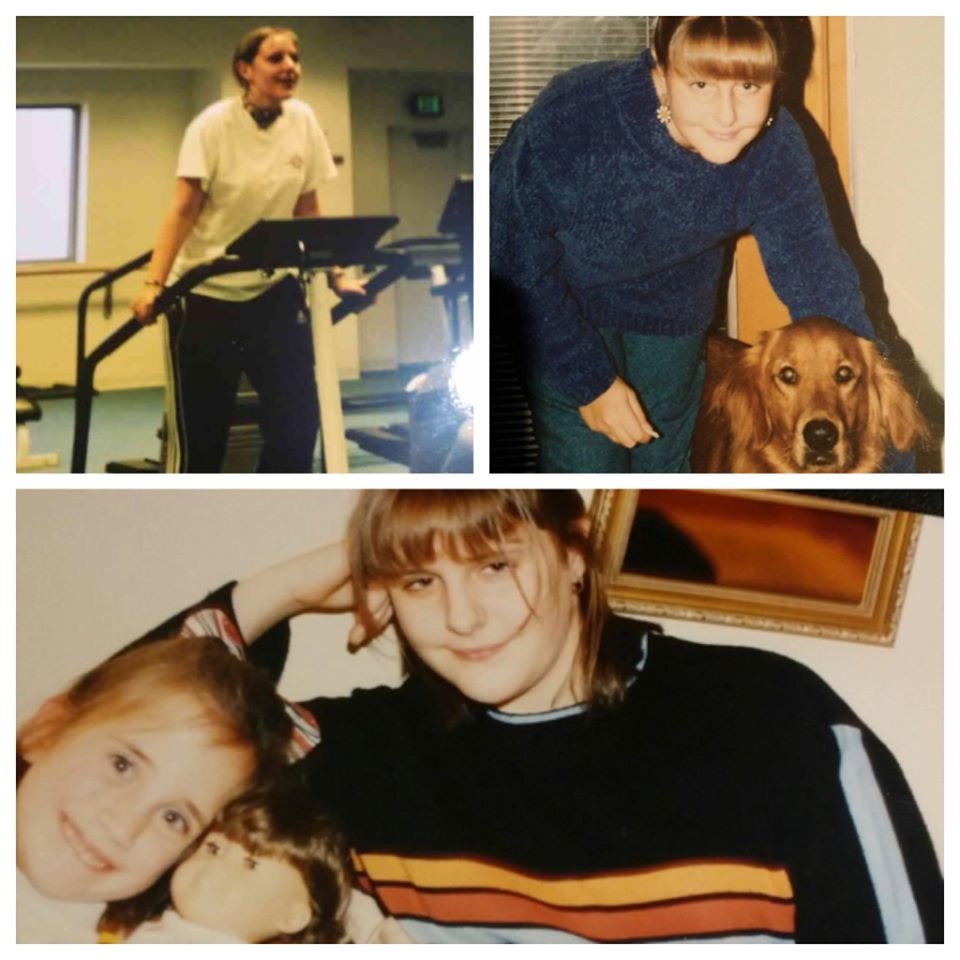
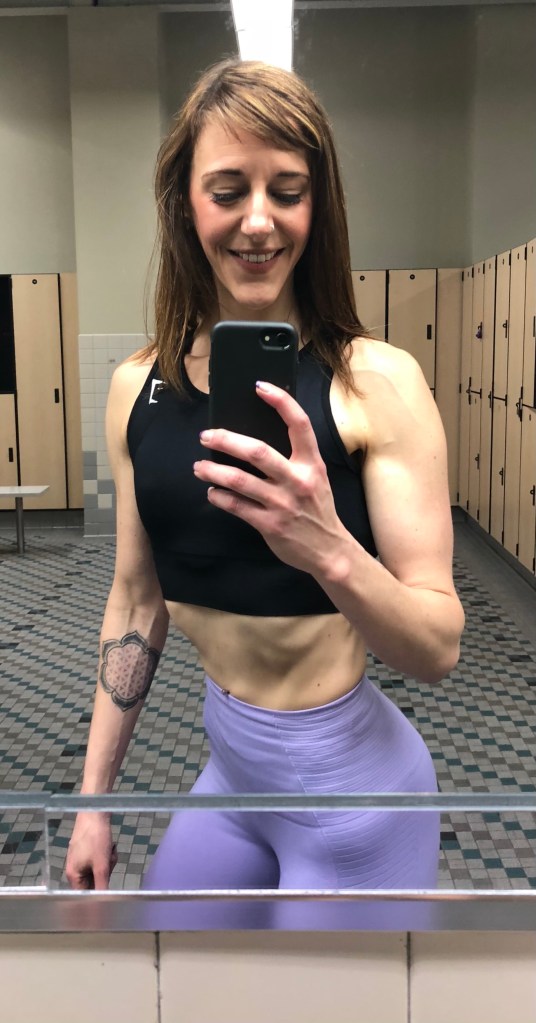
Top left is when I started working out obsessively at age 16, top right and bottom photo are from middle school when I was at my “heaviest” that drove the disordered behaviors.

In college, I became a strict vegetarian out of compassion for animals, but I did not understand how to meet my nutritional needs. I was studying dietetics and earning personal training certifications while running frequently and using exercise as a way to maintain control. From the outside, I looked disciplined. Internally, my relationship with food and exercise remained tense and inconsistent.

Later, I became involved in a meal-replacement program through an MLM. I replaced two meals a day with shakes and practiced intermittent fasting framed as “cleanse days.” In hindsight, this was structured under-eating presented as wellness. It fit seamlessly into patterns I had lived in for years.

Eating often felt overwhelming. Cooking felt like a hurdle. Certain textures bothered me. My appetite felt fragile and unreliable. This sensory sensitivity existed long before the parosmia that would come years later. From early on, food was shaped by stress rather than nourishment.

During this entire period, I was also on hormonal birth control, first the NuvaRing and later the Mirena IUD, for nearly a decade. Long-term hormonal modulation can influence mood, inflammation, appetite, and weight distribution. It added another layer of complexity to a system already under strain.

Looking back, I can see that my teens and twenties were marked by near constant restriction. Restriction felt normal. Thriving did not.

The book Why Women Need Fat discusses the idea of a biological weight “set point,” the range a body tends to return to when conditions are stable and adequately nourished. I now understand that I remained below my natural set point for years through force rather than balance. My biology never experienced consistency or safety.

This was the landscape I carried into my thirties.


The Body I Built and the Body That Broke

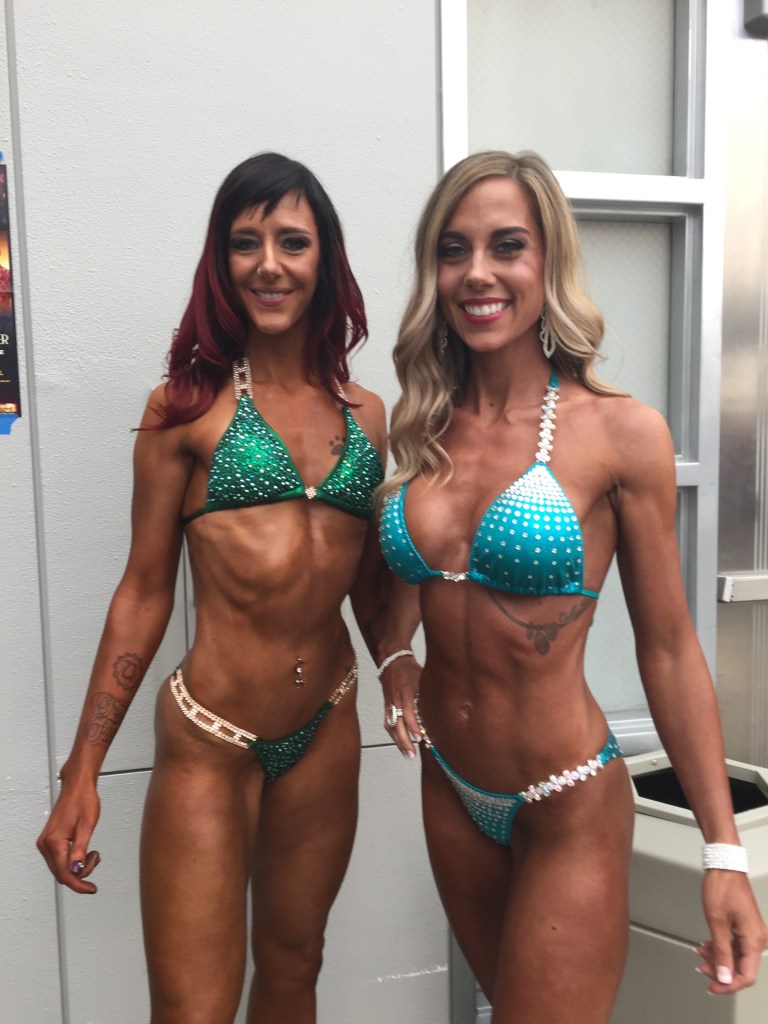
By the time I entered the bodybuilding world in 2017 and 2018, I already had years of chronic under-eating, over-exercising, and nutrient gaps behind me. Bodybuilding did not create my issues. It amplified them.

I competed in four shows. People admired the discipline and the physique. Internally, my body was weakening. I was overtraining and undereating. By 2019, my immune system began to fail. I developed severe canker sores, sometimes twenty or more at once. I started noticing weight-loss resistance. Everything I had done in the past, was no longer working. On my thirty-fifth birthday, I got shingles. My energy crashed. My emotional bandwidth narrowed. My body was asking for rest, but I did not know how to slow down.

Dive deeper into my body building journey here:

Around this time, I was also navigating eating disorder recovery. Learning how to eat without panic or rigid control was emotionally exhausting even under ideal circumstances… but little did I know things were about to take a massive turn for the worst.


COVID, Sensory Loss, and the Unraveling of Appetite

After getting sick with the ‘vid late 2020, everything shifted again. I developed parosmia, a smell and taste distortion that made many foods taste rotten or chemical. Protein and cooked foods often tasted spoiled. Herbs smelled like artificial chemical. Eating became distressing and, at times, impossible.

My appetite dropped significantly. There were periods where my intake was very low, yet my weight continued to rise. This is not uncommon following illness or prolonged stress. The body often shifts into energy conservation, prioritizing survival overweight regulation.

Weight gain became another source of grief. Roughly thirty pounds over the next five years. I feel embarrassed and avoid photographs. I often worry about how others will perceive me.

If this experience resonates, it is important to say this clearly: your body is not betraying you. It is responding to stress, illness, and prolonged strain in the way bodies are designed to respond.


Why Women’s Bodies Adapt Instead of “Bounce Back”

When years of restriction, intense exercise, chronic stress, illness, hormonal shifts, and emotional trauma accumulate, the body often enters a protective state. Metabolism slows. Hormonal signaling shifts. Hunger cues become unreliable. Weight gain or resistance to weight loss can occur even during periods of low intake, because energy regulation is being driven by survival physiology rather than simple calorie balance.

This is not failure. It is physiology.

The calories-in, calories-out model does not account for thyroid suppression, nervous system activation, sleep disruption, pain, trauma, or metabolic adaptation. It reduces a complex biological system to arithmetic.

Women are not machines. We are adaptive systems built for survival. Sometimes resilience looks like holding onto energy when the body does not feel safe.


The Systems That Reinforce Shame
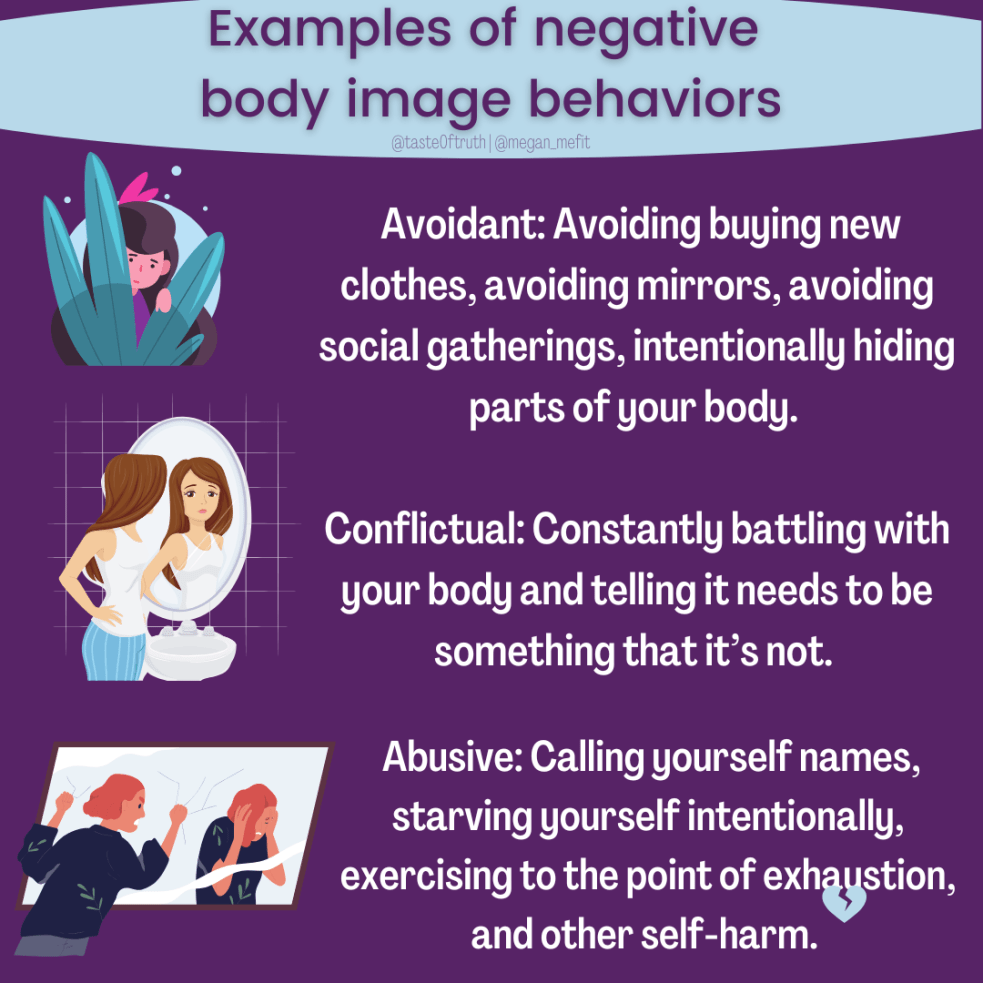
Despite this biological reality, we live in a culture that ties women’s value to discipline and appearance. When women gain weight, even under extreme circumstances, we blame ourselves before questioning the system.

Diet culture frames shrinking as virtue.

Toxic positivity encourages acceptance without context.

Industrial food environments differ radically from those our ancestors evolved in.

Medical systems often dismiss women’s pain and metabolic complexity.

Social media amplifies comparison and moralizes body size.

None of this is your fault. And all of it shapes your experience.

This is why understanding the science matters. This is why telling the truth matters. This is why sharing stories matters.


In the book, More Than a Body, Lindsay and Lexie Kite describe how women are taught to relate to themselves through constant self-monitoring. Instead of living inside our bodies, we learn to watch ourselves from the outside. We assess how we look, how we are perceived, and whether our bodies are acceptable in a given moment.

This constant self-surveillance does real harm. It pulls attention away from hunger, pain, fatigue, and intuition. It trains women to override bodily signals in favor of appearance management. And over time, it creates a split where the body is treated as a project to control rather than a system to understand or care for.

When you layer this kind of self-objectification on top of chronic stress, restriction, illness, and trauma, the result is not empowerment. It is disconnection. And disconnection makes it even harder to hear what the body needs when something is wrong.

Weight gain is not just a biological response. It becomes a moral verdict. And that is how women end up fighting bodies that are already struggling to keep them alive.

The Inheritance Ends Here

For a long time, I believed that breaking generational cycles only applied to mothers and daughters. I do not have children, so I assumed what I inherited would simply end with me, unchanged.

Brumberg’s work helped me see this differently.

What we inherit is not passed down only through parenting. It moves through tone, silence, and self-talk. It appears in how women speak about their bodies in front of others. It lives in the way shame is normalized.

I inherited a legacy of body shame. Even on the days when I still feel its weight, I am choosing not to repeat it.

For me, the inheritance ends with telling the truth about this journey and refusing to speak to my body with the same cruelty I absorbed growing up. It ends here.


Closing the Circle: Your Body Is Not Broken

I wish I could end this with a simple story of resolution. I cannot. I am still in the middle of this. I still grieve. I still struggle with eating and movement. I am still learning how to inhabit a body that feels unfamiliar.

But I know this: my body is not my enemy. She is not malfunctioning. She is adapting to a lifetime of stress, illness, restriction, and emotional weight.

If you are in a similar place, I hope this offers permission to stop fighting yourself and start understanding the patterns your body is following. Not because everything will suddenly improve, but because clarity is often the first form of compassion.

Your body is not betraying you. She is trying to keep you here.

And sometimes the most honest thing we can do is admit that we are still finding our way.

References

  1. Brumberg, J. J. (1997). The Body Project: An Intimate History of American Girls. Random House.
  2. Lassek, W. D., & Gaulin, S. J. C. (2011). Why Women Need Fat: How “Healthy” Food Makes Us Gain Excess Weight and the Surprising Solution to Losing It Forever. Hudson Street Press.
  3. Kite, L., & Kite, L. (2020). More Than a Body: Your Body Is an Instrument, Not an Ornament. Houghton Mifflin Harcourt.

Scientific and academic sources

  1. Lassek, W. D., & Gaulin, S. J. C. (2006). Changes in body fat distribution in relation to parity in American women. Evolution and Human Behavior, 27(3), 173–185.
  2. Lassek, W. D., & Gaulin, S. J. C. (2008). Waist–hip ratio and cognitive ability. Proceedings of the Royal Society B, 275(1644), 193–199.
  3. Dulloo, A. G., Jacquet, J., & Montani, J. P. (2015). Adaptive thermogenesis in human body-weight regulation. Obesity Reviews, 16(S1), 33–43.
  4. Fothergill, E., et al. (2016). Persistent metabolic adaptation after weight loss. Obesity, 24(8), 1612–1619.
  5. Kyle, U. G., et al. (2004). Body composition interpretation. American Journal of Clinical Nutrition, 79(6), 955–962.
  6. Simopoulos, A. P. (2016). Omega-6/omega-3 balance and obesity risk. Nutrients, 8(3), 128.

Trauma, stress, and nervous system context

  1. Sapolsky, R. M. (2004). Why Zebras Don’t Get Ulcers. Henry Holt and Company.
  2. Walker, P. (2013). Complex PTSD: From Surviving to Thriving. Azure Coyote Books.

The Older Story Beneath Christmas

A History of Yule and Cultural Amnesia

Every December, the same argument erupts like clockwork.

“Christmas is pagan.”
“No it isn’t, stop lying.”
“Actually, it’s Saturnalia.”
“Actually, it’s Jesus’ birthday.”

Christian Calling others out 😮

And honestly, the argument itself is the least interesting part.

Because Christmas didn’t replace older solstice traditions.
It grew out of them.

Long before doctrine, people were already gathering at midwinter. Lighting fires. Sharing food. Hanging evergreens. Leaving offerings. Watching the sun closely. Trying to survive the longest night of the year.

Most of what we now call “Christmas spirit” (the lights, the feasting, the greenery, the warmth, even the winter gift-giver) is older than Christian theology by centuries.

And yet, when I converted to Christianity in 2022, none of that felt magical.

It felt dangerous.


My First Christian Christmas: Panic, Purging, and Fear

I was only a few months into my short-lived Christian phase when December arrived, and I suddenly found myself terrified that Christmas was pagan, demonic, or spiritually contaminated.

I burned books.
I threw away crystals.
I cleaned my home like I was preparing for divine inspection.
I interrogated every decoration like it might open a portal.

I’m not exaggerating. I recently found an old document I wrote during that time, and reading it now is unsettling. It reads like I took an entire bucket of fundamentalist talking points, sprinkled in some Wikipedia conspiracies, and shook it like a snow globe.

Here are real lines I wrote in 2022:

“Christmas is a religious holiday. But it’s not Christian.”
“Christmas is the birthday of the sun god Tammuz.”
“Mistletoe came from druids who used it for demonic occult powers.”
“Santa Claus is based on Odin and meant to deceive children.”
“Jesus does not want you to celebrate Christmas.”

I believed every word of it.

Because fear-based Christianity works by shrinking your imagination.
It makes symbols dangerous.
History suspicious.
The world a spiritual minefield.

That was my first clue this wasn’t JUST about theology. It was about fear.
And the inability to hold layered meaning.


Why Winter Was Sacred Long Before Religion

For pre-industrial people, winter wasn’t cozy.

It wasn’t aesthetic. It wasn’t symbolic. It was dangerous.

Food stores ran low. Animals died. Illness spread. Darkness swallowed the day.

When the sun disappeared, it wasn’t metaphorical. It was existential.

That’s why midwinter mattered everywhere, not because cultures shared gods, but because they shared bodies, seasons, and risk.

Homes were built from thick logs, stone, and earth. Materials with thermal mass that held heat long after the fire dimmed. Hearths weren’t decorative. They were survival technology. Families and animals gathered together because warmth meant life.

This wasn’t primitive living. It was skilled living. And it shaped belief.

Seasonal rites weren’t abstract spirituality.
They were instructions for how to endure.


This Isn’t Just Capitalism — It’s Cultural Amnesia

It’s tempting to blame modern capitalism for the way winter has been flattened into noise, urgency, and forced cheer. And capitalism absolutely accelerated the problem.

But that explanation skips a much older rupture.

Pre-Christian seasonal traditions already honored limits. Rest. Darkness. Slowness. Winter was understood as a time of contraction, not productivity. You didn’t push harder in December. You pulled inward. You conserved. You waited.

Those rhythms were disrupted long before department stores and advertising campaigns.

First came religious overwrite… seasonal intelligence reframed into theological narratives that demanded certainty and transcendence over embodiment. Then came industrialization, which severed daily life from land, daylight, and season entirely. Artificial light erased night. Clocks replaced the sun. Productivity became moral.

By the time capitalism arrived in its modern form, much of the damage was already done. Capitalism didn’t invent our disconnection from seasonal limits. It inherited it.

What we’re really dealing with isn’t just exploitation.

It’s amnesia.

We forgot how winter works. We forgot how rest works. We forgot how darkness functions as part of a healthy cycle. And once that memory was gone, it became easy to sell us endless brightness in the darkest part of the year.


What Yule Actually Was. Before Christianity Rewrote It

This is where the history gets interesting….

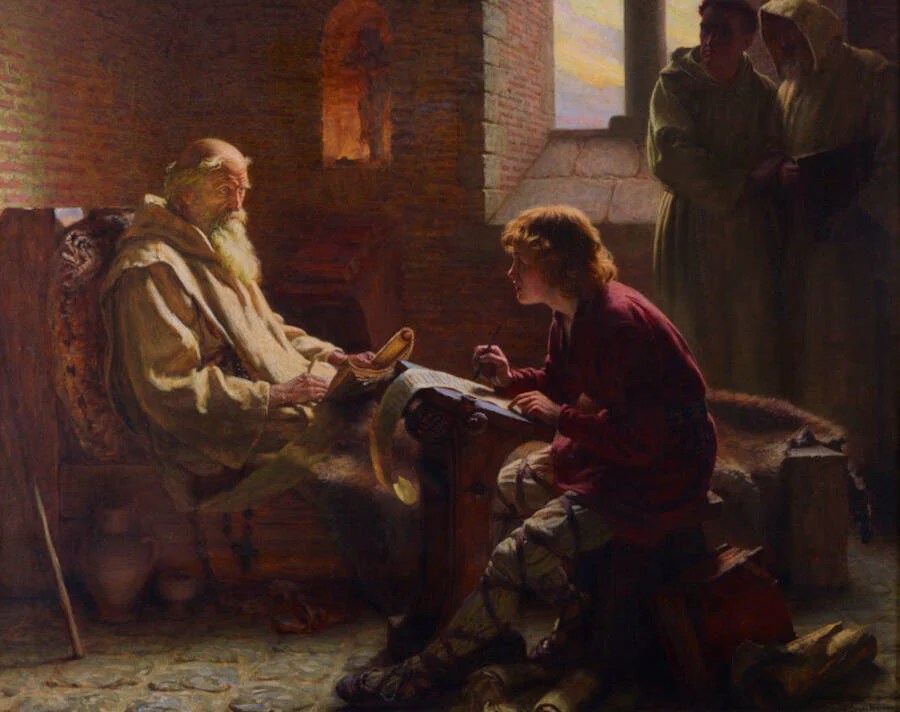
The earliest surviving written reference to Yule comes from the 8th century, recorded by the Christian monk Bede. Like much of what we know about pre-Christian traditions, it was documented after conversion had already begun. The traditions themselves are older, but the written record is fragmentary and filtered.

The Venerable Bede, an English monk and missionary, was among the earliest writers to record the existence of Yule.

That timing matters.

Like much of what we know about pre-Christian Europe, Yule was documented after conversion had already begun. Earlier traditions were primarily oral, and many were actively suppressed or destroyed, which means the written record is incomplete and filtered through Christian authors.

That does not mean the traditions were new.

It means Christianity arrived late to write them down.

Later sources, such as Snorri Sturluson in Heimskringla (12th–13th century), describe Yule as a midwinter feast involving communal drinking, oath-making, ceremonial meals, ancestor honoring, and celebrations lasting multiple days, often twelve. By the time Snorri was writing, Christianity had already reshaped much of Nordic life, yet the seasonal patterns he records remain strikingly consistent.

The record is not pristine. But it is consistent enough to tell us this:
Yule was a land-based, seasonal response to winter, practiced long before Christianity and remembered imperfectly afterward.

So, when people talk about the “Twelve Days of Christmas,” they’re unintentionally echoing Yule, not the Gospels.


Yule Was Never One Thing — or One Date

There was never a single Yule and never a single calendar.

Some communities marked the solstice itself. Others observed the days before it.
Others celebrated after, once the sun’s return was perceptible.

Yule could last days or weeks, depending on latitude, climate, and local conditions. This diversity wasn’t confusion. It was responsiveness.

Seasonal traditions bent to land, not doctrine.
And that flexibility is one reason they survived so long.


Ancestors, Offerings, and the Household

Yule wasn’t only about gods. It was about the dead.

Midwinter was understood as a liminal time when ancestors drew near. The boundary between worlds thinned. Homes became places of hospitality not just for the living, but for those who came before.

Offerings were left. Food. Drink. Light. We still do this…. even if we pretend it’s just for children.

Milk and cookies for Santa didn’t come out of nowhere.
They echo something far older: leaving nourishment overnight, acknowledging unseen visitors, participating in reciprocity.

The modern story makes it cute.
The older story makes it sacred.


Before Santa, the Sky Was Crowded

Across Northern and Eastern Europe, winter solstice was associated with feminine figures of light, fertility, and renewal— many of whom traveled the sky.

In Baltic traditions, Saule carried the sun across the heavens. Among the Sámi, Beiwe rode through the winter sky in a sleigh pulled by reindeer, restoring fertility to the frozen land.

Darkness wasn’t evil. It was gestational.

The womb is dark. Seeds germinate underground.
Transformation happens unseen. That imagery didn’t disappear.

It migrated.


When Christmas Was Once Illegal

Here’s a part of the story that tends to surprise people.

Christmas was not always embraced by Christianity in America.
In fact, it was once illegal.

In the mid-1600s, Puritan leaders in New England viewed Christmas as pagan, Catholic, and morally corrupt. Everything associated with it raised suspicion.

Evergreens were considered pagan.
Feasting was considered pagan.
Dancing, games, and excess were condemned.
Even taking the day off work was seen as spiritually dangerous.

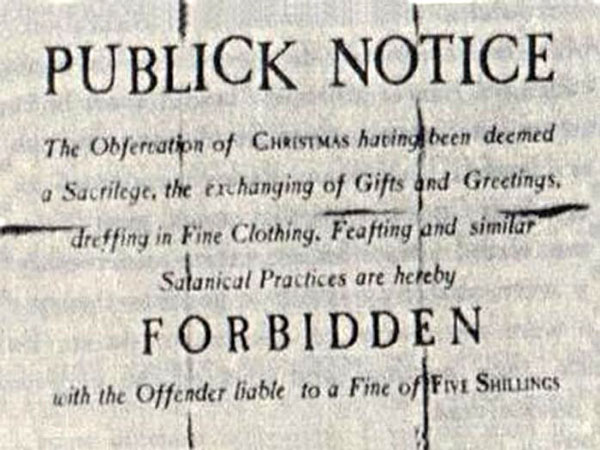
In 1659, the Massachusetts Bay Colony passed a law banning the celebration of Christmas outright. The statute read:

“Whosoever shall be found observing any such day as Christmas or the like, either by forbearing labour, feasting, or any other way… every such person so offending shall pay for every such offence five shillings.”

Celebrating Christmas was a finable offense.

The ban remained in effect until 1681. And even after it was repealed, many New England towns treated December 25th as an ordinary workday well into the 1700s.

Early American Christianity didn’t preserve Christmas.

It rejected it.

And yet, winter rituals have a way of surviving rejection.


How Christmas Quietly Returned

Christmas didn’t re-enter American life through theology or church decree.

It returned through households.

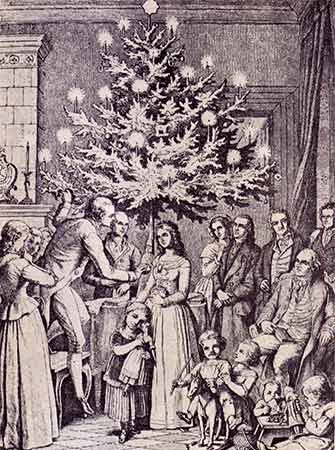
Throughout the 1700s and early 1800s, winter customs persisted in small, domestic ways. Evergreen branches were brought indoors. Candles were lit in windows. Food was shared. Stories of winter figures and gift-givers circulated quietly within families.

These practices weren’t organized or ideological. They were inherited.

Passed down the way people pass down recipes, songs, and seasonal habits, especially in communities tied to land, season, and home.

They survived because they worked.

They made winter bearable.
They gave rhythm to darkness.
They anchored people to memory and place.

Over time, these household customs accumulated. By the mid-1800s, Christmas re-emerged into public culture, not as a restored Christian holy day, but as a reassembled seasonal festival shaped by folklore, family practice, and winter necessity.

Only later was it fully absorbed, standardized, and commercialized.

That shift, from household memory to mass reproduction…. changed everything.


Santa Claus, Commercialism, and My Mom’s Coca-Cola Bathroom

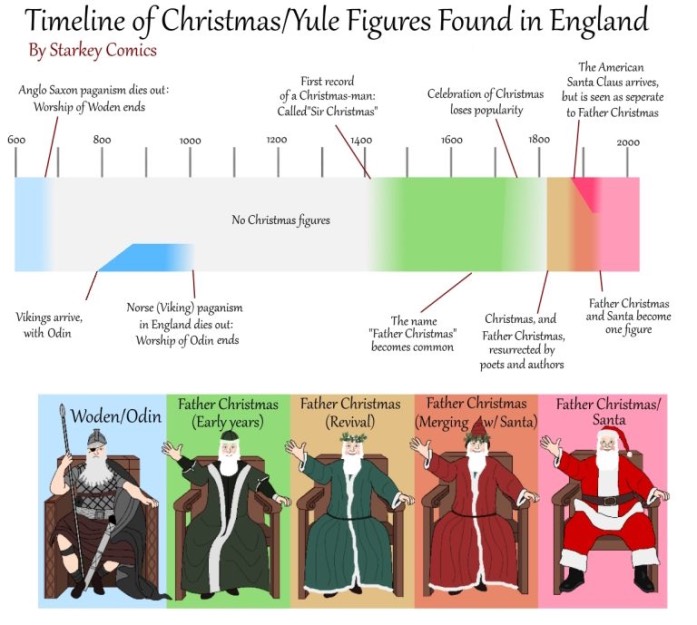
Santa is one of the clearest examples of what happens when household tradition gives way to mass culture. Early versions of Santa look nothing like the modern mascot. Long robes. Staffs. Hoods. Sometimes thin. Sometimes eerie. Often dressed in green, brown, or deep red.

These figures echo older winter travelers. Odin riding the sky, spirits roaming during Yule, ancestors moving close. This transformation accelerated in the 1800s, when American illustrators and writers began merging European folklore with newly invented holiday imagery.

By then, Santa took shape again.

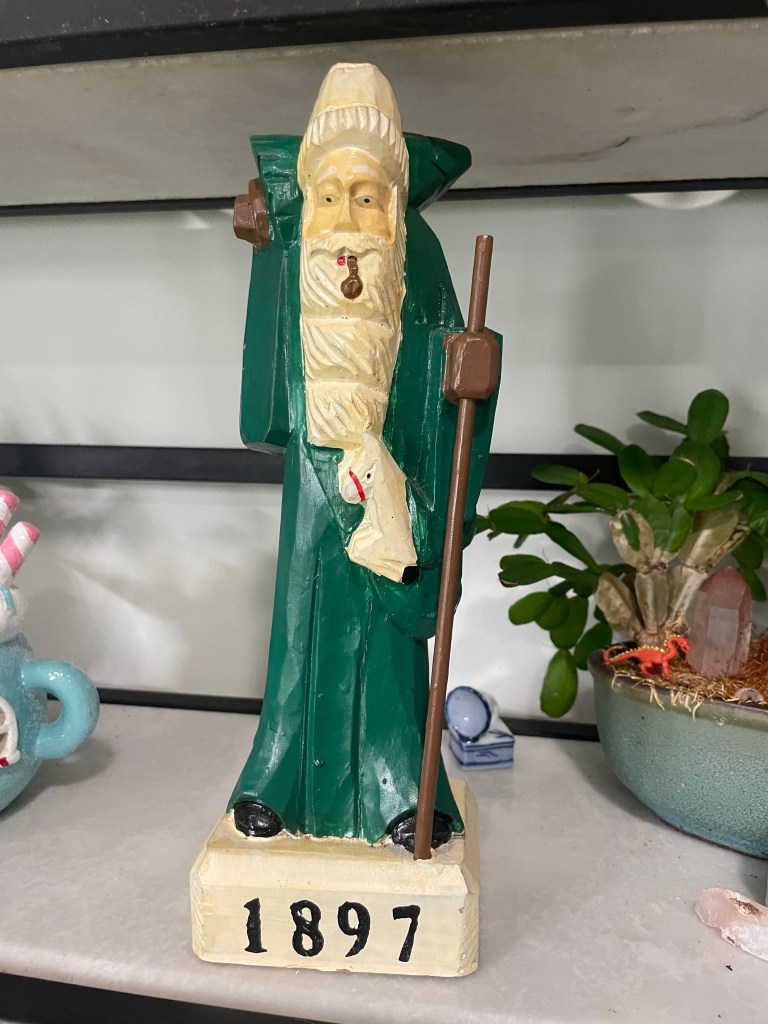
My husband and I recently found a reproduction Santa figure based on an 1897 illustration. He’s dressed in a long green robe with a staff in hand. This style was common in the 1800s, especially in Germanic and Scandinavian traditions where the winter gift-giver was closer to a folkloric spirit than a cozy grandfather. Seeing him in that deep forest green, with that hooded, old-world posture, makes it obvious how far the modern Santa has drifted from his roots.


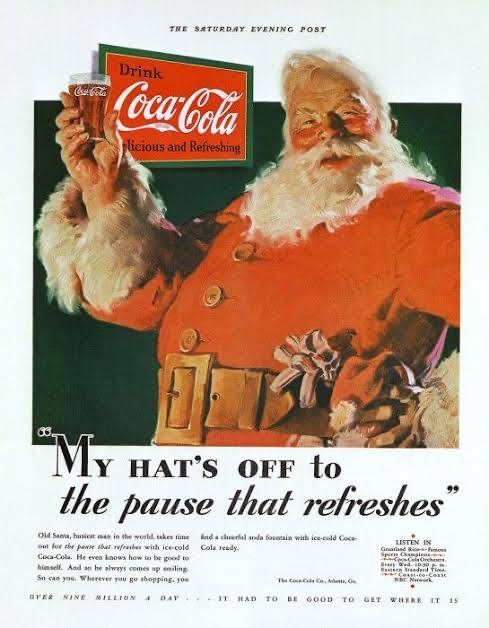
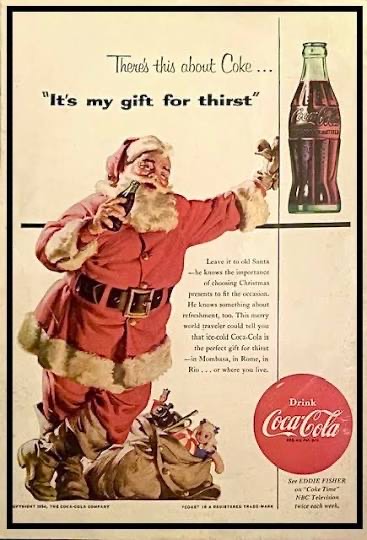
By the 1900s, Coca-Cola standardized him. Red suit. White trim. Jolly. Brand-safe. Growing up, this wasn’t abstract for me.

My mom worked for Coca-Cola when the company was based in Richmond, Virginia, in the early 1980s. My first word was “Coke.” Coca-Cola wasn’t just a brand in our house, it was part of the atmosphere.

My mom loved Coca-Cola décor. We had Coca-Cola signs, collectibles, and even a full Coca-Cola bathroom. At the time, it just felt normal. Cozy, even. Americana. Tradition.

I didn’t realize until much later how completely my sense of “holiday spirit” had been shaped by corporate nostalgia rather than ancestral memory. What I thought of as timeless wasn’t old at all. It was manufactured, standardized, and sold back to us as heritage.

That doesn’t make it evil. But it does matter.

Because when branding replaces ritual, something gets flattened. The symbols remain, but the relationship is gone. What was once seasonal, local, and embodied becomes aesthetic. Consumable. Safe.

And for many of us, that’s the only version of winter we were ever given.

That’s not a judgment. It’s just reality. Most of us weren’t raised with ritual.
We were raised with branding.

What was lost in that transformation wasn’t belief. It was relationship— to land, to season, to memory.

And the people who held onto that relationship longest were already labeled for it.


Why “Heathen” Never Meant Godless

The word heathen never originally meant immoral or evil.

It meant rural.

Its earliest known form, haithno, is feminine and means “woman of the heath” — the open, uncultivated land beyond cities and roads. From there it spread through Germanic languages: Anglo-Saxon hǣþen, Old Norse heidinn, Old High German heidan.

Clergy used heathen to describe those who kept ancestral customs while cities converted. The 8th-century monk Paulus Diaconus wrote of heidenin commane (the rural people) calling them “the wild heathen.”

Offerings to trees, springs, and stones were condemned as sacrilege. Over time, heathen merged with Latin paganus, meaning “rural dweller,” and gentilis, meaning “of another tribe.”

What began as a description of people who would not leave the wild became a moral accusation.

Later, the same language was exported outward… applied to colonized lands as uncivilized or heathen.

The fear was never really about gods. It was about land that refused to be controlled.

What Actually Happened, and Why the Old Ways Are Calling Back

The same patterns repeat across centuries: suppression, survival, absorption, and forgetting.

But we need to be honest about what that suppression looked like.

This was not a gentle handoff.
It was not mutual exchange.
It was not respectful evolution.

Christianity did not simply reinterpret older traditions.
It destroyed them where it could.

This is not rhetoric. It is history.

Historian Catherine Nixey documents this process in The Darkening Age. Early Christianity treated pagan traditions not as ancestors, but as enemies. Temples were smashed. Statues were defaced. Sacred groves were cut down. Libraries were burned. Seasonal rites that had structured life for centuries were criminalized.

This destruction was not hidden or accidental. It was celebrated.

Christian writers praised the demolition of temples. They mocked the old gods as demons. Beauty, pleasure, ritual, and joy were reframed as moral danger. Festivals became obscene. Feasting became gluttony. The body itself became suspect.

What could not be eradicated outright was stripped, renamed, and absorbed, while its origins were denied.

The solstice became Christ’s birth.
The returning sun became metaphor.
Evergreens became safe symbols.
Ancestor offerings were reduced to children’s fantasy.

This was not borrowing. It was conquest, followed by selective inheritance.

When that conquest met resistance in rural places, in households, and in women’s hands, it adapted. It waited. It layered itself over what remained.

That is why the seams still show. That is why Christmas has always felt haunted.
Layered. Conflicted. Unstable.

What survived did so despite institutional Christianity, not because of it.

It survived in kitchens and hearths. In fields and forests.
In winter nights and quiet ritual.
In land-based people who refused to forget how the seasons worked.

Centuries later, capitalism finished what religion began. What remained was flattened into nostalgia, branding, and spectacle.

Not because the old ways were weak.
But because they were powerful.


Why the Call Feels Loud Again

The pull people feel now toward solstice, ancestors, darkness, rest, and land is not aesthetic.

It is memory.

It is the body remembering rhythms it was trained to forget.
It is the psyche rejecting constant light, constant productivity, constant cheer.
It is old intelligence resurfacing after centuries of suppression.

The old gods were never gone. They were buried. Winter has a way of thawing buried things.

If something in you responds to the fire, the darkness, the offering, or the pause, that does not mean you are rejecting modern life or indulging fantasy.

It means you are responding to a pattern older than doctrine.
Older than empire. Older than the fear that tried to erase it.

What was destroyed is stirring. What was taken is being remembered.

In a few days, I’ll be sitting down with Universal Pagan Temple for a conversation on pagan culture, ritual, history, and lived practice, with Sigrún Gregerson, Pagan priestess and educator. If this piece brought up questions for you, about Yule, Mother’s Night, ancestor work, or what reclaiming these traditions actually looks like, I’d love to carry them into that conversation. Feel free to leave your questions in the comments or send them my way.

This is how the old ways return.
Quietly. Carefully. Through memory, practice, and conversation.

My Mother’s Night Altar 12.20.25

Social Miasm Theory: The Biology of a Sick Society

How Suppression Shapes Our Bodies, Minds, and the World We Live In

Hey hey, Welcome back! Today’s episode connects beautifully to something many of you resonated with in my earlier show, Science or Stagnation? The Risk of Unquestioned Paradigms. In that episode, we talked about scientism… not science itself, but the dogma that forms around certain scientific ideas.

That’s why voices like Rupert Sheldrake have always fascinated me. Sheldrake, for those unfamiliar, isn’t a fringe crank. He’s a Cambridge-trained biologist who dared to question what he calls the “ten dogmas of modern science”: that nature is mechanical, that the mind is only the brain, that the laws of nature are fixed, that free will is an illusion, and so on.

When he presented these questions in a TED Talk, it struck such a nerve that the talk was quietly taken down. And that raised an obvious question: If the ideas are so wrong… why not let them stand and fall on their own? Why censor them unless they hit something tender? All of this sets the stage for today’s conversation.

Because the theory we’re exploring, Social Miasm Theory, fits right inside that tension between mainstream assumptions and the alternative frameworks we often dismiss too quickly.

My friend Stephinity Salazar just published a fascinating piece of research arguing that suppression  (of toxins, trauma, emotion, and truth) is the root pattern underlying both chronic illness and our wider social dysfunction. It’s a theory that steps outside the materialist worldview and challenges the mechanistic lens we’ve all been taught to see through.

You don’t have to agree with everything…that’s not the goal here.

What I love is the chance to explore, to ask good questions, and to stay grounded while examining ideas that stretch our understanding.

This blog is your guide to the episode, so you can track the concepts, explore the references, and dive deeper while you listen.

So, with that, let’s dive into Social Miasm Theory: what it is, where it comes from, why it matters, and what it might reveal about the world we’re living in today.


What Are Miasms, Anyway?

To anchor our conversation, Stephinity starts by grounding the concept of “miasms” in its homeopathic roots. Historically, Samuel Hahnemann (founder of homeopathy) described three primary miasms:

  • Psora, linked to scabies or skin conditions
  • Syphilis, associated with destructive disease
  • Sycosis, with overgrowth and tissue proliferation

Since then, the theory has expanded. Many modern homeopaths now talk about five chronic miasms, adding:

These aren’t diseases…they’re patterns. A kind of “constitutional operating system.”

Stephinity’s work takes this a step further:
If individuals can have miasms, societies can too.

It’s an ambitious idea. And honestly? A compelling one when you consider what’s happening globally.


Why Social Miasm Theory Matters

Suppression doesn’t stay in the body. It echoes outward into culture, politics, ecosystems, and collective behavior.

She breaks suppression into four types:

  • Toxic suppression: chemicals, pollutants, EMFs, pathogens
  • Emotional suppression: trauma, grief, stress, unprocessed feelings
  • Psychological suppression: denial, cognitive dissonance, fear-driven attachment to ideology
  • Truth suppression: propaganda, censorship, disinformation, scientific dogma

When these forms of suppression accumulate, she argues, they create a “social miasm”: a pathological field that shapes everything from public health to political polarization.

Even if you don’t buy every mechanism she proposes, the metaphor works. And the patterns are hard to ignore.

Evidence, Epistemology, and Skeptics: What Counts as “Real”?

This is the part my skeptical listeners will perk up for.

In the interview, I asked her the question I knew many of you were thinking:
“How do you define evidence within this framework? What would you want skeptical listeners to understand before judging it?”

Stephinity argues that the modern scientific lens is too narrow. Not wrong—but incomplete. She sees value in:

  • case studies
  • pattern recognition
  • field effects
  • resonance models
  • historical cycles
  • experiential knowledge

Whether or not you agree, her challenge to mechanistic materialism echoes thinkers like Rupert Sheldrake, IONS researchers, and even physicists questioning entropic cosmology.

And she’s not claiming this replaces science. She’s asking what science misses when it refuses to look beyond the physical.


Suppression: What It Looks Like in Real Life

Stephinity’s paper covers how suppression shows up on multiple levels. Here are a few examples she explores:

  • Overuse of symptom-suppressive medications
  • Emotional avoidance that pushes trauma deeper
  • Social pressure to conform
  • Institutional censorship
  • Environmental toxins that overwhelm the microbiome
  • Radiation and electromagnetic exposures

She frames suppression as a terrain problem: when the body or society becomes too acidic, stressed, toxic, or disconnected, the miasm takes root.

This is where we start to cross into the biological, psychological, and social layers—which brings us to one of my favorite parts of her theory.


Neuroparasitology: When Parasites Change Behavior

The concept of a new branch of science of neuroparasitology. Study of the influence of parasites on the activity of the brain.

This is the section I teased in the podcast because it’s both wild and backed by real research.

Stephinity references studies showing that parasites can alter host behavior not just in insects or rodents, but potentially in humans too. Her paper cites examples like helminths, nematodes, mycotoxins, and other microorganisms (McAuliffe, 2016; Colaiacovo, 2021). These organisms are everywhere, not just in “developing countries” (Yu, 2010).

Researchers have documented parasites that:

  • influence mood
  • shift risk-taking
  • modify sexual attraction
  • impair impulse control
  • change social patterns

This is what Dawkins called the extended phenotype (1982): the parasite’s genes expressing themselves through the host’s behavior. Neuroparasitologists Hughes & Libersat (2019) and Johnson (2020) have shown how certain infections can shift personality traits in specific, predictable ways.

Stephinity ties this into terrain: parasites tend to thrive in acidic, low-oxygen, stressed, radiative environments (Clark, 1995; Tennant, 2013; Cerecedes, 2015). In her view, chronic suppression creates exactly that kind of internal ecosystem.

But there’s another layer here. One that isn’t biological at all.

This is where philosopher Daniel Dennett enters the chat.

In Breaking the Spell, Dennett describes “parasites of the mind”: ideas that spread not because they’re true, but because they’re incredibly good at hijacking human psychology. These mental parasites latch onto our cognitive wiring the same way biological one’s latch onto the nervous system. They survive by exploiting:

  • fear
  • moral impulses
  • tribal loyalty
  • the desire for certainty
  • social pressure
  • existential insecurity

According to Dennett, religious dogmas, conspiracy theories, and ideological extremes act like memetic parasites: they replicate by using us, encouraging us to host them and then pass them on.

In other words: not all parasites live in the gut. Some live in the mind.

And…..we even discussed how billionaire Les Wexner once publicly described having a “dybbuk spirit” a kind of parasitic entity in Jewish folklore known for influencing personality. Whether symbolic or literal, the analogy fits. 🫨😮

Her point is simple:
When the terrain is weak, something else will fill the space.

Whether that “something” is trauma, ideology, toxicity, or a literal parasite… the mechanism rhymes.


Collective Delusion and Mass Psychosis

Drawing on Jung and Dostoevsky, Stephinity explores the idea that societies can enter “psychic epidemics.”

You’ve seen this. We all have…

The last decade has been a masterclass in how fear, propaganda, and emotional suppression create predictable patterns:

  • polarization
  • tribal thinking
  • moral panics
  • ideological possession
  • scapegoating
  • censorship
  • intolerance of nuance

She argues these are symptoms of a cultural miasm—not failures of individual character.

Whether you lean left, right, or somewhere out in the wilderness, you’ve likely felt this rising tension. And it’s hard not to see how unresolved collective trauma feeds it.


COVID as a Catalyst: What the Pandemic Revealed

Another part of her paper dives into how the pandemic brought hidden patterns to the surface.

Some of her claims are controversial, especially around EMFs and environmental co-factors. In the episode, we unpack these with curiosity, not blind acceptance.

Her larger point is that COVID exposed:

  • institutional fragility
  • scientific gatekeeping
  • public distrust
  • trauma-based responses
  • authoritarian overreach
  • the psychological toll of suppression

Whether you agree with the specific mechanisms or not, the last decade made one thing undeniable: something in our social terrain is deeply dysregulated.


8. Healing Forward: What Do We Do With All This?

If suppression drives miasms, then healing means unsuppressing. Gently, not chaotically.

Stephinity suggests practices like:

  • emotional honesty
  • reconnecting with nature
  • releasing stored trauma
  • nutritional and detoxification support
  • reducing exposure to chronic stressors
  • restoring community and meaning
  • opening space for spiritual or intuitive insight

She’s not prescribing a protocol. She’s offering a map.

The destination is what the Greeks called sophrosyne: a state of balance between wisdom and sanity. Not blissful ignorance, not paranoid awakening. Just grounded clarity.

And I think we could all use a bit more of that.


Key Evidence and Arguments

  • Stephinity critiques materialist science, calling out what she terms “entropic cosmology.” She argues that by assuming nature is strictly mechanistic, mainstream science misses field-based phenomena, non-local consciousness, and deeper systemic patterns.
  • She draws on historical and homeopathic sources (Hahnemann, Kent) to build her theoretical foundation but also argues for newer forms of evidence: resonance, case studies, and pattern detection in social systems.
  • On the environmental front, she explores links between toxins, EMF / 5G, biotech, and chronic disease, not just as correlation, but as evidence of suppression dynamics.
  • Psychologically, she invokes mass delusion or collective repression (drawing from Jung, Dostoevsky) seeing societal crises as expressions of buried collective shadow.
  • Ultimately, her call to action isn’t just for individual healing, but for systemic awakening: more transparency, alternative medical paradigms, and restored connection with nature.

Why This Matters for You

Even if homeopathy isn’t your jam, Social Miasm Theory offers a metaphor (and potentially a map) for understanding how inner repression becomes external crisis. If this episode does anything, I hope it gives you permission to look a little closer and question the stuff we’re told not to touch.


📚 Want to Dig Deeper?

Stephinity’s website: YOUR BODY ELECTRIC YOUR BODY ELECTRIC | FULL SPECTRUM FREQUENCY MEDICINE Find her on Linkden , Instagram and Substack

Social Miasm Theory: Revisiting Chronic Illness from a Meta-Perspective of Suppression [truncated version, pre-JSE publishing]

Official published paper

Miasms

https://www.unifiedfield.info/

https://corbettreport.com/how-the-government-manufactured-covid-consent

Use of fear to control behavior in Covid crisis was ‘totalitarian’, admit scientists

Ponzinomics & Predatory Business Models

When “Trust the Process” Isn’t What It Seems

A Deep Dive into MLMs with Robert L. FitzPatrick

When I first joined a multi-level marketing company, it felt like destiny. Freedom. Empowerment. Community. So much so that I tattooed “trust the process” on my body as a daily reminder. But the deeper I got, the more I noticed the cracks: emotional manipulation, magical thinking, and an almost religious silencing of doubts.

If you missed last week’s episode here is the deep dive of my own experience.

That’s why I’m thrilled to share this week’s podcast interview with Robert L. FitzPatrick. Robert has been sounding the alarm on MLMs for decades, long before it was common to describe them as cult-like. He’s the author of Ponzinomics: The Untold Story of Multi-Level Marketing, co-author of False Profits, and a respected expert cited by the BBC, The New York Times, and courts alike. For years, he’s been giving people the tools (language, data, and perspective) to recognize MLMs for what they truly are: predatory business models, not opportunities.

Here is the image of the “Airplane Game” we reference in the interview

In this episode, we cover:

  • The Spark: Robert’s first encounter with a scam-like business in the 1980s, which pushed him into decades of research on MLMs and fraud—mirroring the way my own personal MLM experience prompted deep self-examination.
  • Why “Not All MLMs” Is a Myth: The business model itself is designed to funnel money upward, making it impossible for the vast majority to succeed, regardless of the company or product.
  • Puritan Theology & Prosperity: How old ideas linking wealth to virtue evolved into the prosperity gospel, and how MLMs exploit that mindset.
  • Cultural Hooks: From hustle culture to self-improvement mantras and spiritual undertones, MLMs borrow heavily from mainstream culture to recruit and retain followers.
  • Narrative Control: How pre-scripted objections, emotional manipulation, and silencing tactics maintain loyalty and block critical thinking—something I’ve noticed both in MLMs and high-control religious groups.
  • The Hard Numbers: Realistic odds of success are brutal—most recruits lose money, almost all quit within a year, and mandatory purchases like “Healthy Mind and Body” programs or the Isabody Challenge trap participants financially and emotionally.
  • Legality & Political Protection: If MLMs are fundamentally unfair, how are they still legal? And what protects them politically?
  • Beyond the MLM Mindset: MLMs don’t just drain your wallet—they reshape identities, fracture communities, and erode trust in yourself and others.

This conversation is essential for anyone curious about MLMs, whether you’ve been drawn into one, have friends or family involved, or are simply interested in understanding how these systems work under the surface. Robert’s insights give us not just the numbers, but the language and tools to recognize the scam and the courage to break free from it.

Tune in for an eye-opening conversation that goes beyond the hype and digs into the real human cost of MLMs.

Links 

rfitzpatrick@pyramidschemealert.org

www.pyramidschemealert.org

Twitter: @pyramidalert

FB: @ponzinomicsthebook

Further reading: 

Goodbye FTC 

Quiz: How Many MLMs Are There? 

Institutional Support for Multi-Level Marketing in America Is Cracking

Taste0ftruth Tuesdays Previous blogs on MLMs

The MLM Illusion: Selling a Dream or a Trap?

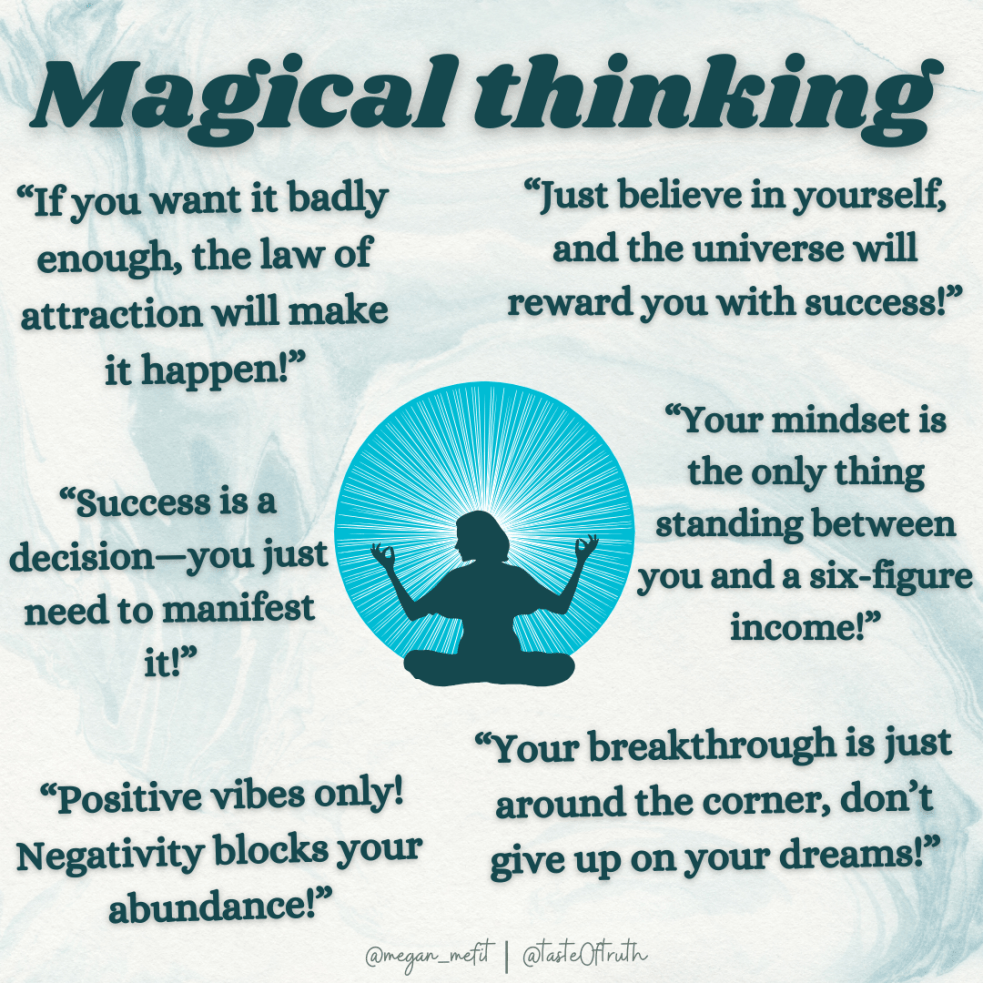
Why MLMs Exploit Magical Thinking

Uncover how MLMs and high-control religions exploit narratives to control and isolate you

Lottery Odds vs MLM: Which Poses a Higher Financial Risk?

Previous Interviews:

Deconstructing Deception: MLMs, Exploitation & Online Influencers

From Serendipity to Scrutiny: The Truth Behind MLMs and Coercive Control

The Dark Side of Manifestation and MLMs

✨Let’s talk Manifestation & MLMs✨

In recent decades, the Law of Attraction has become one of the most influential belief systems in wellness, self-help, and multilevel marketing (MLM) circles. Its premise is seductively simple: your thoughts shape your reality. Think positively, and abundance will flow; dwell on negativity, and you’ll attract misfortune.

We have discussed the pitfalls of Law of attraction in a previous episode, you can find here.

🎙️ Another throwback episode is linked below, where I unpack my journey from wellness fanatic within MLM into a high-control religion. Together, we explore the wild “crunchy hippie to alt-right pipeline.” 🌿➡️🛑 social media, influencers, and wellness hype quietly nudge people toward extreme ideas, and in this episode, we break down exactly how. 🎧🔥

This modern doctrine of “mind over matter” is often traced to The Secret (2006) by Rhonda Byrne, but its genealogy is much older. It reaches back to New Thought philosophy of the 19th century, where figures like Ralph Waldo Emerson, Phineas Quimby, and later Mary Baker Eddy (founder of Christian Science) claimed that divine thought itself was the engine of reality. These Mind Cure and faith healing movements linked spirt and matter together. Disease, poverty, and suffering were seen as products of “wrong or stinking thinking.” Salvation was not just spiritual but cognitive: change your thinking, change your life.

and so again I say: It is shockingly right instead of shockingly wrong of you to be prosperous. Obviously, you cannot be very happy if you are poor and you need not be poor. It is a sin. –Catherine Ponder (The Dynamic Laws of Prosperity)

In fact, it is the search for spiritual healing of the body that led to what is known today as prosperity consciousness or in Christian evangelism, it’s prosperity theology.

That intellectual lineage matters because it shows how the Law of Attraction has always been more than a harmless pep talk. It represents a cosmology of control, one that locates all responsibility (and blame) within the individual mind. As we have discussed many times before, Jonathan Haidt observes in The Righteous Mind, belief systems serve a dual function: they bind communities together and blind them to alternative explanations.

In this sense, the Law of Attraction doesn’t just inspire positive thinking; it narrows. By framing success and failure as purely mental vibrations, it obscures structural realities like economic inequality, physical health and genetic limitations, racism, or corporate exploitation.

And that narrowing is precisely what makes it the perfect handmaiden to MLM culture.


When Positive Thinking Becomes a Business Model

Robert L. FitzPatrick, in False Profits and Ponzinomics, describes MLMs as “endless chain” recruitment schemes. What sustains them isn’t product sales but the constant influx of hopeful recruits. Yet these schemes require something more than numbers: they require belief.

Here, the Law of Attraction becomes the MLM’s best salesman. Distributors are told:

  • Failure isn’t about the structure of the business; it’s about your mindset.
  • Doubt is “negative energy” that will block your success.
  • Quitting is not just a business choice but a moral failing.

In the Amway training program, the “ABCs of Success” are “Attitude, Belief and Commitment.” Attitude was the key which must be guarded. Don’t let anyone steal your attitude. Negative was defined as “whatever influence weakens your belief and commitment in the business” -False Profits

This is where Norman Vincent Peale’s “positive thinking” gospel dovetails with MLM. In his 1948 book Positive Thinking for a Time Like This, Peale popularized the phrase

“Let go and let God. Let Him take over your life and run it. He knows how.”

While originally a call to spiritual surrender, the phrase has since been weaponized in countless contexts from Holiness movements to Alcoholics Anonymous to prosperity preaching. At its worst, it functions as a silencer: don’t question, don’t resist, don’t think critically. Just “let go,” and trust that outcomes (or uplines) will provide.

Eastern Orthodox Christianity has a word for this: prelest. It’s the belief that human beings are so easily deceived that any private sense of spiritual progress — a feeling of clarity, joy, empowerment, even a mystical experience — can’t be trusted on its own. Without humility and the guidance of a spiritual father, you’re told it may just be pride, delusion, or the devil in disguise.

That’s the trap: you can’t trust your own mind, heart, or gut. The only “safe” option is obedience to the system. Which is exactly how MLMs and other high-control groups operate — undermining self-trust to keep you dependent.

Nietzsche would have called this a kind of slave morality, a belief system that encourages resignation to suffering rather than rebellion against unjust structures. The Law of Attraction, framed in this way, doesn’t challenge MLM exploitation; it sanctifies it.

More powerful than any product, charismatic leader, or compensation plan, the MLM mindset materials (the tapes, courses, and “personal development” kits) are the prime tools used to recruit and control distributors. Once you’re in the system, you’re encouraged to buy these materials week after week, keeping you invested emotionally and financially while feeding the company’s bottom line.

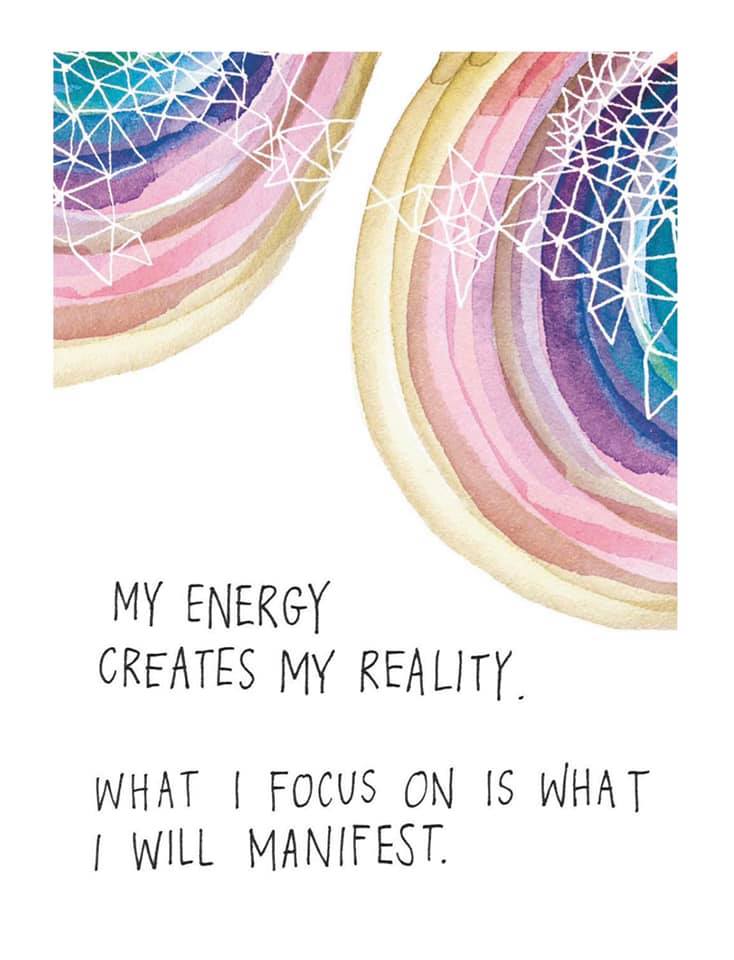
I went back through my Facebook to find some goodies for you! 😜This photo says “My energy creates my reality. What I focus on is what I will Manifest.” Here is the original caption so you can hear how brainwashed I was. “💥🙌🏼Belief is a feeling of certainty about something, driven by emotion. Feeling certain means that it feels true to you and therefore it is your reality. 💥🙌🏼 💪🏼 What you focus on you find 💪🏼 👀 You’ve got to believe it, to see it 👀”

Flashback to my first corporate event Aug 2016. My upline purchased my flight basically forcing me to go.

My caption at the time: 🤮

🔥IGNITE YOUR VISION! 🔥
⚡Attended an event that changed my life. Showed me the massive vision of this company.
🤗Join our passionate, growing team of 18-35-year-olds striving for extraordinary lives and ownership of health, dreams, and contributions.
🤩Returning to this LIFE CHANGING event soon! Nashville, TN—let’s learn, grow, and celebrate!

Sounds inspiring, right? Except what they’re really selling is mandatory product purchases, endless hype, and a community that keeps you chasing the next status milestone. That “massive vision” isn’t about your health or dreams—it’s about the company’s bottom line.

Words like passionate, extraordinary, innovators, ownership are carefully chosen psychological nudges, making you feel like life itself is on the line if you’re not on board. And the countdown to the next “life-changing” event? Keeps you spending, attending, and emotionally hooked.

This is exactly what FitzPatrick calls out in Ponzinomics: the sales rep is the best customer. Only a tiny fraction of participants earn anything; the rest are paying to stay inspired.

More flashback images from my cult days….


The Psychological Toll

When these elements collide the New Thought inheritance of “mind over matter,” Peale’s positive thinking, religious community networks and MLM compensation plans… the result is a high-control environment dressed in empowerment language.

The outcomes are rarely empowering:

  • Blame and guilt when inevitable losses occur.
  • Anxiety from the demand to maintain “high vibrations.”
  • Suppression of doubt, lest skepticism be mistaken for weakness.
  • Financial harm disguised as personal failure.

In wellness communities, this logic extends beyond money. If essential oils don’t heal your illness, it’s because your mindset was wrong. If the diet doesn’t work, it’s because you didn’t “believe” enough. Structural realities (biology, medicine, inequality) are flattened into personal responsibility.

As Haidt warns, morality (and by extension ideology) can both bind and blind. The Law of Attraction, when paired with MLM, binds participants into a shared culture of hope and positivity while blinding them to exploitation.


Connecting the Dots: Bodybuilding, Metabolism & Team Isagenix

A couple weeks ago on the podcast, I shared about my bodybuilding years and the metabolic fallout I still live with today. I had forgotten how much of that season was actually entangled with my Isagenix obsession. My upline (the couple who enrolled me) were a part of Team Isagenix®, and I craved the validation of being “seen” as a successful athlete inside that community.

The requirements were brutal: placing in the top three of multiple competitions in a short span of time. So, between May 2017 and October 2018, I crammed in four shows in just 18 months. No off-season. No recovery. Just constant prep cycles. My metabolism never had a chance to stabilize, and I pushed myself past healthy limits. I wrecked my body and I’m still paying the price.

This is why I push back so hard when people insist that success is all about having a “positive enough” attitude to manifest it. My mindset was ironclad. What I lacked the conscious awareness that valued human health over recruitment and body image. That drive wasn’t just about stage lights and trophies. It was about proving my worth to an MLM culture that dangled prestige as the price of belonging. Team Isagenix® made the bar steep, and I was determined to clear it, no matter the cost.

And if you need proof of how deep this “mindset over matter” indoctrination goes, look no further than my old upline…now rebranded as a Manifestation Coach. Picture the classic boss-babe felt hat, paired with a website promising “signature mindset tools for rapid results.” According to her, if fear or doubt was “shrinking your dreams,” this was your moment to “flip it.” She name-drops 8-figure companies, influencers, and visionaries (the usual credibility glitter) while selling memberships, live events, and 7-day challenges.

It’s the same pitch recycled: your struggle isn’t systemic, it’s your mindset. If you’re not living your “life you truly love,” it’s because you haven’t invested enough in flipping the script (with her paid framework, of course). The MLM grind culture just got a new coat of “manifesting” paint.


🧠 Isagenix Programs & Their Psychological Impact

  • Healthy Mind and Body Program: A 60-day “mindset” initiative framed as holistic wellness. In practice, it ties product use to personal development, creating behavioral conditioning and binding members into a sense of shared identity and belonging. 🚩
  • IsaBody Challenge: A 16-week transformation contest requiring regular Isagenix product purchases. Completion comes with swag and vouchers; finalists are paraded as “success stories,” gamifying loyalty and dangling prestige as bait. The grand prize winner earns $25,000 but most participants earn only deeper entanglement. 🚩
  • Team Isagenix: Marketed as a prestige group for elite athletes with current national certifications, offering exclusivity and aspirational branding. This elevates certain members as “proof” of the products’ legitimacy, fueling both loyalty and recruitment. 🚩
  • Product Consumption: Isagenix requires 100 PV every 30 days just to remain “active.” This equates to about $150/month you HAVE to spend. On paper, bonuses and ranks promise unlimited potential. In reality, most associates struggle to recoup even their monthly product costs. Personal development rhetoric and community belonging often eclipse these financial realities, keeping participants cycling through hope, debt, and blame. 🚩

🤮🐦‍🔥 “Transform Your Life with Isagenix | Empowering Wellness and Wealth” 🐦‍🔥 🤮

Watch closely, because this is where the magic happens: the company paints a picture of limitless opportunity, but as Robert L. FitzPatrick lays out in Ponzinomics, the secret is that the sales rep is the best customer. That’s right… the real profits aren’t coming from your vague dreams of financial freedom; they’re coming from the people who are already buying the products and trying to climb the ranks.

The numbers don’t lie. According to Isagenix’s own disclosure: the overall average annual income for associates is $892. Among those who actually earned anything, the average jumps to $3,994. Do the math: $892 ÷ $3,994 ≈ 0.223 — meaning only about 22% of associates earn anything at all. The other 78%? Zero. Nada. Zilch.

And before you start fantasizing about that $3,994, remember: that’s before expenses. Let’s run a realistic scenario based on actual product spend:

  • $150/month on products or promotional materials = $1,800/year → net ≈ $2,194 − $1,800 = $1,194 before other costs.
  • Factor in travel, events, or socials? That $1,194 could easily drop to near zero…or negative.

The point: the so-called “income potential” evaporates fast when you account for the mandatory spending MLMs require. The only thing truly transformed is the company’s bottom line, not yours.

No wonder the comments are turned off.

Apparently, nobody actually crunches the numbers while the marketing spiel promises energy, strength, and vitality as if a shake could fix financial exploitation, metabolic burnout, and guilt-tripping at the same time.

My story is just one case study of how these tactics play out in real lives: I was recruited through trusted connections, emotionally manipulated with promises of transformation, pressured into relentless product use, and left with financial strain and long-lasting health consequences. That’s the “empowerment” MLMs sell and it’s why scrutiny matters.


Cultural Ecosystems That Enable MLMs


MLMs don’t operate in a vacuum. They flourish where belief structures already normalize submission to authority, truth-claims, and tightly networked communities. Evangelicals and the LDS Church provide striking examples: tight-knit congregations, missionary training in persuasion, and a cultural emphasis on self-reliance and communal obligation create fertile ground for recruitment.

Companies like Nu Skin, Young Living, doTERRA, and Melaleuca have disproportionately strong followings in Utah and among Mormon communities. FitzPatrick notes that MLMs thrive where trust networks and shared values make persuasion easier. The kind of environment where aspirational marketing and “prestige” teams can latch onto pre-existing social structures.

In short, it’s not just the products or the promises of positive thinking; it’s where belief, community, and culture all collide… that allows MLMs to hook people and keep them chasing elusive success.


Beyond Magical Thinking

The critique, then, is not of hope or positivity per se, but of weaponized optimism. When mantras like let go and let God or just thinking positive to manifest it are used to shut down discernment, discourage action, or excuse exploitation, they cease to be spiritual tools and become instruments of control.

Nietzsche challenged us to look beyond systems that sanctify passivity, urging instead a confrontation with reality even when it is brutal. FitzPatrick’s work extends this challenge to the world of commerce: if we truly care about empowerment, we must be willing to see how belief systems can be manipulated for profit.

That’s why MLMs and the Law of Attraction deserve scrutiny. Not because they promise too much, but because they redirect responsibility away from unjust structures and onto the very people they exploit.


Coming Up: A Deeper Dive

Next week on the podcast, I’ll be speaking with Robert L. FitzPatrick, author of False Profits and one of the world’s leading experts on MLMs. With decades of research, FitzPatrick has testified in court cases exposing fraudulent MLM schemes and helped unravel the mechanisms behind these multi-billion-dollar operations. He’s seen firsthand how MLMs manipulate culture, co-opt spirituality, and turn belief itself into a product.

Stay tuned. This is a conversation about more than scams, it’s about the machinery of belief, and how it shapes our lives in ways we rarely see.

Taste0ftruth Tuesdays Previous blogs on MLMs

The MLM Illusion: Selling a Dream or a Trap?

Why MLMs Exploit Magical Thinking

Uncover how MLMs and high-control religions exploit narratives to control and isolate you

Lottery Odds vs MLM: Which Poses a Higher Financial Risk?

Previous Interviews:

Deconstructing Deception: MLMs, Exploitation & Online Influencers

From Serendipity to Scrutiny: The Truth Behind MLMs and Coercive Control

References/Suggested Reading

  • Byrne, Rhonda. The Secret. New York: Atria Books, 2006.
  • Eddy, Mary Baker. Science and Health with Key to the Scriptures. Boston: The Christian Science Publishing Society, 1875.
  • Emerson, Ralph Waldo. The Essential Writings of Ralph Waldo Emerson. Edited by Brooks Atkinson. New York: Modern Library, 2000.
  • FitzPatrick, Robert L. False Profits: Seeking Financial and Spiritual Deliverance in Multi-Level Marketing and Pyramid Schemes. Charlotte, NC: Herald Press, 1997.
  • FitzPatrick, Robert L. Ponzinomics: The Untold Story of Multi-Level Marketing. Charlotte, NC: Skyhorse Publishing, 2020.
  • Haidt, Jonathan. The Righteous Mind: Why Good People Are Divided by Politics and Religion. New York: Vintage Books, 2012.
  • Nietzsche, Friedrich. On the Genealogy of Morals. Edited by Walter Kaufmann. New York: Vintage Books, 1989 (originally published 1887).
  • Peale, Norman Vincent. Positive Thinking for a Time Like This. New York: Prentice-Hall, 1948.
  • Quimby, Phineas P. The Quimby Manuscripts. Edited by Horatio W. Dresser. New York: Thomas Y. Crowell, 1921.
  • Wallace, David Foster. “Consider the Lobster.” In Consider the Lobster and Other Essays. New York: Little, Brown, 2005. (Useful on consumer culture critique, if you want a modern edge.)

Fit for TV: How Screens, Diet Culture, and Reality Shows Rewire Our Bodies and Minds

When Willpower Isn’t Enough: Media, Metabolism, and the Myth of Transformation

You’re listening to Taste Test Thursdays–a space for the deep dives, the passion projects, and the stories that didn’t quite fit the main course. Today, we’re hitting pause on the intense spiritual and political conversations we usually have to focus on something just as powerful: how technology shapes our bodies, minds, and behaviors. We’ll be unpacking a recent Netflix documentary that highlights research and concepts we’ve explored before, shining a light on the subtle ways screens and media program us and why it matters more than ever.

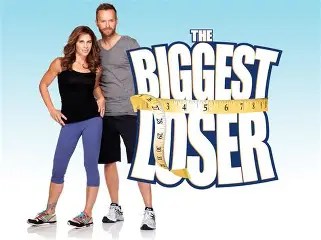
I have a confession: I watched The Biggest Loser. Yep. Cringe, right? Back in 2008, when I was just starting to seriously focus on personal training (I got my first certification in 2006 but really leaned in around 2008), this show was everywhere. It was intense, dramatic, and promised transformation—a visual fairy tale of sweat, willpower, and discipline.

Looking back now, it’s so painfully cringe, but I wasn’t alone. Millions of people were glued to the screens, absorbing what the show told us about health, fat loss, and success. And the new Netflix documentary Fit for TV doesn’t hold back. It exposes the extreme, sometimes illegal methods used to push contestants: caffeine pills given by Jillian Michaels, emotional manipulation, extreme exercise protocols, and food as a weapon. Watching it now, I can see how this programming shaped not just contestants, but an entire generation of viewers—including me.


Screens Aren’t Just Entertainment

Laura Dodsworth nails it in Free Your Mind:

“Television is relaxing, but it also is a source of direct and indirect propaganda. It shapes your perception of reality. What’s more, you’re more likely to be ‘programmed’ by the programming when you are relaxed.”

This is key. Television isn’t just a casual distraction. It teaches, it socializes, and it normalizes behavior. A study by Lowery & DeFleur (Milestones in Mass Communication Research, 1988) called TV a “major source of observational learning.” Millions of people aren’t just entertained—they’re learning what’s normal, acceptable, and desirable.

Dodsworth also warns:

“Screens do not show the world; they obscure. The television screen erects visual screens in our mind and constructs a fake reality that obscures the truth.”

And that’s exactly what reality diet shows did. They created a distorted narrative: extreme restriction and punishment equals success. If you just try harder, work longer, and push further, your body will cooperate. Except, biology doesn’t work like that.


The Metabolic Reality

Let’s dig into the science. The Netflix documentary Fit for TV references the infamous Biggest Loser study, which tracked contestants years after the show ended. Here’s what happened:

  • Contestants followed extreme protocols: ~1,200 calories a day, 90–120 minutes of intense daily exercise (sometimes up to 5–8 hours), and “Franken-foods” like fat-free cheese or energy drinks.
  • They lost massive amounts of weight on TV. Dramatic, visible transformations. Ratings gold.
  • Six years later, researchers checked back: most regained ~70% of the weight. But the real kicker? Their resting metabolic rate (RMR) was still burning 700 fewer calories per day than baseline—500 calories less than expected based on regained body weight.
  • In everyday terms? Imagine you used to burn 2,000 calories a day just by living. After extreme dieting, your body was burning only 1,300–1,500 calories a day, even though you weighed almost the same. That’s like your body suddenly deciding it needs to hold on to every calorie, making it much harder to lose weight—or even maintain it—no matter how “good” you eat or how much you exercise.

This is huge. It shows extreme dieting doesn’t just fail long-term; it fundamentally rewires your metabolism.

Why?

  • Leptin crash: The hormone that tells your brain you’re full plummeted during the show. After weight regain, leptin rebounded, but RMR didn’t. Normally, these rise and fall together—but the link was broken.
  • Loss of lean mass: Contestants lost ~25 pounds of muscle. Regaining some of it didn’t restore metabolic function.
  • Hormonal havoc: Chronic calorie deficits and overtraining disrupted thyroid, reproductive, and adrenal hormones. Weight loss resistance, missed periods, hair loss, and constant cold are all part of the aftermath.

Put bluntly: your body is not passive. Extreme dieting triggers survival mode, conserving energy, increasing hunger, and slowing metabolism.

Read more:


Personal Lessons: Living It

I know this from my own experience. Between May 2017 and October 2018, I competed in four bodybuilding competitions. I didn’t prioritize recovery or hormone balance, and I pushed my body way too hard. The metabolic consequences? Echoes of the Biggest Loser study:

  • Slowed metabolism after prep phases.
  • Hormonal swings that made maintaining progress harder.
  • Mental fatigue and burnout from extreme restriction and exercise.

Diet culture and TV had me convinced that suffering = transformation. But biology doesn’t care about your willpower. Extreme restriction is coercion, not empowerment.

Read more:


From Digital Screens to Unrealistic Bodies

This isn’t just a TV problem. The same mechanisms appear in social media fitness culture, or “fitspiration.” In a previous podcast and blog, From Diary Entries to Digital Screens: How Beauty Ideals and Sexualization Have Transformed Over Time, we discussed the dangerous myth: hard work guarantees results.

Fitness influencers, trainers, and the “no excuses” culture sell the illusion that discipline alone equals success. Consistency and proper nutrition matter—but genetics set the foundation. Ignoring this truth fuels:

  • Unrealistic expectations: People blame themselves when they don’t achieve Instagram-worthy physiques.
  • Overtraining & injury: Chasing impossible ideals leads to chronic injuries and burnout.
  • Disordered eating & supplement abuse: Extreme diets, excessive protein, or PEDs are often used to push past natural limits.

The industry keeps genetics under wraps because the truth doesn’t sell. Expensive programs, supplement stacks, and influencer promises rely on people believing they can “buy” someone else’s results. Many extreme physiques are genetically gifted and often enhanced, yet presented as sheer willpower. The result? A culture of self-blame and impossible standards.


Fitspiration and Self-Objectification

The 2023 study in Computers in Human Behavior found that exposure to fitspiration content increases body dissatisfaction, especially among women who already struggle with self-image. Fitspo encourages the internalized gaze that John Berger described in Ways of Seeing:

“A woman must continually watch herself. She is almost continually accompanied by her own image of herself… she comes to consider the surveyor and the surveyed within her as the two constituent yet always distinct elements of her identity as a woman.”

One part of a woman is constantly judging her body; the other exists as a reflection of an ideal. Fitness becomes performative, not functional. Anxiety, depression, disordered eating, and self-objectification follow. Fitness culture no longer focuses on strength or health—it’s about performing an idealized body for an audience.


The Dangerous Pipeline: Fitspo to Porn Culture

This extends further. Fitspiration primes women to see themselves as objects, which feeds directly into broader sexualization. Porn culture and the sex industry reinforce the same dynamic: self-worth tied to appearance, desire, and external validation. Consider these stats:

  • Over 134,000 porn site visits per minute globally.
  • 88% of porn scenes contain physical aggression, 49% verbal aggression, with women overwhelmingly targeted (Bridges et al., 2010).
  • Most youth are exposed to pornography between ages 11–13 (Wright et al., 2021).
  • 91.5% of men and 60.2% of women report watching porn monthly (Solano, Eaton, & O’Leary, 2020).

Fitspiration teaches the same objectification: value is appearance-dependent. Social media and reality TV prime us to obsess over performance and image, extending beyond fitness into sexualization and body commodification.

Read more:

Netflix Documentary: The Dark Side

Fit for TV exposes just how far the show went:

  • Contestants were given illegal caffeine pills to keep energy up.
  • Trainers manipulated emotions for drama—heightened stress, shame, and competitiveness.
  • Food was weaponized—rationed, withheld, or turned into rewards/punishments.
  • Exercise protocols weren’t just intense—they were unsafe, designed to produce dramatic visuals for the camera.

The documentary also makes it clear: these methods weren’t isolated incidents. They were systemic, part of a machine that broadcasts propaganda as entertainment.


The Bigger Picture: Propaganda, Screens, and Social Conditioning

Dodsworth again:

“Watching TV encourages normative behavior.”

Shows like The Biggest Loser don’t just affect contestants—they socialize an audience. Millions of viewers internalize: “Success = willpower + suffering + restriction.” Social media amplifies this further, nudging us constantly toward behaviors dictated by advertisers, algorithms, and curated narratives.

George Orwell imagined a world of compulsory screens in 1984. We aren’t there yet—but screens still shape behavior, expectations, and self-perception.

The good news? Unlike Orwell’s telescreens, we can turn off our TVs. We can watch critically. We can question the values being sold to us. Dodsworth reminds us:

“Fortunately for us, we can turn off our television and we should.”


Breaking Free

Here’s the takeaway for me—and for anyone navigating diet culture and fitness media:

  1. Watch critically: Ask, “What is this really teaching me?”
  2. Respect biology: Your body fights extreme restriction—it’s not lazy or weak.
  3. Pause before you absorb: Screens are powerful teachers, but you have the final say.

The bigger question isn’t just “What should I eat?” or “How should I train?” It’s:

Who’s controlling the story my mind is telling me, and who benefits from it?

Reality shows like The Biggest Loser and even social media feeds are not neutral. They are propaganda machines—wrapped in entertainment, designed to manipulate perception, reward suffering, and sell ideals that are biologically unsafe.

I’ve lived some of those lessons firsthand. The scars aren’t just physical—they’re mental, hormonal, and metabolic. But the first step to freedom is seeing the screen for what it really is, turning it off, and reclaiming control over your body, mind, and reality.

Thank you for taking the time to read/listen!

🙏 Please help this podcast reach a larger audience in hope to edify & encourage others! To do so: leave a 5⭐️ review and send it to a friend! Thank you for listening! I’d love to hear from you, find me on Instagram!⁠⁠⁠ @taste0ftruth⁠⁠⁠ , @megan_mefit , ⁠⁠⁠ Pinterest! ⁠⁠ ⁠ Substack and on X! 

Until then, maintain your curiosity, embrace skepticism, and keep tuning in! 🎙️🔒

🆕🆕This collection includes books that have deeply influenced my thinking, challenged my assumptions, and shaped my content. ⁠Book Recommendations – Taste0ftruth Tuesdays

Your Body Is the Scoreboard

From Heart to Brain: The Neuroscience Behind Connection and Calm

Welcome back to Taste of Truth Tuesdays, where we maintain our curiosity, embrace skepticism, and never stop asking what’s really going on beneath the surface. Last week, I prepared you for this episode, so if you missed out, please check it out! It’s short and sweet.

Now, for today’s episode….

Let me ask you something:

Why does your body feel like it’s on high alert… even when nothing “bad” is happening?
Why do you either trust too quickly or not at all and end up anxious, burned out, and ashamed?
Why is it so damn hard to regulate your emotions, especially when you’re great at controlling everything else?

If those questions hit a little too close to home… this episode is for you.

Last season, we dove deep into complex trauma through Pete Walker’s From Surviving to Thriving, unpacking how childhood neglect, emotional abuse, and developmental trauma shape adult patterns.

And today? We’re going even deeper — through the lens of neuroscience.

Because what if these aren’t personality quirks or moral failings? What if your brain and body are actually doing their best to protect you, using adaptations wired by Complex PTSD?

My guest today is Cody Isabel | Neuroscience, a neuroscience researcher and writer whose work has become a game-changer in trauma conversations. He holds a degree in Cognitive Behavioral Neuroscience, has training in Internal Family Systems psychotherapy, and specializes in the emerging field of Psychoneuroimmunology — the study of how your thoughts, brain, and immune system interact.

His Substack article, “PTSD & Complex PTSD Are NOT the Same Thing,” has been one of the clearest, most validating reads on this topic I’ve found.

So, if you’ve ever felt stuck, shut down, reactive, misunderstood, or like your nervous system has a mind of its own…. stay with me.

Because today we’re not just talking trauma.
We’re talking nervous system intelligence.
We’re talking identity repair.
We’re talking real, embodied healing.

And before we get into that, I want to bring a few threads together from past episodes—because they’re all woven into this conversation.

We’ve talked about fawning, the lesser-known trauma response that shows up as chronic people-pleasing, self-abandonment, and conflict avoidance—especially common in those who’ve survived high-control environments. In this episode with Theresa, we also explore the stress cycle. According to Selye’s General Adaptation Syndrome, your body moves through three stages when facing ongoing stress: Alarm, Resistance, and eventually, Exhaustion. And fawning, while behavioral, can easily become your nervous system’s go-to tactic—especially during prolonged stress or in the presence of power dynamics that feel threatening.

We have talked about the Emotional Hijack and how trauma impacts the brain in this episode.

We’ve also referenced the vagus nerve, but not specifically Polyvagal Theory—but today, we’re going deeper. Instead of seeing your stress responses as “malfunctions,” it reframes them as adaptive survival strategies. Your nervous system isn’t betraying you—it’s trying to protect you. It’s just working off old wiring.

Think of it like this:

Your nervous system is constantly scanning for cues of safety or threat—this is called neuroception. And based on what it detects, your body shifts into different states—each with a biological purpose.

The Polyvagal Chart breaks this down into three major states:

1. 🟢 Ventral Vagal – Social Engagement (Safety)

This is your “rest-and-connect” zone. You feel grounded, calm, curious, and open. You can be present with yourself and with others. Your body prioritizes digestion, immune function, and bonding hormones like oxytocin. You’re regulated.

This is the state we’re meant to live in most of the time—but trauma, chronic stress, or inconsistent caregiving can knock us out of it.

2. 🟡 Sympathetic – Fight or Flight (Danger)

When your system detects danger, it flips into high alert. Blood rushes to your limbs, your heart races, your digestion shuts down. You either fight (rage, irritation) or flee (anxiety, panic). This is survival mode. It’s not rational—it’s reactive.

And if that still doesn’t resolve the threat?

3. 🔴 Dorsal Vagal – Freeze (Life Threat)

This is the deepest shutdown. Your system says: “This is too much. I can’t.” You go numb. You collapse. You may dissociate, feel hopeless, or emotionally flatline. It’s not weakness—it’s your nervous system pulling the emergency brake to conserve energy and protect you.

Here’s what’s crucial to understand: these responses aren’t choices. They’re biological defaults. And many of us are stuck in loops of fight, flight, or freeze because our systems never got a chance to complete the stress cycle and return to safety.

So instead of shaming yourself for overreacting or shutting down, what if you asked:

“What is my nervous system trying to do for me right now?”
“What does it need to feel safe again?”

That shift—from judgment to curiosity—is the beginning of healing.

And we’ll connect this to another major thread—attachment systems, which we haven’t unpacked in depth yet, but absolutely need to.

Your attachment system is the biological and psychological mechanism that drives you to seek safety, closeness, and emotional connection—especially when you’re under stress. It develops in early childhood through repeated interactions with your caregivers, shaping how you regulate your emotions, perceive threats, and relate to others. If those caregivers were emotionally attuned, predictable, and responsive, you likely formed a secure attachment. But if they were inconsistent, neglectful, controlling, or chaotic… your attachment system learned to adapt in ways that may have kept you safe then—but cost you connection now.

In The Happiness Hypothesis, Jonathan Haidt points to a disturbing moment in psychological history that disrupted the natural development of secure attachment: the rise of behaviorism in the early 20th century.

John B. Watson, a founding figure of behaviorism, famously applied the same rigid, mechanistic principles he used on rats to raising human children. In his 1928 bestseller The Psychological Care of Infant and Child, he urged parents not to kiss their children, not to comfort them when they cried, and to withhold affection—believing emotional bonding would produce weak, dependent adults.

By the mid-20th century, attachment theory began to challenge these behaviorist claims. John Bowlby, in the 1950s, argued that infants form emotional bonds with caregivers as an innate survival mechanism—not merely as conditioned responses to rewards, as behaviorism suggested. His work, drawing from ethology, psychoanalysis, and control systems theory, moved beyond behaviorism’s narrow stimulus-response framework. Mary Ainsworth’s empirical research in the 1960s and ’70s, through her Strange Situation study, confirmed that attachment styles stem from caregiver sensitivity and infant security needs, rather than simple conditioning.

Yet, ironically, during the 1970s and ’80s, Christian parenting teachings—particularly those popularized by figures like Dobson—adopted and amplified the very behaviorist ideas that attachment research was already disproving. These teachings emphasized strict discipline and emotional control, often citing Scripture to justify practices rooted in outdated psychological theories rather than theology.

Let that sink in.

For decades, dominant parenting advice discouraged emotional responsiveness, treating affection not as a necessity but as a liability.

This wasn’t just bad advice—it was the psychological equivalent of nutritional starvation. Instead of missing vitamins, children missed attunement, safety, and connection. As attachment research has since shown, those early emotional experiences shape nervous system development, stress regulation, and whether someone grows up trusting or fearing closeness.

So, when we talk about stress responses like fawning… or chronic over-functioning… or emotional dysregulation… we’re often seeing the adult expression of a nervous system that never learned what safety feels like in the presence of other people.

And that’s why today’s conversation matters. Because healing isn’t just about rewiring thought patterns. It’s about rebuilding your felt sense of safety—in your body, in your relationships, and in your life.

And if you are anything like me and have found yourself wondering… why your nervous system reacts the way it does… or why regulating your emotions feels impossible even when you “know better” … this episode will connect the dots in ways that are both validating and eye-opening.

We’re talking trauma, identity, neuroplasticity, stress, survival, and what it really means to come home to yourself.

The topics we explore:

  • The critical differences between PTSD and Complex PTSD — and how each impacts the brain and body
  • Why CPTSD isn’t just a fear response, but a full-body survival adaptation that reshapes your identity
  • What it means to heal “from the bottom up,” and why insight alone isn’t enough
  • How books and language can validate our experience — without replacing the need for somatic work
  • The push-pull of relational safety: why CPTSD makes connection feel risky, even when we crave it
  • How trauma affects the Default Mode Network, and why healing often feels like rediscovering who you are

Whether you’re navigating relational triggers, spiritual disorientation, or the long road of recovery, this conversation offers clarity, compassion, and a grounded path forward.

Please enjoy the interview!

Subscribe now on Substack!

LINKS:

Check out Cody’s work! About – The Mind, Brain, Body Digest

The Top 5 Childhood Core Wounds in Overachievers 🧠

No Bad Parts | IFS Institute | Schwartz

Transcending Trauma Healing Complex PTSD with Internal Family Systems Therapy

Understanding Hormonal Changes in Midlife Women

The Truth About Hormones &Body Fat

If you’re a woman in midlife witnessing changes in your body, let’s be honest—hearing one more expert say “just move more and eat less” might make you scream. That tired, oversimplified advice ignores the very real ways our bodies change—and the decades of life we’ve already lived in them.

Midlife, generally defined as the ages between 37 and 65, isn’t just a calendar phase. It’s a biological, emotional, and identity-shifting chapter. For women, it often marks the beginning of perimenopause—the transitional period leading up to menopause, when the ovaries gradually produce less estrogen. Menopause itself is defined as the 12-month mark after your final menstrual period, but the hormonal fluctuations and symptoms often begin years before and can last well beyond that point.

To really understand what’s happening in our bodies now, we have to rewind the clock.

From puberty, our bodies have been shaped by an elegant hormonal dance. Estrogen, progesterone, and to a lesser extent testosterone, govern everything from our cycle to our skin, from our energy to our emotional responses. These hormones rise and fall in predictable patterns until they don’t. And when they don’t, you feel it.

Hot flashes. Sleep disruptions. Brain fog. Mood swings. Slower recovery from workouts. A scale that doesn’t seem to budge no matter what you do. And the silent undercurrents like the gradual loss of bone density—osteopenia—that often go unnoticed until it’s too late.

These aren’t random annoyances. They’re signals. And they deserve to be understood.

In this post and in today’s podcast episode, I talk with registered dietitian and research wizard Maryann Jacobsen about what actually helps us thrive during perimenopause and menopause. We get into why muscle is metabolic gold, why cardio isn’t always the answer, and how biofeedback your body’s own cues like hunger, energy, sleep, and mood can tell you more about what’s working than any calorie tracker or influencer’s reel ever could.

We also challenge the idea that your bathroom scale is the best measure of health. Spoiler alert: it’s not. Tools like DEXA scans provide deeper insight into your bone density and lean mass—two things that matter more than “weight” ever could in this stage of life. And while your smart scale using bioelectrical impedance might not be as accurate, it can still help you track general trends if you know how to interpret it.

One part of our conversation that hit me hard was Maryann’s mention of the body fat research around fertility. Scientists have found that a minimum of 17% body fat is required just to get a menstrual cycle, and about 22% is needed to maintain ovulation. But here’s the real shocker: in mature women, regular ovulatory cycles are often supported best at 26–28% body fat. (PMID: 3117838, 2282736) That means what many of us have been taught to chase ultra-lean physiques (around 17 BF% or so), chronic calorie restriction, or overtraining can actually backfire on our reproductive health, bone health, and overall vitality.

In populations where food is scarce or physical demands are high, we see patterns: delayed first periods, longer gaps between births, earlier menopause. It’s the body adapting for survival. But in modern life, we sometimes impose these same conditions on ourselves in the name of “fitness.”


And while estrogen usually gets the spotlight in menopause care often treated as the main character it’s progesterone that deserves a standing ovation. Many women are told they “need progesterone” just to protect themselves from estrogen’s effects, as if it’s merely a buffer. But that undersells its brilliance.

The name progesterone literally means “pro-gestation,” but its impact goes far beyond fertility. Progesterone is a master regulator. It stabilizes tissues, supports metabolic balance, calms inflammation, protects against stress, and even plays a role in brain health. While estrogen stimulates, progesterone shields. While estrogen builds, progesterone restores.

Fascinatingly, our bodies produce far more progesterone than estrogen especially after ovulation and during pregnancy. That’s not a fluke. It reflects just how critical progesterone is to our overall well-being.

So when ovulation slows or disappears in midlife, it’s not just your period going quiet. It’s this entire downstream network of hormonal resilience especially progesterone that starts to fade. And that’s when symptoms ramp up.

Understanding this isn’t just about managing menopause. It’s about honoring your biology, updating your strategy, and supporting your body like the powerful, responsive system it actually is.

If we want to balance and optimize our hormones in midlife, we have to re-evaluate our goals. This isn’t about grinding harder it’s about getting smarter. And to get smarter, we need to zoom out.

Ovulation isn’t just some fertility footnote-it’s the main event of your cycle. But many of us were taught that the bleed is the cycle. Nope. That’s just the after-party. The headliner? Ovulation.

Why does this matter in midlife?

Because ovulation is what triggers the production of progesterone a hormone that plays a critical role in metabolism, mood, sleep, brain function, and bone health. And spoiler: progesterone is the first to dip off the radar as we enter perimenopause. That’s why your energy feels off, your sleep gets weird, and your tolerance for stress tanks. Your body isn’t broken—it’s adapting.

Here’s where things click into place: your body will only ovulate consistently if it feels safe and nourished. That means you’re eating enough, not overtraining, and not living in a cortisol-fueled chaos spiral.

Ovulation isn’t just about reproduction it’s a vital sign of health.
And the two hormones that anchor your entire cycle, estrogen and progesterone, do so much more than regulate periods.

From bone density to brain function, from insulin sensitivity to mitochondrial health, these hormones influence nearly every system in your body. So, when they fluctuate…. or flatline… you feel it. Not just in your body, but in your entire day to day experience.

So, let’s break the rules, rewrite the midlife playbook, and finally start listening to the wisdom our bodies have been whispering all along.

LINKS:

In-depth-guide-on-midlife-weight

The Hidden Risks of Ozempic: Rapid Weight Loss Can Weaken Bones and Muscles

Farmer Vs Banker episode Move More, Eat Less? The Lie That Won’t Die

Resistance-exercise-perimenopause-symptoms

To take hormone therapy or not to take hormone therapy

The Case for Cardio

Contrary to popular belief, a larger body may actually be healthier (insta post)

Why Are Americans So Obsessed With Protein? Blame MAGA.

Midlife stress and its ripple effect on health

Meet your new post-40 nervous system

Move More, Eat Less? The Lie That Won’t Die

The Fatal Flaws of Calories In Calories Out and the Metabolism Model That Could Change Everything

Alright, let’s talk about the four most useless words in the history of weight loss advice: ‘Just eat less, move more.’ You’ve heard it, I’ve heard it, and if this phrase actually worked the way people think it does, we wouldn’t have skyrocketing rates of obesity, metabolic dysfunction, and entire industries built around yo-yo dieting. But here’s the kicker—it sounds logical. Simple math, right? Calories in, calories out. Except the human body is not a bank account; it’s a biological orchestra, and the way we process energy is more like a symphony than a spreadsheet.

We’ve already tackled the oversimplified calorie-counting dogma in our Science Dogma episode, and we’ve explored how perception alone—like believing a milkshake is ‘indulgent’—can literally alter our hormonal response. That’s not woo-woo, that’s science. But today, we’re going deeper. Because beyond the CICO model, beyond the calorie obsession, there’s a much bigger, messier, and more fascinating reality about metabolism, obesity, and why diet advice keeps failing people.

And I know what some of you might be thinking—‘But Megan, are you saying calories don’t matter?’ No. I’m saying they don’t tell the whole story. The way we eat, when we eat, why we eat, our hormones, stress levels, metabolic adaptations, even our past dieting history—all of it plays into how our body responds to food.

So as we close out Season 3 of Taste of Truth Tuesday, I want to leave you with something foundational. Not another diet trend. Not another oversimplified soundbite. But a real, nuanced conversation about what actually influences metabolism, weight loss, and why some of the most popular strategies—like keto, intermittent fasting, and calorie counting—work for some people but absolutely wreck others.

And here’s the disclaimer—I’m not an advocate for low-carb dieting in general, especially as someone who’s recovered from disordered eating. But my guest today? He eats low-carb and keto. And here’s what I respect—he’s not dogmatic about it. He understands that the real answer to health and weight loss isn’t found in any one-size-fits-all approach. It’s about bio-individuality.

So grab your coffee, take a deep breath, and get ready to rethink everything you thought you knew about metabolism. Let’s do this.


The calorie, as a unit of measurement, has a fascinating history that ties directly into the calories in, calories out (CICO) debate. While many assume the calorie has always been the standard for measuring food energy, its adoption in nutrition is relatively recent and shaped by shifts in scientific understanding, industry influence, and public health narratives.

The Origin of the Calorie

The concept of the calorie originated in physics, not nutrition. In the early 19th century, Nicolas Clément, a French chemist, introduced the term calorie as a measure of heat energy. By the late 1800s, scientists like Wilbur Olin Atwater adapted this concept to human metabolism, conducting bomb calorimeter experiments to determine how much energy food provided when burned. Atwater’s Physiological Fuel Values established the foundation for modern caloric values assigned to macronutrients (fat = 9 kcal/g, carbohydrates and protein = 4 kcal/g, alcohol = 7 kcal/g).

The Rise of Caloric Nutrition

By the early 20th century, calories became central to dietary guidelines, especially in public health efforts to address malnutrition. During both World Wars, governments used calorie counts to ration food efficiently. However, as food abundance grew, the focus shifted from ensuring sufficient calorie intake to preventing excess, paving the way for weight-focused dietary interventions.

CICO and the Simplification of Weight Loss

The calories in, calories out model became dominant in the mid-20th century, driven by research showing that weight loss or gain depended on energy balance. The First Law of Thermodynamics—energy cannot be created or destroyed, only transformed—was applied to human metabolism, reinforcing the idea that a calorie surplus leads to weight gain and a deficit to weight loss.

This framework became the foundation of mainstream diet advice, but it often overlooked complexities such as:

  • Hormonal influences (e.g., insulin, leptin, ghrelin)
  • Metabolic adaptation (how bodies adjust to calorie deficits)
  • The thermic effect of food (protein takes more energy to digest than fat or carbs)
  • Gut microbiome effects on calorie absorption
  • Psychological and behavioral aspects of eating

Criticism and the Evolution of the Debate

By the late 20th century, challenges to strict CICO thinking emerged. Researchers in endocrinology and metabolism, such as Dr. Robert Lustig and Dr. David Ludwig, highlighted that not all calories affect the body in the same way—insulin regulation, macronutrient composition, and food quality play crucial roles.

Low-carb and ketogenic diet advocates argued that carbohydrate restriction, not just calorie restriction, was key to weight management due to its impact on insulin and fat storage.

I personally think, it’s not just carbs or calories doing this. There are at least 42 factors that impact blood sugar and metabolism. This is something I’ve worked to educate my audience on for years. Carbs are just one piece of the puzzle. Stress, sleep, gut microbiome, meal timing, inflammation, hormonal balance—all of these influence the body’s metabolic “terrain.”

Where Are We Now?

Today, the calorie remains a useful measure, but the conversation has expanded beyond simple energy balance. Researchers acknowledge that while calories matter, factors like food quality, hormonal responses, and individual metabolic differences significantly impact how the body processes energy. The debate now leans toward a more nuanced view.


Now, let’s talk about why this matters.

Today, I’m joined by Adam Kosloff, an author and researcher who isn’t afraid to challenge conventional wisdom—especially when it comes to obesity and metabolism. A Substack post of his, A Righteous Assault on the Absolute Worst Idea in the History of Science, takes a sledgehammer to the dominant ‘calories in, calories out’ model, aka Move More, Eat Less? The Lie That Won’t Die, arguing that our understanding of fat storage is fundamentally broken. Instead, he presents a revolutionary new framework—the Farmer Model—that redefines how we think about metabolism, obesity, and weight loss.

For years, the dominant narrative around weight loss has been depressingly simple: “move more, eat less.” This slogan has been drilled into us by dietitians, doctors, and fitness gurus as if it were an unshakable law of physics. But if it were that simple, why has metabolic disease skyrocketed despite more people tracking their calories and increasing exercise?

Adam challenges the traditional CICO (calories in, calories out) model, not just by saying it’s wrong, but by arguing it is catastrophically misleading. His Farmer Model reframes obesity and metabolic dysfunction as a landscape issue rather than a simple calorie balance equation.

Think of your metabolism like farmland. The most obvious disruptor might be “acid rain”—high-carb, sweet, ultra-processed foods that erode the topsoil, flood the land, and cause metabolic damage (fat storage, inflammation, insulin spikes). But not all disruptions look like a storm.

Sometimes, the changes are more insidious. Maybe those daily lattes weren’t a flood but a subtle shift in the terrain, like over-fertilizing a field. Too much of a good thing, whether dairy proteins or artificial sweeteners, can nudge the metabolic landscape in a way that leads to dysfunction over time.

And here’s the kicker: It’s not just carbs or calories doing this. There are at least 42 factors that impact blood sugar and metabolism. This is something I’ve worked to educate my audience on for years. Carbs are just one piece of the puzzle. Stress, sleep, gut microbiome, meal timing, inflammation, hormonal balance—all of these influence the body’s metabolic “terrain.”

Adam’s latest Substack post, 10 Smackdowns That Lay Waste to CICO, was an absolute banger. The line “Gaze upon these arguments, ye mighty gym bros, and despair…” had me cackling. But beyond the sass, the research was rock solid. In our conversation, we break down some of the most devastating smackdowns against CICO and discuss which ones tend to make the most die-hard calorie counters short-circuit.

The takeaway? The “move more, eat less” doctrine is outdated and incomplete. It’s time for a more sophisticated conversation about metabolism that acknowledges the complexity of the human body rather than reducing it to a basic math equation.

LINKS

Science or Stagnation? The Risk of Unquestioned Paradigms – The first episode we challenged calories in, calories out (CICO) & mention Germ theory vs Terrain theory

The Farmer vs. The Banker

10 Smackdowns that lay waste to CICO

3 Times I Gained Weight on Keto

Gary Taubes Substack articles

Emotional Hijacks & Nutritional Hacks: Unveiling the🧠Amygdala’s Secrets ⁠

The Dissolution of the Nutrition Science Initiative

Obesity and Starvation Found Together

The Influence of Religious Movements on Nutrition

Why Challenging Beliefs Feels Like a Personal Attack—And Why It Shouldn’t

The Biggest Loser Study-The metabolic consequences of extreme dieting & the weight gain rebound effect

Taste Test Thursdays: A BONUS Series!

A New Way to Dig Into Truth Together

Hey everyone, welcome to the very first episode of Taste Test Thursdays! If you’re new here, this is a special bonus series where I’ll be giving you a behind-the-scenes look at the topics I didn’t get a chance to fully explore during Season 3 of Taste of Truth Tuesdays. Think of this as the leftovers—the ideas that were simmering on the back burner but never made it onto the main plate.

But this series isn’t just about what I didn’t cover. It’s about giving you a deeper look into my thought process—how I research, why I choose certain topics, and the unfiltered thoughts I don’t always include in the main episodes. Some weeks will be casual, some will be research-heavy, and some, like today, will be personal.

Because for this first episode, I want to start with a topic I’ve touched on but never fully shared: my own experience with chronic pain and how it shaped not only my fitness journey but my entire approach to health and resilience.

The Story Behind My Chronic Pain & Fitness Journey

Let’s rewind a bit. Growing up, I was always active, but I never saw fitness as something I’d build my life around. That changed when I started dealing with chronic pain. At first, it was subtle—nagging aches, stiffness that didn’t go away. But then it became something more. Pain wasn’t just an inconvenience; it dictated what I could and couldn’t do. Doctors didn’t always have clear answers, and at times, it felt like I was being dismissed.

That frustration pushed me to start researching on my own-diving into biomechanics, nutrition, corrective exercise, and the ways the nervous system and pain are intertwined. I wasn’t just looking for relief; I was trying to understand why my body was responding this way. And what I found changed everything.

A while back, I wrote a blog post about this—one that really captures my experience in a way that feels raw and honest. And instead of just summarizing it, I want to share it with you here. So, here’s that piece, in its entirety.

How It Shaped My Career & Perspective

This experience didn’t just lead me into fitness; it redefined how I approach movement altogether. It made me realize that pain isn’t just a physical experience—it’s emotional, neurological, and deeply personal. It’s why I’m so passionate about evidence-based approaches to health and why I push back against a lot of the oversimplified fitness narratives out there.

I’ve seen firsthand how the right training, nutrition, and mindset shifts can change the way someone interacts with their own body. And I’ve also seen the damage of quick-fix culture—where people are told they just need more discipline, or worse, that their pain is all in their head.

What I Wish More People Knew About Chronic Pain & Fitness

One of the biggest misconceptions I had to unlearn is that pain automatically means damage. That’s something I wish more people understood. Pain is real, but it’s also complex—it can be influenced by stress, trauma, movement patterns, and even the stories we tell ourselves about our bodies. Learning that was a game changer for me.

Another thing? There is no one-size-fits-all approach. Healing, strength, and movement look different for everyone, and that’s okay.

What to Expect From Taste Test Thursdays

So, that’s today’s leftover—a topic I didn’t get to fully explore in Season 3 but felt like now was the right time to share. But Taste Test Thursdays won’t always be this personal. Some weeks, I’ll take you inside my research process—breaking down how I fact-check, where I find sources, and the information I don’t trust. Other weeks, I’ll revisit ideas I didn’t have time for, explore unfiltered takes, or answer your burning questions.

Next week, we’ll be talking about how I put together my episodes—how I decide on topics, what I look for in sources, and some of the biggest red flags I watch out for when researching.

I’d love to hear from you—what’s been your experience with pain and fitness? Have you ever had to unlearn things about your own body? Let me know over on Instagram or in the comments if you’re listening somewhere that allows it.

Thanks for being here, and as always—maintain your curiosity, embrace skepticism, and keep tuning in!