The Fragility of Freedom

What Liberty Actually Depends On

Hey hey, welcome back to Taste of Truth Tuesdays. Today’s episode is where we dig into philosophy, culture, history, and the ideas that have shaped the world we’re living in—everything from classical texts to the American founding documents that are still very much relevant to how we should think about freedom today.

Listen here:

There’s a growing sense that something isn’t working.

You see it in the fragmentation of identity, the erosion of shared norms, and the breakdown of trust across institutions.

You don’t have to look very hard to notice it.

People don’t trust elections, medicine, or the media—sometimes all at once, and often for completely different reasons.

Dating is “freer” than it’s ever been, and yet it feels more unstable, more transactional, and more confusing than most people expected.

Corporations speak like moral authorities, issuing statements about justice and truth, while operating through incentives that have nothing to do with either.

Everything is still functioning. But less of it feels legitimate.

In my last piece, I traced one part of this problem back to a common assumption, that Christianity built the foundations of the West. But when you actually follow the development of those ideas, much of what we associate with Western thought—natural law, reason, and the structure of political life—has deeper roots in the Greco-Roman philosophical tradition.

That matters, because the frameworks we inherit shape what we think freedom is, and what we expect it to do.

This piece is a continuation of that question. Not only about where those ideas came from, but about what they require to hold together.

Because a free society doesn’t sustain itself on freedom alone. It depends on discipline, restraint, and a shared understanding of limits—conditions that the system itself cannot produce.

And when those begin to erode, the system doesn’t just break. It follows a pattern that’s been observed for a very long time.

Jefferson intentionally designed the Virginia Capitol in Richmond directly after the Roman temple Maison Carrée~16 CE

I. The Fear Beneath the Founding

This isn’t a new problem.

The relationship between freedom and instability shows up wherever societies try to govern themselves.

The American founding emerged out of that concern. The people designing the system weren’t just thinking about how to create liberty, they were trying to understand why it collapses.

The colonists weren’t casually referencing Rome. English translations of Vertot’s Revolutions that Happened in the Government of the Roman Republic (1720) were in almost every library, private or institutional, in British North America. They studied how free societies decay, how power shifts from shared trust into something self-serving, and how internal corruption (not just external threat) brings systems down.

They believed they were watching it happen in real time.

What they took from antiquity was not blind optimism about freedom, but caution.

And this wasn’t limited to classical history. As Bernard Bailyn observed, the colonists were immersed in dense and serious political literature, shaped by philosophy, and sustained reflection on the problem of power.

Part of what they were working with was an older line of thought running through Greek and Roman philosophy.

The idea that human life is not directionless. That there are patterns to how people live, and that some ways of living lead to stability and flourishing, while others lead to breakdown.

You can already see the foundation of this in Aristotle. He didn’t use the term “natural law,” but the structure is there. Human beings have a nature, and flourishing comes from living in alignment with it—not whatever we happen to want in the moment, but a way of life shaped by discipline, balance, and the cultivation of virtue over time.

The Stoics make this more explicit. They describe the world as ordered by reason—logos—and argue that human beings can come to understand that order.

From that perspective, moral truth isn’t something we invent. It’s something we discover. And law, at its best, should reflect that underlying structure rather than contradict it.

By the time you get to Rome, this idea is articulated more directly. Cicero describes a true law grounded in right reason and in agreement with nature—something universal, not dependent on custom or preference, but rooted in reality itself.

These ideas don’t disappear. They are carried forward and developed.

Christian thinkers later absorb and expand them, especially through Thomas Aquinas, who integrates Greek philosophy and Roman legal thought into a more explicit framework of natural law. And that influence is real. It’s part of the Western story whether we like it or not.

But that’s not the point of this piece.

What matters here is that by the time you reach the early modern period, this idea of a structured moral order—something that places limits on behavior and grounds freedom in discipline—is already well established.

You can see that continuity clearly in how the Founders and colonists read earlier political thought. Returning to those earlier sources, Plato describes how political systems degrade over time, arguing that excessive and undisciplined freedom can produce disorder, which eventually leads people to accept tyranny in the search for stability. Aristotle traces how democracies collapse when law gives way to persuasion and personality. Polybius maps the recurring cycle through which governments rise and decay.
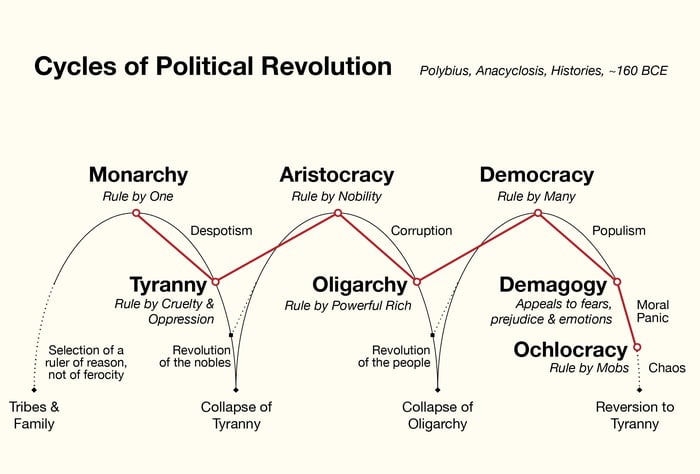
What he described was called anacyclosis, a recurring cycle of political systems. Governments begin in relatively stable forms, rule by one, by a few, or by many, but over time they degrade. Kingship becomes tyranny. Aristocracy becomes oligarchy. Democracy, when it loses discipline, collapses into what he called ochlocracy, rule by the mob.

This wasn’t abstract to the colonists, like I said,  they believed they were watching this pattern unfold in real time. And it shows up just as clearly in the political language of the founding era itself.


As Bailyn explains, monarchy, aristocracy, and democracy were each seen as capable of producing human happiness. But left unchecked, each would inevitably collapse into its corrupt form: tyranny, oligarchy, or mob rule.


Writings like Cato’s Letters were widely read in the colonies and helped shape how ordinary people understood government, power, and liberty.

What’s striking when you read Cato more closely is how little confidence they placed in moral restraint alone. It doesn’t describe freedom as unlimited expression or personal autonomy. The idea that belief, fear of God, or good intentions would keep power in check is treated as dangerously naive. Power is not self-regulating, and it is not made safe by the character or beliefs of those who hold it. It has to be exposed, limited, and actively resisted—because even institutions and ideas meant to restrain it, including religion, can be repurposed to justify its expansion.

It describes government more as a trust—one that exists to protect the conditions that make ordinary life possible.

As Cato writes:

“Power is like fire; it warms, it burns, it destroys. It is a dangerous servant and a fearful master”

And more directly:

“What is government, but a trust committed…that everyone may, with the more security, attend upon his own?”

The assumption is clear. Power must be restrained. Freedom depends on it.

But in Cato’s framing, that restraint doesn’t come from structure alone. It depends on constant exposure and resistance. Freedom of speech and a free press aren’t treated as abstract rights, but as active safeguards—tools for uncovering corruption and preventing power from consolidating unchecked. The logic is simple but demanding: power does not correct itself. It expands, protects its own interests, and, if left unchallenged, begins to operate beyond the limits it was given.

The point of understanding the political cycles of revolution wasn’t to say that any one system was uniquely flawed. It was that all systems are vulnerable to the same underlying problem:

Human nature.

Self-interest eventually creeps in. Restraint erodes. Power shifts from a trust into something personal and extractive.

And once that shift happens, the form of government matters less than the character of the people within it. That thread runs directly into the founding.

The American system wasn’t designed as a pure democracy. It was an attempt to stabilize a problem earlier thinkers had already identified.

Rather than choosing a single form of government, the founders built a mixed system, blending elements of rule by one, rule by a few, and rule by many. An executive to act with decisiveness. A Senate to provide deliberation and continuity. A House to represent the people more directly.

This wasn’t accidental.

It reflected an awareness that each form of government carries its own risks, and that concentrating power in any one place tends to accelerate its corruption.

By distributing power across different institutions, the goal was to create tension within the system itself. Ambition would check ambition. Competing interests would slow the consolidation of power.

From my understanding, they weren’t trying to escape the cycle Polybius described. They were trying to manage it.

They weren’t designing a perfect system. They were attempting to design one built to withstand imperfect people.

But even that depended on something it could not guarantee.
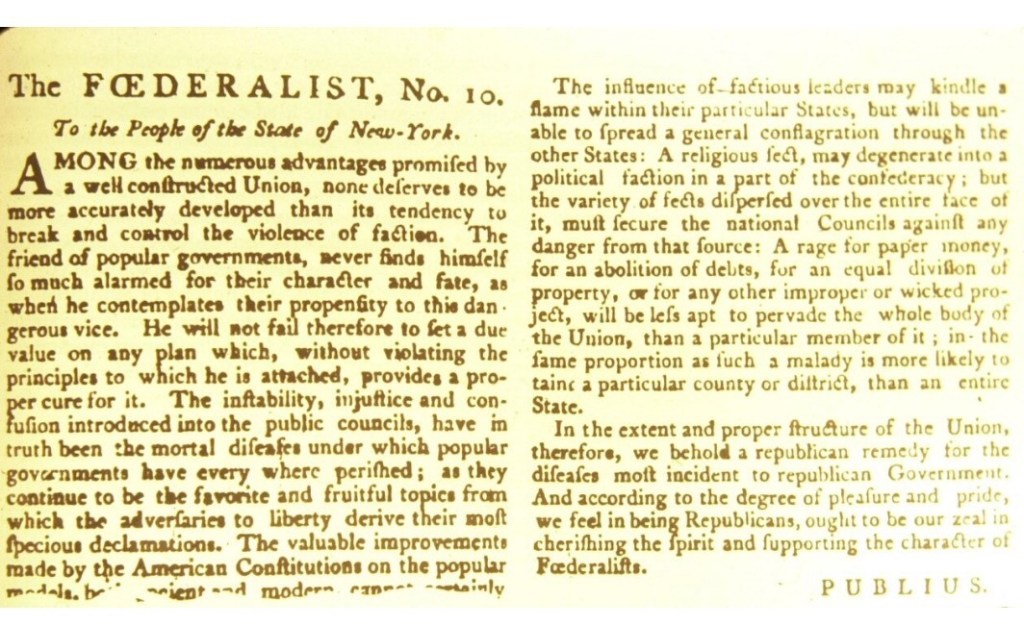
In Federalist No. 10, James Madison writes:

“The latent causes of faction are thus sown in the nature of man.”

He’s not describing a temporary problem. He’s describing a permanent one.

Differences in opinion, interests, wealth, and temperament don’t disappear. They organize. They form groups. And those groups will sometimes pursue aims that are at odds with the rights of others or the stability of the system itself.

Madison’s conclusion is straightforward:

“The causes of faction cannot be removed… relief is only to be sought in the means of controlling its effects.”

That distinction is crucial. He doesn’t try to eliminate conflict or force unity. He assumes conflict is inevitable and builds a system around that reality.

Instead of requiring perfect discipline from individuals, the structure disperses power, multiplies interests, and forces negotiation. Representation slows decision-making. Scale makes domination more difficult.

Freedom is preserved not by removing conflict, but by structuring it.


They looked ahead with anxiety, not confidence. Because they believed liberty was collapsing everywhere. New tyrannies had spread like plagues. The world had become, in their words, “a slaughterhouse.” Across the globe:  Rulers of the East were almost universally absolute tyrants…Africa was described as scenes of tyranny, barbarism, confusion and violence. France ruled by arbitrary authority. Prussia under absolute government. Sweden and Denmark had “sold their liberties.” Rome burdened by civil and religious control. Germany is a hundred-headed hydra. Poland consumed by chaos. Only Britain (and the colonies) were believed to still hold onto liberty. And even there… barely. From revolutionary-era political writings, as compiled by Bernard Bailyn


University of Virginia Rotunda-Modeled after the Roman Pantheon

II. Ordered Liberty and the Kind of Person It Requires

The founders believed in liberty, but not as an unlimited good. They believed in ordered liberty. Freedom that exists within a framework of responsibility, discipline, and civic virtue. The system they designed assumed a certain kind of person, one capable of self-governance, restraint, and participation in a shared moral world.

That assumption was not optional. It was structural. It’s easy to miss how much is built into that.

And this is where the modern tension and the current understanding of freedom begins to diverge from its origins.

Classical Liberalism, in its earlier form, was not about as Deneen states in Why Liberalism Failed, detaching individuals from all institutions, identities, or relationships. But it was about protecting individuals from tyranny while preserving the conditions necessary for a functioning society. It assumed the continued existence of family, community, religious frameworks, and shared norms.

But where Deneen is right, early liberal thought did introduce something new. 

John Locke, for example, reframed institutions like marriage as voluntary associations rather than fixed, inherited structures. That didn’t mean early liberal political philosophy was designed to erode the family. But it did change how those institutions were understood. It placed individual choice alongside social stability in a way that could be expanded over time.

To understand where this expansion comes from, you have to look at what came before it


Without freedom of thought, there can be no such thing as wisdom; and no such thing as publick liberty, without freedom of speech: Which is the right of every man, as far as by it he does not hurt and control the right of another; and this is the only check which it ought to suffer, the only bounds which it ought to know. Cato’s letters No.15


III. The Moral Inheritance of the West

The Lia Fail Inauguration Stone on the Hill of Tara in County Meath Ireland

In many pre-Christian societies, moral life wasn’t organized primarily around abstract rules or universal doctrines, but around continuity. Identity was tied to lineage, family, and inherited roles. Authority came not from individual preference, but from what had been passed down—customs, obligations, and expectations shaped over generations. To live well wasn’t just a personal project. It meant upholding something larger than yourself: maintaining the reputation of your family, fulfilling your role within a community, and carrying forward a way of life that you didn’t create but were responsible for preserving.

You can see how this played out in places like Anglo-Saxon England, where social structure and legal life were more embedded in family and local custom than in centralized doctrine. Women, for example, could own property, inherit land, appear in legal proceedings, and in some cases exercise real economic and political influence. These weren’t modern equality frameworks, but they complicate the assumption that agency and rights only emerge through later “progress.”

That structure did more than organize society. It created cohesion. It gave people a shared reference point for what mattered, what was expected, and what should be restrained—even when no one was watching. Authority wasn’t something constantly renegotiated. It was inherited, lived, and reinforced through participation in a shared way of life.

Greek and Roman life was also structured around civic duty, hierarchy, and inherited roles.

Their moral frameworks reflected that structure. Thinkers like Aristotle emphasized virtue as balance, habits cultivated over time within a community, oriented toward harmony and the common good.

As Christianity spread, moral authority became less tied to lineage and local custom, and more anchored in universal doctrine—rules that applied across communities, not just within them. Obligation didn’t vanish, but it was increasingly reframed. Less about inherited roles within a specific people, more about the individual’s relationship to a broader moral order.

That shift didn’t happen all at once, and it’s not a simple story. The development of early Christianity, its integration into the Roman Empire, and the ways it reshaped intellectual life and authority are far more complex than a few paragraphs can capture here. I’ve gone into that in more detail elsewhere, particularly around the Constantinian period and the rise of revelation and fall of reason.

This development intensifies further with the rise of Protestantism, where that reframing of obligation becomes even more explicit.The movement from the Seven Deadly Sins to the Ten Commandments as a dominant moral framework.
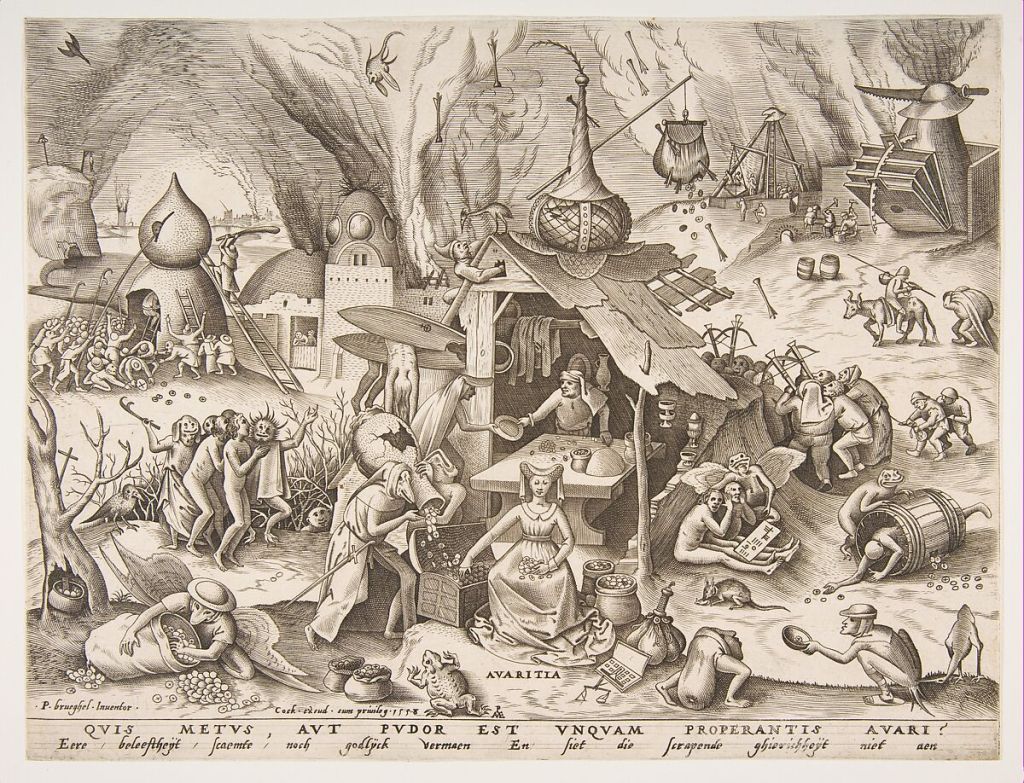
Avarice (Avaritia), from “The Seven Deadly Sins”
Pieter van der Heyden Netherlandish
After Pieter Bruegel the Elder Netherlandish
Publisher Hieronymus Cock Netherlandish
1558

The Seven Deadly Sins, pride, greed, lust, envy, gluttony, wrath, and sloth, are not rules in the strict sense. They describe internal dispositions, patterns of character that distort judgment and pull a person out of balance. They are concerned with formation, with who you are becoming.

The Ten Commandments, by contrast, are structured as prohibitions. You shall not. They define boundaries, obedience, and transgression in relation to divine authority.

Both frameworks aim at moral order. But they operate differently. One is oriented toward the cultivation of character within a shared moral world. The other emphasizes compliance, law, and accountability before God.

The Protestant Reformation further reduced the role of mediating institutions, emphasizing personal conscience, direct access to scripture, and an individual relationship to truth. Authority became less external and more internalized, but also more individualized and less uniformly shared.

The emphasis is unmistakable. Moral responsibility is no longer primarily inherited or communal, but individual and direct.

This did not dissolve the community. But it did begin to relocate the moral center of gravity, from the maintenance of balance within a community, to the accountability of the individual before God.

A political system built on individual rights and self-governance emerged from a cultural framework that had already begun to center moral responsibility at the level of the individual.

At the same time, Christianity reshaped how the natural world was understood. Earlier traditions often treated nature as infused with meaning, order, or even divinity. Christianity maintained that the world was ordered, but no longer sacred in itself. It was created, not divine.

That distinction introduced a kind of distance. A world that is no longer sacred in itself becomes, over time, easier to treat as something external, something to study, measure, and ultimately use.

None of these shifts were inherently destabilizing on their own. But they altered the underlying framework.

Over time, they contributed to a gradual reorientation, one that made it easier to conceive of the individual as separate, autonomous, and capable of standing apart from inherited structures.

That development would later be expanded and amplified through liberal thought.

But the point is not that Protestant Christianity caused modern individualism. It is that it helped make it thinkable.

By the time you reach the Enlightenment and the American founding, those earlier shifts had not disappeared. They had been carried forward and reworked into a new framework—one increasingly shaped by reason, not as a rejection of religion entirely, but as a refusal to let authority go unquestioned simply because it claims moral or divine legitimacy.
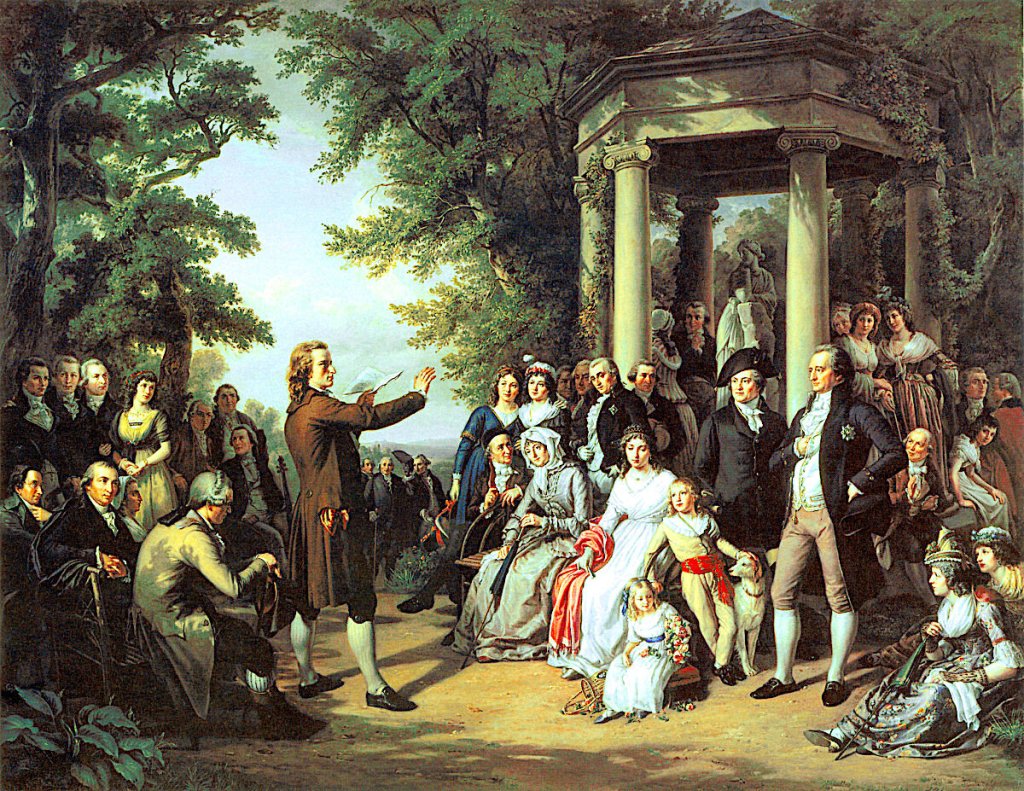

The state of nature has a law of nature to govern it, which obliges every one: and reason, which is that law, teaches all mankind, who will but consult it, that being all equal and independent, no one ought to harm another in his life, health, liberty, or possessions… (and) when his own preservation comes not in competition, ought he, as much as he can, to preserve the rest of mankind, and may not, unless it be to do justice on an offender, take away, or impair the life, or what tends to the preservation of the life, the liberty, health, limb, or goods of another.

-John Locke on the rights to life, liberty, and property of ourselves and others


IV. When Freedom Loses Its Structure
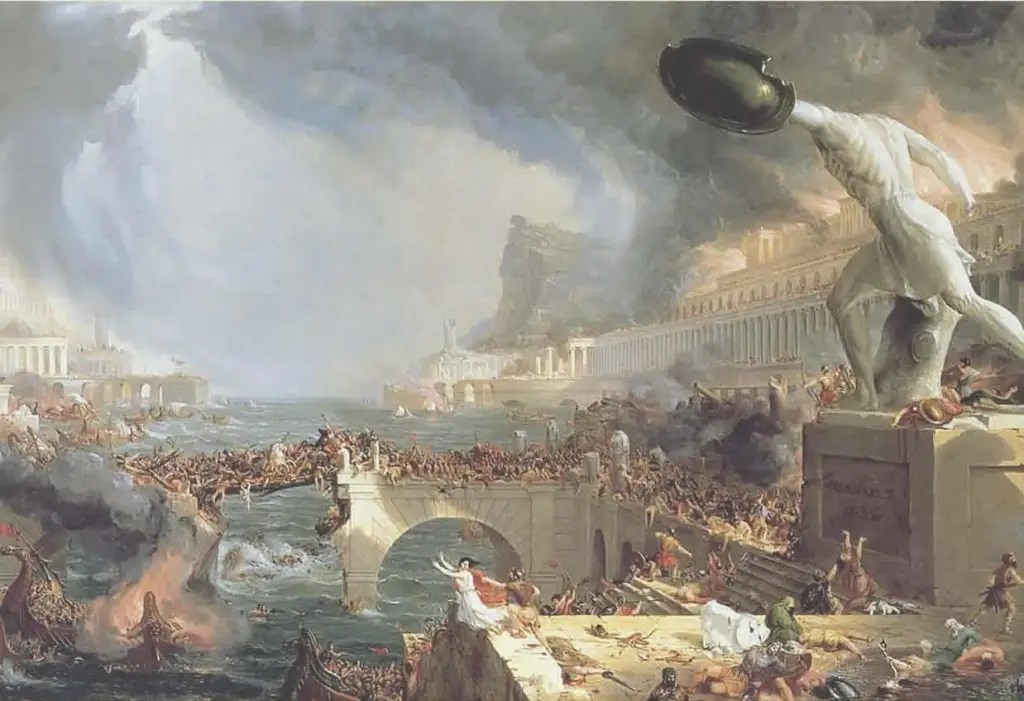
Over the next two centuries, that framework continued to expand. Early expansions focused on political participation—who could vote, who counted as a citizen, and who could take part in public life.

By the mid-20th century, that expansion accelerated through civil rights movements, which pushed the language of equality and access further into law, culture, and institutions.

In the 1960s into the 1970s, the focus widened into personal life. Questions of family, marriage, sexuality, and individual identity were increasingly reframed in terms of autonomy and personal choice.

The sexual revolution, in particular, was widely understood as an expansion of personal freedom: loosening traditional constraints around sex, marriage, and family life. But over time, some of the assumptions underlying that shift have come under renewed scrutiny. The idea that women can navigate complete sexual and relational autonomy without significant cost appears increasingly fragile, especially in the absence of the social structures that once provided stability and direction.

Expanding rights changes the system, not just access to it.

What’s often assumed is that this expansion is self-justifying—that extending rights is always a net good, and that the system can absorb that expansion without consequence. But that assumption is rarely examined.

As the scope of participation widens, so does the demand placed on the system and on the people within it.

A political system built on equal participation assumes a level of judgment, responsibility, and long-term thinking that is not evenly distributed. It assumes that individuals, given more freedom, will be able to navigate it without undermining the conditions that make it possible in the first place.

What we also see in modern times is the cultural and institutional structures that once shaped behavior—family expectations, community standards, shared moral frameworks have become much weaker, more contested, or easier to reject.

For most of known human history, moral behavior wasn’t just a matter of personal conviction. It was embedded in small, stable, reputation-based communities where actions were visible, remembered, and judged over time. Behavior carried consequences because it was tied to relationships that endured.

That community system relied on three conditions: shared standards, stable enforcement, and long-term relationships. As those weaken, accountability becomes less consistent or non existent. Not because human nature has changed, but because the structures that made behavior visible and tied to consequences have broken down.

Part of that shift is tied to the broader move toward secularism. As religious frameworks lose authority, the shared narratives that once provided cohesion, meaning, and moral orientation begin to fragment. This doesn’t eliminate the human need for structure—it shifts where people look for it. It disperses into competing sources of identity, morality, and meaning.

In The Republic, Plato makes a similar observation about belief itself. What matters is not just what people claim to believe, but whether those beliefs hold under pressure. “We must test them… to see whether they will hold to their convictions when they are subjected to fear, pleasure, or pain.”

Without shared structures reinforcing those convictions, belief becomes more reactive, more situational, and more easily reshaped by external forces.

We are left with a society of multiple, incompatible systems of belief—each with its own values, demands, and claims to legitimacy, but no widely accepted structure holding them together. 

What was once a shared moral world becomes a contested one.

In Propaganda, Edward Bernays makes a blunt observation: the conscious and intelligent manipulation of the masses is not only possible, but essential to managing modern society. That insight becomes more relevant, not less, in the absence of a shared framework.

Because when a society loses the unifying structures that once held it together, the vacuum doesn’t stay empty. New ideologies rush in (secular, political, cultural) offering belonging, morality, and meaning, often with more intensity than the systems they replaced.

More autonomy. Less formation. More fragmentation. Less agreement on what freedom even demands.

This raises a harder question: whether removing earlier constraints produced the kind of freedom it promised, or simply replaced one set of pressures with another.

As that imbalance deepens, people don’t simply become more independent. They look for stability elsewhere.

This is where Deneen’s observation becomes useful, even if I don’t fully agree with his framing. As traditional institutions weaken, dependence doesn’t disappear—it shifts. From local, relational structures to larger, more abstract systems like the state and the market.

Another way to see this is that societies don’t just rely on formal institutions. They rely on something less visible—a kind of cultural immune system. Shared norms, expectations, and informal boundaries that regulate behavior without constant enforcement.

When those weaken, systems don’t become freer. They become easier to exploit.

One of the clearest examples of that vulnerability is the modern corporation.

The American system was designed in deep suspicion of concentrated power, yet over time it has extended expansive protections to corporate entities, allowing large institutions, backed by wealth, media, and legal abstraction, to shape public life in ways the founding framework was poorly equipped to restrain. 

The founders were wary of concentrated power, but they were not designing a system for multinational corporations with vast economic and informational reach. Over time, constitutional doctrine expanded in ways that made these entities increasingly difficult to limit, culminating in decisions like Citizens United, where the Court held that independent political spending by corporations and unions could not be restricted under the First Amendment.

This is part of the same pattern. A system built to preserve liberty becomes easier to exploit when power no longer appears as a king, a church, or a visible ruling class, but as diffuse institutions operating through law, markets, and media.
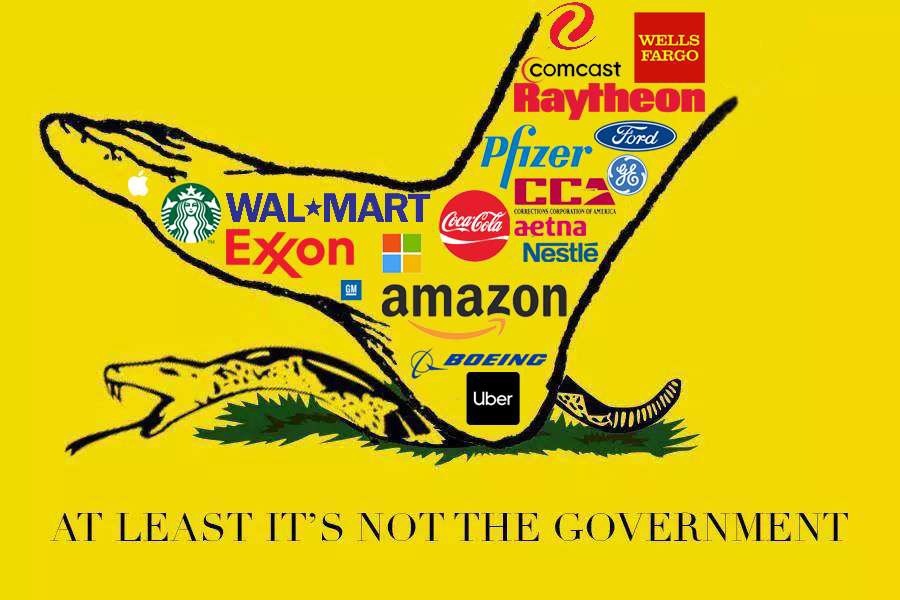
And as we have seen that happen, trust has eroded, cooperation breaks down, and the very conditions that made freedom possible have begun to unravel.

But I don’t think that was the original aim of classical liberalism.

It’s not that it set out to dismantle the community. It’s that over time, through cultural, economic, and technological changes, the balance between freedom and structure eroded. And now we’re dealing with the consequences of that imbalance.

The more I read, the harder it is to ignore the tension at the heart of the American Revolution itself.

It speaks the language of liberty, but often operated through pressure, surveillance, and social enforcement. Groups like the Sons of Liberty didn’t just resist authority—they replaced it with their own forms of coercion, loyalty tests, and public punishment.
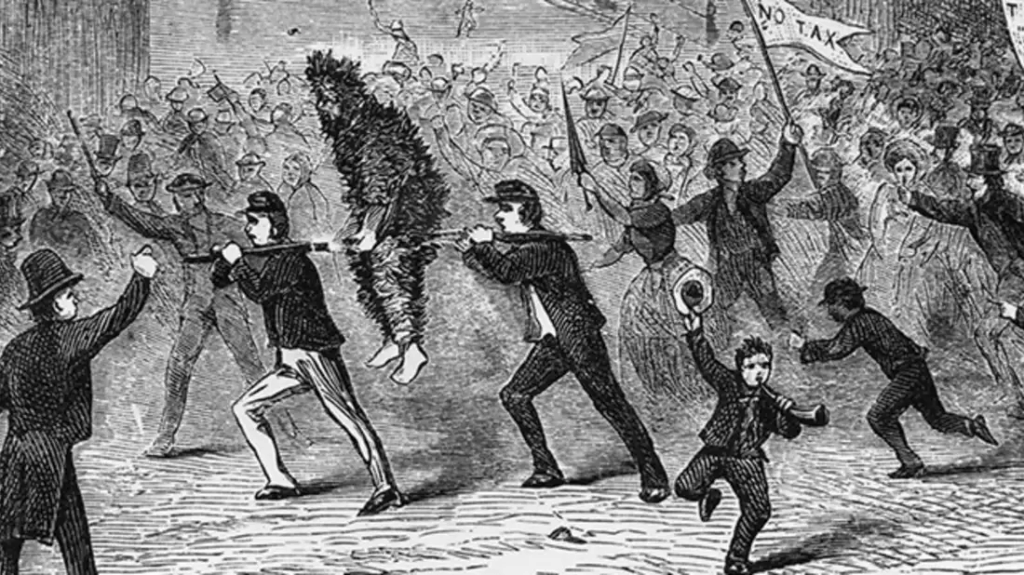
The sons of liberty regularly tar and feathered anyone who offended them or were officers of the British government.

I am not saying the ideals were wrong. It means liberty, on its own, doesn’t sustain itself.When formal authority is rejected, power doesn’t disappear. It simply relocates.

And without shared discipline or internal restraint, it often reappears in more fragmented, less accountable forms.

Liberty is not the absence of power.

It’s a problem of how power is structured, restrained, and lived.

There’s another reaction to this tension that’s worth acknowledging, even if it goes too far.

Thinkers like Mencken argued that the real problem isn’t the system, but the people—that democracy inevitably lowers the standard because it reflects the average citizen. 

And I understand the sentiment; but that framing misses something important.

The issue isn’t that people are inherently incapable of self-government.

It’s that self-government requires habits, discipline, and formation that a system alone cannot produce.

What makes this moment particularly interesting is that the unease people feel doesn’t map neatly onto political categories.

Across both the left and the right, there’s a growing intuition that something isn’t functioning the way it should.

You see it in the rare points of agreement. Public frustration over the lack of transparency in the Epstein files cuts across political lines, with overwhelming majorities convinced that key information is still being withheld and justice is yet to be served. 

You see it in foreign policy as well. Even in a deeply divided country, there is broad skepticism toward escalating conflicts like the war involving Iran, with many of us questioning the purpose, cost, and direction of involvement. 
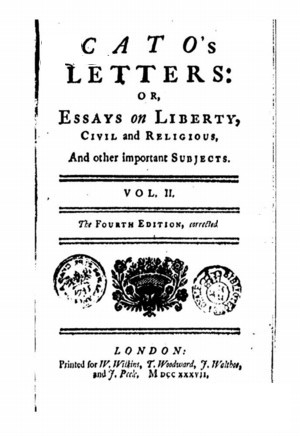
That concern isn’t new. It shows up clearly in Cato’s Letters, where distrust of power wasn’t abstract—it was grounded in history. The Roman Empire was a constant reference point, especially in how standing armies, once established, could be turned inward, gradually eroding liberty and consolidating control.

They weren’t against defense. But they were deeply wary of permanent military power and foreign entanglements that primarily served those in control, not the public. War wasn’t just protection. It was one of the fastest ways power could expand.

And it’s hard not to wonder how they would look at what we now call the military-industrial complex—how permanent it’s become, how embedded it is, and how easily it justifies its own expansion. 

Power attracts interests that seek to influence it through money, proximity, and favor and over time those interests become embedded within the system itself, shaping decisions in ways that are no longer aligned with the public.

How this shows up today in modern times points to the fact that governmental power no longer feels like a trust. We The People who want to put America and her people’s needs First, are witnessing an occupied government like never before. And that our institutions are no longer held accountable. They have become self-protective and disconnected from the very people they’re meant to serve.


“Power, in proportion to its extent, is ever prone to wantonness.” — Josiah Quincy Jr., Observations on the Boston Port-Bill (1774)

“The supreme power is ever possessed by those who have arms in their hands.” (colonial political writing, mid-18th century)

Standing armies, they warned, could become “the means, in the hands of a wicked and oppressive sovereign, of overturning the constitution… and establishing the most intolerable despotism.” — Simeon Howard, sermon (c. 1773–1775)

Which is why Jefferson insisted on keeping “the military… subject to the civil power,” not the other way around (1774).


There’s also empirical evidence from over a decade ago pointing in that direction. 
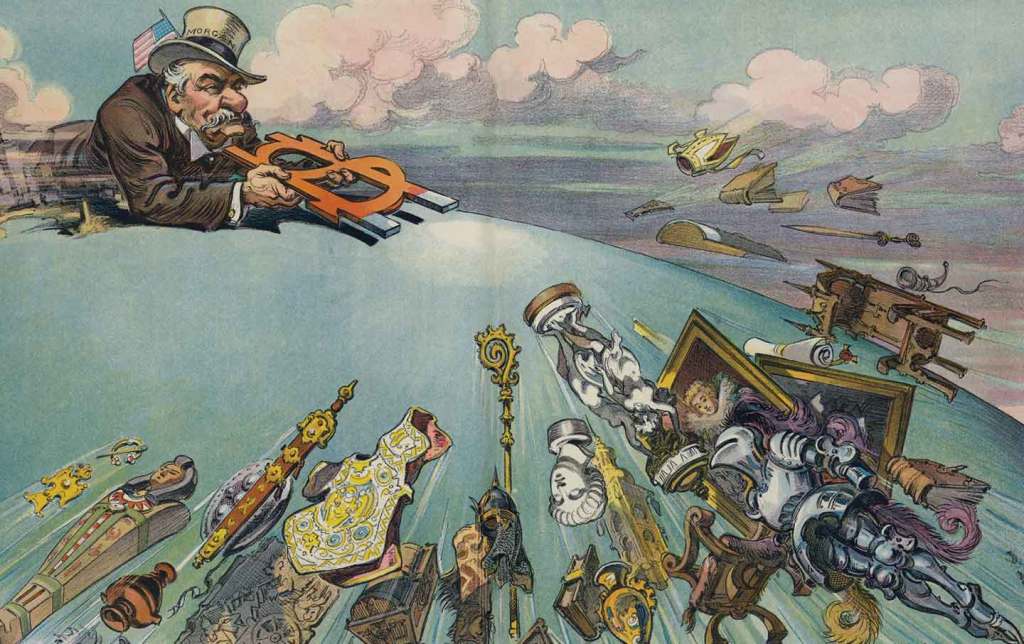
Sometimes known as “the oligarchy study” published in 2014 by Martin Gilens and Benjamin Page analyzed nearly 1,800 policy decisions in the United States and found that economic elites and organized business interests have a substantial independent influence on policy outcomes, while average citizens have little to no independent impact.

Policies favored by the majority tend to pass only when they align with the preferences of the wealthy. When they don’t, public opinion has almost no measurable effect.

This one study doesn’t prove that the system has fully collapsed into oligarchy.

But it does reinforce our intuition that something has shifted, that power is no longer functioning as it should and that representation is much more limited than we assume.

What I’ve learned from putting this together is that this concern is not new. It’s ancient.

It’s the same fear that appears in the Greek philosophers, carries through Rome, reemerges in the founding era, and is now unfolding again in modern society.

This is the same dynamic Madison was pointing to in Federalist No. 10. When legitimacy starts to weaken, people don’t simply disengage.

They form groups around competing explanations for what’s gone wrong—different interests, different priorities, different visions of what should replace it.

Within the modern left, those responses are not all the same.

Establishment Democrats still operate within existing systems. Liberals tend to push for reform through policy. Progressives begin to question the structure itself. And further out, democratic socialists and revolutionary groups are not aiming to fix the system, but to replace it entirely.

That distinction matters. Because once you move from reform to replacement, you’re no longer arguing about how to use a system.

You’re arguing about whether it should exist at all. At the far end of that spectrum, some movements push toward dismantling foundational structures entirely, treating them as irredeemably corrupt.

You can see this in specific, coordinated efforts.

Large-scale protest movements like the recent “No Kings” demonstrations, like on March 28th, 2026, bringing 8 million people into the streets across the United States. With more than 3,300 coordinated events spanning all 50 states, the mobilization set a record for the largest single day of protest in U.S. history.

They have planned actions like May Day strikes, where activists are calling for mass labor disruption and economic shutdown. And organized noncooperation campaigns designed to train people in how to resist, overwhelm, or halt existing systems altogether.

Their logic is that the system of capitalism is no longer seen as something to work within, but something to resist, bypass, or bring to a stop.

Not reform. But disruption and replacement.

I’ve spent enough time around these spaces to understand the appeal. When institutions feel captured or unresponsive, the instinct is not to reform them—but to burn them down to the ground.

Freedom is not collapsing because people have rejected it. It’s becoming unstable because we can no longer agree on what it is, what it requires, or what its limits should be.

And as more of the burden falls on individuals while leadership fails to model it, people start to feel both responsible and powerless. And that’s where apathy begins to take hold——when it no longer feels like it matters, especially to the people at the top.
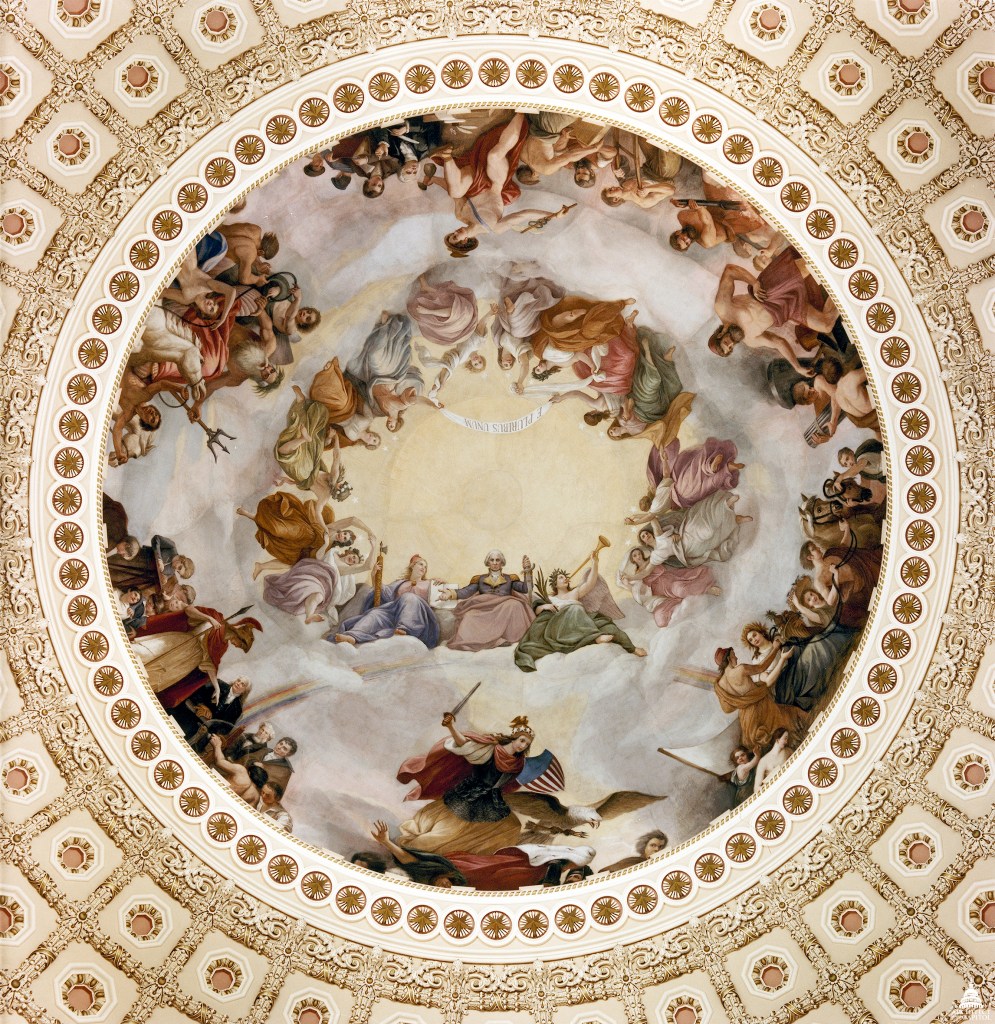
United States Capitol Rotunda — The Dome Painting “The Apotheosis of Washington” Painted by Constantino Brumidi in 1865

V. The Human Problem at the Center of Freedom

A republic doesn’t survive on laws alone.

It survives on citizens who can exercise restraint, who understand limits, who see freedom not just as permission, but as responsibility.

One way to understand this shift more clearly is through moral psychology. Human beings don’t arrive at morality purely through reasoning. We rely on a set of underlying intuitions (care, fairness, loyalty, authority, and a sense of the sacred) that shape how we judge right and wrong before we ever explain why.

In more conservative or traditional societies, these moral intuitions tend to operate together rather than in isolation. Care, fairness, loyalty, authority, and a sense of the sacred reinforce one another, creating a more unified moral framework. People may still disagree, but they are drawing from a shared moral language, with expectations around family, roles, restraint, and what should or should not be done.

But that kind of shared moral framework doesn’t hold evenly across modern society.
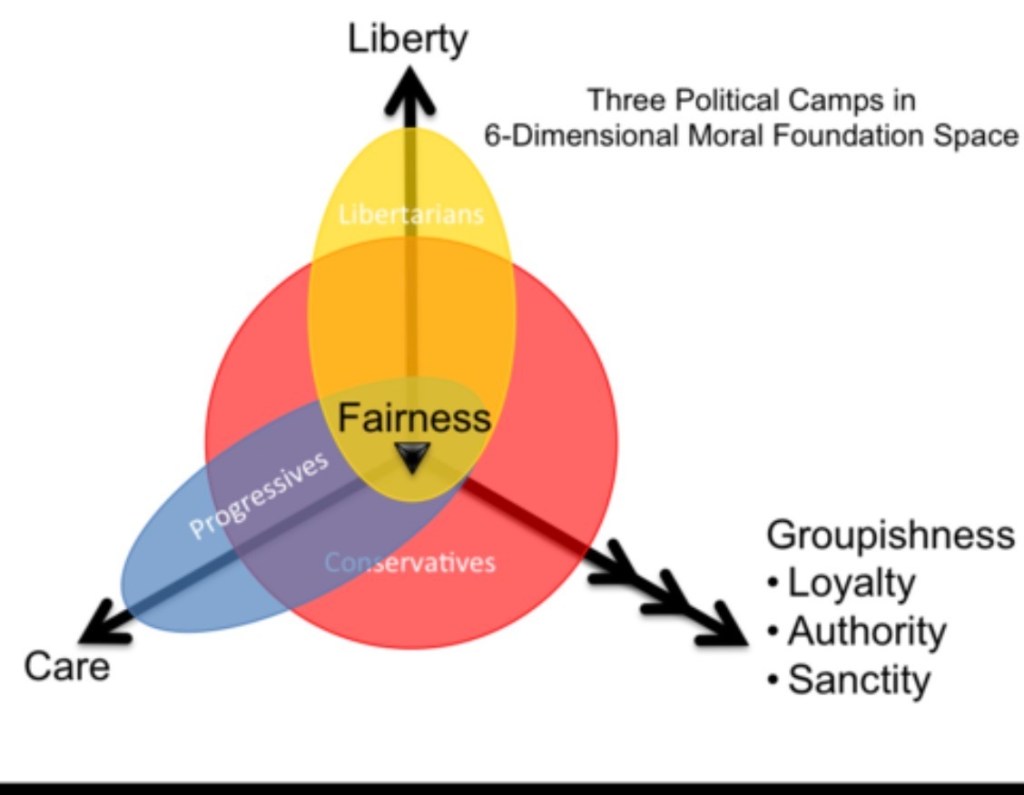
The second way to see this is by looking at how these moral intuitions organize into distinct patterns cluster across different groups. In the chart, you can see three broad orientations: progressives, conservatives, and libertarians. Progressives tend to cluster around care and fairness. Conservatives draw from a wider range, incorporating loyalty, authority, and a sense of the sacred alongside those concerns. Libertarians center heavily on liberty, placing less weight on the others. What looks like a disagreement about politics is often a difference in moral orientation—people emphasizing entirely different parts of the same moral landscape.

And the differences don’t just show up in orientation, but in intensity.
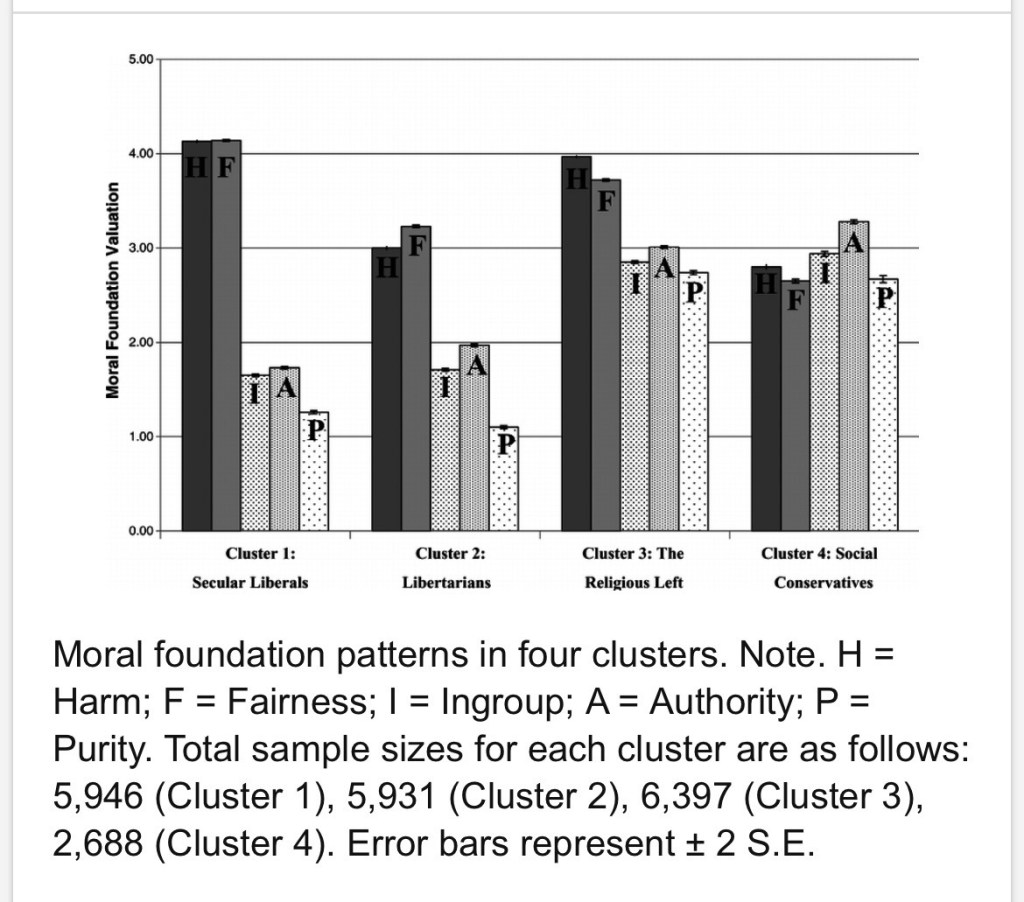
This bar graph illustrates this pattern more clearly when we look at how different groups actually prioritize these moral intuitions. 

Secular liberals and the religious left tend to emphasize care and fairness most strongly, focusing on reducing harm and promoting equality. By contrast, more traditional or socially conservative groups draw more evenly across a broader set of values, including loyalty, authority, and a sense of the sacred alongside care and fairness. Libertarians tend to narrow even further, prioritizing individual liberty while placing less emphasis on collective or traditional moral structures. 

The result isn’t just disagreement over morality—it’s a difference in what people are even measuring in the first place, which makes shared judgment harder to sustain.

You can see the split in how people respond to the same breakdown in trust.

For those on the left, freedom means removing constraint entirely and that leads to a push to dismantle systems they see as corrupt or oppressive. 

For those on the right, it produces deep suspicion: distrust of elections, media, public health authority, and government itself, along with a desire to restore order, stability, and clearer boundaries. In some cases, that turns into nostalgia for earlier structures: family roles, gender norms, and forms of religious authority that are seen as more stable, even if that restoration comes with its own trade-offs.

These aren’t just different political positions. 

They reflect different instincts about what matters most and different assumptions about what freedom is for.

And both risk missing the deeper question.

Not just: what system creates freedom?

But what kind of people can sustain it?

This is where Aristotle’s framework becomes difficult to ignore. In that sense, his may be closer to the truth than many modern assumptions. It starts from the premise that people are not equal in their capacity for judgment or self-governance—and builds from there, rather than pretending those differences don’t matter.

It shows up in how people live, how they make decisions, and how they exercise restraint. That’s where his framework of virtue comes in—not as an ideal, but as a way of describing what it actually takes to live well and participate in a functioning society.
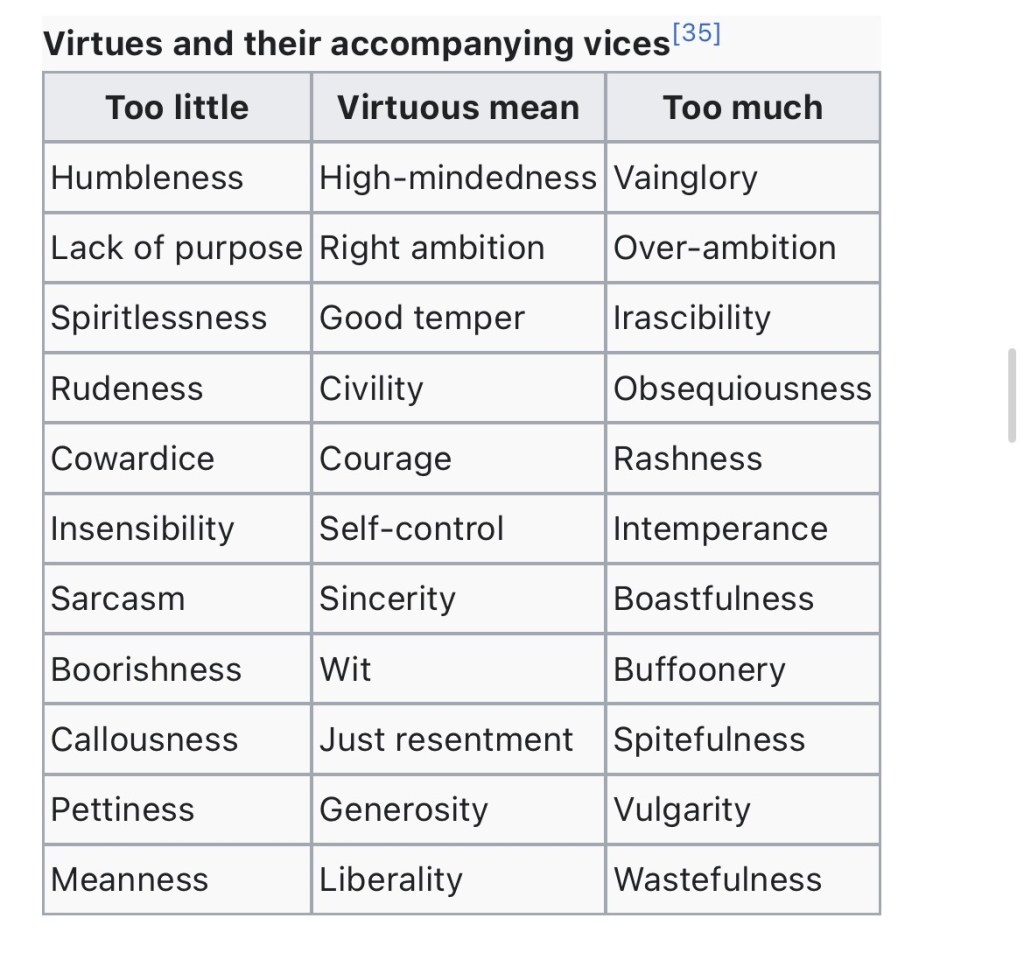
He didn’t think virtue was about perfection. He thought of it as balance. Courage sits between cowardice and recklessness.

Self-control between indulgence and insensibility.

Generosity between stinginess and excess.

Virtue is not automatic. It is cultivated. And it can be lost.

He applied that same logic to political systems. A government can exist in a healthy form, oriented toward the common good, or in a corrupted form, serving only a faction. At that point, the difference isn’t just structural. It comes down to character.

One tension that keeps resurfacing in political thought is the gap between equality in principle and inequality in capacity.

You can see this play out in small, everyday ways. Give ten people the same freedom, the same opportunity, the same set of rules—and you don’t get the same outcomes. Some plan ahead. Some act impulsively. Some take responsibility. Others look for ways around it. The structure is equal, but the response isn’t. 

Because human beings are not identical in judgment, discipline, or temperament. Some are more capable of long-term thinking, self-restraint, and navigating complexity than others.

A free society doesn’t eliminate those differences. It has to operate in spite of them. And that creates the real challenge.

A system built on self-government depends on habits it cannot enforce, on restraint it cannot require, and on a shared understanding of limits it cannot guarantee.

Which raises a difficult question:

What happens when a system built on equal freedom depends on unequal capacities to sustain it?

Freedom is not self-sustaining. The more we treat it like it is, the more fragile it becomes. 

When those conditions weaken, the structure doesn’t collapse all at once. It loosens, then drifts, and eventually begins to follow the same pattern that earlier thinkers warned about. 

Not because the idea of freedom was flawed, but because it was always contingent on something more demanding than we like to admit.

And that’s what makes the older warnings so difficult to ignore. The concerns that show up in Greek philosophy, carry through Rome, and reappear in the founding era weren’t tied to one moment in history. They’re describing something recurring. Power doesn’t stay put. It accumulates. It protects itself. And without pressure against it, it shifts (often quietly) into something more self-serving than it was at the start.

The documents and letters from the founding era weren’t written for a stable world. They were written by people who assumed this drift was inevitable. That’s why they were obsessed over things like faction, corruption, and the abuse of power. Not just as political problems, but as moral ones. Because once corruption sets in, it doesn’t just distort institutions. It reshapes the people within them. A corrupt government cannot be a just government. That’s why they treated free speech, free press and an informed public less like ideals and more like important tools—ways of forcing power into the open before it had the chance to consolidate.

Cato’s letters, in particular, were relentless on this point. They knew that a society that becomes consumed with wealth, status, and self-interest doesn’t just become unequal. It becomes easier to manipulate, easier to divide, and eventually less capable of governing itself at all. Civic virtue wasn’t a side note. It was the condition that made freedom possible in the first place.

And when you look at it from that angle, it doesn’t feel like you’re reading writings from the 18th century. It feels familiar, much closer to home. 

Of course, the scale is different now. The mechanisms are different. But the tension is very much the same. Governments and corporations operate with a level of reach the founders never could have imagined with technology. Information is filtered, behavior is shaped, and power often moves through systems that don’t look like power at all. You don’t always see it directly. But you feel the effects of it.

So the responsibility doesn’t go away. It never did.

If anything, it becomes less obvious and more necessary at the same time.

A system like this doesn’t hold because it was designed well. It holds, when it does, because enough people are still paying attention. Still pushing back. Still unwilling to let power define its own limits.

And once that slips…once that expectation fades, the structure doesn’t fail all at once. It just stops holding in the way it used to. And the pattern continues.
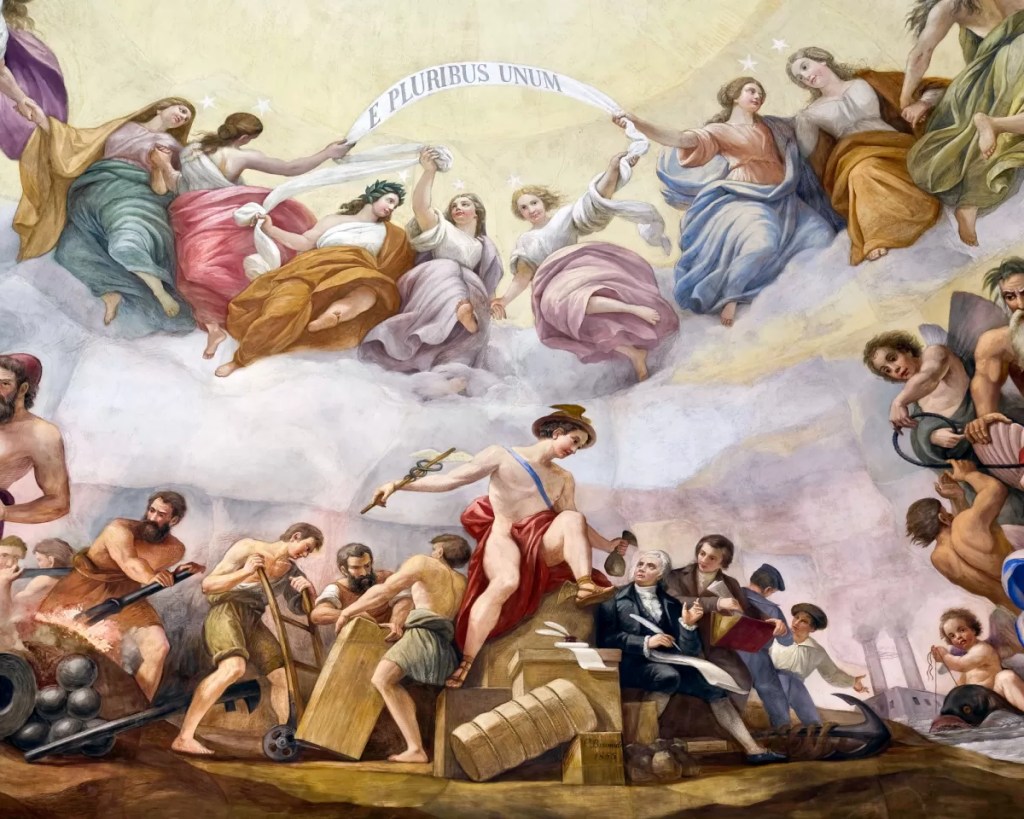
United States Capitol Rotunda — The Dome Painting “The Apotheosis of Washington” Painted by Constantino Brumidi in 1865

Resources: 

This piece pulls from a mix of ancient sources, founding-era writing, and modern critiques. Not because I agree with all of them, but because each one sharpens a different part of the problem. If you want to work through it yourself, these are the ones that shaped how I’m thinking about it:

Corporate Rights and the Most Absurd Legal Fiction: A Reactionary History and Analysis of Corporate Personhood

Bernard Bailyn — The Ideological Origins of the American Revolution
Less about what the founders built, more about what they were reacting to—especially the collapse of earlier republics.

Alexander Hamilton, James Madison, John Jay — The Federalist Papers
A direct look at how they thought about human nature, power, and why freedom needs structure to hold.

Patrick Deneen — Why Liberalism Failed
I don’t agree with all of it, but the critique of modern individualism and the erosion of shared norms is worth taking seriously.

Plato — The Republic
Still one of the clearest descriptions of how excessive freedom destabilizes a society.

Aristotle — Politics
Helpful for understanding how democracies drift when law loses authority and personality takes over.

Polybius — Histories
His framework for how governments rise and decay is hard to unsee once you see it.

Louise Perry — The Case Against the Sexual Revolution
A modern example of how expanded freedom doesn’t always produce the outcomes people expect.

Jonathan Haidt — The Righteous Mind
Useful for understanding why reason alone doesn’t hold societies together—and why people experience morality so differently.

Charles Freeman — The Closing of the Western Mind
Explores how early Christianity reshaped intellectual life in the West.
Also recommended: The Opening of the Western Mind

Roger E. Olson — The Story of Christian Theology
A clear overview of how Christian thought developed over time and how its internal tensions evolved.

Judith Bennett — Women in the Medieval English Countryside
Insight into everyday life, structure, and roles in pre-modern society.

Christine Fell — Women in Anglo-Saxon England
A look at social organization and cultural norms in early English society.
Social Miasm Theory: The Biology of a Sick Society

How Suppression Shapes Our Bodies, Minds, and the World We Live In

Hey hey, Welcome back! Today’s episode connects beautifully to something many of you resonated with in my earlier show, Science or Stagnation? The Risk of Unquestioned Paradigms. In that episode, we talked about scientism… not science itself, but the dogma that forms around certain scientific ideas.

That’s why voices like Rupert Sheldrake have always fascinated me. Sheldrake, for those unfamiliar, isn’t a fringe crank. He’s a Cambridge-trained biologist who dared to question what he calls the “ten dogmas of modern science”: that nature is mechanical, that the mind is only the brain, that the laws of nature are fixed, that free will is an illusion, and so on.

When he presented these questions in a TED Talk, it struck such a nerve that the talk was quietly taken down. And that raised an obvious question: If the ideas are so wrong… why not let them stand and fall on their own? Why censor them unless they hit something tender? All of this sets the stage for today’s conversation.

Because the theory we’re exploring, Social Miasm Theory, fits right inside that tension between mainstream assumptions and the alternative frameworks we often dismiss too quickly.

My friend Stephinity Salazar just published a fascinating piece of research arguing that suppression  (of toxins, trauma, emotion, and truth) is the root pattern underlying both chronic illness and our wider social dysfunction. It’s a theory that steps outside the materialist worldview and challenges the mechanistic lens we’ve all been taught to see through.

You don’t have to agree with everything…that’s not the goal here.

What I love is the chance to explore, to ask good questions, and to stay grounded while examining ideas that stretch our understanding.

This blog is your guide to the episode, so you can track the concepts, explore the references, and dive deeper while you listen.

So, with that, let’s dive into Social Miasm Theory: what it is, where it comes from, why it matters, and what it might reveal about the world we’re living in today.


What Are Miasms, Anyway?

To anchor our conversation, Stephinity starts by grounding the concept of “miasms” in its homeopathic roots. Historically, Samuel Hahnemann (founder of homeopathy) described three primary miasms:

  • Psora, linked to scabies or skin conditions
  • Syphilis, associated with destructive disease
  • Sycosis, with overgrowth and tissue proliferation

Since then, the theory has expanded. Many modern homeopaths now talk about five chronic miasms, adding:

These aren’t diseases…they’re patterns. A kind of “constitutional operating system.”

Stephinity’s work takes this a step further:
If individuals can have miasms, societies can too.

It’s an ambitious idea. And honestly? A compelling one when you consider what’s happening globally.


Why Social Miasm Theory Matters

Suppression doesn’t stay in the body. It echoes outward into culture, politics, ecosystems, and collective behavior.

She breaks suppression into four types:

  • Toxic suppression: chemicals, pollutants, EMFs, pathogens
  • Emotional suppression: trauma, grief, stress, unprocessed feelings
  • Psychological suppression: denial, cognitive dissonance, fear-driven attachment to ideology
  • Truth suppression: propaganda, censorship, disinformation, scientific dogma

When these forms of suppression accumulate, she argues, they create a “social miasm”: a pathological field that shapes everything from public health to political polarization.

Even if you don’t buy every mechanism she proposes, the metaphor works. And the patterns are hard to ignore.

Evidence, Epistemology, and Skeptics: What Counts as “Real”?

This is the part my skeptical listeners will perk up for.

In the interview, I asked her the question I knew many of you were thinking:
“How do you define evidence within this framework? What would you want skeptical listeners to understand before judging it?”

Stephinity argues that the modern scientific lens is too narrow. Not wrong—but incomplete. She sees value in:

  • case studies
  • pattern recognition
  • field effects
  • resonance models
  • historical cycles
  • experiential knowledge

Whether or not you agree, her challenge to mechanistic materialism echoes thinkers like Rupert Sheldrake, IONS researchers, and even physicists questioning entropic cosmology.

And she’s not claiming this replaces science. She’s asking what science misses when it refuses to look beyond the physical.


Suppression: What It Looks Like in Real Life

Stephinity’s paper covers how suppression shows up on multiple levels. Here are a few examples she explores:

  • Overuse of symptom-suppressive medications
  • Emotional avoidance that pushes trauma deeper
  • Social pressure to conform
  • Institutional censorship
  • Environmental toxins that overwhelm the microbiome
  • Radiation and electromagnetic exposures

She frames suppression as a terrain problem: when the body or society becomes too acidic, stressed, toxic, or disconnected, the miasm takes root.

This is where we start to cross into the biological, psychological, and social layers—which brings us to one of my favorite parts of her theory.


Neuroparasitology: When Parasites Change Behavior

The concept of a new branch of science of neuroparasitology. Study of the influence of parasites on the activity of the brain.

This is the section I teased in the podcast because it’s both wild and backed by real research.

Stephinity references studies showing that parasites can alter host behavior not just in insects or rodents, but potentially in humans too. Her paper cites examples like helminths, nematodes, mycotoxins, and other microorganisms (McAuliffe, 2016; Colaiacovo, 2021). These organisms are everywhere, not just in “developing countries” (Yu, 2010).

Researchers have documented parasites that:

  • influence mood
  • shift risk-taking
  • modify sexual attraction
  • impair impulse control
  • change social patterns

This is what Dawkins called the extended phenotype (1982): the parasite’s genes expressing themselves through the host’s behavior. Neuroparasitologists Hughes & Libersat (2019) and Johnson (2020) have shown how certain infections can shift personality traits in specific, predictable ways.

Stephinity ties this into terrain: parasites tend to thrive in acidic, low-oxygen, stressed, radiative environments (Clark, 1995; Tennant, 2013; Cerecedes, 2015). In her view, chronic suppression creates exactly that kind of internal ecosystem.

But there’s another layer here. One that isn’t biological at all.

This is where philosopher Daniel Dennett enters the chat.

In Breaking the Spell, Dennett describes “parasites of the mind”: ideas that spread not because they’re true, but because they’re incredibly good at hijacking human psychology. These mental parasites latch onto our cognitive wiring the same way biological one’s latch onto the nervous system. They survive by exploiting:

  • fear
  • moral impulses
  • tribal loyalty
  • the desire for certainty
  • social pressure
  • existential insecurity

According to Dennett, religious dogmas, conspiracy theories, and ideological extremes act like memetic parasites: they replicate by using us, encouraging us to host them and then pass them on.

In other words: not all parasites live in the gut. Some live in the mind.

And…..we even discussed how billionaire Les Wexner once publicly described having a “dybbuk spirit” a kind of parasitic entity in Jewish folklore known for influencing personality. Whether symbolic or literal, the analogy fits. 🫨😮

Her point is simple:
When the terrain is weak, something else will fill the space.

Whether that “something” is trauma, ideology, toxicity, or a literal parasite… the mechanism rhymes.


Collective Delusion and Mass Psychosis

Drawing on Jung and Dostoevsky, Stephinity explores the idea that societies can enter “psychic epidemics.”

You’ve seen this. We all have…

The last decade has been a masterclass in how fear, propaganda, and emotional suppression create predictable patterns:

  • polarization
  • tribal thinking
  • moral panics
  • ideological possession
  • scapegoating
  • censorship
  • intolerance of nuance

She argues these are symptoms of a cultural miasm—not failures of individual character.

Whether you lean left, right, or somewhere out in the wilderness, you’ve likely felt this rising tension. And it’s hard not to see how unresolved collective trauma feeds it.


COVID as a Catalyst: What the Pandemic Revealed

Another part of her paper dives into how the pandemic brought hidden patterns to the surface.

Some of her claims are controversial, especially around EMFs and environmental co-factors. In the episode, we unpack these with curiosity, not blind acceptance.

Her larger point is that COVID exposed:

  • institutional fragility
  • scientific gatekeeping
  • public distrust
  • trauma-based responses
  • authoritarian overreach
  • the psychological toll of suppression

Whether you agree with the specific mechanisms or not, the last decade made one thing undeniable: something in our social terrain is deeply dysregulated.


8. Healing Forward: What Do We Do With All This?

If suppression drives miasms, then healing means unsuppressing. Gently, not chaotically.

Stephinity suggests practices like:

  • emotional honesty
  • reconnecting with nature
  • releasing stored trauma
  • nutritional and detoxification support
  • reducing exposure to chronic stressors
  • restoring community and meaning
  • opening space for spiritual or intuitive insight

She’s not prescribing a protocol. She’s offering a map.

The destination is what the Greeks called sophrosyne: a state of balance between wisdom and sanity. Not blissful ignorance, not paranoid awakening. Just grounded clarity.

And I think we could all use a bit more of that.


Key Evidence and Arguments

  • Stephinity critiques materialist science, calling out what she terms “entropic cosmology.” She argues that by assuming nature is strictly mechanistic, mainstream science misses field-based phenomena, non-local consciousness, and deeper systemic patterns.
  • She draws on historical and homeopathic sources (Hahnemann, Kent) to build her theoretical foundation but also argues for newer forms of evidence: resonance, case studies, and pattern detection in social systems.
  • On the environmental front, she explores links between toxins, EMF / 5G, biotech, and chronic disease, not just as correlation, but as evidence of suppression dynamics.
  • Psychologically, she invokes mass delusion or collective repression (drawing from Jung, Dostoevsky) seeing societal crises as expressions of buried collective shadow.
  • Ultimately, her call to action isn’t just for individual healing, but for systemic awakening: more transparency, alternative medical paradigms, and restored connection with nature.

Why This Matters for You

Even if homeopathy isn’t your jam, Social Miasm Theory offers a metaphor (and potentially a map) for understanding how inner repression becomes external crisis. If this episode does anything, I hope it gives you permission to look a little closer and question the stuff we’re told not to touch.


📚 Want to Dig Deeper?

Stephinity’s website: YOUR BODY ELECTRIC YOUR BODY ELECTRIC | FULL SPECTRUM FREQUENCY MEDICINE Find her on Linkden , Instagram and Substack

Social Miasm Theory: Revisiting Chronic Illness from a Meta-Perspective of Suppression [truncated version, pre-JSE publishing]

Official published paper

Miasms

https://www.unifiedfield.info/

https://corbettreport.com/how-the-government-manufactured-covid-consent

Use of fear to control behavior in Covid crisis was ‘totalitarian’, admit scientists

Escaping One Cult, Joining Another? The Trap of Ideological Echo Chambers

When ‘Cult Recovery’ Looks a Lot Like a New Cult

I had a lot of different topics in mind for my final solo episode of Taste of Truth Tuesdays Season 3. For example, The Stress-Mitochondria Connection: How B vitamins, Taurine and Magnesium Fuel your Energy, A world without religion: Freedom or Fragmentation, How Emotional Trauma contributes to Chronic Pain or the Social Media Dilemma How to Break Free from the Digital Grip… But then, a new development landed right in my lap—one that perfectly encapsulates the concerning trends I’ve been observing in the deconstruction, ex-Christian, anti-MLM, and ex-cult communities.

My friend Brandie, who I had on in Season 2 for the episode From Serendipity to Scrutiny, recently blocked me. And why? Because I simply pushed back and asked questions. We’d had some private conversations in the DMs that had already raised red flags for me, but apparently, even the slightest bit of pushback was enough to get me cut off. This isn’t just about one friendship—it’s about a much bigger pattern I’ve seen unfolding.

The Deconstruction Pipeline: When Leaving a High-Control Group Means Entering Another

One of the biggest ironies in the ExChristian circles is how quickly people flee high-control religious environments only to land in equally dogmatic ideological spaces. This isn’t a coincidence—it’s human nature. As Jonathan Haidt lays out in The Righteous Mind, our reasoning evolved more for argumentation than truth-seeking. We are wired for confirmation bias, and when we leave one belief system, we often replace it with another that feels equally absolute but now appears “rational” or “liberating.”

This is where figures like Steven Hassan and Janja Lalich come in (because this isn’t just about Brandie) self-proclaimed experts on cults who, ironically, exhibit the same control tactics they claim to expose. Hassan, a former Moonie turned cult deprogrammer, has made a career out of helping people escape authoritarian religious systems. But a deeper look at his work reveals an ideological bent (it’s hard to ignore). He frequently frames conservative or traditional religious beliefs as inherently cult-like while giving progressive or leftist movements a pass. He has called Trumpism a cult but is conspicuously silent on the high-control tactics within certain progressive activist spaces. His criteria for what constitute undue influence seem to shift depending on the political context, (BITE model) making his framework less about critical thinking and more about reinforcing his preferred ideological narrative. I did what Hassan won’t: use his own model to break down the mind control tactics of the extreme left.

Janja Lalich follows a similar pattern. A (supposedly) former Marxist-Leninist, she applies her cult analysis primarily to religious and right-wing groups while glossing over the coercive elements in the far-left spaces she once occupied (or still does). Her work is valuable in breaking down how high-demand groups operate, but she, too, appears to have blind spots when it comes to ideological echo chambers outside of the religious sphere. These represent a pattern rather than an isolated incident. Other platforms like (The New Evangelicals, Dr. Pete Enns (The Bible for Normal People), Eve was framed, Jesus Unfollower, Dr. Laura Anderson just to name a few.) highlight control tactics when they appear in traditional or conservative groups but fail to apply the same scrutiny to their own ideological circles.

This selective analysis creates a dangerous illusion: it allows people leaving fundamentalist religious spaces to believe they are now “free thinkers” while unknowingly adopting another rigid belief system. The deconstruction pipeline often leads former evangelicals straight into progressive activism, where purity tests, ideological loyalty, and social shaming operate just as effectively as they did in the church. The language changes: “sin” becomes “problematic,” “heresy” becomes “harmful rhetoric”, but the mechanisms remain the same.

Haidt’s work on moral foundations helps explain this phenomenon. Progressive and conservative worldviews are built on different moral intuitions, but both can be taken to extremes. The key to avoiding ideological capture is intellectual humility—the ability to recognize that no belief system has a monopoly on truth and that reason itself can be weaponized for tribalism.

John Stuart Mill warned of this centuries ago: the greatest threat to truth is not outright censorship but the cultural and social pressures that make certain ideas unspeakable. Greg Lukianoff and Jonathan Haidt’s The Coddling of the American Mind echoes this concern, showing how overprotective thinking and emotional reasoning have created a generation that confuses disagreement with harm.

Franklin O’Kanu’s concept of the “fake intellectual” is particularly relevant here—people who claim to be champions of free thought while aggressively enforcing ideological orthodoxy.

In this episode, through my experience with Brandie, I’ll illustrate how skepticism is selectively applied, and how ‘critical thinking’ communities can become just as dogmatic as the systems they reject. And unlike Hassan or Lalich, my connection with Brandie was personal. And that’s why I felt this warranted an entire podcast episode. Because what happened with her is a microcosm of a larger issue: people leaving high-control spaces only to re-enter new ones. They are convinced that this time, they’ve finally found the “truth.” Spoiler alert: that’s not how truth works.

So, let’s talk about it.


Blocked for Asking Questions

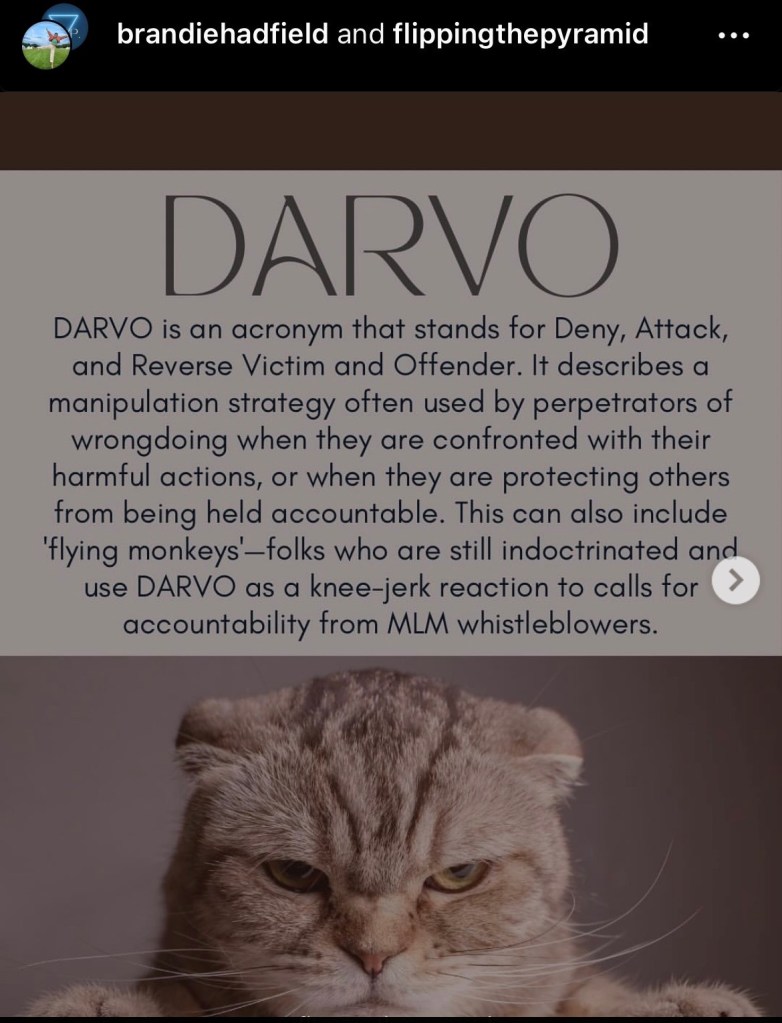
Recently, Brandie posted on Instagram about DARVO—a psychological tactic where abusers Deny, Attack, and Reverse Victim and Offender to avoid accountability. I agree that MLMs use DARVO. But I wanted to add friendly pushback, that I’ve noticed anti-MLM advocates use similar tactics to silence critics—especially when it comes to questioning the food industry— but she had turned the comments off.

So I went to Substack, wrote a note, tagged her and asked for us to have a discussion. and that’s when she blocked me. Not for being aggressive. Not for being rude. But for questioning her narrative.

So much for open conversation.

DARVO: The Classic Manipulation Tactic

DARVO stands for Deny, Attack, Reverse Victim and Offender—a tactic frequently used by abusers, cult leaders, and high-control groups when they’re called out. It flips accountability on its head, making the person asking legitimate questions seem like the aggressor while the actual manipulator plays the victim.

How MLMs Use DARVO

Multi-Level Marketing (MLM) schemes thrive on DARVO because their entire business model is built on deception. Here’s a classic example:

  1. Deny – A distributor is confronted with the fact that 99% of people in MLMs lose money. Instead of addressing the data, they deny it completely:
    “That’s just a myth! I know tons of people making six figures!”
  2. Attack – When pressed further, they go on the offensive, accusing the skeptic of being negative or jealous:
    “Wow, you’re so close-minded. No wonder you’re not successful!”
  3. Reverse Victim and Offender – Finally, they paint themselves as the victim and the questioner as the bully:
    “I’m just a woman trying to build a business and empower others. Why are you trying to tear me down?”

This tactic shuts down meaningful discussion and keeps people trapped in a system that exploits them.

Do you know what else exploits individuals? Fear and propaganda.

I saw this firsthand in a recent conversation with a friend who’s deeply entrenched in leftist ideologies and what I’d call “Trump Derangement Syndrome.” She shared a post warning people to change their bank accounts because of a false claim that Elon Musk’s staff had access to personal financial data. I pointed out that the post was misinformation, but instead of engaging with the facts, the conversation quickly shifted in a way that mirrors the DARVO tactic.

First, she denied that the post could be harmful or misleading. Then, she attacked me for not understanding the larger “fear” that people are feeling in the current political climate. Finally, she reversed the roles, casting herself as the victim of a chaotic world and me as the one creating unnecessary tension by questioning the post.

This is a textbook example of DARVO, a tactic that deflects accountability, shifts blame, and keeps people trapped in fear-driven narratives. It keeps them from having honest, fact-based conversations and prevents any real understanding of what’s going on around them.

How Brandie Used DARVO on Me

Ironically, despite being an anti-MLM advocate, Brandie used the exact same manipulation tactics when I pushed back on some of her positions. This is a woman who criticizes manipulative marketing tactics in MLMs, yet here she was, employing the very same tactics in our discussion. It’s a stark example of how these patterns can be so ingrained that even those who oppose them can fall into using them.

Deny – When I questioned her promotion of dietitians who endorse processed foods like Clif Z Bars (which recently faced a class-action lawsuit for misleading health claims), she refused to acknowledge the legitimate concerns. Instead, she dismissed it by claiming that caring about food ingredients was more stressful for the body than just eating the food itself—a false dichotomy that undermines any nuance in the conversation, especially when she often critiques the same logical fallacy in other contexts.

Attack – Rather than engaging with my points, she made it personal, implying that I was being antagonistic or bad-faith for even questioning her stance.

Reverse Victim and Offender – Finally, when I didn’t back down, she blocked me, flipping the narrative to make it seem like I was the one causing harm simply by asking questions.


When Therapy Becomes Thought Control: The Weaponization of Mental Health

What makes this dynamic even more interesting is that both my friend in Portland and Brandie, an anti-MLM advocate, are therapists. These conversations have all unfolded within a culture that professes to value feelings, emotional well-being, and mental health awareness. More people are going to therapy than ever before, and an increasing number of people are training to become therapists—mostly women. Currently, around 70-80% of psychologists and therapists are female, and those seeking help are also more likely to be female.

The field has increasingly become a vehicle for ideological activism. Dr. Roger McFillin has spoken extensively about this shift, describing how therapy now often reinforces victimhood narratives rather than fostering resilience. Instead of helping clients process experiences and build coping skills, many therapists nudge them toward predetermined ideological conclusions—especially in areas of identity, oppression, and systemic injustice.

This shift has eroded one of psychology’s most fundamental ethical principles: informed consent. Clients, particularly young and vulnerable individuals, are often funneled into ideological frameworks without realizing it. Under the guise of “affirming care” or “social justice-informed therapy,” therapists may subtly guide them toward specific worldviews rather than offering a full range of perspectives. What should be a process of self-discovery instead becomes thought reform, where questioning the prevailing narrative is framed as harmful or regressive.

Therapy is no longer just political—it has become a mechanism of enforcement. We see this in counseling programs that demand ideological conformity from students, in therapists who blur the line between clinical work and activism, and in public figures like Janja Lalich and Steven Hassan, who claim to expose undue influence while engaging in the same tactics. This is ideological gatekeeping disguised as expertise.

Rather than fostering open exploration, the field is increasingly defined by rigid dogma. Questioning the dominant ideology isn’t framed as critical thinking—it’s labeled as resistance, ignorance, or even harm. And when that happens, dissenting voices aren’t debated; they’re erased. If this trend continues, therapy won’t just be a tool for self-improvement. It will be a tool for social control. It already is.


The Hypocrisy of Selective Skepticism

Brandie and the anti-MLM crowd claim to combat misinformation, yet they overlook a significant issue: the influence of Big Food and Big Pharma on public health narratives.

On her social media story and in private conversations, Brandie has defended dietitians who actively promote ultra-processed foods. Some registered dietitians with large platforms endorse products like Hawaiian Punch and Clif Z Bars as acceptable—even healthy—options.

Clif Z Bars, for example, were recently involved in a $12 million class action settlement for falsely marketing their products as “healthy and nutritious.” These bars are 37% added sugar, essentially sugar bombs.

Yet, a dietitian Brandie supports feeds these bars to her young children, publicly calling them a “healthy snack.” Why is this not considered misinformation?

A deeper issue lies in the conflicts of interest within the nutrition field. 95% of the 2020 U.S. Dietary Guidelines Advisory Committee members had conflicts of interest with the food and pharmaceutical industries. Many had financial ties to corporations like Kellogg, Abbott, Kraft, Mead Johnson, General Mills, and Dannon. Similarly, a 2023 report by U.S. Right to Know revealed that 65% of the 2025 Dietary Guidelines Advisory Committee had high-risk or medium-risk conflicts of interest with industry actors like Novo Nordisk, the National Dairy Council, Eli Lilly, and Weight Watchers International.

Interestingly, both Clif Z Bars and Hawaiian Punch—the two foods mentioned in this discussion—are owned by Mondelēz International, a company that has faced scrutiny over its ties to government-advising scientists and other potential conflicts of interest. This raises an important question: How much of what we’re told by credentialed experts is shaped by corporate influence rather than unbiased science?

These conflicts of interest raise serious concerns about industry influence over public health recommendations. Yet, if you question this, you’re labeled anti-science.

This kind of blind faith in authority is no different from religious dogma. The pursuit of truth should always leave room for debate. This also highlights why blindly trusting “credentialed experts” is insufficient. Degrees and titles don’t guarantee that recommendations are free from corporate influence.

Rather than acknowledge these conflicts, Brandie and her followers discredit those asking valid questions, often accusing them of using the “Just Asking Questions” fallacy.

The “Just Asking Questions” Fallacy

A common tactic used to dismiss skepticism is labeling it as the “Just Asking Questions” (JAQ) fallacy. This fallacy occurs when people imply that merely questioning an issue is a form of misinformation or bad faith argumentation.

Many dietitians and anti-MLM advocates are deeply entrenched in mainstream narratives on topics like vaccine safety, climate change, and pharmaceutical efficacy. When skeptics ask pointed questions about these subjects, they are often accused of using JAQing off—a term that suggests they are sowing doubt without providing counter-evidence. The accusation assumes that asking difficult questions is inherently conspiratorial, rather than a legitimate means of inquiry.

But skepticism is not the same as denialism. Critical thinking demands that we interrogate all claims—especially those made by institutions with financial or ideological incentives. Dismissing questions outright only serves to protect entrenched power structures.


The Counterpoint: Intellectual Humility and the Dogma of Data

While it’s vital to engage critically with the information we’re presented, it’s equally crucial to consider the potential pitfalls of blind adherence to any ideology—whether it’s religious, political, or scientific. In the modern age, science and data have often become the new forms of dogma. The scientific community, which prides itself on skepticism and inquiry, is sometimes treated as an unassailable authority—leaving no room for dissent or alternative perspectives.

The worship of science and data as infallible can feel eerily similar to religious dogma. It demands conformity in the name of progress, dismisses alternative viewpoints, and often shuts down debate—all while asserting that it’s in the name of critical thinking and rationality. In this system, the pursuit of truth can ironically become an exercise in tribalism and intellectual rigidity.

What is critical to recognize is that science and reason themselves are not immune to bias, corruption, or influence. Take, for example, the “revolving door” between regulatory agencies and the pharmaceutical industry, which compromises the integrity of public health policies. This conflict of interest is a significant factor in the mistrust surrounding many mainstream health recommendations, especially when we see how corporate interests shape the outcomes of clinical trials, the approval of drugs, or public health initiatives.

Take the nutrition field, for example. The dietitian mentioned earlier endorses Clif Z Bars for her young children, but if you challenge this, you’re accused of being anti-science or fear-mongering.

Similarly, when figures like RFK Jr. highlight pharmaceutical industry ties to regulatory agencies, critics don’t engage with the data. Instead, they attempt to discredit the person asking the questions.

The Real Issue is Deception from Trusted Intuitions

The real misinformation often stems from corporate-backed institutions. Public trust in physicians and hospitals fell from 71.5% in April 2020 to 40.1% in January 2024—not due to misinformation, but because people witnessed firsthand the contradictions, shifting narratives, and financial incentives behind public health decisions. Trust is eroded by deception, not by questioning.

RFK Jr. isn’t “sowing doubt” for the sake of it. He’s pointing out documented cases where pharmaceutical companies have manipulated clinical trials, buried adverse data, and exercised significant influence over regulatory bodies. His book The Real Anthony Fauci outlines a heavily researched case against the unchecked power of Big Pharma and its ties to government agencies. If his claims were false, he would face lawsuits, yet his work continues to spark vital discussions.

True skepticism means demanding better science, not blindly trusting authority. The real danger lies in silencing those who ask critical questions.


Big Food and the Shaming of Health Advocates

A recent study has revealed something I find all too familiar: intimidation tactics used by industries like Big Tobacco, ultra-processed food companies, and alcohol sectors to bully and silence researchers, whistleblowers, and anyone challenging their agenda. This tactic—used by Big Food to discredit critics—reminds me of the way people are shamed or bullied for questioning processed foods or advocating for healthier diets. If you’ve ever pointed out the risks of sugary snacks or fast food, you’ve probably been labeled an extremist, a health-obsessed “wellness warrior,” or worse, a “purity culture” advocate. I can’t help but feel this is just another form of gaslighting, where we’re told that it’s worse to worry about the ingredients in our food than it is to consume those ingredients, even if they are known to contribute to chronic health conditions.

Ironically, this kind of manipulation is the same strategy Big Tobacco used for decades to muddy the waters around the health risks of smoking. And now, ultra-processed food companies are doing the same thing—distracting us from the very real, documented consequences of a poor diet.


Why We Need to Trust Ourselves, Not JUST the Experts

What frustrates me is how the anti-MLM community often jumps on wellness advocates who want to clean up their diets for health reasons. While I agree that MLMs are a breeding ground for manipulation, this should not mean we ignore the very real need to question the food industry’s stranglehold on our diets and health. It’s vital to recognize that not all experts have your best interests at heart. Many of the mainstream recommendations we’re told to follow come from organizations or industries with questionable motives—whether it’s Big Pharma, Big Food, or Big Tobacco. These same industries have a long history of misleading the public, and many of their experts are bought and paid for by corporate interests.

Wanting to improve your diet to manage or reverse chronic health conditions shouldn’t be dismissed as obsessive or extreme. It’s a rational, self-preserving choice that empowers you to take control of your health, even when the mainstream narrative tells you otherwise.


Is This Healing or Just Another High-Control Belief System?

Brandie often talks about “cult recovery” and the importance of psychological resilience. But is she really modeling resilience? Because true resilience isn’t about avoiding discomfort—it’s about engaging with it, questioning your own biases, and standing firm in discussions, even when they challenge your worldview.

Instead, she’s teaching people to coddle their minds. To create ideological echo chambers where questioning the “right” experts is heresy. To avoid any perspective that might cause discomfort. If she’s teaching people to avoid discomfort rather than work through it, I’m not sure how that aligns with the principles of ethical psychotherapy.

True healing requires grappling with discomfort, not running from it. When you teach people to shut down their discomfort rather than confront it, you’re not promoting growth—you’re just pushing them into another high-control belief system.

That’s not healing. That’s just another form of control.

And let’s be real—if your response to fair, thoughtful criticism is to shut down the conversation and block people who used to support you, you haven’t actually deconstructed anything. You’ve just built a new echo chamber with different branding.


The Bigger Picture

This isn’t just about Brandie. It’s about a larger pattern I see in the deconstruction and anti-MLM communities. Many of them claim to be freeing minds, but in reality, they’re just recruiting people into a different kind of ideological purity test.

The message is clear: You’re allowed to be skeptical, but only in the “approved” ways.

That’s not intellectual freedom. That’s just another cult.


Where Do We Go From Here?

We need real conversations about manipulation and misinformation—whether it comes from MLMs, Big Food, Big Pharma, or influencer dietitians who profit from pushing corporate-backed narratives. It means we need to question everything—without replacing one unquestionable authority with another. And we need to be willing to hold all forms of power accountable, not just the ones that fit neatly into our existing beliefs.

Because if we’re not careful, we’ll escape one high-control group only to fall right into another.

Sources:

Consent Isn’t Enough: The Harsh Truth About “Sex Work”

Beyond the Glamour: The Dark Reality of the Sex Industry

Welcome back to Taste of Truth Tuesdays. Today’s episode is one that I’ve both been eager and hesitant to share. While I’ve spoken about my journey through faith, fitness and personal transformation that there’s one chapter I’ve largely kept private until now….

For most of my life, I was fed a specific narrative: go to college, get a degree, build a career, and don’t worry about prioritizing marriage or family. Financial independence was the ultimate goal.

After graduating college, I moved from Virginia to Portland, Oregon, to chase my career as a personal trainer, lifestyle coach, and professional circus performer. My income relied on clientele, and while I had busy seasons, nothing was ever truly stable. But with inconsistent income and the ever-present pressure to make ends meet, I found myself in a space that many glamorize but few truly understand—the world of sugar dating.

At first, it didn’t seem that different from the casual dating I was already doing—except now, dinner was covered, and there was a financial incentive. But the deeper I got, the more I realized how unstable and unsafe it was. Most of these men didn’t care about you as a person; they just wanted no-strings-attached access to your body. And when I found myself in situations where I wasn’t in control—where boundaries were ignored, protection was negotiable, and at times, I left empty-handed even after doing my part—I started to see the cracks in the ‘empowerment’ narrative. I remember one night, sitting in my car after being verbally and physically assaulted, I realized I had no one to report it to. No way to warn the next woman. That’s when the illusion fully shattered for me.

That’s why today’s conversation is so important. I’m joined by Sloane Wilson from Exodus Cry, an organization dedicated to exposing the truth about sexual exploitation and advocating for survivors. We’re unpacking the hard truths about the sex industry, the myths that keep women trapped in it, and the cultural shifts that have normalized what should never be considered “just work.”

But we’re also diving into something deeper, faith. Both Sloane and I have gone through our own journeys of deconstruction and reconstruction. She’s seen firsthand how the church can mishandle encountering survivors and how delicate and complex these situations can be.

The Reality of “Sugar Dating”

Some nights felt harmless—like having dinner with a businessman who just wanted company and conversation. But most nights? They were anything but that. The truth is, the fantasy of sugar dating—mutually beneficial, long-term arrangements with financial stability—was just that: a fantasy. Most men weren’t offering monthly allowances or ongoing support. They wanted pay-per-meet agreements—no strings attached, no safety net, just transactional sex. And when survival depended on it, I found myself scrambling to secure the next “daddy.”

I struggled to assert myself, especially in two key areas: insisting on protection and ensuring I was paid upfront. That put me at immense risk—both for my health and my safety. One night, I was forced into acts I didn’t consent to, verbally assaulted, and then left empty-handed. Sitting in my car afterward, I realized something chilling: there was no one to report it to. No way to warn the next girl. No system to hold these men accountable.

Some men had hidden home cameras, recording our time together without my consent. Others were forceful, rough, and used sex toys in ways that crossed every boundary I had. And yet, as awful as those experiences were, I knew I was lucky—because it could have been so much worse.

Most of these men pushed to move conversations off the platform as quickly as possible, demanding explicit photos before agreeing to meet. When you’re in a financial bind, it’s hard to say no. That’s how exploitation thrives—through desperation.


The Trap of a “Luxe” Illusion

Looking back, I wonder—why didn’t I just walk away? Why couldn’t I see, from the beginning, that this wasn’t sustainable? I wasn’t like most women in the industry. I was white, college-educated, and didn’t even have student debt shackling me. My financial stress came from my own reckless spending—maxed-out credit cards and the relentless costs of bodybuilding, a sport I was pouring everything into. So why, with all the options I had, did I keep chasing this?

I think part of it was desperation. The MLM-like promise of sugar dating had me convinced that if I just worked harder, played the game right, and landed the right arrangement, I could have financial security and independence. I put more energy into curating the perfect sugar persona than I ever did into building my personal training business. And maybe, just maybe, I was chasing the mirage of someone close to me—someone who had made sugar dating “work.” I saw her succeed, and I kept believing I could, too.

But there’s another layer. One I don’t love admitting (and one my mom will absolutely deny.) My mother praised me for it. She told me, “I wish I had done this when I was your age.” That kind of validation messes with your perception of right and wrong. It made it seem like I was onto something genius, like I had cracked code other women were too scared or too moralistic to try. Was I subconsciously trying to prove something? Was I filling the void left by emotional neglect?

Or was it just my own damn fault?

That’s the thing about these choices—they never come down to just one reason. It is always more complex. It wasn’t just the financial stress. It wasn’t just my upbringing. It wasn’t just the influence of someone I admired. It was all of it, tangled together, keeping me locked in place. And it took me years to realize that no amount of effort or strategy would turn sugar dating into the safety net I desperately wanted it to be.


The Lie of “Sex Work is Work”

For a long time, I believed the mantra: “sex work is work.” It’s the rallying cry of the sex-positive movement, a phrase meant to legitimize the industry. Prostitution is often called “the oldest profession,” but historically, it has always been a last resort for survival. Women don’t enter this industry because it’s empowering. They do it because they have no better options.

The real harm in prostitution isn’t just about bad working conditions or societal stigma. It’s about dehumanization. When sex is reduced to a transaction, people become commodities. And when we treat people like products to be bought and sold, we strip them of their dignity.

Louise Perry, in The Case Against the Sexual Revolution, makes this point powerfully. She argues that the sex industry’s only real defense is a hollow, commodified version of “liberation”—one that insists, “Everyone consents, everyone is an adult, the women enjoy it, so who are you to judge?” But when consent is the only moral standard, we ignore the broader ethical issue: that people are being treated as means to an end. Consent alone does not erase coercion, exploitation, or harm.

In our postmodern culture, we’ve rejected objective morality and replaced it with a consumerist approach to sex. If both parties “agree,” then anything goes. But this is a dangerous slope—one that allows predatory men to exploit desperate women under the guise of empowerment.


Insights from Recent Research

New research exposes the blurred lines between sugar dating and traditional sex work. A study published in The Journal of Sex Research found that over one-third of sugar babies have engaged in other forms of transactional sex work, such as escorting or stripping. This challenges the narrative that sugar dating is different or “classier” than prostitution. The reality? It operates on the same fundamental exchange.

The study also found that sugar benefactors reported an average of over six arrangements, indicating a revolving door of sugar relationships. For these men, sugar dating is just another avenue for purchasing companionship and sex.

Beyond the emotional toll, sugar dating carries serious legal and personal risks. Legal experts warn that these arrangements can lead to blackmail, coercion, and threats—especially when expectations aren’t met. Many women find themselves in vulnerable situations with no real recourse. The illusion of control is just that—an illusion.


The Flawed Narrative Around Sex Work and Deconstructing Purity Culture

In the deconstruction space, there’s a growing trend of equating sexual liberation with empowerment while rejecting any critique of the sex industry as moral panic. A popular post circulating on International Sex Workers Day exemplifies this mindset, arguing that deconstructing purity culture requires deconstructing any negative views of sex work. The claim? Sex work and sex trafficking are entirely separate, and many big Christian anti-trafficking organizations wrongly conflate the two to push an agenda. The post insists that if a person is not forced, defrauded, or coerced, they are simply making a free choice to engage in sex work. But this argument is deeply flawed when examined through historical context, real-world data, and the experiences of women who have lived through it.

The Demand Problem: Why Legalizing Sex Work Doesn’t Protect Women

One of the most critical oversights in this argument is the failure to acknowledge that sex work is a demand-driven industry. As Louise Perry outlines in The Case Against the Sexual Revolution, countries that have legalized prostitution have seen an increase in trafficking. Why? Because legalizing the industry normalizes the demand for paid sex, and when there aren’t enough willing participants, traffickers step in to fill the gap. Studies show that in places like Germany and the Netherlands, where prostitution is legal, trafficking rates have skyrocketed because the market rewards pimps and exploiters. The idea that sex work can be fully separate from trafficking ignores the economic reality that supply follows demand.

Linda Lovelace’s experience in Deep Throat is a perfect example of this. The film was a massive success, grossing over $600 million, and was hailed as revolutionary at the time. But years later, Lovelace revealed that she had been coerced into performing in the film under violent and abusive conditions. Her book Ordeal exposed the hidden abuse within the industry—an industry that thrives precisely because there is a market for extreme, degrading content. This isn’t an isolated case; countless women have echoed similar stories after leaving the industry, only to be dismissed while they were still in it because they were expected to uphold the “liberation” narrative.

The Exploitation Behind the Industry

Another major flaw in the sex-work-as-liberation argument is the lack of accountability within the industry itself. MindGeek, the corporation behind the world’s largest pornography sites, has faced multiple civil lawsuits for monetizing non-consensual content—including child sexual abuse, rape, revenge pornography, and voyeuristic recordings of women showering. Reports from December 2020 revealed that the platform was infested with videos depicting abuse and that it profited from some of the darkest corners of human sexuality.

The industry thrives on the illusion that all participants are willing, yet it repeatedly fails to ensure consent. The reality is that the vast majority of those in sex work come from backgrounds of financial instability, trauma, or coercion—not from an empowered, freely chosen career path. The notion that sex work is “just another job” ignores how uniquely dangerous, exploitative, and often inescapable it can be.

The Broader Issue: Normalizing Harm Under the Guise of Liberation

This same pattern of dismissing harm under the banner of liberation isn’t exclusive to the sex industry. I recently came across another example in the deconstruction space where an account that advocates for women’s sexual empowerment was documenting her abortion experience on National Abortion Day. She filmed herself taking the abortion pill as if it were nothing—a casual, almost celebratory act. But this kind of messaging erases the medical realities and risks associated with the abortion pill. It ignores the fact that women absolutely should get an ultrasound before taking it to determine gestational age and rule out ectopic pregnancy, which can be fatal if left untreated. Reducing such a serious medical decision to a political performance trivializes the real consequences that many women face.

This connects back to the issue with sex work: the rush to de-stigmatize everything labeled as “empowerment” often leads to a dangerous lack of critical thought. If deconstruction is about questioning harmful narratives, then why aren’t we allowed to question the harm within the sex industry? Why does rejecting purity culture mean embracing an industry that, time and time again, has been built on coercion, abuse, and exploitation?

Deconstructing purity culture shouldn’t mean abandoning discernment. If anything, it should mean taking an even closer look at these industries and asking hard questions about who truly benefits from them. Because when we actually listen to the stories of women who have left sex work, the pattern is clear: what is sold as empowerment often turns out to be exploitation in disguise.

Healing & Advocacy

Looking back, my perspective has completely shifted. The journey out of the sex industry has been long and complicated, but I’m grateful for the clarity I have now. Organizations like Exodus Cry work to expose the realities of the commercial sex trade and fight for real change. And voices like Louise Perry’s are crucial in dismantling the harmful myths that keep this industry alive.

The sexual revolution promised liberation, but for many women, it delivered exploitation instead. The more we normalize the commodification of sex, the more we enable the very systems that harm us. It’s time to rethink everything we’ve been told about “sex work” and start asking: Who really benefits from this industry? Because it’s certainly not the women inside it.

If you’ve ever questioned the narrative around sex work, if you’ve been curious about the reality behind sugar dating, or if you want to hear from someone who’s been there—I invite you to tune in.

It’s time to move beyond the glamour and face the truth.

Resources:

The Hidden Tactics of Big Food and Big Tobacco

A Christmas Lesson in Gaslighting

As we gather around our holiday tables, indulging in sweet treats and sipping warm drinks, there’s something deeply unsettling happening behind the scenes of what we consume every day. A recent study has revealed something I find all too familiar: intimidation tactics used by industries like Big Tobacco, ultra-processed food companies, and alcohol sectors to bully and silence researchers, whistleblowers, and anyone challenging their agenda.

These industries have a long history of using misinformation, manufactured doubt, and emotional manipulation to protect their profits—and it’s not just limited to public health campaigns. This plays out in everyday conversations, too. It’s a pattern that many of us have experienced firsthand, especially those who advocate for healthier lifestyles and more transparency in what we put in our bodies.


A Christmas Paradox: Big Food’s Gaslighting & the Anti-MLM Pushback

This tactic—used by Big Food to discredit critics—reminds me of the way people are shamed or bullied for questioning processed foods or advocating for healthier diets. If you’ve ever pointed out the risks of sugary snacks or fast food, you’ve probably been labeled an extremist, a health-obsessed “wellness warrior,” or worse, a “purity culture” advocate. I can’t help but feel this is just another form of gaslighting, where we’re told that it’s worse to worry about the ingredients in our food than it is to consume those ingredients, even if they are known to contribute to chronic health conditions.

Ironically, this kind of manipulation is the same strategy Big Tobacco used for decades to muddy the waters around the health risks of smoking. And now, ultra-processed food companies are doing the same thing—distracting us from the very real, documented consequences of a poor diet.


Why We Need to Trust Ourselves, Not the Experts

What frustrates me is how the anti-MLM community often jumps on wellness advocates who want to clean up their diets for health reasons. While I agree that MLMs are a breeding ground for manipulation, this should not mean we ignore the very real need to question the food industry’s stranglehold on our diets and health. It’s vital to recognize that not all experts have your best interests at heart. Many of the mainstream recommendations we’re told to follow come from organizations or industries with questionable motives—whether it’s Big Pharma, Big Food, or Big Tobacco. These same industries have a long history of misleading the public, and many of their experts are bought and paid for by corporate interests.

Wanting to improve your diet to manage or reverse chronic health conditions shouldn’t be dismissed as obsessive or extreme. It’s a rational, self-preserving choice that empowers you to take control of your health, even when the mainstream narrative tells you otherwise.


Unwrapping the Truth This Holiday Season

This holiday season, let’s unwrap a new perspective: critical thinking over consumerism, authenticity over convenience, and self-empowerment over external pressures. It’s time we stop letting industries dictate our health choices and start reclaiming agency in what we put into our bodies.

If you’ve ever been gaslighted for your food choices, or made to feel like you’re ‘too much’ for caring about your health, know you’re not alone. The more we learn about these intimidation tactics, the better equipped we’ll be to call them out.

As we approach the new year, let’s challenge the status quo—questioning not just what’s on our plates, but the motives of the systems that feed us.

Kamala Harris: Facts vs. Political Rhetoric

As Election Day nears, political posts and talking points become increasingly prominent, urging voters to support particular candidates based on curated narratives. Recently, I encountered a post advocating for Kamala Harris that presented a series of arguments while sidestepping deeper context and misrepresenting the records of her and other candidates. Instead of providing accurate, nuanced information, the post relied on sensational claims, oversimplifications, and misinformation. Here’s a breakdown to help you navigate the facts and understand why informed decision-making is essential.

For example, relying on polls to create urgency without diving into each candidate’s strengths and weaknesses feels more like fearmongering than honest discussion. Voters deserve transparency and facts, not tactics to pressure them into a specific choice. Here’s a breakdown of some problematic points from a recent post urging support for Kamala Harris—and why we should be cautious of these tactics.

1. Misleading Use of Project 2025

A key part of the post references Project 2025, presenting it as if it’s Trump’s official policy agenda. However, this isn’t accurate. Project 2025 is a proposal from a conservative think tank, the Heritage Foundation, designed to outline a vision for a future administration that aligns with its goals. It’s not an official platform, nor has Trump explicitly committed to implementing it. Misrepresenting this proposal as Trump’s policy can create confusion among voters and detracts from a real understanding of each candidate’s agenda. Informed voting hinges on focusing on what candidates have actually endorsed and outlined rather than speculative proposals, allowing voters to evaluate their commitments.

2. Economic Claims and Inflation

One of the contentions in recent political discourse is the characterization of inflation and economic performance during Donald Trump’s presidency. Some critics argue that the lower prices experienced during Trump’s tenure can be attributed solely to a “regular economic cycle,” suggesting that his policies had little to no meaningful impact on inflation levels. This perspective oversimplifies a complex economic landscape shaped by multiple interacting factors.

The Complexity of Economic Influences

To understand the dynamics of inflation and economic health, it’s essential to consider the various elements at play:

  • Global Markets: Fluctuations in international markets can significantly influence domestic prices. Changes in demand and supply chains due to global events—such as trade disputes or natural disasters—can create ripples that affect the cost of goods and services.
  • Supply Chain Dynamics: The intricate web of global supply chains has a profound impact on inflation. Disruptions, whether from natural disasters, pandemics, or geopolitical tensions, can lead to shortages and increased prices, regardless of domestic policy.
  • Federal Monetary Policies: The role of the Federal Reserve in managing interest rates and money supply is crucial. Monetary policies can stimulate or slow down economic growth, directly affecting inflation rates.
  • External Events: Economic cycles are indeed one part of the equation, but they are often influenced by external events. Historical precedents show that natural disasters, international conflicts, or pandemics (like COVID-19) can drastically alter economic trajectories.

Reducing the conversation about inflation to mere “economic cycles” ignores the multifaceted nature of economic health and the implications of policy decisions. Voters deserve a comprehensive understanding of how each candidate’s proposals could shape the economy.

Kamala Harris’s Role in Current Inflationary Trends

As the current Vice President, Kamala Harris is intricately linked to the Biden administration’s policies, which have faced significant criticism regarding inflation. Many argue that the administration’s approach has exacerbated economic challenges rather than alleviating them:

  • Spending Policies: The Biden administration has implemented extensive spending programs, which, while aimed at stimulating the economy, have drawn criticism for contributing to rising inflation. Critics assert that such fiscal policies, coupled with pandemic-related stimulus measures, have flooded the market with cash, driving demand without sufficient supply.
  • Regulatory Measures: Harris, as part of the administration, has supported regulatory frameworks that some argue have hindered economic recovery. Increased regulations on energy production, for instance, have been linked to rising fuel prices, further impacting household budgets.
  • Border Policies: The current administration’s handling of immigration and border security has also been scrutinized. Critics contend that a lack of effective border management has led to disruptions in labor supply, further contributing to inflationary pressures in various sectors.

The Need for Informed Decision-Making

To make informed decisions, voters must critically evaluate the economic proposals put forth by each candidate. Understanding the interplay between inflation, job growth, and the average household budget is crucial. The stakes are high, and voters deserve clarity on how proposed policies may directly impact their lives.

By engaging with these complex economic realities, voters can hold candidates accountable for their roles in shaping economic outcomes. The conversation should not be reduced to simplistic narratives about cycles; instead, it should encompass a thorough examination of policies, their implications, and the broader economic context.

Complexity > Simplification

In an era of heightened economic anxiety, it’s vital for voters to seek out nuanced discussions about inflation and economic health. As we navigate the complexities of the current economic landscape, we must hold our leaders accountable for their policy decisions and strive for a deeper understanding of how these choices affect our everyday lives. The responsibility lies with both voters and candidates to engage in meaningful discourse, ensuring that the electorate is equipped to make informed choices that reflect their values and priorities.

3. Reproductive Rights and Personal Stories

The post suggests that voting for Harris is vital for preserving reproductive freedoms, referencing tragic stories of women denied abortion care due to restrictive laws.

The Impact of Restrictive Abortion Laws on Women’s Health Care

In the wake of the Supreme Court’s decision to overturn Roe v. Wade, many states have enacted strict abortion bans, igniting a heated debate about the implications for women’s health care. A recurring claim amidst this discourse is that these restrictions prevent women from receiving life-saving medical treatment. However, the reality is complex and often misrepresented.

Organizations like the Family Research Council argue that the narrative surrounding abortion and necessary medical care is exaggerated. They contend that medical emergencies can often be addressed without resorting to abortion, framing the conversation around the need for compassionate care that doesn’t solely rely on abortion as a solution.

The nuances of this issue highlight the importance of access to comprehensive reproductive health care. While some advocates for restrictive laws argue for alternatives to abortion in managing pregnancies, studies indicate that these restrictions can lead to detrimental health outcomes for women. The Guttmacher Institute emphasizes that the relationship between abortion access and maternal health is complex, noting that various factors, including socioeconomic status and healthcare access, play significant roles.

It’s important to consider that some studies may have methodological limitations, which can affect the conclusions drawn. Critics point out that data on maternal health can be incomplete and that different studies may use varying methodologies, leading to conflicting results. This highlights the need for a nuanced approach when evaluating the impacts of restrictive abortion laws.

The conversation around abortion laws and women’s health is not just about the legality of the procedure; it’s about the overall quality of care that women receive. True accountability and safety in health care require an environment where medical professionals can make decisions based on the best interests of their patients, free from the constraints of legal penalties.

For a deeper understanding of the complexities surrounding abortion restrictions and their effects on women’s health, you can explore articles from reputable sources such as the Johns Hopkins Bloomberg School of Public Health and the Guttmacher Institute. The dialogue surrounding this issue must remain grounded in factual evidence and empathetic care to ensure that women’s health is prioritized amidst the legal and political debates.

References

• Johns Hopkins Bloomberg School of Public Health

• Guttmacher Institute

4. Childcare and Family Support

Childcare and Family Support: A Critical Examination of Policy Proposals

In the ongoing discourse surrounding childcare policies, proposals such as Kamala Harris’s aim to cap childcare costs at 7% of a family’s income have sparked heated debate. While the intent to alleviate the financial burden of childcare is commendable, it is crucial to critically evaluate the implications of such proposals, particularly regarding concerns about government overreach and the potential shift towards collectivist ideologies that some may label as “communist.”

The Promise of Capping Childcare Costs

Capping childcare costs presents a viable solution to a pressing issue for many families. The skyrocketing costs of childcare can significantly strain household budgets, often consuming a large portion of income. Limiting these costs to 7% of income could offer financial relief to families, making childcare more affordable and allowing them to allocate funds to other essentials.

Feasibility of Implementation

Despite its appeal, the practicality of enforcing such a cap raises critical questions. How would this cap be uniformly applied across different states, each with unique economic conditions, childcare costs, and regulations? Critics argue that enforcing a national cap could lead to unintended consequences, such as diminished quality of care if providers are unable to sustain their businesses under the new financial constraints.

Funding Mechanisms: The Economic Debate

A significant concern surrounding the proposal is its funding. Capping costs at 7% of income necessitates a robust financial framework to support childcare providers, ensuring they can deliver quality care while remaining financially viable.

  • Government Intervention vs. Free Market: Opponents argue that such policies reflect a move toward increased government intervention in private markets, which can lead to inefficiencies and a decline in quality. By capping prices, the government essentially dictates what providers can charge, potentially stifling innovation and competitiveness in the childcare sector.
  • Economic Impact on Providers: The implications for childcare providers are profound. If they cannot charge sustainable rates, many may close their doors, leading to a reduced availability of care options. This could particularly impact smaller providers who lack the resources to absorb financial losses, leading to a monopoly of larger, less personalized care facilities.

Risks of Overreach: A Slippery Slope

The notion that capping childcare costs aligns with socialist or communist ideologies is a significant concern for many. Critics of such policies argue that they reflect a broader trend toward government overreach, where the state increasingly intervenes in personal financial matters.

  • Individual Freedom: Policies that regulate prices in this manner can be viewed as a step away from individual freedom and choice in the marketplace. Parents should have the right to choose childcare based on their needs and preferences, rather than having their options limited by government mandates.
  • Dependency on Government Programs: Furthermore, creating a system where families rely on government caps and subsidies can foster dependency, diminishing the personal responsibility and entrepreneurial spirit that drives innovation in the childcare sector.

Examining Accessibility and Quality

While capping costs is intended to increase accessibility, it must be paired with a thorough assessment of quality. The overarching goal should not only be to make childcare affordable but also to ensure that families have access to high-quality services.

  • Quality Assurance: Simply capping costs does not guarantee that childcare facilities will maintain high standards of care. If financial pressures mount, some providers may cut corners, potentially compromising the quality of care for children.
  • Regional Disparities: The implementation of such a cap could exacerbate regional disparities in childcare availability. Urban areas may still struggle with long waitlists and high demand, while rural regions may lack access to quality facilities altogether.

A Call for Informed and Nuanced Discussion

In discussing childcare policies, it is essential to engage in a nuanced analysis that considers not only the benefits but also the potential drawbacks and broader implications. Voters need clear, comprehensive information about the proposals being put forth, including their feasibility, funding mechanisms, and the potential impact on families and providers.

  • Informed Electorate: An informed electorate is crucial for holding elected officials accountable. Families deserve policies that truly support them without sacrificing their autonomy or the quality of care available to their children.
  • Alternative Solutions: Alongside the conversation on capping costs, it’s vital to explore alternative solutions that promote affordability without compromising individual freedoms or the integrity of the childcare market. Options such as universal pre-kindergarten, direct subsidies based on income, and encouraging workplace support can provide meaningful relief without the risks associated with broad price controls.

By fostering an environment of informed discussion and critically examining the implications of childcare policies, we can move towards solutions that genuinely support families and children while safeguarding individual freedoms and economic vitality.

5. Taxes and Tariffs

Tax Policies: Trump’s Tariffs vs. Harris’s Wealth Tax

The discussion surrounding tax policies has become increasingly polarized in the current political landscape. Proponents of both Donald Trump and Kamala Harris present arguments that aim to persuade voters of the efficacy of their respective approaches. While critiques of Trump’s tariff plans suggest that they will inevitably drive-up prices for consumers, Harris’s proposal to impose higher taxes on the wealthy is frequently lauded as a pathway to funding essential social programs. However, the reality of these tax policies is much more nuanced and requires a thorough examination.

The Role of Tariffs in Trade Policy

Trump’s administration embraced a strategy of implementing tariffs as a means to address perceived unfair trade practices, particularly with countries like China. Critics argue that such tariffs ultimately burden consumers through increased prices on imported goods. However, this perspective oversimplifies the potential benefits of tariffs as negotiation tools within trade disputes.

  • Tariffs as Leverage: Tariffs can be leveraged in negotiations to compel trading partners to modify their practices, potentially leading to more favorable trade agreements. In this light, tariffs are not merely a tax on consumers but a strategic economic policy aimed at achieving broader trade objectives.
  • Contextual Impact: The impact of tariffs is not uniform; their effectiveness and consequences are contingent on various factors, including the economic context, the specific goods affected, and the resilience of domestic supply chains. In some instances, tariffs might incentivize domestic production, leading to job creation and economic growth.
  • Supply Chains and Global Markets: Tariffs can disrupt existing supply chains, leading to increased costs in the short term. However, over time, the market may adapt, finding new suppliers or innovating to mitigate these costs. Understanding the dynamic nature of global markets is essential in evaluating the long-term effects of tariff policies.

Harris’s Tax Proposals: Funding vs. Economic Growth

In contrast, Kamala Harris advocates for increasing taxes on the wealthy as a means to fund social programs and address income inequality. While this approach may resonate with many voters seeking social equity, it also raises critical questions about its broader economic implications.

  • Impact on Job Creation: Increased taxes on higher income brackets can have significant effects on investment behaviors. Wealthier individuals often reinvest their capital in businesses, startups, and job creation. Higher taxes could deter investment, leading to slower job growth and innovation, ultimately harming the very economic dynamism that drives prosperity.
  • Investment and Economic Growth: The long-term economic impact of Harris’s tax proposals must consider potential disincentives for investment. If capital is taxed at higher rates, wealthy individuals may choose to divert their resources elsewhere, potentially stifling growth in sectors that rely on private investment.
  • Funding Social Programs: While the revenue generated from higher taxes on the wealthy could fund essential social programs—such as education, healthcare, and infrastructure—it’s essential to assess how effectively these programs translate into measurable economic benefits. A well-structured social program can enhance workforce productivity and overall economic health, but poorly implemented initiatives can lead to inefficiencies and wasted resources.

The Need for Comprehensive Discussion

To truly understand the impact of tax policies, a nuanced discussion is imperative—one that goes beyond one-sided arguments and considers the broader economic implications of each candidate’s proposals.

  • Holistic Evaluation: Voters should assess not only how these policies aim to address immediate needs but also how they will shape the economic landscape in the years to come. This includes considering the interplay between taxation, investment, and job creation.
  • Informed Decision-Making: As voters navigate the complexities of tax policies, it is crucial to evaluate both sides critically. Understanding the potential trade-offs between funding essential programs and encouraging economic growth will empower voters to make informed decisions that align with their values and priorities.

The Complexity of Economic Policies

The discourse around tax policies, tariffs, and their impacts on the economy is multifaceted. As voters engage in this critical dialogue, it is essential to look beyond simplistic narratives. Both Trump’s tariff strategies and Harris’s tax proposals have their merits and drawbacks, and a comprehensive understanding of these issues will lead to more informed electoral choices. Only through careful consideration of the broader economic implications can we hope to achieve a balanced approach to taxation and economic policy that serves the interests of all Americans.

6. Social Security and Economic Sustainability

The debate surrounding Social Security’s future has become increasingly contentious in the political arena, with claims suggesting that Trump’s economic plans could drain Social Security funds within a mere six years. This assertion stems from a particular study’s projections, yet it represents a simplistic view of a complex issue that demands thorough investigation.

Understanding the Context of Social Security

Social Security serves as a vital safety net for millions of Americans, providing financial support to retirees, the disabled, and survivors of deceased workers. The sustainability of this program is of paramount importance, and discussions regarding its future should not be reduced to alarmist rhetoric or one-dimensional analyses.

  • Complexity of Funding: The Social Security Administration is funded through payroll taxes collected from workers and their employers. Over the years, changes in demographics, such as an aging population and a declining birthrate, have contributed to the program’s financial pressures. Understanding these dynamics is essential when evaluating any candidate’s economic proposals.
  • Future Projections: While it’s accurate that certain projections indicate potential shortfalls in Social Security funding in the coming years, these forecasts often rely on assumptions that can change based on policy adjustments, economic growth, and workforce participation rates. A comprehensive examination of these projections should factor in various scenarios rather than solely focusing on worst-case outcomes.

Evaluating Candidates’ Proposals

In discussing the sustainability of Social Security, it is essential to analyze each candidate’s plans for securing the program’s future. Here’s how this evaluation can be approached:

  • Trump’s Approach: While critics may argue that Trump’s economic policies could jeopardize Social Security funding, it’s important to assess what specific measures he proposes to address these concerns. This could include tax reforms, adjustments to benefits, or initiatives aimed at boosting economic growth, which could, in turn, increase payroll tax revenues.
  • Harris’s Plan: Similarly, Kamala Harris should be scrutinized regarding her strategies for ensuring the longevity of Social Security. This includes exploring her proposals for increased funding, reforms aimed at expanding benefits, or addressing the broader economic conditions that impact the program.
  • Bipartisan Solutions: The sustainability of Social Security is not solely a partisan issue. There is a growing consensus among some lawmakers that bipartisan efforts are necessary to secure the program’s future. Any serious analysis should consider proposals from both parties and explore avenues for cooperation in reforming Social Security.

The Importance of Informed Discussions

As voters prepare for upcoming elections, understanding the policies that directly impact Social Security is crucial. Here are some key points for informed discussion:

  • Impact on Beneficiaries: It’s vital to analyze how each candidate’s proposals will affect current and future beneficiaries of Social Security. This includes assessing potential changes to benefit structures, eligibility criteria, and the overall funding mechanisms that underpin the program.
  • Long-Term Viability: An informed discussion should not only highlight immediate concerns about funding but also explore long-term strategies for ensuring the viability of Social Security. This might involve discussions around economic growth, employment rates, and the importance of maintaining a robust workforce.
  • Equipping Voters: Ultimately, voters need a clear understanding of how different candidates’ policies may influence their financial security and the future of social safety nets. Engaging in comprehensive discussions about Social Security allows voters to make choices that align with their values and needs.

A Call for Thoughtful Engagement

In conclusion, the discourse surrounding Social Security and economic policies requires careful examination and a balanced perspective. By moving beyond alarmist claims and engaging in substantive discussions, voters can better navigate the complexities of each candidate’s proposals. A thorough evaluation of Trump’s economic plans, Harris’s policy approaches, and the broader context of Social Security will empower voters to make informed decisions that impact their lives and the future of this essential program.

7. Gun Violence and Safety

The Impact of Gun Laws on Law-Abiding Citizens

In the ongoing debate about gun reform, the narrative often positions Kamala Harris as a champion of stricter gun laws, while Donald Trump is portrayed as favoring unrestricted access to firearms. This dichotomy oversimplifies a multifaceted issue that requires a deeper exploration of how proposed policies may affect both public safety and individual rights.

The Reality of Gun Violence

Gun violence in America is a complex phenomenon influenced by various factors, including socioeconomic conditions, mental health issues, and criminal activity. It is essential to understand that simply enacting more gun laws does not automatically translate into reduced violence. Here are some key points to consider:

  • Law Abiding vs. Criminal Behavior: Stricter gun laws primarily impact law-abiding citizens who follow the rules. Those intent on committing crimes or engaging in violence often disregard the law entirely. Criminals typically obtain firearms through illegal means, such as theft or the black market. Consequently, imposing stricter regulations may leave responsible gun owners without the means to defend themselves, while failing to deter those who are already breaking the law.
  • Universal Background Checks: While proposals for universal background checks are presented as common-sense reforms, their effectiveness remains a topic of debate. Proponents argue that they could help prevent firearms from falling into the hands of individuals with criminal backgrounds or mental health issues. However, opponents raise concerns about the potential for these measures to create barriers for law-abiding citizens seeking to purchase firearms legally, without significantly impacting those determined to engage in violent acts.
  • Mental Health and Crime Rates: Trump’s focus on addressing mental health and crime rates highlights another critical dimension of the gun violence discussion. Understanding that many mass shootings are perpetrated by individuals with underlying mental health issues suggests that a comprehensive approach should include mental health support and early intervention, rather than solely focusing on restricting access to firearms. Effective mental health initiatives could address some of the root causes of gun violence, ultimately benefiting society at large.

The Nuanced Discussion on Gun Reform

Engaging in a comprehensive analysis of both candidates’ proposals is vital for voters to understand the broader implications of gun reform policies:

  • Harris’s Approach: While Harris advocates for gun reform measures, it is important to scrutinize how these laws would realistically play out. Will they genuinely contribute to public safety, or do they risk alienating responsible gun owners without addressing the root causes of violence?
  • Trump’s Perspective: Trump’s approach emphasizes the need to focus on crime prevention and mental health care as crucial components of reducing gun violence. This perspective acknowledges that simply adding laws does not address the complexities behind the issue, and instead advocates for a multifaceted strategy that encompasses various societal factors.
  • Understanding Consequences: Voters should consider the potential consequences of gun laws, including how they might affect individual rights, self-defense capabilities, and overall public safety. An informed electorate needs to analyze not just the intentions behind proposed legislation but also its actual impact on crime rates and societal behavior.

A Call for Informed Engagement

In conclusion, the debate over gun reform requires a nuanced understanding of how laws affect different segments of society. While advocating for more stringent regulations may resonate with some, it is essential to recognize that such measures often disproportionately impact law-abiding citizens without addressing the underlying causes of gun violence. Engaging in thoughtful discussions about the candidates’ positions can empower voters to make informed choices about how best to address gun violence in America.

8. The Character Argument

Kamala Harris: A Critical Examination of Character and Integrity

Kamala Harris, the Vice President of the United States, has faced significant scrutiny regarding her character and integrity, particularly concerning the early stages of her career. Many argue that her rise to prominence was not solely based on merit but was influenced by her controversial personal choices, including her relationship with former married San Francisco Mayor Willie Brown.

Controversial Beginnings: The Willie Brown Affair

A Relationship Built on Compromise: Harris’s political career began amid controversy when she became romantically involved with Willie Brown, a powerful and married politician, in the 1990s. Critics argue that this relationship raises serious ethical questions about her rise in California politics. Many see it as emblematic of a troubling trend where personal relationships, rather than qualifications or experience, can dictate career advancement.

  • Perceived Opportunism: The nature of Harris’s relationship with Brown has led to accusations of opportunism. Detractors argue that her ascent in political circles was facilitated by this connection rather than through hard work or public service. This perception has tainted her image, leading many to view her as someone who leveraged personal relationships for political gain rather than as a principled leader.

Inconsistent Political Stances

Shifting Ideologies: Harris has often altered her positions on key issues, leading to further skepticism about her authenticity. Her transformation from a tough-on-crime prosecutor to a progressive advocate for criminal justice reform raises questions about whether her beliefs are genuine or simply tailored to fit political currents.

  • Voter Discontent: This inconsistency has alienated potential supporters who seek a candidate with a clear, unwavering commitment to their principles. Many voters find it difficult to trust a leader who appears to change their beliefs based on political expediency, undermining Harris’s credibility.

Failed Leadership and Governance

Inability to Address Key Issues: As Vice President, Harris has been assigned critical responsibilities, particularly regarding immigration and economic policy. Her handling of these issues has often been criticized as ineffective, leading to a perception of incompetence.

  • Disconnection from Reality: Critics argue that her approach lacks the urgency and clarity necessary to address the pressing challenges facing Americans today. This disconnection between her rhetoric and the realities of governance further tarnishes her image and raises doubts about her leadership abilities.

Character Attacks and Public Perception

A Focus on Character in Politics: Harris’s past, particularly her relationship with Brown, has become a focal point for critics. Many see her as emblematic of a political culture that prioritizes personal ambition over integrity, making her an unworthy role model.

  • Erosion of Trust: The combination of her controversial personal life and her shifting political stances has eroded trust among voters. Many are hesitant to support a candidate whose character appears questionable, leading to significant challenges as she navigates her political career.

The Case Against Kamala Harris

Kamala Harris’s character, shaped by a controversial past and inconsistent political positions, raises serious questions about her suitability as a leader. Critics argue that her rise in politics was influenced by personal relationships rather than merit, making her a questionable figure in the realm of public service. As she continues in her role as Vice President, the narrative surrounding her character remains a significant hurdle—can she rise above the perception of opportunism and prove herself as a credible leader, or will her past continue to overshadow her future?

9. Border Security and National Safety

The situation at the U.S.-Mexico border has spiraled into a national crisis, marked by rampant sex trafficking and an unprecedented fentanyl epidemic. Under the leadership of Vice President Kamala Harris and President Joe Biden, policies have failed to address these pressing issues, allowing organized crime and drug cartels to thrive while leaving vulnerable populations exposed to exploitation and danger.

Sex Trafficking: An Epidemic at the Border

A Dire Human Rights Issue: The border has become a major corridor for human trafficking, especially sex trafficking, during the Biden administration. Vulnerable individuals, including women and children fleeing violence and poverty, are preyed upon by traffickers who exploit their desperation. The lax enforcement of border policies under Harris and Biden has created an environment ripe for such abuses.

  • Cartel Involvement: Cartels have capitalized on the chaos at the border, using it as a pipeline for smuggling individuals into a life of sexual exploitation. With increased trafficking, they undermine community safety and contribute to a culture of violence, all while the administration turns a blind eye.

Government Inaction: Critics argue that Harris and Biden have not done nearly enough to combat sex trafficking. While there are some initiatives in place, the administration’s approach lacks the urgency and resources necessary to dismantle trafficking networks and protect vulnerable populations. This failure to act is allowing the crisis to deepen.

Fentanyl Crisis: A Public Health Emergency

The Surge of Synthetic Opioids: The fentanyl crisis has reached alarming levels, with the drug flooding into the U.S. from Mexico. Under the Biden administration, fentanyl-related overdose deaths have skyrocketed, exposing a critical failure in border enforcement and drug control policies.

  • Cartel Profiteering: Drug cartels are profiting immensely from the fentanyl trade, which has become their most lucrative business. The Biden administration’s ineffective policies have allowed these cartels to establish themselves as dominant players in the drug trade, leading to devastating consequences for American communities.

Government Apathy: The Harris and Biden administration’s response to the fentanyl crisis has been criticized as insufficient. Many argue that the administration is aware of the extent of the problem yet continues to allow cartels to operate with little interference. This inaction directly contributes to the rising death toll from overdoses and addiction.

The Cartel’s Growing Power

A Profitable Business Model: The cartels’ success in controlling both drug and human trafficking operations is alarming. The Biden administration’s policies have created a power vacuum at the border, allowing cartels to thrive and expand their influence, which poses a direct threat to national security.

  • Community Impact: The influence of cartels extends beyond the border, infiltrating American neighborhoods and contributing to a surge in violence and drug-related crime. The Harris-Biden administration’s failure to act against these criminal organizations is endangering lives and destabilizing communities across the country.

Calls for Action

Demand for Accountability: There is an urgent need for the Harris and Biden administration to take decisive action against the ongoing crises at the border. Comprehensive border security measures must be implemented to combat trafficking and protect vulnerable individuals from exploitation.

  • Bipartisan Solutions: Addressing these crises should transcend party lines, as they affect all Americans. A unified approach that includes stricter border enforcement, increased support for victims of trafficking, and investments in drug prevention and treatment programs is essential for tackling these multifaceted issues.

A Call for Urgent Reform

The crises of sex trafficking and the fentanyl epidemic at the U.S.-Mexico border represent a national disaster exacerbated by the failures of Vice President Kamala Harris and President Joe Biden. Their administration’s ineffective policies and lack of urgency must be addressed to protect vulnerable populations and safeguard public health. Without significant reforms and a renewed commitment to border security, the situation will only continue to deteriorate, endangering countless lives.

10. Crime Rate Discrepancies

Crime Rate Discrepancies: The Impact of Immigration

The discussion surrounding crime rates has intensified, particularly concerning the implications of immigration on public safety. Former President Donald Trump’s assertion that the FBI misrepresented crime rates opened a debate rooted in evidence suggesting a significant rise in violent crime. This conversation necessitates a closer look at the data, the influence of illegal immigration, and the broader consequences for public policy.

Rising Violent Crime and Its Correlation with Immigration

Recent data indicates a troubling surge in violent crime across the United States, especially in urban areas governed by progressive policies. This increase includes various violent offenses such as homicides, assaults, and robberies. While multiple factors contribute to this rise—including socio-economic challenges and changes in policing—the argument persists that illegal immigration plays a significant role.

Advocates for stricter immigration enforcement highlight that illegal immigrants disproportionately contribute to crime, particularly in cities with high rates of illegal crossings. The chaos at the southern border has allowed criminal elements, including drug cartels and gangs, to flourish, leading to more violence and crime in American communities. This reality is particularly evident in cities governed by progressive administrations, where policies that prioritize leniency toward illegal immigration have failed to safeguard public safety.

Media Representation and Data Transparency

The media often presents a skewed view of crime statistics, focusing on isolated incidents while neglecting to report on the broader trends associated with illegal immigration. When significant revisions to crime data occur, the relationship between illegal immigration and rising crime rates is frequently overlooked, creating a false narrative about public safety.

With the transition to the National Incident-Based Reporting System (NIBRS), crime reporting has become more detailed, yet the media’s failure to provide context leaves the public misinformed. The absence of honest discussions about crime rates in connection with immigration fosters confusion and fear among voters.

Political Accountability: Candidates’ Positions on Immigration and Crime

As the electorate evaluates candidates’ stances on crime and immigration, it’s crucial to scrutinize their proposed policies and track records:

  • Trump’s Approach: Trump has consistently advocated for a tough-on-crime stance, directly linking rising crime rates to illegal immigration. His focus on securing the border and enforcing immigration laws reflects a commitment to restoring safety in American communities.
  • Biden’s Perspective: The Biden administration has often been criticized for promoting policies perceived as permissive, leading to an environment where criminal behavior is inadvertently encouraged. Under Biden’s leadership, progressive cities have embraced softer approaches to crime, including decreased penalties for certain offenses, which critics argue contributes to a rise in theft and other crimes. The perception that stealing has been legalized in many areas undermines public trust in law enforcement and exacerbates the challenges of maintaining safety.

Voters must consider how these contrasting approaches impact crime rates and community safety.

The Implications for Voter Decision-Making

The discourse surrounding crime and immigration plays a pivotal role in shaping voter sentiment. Misinformation or incomplete narratives can skew public perception, leading voters to make decisions based on fear rather than factual analysis.

To combat this, it’s essential for the public to demand reliable data and engage in informed discussions about the implications of crime statistics and immigration. By fostering transparency and accountability, we can empower voters to make choices that reflect their values and priorities.

The Call for Clarity and Accountability

As we confront the complexities of crime rate discrepancies, the influence of immigration, and the failures of progressive policies in urban governance, the need for accurate reporting and transparency is paramount. An informed electorate is vital for a functioning democracy, and access to reliable crime data is critical in understanding the relationship between immigration and public safety. By insisting on accountability from our leaders and engaging in informed discussions, we can ensure that the safety of our communities remains a top priority in political discourse.

In summary:

In conclusion, the debate surrounding Kamala Harris’s candidacy and the broader electoral landscape demands a nuanced understanding of how policies affect different segments of society.

Ironically, Emily Amick, in her post “Convincing Someone to Vote for Harris Today,” positions herself as a representative of democracy while peddling misinformation and propaganda through one-sided talking points. Posts that focus on convincing rather than informing can lead to polarization and misinformation. A truly informed choice means seeing both the strengths and limitations of each candidate’s platform. Instead of relying on one-sided narratives, we should strive for transparency, facts, and a full understanding of what’s at stake. Voters deserve to engage with nuanced discussions as they approach Election Day, enabling them to make choices rooted in understanding rather than manipulation.

Further Reading:

Kamala Harris

  1. Harris’ Political History
    • The New York Times – “Kamala Harris, the Vice President Who Made History”
      Link to article
    • CNN – “Kamala Harris: A Timeline of Her Political Career”
      Link to article
  2. Criticism of Harris’ Career
    • Politico – “Kamala Harris: A Political Biography”
      Link to article
    • The Federalist – “Kamala Harris’s Path to Power Is Marked by Corruption”
      Link to article

Border Issues

  1. Border Crisis Overview
    • Migration Policy Institute – “Immigration in the Biden Era”
      Link to article
    • The Center for Immigration Studies – “The 2021 Border Crisis: Causes and Consequences”
      Link to report
  2. Sex Trafficking and Human Trafficking
    • U.S. Department of State – “Trafficking in Persons Report”
      Link to report
    • Polaris Project – “Human Trafficking Statistics”
      Link to report

Fentanyl Crisis

  1. Fentanyl Crisis Analysis
    • Centers for Disease Control and Prevention (CDC) – “Opioid Overdose”
      Link to report
    • National Institute on Drug Abuse (NIDA) – “Fentanyl”
      Link to article
  2. Investigative Reporting on Fentanyl and Drug Trafficking
    • The Wall Street Journal – “Fentanyl: The Deadly Opioid Crisis”
      Link to articles

Think Tanks and Political Influences

  1. Heritage Foundation
    • Heritage Foundation – “Policy Studies”
      Link to studies
    • The Hill – “Heritage Foundation: The Conservative Influence on American Politics”
      Link to article
  2. Influence on Democratic Policies
    • Brookings Institution – “The Legacy of Conservative Think Tanks”
      Link to article
    • The New Republic – “How the Heritage Foundation is Shaping the Democratic Agenda”
      Link to article

General Analysis

  1. Biden Administration Policies
    • The Atlantic – “The Biden Administration’s Approach to Immigration”
      Link to article
    • Reuters – “Biden’s Border Policies: A Comprehensive Review”
      Link to article
  2. Broader Socioeconomic Impacts
    • Pew Research Center – “The Public’s Views on Immigration”
      Link to report
    • The Urban Institute – “The Impact of Immigration Policies on Families”
      Link to report

Investigative and News Reporting

  1. National Public Radio (NPR) – Coverage on Border Issues and Policies
    Link to NPR
  2. The New York Times and The Washington Post – Regular articles covering ongoing border issues, trafficking, and drug crises.
    Link to NYT
    Link to Washington Postg

#politics #emilyamrick #democracyinretrograde #misinformation #election2024 #harris #teamblue #propaganda #maga2024 #trump2024 #harriswaltz2024