Kangen Water: Science or Scam?

Let’s talk about Kangen Water—a glorified water filter that’s convinced half the wellness community it can practically save the world. Kangen is often presented as the “it” product that will cleanse your body, raise your pH, and cure whatever ails you. From detoxification to slowing the aging process, the claims are endless. But does it actually do any of this, or is it just one expensive bottle of hype?

As someone who loves to blog about wellness trends and help people navigate the often confusing and sometimes downright misleading claims in the wellness industry, I’m here to cut through the noise. It’s time to stop buying into pseudoscience that preys on our desire for easy fixes. The wellness world is filled with products promising miracle results—products that are often built on shaky science or worse, none at all. Kangen Water is no exception.

Let’s break down whether this water really deserves its pedestal, or if it’s just another trend feeding into a culture of overpriced wellness gimmicks.

Water: Neutral, Alkaline, and Misleading Marketing

Water (H2O) typically has a neutral pH, sitting around 7, but it naturally dissociates into hydrogen (H) and hydroxide (OH) ions. The more hydrogen ions in water, the more acidic it becomes, while the more OH ions, the more basic (alkaline) it gets. In pure water, these ions are present in a small amount, and they tend to balance out by reforming into H2O. So, what is alkaline water, and what’s in it?

Real alkaline water contains something to make it basic—often baking soda. Some products claim to alkalinize water electrically, but here’s the catch: any ions in the water will eventually neutralize each other. In the end, pure water will always strive for a pH of 7. The idea that you can “alkalinize” water and benefit your body is where the pseudoscience comes in.

The claim is that when the body becomes “too acidic,” it can lead to a slew of health issues, and drinking alkaline water can balance things out. But here’s the truth: The body works tirelessly to maintain a very narrow pH range—7 to 7.4—in the blood and tissues. Any fluctuation outside this range is potentially dangerous, which is why the body has mechanisms to keep pH in check, like regulating breathing to balance CO2 levels and adjusting urine acidity.

Put simply, the idea that drinking alkaline water will “balance” your body’s pH is misleading. The body is already equipped with efficient systems for managing pH balance, and consuming regular food or liquids, regardless of their pH, won’t disrupt this delicate equilibrium. That’s right—your body’s pH is mostly unaffected by alkaline or acidic foods and beverages. This is why the whole alkaline diet and water movement is rooted in pseudoscience.

While some studies have tried to link an alkaline diet or water to benefits like preventing cancer or osteoporosis, they fail to provide solid evidence. A 2016 systematic review found no proof that alkaline water prevents or treats cancer. A 2011 review similarly found no support for an alkaline diet’s protective effects on bone health. So why do people keep buying into it? The answer lies in clever marketing, celebrity endorsements, and the placebo effect.

In reality, the only plausible benefit of alkaline water may be for those suffering from acid reflux, where it could act as a temporary antacid. But even this is not proven, and established treatments for acid reflux are far more effective.

So, the next time you’re thinking about splurging on Kangen Water or an expensive alkaline water machine, ask yourself: “Am I really buying science—or am I buying into pseudoscience wrapped in a fancy bottle?”

First off, let’s clear up a few things. The Kangen machine has only a single filter, and it’s inadequate for dealing with many of the toxins found in tap water. In fact, because of shortcomings with the filter, the Kangen machine just might change your life—for the worse. The filter in the Kangen machine doesn’t reduce levels of heavy metals or salt, meaning that if you’re relying on it for purity, you’re still drinking some of the same contaminants that you started with.

The Claim: Alkaline Water = Health Savior

Kangen Water’s marketing suggests that its alkaline properties can balance your body’s pH, improve health, and even slow aging. And while this sounds great, there’s a big problem: our stomach acid has an essential job to do, and it does not care about alkaline water. The stomach is a pH powerhouse, designed to digest food with an acidity of around 1.5 to 3.5, which is harsh enough to break down whatever you eat. So, if you’re gulping down alkaline water thinking it’s going to go in and “balance your body’s pH,” hate to break it to you, but it’s being neutralized by stomach acid in a matter of seconds.

The Antioxidant Claims: A Splash of Misleading Science

Another claim is that Kangen Water provides a “high antioxidant” effect by adding molecular hydrogen (H₂) to the water. Real antioxidants like vitamins C and E are absorbed into the bloodstream, where they tackle free radicals directly. But hydrogen’s benefits may not even survive digestion—our stomach acid can neutralize hydrogen molecules before they’re absorbed. While a few small studies suggest hydrogen-rich water might offer some benefits, there’s little robust evidence to back Kangen Water’s lofty promises.

Bottom line? Real antioxidants from food and supplements are a safer, cheaper bet than a pricey filter.

Science Says: Um, No Thanks

There’s simply no solid science to back the idea that alkaline water has sweeping health benefits. Hydration? Absolutely important. But a magic pH fix? Not really. The idea that our bodies need “detoxing” is an incredibly popular concept in the wellness space. If you spend any time on social media or browsing health blogs, you’ve likely come across expensive detox programs, supplements, or special teas that promise to cleanse your body of “toxins.” But here’s the reality: the body has its own built-in detox systems that do an exceptional job of keeping things running smoothly—without the need for any pricey detox gimmicks.

The Body’s Built-In Detox Systems

Our liver and kidneys are the real detox heroes of the body. These organs are specifically designed to filter out harmful substances and waste products, ensuring that our body remains balanced and healthy. The liver plays a central role in detoxifying harmful chemicals by metabolizing them into safer substances, which are then either excreted through bile or filtered through the blood to the kidneys for excretion via urine. These processes are efficient, effective, and happen continuously, without you having to do anything.

Liver: The liver acts like a sophisticated chemical processing plant. It filters out toxins, breaks down fats, proteins, and carbohydrates, and even helps with the digestion of food by producing bile. It’s constantly at work, breaking down substances like alcohol, medications, and other chemicals in the body, rendering them safe or neutral for excretion.

Kidneys: The kidneys are in charge of filtering waste products and excess substances (such as water, salt, and waste metabolites) from the bloodstream, which are then eliminated as urine. They also regulate the body’s fluid balance, keeping things like electrolyte levels in check, which helps maintain overall homeostasis.

These systems work synergistically to maintain a delicate balance in your body. They don’t need the help of a fancy detox program or juice cleanse—they do the job perfectly well on their own.

Why Detox Products Are Mostly a Marketing Scam

So why are detox products so popular, and why are they sold for high prices? A big part of the appeal is that these products promise to make people feel “cleaner” or “lighter” by removing toxins. But many of the ingredients in these products (whether it’s activated charcoal, herbal supplements, or teas) often lack scientific support for their detox claims. For instance, while some herbal teas might have mild diuretic effects, they don’t actually enhance the body’s ability to remove toxins in a meaningful way. In fact, some detox teas have been found to contain dangerous substances, including laxatives that can lead to dehydration and an imbalance in electrolytes.

It’s also important to note that the idea of “toxins” is often used very broadly and vaguely in the wellness industry. Toxins, in the sense that they are often described in detox marketing, are not necessarily specific substances that we need to rid ourselves of. In fact, the body regularly processes and neutralizes “toxins” naturally. The idea of a “toxic overload” is rarely grounded in scientific fact—unless, of course, you’re dealing with something like heavy metal poisoning or an actual overdose, which are medical conditions requiring professional treatment.

The Myth of Quick Fixes

The idea of quick detoxes or cleanses may also play into the human desire for immediate results. People want easy answers and fast solutions for things like weight loss, clearer skin, or improved energy. While it may be tempting to buy into the myth that you can “flush out” all your health problems in a few days, the reality is that lasting health comes from a balanced, sustainable lifestyle, not a quick cleanse. Regular hydration, a well-rounded diet, and sufficient sleep go a lot further toward maintaining your body’s natural detox processes than any supplement or fad.

Real Health Practices vs. Detox Scams

The best thing you can do to support your liver, kidneys, and overall health is to maintain a lifestyle that supports them. This means:

  • Drinking plenty of water (which helps kidneys function properly)
  • Eating a balanced diet with a variety of whole foods (rich in antioxidants, vitamins, and minerals)
  • Exercising regularly (to boost circulation and support liver health)
  • Avoiding excessive alcohol or toxins (to prevent overworking your detox systems)
  • Getting plenty of sleep (for cellular repair and recovery)

These practices help maintain the natural detox processes your body already does efficiently. Instead of spending money on detox products that may only leave you feeling deprived or temporarily lighter, focus on these sustainable habits that provide long-term benefits. Your body doesn’t need a detoxing break—it needs consistent support to keep running at its best.

In short, while the wellness industry promotes detox products as if they are a magic solution, the truth is that your liver, kidneys, and body as a whole have been doing the job perfectly all along.

The Role of Metabolism in Detoxification and Health

The real question you should be asking is whether your metabolic function is optimal. If it’s not, detox programs and restrictive diets are just band aids, suppressing symptoms like weight gain or chronic inflammation without addressing the root cause. And that root cause is often poor metabolic health.

What is metabolism?

  • It’s how efficiently and effectively your body uses energy to perform essential functions. Your metabolism impacts everything from how your cells function, to hormone production, and even the detox systems themselves.
  • Metabolism affects key functions such as:
    • Detoxification (liver, kidneys, skin)
    • Digestion
    • Hormonal output (thyroid, adrenals, insulin)
    • Inflammation and immune response
    • Menstrual cycles and reproductive health

When you focus on optimizing your metabolism through a well-rounded lifestyle—eating enough, managing stress, moving regularly, and prioritizing sleep—you support all of these systems, including detoxification. Restrictive detox diets that promise to “reset” your body do the opposite, often exacerbating metabolic imbalances.

How to Support Your Metabolism (and Detox Naturally)

Instead of relying on trendy detoxes, consider nurturing your body’s natural processes with these foundational practices:

  • Nourish your body rather than restricting it.
  • Eat a balance of protein, carbs, and healthy fats at regular intervals.
  • Breathe deeply to manage your nervous system.
  • Prioritize stress reduction and downtime (yes, even doing nothing is important).
  • Eat consistently, don’t skip meals.
  • Prioritize sleep—it’s essential for metabolic repair.
  • Increase daily movement—move more throughout the day!

A healthy metabolism is the foundation of a healthier body—when you heal your metabolism, you heal your whole self.

In conclusion, skip the detox fads, focus on metabolic health, and support your body’s natural detoxing systems. Your body is incredibly capable, and all it really needs is consistent care and support. 🍑

The Price Tag: Prepare to Be Shocked

Kangen Water machines range from $1,280 to almost $6,000. That’s right—almost six grand for a fancy filter. For comparison, you could buy a lifetime supply of high-quality bottled water, a well-reviewed filtration system, or even invest in a small swimming pool. And while Kangen distributors might tell you it’s an investment in your health, what they really mean is it’s an investment in their commission check.\

The Catch: Welcome to the MLM Trap

Kangen Water’s parent company, Enagic, operates through a multi-level marketing (MLM) model. That means a good chunk of their “sales” come from distributors who are also customers, encouraged to buy machines to qualify for commissions. It’s not so much about the water’s life-changing properties as it is about recruiting new people to buy machines, who then recruit others, and so on. Each sale pays up to 8 people in the “upline,” making it more about building a downline than actually selling to customers 

How to Avoid the Hype

If you’re really concerned about hydration and wellness, stick to filtered water. A quality filtration system can be a great investment without the price tag or the questionable promises. If you want to experiment with pH, try adding lemon to your water. Despite its acidity, lemon can actually have an alkalizing effect on the body once metabolized, and it costs about 50 cents.

Bottom Line: Don’t Drink the Kool-Aid

Wellness should be about making informed, evidence-based choices, not falling for fancy (and pricey) illusions. Kangen Water is marketed as a wellness must-have, but a good filtration system will do the job just as well—without the cult-like MLM tactics. So next time someone tells you alkaline water is the answer, just remember: your body is already handling things perfectly well, and it doesn’t need a $5,000 machine to do its job.


Resources: 

Here are some top resources to explore the science (or lack thereof) behind alkaline water and other wellness claims:

Books

  • 1. “Bad Science” by Ben Goldacre – Critiques pseudoscientific health claims, with sections on the wellness industry.
  • 2. “Trick or Treatment: The Undeniable Facts about Alternative Medicine” by Simon Singh & Edzard Ernst – Examines popular health trends and evaluates evidence behind them.

Articles

Videos

  • 1. Science Vs. (Podcast by Wendy Zukerman) – Covers alkaline water in various episodes, debunking wellness trends.
  • 2. “Alkaline Diets: Fact or Fiction?” by Dr. Mike Hansen on YouTube – A medical professional’s take on alkaline water and diets, with easy-to-understand explanations.

These resources give a broad perspective on why certain wellness claims, like those around alkaline water, often lack scientific support.

Two highly regarded resources targeting MLMs like Kangen Water, are:

1. YouTube Channels: Anti-MLM content creators on YouTube, such as Illuminaughtii and
Always Marco offer thorough, engaging analyses on MLMs, including Kangen Water’s practices and claims. These creators debunk misleading promises of financial success and health benefits promoted by MLM companies, providing evidence-backed critiques and personal accounts from former members.

2. The Anti-MLM Coalition: This website hosts a wide array of articles, lists, and YouTube recommendations that critique various MLMs. They detail many companies, including Enagic (the manufacturer of Kangen Water systems), breaking down why these structures are problematic. The coalition’s articles dissect business tactics, income claims, and legal actions, helping potential recruits or current distributors understand the reality behind MLM promises.

These resources offer educational, factual content to help audiences critically evaluate MLMs and make informed decisions.
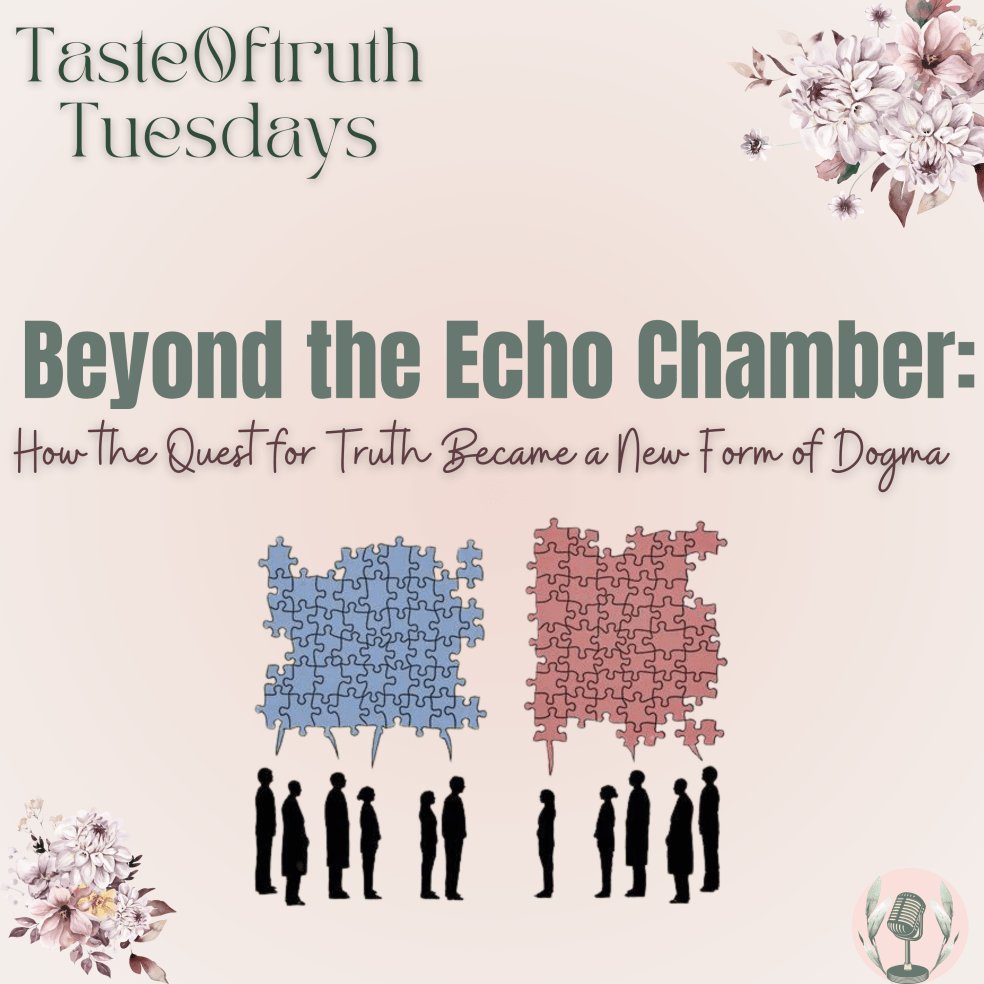

Beyond the Echo Chamber: How the Quest for Truth Became a New form of Dogma

Bonus Episode: Reflections on the Election Cycle – A Message for the Deconstruction Community

Welcome to today’s deep dive into a topic that’s been stirring within me for months. If you’re new here, let me explain the deconstruction space, or the deconstruction community—a movement that’s gaining momentum for those of us disentangling ourselves from rigid, fundamentalist beliefs. This process is supposed to be healing and, ideally, a source of growth, but it’s not without its share of controversy. That’s what we’re here to talk about.

In my podcast episode titled Faith Unbound: Navigating the Process of Disentanglement—or rather, Deconversion after my own journey took a deeper turn—I discussed my initial discovery of this space back in February. At that point, I’d begun to question my former beliefs, and the deconstruction community felt like a safe haven. After 6-7 months in, I’m seeing patterns that are unsettlingly familiar. The community has been valuable, yet I’ve grown concerned as it increasingly mirrors the same kinds of rigidity and tribalism many of us were trying to escape.

My posts and Instagram reels have hinted at this frustration, but I’m here today to pull these thoughts together more fully. Moving away from one dogma only to embrace another feels to me, like a new form of entrapment. The craving for certainty and “the right side” is strong, and without realizing it, we’re swapping one rigid system for another. In this space that’s supposed to champion open-mindedness, judgment and exclusion seem to have replaced curiosity and true critical thought.

It’s a reminder that true growth and change happen only when we’re open to different perspectives—not quick to label those who disagree with us as enemies. As the philosopher John Stuart Mill argued in his 1859 work, On Liberty, Free speech is essential for discovering the truth. He believed true understanding and truth itself emerge only through open debate and free expression. This highlights the complexity of truth, it’s only when differing perspectives clash that ideas are refined and strengthened. Let’s explore how that idea relates to today’s topic.

Setting the Stage: The Political and Psychological Landscape

Before we dig into the deconstruction community, let’s set the stage with something I found really interesting. Back before the 2024 election, journalist Mark Halperin expressed some serious concerns on Tucker Carlson’s podcast (cue the BOOs and HISSS from all the progressives–I hear you!) about what would happen if Trump were to win a second term. He predicted widespread psychological distress, especially among Democrats, which would affect everything from mental health to social interactions. And, wow, did that hit the mark.

Since Trump’s victory, movements like the 4B movement have surged among women on social media, particularly in response to reproductive rights concerns and conservative gender roles. Originating in South Korea, the movement’s name, “4B,” stems from “B,” shorthand for “no” in Korean, symbolizing “No sex, No dating, No marrying men, and No children.” Recently, the movement has sparked a 450% increase in Google searches in the U.S., with many calling it the “4 Nos” or referencing “Lysistrata” for its radical stance against traditional gender expectations. I’ve shared my thoughts on traditional gender expectations in a previous episode.

The Blue Bracelet Movement: Solidarity or Performative Gesture?

Following the 2024 election, white women supporting Kamala Harris have rallied around an unexpected symbol: a blue bracelet. For many, it represents allegiance, a small but visible way to signal “I’m not with them” to women who voted for Trump. But like other quick-fix political symbols, it’s raising questions: Does this bracelet truly contribute to progress, or is it merely performative—a way to sidestep deeper, tougher conversations within their communities?

The trend echoes past symbolic movements like 2017’s “pussy hats,” which aimed to unify and empower but were later criticized for their lack of sustained action. Today, similar critiques have emerged around the bracelet, with critics suggesting it’s more of a comforting gesture for its wearers than a true commitment to change. Some Black activists and allies have pointed out that symbols alone aren’t enough; they want allies willing to challenge and change the beliefs of those around them, including friends and family who may hold differing views.

Could the Blue Bracelet Movement become a lasting emblem of allyship or fade as a passing trend? Its fate rests on whether those wearing it step up to engage in hard conversations and meaningful action.

Misinformation and Its Impact on Abortion Laws

But let’s get back to deconstruction—and something that’s been coming up a lot lately, particularly within that space: misinformation about abortion laws. Here’s the thing: there is no federal abortion ban in place. I repeat, NO federal abortion ban.

The Trump administration’s role in the overturning of Roe v. Wade has sparked fierce debates on both sides, but it’s important to clarify that the administration never stated it aimed to eliminate abortion nationwide. Instead, the ruling simply returned the power to regulate abortion to individual states. Some conservative figures have even used quotes from Ruth Bader Ginsburg to suggest she supported a more gradual, state-based approach. However, Ginsburg critiqued the federal approach, arguing a more state-focused shift could have garnered broader public support for gender equality. Polls consistently show that while many Americans support the legality of abortion, most also favor restrictions—especially in later stages of pregnancy. This nuance, however, often gets lost in campaign rhetoric, which is typically framed in absolute terms to galvanize voter turnout. But as we’ve seen, such messaging has not always yielded the intended results, revealing the complexity of public opinion on this issue.

Yes, the Roe v. Wade decision was overturned, but all that did was give states the power to regulate abortion. Some states have restrictions, sure, but no federal law is imposing a nationwide ban. And without a massive shift in Congress and the courts, it’s unlikely that will happen.

I don’t think it will. Trump himself has spoken out against that. His wife has spoken for protecting these in some way, shape or form. We have other folks coming over from the Democratic Party under this Unity Party bracket. I just don’t think that they’re going to force Christian nationalism, and abortion bans across the entire nation. I guess we’ll see.

Then, there’s this idea going around that women won’t be able to access life-saving procedures if they have a miscarriage. This is just false. In fact, most states with abortion restrictions still allow medical treatments for miscarriages, like dilation and curettage (D&C), which are essential to protect a woman’s health. What’s actually being restricted are elective abortions—not necessary procedures.

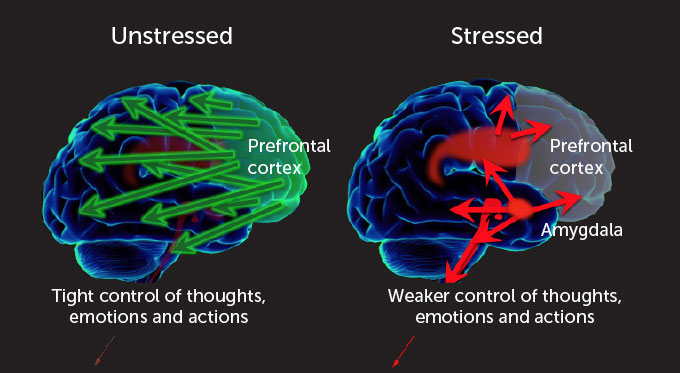
But here’s where things get really tricky. The spread of these exaggerated claims taps into the emotional centers of our brains. If you remember our previous episodes, we talked about amygdala hijacking—the brain’s response to fear and anxiety. When we hear these alarmist claims, it triggers that fear-based reaction, shutting down our ability to think rationally. Instead of focusing on the facts, we’re just reacting emotionally.

The Dangers of Misinformation

Let’s talk about the danger of this. Misinformation, especially when it involves highly emotional issues like reproductive rights, isn’t just harmless chatter—it’s psychological warfare. It keeps people in a constant state of anxiety, preventing them from thinking rationally. The real issue? People are more likely to believe in the fear-based narrative than to actually check the facts. They’re too busy being triggered emotionally.

This plays directly into the hands of the fearmongers. It becomes easier to control a population if you can make them afraid, right? And what do we see happening? Misguided campaigns around “miscarriage care,” the spread of exaggerated stories, and people feeling like their rights are under direct attack. It’s chaos. And it’s all based on misinformation, yet the ones who are screaming the loudest about misinformation are the very ones spreading it.

Can you already hear the echoes of evangelicalism? This brings me to the concepts of Jonathan Haidt’s the Righteous Mind: Why Good People Are Divided by Politics and Religion because they apply here. Haidt explains how our moral intuitions drive our beliefs and politics, often dividing us along different moral foundations.

Many folks in the deconstruction space, now lean left, where values like care and fairness are paramount. Meanwhile, conservative values like loyalty and authority are often viewed as suspect, fostering an “us vs. them” mentality that can feel righteous but alienating. Ironically, in striving for freedom and empathy, the deconstruction space sometimes ends up falling into the same black-and-white thinking it critiques.

In tandem, Greg Lukianoff and Jonathan Haidt’s book The Coddling of the American Mind offers a useful framework for understanding these shifts, identifying “Three Great Untruths”: 1) “What doesn’t kill you makes you weaker,” 2) “Always trust your feelings,” and 3) “Life is a battle between good people and evil people.” These untruths, they argue, create fragility, discourage critical thinking, and foster a tribal mentality—traits that increasingly characterize the deconstruction space and parts of the progressive left.

It’s ironic to me that some people leave evangelical Christianity thinking they’re free, only to stumble into a new form of dogma within the deconstruction space. My experience is different—I didn’t grow up in the church but was recruited during the pandemic. Having lived outside of purity culture, I feel fortunate not to carry that baggage. While I empathize with those navigating their journeys, it’s tough to see them act as critics and bullies. Let’s unpack these dynamics by exploring three key untruths in this space.

1. The Untruth of Fragility: “What doesn’t kill you makes you weaker.”

For many, deconstructing from fundamentalist beliefs took resilience and a willingness to confront discomfort. Yet, in today’s deconstruction space, there’s an emphasis on avoiding ideas seen as “unsafe” or “harmful”—typically anything that deviates from progressive orthodoxy. and I mean, I genuinely felt this way. I think that might be somewhat of a trauma response. I was like, I hate the patriarchy. I must stand up against this. This is harmful. This is dangerous. And there is a lot of data proving that this isn’t true, whether we want to look at the history of the ancient church or just, you know, the research data that I’ve shared in previous episodes but my point–this fragility, reinforced by social media algorithms, cultivates an environment where disagreement feels threatening rather than enriching.

This approach mirrors the fundamentalist rejection of “dangerous” secular ideas, where dissent is demonized. The irony is that what began as a call for open-mindedness has become a kind of brittle certitude, one that isolates rather than connects. Instead of learning resilience, we’re re-teaching fragility, limiting our growth and deepening the ideological chasm.

Protestors outside a Temple of Satan

2. The Untruth of Emotional Reasoning: “Always trust your feelings.”

Fundamentalism often equates strong feelings with truth—“If I feel it, it must be right.” In the deconstruction space, there’s a similar emphasis on emotional reasoning. If something feels offensive or unsettling, it’s treated as harmful. This approach is amplified by social media, where outrage and personal offense are rewarded with visibility.

Haidt’s work reminds us that emotions shape our moral judgments but don’t always lead to truth. Reacting purely on feeling closes off critical thinking, creating echo chambers where alternative perspectives are rarely considered. Instead of fostering deeper understanding, emotional reasoning entrenches our biases, fueling judgment rather than curiosity.

3. The Untruth of Us vs. Them: “Life is a battle between good people and evil people.”

The most divisive untruth is the idea that the world can be split into “good” and “evil” camps. This is evident in how some in the deconstruction community approach politics and social issues, painting conservatives or moderates as morally inferior. We see a rigid, “with us or against us” mentality, where anyone who questions progressive narratives is labeled “deplorable,” “harmful,” “Trash”, “Nazi” or worse.

Haidt’s research reveals that moral division is natural; we all tend to view those who disagree with us as misguided or even morally flawed. But when we approach every difference as a moral battleground, we close off true dialogue. Coming from a high-Calvinist church—one of the most cult-like, fundamentalist circles you can get into—I know what it’s like to think the rapture is imminent or to believe that if you don’t say all the “right” words exactly, you’ll burn in hell. My journey has taken me from being pro-choice in Portland, OR, having had three abortions myself, to joining an abolitionist movement to outlaw abortion. I haven’t even spoken about the profound pain and regret I carry about this. Yet here I am, reflecting on how divisive our society has become, with so little room for understanding across political lines. In the deconstruction space, you’d expect a shared empathy after leaving behind rigid belief systems, but instead, the culture seems to mirror the very exclusivity and “us vs. them” mentality of evangelical spaces.

Living in Portland, surrounded by ideologies that often pushed the limits of what I felt was morally comfortable, I wrestled with the impacts of various movements. I started to question whether certain messages of empowerment—like third-wave feminism—truly uplift or, instead, encourage behaviors that commodify women’s bodies and promote sexualization from a very young age. And while sex work has become a celebrated concept under the mantra “sex work is real work,” my own painful experiences in that industry make me see things differently. To me, it’s not empowering; it’s the opposite. Instead of championing it, I believe we should work to dismantle the industry.

It’s not just isolated concepts; there’s a broader pattern of glorifying “anything goes” hedonism and dismissing traditional values in the progressive space, which I find deeply troubling. Living in that environment left me with a raw understanding of how damaging these ideologies can be, leaving permanent scars. I grieve over the three abortions I’ve had. I cry because, despite being told it was just “a clump of cells,” I knew it was more than that. Watching the left demand “trust the science” while denying that life begins at conception feels twisted to me.

Moreover, there’s a deep, dark history in the advocacy of reproductive rights that gets glossed over—like the disturbing eugenics past of Planned Parenthood’s Margaret Sanger. Are we just going to ignore that?


Since the last election ended with a Trump landslide victory, rather than sparking any self-reflection, this moral absolutism seems to have intensified. The comments sections on many deconstruction accounts reveal the same tribal thinking they claim to oppose. Instead of creating bridges, we see entrenched sides, instead of open-mindedness, we see judgment.

 Look, I’ve been there. I was a proud Democrat in the past. I voted for Obama. But now, as an independent, I’m calling it like I see it. Democrats need to take a good hard look at themselves if they want a chance at victory. Blaming the electorate isn’t the answer. You cannot keep denying biology and pretending men. Along in women’s sports, restrooms or prisons. The idea that kids should undergo irreversible changes. It’s misguided and is absolutely out of touch. The open border agenda. It’s hurting American workers, pushing down wages and driving up the cost of housing. When will you start protecting your own people instead of pandering to these extreme policies? Discriminating against whites, Asians and men and the name of countering past wrongs is not only setting us back, but it’s racist in itself. Abandoning merit-based selection is wrecking our economy and opportunities for everyone. I mean, you cannot let people camp, defecate and shoot up in public spaces and expect things to improve. The average voter is seeing all of this and they’re rejecting it. If Democrats want to win again, they need to rethink their approach and get back to reality. Enough is enough.

The Pipeline Problem: How Social Media Radicalizes

This divide is worsened by social media, where algorithms favor outrage and tribalism, pulling people toward extreme ideologies. Just as researchers have observed a “crunchy hippie to alt-right pipeline,” there’s a similar dynamic at play in progressive spaces, where folks in the deconstruction space are drawn into radical social justice ideologies that feel every bit as dogmatic as evangelicalism.

In this progressive pipeline, identity politics becomes a weapon, and moral purity is enforced through a power/victim binary that discourages complexity and invites fear of being labeled an oppressor. This kind of ideological purity resembles the control and certainty we experienced in evangelicalism, only now with a new political coat of paint.


And this leads me into the horseshoe theory suggests that the far-left and far-right, though seemingly at opposite ends of the spectrum, often mirror each other in attitudes and tactics. This theory, initially presented by French philosopher Jean-Pierre Faye, proposes that the extremes of any ideology may end up behaving similarly—both tending toward authoritarianism and totalitarian thought despite their stated differences. Although this theory has its critics, the broader concept of ideological mirroring holds up in our analysis of what’s happening in the deconstruction space. At first, it was all about freedom—breaking away from oppressive systems, rejecting dogma, and embracing openness. But ironically, as people deconstruct their faith, they can fall into a similar trap: from being free thinkers to members of a new ideological cult.

Basically, when you leave fundamentalism without fully deconstructing dogmatic thinking, you risk trading one rigid ideology for another. Without cultivating humility and empathy, we will perpetrate the very same cycles of judgement and exclusion.

The Path Forward: True Openness and Curiosity

What’s the solution here? Jonathan Haidt’s insights remind us that real dialogue begins by understanding the values behind other people’s beliefs, even if we disagree with them. Progress and healing require that we listen beyond the labels, engaging in good faith rather than moral grandstanding. If we are to avoid replicating the very structures we’re deconstructing, we need to make space for differing perspectives and approach them with curiosity.

So, this means you cannot demonize conservatives, you cannot call everyone that voted for Trump a bigot, racist, misogynist. There’s something wrong with that thinking. You have been sold these three untruths. It’s a tired accusation that doesn’t hold up when you look at the numbers. Trump support among white voters did drop from 57% in 2020 to 49% in 2024. But the kicker is his support among black and Latino voters actually went up from 38 to 42%. So, against all odds, Trump is doing something that the Democratic Party has failed to do for decades. He’s making the Republican Party more diverse than has been in 60 years. Let’s cut out the divisive name calling and start acknowledging the reality of his growing appeal across different communities.


Real change happens when we go beyond just labeling others and instead build spaces where critical thought can flourish—even when it’s uncomfortable. This is my message to the deconstruction community and beyond!

It’s simple: stop pretending that we have all the answers. True freedom of thought is not about certainty. It’s about curiosity. It’s about asking the tough questions, not just parroting whatever’s trendy on social media or echoing the louder voices in your ideological group.

We need to do away with the binary thinking that divides us into “good” or “evil,” “us” or “them,” and start embracing true diversity of thought. Only by having those uncomfortable, nuanced conversations will we ever break free from the ideological cults—whether they’re rooted in religion, politics, or even deconstruction itself.

So, as we wrap up today’s episode, remember this: It’s time to get real. Misinformation is everywhere, and sometimes, it’s coming from the very people who claim to be fighting it. Whether it’s the left, the right, or the deconstruction space—don’t get caught up in the hype.

Thanks for tuning in to Taste of Truth Tuesdays. Until next time, keep questioning, keep learning, and never, ever stop thinking for yourself.

Understanding the Impact of Diet on Thyroid Health

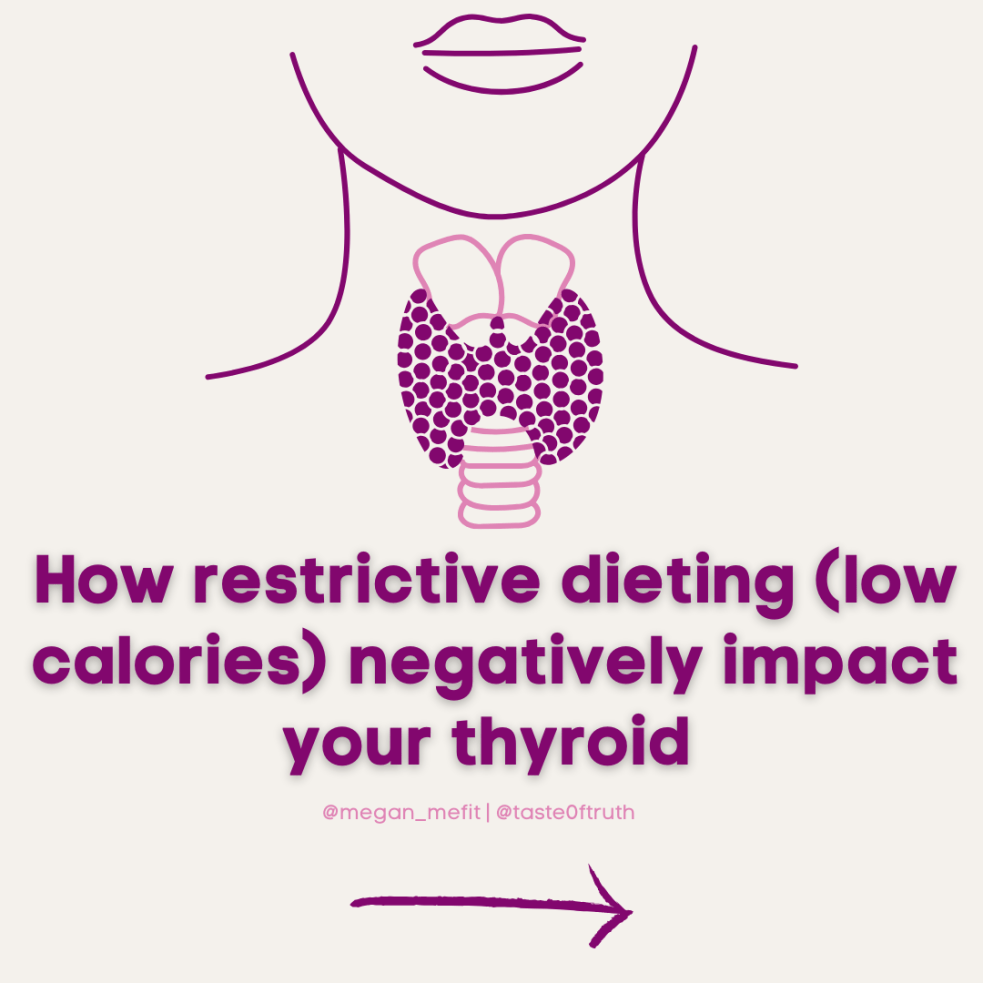
When clients come to me saying they have a “slow metabolism” or a “broken” metabolism, often they think they need to eat even less or cut carbs to jumpstart weight loss. But let me flip the script: in many cases, it’s actually chronic under-eating and restrictive dieting that’s slowing down their metabolism. Chronic dieting, especially with very low calories, can lead to impaired thyroid function and ultimately disrupt how the body uses energy. Here’s how it happens and what you can do to restore balance.


What is the Thyroid and Why Does It Matter?

Your thyroid is a small gland in your neck that plays a massive role in regulating your body’s metabolism. Often called the “controller” of metabolic function, the thyroid works closely with the hypothalamus and pituitary glands in the brain to maintain your metabolic rate. This system allows your body to increase or decrease energy production based on its needs, influencing everything from how you process food to your body temperature.

The thyroid primarily produces two hormones:

  • T3 (Triiodothyronine) – the active hormone that your cells use.
  • T4 (Thyroxine) – the inactive hormone that must be converted into T3 before your body can use it.

The production and conversion of these hormones depend on a feedback loop that begins with TSH (Thyroid Stimulating Hormone), which signals the thyroid to produce and release T4. But when the body is stressed—especially due to chronic under-eating or extreme calorie restriction—this whole process can become disrupted.

How Chronic Dieting Wrecks Your Thyroid

Under-eating is a significant source of stress for the body. Dieting or calorie restriction triggers the HPA axis (Hypothalamic-Pituitary-Adrenal axis), leading to an increase in CRH (Corticotropin-Releasing Hormone) and cortisol, our primary stress hormone. High cortisol levels can interfere with thyroid function in the following ways:

  • Reduces TSH Production: Elevated cortisol inhibits TSH, lowering T4 production and decreasing the amount of thyroid hormone available for energy use.
  • Impairs T4-to-T3 Conversion: Chronic stress slows down the conversion of T4 (inactive) into T3 (active), reducing your body’s energy production.
  • Increases rT3 Levels: Instead of converting into T3, some T4 becomes reverse T3 (rT3), a hormone that blocks T3 from being used. This, in turn, reduces the sensitivity of your cells to thyroid hormones, further lowering metabolic function.

This is why individuals who chronically under-eat or yo-yo diet often experience symptoms of hypothyroidism, even without an official diagnosis.


Symptoms of Suboptimal Thyroid Function

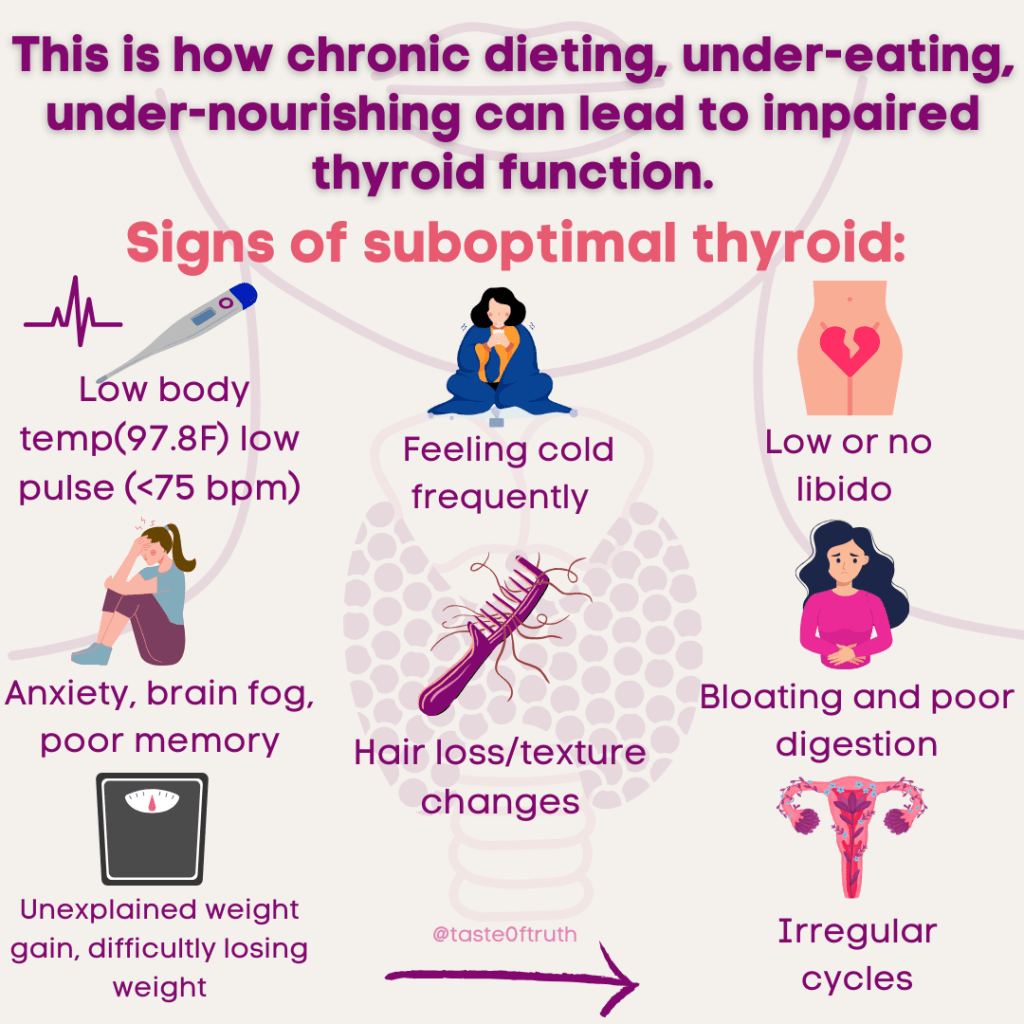
If your thyroid isn’t functioning optimally, you may notice some of the following symptoms:

  • Low body temperature (below 97.8°F)
  • Frequent feelings of cold, regardless of weather
  • Low or no libido
  • Anxiety, brain fog, or poor memory
  • Unexplained weight gain or difficulty losing weight
  • Bloating, poor digestion
  • Changes in hair texture or hair loss

Many clients experiencing these symptoms have been stuck in a calorie-deficit mindset for years, keeping their bodies in a constant state of stress. As a result, they’re often dealing with adrenal dysfunction, hypothyroidism, or even reproductive health issues, like extreme PMS, cycle loss, or low testosterone.


Restoring Your Thyroid Health—The First Steps

To begin improving thyroid health, our initial goal is to support both psychological and physiological balance, moving away from restrictive dieting and focusing on nourishment. Here’s a breakdown of the steps:

  1. Stabilize Blood Sugar: Balanced blood sugar supports thyroid health and reduces stress on the body.
  2. Maximize Nutrient Density: Prioritize whole, nutrient-rich foods to ensure your body receives adequate vitamins and minerals, especially selenium, zinc, and iodine, which are crucial for thyroid function.
  3. Reduce Inflammation: Chronic inflammation can further stress the thyroid. Anti-inflammatory foods and lifestyle practices can help.
  4. Incorporate Breathwork: Simple breathwork techniques can stimulate the vagus nerve, helping to regulate the HPA axis and reduce stress.
  5. Avoid Dietary Triggers: Reduce foods that promote “leaky gut,” such as highly processed foods, sugar, and gluten, if sensitive. This protects your immune and thyroid health.
  6. Manage Stress Proactively: Yoga, meditation, journaling, or spending time in nature can help keep cortisol in check.
  7. Reduce Toxins and Pollutants: Environmental toxins can interfere with hormone health, so minimizing exposure can be a powerful step.
  8. Prioritize Rest and Sleep: Quality sleep allows the body to recover and reset, which is essential for thyroid health.

The Bottom Line

Restrictive dieting isn’t the solution to a slow metabolism; it’s often the root cause. Chronic under-eating can lead to imbalances in your thyroid and adrenal glands, ultimately slowing down your metabolic rate and making it harder to achieve your fitness goals. Rebuilding a balanced, nourished body will not only help you feel better but will also lay the foundation for sustainable health.

This week, we’re talking all things thyroid health, and this post breaks down why breaking free from the dietary dogma of diet culture is crucial! Ever feel like your energy’s tanked, your minds in a fog, or your metabolism’s stuck in slow motion? 🧠✨ You’re not alone, and it could be your thyroid talking.

On this week’s Taste of Truth Tuesdays, we’re joined by Nicole, a holistic health advocate who’s here to shed light on how diet culture’s obsession with restriction can wreak havoc on your thyroid. From her own experience facing an autoimmune diagnosis to her advocacy for individualized nutrition, Nicole breaks down how restrictive dieting not only slows your metabolism but also impacts hormone balance, brain clarity, and overall well-being. Join us to learn how making friends with food (yes, even carbs!) might be the best way to support your thyroid and reclaim your energy.

Brain Fog, Thyroid Health, and Gut Connection: Insights from an Integrative Dietitian

Ever felt like your brain’s on vacation while your body’s still clocking in? 🧠✨ Join us as Nicole unveils the secrets behind thyroid health, brain fog, and why carbs might just be your new best friend!

🔍 From Autoimmune Shock to Holistic Advocate: Nicole shares her journey from being blindsided by an autoimmune diagnosis to questioning mainstream diet culture and diving into functional medicine. Find out what sparked her transformation into an advocate for individualized nutrition and holistic health!

💡 Thyroid Health Unveiled: Thyroid dysfunction can be a mystery wrapped in an enigma! Nicole explains why thyroid hormones are key to overall health and how her unique approach, including The BRAIN Method, differs from traditional treatments. Discover how she tackles symptoms and optimizes thyroid function!

🧠 Decoding Brain Fog: Ever felt like your brain is stuck in a fog? Nicole breaks down the most common culprits of brain fog and offers tips on how women can pinpoint their own triggers. Say goodbye to mental sluggishness and hello to clarity!

🌱 Gut Health & Thyroid Function: Did you know your gut health has a major impact on your thyroid? Nicole dives into how imbalances in your gut can affect thyroid hormone production and utilization. Learn how addressing gut health can boost your thyroid function!

🍞 Carbs & Hypothyroidism: Carbs might be getting a bad rap, but Nicole explains why they’re actually essential for those with hypothyroidism. Discover how including carbs in your diet can support thyroid function and enhance overall well-being.

Listen here!

Mentioned in the interview:

⁠MEET YOUR THYROID⁠

⁠BRAIN METHOD⁠

⁠Why Nicole added HTMA (hair tissue analysis) to her practice ⁠

⁠Which comes first? Gut dysfunction or Thyroid dysfunction? ⁠

⁠Could your gut be creating roadblocks in your Thyroid Hormone Journey? ⁠

⁠Why you need carbs especially if you have hypothyroidism⁠

⁠Home – New – Chews Food Wisely⁠

🙏 Please help this podcast reach a larger audience in hope to edify & encourage others! To do so: leave a 5⭐️ review and send it to a friend! Thank you for listening! I’d love to hear from you, find me on Instagram!⁠⁠⁠⁠ @taste0ftruth⁠⁠⁠⁠ or⁠⁠⁠⁠ Pinterest! ⁠⁠ ⁠⁠⁠ ⁠

How Creative Expression Helps Overcome Trauma

When you grow up in a high-control environment—whether through religion, a rigid upbringing, or a spiritual path that preaches emotional suppression—it can feel like your natural human emotions are something to be ashamed of. I’ve lived it. In the high-control religion I was a part of, anger wasn’t just frowned upon; it was portrayed as sinful, a sign of personal failure or weakness. Through the lens of ACBC Biblical counseling (Nouthetic Counseling), anger was framed as something to be suppressed, manipulated out of existence with tactics like guilt, shame, and isolation. But here’s the truth: anger, like any other emotion, isn’t inherently wrong. It’s human. And when we lose access to it, we also lose access to parts of ourselves.

Anger, as Aristotle once put it, is a passion. When experienced and expressed for the right reasons and in the right way, it can even be virtuous. Yet, in so many spiritual environments, particularly the ones I encountered, emotions like anger were seen as dangerous, spiritually harmful, or outright sinful. Especially for women, who are often taught to prioritize harmony and remain calm at all costs, anger can become something we’re scared to touch. For men, anger might be more accepted, but vulnerability is not, creating its own emotional imbalance.

What happens when we suppress emotions like anger? We get stuck, often feeling disconnected from our bodies, from our creativity, and from any sense of playfulness. That’s why art and play become essential tools in healing from spiritual and religious trauma. They allow us to access and express emotions that were long buried, giving us the space to feel without fear. Art doesn’t just heal—it empowers. It gives back what was stolen. Let’s unpack why:

Why Art & Play Matter in Healing Trauma

Trauma—especially the kind stemming from spiritual or religious abuse—can leave you feeling stuck, numb, or like a stranger to your own creativity. High-control environments stifle our freedom to express, explore, or simply be. Art and play can feel like reclaiming those parts of us that were silenced, buried under the weight of shame, fear, or guilt.

“Wherever I look, I see the same themes: not being allowed to feel, to say what you feel, to trust your perceptions, to ask for what you need. This is how we remain imprisoned in our pain.” -Alice Miller

Engaging in creative expression—whether it’s painting, dancing, writing, or making music—gives us a way to process emotions that can be difficult, even impossible, to articulate. Trauma lodges itself deep in the body and subconscious, often beyond the reach of words. But through art, we can access those hidden parts and begin to heal them in ways that talking just doesn’t touch. It’s like tapping into a language the body understands.

Play, on the other hand, might feel like a foreign concept if you’ve been conditioned to take life way too seriously, to follow rules without question. But it’s through play that we reconnect with spontaneity, joy, and a sense of safety—things that high-control environments tend to strip away. Play is about reawakening that inner child, the part of you that knows how to explore and create without fear of judgment. It’s about taking back the joy you were told to suppress.

How Art & Play Help in Deconstructing Religious Trauma

When we start unraveling the teachings we once held as truth, it can feel like walking through a minefield. Shame, fear, and guilt are often deeply embedded in the narratives we were fed. Art becomes a tool for rebellion, a way to question, challenge, and rewrite those beliefs. By creating, we aren’t just making things; we’re making space for new perspectives. We’re loosening the grip that old doctrines had on us.

In high-control environments, the idea of play is usually dismissed as frivolous or even sinful. Reclaiming that sense of play is like finding a key to unlock the parts of yourself that were shut away. Playfulness, whether it’s dancing with wild abandon, hula hooping (yes, circus arts shoutout!), or exploring new hobbies, gives you back a sense of agency. It’s a way to create space for curiosity again, to embrace wonder without the burden of fear or shame. Think of it as giving yourself permission to live without someone else’s narrative hanging over you.

Scientific Backing for Creative Therapies

The science backs this up, too. Numerous studies have shown that creative therapies—like art, dance, and even movement-based play—can significantly reduce symptoms of PTSD, anxiety, and depression. They work by helping the brain rewire itself through neuroplasticity. When you engage in creative activities, you’re not just distracting yourself—you’re helping your brain form new, healthier connections. You’re building resilience, reprogramming the way your brain responds to trauma.

Art and play ignite parts of the brain that foster emotional regulation and healing. This is where trauma lives, after all—deep within the nervous system. But creativity taps into a different part of the brain than verbal communication does, allowing survivors of trauma to express and release emotions they may not even know they’re holding onto.

By embracing art and play, you’re not just finding a distraction from your pain—you’re giving yourself a way to heal, to reclaim parts of yourself that were taken, and to reconnect with joy, creativity, and freedom. The beauty of it all? There’s no right or wrong way to do it. You’re creating your path forward. So, grab that paintbrush, dance it out, or pick up that pen and let your soul speak.

Resources for Healing Through Art and Play

Books:

  1. “Healing the Fragmented Selves of Trauma Survivors” by Janina Fisher
    This book dives into how trauma fragments a person’s sense of self, especially those recovering from spiritual abuse or high-control environments. Fisher provides practical tools, like body-based therapies and creative expressions, to help reintegrate those fragmented parts into a cohesive whole.
  2. “Trauma and Recovery” by Judith Herman
    Herman’s work is a cornerstone in understanding trauma and its long-term effects. She emphasizes the importance of survivors reclaiming their voices, and how creative expression—whether through writing, painting, or dance—plays a critical role in their recovery journey.
  3. “The Creative Cure” by Jacob Nordby
    Nordby explores how reconnecting with creativity can reignite your sense of self and joy. Especially for those who’ve had their emotional expression controlled or diminished by strict belief systems, this book offers a roadmap to reclaiming a more authentic, free version of yourself through creativity.
  4. “Complex PTSD: From Surviving to Thriving” by Pete Walker
    This book focuses on healing the long-term effects of complex PTSD, which many individuals from high-control religious backgrounds experience. Walker highlights how therapeutic outlets like art, journaling, and other forms of play help survivors process their trauma and begin to thrive again.
  5. “Art Therapy Sourcebook” by Cathy Malchiodi
    Malchiodi is a pioneer in the field of art therapy. This book is a practical guide for anyone looking to explore art as a form of emotional expression and healing, especially in the context of trauma recovery. It offers hands-on approaches for integrating creative expression into your healing process.

Articles & Journals:

  1. American Art Therapy Association
    This site offers numerous research studies on the effectiveness of art therapy in healing trauma, especially for those recovering from spiritual abuse or restrictive environments. It provides a well-rounded view of the therapeutic benefits of engaging in creative arts.
  2. International Journal of Play Therapy
    A comprehensive journal that highlights the healing potential of play therapy for trauma survivors. It explores how play can foster emotional resilience and repair, allowing individuals to reconnect with parts of themselves that were silenced or controlled.
  3. “Creative Arts Therapies and Trauma: Scope and Impact”
    A review that outlines how various forms of creative expression—like music, drama, and visual arts—help trauma survivors heal. This article explains how these therapies leverage the brain’s neuroplasticity to create new, healthier emotional patterns.

Experts & Practitioners:

  1. Pat Ogden – Sensorimotor Psychotherapy
    Ogden’s work is at the intersection of movement and trauma recovery. She focuses on how trauma manifests in the body and uses techniques like creative movement and body-based therapies to help people heal from deep emotional wounds. Her book “Trauma and the Body” is a great resource for understanding this approach.
  2. Peter Levine – Somatic Experiencing
    Levine is renowned for his work on trauma recovery through the body. His book “Waking the Tiger: Healing Trauma” offers insights into how movement and body-based expression can help survivors release trauma and regain a sense of safety and control.

Podcasts & Websites:

  1. Sounds True – Insights at the Edge Podcast
    Hosted by Tami Simon, this podcast often features interviews with leading experts in trauma and healing. Guests like Peter Levine and Pat Ogden discuss the importance of integrating creative practices like art and movement into trauma recovery.
  2. Healing Arts Radio (Online Radio Show)
    Focused on art therapy and trauma healing, this show features episodes on creative therapies and personal stories of recovery through art. It’s an inspiring resource for understanding how play and art can transform emotional wounds into creative empowerment.
  3. Institute for Creative Mindfulness
    This site provides resources and courses on expressive arts therapies for trauma survivors. It emphasizes how art and movement therapies foster resilience and healing by tapping into emotional expression and body awareness.

From Burnout to Breakthrough:  Healing, Art, and Resilience with Katherine Spearing

🎙️ Welcome Back! Join me as I chat with Katherine Spearing, MA, CTRC — founder of Tears of Eden 🌸, a nonprofit supporting survivors of spiritual abuse, and former host of the groundbreaking Uncertain podcast 🎧. Katherine is also the host of Trauma & Pop Culture, a Certified Trauma Recovery Practitioner 🧠, and an expert in helping those who have survived cults, high-control environments, and sexual abuse 💔. She even offers specialized trauma-informed career coaching 💼!

In this episode, we discuss: 💡 The most impactful themes from Uncertain — including her powerful episode with Dr. Laura Anderson on anger 😡 and the concept of second-wave fundamentalism. 🎭 How creative arts therapies are aiding survivors of sexual abuse in their healing journey, and how these methods differ from traditional therapy 🎨. 🛑 Managing the emotional weight of working with spiritual abuse survivors and Katherine’s personal journey to avoid burnout 🧘‍♀️. 👩‍🎤 Challenging traditional gender roles in Christianity — how they’ve shaped perceptions of women’s worth and agency, and steps for creating more inclusive spaces 🚺. 🛡️ Building healthy community dynamics to protect against spiritual abuse while fostering authentic, supportive connections 🌱. 🔥 A sneak peek into Katherine’s upcoming book on spiritual abuse, including why the church is so obsessed with sex 💭.

Tune in now for an insightful conversation on healing, resilience, and challenging the status quo! 🗣️✨

Don’t miss out on Katherine’s wisdom and unique perspective. 🎧

Tears of Eden podcast episode we mentioned

Blog — Katherine Spearing

Tears of Eden: Supporting survivors of Spiritual Abuse and Religious Trauma

🙏 Please help this podcast reach a larger audience in hope to edify & encourage others! To do so: leave a 5⭐️ review and send it to a friend! Thank you for listening! I’d love to hear from you, find me on Instagram!⁠⁠⁠ @taste0ftruth⁠⁠⁠ or⁠⁠⁠ Pinterest! ⁠⁠ ⁠ 

Well Considered: Mastering Informed Consent in Medicine

Take Control of Your Health Decisions: A Deep Dive with Just the Inserts

This week on Taste of Truth Tuesdays, we’re excited to welcome a special guest— the founder of Just the Inserts 🩺💊—as we explore her groundbreaking new book, Well Considered: A Handbook for Making Informed Medical Decisions. In this episode, we tackle one of the most vital topics in healthcare today: informed consent.

Here’s a preview of what we’ll be unpacking:

✨ What Inspired Well Considered?

What was the catalyst for creating this essential handbook? We’ll dive into the pivotal moment that led to its conception. Whether it was a personal experience or witnessing the confusion around medical decisions, you’ll hear the full backstory straight from the source.

📝 What is Informed Consent and Why Is It a Game-Changer?

Informed consent is more than a checkbox—it’s about having the knowledge and confidence to make the best choices for your health. We break down the meaning of informed consent and explore why it’s crucial for every patient to understand their options before saying ‘yes’ to a treatment.

📜 Are Inserts Just for Legal Reasons?

Some critics claim Just the Inserts causes unnecessary alarm by drawing too much attention to drug inserts. We take on these criticisms and discuss why inserts are far more than just legal protections for pharmaceutical companies. Get ready to hear why being fully informed isn’t about fear—it’s about empowerment.

💡 Feeling Rushed by Healthcare Providers? Here’s How to Stand Your Ground

Ever felt pressured by a doctor to make a snap decision? You’re not alone. We’ll share practical advice on how to slow down the conversation, ask the right questions, and ensure your voice is heard—without being rushed into treatments or medications.

💉 The Vaccine Debate: Individual Choice vs. Public Health

Vaccines are a hot topic, sparking debates about individual rights versus collective health. We’ll explore how to navigate this complex issue, finding balance between personal autonomy and the greater good when it comes to medical interventions like vaccines.

Dr. Stanley Plotkin, a prominent figure in vaccinology, and some of his colleagues recently published an article that has drawn significant attention. The article acknowledges that vaccines are not as thoroughly studied as previously claimed, particularly in terms of safety, both before and after they are licensed. This has raised concerns among critics, who argue that for decades, the public was assured that vaccines underwent rigorous safety testing.

Key points from the article include the admission that prelicensure clinical trials often have limited sample sizes and short follow-up periods, which may not fully capture long-term safety data. Additionally, there are currently no dedicated resources for post-authorization safety studies, relying instead on annual appropriations approved by Congress. This lack of resources for ongoing safety monitoring has been criticized as inadequate, particularly given the widespread use of vaccines.

This revelation has been met with strong reactions, especially from those who have long questioned the rigor of vaccine safety studies. They argue that these acknowledgments confirm their concerns that vaccine safety has not been as thoroughly investigated as it should be.

Read the paper here

🧠 Get the Right Info: Making Confident Prescription Decisions

Not all medical advice is created equal, and it can be tough to know if your doctor is offering the best treatment options for you. We’ll share strategies for ensuring you get the most accurate, unbiased information when making choices about prescription medications.

✔️ 3 Actionable Tips to Start Making Informed Choices Today

We’ll wrap up the episode with three practical, actionable tips to empower you to start making more informed medical decisions—whether you’re picking up a prescription or heading in for a routine check-up.

Search products

Learn how to read an insert!

Women’s fitness clothing alternatives


This week’s conversation is all about reclaiming control over your health decisions. Tune in for an eye-opening discussion that’ll give you the tools you need to ask better questions, challenge the status quo, and take a more active role in your medical care.

Don’t miss this powerful episode of Taste of Truth Tuesdays! 🎙️

#InformedConsent #MedicalDecisions #HealthcareEmpowerment #WellConsidered

The MLM Illusion: Selling a Dream or a Trap?

New Episode Alert: The Dark Side of MLMs and Coercive Control

🚨 This Week on Taste of Truth Tuesdays 🚨, we’re diving into the complex and manipulative world of multi-level marketing (MLM) companies—uncovering the coercive control tactics they use to keep people hooked. 🧠💸 MLMs don’t just sell products. They sell a dream—a dream of financial freedom, wealth, and unlimited success. The problem? That dream is often built on deceptive tactics that prey on vulnerability, foster magical thinking, and emotionally manipulate their members.

At first glance, MLMs seem like a golden opportunity. They promise wealth, freedom, and independence—targeting people who are seeking a way out of financial struggle or a traditional 9-to-5. But underneath those glittering promises are dangerous tactics that prey on human psychology, exploiting emotional weaknesses to create loyalty and blind devotion.

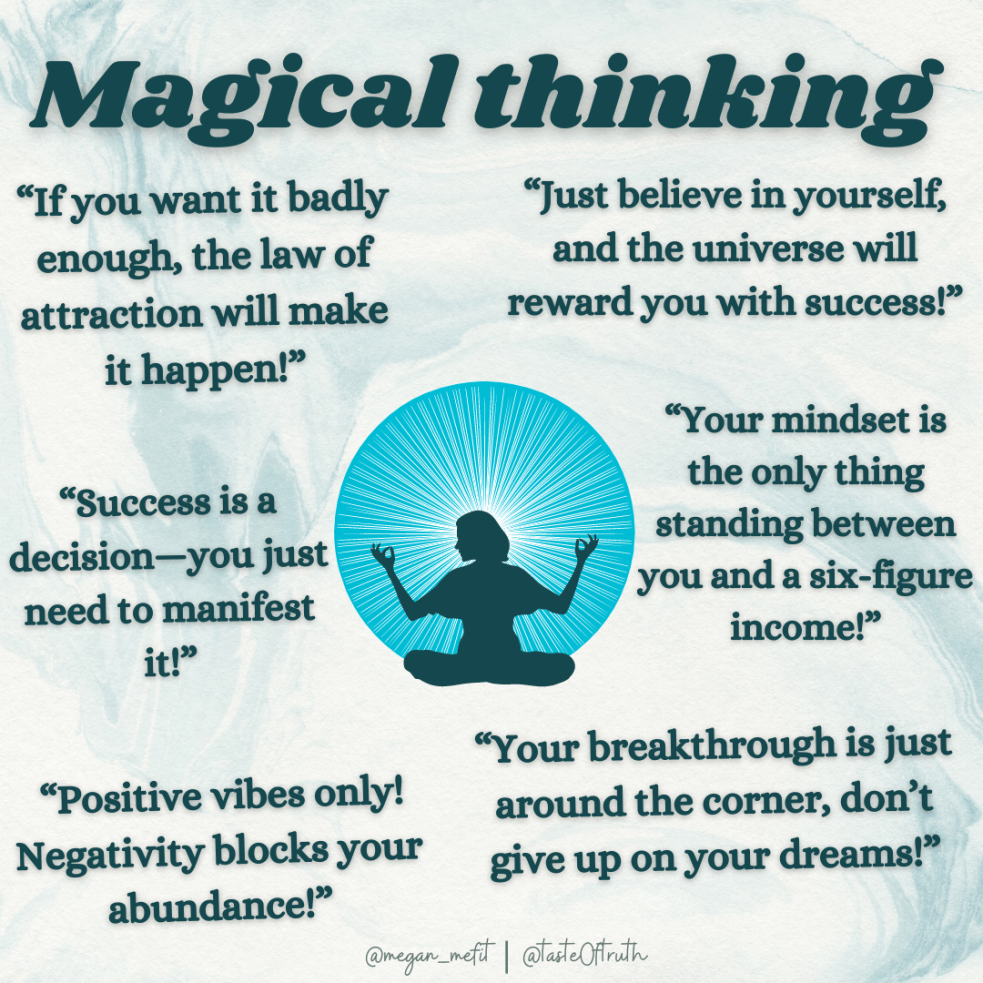
A key tactic MLMs use is magical thinking. This is the belief that positive thoughts and visualizations alone can bring success, wealth, or health. A 2019 study in Frontiers in Psychology revealed that many MLMs sell products—like supplements and essential oils—by making unverified claims about curing diseases, with little to no scientific evidence to back them up. 😳

Why Is Magical Thinking So Dangerous?

Magical thinking isn’t just harmless optimism. In the context of MLMs, it can lead people to make poor financial and health decisions. Here’s why it’s so dangerous:

🚫 False Sense of Control: Magical thinking tricks people into believing they can control outcomes simply by thinking positively. This false confidence can prevent them from taking real, actionable steps to improve their situation.

🚫 Health Risks: MLMs often push supplements and oils with promises of “miracle cures” for serious illnesses—without scientific validation. People may choose these products over actual medical treatments, putting their health in danger.

🚫 Emotional Manipulation: By convincing members that failure is due to their lack of belief or effort, MLMs shift the blame from the system to the individual. This creates a toxic cycle of guilt and shame, trapping people emotionally in the MLM.

Coercive Loyalty and Emotional Manipulation

Beyond magical thinking, MLMs use coercive control tactics to create a false sense of community and belonging. They foster an atmosphere of loyalty where members feel pressured to stay positive, constantly recruit new people, and never question the system.

💥 Coercive Loyalty: Members are often told that the reason they’re not successful is because they’re not trying hard enough, recruiting enough, or believing in themselves. This turns failure into a personal flaw, rather than a flaw in the business model.

💥 Community Pressure: MLMs thrive on social dynamics, where members are encouraged to pressure their friends and family into joining. This creates a network of dependency and makes it harder for people to leave, even when they start seeing the cracks in the system.

💥 Emotional Exploitation: Guilt, shame, and failure are powerful emotional tools used by MLMs. When people don’t succeed, they’re often made to feel as if they didn’t believe in the product or themselves enough. This emotional manipulation keeps members invested—financially, mentally, and emotionally—even when the odds are against them.

Breaking Free: Real Stories of Escaping MLMs

In this week’s episode, we also share real stories of individuals who have been trapped in MLMs and how they broke free. These stories highlight the emotional, financial, and mental toll that MLMs take on their members, and how difficult it can be to escape once you’re in the cycle. 😳

Why You Need to Listen

If you’ve ever been approached by someone pushing a “life-changing opportunity” or a “groundbreaking product,” this episode is for you. If you’ve been tempted to join an MLM—or know someone who has—this episode is essential listening. We’re unpacking the toxic blend of pseudoscience, community pressure, and emotional exploitation that keeps MLMs running, and sharing actionable tips on how to recognize the red flags before it’s too late. 🚩

Tune in to this week’s episode of Taste of Truth Tuesdays to learn how to protect yourself from the manipulative tactics of MLMs and avoid falling into their web of magical thinking and emotional control. Whether you’re considering joining an MLM or are currently involved, understanding these tactics is key to protecting your financial and emotional well-being.


🎧 Listen to the full episode now—


#MLMAwareness #MagicalThinking #CoerciveControl #PodcastAlert #HealthOverHype #EmotionalManipulation #CriticalThinking #MultiLevelMarketing #BreakFreeFromMLMs

Why MLMs Exploit Magical Thinking

Magical thinking is often presented as something harmless, quirky, or even empowering: believe hard enough, visualize the outcome, raise your vibration, and somehow reality will reorganize itself around your desires.

The right thoughts will attract the right life.
The right energy will attract money.
The right mindset will make the business work.
And if it still isn’t working? Well, apparently you need to believe harder.

This is where magical thinking stops being an innocent coping mechanism and becomes something far more manipulative.

There is nothing inherently wrong with imagination, hope, ritual, goal-setting, or trying to orient your mind toward possibility. The problem begins when thoughts are treated as though they possess direct causal power over circumstances—and when that belief is used to excuse exploitative systems, deny material reality, and blame people for outcomes they cannot fully control.

Multi-level marketing companies thrive inside this framework.

They rarely sell only skincare, supplements, leggings, essential oils, or some mysterious powdered substance promising to fix your hormones. They sell a total worldview: success is available to anyone, financial freedom is right around the corner, and your mindset is the only meaningful obstacle standing between you and the life you deserve.

It sounds liberating.

In practice, it becomes a remarkably effective form of narrative control.

The Manifestation-to-MLM Pipeline

Manifestation culture and MLM culture speak remarkably similar languages.

Both frequently suggest that your external circumstances are a reflection of your internal state. Wealth signals alignment. Success proves belief. Failure reveals fear, negativity, laziness, or some hidden subconscious block.

Within this worldview, structural explanations disappear.

The compensation plan is not the problem. Market saturation is not the problem. Recruitment-based growth is not the problem. The cost of inventory, conferences, subscriptions, samples, coaching, and social-media advertising is not the problem.

You are the problem.

You did not show up consistently enough.
You entertained doubt.
You listened to “negative people.”
You failed to embody your future self.
You did not want it badly enough.

This is one of the reasons magical thinking is so useful to high-pressure groups: it turns legitimate criticism into evidence of personal or spiritual deficiency.

The system never has to prove itself because its members are taught to endlessly prove themselves to the system.

Why Magical Thinking Becomes Dangerous

1. It Creates a False Sense of Control

Magical thinking offers certainty in an uncertain world. That is part of its appeal.

It tells people that they can control outcomes through the correct combination of intention, visualization, emotional regulation, disciplined optimism, and personal belief. In an MLM, that message becomes attached to a business opportunity: anyone can succeed as long as they follow the system and maintain the right mindset.

But real outcomes are shaped by countless factors: timing, money, health, geography, existing social networks, market conditions, family responsibilities, luck, and the structure of the business itself.

A person can work hard and still fail inside a bad system.

That truth is uncomfortable, especially for companies that need a constant stream of hopeful recruits. It is much more convenient to teach people that their thoughts determine their results.

The illusion of total control can actually make people less capable of evaluating reality. Instead of asking whether the opportunity is financially sound, they are taught to examine whether they have been sufficiently positive.

2. It Keeps People Spending Money

MLMs routinely frame additional spending as an investment in your future identity.

Buy the starter kit.
Purchase enough inventory to qualify for the next rank.
Attend the conference.
Pay for the leadership retreat.
Subscribe to the training platform.
Order samples for potential customers.
Invest in yourself.

And because magical thinking encourages people to interpret persistence as proof of faith, each new expense can feel like the final energetic or financial commitment required before the breakthrough arrives.

Success is always one more month away.

One more recruit.
One more product launch.
One more mindset shift.
One more payment on the credit card.

The vast majority of MLM participants do not earn a meaningful profit after expenses are considered. But individual success stories are repeatedly elevated as proof that the opportunity works for anyone.

The person at the top of the pyramid becomes a living vision board.

Her house, vacations, body, marriage, car, and carefully curated morning routine are presented as evidence of what is available to everyone—provided they remain loyal enough to the process.

3. It Spiritualizes Shame

This may be the most psychologically damaging part of the entire system.

When success is attributed to mindset, failure becomes a moral judgment.

You were too negative.
You doubted the process.
You allowed fear to win.
You did not protect your energy.
You lacked discipline.
You secretly did not believe you deserved success.

Instead of recognizing that they were recruited into an unsustainable model, people begin searching themselves for defects.

They feel ashamed of their bank account, embarrassed by their lack of progress, and guilty for disappointing the person who recruited them. They may hide losses from their spouse, distance themselves from skeptical friends, and become even more dependent on the MLM community for reassurance.

The emotional burden is transferred entirely onto the individual while the company remains untouched.

This is authority without accountability: the system claims the right to interpret your life, demand your loyalty, and define your failures, while accepting no responsibility for the harm it causes.

4. It Encourages Detachment from Reality

“Protecting your mindset” can sound like healthy emotional hygiene. Inside a high-control environment, however, it often means avoiding information that might interrupt belief.

Critical articles are dismissed as negativity. Former members are called bitter. Concerned family members are accused of having a scarcity mindset. Financial evidence is treated as less meaningful than testimonials, intuition, or the leader’s personal story.

Members may be encouraged to behave as though their desired reality already exists—even while debt increases, relationships fracture, and emotional exhaustion sets in.

This is not optimism. It is spiritual escapism.

Reality becomes something to override rather than something to examine.

And when acknowledging the truth threatens your identity, friendships, income fantasy, and sense of belonging all at once, leaving becomes much harder than simply quitting a side business.

Why MLMs Depend on Magical Thinking

It Produces Loyalty

MLMs create communities organized around shared belief.

Members are given a new vocabulary, a new vision for their future, new mentors, new rituals, and sometimes an entirely new social circle. Group calls, conventions, recognition ceremonies, rank advancements, and motivational speeches reinforce the feeling that participants are part of something larger than themselves.

The group is not merely selling products. It is changing lives.

Once that identity takes hold, criticism can feel deeply personal. Questioning the company becomes indistinguishable from questioning the friendships, dreams, and transformation attached to it.

Leaving may mean admitting financial loss, disappointing an upline, and losing an entire community.

This is why “just walk away” is rarely as simple as it sounds.

It Protects the Business Model from Criticism

Magical thinking provides an almost perfect shield against accountability.

When someone succeeds, the system gets the credit.

When someone fails, the individual gets the blame.

Success proves the opportunity works. Failure proves the participant did not work it correctly.

This makes the central claim effectively unfalsifiable. No amount of personal loss can disprove the system because loss itself is reinterpreted as evidence that the person lacked belief, effort, consistency, or alignment.

That is not a legitimate business evaluation. It is a closed belief system.

It Fuels Recruitment

“You can do this too” is one of the most powerful promises in MLM culture.

Recruitment depends on convincing ordinary people that extraordinary wealth is available without extraordinary privilege, timing, experience, or luck. The dream must appear universally accessible.

Manifestation language helps close the gap between fantasy and evidence.

You do not need to understand the compensation plan.
You need to trust your intuition.

You do not need to examine average earnings.
You need to stop limiting yourself.

You do not need to ask whether the market is saturated.
You need to believe there is abundance for everyone.

This reframing transforms reasonable skepticism into a character flaw. The recruit is not being cautious; she is “playing small.”

Red Flags to Watch For

Slogans That Replace Evidence

Be cautious when complicated financial or personal outcomes are reduced to phrases such as:

  • “Believe and achieve.”
  • “Your vibe attracts your tribe.”
  • “If you can see it, you can create it.”
  • “The only limits are the ones in your mind.”
  • “Other people’s negativity is blocking your success.”

A slogan is not a business plan. An affirmation is not an income disclosure.

Exceptional Stories Presented as Typical Outcomes

MLMs love personal testimony because stories are emotionally powerful.

The single mother who retired her husband.
The teacher who became a millionaire.
The woman who paid off all her debt from her phone.
The cancer survivor who found purpose through the product.

These stories may be real, embellished, incomplete, or financially misleading. But even when they are accurate, they do not reveal what usually happens.

A few highly visible winners cannot tell you whether the opportunity is financially viable for the average participant.

Pressure to Remain Relentlessly Positive

Healthy communities allow questions, disappointment, disagreement, and honest discussion of failure.

High-control communities interpret those things as contamination.

When people are expected to perform positivity at all times, the group is not protecting morale. It is protecting the narrative.

Watch what happens when someone asks about debt, low earnings, product claims, attrition, or the compensation structure. Are those questions answered directly, or is the person accused of lacking faith?

Anecdotes Treated as More Important Than Evidence

Personal experience can be meaningful, but it is not a substitute for reliable data.

MLMs often rely on transformation photos, testimonials, dramatic origin stories, and claims about what “worked for me.” The emotional impact of those stories can distract from questions about evidence, typical outcomes, expenses, health claims, and financial risk.

When facts threaten the fantasy, the facts are often dismissed as negative energy.

That should tell you everything.

The Difference Between Hope and Manipulation

Hope is not the enemy.

Neither are imagination, spiritual practice, ambition, or the desire to create a better life.

But genuine hope can survive contact with reality.

It does not require you to ignore evidence. It does not demand that you blame yourself for every disappointment. It does not isolate you from people who ask reasonable questions. And it does not insist that an exploitative system would work perfectly if only its victims were more spiritually disciplined.

That is not empowerment.

It is blame wearing a vision-board costume.

Magical thinking becomes dangerous when it teaches people that thoughts are more important than circumstances, that criticism is more dangerous than exploitation, and that every failure reveals a defect in the believer rather than a flaw in the belief system.

This is the thread connecting so much fake spirituality with MLM culture: both can turn uncertainty into certainty, desire into doctrine, and personal vulnerability into profit.

So when someone promises that the universe will reward you—as long as you purchase the starter kit, join the team, follow the mentor, raise your vibration, and stop listening to the “negative” people in your life—it is worth pausing.

Ask for the evidence.

Look at the actual numbers.

Listen to the people who left.

And pay very close attention to any system that promises you complete control over your destiny while taking absolutely no responsibility for the outcome.

From Serendipity to Scrutiny: The Truth Behind MLMs and Coercive Control

At the beginning of my journey into multi-level marketing (MLM), I felt an overwhelming sense of serendipity. Like many others, I was drawn into the promise of freedom, financial independence, and the power of owning my own business. That initial excitement felt so right, I even got a “trust the process” tattoo to anchor myself in the belief that I was on the right path. But the deeper I delved into this world, the more I realized the complexities and underlying control tactics that defined it.

Reflecting on my early days in the MLM space, I can’t help but think of how magical the thinking felt. I truly believed I was guided into the opportunity. But as time went on, the inconsistencies, emotional manipulation, and exploitative nature became impossible to ignore. It’s been a journey of grieving that magical thinking—something I now understand as part of a coercive, controlling system designed to keep me chasing an illusion.

Brandie, my guest on this episode, shares a similar experience. As a mother, writer, speaker, and advocate, she’s been at the forefront of exposing MLMs as commercial cults, wellness scams, and even legalized labor trafficking. She has spoken extensively about how her journey, which started with serendipity, eventually led her to scrutinize MLMs more critically. Her insights reflect the emotional complexity many face when disentangling from these organizations.

Here are some key aspects of our conversation:

  • The Magical Thinking Trap: Both Brandie and I felt an initial sense of serendipity, which was reinforced by the community and mentors telling us to “trust the process.” This belief system is intentionally nurtured in MLMs to keep participants emotionally invested.
  • Leveraging Credentials: We discussed how MLMs often leverage the credentials and influence of professionals like doctors, nutritionists, and influencers to give the illusion of legitimacy. Brandie emphasized how this tactic makes MLM pitches more persuasive, especially to vulnerable individuals seeking validation.
  • The “Mother” Angle: Brandie shared how MLMs often target mothers, using manipulative language that preys on their desire for financial freedom and the ability to work from home while caring for their families. The messaging can be so powerful that mothers internalize guilt and blame when they don’t succeed, despite the system being rigged against them.
  • Unpaid Labor and Emotional Manipulation: We delved into how MLMs strategically manipulate participants into performing unpaid labor, like attending large-group-awareness trainings or MLM conferences, under the guise that these events will lead to success. This creates a cycle of emotional dependency on the MLM structure.
  • Coercive Control Beyond the Home: Brandie highlighted the growing movement to criminalize coercive control, not just in domestic environments but also in online groups and commercial cults, including MLMs. Canada’s Bill C-332 and California’s SB 1141 are steps toward addressing this kind of manipulation in non-physical forms.
    • Misleading Social Media Practices: MLMs are notorious for using social media posts to bait others into joining, often hiding the true nature of the opportunity behind attractive lifestyle imagery and vague promises of success.
    • Paid Certifications as Funnels: Another tactic we discussed is the use of paid certifications and courses as entry points to recruit others into MLMs or similar for-profit groups, disguising recruitment as personal development.
    • Power Dynamics and Influence: Brandie warned about individuals in positions of power, like pastors or healthcare professionals, who pitch MLM opportunities using their influence, creating a dangerous overlap between authority and exploitation.
    • Bait-and-Switch in Non-Profits: Some MLMs use non-profit organizations as fronts to recruit members, exploiting charitable intentions for financial gain.

Brandie’s Substack recently covered how Canada’s Bill C-332 and California’s SB 1141 aim to combat coercive control. These laws recognize that coercion doesn’t always result in physical harm but can have long-lasting emotional and psychological effects. Extending these protections to online and commercial environments, like MLMs, is a crucial step toward addressing the hidden abuse happening in plain sight.

MLM Compensation Plans

For those unfamiliar with how MLMs work, here’s a breakdown of their typical compensation plans, which all hinge on recruitment:

  • Binary: You recruit two people, who recruit two more, forming a pyramid. You earn based on the sales and recruits of those beneath you.
  • Unilevel: You can recruit as many people as possible, with everyone directly under you. You earn a percentage of sales from your downline.
  • Forced Matrix: There’s a limit to how many people you can recruit directly, so recruits are placed under others in your team, further embedding the hierarchical structure.

Although MLMs claim that participants can make money from sales alone, true financial gain only comes from recruiting others. Companies avoid pyramid scheme accusations by paying bonuses on downline commissions rather than direct recruitment. Still, this setup exploits participants, most of whom will never see a living wage.

MLM Profitability

Studies and reports paint a grim picture for those involved in MLMs:

  • FTC Report: According to the Federal Trade Commission (FTC), approximately 99% of MLM participants end up losing money.
  • Profit Sources: Success in MLMs often hinges on recruiting new participants rather than selling products to consumers, which creates a structure where the majority are positioned at the bottom, struggling to make a profit.

When it comes to making a profit, the comparison between lottery odds and MLM (multi-level marketing) success rates reveals a stark reality: both paths are fraught with significant financial risk, but MLMs typically offer even lower chances of profitability.

If you’re evaluating an MLM opportunity, watch out for:

  • Deceptive earnings claims
  • Manipulative recruitment tactics disguised as “personal development”
  • High-pressure tactics to attend unpaid events
  • Cult-like devotion to leadership or the company itself

As Brandie and I peeled back the layers, it became clear that MLMs are not just financial traps—they are systems of coercive control designed to exploit both financially and emotionally. With legal movements like Bill C-332 gaining traction, there’s hope that MLMs and similar organizations will finally face the scrutiny they deserve.


Grieving the magical thinking days has been bittersweet. In some ways, it was easier to believe in the serendipity, but now, stepping into a space of scrutiny offers greater growth and clarity. In that sense, the journey may be more challenging, but it’s also far more rewarding.

How MLMs and high-control religions exploit narratives to control and isolate

As we have discussed in a previous blog post, in both MLM companies and high-control religions, sophisticated methods of narrative control and emotional manipulation are used to maintain adherence and deflect objections. These organizations craft carefully curated stories of success, empowerment, and belonging, reinforcing a strong sense of group identity while discouraging critical thinking. Objections are met with pre-scripted narratives designed to dismiss doubts and isolate dissenters, creating environments where questioning becomes taboo.

By understanding the parallels between these two worlds, we can begin to recognize the underlying tactics used to manipulate emotions and maintain control. Whether it’s an MLM promising financial freedom or a religious group offering spiritual salvation, the emotional hooks are the same: they both rely on your commitment to their carefully constructed reality. Breaking free means reclaiming your own narrative, embracing skepticism, and fostering critical thought in the face of pressure to conform.

Be sure to find Brandie on Instagram and on Substack!

Resources mentioned in the interview:

🙏 Please help this podcast reach a larger audience in hope to edify & encourage others! To do so: leave a 5⭐️ review and send it to a friend! Thank you for listening! I’d love to hear from you, find me on Instagram!⁠⁠⁠ @taste0ftruth⁠⁠⁠ or⁠⁠⁠ Pinterest! ⁠⁠ ⁠ 

Here are some of the best resources for learning more about commercial cults and anti-MLM movements:

Books:

  1. Ponzinomics: The Untold Story of Multi-Level Marketing by Robert L. FitzPatrick – This book provides a thorough exploration of MLMs and their business structures, helping readers understand how they operate like legal pyramid schemes.
  2. Cultish: The Language of Fanaticism by Amanda Montell – Analyzes how cults (including MLMs) use language and manipulation techniques to maintain control over their members.
  3. Duped: Compulsive Consumers and the Culture of Shame by Ron Jonson – While not MLM-specific, this book delves into how we’re manipulated by industries that exploit our insecurities.

Websites & Blogs:

  1. Truth In Advertising (TINA.org) – A watchdog organization that exposes deceptive marketing practices, including MLM earnings claims and false advertising.
  2. MLMTruth.org – A resource dedicated to educating the public on the dangers and tactics of MLMs, providing reports and analysis on popular companies.
  3. The Anti-MLM Coalition – This coalition provides insight, resources, and stories from those who’ve escaped MLMs, along with analysis of companies and their harmful practices.

YouTube Channels:

  1. The Anti-MLM Coalition – A YouTube channel that breaks down how MLMs operate, featuring stories from former MLM participants and experts in cult dynamics.
  2. Savannah Marie – A former MLM participant who creates in-depth critiques and investigative videos on popular MLM schemes.
  3. The Recovering Hunbot – Focuses on exposing the emotional manipulation and false promises made by MLM companies.
  4. Hannah Alonzo-Hosts commentary-style videos relating to multi-level marketing companies, scams, cults, and influencer/social media culture.

Podcasts:

  1. The Dream – A highly-rated podcast that dives deep into the world of MLMs, offering an in-depth investigation into the industry’s history and practices.
  2. Life After MLM – Hosted by Roberta Blevins, this podcast features interviews with former MLM participants, exploring the mental and financial impacts of MLMs.
  3. Opportunity Cost-Hosted by a past guest, Jill, and is about multi-level marketing, each episode she covers inner workings, origins, nuances, and tries to answer the question: Is this the opportunity of a lifetime? Or the illusion of one?

Conferences & Activist Groups:

  1. The Anti-MLM Conference – A yearly event that gathers MLM critics, industry experts, and scholars to discuss deceptive practices in MLMs and their broader social impacts.
  2. Multi-Level Marketing Conference (MLM Conference) – A scholarly conference that brings together academics, legal experts, and former MLM participants to discuss MLMs from a critical perspective.
  3. Pyramid Scheme Alert – Run by Robert FitzPatrick, a pioneer in anti-MLM activism, this organization focuses on educating the public about the dangers of pyramid schemes and MLMs.

These resources provide a wide range of perspectives on commercial cults and MLMs, making them essential for those looking to understand and dismantle the harmful structures behind these organizations.