When Discipline Stops Working

What Women Were Never Told About Weight, Aging, and Control

The Science They Never Told Us

This is the first episode of 2026, and I wanted to start the year by slowing things down, getting a bit personal instead of chasing the latest talking points.

At the end of last year, I spent time reading a few books that genuinely stopped me in my tracks. Not because they offered a new diet or a new protocol, but because they challenged something much deeper: the story we’ve been told about discipline, control, and women’s bodies.

There is a reason women’s bodies change across the lifespan. And it has very little to do with willpower, discipline, or personal failure.

In Why Women Need Fat, evolutionary biologists William Lassek and Steven Gaulin make the case that most modern conversations about women’s weight are fundamentally misinformed. Not because women are doing something wrong, but because we’ve built our expectations on a misunderstanding of what female bodies are actually designed to do.

A major part of their argument focuses on how industrialization radically altered the balance of omega-6 to omega-3 fatty acids in the modern food supply, particularly through seed oils and ultra-processed foods. They make a compelling case that this shift plays a role in rising obesity and metabolic dysfunction at the population level.

I agree that this imbalance matters, and it’s a topic that deserves its own full episode. At the same time, it does not explain every woman’s story. Diet composition can influence metabolism, but it cannot override prolonged stress, illness, hormonal disruption, nervous system dysregulation, or years of restriction. In my own case, omega-6 intake outside of naturally occurring sources is relatively low and does not account for the changes I’ve experienced. That matters, because it reminds us that biology is layered. No single variable explains a complex adaptive system.

One of the most important ideas in the book is that fat distribution matters more than fat quantity.

Women do not store fat the same way men do. A significant portion of female body fat is stored in the hips and thighs, known as gluteofemoral fat. This fat is metabolically distinct from abdominal or visceral fat. It is more stable, less inflammatory, and relatively enriched in long-chain fatty acids, including DHA, which plays a key role in fetal brain development.

From an evolutionary standpoint, this makes sense. Human infants are born with unusually large, energy-hungry brains. Women evolved to carry nutritional reserves that could support pregnancy and lactation, even during times of scarcity. In that context, having fat on your lower body was not a flaw or a failure. It was insurance.

From this perspective, fat is not excess energy. It is deferred intelligence, stored in anticipation of future need. This is where waist-to-hip ratio enters the conversation.
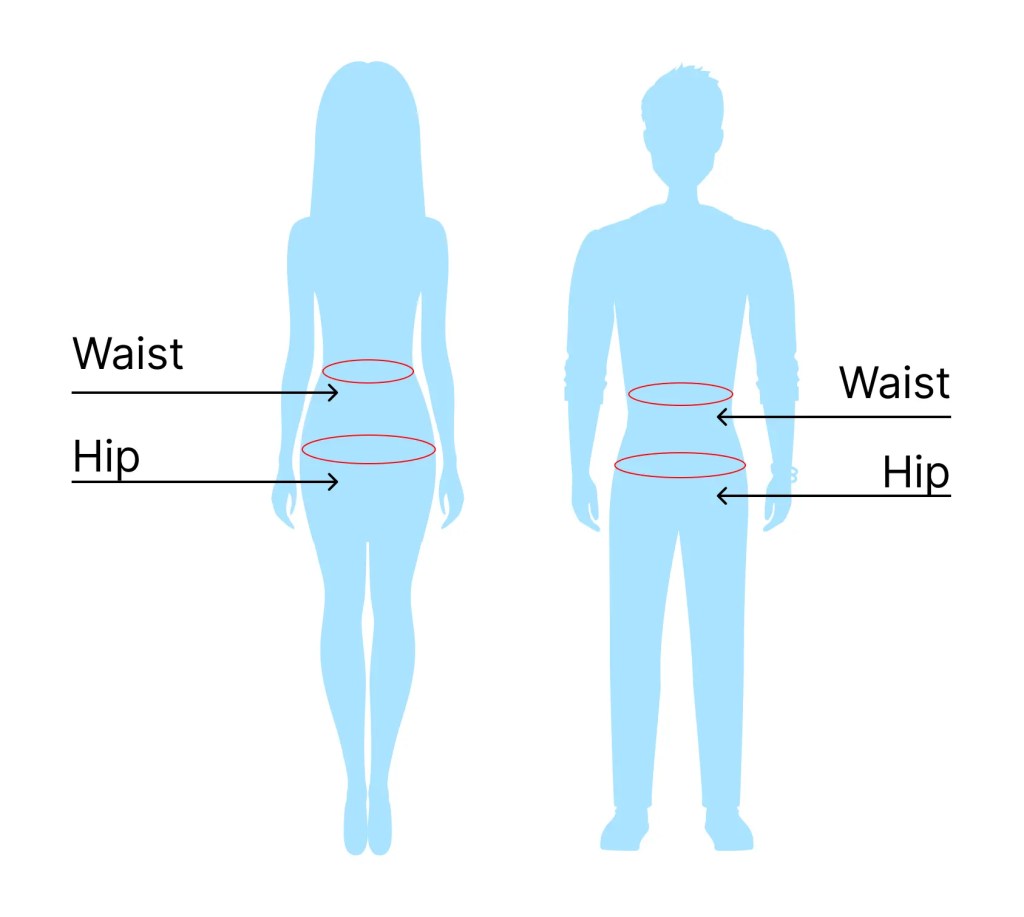
Across cultures and historical periods, a lower waist-to-hip ratio in women has been associated with reproductive health, metabolic resilience, and successful pregnancies. This is not about thinness, aesthetics, or moral worth. It is about fat function, not fat fear, and about how different tissues behave metabolically inside the body. It is about where fat is stored and how it functions.

And in today’s modern culture we have lost that distinction.

Instead of asking what kind of fat a woman carries, we became obsessed with how much. Instead of understanding fat as tissue with purpose, we turned it into a moral scoreboard. Hips became a problem. Thighs became something to shrink. Curves became something to discipline.

Another central idea in Why Women Need Fat is biological set point.
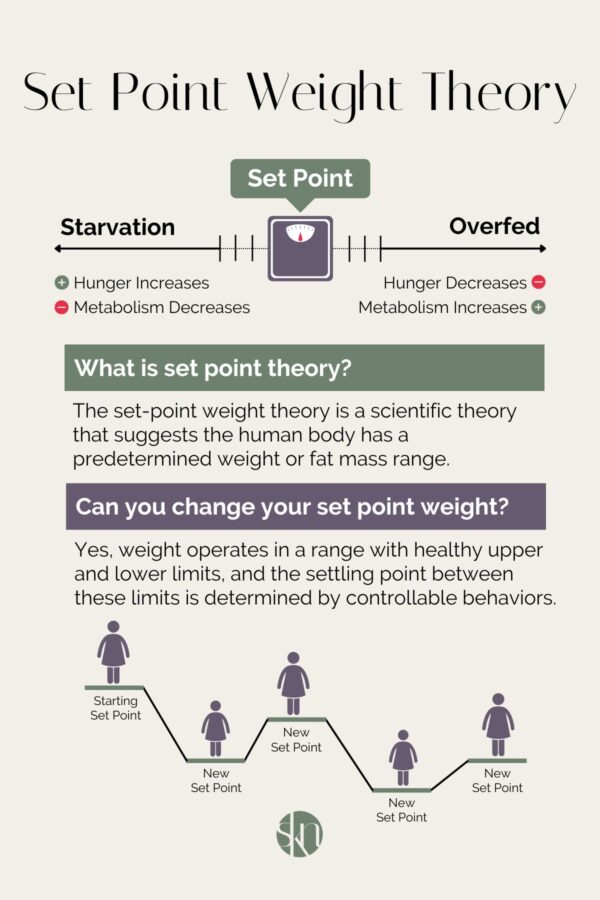
The authors argue that women’s bodies tend to defend a natural weight range when adequately nourished and not under chronic stress. When women remain below that range through restriction, over-exercise, or prolonged under-fueling, the body does not interpret that as success. It interprets it as threat.

Over time, the body adapts, not out of defiance, but out of protection.

Metabolism slows. Hunger and fullness cues become unreliable. Hormonal systems compensate. When the pressure finally eases, weight often rebounds, sometimes beyond where it started, because the body is trying to restore safety.

From this perspective, midlife weight gain, post-illness weight gain, or weight gain after years of restriction is not mysterious. It is not rebellion. It is regulation.

None of this is taught to women.

Instead, we are told that if our bodies change, we failed. That aging is optional. That discipline and botox should override biology. That the number on the scale tells the whole story.

So, before we talk about culture, family, trauma, or personal experience, this matters:

Women’s bodies are not designed to stay static.
They are designed to adapt.

Once you understand that, everything else in this conversation changes.


Why the Body Became the Battlefield
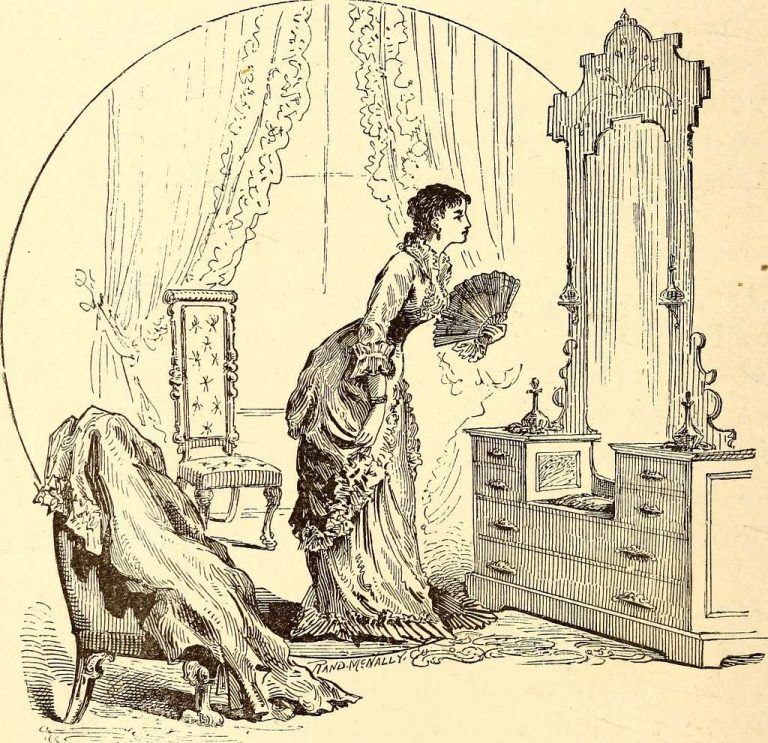
This is where historian Joan Jacobs Brumberg’s work in The Body Project: An Intimate History of American Girls, provides essential context, but it requires some precision.

Girls have not always been free from shame. Shame itself is not new. What has changed is what women are taught to be ashamed of, and how that shame operates in daily life.

Brumberg asks a question that still feels unresolved today:
Why is the body still a girl’s nemesis? Shouldn’t sexually liberated girls feel better about themselves than their corseted counterparts a century ago?

Based on extensive historical research, including diaries written by American girls from the 1830s through the 1990s, Brumberg shows that although girls today enjoy more formal freedoms and opportunities, they are also under more pressure and at greater psychological risk. This is due to a unique convergence of biological vulnerability and cultural forces that turned the adolescent female body into a central site of social meaning during the twentieth century.

In the late nineteenth and early twentieth centuries, girls did not typically grow up fixated on thinness, calorie control, or constant appearance monitoring. Their diaries were not filled with measurements or food rules. Instead, they wrote primarily about character, self-restraint, moral development, relationships, and their roles within family and community.

One 1892 diary entry reads:

“Resolved, not to talk about myself or feelings. To think before speaking. To work seriously. To be self-restrained in conversation and in actions. Not to let my thoughts wander. To be dignified. Interest myself more in others.”

In earlier eras, female shame was more often tied to behavior, sexuality, obedience, and virtue. The body mattered, but primarily as a moral symbol rather than an aesthetic project requiring constant surveillance and correction.

That changed dramatically in the twentieth century.

Brumberg documents how the mother-daughter connection loosened, particularly around menstruation, sexuality, and bodily knowledge. Where female relatives and mentors once guided girls through these transitions, doctors, advertisers, popular media, and scientific authority increasingly stepped in to fill that role.
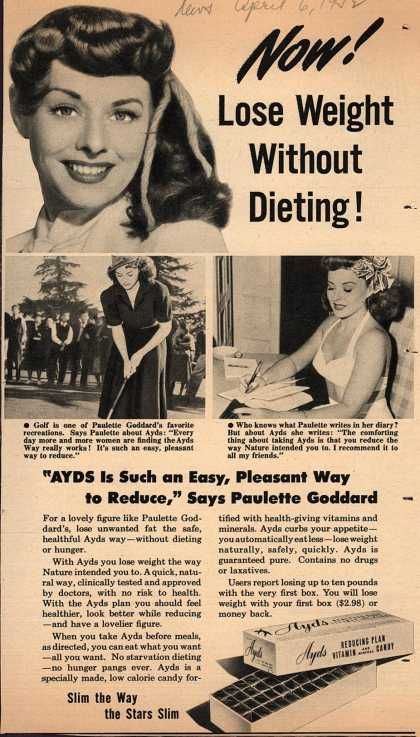
At the same time, mass media, advertising, film, and medicalized beauty standards created a new and increasingly exacting ideal of physical perfection. Changing norms around intimacy and sexuality also shifted the meaning of virginity, turning it from a central moral value into an outdated or irrelevant one. What replaced it was not freedom from scrutiny, but a different kind of pressure altogether.

By the late twentieth century, girls were increasingly taught that their bodies were not merely something they inhabited, but something they were responsible for perfecting.

A 1982 diary entry captures this shift starkly:

“I will try to make myself better in any way I possibly can with the help of my budget and baby-sitting money. I will lose weight, get new lenses, already got a new haircut, good makeup, new clothes and accessories.”

What changed was not the presence of shame, but its location. Shame moved inward.

Rather than being externally enforced through rules and prohibitions, it became self-policed. Girls were taught to monitor themselves constantly, to evaluate their bodies from the outside, and to treat appearance as the primary expression of identity and worth.

Brumberg is explicit on this point. The fact that American girls now make their bodies their central project is not an accident or a cultural curiosity. It is a symptom of historical changes that are only beginning to be fully understood.

This is where more recent work, such as Louise Perry’s The Case Against the Sexual Revolution, helps extend Brumberg’s analysis into the present moment. Perry argues that while sexual liberation promised autonomy and empowerment, it often left young women navigating powerful biological and emotional realities without the social structures that once offered protection, guidance, or meaning. In that vacuum, the body became one of the few remaining sites where control still seemed possible.

The result is a paradox. Girls are freer in theory, yet more burdened in practice. The body, once shaped by communal norms and shared female knowledge, becomes a solitary project, managed under intense cultural pressure and constant comparison.

For many girls, this self-surveillance does not begin with magazines or social media. It begins at home, absorbed through tone, comments, and modeling from the women closest to them.

Brumberg argues that body dissatisfaction is often transmitted from mother to daughter, not out of cruelty, but because those mothers inherited the same aesthetic anxieties. Over time, body shame becomes a family inheritance, passed down quietly and persistently.

Some mothers transmit it subtly.

Others do it bluntly.

This matters not because my experience is unique, but because it illustrates what happens when a body shaped by restriction, stress, and cultural pressure is asked to perform indefinitely. Personal stories are often dismissed as anecdotal, but they are where biological theory meets lived reality.

If you want to dive deeper into this topic:


Where It All Began: The Messages That Shape Us

I grew up in a household where my body was not simply noticed. It was scrutinized, compared, and commented on. Comments like that do not fade with time. They shape how you see yourself in mirrors and photographs. They teach you that your body must be managed and monitored. They plant the belief that staying small is the price of safety.

So, I grew up believing that if I could control my body well enough, I could avoid humiliation. I could avoid becoming the punchline. I could avoid being seen in the wrong way.

For a while, I turned that fear into discipline.


The Years Before the Collapse: A Lifetime of Restriction and Survival

Food never felt simple for me. Long before bodybuilding, chronic pain, or COVID, I carried a strained relationship with eating. Growing up in a near constant state of anxiety meant that hunger cues often felt unpredictable. Eating was something to plan around or push through. It rarely felt intuitive or easy.

Because of this, I experimented with diets that replaced real meals with cereal or shakes. I followed plans like the Special K diet. I relied on Carnation Instant Breakfast instead of full meals. My protein intake was low. My fear of gaining weight was high. Restriction became familiar.

Top left is when I started working out obsessively at age 16, top right and bottom photo are from middle school when I was at my “heaviest” that drove the disordered behaviors.

In college, I became a strict vegetarian out of compassion for animals, but I did not understand how to meet my nutritional needs. I was studying dietetics and earning personal training certifications while running frequently and using exercise as a way to maintain control. From the outside, I looked disciplined. Internally, my relationship with food and exercise remained tense and inconsistent.

Later, I became involved in a meal-replacement program through an MLM. I replaced two meals a day with shakes and practiced intermittent fasting framed as “cleanse days.” In hindsight, this was structured under-eating presented as wellness. It fit seamlessly into patterns I had lived in for years.

Eating often felt overwhelming. Cooking felt like a hurdle. Certain textures bothered me. My appetite felt fragile and unreliable. This sensory sensitivity existed long before the parosmia that would come years later. From early on, food was shaped by stress rather than nourishment.

During this entire period, I was also on hormonal birth control, first the NuvaRing and later the Mirena IUD, for nearly a decade. Long-term hormonal modulation can influence mood, inflammation, appetite, and weight distribution. It added another layer of complexity to a system already under strain.

Looking back, I can see that my teens and twenties were marked by near constant restriction. Restriction felt normal. Thriving did not.

The book Why Women Need Fat discusses the idea of a biological weight “set point,” the range a body tends to return to when conditions are stable and adequately nourished. I now understand that I remained below my natural set point for years through force rather than balance. My biology never experienced consistency or safety.

This was the landscape I carried into my thirties.


The Body I Built and the Body That Broke

By the time I entered the bodybuilding world in 2017 and 2018, I already had years of chronic under-eating, over-exercising, and nutrient gaps behind me. Bodybuilding did not create my issues. It amplified them.

I competed in four shows. People admired the discipline and the physique. Internally, my body was weakening. I was overtraining and undereating. By 2019, my immune system began to fail. I developed severe canker sores, sometimes twenty or more at once. I started noticing weight-loss resistance. Everything I had done in the past, was no longer working. On my thirty-fifth birthday, I got shingles. My energy crashed. My emotional bandwidth narrowed. My body was asking for rest, but I did not know how to slow down.

Dive deeper into my body building journey here:

Around this time, I was also navigating eating disorder recovery. Learning how to eat without panic or rigid control was emotionally exhausting even under ideal circumstances… but little did I know things were about to take a massive turn for the worst.


COVID, Sensory Loss, and the Unraveling of Appetite

After getting sick with the ‘vid late 2020, everything shifted again. I developed parosmia, a smell and taste distortion that made many foods taste rotten or chemical. Protein and cooked foods often tasted spoiled. Herbs smelled like artificial chemical. Eating became distressing and, at times, impossible.

My appetite dropped significantly. There were periods where my intake was very low, yet my weight continued to rise. This is not uncommon following illness or prolonged stress. The body often shifts into energy conservation, prioritizing survival overweight regulation.

Weight gain became another source of grief. Roughly thirty pounds over the next five years. I feel embarrassed and avoid photographs. I often worry about how others will perceive me.

If this experience resonates, it is important to say this clearly: your body is not betraying you. It is responding to stress, illness, and prolonged strain in the way bodies are designed to respond.


Why Women’s Bodies Adapt Instead of “Bounce Back”

When years of restriction, intense exercise, chronic stress, illness, hormonal shifts, and emotional trauma accumulate, the body often enters a protective state. Metabolism slows. Hormonal signaling shifts. Hunger cues become unreliable. Weight gain or resistance to weight loss can occur even during periods of low intake, because energy regulation is being driven by survival physiology rather than simple calorie balance.

This is not failure. It is physiology.

The calories-in, calories-out model does not account for thyroid suppression, nervous system activation, sleep disruption, pain, trauma, or metabolic adaptation. It reduces a complex biological system to arithmetic.

Women are not machines. We are adaptive systems built for survival. Sometimes resilience looks like holding onto energy when the body does not feel safe.


The Systems That Reinforce Shame
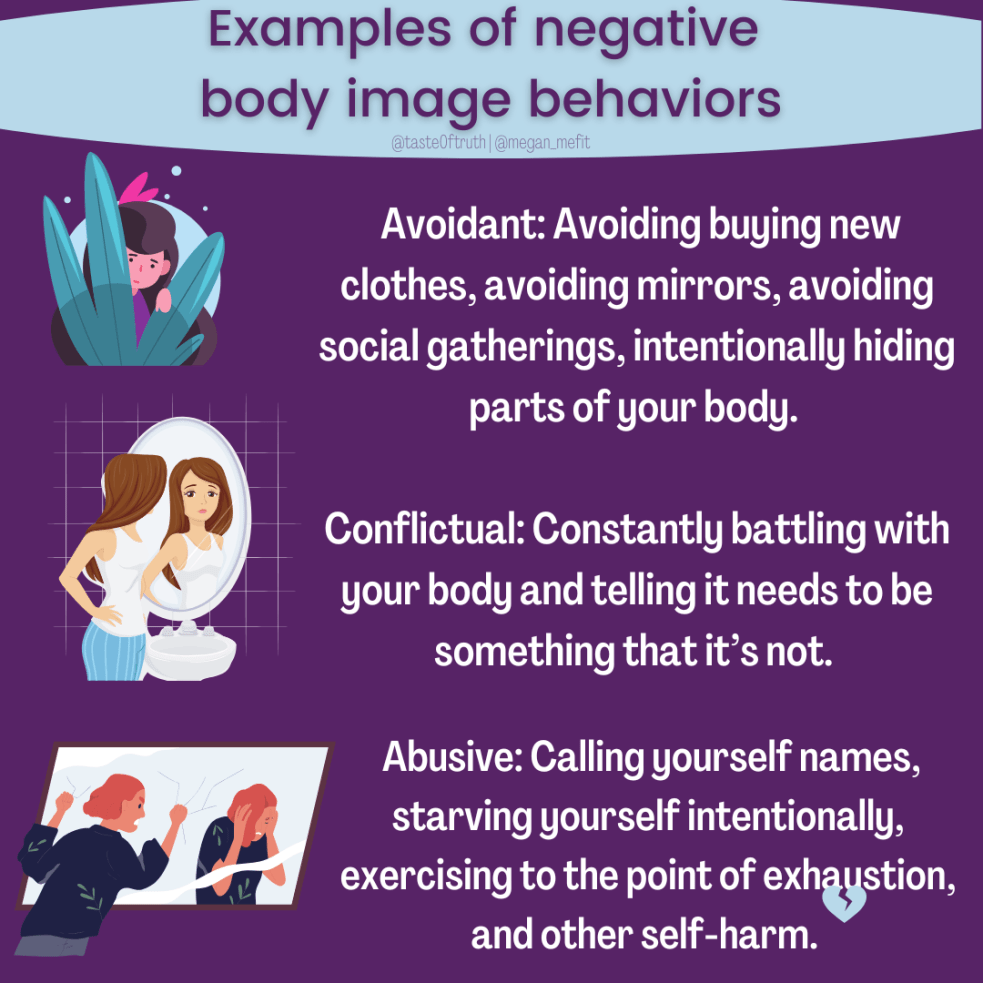
Despite this biological reality, we live in a culture that ties women’s value to discipline and appearance. When women gain weight, even under extreme circumstances, we blame ourselves before questioning the system.

Diet culture frames shrinking as virtue.

Toxic positivity encourages acceptance without context.

Industrial food environments differ radically from those our ancestors evolved in.

Medical systems often dismiss women’s pain and metabolic complexity.

Social media amplifies comparison and moralizes body size.

None of this is your fault. And all of it shapes your experience.

This is why understanding the science matters. This is why telling the truth matters. This is why sharing stories matters.


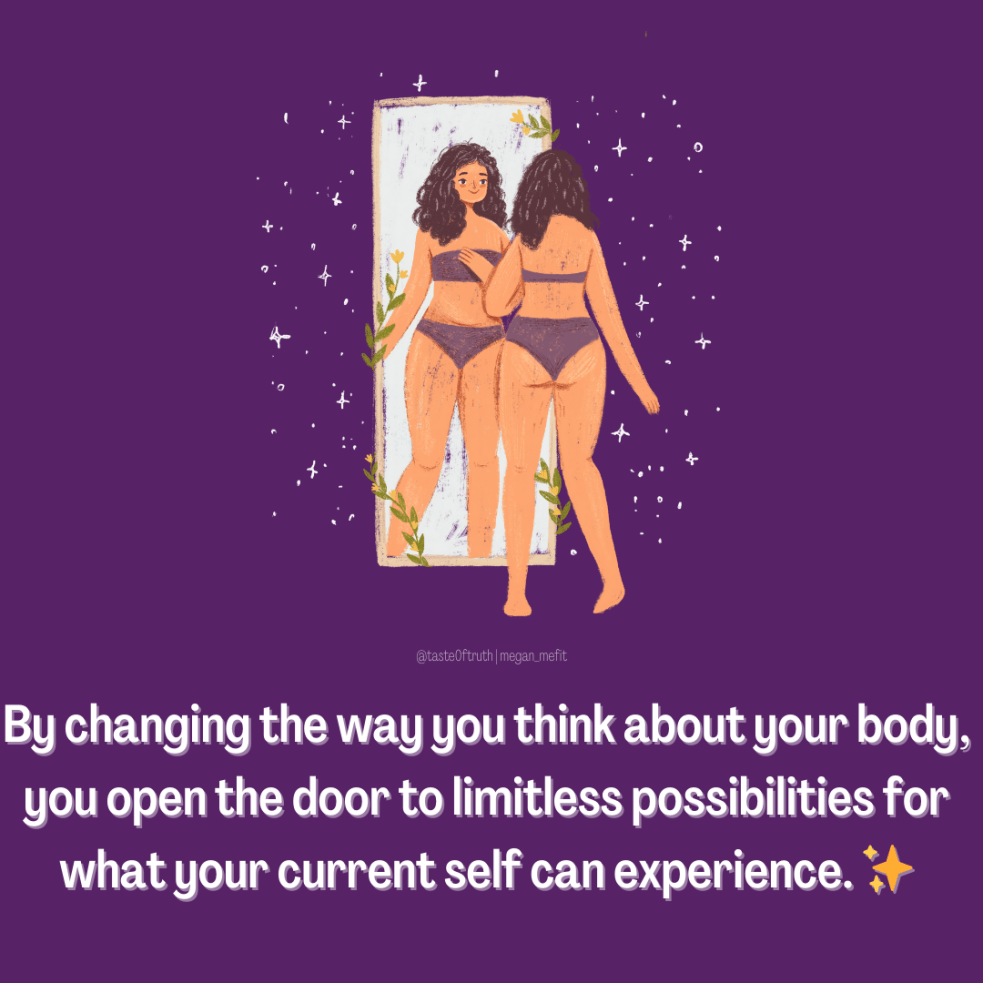
In the book, More Than a Body, Lindsay and Lexie Kite describe how women are taught to relate to themselves through constant self-monitoring. Instead of living inside our bodies, we learn to watch ourselves from the outside. We assess how we look, how we are perceived, and whether our bodies are acceptable in a given moment.

This constant self-surveillance does real harm. It pulls attention away from hunger, pain, fatigue, and intuition. It trains women to override bodily signals in favor of appearance management. And over time, it creates a split where the body is treated as a project to control rather than a system to understand or care for.

When you layer this kind of self-objectification on top of chronic stress, restriction, illness, and trauma, the result is not empowerment. It is disconnection. And disconnection makes it even harder to hear what the body needs when something is wrong.

Weight gain is not just a biological response. It becomes a moral verdict. And that is how women end up fighting bodies that are already struggling to keep them alive.

The Inheritance Ends Here

For a long time, I believed that breaking generational cycles only applied to mothers and daughters. I do not have children, so I assumed what I inherited would simply end with me, unchanged.

Brumberg’s work helped me see this differently.

What we inherit is not passed down only through parenting. It moves through tone, silence, and self-talk. It appears in how women speak about their bodies in front of others. It lives in the way shame is normalized.

I inherited a legacy of body shame. Even on the days when I still feel its weight, I am choosing not to repeat it.

For me, the inheritance ends with telling the truth about this journey and refusing to speak to my body with the same cruelty I absorbed growing up. It ends here.


Closing the Circle: Your Body Is Not Broken

I wish I could end this with a simple story of resolution. I cannot. I am still in the middle of this. I still grieve. I still struggle with eating and movement. I am still learning how to inhabit a body that feels unfamiliar.

But I know this: my body is not my enemy. She is not malfunctioning. She is adapting to a lifetime of stress, illness, restriction, and emotional weight.

If you are in a similar place, I hope this offers permission to stop fighting yourself and start understanding the patterns your body is following. Not because everything will suddenly improve, but because clarity is often the first form of compassion.

Your body is not betraying you. She is trying to keep you here.

And sometimes the most honest thing we can do is admit that we are still finding our way.

References

  1. Brumberg, J. J. (1997). The Body Project: An Intimate History of American Girls. Random House.
  2. Lassek, W. D., & Gaulin, S. J. C. (2011). Why Women Need Fat: How “Healthy” Food Makes Us Gain Excess Weight and the Surprising Solution to Losing It Forever. Hudson Street Press.
  3. Kite, L., & Kite, L. (2020). More Than a Body: Your Body Is an Instrument, Not an Ornament. Houghton Mifflin Harcourt.

Scientific and academic sources

  1. Lassek, W. D., & Gaulin, S. J. C. (2006). Changes in body fat distribution in relation to parity in American women. Evolution and Human Behavior, 27(3), 173–185.
  2. Lassek, W. D., & Gaulin, S. J. C. (2008). Waist–hip ratio and cognitive ability. Proceedings of the Royal Society B, 275(1644), 193–199.
  3. Dulloo, A. G., Jacquet, J., & Montani, J. P. (2015). Adaptive thermogenesis in human body-weight regulation. Obesity Reviews, 16(S1), 33–43.
  4. Fothergill, E., et al. (2016). Persistent metabolic adaptation after weight loss. Obesity, 24(8), 1612–1619.
  5. Kyle, U. G., et al. (2004). Body composition interpretation. American Journal of Clinical Nutrition, 79(6), 955–962.
  6. Simopoulos, A. P. (2016). Omega-6/omega-3 balance and obesity risk. Nutrients, 8(3), 128.

Trauma, stress, and nervous system context

  1. Sapolsky, R. M. (2004). Why Zebras Don’t Get Ulcers. Henry Holt and Company.
  2. Walker, P. (2013). Complex PTSD: From Surviving to Thriving. Azure Coyote Books.
Social Miasm Theory: The Biology of a Sick Society

How Suppression Shapes Our Bodies, Minds, and the World We Live In

Hey hey, Welcome back! Today’s episode connects beautifully to something many of you resonated with in my earlier show, Science or Stagnation? The Risk of Unquestioned Paradigms. In that episode, we talked about scientism… not science itself, but the dogma that forms around certain scientific ideas.

That’s why voices like Rupert Sheldrake have always fascinated me. Sheldrake, for those unfamiliar, isn’t a fringe crank. He’s a Cambridge-trained biologist who dared to question what he calls the “ten dogmas of modern science”: that nature is mechanical, that the mind is only the brain, that the laws of nature are fixed, that free will is an illusion, and so on.

When he presented these questions in a TED Talk, it struck such a nerve that the talk was quietly taken down. And that raised an obvious question: If the ideas are so wrong… why not let them stand and fall on their own? Why censor them unless they hit something tender? All of this sets the stage for today’s conversation.

Because the theory we’re exploring, Social Miasm Theory, fits right inside that tension between mainstream assumptions and the alternative frameworks we often dismiss too quickly.

My friend Stephinity Salazar just published a fascinating piece of research arguing that suppression  (of toxins, trauma, emotion, and truth) is the root pattern underlying both chronic illness and our wider social dysfunction. It’s a theory that steps outside the materialist worldview and challenges the mechanistic lens we’ve all been taught to see through.

You don’t have to agree with everything…that’s not the goal here.

What I love is the chance to explore, to ask good questions, and to stay grounded while examining ideas that stretch our understanding.

This blog is your guide to the episode, so you can track the concepts, explore the references, and dive deeper while you listen.

So, with that, let’s dive into Social Miasm Theory: what it is, where it comes from, why it matters, and what it might reveal about the world we’re living in today.


What Are Miasms, Anyway?

To anchor our conversation, Stephinity starts by grounding the concept of “miasms” in its homeopathic roots. Historically, Samuel Hahnemann (founder of homeopathy) described three primary miasms:

  • Psora, linked to scabies or skin conditions
  • Syphilis, associated with destructive disease
  • Sycosis, with overgrowth and tissue proliferation

Since then, the theory has expanded. Many modern homeopaths now talk about five chronic miasms, adding:

These aren’t diseases…they’re patterns. A kind of “constitutional operating system.”

Stephinity’s work takes this a step further:
If individuals can have miasms, societies can too.

It’s an ambitious idea. And honestly? A compelling one when you consider what’s happening globally.


Why Social Miasm Theory Matters

Suppression doesn’t stay in the body. It echoes outward into culture, politics, ecosystems, and collective behavior.

She breaks suppression into four types:

  • Toxic suppression: chemicals, pollutants, EMFs, pathogens
  • Emotional suppression: trauma, grief, stress, unprocessed feelings
  • Psychological suppression: denial, cognitive dissonance, fear-driven attachment to ideology
  • Truth suppression: propaganda, censorship, disinformation, scientific dogma

When these forms of suppression accumulate, she argues, they create a “social miasm”: a pathological field that shapes everything from public health to political polarization.

Even if you don’t buy every mechanism she proposes, the metaphor works. And the patterns are hard to ignore.

Evidence, Epistemology, and Skeptics: What Counts as “Real”?

This is the part my skeptical listeners will perk up for.

In the interview, I asked her the question I knew many of you were thinking:
“How do you define evidence within this framework? What would you want skeptical listeners to understand before judging it?”

Stephinity argues that the modern scientific lens is too narrow. Not wrong—but incomplete. She sees value in:

  • case studies
  • pattern recognition
  • field effects
  • resonance models
  • historical cycles
  • experiential knowledge

Whether or not you agree, her challenge to mechanistic materialism echoes thinkers like Rupert Sheldrake, IONS researchers, and even physicists questioning entropic cosmology.

And she’s not claiming this replaces science. She’s asking what science misses when it refuses to look beyond the physical.


Suppression: What It Looks Like in Real Life

Stephinity’s paper covers how suppression shows up on multiple levels. Here are a few examples she explores:

  • Overuse of symptom-suppressive medications
  • Emotional avoidance that pushes trauma deeper
  • Social pressure to conform
  • Institutional censorship
  • Environmental toxins that overwhelm the microbiome
  • Radiation and electromagnetic exposures

She frames suppression as a terrain problem: when the body or society becomes too acidic, stressed, toxic, or disconnected, the miasm takes root.

This is where we start to cross into the biological, psychological, and social layers—which brings us to one of my favorite parts of her theory.


Neuroparasitology: When Parasites Change Behavior

The concept of a new branch of science of neuroparasitology. Study of the influence of parasites on the activity of the brain.

This is the section I teased in the podcast because it’s both wild and backed by real research.

Stephinity references studies showing that parasites can alter host behavior not just in insects or rodents, but potentially in humans too. Her paper cites examples like helminths, nematodes, mycotoxins, and other microorganisms (McAuliffe, 2016; Colaiacovo, 2021). These organisms are everywhere, not just in “developing countries” (Yu, 2010).

Researchers have documented parasites that:

  • influence mood
  • shift risk-taking
  • modify sexual attraction
  • impair impulse control
  • change social patterns

This is what Dawkins called the extended phenotype (1982): the parasite’s genes expressing themselves through the host’s behavior. Neuroparasitologists Hughes & Libersat (2019) and Johnson (2020) have shown how certain infections can shift personality traits in specific, predictable ways.

Stephinity ties this into terrain: parasites tend to thrive in acidic, low-oxygen, stressed, radiative environments (Clark, 1995; Tennant, 2013; Cerecedes, 2015). In her view, chronic suppression creates exactly that kind of internal ecosystem.

But there’s another layer here. One that isn’t biological at all.

This is where philosopher Daniel Dennett enters the chat.

In Breaking the Spell, Dennett describes “parasites of the mind”: ideas that spread not because they’re true, but because they’re incredibly good at hijacking human psychology. These mental parasites latch onto our cognitive wiring the same way biological one’s latch onto the nervous system. They survive by exploiting:

  • fear
  • moral impulses
  • tribal loyalty
  • the desire for certainty
  • social pressure
  • existential insecurity

According to Dennett, religious dogmas, conspiracy theories, and ideological extremes act like memetic parasites: they replicate by using us, encouraging us to host them and then pass them on.

In other words: not all parasites live in the gut. Some live in the mind.

And…..we even discussed how billionaire Les Wexner once publicly described having a “dybbuk spirit” a kind of parasitic entity in Jewish folklore known for influencing personality. Whether symbolic or literal, the analogy fits. 🫨😮

Her point is simple:
When the terrain is weak, something else will fill the space.

Whether that “something” is trauma, ideology, toxicity, or a literal parasite… the mechanism rhymes.


Collective Delusion and Mass Psychosis

Drawing on Jung and Dostoevsky, Stephinity explores the idea that societies can enter “psychic epidemics.”

You’ve seen this. We all have…

The last decade has been a masterclass in how fear, propaganda, and emotional suppression create predictable patterns:

  • polarization
  • tribal thinking
  • moral panics
  • ideological possession
  • scapegoating
  • censorship
  • intolerance of nuance

She argues these are symptoms of a cultural miasm—not failures of individual character.

Whether you lean left, right, or somewhere out in the wilderness, you’ve likely felt this rising tension. And it’s hard not to see how unresolved collective trauma feeds it.


COVID as a Catalyst: What the Pandemic Revealed

Another part of her paper dives into how the pandemic brought hidden patterns to the surface.

Some of her claims are controversial, especially around EMFs and environmental co-factors. In the episode, we unpack these with curiosity, not blind acceptance.

Her larger point is that COVID exposed:

  • institutional fragility
  • scientific gatekeeping
  • public distrust
  • trauma-based responses
  • authoritarian overreach
  • the psychological toll of suppression

Whether you agree with the specific mechanisms or not, the last decade made one thing undeniable: something in our social terrain is deeply dysregulated.


8. Healing Forward: What Do We Do With All This?

If suppression drives miasms, then healing means unsuppressing. Gently, not chaotically.

Stephinity suggests practices like:

  • emotional honesty
  • reconnecting with nature
  • releasing stored trauma
  • nutritional and detoxification support
  • reducing exposure to chronic stressors
  • restoring community and meaning
  • opening space for spiritual or intuitive insight

She’s not prescribing a protocol. She’s offering a map.

The destination is what the Greeks called sophrosyne: a state of balance between wisdom and sanity. Not blissful ignorance, not paranoid awakening. Just grounded clarity.

And I think we could all use a bit more of that.


Key Evidence and Arguments

  • Stephinity critiques materialist science, calling out what she terms “entropic cosmology.” She argues that by assuming nature is strictly mechanistic, mainstream science misses field-based phenomena, non-local consciousness, and deeper systemic patterns.
  • She draws on historical and homeopathic sources (Hahnemann, Kent) to build her theoretical foundation but also argues for newer forms of evidence: resonance, case studies, and pattern detection in social systems.
  • On the environmental front, she explores links between toxins, EMF / 5G, biotech, and chronic disease, not just as correlation, but as evidence of suppression dynamics.
  • Psychologically, she invokes mass delusion or collective repression (drawing from Jung, Dostoevsky) seeing societal crises as expressions of buried collective shadow.
  • Ultimately, her call to action isn’t just for individual healing, but for systemic awakening: more transparency, alternative medical paradigms, and restored connection with nature.

Why This Matters for You

Even if homeopathy isn’t your jam, Social Miasm Theory offers a metaphor (and potentially a map) for understanding how inner repression becomes external crisis. If this episode does anything, I hope it gives you permission to look a little closer and question the stuff we’re told not to touch.


📚 Want to Dig Deeper?

Stephinity’s website: YOUR BODY ELECTRIC YOUR BODY ELECTRIC | FULL SPECTRUM FREQUENCY MEDICINE Find her on Linkden , Instagram and Substack

Social Miasm Theory: Revisiting Chronic Illness from a Meta-Perspective of Suppression [truncated version, pre-JSE publishing]

Official published paper

Miasms

https://www.unifiedfield.info/

https://corbettreport.com/how-the-government-manufactured-covid-consent

Use of fear to control behavior in Covid crisis was ‘totalitarian’, admit scientists

Understanding Hormonal Changes in Midlife Women

The Truth About Hormones &Body Fat

If you’re a woman in midlife witnessing changes in your body, let’s be honest—hearing one more expert say “just move more and eat less” might make you scream. That tired, oversimplified advice ignores the very real ways our bodies change—and the decades of life we’ve already lived in them.

Midlife, generally defined as the ages between 37 and 65, isn’t just a calendar phase. It’s a biological, emotional, and identity-shifting chapter. For women, it often marks the beginning of perimenopause—the transitional period leading up to menopause, when the ovaries gradually produce less estrogen. Menopause itself is defined as the 12-month mark after your final menstrual period, but the hormonal fluctuations and symptoms often begin years before and can last well beyond that point.

To really understand what’s happening in our bodies now, we have to rewind the clock.

From puberty, our bodies have been shaped by an elegant hormonal dance. Estrogen, progesterone, and to a lesser extent testosterone, govern everything from our cycle to our skin, from our energy to our emotional responses. These hormones rise and fall in predictable patterns until they don’t. And when they don’t, you feel it.

Hot flashes. Sleep disruptions. Brain fog. Mood swings. Slower recovery from workouts. A scale that doesn’t seem to budge no matter what you do. And the silent undercurrents like the gradual loss of bone density—osteopenia—that often go unnoticed until it’s too late.

These aren’t random annoyances. They’re signals. And they deserve to be understood.

In this post and in today’s podcast episode, I talk with registered dietitian and research wizard Maryann Jacobsen about what actually helps us thrive during perimenopause and menopause. We get into why muscle is metabolic gold, why cardio isn’t always the answer, and how biofeedback your body’s own cues like hunger, energy, sleep, and mood can tell you more about what’s working than any calorie tracker or influencer’s reel ever could.

We also challenge the idea that your bathroom scale is the best measure of health. Spoiler alert: it’s not. Tools like DEXA scans provide deeper insight into your bone density and lean mass—two things that matter more than “weight” ever could in this stage of life. And while your smart scale using bioelectrical impedance might not be as accurate, it can still help you track general trends if you know how to interpret it.

One part of our conversation that hit me hard was Maryann’s mention of the body fat research around fertility. Scientists have found that a minimum of 17% body fat is required just to get a menstrual cycle, and about 22% is needed to maintain ovulation. But here’s the real shocker: in mature women, regular ovulatory cycles are often supported best at 26–28% body fat. (PMID: 3117838, 2282736) That means what many of us have been taught to chase ultra-lean physiques (around 17 BF% or so), chronic calorie restriction, or overtraining can actually backfire on our reproductive health, bone health, and overall vitality.

In populations where food is scarce or physical demands are high, we see patterns: delayed first periods, longer gaps between births, earlier menopause. It’s the body adapting for survival. But in modern life, we sometimes impose these same conditions on ourselves in the name of “fitness.”


And while estrogen usually gets the spotlight in menopause care often treated as the main character it’s progesterone that deserves a standing ovation. Many women are told they “need progesterone” just to protect themselves from estrogen’s effects, as if it’s merely a buffer. But that undersells its brilliance.

The name progesterone literally means “pro-gestation,” but its impact goes far beyond fertility. Progesterone is a master regulator. It stabilizes tissues, supports metabolic balance, calms inflammation, protects against stress, and even plays a role in brain health. While estrogen stimulates, progesterone shields. While estrogen builds, progesterone restores.

Fascinatingly, our bodies produce far more progesterone than estrogen especially after ovulation and during pregnancy. That’s not a fluke. It reflects just how critical progesterone is to our overall well-being.

So when ovulation slows or disappears in midlife, it’s not just your period going quiet. It’s this entire downstream network of hormonal resilience especially progesterone that starts to fade. And that’s when symptoms ramp up.

Understanding this isn’t just about managing menopause. It’s about honoring your biology, updating your strategy, and supporting your body like the powerful, responsive system it actually is.

If we want to balance and optimize our hormones in midlife, we have to re-evaluate our goals. This isn’t about grinding harder it’s about getting smarter. And to get smarter, we need to zoom out.

Ovulation isn’t just some fertility footnote-it’s the main event of your cycle. But many of us were taught that the bleed is the cycle. Nope. That’s just the after-party. The headliner? Ovulation.

Why does this matter in midlife?

Because ovulation is what triggers the production of progesterone a hormone that plays a critical role in metabolism, mood, sleep, brain function, and bone health. And spoiler: progesterone is the first to dip off the radar as we enter perimenopause. That’s why your energy feels off, your sleep gets weird, and your tolerance for stress tanks. Your body isn’t broken—it’s adapting.

Here’s where things click into place: your body will only ovulate consistently if it feels safe and nourished. That means you’re eating enough, not overtraining, and not living in a cortisol-fueled chaos spiral.

Ovulation isn’t just about reproduction it’s a vital sign of health.
And the two hormones that anchor your entire cycle, estrogen and progesterone, do so much more than regulate periods.

From bone density to brain function, from insulin sensitivity to mitochondrial health, these hormones influence nearly every system in your body. So, when they fluctuate…. or flatline… you feel it. Not just in your body, but in your entire day to day experience.

So, let’s break the rules, rewrite the midlife playbook, and finally start listening to the wisdom our bodies have been whispering all along.

LINKS:

In-depth-guide-on-midlife-weight

The Hidden Risks of Ozempic: Rapid Weight Loss Can Weaken Bones and Muscles

Farmer Vs Banker episode Move More, Eat Less? The Lie That Won’t Die

Resistance-exercise-perimenopause-symptoms

To take hormone therapy or not to take hormone therapy

The Case for Cardio

Contrary to popular belief, a larger body may actually be healthier (insta post)

Why Are Americans So Obsessed With Protein? Blame MAGA.

Midlife stress and its ripple effect on health

Meet your new post-40 nervous system

Move More, Eat Less? The Lie That Won’t Die

The Fatal Flaws of Calories In Calories Out and the Metabolism Model That Could Change Everything

Alright, let’s talk about the four most useless words in the history of weight loss advice: ‘Just eat less, move more.’ You’ve heard it, I’ve heard it, and if this phrase actually worked the way people think it does, we wouldn’t have skyrocketing rates of obesity, metabolic dysfunction, and entire industries built around yo-yo dieting. But here’s the kicker—it sounds logical. Simple math, right? Calories in, calories out. Except the human body is not a bank account; it’s a biological orchestra, and the way we process energy is more like a symphony than a spreadsheet.

We’ve already tackled the oversimplified calorie-counting dogma in our Science Dogma episode, and we’ve explored how perception alone—like believing a milkshake is ‘indulgent’—can literally alter our hormonal response. That’s not woo-woo, that’s science. But today, we’re going deeper. Because beyond the CICO model, beyond the calorie obsession, there’s a much bigger, messier, and more fascinating reality about metabolism, obesity, and why diet advice keeps failing people.

And I know what some of you might be thinking—‘But Megan, are you saying calories don’t matter?’ No. I’m saying they don’t tell the whole story. The way we eat, when we eat, why we eat, our hormones, stress levels, metabolic adaptations, even our past dieting history—all of it plays into how our body responds to food.

So as we close out Season 3 of Taste of Truth Tuesday, I want to leave you with something foundational. Not another diet trend. Not another oversimplified soundbite. But a real, nuanced conversation about what actually influences metabolism, weight loss, and why some of the most popular strategies—like keto, intermittent fasting, and calorie counting—work for some people but absolutely wreck others.

And here’s the disclaimer—I’m not an advocate for low-carb dieting in general, especially as someone who’s recovered from disordered eating. But my guest today? He eats low-carb and keto. And here’s what I respect—he’s not dogmatic about it. He understands that the real answer to health and weight loss isn’t found in any one-size-fits-all approach. It’s about bio-individuality.

So grab your coffee, take a deep breath, and get ready to rethink everything you thought you knew about metabolism. Let’s do this.


The calorie, as a unit of measurement, has a fascinating history that ties directly into the calories in, calories out (CICO) debate. While many assume the calorie has always been the standard for measuring food energy, its adoption in nutrition is relatively recent and shaped by shifts in scientific understanding, industry influence, and public health narratives.

The Origin of the Calorie

The concept of the calorie originated in physics, not nutrition. In the early 19th century, Nicolas Clément, a French chemist, introduced the term calorie as a measure of heat energy. By the late 1800s, scientists like Wilbur Olin Atwater adapted this concept to human metabolism, conducting bomb calorimeter experiments to determine how much energy food provided when burned. Atwater’s Physiological Fuel Values established the foundation for modern caloric values assigned to macronutrients (fat = 9 kcal/g, carbohydrates and protein = 4 kcal/g, alcohol = 7 kcal/g).

The Rise of Caloric Nutrition

By the early 20th century, calories became central to dietary guidelines, especially in public health efforts to address malnutrition. During both World Wars, governments used calorie counts to ration food efficiently. However, as food abundance grew, the focus shifted from ensuring sufficient calorie intake to preventing excess, paving the way for weight-focused dietary interventions.

CICO and the Simplification of Weight Loss

The calories in, calories out model became dominant in the mid-20th century, driven by research showing that weight loss or gain depended on energy balance. The First Law of Thermodynamics—energy cannot be created or destroyed, only transformed—was applied to human metabolism, reinforcing the idea that a calorie surplus leads to weight gain and a deficit to weight loss.

This framework became the foundation of mainstream diet advice, but it often overlooked complexities such as:

  • Hormonal influences (e.g., insulin, leptin, ghrelin)
  • Metabolic adaptation (how bodies adjust to calorie deficits)
  • The thermic effect of food (protein takes more energy to digest than fat or carbs)
  • Gut microbiome effects on calorie absorption
  • Psychological and behavioral aspects of eating

Criticism and the Evolution of the Debate

By the late 20th century, challenges to strict CICO thinking emerged. Researchers in endocrinology and metabolism, such as Dr. Robert Lustig and Dr. David Ludwig, highlighted that not all calories affect the body in the same way—insulin regulation, macronutrient composition, and food quality play crucial roles.

Low-carb and ketogenic diet advocates argued that carbohydrate restriction, not just calorie restriction, was key to weight management due to its impact on insulin and fat storage.

I personally think, it’s not just carbs or calories doing this. There are at least 42 factors that impact blood sugar and metabolism. This is something I’ve worked to educate my audience on for years. Carbs are just one piece of the puzzle. Stress, sleep, gut microbiome, meal timing, inflammation, hormonal balance—all of these influence the body’s metabolic “terrain.”

Where Are We Now?

Today, the calorie remains a useful measure, but the conversation has expanded beyond simple energy balance. Researchers acknowledge that while calories matter, factors like food quality, hormonal responses, and individual metabolic differences significantly impact how the body processes energy. The debate now leans toward a more nuanced view.


Now, let’s talk about why this matters.

Today, I’m joined by Adam Kosloff, an author and researcher who isn’t afraid to challenge conventional wisdom—especially when it comes to obesity and metabolism. A Substack post of his, A Righteous Assault on the Absolute Worst Idea in the History of Science, takes a sledgehammer to the dominant ‘calories in, calories out’ model, aka Move More, Eat Less? The Lie That Won’t Die, arguing that our understanding of fat storage is fundamentally broken. Instead, he presents a revolutionary new framework—the Farmer Model—that redefines how we think about metabolism, obesity, and weight loss.

For years, the dominant narrative around weight loss has been depressingly simple: “move more, eat less.” This slogan has been drilled into us by dietitians, doctors, and fitness gurus as if it were an unshakable law of physics. But if it were that simple, why has metabolic disease skyrocketed despite more people tracking their calories and increasing exercise?

Adam challenges the traditional CICO (calories in, calories out) model, not just by saying it’s wrong, but by arguing it is catastrophically misleading. His Farmer Model reframes obesity and metabolic dysfunction as a landscape issue rather than a simple calorie balance equation.

Think of your metabolism like farmland. The most obvious disruptor might be “acid rain”—high-carb, sweet, ultra-processed foods that erode the topsoil, flood the land, and cause metabolic damage (fat storage, inflammation, insulin spikes). But not all disruptions look like a storm.

Sometimes, the changes are more insidious. Maybe those daily lattes weren’t a flood but a subtle shift in the terrain, like over-fertilizing a field. Too much of a good thing, whether dairy proteins or artificial sweeteners, can nudge the metabolic landscape in a way that leads to dysfunction over time.

And here’s the kicker: It’s not just carbs or calories doing this. There are at least 42 factors that impact blood sugar and metabolism. This is something I’ve worked to educate my audience on for years. Carbs are just one piece of the puzzle. Stress, sleep, gut microbiome, meal timing, inflammation, hormonal balance—all of these influence the body’s metabolic “terrain.”

Adam’s latest Substack post, 10 Smackdowns That Lay Waste to CICO, was an absolute banger. The line “Gaze upon these arguments, ye mighty gym bros, and despair…” had me cackling. But beyond the sass, the research was rock solid. In our conversation, we break down some of the most devastating smackdowns against CICO and discuss which ones tend to make the most die-hard calorie counters short-circuit.

The takeaway? The “move more, eat less” doctrine is outdated and incomplete. It’s time for a more sophisticated conversation about metabolism that acknowledges the complexity of the human body rather than reducing it to a basic math equation.

LINKS

Science or Stagnation? The Risk of Unquestioned Paradigms – The first episode we challenged calories in, calories out (CICO) & mention Germ theory vs Terrain theory

The Farmer vs. The Banker

10 Smackdowns that lay waste to CICO

3 Times I Gained Weight on Keto

Gary Taubes Substack articles

Emotional Hijacks & Nutritional Hacks: Unveiling the🧠Amygdala’s Secrets ⁠

The Dissolution of the Nutrition Science Initiative

Obesity and Starvation Found Together

The Influence of Religious Movements on Nutrition

Why Challenging Beliefs Feels Like a Personal Attack—And Why It Shouldn’t

The Biggest Loser Study-The metabolic consequences of extreme dieting & the weight gain rebound effect

Escaping One Cult, Joining Another? The Trap of Ideological Echo Chambers

When ‘Cult Recovery’ Looks a Lot Like a New Cult

I had a lot of different topics in mind for my final solo episode of Taste of Truth Tuesdays Season 3. For example, The Stress-Mitochondria Connection: How B vitamins, Taurine and Magnesium Fuel your Energy, A world without religion: Freedom or Fragmentation, How Emotional Trauma contributes to Chronic Pain or the Social Media Dilemma How to Break Free from the Digital Grip… But then, a new development landed right in my lap—one that perfectly encapsulates the concerning trends I’ve been observing in the deconstruction, ex-Christian, anti-MLM, and ex-cult communities.

My friend Brandie, who I had on in Season 2 for the episode From Serendipity to Scrutiny, recently blocked me. And why? Because I simply pushed back and asked questions. We’d had some private conversations in the DMs that had already raised red flags for me, but apparently, even the slightest bit of pushback was enough to get me cut off. This isn’t just about one friendship—it’s about a much bigger pattern I’ve seen unfolding.

The Deconstruction Pipeline: When Leaving a High-Control Group Means Entering Another

One of the biggest ironies in the ExChristian circles is how quickly people flee high-control religious environments only to land in equally dogmatic ideological spaces. This isn’t a coincidence—it’s human nature. As Jonathan Haidt lays out in The Righteous Mind, our reasoning evolved more for argumentation than truth-seeking. We are wired for confirmation bias, and when we leave one belief system, we often replace it with another that feels equally absolute but now appears “rational” or “liberating.”

This is where figures like Steven Hassan and Janja Lalich come in (because this isn’t just about Brandie) self-proclaimed experts on cults who, ironically, exhibit the same control tactics they claim to expose. Hassan, a former Moonie turned cult deprogrammer, has made a career out of helping people escape authoritarian religious systems. But a deeper look at his work reveals an ideological bent (it’s hard to ignore). He frequently frames conservative or traditional religious beliefs as inherently cult-like while giving progressive or leftist movements a pass. He has called Trumpism a cult but is conspicuously silent on the high-control tactics within certain progressive activist spaces. His criteria for what constitute undue influence seem to shift depending on the political context, (BITE model) making his framework less about critical thinking and more about reinforcing his preferred ideological narrative. I did what Hassan won’t: use his own model to break down the mind control tactics of the extreme left.

Janja Lalich follows a similar pattern. A (supposedly) former Marxist-Leninist, she applies her cult analysis primarily to religious and right-wing groups while glossing over the coercive elements in the far-left spaces she once occupied (or still does). Her work is valuable in breaking down how high-demand groups operate, but she, too, appears to have blind spots when it comes to ideological echo chambers outside of the religious sphere. These represent a pattern rather than an isolated incident. Other platforms like (The New Evangelicals, Dr. Pete Enns (The Bible for Normal People), Eve was framed, Jesus Unfollower, Dr. Laura Anderson just to name a few.) highlight control tactics when they appear in traditional or conservative groups but fail to apply the same scrutiny to their own ideological circles.

This selective analysis creates a dangerous illusion: it allows people leaving fundamentalist religious spaces to believe they are now “free thinkers” while unknowingly adopting another rigid belief system. The deconstruction pipeline often leads former evangelicals straight into progressive activism, where purity tests, ideological loyalty, and social shaming operate just as effectively as they did in the church. The language changes: “sin” becomes “problematic,” “heresy” becomes “harmful rhetoric”, but the mechanisms remain the same.

Haidt’s work on moral foundations helps explain this phenomenon. Progressive and conservative worldviews are built on different moral intuitions, but both can be taken to extremes. The key to avoiding ideological capture is intellectual humility—the ability to recognize that no belief system has a monopoly on truth and that reason itself can be weaponized for tribalism.

John Stuart Mill warned of this centuries ago: the greatest threat to truth is not outright censorship but the cultural and social pressures that make certain ideas unspeakable. Greg Lukianoff and Jonathan Haidt’s The Coddling of the American Mind echoes this concern, showing how overprotective thinking and emotional reasoning have created a generation that confuses disagreement with harm.

Franklin O’Kanu’s concept of the “fake intellectual” is particularly relevant here—people who claim to be champions of free thought while aggressively enforcing ideological orthodoxy.

In this episode, through my experience with Brandie, I’ll illustrate how skepticism is selectively applied, and how ‘critical thinking’ communities can become just as dogmatic as the systems they reject. And unlike Hassan or Lalich, my connection with Brandie was personal. And that’s why I felt this warranted an entire podcast episode. Because what happened with her is a microcosm of a larger issue: people leaving high-control spaces only to re-enter new ones. They are convinced that this time, they’ve finally found the “truth.” Spoiler alert: that’s not how truth works.

So, let’s talk about it.


Blocked for Asking Questions

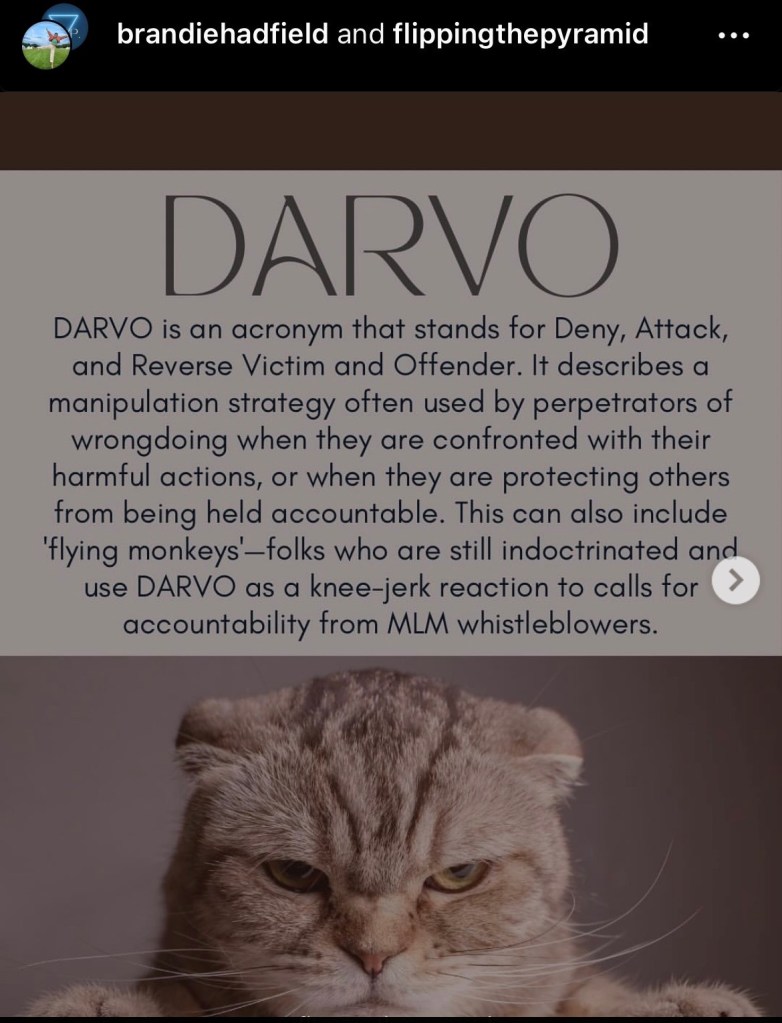
Recently, Brandie posted on Instagram about DARVO—a psychological tactic where abusers Deny, Attack, and Reverse Victim and Offender to avoid accountability. I agree that MLMs use DARVO. But I wanted to add friendly pushback, that I’ve noticed anti-MLM advocates use similar tactics to silence critics—especially when it comes to questioning the food industry— but she had turned the comments off.

So I went to Substack, wrote a note, tagged her and asked for us to have a discussion. and that’s when she blocked me. Not for being aggressive. Not for being rude. But for questioning her narrative.

So much for open conversation.

DARVO: The Classic Manipulation Tactic

DARVO stands for Deny, Attack, Reverse Victim and Offender—a tactic frequently used by abusers, cult leaders, and high-control groups when they’re called out. It flips accountability on its head, making the person asking legitimate questions seem like the aggressor while the actual manipulator plays the victim.

How MLMs Use DARVO

Multi-Level Marketing (MLM) schemes thrive on DARVO because their entire business model is built on deception. Here’s a classic example:

  1. Deny – A distributor is confronted with the fact that 99% of people in MLMs lose money. Instead of addressing the data, they deny it completely:
    “That’s just a myth! I know tons of people making six figures!”
  2. Attack – When pressed further, they go on the offensive, accusing the skeptic of being negative or jealous:
    “Wow, you’re so close-minded. No wonder you’re not successful!”
  3. Reverse Victim and Offender – Finally, they paint themselves as the victim and the questioner as the bully:
    “I’m just a woman trying to build a business and empower others. Why are you trying to tear me down?”

This tactic shuts down meaningful discussion and keeps people trapped in a system that exploits them.

Do you know what else exploits individuals? Fear and propaganda.

I saw this firsthand in a recent conversation with a friend who’s deeply entrenched in leftist ideologies and what I’d call “Trump Derangement Syndrome.” She shared a post warning people to change their bank accounts because of a false claim that Elon Musk’s staff had access to personal financial data. I pointed out that the post was misinformation, but instead of engaging with the facts, the conversation quickly shifted in a way that mirrors the DARVO tactic.

First, she denied that the post could be harmful or misleading. Then, she attacked me for not understanding the larger “fear” that people are feeling in the current political climate. Finally, she reversed the roles, casting herself as the victim of a chaotic world and me as the one creating unnecessary tension by questioning the post.

This is a textbook example of DARVO, a tactic that deflects accountability, shifts blame, and keeps people trapped in fear-driven narratives. It keeps them from having honest, fact-based conversations and prevents any real understanding of what’s going on around them.

How Brandie Used DARVO on Me

Ironically, despite being an anti-MLM advocate, Brandie used the exact same manipulation tactics when I pushed back on some of her positions. This is a woman who criticizes manipulative marketing tactics in MLMs, yet here she was, employing the very same tactics in our discussion. It’s a stark example of how these patterns can be so ingrained that even those who oppose them can fall into using them.

Deny – When I questioned her promotion of dietitians who endorse processed foods like Clif Z Bars (which recently faced a class-action lawsuit for misleading health claims), she refused to acknowledge the legitimate concerns. Instead, she dismissed it by claiming that caring about food ingredients was more stressful for the body than just eating the food itself—a false dichotomy that undermines any nuance in the conversation, especially when she often critiques the same logical fallacy in other contexts.

Attack – Rather than engaging with my points, she made it personal, implying that I was being antagonistic or bad-faith for even questioning her stance.

Reverse Victim and Offender – Finally, when I didn’t back down, she blocked me, flipping the narrative to make it seem like I was the one causing harm simply by asking questions.


When Therapy Becomes Thought Control: The Weaponization of Mental Health

What makes this dynamic even more interesting is that both my friend in Portland and Brandie, an anti-MLM advocate, are therapists. These conversations have all unfolded within a culture that professes to value feelings, emotional well-being, and mental health awareness. More people are going to therapy than ever before, and an increasing number of people are training to become therapists—mostly women. Currently, around 70-80% of psychologists and therapists are female, and those seeking help are also more likely to be female.

The field has increasingly become a vehicle for ideological activism. Dr. Roger McFillin has spoken extensively about this shift, describing how therapy now often reinforces victimhood narratives rather than fostering resilience. Instead of helping clients process experiences and build coping skills, many therapists nudge them toward predetermined ideological conclusions—especially in areas of identity, oppression, and systemic injustice.

This shift has eroded one of psychology’s most fundamental ethical principles: informed consent. Clients, particularly young and vulnerable individuals, are often funneled into ideological frameworks without realizing it. Under the guise of “affirming care” or “social justice-informed therapy,” therapists may subtly guide them toward specific worldviews rather than offering a full range of perspectives. What should be a process of self-discovery instead becomes thought reform, where questioning the prevailing narrative is framed as harmful or regressive.

Therapy is no longer just political—it has become a mechanism of enforcement. We see this in counseling programs that demand ideological conformity from students, in therapists who blur the line between clinical work and activism, and in public figures like Janja Lalich and Steven Hassan, who claim to expose undue influence while engaging in the same tactics. This is ideological gatekeeping disguised as expertise.

Rather than fostering open exploration, the field is increasingly defined by rigid dogma. Questioning the dominant ideology isn’t framed as critical thinking—it’s labeled as resistance, ignorance, or even harm. And when that happens, dissenting voices aren’t debated; they’re erased. If this trend continues, therapy won’t just be a tool for self-improvement. It will be a tool for social control. It already is.


The Hypocrisy of Selective Skepticism

Brandie and the anti-MLM crowd claim to combat misinformation, yet they overlook a significant issue: the influence of Big Food and Big Pharma on public health narratives.

On her social media story and in private conversations, Brandie has defended dietitians who actively promote ultra-processed foods. Some registered dietitians with large platforms endorse products like Hawaiian Punch and Clif Z Bars as acceptable—even healthy—options.

Clif Z Bars, for example, were recently involved in a $12 million class action settlement for falsely marketing their products as “healthy and nutritious.” These bars are 37% added sugar, essentially sugar bombs.

Yet, a dietitian Brandie supports feeds these bars to her young children, publicly calling them a “healthy snack.” Why is this not considered misinformation?

A deeper issue lies in the conflicts of interest within the nutrition field. 95% of the 2020 U.S. Dietary Guidelines Advisory Committee members had conflicts of interest with the food and pharmaceutical industries. Many had financial ties to corporations like Kellogg, Abbott, Kraft, Mead Johnson, General Mills, and Dannon. Similarly, a 2023 report by U.S. Right to Know revealed that 65% of the 2025 Dietary Guidelines Advisory Committee had high-risk or medium-risk conflicts of interest with industry actors like Novo Nordisk, the National Dairy Council, Eli Lilly, and Weight Watchers International.

Interestingly, both Clif Z Bars and Hawaiian Punch—the two foods mentioned in this discussion—are owned by Mondelēz International, a company that has faced scrutiny over its ties to government-advising scientists and other potential conflicts of interest. This raises an important question: How much of what we’re told by credentialed experts is shaped by corporate influence rather than unbiased science?

These conflicts of interest raise serious concerns about industry influence over public health recommendations. Yet, if you question this, you’re labeled anti-science.

This kind of blind faith in authority is no different from religious dogma. The pursuit of truth should always leave room for debate. This also highlights why blindly trusting “credentialed experts” is insufficient. Degrees and titles don’t guarantee that recommendations are free from corporate influence.

Rather than acknowledge these conflicts, Brandie and her followers discredit those asking valid questions, often accusing them of using the “Just Asking Questions” fallacy.

The “Just Asking Questions” Fallacy

A common tactic used to dismiss skepticism is labeling it as the “Just Asking Questions” (JAQ) fallacy. This fallacy occurs when people imply that merely questioning an issue is a form of misinformation or bad faith argumentation.

Many dietitians and anti-MLM advocates are deeply entrenched in mainstream narratives on topics like vaccine safety, climate change, and pharmaceutical efficacy. When skeptics ask pointed questions about these subjects, they are often accused of using JAQing off—a term that suggests they are sowing doubt without providing counter-evidence. The accusation assumes that asking difficult questions is inherently conspiratorial, rather than a legitimate means of inquiry.

But skepticism is not the same as denialism. Critical thinking demands that we interrogate all claims—especially those made by institutions with financial or ideological incentives. Dismissing questions outright only serves to protect entrenched power structures.


The Counterpoint: Intellectual Humility and the Dogma of Data

While it’s vital to engage critically with the information we’re presented, it’s equally crucial to consider the potential pitfalls of blind adherence to any ideology—whether it’s religious, political, or scientific. In the modern age, science and data have often become the new forms of dogma. The scientific community, which prides itself on skepticism and inquiry, is sometimes treated as an unassailable authority—leaving no room for dissent or alternative perspectives.

The worship of science and data as infallible can feel eerily similar to religious dogma. It demands conformity in the name of progress, dismisses alternative viewpoints, and often shuts down debate—all while asserting that it’s in the name of critical thinking and rationality. In this system, the pursuit of truth can ironically become an exercise in tribalism and intellectual rigidity.

What is critical to recognize is that science and reason themselves are not immune to bias, corruption, or influence. Take, for example, the “revolving door” between regulatory agencies and the pharmaceutical industry, which compromises the integrity of public health policies. This conflict of interest is a significant factor in the mistrust surrounding many mainstream health recommendations, especially when we see how corporate interests shape the outcomes of clinical trials, the approval of drugs, or public health initiatives.

Take the nutrition field, for example. The dietitian mentioned earlier endorses Clif Z Bars for her young children, but if you challenge this, you’re accused of being anti-science or fear-mongering.

Similarly, when figures like RFK Jr. highlight pharmaceutical industry ties to regulatory agencies, critics don’t engage with the data. Instead, they attempt to discredit the person asking the questions.

The Real Issue is Deception from Trusted Intuitions

The real misinformation often stems from corporate-backed institutions. Public trust in physicians and hospitals fell from 71.5% in April 2020 to 40.1% in January 2024—not due to misinformation, but because people witnessed firsthand the contradictions, shifting narratives, and financial incentives behind public health decisions. Trust is eroded by deception, not by questioning.

RFK Jr. isn’t “sowing doubt” for the sake of it. He’s pointing out documented cases where pharmaceutical companies have manipulated clinical trials, buried adverse data, and exercised significant influence over regulatory bodies. His book The Real Anthony Fauci outlines a heavily researched case against the unchecked power of Big Pharma and its ties to government agencies. If his claims were false, he would face lawsuits, yet his work continues to spark vital discussions.

True skepticism means demanding better science, not blindly trusting authority. The real danger lies in silencing those who ask critical questions.


Big Food and the Shaming of Health Advocates

A recent study has revealed something I find all too familiar: intimidation tactics used by industries like Big Tobacco, ultra-processed food companies, and alcohol sectors to bully and silence researchers, whistleblowers, and anyone challenging their agenda. This tactic—used by Big Food to discredit critics—reminds me of the way people are shamed or bullied for questioning processed foods or advocating for healthier diets. If you’ve ever pointed out the risks of sugary snacks or fast food, you’ve probably been labeled an extremist, a health-obsessed “wellness warrior,” or worse, a “purity culture” advocate. I can’t help but feel this is just another form of gaslighting, where we’re told that it’s worse to worry about the ingredients in our food than it is to consume those ingredients, even if they are known to contribute to chronic health conditions.

Ironically, this kind of manipulation is the same strategy Big Tobacco used for decades to muddy the waters around the health risks of smoking. And now, ultra-processed food companies are doing the same thing—distracting us from the very real, documented consequences of a poor diet.


Why We Need to Trust Ourselves, Not JUST the Experts

What frustrates me is how the anti-MLM community often jumps on wellness advocates who want to clean up their diets for health reasons. While I agree that MLMs are a breeding ground for manipulation, this should not mean we ignore the very real need to question the food industry’s stranglehold on our diets and health. It’s vital to recognize that not all experts have your best interests at heart. Many of the mainstream recommendations we’re told to follow come from organizations or industries with questionable motives—whether it’s Big Pharma, Big Food, or Big Tobacco. These same industries have a long history of misleading the public, and many of their experts are bought and paid for by corporate interests.

Wanting to improve your diet to manage or reverse chronic health conditions shouldn’t be dismissed as obsessive or extreme. It’s a rational, self-preserving choice that empowers you to take control of your health, even when the mainstream narrative tells you otherwise.


Is This Healing or Just Another High-Control Belief System?

Brandie often talks about “cult recovery” and the importance of psychological resilience. But is she really modeling resilience? Because true resilience isn’t about avoiding discomfort—it’s about engaging with it, questioning your own biases, and standing firm in discussions, even when they challenge your worldview.

Instead, she’s teaching people to coddle their minds. To create ideological echo chambers where questioning the “right” experts is heresy. To avoid any perspective that might cause discomfort. If she’s teaching people to avoid discomfort rather than work through it, I’m not sure how that aligns with the principles of ethical psychotherapy.

True healing requires grappling with discomfort, not running from it. When you teach people to shut down their discomfort rather than confront it, you’re not promoting growth—you’re just pushing them into another high-control belief system.

That’s not healing. That’s just another form of control.

And let’s be real—if your response to fair, thoughtful criticism is to shut down the conversation and block people who used to support you, you haven’t actually deconstructed anything. You’ve just built a new echo chamber with different branding.


The Bigger Picture

This isn’t just about Brandie. It’s about a larger pattern I see in the deconstruction and anti-MLM communities. Many of them claim to be freeing minds, but in reality, they’re just recruiting people into a different kind of ideological purity test.

The message is clear: You’re allowed to be skeptical, but only in the “approved” ways.

That’s not intellectual freedom. That’s just another cult.


Where Do We Go From Here?

We need real conversations about manipulation and misinformation—whether it comes from MLMs, Big Food, Big Pharma, or influencer dietitians who profit from pushing corporate-backed narratives. It means we need to question everything—without replacing one unquestionable authority with another. And we need to be willing to hold all forms of power accountable, not just the ones that fit neatly into our existing beliefs.

Because if we’re not careful, we’ll escape one high-control group only to fall right into another.

Sources:

Consent Isn’t Enough: The Harsh Truth About “Sex Work”

Beyond the Glamour: The Dark Reality of the Sex Industry

Welcome back to Taste of Truth Tuesdays. Today’s episode is one that I’ve both been eager and hesitant to share. While I’ve spoken about my journey through faith, fitness and personal transformation that there’s one chapter I’ve largely kept private until now….

For most of my life, I was fed a specific narrative: go to college, get a degree, build a career, and don’t worry about prioritizing marriage or family. Financial independence was the ultimate goal.

After graduating college, I moved from Virginia to Portland, Oregon, to chase my career as a personal trainer, lifestyle coach, and professional circus performer. My income relied on clientele, and while I had busy seasons, nothing was ever truly stable. But with inconsistent income and the ever-present pressure to make ends meet, I found myself in a space that many glamorize but few truly understand—the world of sugar dating.

At first, it didn’t seem that different from the casual dating I was already doing—except now, dinner was covered, and there was a financial incentive. But the deeper I got, the more I realized how unstable and unsafe it was. Most of these men didn’t care about you as a person; they just wanted no-strings-attached access to your body. And when I found myself in situations where I wasn’t in control—where boundaries were ignored, protection was negotiable, and at times, I left empty-handed even after doing my part—I started to see the cracks in the ‘empowerment’ narrative. I remember one night, sitting in my car after being verbally and physically assaulted, I realized I had no one to report it to. No way to warn the next woman. That’s when the illusion fully shattered for me.

That’s why today’s conversation is so important. I’m joined by Sloane Wilson from Exodus Cry, an organization dedicated to exposing the truth about sexual exploitation and advocating for survivors. We’re unpacking the hard truths about the sex industry, the myths that keep women trapped in it, and the cultural shifts that have normalized what should never be considered “just work.”

But we’re also diving into something deeper, faith. Both Sloane and I have gone through our own journeys of deconstruction and reconstruction. She’s seen firsthand how the church can mishandle encountering survivors and how delicate and complex these situations can be.

The Reality of “Sugar Dating”

Some nights felt harmless—like having dinner with a businessman who just wanted company and conversation. But most nights? They were anything but that. The truth is, the fantasy of sugar dating—mutually beneficial, long-term arrangements with financial stability—was just that: a fantasy. Most men weren’t offering monthly allowances or ongoing support. They wanted pay-per-meet agreements—no strings attached, no safety net, just transactional sex. And when survival depended on it, I found myself scrambling to secure the next “daddy.”

I struggled to assert myself, especially in two key areas: insisting on protection and ensuring I was paid upfront. That put me at immense risk—both for my health and my safety. One night, I was forced into acts I didn’t consent to, verbally assaulted, and then left empty-handed. Sitting in my car afterward, I realized something chilling: there was no one to report it to. No way to warn the next girl. No system to hold these men accountable.

Some men had hidden home cameras, recording our time together without my consent. Others were forceful, rough, and used sex toys in ways that crossed every boundary I had. And yet, as awful as those experiences were, I knew I was lucky—because it could have been so much worse.

Most of these men pushed to move conversations off the platform as quickly as possible, demanding explicit photos before agreeing to meet. When you’re in a financial bind, it’s hard to say no. That’s how exploitation thrives—through desperation.


The Trap of a “Luxe” Illusion

Looking back, I wonder—why didn’t I just walk away? Why couldn’t I see, from the beginning, that this wasn’t sustainable? I wasn’t like most women in the industry. I was white, college-educated, and didn’t even have student debt shackling me. My financial stress came from my own reckless spending—maxed-out credit cards and the relentless costs of bodybuilding, a sport I was pouring everything into. So why, with all the options I had, did I keep chasing this?

I think part of it was desperation. The MLM-like promise of sugar dating had me convinced that if I just worked harder, played the game right, and landed the right arrangement, I could have financial security and independence. I put more energy into curating the perfect sugar persona than I ever did into building my personal training business. And maybe, just maybe, I was chasing the mirage of someone close to me—someone who had made sugar dating “work.” I saw her succeed, and I kept believing I could, too.

But there’s another layer. One I don’t love admitting (and one my mom will absolutely deny.) My mother praised me for it. She told me, “I wish I had done this when I was your age.” That kind of validation messes with your perception of right and wrong. It made it seem like I was onto something genius, like I had cracked code other women were too scared or too moralistic to try. Was I subconsciously trying to prove something? Was I filling the void left by emotional neglect?

Or was it just my own damn fault?

That’s the thing about these choices—they never come down to just one reason. It is always more complex. It wasn’t just the financial stress. It wasn’t just my upbringing. It wasn’t just the influence of someone I admired. It was all of it, tangled together, keeping me locked in place. And it took me years to realize that no amount of effort or strategy would turn sugar dating into the safety net I desperately wanted it to be.


The Lie of “Sex Work is Work”

For a long time, I believed the mantra: “sex work is work.” It’s the rallying cry of the sex-positive movement, a phrase meant to legitimize the industry. Prostitution is often called “the oldest profession,” but historically, it has always been a last resort for survival. Women don’t enter this industry because it’s empowering. They do it because they have no better options.

The real harm in prostitution isn’t just about bad working conditions or societal stigma. It’s about dehumanization. When sex is reduced to a transaction, people become commodities. And when we treat people like products to be bought and sold, we strip them of their dignity.

Louise Perry, in The Case Against the Sexual Revolution, makes this point powerfully. She argues that the sex industry’s only real defense is a hollow, commodified version of “liberation”—one that insists, “Everyone consents, everyone is an adult, the women enjoy it, so who are you to judge?” But when consent is the only moral standard, we ignore the broader ethical issue: that people are being treated as means to an end. Consent alone does not erase coercion, exploitation, or harm.

In our postmodern culture, we’ve rejected objective morality and replaced it with a consumerist approach to sex. If both parties “agree,” then anything goes. But this is a dangerous slope—one that allows predatory men to exploit desperate women under the guise of empowerment.


Insights from Recent Research

New research exposes the blurred lines between sugar dating and traditional sex work. A study published in The Journal of Sex Research found that over one-third of sugar babies have engaged in other forms of transactional sex work, such as escorting or stripping. This challenges the narrative that sugar dating is different or “classier” than prostitution. The reality? It operates on the same fundamental exchange.

The study also found that sugar benefactors reported an average of over six arrangements, indicating a revolving door of sugar relationships. For these men, sugar dating is just another avenue for purchasing companionship and sex.

Beyond the emotional toll, sugar dating carries serious legal and personal risks. Legal experts warn that these arrangements can lead to blackmail, coercion, and threats—especially when expectations aren’t met. Many women find themselves in vulnerable situations with no real recourse. The illusion of control is just that—an illusion.


The Flawed Narrative Around Sex Work and Deconstructing Purity Culture

In the deconstruction space, there’s a growing trend of equating sexual liberation with empowerment while rejecting any critique of the sex industry as moral panic. A popular post circulating on International Sex Workers Day exemplifies this mindset, arguing that deconstructing purity culture requires deconstructing any negative views of sex work. The claim? Sex work and sex trafficking are entirely separate, and many big Christian anti-trafficking organizations wrongly conflate the two to push an agenda. The post insists that if a person is not forced, defrauded, or coerced, they are simply making a free choice to engage in sex work. But this argument is deeply flawed when examined through historical context, real-world data, and the experiences of women who have lived through it.

The Demand Problem: Why Legalizing Sex Work Doesn’t Protect Women

One of the most critical oversights in this argument is the failure to acknowledge that sex work is a demand-driven industry. As Louise Perry outlines in The Case Against the Sexual Revolution, countries that have legalized prostitution have seen an increase in trafficking. Why? Because legalizing the industry normalizes the demand for paid sex, and when there aren’t enough willing participants, traffickers step in to fill the gap. Studies show that in places like Germany and the Netherlands, where prostitution is legal, trafficking rates have skyrocketed because the market rewards pimps and exploiters. The idea that sex work can be fully separate from trafficking ignores the economic reality that supply follows demand.

Linda Lovelace’s experience in Deep Throat is a perfect example of this. The film was a massive success, grossing over $600 million, and was hailed as revolutionary at the time. But years later, Lovelace revealed that she had been coerced into performing in the film under violent and abusive conditions. Her book Ordeal exposed the hidden abuse within the industry—an industry that thrives precisely because there is a market for extreme, degrading content. This isn’t an isolated case; countless women have echoed similar stories after leaving the industry, only to be dismissed while they were still in it because they were expected to uphold the “liberation” narrative.

The Exploitation Behind the Industry

Another major flaw in the sex-work-as-liberation argument is the lack of accountability within the industry itself. MindGeek, the corporation behind the world’s largest pornography sites, has faced multiple civil lawsuits for monetizing non-consensual content—including child sexual abuse, rape, revenge pornography, and voyeuristic recordings of women showering. Reports from December 2020 revealed that the platform was infested with videos depicting abuse and that it profited from some of the darkest corners of human sexuality.

The industry thrives on the illusion that all participants are willing, yet it repeatedly fails to ensure consent. The reality is that the vast majority of those in sex work come from backgrounds of financial instability, trauma, or coercion—not from an empowered, freely chosen career path. The notion that sex work is “just another job” ignores how uniquely dangerous, exploitative, and often inescapable it can be.

The Broader Issue: Normalizing Harm Under the Guise of Liberation

This same pattern of dismissing harm under the banner of liberation isn’t exclusive to the sex industry. I recently came across another example in the deconstruction space where an account that advocates for women’s sexual empowerment was documenting her abortion experience on National Abortion Day. She filmed herself taking the abortion pill as if it were nothing—a casual, almost celebratory act. But this kind of messaging erases the medical realities and risks associated with the abortion pill. It ignores the fact that women absolutely should get an ultrasound before taking it to determine gestational age and rule out ectopic pregnancy, which can be fatal if left untreated. Reducing such a serious medical decision to a political performance trivializes the real consequences that many women face.

This connects back to the issue with sex work: the rush to de-stigmatize everything labeled as “empowerment” often leads to a dangerous lack of critical thought. If deconstruction is about questioning harmful narratives, then why aren’t we allowed to question the harm within the sex industry? Why does rejecting purity culture mean embracing an industry that, time and time again, has been built on coercion, abuse, and exploitation?

Deconstructing purity culture shouldn’t mean abandoning discernment. If anything, it should mean taking an even closer look at these industries and asking hard questions about who truly benefits from them. Because when we actually listen to the stories of women who have left sex work, the pattern is clear: what is sold as empowerment often turns out to be exploitation in disguise.

Healing & Advocacy

Looking back, my perspective has completely shifted. The journey out of the sex industry has been long and complicated, but I’m grateful for the clarity I have now. Organizations like Exodus Cry work to expose the realities of the commercial sex trade and fight for real change. And voices like Louise Perry’s are crucial in dismantling the harmful myths that keep this industry alive.

The sexual revolution promised liberation, but for many women, it delivered exploitation instead. The more we normalize the commodification of sex, the more we enable the very systems that harm us. It’s time to rethink everything we’ve been told about “sex work” and start asking: Who really benefits from this industry? Because it’s certainly not the women inside it.

If you’ve ever questioned the narrative around sex work, if you’ve been curious about the reality behind sugar dating, or if you want to hear from someone who’s been there—I invite you to tune in.

It’s time to move beyond the glamour and face the truth.

Resources:

The Wounds We Don’t See: Betrayal, Recovery and Rebuilding Trust

Healing After Religious Abuse: A Conversation with Connie A. Baker

Religious abuse can leave deep scars—ones that don’t just fade with time but require intentional healing. In this week’s conversation, I sat down with Connie A. Baker, author of Traumatized by Religious Abuse, for an honest and heartfelt discussion about the journey of healing from spiritual trauma. Connie shares her own experiences, the painful realities of the “second wound,” and how survivors can reclaim their emotional autonomy after years of manipulation and control.

Why Healing Can’t Be Rushed

One of the most profound takeaways from our conversation was the reminder that healing isn’t something to bulldoze through. Connie calls herself a “recovering bulldozer,” always pushing to move forward as quickly as possible. But in trauma recovery, speed can be counterproductive. She embraces the mantra, slow is steady, and steady is fast. For survivors, learning to slow down and allow healing to unfold naturally is essential. Trying to rush past the pain often leads to setbacks, while true recovery requires patience, self-compassion, and time.

The Second Wound: Betrayal After Speaking Out

Connie describes how only 25% of the damage she endured came from the abuse itself—the remaining 75% came from the judgment, rejection, and betrayal she faced when she spoke out. This “second wound” is a devastating reality for many survivors who expect support but instead encounter disbelief, gaslighting, or outright hostility.

I resonated deeply with this. When I began speaking about my own experiences within the church, I was met with accusations of backsliding, manipulation, and spiritual rebellion. Survivors already carry the weight of their trauma, and the added burden of social ostracization can feel insurmountable.

So how do we heal from this betrayal? Connie shares practical steps, including:

  • Finding safe, validating spaces where your story is heard and honored.
  • Understanding that others’ disbelief or discomfort does not negate your truth.
  • Developing strong boundaries to protect yourself from further harm.

Naming Abuse and Embracing Spectrum Thinking

One of the most insidious aspects of religious abuse is the difficulty of naming it. Many survivors downplay their experiences, believing that if they weren’t physically harmed, it “wasn’t that bad.” But Connie emphasizes that minimizing abuse hinders healing.

Abuse exists on a spectrum—from coercive control and emotional manipulation to outright physical harm. Recognizing where an experience falls on that spectrum is crucial for understanding the impact and taking steps toward recovery. This applies beyond religion too—cults, MLMs, and even rigid ideological movements can exhibit the same coercive tactics found in high-control religious environments.

Developing spectrum thinking—moving away from rigid “all or nothing” perspectives—allows survivors to see the full picture. Instead of thinking, “I was never physically hurt, so it wasn’t abuse,” they can acknowledge, “This environment manipulated me, eroded my self-trust, and controlled my emotions. That was harmful.”

Reclaiming Emotional Autonomy

Spiritual abuse often hinges on emotional suppression. Survivors are told that negative emotions—anger, sadness, fear—are sinful or a sign of weak faith. Verses like “Rejoice in the Lord always” and “Be anxious for nothing” are weaponized to shame people into emotional denial.

But emotions provide vital information. Anger tells us when our boundaries have been crossed. Sadness signals loss and the need for healing. Anxiety can be a survival mechanism. Connie reminds us that full wisdom comes from embracing the entire spectrum of human emotions.

Learning to trust yourself again after years of emotional control is no small feat. Some practical steps include:

  • Allowing yourself to feel emotions without labeling them as good or bad.
  • Recognizing when religious conditioning is silencing your true feelings.
  • Using anger constructively—to set boundaries rather than self-destruct.

Wrestling with Worldview: From Spiritual to Materialist and Back Again

Many survivors of religious abuse go through a radical shift in their worldview. Some reject spirituality entirely, embracing a materialist perspective where only the tangible world is real. Others swing to the opposite extreme, seeking comfort in rigid new belief systems.

Connie highlights that this spectrum—from deeply spiritual to strictly materialist—is something many survivors navigate as they attempt to make sense of their experiences. Some turn to hedonism—“Eat, drink, and be merry”—while others find meaning in service, activism, or intellectual pursuits. What matters most isn’t where someone lands on the spectrum but rather the process of wrestling with meaning, truth, and autonomy after religious trauma.

Final Thoughts

Healing from religious abuse is not linear. It’s messy, painful, and often isolating. But as Connie’s journey shows, it’s possible. By embracing the full range of emotions, setting firm boundaries, and recognizing abuse for what it is, survivors can reclaim their autonomy and rebuild a life of freedom and self-trust.

If you’re in the midst of this journey, know that you are not alone. Whether you’re deconstructing, reconstructing, or simply trying to make sense of it all, your experiences are valid. And healing—real, lasting healing—is possible.

What part of this conversation resonated most with you? Drop a comment and let’s keep the discussion going.

And as always: Maintain your curiosity, embrace skepticism, and keep tuning in! 🎙️🔒

Resources:

From ‘Women’ to ‘AFAB’: The Ideological Capture of Biology and the War on Reality

Welcome back to Taste of Truth Tuesdays. Today, we’re diving into a topic I’ve wanted to explore for a while now. Earlier this month, I came across a writer on Substack who posted something that really struck me. In his piece, he used dehumanizing language ‘assigned female at birth’. While his intention may have been to be inclusive, I found it to be exclusive and downright misogynistic.

It reminded me of back in 2021, I had a few people reach out to me on Instagram, pointing out that we had shifted from using the term ‘women’ to ‘AFAB’—’assigned female at birth.’ My gut reaction was intense—what the hell is going on here? It also reminds me of when I was living in Portland, I was constantly stressed, seeking external validation, and lacked the courage to speak up against gender ideology around 2013-2015. Little did I know, it would eventually take over the world.

Now, we’re going to dive into the consequences of transgenderism and its impact on children. And here’s the thing: I’m no longer afraid of being canceled or ridiculed. Honestly, I’ve already lost all my friends. But at this point, I’ve come to appreciate who I am, and standing for truth in today’s world has never been more important. It’s worth every consequence.

How We Got Here—The Origins of Gender Ideology

To understand how we went from recognizing biological sex as reality to debating whether we can even say the word “women” in medical journals, we have to look at where gender ideology came from.

This whole mess started with psychologist John Money in the 1950s. He was one of the first people to separate “gender” from “sex,” arguing that gender was a social construct, independent of biology. Expanding on John Money’s experiments is crucial because they expose the disturbing origins of gender ideology. Money, a psychologist and sexologist, was instrumental in pushing the idea that gender identity is entirely socially constructed, separate from biological sex. However, his most infamous experiment—the case of David Reimer—reveals the dark and unethical foundation of this belief system.

David Reimer was born male, alongside his identical twin brother, Brian. After a botched circumcision, Money convinced his parents to raise David as a girl, “Brenda,” after undergoing surgery and hormone treatments. Money believed this would prove that gender identity was purely a matter of socialization. However, David never truly identified as female. He struggled with severe psychological distress, eventually rejecting the imposed identity in his teenage years and transitioning back to male. His twin brother Brian also suffered severe emotional distress, and both tragically died by suicide in their 30s—a devastating consequence of Money’s reckless experiment.

The nature vs. nurture debate is at the heart of this issue. Money’s work attempted to prove that nurture—socialization and upbringing—could completely override biological sex. Yet, the failure of the Reimer case demonstrated the opposite: biology plays an undeniable role in identity and development. Attempts to force individuals into gender identities that contradict their biology often lead to severe psychological distress.

While John Money championed the idea that gender was purely a social construct, his ideological opponent, Dr. Milton Diamond, spent decades proving otherwise. Diamond, a biologist and sexologist, conducted extensive research showing that biological sex has an innate influence on identity. He exposed the flaws in Money’s work, particularly the David Reimer case, and argued that forcing an identity contrary to one’s biology leads to immense suffering. Diamond’s work underscored the importance of acknowledging biological sex while still allowing for individual gender expression—a stance completely at odds with today’s gender ideology, which seeks to erase biological realities altogether.

Intersex conditions are often misused as a justification for erasing sex-based distinctions. While intersex individuals exist, they make up a small fraction of the population and do not negate the binary nature of human sexual reproduction. Most intersex conditions result in variations of male or female biology, not a third sex. Using intersex as a reason to eliminate sex-based language ultimately harms both intersex and non-intersex individuals by denying the reality of biological differences.

Beyond David Reimer’s case, Money’s broader work was filled with moral controversies. His therapy sessions with young children were highly controversial and ethically disturbing by today’s standards. He conducted what he called “sexual rehearsal therapy,” which involved encouraging children to engage in sexual activities with their parents or siblings as a form of treatment for various psychological issues.

These sessions were intended to help children overcome sexual anxieties or developmental disorders, but they often crossed serious ethical boundaries and caused significant harm to the children involved. The lack of informed consent, the inappropriate nature of the activities, and the potential for long-term psychological damage have led to widespread criticism of Money’s methods.

Despite this, Money’s ideas laid the foundation for modern gender ideology. His theories, though discredited by cases like David Reimer’s, were absorbed into academia and later expanded upon by activists. The result? A cultural shift where subjective identity is prioritized over biological reality, and dissent is often met with backlash.

Understanding the origins of gender ideology is crucial because it reveals the shaky foundation upon which these ideas were built. Science, ethics, and real-world consequences all point to the same conclusion: biology matters, and attempts to erase it come at a significant human cost.

His theories were later expanded by Judith Butler in the ‘90s, who pushed the idea that gender is performative and entirely detached from biology. This philosophy has now morphed into the idea that sex itself is a “social construct.”

The Trans Flag’s Creator: A Window into Gender Ideology’s Evolution

Monica Helms, born Robert Hogge, designed the trans🏳️‍⚧️ pride flag in 1999.

Genevieve Gluck wrote in Reduxx Magizine:

According to researcher Dr. Sarah Goode, CEO of StopSO (Specialist Treatment Organization for the Prevention of Sexual Offending), pedophiles who organize online have developed their own culture, language, and symbols. One common symbol used in pedophile forums incorporates the colors baby blue, pink and white. In her lecture, ‘Hidden Knowledge: What We Ought to Know About Pedophiles,’ Dr. Goode shows a slide of the image, and says, “The pink half represents ‘girl lovers’ and the blue half represents ‘boy lovers.’”

The color code system appears to predate the initial design of the transgender flag and can be traced back to at least as early as 1997, according to online pro-pedophile forums.

Areas in Europe that advertise child trafficking to pedophile sex tourists have used the color code: “blue curtains mean a boy child prostitute and pink curtains a girl.”

It is unclear whether Helms was aware of this correlation at the time, but when discussing the symbolism behind the trans flag in an interview in 2017, Helms stated that blue represented young boys and pink represented young girls.

Whatever the case may be, his personal history and writings reveal disturbing patterns that echo the unsettling dynamics of gender ideology we’ve seen in figures like Dr. John Money. Helms, who now identifies as a woman, has long been involved in controversial and fetishistic behaviors, even writing “forced feminization” and erotic short stories. His writings include disturbing themes, such as the sexualization of minors, notably in a short story where a man marries a young girl who ages slowly, reflecting a disturbing fantasy that came to him in a dream.

In his memoir, More Than Just a Flag, Helms describes his “bigender” identity, as an “enlightened” being who floats between multiple identities, switching from male to female, sometimes simultaneously, or in an instant. He recalls times of experimentation, especially as an adult, where he would wear clothing inappropriate for his age and faced consequences for doing so at work.

Adding a deeply unsettling layer to the conversation, Helms, who was 70 at the time in 2022, made headlines by claiming to have changed his age to 25. Given the logic behind these transformations, this age shift sparked a viral conversation, with some commenters pointing out that his partner, Darlene Darlington Wagner, would now be “just 16 years old.” This raises questions about how fluid identity could extend beyond gender and into age.

As gender ideology increasingly became intertwined with political movements, it found its way into the mainstream, especially within the Democratic Party. Initially, intellectual discussions around gender began with French philosophers whose ideas about the body, power, and identity influenced later iterations of gender theory. But these complex theories have since been stripped of their nuance and rebranded into a political dogma that now dominates much of the left-leaning discourse.

The Democratic Party, which once championed civil rights and social justice, now finds itself navigating a fine line between advocating for freedom and accommodating forces that seek to change the very definition of identity itself. But at what cost? The more corporate interests and industries gain traction in shaping these ideologies, the more the left’s original values of anti-corporate resistance become a distant memory.

Which brings us to today’s nightmare.

From Fringe Theory to Political Dogma—How Gender Ideology Took Over the Democratic Party

How did academic theorizing become an institutionalized belief system within mainstream politics, particularly in the Democratic Party? This transformation happened through several key developments:

  1. The Rise of Queer Theory in Academia – Universities became breeding grounds for gender ideology throughout the 1990s and 2000s. Gender studies departments, influenced by postmodernist philosophy, framed gender as entirely fluid, rejecting biological sex distinctions. As students trained in these theories graduated and took positions in media, education, and activism, they carried these ideas into broader society.
  2. Institutional Capture and Activism – Activist organizations like the Human Rights Campaign (HRC) and the American Civil Liberties Union (ACLU) began pushing gender ideology into corporate policies, legal frameworks, and public schools. Their influence, combined with the rapid spread of social media, helped mainstream these concepts far beyond the academic world.
  3. Legal and Policy Shifts – Under the Obama administration, gender ideology gained political traction, particularly through Title IX reinterpretations that mandated schools to accommodate self-declared gender identities. This was further expanded under the Biden administration, with policies requiring federally funded institutions to adopt gender-affirming policies in sports, healthcare, and education. Let’s talk about the hilarious double standards around the billionaires funding the LGBT movement. We’ve all seen the left melting down over the influence of billionaires—except, of course, when those billionaires are funding agendas they support. An article from First Things calls out some of the big names behind the LGBT movement, and guess what? It’s showcases this massive contradiction.
  4. Big Tech and Media Reinforcement – Social media platforms, major news outlets, and entertainment industries began actively promoting gender ideology while censoring dissenting views. This created a cultural environment where questioning gender ideology was framed as hateful or bigoted, further entrenching it within left-wing politics.
  5. The Redefinition of Civil Rights – Transgender identity was increasingly framed as the next major civil rights frontier, equating sex-based protections with racial and disability rights. This shifted the Democratic Party’s platform to fully embrace gender ideology, making skepticism or critique politically unacceptable within mainstream liberal discourse.

The Shift from ‘Women’ to ‘AFAB’—Erasing Women for Ideology

So why has the term “women” been replaced with “AFAB” (Assigned Female At Birth)? The justification is that saying “women” is “exclusionary” to trans-identified females. But in reality, it’s deeply misogynistic.

Jennifer Bilek, in her Dispatches from the 11th Hour essays, has done incredible work exposing how gender ideology isn’t some organic civil rights movement—it’s a well-funded social engineering project backed by billionaires and biotech companies. She points out that this linguistic shift isn’t just about “inclusion.” It’s about destabilizing categories of sex for the benefit of corporate and medical industries.

When you erase the words “women” or “woman,” you erase women’s ability to advocate for their needs. You make it harder to talk about female-specific health issues. And you make it easier for policies to prioritize ideology over science.

The Medical and Scientific Consequences of Erasing Sex

This isn’t just an abstract cultural issue. It has real, dangerous consequences for medicine and science.

Historically, women have been excluded from medical research—for decades, studies were conducted almost exclusively on male subjects, and the results were assumed to apply to women. The problem? Women are not small men. We have different hormonal cycles, different metabolic rates, and different responses to medications.

Here are just a few examples of how ignoring biological sex in medicine harms women:

  • Heart disease: Women’s symptoms are different from men’s, and because most research was done on men, women are more likely to be misdiagnosed.
  • ACL injuries: Women are at a significantly higher risk due to differences in hip structure and ligament laxity, yet training protocols are still modeled on male athletes.
  • Medication dosages: Women metabolize drugs differently, but dosages are often tested on male bodies, leading to overdoses or ineffective treatments for women.

In 2016, the NIH finally mandated that women be included in medical research, a huge step forward. But now, under gender ideology, we’re reversing that progress by saying we can’t acknowledge sex at all.

If we replace “women’s health” with “AFAB health,” how do we effectively study and treat female-specific conditions like PCOS, endometriosis, or pregnancy-related complications?

We don’t. Because that’s the point.

The Connection Between Transgenderism and Transhumanism

As the journalist, Stella Morabito, has written:

“Transgenderism is a vehicle for state power and censorship.”

It is tyranny dressed up in the clothes of what has become the carcass of the progressive left and it seeks absolute power and control over humanity and nature.

This is where things get dark.

Jennifer Bilek and other researchers have pointed out how gender ideology is just one arm of a larger movement: transhumanism—the belief that humanity should merge with technology, that our bodies are “obsolete,” and that we should ultimately move beyond biology altogether.

Think about what the transgender movement pushes:

  • The idea that our bodies are wrong and need to be medically altered
  • A reliance on synthetic hormones for life
  • The normalization of body modification to fit identity over reality

Now zoom out: Who benefits from this ideology? Pharmaceutical companies. The same billionaires pushing trans activism are also deeply invested in AI, biotech, and synthetic biology.

Oligarchs on both the political right like Peter Thiel and on the left like Jeff Bezos. JD Vance is the co-founder of Narya Capital and invested in Amplied Bio which has announced a strategic partnership RNAV8 to support MRNA therapeutic developers. Even MAHA’s hero RFK Jr has invested in Crispr technology. Financially disclosers released in Jan 2025 reveal he holds invested in Crispr therapeutics which specialists in gene editing technologies, as well as Dragon Fly Therapeutics which focuses on immunotherapies. So, despite his history of expressing concerns against gene-editing therapy. He did state he would divest from these companies if confirmed secretary of HHS. So, Mr. Secretary, we are keeping eyes on you. 👀

I haven’t even mentioned of Elon Musk with NeuraLink and who knows what else that guy has planned. I am a big fan of DODGE and the exposure of the corruption, YET I definitely keep a skeptical eye on him as well.

The goal is not just to let people “live as their authentic selves.” The goal is to dissolve sex-based reality entirely, making people dependent on medical interventions for life. This isn’t liberation—it’s medical enslavement.

Brave New World Revisited: The Synthetic Creation of Culture

Earlier this year I read Huxley’s Brave New World, and it didn’t read as fiction, it read as he had a crystal ball into the future. In his dystopia, human reproduction was industrialized, the family unit was obsolete, and people were engineered for compliance under the guise of “progress.” Sound familiar? The push for synthetic reproduction, the erasure of sex-based identity, and the growing narrative that biology itself is a problem all mirror Huxley’s warning.

Jennifer Bilek exposes how transhumanism is the real endgame. The same corporate interests promoting gender ideology are also pioneering artificial wombs, genetically modified embryos, and bioengineered organ harvesting. This is a world where human beings are no longer conceived but manufactured. Where the natural, biological family is replaced by state-sanctioned, lab-grown “life.”

Huxley warned us about a future where people would love their servitude—where the loss of freedom would be reframed as liberation. That future is unfolding now. The question is: Are we resisting dehumanization, or are we embracing it under a new name?

The Erasure of Women Illustration by Greg Groesch

Fighting Back Against the Erasure of Women

So what do we do?

  1. Refuse to comply with ideological language. Women are women—not AFABs.
  2. Call out the erasure of sex in medicine and policy. We must advocate for sex-based language in healthcare.
  3. Expose the billionaires funding this movement. This is not grassroots activism—it’s top-down social engineering.

The fight to protect reality isn’t just about ideology. It’s about protecting women, safeguarding science, and ensuring future generations don’t grow up in a world where “female” is a forbidden word.

Sources:

From Diary Entries to Digital Screens: How Beauty Ideals and Sexualization Have Transformed Over Time

Over the past year, we’ve explored a web of interconnected topics—religious extremism, theology, the role of social media in radicalization, and most recently, body image and the impact of fitspiration.

These discussions aren’t isolated; they all trace back to a common thread—how external influences shape our beliefs, behaviors, and sense of identity. Today, we’re diving deeper into that connection, looking at how beauty standards, social media, and the normalization of self-objectification are part of a larger cultural shift.

The Evolution of Body Image: From Calorie Counting to the Cult of Fitness

Our cultural obsession with body modification isn’t new—it’s just evolved.

In The Body Project, historian Joan Jacobs Brumberg explores the history of American girls and how today women have more freedom and choice than ever before, but many of us begin a pattern of negative self-image, beauty obsession and dieting as early as five or six. Brumberg states:

“All throughout history, adolescent self-consciousness is quite persistent, but it’s level is raised or lowered, like the water level in a pool, by the cultural and social setting.”

For instance, in the late 19th century, girls might have been particularly conscious of their hands and feet due to the fashion and modesty standards of the time, as well as the emphasis on delicate and proper presentation. Additionally, the ideal feminine silhouette of the time, with tightly laced corsets and voluminous skirts, might have made girls more conscious of their waists and overall body shape.

So, while in modern day times, we may cringe at the confinements of what the Victorian society and wearing the corset did to women, but I’d like to argue that in 2025 body angst is driven by much more sinister forces. Today, commercial interests utilize marketing strategies that result in enormous amounts of profit for the manufactures of cosmetic, surgery, hair products and of course diet foods.

The reality that American girls now center their lives around their bodies is neither coincidental nor trivial: it reflects historical shifts that are just now being comprehended.

15th November 1926: Film star, Mae Murray (1889 – 1965) making herself up in a mirror in the lid of her make-up box.

Brumberg examines how the modern fixation on weight began in the early 20th century. Historically, the surge of explicit “girl talk” about body and sexuality is a relatively recent American phenomenon. As the language surrounding sex and the body has evolved, so too have the body projects of different generations of American girls. By the 1920s, girls began writing about their efforts to develop sexual allure through clothing and cosmetics, and for the first time, they experimented with “slimming”—a new body project tied to the scientific discovery of the calorie. The dieters and sexual players of the 1920s were generally girls in middle to late adolescence, finishing high school or heading off to college and jobs in the business world—unlike today, where such concerns often affect younger children and teenagers.

By the 1970s and 1980s, body control became about more than just being thin; it evolved into sculpting the ideal physique. This shift gave rise to what we now recognize as the cult of fitness—a movement that reframed body control as discipline and self-mastery. The rise of bodybuilding, aerobics, and the emerging diet industry all played a role in selling the idea that, with enough effort, anyone could build their “dream body.”

The Role of Genetics in Muscle Growth: What Fitness Culture Gets Wrong

But science tells a different story. While training and nutrition matter, genetics play a massive role in muscle development, strength, and even fat distribution. A study published in Communications Biology (2020) found that an individual’s ability to build muscle and strength is 50-80% genetic (Pei et al., 2020).

This means that two people following the exact same training program and nutrition plan will not achieve the same results—because their genetic blueprint largely determines their potential for muscle growth, recovery speed, tendon strength, and even motivation to train.

Yet, fitness culture—including myself as a personal trainer for nearly 20 years—rarely acknowledges this, pushing the narrative that extreme discipline alone is the key to achieving a certain look. This myth is not only misleading but also damaging, leading many people to believe that if they just worked harder, ate “cleaner,” or followed the right influencer’s workout, they could look like a fitness model.

How Genetics Impact Strength and Muscle Development

  1. Muscle Fiber Composition: The Fast-Twitch vs. Slow-Twitch Factor
    • People with a higher percentage of fast-twitch muscle fibers (Type II) have a genetic advantage in strength and hypertrophy (muscle growth). These fibers respond better to resistance training and grow larger than slow-twitch (Type I) fibers, which are more endurance-focused.
    • Some individuals are naturally fast-twitch dominant, making it easier for them to build muscle. Others are slow-twitch dominant, meaning they may struggle with size gains but excel in endurance sports like long-distance running (Timmons et al., 2010).
  2. Myostatin: The Genetic “Muscle Growth Brake”
    • Myostatin is a protein that regulates muscle growth by preventing muscles from getting too large.
    • People with lower levels of myostatin (due to genetic mutations) have an easier time building muscle naturally. Some bodybuilders and elite athletes are born with myostatin deficiencies, giving them an unfair advantage (Lee & McPherron, 2001).
  3. Testosterone and Hormonal Variability
    • Testosterone is a major driver of muscle protein synthesis, and its levels vary wildly among individuals.
    • Some people naturally produce more free testosterone (the biologically active form), which enhances muscle recovery, strength, and hypertrophy.
    • Women generally have 10-20 times lower testosterone levels than men, making significant muscle gains much harder without pharmacological assistance (i.e., steroids) (Kraemer et al., 1998).
  4. Bone Structure and Muscle Insertions: The Aesthetic Factor
    • Ever wonder why some people seem to have a “naturally sculpted” look even before they start training?
    • Bone structure (such as clavicle length, rib cage width, and hip-to-waist ratio) dictates how muscle mass is distributed.
    • Muscle insertion points vary genetically, meaning some people have longer muscle bellies, which create fuller-looking muscles, while others have shorter insertions, making certain muscles appear smaller or less defined no matter how much they train (Abe et al., 2016).

The Dangerous Myth of “Hard Work = Guaranteed Results”

Fitness influencers, personal trainers, and the entire “no excuses” culture have sold the idea that discipline alone determines success. And yes—training consistency and proper nutrition absolutely matter. But they will never override genetic limitations.

This myth leads to:

  • Unrealistic Expectations: People blame themselves when they don’t achieve Instagram-worthy physiques, despite training and eating “perfectly.”
  • Overtraining & Injury: Chasing unrealistic body standards leads many to overtrain, ignore recovery, and develop chronic injuries.
  • Disordered Eating & Supplement Abuse: Some resort to extreme dieting, excessive protein intake, or even performance-enhancing drugs to push past genetic limits.

The Industry’s Selective Silence on Genetics

Why does fitness culture ignore genetics? Simple: it doesn’t sell. If people accepted that their muscle-building potential was largely predetermined, the billion-dollar fitness industry wouldn’t be able to push:

  • Expensive training programs promising “X body in X weeks.”
  • Supplement stacks claiming to “maximize muscle growth.”
  • The illusion that buying a program from a shredded influencer will make you look like them.

Ironically, many of the biggest names in fitness—especially those with extreme physiques—are genetically gifted (and often enhanced by PEDs). Yet, they claim their results come solely from “hard work and dedication,” keeping their followers trapped in a cycle of unrealistic expectations and self-blame.

After nearly 20 years as a personal trainer, I wish I had been more honest about genetics with my clients. Fitness is absolutely a combination of training, nutrition, recovery, and mindset—but genetics are the foundation that determines what’s possible.

Let’s stop pretending everyone can achieve the same results through sheer willpower. Fitness should be about maximizing your individual potential—not chasing an impossible ideal. Focusing on body neutral fitness and strength training gave me tangible, measurable improvements, but it also made me realize how much misinformation circulates in mainstream fitness spaces, particularly in the fitspiration content flooding social media.

Fitspiration: The Reinvention of Beauty Standards

A 2023 study in Computers in Human Behavior compared the effects of fit ideal vs. non-fit ideal body types in fitspiration imagery. The findings? Exposure to fitspiration content significantly increases body dissatisfaction, especially in women who already struggle with self-image. This isn’t surprising—social media’s curated highlight reels create a distorted sense of what’s achievable. And just like 90s diet culture failed to acknowledge genetic differences in weight, today’s fitness culture largely ignores the reality that strength and muscle growth are heavily influenced by genetics.

But the impact of fitspiration goes beyond body image. The same mechanisms that fuel fitness obsession—comparison, idealization, and self-objectification—are also at play in the broader cultural shift toward hypersexualization.

Fitspiration and Self-Objectification: The Internalized Gaze

Self-objectification occurs when a person sees themselves through the eyes of others, measuring their worth by how they look rather than who they are. And nowhere is this dynamic more evident than in fitspiration culture.

John Berger describes this process perfectly in Ways of Seeing:

“A woman must continually watch herself. She is almost continually accompanied by her own image of herself… From earliest childhood she has been taught and persuaded to survey herself continually. And so she comes to consider the surveyor and the surveyed within her as the two constituent yet always distinct elements of her identity as a woman.”

Fitspiration content encourages this exact split identity—one part of a woman is the observer, constantly assessing whether she looks toned, lean, or strong enough. The other part is the observed, existing only as a reflection of an idealized body type. It’s no longer just about fitness; it’s about performing fitness for an audience.

And the consequences are severe:

  • Chronic body surveillance leads to increased anxiety, depression, and disordered eating (Fredrickson & Roberts, 1997).
  • Instead of focusing on how movement feels, women focus on how their bodies appear while exercising.
  • The line between fitness and sexualization blurs, reinforcing the idea that a woman’s body is only valuable when it is desirable to others.

In this way, fitspiration isn’t just a rebranded version of diet culture—it’s also a pipeline to broader cultural hypersexualization, where the body is constantly on display, measured, and objectified. And this feeds directly into an even deeper issue: the normalization of pornography and the sex industry, where women’s bodies are not just idealized but commodified.

By promoting self-objectification as empowerment, fitspiration culture primes women to see themselves as both the product and the consumer, caught in an endless cycle of external validation. And the most insidious part? It’s framed as self-improvement—when in reality, it’s just another system designed to keep women watching themselves instead of living fully.

The Connection Between Fitspiration, Porn Culture, and Self-Objectification

The way women are impacted by pornography—and by extension, the sex industry—is something far too many people overlook. The statistics are staggering:

  • The top three porn sites receive a combined 134,491 visits per minute.
  • Most pornographic videos contain some form of aggression or violence, particularly toward women. A 2020 meta-analysis found that 88% of pornographic scenes contain physical aggression (slapping, choking, hair-pulling) and 49% contain verbal aggression, with women overwhelmingly being the targets (Bridges et al., 2010).
  • Most young people are exposed to pornography between the ages of 11 and 13, with some studies reporting an even earlier age for boys (Wright et al., 2021).
  • A 2020 study found that 91.5% of men and 60.2% of women had watched porn in the past month (Solano, Eaton, & O’Leary, 2020).

How This Connects to Fitspiration and Porn Culture

At first glance, fitspiration (or “fitspo”) might seem like it has nothing to do with pornography or the sex industry. After all, isn’t fitness about health and strength? But when we look closer, the connections become clear.

  1. Both fitspiration and porn culture promote self-objectification.
    Fitspiration culture tells women that their worth is tied to their body’s appearance—specifically, whether they have a lean, sculpted, and sexually desirable physique. This reinforces self-objectification, where women begin viewing their bodies primarily as objects to be judged rather than lived-in, experienced, and valued beyond aesthetics.

Remember our study in Computers in Human Behavior (2023) found that exposure to fitspiration imagery leads to increased body dissatisfaction and self-objectification, particularly among women who already struggle with body image….Similarly, pornography fuels external validation as a primary measure of self-worth.

Women in both fitspo and porn culture are expected to conform to an idealized version of femininity that is both hypersexualized and carefully curated for male consumption.

  1. Both industries capitalize on the illusion of empowerment.
    One of the biggest arguments in favor of fitspiration and porn is that they “empower” women. But empowerment, in its truest sense, involves autonomy, agency, and self-determination—not just adhering to societal beauty standards under the guise of “strength” or “choice.”
  • Fitspiration content often presents extreme dieting, excessive exercise, and body sculpting as forms of self-discipline and self-improvement, even when they veer into disordered behaviors.
  • The porn industry promotes the idea that sex work is a path to empowerment, despite overwhelming evidence of the harm it causes to those involved. Research on women in the porn industry has found high rates of PTSD, substance abuse, and coercion (Farley et al., 2003).

The same narrative that tells women they must be “empowered” by fitspiration also tells them they must be “empowered” by commodifying their bodies through sex work. The reality is that both industries profit from women internalizing external standards of worth rather than defining it for themselves.

  1. The rise of OnlyFans and the blending of fitness and sex work.
    Social media has blurred the lines between fitness influencers and the sex industry in a way that previous generations didn’t experience. Platforms like Instagram, TikTok, and OnlyFans have created a new category of influencers who monetize their appearance—whether through fitness content, sexually suggestive photos, or outright pornography.
  • Some fitness influencers now have OnlyFans accounts, where they claim to be selling fitness content but also offer sexually explicit material.
  • The normalization of “soft porn” in fitness spaces (suggestive poses, hypersexualized workout attire) conditions women to see their fitness journey as something that must be publicly displayed and validated by others.
  • Many young women have turned to selling “spicy content” on OnlyFans as a form of income, believing it to be harmless self-expression—only to later experience the psychological and social fallout.

This isn’t just theoretical. A growing body of research shows that women who engage in sexualized self-presentation online report higher levels of self-objectification, body dissatisfaction, and lower self-esteem (Boursier et al., 2020).

The Psychological Toll: What Happens When Women Internalize These Messages?

Self-objectification doesn’t just impact body image—it affects mental health, cognitive performance, and even physical performance. Studies have found that women who are primed to focus on their appearance:

  • Perform worse on cognitive tasks (Fredrickson et al., 1998).
  • Experience greater body shame and anxiety (Moradi & Huang, 2008).
  • Are less likely to engage in activities that prioritize function over appearance (Roberts & Gettman, 2004).

And this has real-world consequences. Women who internalize self-objectification are more likely to experience:

  • Higher rates of depression and anxiety
  • Greater susceptibility to eating disorders
  • Lower confidence in their physical abilities

Reframing the Narrative: What’s the Alternative?

Recognizing these patterns is the first step in breaking free from them. If fitspiration, porn culture, and social media all push the message that women must shape themselves into externally validated objects, then the antidote is reclaiming agency over our bodies—not as things to be looked at, but as tools for living, experiencing, and creating.

  • Strength training should be about what your body can do, not how it looks.
  • Health and fitness should prioritize function over pain.
  • Challenge Beauty Norms & External Validation. Who benefits from women being consumed by their appearance? The more we recognize these influences, the easier it is to resist them.
  • Women should be encouraged to pursue movement, sport, and physical strength without the added layer of performative sexuality.

Joan Jacobs Brumberg’s The Body Project reinforced for me how unprepared young women have been for the level of sexualization and exploitation in our culture—something that has only worsened with social media. The way sex work is framed as “empowerment” in some circles ignores the long-term harm it inflicts, and I’ve seen that firsthand.

I can’t wait to discuss this more with my friend Sloane Wilson, a survivor advocate with Exodus Cry, on my podcast later this season. Her insights into the realities of the sex industry and the dangers of normalizing self-objectification are incredibly important for this conversation.

The Real Story Behind Nutrition Research: Unpacking ‘Statistical Significance’

What You Need to Know About Risk and Bias

If you’ve ever been confused by conflicting diet headlines, you’re not alone! Nutrition research aims to help us understand how different foods impact our health, but the process isn’t always straightforward. From small sample sizes to biases and misinterpreted data, the field is full of challenges that can lead to mixed messages. Today, we’re breaking down the complex world of nutrition research, unpacking what it really tells us, what it doesn’t, and how we can read between the lines to make sense of it all.

This is a complex topic, especially when it comes to understanding terms like absolute and relative risk, which can often be confusing without a visual, so be sure to scroll along as you listen!

Let’s dive in!

I recently sat down with Jacqui, a passionate advocate for empowering women to understand and support their bodies at every life stage. Our conversation was deeply insightful, particularly as Jacqui highlighted the importance of critically assessing nutrition research, an area she’s worked in for years. From her early love for nutrition labels to her background in bio-nutritional statistics and clinical trials, Jacqui’s journey has led her to focus on prenatal research and nutrition that fosters development.

Throughout our interview, Jacqui stressed the need for a more nuanced approach when it comes to nutrition science, pointing out how certain research methodologies and common misinterpretations can lead us astray.


1. The Pitfalls of Food Frequency Questionnaires (FFQs)

One of Jacqui’s key points was the reliability—or lack thereof—of Food Frequency Questionnaires (FFQs), a tool frequently used to assess dietary habits. FFQs often rely on participants’ memory, which can be imprecise and subjective.

Jacqui shared her firsthand experience collecting FFQ data and witnessing how confused participants often were when asked to recall what they ate. This variability in data collection can significantly impact the accuracy of nutritional studies, making it difficult to draw reliable conclusions about diet and health.

FFQs, though commonly used in research, often do not capture the full complexity of individual diets. This leads to inaccuracies in studies that can misguide dietary guidelines and public health advice. Jacqui emphasized that this is a critical issue because it directly affects how we understand nutrition and the effectiveness of dietary recommendations.


2. Understanding Relative Risk vs. Absolute Risk in Nutrition Headlines

Nutrition studies often grab attention with sensational headlines, particularly when they report relative risks. Jacqui explained how a “33% increase in risk” can sound alarming, but in many cases, it doesn’t reflect the real picture. The key issue here is the difference between relative risk and absolute risk.

  • Relative risk refers to the increased risk of a particular outcome in one group compared to another. While this sounds important, it can be misleading without context. For example, a small increase in relative risk might not translate to a significant increase in your actual chance of experiencing that outcome.
  • Absolute risk, on the other hand, tells us the actual probability of an event happening.

Jacqui stressed the importance of recognizing this distinction when reading nutrition headlines.

A 33% increase in relative risk might sound alarming, but when we examine the absolute risk, the actual impact could be much less significant. Understanding this distinction helps consumers interpret research with greater accuracy, preventing them from falling for misleading headlines.
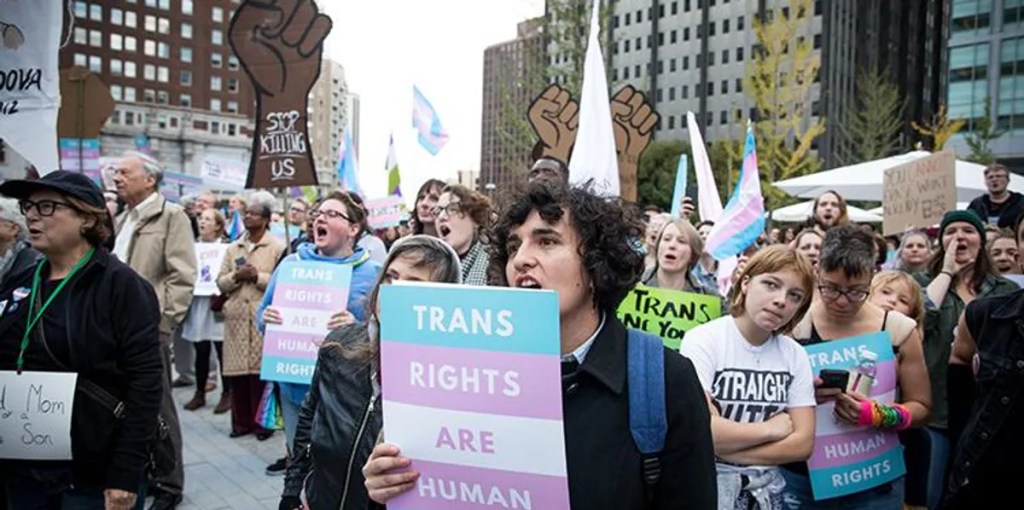
Review Jacqui post here to learn more!


3. The Problem with ‘Statistically Significant’ Results

The term “statistically significant” often sounds impressive, but Jacqui warned that it’s not always a reliable indicator of a meaningful finding. In nutritional research, a statistically significant result means that the data supports a specific conclusion beyond what could be expected by chance. However, Jacqui compared this to winning a small lottery: just because the result is statistically significant doesn’t necessarily mean it’s practically important.

In many cases, results that are statistically significant may not have a meaningful or clinically significant impact on real-world outcomes. For example, a study might show a statistically significant difference in health markers between two groups, but the actual difference might be so small that it doesn’t matter in terms of improving health.

When encountering results labeled as statistically significant, Jacqui advised readers to take a step back and ask: Is this result meaningful in the real world, or is it just a statistical fluke?


4. Why Nutritional Research Seems Contradictory

Another fascinating part of our conversation focused on the reasons why nutritional research can often feel contradictory. Jacqui pointed out that factors like small sample sizes, observational study designs, and various biases can skew the outcomes of studies. These variables contribute to conflicting opinions and conclusions in the field of nutrition.

Moreover, biases—whether financial or ideological—can shape the results of studies and the way findings are interpreted. For instance, when a study is funded by a food company, the results might be more favorable toward the products of that company, consciously or unconsciously.

Jacqui encouraged listeners to develop a critical eye when reading nutrition studies. Instead of accepting conclusions at face value, she suggested asking questions like: What’s the sample size? Who funded the study? What biases could influence the results?


5. How to Approach Nutrition Research as an Informed Consumer

So, how should we navigate the sea of nutrition research to make informed decisions about our food? Jacqui’s advice is simple yet powerful: approach nutrition research with a critical mindset.

Here’s how to do it:

  • Look beyond the headlines: Understand the difference between relative and absolute risk and question whether the findings are clinically significant.
  • Question study design: Be wary of studies with small sample sizes or those that rely on self-reported data, like FFQs. Also, consider the biases that may influence results.
  • Seek balanced perspectives: Look for research that examines multiple viewpoints and is not influenced by financial or ideological pressures.

Jacqui’s passion for empowering women through nutrition, particularly prenatal research, shines through in her work. By shedding light on the limitations and complexities of nutrition research, she offers us a much-needed roadmap to make informed decisions about our health. Whether you’re navigating the confusion of wellness trends or simply trying to understand what’s truly healthy, Jacqui’s insights can help us all approach nutrition with more clarity and skepticism.


Want more insights from Jacqui? Follow her on Instagram, where she shares practical advice and challenges the latest trends in wellness.

Learn more about Jacqui

Work with Jacqui: https://www.wellnesswithjacqui.co.za/contact 

The lazy cookbook https://www.wellnesswithjacqui.co.za/product-page/the-lazy-cookbook

Women’s health course: https://cominghometoyourself.thinkific.com/courses/coming-home-to-yourself

Stay curious, embrace skepticism, and keep tuning in!