When Discipline Stops Working

What Women Were Never Told About Weight, Aging, and Control

The Science They Never Told Us

This is the first episode of 2026, and I wanted to start the year by slowing things down, getting a bit personal instead of chasing the latest talking points.

At the end of last year, I spent time reading a few books that genuinely stopped me in my tracks. Not because they offered a new diet or a new protocol, but because they challenged something much deeper: the story we’ve been told about discipline, control, and women’s bodies.

There is a reason women’s bodies change across the lifespan. And it has very little to do with willpower, discipline, or personal failure.

In Why Women Need Fat, evolutionary biologists William Lassek and Steven Gaulin make the case that most modern conversations about women’s weight are fundamentally misinformed. Not because women are doing something wrong, but because we’ve built our expectations on a misunderstanding of what female bodies are actually designed to do.

A major part of their argument focuses on how industrialization radically altered the balance of omega-6 to omega-3 fatty acids in the modern food supply, particularly through seed oils and ultra-processed foods. They make a compelling case that this shift plays a role in rising obesity and metabolic dysfunction at the population level.

I agree that this imbalance matters, and it’s a topic that deserves its own full episode. At the same time, it does not explain every woman’s story. Diet composition can influence metabolism, but it cannot override prolonged stress, illness, hormonal disruption, nervous system dysregulation, or years of restriction. In my own case, omega-6 intake outside of naturally occurring sources is relatively low and does not account for the changes I’ve experienced. That matters, because it reminds us that biology is layered. No single variable explains a complex adaptive system.

One of the most important ideas in the book is that fat distribution matters more than fat quantity.

Women do not store fat the same way men do. A significant portion of female body fat is stored in the hips and thighs, known as gluteofemoral fat. This fat is metabolically distinct from abdominal or visceral fat. It is more stable, less inflammatory, and relatively enriched in long-chain fatty acids, including DHA, which plays a key role in fetal brain development.

From an evolutionary standpoint, this makes sense. Human infants are born with unusually large, energy-hungry brains. Women evolved to carry nutritional reserves that could support pregnancy and lactation, even during times of scarcity. In that context, having fat on your lower body was not a flaw or a failure. It was insurance.

From this perspective, fat is not excess energy. It is deferred intelligence, stored in anticipation of future need. This is where waist-to-hip ratio enters the conversation.
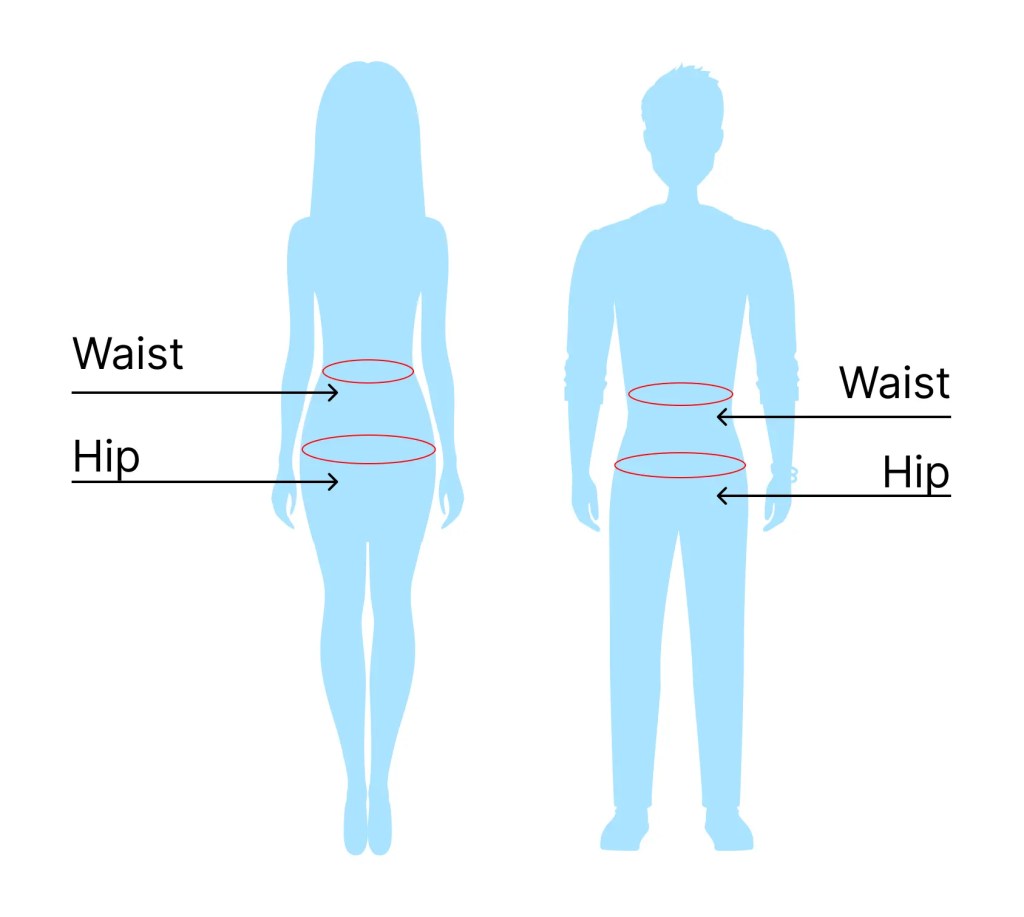
Across cultures and historical periods, a lower waist-to-hip ratio in women has been associated with reproductive health, metabolic resilience, and successful pregnancies. This is not about thinness, aesthetics, or moral worth. It is about fat function, not fat fear, and about how different tissues behave metabolically inside the body. It is about where fat is stored and how it functions.

And in today’s modern culture we have lost that distinction.

Instead of asking what kind of fat a woman carries, we became obsessed with how much. Instead of understanding fat as tissue with purpose, we turned it into a moral scoreboard. Hips became a problem. Thighs became something to shrink. Curves became something to discipline.

Another central idea in Why Women Need Fat is biological set point.
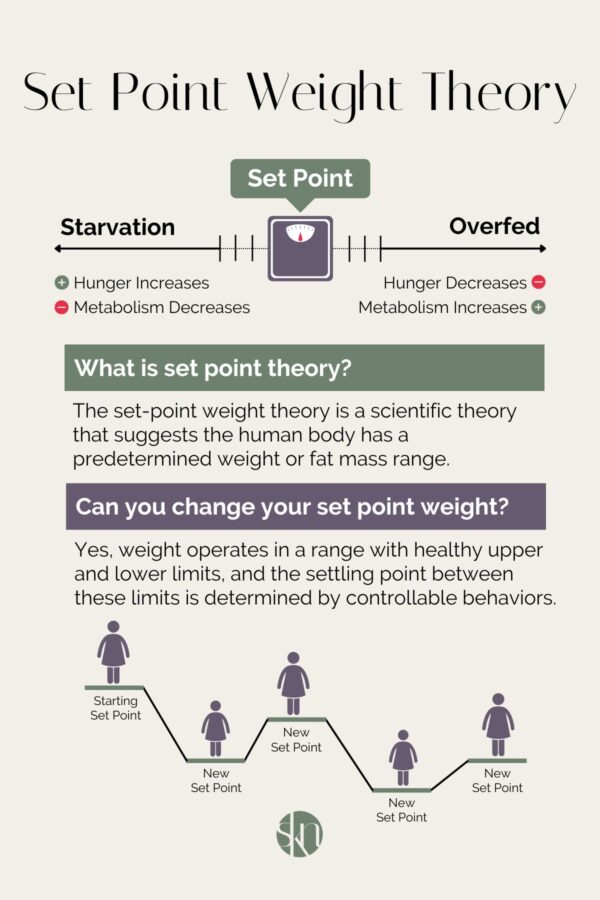
The authors argue that women’s bodies tend to defend a natural weight range when adequately nourished and not under chronic stress. When women remain below that range through restriction, over-exercise, or prolonged under-fueling, the body does not interpret that as success. It interprets it as threat.

Over time, the body adapts, not out of defiance, but out of protection.

Metabolism slows. Hunger and fullness cues become unreliable. Hormonal systems compensate. When the pressure finally eases, weight often rebounds, sometimes beyond where it started, because the body is trying to restore safety.

From this perspective, midlife weight gain, post-illness weight gain, or weight gain after years of restriction is not mysterious. It is not rebellion. It is regulation.

None of this is taught to women.

Instead, we are told that if our bodies change, we failed. That aging is optional. That discipline and botox should override biology. That the number on the scale tells the whole story.

So, before we talk about culture, family, trauma, or personal experience, this matters:

Women’s bodies are not designed to stay static.
They are designed to adapt.

Once you understand that, everything else in this conversation changes.


Why the Body Became the Battlefield
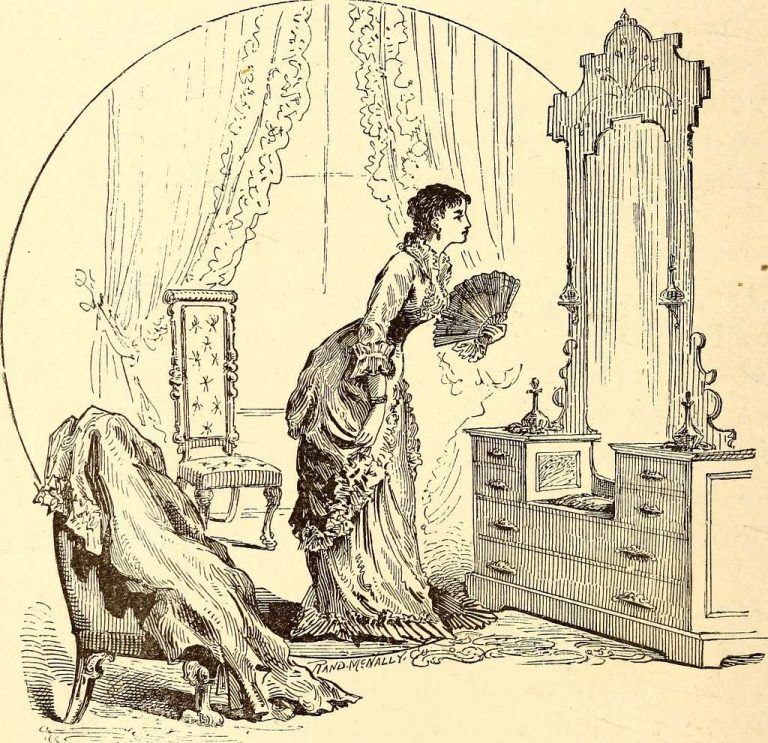
This is where historian Joan Jacobs Brumberg’s work in The Body Project: An Intimate History of American Girls, provides essential context, but it requires some precision.

Girls have not always been free from shame. Shame itself is not new. What has changed is what women are taught to be ashamed of, and how that shame operates in daily life.

Brumberg asks a question that still feels unresolved today:
Why is the body still a girl’s nemesis? Shouldn’t sexually liberated girls feel better about themselves than their corseted counterparts a century ago?

Based on extensive historical research, including diaries written by American girls from the 1830s through the 1990s, Brumberg shows that although girls today enjoy more formal freedoms and opportunities, they are also under more pressure and at greater psychological risk. This is due to a unique convergence of biological vulnerability and cultural forces that turned the adolescent female body into a central site of social meaning during the twentieth century.

In the late nineteenth and early twentieth centuries, girls did not typically grow up fixated on thinness, calorie control, or constant appearance monitoring. Their diaries were not filled with measurements or food rules. Instead, they wrote primarily about character, self-restraint, moral development, relationships, and their roles within family and community.

One 1892 diary entry reads:

“Resolved, not to talk about myself or feelings. To think before speaking. To work seriously. To be self-restrained in conversation and in actions. Not to let my thoughts wander. To be dignified. Interest myself more in others.”

In earlier eras, female shame was more often tied to behavior, sexuality, obedience, and virtue. The body mattered, but primarily as a moral symbol rather than an aesthetic project requiring constant surveillance and correction.

That changed dramatically in the twentieth century.

Brumberg documents how the mother-daughter connection loosened, particularly around menstruation, sexuality, and bodily knowledge. Where female relatives and mentors once guided girls through these transitions, doctors, advertisers, popular media, and scientific authority increasingly stepped in to fill that role.
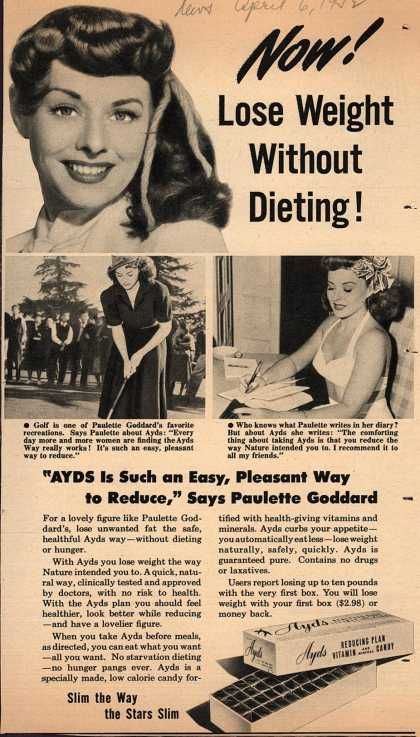
At the same time, mass media, advertising, film, and medicalized beauty standards created a new and increasingly exacting ideal of physical perfection. Changing norms around intimacy and sexuality also shifted the meaning of virginity, turning it from a central moral value into an outdated or irrelevant one. What replaced it was not freedom from scrutiny, but a different kind of pressure altogether.

By the late twentieth century, girls were increasingly taught that their bodies were not merely something they inhabited, but something they were responsible for perfecting.

A 1982 diary entry captures this shift starkly:

“I will try to make myself better in any way I possibly can with the help of my budget and baby-sitting money. I will lose weight, get new lenses, already got a new haircut, good makeup, new clothes and accessories.”

What changed was not the presence of shame, but its location. Shame moved inward.

Rather than being externally enforced through rules and prohibitions, it became self-policed. Girls were taught to monitor themselves constantly, to evaluate their bodies from the outside, and to treat appearance as the primary expression of identity and worth.

Brumberg is explicit on this point. The fact that American girls now make their bodies their central project is not an accident or a cultural curiosity. It is a symptom of historical changes that are only beginning to be fully understood.

This is where more recent work, such as Louise Perry’s The Case Against the Sexual Revolution, helps extend Brumberg’s analysis into the present moment. Perry argues that while sexual liberation promised autonomy and empowerment, it often left young women navigating powerful biological and emotional realities without the social structures that once offered protection, guidance, or meaning. In that vacuum, the body became one of the few remaining sites where control still seemed possible.

The result is a paradox. Girls are freer in theory, yet more burdened in practice. The body, once shaped by communal norms and shared female knowledge, becomes a solitary project, managed under intense cultural pressure and constant comparison.

For many girls, this self-surveillance does not begin with magazines or social media. It begins at home, absorbed through tone, comments, and modeling from the women closest to them.

Brumberg argues that body dissatisfaction is often transmitted from mother to daughter, not out of cruelty, but because those mothers inherited the same aesthetic anxieties. Over time, body shame becomes a family inheritance, passed down quietly and persistently.

Some mothers transmit it subtly.

Others do it bluntly.

This matters not because my experience is unique, but because it illustrates what happens when a body shaped by restriction, stress, and cultural pressure is asked to perform indefinitely. Personal stories are often dismissed as anecdotal, but they are where biological theory meets lived reality.

If you want to dive deeper into this topic:


Where It All Began: The Messages That Shape Us

I grew up in a household where my body was not simply noticed. It was scrutinized, compared, and commented on. Comments like that do not fade with time. They shape how you see yourself in mirrors and photographs. They teach you that your body must be managed and monitored. They plant the belief that staying small is the price of safety.

So, I grew up believing that if I could control my body well enough, I could avoid humiliation. I could avoid becoming the punchline. I could avoid being seen in the wrong way.

For a while, I turned that fear into discipline.


The Years Before the Collapse: A Lifetime of Restriction and Survival

Food never felt simple for me. Long before bodybuilding, chronic pain, or COVID, I carried a strained relationship with eating. Growing up in a near constant state of anxiety meant that hunger cues often felt unpredictable. Eating was something to plan around or push through. It rarely felt intuitive or easy.

Because of this, I experimented with diets that replaced real meals with cereal or shakes. I followed plans like the Special K diet. I relied on Carnation Instant Breakfast instead of full meals. My protein intake was low. My fear of gaining weight was high. Restriction became familiar.
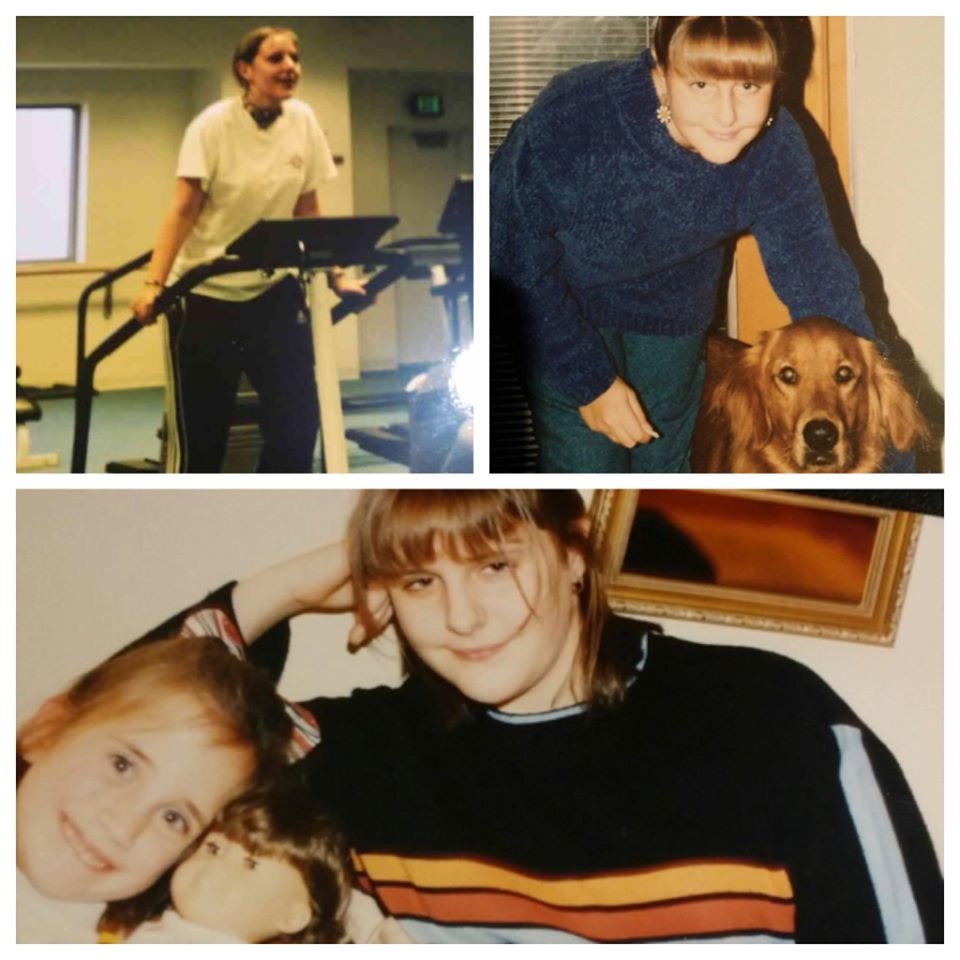
Top left is when I started working out obsessively at age 16, top right and bottom photo are from middle school when I was at my “heaviest” that drove the disordered behaviors.

In college, I became a strict vegetarian out of compassion for animals, but I did not understand how to meet my nutritional needs. I was studying dietetics and earning personal training certifications while running frequently and using exercise as a way to maintain control. From the outside, I looked disciplined. Internally, my relationship with food and exercise remained tense and inconsistent.

Later, I became involved in a meal-replacement program through an MLM. I replaced two meals a day with shakes and practiced intermittent fasting framed as “cleanse days.” In hindsight, this was structured under-eating presented as wellness. It fit seamlessly into patterns I had lived in for years.

Eating often felt overwhelming. Cooking felt like a hurdle. Certain textures bothered me. My appetite felt fragile and unreliable. This sensory sensitivity existed long before the parosmia that would come years later. From early on, food was shaped by stress rather than nourishment.

During this entire period, I was also on hormonal birth control, first the NuvaRing and later the Mirena IUD, for nearly a decade. Long-term hormonal modulation can influence mood, inflammation, appetite, and weight distribution. It added another layer of complexity to a system already under strain.

Looking back, I can see that my teens and twenties were marked by near constant restriction. Restriction felt normal. Thriving did not.

The book Why Women Need Fat discusses the idea of a biological weight “set point,” the range a body tends to return to when conditions are stable and adequately nourished. I now understand that I remained below my natural set point for years through force rather than balance. My biology never experienced consistency or safety.

This was the landscape I carried into my thirties.


The Body I Built and the Body That Broke

By the time I entered the bodybuilding world in 2017 and 2018, I already had years of chronic under-eating, over-exercising, and nutrient gaps behind me. Bodybuilding did not create my issues. It amplified them.

I competed in four shows. People admired the discipline and the physique. Internally, my body was weakening. I was overtraining and undereating. By 2019, my immune system began to fail. I developed severe canker sores, sometimes twenty or more at once. I started noticing weight-loss resistance. Everything I had done in the past, was no longer working. On my thirty-fifth birthday, I got shingles. My energy crashed. My emotional bandwidth narrowed. My body was asking for rest, but I did not know how to slow down.

Dive deeper into my body building journey here:

Around this time, I was also navigating eating disorder recovery. Learning how to eat without panic or rigid control was emotionally exhausting even under ideal circumstances… but little did I know things were about to take a massive turn for the worst.


COVID, Sensory Loss, and the Unraveling of Appetite

After getting sick with the ‘vid late 2020, everything shifted again. I developed parosmia, a smell and taste distortion that made many foods taste rotten or chemical. Protein and cooked foods often tasted spoiled. Herbs smelled like artificial chemical. Eating became distressing and, at times, impossible.

My appetite dropped significantly. There were periods where my intake was very low, yet my weight continued to rise. This is not uncommon following illness or prolonged stress. The body often shifts into energy conservation, prioritizing survival overweight regulation.

Weight gain became another source of grief. Roughly thirty pounds over the next five years. I feel embarrassed and avoid photographs. I often worry about how others will perceive me.

If this experience resonates, it is important to say this clearly: your body is not betraying you. It is responding to stress, illness, and prolonged strain in the way bodies are designed to respond.


Why Women’s Bodies Adapt Instead of “Bounce Back”

When years of restriction, intense exercise, chronic stress, illness, hormonal shifts, and emotional trauma accumulate, the body often enters a protective state. Metabolism slows. Hormonal signaling shifts. Hunger cues become unreliable. Weight gain or resistance to weight loss can occur even during periods of low intake, because energy regulation is being driven by survival physiology rather than simple calorie balance.

This is not failure. It is physiology.

The calories-in, calories-out model does not account for thyroid suppression, nervous system activation, sleep disruption, pain, trauma, or metabolic adaptation. It reduces a complex biological system to arithmetic.

Women are not machines. We are adaptive systems built for survival. Sometimes resilience looks like holding onto energy when the body does not feel safe.


The Systems That Reinforce Shame
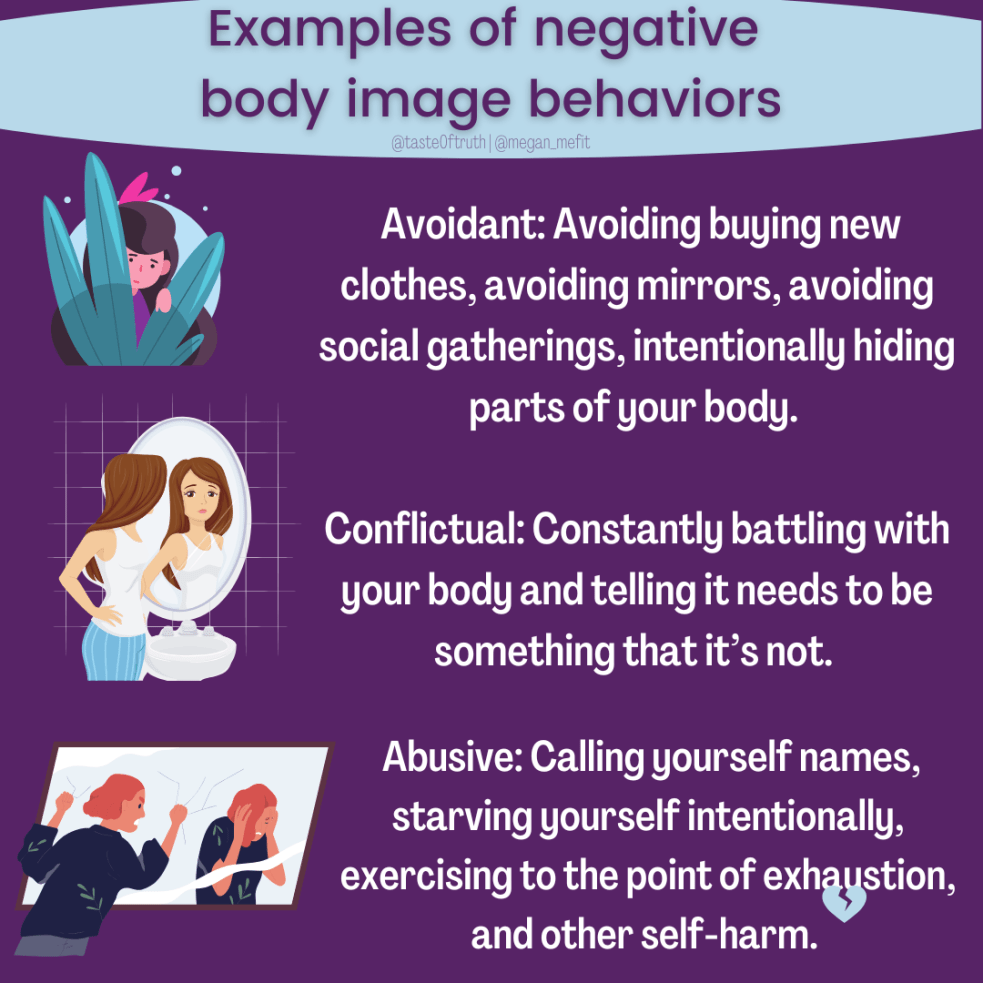
Despite this biological reality, we live in a culture that ties women’s value to discipline and appearance. When women gain weight, even under extreme circumstances, we blame ourselves before questioning the system.

Diet culture frames shrinking as virtue.

Toxic positivity encourages acceptance without context.

Industrial food environments differ radically from those our ancestors evolved in.

Medical systems often dismiss women’s pain and metabolic complexity.

Social media amplifies comparison and moralizes body size.

None of this is your fault. And all of it shapes your experience.

This is why understanding the science matters. This is why telling the truth matters. This is why sharing stories matters.


In the book, More Than a Body, Lindsay and Lexie Kite describe how women are taught to relate to themselves through constant self-monitoring. Instead of living inside our bodies, we learn to watch ourselves from the outside. We assess how we look, how we are perceived, and whether our bodies are acceptable in a given moment.

This constant self-surveillance does real harm. It pulls attention away from hunger, pain, fatigue, and intuition. It trains women to override bodily signals in favor of appearance management. And over time, it creates a split where the body is treated as a project to control rather than a system to understand or care for.

When you layer this kind of self-objectification on top of chronic stress, restriction, illness, and trauma, the result is not empowerment. It is disconnection. And disconnection makes it even harder to hear what the body needs when something is wrong.

Weight gain is not just a biological response. It becomes a moral verdict. And that is how women end up fighting bodies that are already struggling to keep them alive.

The Inheritance Ends Here

For a long time, I believed that breaking generational cycles only applied to mothers and daughters. I do not have children, so I assumed what I inherited would simply end with me, unchanged.

Brumberg’s work helped me see this differently.

What we inherit is not passed down only through parenting. It moves through tone, silence, and self-talk. It appears in how women speak about their bodies in front of others. It lives in the way shame is normalized.

I inherited a legacy of body shame. Even on the days when I still feel its weight, I am choosing not to repeat it.

For me, the inheritance ends with telling the truth about this journey and refusing to speak to my body with the same cruelty I absorbed growing up. It ends here.


Closing the Circle: Your Body Is Not Broken

I wish I could end this with a simple story of resolution. I cannot. I am still in the middle of this. I still grieve. I still struggle with eating and movement. I am still learning how to inhabit a body that feels unfamiliar.

But I know this: my body is not my enemy. She is not malfunctioning. She is adapting to a lifetime of stress, illness, restriction, and emotional weight.

If you are in a similar place, I hope this offers permission to stop fighting yourself and start understanding the patterns your body is following. Not because everything will suddenly improve, but because clarity is often the first form of compassion.

Your body is not betraying you. She is trying to keep you here.

And sometimes the most honest thing we can do is admit that we are still finding our way.
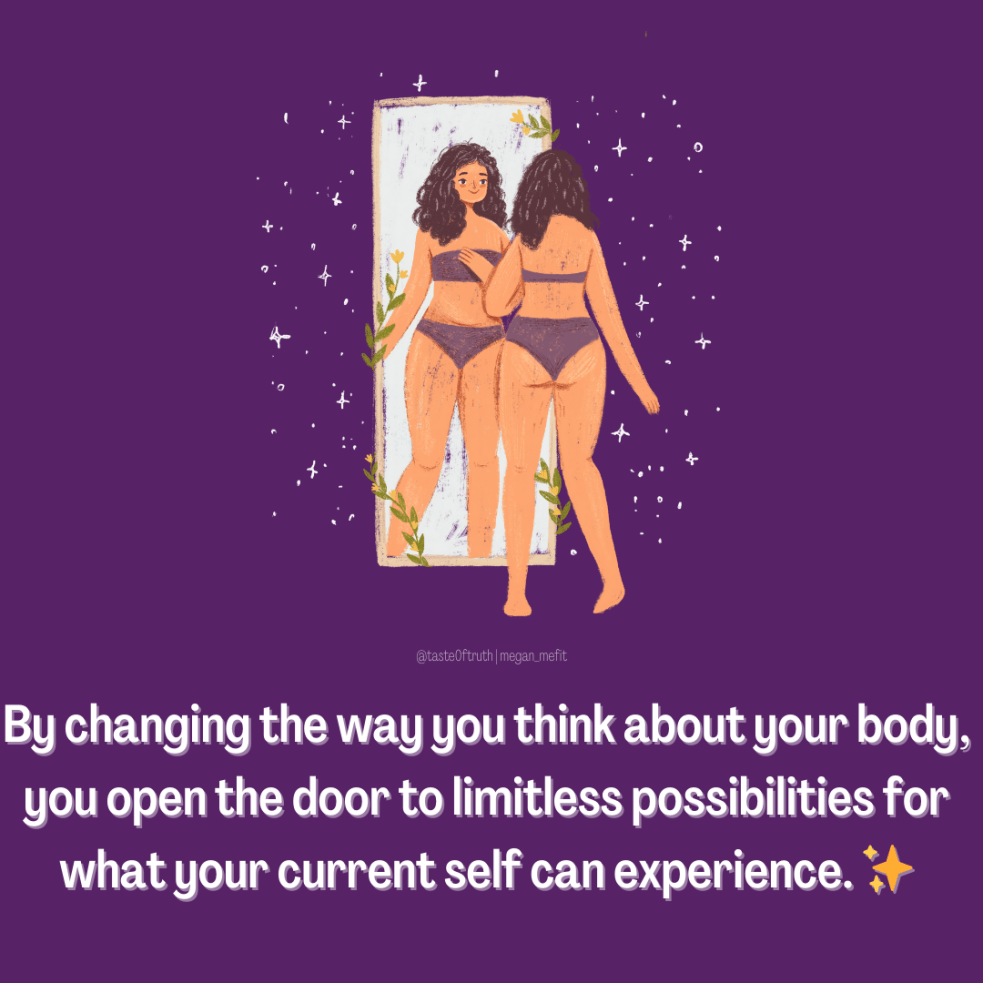

References

  1. Brumberg, J. J. (1997). The Body Project: An Intimate History of American Girls. Random House.
  2. Lassek, W. D., & Gaulin, S. J. C. (2011). Why Women Need Fat: How “Healthy” Food Makes Us Gain Excess Weight and the Surprising Solution to Losing It Forever. Hudson Street Press.
  3. Kite, L., & Kite, L. (2020). More Than a Body: Your Body Is an Instrument, Not an Ornament. Houghton Mifflin Harcourt.

Scientific and academic sources

  1. Lassek, W. D., & Gaulin, S. J. C. (2006). Changes in body fat distribution in relation to parity in American women. Evolution and Human Behavior, 27(3), 173–185.
  2. Lassek, W. D., & Gaulin, S. J. C. (2008). Waist–hip ratio and cognitive ability. Proceedings of the Royal Society B, 275(1644), 193–199.
  3. Dulloo, A. G., Jacquet, J., & Montani, J. P. (2015). Adaptive thermogenesis in human body-weight regulation. Obesity Reviews, 16(S1), 33–43.
  4. Fothergill, E., et al. (2016). Persistent metabolic adaptation after weight loss. Obesity, 24(8), 1612–1619.
  5. Kyle, U. G., et al. (2004). Body composition interpretation. American Journal of Clinical Nutrition, 79(6), 955–962.
  6. Simopoulos, A. P. (2016). Omega-6/omega-3 balance and obesity risk. Nutrients, 8(3), 128.

Trauma, stress, and nervous system context

  1. Sapolsky, R. M. (2004). Why Zebras Don’t Get Ulcers. Henry Holt and Company.
  2. Walker, P. (2013). Complex PTSD: From Surviving to Thriving. Azure Coyote Books.

Forgiveness or Control? How Evangelical Culture Weaponizes Grief

Hey hey, welcome back to Taste of Truth Tuesdays.

Today we’re unpacking several interwoven topics I’ve explored in my writing before why people get drawn into high-control environments and how forgiveness in Christian culture is often weaponized, not as a path to healing, but as a tool to silence victims and protect institutions. This isn’t just a personal issue; it’s an institutional one.

This came into sharp focus after Erika Kirk, Charlie Kirk’s widow, said she forgives her husband’s killer. I’m not here to critique her grief, that’s her own process. What I want to explore is the cultural framework that makes this kind of forgiveness expected, celebrated, and even demanded in evangelical spaces. I have a MUCH MUCH longer blog linked here if you want to go much deeper than I plan to cover today.


Why Grief Is Ripe for Recruitment

Before even touching forgiveness, let’s pause on why this moment is so primed for revivalist recruiting. Sociologists and psychologists have long noted that people are most vulnerable to high-control groups (whether churches or MLMs) during times of disruption and emotional chaos.

Laura Dodsworth, in her book Free Your Mind, calls this a “blip.” A blip is any disruption that cracks our normal defenses: loss, illness, exhaustion, grief. Even smaller stressors (Think HALT) Hunger, anger/anxiety, loneliness or being tired can chip away at our resistance. Push long enough, and the conscious mind collapses into a state of openness, hungry for belonging and ready to absorb new narratives.

That’s exactly what makes funerals, memorials, and major crises fertile ground for recruitment. Orwell nailed it in 1984:

“Power is in tearing human minds to pieces and putting them together again in shapes of your own choosing.”

Jehovah’s Witnesses even admit to targeting what they call “ripe fruit”-the recently bereaved. In Brazil, recruiters have driven cars with loudspeakers through cemeteries on All Souls’ Day, broadcasting sermons to tens of thousands of mourners. That isn’t compassion; it’s strategic exploitation. Naomi Klein would call it the Shock Doctrine: trauma as an entry point for control.

We’re seeing the same tactics play out online right now. Someone posts about “returning to church” after years away, and within hours their feed fills with love-bombing-likes, comments, and digital hugs. It feels affirming, but it’s also classic manipulation: vulnerability plus attention equals a wide-open door into manipulation.

And so it’s no surprise that revivalist energy is surging in the wake of Kirk’s death.

Situational vulnerability + orchestrated belonging = fertile ground for expansion.


The Myth of “Christlike” Forgiveness

This brings us back to forgiveness. I want to be CLEAR HERE, obviously Erika Kirk wasn’t coerced into forgiving, but in evangelical culture forgiveness is never entirely personal, it’s baked into the ethos. The more you forgive, the more “Christlike” you appear.

Matthew 6:14–15 “For if you forgive others their trespasses, your heavenly Father will also forgive you, but if you do not forgive others their trespasses, neither will your Father forgive your trespasses.”

That expectation is dangerous. Forgiveness is sacred when it grows out of genuine healing. But when demanded prematurely, it becomes a weapon. Survivors are told to “forgive as you’ve been forgiven” before they’re ready, before their pain is acknowledged, and typically long before their abuser is held accountable.

Pete Walker, in The Tao of Fully Feeling, argues that forgiveness is not a one-time act but a continual choice and that choice only works after grief, rage, and hurt are fully processed. Skip that, and forgiveness turns into compliance, a way to silence anger and keep victims stuck.

In other words: real forgiveness empowers the survivor. Weaponized forgiveness protects the institution.


How Churches Use Forgiveness to Protect Themselves

We’ve seen this pattern across evangelical institutions:

  • The Guidepost Report (2022) exposed that SBC leadership maintained a secret list of over 700 abusive pastors, shielding them from consequences while survivors were ignored, discredited, or retaliated against.
  • Jennifer Lyell, an SBC abuse survivor, was vilified by church leadership when she came forward. Instead of support, she was publicly shamed, and her abuser faced no consequences.
  • Christa Brown, another survivor, spent years advocating for reform after being assaulted by her youth pastor. The SBC’s response? Stonewalling, gaslighting, and further silencing.
  • Jehovah’s Witnesses have a longstanding pattern of protecting sexual predators under their “two-witness rule,” which requires at least two people to witness abuse for it to be considered valid. This impossible standard allows abusers to go unpunished while victims are shunned for speaking out.

In each case, forgiveness isn’t about healing. It’s about compliance, silence, and institutional survival.


Nietzsche, Freud, and the Cycles of Guilt

This isn’t new. Nietzsche warned that Abrahamic religions hijacked older wisdom traditions, reframing them into systems of obedience rather than life-affirmation. Freud saw religion as a kind of collective neurosis, trapping people in loops of guilt and repression.

What is ironic, Freud’s own psychoanalytic model looks eerily similar to the religious structures he critiqued. As historian Bakan and others have suggested, Freud may have drawn (consciously or not) on Jewish mysticism, replacing priests with analysts, confession with therapy, sin with repressed desire. In trying to explain away religion, Freud ended up reproducing its patterns in secular form. In other words, the pattern of taking human vulnerability and channeling it into control runs deep.

And this is where Laura Dodsworth’s idea of the “blip” becomes so relevant. The blip is that moment of rupture…when you’re grieving, disoriented, exhausted, or otherwise cracked open. Your defenses are down, your critical mind isn’t firing at full strength, and the brain is searching for something to hold onto. In these liminal spaces, new ideologies rush in.

That’s why this moment is so ripe for revivalist energy. It’s not just about forgiveness…it’s about the total atmosphere of grief and disruption that can act as a blip. And high-control groups know it. It’s why political movements, religious revivals, and even MLMs wait for crisis points: job loss, divorce, a death in the family. The blip isn’t compassionately held-it’s exploited.

So when we watch something like Kirk’s memorial, we’re not just seeing personal mourning. We’re watching a social script unfold, one that revivalists know how to activate. In this script, forgiveness, obedience, and “turning your life over” aren’t neutral virtues—they become instruments of recruitment. Which means the real question isn’t should people forgive, but who benefits when forgiveness and emotional openness are demanded at the exact moment people are least able to resist?

Sources & Recommended Reading

  • Laura Dodsworth, Free Your Mind: The New World of Manipulation and How to Resist It (2023) – esp. Chapter 10, “Watch Out for the Blip.”
  • George Orwell, 1984 (1949) – “Power is in tearing human minds to pieces…”
  • Naomi Klein, The Shock Doctrine: The Rise of Disaster Capitalism (2007).
  • Pete Walker, The Tao of Fully Feeling: Harvesting Forgiveness out of Blame (1996).
  • Friedrich Nietzsche, On the Genealogy of Morals (1887); The Antichrist (1895).
  • Sigmund Freud, The Future of an Illusion (1927).
  • David Bakan, Sigmund Freud and the Jewish Mystical Tradition (1958).
  • Investigative reports on abuse cover-ups:
    • Southern Baptist Convention (SBC) scandal (Houston Chronicle, 2019).
    • Hillsong global abuse reports (various, 2020–2022).
    • Grace Community Church & John MacArthur counseling cases (Christianity Today, 2022).
  • Jehovah’s Witness recruitment practices

Your Body Is the Scoreboard

From Heart to Brain: The Neuroscience Behind Connection and Calm

Welcome back to Taste of Truth Tuesdays, where we maintain our curiosity, embrace skepticism, and never stop asking what’s really going on beneath the surface. Last week, I prepared you for this episode, so if you missed out, please check it out! It’s short and sweet.

Now, for today’s episode….

Let me ask you something:

Why does your body feel like it’s on high alert… even when nothing “bad” is happening?
Why do you either trust too quickly or not at all and end up anxious, burned out, and ashamed?
Why is it so damn hard to regulate your emotions, especially when you’re great at controlling everything else?

If those questions hit a little too close to home… this episode is for you.

Last season, we dove deep into complex trauma through Pete Walker’s From Surviving to Thriving, unpacking how childhood neglect, emotional abuse, and developmental trauma shape adult patterns.

And today? We’re going even deeper — through the lens of neuroscience.

Because what if these aren’t personality quirks or moral failings? What if your brain and body are actually doing their best to protect you, using adaptations wired by Complex PTSD?

My guest today is Cody Isabel | Neuroscience, a neuroscience researcher and writer whose work has become a game-changer in trauma conversations. He holds a degree in Cognitive Behavioral Neuroscience, has training in Internal Family Systems psychotherapy, and specializes in the emerging field of Psychoneuroimmunology — the study of how your thoughts, brain, and immune system interact.

His Substack article, “PTSD & Complex PTSD Are NOT the Same Thing,” has been one of the clearest, most validating reads on this topic I’ve found.

So, if you’ve ever felt stuck, shut down, reactive, misunderstood, or like your nervous system has a mind of its own…. stay with me.

Because today we’re not just talking trauma.
We’re talking nervous system intelligence.
We’re talking identity repair.
We’re talking real, embodied healing.

And before we get into that, I want to bring a few threads together from past episodes—because they’re all woven into this conversation.

We’ve talked about fawning, the lesser-known trauma response that shows up as chronic people-pleasing, self-abandonment, and conflict avoidance—especially common in those who’ve survived high-control environments. In this episode with Theresa, we also explore the stress cycle. According to Selye’s General Adaptation Syndrome, your body moves through three stages when facing ongoing stress: Alarm, Resistance, and eventually, Exhaustion. And fawning, while behavioral, can easily become your nervous system’s go-to tactic—especially during prolonged stress or in the presence of power dynamics that feel threatening.

We have talked about the Emotional Hijack and how trauma impacts the brain in this episode.

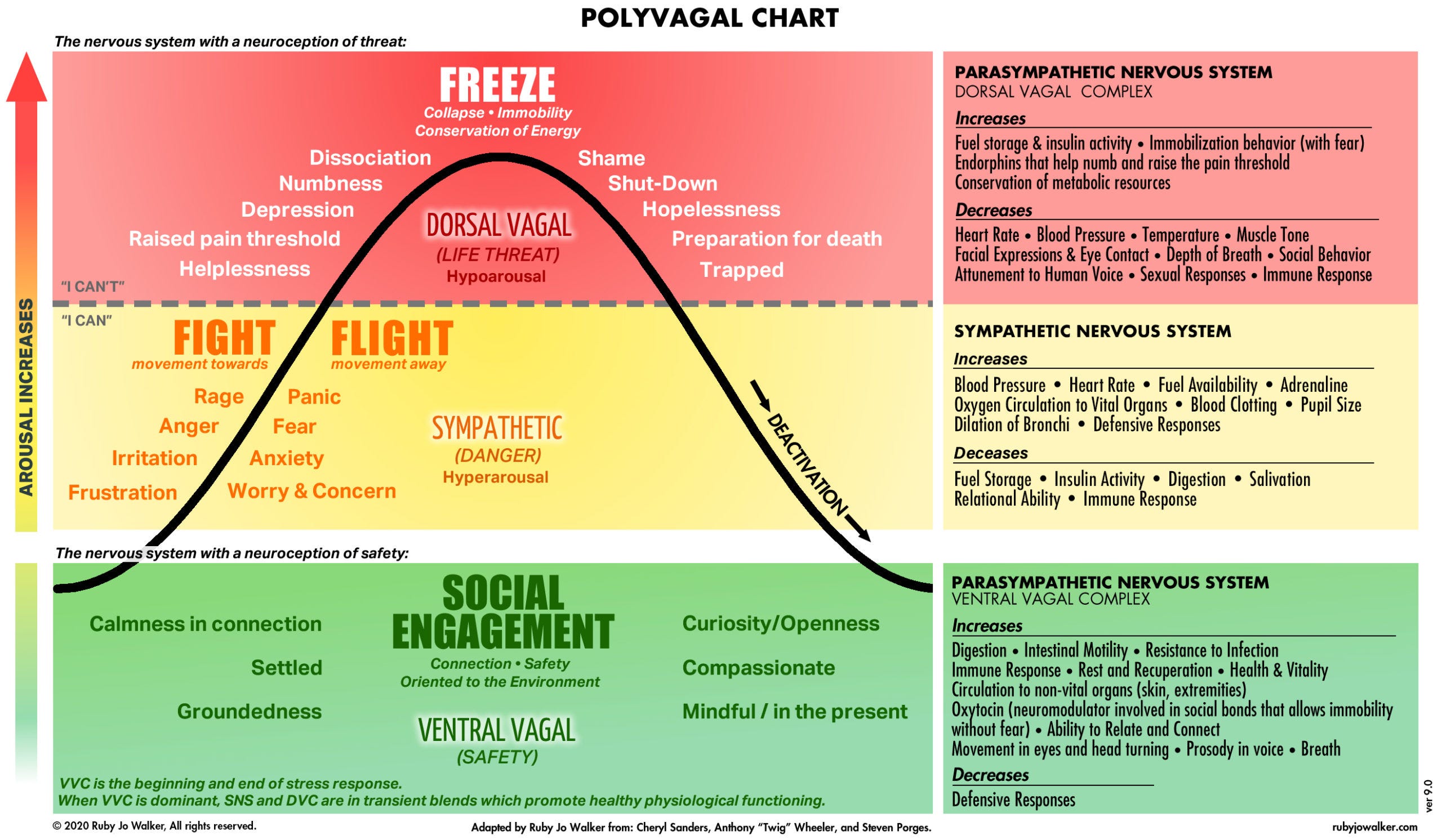
We’ve also referenced the vagus nerve, but not specifically Polyvagal Theory—but today, we’re going deeper. Instead of seeing your stress responses as “malfunctions,” it reframes them as adaptive survival strategies. Your nervous system isn’t betraying you—it’s trying to protect you. It’s just working off old wiring.

Think of it like this:

Your nervous system is constantly scanning for cues of safety or threat—this is called neuroception. And based on what it detects, your body shifts into different states—each with a biological purpose.

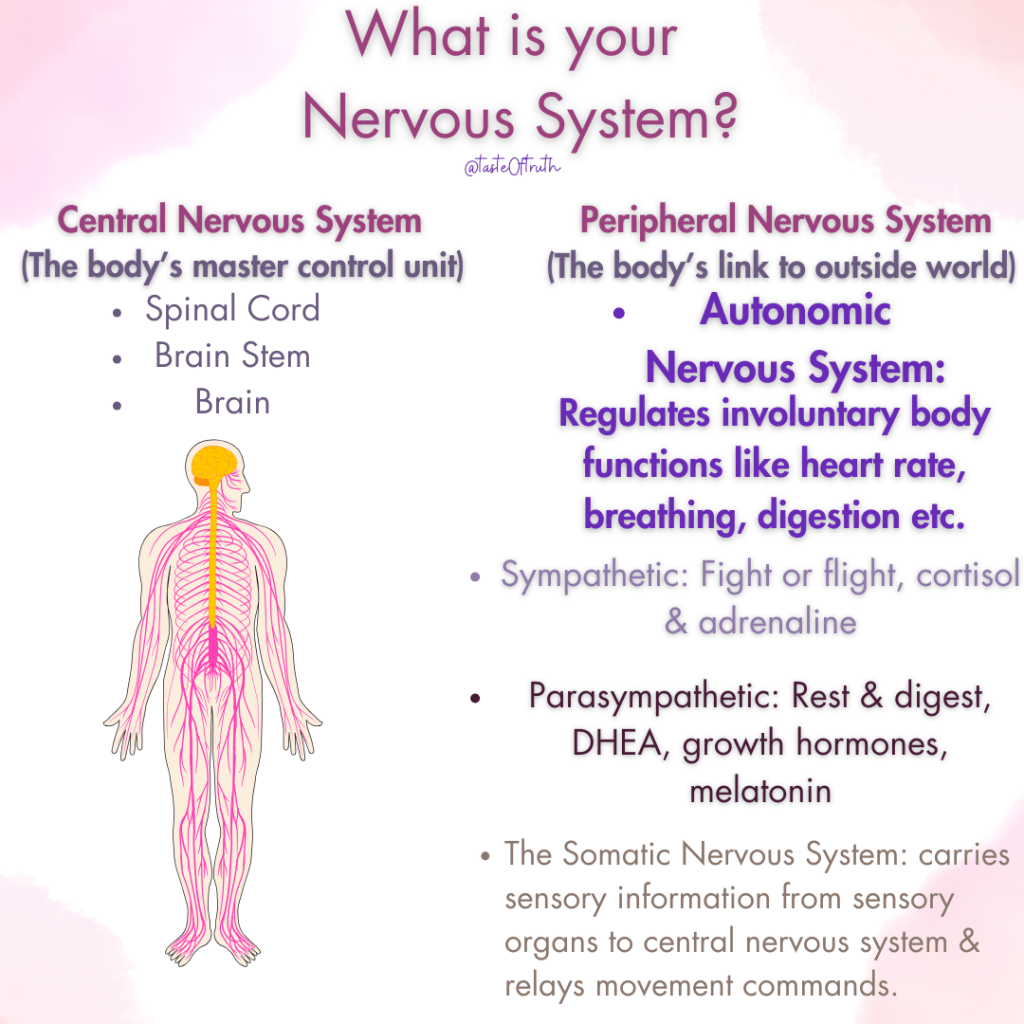
The Polyvagal Chart breaks this down into three major states:

1. 🟢 Ventral Vagal – Social Engagement (Safety)

This is your “rest-and-connect” zone. You feel grounded, calm, curious, and open. You can be present with yourself and with others. Your body prioritizes digestion, immune function, and bonding hormones like oxytocin. You’re regulated.

This is the state we’re meant to live in most of the time—but trauma, chronic stress, or inconsistent caregiving can knock us out of it.

2. 🟡 Sympathetic – Fight or Flight (Danger)

When your system detects danger, it flips into high alert. Blood rushes to your limbs, your heart races, your digestion shuts down. You either fight (rage, irritation) or flee (anxiety, panic). This is survival mode. It’s not rational—it’s reactive.

And if that still doesn’t resolve the threat?

3. 🔴 Dorsal Vagal – Freeze (Life Threat)

This is the deepest shutdown. Your system says: “This is too much. I can’t.” You go numb. You collapse. You may dissociate, feel hopeless, or emotionally flatline. It’s not weakness—it’s your nervous system pulling the emergency brake to conserve energy and protect you.

Here’s what’s crucial to understand: these responses aren’t choices. They’re biological defaults. And many of us are stuck in loops of fight, flight, or freeze because our systems never got a chance to complete the stress cycle and return to safety.

So instead of shaming yourself for overreacting or shutting down, what if you asked:

“What is my nervous system trying to do for me right now?”
“What does it need to feel safe again?”

That shift—from judgment to curiosity—is the beginning of healing.

And we’ll connect this to another major thread—attachment systems, which we haven’t unpacked in depth yet, but absolutely need to.

Your attachment system is the biological and psychological mechanism that drives you to seek safety, closeness, and emotional connection—especially when you’re under stress. It develops in early childhood through repeated interactions with your caregivers, shaping how you regulate your emotions, perceive threats, and relate to others. If those caregivers were emotionally attuned, predictable, and responsive, you likely formed a secure attachment. But if they were inconsistent, neglectful, controlling, or chaotic… your attachment system learned to adapt in ways that may have kept you safe then—but cost you connection now.

In The Happiness Hypothesis, Jonathan Haidt points to a disturbing moment in psychological history that disrupted the natural development of secure attachment: the rise of behaviorism in the early 20th century.

John B. Watson, a founding figure of behaviorism, famously applied the same rigid, mechanistic principles he used on rats to raising human children. In his 1928 bestseller The Psychological Care of Infant and Child, he urged parents not to kiss their children, not to comfort them when they cried, and to withhold affection—believing emotional bonding would produce weak, dependent adults.

By the mid-20th century, attachment theory began to challenge these behaviorist claims. John Bowlby, in the 1950s, argued that infants form emotional bonds with caregivers as an innate survival mechanism—not merely as conditioned responses to rewards, as behaviorism suggested. His work, drawing from ethology, psychoanalysis, and control systems theory, moved beyond behaviorism’s narrow stimulus-response framework. Mary Ainsworth’s empirical research in the 1960s and ’70s, through her Strange Situation study, confirmed that attachment styles stem from caregiver sensitivity and infant security needs, rather than simple conditioning.

Yet, ironically, during the 1970s and ’80s, Christian parenting teachings—particularly those popularized by figures like Dobson—adopted and amplified the very behaviorist ideas that attachment research was already disproving. These teachings emphasized strict discipline and emotional control, often citing Scripture to justify practices rooted in outdated psychological theories rather than theology.

Let that sink in.

For decades, dominant parenting advice discouraged emotional responsiveness, treating affection not as a necessity but as a liability.

This wasn’t just bad advice—it was the psychological equivalent of nutritional starvation. Instead of missing vitamins, children missed attunement, safety, and connection. As attachment research has since shown, those early emotional experiences shape nervous system development, stress regulation, and whether someone grows up trusting or fearing closeness.

So, when we talk about stress responses like fawning… or chronic over-functioning… or emotional dysregulation… we’re often seeing the adult expression of a nervous system that never learned what safety feels like in the presence of other people.

And that’s why today’s conversation matters. Because healing isn’t just about rewiring thought patterns. It’s about rebuilding your felt sense of safety—in your body, in your relationships, and in your life.

And if you are anything like me and have found yourself wondering… why your nervous system reacts the way it does… or why regulating your emotions feels impossible even when you “know better” … this episode will connect the dots in ways that are both validating and eye-opening.

We’re talking trauma, identity, neuroplasticity, stress, survival, and what it really means to come home to yourself.

The topics we explore:

  • The critical differences between PTSD and Complex PTSD — and how each impacts the brain and body
  • Why CPTSD isn’t just a fear response, but a full-body survival adaptation that reshapes your identity
  • What it means to heal “from the bottom up,” and why insight alone isn’t enough
  • How books and language can validate our experience — without replacing the need for somatic work
  • The push-pull of relational safety: why CPTSD makes connection feel risky, even when we crave it
  • How trauma affects the Default Mode Network, and why healing often feels like rediscovering who you are

Whether you’re navigating relational triggers, spiritual disorientation, or the long road of recovery, this conversation offers clarity, compassion, and a grounded path forward.

Please enjoy the interview!

Subscribe now on Substack!

LINKS:

Check out Cody’s work! About – The Mind, Brain, Body Digest

The Top 5 Childhood Core Wounds in Overachievers 🧠

No Bad Parts | IFS Institute | Schwartz

Transcending Trauma Healing Complex PTSD with Internal Family Systems Therapy

The Deluded Brain: Why Control Feels Safe, Certainty Feels Holy, & Complexity Feels Threatening

Welcome to Taste Test Thursday! You know how online debates often turn into full-blown keyboard wars? People lash out with rage when their beliefs whether political, religious, or social are challenged. But why? What’s behind these intense, emotional responses?

What if it’s not just about bad ideas, but something deeper a brain imbalance? What if our need for certainty and addiction to outrage comes from the way our brains are wired to process the world?

Today we’re diving into the neuroscience behind these defensive reactions. We’ll see how the brain’s wiring for survival influences everything from ideological rigidity to emotional hijacking. We’re setting the stage for something important that we’ll explore this upcoming Tuesday how Complex PTSD and PTSD are NOT the same thing. This is an episode you won’t want to miss, especially if you’ve ever felt stuck in a cycle of intense emotional reactions that you just can’t control.

Let’s review something we’ve discussed before: Amygdala Hijacking. If you remember, the amygdala is a part of our brain that processes emotions like fear and anger. Now, when the amygdala gets triggered especially in stressful or traumatic situations it can completely bypass the more rational prefrontal cortex. This results in what we call an “emotional hijack,” where the brain goes straight into fight-or-flight mode often in situations that don’t actually require that level of reaction.

This kind of response helps explain why some people find comfort in fundamentalism.

“At its most basic, the allure of fundamentalism, whether religious or ideological, liberal or conservative, is that it provides an appealing order to things that are actually disorderly.”
Peter Mountford The Dismal Science

That line hits at something crucial we have explored many times before: the human brain craves order, especially in the face of chaos. The illusion of control is one of our brain’s favorite coping mechanisms and when we find a system (religious, political, or otherwise) that delivers black-and-white certainty? You get a dopamine hit.

Rigid ideologies offer a tidy framework that feels safe and predictable especially in times of confusion, disillusionment, or personal crisis. That’s not just philosophy. That’s neurology.


When Chaos Was the Norm, Control Becomes a Coping Mechanism

For many of us, rigid beliefs aren’t just intellectual frameworks. They’re emotional survival strategies.

The need for control, the drive for perfection, the desire to be “good enough” to earn love these weren’t just quirks of personality. They were adaptations to childhoods where emotional needs weren’t met. And like many people who grew up in households marked by emotional neglect, those patterns shaped everything: our relationships, our careers, our bodies, and the ideologies we clung to.

Psychologists like Alice Miller and Elan Golomb have long noted how children raised in emotionally unavailable or narcissistic homes often create a false self a version of themselves designed to gain approval and avoid rejection.
It’s a blueprint that gets carried into adulthood, often unconsciously.

That’s why fundamentalist spaces feel so magnetic to people with childhood trauma. They offer:

  • Clear rules instead of emotional chaos
  • “Unconditional” love that’s actually highly conditional
  • A surrogate parent in the form of a deity or ideology that tells you who to be

Religious trauma often echoes family trauma—because it’s a new version of the same wound.


When Identity Is Built on Compliance

When a belief system rewards obedience over curiosity, it recreates the dynamics of an authoritarian household. You’re loved when you perform correctly. You belong when you don’t question. You’re “good” when you conform.

So what happens when you start to deconstruct?

The moment someone questions the “truth,” it’s perceived as a betrayal—not just of doctrine, but of identity and tribe. And that’s when we see:

  • Verbal attacks – Heretic. Traitor. Bigot.
  • Social ostracism – Canceled. Shunned. Ghosted.
  • Online harassment – Dogpiling and moral outrage.
  • Even physical aggression – History is full of examples, from witch hunts to ideological purges.

But this isn’t just about “bad actors.” It’s about brains shaped by fear.

When your childhood taught you that being wrong = being unloved, then someone challenging your beliefs doesn’t just feel uncomfortable it feels unsafe.
Disagreement triggers:

  • Cognitive dissonance – That gut-wrenching anxiety when facts don’t fit your worldview
  • Fear of consequences – Hellfire or public shaming
  • Loss of self – Because the belief was the identity
  • Loss of community – The people who “loved” you might now condemn you

The Brain’s Role in Certainty Addiction

Neuroscience adds another layer here—one that makes ideological rigidity more understandable, even if it’s not excusable.

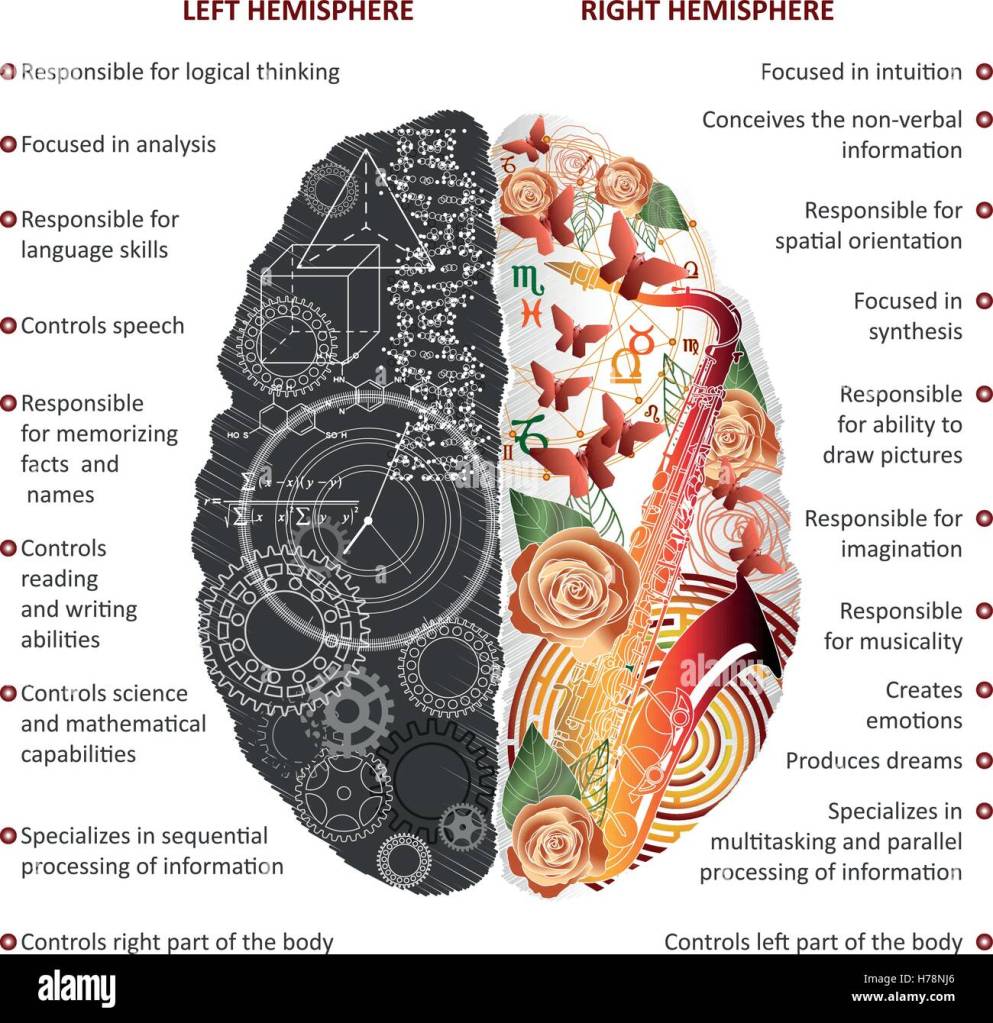
Dr. Iain McGilchrist, in The Master and His Emissary, outlines how the brain’s left and right hemispheres don’t just process information differently—they perceive reality differently.

❌ Not: “Left brain = logic, Right brain = creativity.”
✅ But: “Left brain = control, categorization, and certainty. Right brain = context, relationship, and meaning.”

In a balanced brain, the right hemisphere leads—it sees the big picture, embraces nuance, and stays grounded in lived reality. The left hemisphere refines, classifies, and helps us act.

But modern culture has flipped the script. We’ve let the left hemisphere hijack our perception, reducing the complex to the manageable, the mysterious to the measurable. In this flipped hierarchy:

  • Ambiguity feels threatening
  • Context gets stripped away
  • Relationship is sacrificed for abstraction
  • And certainty becomes a kind of drug

That’s why ideological possession feels so safe. The left brain loves a clear system, even if it’s oppressive. It would rather be certain and wrong than uncertain and real.

So, when someone questions your belief, it’s not just inconvenient. It shatters the left brain’s illusion of control. And when that illusion is all, you’ve known since childhood, the reaction isn’t just intellectual-it’s existential. a threat.


When Belief Becomes Identity

Jonathan Haidt, in The Righteous Mind, explains that we don’t arrive at beliefs through pure logic. We have moral intuitions quick, gut-level judgments and then our reasoning brain (usually the left hemisphere) steps in, not to find the truth, but to defend the tribe.

The moment someone questions our “truth,” we don’t hear it as a conversation—we hear it as an attack.

What happens next?

Verbal Attacks:
When someone questions a core belief, the response often isn’t curiosity—it’s insults, belittling, or outright contempt. In faith spaces, that might look like calling someone a heretic. In political spaces, it’s labels like traitor, bigot, or grifter.

Social Ostracism:
Both religious and political groups punish deviation. Doubters are canceled, excommunicated, or ghosted. Deconstruct your faith? You might lose your church community. Question political orthodoxy? You might lose friends—or your job.

Online Harassment:
The algorithm rewards outrage. Post a thoughtful question about a sacred ideology and you’ll get dogpiled. Our moral tastebuds, as Haidt would say, are being hijacked by dopamine-fueled tribalism.

Physical Aggression:
At the extremes, ideological certainty becomes dangerous. From holy wars to revolutions, the ugliest parts of history stem from one belief: we’re right, and they’re evil.


Why We React This Way: The Psychology of Threat

When beliefs are fused with identity, disagreement feels like annihilation. Especially when the community around us reinforces that fusion. Here’s the pattern:

  • Fear of Deviation: Questioning is framed as betrayal either spiritual or social.
  • Cognitive Dissonance: New ideas create discomfort, and doubling down feels safer than rethinking.
  • Fear of Consequences: From hellfire to being canceled, the cost of questioning is high.
  • Identity Threat: When belief equals self-worth, letting go feels like losing yourself.
  • Social Pressure: Communities often reward conformity and punish dissent.

This is where McGilchrist and Haidt align beautifully: one shows how the brain gets hijacked by the need for control, the other shows how morality binds us to our tribe and blinds us to complexity.


Make-Believe, Morality, and the Group

In our episode with Neil Van Leeuwen, author of Religion as Make-Believe, we unpacked another crucial insight: factual beliefs are flexible, but identity-based beliefs aren’t. They don’t require evidence. In fact, falsehoods often serve the group better because they signal loyalty, not logic.

This is why both sides of a political aisle can believe obviously contradictory things because the truth is secondary to belonging. And once we belong, we don’t think critically–we defend instinctively.


The Antidote: Intellectual Humility

The only way out is through a kind of self-aware disruption.

  • Open Dialogue: Spaces where disagreement isn’t punished—but explored.
  • Supportive Community: Groups that allow for doubt, evolution, and honest questioning.
  • Personal Reflection: A willingness to examine the stories we tell ourselves—and why we need them.
  • Interdisciplinary Curiosity: Instead of staying in one thought silo, we pull from neuroscience, sociology, philosophy, and lived experience.

Fundamentalism, at its core, is the elevation of certainty over curiosity. But healing, freedom, and truth? They live on the other side of that certainty.


So, what’s one belief you once clung to tightly only to realize it wasn’t the whole truth?

Let’s talk about it in the comments.

And remember:

Maintain your curiosity, embrace skepticism, and keep tuning in. 🎙️🔒
We’re not here to worship reason or reject it.
We’re here to see more clearly.

Sources:

  1. Dr. Iain McGilchrist – Left and Right Hemisphere Functions
    McGilchrist, Iain. The Master and His Emissary: The Divided Brain and the Making of the Western World. Yale University Press, 2009.
  2. Alice Miller – Emotional Neglect and the False Self
    Miller, Alice. The Drama of the Gifted Child: The Search for the True Self. Basic Books, 1997.
  3. Elan Golomb – Narcissistic Parenting and Emotional Consequences
    Golomb, Elan. Trapped in the Mirror: Adult Children of Narcissists in Their Struggle for Self. William Morrow, 1992.
  1. Neil Van Leeuwen – Religious Trauma and Belief Systems
    Van Leeuwen, Neil. Religion as Make-Believe: The Religious Imagination and the Design of the World. Cambridge University Press, 2021.
  2. Jonathan Haidt – Moral Psychology and Group Loyalty
    Haidt, Jonathan. The Righteous Mind: Why Good People are Divided by Politics and Religion. Pantheon Books, 2012.

Taste Test Thursdays: A BONUS Series!

A New Way to Dig Into Truth Together

Hey everyone, welcome to the very first episode of Taste Test Thursdays! If you’re new here, this is a special bonus series where I’ll be giving you a behind-the-scenes look at the topics I didn’t get a chance to fully explore during Season 3 of Taste of Truth Tuesdays. Think of this as the leftovers—the ideas that were simmering on the back burner but never made it onto the main plate.

But this series isn’t just about what I didn’t cover. It’s about giving you a deeper look into my thought process—how I research, why I choose certain topics, and the unfiltered thoughts I don’t always include in the main episodes. Some weeks will be casual, some will be research-heavy, and some, like today, will be personal.

Because for this first episode, I want to start with a topic I’ve touched on but never fully shared: my own experience with chronic pain and how it shaped not only my fitness journey but my entire approach to health and resilience.

The Story Behind My Chronic Pain & Fitness Journey

Let’s rewind a bit. Growing up, I was always active, but I never saw fitness as something I’d build my life around. That changed when I started dealing with chronic pain. At first, it was subtle—nagging aches, stiffness that didn’t go away. But then it became something more. Pain wasn’t just an inconvenience; it dictated what I could and couldn’t do. Doctors didn’t always have clear answers, and at times, it felt like I was being dismissed.

That frustration pushed me to start researching on my own-diving into biomechanics, nutrition, corrective exercise, and the ways the nervous system and pain are intertwined. I wasn’t just looking for relief; I was trying to understand why my body was responding this way. And what I found changed everything.

A while back, I wrote a blog post about this—one that really captures my experience in a way that feels raw and honest. And instead of just summarizing it, I want to share it with you here. So, here’s that piece, in its entirety.

How It Shaped My Career & Perspective

This experience didn’t just lead me into fitness; it redefined how I approach movement altogether. It made me realize that pain isn’t just a physical experience—it’s emotional, neurological, and deeply personal. It’s why I’m so passionate about evidence-based approaches to health and why I push back against a lot of the oversimplified fitness narratives out there.

I’ve seen firsthand how the right training, nutrition, and mindset shifts can change the way someone interacts with their own body. And I’ve also seen the damage of quick-fix culture—where people are told they just need more discipline, or worse, that their pain is all in their head.

What I Wish More People Knew About Chronic Pain & Fitness

One of the biggest misconceptions I had to unlearn is that pain automatically means damage. That’s something I wish more people understood. Pain is real, but it’s also complex—it can be influenced by stress, trauma, movement patterns, and even the stories we tell ourselves about our bodies. Learning that was a game changer for me.

Another thing? There is no one-size-fits-all approach. Healing, strength, and movement look different for everyone, and that’s okay.

What to Expect From Taste Test Thursdays

So, that’s today’s leftover—a topic I didn’t get to fully explore in Season 3 but felt like now was the right time to share. But Taste Test Thursdays won’t always be this personal. Some weeks, I’ll take you inside my research process—breaking down how I fact-check, where I find sources, and the information I don’t trust. Other weeks, I’ll revisit ideas I didn’t have time for, explore unfiltered takes, or answer your burning questions.

Next week, we’ll be talking about how I put together my episodes—how I decide on topics, what I look for in sources, and some of the biggest red flags I watch out for when researching.

I’d love to hear from you—what’s been your experience with pain and fitness? Have you ever had to unlearn things about your own body? Let me know over on Instagram or in the comments if you’re listening somewhere that allows it.

Thanks for being here, and as always—maintain your curiosity, embrace skepticism, and keep tuning in!

The Ideological Capture of Mental Health: A Whistleblower’s Story

How ‘Decolonizing Healing’ Became a Weapon of Social Engineering

The other week in our episode, Escaping One Cult, Joining Another? The Trap of Ideological Echo Chambers—When ‘Cult Recovery’ Looks a Lot Like a New Cult, I first introduced this idea: people leave high-control religion thinking they’ve found freedom, only to land in another rigid belief system.

And today, we’re diving even deeper.

Why does this happen?

Because humans are tribal.

Political scientists have long found that our opinions are shaped more by group identity than by rational self-interest. As Jonathan Haidt explains in The Righteous Mind, politics is deeply tribal—we’re hardwired to align with groups, not necessarily because they offer truth, but because they provide belonging.

As I’ve been navigating the deconstruction, ex-Christian, ex-cult communities, I’ve noticed for many, the radical progressive left becomes their new “safe” community, offering a clear moral hierarchy—oppressed vs. oppressor, privileged vs. marginalized. It mirrors what they once found in their faith.

But here’s the problem: the partisan brain, already trained in “us vs. them” thinking, doesn’t become freer—it simply finds a new orthodoxy.

John McWhorter has argued that woke ideology functions like a religion:

  • Instead of original sin, there’s privilege, marking some people as morally compromised from birth.
  • Instead of prayer, there’s public confession of biases and activism as penance.
  • Instead of heaven, there’s a utopia achieved through systemic change.

This framework offers a sense of moral clarity and belonging—but like any fundamentalist movement, it cannot tolerate dissent. As McWhorter warns,

“What we’re seeing isn’t a quest for justice but a demand for unquestioning orthodoxy.”

And that’s why so much of the deconstruction space looks less like healing and more like indoctrination.

“Systemic racism.” “Oppression.” “Intersectionality.”

These words dominate the language of social justice activism, but what do they actually mean? If you take them at face value, you might think they’re about fighting discrimination or ensuring equal opportunity.

But if you really listen—if you really follow the ideology to its core—it all comes back to one thing: capitalism.

For the radical left, capitalism isn’t just an economic system; it’s the system—the root of all oppression. The force that creates every hierarchy, every disparity, every injustice.

When they say systemic racism, they don’t mean individual prejudice or even discriminatory laws—they mean the entire capitalist structure that, in their view, was built to privilege some and exploit others.

And here’s the part that’s honestly exhausting—watching the same deconstruction folks preach about “decolonizing healing” and “Christian nationalism” in the same breath while pushing trauma support for religious survivors—all while being knee-deep in Critical Race Theory.

It’s one thing to acknowledge past harms. But this ideology just piles on more depression and anxiety without offering real solutions.

Let’s get real: this isn’t healing. It’s more of the same toxic division and victimhood—repackaged as activism.

And if you think I’m exaggerating, just listen to this clip from my interview last season with the founder of Tears of Eden, a nonprofit supporting survivor of spiritual abuse:

Katherine Spearing: (Timestamp 4:32)
“Now, like, one of the things that I have committed to—who knows how long it will last—I don’t listen to white men. Like, I don’t listen to white men’s podcasts, I don’t listen to white men on TV, white men sermons, I don’t read white men’s books, and I miss ZERO things by not listening to white men. There is amazing material created by BIPOC, queer-identifying people, women—I miss ZERO things not listening to white men. And we, as a culture—especially in fundamentalist spaces—have platformed white men as voices of authority and trust.”

Now let’s take Nikki G. Speaks, who also works with Tears of Eden. Her book frames Christian nationalism as the root of systemic oppression, defining it in a way that casts anyone with conservative values or moral convictions as complicit. And it’s not just an argument—it’s being packaged as trauma recovery. Just look at how it’s marketed:

“Hearing the same controlling language in our laws that I heard in church feels like a step backward in my healing.” “It’s like my trauma has left the church and entered our government—it’s a reminder of how pervasive these beliefs can be.”

This isn’t about healing—it’s about turning political disagreement into personal trauma. And this is just one example of how therapy spaces are being used to enforce ideology rather than foster true recovery.

Let that sink in.

This is what is being promoted under the guise of “healing.”

This isn’t about liberation. It’s about swapping one dogma for another, one form of control for another. And the worst part?

It’s being fed to people who have already been deeply wounded, offering them more alienation and resentment instead of real recovery.

This is where intersectionality comes in.

Coined by Kimberlé Crenshaw in the 1980s, intersectionality originally described how different forms of discrimination—race, gender, class—could compound. But in the hands of modern activists, it’s become something much broader—a blueprint for how capitalism oppresses everyone.

Race? Capitalism’s fault.
Gender? A hierarchy created by capitalism.
Policing? A tool of capitalism to protect property and maintain order.
Disability? Even that, they argue, is socially constructed through a capitalist framework that determines who is “productive” and who isn’t.

The goal isn’t reform—it’s destruction. Private property, free markets, law enforcement, even objective truth itself—everything is viewed as an extension of capitalism’s oppressive grip. And because the U.S. Constitution protects that system, it too is labeled a racist, colonialist document that must be overturned.

This is why, no matter what progress is made, America will always be deemed a racist society by those who see racism and capitalism as inextricably linked. And if you think this sounds extreme, just wait—because the next frontier, Queer Marxism, takes it even further. This emerging ideology argues that capitalism didn’t just create economic classes but created gender itself. That masculinity and femininity aren’t just cultural norms, but capitalist inventions designed to uphold oppression.

The radical goal? Not just to redefine gender—but to abolish it entirely.

Today, I’m joined by someone who saw this ideology take over firsthand.

Suzannah Alexander is the writer behind Diogenes in Exile and a self-described whistleblower. Her journey took a sharp turn when she returned to grad school to pursue a master’s in clinical Mental Health Counseling at the University of Tennessee. Instead of a rigorous academic environment, she found a program completely entrenched in Critical Theories—one that didn’t just push radical ideas but actively rejected her Buddhist practice and raised serious ethical concerns about how future therapists were being trained. Believing the curriculum would do more harm than good, she made the difficult decision to leave.

Since then, Suzannah has dedicated herself to investigating and exposing the ideological capture of psychology, higher education, and other institutions that seem to have lost their way.

Today, we’re pulling back the curtain on what’s really happening in academia and the mental health field—how radical ideologies are shaping the next generation of therapists, and what that means for all of us.

This isn’t just about politics.

This is about the fundamental reshaping of how we think about identity, human nature, and even reality itself.

Buckle up—this conversation is going to challenge some assumptions.

Let’s get into it.


The ‘Shell Game’ of Autonomy vs. Collectivism

In the counseling profession, the ACA (American Counseling Association) Code of Ethics emphasizes autonomy as a fundamental value. Counselors are meant to respect the autonomy of their clients, allowing them to make decisions based on their own needs, values, and beliefs. However, there’s a disturbing contradiction in the way this value is applied.

Suzannah points out a glaring issue: while the ACA Code of Ethics pushes for autonomy on an individual level, the broader agenda within counselor training increasingly prioritizes societal goals—often driven by collectivist ideologies—over the well-being of the individual client. She likens this contradiction to a “shell game,” where one thing (autonomy) is promised, but what you get is something entirely different: an emphasis on societal goals and moral frameworks that favor groupthink over personal decision-making.

From Competence to Conformity: The New Standard for Counselor Training

In Suzannah’s story, she highlights how counseling programs have made a troubling shift from evaluating students based on competence—their ability to effectively help clients—to assessing whether they’re willing to “confess, comply, and conform.” This process, Suzannah describes, is what she terms “ideological purification.”

This ideological purification isn’t about developing professional skill; it’s about enforcing a prescribed set of beliefs. Under the influence of CACREP (Council for Accreditation of Counseling and Related Educational Programs) standards, students are now pressured to align their personal values and beliefs with certain ideological standards. For Suzannah, this was most evident in how multicultural counseling courses and other required coursework increasingly centered around critical race theory, intersectionality, and social justice activism.

Suzannah asks: How can this ideological shift affect students who resist, and what happens when they’re coerced into aligning with values that aren’t their own?

The danger here is twofold: students who resist this ideological conditioning may find themselves marginalized, pushed out of programs, or forced into an uncomfortable position where they feel pressured to abandon their own beliefs. This, Suzannah argues, creates a chilling atmosphere for anyone who doesn’t conform to the prescribed worldview.

Ideological Purity in Counselor Training: What’s at Stake?

Suzannah’s personal experience with CACREP’s “dispositions” exemplifies the pressure to align personal beliefs with ideological standards. She shares that this led to her being placed on a “Support Plan”—essentially a probationary period where she was expected to prove her ideological compliance. This was compounded by verbal abuse from professors who seemed intent on forcing her to adopt a specific worldview, regardless of her personal or professional integrity.

Suzannah reflects: How did this ideological enforcement affect her professional integrity? The pressure to abandon her personal beliefs and adopt prescribed values made her question whether counseling, a field that should center around helping individuals find their own path, had become more about enforcing conformity than fostering autonomy.

The Impact of Ideological Capture on Effective Therapy

Suzannah’s concerns go beyond her own experience; she warns of the long-term consequences of this ideological capture on the broader counseling profession. As the training process increasingly focuses on ideological purity rather than competence, it undermines the very foundation of therapy—trust, autonomy, and the ability to genuinely help clients.

Suzannah argues that when counselor training programs force students to abandon their personal beliefs, they create a system where the ability to genuinely help clients is compromised. Counselors may find themselves unable to offer support that reflects the true diversity of their clients’ experiences—particularly those who may not share the same ideological framework. This ideological conditioning poses a real threat to the integrity of the counseling profession as a whole.

The Long-Term Consequences: A Dangerous Path

The future of the counseling profession, as Suzannah warns, is in jeopardy if this trend of ideological conformity continues. What once was a field designed to support individuals in navigating their personal struggles is at risk of becoming another ideological tool, where practitioners are forced to conform to an orthodoxy rather than providing true, individualized care.

As Suzannah explains, the core values of counseling—such as autonomy, respect for the individual, and the ability to help clients work through their unique experiences—are being overshadowed by an agenda that prioritizes ideological purity. If this trend continues, it may lead to a future where counselors are more concerned with political correctness than the well-being of their clients.

The Final Question: Is Healing Possible in This New Environment?

Suzannah’s story raises critical questions about the future of counseling and mental health support in an increasingly ideological landscape. How do counselors maintain their professional integrity in a system that demands conformity? How can clients receive true support when the professionals meant to help them are being trained under such an ideological framework?

The answers to these questions will shape the future of mental health care. If the trend of ideological capture continues, it may very well reshape the profession into something unrecognizable—an environment where therapy becomes just another vehicle for ideological control, rather than a space for healing and personal growth.


Have thoughts on this? Join the conversation! If you’ve experienced the impact of ideological conformity in mental health training or therapy, share your story in the comments or send us a message. The more we understand the forces shaping mental health care, the better equipped we are to fight for a future where autonomy and true healing are at the center of care.

Links:

Further Reading

Untangling the Threads of Chronic Pain, Trauma, and Healing

How Emotional Trauma Contributes to Chronic Pain

If you had asked me a year ago why my body hurt so much—why my hips ached, my calves tightened with every step, or why even walking on the treadmill felt like a chore—I would have said it was from overtraining or poor posture. What I couldn’t articulate then was that my pain wasn’t just physical. It was a complex dance involving my nervous system, my fascia, and my body’s attempt to protect itself after years of unresolved trauma.

Our nervous system plays a fundamental role in chronic pain. When we experience physical or emotional trauma, our body reacts by creating a heightened state of alertness. Over time, these experiences are encoded in the nervous system as neurotags—clusters of physical, emotional, and cognitive memories that influence how we react to stress and pain. Chronic pain, I’ve learned, is often an echo of this activation. It’s not just about tight muscles or structural imbalances—it’s a survival mechanism trying to make sense of and respond to past trauma.

This is the story of how I’ve started to untangle it all, and how chronic pain, emotional wounds, and trauma are all intricately tied together in ways I never imagined.

The Connection Between Chronic Pain and Trauma

For years, I treated my body like a machine. During my bodybuilding days, I pushed through discomfort, ignored signs of overtraining, and celebrated soreness as a badge of honor. But what I didn’t understand then was how my nervous system was quietly keeping score.

Chronic pain, I’ve learned, isn’t just about tight muscles or structural imbalances—it’s a survival strategy. When we experience trauma, whether from overtraining, stress, or emotional wounds, our nervous system can get stuck in a heightened state of alertness. It’s like a smoke alarm that keeps going off, long after the fire has been extinguished.

Fascia, the connective tissue that surrounds every muscle and organ in our body, plays a fascinating role in this process. Fascia isn’t just structural—it’s sensory. It’s packed with nerve endings that communicate directly with the brain. When the body perceives danger (even subconsciously), the fascia can tighten, creating patterns of tension that mirror emotional or physical trauma. In my case, that tension showed up in my psoas muscles, my calves, and my lower back—all areas associated with safety and movement.

The more I explored these connections, the more I began to see that pain wasn’t random—it was a message from my body. And it was asking me to listen.


The Power of Neurotags: How Pain and Trauma Intersect

One of the most eye-opening concepts I’ve come across in my journey is the idea of neurotags—a term used to describe the brain’s way of organizing and processing sensory, emotional, and cognitive information. Neurotags are like maps of experiences that are built over time, creating an interconnected network of physical sensations, emotions, and thoughts that work together to form a response to stimuli.

Here’s the kicker: Chronic pain is often stored in these neurotags. When trauma occurs—whether physical, emotional, or psychological—it gets encoded in the nervous system as a pattern. These patterns are not just about the physical experience of pain, but also the emotions and thoughts tied to that experience.

When trauma is stored in the nervous system, it doesn’t just affect how we feel physically; it affects our entire emotional and cognitive landscape. For example, someone who has experienced physical trauma may also experience emotional flashbacks or cognitive distortions that are linked to that experience. These flashbacks are like sudden replays of past trauma, but they don’t just exist in the mind—they can show up physically in the body.


Neurotags, Emotional Flashbacks, and Chronic Pain

Think about it this way: When we experience a traumatic event, our nervous system reacts by encoding that event into a neurotag. This neurotag includes not only the physical sensations (like tightness, pain, or discomfort), but also the emotions (fear, anger, sadness) and cognitive patterns (thoughts like “I am unsafe” or “I am weak”).

Emotional flashbacks happen when the brain reactivates these neurotags, causing the body to respond as if the trauma is happening again. This is why someone with chronic pain may experience intense emotions that seem disproportionate to the physical sensations they’re feeling. The pain can trigger a flashback—a sudden, overwhelming re-experience of trauma that isn’t just mental but is felt deeply in the body.

In my case, the tension I experienced in my hips and lower back was a reflection of both the physical trauma of overtraining and the emotional trauma I had internalized from years of pushing myself too hard and ignoring my body’s signals. When my nervous system encountered stress, it activated these neurotags, making the tension and pain feel more intense and more pervasive. The more I resisted this pain or ignored the emotional connection to it, the worse it became.


How I’m Healing: Creating New Neurotags and Engaging the Vagus Nerve

Understanding neurotags has been revolutionary in how I approach my healing process. The key to healing, I’ve learned, is not simply “fixing” the physical pain but reprogramming the neurotags. This involves creating new patterns that support healing, safety, and relaxation.

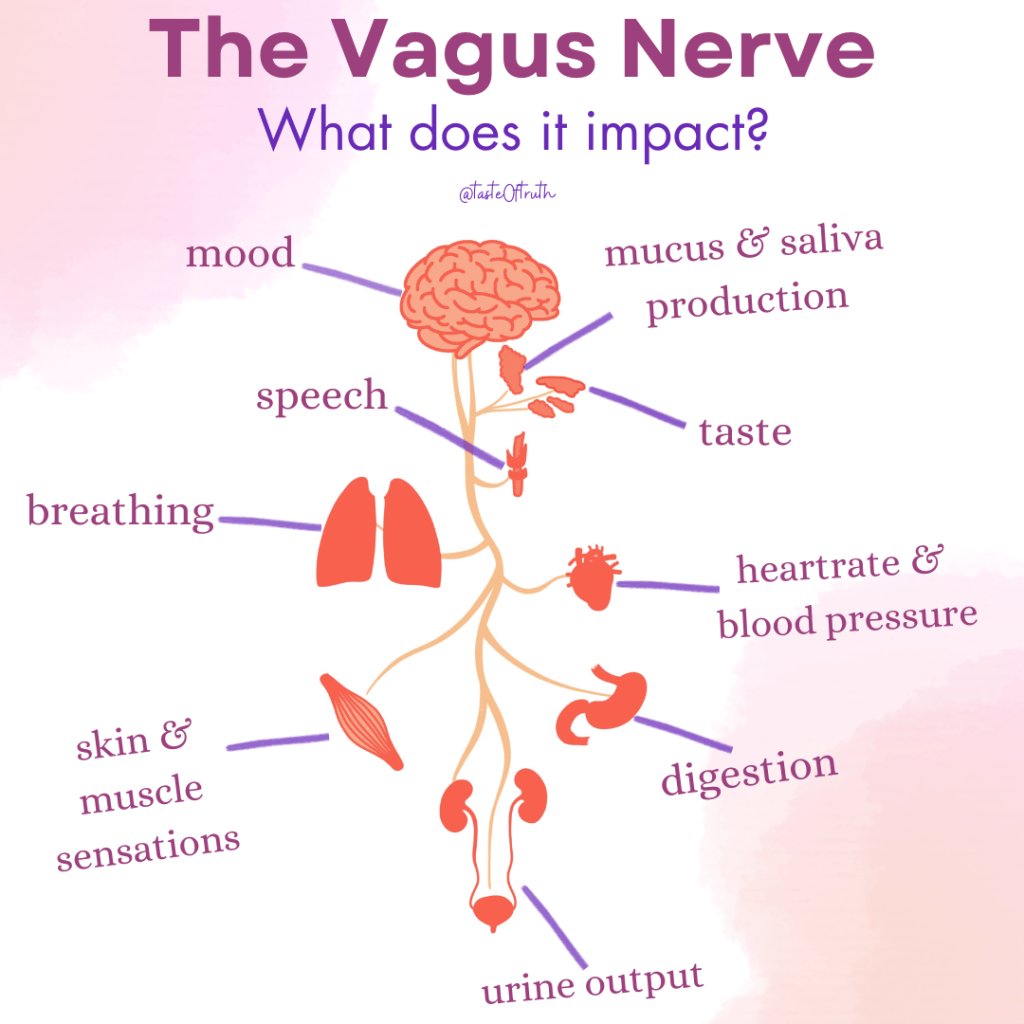
One powerful way I’m rewiring my nervous system is by engaging the vagus nerve, the longest cranial nerve that plays a critical role in regulating the parasympathetic nervous system. The vagus nerve is like the body’s “brakes,” helping to turn off the fight-or-flight response and return the body to a state of calm. When activated, it encourages relaxation, emotional regulation, and recovery—exactly what my body needs as I untangle the tension stored in my fascia and nervous system.

Here’s how I’m starting to rewire my system:

Reconnecting with Joyful Movement:
I’ve reintroduced activities that make me feel alive, like walking in the garden or playing with my pets. These moments remind me that movement isn’t just about strength—it’s about freedom. By incorporating joyful, non-stressful activities, I’m helping to reinforce new neurotags that associate movement with pleasure and ease.

Reclaiming Safety Through Movement:
Instead of high-intensity workouts, I’ve shifted to gentle, functional exercises that strengthen my core and glutes while supporting my nervous system. Slow, mindful movements like glute bridges, bird dogs, and pelvic tilts have become my new best friends. These exercises not only build strength but signal to my nervous system that it’s safe to move.

Releasing Fascia with Love:
I’ve embraced somatic practices like gentle rocking, diaphragmatic breathing, and fascia-focused stretches to help release tension. These practices aren’t just physical—they’re a way of telling my body, “You’re safe now.” They help reprogram the neurotags associated with stress and trauma by sending a message of relaxation and calm.

Vagus Nerve Activation:
To support my nervous system’s recovery, I’ve incorporated practices that stimulate the vagus nerve, such as slow, deep belly breathing and humming. Breathing deeply into my diaphragm (focusing on long exhales) has been especially helpful in calming my body and signaling to my nervous system that it’s okay to relax. By consciously engaging my vagus nerve, I’m helping shift from the fight-or-flight response into a restorative state.

Rewriting Emotional Patterns:
Rewiring my nervous system also means rewriting my emotional patterns. This involves acknowledging the emotional flashbacks that arise when pain triggers old neurotags and consciously choosing to respond with compassion and self-care. Instead of reacting with fear or frustration, I’m learning to pause, breathe, and remind myself that I’m safe now.

What Chronic Pain Has Taught Me

Chronic pain has been a tough teacher, but it’s taught me lessons I wouldn’t trade for anything:

  • Your body is always on your side. Pain is a signal, not a punishment.
  • Healing isn’t linear. Some days, progress looks like resting instead of pushing.
  • Movement is medicine, but only when done with intention and love.

I share this journey because I know I’m not alone. So many of us carry the weight of trauma—both emotional and physical—in our bodies. And while the road to healing isn’t easy, it’s worth it.

If you’re navigating chronic pain, I want you to know this: Your body isn’t broken, and you don’t have to fight it. With the right tools, patience, and self-compassion, you can create safety, release tension, and rediscover the joy of movement.

I’m still on this journey, and I’d love to hear about yours. What has chronic pain taught you? How are you learning to trust your body again? Let’s keep this conversation going—because healing happens when we feel safe enough to share.

How Creative Expression Helps Overcome Trauma

When you grow up in a high-control environment—whether through religion, a rigid upbringing, or a spiritual path that preaches emotional suppression—it can feel like your natural human emotions are something to be ashamed of. I’ve lived it. In the high-control religion I was a part of, anger wasn’t just frowned upon; it was portrayed as sinful, a sign of personal failure or weakness. Through the lens of ACBC Biblical counseling (Nouthetic Counseling), anger was framed as something to be suppressed, manipulated out of existence with tactics like guilt, shame, and isolation. But here’s the truth: anger, like any other emotion, isn’t inherently wrong. It’s human. And when we lose access to it, we also lose access to parts of ourselves.

Anger, as Aristotle once put it, is a passion. When experienced and expressed for the right reasons and in the right way, it can even be virtuous. Yet, in so many spiritual environments, particularly the ones I encountered, emotions like anger were seen as dangerous, spiritually harmful, or outright sinful. Especially for women, who are often taught to prioritize harmony and remain calm at all costs, anger can become something we’re scared to touch. For men, anger might be more accepted, but vulnerability is not, creating its own emotional imbalance.

What happens when we suppress emotions like anger? We get stuck, often feeling disconnected from our bodies, from our creativity, and from any sense of playfulness. That’s why art and play become essential tools in healing from spiritual and religious trauma. They allow us to access and express emotions that were long buried, giving us the space to feel without fear. Art doesn’t just heal—it empowers. It gives back what was stolen. Let’s unpack why:

Why Art & Play Matter in Healing Trauma

Trauma—especially the kind stemming from spiritual or religious abuse—can leave you feeling stuck, numb, or like a stranger to your own creativity. High-control environments stifle our freedom to express, explore, or simply be. Art and play can feel like reclaiming those parts of us that were silenced, buried under the weight of shame, fear, or guilt.

“Wherever I look, I see the same themes: not being allowed to feel, to say what you feel, to trust your perceptions, to ask for what you need. This is how we remain imprisoned in our pain.” -Alice Miller

Engaging in creative expression—whether it’s painting, dancing, writing, or making music—gives us a way to process emotions that can be difficult, even impossible, to articulate. Trauma lodges itself deep in the body and subconscious, often beyond the reach of words. But through art, we can access those hidden parts and begin to heal them in ways that talking just doesn’t touch. It’s like tapping into a language the body understands.

Play, on the other hand, might feel like a foreign concept if you’ve been conditioned to take life way too seriously, to follow rules without question. But it’s through play that we reconnect with spontaneity, joy, and a sense of safety—things that high-control environments tend to strip away. Play is about reawakening that inner child, the part of you that knows how to explore and create without fear of judgment. It’s about taking back the joy you were told to suppress.

How Art & Play Help in Deconstructing Religious Trauma

When we start unraveling the teachings we once held as truth, it can feel like walking through a minefield. Shame, fear, and guilt are often deeply embedded in the narratives we were fed. Art becomes a tool for rebellion, a way to question, challenge, and rewrite those beliefs. By creating, we aren’t just making things; we’re making space for new perspectives. We’re loosening the grip that old doctrines had on us.

In high-control environments, the idea of play is usually dismissed as frivolous or even sinful. Reclaiming that sense of play is like finding a key to unlock the parts of yourself that were shut away. Playfulness, whether it’s dancing with wild abandon, hula hooping (yes, circus arts shoutout!), or exploring new hobbies, gives you back a sense of agency. It’s a way to create space for curiosity again, to embrace wonder without the burden of fear or shame. Think of it as giving yourself permission to live without someone else’s narrative hanging over you.

Scientific Backing for Creative Therapies

The science backs this up, too. Numerous studies have shown that creative therapies—like art, dance, and even movement-based play—can significantly reduce symptoms of PTSD, anxiety, and depression. They work by helping the brain rewire itself through neuroplasticity. When you engage in creative activities, you’re not just distracting yourself—you’re helping your brain form new, healthier connections. You’re building resilience, reprogramming the way your brain responds to trauma.

Art and play ignite parts of the brain that foster emotional regulation and healing. This is where trauma lives, after all—deep within the nervous system. But creativity taps into a different part of the brain than verbal communication does, allowing survivors of trauma to express and release emotions they may not even know they’re holding onto.

By embracing art and play, you’re not just finding a distraction from your pain—you’re giving yourself a way to heal, to reclaim parts of yourself that were taken, and to reconnect with joy, creativity, and freedom. The beauty of it all? There’s no right or wrong way to do it. You’re creating your path forward. So, grab that paintbrush, dance it out, or pick up that pen and let your soul speak.

Resources for Healing Through Art and Play

Books:

  1. “Healing the Fragmented Selves of Trauma Survivors” by Janina Fisher
    This book dives into how trauma fragments a person’s sense of self, especially those recovering from spiritual abuse or high-control environments. Fisher provides practical tools, like body-based therapies and creative expressions, to help reintegrate those fragmented parts into a cohesive whole.
  2. “Trauma and Recovery” by Judith Herman
    Herman’s work is a cornerstone in understanding trauma and its long-term effects. She emphasizes the importance of survivors reclaiming their voices, and how creative expression—whether through writing, painting, or dance—plays a critical role in their recovery journey.
  3. “The Creative Cure” by Jacob Nordby
    Nordby explores how reconnecting with creativity can reignite your sense of self and joy. Especially for those who’ve had their emotional expression controlled or diminished by strict belief systems, this book offers a roadmap to reclaiming a more authentic, free version of yourself through creativity.
  4. “Complex PTSD: From Surviving to Thriving” by Pete Walker
    This book focuses on healing the long-term effects of complex PTSD, which many individuals from high-control religious backgrounds experience. Walker highlights how therapeutic outlets like art, journaling, and other forms of play help survivors process their trauma and begin to thrive again.
  5. “Art Therapy Sourcebook” by Cathy Malchiodi
    Malchiodi is a pioneer in the field of art therapy. This book is a practical guide for anyone looking to explore art as a form of emotional expression and healing, especially in the context of trauma recovery. It offers hands-on approaches for integrating creative expression into your healing process.

Articles & Journals:

  1. American Art Therapy Association
    This site offers numerous research studies on the effectiveness of art therapy in healing trauma, especially for those recovering from spiritual abuse or restrictive environments. It provides a well-rounded view of the therapeutic benefits of engaging in creative arts.
  2. International Journal of Play Therapy
    A comprehensive journal that highlights the healing potential of play therapy for trauma survivors. It explores how play can foster emotional resilience and repair, allowing individuals to reconnect with parts of themselves that were silenced or controlled.
  3. “Creative Arts Therapies and Trauma: Scope and Impact”
    A review that outlines how various forms of creative expression—like music, drama, and visual arts—help trauma survivors heal. This article explains how these therapies leverage the brain’s neuroplasticity to create new, healthier emotional patterns.

Experts & Practitioners:

  1. Pat Ogden – Sensorimotor Psychotherapy
    Ogden’s work is at the intersection of movement and trauma recovery. She focuses on how trauma manifests in the body and uses techniques like creative movement and body-based therapies to help people heal from deep emotional wounds. Her book “Trauma and the Body” is a great resource for understanding this approach.
  2. Peter Levine – Somatic Experiencing
    Levine is renowned for his work on trauma recovery through the body. His book “Waking the Tiger: Healing Trauma” offers insights into how movement and body-based expression can help survivors release trauma and regain a sense of safety and control.

Podcasts & Websites:

  1. Sounds True – Insights at the Edge Podcast
    Hosted by Tami Simon, this podcast often features interviews with leading experts in trauma and healing. Guests like Peter Levine and Pat Ogden discuss the importance of integrating creative practices like art and movement into trauma recovery.
  2. Healing Arts Radio (Online Radio Show)
    Focused on art therapy and trauma healing, this show features episodes on creative therapies and personal stories of recovery through art. It’s an inspiring resource for understanding how play and art can transform emotional wounds into creative empowerment.
  3. Institute for Creative Mindfulness
    This site provides resources and courses on expressive arts therapies for trauma survivors. It emphasizes how art and movement therapies foster resilience and healing by tapping into emotional expression and body awareness.

From Burnout to Breakthrough:  Healing, Art, and Resilience with Katherine Spearing

🎙️ Welcome Back! Join me as I chat with Katherine Spearing, MA, CTRC — founder of Tears of Eden 🌸, a nonprofit supporting survivors of spiritual abuse, and former host of the groundbreaking Uncertain podcast 🎧. Katherine is also the host of Trauma & Pop Culture, a Certified Trauma Recovery Practitioner 🧠, and an expert in helping those who have survived cults, high-control environments, and sexual abuse 💔. She even offers specialized trauma-informed career coaching 💼!

In this episode, we discuss: 💡 The most impactful themes from Uncertain — including her powerful episode with Dr. Laura Anderson on anger 😡 and the concept of second-wave fundamentalism. 🎭 How creative arts therapies are aiding survivors of sexual abuse in their healing journey, and how these methods differ from traditional therapy 🎨. 🛑 Managing the emotional weight of working with spiritual abuse survivors and Katherine’s personal journey to avoid burnout 🧘‍♀️. 👩‍🎤 Challenging traditional gender roles in Christianity — how they’ve shaped perceptions of women’s worth and agency, and steps for creating more inclusive spaces 🚺. 🛡️ Building healthy community dynamics to protect against spiritual abuse while fostering authentic, supportive connections 🌱. 🔥 A sneak peek into Katherine’s upcoming book on spiritual abuse, including why the church is so obsessed with sex 💭.

Tune in now for an insightful conversation on healing, resilience, and challenging the status quo! 🗣️✨

Don’t miss out on Katherine’s wisdom and unique perspective. 🎧

Tears of Eden podcast episode we mentioned

Blog — Katherine Spearing

Tears of Eden: Supporting survivors of Spiritual Abuse and Religious Trauma

🙏 Please help this podcast reach a larger audience in hope to edify & encourage others! To do so: leave a 5⭐️ review and send it to a friend! Thank you for listening! I’d love to hear from you, find me on Instagram!⁠⁠⁠ @taste0ftruth⁠⁠⁠ or⁠⁠⁠ Pinterest! ⁠⁠ ⁠ 

Unraveling the Impact of Stress on Chronic Health with Theresa Piela

In this week’s episode, we dive into the power of Emotional Freedom Techniques (EFT) tapping — a unique blend of traditional Chinese medicine and modern psychology. By tapping on specific meridian points while addressing emotional struggles, EFT helps release energy blockages, reducing stress, anxiety, and even trauma. 🌱✨

In this powerful episode, I sit down with holistic healing expert Theresa Piela to explore the deep connection between chronic stress and health. Theresa shares her personal story of hitting rock bottom in 2019, when chronic illness nearly led to organ failure. We dive into the guilt and exhaustion that comes with being chronically ill in a toxic world, and how healing techniques like Emotional Freedom Techniques (EFT) tapping can offer relief. 🌱✨

We’ll explore how EFT has shown promising results in mental health, from lowering cortisol levels to easing PTSD symptoms in veterans. However, with its roots in spiritual and energetic practices, EFT has sparked controversy in some Christian communities. Join us as we unpack these perspectives and discuss how EFT can be a powerful tool for both emotional and physical healing.

The Impact of Stress on the Body

Understanding Stress: Theresa breaks down the three stages of stress and how they manifest in our daily lives, leading to digestive issues and chronic illnesses. She sheds light on the silent havoc that prolonged stress wreaks on our gut health and overall bodily functions.

The Three Stages of Stress and the Fawning Response: Understanding How High-Control Religions Impact Emotional Well-Being

Stress is an inevitable part of life, but how our bodies and minds respond to it can vary significantly depending on the intensity and duration of the stressor. Hans Selye, a pioneering endocrinologist, developed the General Adaptation Syndrome (GAS) to describe the body’s physiological response to stress. This model helps explain how prolonged stress affects overall health and well-being. While the three stages of stress capture the body’s core reactions, the behavioral response known as fawning—especially common among individuals who have come out of high-control environments like fundamentalist religions—adds another layer to this discussion.

The Three Stages of Stress: General Adaptation Syndrome

Selye’s General Adaptation Syndrome describes how the body responds to stress over time, detailing three distinct stages:

1. Alarm Stage

This is the initial, immediate response to a stressor. When faced with a perceived threat, the body goes into “fight or flight” mode, releasing adrenaline and cortisol. These stress hormones increase heart rate, sharpen focus, and provide a surge of energy to prepare you to either confront the threat or escape it. In modern life, this could be triggered by anything from a work deadline to an argument with a loved one.

2. Resistance Stage

If the stressor continues beyond the initial shock, the body enters the resistance stage. While the outward signs of the fight-or-flight response might fade, internally, the body is still on high alert. Stress hormones like cortisol remain elevated, and the body tries to adapt and cope. However, this stage can’t last forever. Prolonged exposure to stress at this level takes a toll on the body, potentially leading to mental and physical exhaustion.

3. Exhaustion Stage

When stress continues for a prolonged period without adequate recovery, the body eventually reaches the exhaustion stage. Here, the body’s resources are depleted, and it can no longer function normally. Symptoms such as fatigue, depression, anxiety, and even burnout may manifest. The immune system weakens, making the individual more vulnerable to illness and disease.

Understanding these stages is crucial for recognizing when stress becomes chronic and dangerous. But there’s more to the picture when considering how stress affects behavior—especially in people who have experienced trauma or high-control environments.

Enter the Fawning Response: A Behavioral Reaction to Trauma

Fawning doesn’t fit neatly into the General Adaptation Syndrome model because it’s a behavioral rather than a purely physiological response. Still, it’s crucial to understanding how certain people cope with chronic stress or trauma, particularly in interpersonal or high-control environments.

The “Four Fs” of trauma responses—Fight, Flight, Freeze, and Fawn—describe various ways people react when they feel threatened. While fighting, fleeing, or freezing are instinctive survival responses, fawning is a more subtle and less discussed way of coping, often rooted in a need to appease the threat to maintain safety.

What Is Fawning?

Fawning involves appeasing or placating others to avoid conflict or harm. People who fawn try to please or appease the person or situation causing the stress in order to de-escalate the threat. Instead of confronting the stressor (fight), avoiding it (flight), or becoming immobilized (freeze), a person who fawns seeks to reduce the danger by submitting, people-pleasing, or over-accommodating.

This behavior often develops in individuals who have experienced prolonged stress or trauma, especially in abusive, manipulative, or high-control environments like toxic relationships or fundamentalist religions.

How Fawning Fits into the General Adaptation Syndrome Model

Although fawning isn’t a stage of stress, we can still see how it might manifest within the GAS framework:

  • Alarm Stage: Fawning could be an immediate response to the initial stressor. Rather than fleeing or fighting, someone might instinctively try to placate the threat. For instance, in a high-control religion, a person might conform instantly to avoid punishment or conflict.
  • Resistance Stage: If the stress persists, fawning can become a habitual response during the resistance stage. The person continues engaging in appeasement behaviors, attempting to manage the ongoing stressor while sacrificing their own needs and well-being in the process.
  • Exhaustion Stage: Over time, relying on fawning as a coping mechanism can lead to emotional and physical exhaustion. Constantly trying to meet others’ demands, avoiding conflict, and suppressing one’s own needs results in burnout and emotional depletion.

Fawning and High-Control Religions: The Long-Lasting Impact

People who come out of high-control religions often exhibit the fawning response as they attempt to navigate new environments and relationships. These religions typically operate with strict rules, strong hierarchies, and harsh consequences for dissent. As a result, members often suppress their own needs and opinions to avoid punishment or ostracism.

Even after leaving these environments, the pattern of fawning often persists. The deeply ingrained survival mechanism of appeasing authority figures to avoid conflict becomes habitual. This behavior may manifest in various ways:

  • People-pleasing: Going out of their way to accommodate others, even at the expense of their own well-being.
  • Difficulty asserting boundaries: Struggling to say no or express personal needs and preferences, often feeling guilty for doing so.
  • Fear of conflict: Avoiding disagreements or confrontations out of fear of rejection or punishment.
  • Self-silencing: Suppressing thoughts, feelings, and opinions in order to maintain harmony and avoid disapproval.

For those deconstructing from high-control religions, the fawning response can be particularly challenging to recognize and unlearn. Many may not even realize that their behaviors are rooted in a trauma response. Helping individuals understand and break these patterns is essential for their emotional recovery.

Moving Forward: Unlearning Fawning and Rebuilding Self-Worth

Breaking the cycle of fawning involves learning to assert boundaries, rebuild self-worth, and reclaim personal autonomy. This is not an easy process, especially for those who have spent years in environments where appeasement was essential for survival. Therapy, support groups, and self-compassion can be powerful tools in helping people regain their sense of self after leaving high-control environments.

By recognizing fawning as a response to trauma and stress, individuals can begin to unlearn these behaviors, reclaim their identity, and create healthier relationships—both with others and with themselves.

Understanding stress responses, both physiological and behavioral, is key to supporting individuals who are recovering from trauma. Recognizing the fawning response and how it fits into the broader stress picture can open the door to healing for those emerging from high-control situations like fundamentalist religions.

Mindset & Thought Shifting: Changing How We React to Stress

We must first accept that stress is a normal and natural part of life. Short-term stress, when followed by ample recovery, can enhance cognition and boost our capabilities. It’s like strength training: with proper recovery, the stress we place on our muscles leads to gains. However, persistent stress, if not managed properly, can be damaging. This is why we must shift our relationship with stress.

In times of severe depletion and exhaustion, recovery takes time and commitment. Start by meeting yourself where you are. Shift your mindset by deliberately choosing thoughts that signal to your body that everything is okay. Surround yourself with calming influences—whether it’s people, sounds, colors, or landscapes—that make you feel safe and hopeful. This isn’t a luxury; it’s a requirement for healing. Equally important is removing stimuli that drain you and recognizing that your body has an incredible capacity to heal when given the right tools.

As the Dalai Lama once said, “If a problem is fixable, if a situation is such that you can do something about it, then there is no need to worry. If it’s not fixable, then there is no help in worrying. There is no benefit in worrying whatsoever.”


Fuel & Nutrition: Supporting Your Body’s Adaptive Stress Response

Just as important as shifting your mindset is fueling your body with the right nutrients. A starved or inflamed system will struggle to adapt to stress, especially when trying to balance internal chaos. Proper nutrition is key to supporting the body’s stress response.

When the body isn’t fueled properly, persistent stress leads to harmful effects, such as blood sugar swings, hormonal dysregulation, and weakened immunity. To counteract this, we need to provide the body with the building blocks it needs to recover.

Here’s a high-level look at what your body requires for optimal function:

  • Proteins: Anti-inflammatory sources like grass-fed beef, broths, shellfish, and dairy.
  • Carbohydrates: Glucose and fructose from fruits, honey, maple syrup, and root vegetables.
  • Fats: Saturated fats are essential.
  • Vitamins & Minerals: Vitamin C, D, E, B1, B6, B12, calcium, magnesium, copper, sodium, potassium, selenium, and zinc.

Addressing intestinal permeability, blood sugar imbalances, and other stress-induced dysfunctions through proper nutrition will help rebuild resilience. For those with severe gut issues, a nutrient-dense, elimination-style diet—like carnivore plus easy-to-digest carbs—may be necessary short-term to restore balance.

In the end, listening to your body is critical. Experiment with what makes you feel good, trust yourself, and remember: you know best.

By shifting your mindset and supporting your body with proper fuel, you can navigate life’s stressors with resilience and strength.

Ever wonder why stress keeps you up at night?

Sleep Disruption and Hormones: How Stress, Trauma, and Hormonal Imbalances Impact Sleep Quality

Sleep is one of the most critical factors for overall health, and yet, it’s often disrupted by stress and hormonal imbalances. In this section, we’ll dive into how stress hormones like cortisol and adrenaline interfere with sleep, explore the impact of early life trauma on sleep quality, and discuss how the menstrual cycle and hormonal imbalances can further complicate our ability to achieve restful sleep.

Stress Hormones and Sleep Disruption

Stress hormones such as cortisol and adrenaline play significant roles in the body’s response to stress, but when they’re constantly elevated, they can wreak havoc on our sleep.

  1. Cortisol: Often referred to as the “stress hormone,” cortisol follows a natural rhythm called the circadian rhythm. In healthy individuals, cortisol levels are highest in the morning to help us wake up and get ready for the day, and they naturally decline in the evening to prepare the body for rest. However, when we are under chronic stress, cortisol can become dysregulated. Instead of dropping at night, elevated cortisol levels can keep us in a state of alertness, making it difficult to fall asleep or stay asleep. This leads to frequent waking, shallow sleep, and feeling unrefreshed in the morning.
  2. Adrenaline (Epinephrine): Adrenaline is the hormone responsible for the fight-or-flight response, which prepares the body to face a threat by increasing heart rate, blood flow, and energy levels. If adrenaline surges before bed—due to stress, anxiety, or even unresolved trauma—it can make falling asleep nearly impossible. You might feel restless, agitated, or have racing thoughts, all of which disturb the calm necessary for a good night’s sleep.

Practical Strategies for Managing Stress Hormones for Better Sleep

  • Create a Wind-Down Routine: Establishing a relaxing pre-sleep routine helps signal to your body that it’s time to rest. This can include dimming lights, turning off electronic devices (which emit blue light and can increase cortisol), and engaging in calming activities like reading, gentle stretching, or meditation.
  • Balance Blood Sugar: Blood sugar spikes and crashes can trigger cortisol release. Eating a well-balanced meal with protein, healthy fats, and complex carbohydrates before bed can stabilize blood sugar levels and prevent cortisol surges during the night.
  • Supplement Support: Some supplements, such as magnesium, have been shown to help reduce cortisol levels and promote relaxation. Herbal adaptogens like ashwagandha and holy basil can also support the body’s stress response and reduce cortisol.
  • Mind-Body Techniques: Practices like yoga, deep breathing exercises, and progressive muscle relaxation can help lower cortisol and calm the nervous system before sleep.

The Impact of Early Life Trauma and Adverse Events on Sleep

Early life trauma or Adverse Childhood Experiences (ACEs) have profound effects on the body’s stress response systems, which can manifest later in life as sleep disturbances. Research shows that people who have experienced trauma, particularly in early development, often have overactive sympathetic nervous systems and altered cortisol levels, leading to difficulty achieving deep, restorative sleep.

  • Hypervigilance: Trauma survivors often experience hypervigilance, a heightened state of awareness where the body is constantly scanning for potential threats, even during sleep. This state of heightened arousal makes it hard to relax, and the individual may have trouble entering deeper stages of sleep like REM (Rapid Eye Movement) or slow-wave sleep.
  • Fragmented Sleep: Those with a history of trauma may wake frequently during the night, as their bodies remain on high alert. This fragmentation prevents the deep, uninterrupted sleep necessary for physical and emotional recovery.
  • Nightmares and Flashbacks: Trauma-related nightmares are common and can disrupt sleep, causing the individual to wake in distress. Flashbacks, even during waking hours, can trigger the body’s stress response, elevating cortisol and adrenaline and making sleep difficult.

Strategies to Address Sleep Disruption in Trauma Survivors

  • Trauma-Informed Therapy: Engaging in trauma therapy, such as Cognitive Behavioral Therapy for Insomnia (CBT-I) or Eye Movement Desensitization and Reprocessing (EMDR), can help individuals process traumatic memories and regulate their nervous system responses, ultimately improving sleep.
  • Grounding Techniques: Practicing grounding exercises, such as focusing on your breath or engaging your five senses, can help bring your body back into the present moment, reducing hypervigilance and promoting relaxation before bed.
  • Sleep-Friendly Environment: Creating a sleep environment that feels safe and secure is crucial for trauma survivors. Using weighted blankets, soothing sounds, and minimizing noise or light disturbances can enhance feelings of safety during sleep.

The Role of Menstrual Cycles and Hormonal Imbalances in Sleep Disruption

For many women, sleep disturbances can be closely tied to the fluctuations in estrogen, progesterone, and other hormones that occur throughout the menstrual cycle. Hormonal imbalances, especially during perimenopause or menopause, can further exacerbate sleep issues.

  1. Estrogen and Progesterone: These hormones play vital roles in regulating sleep. Estrogen promotes sleep by increasing serotonin, a neurotransmitter that helps regulate mood and sleep patterns. Progesterone has a calming, sedative effect on the brain and helps prepare the body for sleep. However, imbalances in these hormones—whether due to the menstrual cycle, pregnancy, or menopause—can lead to insomnia, night sweats, and difficulty staying asleep.
    • Premenstrual Sleep Disruption: Many women experience disrupted sleep in the luteal phase of their cycle (the days leading up to menstruation), when progesterone levels spike and then rapidly drop. This sudden shift can lead to insomnia or restless sleep, often accompanied by PMS symptoms like bloating, mood swings, and cramps.
    • Perimenopause and Menopause: As women approach menopause, declining estrogen and progesterone levels can lead to hot flashes, night sweats, and other symptoms that interfere with sleep. The lack of estrogen can also cause vaginal dryness and discomfort, further disrupting rest.
  2. Cortisol and Menstrual Cycles: High cortisol levels, often due to stress, can also impact the menstrual cycle by suppressing the release of sex hormones, leading to irregular periods or exacerbating PMS symptoms, which in turn disrupt sleep.

Practical Strategies for Hormonal Sleep Issues

  • Track Your Cycle: By tracking your menstrual cycle, you can become more aware of patterns in sleep disturbances and adjust your habits accordingly. For instance, you might prioritize stress management techniques and good sleep hygiene during the luteal phase.
  • Herbal Support: Certain herbs like chasteberry (Vitex), black cohosh, and red clover can help balance estrogen and progesterone levels, potentially reducing sleep issues related to PMS or menopause.
  • Hormone Replacement Therapy (HRT): For women in perimenopause or menopause, bioidentical hormone replacement therapy (BHRT) can help restore hormone balance, improving sleep quality. Consulting a healthcare provider about HRT options may be helpful.

Takeaway: Supporting Hormonal Balance for Better Sleep

Stress, trauma, and hormonal imbalances each play a major role in sleep disruption, but by managing stress hormones, addressing trauma, and supporting hormonal health, you can improve your ability to achieve deep, restorative sleep. Prioritizing sleep hygiene, engaging in calming practices, balancing blood sugar, and supporting hormone levels with natural or medical interventions are key strategies in restoring balance and reclaiming restful nights.

Nutritional and Lifestyle Adjustments: Theresa shares actionable tips on how to nourish your body for better sleep. From balancing blood sugar to enjoying nutritionally dense meals, she emphasizes the importance of tuning into what your body needs, rather than following rigid dietary rules. We also explore the benefits of bedtime snacks like fructose, carbs, and chamomile tea to promote restful sleep.

Emotional Resilience and Self-Compassion: In a world that demands so much from us, Theresa encourages us to meet ourselves with curiosity and compassion. She reminds us that it’s okay to feel frustrated, angry, or tired—these emotions are part of being human. Through self-experimentation and treating ourselves with the kindness we would offer a child, we can navigate the healing journey with more grace.

Tune in to this episode for a heartfelt and insightful discussion that will leave you with practical tools and a renewed sense of hope on your path to healing. Whether you’re struggling with insomnia, chronic stress, or just trying to find balance in a chaotic world, Theresa’s wisdom is not to be missed.

For helpful tapping videos, be sure to check out TappingwithT.com, where you can explore a variety of free resources without needing to sign up. You can also take advantage of a 7-day free trial to the membership and app! Additionally, if you’re interested in personalized support, 30-minute discovery calls are available for those considering 1:1 sessions.

About Us — Living Roots Wellness

The Trauma-Brain-Gut Connection — Living Roots Wellness

Stress, Adaptation, & Repair — Living Roots Wellness

EFT Tapping — Living Roots Wellness

#EFTTapping #ChronicStress #HolisticHealing #Spirituality #deconstruction