The Deluded Brain: Why Control Feels Safe, Certainty Feels Holy, & Complexity Feels Threatening

Welcome to Taste Test Thursday! You know how online debates often turn into full-blown keyboard wars? People lash out with rage when their beliefs whether political, religious, or social are challenged. But why? What’s behind these intense, emotional responses?

What if it’s not just about bad ideas, but something deeper a brain imbalance? What if our need for certainty and addiction to outrage comes from the way our brains are wired to process the world?

Today we’re diving into the neuroscience behind these defensive reactions. We’ll see how the brain’s wiring for survival influences everything from ideological rigidity to emotional hijacking. We’re setting the stage for something important that we’ll explore this upcoming Tuesday how Complex PTSD and PTSD are NOT the same thing. This is an episode you won’t want to miss, especially if you’ve ever felt stuck in a cycle of intense emotional reactions that you just can’t control.

Let’s review something we’ve discussed before: Amygdala Hijacking. If you remember, the amygdala is a part of our brain that processes emotions like fear and anger. Now, when the amygdala gets triggered especially in stressful or traumatic situations it can completely bypass the more rational prefrontal cortex. This results in what we call an “emotional hijack,” where the brain goes straight into fight-or-flight mode often in situations that don’t actually require that level of reaction.

This kind of response helps explain why some people find comfort in fundamentalism.

“At its most basic, the allure of fundamentalism, whether religious or ideological, liberal or conservative, is that it provides an appealing order to things that are actually disorderly.”
Peter Mountford The Dismal Science

That line hits at something crucial we have explored many times before: the human brain craves order, especially in the face of chaos. The illusion of control is one of our brain’s favorite coping mechanisms and when we find a system (religious, political, or otherwise) that delivers black-and-white certainty? You get a dopamine hit.

Rigid ideologies offer a tidy framework that feels safe and predictable especially in times of confusion, disillusionment, or personal crisis. That’s not just philosophy. That’s neurology.


When Chaos Was the Norm, Control Becomes a Coping Mechanism

For many of us, rigid beliefs aren’t just intellectual frameworks. They’re emotional survival strategies.

The need for control, the drive for perfection, the desire to be “good enough” to earn love these weren’t just quirks of personality. They were adaptations to childhoods where emotional needs weren’t met. And like many people who grew up in households marked by emotional neglect, those patterns shaped everything: our relationships, our careers, our bodies, and the ideologies we clung to.

Psychologists like Alice Miller and Elan Golomb have long noted how children raised in emotionally unavailable or narcissistic homes often create a false self a version of themselves designed to gain approval and avoid rejection.
It’s a blueprint that gets carried into adulthood, often unconsciously.

That’s why fundamentalist spaces feel so magnetic to people with childhood trauma. They offer:

  • Clear rules instead of emotional chaos
  • “Unconditional” love that’s actually highly conditional
  • A surrogate parent in the form of a deity or ideology that tells you who to be

Religious trauma often echoes family trauma—because it’s a new version of the same wound.


When Identity Is Built on Compliance

When a belief system rewards obedience over curiosity, it recreates the dynamics of an authoritarian household. You’re loved when you perform correctly. You belong when you don’t question. You’re “good” when you conform.

So what happens when you start to deconstruct?

The moment someone questions the “truth,” it’s perceived as a betrayal—not just of doctrine, but of identity and tribe. And that’s when we see:

  • Verbal attacks – Heretic. Traitor. Bigot.
  • Social ostracism – Canceled. Shunned. Ghosted.
  • Online harassment – Dogpiling and moral outrage.
  • Even physical aggression – History is full of examples, from witch hunts to ideological purges.

But this isn’t just about “bad actors.” It’s about brains shaped by fear.

When your childhood taught you that being wrong = being unloved, then someone challenging your beliefs doesn’t just feel uncomfortable it feels unsafe.
Disagreement triggers:

  • Cognitive dissonance – That gut-wrenching anxiety when facts don’t fit your worldview
  • Fear of consequences – Hellfire or public shaming
  • Loss of self – Because the belief was the identity
  • Loss of community – The people who “loved” you might now condemn you

The Brain’s Role in Certainty Addiction

Neuroscience adds another layer here—one that makes ideological rigidity more understandable, even if it’s not excusable.

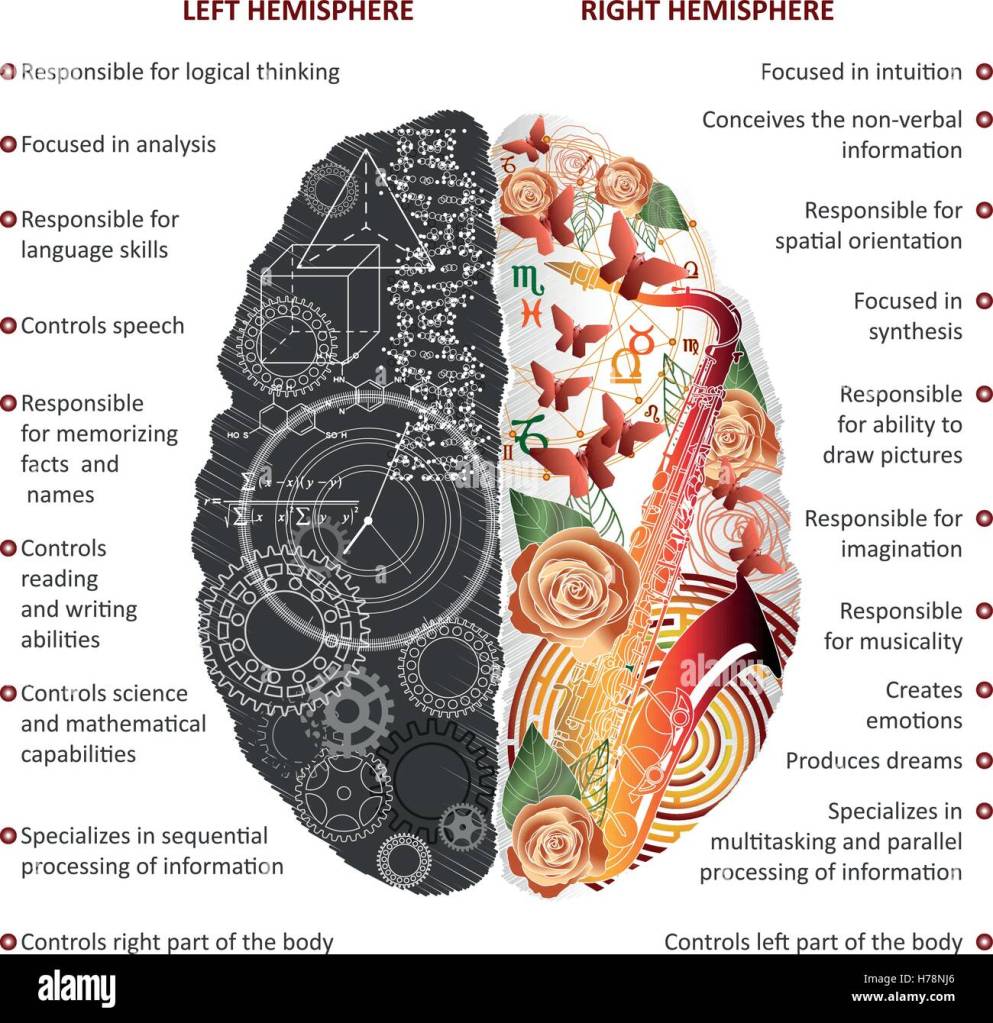
Dr. Iain McGilchrist, in The Master and His Emissary, outlines how the brain’s left and right hemispheres don’t just process information differently—they perceive reality differently.

❌ Not: “Left brain = logic, Right brain = creativity.”
✅ But: “Left brain = control, categorization, and certainty. Right brain = context, relationship, and meaning.”

In a balanced brain, the right hemisphere leads—it sees the big picture, embraces nuance, and stays grounded in lived reality. The left hemisphere refines, classifies, and helps us act.

But modern culture has flipped the script. We’ve let the left hemisphere hijack our perception, reducing the complex to the manageable, the mysterious to the measurable. In this flipped hierarchy:

  • Ambiguity feels threatening
  • Context gets stripped away
  • Relationship is sacrificed for abstraction
  • And certainty becomes a kind of drug

That’s why ideological possession feels so safe. The left brain loves a clear system, even if it’s oppressive. It would rather be certain and wrong than uncertain and real.

So, when someone questions your belief, it’s not just inconvenient. It shatters the left brain’s illusion of control. And when that illusion is all, you’ve known since childhood, the reaction isn’t just intellectual-it’s existential. a threat.


When Belief Becomes Identity

Jonathan Haidt, in The Righteous Mind, explains that we don’t arrive at beliefs through pure logic. We have moral intuitions quick, gut-level judgments and then our reasoning brain (usually the left hemisphere) steps in, not to find the truth, but to defend the tribe.

The moment someone questions our “truth,” we don’t hear it as a conversation—we hear it as an attack.

What happens next?

Verbal Attacks:
When someone questions a core belief, the response often isn’t curiosity—it’s insults, belittling, or outright contempt. In faith spaces, that might look like calling someone a heretic. In political spaces, it’s labels like traitor, bigot, or grifter.

Social Ostracism:
Both religious and political groups punish deviation. Doubters are canceled, excommunicated, or ghosted. Deconstruct your faith? You might lose your church community. Question political orthodoxy? You might lose friends—or your job.

Online Harassment:
The algorithm rewards outrage. Post a thoughtful question about a sacred ideology and you’ll get dogpiled. Our moral tastebuds, as Haidt would say, are being hijacked by dopamine-fueled tribalism.

Physical Aggression:
At the extremes, ideological certainty becomes dangerous. From holy wars to revolutions, the ugliest parts of history stem from one belief: we’re right, and they’re evil.


Why We React This Way: The Psychology of Threat

When beliefs are fused with identity, disagreement feels like annihilation. Especially when the community around us reinforces that fusion. Here’s the pattern:

  • Fear of Deviation: Questioning is framed as betrayal either spiritual or social.
  • Cognitive Dissonance: New ideas create discomfort, and doubling down feels safer than rethinking.
  • Fear of Consequences: From hellfire to being canceled, the cost of questioning is high.
  • Identity Threat: When belief equals self-worth, letting go feels like losing yourself.
  • Social Pressure: Communities often reward conformity and punish dissent.

This is where McGilchrist and Haidt align beautifully: one shows how the brain gets hijacked by the need for control, the other shows how morality binds us to our tribe and blinds us to complexity.


Make-Believe, Morality, and the Group

In our episode with Neil Van Leeuwen, author of Religion as Make-Believe, we unpacked another crucial insight: factual beliefs are flexible, but identity-based beliefs aren’t. They don’t require evidence. In fact, falsehoods often serve the group better because they signal loyalty, not logic.

This is why both sides of a political aisle can believe obviously contradictory things because the truth is secondary to belonging. And once we belong, we don’t think critically–we defend instinctively.


The Antidote: Intellectual Humility

The only way out is through a kind of self-aware disruption.

  • Open Dialogue: Spaces where disagreement isn’t punished—but explored.
  • Supportive Community: Groups that allow for doubt, evolution, and honest questioning.
  • Personal Reflection: A willingness to examine the stories we tell ourselves—and why we need them.
  • Interdisciplinary Curiosity: Instead of staying in one thought silo, we pull from neuroscience, sociology, philosophy, and lived experience.

Fundamentalism, at its core, is the elevation of certainty over curiosity. But healing, freedom, and truth? They live on the other side of that certainty.


So, what’s one belief you once clung to tightly only to realize it wasn’t the whole truth?

Let’s talk about it in the comments.

And remember:

Maintain your curiosity, embrace skepticism, and keep tuning in. 🎙️🔒
We’re not here to worship reason or reject it.
We’re here to see more clearly.

Sources:

  1. Dr. Iain McGilchrist – Left and Right Hemisphere Functions
    McGilchrist, Iain. The Master and His Emissary: The Divided Brain and the Making of the Western World. Yale University Press, 2009.
  2. Alice Miller – Emotional Neglect and the False Self
    Miller, Alice. The Drama of the Gifted Child: The Search for the True Self. Basic Books, 1997.
  3. Elan Golomb – Narcissistic Parenting and Emotional Consequences
    Golomb, Elan. Trapped in the Mirror: Adult Children of Narcissists in Their Struggle for Self. William Morrow, 1992.
  1. Neil Van Leeuwen – Religious Trauma and Belief Systems
    Van Leeuwen, Neil. Religion as Make-Believe: The Religious Imagination and the Design of the World. Cambridge University Press, 2021.
  2. Jonathan Haidt – Moral Psychology and Group Loyalty
    Haidt, Jonathan. The Righteous Mind: Why Good People are Divided by Politics and Religion. Pantheon Books, 2012.

Understanding Hormonal Changes in Midlife Women

The Truth About Hormones &Body Fat

If you’re a woman in midlife witnessing changes in your body, let’s be honest—hearing one more expert say “just move more and eat less” might make you scream. That tired, oversimplified advice ignores the very real ways our bodies change—and the decades of life we’ve already lived in them.

Midlife, generally defined as the ages between 37 and 65, isn’t just a calendar phase. It’s a biological, emotional, and identity-shifting chapter. For women, it often marks the beginning of perimenopause—the transitional period leading up to menopause, when the ovaries gradually produce less estrogen. Menopause itself is defined as the 12-month mark after your final menstrual period, but the hormonal fluctuations and symptoms often begin years before and can last well beyond that point.

To really understand what’s happening in our bodies now, we have to rewind the clock.

From puberty, our bodies have been shaped by an elegant hormonal dance. Estrogen, progesterone, and to a lesser extent testosterone, govern everything from our cycle to our skin, from our energy to our emotional responses. These hormones rise and fall in predictable patterns until they don’t. And when they don’t, you feel it.

Hot flashes. Sleep disruptions. Brain fog. Mood swings. Slower recovery from workouts. A scale that doesn’t seem to budge no matter what you do. And the silent undercurrents like the gradual loss of bone density—osteopenia—that often go unnoticed until it’s too late.

These aren’t random annoyances. They’re signals. And they deserve to be understood.

In this post and in today’s podcast episode, I talk with registered dietitian and research wizard Maryann Jacobsen about what actually helps us thrive during perimenopause and menopause. We get into why muscle is metabolic gold, why cardio isn’t always the answer, and how biofeedback your body’s own cues like hunger, energy, sleep, and mood can tell you more about what’s working than any calorie tracker or influencer’s reel ever could.

We also challenge the idea that your bathroom scale is the best measure of health. Spoiler alert: it’s not. Tools like DEXA scans provide deeper insight into your bone density and lean mass—two things that matter more than “weight” ever could in this stage of life. And while your smart scale using bioelectrical impedance might not be as accurate, it can still help you track general trends if you know how to interpret it.

One part of our conversation that hit me hard was Maryann’s mention of the body fat research around fertility. Scientists have found that a minimum of 17% body fat is required just to get a menstrual cycle, and about 22% is needed to maintain ovulation. But here’s the real shocker: in mature women, regular ovulatory cycles are often supported best at 26–28% body fat. (PMID: 3117838, 2282736) That means what many of us have been taught to chase ultra-lean physiques (around 17 BF% or so), chronic calorie restriction, or overtraining can actually backfire on our reproductive health, bone health, and overall vitality.

In populations where food is scarce or physical demands are high, we see patterns: delayed first periods, longer gaps between births, earlier menopause. It’s the body adapting for survival. But in modern life, we sometimes impose these same conditions on ourselves in the name of “fitness.”


And while estrogen usually gets the spotlight in menopause care often treated as the main character it’s progesterone that deserves a standing ovation. Many women are told they “need progesterone” just to protect themselves from estrogen’s effects, as if it’s merely a buffer. But that undersells its brilliance.

The name progesterone literally means “pro-gestation,” but its impact goes far beyond fertility. Progesterone is a master regulator. It stabilizes tissues, supports metabolic balance, calms inflammation, protects against stress, and even plays a role in brain health. While estrogen stimulates, progesterone shields. While estrogen builds, progesterone restores.

Fascinatingly, our bodies produce far more progesterone than estrogen especially after ovulation and during pregnancy. That’s not a fluke. It reflects just how critical progesterone is to our overall well-being.

So when ovulation slows or disappears in midlife, it’s not just your period going quiet. It’s this entire downstream network of hormonal resilience especially progesterone that starts to fade. And that’s when symptoms ramp up.

Understanding this isn’t just about managing menopause. It’s about honoring your biology, updating your strategy, and supporting your body like the powerful, responsive system it actually is.

If we want to balance and optimize our hormones in midlife, we have to re-evaluate our goals. This isn’t about grinding harder it’s about getting smarter. And to get smarter, we need to zoom out.

Ovulation isn’t just some fertility footnote-it’s the main event of your cycle. But many of us were taught that the bleed is the cycle. Nope. That’s just the after-party. The headliner? Ovulation.

Why does this matter in midlife?

Because ovulation is what triggers the production of progesterone a hormone that plays a critical role in metabolism, mood, sleep, brain function, and bone health. And spoiler: progesterone is the first to dip off the radar as we enter perimenopause. That’s why your energy feels off, your sleep gets weird, and your tolerance for stress tanks. Your body isn’t broken—it’s adapting.

Here’s where things click into place: your body will only ovulate consistently if it feels safe and nourished. That means you’re eating enough, not overtraining, and not living in a cortisol-fueled chaos spiral.

Ovulation isn’t just about reproduction it’s a vital sign of health.
And the two hormones that anchor your entire cycle, estrogen and progesterone, do so much more than regulate periods.

From bone density to brain function, from insulin sensitivity to mitochondrial health, these hormones influence nearly every system in your body. So, when they fluctuate…. or flatline… you feel it. Not just in your body, but in your entire day to day experience.

So, let’s break the rules, rewrite the midlife playbook, and finally start listening to the wisdom our bodies have been whispering all along.

LINKS:

In-depth-guide-on-midlife-weight

The Hidden Risks of Ozempic: Rapid Weight Loss Can Weaken Bones and Muscles

Farmer Vs Banker episode Move More, Eat Less? The Lie That Won’t Die

Resistance-exercise-perimenopause-symptoms

To take hormone therapy or not to take hormone therapy

The Case for Cardio

Contrary to popular belief, a larger body may actually be healthier (insta post)

Why Are Americans So Obsessed With Protein? Blame MAGA.

Midlife stress and its ripple effect on health

Meet your new post-40 nervous system

Scroll, Like, Repeat

How Social Media Is Rewiring Our Brains

Welcome to Taste of Truth Tuesdays—the podcast where we dive into hard questions, challenge the status quo, and explore the wild, messy journey of life. I’m your host, Megan Leigh, and wow… here we are. The finale. 🎭

It’s hard to believe we’ve reached this point, but just like any great adventure, sometimes you’ve gotta know when to step back, take a breath, and let the journey settle. But before I hang up the mic, we’re going out with a bang—talking about something that’s taken over our minds, our lives, and—let’s be real—our souls: social media.

Now, don’t roll your eyes just yet. I know, I know—you’re probably thinking, “Oh, great. Another episode on social media. Can’t wait for more doom and gloom.” But stick with me. We’re not just talking about your Instagram algorithm or the latest TikTok trend. We’re diving deep into the brain science behind our scrolling obsession, the way social media messes with our mental health, and—hold on to your hats—the role it plays in shaping our very identities.

So, buckle up, because this is the episode where we reclaim our time, our attention, and—if we’re lucky—our sanity.

It’s time to get real. Let’s unravel the truth about how social media is rewiring our brains… and what we can do about it.

Social media: It started as a fun way to connect, share cat memes, and stalk your high school crush’s wedding photos. Ah, the good old days, right? Over the years, it has morphed into something far more insidious—a time sink, an anxiety amplifier, and, for many, an addiction.

We’ve all felt it: that pull to check our phones every five minutes, the sudden rush when our post gets shared, the quiet frustration when we can’t get the perfect shot for the ‘gram. But these reactions aren’t accidents. They’re carefully crafted designs by tech giants who know exactly how to keep us coming back for more. Let’s begin by diving deep into the science behind the scroll…..

The Science Behind the Scroll

The tech companies behind Instagram, TikTok, and Facebook have cracked the code on how to get us hooked—and it’s all about the brain’s reward system.

Every like, comment, or share triggers a dopamine release. That’s the same brain chemical activated when we eat chocolate, win a prize, or, frankly, get any form of instant gratification. Dopamine feels good, and your brain remembers that. Over time, your brain starts to associate social media with that feeling of pleasure, and bam—you’re hooked. This is the kind of addiction we’re talking about.

According to recent studies, social media addiction is particularly prevalent among younger demographics. Approximately 40% of users aged 18 to 22 report being addicted to social media. This trend continues into the age group of 23 to 38, where 15% admit to addiction.

But the consequences go deeper than wasted time. This constant stimulation has been linked to:

  • Decreased attention spans: You know that feeling when reading a full page of a book feels like climbing Mount Everest? That’s your brain, rewired by quick-hit content.
  • Cognitive overload: The endless stream of content leaves little room for deep thinking or creative problem-solving.
  • “Brain rot”: This TikTok trend perfectly sums up the mental fatigue, fog, and disconnection many of us feel after hours online.

And this isn’t just some accidental byproduct. Jonathan Haidt, in his book The Righteous Mind, highlights the complexity of our moral and psychological wiring. He argues that human brains aren’t just wired for truth or objective reasoning. We are, at our core, designed to belong—to feel like part of the group. The “we’re right, they’re wrong” mentality? It’s not just a political tactic. It’s part of our psychology. Our social groups, whether online or in person, reinforce this mindset by creating echo chambers of validation and us-versus-them narratives.

Haidt’s quote on this rings true here:

“Our brains are more like lawyers arguing a case than scientists seeking truth.”

The constant validation we get from social media platforms taps into this dynamic—we’re more interested in being right and fitting in than in evaluating the facts or considering alternative perspectives. This is why social media can be so dangerous for our mental health. It’s not just about being addicted to the likes; it’s about how we’re rewiring our brains to crave validation over truth and connection.

Unveiling the Influence: Social Media’s Role in Recruitment and Brainwashing

Throughout Season 2, we’ve explored social media’s pervasive impact. From its role in shaping our perceptions to its influence on our behaviors, the digital realm’s grip is undeniable.

Social media wields considerable influence in radicalizing individuals and indoctrinating them into high-control religions, MLM schemes, and even ideological movements. The speed and reach of online platforms have amplified some of the most extreme, fringe ideas—turning them into mainstream conversations. A prime example of this is the social contagion of trans ideology, where a once niche and academic discussion about gender dysphoria has rapidly become a cultural movement that shapes public perception and (unfortunately) policy.

As platforms have expanded, the lines between identity, ideology, and community have blurred. Individuals seeking validation or belonging often find themselves drawn into conversations that are not just about personal identity, but about deeply entrenched political narratives. This creates fertile ground for ideological recruitment, where the promise of solidarity and empowerment can quickly morph into a dogmatic worldview.

But it’s not just about identity politics or radical gender ideologies. Social media also plays a pivotal role in radicalizing racial narratives. What were once niche, academic discussions about systemic racism, implicit bias, and social justice have now been thrust into the mainstream. These conversations, once confined to university lecture halls and activist circles, are amplified in real-time, shaping cultural narratives. This has created a new, all-encompassing cultural force.

The rise of radicalized racial narratives and the widespread adoption of a “prejudice plus power” definition of racism online has altered how these conversations unfold. The Internet lowers the cost of group action, making it easier for movements to organize, but also more vulnerable to collapse under scrutiny. While these conversations can be valuable, the speed at which they spread leaves little room for nuance, making the discourse more polarized and susceptible to manipulation.

The same strategies used by high-control groups, MLMs, and radical ideologies are now being leveraged in these public online spaces. Emotional appeals, the promise of community, and a collective sense of identity are powerful tools, but they also trap individuals in narrow, divisive worldviews. The social contagion effect of these movements, whether it’s trans ideology or the racial justice discourse, can lead to rapid shifts in beliefs that feel almost impossible to resist, especially when everyone around you is also influenced by these same narratives.

How Social Media Impacts Mental Health

It’s no secret that social media takes a toll on mental health. But let’s get specific.

  • A 2020 study in Cyberpsychology, Behavior, and Social Networking found that excessive use is directly correlated with higher levels of anxiety and depression.
  • A 2018 British study revealed that social media disrupts sleep patterns, which are crucial for mental well-being.
  • And those carefully curated Instagram feeds? They lead to a nasty habit of social comparison, where we measure our real lives against someone else’s highlight reel.

The result? A vicious cycle of feeling “less than.” Even when we know that influencer’s perfect morning routine is staged, it’s hard not to feel like we’re falling short.

As a military spouse, I’ve felt this firsthand. In the loneliest seasons—new city, no community, husband busy working, social media felt like a lifeline. I craved connection, and Instagram was always there. But what I found wasn’t real friendship. It was hollow validation—likes, emoji reactions, and disappearing DMs. A digital sugar rush with zero sustenance.

Eventually, I had to get brutally honest with myself: social media had become my coping mechanism. I wasn’t reaching out to real people—I was scrolling through their highlight reels, mistaking proximity for intimacy.

Here’s the friendship test I use now: Did you know about their vacation before they posted the beach picture? If not, are you actually close?

Somehow, we’re more “connected” than ever, yet we’ve never felt so alone. That’s the connection conundrum.

As humans, we’re wired for belonging. We want to be seen, heard, loved. But seeing people online—and being seen by them—isn’t the same. It doesn’t satisfy the soul. It’s like eating fast food when what we really need is a home-cooked meal. We’re being fed, but we’re not getting nourished.

And that’s the scary part. People are starting to wonder what’s wrong with them. Why do I feel so empty? Why do I still feel lonely after a scroll session? But it’s not you—it’s the system. Social media has rewired our sense of connection. We think checking someone’s profile counts as keeping in touch.

But here’s the truth: it’s not enough. It was never meant to be.


The Lies Social Media Tells Us (And What Happens When We Stop Believing Them)

Inspired by Carly Burr’s “The Social Media Shift”

Social media is built on illusions—on selling us a version of reality that makes us feel just dependent enough to keep coming back. But Carly Burr cracks that illusion wide open in The Social Media Shift, revealing the deeper psychological and social conditioning behind our screen habits.

Let’s bust a few of the biggest myths that keep us stuck:


Lie #1: “I’ll lose connection.”

Platforms want you to believe they’re the glue holding your social life together—but that’s marketing, not truth. As Burr points out, real connection isn’t algorithmically filtered. It’s not passive. It’s intentional. It’s messy. It shows up in the awkward pauses of a phone call, the unsaid comfort of sitting beside someone, or a handwritten birthday card instead of a story reply.

The dopamine hit of a like isn’t the same as being seen.


Lie #2: “I’ll lose friends.”

Okay, but let’s talk about the quality of those friendships.

Social media keeps us tethered to past versions of ourselves—people we haven’t seen in a decade, relationships that faded for a reason, or mutuals we don’t even talk to. Burr argues that the constant stream of “updates” creates a false sense of closeness, making us feel socially exhausted while still emotionally empty.

Letting go of these weak ties isn’t loss. It’s liberation. You create space for depth over breadth—real conversations, real community.


Lie #3: “I’ll miss out.”

Ah yes, FOMO—the bread and butter of the scroll. But Carly flips this on its head with the concept of voluntary disconnection—not as retreat, but as rebellion. When you step away from the curated highlight reels, you stop comparing your real life to someone else’s filtered one.

This is the beginning of JOMO—the Joy of Missing Out.

Imagine the freedom of opting out of the noise so you can tune into your creativity, your actual priorities, and the people in the room with you. Spoiler alert: You’re not missing out—you’re waking up.


If this is what social media does to fully developed adults—those of us with matured brains, responsibilities, and years of analog life under our belts—then what happens when the same platforms are handed to kids?

Enter: Generation Alpha.
A generation being raised on screens, where digital stimulation replaces real-world experience, and curated identities form before self-awareness even sets in.

Let’s talk about the kids. Because this isn’t just a personal problem anymore—it’s a cultural crisis.

Generation Alpha & the Screen Trap: Childhood Rewired

Generation Alpha—kids born between 2010 and 2025—aren’t just growing up with technology. They’re growing up inside it.

Unlike Millennials or even Gen Z, who eased into the digital world, Gen Alpha was handed iPads before they could speak in full sentences. Their lullabies come from YouTube. Their friendships are filtered through emojis and DMs. The result? Alarming trends in social development: reduced face-to-face interaction, emotional dysregulation, increased narcissism, and shrinking independence.

Parents, this is a wake-up call.
You don’t need another expert to tell you what you already feel in your gut: handing a toddler a tablet to keep them quiet isn’t harmless. Kids need eye contact, boredom, dirt under their nails—not dopamine loops and digital pacifiers. For thousands of years, parents raised kids without screens. This is not impossible.

In The Anxious Generation, psychologist Jonathan Haidt breaks it down: the brain’s reward system (aka dopamine central) develops early, but the self-control center—the prefrontal cortex—doesn’t fully mature until about age 25. So, when kids are handed infinite-scroll devices packed with peer comparison, algorithmic manipulation, and curated realities, it’s like giving a toddler the keys to a sports car and pointing them toward a cliff.

Haidt calls screens “experience blockers.” Instead of learning through play, climbing trees, exploring neighborhoods, and negotiating playground politics, today’s kids are navigating TikTok trends and selfie angles. We’ve traded real-world resilience for digital performance.

“When you remove thousands of hours of unsupervised play, real-life social interaction, and physical exploration—and replace it with filtered selfies, infinite scroll, and a feedback loop of online validation—you don’t just rewire childhood. You rewire the brain.”
— Jonathan Haidt, The Anxious Generation

And that’s exactly what we’re seeing: a generation more anxious, more depressed, and more disconnected than ever before.

This isn’t about shaming parents—it’s about reclaiming childhood. Because what’s at stake isn’t just screen time. It’s the architecture of the next generation’s minds.

From Screen Time to Screen Stardom: The Rise of Kid Influencers

But it’s not just about passive consumption anymore. Increasingly, kids aren’t just watching content—they are the content.

Welcome to the unsettling world of kid influencers. Platforms like YouTube and Instagram have turned childhood into a brand opportunity, with children as young as five raking in sponsorship deals, building fan bases, and performing for millions.

And behind the ring lights and carefully edited vlogs? A growing wave of exploitation.

A recent Netflix documentary pulls back the curtain on this world, spotlighting the case of Piper Rockelle—a child YouTuber whose life has been shaped by online fame. What the documentary uncovers is deeply troubling: blurred boundaries, lost innocence, and kids caught in a perpetual performance loop for clicks, clout, and cash.

These children aren’t just growing up on camera—they’re growing up for the camera.

The pressure to maintain a digital persona, please followers, and produce viral content creates a toxic cocktail of emotional distress and identity confusion. They’re rewarded not for who they are, but for how well they perform. And the cost? A real, grounded childhood, full of uncurated, unsponsored experiences.

We’ve moved from screens blocking real-world development to screens broadcasting their absence.

What started as a parenting shortcut has morphed into a monetization machine—and the kids are paying the price.


How to Reclaim Your Life from Social Media

Ready to take your brain back? Here’s how to kick the scroll addiction and get your attention span (and your life) back on track—without moving to a cabin in the woods.

What Your Morning Scroll Is Doing to Your Brain

When we first wake up, our brain is gently humming in alpha and theta waves—those dreamy, creative states where intuition, introspection, and problem-solving flourish. Think: peaceful forest glade at sunrise.

But the moment your thumb reaches for your phone? Bam—dopamine starts firing, cortisol spikes, and your brain is jolted into high-beta wave activity. Translation? You’ve just swapped a meditative meadow for the chaos of a Vegas casino floor—bright lights, ringing bells, constant stimulation.

And we wonder why we feel frazzled before we’ve even had coffee.

1. Set Boundaries with Your Devices

• Start and end your day screen-free. The first and last hour of your day should belong to you, not your feed. Use that time for reading, stretching, journaling, or making actual eye contact with a human or a pet.

• Silence the dopamine drip. Turn off notifications for non-essential apps. That buzz you feel when you get a like? It’s manufactured.

• App timer yourself. Even five-minute limits can break the spell.

2. Give Your Brain (and Eyes) a Break

• Try the 20-20-20 Rule: Every 20 minutes, look at something 20 feet away for 20 seconds. This not only reduces eye strain but helps reset your nervous system and disrupt the scroll trance.

3. Declutter Your Digital Space

  • Unfollow with intention. If an account makes you feel less-than, anxious, or enraged, you don’t owe it your attention.
  • Hide the candy. Move social apps off your home screen—or delete them entirely. Make mindless checking inconvenient.

4. Prioritize Analog Experiences

  • Reconnect with real-life hobbies. Gardening, painting, cooking, journaling—anything that grounds you in the physical world.
  • Create with your hands. We’re wired for tactile engagement. Knitting does more for your nervous system than 1,000 likes ever will.
  • Start small. Spend just 30 minutes this week doing something screen-free that brings you joy. Bonus points if it’s outside.

5. Use Technology Intentionally

Before you open an app, ask yourself:

“Is this productive or passive?”

Reading an article that educates you? Great.

Doom-scrolling through drama accounts?? Not so much.

Pause. Choose. Proceed.

As we navigate social media, it’s crucial to develop critical thinking skills that help us evaluate the flood of information we encounter. This isn’t about censorship, but about cultivating the ability to separate fact from fiction, identify bias, and question what’s being presented to us. The power of algorithms and viral content means we are often exposed to extreme or misleading viewpoints. By sharpening our ability to critically analyze media, we can better protect ourselves from manipulation while still engaging with important issues in a thoughtful way.


And that’s a wrap-not just on Season 3, but maybe, just maybe, on Taste of Truth Tuesdays entirely.

I started this podcast to explore the hard questions, challenge the dominant narratives, and create space for curiosity and critical thinking. And I’ve loved every gritty, gut-honest, mind-expanding moment with you. But here’s the truth I can’t ignore: the very platforms that help us spread ideas and connect also fracture our attention, distort our sense of reality, and leave us more addicted than aligned.

So, if this is the end, it’s not because I’m out of things to say—but because I want to live what I preach. I want to reclaim my time. I want to make art, grow food, write slowly, and have real conversations without an algorithm eavesdropping.

If you’ve walked with me through this journey—thank you. From the bottom of my heart. You’ve made this sacred.

And if this is goodbye, it’s also an invitation. To stay curious. To remain skeptical. To turn down the noise and tune into your own voice.

This isn’t the end of my voice, but it might be the beginning of a different kind of truth-telling—one that doesn’t require a platform to feel real.

So, for one last time…

Maintain your curiosity,

Embrace skepticism,

And keep tuning in-

Even if it’s just to your own soul.

Thanks for reading Taste of Truth! Subscribe for free to receive new posts and support my work.

Sources:

1. Hagar, Ashley, and Hisham Bensaadat. “‘iPad Kids’ Are Shaping the Future of Education.” Seattle Spectator.

2. NPR. “How Young Is Too Young for a Smartphone?” August 6, 2019.

3. Twenge, Jean M. “The Sad State of Happiness in the United States and the Role of Digital Media.” World Happiness Report 2019.

4. Andreassen, Cecilie Schou, et al. “The Relationship Between Addictive Use of Social Media, Narcissism, and Self-Esteem: Findings from a Large National Survey.” Addictive Behaviors, Volume 64, 2017, Pages 287–293.

5. Keles, Betul, et al. “A Systematic Review: The Influence of Social Media on Depression, Anxiety and Psychological Distress in Adolescents.” International Journal of Adolescence and Youth, 2020.

6. Royal Society for Public Health (UK). “Status of Mind: Social Media and Young People’s Mental Health and Wellbeing.” 2017.

7. Rosher, Jenna, and Kief Davidson, directors. Bad Influence: The Dark Side of Kidfluencing. Netflix, 2025.

Netflix. “The Program: Cons, Cults, and Kidfluencers.” (documentary on kid influencer culture, 2024).

Taste Test Thursdays: The Creative Chaos Behind the Curtain

Hey friends, and welcome to another Taste Test Thursday—where we’re serving up the scraps, the side dishes, and the stories that didn’t quite make it to the main course over on Taste of Truth Tuesdays. I’m your host, Megan Leigh, and today I’m inviting you into the behind-the-scenes mess and magic of how each episode comes to life.

No Master Plan—Just a Gut Feeling

Honestly? Each season starts as a complete blank slate. Sure, I usually have a few themes I know I’ll circle back to—nutrition, fitness, body image, spirituality—but there’s no rigid map. It’s more like I’m following a scent trail. And yeah, that might sound a little woo, but if you’ve been here for a while, you know I’m not afraid to blend the practical with the mystical.

There’s this intuitive flow to it. I don’t always know where we’re going—but I trust we’ll end up somewhere honest.

Where I Find My Guests

Most of my guests? I stumble across them in the wild—on Substack, Instagram, someone else’s podcast, or even real-life circles. Before I ever hit “invite,” I try to go deep with their work. I read their writing, binge their interviews, scroll their posts, and ask myself:

  • What do they really stand for?
  • Does their voice contribute to the kind of dialogue I want to host here?

I take platforming seriously. I know I’m not responsible for a guest’s entire body of work, but I do feel responsible for curating voices that align with the space we’re building together. That doesn’t mean I have to agree with every single word they say—but there needs to be a shared thread of integrity.

That said… sometimes I get it wrong. There’ve been moments when I jumped into an interview too quickly—maybe I skimmed their stuff or got pulled in by one compelling take—and mid-recording I realized: “Oh no. This isn’t a fit.”
It’s uncomfortable, but it’s part of the process. And I’m learning from it every time.

Following the Rabbit Trails

The books I recommend? They usually come from the same rabbit holes I fall down—reading essays, following threads across Substacks, or chasing a quote from one podcast to the next. My brain is basically a conspiracy board with red yarn connecting ideas. Tracking how I get from point A to Z? A mystery even to me.

Writing Questions with Curiosity

Developing questions for guests is an evolving art form. I anchor myself in two core questions:

  • What’s my main intention with this guest?
  • What’s the one big takeaway I want the listener to walk away with?

Once I’ve roughed out my ideas, I bring in ChatGPT to help shape and sharpen them—tightening the language and helping me spot blind spots. I send the final questions to guests about a week ahead of time so they can feel prepared and grounded when we hit record.

Editing Isn’t Glamorous—But I Love the Creative Bits

For editing, I use an AI tool that balances audio levels and trims awkward pauses. Nothing fancy. But the parts I love? Coming up with episode titles, designing the cover art, and writing these blog posts.

Sometimes the blog expands on an episode’s theme. Other times, it’s short and sweet. Either way—if you’ve got a preference, I’d love to know. Seriously. I want this to feel like a conversation, not a monologue.

How Themes Find Me (Not the Other Way Around)

One of the most fascinating things about this whole creative process? Every season finds its own theme—even though I never plan it that way.

  • In Season Two, the theme that emerged was control—and the dopamine hit we chase in high-control environments, whether that’s strict diets or rigid religious rules.
  • In Season Three, the big thread was the cost of certainty—how much we sacrifice when we demand black-and-white answers in a beautifully grey world.

I don’t map this stuff out in advance. It just… happens. And honestly? That’s been one of the most surprising and affirming parts of hosting this podcast. Watching these ideas thread themselves together like they’ve been waiting for a home.

Your Turn

So that’s the scoop—how the sausage gets made, or maybe how the plates get stacked before the main course hits the table.

If you’ve got questions about the process—or ideas for what you’d love to hear on a future Taste Test Thursday—don’t be shy. Hit reply, send a DM, or drop a comment. I’m always listening.

Until next time—
Maintain your curiosity, embrace skepticism, and keep tuning in. 🎙️🔒

Move More, Eat Less? The Lie That Won’t Die

The Fatal Flaws of Calories In Calories Out and the Metabolism Model That Could Change Everything

Alright, let’s talk about the four most useless words in the history of weight loss advice: ‘Just eat less, move more.’ You’ve heard it, I’ve heard it, and if this phrase actually worked the way people think it does, we wouldn’t have skyrocketing rates of obesity, metabolic dysfunction, and entire industries built around yo-yo dieting. But here’s the kicker—it sounds logical. Simple math, right? Calories in, calories out. Except the human body is not a bank account; it’s a biological orchestra, and the way we process energy is more like a symphony than a spreadsheet.

We’ve already tackled the oversimplified calorie-counting dogma in our Science Dogma episode, and we’ve explored how perception alone—like believing a milkshake is ‘indulgent’—can literally alter our hormonal response. That’s not woo-woo, that’s science. But today, we’re going deeper. Because beyond the CICO model, beyond the calorie obsession, there’s a much bigger, messier, and more fascinating reality about metabolism, obesity, and why diet advice keeps failing people.

And I know what some of you might be thinking—‘But Megan, are you saying calories don’t matter?’ No. I’m saying they don’t tell the whole story. The way we eat, when we eat, why we eat, our hormones, stress levels, metabolic adaptations, even our past dieting history—all of it plays into how our body responds to food.

So as we close out Season 3 of Taste of Truth Tuesday, I want to leave you with something foundational. Not another diet trend. Not another oversimplified soundbite. But a real, nuanced conversation about what actually influences metabolism, weight loss, and why some of the most popular strategies—like keto, intermittent fasting, and calorie counting—work for some people but absolutely wreck others.

And here’s the disclaimer—I’m not an advocate for low-carb dieting in general, especially as someone who’s recovered from disordered eating. But my guest today? He eats low-carb and keto. And here’s what I respect—he’s not dogmatic about it. He understands that the real answer to health and weight loss isn’t found in any one-size-fits-all approach. It’s about bio-individuality.

So grab your coffee, take a deep breath, and get ready to rethink everything you thought you knew about metabolism. Let’s do this.


The calorie, as a unit of measurement, has a fascinating history that ties directly into the calories in, calories out (CICO) debate. While many assume the calorie has always been the standard for measuring food energy, its adoption in nutrition is relatively recent and shaped by shifts in scientific understanding, industry influence, and public health narratives.

The Origin of the Calorie

The concept of the calorie originated in physics, not nutrition. In the early 19th century, Nicolas Clément, a French chemist, introduced the term calorie as a measure of heat energy. By the late 1800s, scientists like Wilbur Olin Atwater adapted this concept to human metabolism, conducting bomb calorimeter experiments to determine how much energy food provided when burned. Atwater’s Physiological Fuel Values established the foundation for modern caloric values assigned to macronutrients (fat = 9 kcal/g, carbohydrates and protein = 4 kcal/g, alcohol = 7 kcal/g).

The Rise of Caloric Nutrition

By the early 20th century, calories became central to dietary guidelines, especially in public health efforts to address malnutrition. During both World Wars, governments used calorie counts to ration food efficiently. However, as food abundance grew, the focus shifted from ensuring sufficient calorie intake to preventing excess, paving the way for weight-focused dietary interventions.

CICO and the Simplification of Weight Loss

The calories in, calories out model became dominant in the mid-20th century, driven by research showing that weight loss or gain depended on energy balance. The First Law of Thermodynamics—energy cannot be created or destroyed, only transformed—was applied to human metabolism, reinforcing the idea that a calorie surplus leads to weight gain and a deficit to weight loss.

This framework became the foundation of mainstream diet advice, but it often overlooked complexities such as:

  • Hormonal influences (e.g., insulin, leptin, ghrelin)
  • Metabolic adaptation (how bodies adjust to calorie deficits)
  • The thermic effect of food (protein takes more energy to digest than fat or carbs)
  • Gut microbiome effects on calorie absorption
  • Psychological and behavioral aspects of eating

Criticism and the Evolution of the Debate

By the late 20th century, challenges to strict CICO thinking emerged. Researchers in endocrinology and metabolism, such as Dr. Robert Lustig and Dr. David Ludwig, highlighted that not all calories affect the body in the same way—insulin regulation, macronutrient composition, and food quality play crucial roles.

Low-carb and ketogenic diet advocates argued that carbohydrate restriction, not just calorie restriction, was key to weight management due to its impact on insulin and fat storage.

I personally think, it’s not just carbs or calories doing this. There are at least 42 factors that impact blood sugar and metabolism. This is something I’ve worked to educate my audience on for years. Carbs are just one piece of the puzzle. Stress, sleep, gut microbiome, meal timing, inflammation, hormonal balance—all of these influence the body’s metabolic “terrain.”

Where Are We Now?

Today, the calorie remains a useful measure, but the conversation has expanded beyond simple energy balance. Researchers acknowledge that while calories matter, factors like food quality, hormonal responses, and individual metabolic differences significantly impact how the body processes energy. The debate now leans toward a more nuanced view.


Now, let’s talk about why this matters.

Today, I’m joined by Adam Kosloff, an author and researcher who isn’t afraid to challenge conventional wisdom—especially when it comes to obesity and metabolism. A Substack post of his, A Righteous Assault on the Absolute Worst Idea in the History of Science, takes a sledgehammer to the dominant ‘calories in, calories out’ model, aka Move More, Eat Less? The Lie That Won’t Die, arguing that our understanding of fat storage is fundamentally broken. Instead, he presents a revolutionary new framework—the Farmer Model—that redefines how we think about metabolism, obesity, and weight loss.

For years, the dominant narrative around weight loss has been depressingly simple: “move more, eat less.” This slogan has been drilled into us by dietitians, doctors, and fitness gurus as if it were an unshakable law of physics. But if it were that simple, why has metabolic disease skyrocketed despite more people tracking their calories and increasing exercise?

Adam challenges the traditional CICO (calories in, calories out) model, not just by saying it’s wrong, but by arguing it is catastrophically misleading. His Farmer Model reframes obesity and metabolic dysfunction as a landscape issue rather than a simple calorie balance equation.

Think of your metabolism like farmland. The most obvious disruptor might be “acid rain”—high-carb, sweet, ultra-processed foods that erode the topsoil, flood the land, and cause metabolic damage (fat storage, inflammation, insulin spikes). But not all disruptions look like a storm.

Sometimes, the changes are more insidious. Maybe those daily lattes weren’t a flood but a subtle shift in the terrain, like over-fertilizing a field. Too much of a good thing, whether dairy proteins or artificial sweeteners, can nudge the metabolic landscape in a way that leads to dysfunction over time.

And here’s the kicker: It’s not just carbs or calories doing this. There are at least 42 factors that impact blood sugar and metabolism. This is something I’ve worked to educate my audience on for years. Carbs are just one piece of the puzzle. Stress, sleep, gut microbiome, meal timing, inflammation, hormonal balance—all of these influence the body’s metabolic “terrain.”

Adam’s latest Substack post, 10 Smackdowns That Lay Waste to CICO, was an absolute banger. The line “Gaze upon these arguments, ye mighty gym bros, and despair…” had me cackling. But beyond the sass, the research was rock solid. In our conversation, we break down some of the most devastating smackdowns against CICO and discuss which ones tend to make the most die-hard calorie counters short-circuit.

The takeaway? The “move more, eat less” doctrine is outdated and incomplete. It’s time for a more sophisticated conversation about metabolism that acknowledges the complexity of the human body rather than reducing it to a basic math equation.

LINKS

Science or Stagnation? The Risk of Unquestioned Paradigms – The first episode we challenged calories in, calories out (CICO) & mention Germ theory vs Terrain theory

The Farmer vs. The Banker

10 Smackdowns that lay waste to CICO

3 Times I Gained Weight on Keto

Gary Taubes Substack articles

Emotional Hijacks & Nutritional Hacks: Unveiling the🧠Amygdala’s Secrets ⁠

The Dissolution of the Nutrition Science Initiative

Obesity and Starvation Found Together

The Influence of Religious Movements on Nutrition

Why Challenging Beliefs Feels Like a Personal Attack—And Why It Shouldn’t

The Biggest Loser Study-The metabolic consequences of extreme dieting & the weight gain rebound effect

Taste Test Thursdays: A BONUS Series!

A New Way to Dig Into Truth Together

Hey everyone, welcome to the very first episode of Taste Test Thursdays! If you’re new here, this is a special bonus series where I’ll be giving you a behind-the-scenes look at the topics I didn’t get a chance to fully explore during Season 3 of Taste of Truth Tuesdays. Think of this as the leftovers—the ideas that were simmering on the back burner but never made it onto the main plate.

But this series isn’t just about what I didn’t cover. It’s about giving you a deeper look into my thought process—how I research, why I choose certain topics, and the unfiltered thoughts I don’t always include in the main episodes. Some weeks will be casual, some will be research-heavy, and some, like today, will be personal.

Because for this first episode, I want to start with a topic I’ve touched on but never fully shared: my own experience with chronic pain and how it shaped not only my fitness journey but my entire approach to health and resilience.

The Story Behind My Chronic Pain & Fitness Journey

Let’s rewind a bit. Growing up, I was always active, but I never saw fitness as something I’d build my life around. That changed when I started dealing with chronic pain. At first, it was subtle—nagging aches, stiffness that didn’t go away. But then it became something more. Pain wasn’t just an inconvenience; it dictated what I could and couldn’t do. Doctors didn’t always have clear answers, and at times, it felt like I was being dismissed.

That frustration pushed me to start researching on my own-diving into biomechanics, nutrition, corrective exercise, and the ways the nervous system and pain are intertwined. I wasn’t just looking for relief; I was trying to understand why my body was responding this way. And what I found changed everything.

A while back, I wrote a blog post about this—one that really captures my experience in a way that feels raw and honest. And instead of just summarizing it, I want to share it with you here. So, here’s that piece, in its entirety.

How It Shaped My Career & Perspective

This experience didn’t just lead me into fitness; it redefined how I approach movement altogether. It made me realize that pain isn’t just a physical experience—it’s emotional, neurological, and deeply personal. It’s why I’m so passionate about evidence-based approaches to health and why I push back against a lot of the oversimplified fitness narratives out there.

I’ve seen firsthand how the right training, nutrition, and mindset shifts can change the way someone interacts with their own body. And I’ve also seen the damage of quick-fix culture—where people are told they just need more discipline, or worse, that their pain is all in their head.

What I Wish More People Knew About Chronic Pain & Fitness

One of the biggest misconceptions I had to unlearn is that pain automatically means damage. That’s something I wish more people understood. Pain is real, but it’s also complex—it can be influenced by stress, trauma, movement patterns, and even the stories we tell ourselves about our bodies. Learning that was a game changer for me.

Another thing? There is no one-size-fits-all approach. Healing, strength, and movement look different for everyone, and that’s okay.

What to Expect From Taste Test Thursdays

So, that’s today’s leftover—a topic I didn’t get to fully explore in Season 3 but felt like now was the right time to share. But Taste Test Thursdays won’t always be this personal. Some weeks, I’ll take you inside my research process—breaking down how I fact-check, where I find sources, and the information I don’t trust. Other weeks, I’ll revisit ideas I didn’t have time for, explore unfiltered takes, or answer your burning questions.

Next week, we’ll be talking about how I put together my episodes—how I decide on topics, what I look for in sources, and some of the biggest red flags I watch out for when researching.

I’d love to hear from you—what’s been your experience with pain and fitness? Have you ever had to unlearn things about your own body? Let me know over on Instagram or in the comments if you’re listening somewhere that allows it.

Thanks for being here, and as always—maintain your curiosity, embrace skepticism, and keep tuning in!

The Ideological Capture of Mental Health: A Whistleblower’s Story

How ‘Decolonizing Healing’ Became a Weapon of Social Engineering

The other week in our episode, Escaping One Cult, Joining Another? The Trap of Ideological Echo Chambers—When ‘Cult Recovery’ Looks a Lot Like a New Cult, I first introduced this idea: people leave high-control religion thinking they’ve found freedom, only to land in another rigid belief system.

And today, we’re diving even deeper.

Why does this happen?

Because humans are tribal.

Political scientists have long found that our opinions are shaped more by group identity than by rational self-interest. As Jonathan Haidt explains in The Righteous Mind, politics is deeply tribal—we’re hardwired to align with groups, not necessarily because they offer truth, but because they provide belonging.

As I’ve been navigating the deconstruction, ex-Christian, ex-cult communities, I’ve noticed for many, the radical progressive left becomes their new “safe” community, offering a clear moral hierarchy—oppressed vs. oppressor, privileged vs. marginalized. It mirrors what they once found in their faith.

But here’s the problem: the partisan brain, already trained in “us vs. them” thinking, doesn’t become freer—it simply finds a new orthodoxy.

John McWhorter has argued that woke ideology functions like a religion:

  • Instead of original sin, there’s privilege, marking some people as morally compromised from birth.
  • Instead of prayer, there’s public confession of biases and activism as penance.
  • Instead of heaven, there’s a utopia achieved through systemic change.

This framework offers a sense of moral clarity and belonging—but like any fundamentalist movement, it cannot tolerate dissent. As McWhorter warns,

“What we’re seeing isn’t a quest for justice but a demand for unquestioning orthodoxy.”

And that’s why so much of the deconstruction space looks less like healing and more like indoctrination.

“Systemic racism.” “Oppression.” “Intersectionality.”

These words dominate the language of social justice activism, but what do they actually mean? If you take them at face value, you might think they’re about fighting discrimination or ensuring equal opportunity.

But if you really listen—if you really follow the ideology to its core—it all comes back to one thing: capitalism.

For the radical left, capitalism isn’t just an economic system; it’s the system—the root of all oppression. The force that creates every hierarchy, every disparity, every injustice.

When they say systemic racism, they don’t mean individual prejudice or even discriminatory laws—they mean the entire capitalist structure that, in their view, was built to privilege some and exploit others.

And here’s the part that’s honestly exhausting—watching the same deconstruction folks preach about “decolonizing healing” and “Christian nationalism” in the same breath while pushing trauma support for religious survivors—all while being knee-deep in Critical Race Theory.

It’s one thing to acknowledge past harms. But this ideology just piles on more depression and anxiety without offering real solutions.

Let’s get real: this isn’t healing. It’s more of the same toxic division and victimhood—repackaged as activism.

And if you think I’m exaggerating, just listen to this clip from my interview last season with the founder of Tears of Eden, a nonprofit supporting survivor of spiritual abuse:

Katherine Spearing: (Timestamp 4:32)
“Now, like, one of the things that I have committed to—who knows how long it will last—I don’t listen to white men. Like, I don’t listen to white men’s podcasts, I don’t listen to white men on TV, white men sermons, I don’t read white men’s books, and I miss ZERO things by not listening to white men. There is amazing material created by BIPOC, queer-identifying people, women—I miss ZERO things not listening to white men. And we, as a culture—especially in fundamentalist spaces—have platformed white men as voices of authority and trust.”

Now let’s take Nikki G. Speaks, who also works with Tears of Eden. Her book frames Christian nationalism as the root of systemic oppression, defining it in a way that casts anyone with conservative values or moral convictions as complicit. And it’s not just an argument—it’s being packaged as trauma recovery. Just look at how it’s marketed:

“Hearing the same controlling language in our laws that I heard in church feels like a step backward in my healing.” “It’s like my trauma has left the church and entered our government—it’s a reminder of how pervasive these beliefs can be.”

This isn’t about healing—it’s about turning political disagreement into personal trauma. And this is just one example of how therapy spaces are being used to enforce ideology rather than foster true recovery.

Let that sink in.

This is what is being promoted under the guise of “healing.”

This isn’t about liberation. It’s about swapping one dogma for another, one form of control for another. And the worst part?

It’s being fed to people who have already been deeply wounded, offering them more alienation and resentment instead of real recovery.

This is where intersectionality comes in.

Coined by Kimberlé Crenshaw in the 1980s, intersectionality originally described how different forms of discrimination—race, gender, class—could compound. But in the hands of modern activists, it’s become something much broader—a blueprint for how capitalism oppresses everyone.

Race? Capitalism’s fault.
Gender? A hierarchy created by capitalism.
Policing? A tool of capitalism to protect property and maintain order.
Disability? Even that, they argue, is socially constructed through a capitalist framework that determines who is “productive” and who isn’t.

The goal isn’t reform—it’s destruction. Private property, free markets, law enforcement, even objective truth itself—everything is viewed as an extension of capitalism’s oppressive grip. And because the U.S. Constitution protects that system, it too is labeled a racist, colonialist document that must be overturned.

This is why, no matter what progress is made, America will always be deemed a racist society by those who see racism and capitalism as inextricably linked. And if you think this sounds extreme, just wait—because the next frontier, Queer Marxism, takes it even further. This emerging ideology argues that capitalism didn’t just create economic classes but created gender itself. That masculinity and femininity aren’t just cultural norms, but capitalist inventions designed to uphold oppression.

The radical goal? Not just to redefine gender—but to abolish it entirely.

Today, I’m joined by someone who saw this ideology take over firsthand.

Suzannah Alexander is the writer behind Diogenes in Exile and a self-described whistleblower. Her journey took a sharp turn when she returned to grad school to pursue a master’s in clinical Mental Health Counseling at the University of Tennessee. Instead of a rigorous academic environment, she found a program completely entrenched in Critical Theories—one that didn’t just push radical ideas but actively rejected her Buddhist practice and raised serious ethical concerns about how future therapists were being trained. Believing the curriculum would do more harm than good, she made the difficult decision to leave.

Since then, Suzannah has dedicated herself to investigating and exposing the ideological capture of psychology, higher education, and other institutions that seem to have lost their way.

Today, we’re pulling back the curtain on what’s really happening in academia and the mental health field—how radical ideologies are shaping the next generation of therapists, and what that means for all of us.

This isn’t just about politics.

This is about the fundamental reshaping of how we think about identity, human nature, and even reality itself.

Buckle up—this conversation is going to challenge some assumptions.

Let’s get into it.


The ‘Shell Game’ of Autonomy vs. Collectivism

In the counseling profession, the ACA (American Counseling Association) Code of Ethics emphasizes autonomy as a fundamental value. Counselors are meant to respect the autonomy of their clients, allowing them to make decisions based on their own needs, values, and beliefs. However, there’s a disturbing contradiction in the way this value is applied.

Suzannah points out a glaring issue: while the ACA Code of Ethics pushes for autonomy on an individual level, the broader agenda within counselor training increasingly prioritizes societal goals—often driven by collectivist ideologies—over the well-being of the individual client. She likens this contradiction to a “shell game,” where one thing (autonomy) is promised, but what you get is something entirely different: an emphasis on societal goals and moral frameworks that favor groupthink over personal decision-making.

From Competence to Conformity: The New Standard for Counselor Training

In Suzannah’s story, she highlights how counseling programs have made a troubling shift from evaluating students based on competence—their ability to effectively help clients—to assessing whether they’re willing to “confess, comply, and conform.” This process, Suzannah describes, is what she terms “ideological purification.”

This ideological purification isn’t about developing professional skill; it’s about enforcing a prescribed set of beliefs. Under the influence of CACREP (Council for Accreditation of Counseling and Related Educational Programs) standards, students are now pressured to align their personal values and beliefs with certain ideological standards. For Suzannah, this was most evident in how multicultural counseling courses and other required coursework increasingly centered around critical race theory, intersectionality, and social justice activism.

Suzannah asks: How can this ideological shift affect students who resist, and what happens when they’re coerced into aligning with values that aren’t their own?

The danger here is twofold: students who resist this ideological conditioning may find themselves marginalized, pushed out of programs, or forced into an uncomfortable position where they feel pressured to abandon their own beliefs. This, Suzannah argues, creates a chilling atmosphere for anyone who doesn’t conform to the prescribed worldview.

Ideological Purity in Counselor Training: What’s at Stake?

Suzannah’s personal experience with CACREP’s “dispositions” exemplifies the pressure to align personal beliefs with ideological standards. She shares that this led to her being placed on a “Support Plan”—essentially a probationary period where she was expected to prove her ideological compliance. This was compounded by verbal abuse from professors who seemed intent on forcing her to adopt a specific worldview, regardless of her personal or professional integrity.

Suzannah reflects: How did this ideological enforcement affect her professional integrity? The pressure to abandon her personal beliefs and adopt prescribed values made her question whether counseling, a field that should center around helping individuals find their own path, had become more about enforcing conformity than fostering autonomy.

The Impact of Ideological Capture on Effective Therapy

Suzannah’s concerns go beyond her own experience; she warns of the long-term consequences of this ideological capture on the broader counseling profession. As the training process increasingly focuses on ideological purity rather than competence, it undermines the very foundation of therapy—trust, autonomy, and the ability to genuinely help clients.

Suzannah argues that when counselor training programs force students to abandon their personal beliefs, they create a system where the ability to genuinely help clients is compromised. Counselors may find themselves unable to offer support that reflects the true diversity of their clients’ experiences—particularly those who may not share the same ideological framework. This ideological conditioning poses a real threat to the integrity of the counseling profession as a whole.

The Long-Term Consequences: A Dangerous Path

The future of the counseling profession, as Suzannah warns, is in jeopardy if this trend of ideological conformity continues. What once was a field designed to support individuals in navigating their personal struggles is at risk of becoming another ideological tool, where practitioners are forced to conform to an orthodoxy rather than providing true, individualized care.

As Suzannah explains, the core values of counseling—such as autonomy, respect for the individual, and the ability to help clients work through their unique experiences—are being overshadowed by an agenda that prioritizes ideological purity. If this trend continues, it may lead to a future where counselors are more concerned with political correctness than the well-being of their clients.

The Final Question: Is Healing Possible in This New Environment?

Suzannah’s story raises critical questions about the future of counseling and mental health support in an increasingly ideological landscape. How do counselors maintain their professional integrity in a system that demands conformity? How can clients receive true support when the professionals meant to help them are being trained under such an ideological framework?

The answers to these questions will shape the future of mental health care. If the trend of ideological capture continues, it may very well reshape the profession into something unrecognizable—an environment where therapy becomes just another vehicle for ideological control, rather than a space for healing and personal growth.


Have thoughts on this? Join the conversation! If you’ve experienced the impact of ideological conformity in mental health training or therapy, share your story in the comments or send us a message. The more we understand the forces shaping mental health care, the better equipped we are to fight for a future where autonomy and true healing are at the center of care.

Links:

Further Reading

Detransition, Lawsuits, & Accountability: A Deep Dive with Transition Justice

When Affirmation Fails: The Fight for Justice in Gender Medicine

For years, we’ve been told that gender affirmation is the only compassionate response. Questioning it? Unthinkable. But as the dust settles, more and more individuals are coming forward with stories of regret, medical complications, and the realization that they weren’t given the full picture before making life-altering decisions.

This week on Taste of Truth Tuesdays, I sat down with Martha, co-founder of Transition Justice, an organization dedicated to helping detransitioners and their families seek legal recourse. If you’re unfamiliar, Transition Justice is one of the few organizations providing legal resources for those who feel they were misled, rushed, or even coerced into medical transition without true informed consent.

The Legal Battle Over Gender Medicine

One of the biggest takeaways from my conversation with Martha was the growing number of legal cases related to gender medicine. Detransitioners—many of whom transitioned as minors—are now speaking out, claiming that the medical community failed them. They argue they were fast-tracked into hormone therapy and surgeries without adequate psychological evaluation or a real understanding of the long-term consequences.

Transition Justice connects these individuals with legal professionals who can help them navigate potential malpractice suits and other forms of legal action. The goal? Accountability. Because when medical institutions push an ideology over evidence-based care, lives are affected—permanently.

Social & Ideological Pressures: A Personal Reflection

As someone who lived in Portland for years, I watched firsthand as gender ideology swept through my social circles. I had friends who transitioned, friends who encouraged their kids to transition, and a culture that made any dissent feel like social suicide. Parents who hesitated were accused of being unsupportive, bigoted, even abusive. Many went along with it—not because they were convinced, but because they were afraid.

Now, years later, some of those same parents are questioning everything. Some of those kids, now young adults, regret what happened. But where do they turn when their bodies have changed irreversibly? When the very institutions that promised to help them are nowhere to be found?

The Ethics of Informed Consent

One of the key issues Martha and I discussed was the tension between bodily autonomy and medical ethics. Should adults have the right to modify their bodies as they see fit? Some states limit abortion at some extent. But what about minors? What about individuals who were never properly informed of the risks? What happens when a decision made at 13 results in permanent medical complications at 25?

Medical ethics demand that patients receive full, unbiased information about risks, benefits, and alternatives before undergoing treatment. But in many cases, detransitioners say they were only given one path: affirmation or nothing. The idea that therapy, alternative treatments, or even just more time to explore could be a viable option was dismissed as “conversion therapy.” That’s not informed consent—that’s coercion.

What Comes Next?

The tide is shifting. Countries like the UK, Sweden, and Finland have already started scaling back gender-affirming treatments for minors, citing a lack of evidence and serious concerns about long-term harm. The U.S., however, remains deeply divided. But as more detransitioners come forward and more lawsuits gain traction, it’s clear this conversation isn’t going away.

Martha believes we’re on the cusp of major legal and cultural shifts. Institutions that once claimed there were “no regrets” are being forced to reckon with reality. And for those who were harmed? Transition Justice is fighting to make sure they’re heard—and that those responsible are held accountable.

Final Thoughts

This is a conversation we need to have—without fear, without labels, and without ideological blinders. If we care about bodily autonomy, medical ethics, and the well-being of future generations, we can’t afford to look away.

Want to hear the full discussion? Listen to my interview with Martha on Taste of Truth Tuesdays! And if you or someone you know has been impacted by these issues, check out Transition Justice at

Home | Transition Justice

Partners for Ethical Care | Medicalization

Detransition: a Real and Growing Phenomenon | SEGM

Home – Moms for Liberty

Protect Kids CA Launches Petition to Repeal Transgender Policies and Protect Parent Rights – California Family Council

Ban on puberty blockers to be made indefinite on experts’ advice – GOV.UK

🙏 Please help this podcast reach a larger audience in hope to edify & encourage others! To do so: leave a 5⭐️ review and send it to a friend! Thank you for listening! I’d love to hear from you, find me on Instagram!⁠⁠⁠ @taste0ftruth⁠⁠⁠ , @megan_mefit , ⁠⁠⁠ Pinterest! ⁠⁠ ⁠ Substack and on X!

Weaponized Forgiveness, Institutional Abuse, and Evangelical Justifications for Harm

Forgive and Forget? The Dark Side of Christian Forgiveness Culture

One of the main reasons I left mainstream Christianity is the way forgiveness has been weaponized. It’s used not as a path to healing but as a tool to silence victims, excuse harm, and protect institutions.

Instead of confronting abuse, many churches demand those survivors “forgive as they have been forgiven,” which conveniently shields perpetrators and absolves leadership from responsibility. Nowhere is this clearer than in the Southern Baptist Convention (SBC)—the largest Protestant denomination in the U.S.—which has spent decades covering up abuse while doing the bare minimum to protect children.

What Is the Southern Baptist Convention (SBC)?

The Southern Baptist Convention (SBC) is the largest Protestant denomination in the U.S., with over 47,000 churches and 13 million members as of 2024. Founded in 1845, the SBC split from northern Baptists over slavery and has since maintained a conservative theological stance.

The SBC holds complementarian beliefs, teaching that men and women have distinct, God-ordained roles with male headship in both the church and the home. This doctrine reinforces strict gender hierarchies, contributing to a culture of silence around abuse, particularly when male leaders are involved.


The SBC’s Persistent Failure to Protect Children

Despite its size and influence, the SBC has long failed to protect children from abuse. Recent reports show that only 58% of SBC-affiliated congregations require background checks for staff and volunteers working with children, and in smaller churches, this number drops to just 35%. A past audit revealed 12.5% of background checks flagged criminal histories that could disqualify individuals from church roles. These numbers underscore the SBC’s ongoing failure to address its own scandals.

Even if some churches struggle financially, it’s grossly irresponsible to assume volunteers are qualified without basic screenings. Churches should at the very least implement strict policies and mandatory training on abuse prevention and reporting—but the data proves otherwise.

Source: Southern Baptist Membership Decline Slows, Baptisms and Attendance Grow | Lifeway Research | May 7, 2024


SBC’s Hidden Influence: The Non-Denominational Loophole

Many churches that appear to be “non-denominational” are quietly affiliated with the SBC for financial and structural support. This means:

  • They may not openly use “Southern Baptist” in their name, yet still receive funding, resources, and pastoral training from the SBC.
  • Their leadership and policies often align with SBC doctrine, even if they market themselves as independent.
  • Some SBC-affiliated churches hide their connections to avoid association with the denomination’s abuse scandals, while still benefiting from its network.

This hidden network allows the SBC to maintain significant influence over American evangelicalism, even among those who believe they’re attending independent churches. And when scandals emerge, the denomination claims little accountability over individual churches, even as it continues to fund them.

  • The Guidepost Report (2022) exposed that SBC leadership maintained a secret list of over 700 abusive pastors, shielding them from consequences while survivors were ignored, discredited, or retaliated against.
  • Jennifer Lyell, an SBC abuse survivor, was vilified by church leadership when she came forward. Instead of support, she was publicly shamed, and her abuser faced no consequences.
  • Christa Brown, another survivor, spent years advocating for reform after being assaulted by her youth pastor. The SBC’s response? Stonewalling, gaslighting, and further silencing.

This is not an anomaly. It’s a pattern.


The Hillsong Scandal: A Deep Dive into Leadership, Accountability, and Institutional Culture

Hillsong Church, once hailed as a beacon of contemporary Christianity with its celebrity-driven worship services and massive global influence, has been mired in a series of scandals that have sent shockwaves through the church and beyond. The drama surrounding Hillsong reflects much deeper systemic issues within religious institutions, particularly those that prioritize celebrity culture, financial power, and unchecked leadership.

Brian Houston and His Father’s Abuse Scandal

At the heart of the Hillsong scandal is the case of Brian Houston and his handling of sexual abuse allegations against his father, Frank Houston, a founding member of the Assemblies of God in New Zealand. Frank Houston’s abuse of children became widely known, but Brian Houston’s failure to act—despite being aware of the allegations for decades—has raised serious questions about the church’s culture of secrecy and its prioritization of protecting its leaders over seeking justice for victims.

In 2021, Brian Houston was charged with covering up his father’s abuse, but he was acquitted in 2023. While the legal outcomes may be behind him, the moral and ethical questions surrounding his actions remain. His failure to report the abuse to the authorities and the lack of transparency in how Hillsong handled the situation speaks to the larger issue of institutions shielding leaders from accountability, especially when their actions threaten the church’s public image.

Carl Lentz and Leadership Failures

Another key figure in the Hillsong saga is Carl Lentz, the former lead pastor of Hillsong New York. Lentz’s celebrity status, especially his close relationships with figures like Justin Bieber, elevated him to international fame. But in 2020, Lentz was fired from his position after admitting to an extramarital affair. The church’s response to Lentz’s scandal raised more questions than answers. Hillsong failed to address the broader cultural issues at play—namely, a leadership model built on celebrity culture and a lack of accountability.

The church’s focus on its brand, public image, and the reputations of its leaders made it easier to overlook the toxic dynamics that led to Lentz’s behavior. His fall from grace demonstrated the dangers of elevating leaders to superstar status, where moral accountability is secondary to their influence and popularity.

Financial Mismanagement and Lack of Transparency

Financial scandals have also been a hallmark of Hillsong’s decline. Despite its non-profit status, Hillsong has faced accusations of lavish spending by its leaders, including Brian Houston, and financial mismanagement that prioritized the comfort of senior leaders over the needs of the congregation. Hillsong’s lack of financial transparency has led many to question how donations were being spent, particularly when its leaders were living luxurious lifestyles while the church’s financial practices remained opaque.

Reports have shown that church members had little insight into the church’s budgeting or financial decisions, raising alarms about how donations were being used. This financial opacity has created a culture of distrust, with many questioning whether Hillsong truly operated as a faith-based organization or as a business built around its leaders’ financial gain.

Celebrity Culture and Unchecked Leadership

The rise of Hillsong as a “celebrity church” is a clear example of the dangers of celebrity culture within religious organizations. Leaders like Brian Houston and Carl Lentz became more known for their status than their spiritual leadership. This culture created a disconnect between the mission of the church and the behaviors of those at its helm, fostering an environment where moral failings were excused, and accountability was pushed aside in favor of maintaining the church’s celebrity-driven image.

The celebrity culture at Hillsong is not an isolated phenomenon—many mega-churches and influential religious organizations have succumbed to similar dynamics. Leaders are often viewed as untouchable figures whose actions are excused because of their fame and influence. This lack of accountability has led to repeated scandals and a breakdown in trust between church leadership and their congregations.


A Culture of Silence and Protection

Celebrity culture and the culture of silence are both hallmarks of Christian culture, where forgiveness is weaponized to silence victims and maintain the church’s authority. Survivors who seek accountability are often told they are “bitter” or “holding onto unforgiveness,” while abusers are framed as sinners in need of grace.

This forced-reconciliation model doesn’t just silence victims—it actively enables abusers. Over and over, religious institutions have shielded predators while insisting their victims move on.

  • The Catholic Church sex abuse scandal followed the same pattern—priests were quietly transferred rather than removed.
  • The Southern Baptist Convention (SBC) was exposed in 2022 for covering up hundreds of abuse cases, prioritizing its reputation over protecting the vulnerable.
  • The Institute in Basic Life Principles (IBLP), made infamous by Shiny Happy People, used its teachings to guilt victims into silence, reinforcing submission as godliness.
  • The Mormon Church (LDS) has been accused of systematically covering up child sexual abuse, instructing bishops to handle cases internally rather than report them to authorities. The “help line” for abuse victims has been exposed as a legal shield to protect the church from liability.
  • Jehovah’s Witnesses have a longstanding pattern of protecting sexual predators under their “two-witness rule,” which requires at least two people to witness abuse for it to be considered valid. This impossible standard allows abusers to go unpunished while victims are shunned for speaking out.

This cycle continues because religious institutions prioritize obedience and reputation over accountability. Instead of advocating for justice, they demand submission—a dynamic that ensures abuse thrives in the shadows, disguised as grace.


The Evangelical Rejection of Modern Psychology

Many evangelicals reject modern psychology, fearing it undermines biblical authority and promotes a so-called “victim mentality.” Books like Bad Therapy are used to discredit trauma-informed approaches, mental health care, and gentle parenting—reinforcing the belief that obedience and submission matter more than emotional well-being.

But this isn’t just about dismissing psychology—it’s about control. Evangelical spaces often use forgiveness as a tool to suppress legitimate pain and absolve abusers of accountability. Instead of being a process that centers the victim’s healing, forgiveness is reframed as an obligation, a test of faith that prioritizes reconciliation over justice.

This kind of messaging pressures survivors into “forgiving and forgetting” under the guise of spiritual growth. As Susan Forward explains in Toxic Parents, this demand for immediate forgiveness often leads to “premature reconciliation,” where the victim is pushed to restore relationships without ever addressing the harm done. She describes how toxic family systems—and by extension, religious institutions—weaponize guilt, framing any resistance to reconciliation as bitterness, rebellion, or even sin. Forward emphasizes that true healing requires acknowledging pain, setting boundaries, and understanding that some relationships are too harmful to maintain. Forgiveness, in this sense, should never be about dismissing harm but about reclaiming personal agency.

Similarly, Pete Walker in The Tao of Fully Feeling critiques how many forgiveness frameworks, particularly those influenced by religious teachings, encourage victims to suppress righteous anger rather than process it. He argues that when people are pressured to forgive too soon, they bypass the necessary emotional work of grief and anger, which are essential steps in healing. Walker describes how survivors of abuse are often gaslit into believing that their pain is an obstacle to their spiritual growth rather than a justified response to harm. In contrast, he advocates for harvesting forgiveness out of blame—a process that allows victims to first fully validate their experiences, express their anger, and grieve their losses before even considering forgiveness. This approach reframes forgiveness as something that should serve the survivor’s well-being rather than the comfort of the perpetrator.

This is why modern psychology takes a different approach. Unlike evangelical teachings that frame forgiveness as a duty, trauma-informed perspectives recognize that forgiveness is a choice—one that should empower the survivor, not burden them with more guilt. True healing requires honoring all emotions, including anger, rather than rushing to absolution for the sake of appearances or religious pressure.


ACBC “Biblical Counseling”: When Religion Overrides Psychology

Another significant issue within certain Christian communities is the rise of the Biblical Counseling movement, particularly through the Association of Certified Biblical Counselors (ACBC) and its Nouthetic Counseling model. This approach starkly rejects psychological expertise and promotes the belief that biblical wisdom alone is sufficient to address mental health struggles, trauma, and even domestic violence. While this may seem like a spiritual response to real-world issues, it often exacerbates the trauma and leads to harmful advice.

One glaring problem with ACBC counseling is its lack of professional psychological training. Many of its so-called counselors do not possess accredited education in mental health fields. Instead, they rely on an outdated and rigid interpretation of scripture that reduces complex psychological issues to mere spiritual shortcomings. This is particularly dangerous in cases of trauma, mental illness, and domestic violence, where the guidance of trained mental health professionals is crucial.

Additionally, ACBC’s approach often results in victim-blaming, particularly for women who are struggling with abuse or neglect. Rather than providing the resources and support these women need, the movement encourages them to endure hardship with a sense of spiritual submission. This can exacerbate feelings of helplessness and self-blame, which are already prevalent among victims of abuse.

My Experience within ACBC Biblical Counseling

I was involved in a biblical counseling program that reinforced a system of patriarchal control, stifling my autonomy and presenting a distorted view of marriage and gender roles.

One of the most telling moments was when I encountered an excerpt from The Excellent Wife by Martha Peace in one of the workbooks. The list of expectations outlined for a wife to “glorify” her husband was staggering and disempowering. It included directives like:

  1. Organizing cleaning, grocery shopping, laundry, and cooking while fulfilling your “God-given responsibility” so that your husband is free to focus on his work.
  2. Saving some of your energy every day for him.
  3. Prioritizing your husband above children, parents, friends, jobs, Bible studies, etc., and rearranging your schedule whenever necessary to meet his needs.
  4. Speaking positively about him to others and never slandering him—even if what you’re saying is true.
  5. Doing whatever you can to make him look good, from running errands to helping accomplish his goals, while never taking offense if he chooses not to use your suggestions.
  6. Considering his work, goals, hobbies, and religious duties more important than your own.

As I’ve explained, these expectations weren’t just fringe ideas—they were central to the teachings of Biblical Counseling, widely embraced within the Southern Baptist Convention and many non-denominational churches. What I experienced wasn’t just about a partnership; it was about submission—unquestioning and absolute. The woman’s role was essentially to serve her husband’s needs and desires, no matter the cost to her own identity or autonomy.

But perhaps one of the most chilling aspects of this program was a statement that underscored the complete denial of personal rights. The workbook stated that humble people have “no rights” in Christ—only responsibilities. It referenced Philippians 2:3-8 to justify this perspective.

Don’t be selfish; don’t try to impress others. Be humble, thinking of others as better than yourselves. Don’t look out only for your own interests, but take an interest in others, too. You must have the same attitude that Christ Jesus had.

The workbook then presented a list of “rights” that were seen as sinful or selfish to claim in this context. Some of the rights included:

  • The right to control personal belongings
  • The right to privacy
  • The right to express personal opinions
  • The right to earn and use money
  • The right to plan your own schedule
  • The right to respect
  • The right to be married, protected, appreciated, desired, and treated fairly
  • The right to travel, to have a good education, to be beautiful

There were over thirty items on this list. This wasn’t just a list of personal sacrifices; it was a grooming tool that laid the groundwork for further abuse and manipulation under the guise of spiritual obedience.

These teachings were not about partnership, love, or mutual respect. They were about control, and they left no room for the dignity and rights of individuals, especially women.

If you want to dive deeper into the power dynamics at play in these teachings, I highly recommend listening to this podcast that breaks down the power play behind these ideologies.

A study on women’s anger found that common triggers for anger in women include feelings of helplessness, not being listened to, perceived injustice, and the irresponsibility of others. Instead of addressing these genuine concerns, ACBC’s authoritarian approach often pushes women to submit further, casting aside their voices and their safety in favor of a misguided spiritual ideal. This not only exacerbates their mental health but creates an environment ripe for spiritual abuse.

Corporal Punishment and Legal Definitions of Abuse

A major component of ACBC’s teachings also intersects with the controversial use of corporal punishment, where a thin line between discipline and abuse is often blurred. In some evangelical communities, particularly those influenced by ACBC’s authoritarian doctrines, corporal punishment is defended as a necessary part of biblical discipline, despite overwhelming legal and psychological evidence that physical discipline can have long-term harmful effects.

One of the most enduring arguments for corporal punishment is the misquoted phrase, “Spare the rod, spoil the child.” However, this phrase does not originate from the Bible. It comes from a 17th-century satirical poem by Samuel Butler, Hudibras. Despite this, it continues to be used in evangelical circles to justify spanking, whipping, and other forms of physical punishment.

The Bible passages often cited to defend corporal punishment—Proverbs 13:24, 22:15, 23:13-14, 29:15, and Hebrews 12:5-13—are frequently interpreted in a rigid, literal manner by proponents of corporal punishment. However, this literal approach is a key part of what historian Mark Noll refers to as “the scandal of the evangelical mind.” This narrow hermeneutic reflects a resistance to modern biblical criticism, science, and intellectual inquiry. It prioritizes a literal interpretation of scripture without considering the historical, cultural, and literary context of these texts. As a result, the teachings of scripture are applied in ways that disregard the broader ethical and psychological implications of corporal punishment.

Despite the continued justification for corporal punishment in these circles, modern research overwhelmingly shows its harmful effects. Studies indicate that physical discipline can lead to increased aggression, mental health issues, and weakened parent-child relationships. Yet, many evangelicals remain unwilling to reconsider this harmful tradition, which reflects a broader resistance within conservative Christianity to engage with contemporary understandings of psychology, trauma recovery, and legal definitions of abuse.

To clarify what constitutes abuse, Congress enacted the Federal Child Abuse Prevention and Treatment Act (CAPTA) in 1974, defining physical abuse as:

The infliction of physical injuries such as bruises, burns, welts, cuts, bone and skull fractures, caused by kicking, punching, biting, beating, knifing, strapping, and paddling.

Despite this clear legal definition, corporal punishment remains legal in all 50 states, with 19 states still allowing paddling in schools. This creates a disturbing disconnect: what is considered child abuse in some settings (such as foster care) is still widely accepted in evangelical homes and schools, even when it causes lasting harm to children.

This tension highlights the problematic nature of ACBC’s teachings, which sometimes encourage discipline methods that can be classified as abusive under legal definitions. Rather than fostering healthy relationships between parents and children, these practices often reinforce cycles of harm and emotional neglect, contributing to the very psychological issues ACBC claims to address. The refusal to acknowledge these realities creates a fertile ground for continued spiritual and psychological abuse.


The Case of John MacArthur and Grace Community Church (GCC)

One of the most disturbing examples of ACBC counseling practices, combined with the authoritarian culture it fosters, can be seen in the actions of John MacArthur, the pastor of Grace Community Church in Sun Valley, California, and his church’s mishandling of abuse allegations.

MacArthur has long been a proponent of the Nouthetic Counseling model, promoting a brand of counseling that prioritizes submission and forgiveness above all else, even in cases of serious abuse. One such case involves Eileen Gray, a woman who endured severe abuse at the hands of her husband, David Gray, while seeking help from Grace Community Church. Instead of providing support or professional counseling, Eileen was told by church leaders that seeking outside help was “worldly” and wrong.

Eileen’s testimony reveals the disturbing practices within GCC, where she was repeatedly told to forgive her abuser even if he was not repentant. Pastor Carey Hardy, a close associate of MacArthur, allegedly taught Eileen the “threefold promise of forgiveness”—a concept detailed in a booklet by MacArthur himself. According to this model, forgiveness means acting as though the abuse never happened, never bringing it up again, and never sharing it with others. This approach not only trivializes the severity of abuse but also places the onus on the victim to endure suffering for the sake of forgiveness and spiritual purity.

What is perhaps most alarming is the pressure placed on Eileen to allow David back into the home and “model for the children how to suffer for Jesus.” Eileen was told to accept her husband’s abuse and, in a deeply misguided view, to make her children witness this suffering as an example of Christian resilience. When Eileen refused to allow her children to be exposed to further abuse, she was met with resistance and intimidation.

The Revelation of Abuse and MacArthur’s Dismissal

Despite Eileen’s pleas for help, GCC’s response was woefully inadequate. When Eileen eventually sought counsel from Alvin B. Barber, a pastor who had officiated her marriage, Barber corroborated her account of the abusive counseling she had received from Hardy. Barber’s testimony was a damning indictment of both Hardy and the church’s leadership, as he described how Eileen was told to submit to her abuser and accept the abuse as part of her spiritual journey.

Eileen’s refusal to allow her children to remain in an abusive environment ultimately led her to request removal from the church’s membership. However, in a shocking display of disregard for her safety and well-being, Grace Community Church denied her request and continued to maintain her as a member, further compounding the trauma she had already experienced.

In the wake of these revelations, MacArthur’s involvement in the case became a point of contention. While MacArthur publicly denounced David Gray’s actions and supported his conviction, he simultaneously failed to hold his own leadership accountable for their role in enabling the abuse. MacArthur’s contradictory statements and lack of transparency in addressing the failures of his church’s leadership reflect a deeper systemic issue within his ministry: a prioritization of church authority and reputation over the safety and well-being of its members.

The Larger Implications: Spiritual Abuse and Lack of Accountability

The case of Eileen Gray is far from an isolated incident. It highlights a pattern within certain corners of the evangelical church, where women’s voices are silenced, and their suffering is minimized in favor of preserving a theological ideal that values submission and suffering over justice and healing. This pattern can lead to widespread spiritual abuse, where individuals are subjected to harmful advice and counseling that prioritizes conformity over personal well-being.

Furthermore, the lack of accountability for church leaders like John MacArthur, who have enormous influence in evangelical circles, contributes to the perpetuation of this toxic culture. By refusing to acknowledge the harmful consequences of ACBC-style counseling and the dismissive responses to abuse victims, MacArthur and others in positions of power not only fail to protect the vulnerable but also send a message that spiritual authority trumps the dignity and safety of individuals.

In the case of John MacArthur’s response to abuse allegations within his church, we see a chilling example of how religious institutions, under the guise of biblical wisdom, can cause immense harm. Eileen Gray’s story is a reminder of the dangers of theological systems that prioritize submission, forgiveness, and authority without regard for the trauma and suffering of individuals.

As these abuses come to light, it’s essential to continue challenging the status quo and demand greater accountability from religious leaders and organizations that have long been able to operate with impunity. Victims of spiritual abuse must be heard, and their stories must be validated, not dismissed or ignored.


The Bigger Picture: Power, Control, and the Misuse of Forgiveness

Whether we’re talking about institutional abuse, forced forgiveness, corporal punishment, or the rejection of psychology, the common denominator is control.

Evangelicals often claim that therapy “makes people feel like victims”, yet they embrace an even bigger victim narrative—the belief that Christians are under attack, that psychology is a threat, and that questioning church authority is dangerous.

Modern psychology isn’t perfect. Some aspects can promote excessive victimhood narratives. But that doesn’t mean psychology is inherently bad.

What we need is balance:

  • Healing that acknowledges real harm without trapping people in a victim identity.
  • Forgiveness as a choice, not a weapon.
  • Accountability for abusers, not silence for survivors.

Forgiveness should never be used to:

❌ Silence victims

❌ Excuse abuse

❌ Bypass justice

Discipline should never be an excuse for violence.
Faith should never be a shield for abusers.

Final Thoughts

Leaving mainstream Christianity wasn’t about rejecting faith—it was about rejecting an abusive system that prioritizes power over people.

If the church truly cared about justice, it would:

✔️ Prioritize abuse prevention over “cheap grace.”
✔️ Hold abusers accountable instead of demanding forced forgiveness.
✔️ Recognize that psychology isn’t a threat—but unchecked religious authority is.

It’s time to stop justifying harm in the name of God.

If you’re questioning a church’s affiliation with the Southern Baptist Convention (SBC), here are a few ways to check:

  • Ask directly—but be aware that some churches may downplay or obscure their affiliation.
  • Look for “Great Commission Baptists”—a rebranded term used by some SBC churches to distance themselves from controversy.
  • Use the SBC church locator tool online.
  • Investigate whether the church’s pastors were trained at SBC seminaries (e.g., Southern Baptist Theological Seminary, Southwestern Baptist Theological Seminary).

But here’s the thing: A new approach is emerging—one that focuses on community-driven solutions to address the consequences of institutional failures. Transparency, accountability, and education are now essential for organizations to operate ethically in the 21st century.

As these movements grow, it’s clear that change is happening. If you’re interested in exploring these shifts, especially within religious institutions, check out the upcoming docuseries dropping this Easter Sunday. It will dive deep into the pressing need for institutional reform, highlighting the intersection of religious nonprofits and the modern world. The series will explore the ethical, financial, and leadership issues many faith-based organizations face today. For more information, visit The Religion Business.

Why “Trust the Experts” Is Failing Us: The Shocking Loopholes in Our Food System

How Big Food Hijacked Nutrition Advice

In this week’s Taste of Truth Tuesdays podcast episode, we’re diving into an issue that has been brewing in the wellness world—particularly within the anti-MLM (Multi-Level Marketing) community. While many of us recognize the toxicity of MLM schemes in the beauty, wellness, and health industries, there’s another area where the promotion of questionable health products is happening: the food industry.

It’s strange, really. The same voices that speak out against MLMs’ manipulative practices often promote highly processed, sugar-laden foods in the name of convenience, cost-effectiveness, and even “health.” You’ve likely heard some of these food brands positioned as “healthier alternatives”—like Hawaiian Fruit Punch or cinnamon toast cereals—with a wink and a nod suggesting they’re okay to indulge in because they’re “fun,” “easy,” or “fortified” with vitamins. But here’s the truth: these products aren’t the wholesome treats they’re often presented as. The U.S. food system is more complicated—and far more dangerous—than most people realize.

How Many New Chemicals Are in Our Food?

Between 2000 and 2021, 766 new chemicals were introduced into the U.S. food supply. That’s right—thousands of chemicals and additives have been added to our foods without the rigorous review process people assume exists for food safety. In fact, 98.7% of these chemicals were approved through a loophole called the Generally Recognized as Safe (GRAS) pathway, which allows companies to self-certify their ingredients as safe, bypassing FDA review altogether. This system has enabled potentially harmful chemicals to enter our food without independent oversight.

The implications for consumer health are serious. These chemicals include artificial colors, flavor enhancers, preservatives, and sweeteners linked to various health issues. And because the FDA doesn’t maintain a comprehensive list of all the chemicals in our food, the lack of oversight should concern everyone.

The Problem with Self-Certification: Why HHS Secretary Robert F. Kennedy Jr. Is Pushing Back

It’s a real problem when the system designed to ensure food safety operates like the fox guarding the henhouse. Under the GRAS loophole, manufacturers can decide for themselves whether an ingredient is safe, meaning many additives in foods like sugary cereals or drinks may never have undergone adequate safety testing. As a result, foods marketed as “harmless fun” or “nutritious” could contain chemicals with long-term health risks.

In response, Health and Human Services Secretary Robert F. Kennedy Jr. has directed the FDA to explore eliminating the GRAS loophole. His argument? The current system treats chemicals as “innocent until proven guilty” rather than requiring manufacturers to prove safety before using them in food. Kennedy is pushing for greater FDA oversight to hold companies accountable for the ingredients they use—especially those with potential long-term health effects.

The Irony of Anti-MLM Advocates Promoting Big Food Products

Here’s where things get ironic: Many anti-MLM advocates call out the harmful ingredients in MLM products like shakes or vitamins, exposing their pseudoscience and shady marketing tactics. Yet, these same people turn a blind eye when it comes to mass-market food brands like Hawaiian Fruit Punch and sugary cereals.

Why? Because these products are marketed as “fun,” “easy,” or “family-friendly” and don’t carry the same stigma as MLMs. The problem is, these mass-market foods are often loaded with added sugars, artificial colors, and preservatives that have well-documented links to obesity, diabetes, and other chronic illnesses.

The Truth: Real Nutrition vs. Big Food’s Agenda

The food industry operates much like MLMs in how it prioritizes profit over consumer health. While MLMs exploit their members with empty wellness promises, Big Food capitalizes on our craving for convenience and nostalgia. If they can make something taste good, look appealing, and market it as a childhood favorite, we’ll keep buying it—regardless of its actual nutritional value.

As consumers, we need to recognize that just because something is widely available and heavily marketed doesn’t make it safe. Many of these products contain additives that have never been thoroughly tested or reviewed by the FDA. So, while it’s important to call out MLMs for misleading practices, we can’t ignore the fact that Big Food is playing the same game with what we eat.

Conclusion: What We Can Do About It

In this week’s podcast, we discussed the need for greater transparency and awareness in the food industry. Just like with MLMs, it’s crucial to remain skeptical and stay curious about what’s being marketed to us as “healthy.” Whether it’s a pre-packaged drink or a processed cereal, understanding what’s actually in these products can help us make better, more informed choices about what we’re putting into our bodies.

But beyond skepticism, real empowerment comes from reclaiming control over our food choices—getting back to the basics, connecting with local farmers, growing our own food, and learning how to cook from scratch. The more we detach from the processed food system and build relationships with those who produce real, whole foods, the less power these corporations have over our health.

For those wondering where to start, there are resources to help. Websites like LocalHarvest.org make it easy to find nearby farmers’ markets, family farms, and CSAs (Community Supported Agriculture) in your area. Many farmers’ markets even accept food stamps through the SNAP program, making fresh, local food more accessible than ever. Programs like USDA’s Farmers Market Nutrition Program (FMNP) also help connect families with nutritious, farm-fresh options.

This isn’t about fear—it’s about freedom. The freedom to nourish ourselves and our families with food we trust, to support local communities instead of faceless conglomerates, and to opt out of a system that prioritizes profit over well-being.

Let’s keep asking questions, seeking better alternatives, and finding ways to reconnect with real food. And as always, let’s maintain our curiosity, embrace skepticism, and keep questioning what we’re told is “safe.”

Sources:

  1. Center for Science in the Public Interest. (n.d.). GRAS loophole and FDA food safety concerns. https://www.cspinet.org
  2. Environmental Working Group. (n.d.). Thousands of chemicals in our food system remain unregulated. https://www.ewg.org
  3. LocalHarvest. (n.d.). Find local farms, farmers’ markets, and CSAs. https://www.localharvest.org
  4. Pew Charitable Trusts. (2013). Fixing the FDA’s food additive regulatory system.
  5. U.S. Department of Agriculture. (n.d.). SNAP at Farmers Markets. https://www.fns.usda.gov/fmnp/overview
  6. FDA’s GRAS System: U.S. Food and Drug Administration. (n.d.). Generally Recognized as Safe (GRAS). Retrieved from https://www.fda.gov/food/food-ingredients-packaging/generally-recognized-safe-gras
  7. Robert F. Kennedy Jr.’s Statements on FDA GRAS System: U.S. Department of Health and Human Services. (2025, March 10). HHS Secretary Kennedy directs FDA to explore rulemaking to eliminate pathway for companies to self-affirm food ingredients as safe. Retrieved from https://www.hhs.gov/about/news/2025/03/10/hhs-secretary-kennedy-directs-fda-explore-rulemaking-eliminate-pathway-companies-self-affirm-food-ingredients-safe.html
  8. Studies on Food Additives and Health Risks: National Institutes of Health. (n.d.). Artificial additives and their impact on health. Artificial Food Color Additives and Child Behavior