The Deluded Brain: Why Control Feels Safe, Certainty Feels Holy, & Complexity Feels Threatening

Welcome to Taste Test Thursday! You know how online debates often turn into full-blown keyboard wars? People lash out with rage when their beliefs whether political, religious, or social are challenged. But why? What’s behind these intense, emotional responses?

What if it’s not just about bad ideas, but something deeper a brain imbalance? What if our need for certainty and addiction to outrage comes from the way our brains are wired to process the world?

Today we’re diving into the neuroscience behind these defensive reactions. We’ll see how the brain’s wiring for survival influences everything from ideological rigidity to emotional hijacking. We’re setting the stage for something important that we’ll explore this upcoming Tuesday how Complex PTSD and PTSD are NOT the same thing. This is an episode you won’t want to miss, especially if you’ve ever felt stuck in a cycle of intense emotional reactions that you just can’t control.

Let’s review something we’ve discussed before: Amygdala Hijacking. If you remember, the amygdala is a part of our brain that processes emotions like fear and anger. Now, when the amygdala gets triggered especially in stressful or traumatic situations it can completely bypass the more rational prefrontal cortex. This results in what we call an “emotional hijack,” where the brain goes straight into fight-or-flight mode often in situations that don’t actually require that level of reaction.

This kind of response helps explain why some people find comfort in fundamentalism.

“At its most basic, the allure of fundamentalism, whether religious or ideological, liberal or conservative, is that it provides an appealing order to things that are actually disorderly.”
Peter Mountford The Dismal Science

That line hits at something crucial we have explored many times before: the human brain craves order, especially in the face of chaos. The illusion of control is one of our brain’s favorite coping mechanisms and when we find a system (religious, political, or otherwise) that delivers black-and-white certainty? You get a dopamine hit.

Rigid ideologies offer a tidy framework that feels safe and predictable especially in times of confusion, disillusionment, or personal crisis. That’s not just philosophy. That’s neurology.


When Chaos Was the Norm, Control Becomes a Coping Mechanism

For many of us, rigid beliefs aren’t just intellectual frameworks. They’re emotional survival strategies.

The need for control, the drive for perfection, the desire to be “good enough” to earn love these weren’t just quirks of personality. They were adaptations to childhoods where emotional needs weren’t met. And like many people who grew up in households marked by emotional neglect, those patterns shaped everything: our relationships, our careers, our bodies, and the ideologies we clung to.

Psychologists like Alice Miller and Elan Golomb have long noted how children raised in emotionally unavailable or narcissistic homes often create a false self a version of themselves designed to gain approval and avoid rejection.
It’s a blueprint that gets carried into adulthood, often unconsciously.

That’s why fundamentalist spaces feel so magnetic to people with childhood trauma. They offer:

  • Clear rules instead of emotional chaos
  • “Unconditional” love that’s actually highly conditional
  • A surrogate parent in the form of a deity or ideology that tells you who to be

Religious trauma often echoes family trauma—because it’s a new version of the same wound.


When Identity Is Built on Compliance

When a belief system rewards obedience over curiosity, it recreates the dynamics of an authoritarian household. You’re loved when you perform correctly. You belong when you don’t question. You’re “good” when you conform.

So what happens when you start to deconstruct?

The moment someone questions the “truth,” it’s perceived as a betrayal—not just of doctrine, but of identity and tribe. And that’s when we see:

  • Verbal attacks – Heretic. Traitor. Bigot.
  • Social ostracism – Canceled. Shunned. Ghosted.
  • Online harassment – Dogpiling and moral outrage.
  • Even physical aggression – History is full of examples, from witch hunts to ideological purges.

But this isn’t just about “bad actors.” It’s about brains shaped by fear.

When your childhood taught you that being wrong = being unloved, then someone challenging your beliefs doesn’t just feel uncomfortable it feels unsafe.
Disagreement triggers:

  • Cognitive dissonance – That gut-wrenching anxiety when facts don’t fit your worldview
  • Fear of consequences – Hellfire or public shaming
  • Loss of self – Because the belief was the identity
  • Loss of community – The people who “loved” you might now condemn you
The Brain’s Role in Certainty Addiction

Neuroscience adds another layer here—one that makes ideological rigidity more understandable, even if it’s not excusable.

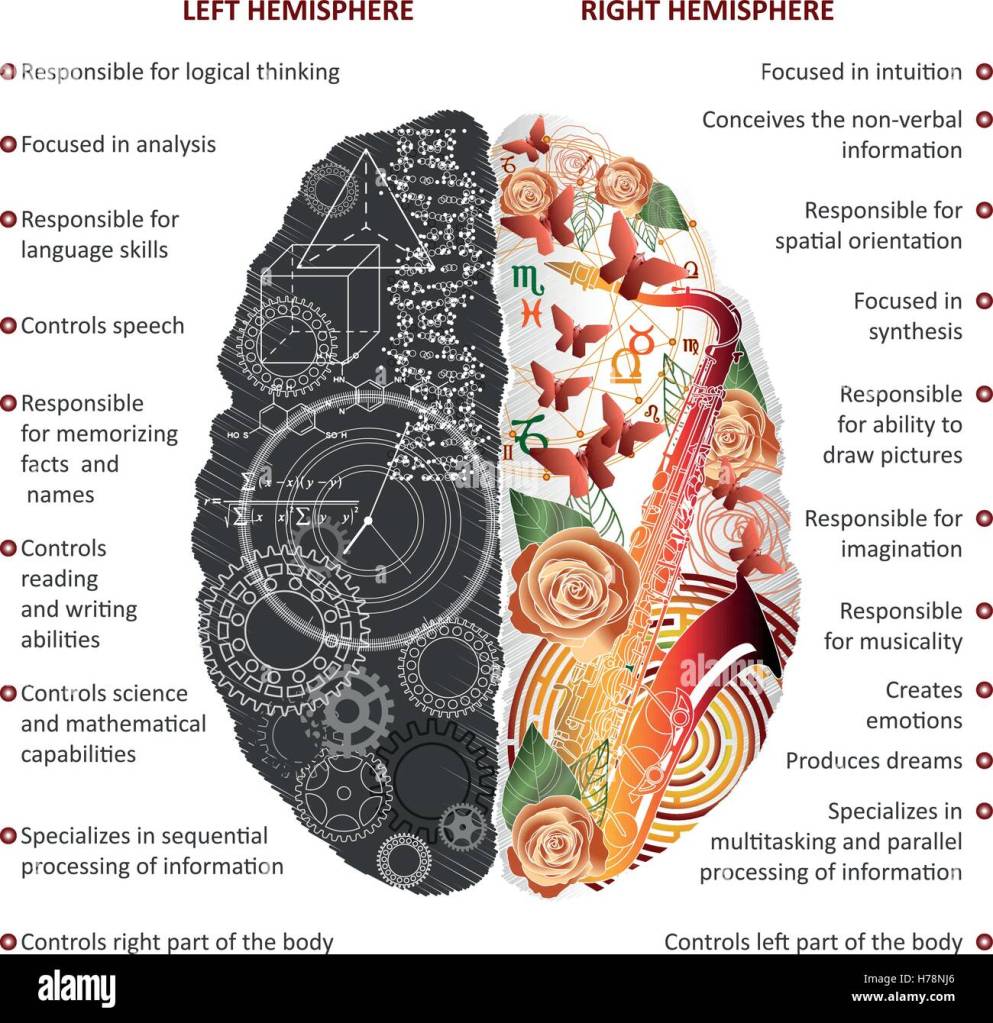
Dr. Iain McGilchrist, in The Master and His Emissary, outlines how the brain’s left and right hemispheres don’t just process information differently—they perceive reality differently.

❌ Not: “Left brain = logic, Right brain = creativity.”
✅ But: “Left brain = control, categorization, and certainty. Right brain = context, relationship, and meaning.”

In a balanced brain, the right hemisphere leads—it sees the big picture, embraces nuance, and stays grounded in lived reality. The left hemisphere refines, classifies, and helps us act.

But modern culture has flipped the script. We’ve let the left hemisphere hijack our perception, reducing the complex to the manageable, the mysterious to the measurable. In this flipped hierarchy:

  • Ambiguity feels threatening
  • Context gets stripped away
  • Relationship is sacrificed for abstraction
  • And certainty becomes a kind of drug

That’s why ideological possession feels so safe. The left brain loves a clear system, even if it’s oppressive. It would rather be certain and wrong than uncertain and real.

So, when someone questions your belief, it’s not just inconvenient. It shatters the left brain’s illusion of control. And when that illusion is all, you’ve known since childhood, the reaction isn’t just intellectual-it’s existential. a threat.


When Belief Becomes Identity

Jonathan Haidt, in The Righteous Mind, explains that we don’t arrive at beliefs through pure logic. We have moral intuitions quick, gut-level judgments and then our reasoning brain (usually the left hemisphere) steps in, not to find the truth, but to defend the tribe.

The moment someone questions our “truth,” we don’t hear it as a conversation—we hear it as an attack.

What happens next?

Verbal Attacks:
When someone questions a core belief, the response often isn’t curiosity—it’s insults, belittling, or outright contempt. In faith spaces, that might look like calling someone a heretic. In political spaces, it’s labels like traitor, bigot, or grifter.

Social Ostracism:
Both religious and political groups punish deviation. Doubters are canceled, excommunicated, or ghosted. Deconstruct your faith? You might lose your church community. Question political orthodoxy? You might lose friends—or your job.

Online Harassment:
The algorithm rewards outrage. Post a thoughtful question about a sacred ideology and you’ll get dogpiled. Our moral tastebuds, as Haidt would say, are being hijacked by dopamine-fueled tribalism.

Physical Aggression:
At the extremes, ideological certainty becomes dangerous. From holy wars to revolutions, the ugliest parts of history stem from one belief: we’re right, and they’re evil.


Why We React This Way: The Psychology of Threat

When beliefs are fused with identity, disagreement feels like annihilation. Especially when the community around us reinforces that fusion. Here’s the pattern:

  • Fear of Deviation: Questioning is framed as betrayal either spiritual or social.
  • Cognitive Dissonance: New ideas create discomfort, and doubling down feels safer than rethinking.
  • Fear of Consequences: From hellfire to being canceled, the cost of questioning is high.
  • Identity Threat: When belief equals self-worth, letting go feels like losing yourself.
  • Social Pressure: Communities often reward conformity and punish dissent.

This is where McGilchrist and Haidt align beautifully: one shows how the brain gets hijacked by the need for control, the other shows how morality binds us to our tribe and blinds us to complexity.


Make-Believe, Morality, and the Group

In our episode with Neil Van Leeuwen, author of Religion as Make-Believe, we unpacked another crucial insight: factual beliefs are flexible, but identity-based beliefs aren’t. They don’t require evidence. In fact, falsehoods often serve the group better because they signal loyalty, not logic.

This is why both sides of a political aisle can believe obviously contradictory things because the truth is secondary to belonging. And once we belong, we don’t think critically–we defend instinctively.


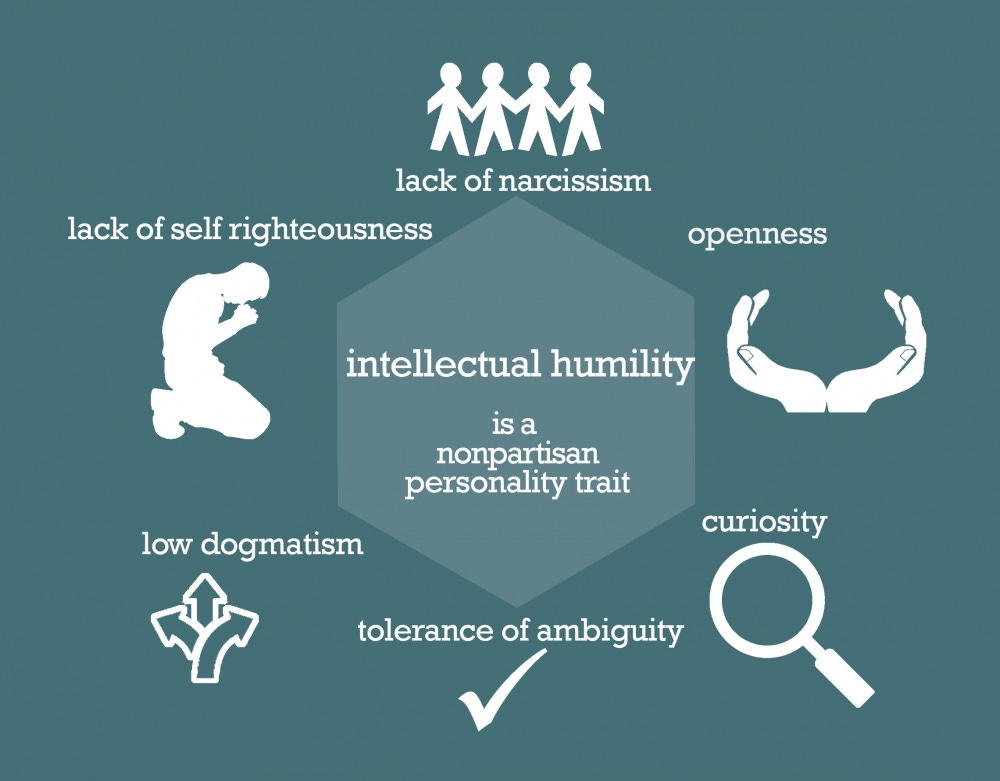
The Antidote: Intellectual Humility

The only way out is through a kind of self-aware disruption.

  • Open Dialogue: Spaces where disagreement isn’t punished—but explored.
  • Supportive Community: Groups that allow for doubt, evolution, and honest questioning.
  • Personal Reflection: A willingness to examine the stories we tell ourselves—and why we need them.
  • Interdisciplinary Curiosity: Instead of staying in one thought silo, we pull from neuroscience, sociology, philosophy, and lived experience.

Fundamentalism, at its core, is the elevation of certainty over curiosity. But healing, freedom, and truth? They live on the other side of that certainty.


So, what’s one belief you once clung to tightly only to realize it wasn’t the whole truth?

Let’s talk about it in the comments.

And remember:

Maintain your curiosity, embrace skepticism, and keep tuning in. 🎙️🔒
We’re not here to worship reason or reject it.
We’re here to see more clearly.

Sources:

  1. Dr. Iain McGilchrist – Left and Right Hemisphere Functions
    McGilchrist, Iain. The Master and His Emissary: The Divided Brain and the Making of the Western World. Yale University Press, 2009.
  2. Alice Miller – Emotional Neglect and the False Self
    Miller, Alice. The Drama of the Gifted Child: The Search for the True Self. Basic Books, 1997.
  3. Elan Golomb – Narcissistic Parenting and Emotional Consequences
    Golomb, Elan. Trapped in the Mirror: Adult Children of Narcissists in Their Struggle for Self. William Morrow, 1992.
  1. Neil Van Leeuwen – Religious Trauma and Belief Systems
    Van Leeuwen, Neil. Religion as Make-Believe: The Religious Imagination and the Design of the World. Cambridge University Press, 2021.
  2. Jonathan Haidt – Moral Psychology and Group Loyalty
    Haidt, Jonathan. The Righteous Mind: Why Good People are Divided by Politics and Religion. Pantheon Books, 2012.

Why Challenging Beliefs Feels Like a Personal Attack—And Why It Shouldn’t

From religion to politics, why deeply held beliefs trigger defensiveness, outrage, and even hostility—and how we can foster better conversations.

We all have seen how the internet seems to bring out everyone’s inner troll. 🧌

The moment a deeply held belief—whether religious or political—is questioned, people lash out with hostility, aggression, or outright rage. Why does this happen? Why do some people react as if their very identity is under attack?

This past summer, we sat down with Dr. Mark Gregory Karris to explore religious trauma, belief deconstruction, and the psychological grip of fundamentalist ideology.

This season on Taste of Truth, we have been expanding the conversation—because this isn’t just about religion. Political ideologies, social movements, and even scientific debates can trigger the same defensive responses.

Fundamentalist thinking—whether in religion or politics—creates a fear-driven, us-vs-them mentality.

At its most basic, the allure of fundamentalism, whether religious or ideological, liberal or conservative, is that it provides an appealing order to things that are actually disorderly. -Peter Mountford

This hits at something crucial that I’ve written about numerous times before: the human brain craves order, even in the face of chaos. The illusion of control is a powerful psychological driver, and our brains reward it with dopamine. Fundamentalist thinking offers a structured, black-and-white framework that feels safe and predictable, making it incredibly appealing—especially in times of uncertainty. It’s why people cling even harder to rigid beliefs when they feel threatened. Whether in faith or politics, the need for certainty can override openness to new information, leading to the defensive reactions we see when those beliefs are questioned.

The moment someone questions the “truth,” it’s perceived as an existential threat, triggering anxiety, cognitive dissonance, and sometimes outright hostility.

Take a look at the patterns:

  • Verbal Attacks: When someone questions a core belief, the response can be insults, shouting, or belittling. For example, in religious circles, someone questioning doctrine might be labeled a heretic, while in political spaces, dissenters might be called traitors or bigots.
  • Social Ostracism: In both fundamentalist religious and political groups, those who challenge the status quo risk being shunned, excommunicated, or “canceled.” A former churchgoer who deconstructs their faith may be cut off from their community, just as someone who questions ideological orthodoxy in politics might lose social standing, friendships, or even career opportunities.
  • Online Harassment: Social media amplifies these reactions. Question a sacred political narrative? Expect dogpiling. Challenge a religious doctrine? Brace yourself for moral outrage. The internet rewards ideological purity and punishes deviation.
  • Physical Aggression: In extreme cases, questioning or challenging deeply held beliefs can escalate to threats or violence. History is littered with examples—holy wars, political purges, ideological revolutions—all stemming from the belief that certain ideas must be defended at any cost.

This isn’t just about bad behavior—it’s about psychology. When beliefs become intertwined with identity, disagreement feels like a personal attack. Fundamentalist teachings—whether religious or ideological—reinforce this by instilling fear of deviation:

  1. Fear of Deviation – Straying from the accepted belief system is framed as dangerous, whether it’s framed as spiritual damnation or societal collapse.
  2. Cognitive Dissonance – Encountering opposing viewpoints creates internal discomfort, making people double down rather than reconsider.
  3. Fear of Consequences – Whether it’s eternal hellfire or being cast out by one’s political tribe, the cost of questioning is framed as too high.
  4. Identity Threat – When beliefs define self-worth, changing one’s mind feels like losing a part of oneself.
  5. Social Pressure – Communities reinforce conformity, and breaking from the group’s ideology invites punishment.

When Morality Binds and Blinds

In The Righteous Mind, Jonathan Haidt explains how moral systems don’t just guide our sense of right and wrong—they also bind us to our tribes and blind us to opposing perspectives. Morality evolved not just to help individuals make ethical choices but to reinforce group cohesion. When we share a moral framework with others, it strengthens social bonds and builds trust. But there’s a cost: once we’re deeply embedded in a moral community—whether religious, political, or ideological—we stop seeing outside perspectives clearly.

This is why people react with such hostility when their beliefs are challenged. They aren’t just defending a set of ideas; they’re defending their sense of identity, belonging, and moral righteousness. A challenge to the belief feels like a challenge to the self—and to the entire group they’re part of.

This also explains why fundamentalist thinking isn’t confined to religion. Political movements, activist groups, and even secular ideologies can exhibit the same rigid certainty, group loyalty, and hostility toward outsiders. The more a belief system becomes tied to identity, the more resistant it is to change—and the more aggressive the response when it’s questioned.

The antidote? Intellectual humility. The ability to recognize that our beliefs, no matter how deeply held, might be flawed. That truth-seeking requires engaging with discomfort. That real conversations happen not when we dig in our heels but when we’re willing to ask, What if I’m wrong?

These dynamics explain why deconstruction—whether of faith or political ideology—often leads to intense backlash. It also reminds me of our conversation with Neil Van Leeuwen, author of Religion as Make-Believe. He pointed out that factual beliefs thrive on evidence, but religious and ideological beliefs function differently. When a belief becomes part of group identity, truth often takes a backseat. In fact, sometimes falsehoods serve the group better because they reinforce belonging.

To close down the conversation, let’s talk about healthy communities—whether religious, political, or social—embrace intellectual humility. Here’s what that looks like:

  • Open Dialogue: Encouraging respectful conversations where differing perspectives are explored rather than attacked.
  • Supportive Community: Allowing for questions, doubts, and evolving beliefs without fear of punishment.
  • Personal Reflection: Cultivating a mindset that prioritizes growth over ideological purity.
  • Interdisciplinary Engagement: Seeking insights from multiple fields rather than reinforcing an echo chamber.

By recognizing these patterns, we can navigate our own beliefs with more self-awareness and engage in discussions that foster curiosity rather than hostility. The question isn’t whether we hold tightly to certain beliefs—it’s whether we’re willing to interrogate why.

So, what’s one belief you’ve held onto tightly that you later questioned?

Let’s talk about it in the comments.

From Burnout to Breakthrough:  Healing, Art, and Resilience with Katherine Spearing

🎙️ Welcome Back! Join me as I chat with Katherine Spearing, MA, CTRC — founder of Tears of Eden 🌸, a nonprofit supporting survivors of spiritual abuse, and former host of the groundbreaking Uncertain podcast 🎧. Katherine is also the host of Trauma & Pop Culture, a Certified Trauma Recovery Practitioner 🧠, and an expert in helping those who have survived cults, high-control environments, and sexual abuse 💔. She even offers specialized trauma-informed career coaching 💼!

In this episode, we discuss: 💡 The most impactful themes from Uncertain — including her powerful episode with Dr. Laura Anderson on anger 😡 and the concept of second-wave fundamentalism. 🎭 How creative arts therapies are aiding survivors of sexual abuse in their healing journey, and how these methods differ from traditional therapy 🎨. 🛑 Managing the emotional weight of working with spiritual abuse survivors and Katherine’s personal journey to avoid burnout 🧘‍♀️. 👩‍🎤 Challenging traditional gender roles in Christianity — how they’ve shaped perceptions of women’s worth and agency, and steps for creating more inclusive spaces 🚺. 🛡️ Building healthy community dynamics to protect against spiritual abuse while fostering authentic, supportive connections 🌱. 🔥 A sneak peek into Katherine’s upcoming book on spiritual abuse, including why the church is so obsessed with sex 💭.

Tune in now for an insightful conversation on healing, resilience, and challenging the status quo! 🗣️✨

Don’t miss out on Katherine’s wisdom and unique perspective. 🎧

Tears of Eden podcast episode we mentioned

Blog — Katherine Spearing

Tears of Eden: Supporting survivors of Spiritual Abuse and Religious Trauma

🙏 Please help this podcast reach a larger audience in hope to edify & encourage others! To do so: leave a 5⭐️ review and send it to a friend! Thank you for listening! I’d love to hear from you, find me on Instagram!⁠⁠⁠ @taste0ftruth⁠⁠⁠ or⁠⁠⁠ Pinterest! ⁠⁠ ⁠ 

The Illusion of Control: Neuroscience of Fundamentalism and Diet Culture

Welcome back Wellness Warriors, and truth seekers!

As we have been discussing all of Season 2, Fundamentalist thinking doesn’t just reside in religious circles—it also permeates wellness and healing spaces. Just as high-control religions exploit human vulnerability, so does diet culture.

I’ve had my share of blindly following extreme health regimens recommended by practitioners, ignoring my own discomfort along the way. It became clear that fundamentalism can crop up in various aspects of life, and part of healing is about recognizing and addressing these tendencies within us.

We have discussed how high control religion and diet culture both capitalize on the brain’s tendency to interpret things in a binary black-and-white manner by presenting clear-cut rules, guidelines, and belief systems that simplify complex issues into easy-to-follow directives.

In this post, we’ll exploring deeper into how the brain’s craving for control and the dopamine boost it triggers can explain why people may transition into high-control environments or swing from one extreme to another. Such as moving from a loose, permissive belief system to a strict, rule-bound one, or from an unrestricted eating pattern to a rigid diet.

The Illusion of Control and Dopamine

The concept of the “illusion of control” ties deeply into our brain’s reward system, particularly through dopamine, a neurotransmitter crucial for motivation and learning. When individuals believe they have control over situations, even when that control is illusory, their brains can release dopamine. This release can provide a rewarding feeling, reinforcing the behavior or belief that leads to this sense of control.

The brain’s craving for control plays a crucial role in how individuals respond to structured systems, be it in religion, diet culture, or Multi-Level Marketing (MLM) schemes. When we encounter a belief system or set of teachings that offers clear, structured guidance, it triggers a sense of control, even if that control is illusory. This perceived control is neurologically rewarding because it leads to the release of dopamine, a neurotransmitter associated with motivation and the reinforcement of behaviors of control over one’s body and health, triggering dopamine release and creating a feedback loop that encourages continued adherence. Similarly, religious fundamentalism often offers clear-cut guidelines on how to live, providing the same sense of security and control, thus reinforcing the behavior.

This perspective not only sheds light on why people might gravitate towards fundamentalism or diet culture but also opens up a discussion on the broader implications of how our brains can be influenced by the promise of control, even when that control is more perceived than real.

What Causes the Illusion of Control

The illusion of control is driven by several factors and provides psychological benefits.

In health and wellness, people often adhere to strict diets or exercise routines, believing they control their weight or fitness, even though genetics and other factors also play a role. This illusion of control can be comforting and encourage adherence.

Similarly, in religion, individuals may follow rigid rules or rituals, thinking they control their spiritual outcomes or moral status, which provides a sense of security and boosts self-esteem.

When did the concept of the illusion of control originate?

The concept, first described by psychologist Ellen Langer in 1975, was initially seen as a way to maintain self-esteem by attributing success to oneself and distancing from failure. Recent research suggests it results from misjudged causality, where people’s sense of control is distorted by their actions rather than actual influence.

Fundamentalism and Structured Belief Systems

Fundamentalism, with its rigid doctrines and absolute truths, can offer a powerful sense of control, especially for those who have previously encountered ambiguity or lack of structure. These rules provide a clear framework for living, reducing the anxiety that comes with uncertainty, and delivering a dopamine-driven sense of reward that reinforces their commitment to the system. This appeal to control can be understood through several key aspects:

1. Structure and Certainty

Fundamentalism provides a clear and structured framework for understanding the world and one’s place within it. This structured approach often includes strict rules, definitive answers, and a well-defined moral code. For individuals who have experienced the fluidity and unpredictability of hyper-charismatic or New Age movements, the stability offered by fundamentalist systems can be particularly attractive.

In fundamentalist belief systems, every aspect of life is often governed by established doctrines. This comprehensive structure can reduce the anxiety associated with uncertainty and ambiguity, offering a predictable environment where individuals feel they know the correct course of action. This sense of predictability can be a significant source of comfort, as it replaces the confusion and complexity of previous experiences with clear-cut answers.

2. The Illusion of Control and Dopamine

The dopamine-driven reward system plays a crucial role in why fundamentalism is appealing. When individuals adhere to the strict rules and guidelines of fundamentalism, their brain releases dopamine, providing a sense of satisfaction and reinforcement. This dopamine release occurs because the rigid structure of fundamentalism offers a perceived sense of control over one’s life and environment.

This sense of control, even if illusory, can be neurologically rewarding. The anticipation and experience of control lead to the release of dopamine, which reinforces the behavior and belief that adherence to fundamentalist teachings is beneficial. Over time, this feedback loop strengthens individuals’ commitment to the belief system, as the dopamine-driven rewards make the structured environment feel more gratifying and secure.

3. Regaining a Sense of Agency

For those coming from less structured or more ambiguous belief systems, fundamentalism can represent a way to regain a sense of agency and direction. After experiencing a lack of clarity or guidance, individuals may find the definitive answers and rules provided by fundamentalism to be reassuring. The shift towards a more structured belief system can be seen as an effort to reassert control over one’s life and decisions.

Fundamentalism’s clear boundaries and absolute truths provide a stark contrast to the uncertainty that may have characterized previous experiences. This transition can be particularly appealing for individuals seeking to regain stability and predictability. The rigid nature of fundamentalism offers a form of control that feels tangible and dependable, even if it is ultimately based on a set of beliefs rather than empirical evidence.

4. Community and Belonging

Fundamentalist communities often emphasize conformity and collective adherence to their doctrines. This communal aspect can further reinforce the illusion of control by providing social validation and support. Being part of a group that shares the same rigid beliefs can enhance the sense of belonging and reinforce the perceived control individuals feel.

The social reinforcement within fundamentalist groups contributes to the illusion of control by making individuals feel supported and validated in their adherence to the teachings. This communal validation can strengthen their commitment to the belief system, as the positive feedback from the group further activates the brain’s reward system.

5. Cognitive Dissonance and Commitment

Once individuals have invested significant time and energy into a fundamentalist belief system, cognitive dissonance can make it challenging to question or abandon their beliefs. The discrepancy between their initial expectations and any potential contradictions or failures within the system can lead them to double down on their commitment.

The illusion of control provided by fundamentalism makes it psychologically difficult to admit that the system may not offer the promised stability or certainty. This cognitive dissonance drives individuals to reinforce their adherence to the system, as admitting any flaws would undermine the very control and certainty they sought to obtain.

The Illusion of Control in Multi-Level Marketing (MLM) Schemes

Similarly to fundamentalist belief systems, MLMs leverage the illusion of control by presenting themselves as opportunities for individuals to take charge of their own success. Participants are led to believe that their efforts directly determine their earnings and advancement within the company. This illusion can be highly appealing, giving people a sense that their hard work and decisions will lead to tangible rewards.

The prospect of achieving success and the belief that one’s actions are under their control can trigger dopamine release in the brain. When individuals see small successes or receive positive feedback, it reinforces their belief in their ability to control their destiny, making them more likely to continue participating despite setbacks.

MLMs often provide structured guidelines, training, and motivational materials that create a sense of control. Participants are given specific strategies to follow, which can make them feel like they have a roadmap to success. This structure reinforces the illusion that they are in control of their outcomes, even when success largely depends on recruitment and team performance.

MLMs frequently emphasize personal responsibility and self-improvement. They promote the idea that success is a result of individual effort and perseverance, subtly shifting blame for any failures onto the individual rather than the system itself. This reinforces the illusion of control by making participants believe that if they follow the system closely enough, they will succeed.

The social aspect of MLMs, including group meetings, motivational events, and social media communities, can amplify the illusion of control. Participants often see others achieving success and feel motivated by their peers, which can strengthen their belief in their own ability to control their outcomes.

Once individuals have invested time, money, and effort into an MLM, the illusion of control can make it difficult for them to step away. The cognitive dissonance created by the gap between their expectations and reality can lead them to double down on their commitment, further reinforcing their belief in their control over their situation.

The Role of Power in the Illusion of Control

Powerful individuals—including CEOs, politicians, religious leaders, and MLM leaders—often overestimate their control over events beyond their expertise. This inflated sense of control can lead to hubris, risky decisions, and an all-or-nothing approach. For example, a wellness guru who believes they can control all aspects of health through strict regimens may push extreme diets or unproven supplements, driven by the illusion of control. Similarly, a religious leader might impose rigid doctrines, believing they can control or influence every aspect of followers’ lives. This overconfidence and all-or-nothing mindset can result in extreme actions and decisions, as seen when individuals adopt overly restrictive health practices or dogmatic religious rules, ultimately leading them to lose touch with reality.

Appeal to Vulnerable Groups

Studies suggest that no one is immune to the illusion of control—under certain circumstances. Research shows that those who are personally involved in actions are among those most likely to overestimate their influence on the outcome. In addition, the behavior of pathological gamblers is driven by the belief that they can beat the odds of what is demonstrably determined purely by chance.

There are people known to be at low risk of susceptibility to illusory control: those who are depressed. Numerous studies show that depressed people are virtually invulnerable to the illusion of control. They have been found to have less distorted views than the non-depressed across a wide array of perceptions and judgments‑a state of mind that has been labeled depressive realism. They are more likely to see the futility of taking action to influence outcomes. When vulnerable individuals meet a group that offers definitive answers provides the certainty and structure these individuals crave, making them more likely to adopt and adhere to the teachings.

Effects of the Illusion of Control

A sense of control is an adaptive trait linked to better health outcomes, including reduced risk of mortality and diseases, improved physical and cognitive function, and higher life satisfaction. It promotes positive behaviors like exercise and good sleep and enhances optimism and a sense of purpose.

However, the illusion of control can also lead to magical thinking, poor decision-making, and risky behaviors such as gambling, as it may encourage unrealistic beliefs and prevent thorough analysis of situations.

In Summary

Reflect on how the illusion of control might be influencing their own choices and beliefs. Consider whether a sense of control is driving your decisions in areas like health, religion, or business ventures. Understanding this psychological mechanism can empower you to make more informed choices and break free from patterns that may not truly serve your well-being. Share your thoughts and experiences in the comments or join the conversation on our social media channels to explore these ideas further.

Plus, join us this week on the podcast, as we talk with @mburtwrites a talented author and advocate in children’s literature, about faith, parenting styles, and mental wellness. Share your thoughts or join the conversation—let’s explore the impact of the illusion of control together! 💭

🎧here

RESOURCES:

Books:

  1. “The Illusion of Control: Why We Overestimate Our Ability to Control Events” by Ellen J. Langer
    • A foundational text by the psychologist who first described the illusion of control.
  2. “Thinking, Fast and Slow” by Daniel Kahneman
    • This book delves into various cognitive biases and heuristics, including the illusion of control.
  3. “The Power of Habit: Why We Do What We Do in Life and Business” by Charles Duhigg
    • Explores how habits form and the role of dopamine in reinforcing behaviors.
  4. “The Dopamine Diet: The Complete Guide to Lose Weight, Boost Your Energy, and Live a Happier Life by Rebalancing Your Brain Chemistry” by Neil W. Dhingra
    • Focuses on how diet impacts dopamine levels and overall well-being.

Articles and Papers:

  1. “Illusion of Control” | Psychology Today
    • An overview of the illusion of control and its psychological underpinnings. Read here
  2. “The Truth About Dopamine and Your Brain” | Psychology Today
    • Explains dopamine’s role in motivation and reinforcement. Read here
  3. “Biology of Motivation, Dopamine, and Brain Circuits That Mediate Pleasure” | SpringerLink
    • A scientific paper detailing dopamine’s role in motivation and reward. Read here
  4. “The Illusion of Control in the Financial Markets” by E. J. Langer
    • Examines how the illusion of control affects decision-making in financial contexts. Read here

Online Resources:

  1. TED Talks
    • Search for TED Talks on cognitive biases and the role of dopamine for accessible explanations and examples.
  2. Coursera and edX
    • Look for courses on psychology, neuroscience, and behavioral economics that cover these topics in depth.
  3. YouTube Channels
    • Channels like CrashCourse and Khan Academy often have videos on psychology and neuroscience that touch on related concepts.

These resources should provide a comprehensive understanding of how the illusion of control and dopamine influence behavior across different contexts.

Beyond the IBLP: Unveiling the Shared Roots of Evangelicalism & Spiritual Trauma

The Institute in Basic Life Principles was founded by Bill Gothard, is known for its strict, authoritarian teachings on Christian living and family roles, often leading to significant emotional harm.

In the deconstruction space, there’s a troubling tendency to focus exclusively on extreme cases of spiritual abuse, such as those from the Institute in Basic Life Principles (IBLP). While it’s crucial to address and understand these severe experiences, it’s equally important to recognize that spiritual and religious trauma can manifest in many forms beyond such high-profile examples.

While IBLP is a notable example of spiritual abuse, its practices reflect broader trends within evangelical Christianity that also emphasize control, guilt, and fear.

Unveiling the Shared Roots

The roots of evangelical Christianity are deeply entwined with guilt, fear, coercion, and deception, a legacy that can permeate all levels of faith practice. This issue isn’t confined to one group or doctrine; rather, it echoes through the broader history of evangelicalism, including the violent and tumultuous period of the Protestant Reformation.

Guilt and Fear: Evangelical teachings often emphasize human sinfulness and the need for constant repentance, creating an environment where guilt and fear become central. The pressure to meet unattainable moral standards can lead to chronic anxiety and self-doubt. Believers may struggle with feelings of inadequacy and unworthiness, which can erode self-esteem and lead to long-term psychological trauma.

Coercion: Many evangelical doctrines employ coercive tactics to ensure conformity and compliance. This can include manipulating believers through promises of divine favor or threats of divine punishment. Such coercion often pressures individuals into adhering to strict beliefs and behaviors, stifling personal autonomy and fostering a sense of control and manipulation.

Deception: The evangelical tradition can sometimes perpetuate deceptive teachings, presenting religious doctrines in a way that omits or distorts critical truths. This can include selective scriptural interpretations or misleading teachings about the nature of God and salvation. When individuals later confront these deceptions, they may experience profound disillusionment and betrayal, further contributing to their trauma.

Historical Context: The Protestant Reformation, a pivotal event in evangelical history, was marked by violent conflict and intense upheaval. The brutality and extremism of this period set a precedent for how religious movements can become entangled in aggression and intolerance. This historical backdrop adds another layer to understanding how evangelical Christianity, in its various forms, can inflict spiritual harm.

By acknowledging this broader context, we can better address the diverse experiences of trauma within the Christian faith and work towards healing that encompasses all who have been affected.\

Let’s look at the parallels:

1. Control and Authority:

  •     Evangelical Teachings: Evangelical groups often emphasize strict adherence to biblical authority and teachings, which can lead to high levels of control over personal beliefs and behavior.
  •    IBLP: The IBLP, founded by Bill Gothard, is known for its rigid set of rules and teachings that govern nearly every aspect of life, including family dynamics, education, and personal conduct.

2. Use of Guilt and Fear:

  •     Evangelical Teachings: Evangelicals may use guilt and fear of eternal damnation to enforce moral behavior and adherence to religious practices.
  •     IBLP: The IBLP uses fear of divine punishment and guilt to maintain control, emphasizing strict obedience to its principles and teachings.

3. Isolation from Dissenting Views:

  •     Evangelical Teachings: Evangelical communities might discourage or isolate members who question or deviate from core beliefs, often labeling dissent as dangerous or sinful.
  •     IBLP: The IBLP isolates its members from outside influences and encourages avoidance of those who criticize or question its teachings.

4. Emphasis on Obedience:

  •     Evangelical Teachings: Emphasis is placed on obedience to God’s commands and church teachings, which can sometimes discourage critical thinking and personal questioning.
  •     IBLP: stresses strict obedience to its guidelines as a sign of faithfulness, often at the expense of personal autonomy and critical reflection.

5. Authoritarian Structure:

  •     Evangelical Teachings: Many evangelical groups have a hierarchical structure where church leaders wield significant authority over members’ beliefs and practices.
  •     IBLP: The IBLP has a centralized authority with Bill Gothard’s teachings at the core, and his directives are followed unquestioningly by adherents.

6. Focus on Family Roles:

  •     Evangelical Teachings: Traditional evangelical teachings often emphasize distinct roles within the family, typically with a strong patriarchal structure.
  •     IBLP: The IBLP advocates for a strict family hierarchy where the father is the ultimate authority, and family roles are rigidly defined.

7. Handling of Dissent and Criticism:

  •     Evangelical Teachings: In many evangelical communities, dissent or criticism of church doctrine or practices can lead to significant social and spiritual consequences. Those who voice doubts may be labeled as troublemakers or heretics, and their concerns are often dismissed or invalidated.
  •     IBLP: The IBLP is known for its strong stance against criticism. Those who question or criticize its teachings are often ostracized or labeled as spiritually immature or rebellious. This approach helps to maintain a homogenous and compliant membership base.

8. Emphasis on Personal Purity and Moral Behavior:

  •     Evangelical Teachings: Evangelical teachings often place a high value on personal purity and moral behavior, with a strong focus on abstaining from behaviors deemed sinful, such as premarital sex, substance abuse, or other forms of moral failing. This emphasis can create a culture of judgment and fear of falling short.
  •     IBLP: The IBLP emphasizes extreme standards of moral behavior and personal purity, with detailed guidelines on how members should conduct themselves in all areas of life. The focus on maintaining high moral standards can lead to guilt and self-policing among members.

9. Economic and Social Expectations:

  •     Evangelical Teachings: Some evangelical communities have specific expectations regarding financial contributions to the church and adherence to tithing practices. Members may be encouraged to prioritize church-related financial support over other expenses.
  •      IBLP: The IBLP also has expectations regarding financial and social behavior, including guidelines on how families should manage their finances and interactions. Members are often encouraged to support the organization financially and align their social activities with its teachings.

10. Role of Testimonies and Personal Experiences:

  •      Evangelical Teachings: Evangelical communities often emphasize personal testimonies and experiences as evidence of spiritual truth. Individuals are encouraged to share their personal stories of conversion or miracles as validation of their faith.
  •      IBLP: The IBLP similarly relies on personal testimonies and experiences to validate its teachings. Success stories and positive outcomes are used to promote the effectiveness of its principles, while negative experiences are often dismissed or attributed to a lack of adherence.

11. Intervention in Personal Choices:

  •      Evangelical Teachings: Evangelical teachings may extend into personal choices such as dating, marriage, and career decisions. Members might receive guidance or pressure to make choices that align with church teachings or leadership directives.
  •     IBLP: The IBLP provides detailed guidance on personal choices, including dating and marriage, often imposing strict rules on how these aspects of life should be approached. Members are expected to follow these guidelines closely, with deviations viewed as problematic.

12. Cultural and Social Isolation:

  •      Evangelical Teachings: Evangelical communities may promote cultural and social isolation from secular society, encouraging members to avoid influences that are seen as contrary to their faith. This can include limiting exposure to secular media, secular education, or interfaith interactions.
  •      IBLP: The IBLP promotes a high degree of cultural and social isolation, encouraging members to avoid secular influences and limit interactions with those outside the organization. This isolation helps to reinforce adherence to IBLP teachings and prevents exposure to alternative viewpoints.

13. Psychological and Emotional Impact:

  •     – Evangelical Teachings: The pressure to conform to strict religious standards can lead to psychological and emotional stress, including anxiety, guilt, and fear of failure or condemnation. Members may struggle with self-esteem and mental health issues as a result of these pressures.
  •     – IBLP: The IBLP’s emphasis on strict adherence to its principles can also have significant psychological and emotional impacts, including stress, guilt, and fear of not measuring up to its standards. This can lead to long-term emotional and psychological difficulties for members.

In examining the similarities between evangelical teachings and the Institute in Basic Life Principles (IBLP), it becomes clear that both systems employ similar methods of control and influence.

Evangelicalism often emphasizes strict adherence to biblical authority, use of guilt and fear, and isolation of dissenting views, which can significantly impact personal beliefs and behavior.

Similarly, IBLP’s rigid rules and central authority exert profound control over its members, using fear and guilt to enforce compliance. Both systems focus on obedience and maintain hierarchical structures that can suppress critical thinking and personal autonomy.

Understanding these parallels sheds light on the broader patterns of spiritual trauma that can arise within high-control religious environments.

Whether within the confines of IBLP or the wider evangelical world, the use of control, guilt, and isolation can have lasting effects on individuals.

Recognizing these patterns is crucial for fostering awareness and support for those affected by such environments. As we continue to explore and address these issues, it is essential to advocate for more compassionate and open approaches to faith and personal growth, free from undue control and fear.

Deconstructing Faith Dynamics: Overcoming Anxiety and Narcissistic Rage

Have you ever noticed how some individuals react with intense hostility or aggression when their deeply held beliefs are questioned? Keep reading as we will be exploring this very concept.

This week on the podcast, we’re sitting down with Dr. Mark Gregory Karris to explore the twists and turns of his diverse professional journey and how it shapes his approach to tackling religious trauma.

 🎢 From deconstructing faith dynamics to navigating life after leaving religious traditions, Dr. Karris dishes out practical steps and deep insights like a pro. 📚 We dive into his latest book ‘Diabolical Trinity’ where he takes on the big questions—like transforming a wrathful God into a compassionate one and the impact of religious experiences on mental health. 🕊️ 

Join us as we uncover the power of community and holistic healing in this can’t-miss conversation! 🌈

Listen here! 🎧

Navigating Anxiety in Fundamentalist Christian Circles During Deconstruction

People entrenched in fundamentalist sects of Christianity often experience heightened anxiety when they witness others going through a process of deconstruction. This reaction stems from their upbringing, where they were taught that deviation from established beliefs and practices is not only wrong but potentially dangerous. In fundamentalist environments, any departure from the accepted norms can be perceived as a threat to one’s faith, community, and even personal safety.

This anxiety is compounded by the fear that questioning or exploring alternative beliefs may lead to spiritual and moral peril. Fundamentalist teachings often instill a rigid worldview where conformity is equated with spiritual safety, and deviation is seen as a sign of weakness or susceptibility to worldly influences.

Moreover, the concept of narcissistic rage can be observed in some cases, where individuals deeply embedded in fundamentalist ideologies react with hostility or aggression towards those who challenge or question their beliefs. Here are a few examples:

Verbal Attacks:

When someone questions a fundamentalist belief, the individual might respond with insults, shouting, or belittling the questioner. For instance, calling someone “ignorant” or “evil” for simply asking a question about their faith.

Social Ostracism:

In a tight-knit religious community, members who express doubts or differing opinions might be shunned, isolated, or expelled from the community.

Online Harassment:

On social media, individuals might react to criticism or questions with trolling or coordinated harassment campaigns against the perceived challenger.

Physical Aggression:

In extreme cases, questioning or challenging fundamentalist beliefs can lead to threats of violence or actual physical harm.

This reaction is different from a healthy spiritual practice, which encourages openness, curiosity, and respectful dialogue about different perspectives.

Examples of Healthy Spirituality:

Open Dialogue:

Encouraging conversations where differing beliefs and perspectives are discussed respectfully, with a genuine interest in understanding the other person’s viewpoint

Supportive Community:

Building a community where questioning and exploring faith is seen as a natural part of spiritual growth, and members support each other through their journeys.

Personal Reflection:

Encouraging conversations where differing beliefs and perspectives are discussed respectfully, with a genuine interest in understanding the other person’s viewpoint.

Interfaith Engagement:

Participating in interfaith dialogues or activities that promote learning from different religious traditions and appreciating the diversity of spiritual experiences.

These contrasting examples can illustrate the difference between a rigid, defensive response and a more open, growth-oriented approach to spirituality.

By recognizing the signs of narcissistic rage and embracing a more open and compassionate approach.

Navigating these dynamics requires empathy and understanding from both sides. Those undergoing deconstruction seek to reconcile their evolving beliefs with their personal experiences and spiritual growth, while those in fundamentalist circles may benefit from recognizing that diversity of belief does not necessarily threaten their own faith or spiritual well-being. Here’s how this dynamic unfolds:

  1. Fear of Deviation: Fundamentalist teachings often emphasize a strict adherence to doctrinal purity and established beliefs. Any questioning or deviation from these beliefs is viewed as a threat to faith and spiritual safety.
  2. Cognitive Dissonance: Witnessing others deconstructing their faith can trigger cognitive dissonance among fundamentalists. It challenges their worldview and belief system, leading to discomfort and anxiety.
  3. Fear of Consequences: Fundamentalist teachings may instill fear regarding the consequences of exploring different beliefs or questioning established doctrines. There’s a pervasive belief that straying from the accepted path could lead to spiritual peril or loss of salvation.
  4. Sense of Identity Threat: For individuals deeply embedded in fundamentalist communities, their identity and sense of belonging are closely tied to doctrinal conformity. Deconstruction challenges this identity, causing emotional distress and anxiety.
  5. Social Pressure: Fundamentalist communities often exert strong social pressure to conform to group norms and beliefs. The prospect of others deconstructing their faith can create social anxiety and a fear of ostracization or judgment from peers and leaders.

In essence, the anxiety experienced by individuals in fundamentalist sects when encountering deconstruction reflects deep-seated beliefs and teachings that equate divergence from established doctrines with spiritual peril. This anxiety underscores the psychological and emotional challenges inherent in questioning and evolving one’s faith within such contexts. Encouraging open dialogue and mutual respect can foster a healthier approach to spiritual exploration and community dynamics.

Beyond Dogma: Wellness & Religion’s Striking Parallels

Welcome back to Taste0ftruth Tuesdays Wellness Warriors and truth seekers!

Listen here 🎧

Fundamentalist thinking doesn’t just reside in religious circles—it also permeates wellness and healing spaces. Just as high-control religions exploit human vulnerability, so does diet culture.

I’ve had my share of blindly following extreme health regimens recommended by practitioners, ignoring my own discomfort along the way. It became clear that fundamentalism can crop up in various aspects of life, and part of healing is about recognizing and addressing these tendencies within us.

High control religion and diet culture both capitalize on the brain’s tendency to interpret things in a binary black-and-white manner by presenting clear-cut rules, guidelines, and belief systems that simplify complex issues into easy-to-follow directives.

Clear Rules and Regulations:

  • High Control Religion: Provides rigid doctrines, moral codes, and commandments that delineate right from wrong, good from evil, and righteous from sinful.
  • Diet Culture: Promotes strict dietary regimes, cleanses, and “good” vs. “bad” foods, categorizing eating behaviors as virtuous or detrimental.

In both of these contexts, this black-and-white thinking oversimplifies complex issues related to spirituality and health, offering a sense of clarity and control in exchange for individual autonomy and critical thinking. 

I used to be fixated on healing, always chasing the next fix. When I later dove into a high-control religion, this perpetual quest for self-improvement morphed into the religious ritual of sanctification—an equally exhausting endeavor.

Healing should be about presence, connection, and truly living—not an endless pursuit of perfection.

Have you noticed this shift in your own or others’ healing journeys?

Here are some examples of fundamentalist thinking and behaviors found in both high-control religions and wellness/healing spaces:

AspectHigh-Control ReligionWellness Spaces
Strict Rules and RegulationsRigid doctrines and moral codes with severe consequencesStrict dietary regimes or detox plans with inflexible guidelines, labeling deviations as harmful or sinful
Authority FiguresCentralized figures with unquestionable teachingsGurus or practitioners whose advice is taken as absolute truth
Us vs. Them MentalityClear divisions between the “righteous” and “sinful” outsidersLabeling foods, behaviors, or people as “clean” or “toxic,” fostering an in-group/out-group mentality
Fear-Based TacticsFear of damnation or punishment to maintain controlInstilling fear of illness or toxins to enforce adherence to wellness practices
Exclusive Truth ClaimsBelief that their interpretation of faith is the only truthClaiming their diet or lifestyle is the only path to true health and well-being
Shame and GuiltUsing shame and guilt to enforce complianceShaming individuals for not adhering to specific diets or wellness protocols
Community PressureIntense pressure to conform within the communitySocial pressure to adhere to specific wellness practices, with fear of ostracism for non-compliance
Promised RewardsPromises of spiritual rewards or salvation for adherencePromises of optimal health or purity through strict adherence to wellness practices
Fundamentalist thinking and behaviors found in both

    Seeking Clarity during Stress

    Gravitating towards fundamentalism after experiencing hyper-charismatic or new age movements can seem understandable. The strict rules and structure provide a perceived sense of safety. Particularly during times of stress and uncertainty, we can gravitate towards the need for a sense of control & structure. However, this rigidity and extreme control often lead to increased trauma over time.

    As I deconstruct from the Christian faith, I am re-evaluating beliefs, questioning long-held doctrines, and confronting the challenges faced within spiritually abusive environments. 

    Fundamentalism’s rigid adherence to traditional beliefs and practices can create significant challenges, fostering environments that can stifle personal freedom, promote division, and sometimes lead to conflict and violence. We also see intolerance towards individuals or groups who hold different beliefs or lifestyles, leading to discrimination, ostracism, or even violence towards perceived “outsiders” or “heretics.”

    This is due to the dogmatism, this fundamentalist ideology tends to promote rigid, inflexible interpretations of religious or ideological principles, discouraging questioning or exploration of ANY alternative viewpoints.

    Fundamentalists are often resistant to change and innovation within religious doctrine or practice, viewing such developments as departures from true faith.

    I recently shared a post on Instagram, reflecting on my journey of deconstruction and exploring progressive spaces, I’ve noticed a concerning trend: the lack of nuance and the prevalence of an ‘us vs. them’ mentality.

    Even within progressive Christianity, there’s pressure to conform to certain social norms and ethical behaviors. Disagreement is often met with resistance, and group identity politics can dominate discussions.

    Please review this blog for more information and resources: Understanding Fundamentalism: Rigid Beliefs, Division, and Psychological Impact I am hoping these resources provide comprehensive insights into the dangers of fundamentalism, illustrating its potential to foster intolerance, social division, and conflict

    Understanding these parallels helps us recognize and challenge fundamentalist thinking in all areas of life, promoting a more balanced and critical approach to wellness and healing, and JUST EXISTING!

    Let’s move away from the dualistic thinking and judgment that these ideologies promote, and instead, embrace a more holistic and compassionate path forward.

    That’s all I have for you today folks! Thanks again for listening/reading. Next week, we will continue the conversation breaking from Diet Culture and for future episodes:

    •Dr. Mark Gregory Karris, author of The Diabiological Trinity Healing Religious Trauma from a Wrathful God, Tormenting Hell & a Sinful Self, Religious Refugees: (De)Constructing Toward Spiritual and Emotional Healing and more
    @neilyvanneily is a philosopher and cognitive scientist known for his work in the intersection of religion, cognition, and culture. He holds a Ph.D. in philosophy from Princeton University. We will be discussing his new book- “Religion as Make-Believe,” which offers a thought-provoking analysis of the nature of religious belief and its role in human societies.

    @mburtwrites To discuss Biblical Counseling & a little bit of the evolution of Christian parenting, along with Kelsey McGinnis, they offer a comprehensive exploration of the historical, cultural, ideological, political, and social factors that have influenced Christian parenting over time.

    @carielmoore to discuss Franciscan theology: which focuses on simplicity, poverty, and love for all. Inspired by Saint Francis, it’s about imitating Christ and caring for the marginalized. 🌿 she also explores parenting through the lens of spirituality, theology, and childhood liberation ✨

    and MORE! Until then, maintain your curiosity, embrace skepticism, and keep tuning in! 🎙️🔒

    Have a great week!

    🙏 Please help this podcast reach a larger audience in hope to encourage others! To do so: leave a 5⭐️ review and send it to a friend! Thank you for listening! I’d love to hear from you, find me on Instagram!⁠⁠⁠⁠⁠ @taste0ftruth⁠⁠⁠⁠⁠ or⁠⁠⁠⁠⁠ Pinterest!

    Understanding Fundamentalism: Rigid Beliefs, Division, and Psychological Impact

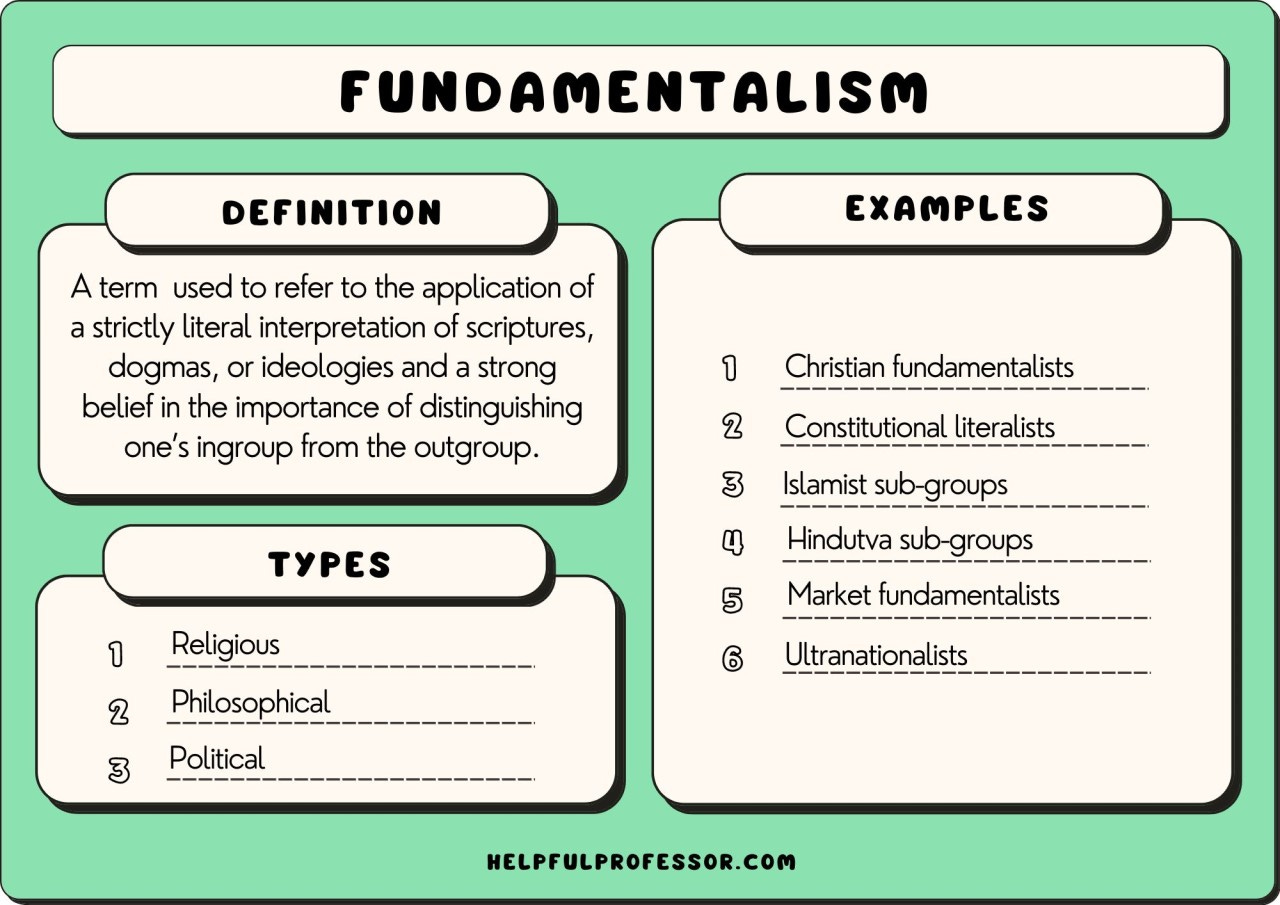
    Fundamentalism refers to a strict adherence to specific theological doctrines typically characterized by a literal interpretation of religious texts. This approach often emphasizes the necessity of returning to the “fundamentals” or original beliefs and practices of a religion. It commonly arises as a reaction against modernist and secular influences perceived to undermine traditional religious values.

    Gravitating towards fundamentalism after experiencing hyper-charismatic or new age movements can seem understandable. The strict rules and structure provide a perceived sense of safety. Particularly during times of stress and uncertainty, we can gravitate towards the need for a sense of control & structure. However, this rigidity and extreme control often lead to increased trauma over time.

    As I deconstruct from the Christian faith, I am re-evaluating beliefs, questioning long-held doctrines, and confronting the challenges faced within spiritually abusive environments. 

    Key features of fundamentalism include:

    • Literalism: Fundamentalists often interpret Scripture texts in a literal or strict manner
    • Inerrancy: Fundamentalists typically uphold the belief in the inerrancy or infallibility of the Bible, viewing them as the ultimate authority in matters of faith and practice. Aka Biblicists
    • Separatism: Fundamentalist movements may advocate for the separation of believers from secular society or from other religious groups deemed to be impure or heretical.
    • Moral Conservatism: Fundamentalists often promote traditional moral values and social norms, opposing practices or lifestyles they perceive as contrary to their religious beliefs.
    • Resistance to Change: Fundamentalists are often resistant to change and innovation within religious doctrine or practice, viewing such developments as departures from true faith.
    • Intolerance: Fundamentalist groups may exhibit intolerance towards individuals or groups who hold different beliefs or lifestyles, leading to discrimination, ostracism, or even violence towards perceived “outsiders” or “heretics.”
    • Dogmatism: Fundamentalist ideology tends to promote rigid, inflexible interpretations of religious or ideological principles, discouraging questioning or exploration of alternative viewpoints.
    • Anti-intellectualism: Critics argue that fundamentalism can foster distrust or rejection of scientific knowledge, critical thinking, and scholarly inquiry, leading to a rejection of evidence-based reasoning and a preference for simplistic, black-and-white thinking

    Potential Dangers to Society:

    1. Intolerance and Division:
      • Fundamentalist ideologies often promote an “us versus them” mentality, leading to increased intolerance and division within society. This can result in discrimination against those who do not share the same beliefs​ (Harvard Book Store)​.
    2. Suppression of Dissent:
      • In fundamentalist communities, questioning or deviating from established doctrines is often discouraged or outright condemned, suppressing intellectual freedom and critical thinking​ (Harvard Book Store)​​ (Barnes & Noble)​.
    3. Extremism and Violence:
      • Fundamentalist beliefs can sometimes justify extreme actions, including violence, against those perceived as threats to their worldview. This can lead to acts of terrorism or other forms of conflict and aggression​ (Harvard University Press)​​ (Barnes & Noble)​.
    4. Impact on Individual Rights:
      • Fundamentalism often imposes strict moral codes that can infringe on individual rights, particularly affecting women and minorities. Practices such as gender segregation, limitations on freedom of expression, and enforcement of strict behavioral norms are common​ (Barnes & Noble)​​ (Harvard Book Store)​.
    5. Resistance to Progress and Change:
      • Fundamentalist groups frequently resist scientific, social, and cultural advancements, hindering progress in areas such as education, healthcare, and human rights. This resistance can have broad negative impacts on societal development​ (Harvard Book Store)​.

    Fundamentalism’s rigid adherence to traditional beliefs and practices can create significant challenges, fostering environments that can stifle personal freedom, promote division, and sometimes lead to conflict and violence.

    Here are some resources that discuss the dangers of fundamentalism from various perspectives, including academic research, books, and articles:

    Books

    1. “The Fundamentalist Mindset: Psychological Perspectives on Religion, Violence, and History” by Charles B. Strozier, David M. Terman, and James W. Jones
      • This book provides a psychological analysis of the fundamentalist mindset, exploring how it can lead to intolerance, aggression, and violence.
    2. “Fundamentalism: The Search for Meaning” by Malise Ruthven
      • Ruthven examines the roots of fundamentalism in various religions and its socio-political impact, highlighting how it can lead to social fragmentation and conflict.
    3. “The Battle for God: A History of Fundamentalism” by Karen Armstrong
      • Armstrong traces the history of fundamentalist movements in Christianity, Islam, and Judaism, and discusses their impact on modern society, emphasizing the dangers of dogmatic thinking and resistance to change.

    Articles

    1. “The Dangers of Fundamentalism” by Andrew Sullivan (New York Magazine)
      • This article discusses the social and political dangers of religious fundamentalism, particularly its impact on democracy and individual freedoms. Read here.
    2. “The Psychology of Religious Fundamentalism” by Ralph W. Hood Jr., Peter C. Hill, and W. Paul Williamson (Guilford Press)
      • This article explores the psychological mechanisms behind religious fundamentalism and its potential to foster rigid, intolerant, and sometimes violent behavior.
    3. “Fundamentalism and the Control of Women” by Patricia Hill Collins (Journal of Women’s History)
      • Collins discusses how fundamentalist ideologies often lead to the suppression of women’s rights and freedoms, impacting gender equality and social justice.

    Academic Papers

    1. “Religious Fundamentalism and Its Impact on Democracy” by Mark Juergensmeyer (Journal of Democracy)
      • This paper explores how fundamentalist movements challenge democratic values and institutions, posing a threat to pluralism and civil liberties. Read here.
    2. “Fundamentalism and the Paradox of Modernity” by Martin E. Marty and R. Scott Appleby (American Academy of Arts and Sciences)
      • The authors analyze the paradoxical relationship between fundamentalist movements and modernity, highlighting the resistance to modern values and the implications for societal progress. Read here.
    3. “The Social Psychology of Religious Fundamentalism” by Roy F. Baumeister, Laura Smart, and Joseph M. Boden (Journal for the Scientific Study of Religion)
      • This paper examines the social psychological aspects of religious fundamentalism, including its impact on group cohesion and intergroup conflict. Read here.

    Online Resources

    1. Pew Research Center: Religion & Public Life
      • Pew provides numerous reports and articles on the impact of religious fundamentalism on society, politics, and culture. Visit Pew Research.
    2. BBC: What is Religious Fundamentalism?
      • A concise overview of religious fundamentalism, its characteristics, and its potential dangers to global security and social harmony. Read here.

    These resources provide comprehensive insights into the dangers of fundamentalism, illustrating its potential to foster intolerance, social division, and conflict.

     #Deconstruction #SpiritualJourney #Faith #ReligiousTrauma #Authenticity

    What are the signs of spiritual gaslighting?

    Gaslighting phrases can unfortunately occur in any context, including within religious communities. Here are some examples of common gaslighting phrases that may be used within church settings:

    • “You’re just being too sensitive.”
    • “That’s not what the Bible says.”
    • “You’re questioning God’s will.”
    • “You’re overreacting.”
    • “You must have misunderstood.”
    • “You’re just seeking attention.”
    • “You’re letting the devil deceive you.”
    • “You need to have more faith.”
    • “You’re not praying hard enough.”
    • “You’re making things up.”
    • “You’re being disobedient to God.”
    • “You’re just looking for excuses.”
    • “You’re being divisive.”
    • “You’re being ungrateful.”
    • “You’re causing problems in the church.”

    Gaslighting is one of the most misused tools to shut people down and shut them up. In the church, these gaslighting phrases get overlooked because they sound spiritual. The truth is they are just ways to control people, their actions, and the narrative around abusive behaviors. Jesus listened to hurting people, and we must learn how to listen.

    It’s important to recognize and address gaslighting behaviors in any context, including within religious communities, to promote healthy and respectful communication.

    Listen to Episode 002 of @church_disrupted where they expose toxic gaslighting phrases & behaviors!

    Have you experienced gaslighting within the church before?

    🏷️ #church #churchhurt #spiritualjourney #narcissist #acts29 #ihopkc #decontruction #newagetojesus #faith #biblical #spiritualgrowth #acbc #deconstructionist #fundamentalism #gaslightingawareness #gaslightingisabuse #gaslight #toxicbehavior #toxicrelationships #toxic #explorepage #mentalhealthawareness #biblicalmarriage #biblicalwisdom #biblicalfemininity #feminity

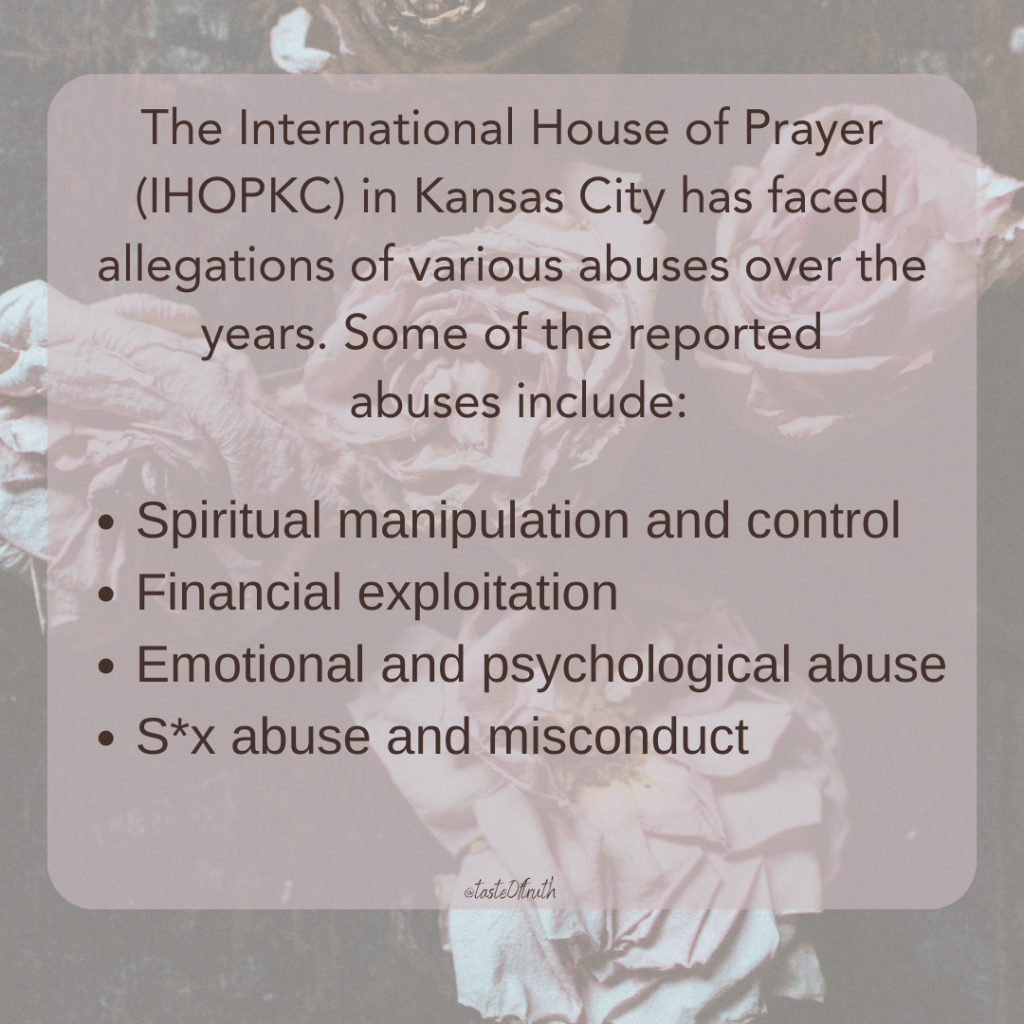
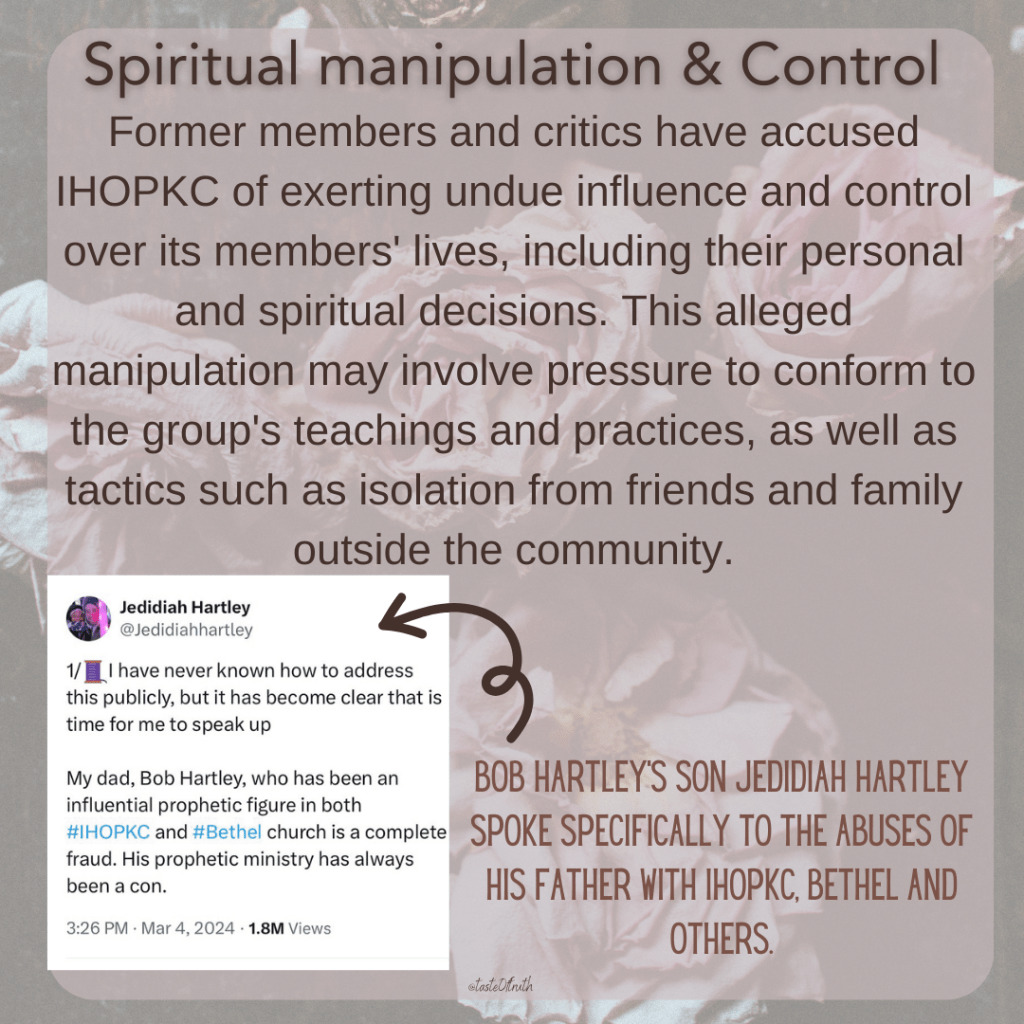
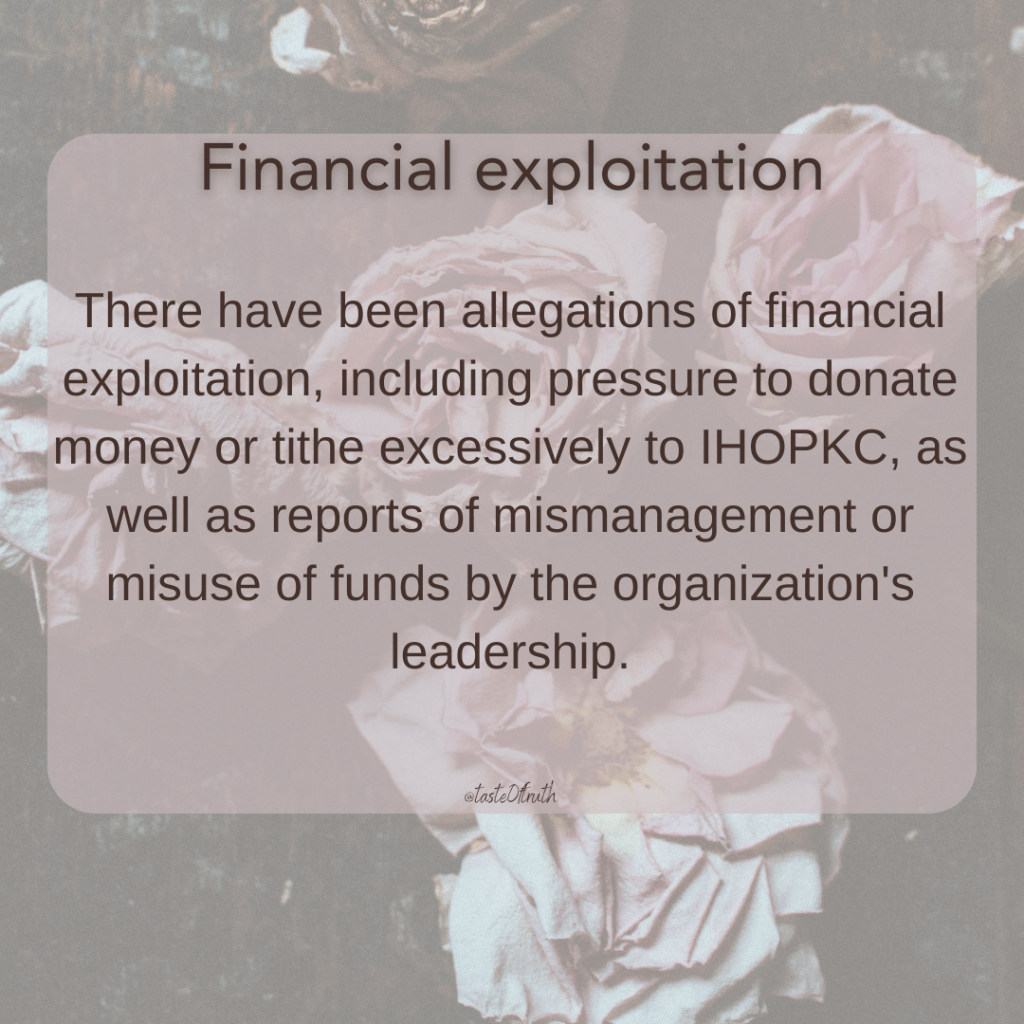
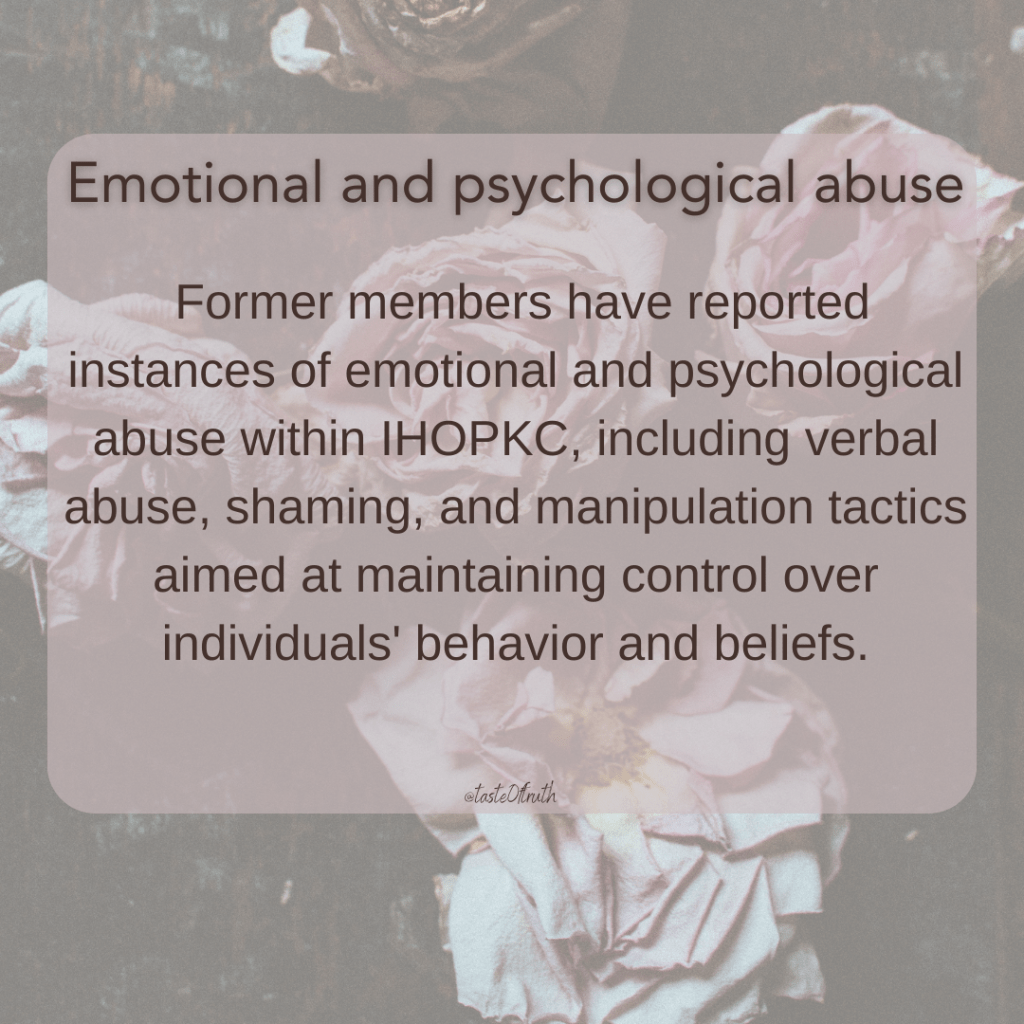
    IHOPKC-Manipulation, Deception & Spiritual Harm

    🎙️Episode 10 From Falsehood to Freedom: Lessons from a former False Prophetess

    This week on the podcast we had Dawn Hill with us who discussed that a HUGE issue with the prophetic prayers and prophetic word movement is the potential for manipulation, deception, and spiritual harm.

    I can’t help but to notice the brutal similarities between the approach IHOPKC is taking which is clearly focused on maintaining control and protecting the institution & the scandals within the Grace Community Church & ACBC Biblical/Nouthetic counseling.

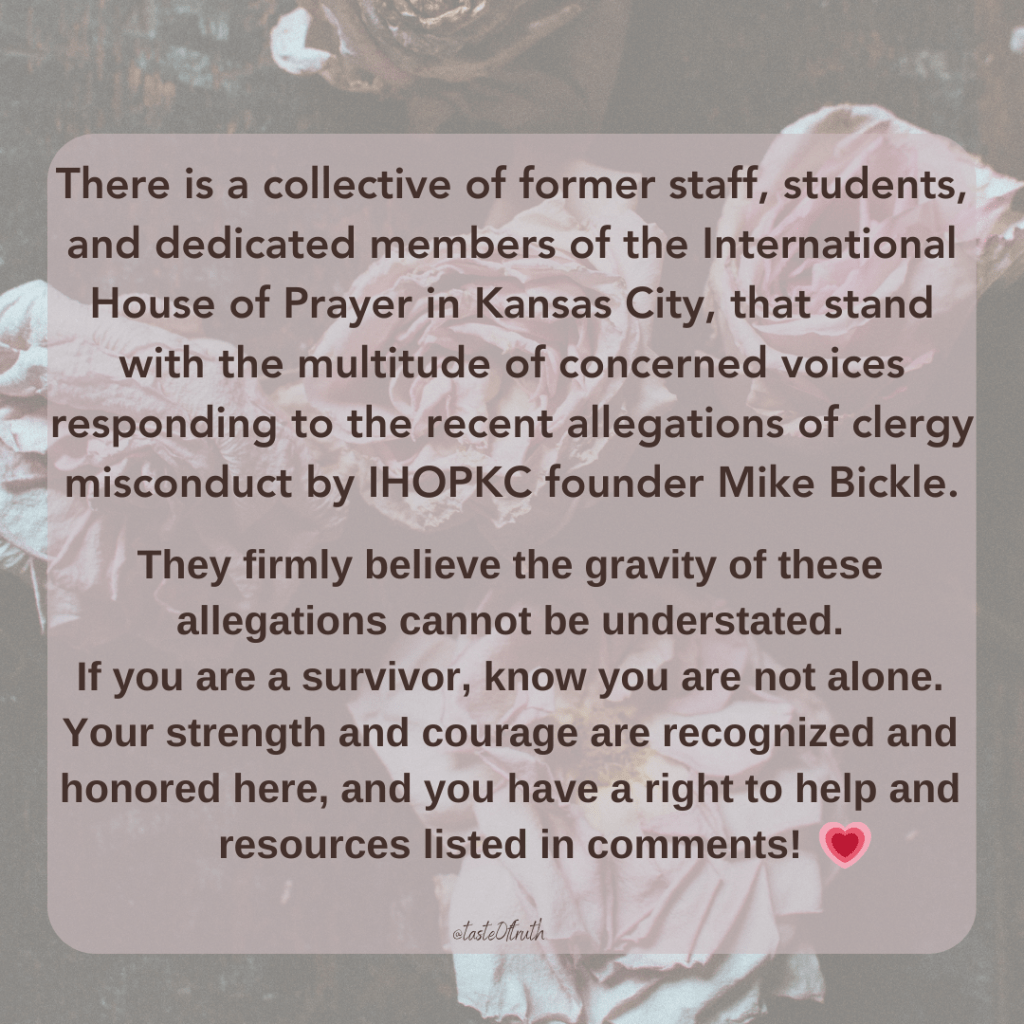
    If you or anyone you know has experienced abuse or misconduct within IHOPKC or any other religious organization PLEASE be encouraged to seek support, speak out, and report your experiences to appropriate authorities.

    SEEK THEN SPEAK – A tool for sexual assault survivors and support people. Visit seekthenspeak.app to fill out a private survey to gather information and consider your next steps.

    MOCSA (Metropolitan Organization to Counter S*xual Assault)

    Call the crisis hotline at (816) 531-0233 in Missouri or (913) 642-0233 in Kansas.

    DRZ Law Call (913) 400-2033 to request a free case evaluation.

    BozLaw PA – Now representing victims of IHOPKC
    Visit http://www.bozlawpa.com and fill out the form on the website to request a free case evaluation.

    International House of Prayer Founder Mike Bickle Accused …… | News & Reporting | Christianity Today

    IHOP Prayer Movement Disputes Link to Murder in Religious …… | News & Reporting | Christianity Today

    IHOPKC confirms ‘inappropriate behavior,’ announces permanent split with founder Bickle (msn.com)

    Woman Says Mike Bickle Used Prophecy to Sexually Abuse Her (julieroys.com)

    IHOPKC Stories – A platform to share your stories