The Crunchy-to-Alt-Right Pipeline: from Wellness to Extremism

Over the last few weeks, we have been exploring the complex interplay between radicalization, conspiracies and religion. During the pandemic, I was one of those new-age rebels that was pumped into conspiracy and conversion to religion pipeline. I was one of those people seeking answers and meaning that was drawn to radical ideologies and conspiratorial narratives that promised belonging, purpose, and empowerment.

A huge aspect of my deconstruction process is realizing how I’ve been susceptible and caught up in cult-like dynamics for most of my adult life. I spent years entangled in an MLM (2016-2020), which only worsened my dis0rded eat1ng behaviors from high school. These products often promoting unrealistic body standards and fostering unhealthy relationships with food. Feeling lost without that community, I was drawn into pandem1c conspiracies and eventually into high-control religion.

The “crunchy hippie to alt-right pipeline” is a phenomenon where individuals initially attracted to alternative wellness and New Age practices become increasingly exposed to far-right ideologies.

This shift is facilitated by social media algorithms and influential figures who blend wellness content with conspiracy theories and extremist views. This shift is facilitated by social media algorithms and influential figures who blend wellness content with conspiracy theories and extremist views.

Key Points of the Pipeline:

  1. Algorithmic Influence:
    • Social media platforms like YouTube and Instagram use algorithms that can gradually expose users to more extreme content. For instance, someone watching videos on natural health remedies might eventually receive recommendations for videos that include far-right conspiracy theories or anti-establishment rhetoric​ (Virginia Review of Politics)​.
  2. Overlapping Values:
    • Certain aspects of New Age and wellness cultures, such as skepticism of mainstream medicine and government, overlap with the distrust and anti-establishment sentiments of far-right groups. This makes the transition smoother as the ideologies can appear to support each other​ (Cross Cultural Solidarity)​.
  3. Influential Figures:
    • Wellness influencers who propagate conspiracy theories (like QAnon) help bridge the gap between New Age communities and far-right ideologies. They often present themselves as offering alternative truths, which can be appealing to those already disillusioned with conventional systems​ (Cross Cultural Solidarity)​.
  4. Community Dynamics:
    • Online communities play a crucial role. Individuals often seek validation and a sense of belonging in these groups. Once part of a community that blends wellness with far-right views, it becomes easier to accept and internalize these extremist ideologies​ (Virginia Review of Politics)​​ (Cross Cultural Solidarity)​.

Implications:

  • Radicalization: This pipeline can lead to the radicalization of individuals who initially joined wellness communities for benign reasons but gradually adopt extremist views.
  • Polarization: The spread of far-right ideologies within wellness spaces contributes to societal polarization and the mainstreaming of conspiracy theories.
  • Public Health Concerns:
    • Misinformation and Hesitancy towards “BigPharma”
      Social media platforms have been conduits for the dissemination of misinformation regarding 💉, leading to hesitancy. False claims about safety and conspiracy theories have undermined public health efforts.
    • Addressing these public health concerns requires a multi-faceted approach that includes combating misinformation, improving mental health services, addressing healthcare inequities, ensuring continuity of chronic disease management, strengthening public health infrastructure, and promoting evidence-based health practices. Public awareness and education, policy reforms, and community engagement are essential in tackling these challenges and improving overall public health outcomes

Conclusion:

Understanding this pipeline is essential for recognizing how seemingly unrelated interests in wellness and spirituality can be co-opted by extremist ideologies. It highlights the need for vigilance and critical thinking in online spaces, as well as the importance of promoting credible information and fostering inclusive communities. For more detailed discussions on this topic, you can refer to articles from sources like the Virginia Review of Politics and Cross Cultural Solidarity​ (Virginia Review of Politics)​​ (Cross Cultural Solidarity)​.

Breaking Free: Escaping the Diet Culture Trap

Welcome back to Taste0ftruth Tuesdays Wellness Warriors, Health Detectives, Nutrition Ninjas and Truth Seekers! ⛓️‍💥 In this blog and podcast episode, we’re breaking free from the chains of diet culture and diving into the refreshing waters of body-neutral fitness! 🚫🍔➡️🏋️‍♀️

  • 👟 Embracing Performance Goals: Discover how focusing on what your body can do, rather than how it looks, can revolutionize your fitness journey.
  • 🌿Body-Neutral Bliss: Learn how to find peace with your body through a body-neutral approach to exercise, celebrating movement for movement’s sake.
  • 🎯 From Rules to Freedom: Say goodbye to restrictive diets and hello to intuitive eating and joyful movement.

🎧 Tune in as we unpack the myths of diet culture and celebrate the liberating path to body-neutral fitness! 💪✨Remember, you’re not just dropping out of diet culture—you’re leveling up to a healthier, happier you! 🌟

Listen 🎧

Raise your hand if you’ve ever felt the pressure to change your body to fit into society’s standards of beauty. 🙋‍♀️ Well, you’re not alone! For years, I found myself trapped in a cycle of dieting and exercising, all in pursuit of the elusive “perfect” body.

But no matter how hard I tried, I just couldn’t seem to make any lasting progress. Sound familiar? That’s because we’ve been sold a lie – the idea that our worth is tied to the number on the scale or the size of our jeans. But guess what? It’s time to break free from that toxic mindset and embrace a new approach to fitness and nutrition. 

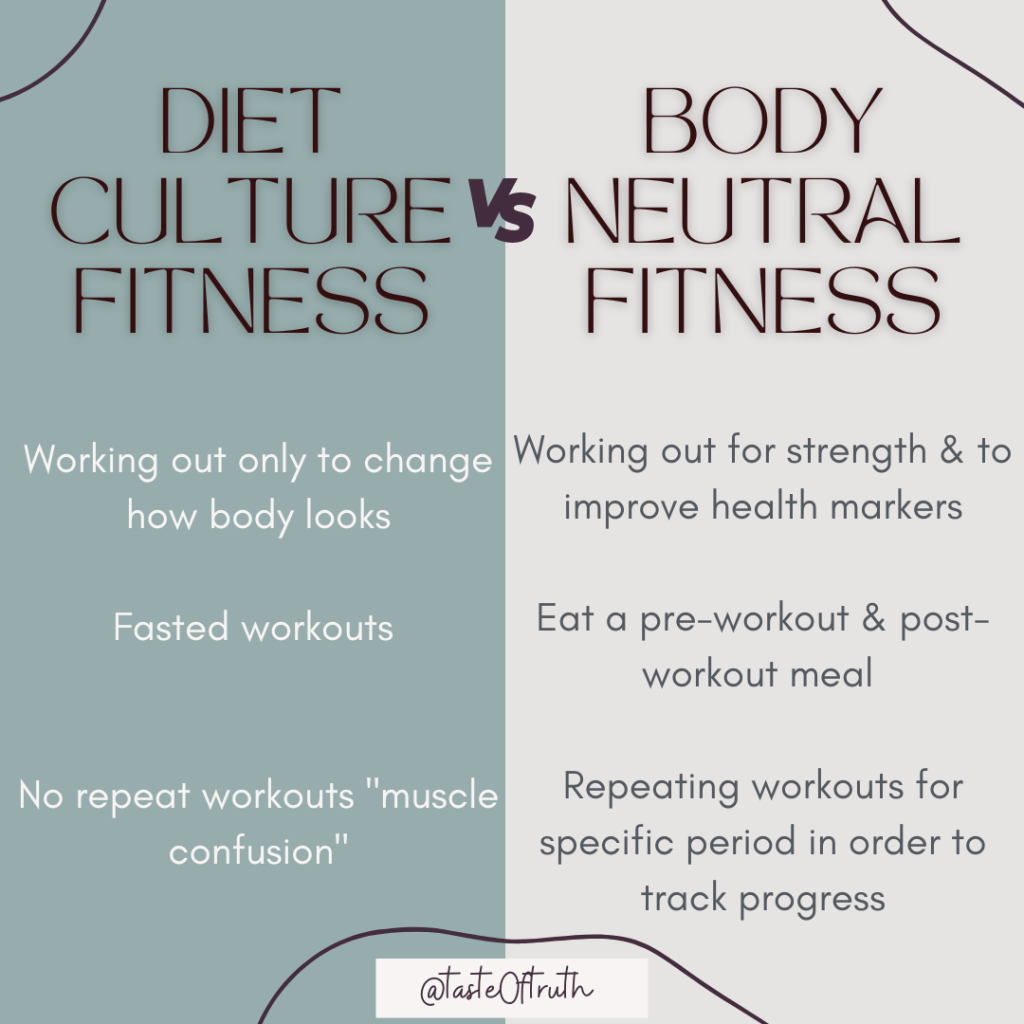
I want to go over common trends I see that I refer to as “diet culture fitness” and then we will compare it with what I recommend “body neutral fitness” ….

Diet culture places value on our weight and size over our health. it promotes messaging that tells us what foods “good” & what foods are “bad.” it glorifies restriction & willpower and ignores our wellbeing.⁣

Diet culture is supported by a multi-billion-dollar industry that pushes weight loss through every medium possible.⁣ Diet culture tells all of us that we are not small enough, strong enough, or lean enough. ⁣

DIET CULTURE IS HARD TO IGNORE.⁣

So, how can one be against diet culture but fine with a diet?⁣ it starts with terminology >>⁣

A DIET merely refers to the foods & drinks we habitually consume. a diet can be a specific, structured way of eating or just our normal daily intake.⁣

The term “DIETING,” is often where the idea of weight loss comes into play. Dieting is (usually) used to describe eating with the purpose of losing weight, which requires a calorie deficit.⁣

>> I am anti-diet culture because i believe that food is not meant to be associated with guilt and shame.

>>I am anti-diet culture because i do not believe that reaching a specific weight, shape or size is ever more important than our physical or mental wellbeing. ⁣

⁣However, I do believe that it is ok to want to change your diet.⁣

⁣It is ok to have aesthetic goals, especially when we can learn to work towards them in a healthy & sustainable manner. ⁣It’s about wanting to shift from old negative eating patterns and thoughts to new behaviors that leave you fueled and healthy.⁣

I believe that it is ok to want to look & feel your best & addressing your nutrition and relationship with food is often the best way to do so.⁣ Your diet is not bad. restriction, shame, guilt, & obsession are

So, what’s the secret to lasting change? It all starts with shifting our focus from aesthetics to performance. Instead of obsessing over how our bodies look, let’s celebrate what they can do! Whether it’s mastering a new yoga pose, hitting a new personal record at the gym, or simply feeling more energized and alive, performance-based goals are where it’s at.

This ultimately means changing the values and the why behind your goal setting:

  • Instead of: “I want to lose the cellulite off my legs.”
  • Try: “I’d like to improve my technique and increase my strength in squats, leg press and deadlifts.”

The intention behind Body Neutral Fitness movement is:

  • Enhance strength & overall performance
  • Boost confidence & find purpose
  • Build stamina for effortless hiking
  • Improve balance, coordination, & mood
  • Enhance health & blood markers

So, WHAT’S THE BOTTOM LINE?

Body neutral fitness is so much more fun, and having fun gets more done! An approach that emphasizes setting and achieving performance goals works better for cultivating a healthy mindset towards fitness which is more sustainable over the long term than an approach that emphasizes aesthetics only.

Whatever your performance may be, shifting the focus changes your mind about your body, which can then remove the limits around what your current body/self can experience.

So, let’s get back to those trends:

What is biofeedback and why is it so important?

This refers to the physiological responses that will bring awareness to our bodily processes and internal health. Sleep, hunger, stress, energy, stress, cravings, recovery, etc. Because optimal health is so much more than just physical! If we track these markers, we can begin to see some underlying causes or maybe issues on why your workout program may not be properly supporting you.

😐Stress: How are your stress levels? How do you manage them?

😋Hunger: Do you wake up hungry? Are you always thinking about food?

💩Digestion: Do you experience painful bloats? do you have regular bowel movements?

😴Sleep: How much sleep are you getting? Do you sleep through the night? How many hours? Do you wake up feeling rested? Does your energy dip mid-afternoon?

🛋️Recovery: Are you taking adequate rest days? Do you feel sore for days after your workouts?

🌀Menstrual Health: Are you missing your period? Do you experience painful cramps or any other PMS symptoms?

🍴Cravings: Do you find yourself struggling with these?

Oftentimes, clients that are experience negative biofeedback, there is an underlying cause that needs to be addressed, BEFORE we can actually focus on a physical transformation goal.

  • 💤Improper sleep or stress management can lead to hormone imbalances that inhibit recovery.
  • 😖Digestive issues can be a sign of chronic stress, low stomach acid and food intolerances.
  • 🥺Mood, focus and libido changes may be linked to under-eating, hormonal imbalances, gut issues, etc.

One of the many variables within fitness program creation is “training volume” (How much you’re doing in a specific time. That can be per workout and within the program like per week/per month). In order to properly prescribe this, a coach needs to understand their clients: fitness level, goals, age, work capacity, recoverability, nutritional status, injury history and life stress. If your coach or fitness trainer didn’t ask you any of these things, that may be something worth looking into.

While physical changes are often used to measure progress, monitoring how you FEEL in response to your nutrition and exercise program is also important. It provides insights to how your metabolism is performing and which possible variables to manipulate in order to see improvements. 💪

🩺NOTE: Assessing biofeedback does NOT replace the need for lab work or medical attention.

ALL-OR-NOTHING Mindset

🧠Diet culture thrives on the All-or-Nothing-mentality. I think this is one of the hardest habits to become aware of and try to replace. I don’t know if anyone else can relate to needing a brain reframe, but typically when clients come to me, they say: “I want a body reset!” and I try to tell them: “You know what, it’s probably your brain that needs the reframe. There are more tips and mindset tricks I want to share with you over the course of season 2.

I want to close say that perfectionism is a TRAP, that so many of us that will get caught up in, within spiritually, and diet and nutrition. And when we slip up, which will always happen, it will feel easier to throw in the towel when we are stuck in all or nothing mentally, on the whole shebang. I think this is one of the most common self-sabotaging behaviors that I see, and this is what I hope to continue the conversations on in this season.

Thank you again for listening/reading and I am looking forward to next’s week’s episode!  Until then, maintain your curiosity, embrace skepticism, and keep tuning in! 🎙️🔒

#podcast#fitness#nutrition#dietculturedropout#dietculture#deconstruction#deconstructingfaith#diet#bodypositive#bodyneutrality#performancegoals#fitnessgoals#bodyimage#dogma