The Hidden Tactics of Big Food and Big Tobacco

A Christmas Lesson in Gaslighting

As we gather around our holiday tables, indulging in sweet treats and sipping warm drinks, there’s something deeply unsettling happening behind the scenes of what we consume every day. A recent study has revealed something I find all too familiar: intimidation tactics used by industries like Big Tobacco, ultra-processed food companies, and alcohol sectors to bully and silence researchers, whistleblowers, and anyone challenging their agenda.

These industries have a long history of using misinformation, manufactured doubt, and emotional manipulation to protect their profits—and it’s not just limited to public health campaigns. This plays out in everyday conversations, too. It’s a pattern that many of us have experienced firsthand, especially those who advocate for healthier lifestyles and more transparency in what we put in our bodies.


A Christmas Paradox: Big Food’s Gaslighting & the Anti-MLM Pushback

This tactic—used by Big Food to discredit critics—reminds me of the way people are shamed or bullied for questioning processed foods or advocating for healthier diets. If you’ve ever pointed out the risks of sugary snacks or fast food, you’ve probably been labeled an extremist, a health-obsessed “wellness warrior,” or worse, a “purity culture” advocate. I can’t help but feel this is just another form of gaslighting, where we’re told that it’s worse to worry about the ingredients in our food than it is to consume those ingredients, even if they are known to contribute to chronic health conditions.

Ironically, this kind of manipulation is the same strategy Big Tobacco used for decades to muddy the waters around the health risks of smoking. And now, ultra-processed food companies are doing the same thing—distracting us from the very real, documented consequences of a poor diet.


Why We Need to Trust Ourselves, Not the Experts

What frustrates me is how the anti-MLM community often jumps on wellness advocates who want to clean up their diets for health reasons. While I agree that MLMs are a breeding ground for manipulation, this should not mean we ignore the very real need to question the food industry’s stranglehold on our diets and health. It’s vital to recognize that not all experts have your best interests at heart. Many of the mainstream recommendations we’re told to follow come from organizations or industries with questionable motives—whether it’s Big Pharma, Big Food, or Big Tobacco. These same industries have a long history of misleading the public, and many of their experts are bought and paid for by corporate interests.

Wanting to improve your diet to manage or reverse chronic health conditions shouldn’t be dismissed as obsessive or extreme. It’s a rational, self-preserving choice that empowers you to take control of your health, even when the mainstream narrative tells you otherwise.


Unwrapping the Truth This Holiday Season

This holiday season, let’s unwrap a new perspective: critical thinking over consumerism, authenticity over convenience, and self-empowerment over external pressures. It’s time we stop letting industries dictate our health choices and start reclaiming agency in what we put into our bodies.

If you’ve ever been gaslighted for your food choices, or made to feel like you’re ‘too much’ for caring about your health, know you’re not alone. The more we learn about these intimidation tactics, the better equipped we’ll be to call them out.

As we approach the new year, let’s challenge the status quo—questioning not just what’s on our plates, but the motives of the systems that feed us.

Creating Dialogue: Moving Beyond Division in Politics

As we move past the recent election, I’ve been reflecting on what it’s taught me about our culture, politics, and the conversations we have about faith and values. I want to share this reflection, not as a definitive answer, but as a personal journey that might resonate with others.

Discovering the “Deconstruction” Community

When I first started questioning my beliefs, especially within Christianity, I found myself among a group of people known as the “deconstruction community.” Many of these individuals were dealing with anger and disillusionment—much of it directed at political figures like Trump, the MAGA movement, and the perceived traditional values upheld by many evangelicals. They spoke openly about issues like spiritual abuse and cult-like dynamics in religious spaces, which resonated with me as I navigated my own experiences of questioning and stepping away from past beliefs.

But as I spent more time in these spaces, I noticed a paradox. The community had an “us vs. them” mentality that was very similar to the kind they were critiquing within conservative Christianity. The language, often harsh and divisive, didn’t align with the openness and curiosity I’d hoped to find. It seemed that some had merely replaced one set of rigid beliefs with another, creating a new kind of fundamentalism in the process.

Moving Beyond Anger and Righteousness

In these circles, I encountered scholars and advocates who passionately spoke against certain ideologies—sometimes with a level of certainty that left little room for nuance. I can empathize with this; when I began deconstructing, I, too, was filled with anger. I often felt morally superior, eager to “call out” harmful ideologies. But as time passed, I began to see that this anger, while understandable, could also be limiting. It kept me in a space where I saw the world in black and white, where there were “good” people on one side and “bad” on the other. I realized that this wasn’t a mindset I wanted to live in forever.

The Value of Autonomy and Discernment

During this election cycle, I found myself reflecting on the importance of autonomy, critical thinking, and discernment. These are qualities that the deconstruction community often claims to uphold. Yet, at times, it feels as though a different kind of fundamentalism has taken root—one where there’s pressure to align with a specific, “acceptable” narrative. I believe we need to make space for people to question, to think deeply, and to weigh their values without the fear of being shamed or silenced.

For instance, while I see harm in patriarchal structures, I also believe it’s damaging to label every conservative viewpoint as “fascist” or “racist.” These labels are extreme and can create walls instead of bridges. This is especially concerning when public figures or communities use this language to fuel fear rather than to inspire honest dialogue. It’s a reminder of how easy it is to fall into binary thinking, even when we’re trying to escape it.

Real-World Impact of Ideas

The power of ideas, especially those circulated in liberal spaces, has had a tangible impact on my life. Phrases like “sex work is real work” and “it’s just a clump of cells” influenced me in ways that I now wish had been more nuanced. I deeply regret some choices and wish I’d had more support, better information, and a broader perspective at the time. This experience fuels my passion for helping others get a fuller picture as they make decisions, especially those that impact their health, values, and future.

The Importance of Diverse Voices

As I look forward, my hope is to help foster a healthier America where diverse voices and perspectives can coexist. This includes voices that don’t necessarily align with mainstream narratives. Figures like Robert Kennedy Jr., for example, are often labeled “conspiracy theorists” within certain circles, including parts of the deconstruction community. But Kennedy has a message that challenges corporate narratives, and I find it disheartening when people dismiss him without truly engaging with his ideas. This tendency to label and dismiss is something I hope we can move beyond.

Building Dialogue Over Division

In closing, my commitment is to create a space where the priority is truth-seeking, not winning. It’s easy to fall into the trap of quick judgments and polarizing narratives, but real growth comes from dialogue, from listening, and from respecting the humanity in one another—even when we disagree. The recent election has reminded me of the importance of these values.

Let’s keep questioning the narratives, seeking understanding, and holding space for multiple perspectives. After all, this isn’t about “winning” or “losing”—it’s about building a more compassionate, informed society.

Thank you for reading, and let’s keep this conversation going. Let’s choose curiosity over condemnation, dialogue over division, and remember there’s always more to the story.

#drlauraanderson #traumarecoverycenter #politics #deconstruction #deconstructingfaith #peteenns #cultlike #election2024 #polarization #lessonslearned #divisivenarratives #democracyinretrograde #emilyamick #democratic #democracy #harris #trump2024 #maha #rfjk #newevangelicals #exvangelicals

Understanding the Group Mind: A Double-Edged Sword

Navigating the waters of community can feel like a tightrope walk, especially for those of us who’ve been through the storm of spiritual abuse. This week on Taste of Truth Tuesdays, I’m excited to welcome a guest who dives deep into the concept of “Group Mind”—the idea that a collective can elevate individual voices, creating a harmonious collaboration. While this concept sounds beautiful on the surface, having walked the line between healthy and toxic communities myself, I can’t help but question: What happens when “Group Mind” becomes a vessel for manipulation rather than a source of strength?

The Allure of Community

Let’s face it: we all crave connection. From childhood friendships to spiritual gatherings, our lives are woven into a fabric of social interactions. In healthy communities, each thread—each individual—contributes to the larger tapestry. Group Mind can be empowering when everyone contributes their unique strengths. Think of a brainstorming session, where different ideas build on each other to create something innovative. But in controlling groups, individuality is suppressed, and members are pressured to conform, stifling creativity and critical thinking.

The Double-Edged Sword of Group Mind

Our guest shares their experience in an improv class, where the idea of Group Mind became both a revelation and a source of anxiety. It’s fascinating how the language of community can feel welcoming yet be weaponized against those who seek authenticity. This mirrors the complexities of modern social dynamics, especially in the age of social media, where radicalization can happen at lightning speed.

In Episode 5 of my podcast, we tackled the “crunchy hippie to alt-right pipeline,” but now it’s time to shine a light on the radicalization of the left—a topic often overlooked. Why did I go from progressive circles to mingling with Trump supporters and Christians? This shift was marked by a range of events and trends reflecting broader changes within progressive movements and their impact on American politics and culture.

The Irony of the Deconstruction Space

As I navigated the deconstruction space, I noticed something ironic: when the deconstruction movement defines a cult and unintentionally describes their own playbook, the irony is hard to miss. Many who now identify as progressive or left leaning have simply swapped one form of fundamentalism for another. They may have shed their evangelical past, but the same dogmatic, ‘us vs. them’ tactics remain. It’s like they never fully untangled themselves from the rigid mindset they claim to oppose.

Social justice has become their new ‘End Times,’ and the tribalism is painfully obvious. Conformity, consequences for stepping out of line, leaders who set the narrative… sound familiar? 🙃

🔍 “It’s not your enemies, it’s the system.” We often fall into the trap of seeing our political landscape as a battle between two sides—one fighting for democracy, the other autocracy. But this binary thinking misses the larger issue: who really has power in shaping policies? Research, like the 2014 study by Gilens and Page, reveals that economic elites and organized interest groups wield far more influence over government decisions than the average citizen or voter. This isn’t about a single party; it’s about a systemic challenge that transcends partisan lines. 🧠

Instead of feeding into divisive narratives, maybe it’s time to ask: Who benefits from keeping us divided? 🤔 Progressive politics can impose control using a power/victim binary that’s reductive and lacks nuance, leveraging the fear of being labeled an oppressor as a tool for compliance. Reflecting on my journey of deconstruction and exploring progressive spaces, I’ve noticed a concerning trend: the lack of nuance and the prevalence of an ‘us vs. them’ mentality.

Even within progressive Christianity, there’s pressure to conform to certain social norms and ethical behaviors. Disagreement is often met with resistance, and group identity politics can dominate discussions. As I listened to a friend lecture me about the systems of whiteness and how white people are part of the problem, I couldn’t help but feel a visceral response in my body. Wasn’t she aware of how she was marginalizing voices that do not align with CRT principles and fostering division rather than unity?

It’s one thing to leave behind a belief system, but if you’re still using the same control tactics, are you really free? Or are you just in another form of groupthink? Many who now identify as progressive or left-leaning have simply swapped one form of radicalism for another.

In navigating my journey, I’ve discovered that while community can be a source of strength, it can also be stifling. Let’s strive for more open dialogue where diverse perspectives are valued.

“I have a dream that my four little children will one day live in a nation where they will not be judged by the color of their skin but by the content of their character.” — Martin Luther King Jr.

Seeking Authentic Community

This brings us back to the concept of Group Mind. While it has the potential to uplift and unite, we must critically assess the communities we choose to engage with. Are they empowering our individuality, or are they reinforcing a new set of dogmas?

As we explore these themes in this week’s podcast episode, I invite you to reflect on your own experiences with community—whether online or offline. Are you in a space that nurtures your authentic self, or have you found yourself caught in another web of control? Let’s challenge ourselves to seek genuine connections that celebrate our uniqueness, rather than merely conforming to the expectations of a collective.

Navigating Community Dynamics

One critical takeaway from my own experiences and the stories shared by others is the importance of asking ourselves the right questions. When evaluating any community—whether it’s a religious group, a social circle, or even an improv class—we should reflect on whether we’re being encouraged to grow into our full selves or if we’re being pressured to shrink into submission.

Key Questions to Consider:

  • Am I celebrated for my unique contributions, or do I feel like a cog in the machine?
  • Is my voice heard and valued, or am I met with silence (or worse) when I express dissent?
  • Does this community expand my horizons, or does it confine me to a narrow worldview?

The Importance of Individuality

One of the most powerful realizations is that a thriving community doesn’t demand the extinction of individualism; it nourishes it. Just as the author of the guest post observed in an improv competition, the true beauty of collaboration lies in the ability of individuals to bring their full selves to the table, enhancing the group dynamic rather than diminishing it.

In my journey, I’ve learned that safe communities are those that not only say, “Yes!” to your ideas but also invite you to share more, to dig deeper, and to embrace the weirdness that makes you unique. They celebrate individuality as an essential ingredient for collective success, transforming “Group Mind” from a potential source of control into a powerful tool for creativity and support.

The Path to Healing

For those of us recovering from spiritual abuse, the journey to find a healthy community can feel daunting. It requires us to sift through the rubble of past experiences, recognizing patterns that once suffocated our voices. But it also offers a chance for healing, a space where we can reclaim our identities and forge connections based on respect and authenticity.

Ultimately, the quest for community is about more than just belonging; it’s about finding spaces where we can be our true selves. It’s about navigating the complexities of connection with our eyes wide open, ready to discern the difference between a supportive group and one that seeks to control.

Conclusion

As we move through life, let’s remember that community can be a double-edged sword. For some of us, especially those healing from trauma or navigating complex PTSD, the journey may be best supported by solitary pursuits—like books, pets, and podcasts—before stepping into the vibrant chaos of group dynamics. We must be vigilant in recognizing when connection serves us and when it threatens to silence our individuality. Here’s to seeking out those communities that empower us, uplift us, and invite us to shine our light—together.


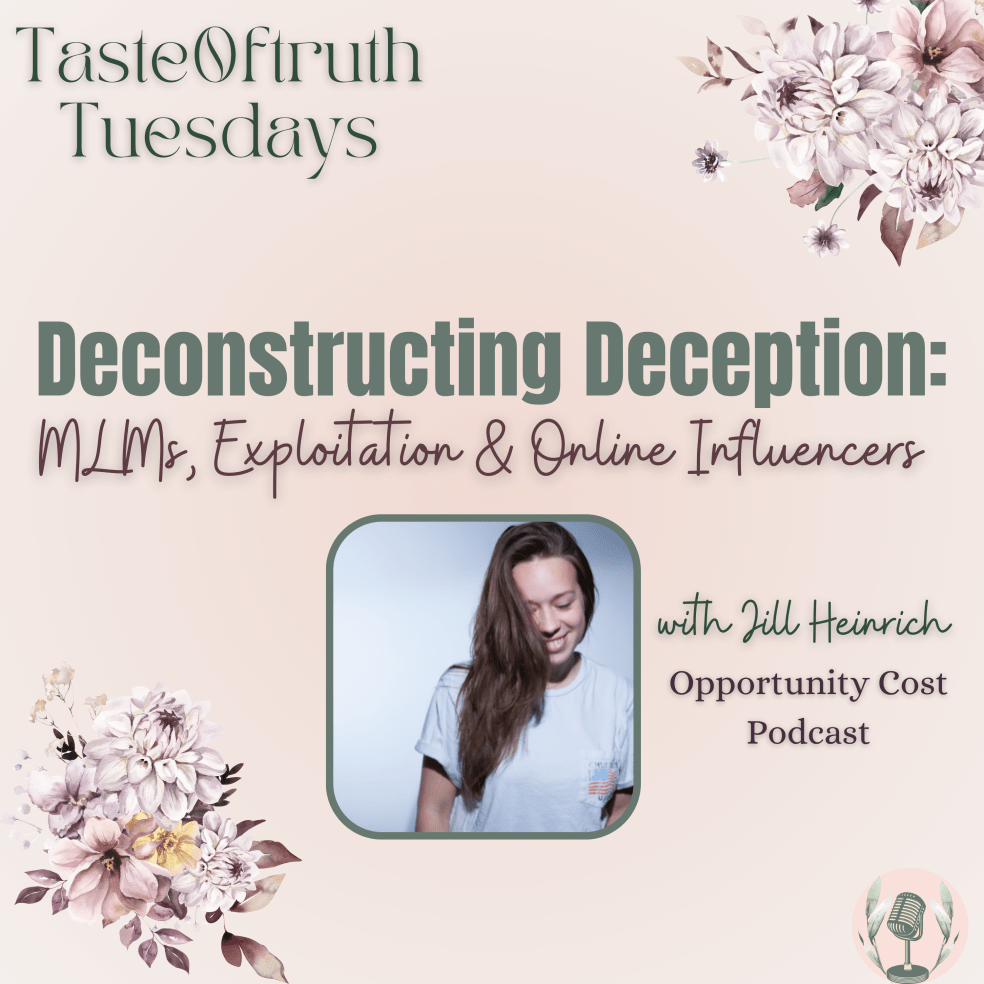
Deconstructing Deception: MLMs, Exploitation & Online Influencers

This week, we’re diving deep into the murky waters of high-control groups like MLMs, conspiracies, and evangelicalism. 💥✨

🚨 Exploitation Alert 🚨

Tune in to explore the shady side of:

  • Lobbyism & Amway – How lobbying shapes the MLM landscape.
  • Enagic’s Kangen Water Scandal – Uncover the dangerous misinformation and financial exploitation by MLMs like Enagic.
  • Faith and Finance – Why are Christian women particularly vulnerable to MLM schemes? Learn to spot the red flags.
  • Influencers and Ideologies – How influencers like Girl Defined hide harmful beliefs behind appealing facades.
  • Podcasting Insights – Hear about the joys and challenges of podcasting, from trusting your instincts to finding joy in the creative process.

Join us for an eye-opening episode that tackles the intersections of gender, culture, business, and control. Don’t miss out on these compelling insights! 🚀✨

Deconstructing Faith Dynamics: Overcoming Anxiety and Narcissistic Rage

Have you ever noticed how some individuals react with intense hostility or aggression when their deeply held beliefs are questioned? Keep reading as we will be exploring this very concept.

This week on the podcast, we’re sitting down with Dr. Mark Gregory Karris to explore the twists and turns of his diverse professional journey and how it shapes his approach to tackling religious trauma.

 🎢 From deconstructing faith dynamics to navigating life after leaving religious traditions, Dr. Karris dishes out practical steps and deep insights like a pro. 📚 We dive into his latest book ‘Diabolical Trinity’ where he takes on the big questions—like transforming a wrathful God into a compassionate one and the impact of religious experiences on mental health. 🕊️ 

Join us as we uncover the power of community and holistic healing in this can’t-miss conversation! 🌈

Listen here! 🎧

Navigating Anxiety in Fundamentalist Christian Circles During Deconstruction

People entrenched in fundamentalist sects of Christianity often experience heightened anxiety when they witness others going through a process of deconstruction. This reaction stems from their upbringing, where they were taught that deviation from established beliefs and practices is not only wrong but potentially dangerous. In fundamentalist environments, any departure from the accepted norms can be perceived as a threat to one’s faith, community, and even personal safety.

This anxiety is compounded by the fear that questioning or exploring alternative beliefs may lead to spiritual and moral peril. Fundamentalist teachings often instill a rigid worldview where conformity is equated with spiritual safety, and deviation is seen as a sign of weakness or susceptibility to worldly influences.

Moreover, the concept of narcissistic rage can be observed in some cases, where individuals deeply embedded in fundamentalist ideologies react with hostility or aggression towards those who challenge or question their beliefs. Here are a few examples:

Verbal Attacks:

When someone questions a fundamentalist belief, the individual might respond with insults, shouting, or belittling the questioner. For instance, calling someone “ignorant” or “evil” for simply asking a question about their faith.

Social Ostracism:

In a tight-knit religious community, members who express doubts or differing opinions might be shunned, isolated, or expelled from the community.

Online Harassment:

On social media, individuals might react to criticism or questions with trolling or coordinated harassment campaigns against the perceived challenger.

Physical Aggression:

In extreme cases, questioning or challenging fundamentalist beliefs can lead to threats of violence or actual physical harm.

This reaction is different from a healthy spiritual practice, which encourages openness, curiosity, and respectful dialogue about different perspectives.

Examples of Healthy Spirituality:

Open Dialogue:

Encouraging conversations where differing beliefs and perspectives are discussed respectfully, with a genuine interest in understanding the other person’s viewpoint

Supportive Community:

Building a community where questioning and exploring faith is seen as a natural part of spiritual growth, and members support each other through their journeys.

Personal Reflection:

Encouraging conversations where differing beliefs and perspectives are discussed respectfully, with a genuine interest in understanding the other person’s viewpoint.

Interfaith Engagement:

Participating in interfaith dialogues or activities that promote learning from different religious traditions and appreciating the diversity of spiritual experiences.

These contrasting examples can illustrate the difference between a rigid, defensive response and a more open, growth-oriented approach to spirituality.

By recognizing the signs of narcissistic rage and embracing a more open and compassionate approach.

Navigating these dynamics requires empathy and understanding from both sides. Those undergoing deconstruction seek to reconcile their evolving beliefs with their personal experiences and spiritual growth, while those in fundamentalist circles may benefit from recognizing that diversity of belief does not necessarily threaten their own faith or spiritual well-being. Here’s how this dynamic unfolds:

  1. Fear of Deviation: Fundamentalist teachings often emphasize a strict adherence to doctrinal purity and established beliefs. Any questioning or deviation from these beliefs is viewed as a threat to faith and spiritual safety.
  2. Cognitive Dissonance: Witnessing others deconstructing their faith can trigger cognitive dissonance among fundamentalists. It challenges their worldview and belief system, leading to discomfort and anxiety.
  3. Fear of Consequences: Fundamentalist teachings may instill fear regarding the consequences of exploring different beliefs or questioning established doctrines. There’s a pervasive belief that straying from the accepted path could lead to spiritual peril or loss of salvation.
  4. Sense of Identity Threat: For individuals deeply embedded in fundamentalist communities, their identity and sense of belonging are closely tied to doctrinal conformity. Deconstruction challenges this identity, causing emotional distress and anxiety.
  5. Social Pressure: Fundamentalist communities often exert strong social pressure to conform to group norms and beliefs. The prospect of others deconstructing their faith can create social anxiety and a fear of ostracization or judgment from peers and leaders.

In essence, the anxiety experienced by individuals in fundamentalist sects when encountering deconstruction reflects deep-seated beliefs and teachings that equate divergence from established doctrines with spiritual peril. This anxiety underscores the psychological and emotional challenges inherent in questioning and evolving one’s faith within such contexts. Encouraging open dialogue and mutual respect can foster a healthier approach to spiritual exploration and community dynamics.