The MLM Illusion: Selling a Dream or a Trap?

New Episode Alert: The Dark Side of MLMs and Coercive Control

🚨 This Week on Taste of Truth Tuesdays 🚨, we’re diving into the complex and manipulative world of multi-level marketing (MLM) companies—uncovering the coercive control tactics they use to keep people hooked. 🧠💸 MLMs don’t just sell products. They sell a dream—a dream of financial freedom, wealth, and unlimited success. The problem? That dream is often built on deceptive tactics that prey on vulnerability, foster magical thinking, and emotionally manipulate their members.

At first glance, MLMs seem like a golden opportunity. They promise wealth, freedom, and independence—targeting people who are seeking a way out of financial struggle or a traditional 9-to-5. But underneath those glittering promises are dangerous tactics that prey on human psychology, exploiting emotional weaknesses to create loyalty and blind devotion.

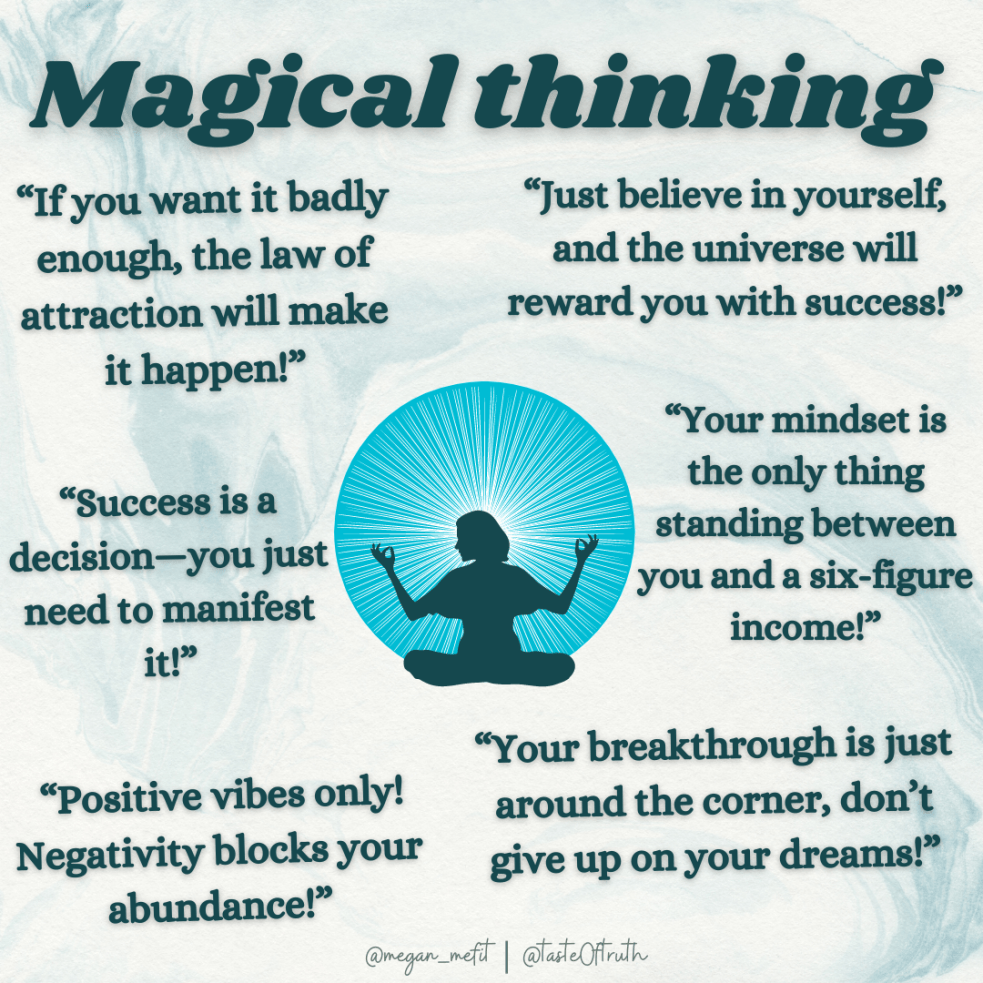
A key tactic MLMs use is magical thinking. This is the belief that positive thoughts and visualizations alone can bring success, wealth, or health. A 2019 study in Frontiers in Psychology revealed that many MLMs sell products—like supplements and essential oils—by making unverified claims about curing diseases, with little to no scientific evidence to back them up. 😳

Why Is Magical Thinking So Dangerous?

Magical thinking isn’t just harmless optimism. In the context of MLMs, it can lead people to make poor financial and health decisions. Here’s why it’s so dangerous:

🚫 False Sense of Control: Magical thinking tricks people into believing they can control outcomes simply by thinking positively. This false confidence can prevent them from taking real, actionable steps to improve their situation.

🚫 Health Risks: MLMs often push supplements and oils with promises of “miracle cures” for serious illnesses—without scientific validation. People may choose these products over actual medical treatments, putting their health in danger.

🚫 Emotional Manipulation: By convincing members that failure is due to their lack of belief or effort, MLMs shift the blame from the system to the individual. This creates a toxic cycle of guilt and shame, trapping people emotionally in the MLM.

Coercive Loyalty and Emotional Manipulation

Beyond magical thinking, MLMs use coercive control tactics to create a false sense of community and belonging. They foster an atmosphere of loyalty where members feel pressured to stay positive, constantly recruit new people, and never question the system.

💥 Coercive Loyalty: Members are often told that the reason they’re not successful is because they’re not trying hard enough, recruiting enough, or believing in themselves. This turns failure into a personal flaw, rather than a flaw in the business model.

💥 Community Pressure: MLMs thrive on social dynamics, where members are encouraged to pressure their friends and family into joining. This creates a network of dependency and makes it harder for people to leave, even when they start seeing the cracks in the system.

💥 Emotional Exploitation: Guilt, shame, and failure are powerful emotional tools used by MLMs. When people don’t succeed, they’re often made to feel as if they didn’t believe in the product or themselves enough. This emotional manipulation keeps members invested—financially, mentally, and emotionally—even when the odds are against them.

Breaking Free: Real Stories of Escaping MLMs

In this week’s episode, we also share real stories of individuals who have been trapped in MLMs and how they broke free. These stories highlight the emotional, financial, and mental toll that MLMs take on their members, and how difficult it can be to escape once you’re in the cycle. 😳

Why You Need to Listen

If you’ve ever been approached by someone pushing a “life-changing opportunity” or a “groundbreaking product,” this episode is for you. If you’ve been tempted to join an MLM—or know someone who has—this episode is essential listening. We’re unpacking the toxic blend of pseudoscience, community pressure, and emotional exploitation that keeps MLMs running, and sharing actionable tips on how to recognize the red flags before it’s too late. 🚩

Tune in to this week’s episode of Taste of Truth Tuesdays to learn how to protect yourself from the manipulative tactics of MLMs and avoid falling into their web of magical thinking and emotional control. Whether you’re considering joining an MLM or are currently involved, understanding these tactics is key to protecting your financial and emotional well-being.


🎧 Listen to the full episode now—


#MLMAwareness #MagicalThinking #CoerciveControl #PodcastAlert #HealthOverHype #EmotionalManipulation #CriticalThinking #MultiLevelMarketing #BreakFreeFromMLMs

Why MLMs Exploit Magical Thinking

Magical thinking is often presented as something harmless, quirky, or even empowering: believe hard enough, visualize the outcome, raise your vibration, and somehow reality will reorganize itself around your desires.

The right thoughts will attract the right life.
The right energy will attract money.
The right mindset will make the business work.
And if it still isn’t working? Well, apparently you need to believe harder.

This is where magical thinking stops being an innocent coping mechanism and becomes something far more manipulative.

There is nothing inherently wrong with imagination, hope, ritual, goal-setting, or trying to orient your mind toward possibility. The problem begins when thoughts are treated as though they possess direct causal power over circumstances—and when that belief is used to excuse exploitative systems, deny material reality, and blame people for outcomes they cannot fully control.

Multi-level marketing companies thrive inside this framework.

They rarely sell only skincare, supplements, leggings, essential oils, or some mysterious powdered substance promising to fix your hormones. They sell a total worldview: success is available to anyone, financial freedom is right around the corner, and your mindset is the only meaningful obstacle standing between you and the life you deserve.

It sounds liberating.

In practice, it becomes a remarkably effective form of narrative control.

The Manifestation-to-MLM Pipeline

Manifestation culture and MLM culture speak remarkably similar languages.

Both frequently suggest that your external circumstances are a reflection of your internal state. Wealth signals alignment. Success proves belief. Failure reveals fear, negativity, laziness, or some hidden subconscious block.

Within this worldview, structural explanations disappear.

The compensation plan is not the problem. Market saturation is not the problem. Recruitment-based growth is not the problem. The cost of inventory, conferences, subscriptions, samples, coaching, and social-media advertising is not the problem.

You are the problem.

You did not show up consistently enough.
You entertained doubt.
You listened to “negative people.”
You failed to embody your future self.
You did not want it badly enough.

This is one of the reasons magical thinking is so useful to high-pressure groups: it turns legitimate criticism into evidence of personal or spiritual deficiency.

The system never has to prove itself because its members are taught to endlessly prove themselves to the system.

Why Magical Thinking Becomes Dangerous

1. It Creates a False Sense of Control

Magical thinking offers certainty in an uncertain world. That is part of its appeal.

It tells people that they can control outcomes through the correct combination of intention, visualization, emotional regulation, disciplined optimism, and personal belief. In an MLM, that message becomes attached to a business opportunity: anyone can succeed as long as they follow the system and maintain the right mindset.

But real outcomes are shaped by countless factors: timing, money, health, geography, existing social networks, market conditions, family responsibilities, luck, and the structure of the business itself.

A person can work hard and still fail inside a bad system.

That truth is uncomfortable, especially for companies that need a constant stream of hopeful recruits. It is much more convenient to teach people that their thoughts determine their results.

The illusion of total control can actually make people less capable of evaluating reality. Instead of asking whether the opportunity is financially sound, they are taught to examine whether they have been sufficiently positive.

2. It Keeps People Spending Money

MLMs routinely frame additional spending as an investment in your future identity.

Buy the starter kit.
Purchase enough inventory to qualify for the next rank.
Attend the conference.
Pay for the leadership retreat.
Subscribe to the training platform.
Order samples for potential customers.
Invest in yourself.

And because magical thinking encourages people to interpret persistence as proof of faith, each new expense can feel like the final energetic or financial commitment required before the breakthrough arrives.

Success is always one more month away.

One more recruit.
One more product launch.
One more mindset shift.
One more payment on the credit card.

The vast majority of MLM participants do not earn a meaningful profit after expenses are considered. But individual success stories are repeatedly elevated as proof that the opportunity works for anyone.

The person at the top of the pyramid becomes a living vision board.

Her house, vacations, body, marriage, car, and carefully curated morning routine are presented as evidence of what is available to everyone—provided they remain loyal enough to the process.

3. It Spiritualizes Shame

This may be the most psychologically damaging part of the entire system.

When success is attributed to mindset, failure becomes a moral judgment.

You were too negative.
You doubted the process.
You allowed fear to win.
You did not protect your energy.
You lacked discipline.
You secretly did not believe you deserved success.

Instead of recognizing that they were recruited into an unsustainable model, people begin searching themselves for defects.

They feel ashamed of their bank account, embarrassed by their lack of progress, and guilty for disappointing the person who recruited them. They may hide losses from their spouse, distance themselves from skeptical friends, and become even more dependent on the MLM community for reassurance.

The emotional burden is transferred entirely onto the individual while the company remains untouched.

This is authority without accountability: the system claims the right to interpret your life, demand your loyalty, and define your failures, while accepting no responsibility for the harm it causes.

4. It Encourages Detachment from Reality

“Protecting your mindset” can sound like healthy emotional hygiene. Inside a high-control environment, however, it often means avoiding information that might interrupt belief.

Critical articles are dismissed as negativity. Former members are called bitter. Concerned family members are accused of having a scarcity mindset. Financial evidence is treated as less meaningful than testimonials, intuition, or the leader’s personal story.

Members may be encouraged to behave as though their desired reality already exists—even while debt increases, relationships fracture, and emotional exhaustion sets in.

This is not optimism. It is spiritual escapism.

Reality becomes something to override rather than something to examine.

And when acknowledging the truth threatens your identity, friendships, income fantasy, and sense of belonging all at once, leaving becomes much harder than simply quitting a side business.

Why MLMs Depend on Magical Thinking

It Produces Loyalty

MLMs create communities organized around shared belief.

Members are given a new vocabulary, a new vision for their future, new mentors, new rituals, and sometimes an entirely new social circle. Group calls, conventions, recognition ceremonies, rank advancements, and motivational speeches reinforce the feeling that participants are part of something larger than themselves.

The group is not merely selling products. It is changing lives.

Once that identity takes hold, criticism can feel deeply personal. Questioning the company becomes indistinguishable from questioning the friendships, dreams, and transformation attached to it.

Leaving may mean admitting financial loss, disappointing an upline, and losing an entire community.

This is why “just walk away” is rarely as simple as it sounds.

It Protects the Business Model from Criticism

Magical thinking provides an almost perfect shield against accountability.

When someone succeeds, the system gets the credit.

When someone fails, the individual gets the blame.

Success proves the opportunity works. Failure proves the participant did not work it correctly.

This makes the central claim effectively unfalsifiable. No amount of personal loss can disprove the system because loss itself is reinterpreted as evidence that the person lacked belief, effort, consistency, or alignment.

That is not a legitimate business evaluation. It is a closed belief system.

It Fuels Recruitment

“You can do this too” is one of the most powerful promises in MLM culture.

Recruitment depends on convincing ordinary people that extraordinary wealth is available without extraordinary privilege, timing, experience, or luck. The dream must appear universally accessible.

Manifestation language helps close the gap between fantasy and evidence.

You do not need to understand the compensation plan.
You need to trust your intuition.

You do not need to examine average earnings.
You need to stop limiting yourself.

You do not need to ask whether the market is saturated.
You need to believe there is abundance for everyone.

This reframing transforms reasonable skepticism into a character flaw. The recruit is not being cautious; she is “playing small.”

Red Flags to Watch For

Slogans That Replace Evidence

Be cautious when complicated financial or personal outcomes are reduced to phrases such as:

  • “Believe and achieve.”
  • “Your vibe attracts your tribe.”
  • “If you can see it, you can create it.”
  • “The only limits are the ones in your mind.”
  • “Other people’s negativity is blocking your success.”

A slogan is not a business plan. An affirmation is not an income disclosure.

Exceptional Stories Presented as Typical Outcomes

MLMs love personal testimony because stories are emotionally powerful.

The single mother who retired her husband.
The teacher who became a millionaire.
The woman who paid off all her debt from her phone.
The cancer survivor who found purpose through the product.

These stories may be real, embellished, incomplete, or financially misleading. But even when they are accurate, they do not reveal what usually happens.

A few highly visible winners cannot tell you whether the opportunity is financially viable for the average participant.

Pressure to Remain Relentlessly Positive

Healthy communities allow questions, disappointment, disagreement, and honest discussion of failure.

High-control communities interpret those things as contamination.

When people are expected to perform positivity at all times, the group is not protecting morale. It is protecting the narrative.

Watch what happens when someone asks about debt, low earnings, product claims, attrition, or the compensation structure. Are those questions answered directly, or is the person accused of lacking faith?

Anecdotes Treated as More Important Than Evidence

Personal experience can be meaningful, but it is not a substitute for reliable data.

MLMs often rely on transformation photos, testimonials, dramatic origin stories, and claims about what “worked for me.” The emotional impact of those stories can distract from questions about evidence, typical outcomes, expenses, health claims, and financial risk.

When facts threaten the fantasy, the facts are often dismissed as negative energy.

That should tell you everything.

The Difference Between Hope and Manipulation

Hope is not the enemy.

Neither are imagination, spiritual practice, ambition, or the desire to create a better life.

But genuine hope can survive contact with reality.

It does not require you to ignore evidence. It does not demand that you blame yourself for every disappointment. It does not isolate you from people who ask reasonable questions. And it does not insist that an exploitative system would work perfectly if only its victims were more spiritually disciplined.

That is not empowerment.

It is blame wearing a vision-board costume.

Magical thinking becomes dangerous when it teaches people that thoughts are more important than circumstances, that criticism is more dangerous than exploitation, and that every failure reveals a defect in the believer rather than a flaw in the belief system.

This is the thread connecting so much fake spirituality with MLM culture: both can turn uncertainty into certainty, desire into doctrine, and personal vulnerability into profit.

So when someone promises that the universe will reward you—as long as you purchase the starter kit, join the team, follow the mentor, raise your vibration, and stop listening to the “negative” people in your life—it is worth pausing.

Ask for the evidence.

Look at the actual numbers.

Listen to the people who left.

And pay very close attention to any system that promises you complete control over your destiny while taking absolutely no responsibility for the outcome.

From Serendipity to Scrutiny: The Truth Behind MLMs and Coercive Control

At the beginning of my journey into multi-level marketing (MLM), I felt an overwhelming sense of serendipity. Like many others, I was drawn into the promise of freedom, financial independence, and the power of owning my own business. That initial excitement felt so right, I even got a “trust the process” tattoo to anchor myself in the belief that I was on the right path. But the deeper I delved into this world, the more I realized the complexities and underlying control tactics that defined it.

Reflecting on my early days in the MLM space, I can’t help but think of how magical the thinking felt. I truly believed I was guided into the opportunity. But as time went on, the inconsistencies, emotional manipulation, and exploitative nature became impossible to ignore. It’s been a journey of grieving that magical thinking—something I now understand as part of a coercive, controlling system designed to keep me chasing an illusion.

Brandie, my guest on this episode, shares a similar experience. As a mother, writer, speaker, and advocate, she’s been at the forefront of exposing MLMs as commercial cults, wellness scams, and even legalized labor trafficking. She has spoken extensively about how her journey, which started with serendipity, eventually led her to scrutinize MLMs more critically. Her insights reflect the emotional complexity many face when disentangling from these organizations.

Here are some key aspects of our conversation:

  • The Magical Thinking Trap: Both Brandie and I felt an initial sense of serendipity, which was reinforced by the community and mentors telling us to “trust the process.” This belief system is intentionally nurtured in MLMs to keep participants emotionally invested.
  • Leveraging Credentials: We discussed how MLMs often leverage the credentials and influence of professionals like doctors, nutritionists, and influencers to give the illusion of legitimacy. Brandie emphasized how this tactic makes MLM pitches more persuasive, especially to vulnerable individuals seeking validation.
  • The “Mother” Angle: Brandie shared how MLMs often target mothers, using manipulative language that preys on their desire for financial freedom and the ability to work from home while caring for their families. The messaging can be so powerful that mothers internalize guilt and blame when they don’t succeed, despite the system being rigged against them.
  • Unpaid Labor and Emotional Manipulation: We delved into how MLMs strategically manipulate participants into performing unpaid labor, like attending large-group-awareness trainings or MLM conferences, under the guise that these events will lead to success. This creates a cycle of emotional dependency on the MLM structure.
  • Coercive Control Beyond the Home: Brandie highlighted the growing movement to criminalize coercive control, not just in domestic environments but also in online groups and commercial cults, including MLMs. Canada’s Bill C-332 and California’s SB 1141 are steps toward addressing this kind of manipulation in non-physical forms.
    • Misleading Social Media Practices: MLMs are notorious for using social media posts to bait others into joining, often hiding the true nature of the opportunity behind attractive lifestyle imagery and vague promises of success.
    • Paid Certifications as Funnels: Another tactic we discussed is the use of paid certifications and courses as entry points to recruit others into MLMs or similar for-profit groups, disguising recruitment as personal development.
    • Power Dynamics and Influence: Brandie warned about individuals in positions of power, like pastors or healthcare professionals, who pitch MLM opportunities using their influence, creating a dangerous overlap between authority and exploitation.
    • Bait-and-Switch in Non-Profits: Some MLMs use non-profit organizations as fronts to recruit members, exploiting charitable intentions for financial gain.

Brandie’s Substack recently covered how Canada’s Bill C-332 and California’s SB 1141 aim to combat coercive control. These laws recognize that coercion doesn’t always result in physical harm but can have long-lasting emotional and psychological effects. Extending these protections to online and commercial environments, like MLMs, is a crucial step toward addressing the hidden abuse happening in plain sight.

MLM Compensation Plans

For those unfamiliar with how MLMs work, here’s a breakdown of their typical compensation plans, which all hinge on recruitment:

  • Binary: You recruit two people, who recruit two more, forming a pyramid. You earn based on the sales and recruits of those beneath you.
  • Unilevel: You can recruit as many people as possible, with everyone directly under you. You earn a percentage of sales from your downline.
  • Forced Matrix: There’s a limit to how many people you can recruit directly, so recruits are placed under others in your team, further embedding the hierarchical structure.

Although MLMs claim that participants can make money from sales alone, true financial gain only comes from recruiting others. Companies avoid pyramid scheme accusations by paying bonuses on downline commissions rather than direct recruitment. Still, this setup exploits participants, most of whom will never see a living wage.

MLM Profitability

Studies and reports paint a grim picture for those involved in MLMs:

  • FTC Report: According to the Federal Trade Commission (FTC), approximately 99% of MLM participants end up losing money.
  • Profit Sources: Success in MLMs often hinges on recruiting new participants rather than selling products to consumers, which creates a structure where the majority are positioned at the bottom, struggling to make a profit.

When it comes to making a profit, the comparison between lottery odds and MLM (multi-level marketing) success rates reveals a stark reality: both paths are fraught with significant financial risk, but MLMs typically offer even lower chances of profitability.

If you’re evaluating an MLM opportunity, watch out for:

  • Deceptive earnings claims
  • Manipulative recruitment tactics disguised as “personal development”
  • High-pressure tactics to attend unpaid events
  • Cult-like devotion to leadership or the company itself

As Brandie and I peeled back the layers, it became clear that MLMs are not just financial traps—they are systems of coercive control designed to exploit both financially and emotionally. With legal movements like Bill C-332 gaining traction, there’s hope that MLMs and similar organizations will finally face the scrutiny they deserve.


Grieving the magical thinking days has been bittersweet. In some ways, it was easier to believe in the serendipity, but now, stepping into a space of scrutiny offers greater growth and clarity. In that sense, the journey may be more challenging, but it’s also far more rewarding.

How MLMs and high-control religions exploit narratives to control and isolate

As we have discussed in a previous blog post, in both MLM companies and high-control religions, sophisticated methods of narrative control and emotional manipulation are used to maintain adherence and deflect objections. These organizations craft carefully curated stories of success, empowerment, and belonging, reinforcing a strong sense of group identity while discouraging critical thinking. Objections are met with pre-scripted narratives designed to dismiss doubts and isolate dissenters, creating environments where questioning becomes taboo.

By understanding the parallels between these two worlds, we can begin to recognize the underlying tactics used to manipulate emotions and maintain control. Whether it’s an MLM promising financial freedom or a religious group offering spiritual salvation, the emotional hooks are the same: they both rely on your commitment to their carefully constructed reality. Breaking free means reclaiming your own narrative, embracing skepticism, and fostering critical thought in the face of pressure to conform.

Be sure to find Brandie on Instagram and on Substack!

Resources mentioned in the interview:

🙏 Please help this podcast reach a larger audience in hope to edify & encourage others! To do so: leave a 5⭐️ review and send it to a friend! Thank you for listening! I’d love to hear from you, find me on Instagram!⁠⁠⁠ @taste0ftruth⁠⁠⁠ or⁠⁠⁠ Pinterest! ⁠⁠ ⁠ 

Here are some of the best resources for learning more about commercial cults and anti-MLM movements:

Books:

  1. Ponzinomics: The Untold Story of Multi-Level Marketing by Robert L. FitzPatrick – This book provides a thorough exploration of MLMs and their business structures, helping readers understand how they operate like legal pyramid schemes.
  2. Cultish: The Language of Fanaticism by Amanda Montell – Analyzes how cults (including MLMs) use language and manipulation techniques to maintain control over their members.
  3. Duped: Compulsive Consumers and the Culture of Shame by Ron Jonson – While not MLM-specific, this book delves into how we’re manipulated by industries that exploit our insecurities.

Websites & Blogs:

  1. Truth In Advertising (TINA.org) – A watchdog organization that exposes deceptive marketing practices, including MLM earnings claims and false advertising.
  2. MLMTruth.org – A resource dedicated to educating the public on the dangers and tactics of MLMs, providing reports and analysis on popular companies.
  3. The Anti-MLM Coalition – This coalition provides insight, resources, and stories from those who’ve escaped MLMs, along with analysis of companies and their harmful practices.

YouTube Channels:

  1. The Anti-MLM Coalition – A YouTube channel that breaks down how MLMs operate, featuring stories from former MLM participants and experts in cult dynamics.
  2. Savannah Marie – A former MLM participant who creates in-depth critiques and investigative videos on popular MLM schemes.
  3. The Recovering Hunbot – Focuses on exposing the emotional manipulation and false promises made by MLM companies.
  4. Hannah Alonzo-Hosts commentary-style videos relating to multi-level marketing companies, scams, cults, and influencer/social media culture.

Podcasts:

  1. The Dream – A highly-rated podcast that dives deep into the world of MLMs, offering an in-depth investigation into the industry’s history and practices.
  2. Life After MLM – Hosted by Roberta Blevins, this podcast features interviews with former MLM participants, exploring the mental and financial impacts of MLMs.
  3. Opportunity Cost-Hosted by a past guest, Jill, and is about multi-level marketing, each episode she covers inner workings, origins, nuances, and tries to answer the question: Is this the opportunity of a lifetime? Or the illusion of one?

Conferences & Activist Groups:

  1. The Anti-MLM Conference – A yearly event that gathers MLM critics, industry experts, and scholars to discuss deceptive practices in MLMs and their broader social impacts.
  2. Multi-Level Marketing Conference (MLM Conference) – A scholarly conference that brings together academics, legal experts, and former MLM participants to discuss MLMs from a critical perspective.
  3. Pyramid Scheme Alert – Run by Robert FitzPatrick, a pioneer in anti-MLM activism, this organization focuses on educating the public about the dangers of pyramid schemes and MLMs.

These resources provide a wide range of perspectives on commercial cults and MLMs, making them essential for those looking to understand and dismantle the harmful structures behind these organizations.

The Revolving Door: Navigating the Intersection of Regulation and Big Pharma

This week we have been diving into conspiracies chronicles, exploring how the 20th century marked a turning point in the rise of political paranoia and corporate influence, as conspiracies began to shape public perception and policy. With the rapid technological and social changes of the Second Industrial Revolution, powerful corporate interests gained unprecedented sway. From the Fletcher Report to the invention of Crisco, and the deeply flawed research by Ancel Keys on dietary fat and heart disease, lobbying, payoffs, and conflicts of interest paved the way for decisions that continue to shape public health policies to this day.

The integrity of our food system has been called into question with a 2020 study revealing that 95% of the members on the Dietary Guidelines Advisory Committee (DGAC) have conflicts of interest with major industry actors. These include ties to companies like Kellogg, General Mills, Kraft, and Dannon. Such conflicts arise through research funding, board memberships, and other forms of collaboration, raising concerns about the impartiality of public health recommendations. With industries like food, pharmaceuticals, and even agriculture involved, the guidelines that shape what Americans are encouraged to eat may be heavily influenced by corporate agendas.

This issue is particularly worrying because dietary guidelines play a critical role in shaping national health policies. A lack of transparency around these conflicts undermines public trust and can skew the focus of health advice, potentially shifting attention away from critical issues like diet-related diseases. Researchers have emphasized the need for stronger regulations and safeguards to mitigate these conflicts, suggesting that more unbiased committees could help prevent corporate interests from unduly shaping the nation’s nutrition policies​.

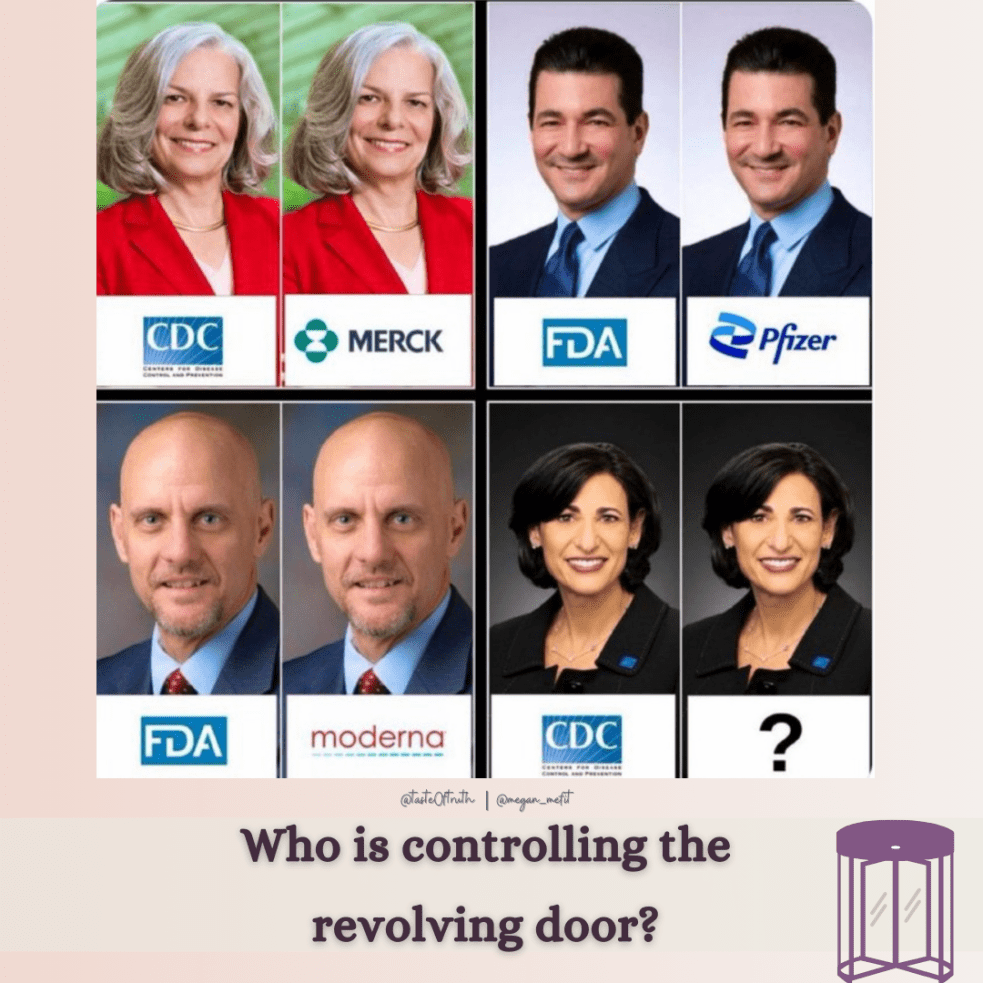
In the realm of public health and pharmaceuticals, there’s a well-documented phenomenon known as the “revolving door” between regulatory agencies and the pharmaceutical industry. This term refers to the cyclical movement of personnel between roles as regulators or policymakers and positions within the industries they oversee.

What Is the Revolving Door?

The revolving door concept highlights a pattern where high-ranking officials from organizations such as the CDC (Centers for Disease Control and Prevention) and the FDA (Food and Drug Administration) transition into influential roles within pharmaceutical companies, and vice versa. This fluid movement raises critical questions about the integrity and impartiality of regulatory oversight.

Notable Examples

Several prominent examples illustrate this phenomenon:

  • Scott Gottlieb, who served as the FDA Commissioner from 2017 to 2019, joined Pfizer’s board of directors shortly after his tenure at the FDA.
  • Julie Gerberding, the CDC Director from 2002 to 2009, transitioned to an executive role at Merck following her time at the CDC.
  • Stephen Hahn, FDA Commissioner from 2019 to 2021, took on a role at Flagship Pioneering, the venture capital firm instrumental in founding Moderna.

The Debate: Conflicts of Interest vs. Expertise

The revolving door sparks intense debate. Critics argue that this cycle of movement can create potential conflicts of interest. Regulators may be more lenient or biased towards the industries with which they have personal or future professional connections. This concern is particularly significant in the pharmaceutical sector, where regulatory decisions have profound implications for public health.

On the other hand, defenders suggest that this movement ensures that regulatory bodies benefit from the expertise and insider knowledge of seasoned professionals. They argue that these individuals bring valuable industry insights that can enhance regulatory practices and decisions.

The Impact on Public Health

The dynamics of the revolving door are crucial in discussions about the impartiality of regulatory oversight. In an industry where public health and safety are at stake, maintaining transparency and objectivity in regulatory processes is paramount. The potential for conflicts of interest necessitates ongoing scrutiny and reforms to ensure that the primary focus remains on safeguarding public health.

Robert F. Kennedy Jr. has been vocal about the issues with U.S. food systems, particularly targeting ultra-processed foods and the conflicts of interest surrounding federal dietary guidelines. He emphasizes how powerful food industry lobbies, including companies behind highly processed products, have influenced organizations like the USDA and FDA. RFK Jr. argues that this corruption has resulted in dietary guidelines that are detrimental to public health, prioritizing corporate profits over scientific integrity. He has criticized the ties between NGOs, including groups like the NAACP and diabetes associations, and the processed food lobby, which he claims skews their advocacy away from public health concerns and toward protecting industry interests.

Kennedy has connected these issues with broader systemic problems in the healthcare and pharmaceutical industries, asserting that ultra-processed foods contribute to a wide range of health problems, including metabolic disorders, cancer, and mental health issues. He also stresses that these foods disproportionately affect low-income communities and marginalized groups due to their accessibility, exacerbating health disparities. His stance resonates with his broader critique of government agencies being compromised by corporate interests, echoing his calls for transparency and reform across various sectors

As this debate continues, it is essential for the public to stay informed about these connections and advocate for transparency and accountability in the regulatory process. The revolving door is more than a mere career path—it’s a vital issue that affects how health policies and safety standards are shaped and enforced.

If you’re looking to explore the topic of conflicts of interest in the U.S. food system, including the influence of corporate lobbying on dietary guidelines and public health, here are some credible resources:

  1. Marion Nestle’s Work
    Marion Nestle, a renowned nutritionist and public health advocate, has extensively written about the politics of food and how corporate interests shape food policies. Her book “Food Politics: How the Food Industry Influences Nutrition and Health” is a foundational resource that explores conflicts of interest in detail. She has also published several articles and blog posts that can be found on her website, Food Politics.
  2. The Center for Science in the Public Interest (CSPI)
    CSPI is a non-profit organization that advocates for public health and transparency in the food industry. They regularly publish reports and articles on how industry lobbyists influence dietary guidelines and public health policies. Visit their site for comprehensive resources: CSPI.
  3. The Journal of the American Medical Association (JAMA)
    JAMA has published several peer-reviewed articles on the conflicts of interest within the committees that develop dietary guidelines. You can access these studies through JAMA.
  4. The Union of Concerned Scientists (UCS)
    UCS focuses on the intersection of science, policy, and industry influence, and they have published reports on the food industry’s role in shaping guidelines. You can find their reports here: UCS Food System Work.
  5. Robert F. Kennedy Jr.’s Health Freedom Platform
    RFK Jr.’s organization, Children’s Health Defense, provides reports and articles on corporate influence in healthcare and the food system. While this source may reflect RFK Jr.’s specific views, it offers insights into his arguments and data regarding industry control. Children’s Health Defense.

These resources provide a deep dive into the systemic issues within the food industry, helping you critically examine how corporate interests shape dietary guidelines and health outcomes.

nutritioninsight.com

Cambridge University Press & Assessment