New Episode Alert: The Dark Side of MLMs and Coercive Control
🚨 This Week on Taste of Truth Tuesdays 🚨, we’re diving into the complex and manipulative world of multi-level marketing (MLM) companies—uncovering the coercive control tactics they use to keep people hooked. 🧠💸 MLMs don’t just sell products. They sell a dream—a dream of financial freedom, wealth, and unlimited success. The problem? That dream is often built on deceptive tactics that prey on vulnerability, foster magical thinking, and emotionally manipulate their members.
At first glance, MLMs seem like a golden opportunity. They promise wealth, freedom, and independence—targeting people who are seeking a way out of financial struggle or a traditional 9-to-5. But underneath those glittering promises are dangerous tactics that prey on human psychology, exploiting emotional weaknesses to create loyalty and blind devotion.
A key tactic MLMs use is magical thinking. This is the belief that positive thoughts and visualizations alone can bring success, wealth, or health. A 2019 study in Frontiers in Psychology revealed that many MLMs sell products—like supplements and essential oils—by making unverified claims about curing diseases, with little to no scientific evidence to back them up. 😳
Why Is Magical Thinking So Dangerous?
Magical thinking isn’t just harmless optimism. In the context of MLMs, it can lead people to make poor financial and health decisions. Here’s why it’s so dangerous:
🚫 False Sense of Control: Magical thinking tricks people into believing they can control outcomes simply by thinking positively. This false confidence can prevent them from taking real, actionable steps to improve their situation.
🚫 Health Risks: MLMs often push supplements and oils with promises of “miracle cures” for serious illnesses—without scientific validation. People may choose these products over actual medical treatments, putting their health in danger.
🚫 Emotional Manipulation: By convincing members that failure is due to their lack of belief or effort, MLMs shift the blame from the system to the individual. This creates a toxic cycle of guilt and shame, trapping people emotionally in the MLM.
Coercive Loyalty and Emotional Manipulation
Beyond magical thinking, MLMs use coercive control tactics to create a false sense of community and belonging. They foster an atmosphere of loyalty where members feel pressured to stay positive, constantly recruit new people, and never question the system.
💥 Coercive Loyalty: Members are often told that the reason they’re not successful is because they’re not trying hard enough, recruiting enough, or believing in themselves. This turns failure into a personal flaw, rather than a flaw in the business model.
💥 Community Pressure: MLMs thrive on social dynamics, where members are encouraged to pressure their friends and family into joining. This creates a network of dependency and makes it harder for people to leave, even when they start seeing the cracks in the system.
💥 Emotional Exploitation: Guilt, shame, and failure are powerful emotional tools used by MLMs. When people don’t succeed, they’re often made to feel as if they didn’t believe in the product or themselves enough. This emotional manipulation keeps members invested—financially, mentally, and emotionally—even when the odds are against them.
Breaking Free: Real Stories of Escaping MLMs
In this week’s episode, we also share real stories of individuals who have been trapped in MLMs and how they broke free. These stories highlight the emotional, financial, and mental toll that MLMs take on their members, and how difficult it can be to escape once you’re in the cycle. 😳
Why You Need to Listen
If you’ve ever been approached by someone pushing a “life-changing opportunity” or a “groundbreaking product,” this episode is for you. If you’ve been tempted to join an MLM—or know someone who has—this episode is essential listening. We’re unpacking the toxic blend of pseudoscience, community pressure, and emotional exploitation that keeps MLMs running, and sharing actionable tips on how to recognize the red flags before it’s too late. 🚩
Tune in to this week’s episode of Taste of Truth Tuesdays to learn how to protect yourself from the manipulative tactics of MLMs and avoid falling into their web of magical thinking and emotional control. Whether you’re considering joining an MLM or are currently involved, understanding these tactics is key to protecting your financial and emotional well-being.
Magical thinking is a quirky psychological phenomenon where people believe that their thoughts, wishes, or actions can directly influence real-world outcomes, despite defying logic or scientific fact. It’s the belief that if you wish for something hard enough, visualize it every day, or think positively, the universe will somehow bend to your will. Sounds empowering, right? But in reality, it leads to a lot of irrational beliefs and behaviors, particularly in high-pressure environments like multi-level marketing (MLM) schemes.
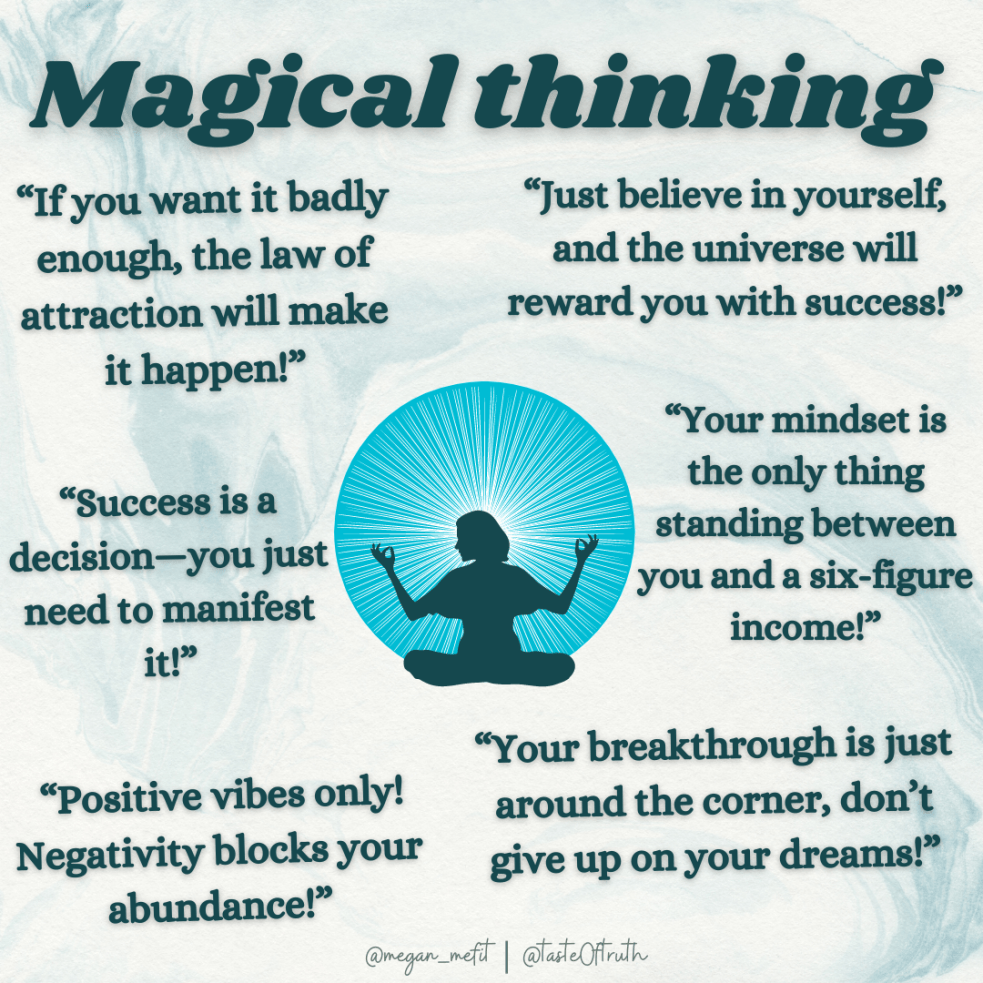
MLMs thrive on this kind of thinking, pushing slogans and practices that dangle the promise of success, wealth, and happiness in front of their members—all through nothing but the power of positive thinking and visualization. “Just think it, and it’ll happen!” But here’s the catch: it never really works like that.
Why Is Magical Thinking Dangerous?
1. False Sense of Control
Magical thinking feeds people this false sense of control over their lives and circumstances. It convinces them that all they need is positive vibes to attract success, which can lead to dangerous complacency. Instead of putting in the hard work, effort, and strategic thinking needed to succeed in any real business, MLM recruits often fall into a trap where they believe success will magically come to them. Spoiler alert: it won’t.
2. Financial Loss
MLMs are notorious for selling the idea that anyone can make it big if they just believe in themselves. It sounds inspiring, right? But it’s a trap. People are encouraged to pour their hard-earned money into products, recruitment materials, and endless training sessions without fully understanding the shaky foundation these businesses stand on. In reality, research shows that up to 99% of MLM participants lose money, but thanks to the allure of magical thinking, they keep going, convinced that their big break is just one more product purchase or recruit away.
3. Emotional Manipulation
MLMs are also masters of emotional manipulation. If you’re not succeeding, they’ll convince you that it’s not the business model that’s failing—it’s you. You didn’t think positively enough, you didn’t manifest hard enough, or you weren’t dedicated enough to your dreams. This emotional burden can leave individuals feeling guilty, ashamed, and like personal failures, even when the deck was stacked against them from the start. The cycle of shame continues as they compare themselves to the shiny success stories splashed all over social media.
4. Detachment from Reality
Magical thinking can lead to complete detachment from reality. When you’re convinced that positive thoughts are all you need, you can easily ignore the mounting red flags. People end up ignoring their dwindling bank accounts, fractured relationships, and mental exhaustion because they’re too busy trying to manifest success. And by the time they snap out of it, the damage is done.
Why Do MLMs Use Magical Thinking?
1. Reinforcement of Loyalty
MLMs aren’t just about selling products—they’re about creating a cult-like loyalty. By pushing magical thinking, they foster a tight-knit community of like-minded believers. This sense of belonging makes it incredibly difficult for individuals to walk away, even when the financial and emotional costs start piling up. After all, leaving the MLM means leaving the tribe—and who wants to be the one to break away?
2. Justification of Failure
When magical thinking is the foundation of your belief system, failure is never about the business model. It’s always personal. Didn’t make the millions you were promised? It’s because you didn’t believe enough. This mindset is a genius way for MLMs to deflect blame, keeping their own reputation intact while making their members feel like the problem lies with them. It keeps the business running without accountability.
3. Encouragement of Recruitment
MLMs thrive on recruitment, and magical thinking is the fuel for the machine. The idea that anyone can succeed if they just think positively or visualize their dreams is a powerful hook for drawing in new recruits. If everyone believes success is inevitable through mental willpower alone, they’ll keep signing up—and bringing others with them.
Red Flags to Watch Out For
• Slogans and Phrases
Be on the lookout for those overly-optimistic, saccharine catchphrases like, “Just believe and you’ll achieve!” or “Manifest your dreams, and they’ll come true!” These slogans might seem harmless at first, but they’re big red flags that magical thinking is being used to manipulate and keep people hooked.
• Focus on Personal Stories
MLMs love to highlight the few personal success stories where individuals “made it,” while conveniently sweeping the 99% of struggling participants under the rug. This selective storytelling distorts reality and feeds the illusion that success is within easy reach for everyone.
• Pressure to Stay Positive
If you feel constant pressure to only stay positive and avoid discussing any challenges or failures, that’s another major warning sign. MLMs don’t want anyone disrupting their “positive vibes” because questioning the business model threatens the entire operation.
• Ignoring Evidence
If an MLM is constantly dismissing scientific evidence or research in favor of anecdotal stories and positive affirmations, it’s time to raise an eyebrow. Facts and figures don’t lie—but magical thinking demands you ignore the hard truths in favor of feel-good fiction.
Conclusion
Magical thinking can feel seductive—after all, who doesn’t want to believe that simply thinking positively can change your life? But in the context of MLMs, it’s a dangerous trap that exploits emotions, manipulates reality, and can lead to significant financial and psychological harm.
Recognizing the power of magical thinking is a key step toward protecting yourself from falling prey to MLM schemes. The next time someone tries to sell you the dream with a hefty dose of “just believe,” remember: real success comes from strategy, effort, and critical thinking—not wishful thinking. Stay sharp, and always dig for the facts behind the hype.
If you’re looking to dig deeper into the topic of magical thinking, MLMs, and their psychological impacts, here are some top-notch resources that will give you the depth and insight needed to fully understand the scope of this issue:
1. Books
“Merchants of Deception” by Eric Scheibeler
A former high-ranking member of an MLM, Scheibeler exposes the dark side of the industry, shining a light on the manipulative tactics, including magical thinking, used to keep participants hooked and financially invested.
“Ponzinomics: The Untold Story of Multi-Level Marketing” by Robert FitzPatrick
FitzPatrick’s book is one of the most thorough resources available on MLMs, dissecting the psychological manipulation that fosters the illusion of success, including how magical thinking plays a role in perpetuating these business models.
“Influence: The Psychology of Persuasion” by Robert B. Cialdini
While not specifically about MLMs, this classic book on persuasion provides a solid foundation for understanding the psychological tactics used in MLMs, including magical thinking. The book covers how people are influenced by emotional appeals and irrational thinking in decision-making.
“The Confidence Game: Why We Fall for It… Every Time” by Maria Konnikova
This book dives into why people fall for scams, cons, and magical thinking, explaining the psychological elements at play, such as the desire for control and emotional manipulation—key tactics used by MLMs.
2. Podcasts
“The Dream”
This investigative podcast explores the world of MLMs, breaking down the psychological manipulation, emotional appeals, and magical thinking used to recruit and retain participants. The show offers interviews and personal stories, exposing the inner workings of MLMs in a captivating and digestible format.
“MLM: The Broke Podcast”
Hosted by a former MLM member, this podcast uncovers how MLMs operate and the manipulative strategies they employ. The podcast touches on magical thinking and the emotional manipulation that keeps participants in these schemes.
3. Academic Articles & Research Papers
“Magical Thinking and Superstitions: How Beliefs and Cognitive Biases Drive Irrational Behavior” – by Michael Shermer
This article explores the psychological underpinnings of magical thinking and how it relates to belief systems. Shermer’s work is helpful for understanding the cognitive biases MLMs exploit.
“The Dark Side of Positive Thinking” by Gabriele Oettingen (Psychological Science)
Oettingen’s research critically examines the idea that positive thinking, often promoted in MLMs, can lead to worse outcomes when people fail to back it up with realistic planning and action, a key aspect of magical thinking.
“The Fantasy of Success: MLMs and the Psychology of Unrealistic Optimism” by Kim Korteweg (Journal of Business Ethics)
This study looks at the role of unrealistic optimism and magical thinking in MLM recruitment and retention, providing a scholarly perspective on how these psychological tricks keep participants engaged.
4. Documentaries & Films
“Betting on Zero” (2016)
This documentary follows hedge fund manager Bill Ackman’s quest to expose Herbalife as a pyramid scheme. It highlights how MLMs, including Herbalife, use magical thinking to maintain their recruitment and selling operations, and the devastating impact it has on participants.
“LuluRich” (2021)
A documentary series about the rise and fall of LuLaRoe, this film touches on the magical thinking that drove people to invest thousands into the company based on promises of riches and financial freedom. It dives into the personal stories of those who fell victim to the MLM’s tactics.
5. Articles and Blogs
“MLMs Use Magical Thinking to Sell Dreams” (The Atlantic)
This article delves into the connection between magical thinking and MLM success, explaining how the industry’s use of vision boards, affirmations, and other positive-thinking tactics lure people into believing they can manifest wealth.
“Why People Keep Falling for MLM Scams” by Amanda Montell (Cosmopolitan)
Montell breaks down the psychological manipulation MLMs use, including magical thinking, and how they tap into emotional vulnerabilities, especially for women seeking financial independence or a sense of community.
“Multi-Level Marketing and the Cult of Magical Thinking” (Psychology Today)
This blog post by a psychologist explores the mental traps of magical thinking, including how MLMs leverage these tactics to keep people hooked, even when they’re losing money.
6. Research Studies & Psychology Databases
American Psychological Association (APA)
The APA has various articles and studies on cognitive distortions, belief systems, and the psychology behind magical thinking, which are key to understanding how MLMs manipulate thought patterns.
PubMed/NIH Studies
If you’re looking for peer-reviewed research, searching PubMed for articles on cognitive biases, emotional manipulation, and the psychology of MLMs can provide high-quality, evidence-based insights.
These resources will give you a comprehensive understanding of how magical thinking, emotional manipulation, and psychological tricks are intertwined with MLM schemes. Whether you’re writing, podcasting, or just seeking to educate yourself, these tools will sharpen your perspective on the dangers of MLMs and the allure of magical thinking.
Welcome back to Taste0ftruth Tuesdays, where today’s topic is Mindsets and Movements: Comparing Law of Attraction, High Control Religion, and Diet Culture
Ever wondered how MLMs thrive? Many of them tap into the power of teachings like the law of attraction—convincing you that your thoughts create your reality. It sounds empowering, right? 🤪
But behind the facade lies a darker truth. MLMs manipulate these beliefs to lure in dreamers, promising wealth and success through their products.
So, what’s the scoop? The Law of Attraction says that what you focus on—whether positive vibes or the occasional grumpy thought—can actually manifest in your life. It’s all about tuning into those good vibrations and sending out positive signals to the universe.
Picture this: by visualizing your dreams, practicing gratitude like a pro, and keeping that vibe high, you’re supposedly paving the way for all those good things to come knocking on your door. 🚪
But hold up! It’s not all rainbows and sunshine. Just like dodging fad diets or harmful religious practices, there are pitfalls.
Stay tuned as we uncover the highs, lows, and everything in between of this cosmic mind game. We’ll share some tips on how to keep your mental mojo balanced, whether you’re manifesting your dream job or just trying to stay chill in the chaos.
Let’s walk that fine line between harnessing the power of our minds and falling into the traps of unrealistic expectations and self-blame.
The law of attraction, diet culture, and high-control religions can promote all-or-nothing thinking in several ways:
1. Law of Attraction: This philosophy suggests that positive thoughts bring positive outcomes, and negative thoughts bring negative outcomes. This can lead people to believe that if they’re not constantly thinking positively, they’re attracting negativity into their lives. This binary thinking ignores the complexity of human emotions and experiences.
2. Diet Culture: Many diets promote strict rules about what foods are “good” or “bad,” fostering an all-or-nothing approach to eating. If someone deviates from the diet even slightly, they may feel like they’ve failed completely. This can contribute to unhealthy relationships with food and body image.
3. High-Control Religions (HCR): Some religions enforce rigid rules and beliefs, presenting a stark contrast between righteousness and sin. Followers may feel intense pressure to adhere perfectly to these standards, fearing severe consequences for any perceived transgression.
This black-and-white thinking can create feelings of guilt, shame, or inadequacy.
In each case, the emphasis on absolutes and extremes discourages nuanced thinking and self-compassion. It can lead individuals to judge themselves harshly for perceived failures and to feel like they must constantly strive for unattainable ideals.
The law of attraction mindset can be damaging to mental health and well-being, I know this from my past experiences prior to being converted into a high control religion. In my journey of deconstruction, I’ve been pondering how belief systems like the law of attraction, high-control religions, and diet culture wield their influence.
Each of these ideologies promises transformative change through strict adherence to their principles, whether it’s manifesting positivity, spiritual purity, or a perfect body.
But here’s the kicker – they all share several common threads 🧵 🪡
1. Belief in Control and Manifestation
2. Promises of Transformation
3. Blaming the Individual for Failure
4. Emphasis on Discipline and Compliance
5. Commercialization and Profit
While their specific goals vary, the law of attraction, high-control religions, and diet culture share fundamental similarities in their mechanisms of belief, control, promise of transformation, and their impact on adherents’ lives
Similarities in Their Harmful Effects:
1. Unrealistic Expectations:
– Law of Attraction: Promises that positive thinking can manifest any desire, leading to unrealistic expectations about what can be achieved without effort or acknowledging external factors.
– Diet Culture: Promotes the idea that a perfect body is achievable through strict adherence to specific diets or exercise regimens, often ignoring genetic, physiological, and lifestyle differences.
– High Control Religion (HCR): Claims of absolute truths and moral perfection can create unattainable standards for behavior and belief, often leading to feelings of inadequacy or failure when individuals fall short.
2. Self-Blame and Guilt:
– Law of Attraction: Encourages individuals to believe that any failure to achieve their desires is due to their own negative thinking, leading to self-blame and guilt.
– Diet Culture: Instills guilt and shame in individuals who cannot maintain the prescribed diet or achieve the desired body image, blaming them for a lack of willpower or discipline.
– HCR: Imposes strict moral codes and doctrines, where deviation is often seen as a personal failure or sin, leading to guilt and self-condemnation.
3. Emotional Manipulation:
– Law of Attraction: Often exploits emotional vulnerability by selling the idea that happiness and success are just a thought away, leading to financial exploitation through self-help products and courses.
– Diet Culture: Uses emotional manipulation to sell products, diets, and fitness programs, preying on insecurities about body image and societal standards of beauty.
– HCR: Can manipulate emotions by promising eternal rewards or threatening eternal punishment, using fear and hope to control behavior and beliefs.
4. Avoidance of Complex Realities:
– Law of Attraction: Simplifies complex life issues by attributing outcomes solely to individual thoughts, ignoring systemic, social, and external factors.
– Diet Culture: Overlooks the complexities of human biology, metabolism, and mental health by promoting one-size-fits-all solutions to weight and health.
– HCR: May offer simple answers to complex existential questions, discouraging critical thinking and exploration of diverse perspectives.
5. Promotion of Perfectionism:
– Law of Attraction: Suggests that perfect thoughts can lead to a perfect life, fostering an unrealistic ideal of constant positivity.
– Diet Culture: Advocates for an ideal body type and perfect eating habits, leading to obsessive behaviors and unhealthy relationships with food and self-image.
– HCR: Can push for moral and spiritual perfection, creating pressure to conform to strict standards and leading to anxiety and fear of judgment.
Mental Health Concerns:
1. Unrealistic Expectations:
Believing that thoughts alone can manifest reality may lead to unrealistic expectations and disappointment when desired outcomes don’t materialize. This can lead to frustration, self-blame, and decreased self-esteem.
2. Ignoring Reality:
Overemphasis on positive thinking can sometimes lead to denial of real issues or avoidance of necessary actions. Individuals may neglect practical steps and problem-solving strategies, relying solely on mental strategies.
3. Blame and Guilt:
When negative events occur, individuals might blame themselves for having “wrong” or “negative” thoughts. This self-blame can exacerbate feelings of guilt, anxiety, and depression.
4. Mental Health Symptoms Exacerbation:
For individuals with certain mental health conditions, such as anxiety disorders or obsessive-compulsive disorder (OCD), the pressure to control thoughts can be particularly detrimental. Intrusive thoughts and the fear of their potential impact can intensify symptoms.
5. Isolation:
If individuals feel their spiritual practices are misunderstood or dismissed by others, they may become isolated. Lack of social support can negatively impact mental health.
These ideologies promise transformative change through strict adherence to their principles, often promoting all-or-nothing thinking. But breaking free from this mindset is crucial for fostering balanced perspectives and personal growth.
Here are practical tips to challenge all-or-nothing thinking:
1. Practice Mindfulness: Embrace techniques like meditation to become aware of thoughts without judgment, recognizing when you’re stuck in extremes.
2. Identify Thought Patterns: Notice words like ‘always’ and ‘never,’ replacing them with ‘sometimes’ or ‘progress’ to introduce flexibility.
3. Challenge Assumptions: Explore alternative perspectives and shades of gray instead of thinking in absolutes.
4. Set Realistic Goals: Break down big goals into smaller steps, celebrating progress and effort along the way.
5. Practice Self-Compassion: Be kind to yourself during setbacks, understanding that growth involves learning from mistakes.
6. Seek Different Opinions: Discuss beliefs with trusted others to gain diverse viewpoints and broaden understanding.
7. Use the 10% Rule: Aim for gradual improvement rather than perfection, reducing pressure and promoting sustainable progress.
8. Keep a Thought Journal: Reflect on instances of all-or-nothing thinking to identify triggers and develop alternative interpretations.
9. Practice Gratitude: Regularly acknowledge small positives to shift focus away from perfectionism.
10. Educate Yourself: Learn about cognitive distortions to empower yourself in challenging and changing these patterns effectively.
By integrating these practices, we can cultivate resilience and a more balanced approach to life, moving beyond rigid belief systems toward authenticity and personal well-being.
And that’s all I have for you today, folks!
For upcoming episodes, we have Deconstructing Deception: MLMs, Exploitation & Online Influencers with my friend Jill, we dive into the murky waters of high control groups like MLMs, conspiracies and evangelicalism. We discuss about how exploitation is huge in these environments. And I share a bit more about my journey from MLM entanglement to pandemic conspiracies and high-control religion.
Next month: Equality in Focus: Reproductive Rights, Gender Norms, and Political Reform with my friend Emma and a lot more exciting interviews coming for you!
Until then, maintain your curiosity, embrace skepticism, and keep tuning in! 🎙️🔒
To deepen your understanding of the potential pitfalls of spiritual practices like the law of attraction, diet culture, and religious absolutism, as well as to develop critical thinking and emotional intelligence, consider exploring these high-quality resources across various formats:
Books:
“Bright-Sided: How Positive Thinking Is Undermining America” by Barbara Ehrenreich** – This book critiques the overemphasis on positive thinking and its societal impacts.
“Dietland” by Sarai Walker** – A fictional yet poignant critique of diet culture and societal beauty standards.
“The Body is Not an Apology: The Power of Radical Self-Love” by Sonya Renee Taylor** – Discusses body positivity and challenges diet culture.
“When Prophecy Fails” by Leon Festinger, Henry Riecken, and Stanley Schachter** – A classic work on cognitive dissonance, exploring how people react when prophecies or absolute religious claims fail.
Articles and Papers:
“The Trouble with the ‘Law of Attraction'” by Carolyn Gregoire** (HuffPost) – Discusses the psychological and practical issues with the law of attraction.
“The Harmful Effects of Diet Culture” by Taylor Wolfram** (Academy of Nutrition and Dietetics) – An article exploring the negative impacts of diet culture.
“The Perils of Positive Thinking” by Susan David** (Harvard Business Review) – Analyzes the downsides of relentless positivity in personal and professional settings.
Websites and Online Courses:
Intuitive Eating – A resource focusing on a balanced approach to food and body image, countering diet culture.
Coursera and edX – Provide courses on critical thinking, emotional intelligence, and psychology. Examples include:
– “The Science of Well-Being” by Yale University (Coursera)
– “Psychological First Aid” by Johns Hopkins University (Coursera)
Podcasts and Videos:
1. “Maintenance Phase” – A podcast debunking wellness and diet culture myths.
“The Happiness Lab” by Dr. Laurie Santos** – Explores the science of well-being, addressing the limits of positive thinking.
TED Talks – Search for talks on critical thinking, the psychology of belief, and emotional intelligence. Notable example:
“The Danger of a Single Story” by Chimamanda Ngozi Adichie
Supportive Communities:
Body Positivity Groups** – Communities like “The Body Positive” offer support and resources to counteract diet culture.
Skeptics Societies – Organizations like The Skeptics Society promote scientific skepticism and critical thinking about various claims, including those related to spirituality and religion.
Religious Literacy Projects – Programs like Harvard’s Religious Literacy Project provide nuanced education on religion and its diverse expressions, promoting understanding and critical engagement.
Academic Journals:
Journal of Positive Psychology** – Offers research on the benefits and limitations of positive thinking and related practices.
International Journal for the Psychology of Religion** – Publishes research on the psychological aspects of religious beliefs and practices.
These resources can help you critically engage with the topics, develop a balanced perspective, and avoid the pitfalls associated with overly simplistic or manipulative practices.


 Taste0ftruth Tuesdays