The Bible Isn’t History and Trump Isn’t Your Savior
It’s Been a Minute… Let’s Get Real
Hey Hey, welcome back to Taste of Truth Tuesdays! it’s been over a month since my last episode, and wow—a lot has happened. Honestly, I’ve been doing some serious soul-searching and education, especially around some political events that shook me up.
I was firmly against Trump’s strikes on Iran. And the more I dug in, the more I realized how blind I’d been completely uneducated and ignorant about the massive political power Zionism holds in this country. And it’s clear now: Trump is practically bent over the Oval Office for Netanyahu. The Epstein files cover-up only confirms that blackmail and shadow control are the real puppet strings pulling at the highest levels of power. Our nation has been quietly occupied since Lyndon B. Johnson’s presidency and that’s a whole other episode I’ll get into later.
Once I saw that, the religious right’s worship of him stopped looking like misguided patriotism and started looking like mass delusion. Or complicity. Either way, I couldn’t unsee it.
And that’s when I started asking the bigger questions: What else have we mistaken for holy? What else have we accepted as truth without scrutiny?
For now, I want to cut to the heart of the matter: the major problem at the root of so much chaos: the fact that millions of Christians still believe the Bible is a literal historical document.
This belief doesn’t just distort faith-it fuels political agendas, end-times obsession, and yes, even foreign policy disasters. So, let’s dig into where this all began, how it’s evolved, and why it’s time we rethink everything we thought we knew about Scripture.
Thanks for reading Taste of Truth! Subscribe for free to receive new posts and support my work.
For most Christians, the Bible is more than a book-it’s the blueprint of reality, the inspired Word of God, infallible and untouchable. But what if that belief wasn’t original to Christianity? What if it was a reaction…. a strategic response to modern doubt, historical criticism, and the crumbling authority of the Church?
In this episode, we’re pulling back the veil on the doctrine of biblical inerrancy, the rise of dispensationalism, and the strange marriage of American politics and prophetic obsession. From the Scofield Bible to the belief that modern-day Israel is a fulfillment of God’s plan, we’re asking hard questions about the origins of these ideas.
As Dr. Mark Gregory Karris said when he joined us on a previous episode: “Can you imagine two different families? One, the Bible is the absolute inerrant word of God every.Word, every jot and title, so to speak, is meant to be in there due to the inspiration of God. And so every story you read, you know, God killing Egyptian babies and God flooding the entire planet and thinking, well yeah, there’s gonna be babies gasping for air and drowning grandmothers and all these animals. And that is seen as absolute objective truth. But then in another family, oh, these are, these are myths. These are sacred myths that people can learn from. No, that wasn’t like God speaking and smiting them and burning them alive because they touch this particular arc or now that this is how they thought given their minds at the time, given their understandings of and then like you talked about oh look at that aspect of humanity interesting that they portrayed god and not like it becomes like wow that’s cool instead of like oh my gosh i need 3-4 years of therapy because I was taught the bible in a particular way.”
Once you trace these doctrines back to their roots, it’s not divine revelation you find: it’s human agendas.
Let’s get uncomfortable. Was your faith formed by sacred truth… or centuries of strategic storytelling?
How Literalism Took Over
In the 19th century, biblical literalism became a kind of ideological panic room. As science, archaeology, and critical scholarship began to chip away at traditional interpretations, conservative Christians doubled down. Instead of exploring the Bible as a complex, layered anthology full of metaphor, moral instruction, and mythology, they started treating it like a divine press release. Every word had to be accurate. Every timeline had to match. Every contradiction had to be “harmonized” away.
The Myth of Inerrancy
One of the most destructive byproducts of this era was the invention of biblical inerrancy. Yes, invention. The idea that the Bible is “without error in all that it affirms” isn’t ancient…. it’s theological propaganda, most notably pushed by B.B. Warfield and his peers at Princeton. Rogers and McKim wrote extensively about how this doctrine was manufactured and not handed down from the apostles as many assume. We dive deeper into all that—here.
Inerrancy teaches that the Bible is flawless, even in its historical, scientific, and moral claims. But this belief falls apart under even basic scrutiny. Manuscripts don’t agree. Archaeological timelines conflict with biblical ones. The Gospels contradict each other. And yet this doctrine persists, warping believers’ understanding and demanding blind loyalty to texts written by fallible people in vastly different cultures.
That’s the danger of biblical inerrancy: it treats every verse as historical journalism rather than layered myth, metaphor, or moral instruction. But what happens when you apply that literalist lens to ancient origin stories?
📖 “Read as mythology, the various stories of the great deluge have considerable cultural value, but taken as history, they are asinine and absurd.” — John G. Jackson, Christianity Before Christ
And yet, this is the foundation of belief for millions who think Noah’s Ark was a literal boat and not a borrowed flood myth passed down and reshaped across Mesopotamian cultures. This flattening of myth into fact doesn’t just ruin the poetry-it fuels bad politics, end-times obsession, and yes… Zionism.
And just to be clear, early Christians didn’t read the Bible this way. That kind of rigid literalism didn’t emerge until centuries later…long after the apostles were gone. We’ll get to that.
When we cling to inerrancy, we’re not preserving truth. We’re missing it entirely.
Enter: Premillennial Dispensationalism
If biblical inerrancy was the fuel, C.I. Scofield’s 1909 annotated Bible was the match. His work made premillennial dispensationalism a household belief in evangelical churches. For those unfamiliar with the term, here’s a quick breakdown:
Premillennialism: Jesus will return before a literal thousand-year reign of peace.
Dispensationalism: History is divided into distinct eras (or “dispensations”) in which God interacts with humanity differently.
When merged, this theology suggests we’re living in the “Church Age,” which will end with the rapture. Then comes a seven-year tribulation, the rise of the Antichrist, and finally, Jesus returns for the ultimate battle after which He’ll rule Earth for a millennium. Sounds like the plot of a dystopian film, right? And yet, this became the dominant lens through which American evangelicals interpret reality.
The result? A strange alliance between American evangelicals and Zionist nationalism. You get politicians quoting Revelation like it’s foreign policy, pastors fundraising for military aid, and millions of Christians cheering on war in the Middle East because they think it’ll speed up Jesus’ return.
But here’s what I want you to take away from this episode today: none of this works unless you believe the Bible is literal, infallible, and historically airtight.
How This Shaped Evangelical Culture and Politics
The Scofield Bible didn’t just change theology. It changed culture. Dispensationalist doctrine seeped into seminaries like Dallas Theological Seminary and Moody Bible Institute, influencing generations of pastors. It also exploded into popular culture through Hal Lindsey’s The Late Great Planet Earth and the Left Behind series. Fiction, prophecy, and fear blurred into one big spiritual panic attack.
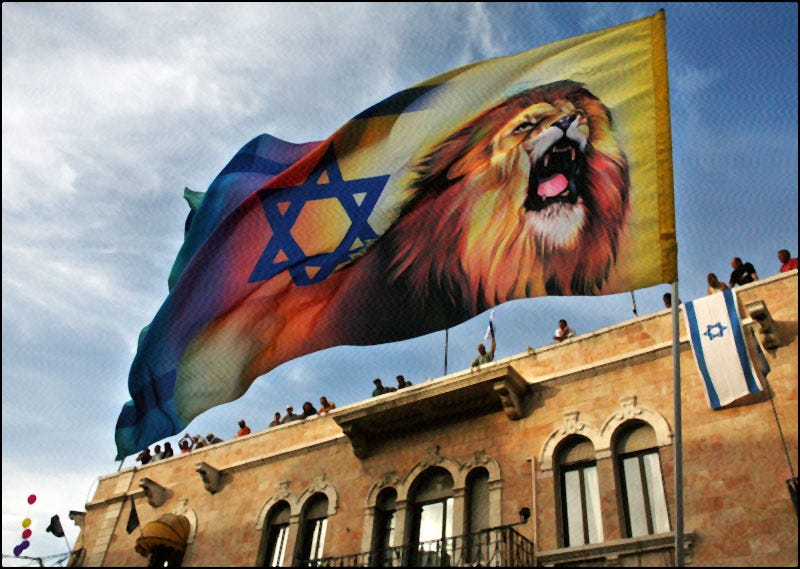
But perhaps the most alarming shift came in the political realm. Dispensationalist belief heavily influences evangelical support for the modern state of Israel. Why? Because many believe Israel’s 1948 founding was a prophetic event. Figures like Jerry Falwell turned theology into foreign policy. His organization, the Moral Majority, was built on an unwavering belief that supporting Israel was part of God’s plan. Falwell didn’t just preach this, he traveled to Israel, funded by its government, and made pro-Israel advocacy a cornerstone of evangelical identity.
This alignment between theology and geopolitics hasn’t faded. In the 2024 election cycle, evangelical leaders ranked support for Israel on par with anti-abortion stances. Ralph Reed, founder of the Faith and Freedom Coalition, explicitly said as much. Donald Trump even quipped that “Christians love Israel more than Jews.” Whether that’s true or not, it reveals just how deep this belief system runs.
And the propaganda doesn’t stop there…currently Israel’s Foreign Ministry is funding a week-long visit for 16 prominent young influencers aligned with Donald Trump’s MAGA and America First movements, part of an ambitious campaign to reshape Israel’s image among American youth.
But Let’s Talk About the Red Flags
This isn’t just about belief-it’s about control. Dispensationalist theology offers a simple, cosmic narrative: you’re on God’s winning team, the world is evil, and the end is near. There’s no room for nuance, no time for doubt. Just stay loyal, and you’ll be saved.
This thinking pattern isn’t exclusive to Christianity. You’ll find it in MLMs, and some conspiracy theory communities. The recipe is the same: create an in-group with secret knowledge, dangle promises of salvation or success, and paint outsiders as corrupt or deceived. It’s classic manipulation-emotional coercion wrapped in spiritual language.
And let’s not forget the date-setting obsession. Hal Lindsey made a career out of it. People still point to blood moons, earthquakes, and global politics as “proof” that prophecy is unfolding. If you’ve ever been trapped in that mindset, you know how addictive and anxiety-inducing it can be.
BY THE WAY, it’s not just dispensationalism or the Scofield Bible that fuels modern Zionism. The deeper issue is, if you believe the Bible is historically accurate and divinely orchestrated, you’re still feeding the ideological engine of Zionism. Because at its core, Christianity reveres Jewish texts, upholds Jewish chosenness, and worships a Jewish messiah. That’s not neutrality it’s alignment.
If this idea intrigued you, you’re not alone. There’s a growing body of work unpacking how Christianity’s very framework serves Jewish supremacy, whether intentionally or not. For deeper dives, check out Adam Green’s work over at Know More News on Rumble, and consider reading The Jesus Hoax: How St. Paul’s Cabal Fooled the World for Two Thousand Years. You don’t have to agree with everything to realize: the story you were handed might not be sacred it might be strategic.
Why This Matters for Deconstruction
For me, one of the most painful parts of deconstruction was realizing I’d been sold a false bill of goods. I was told the Bible was the infallible word of God. That it held all the answers. That doubt was dangerous. But when I began asking real questions, the entire system started to crack.
The doctrine of inerrancy didn’t deepen my faith… it limited it. It kept me from exploring the Bible’s human elements: its contradictions, its cultural baggage, and its genuine beauty. The truth is that these texts were written by people trying to make sense of their world and their experiences with the divine. They are not divine themselves.
Modern Scholarship Breaks the Spell
Modern biblical scholarship has long since moved away from the idea of inerrancy. When you put aside faith-based apologetics and look honestly at the evidence, the traditional claims unravel quickly:
Moses didn’t write the Torah. Instead, the Pentateuch was compiled over centuries by multiple authors, each with their own theological agendas (see the JEDP theory).
King David is likely a mythic figure. Outside of the Bible, there’s no solid evidence he actually existed, much less ruled a vast kingdom.
The Gospels weren’t written by Matthew, Mark, Luke, and John. Those names were added later. The original texts are anonymous and they often contradict each other.
John didn’t write Revelation. Not the Apostle John, anyway. The Greek and style are completely different from the Gospel of John. The real author was probably some unknown apocalyptic mystic on Patmos, writing during Roman persecution.
And yet millions still cling to these stories as literal fact, building entire belief systems and foreign policies on myths and fairy tales.
🧠 Intellectual Starvation in Evangelicalism
Here’s the deeper scandal: it’s not just that foundational Christian stories crumble under modern scrutiny. It’s that the church never really wanted you to think critically in the first place.
Mark Noll, a respected evangelical historian, didn’t mince words when he wrote:
“The scandal of the evangelical mind is that there is not much of an evangelical mind.”
In The Scandal of the Evangelical Mind, Noll traces how American evangelicalism lost its intellectual life. It wasn’t shaped by a pursuit of truth, but by populist revivalism, emotionalism, and a hyper-literal obsession with “the end times.” The same movements that embraced dispensationalism and biblical inerrancy also gutted their communities of academic rigor, curiosity, and serious theological reflection.
The result? A spiritually frantic but intellectually hollow faith—one that discourages questions, mistrusts scholarship, and fears nuance like it’s heresy.
Noll shows that instead of grappling with ambiguity or cultural complexity, evangelicals often default to reactionary postures. This isn’t just a relic of the past. It’s why so many modern Christians cling to false authorship claims, deny historical context, and accept prophecy as geopolitical fact. It’s why Revelation gets quoted to justify Zionist foreign policy without ever asking who actually wrote the book or when, or why.
This anti-intellectualism isn’t an accident. It was baked in from the start.
But Noll doesn’t leave us hopeless. He offers a call forward: for a faith that engages the world with both heart and mind. A faith that can live with tension, welcome complexity, and evolve beyond fear-driven literalism.
What Did the Early Church Actually Think About Scripture?
Here’s what gets lost in modern evangelical retellings: the earliest Christians didn’t treat Scripture the way today’s inerrantists do.
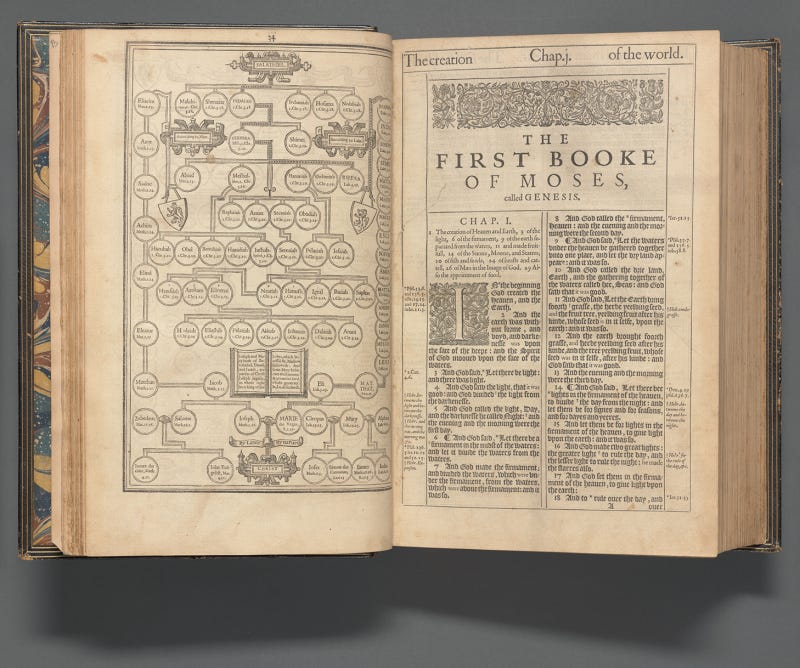
For the first few centuries, Christians didn’t even have a finalized Bible. There were letters passed around, oral traditions, a few widely recognized Gospels, and a whole lot of discussion about what counted as authoritative. It wasn’t until the fourth century that anything close to our current canon was even solidified. And even then, it wasn’t set in stone across all branches of Christianity.
Church fathers like Origen, Clement of Alexandria, and Irenaeus viewed Scripture as spiritually inspired but full of metaphor and mystery. They weren’t demanding literal accuracy; they were mining the texts for deeper meanings. Allegory was considered a legitimate, even necessary, interpretive method. Scripture was read devotionally and theologically, not scientifically or historically. In other words, it wasn’t inerrancy that defined early Christian engagement with Scripture, it was curiosity and contemplation.
For a deeper dive, check out The Gnostic Informant’s incredible documentary that uncovers the first hundred years of Christianity, a period that has been systematically lied about and rewritten. It reveals how much of what we take for granted was shaped by political and theological agendas far removed from the original followers of Jesus.
If you’re serious about understanding the roots of your faith or just curious about how history gets reshaped, this documentary is essential viewing. It’s a reminder that truth often hides in plain sight and that digging beneath the surface is how we reclaim our own understanding.
Protestantism: A Heretical Offshoot Disguised as Tradition
The Protestant Reformation shook things up in undeniable ways. Reformers like Martin Luther and John Calvin challenged the Catholic Church’s abuses and rightly demanded reform. But what’s often missed (or swept under the rug) is how deeply Protestantism broke with the ancient, historic Church.
By insisting on sola scriptura—Scripture alone—as the sole authority, the Reformers rejected centuries of Church tradition, councils, and lived community discernment that shaped orthodox belief. They didn’t invent biblical inerrancy as we know it today, but their elevation of the Bible above all else cracked the door wide open for literalism and fundamentalism to storm in.
What began as a corrective movement turned into a theological minefield. Today, Protestantism isn’t a single coherent tradition; it’s a sprawling forest of over 45,000 different denominations, all claiming exclusive access to “the truth.”
This fragmentation isn’t accidental…. it’s the logical outcome of rejecting historic continuity and embracing personal interpretation as the final authority.
Far from preserving the faith of the ancient Church, Protestantism represents a fractured offshoot: one that often contradicts the early Church’s beliefs and teachings. It trades the richness of lived tradition and community wisdom for a rigid, literalistic, and competitive approach to Scripture.
The 20th century saw this rigid framework perfected into a polished doctrine demanding total conformity and punishing doubt. Protestant fundamentalism turned into an ideological fortress, where questioning is treated as betrayal, and theological nuance is replaced by black-and-white dogma.
If you want to understand where so much of modern evangelical rigidity and end-times obsession comes from, look no further than this fractured legacy. Protestantism’s break with the ancient Church set the stage for the spiritual and intellectual starvation that Mark Noll so powerfully exposes.
Rethinking the Bible
Seeing the Bible as a collection of human writings about God rather than the literal word from God opens up space for critical thinking and compassion. It allows us to:
Study historical context and cultural influences.
Embrace the diversity of perspectives in Scripture.
Let go of rigid interpretations and seek core messages like love, justice, and humility.
Move away from proof-texting and toward spiritual growth.
Reconcile faith with science, reason, and modern ethics.
When we stop demanding that the Bible be perfect, we can finally appreciate what it actually is: a complex, messy, beautiful attempt by humans to understand the sacred.
This shift doesn’t weaken faith…. I believe it strengthens it.
It moves us away from dogma disguised as certainty and into something deeper…. something alive. It opens the door for real relationship, not just with the divine, but with each other. It makes space for growth, for disagreement, for honesty.
And in a world tearing itself apart over whose version of truth gets to rule, that kind of open-hearted spirituality isn’t just refreshing-it’s essential.
Because if your faith can’t stand up to questions, history, or accountability… maybe it was never built on truth to begin with.
Let’s stop worshiping the paper and start seeking the presence.
🔎 Resources Worth Exploring:
“The Jesus Hoax: How St. Paul’s Cabal Fooled the World for Two Thousand Years” by David Skrbina
“Christianity Before Christ” by John G. Jackson
The Scandal of the Evangelical Mind” by Mark Noll – A scathing but sincere critique from within the evangelical tradition itself. Noll exposes how anti-intellectualism, biblical literalism, and cultural isolationism have gutted American Christianity’s ability to engage the world honestly.
Check out Adam Green’s work at Know More News on Rumble for more on the political and mythological implications of Christian Zionism
And don’t miss my interview with Dr. Mark Gregory Karris, author of The Diabolical Trinity: Wrathful God, Sinful Self, and Eternal Hell, where we dive deep into the psychological damage caused by toxic theology
Forget your zombie apocalypse fantasies — the real outbreak is Trump Derangement Syndrome (TDS), where rational thinking flies out the window the moment “Orange Man” is mentioned. TDS has become a modern-day fever that sends reasonable minds into a frenzy. If you’ve seen this around you, you’re not alone. But let me just say, I get it! I used to be there. When Trump won in 2016, I cried. I felt the devastation, the outrage, the “what’s happening to our country?!” moment that so many others experienced. I believed the media narratives without question and wore that emotional turmoil like a badge. But then, something clicked. I started researching more carefully, looking into primary sources, seeking out independent media, and asking myself what I was really feeling about the issues rather than just repeating the party line. Over time, I saw the layers of complexity, nuance, and even hypocrisy that I’d never realized before.
Now, let’s take a deeper look at each of the TDS symptoms:
Symptoms of TDS: Diagnosing the Outrage
1. “Fascist! Racist! Sexist!”
If you so much as mention Trump in a positive light, brace yourself for the onslaught: you’re suddenly a fascist, racist, sexist, homophobic, xenophobic, bigoted conspiracy theorist out to destroy democracy. The irony? This mob is so quick to throw every name in the book that the words have lost all meaning. Their logic: if you disagree, you’re evil. How convenient.
2. Family? Friends? Disposable!
TDS has reached the point where people are cutting off family members over their voting history. Imagine tossing a lifelong friendship because Uncle Joe wore a MAGA hat. For some with TDS, Thanksgiving isn’t a holiday; it’s a battleground. It’s not just about politics anymore — it’s a moral crusade where every dissenting opinion is a betrayal. Call it selective outrage syndrome.
3. Corporate Parrot Mode Activated
When TDS takes over, suddenly the most “anti-establishment” folks turn into the establishment’s biggest fans. They unironically parrot lines from Big Pharma, media conglomerates, tech giants, intelligence agencies, the military-industrial complex, and yes, even the World Economic Forum. In their minds, anything outside these sources? A dangerous conspiracy. “Think for yourself” only applies as long as you’re thinking exactly what they’re thinking.
4. Cancel Culture Gone Wild
Got a book that challenges the status quo? Banned. Statue of a historical figure? Torn down. Art that doesn’t align with the current narrative. Erased. For TDS-ers, history is only as valid as its alignment with their worldview. It’s a never-ending purge of anything that might cause them the slightest discomfort. The new motto? If it offends, it ends.
5. Segregation 2.0
In the wild world of TDS, segregation is back — but now it’s “progressive.” We’re talking division by race, medical status, and whatever category might boost moral superiority. They claim to champion equality, but at every turn, it’s “us versus them.” TDS has transformed inclusivity into a new, hyper-policed form of exclusivity.
6. Piercings, Tattoos, Hair Colors Galore
Extreme individuality, TDS-style: where everyone rebels in exactly the same way. TDS-driven defiance usually manifests in whatever new trend they’re convinced will “stick it to the man”. Just like TDS itself, this uniform has turned rebellion into a team sport. Black masks, blue hair — it’s the official TDS fashion statement. Strut your stuff with the same look as every other anti-establishment warrior on the block. For a movement obsessed with individuality, TDS sure has a strict dress code.
7. “Reproductive Justice” with Selective Amnesia
TDS champions “reproductive rights” but often glosses over the darker history of eugenics behind some early advocates. They’ll celebrate organizations without ever acknowledging where they came from. Bring up Margaret Sanger’s disturbing past, and watch them squirm — or, more likely, accuse you of “attacking reproductive freedom.”
8. Riot, Loot, and Celebrate Criminality (but Take Away the Guns)
TDS folks will tell you that looting and burning buildings are “mostly peaceful.” They cheer on criminality as “expression” but demand that law-abiding citizens be disarmed. In their perfect world, the government holds all the power, while citizens are stripped of their rights. Because nothing says “justice” like leaving the people defenseless.
9. Senile Man Isn’t Senile (and Don’t You Dare Say Otherwise)
Exhibit A of TDS reality distortion: insisting that “Senile Man” is sharp, focused, and totally not slipping. TDS defenders will rationalize every stutter, stumble, and lapse as just “endearing quirks.” They’ve become professional apologists for a guy who can barely string a sentence together without a script.
10. Open Borders Good, Secure Borders Bad
In the TDS worldview, open borders are a humanitarian triumph, and peace negotiations are…dangerous? They cheer escalating tensions and possible war, insisting it’s good for democracy. But God forbid someone suggests security at the borders. That’s “xenophobic” — unless they need walls and fences around their own neighborhoods.
11. MAGA and Russia: The Root of All Evil
To the TDS-affected, MAGA and Russia are the villains of every story. Whatever the issue, it’s their fault. Rising costs, climate disasters, bad sports scores? It’s all “MAGA” or Putin. It’s like a never-ending game of political Mad Libs, where every blank is filled with the same two villains.
12. January 6 is the New 9/11
The narrative: January 6 was on par with Pearl Harbor and 9/11. For TDS followers, a chaotic day at the Capitol has somehow become a world-altering tragedy on par with historic attacks on America. The comparison is absurd, but TDS won’t let it go. Any criticism? Clearly you’re downplaying “the darkest day in history.”
13. Blind Obedience Rebranded as “Saving Democracy”
TDS logic: the only way to “save democracy” is by silencing dissent, canceling opinions, and obeying government orders without question. It’s like a self-contradictory campaign slogan: “Destroy freedom to protect it!” And somehow, they think they’re the enlightened ones.
14. Buzzword Bingo
TDS rhetoric is powered by slogans that sound deep but are emptier than a plastic grocery bag in a windstorm. You’ll hear phrases like “destroy democracy to save it,” “compliance is justice,” and “love wins,” even when they’re trampling over their own definitions. It’s a language of feel-good contradictions — because if it sounds right, who cares if it is right?
TDS Prognosis: From Reason to Rage
Unfortunately, TDS seems to be getting worse, not better. Studies suggest that heavy doses of mainstream media, academic echo chambers, and social media influencers are turning normal folks into a rage-fueled army of identical outrage. And when you throw in teachers’ unions, college admin, and some politicians adding fuel to the fire, it’s no wonder we’re seeing otherwise smart, decent people morph into full-time outrage machines.
In the end, TDS has turned the political landscape into a circus of contradictions, hysterics, and nonsensical slogans. If you’re ready for an apocalypse, you might not need zombies — TDS has already created an army of the enraged, who follow the leader without question, convinced they’re fighting the good fight by shutting down everything they disagree with.
Treatment: A Cure for TDS?
Can you reason with someone deep in TDS? Sometimes it feels impossible, but it’s worth trying. A demoralized person is hard to reach, but most cases of TDS aren’t terminal. Many of those “80 million” Biden voters are reasonable, everyday people who just might be open to a conversation. Looking at the 2024 election landscape, Trump and the GOP have undeniably tapped into a broader, more diverse demographic. Today’s Republican candidates come from various backgrounds, with f igures like Tulsi Gabbard and Vivek Ramaswamy, representing unique perspectives, which is a first for the party on this scale. This diverse mix shows that the party’s focus is evolving—centered not just on identity but on a broader range of ideas.POLITICO.
Let’s resist the divisive forces that are feeding TDS and bring civility back into the mix.
So, here’s the prescription:
Step Away from MSM: The first step is to lower their dose of mainstream media. It’s like a detox.
Upgrade the Information Diet: Guide them toward new, independent sources of information. Look for voices that don’t just echo the usual talking points.
Watch The Coddling of the American Mind: This documentary challenges the ideas that have cultivated TDS and offers perspective on resilience and openness.
Take a Walk Outside: Nature is good for the soul. Sometimes, the answer is as simple as fresh air, sunshine, and a reminder that the world is bigger than our screens.
Hit the Gym: Physical exercise has been shown to reduce anxiety and improve mental clarity. Plus, it’s hard to hold onto bitterness when you’re in the zone.
And Most Importantly, Laugh: Humor can bridge divides faster than any debate. Remember, we can disagree and still respect each other.
Let’s turn down the heat and work on genuine conversations—who knows, maybe one by one, we can cure TDS for good.
But on the real though, breaking through what’s commonly called Trump Derangement Syndrome (TDS) requires understanding why these deeply polarizing reactions arise and how to gently engage people in constructive, open-minded discussions. Here are some insightful resources and strategies to help you navigate TDS, improve communication, and potentially help those caught in it see multiple perspectives more clearly.
1. Books on Political Polarization and Media Influence
“The Coddling of the American Mind” by Jonathan Haidt and Greg Lukianoff This book explores why younger generations are more anxious and polarized, linking it to trends in education, media, and social conditioning. It discusses the impact of overprotection and “safetyism” on mental resilience, which can feed into extreme reactions to political figures like Trump.
“Righteous Mind: Why Good People Are Divided by Politics and Religion” by Jonathan Haidt Haidt’s book explains the moral psychology behind political divides, providing insight into why people demonize others for their beliefs. It’s a resource that encourages empathy and offers tools to understand why certain people feel so strongly about political figures.
“Hate, Inc.” by Matt Taibbi This book takes a deep dive into how the media creates division, rage, and fear to keep audiences engaged. Taibbi argues that both sides of the political spectrum are manipulated by media tactics, which can lead to knee-jerk reactions and a lack of critical thinking.
“Thinking, Fast and Slow” by Daniel Kahneman Kahneman’s insights into the psychology of decision-making and biases are incredibly valuable for understanding how snap judgments form. This is essential for recognizing why some people react so viscerally to certain public figures and how they might break out of these biases.
2. Documentaries and Videos
“The Social Dilemma” This documentary shows how social media platforms amplify outrage and division. It explains how algorithms reward extreme views and reinforce confirmation biases. Viewing this can help someone understand how media exposure may fuel polarized reactions.
Interviews and Talks by Jonathan Haidt Haidt’s lectures on YouTube about political polarization and moral psychology provide easily digestible explanations for why people become entrenched in their beliefs and hostile toward others. His work emphasizes empathy and understanding, which are key in bridging divides.
Interviews with Matt Taibbi on Media Influence Journalist Matt Taibbi frequently discusses media’s role in inflaming division and mistrust. Hearing his perspective on how media drives certain narratives can help someone rethink their news consumption.
3. Podcasts and Alternative Media Outlets
The Joe Rogan Experience Rogan’s podcast often features diverse viewpoints, including from figures who challenge mainstream narratives. Rogan’s open-minded, questioning style can encourage listeners to think independently.
Breaking Points with Krystal and Saagar This independent news show is known for covering both left-wing and right-wing perspectives critically, making it valuable for people seeking balanced information. Hosts Krystal Ball and Saagar Enjeti offer nuanced discussions that don’t fall into mainstream narratives.
The Glenn Greenwald Podcast Greenwald, a journalist and political commentator, is known for challenging establishment narratives. His independent reporting encourages critical thinking and skepticism, which can help break through one-sided views.
4. Online Resources
AllSides.com This news aggregator presents articles from the left, center, and right, helping people see how the same story can be framed differently depending on the outlet. Regularly reading across the spectrum can help break the habit of ideological echo chambers.
Media Bias/Fact Check This site is useful for assessing the political leanings and reliability of different media outlets. People with TDS often trust only certain sources; this tool can provide insight into the biases of those sources, helping individuals diversify their information diet.
5. Therapeutic and Self-Awareness Tools
Mindfulness Practices Practicing mindfulness or meditation can help people become more self-aware and less reactive, making it easier to engage in rational conversations without emotional bias.
Cognitive Behavioral Therapy (CBT) Techniques CBT exercises help people examine the roots of their thoughts and emotions. While this isn’t TDS-specific, understanding thought patterns and challenging automatic, often emotional, responses can reduce irrational thinking related to political issues.
6. Constructive Engagement Tips
Ask Open-Ended Questions Instead of directly challenging someone’s beliefs, ask them questions that make them think deeper: “What made you come to that conclusion?” or “Have you ever looked into other perspectives on this?”
Seek Common Ground Finding points of agreement before delving into differences can make conversations less confrontational and more constructive.
Limit Media Consumption Together If you’re close to someone who seems highly affected by TDS, suggest a “news detox” where both of you take a break from mainstream media. Instead, engage in activities like reading books, listening to long-form discussions, or spending time in nature.
Use Humor Humor can lighten intense topics and make them more approachable. It’s easier to discuss differences when the conversation doesn’t feel like a battle.
Encourage Journaling or Writing Writing can help people clarify their beliefs and analyze their emotions. It encourages self-reflection, which is helpful for overcoming rigid political opinions.
Breaking the cycle of TDS is more about cultivating open-mindedness, empathy, and critical thinking than directly trying to “change minds.” These resources and strategies can help create a space where productive conversations can happen.
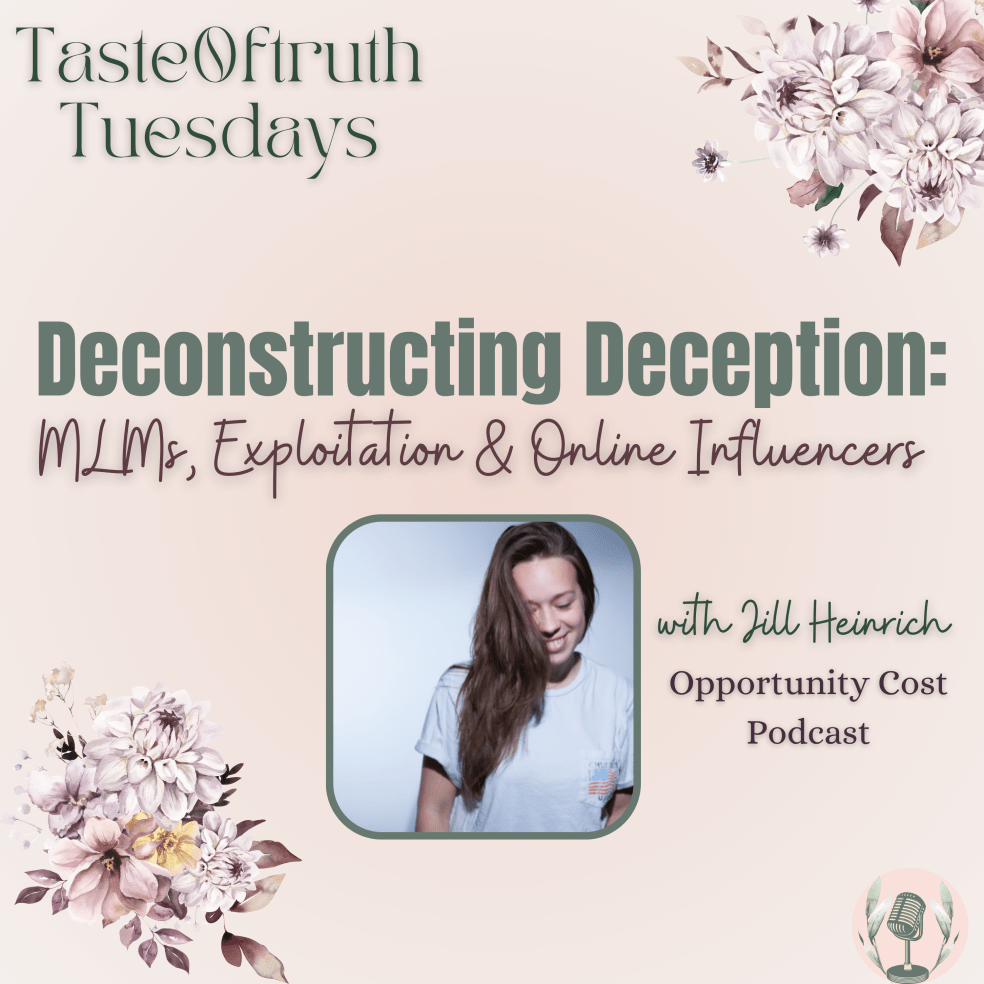
This week, we’re diving deep into the murky waters of high-control groups like MLMs, conspiracies, and evangelicalism. 💥✨
🚨 Exploitation Alert 🚨
Tune in to explore the shady side of:
Lobbyism & Amway – How lobbying shapes the MLM landscape.
Enagic’s Kangen Water Scandal – Uncover the dangerous misinformation and financial exploitation by MLMs like Enagic.
Faith and Finance – Why are Christian women particularly vulnerable to MLM schemes? Learn to spot the red flags.
Influencers and Ideologies – How influencers like Girl Defined hide harmful beliefs behind appealing facades.
Podcasting Insights – Hear about the joys and challenges of podcasting, from trusting your instincts to finding joy in the creative process.
Join us for an eye-opening episode that tackles the intersections of gender, culture, business, and control. Don’t miss out on these compelling insights! 🚀✨





 Taste0ftruth Tuesdays