
Historian Conor Heffernan joins me to talk about muscle magazines, supplement ads, bodybuilding judges, and why so many of us learned to mistake looking fit for being healthy.
Bodybuilders are often treated as the “best of the best” in the fitness industry. They are lean, muscular, disciplined, and seemingly in complete control of their bodies. From the outside, it looks like health perfected.
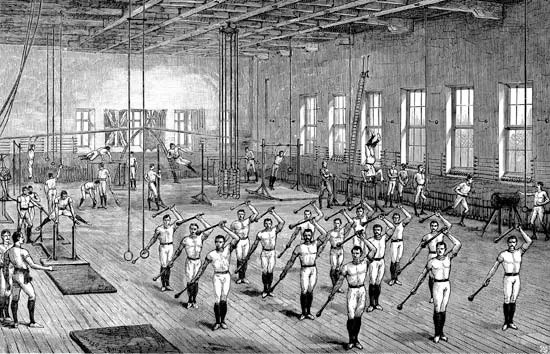
In this episode, I’m joined by Dr. Conor Heffernan , who lectures in the sociology of sport at Ulster University, he is a historian of sport, fitness, and physical culture who has written extensively about bodybuilding and the history of exercise. Together, we examine how the bodybuilding physique became a symbol of health and what that appearance can conceal.
I know how misleading that appearance can be.
Between May 2017 and October 2018, I competed in four bodybuilding shows with no real off-season or time to recover. Much of that had to do with Isagenix, the multilevel marketing company I was involved with that sold meal-replacement shakes and supplements. The couple who enrolled me, my “upline” in MLM terms, were both on Team Isagenix, the company’s athlete team. I wanted a spot alongside them. At the time, I thought making that team would mean the people I looked up to saw me as a successful athlete, too.
That’s a lot to hang on where a judge places you. I was chasing top-three finishes, and taking a few months off felt like putting off my next chance to earn that spot. People saw the discipline, the trophies, and a body they admired. What I remember is how much of my life had narrowed around the next show. I was dealing with disordered eating and chronic injuries, and I kept saying no to things I wanted to do because I was already in prep again.
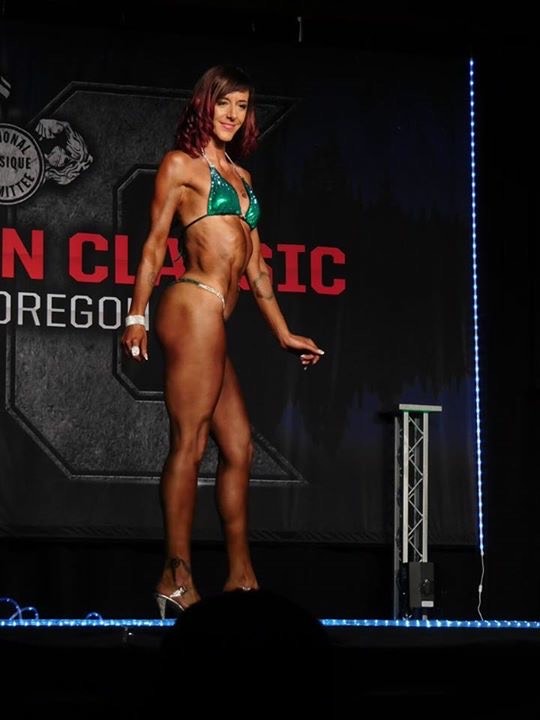

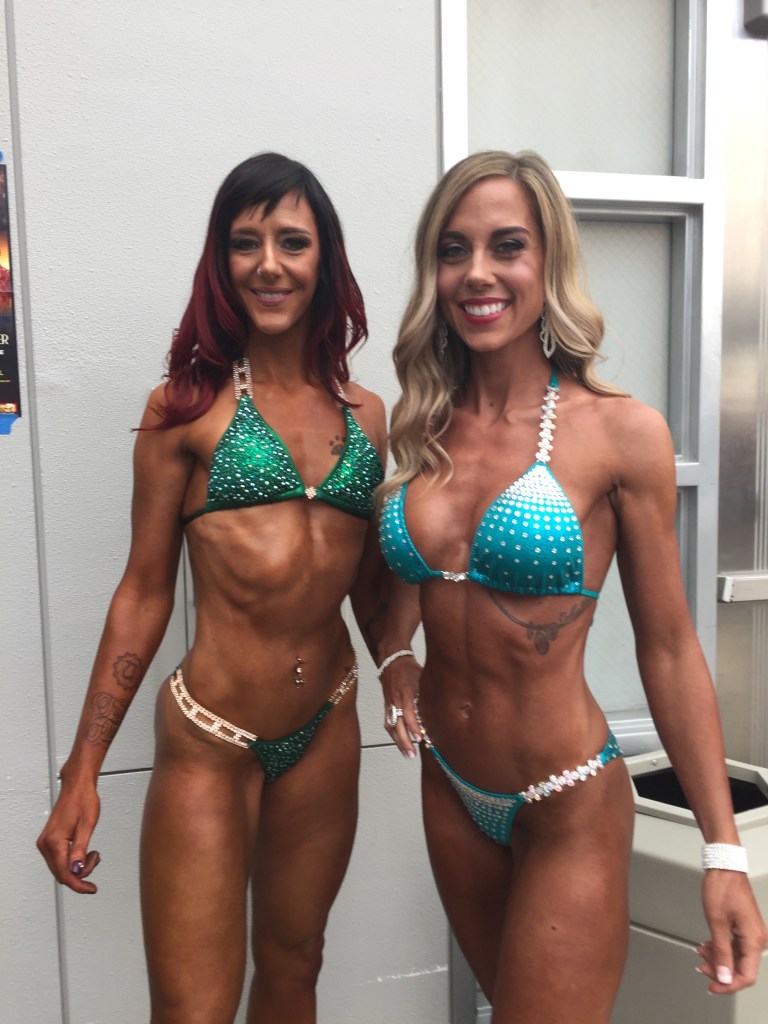


By 2019, I was getting canker sores so bad I’d sometimes have twenty or more in my mouth at once. I got shingles on my 35th birthday. My energy had tanked, and I was dealing with weight loss resistance. After four shows, I knew what had worked for me in the past. I’d make the same changes to my food and training and wait for my weight to come down the way it used to. It just wouldn’t budge. What’s hard for me to admit is that even now, I can look at pictures from around that time and miss being that thin. I have to remind myself that I’m looking at the same woman who had a mouth full of canker sores and still had a hard time letting herself take a break.
In his article Why You Never Feel Finished With Your Body, historian Conor Heffernan writes:
“To participate in fitness culture meant to expose the body to comparison.”
Bodybuilding makes that comparison literal. You spend months preparing for a few minutes under stage lights, where a panel decides whether you look muscular enough, lean enough, and feminine enough to place.
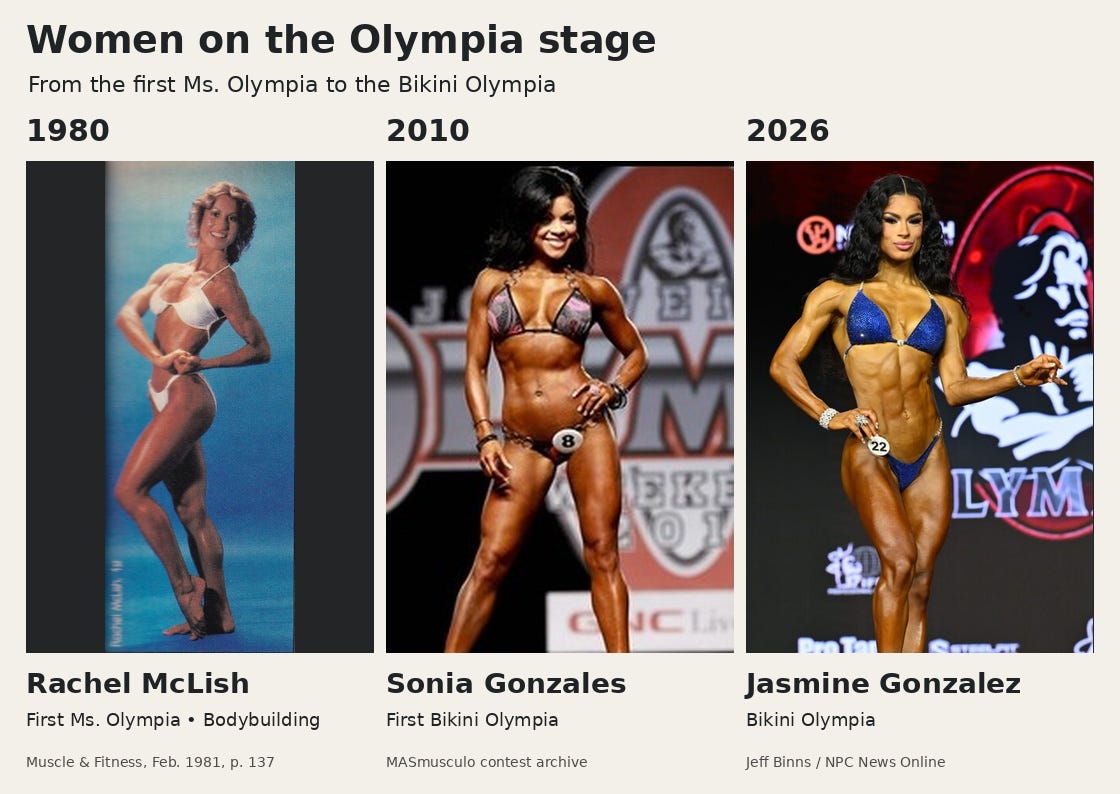
I included the side-by-side because it helps to see what judges rewarded at different points in the sport’s history. Rachel McLish won the first Ms. Olympia in women’s bodybuilding in 1980. The Olympia added a separate Bikini division thirty years later. Compare Sonia Gonzales, who won that first Bikini title in 2010, with Jasmine Gonzalez in 2026. Both won under the same division name, but you can see a difference in the roundness of Jasmine’s shoulders and the sweep of her quads. As we discuss in the episode, this can happen in any field as it becomes more specialized. What once set someone apart can become the baseline. In bodybuilding, that means you can spend years building the physique you saw win, only to step onstage and find the judges are looking for something else.
The physical consequences are becoming more and more difficult to ignore. A 2025 study followed 20,286 male bodybuilding competitors and recorded 121 deaths at an average age of about 45. Sudden cardiac death accounted for 38 percent of them, and professional competitors faced more than five times the risk of sudden cardiac death compared with amateurs. European Heart Journal study
Social media has carried the same system far beyond the competition stage. As Conor writes in Bigger by the Day:
“To stand out in fitness, you need to be bigger, more muscular, and more extreme.”
The algorithm adds a measurable audience that continually demands the next transformation, heavier lift, larger body, or more shocking clip. Someone no longer needs to compete to absorb bodybuilding’s most extreme standards. The stage is now the feed, and the judge is the algorithm.
This also helps explain why bodybuilders have acquired so much authority over health. Place an impressive physique beside a tub of supplements and the body becomes the evidence, even when drugs, dehydration, severe restriction, or genetics contributed far more to the result.
So please tune in to listen to Conor Heffernan and I discuss how subjective judging, fitness media, supplement advertising, and fitness magazine culture created the same very trends we see in social media today. We also talk about what competitors sacrifice along the way and whether training can still matter once the body is no longer treated as a permanent correction project.
Bodybuilding requires enormous discipline. The more pressing issue is why it also treats sacrificed health as proof of that discipline, then presents the result as healthy and desirable.
Thank you so much for taking the time to read and listen to the interview. I’m looking forward to hearing your thoughts.

Important Links:
Physical Culture Study – Studying the History of Fitness
The Sport Working Exactly As Designed: How Bodybuilding Builds Corpses
Why You Never Feel Finished With Your Body
Why Aren’t Supplements Regulated Like Medicines? A story about barbells, powders, and Mel Gibson

