Your Body Is the Scoreboard

From Heart to Brain: The Neuroscience Behind Connection and Calm

Welcome back to Taste of Truth Tuesdays, where we maintain our curiosity, embrace skepticism, and never stop asking what’s really going on beneath the surface. Last week, I prepared you for this episode, so if you missed out, please check it out! It’s short and sweet.

Now, for today’s episode….

Let me ask you something:

Why does your body feel like it’s on high alert… even when nothing “bad” is happening?
Why do you either trust too quickly or not at all and end up anxious, burned out, and ashamed?
Why is it so damn hard to regulate your emotions, especially when you’re great at controlling everything else?

If those questions hit a little too close to home… this episode is for you.

Last season, we dove deep into complex trauma through Pete Walker’s From Surviving to Thriving, unpacking how childhood neglect, emotional abuse, and developmental trauma shape adult patterns.

And today? We’re going even deeper — through the lens of neuroscience.

Because what if these aren’t personality quirks or moral failings? What if your brain and body are actually doing their best to protect you, using adaptations wired by Complex PTSD?

My guest today is Cody Isabel | Neuroscience, a neuroscience researcher and writer whose work has become a game-changer in trauma conversations. He holds a degree in Cognitive Behavioral Neuroscience, has training in Internal Family Systems psychotherapy, and specializes in the emerging field of Psychoneuroimmunology — the study of how your thoughts, brain, and immune system interact.

His Substack article, “PTSD & Complex PTSD Are NOT the Same Thing,” has been one of the clearest, most validating reads on this topic I’ve found.

So, if you’ve ever felt stuck, shut down, reactive, misunderstood, or like your nervous system has a mind of its own…. stay with me.

Because today we’re not just talking trauma.
We’re talking nervous system intelligence.
We’re talking identity repair.
We’re talking real, embodied healing.

And before we get into that, I want to bring a few threads together from past episodes—because they’re all woven into this conversation.

We’ve talked about fawning, the lesser-known trauma response that shows up as chronic people-pleasing, self-abandonment, and conflict avoidance—especially common in those who’ve survived high-control environments. In this episode with Theresa, we also explore the stress cycle. According to Selye’s General Adaptation Syndrome, your body moves through three stages when facing ongoing stress: Alarm, Resistance, and eventually, Exhaustion. And fawning, while behavioral, can easily become your nervous system’s go-to tactic—especially during prolonged stress or in the presence of power dynamics that feel threatening.

We have talked about the Emotional Hijack and how trauma impacts the brain in this episode.

We’ve also referenced the vagus nerve, but not specifically Polyvagal Theory—but today, we’re going deeper. Instead of seeing your stress responses as “malfunctions,” it reframes them as adaptive survival strategies. Your nervous system isn’t betraying you—it’s trying to protect you. It’s just working off old wiring.
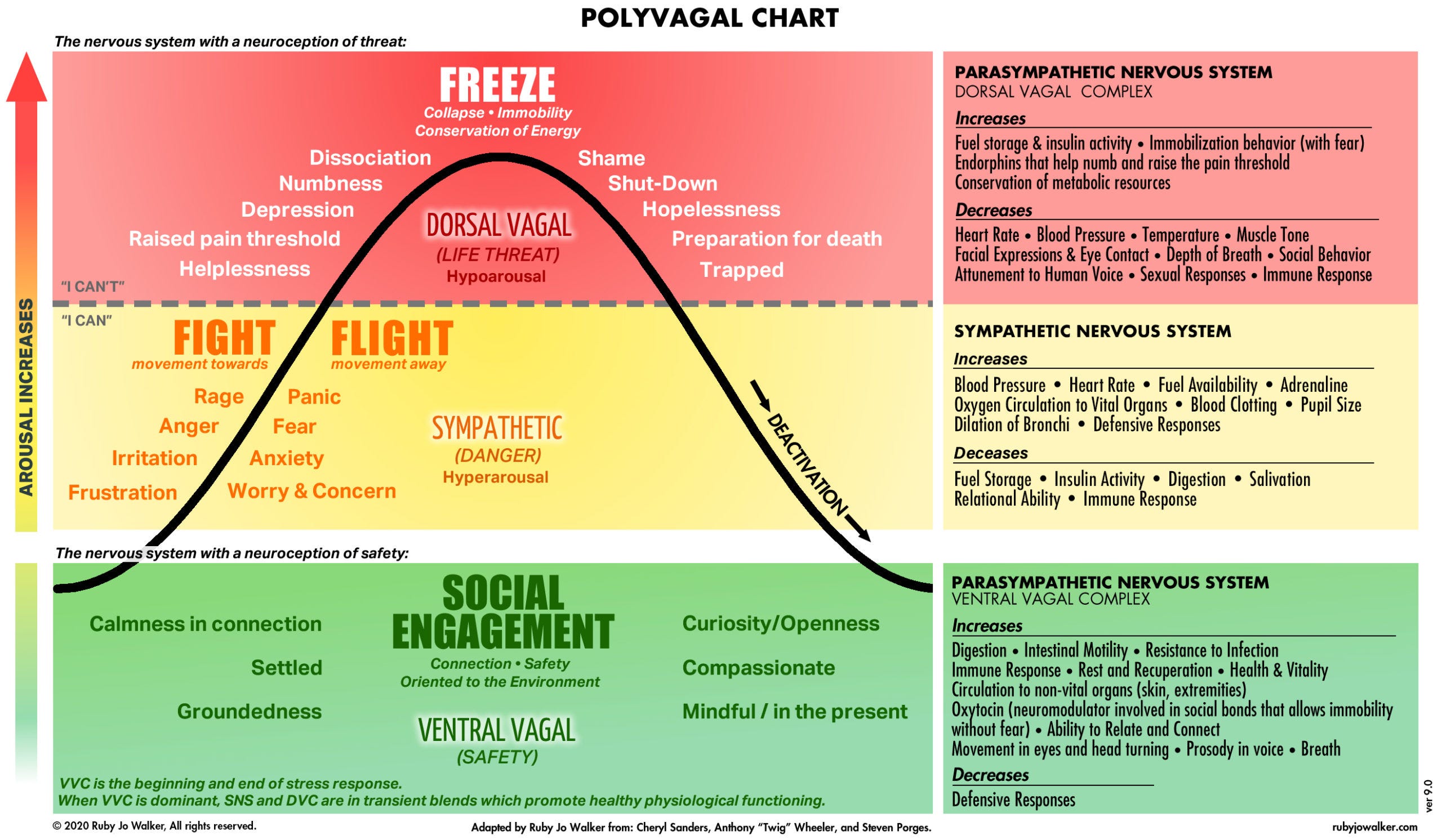
Think of it like this:

Your nervous system is constantly scanning for cues of safety or threat—this is called neuroception. And based on what it detects, your body shifts into different states—each with a biological purpose.

The Polyvagal Chart breaks this down into three major states:

1. 🟢 Ventral Vagal – Social Engagement (Safety)

This is your “rest-and-connect” zone. You feel grounded, calm, curious, and open. You can be present with yourself and with others. Your body prioritizes digestion, immune function, and bonding hormones like oxytocin. You’re regulated.

This is the state we’re meant to live in most of the time—but trauma, chronic stress, or inconsistent caregiving can knock us out of it.

2. 🟡 Sympathetic – Fight or Flight (Danger)

When your system detects danger, it flips into high alert. Blood rushes to your limbs, your heart races, your digestion shuts down. You either fight (rage, irritation) or flee (anxiety, panic). This is survival mode. It’s not rational—it’s reactive.

And if that still doesn’t resolve the threat?

3. 🔴 Dorsal Vagal – Freeze (Life Threat)

This is the deepest shutdown. Your system says: “This is too much. I can’t.” You go numb. You collapse. You may dissociate, feel hopeless, or emotionally flatline. It’s not weakness—it’s your nervous system pulling the emergency brake to conserve energy and protect you.

Here’s what’s crucial to understand: these responses aren’t choices. They’re biological defaults. And many of us are stuck in loops of fight, flight, or freeze because our systems never got a chance to complete the stress cycle and return to safety.

So instead of shaming yourself for overreacting or shutting down, what if you asked:

“What is my nervous system trying to do for me right now?”
“What does it need to feel safe again?”

That shift—from judgment to curiosity—is the beginning of healing.

And we’ll connect this to another major thread—attachment systems, which we haven’t unpacked in depth yet, but absolutely need to.

Your attachment system is the biological and psychological mechanism that drives you to seek safety, closeness, and emotional connection—especially when you’re under stress. It develops in early childhood through repeated interactions with your caregivers, shaping how you regulate your emotions, perceive threats, and relate to others. If those caregivers were emotionally attuned, predictable, and responsive, you likely formed a secure attachment. But if they were inconsistent, neglectful, controlling, or chaotic… your attachment system learned to adapt in ways that may have kept you safe then—but cost you connection now.

In The Happiness Hypothesis, Jonathan Haidt points to a disturbing moment in psychological history that disrupted the natural development of secure attachment: the rise of behaviorism in the early 20th century.

John B. Watson, a founding figure of behaviorism, famously applied the same rigid, mechanistic principles he used on rats to raising human children. In his 1928 bestseller The Psychological Care of Infant and Child, he urged parents not to kiss their children, not to comfort them when they cried, and to withhold affection—believing emotional bonding would produce weak, dependent adults.

By the mid-20th century, attachment theory began to challenge these behaviorist claims. John Bowlby, in the 1950s, argued that infants form emotional bonds with caregivers as an innate survival mechanism—not merely as conditioned responses to rewards, as behaviorism suggested. His work, drawing from ethology, psychoanalysis, and control systems theory, moved beyond behaviorism’s narrow stimulus-response framework. Mary Ainsworth’s empirical research in the 1960s and ’70s, through her Strange Situation study, confirmed that attachment styles stem from caregiver sensitivity and infant security needs, rather than simple conditioning.

Yet, ironically, during the 1970s and ’80s, Christian parenting teachings—particularly those popularized by figures like Dobson—adopted and amplified the very behaviorist ideas that attachment research was already disproving. These teachings emphasized strict discipline and emotional control, often citing Scripture to justify practices rooted in outdated psychological theories rather than theology.

Let that sink in.

For decades, dominant parenting advice discouraged emotional responsiveness, treating affection not as a necessity but as a liability.

This wasn’t just bad advice—it was the psychological equivalent of nutritional starvation. Instead of missing vitamins, children missed attunement, safety, and connection. As attachment research has since shown, those early emotional experiences shape nervous system development, stress regulation, and whether someone grows up trusting or fearing closeness.

So, when we talk about stress responses like fawning… or chronic over-functioning… or emotional dysregulation… we’re often seeing the adult expression of a nervous system that never learned what safety feels like in the presence of other people.

And that’s why today’s conversation matters. Because healing isn’t just about rewiring thought patterns. It’s about rebuilding your felt sense of safety—in your body, in your relationships, and in your life.

And if you are anything like me and have found yourself wondering… why your nervous system reacts the way it does… or why regulating your emotions feels impossible even when you “know better” … this episode will connect the dots in ways that are both validating and eye-opening.

We’re talking trauma, identity, neuroplasticity, stress, survival, and what it really means to come home to yourself.

The topics we explore:

  • The critical differences between PTSD and Complex PTSD — and how each impacts the brain and body
  • Why CPTSD isn’t just a fear response, but a full-body survival adaptation that reshapes your identity
  • What it means to heal “from the bottom up,” and why insight alone isn’t enough
  • How books and language can validate our experience — without replacing the need for somatic work
  • The push-pull of relational safety: why CPTSD makes connection feel risky, even when we crave it
  • How trauma affects the Default Mode Network, and why healing often feels like rediscovering who you are

Whether you’re navigating relational triggers, spiritual disorientation, or the long road of recovery, this conversation offers clarity, compassion, and a grounded path forward.

Please enjoy the interview!

Subscribe now on Substack!

LINKS:

Check out Cody’s work! About – The Mind, Brain, Body Digest

The Top 5 Childhood Core Wounds in Overachievers 🧠

No Bad Parts | IFS Institute | Schwartz

Transcending Trauma Healing Complex PTSD with Internal Family Systems Therapy
How Creative Expression Helps Overcome Trauma

When you grow up in a high-control environment—whether through religion, a rigid upbringing, or a spiritual path that preaches emotional suppression—it can feel like your natural human emotions are something to be ashamed of. I’ve lived it. In the high-control religion I was a part of, anger wasn’t just frowned upon; it was portrayed as sinful, a sign of personal failure or weakness. Through the lens of ACBC Biblical counseling (Nouthetic Counseling), anger was framed as something to be suppressed, manipulated out of existence with tactics like guilt, shame, and isolation. But here’s the truth: anger, like any other emotion, isn’t inherently wrong. It’s human. And when we lose access to it, we also lose access to parts of ourselves.

Anger, as Aristotle once put it, is a passion. When experienced and expressed for the right reasons and in the right way, it can even be virtuous. Yet, in so many spiritual environments, particularly the ones I encountered, emotions like anger were seen as dangerous, spiritually harmful, or outright sinful. Especially for women, who are often taught to prioritize harmony and remain calm at all costs, anger can become something we’re scared to touch. For men, anger might be more accepted, but vulnerability is not, creating its own emotional imbalance.

What happens when we suppress emotions like anger? We get stuck, often feeling disconnected from our bodies, from our creativity, and from any sense of playfulness. That’s why art and play become essential tools in healing from spiritual and religious trauma. They allow us to access and express emotions that were long buried, giving us the space to feel without fear. Art doesn’t just heal—it empowers. It gives back what was stolen. Let’s unpack why:

Why Art & Play Matter in Healing Trauma

Trauma—especially the kind stemming from spiritual or religious abuse—can leave you feeling stuck, numb, or like a stranger to your own creativity. High-control environments stifle our freedom to express, explore, or simply be. Art and play can feel like reclaiming those parts of us that were silenced, buried under the weight of shame, fear, or guilt.

“Wherever I look, I see the same themes: not being allowed to feel, to say what you feel, to trust your perceptions, to ask for what you need. This is how we remain imprisoned in our pain.” -Alice Miller

Engaging in creative expression—whether it’s painting, dancing, writing, or making music—gives us a way to process emotions that can be difficult, even impossible, to articulate. Trauma lodges itself deep in the body and subconscious, often beyond the reach of words. But through art, we can access those hidden parts and begin to heal them in ways that talking just doesn’t touch. It’s like tapping into a language the body understands.

Play, on the other hand, might feel like a foreign concept if you’ve been conditioned to take life way too seriously, to follow rules without question. But it’s through play that we reconnect with spontaneity, joy, and a sense of safety—things that high-control environments tend to strip away. Play is about reawakening that inner child, the part of you that knows how to explore and create without fear of judgment. It’s about taking back the joy you were told to suppress.

How Art & Play Help in Deconstructing Religious Trauma

When we start unraveling the teachings we once held as truth, it can feel like walking through a minefield. Shame, fear, and guilt are often deeply embedded in the narratives we were fed. Art becomes a tool for rebellion, a way to question, challenge, and rewrite those beliefs. By creating, we aren’t just making things; we’re making space for new perspectives. We’re loosening the grip that old doctrines had on us.

In high-control environments, the idea of play is usually dismissed as frivolous or even sinful. Reclaiming that sense of play is like finding a key to unlock the parts of yourself that were shut away. Playfulness, whether it’s dancing with wild abandon, hula hooping (yes, circus arts shoutout!), or exploring new hobbies, gives you back a sense of agency. It’s a way to create space for curiosity again, to embrace wonder without the burden of fear or shame. Think of it as giving yourself permission to live without someone else’s narrative hanging over you.

Scientific Backing for Creative Therapies

The science backs this up, too. Numerous studies have shown that creative therapies—like art, dance, and even movement-based play—can significantly reduce symptoms of PTSD, anxiety, and depression. They work by helping the brain rewire itself through neuroplasticity. When you engage in creative activities, you’re not just distracting yourself—you’re helping your brain form new, healthier connections. You’re building resilience, reprogramming the way your brain responds to trauma.

Art and play ignite parts of the brain that foster emotional regulation and healing. This is where trauma lives, after all—deep within the nervous system. But creativity taps into a different part of the brain than verbal communication does, allowing survivors of trauma to express and release emotions they may not even know they’re holding onto.

By embracing art and play, you’re not just finding a distraction from your pain—you’re giving yourself a way to heal, to reclaim parts of yourself that were taken, and to reconnect with joy, creativity, and freedom. The beauty of it all? There’s no right or wrong way to do it. You’re creating your path forward. So, grab that paintbrush, dance it out, or pick up that pen and let your soul speak.

Resources for Healing Through Art and Play

Books:

  1. “Healing the Fragmented Selves of Trauma Survivors” by Janina Fisher
    This book dives into how trauma fragments a person’s sense of self, especially those recovering from spiritual abuse or high-control environments. Fisher provides practical tools, like body-based therapies and creative expressions, to help reintegrate those fragmented parts into a cohesive whole.
  2. “Trauma and Recovery” by Judith Herman
    Herman’s work is a cornerstone in understanding trauma and its long-term effects. She emphasizes the importance of survivors reclaiming their voices, and how creative expression—whether through writing, painting, or dance—plays a critical role in their recovery journey.
  3. “The Creative Cure” by Jacob Nordby
    Nordby explores how reconnecting with creativity can reignite your sense of self and joy. Especially for those who’ve had their emotional expression controlled or diminished by strict belief systems, this book offers a roadmap to reclaiming a more authentic, free version of yourself through creativity.
  4. “Complex PTSD: From Surviving to Thriving” by Pete Walker
    This book focuses on healing the long-term effects of complex PTSD, which many individuals from high-control religious backgrounds experience. Walker highlights how therapeutic outlets like art, journaling, and other forms of play help survivors process their trauma and begin to thrive again.
  5. “Art Therapy Sourcebook” by Cathy Malchiodi
    Malchiodi is a pioneer in the field of art therapy. This book is a practical guide for anyone looking to explore art as a form of emotional expression and healing, especially in the context of trauma recovery. It offers hands-on approaches for integrating creative expression into your healing process.

Articles & Journals:

  1. American Art Therapy Association
    This site offers numerous research studies on the effectiveness of art therapy in healing trauma, especially for those recovering from spiritual abuse or restrictive environments. It provides a well-rounded view of the therapeutic benefits of engaging in creative arts.
  2. International Journal of Play Therapy
    A comprehensive journal that highlights the healing potential of play therapy for trauma survivors. It explores how play can foster emotional resilience and repair, allowing individuals to reconnect with parts of themselves that were silenced or controlled.
  3. “Creative Arts Therapies and Trauma: Scope and Impact”
    A review that outlines how various forms of creative expression—like music, drama, and visual arts—help trauma survivors heal. This article explains how these therapies leverage the brain’s neuroplasticity to create new, healthier emotional patterns.

Experts & Practitioners:

  1. Pat Ogden – Sensorimotor Psychotherapy
    Ogden’s work is at the intersection of movement and trauma recovery. She focuses on how trauma manifests in the body and uses techniques like creative movement and body-based therapies to help people heal from deep emotional wounds. Her book “Trauma and the Body” is a great resource for understanding this approach.
  2. Peter Levine – Somatic Experiencing
    Levine is renowned for his work on trauma recovery through the body. His book “Waking the Tiger: Healing Trauma” offers insights into how movement and body-based expression can help survivors release trauma and regain a sense of safety and control.

Podcasts & Websites:

  1. Sounds True – Insights at the Edge Podcast
    Hosted by Tami Simon, this podcast often features interviews with leading experts in trauma and healing. Guests like Peter Levine and Pat Ogden discuss the importance of integrating creative practices like art and movement into trauma recovery.
  2. Healing Arts Radio (Online Radio Show)
    Focused on art therapy and trauma healing, this show features episodes on creative therapies and personal stories of recovery through art. It’s an inspiring resource for understanding how play and art can transform emotional wounds into creative empowerment.
  3. Institute for Creative Mindfulness
    This site provides resources and courses on expressive arts therapies for trauma survivors. It emphasizes how art and movement therapies foster resilience and healing by tapping into emotional expression and body awareness.

Unlocking the Power of Hope Molecules: How Movement Transforms Mind and Body

Did you know your body can help your brain feel more hopeful through movement?

In our fast-paced world, finding effective ways to boost our mental and physical well-being is more crucial than ever. Recent research highlights an exciting phenomenon: our muscles aren’t just for movement; they act as endocrine organs, secreting beneficial substances known as hope molecules. These molecules, or myokines, have a profound impact on our brain, body, and mood, offering a natural and powerful way to enhance our overall health.

What Are Hope Molecules?

Hope molecules are proteins released into the bloodstream from our muscles during movement. These myokines play a vital role in:

  • Protecting against depression, PTSD, and chronic stress
  • Increasing neuroplasticity, which helps our brain adapt and grow
  • Altering the hippocampus, a brain region crucial for stress resilience
  • Boosting brain-derived neurotrophic factor (BDNF), which enhances our ability to manage stress and difficult emotions

Dr. Kelly McGonigal succinctly puts it: “Every time we move our muscles, we are giving ourselves an intravenous dose of hope.” This means that even a short burst of movement can significantly impact our mental health, providing an antidepressant effect that enhances resilience to stress and trauma.

For instance, a short walk or a quick workout doesn’t just get the blood pumping; it also triggers the release of these mood-enhancing chemicals. This phenomenon is sometimes referred to as an “antidepressant effect,” where the physical act of moving your body leads to the release of neurotransmitters that can lift your spirits and combat feelings of depression.

Moreover, this boost in mood and resilience isn’t just about the immediate effects. Regular short bursts of exercise contribute to long-term mental health benefits, enhancing your ability to cope with stress and trauma. By incorporating even small amounts of movement into your daily routine, you can help your body produce more hope molecules, thereby strengthening your mental health and emotional resilience.

So, the next time you’re feeling low, remember that a little movement might just be the key to unlocking your body’s natural antidepressants and enhancing your capacity to handle life’s challenges. 🚶‍♀️💪🌟

The Mind-Body Connection: Insights from the “Mind Over Milkshake” Study

To deepen our understanding of how movement and mindset intersect, consider the fascinating findings from the study titled “Mind Over Milkshake: Mindsets, Not Just Nutrients, Determine Ghrelin Response.” This research explores how our beliefs about the food we consume can alter physiological responses, such as hunger and energy regulation.

Participants in the study were given milkshakes with differing calorie information, but their physiological responses varied based on their expectations. The study demonstrated that our mindset about what we consume can impact hormonal and physiological reactions, revealing the powerful connection between belief and bodily responses.

Similarly, our mindset towards exercise can greatly influence the benefits we derive from it. Viewing exercise not merely as a physical task but as a source of hope and well-being can amplify its positive effects on our mental health.

Why Movement Matters More Than We Think

Understanding that hope molecules and our mindset play a critical role in our health highlights the multifaceted benefits of exercise. It’s not just about weight loss or physical fitness; it’s about enhancing:

  • Happiness and life satisfaction
  • Resilience to stress and anxiety
  • A sense of purpose and social connection

Emerging research suggests that when exercised, our muscles essentially become a “pharmacy” for our physical and mental health. This perspective shifts the focus from restrictive exercise goals to a more holistic view of movement as a tool for improving our quality of life.

Applying Hope Molecules to Recovery from High-Control Environments

For those recovering from high-control environments, such as strict religious or ideological communities, the concept of hope molecules is particularly relevant:

  • Resilience and Recovery: Engaging in regular movement can help mitigate the effects of chronic stress and trauma often associated with high-control environments. The release of myokines (hope molecules) during physical activity supports brain health and emotional resilience, aiding in the recovery process.
  • Regaining Control: Movement and exercise can be empowering for those who have felt controlled or restricted. It offers a way to regain a sense of agency and control over one’s body and mind, promoting healing and personal autonomy.
  • Restoring Mental Health: For individuals recovering from harmful environments, exercise can provide a natural antidepressant effect. Regular physical activity enhances mood, reduces symptoms of depression, and supports overall mental health, which is crucial for those rebuilding their lives and self-esteem.

Practical Tips for Integrating Movement into Recovery

  1. Start Small: Incorporate any form of movement into your routine, even if it’s just a few minutes each day. Studies indicate that as little as 3 minutes of exercise can have positive impacts.
  2. Adopt a Positive Mindset: Frame your physical activity as an opportunity for mental and emotional growth, not just a chore. This mindset can enhance the benefits you receive.
  3. Enjoy the Process: Find activities you enjoy and that make you feel good. The more you enjoy your movement, the more likely you are to stick with it.
  4. Build a Routine: Establishing a consistent movement routine can support long-term recovery and well-being. Integrate movement into your daily life in a way that feels sustainable and rewarding.
  5. Connect with Community: Movement can also foster social connections. Engaging in group activities or fitness communities can provide additional support and a sense of belonging, which is valuable for those recovering from isolating environments.

Hacking Consistency: Your Path to Achieving Health Goals

In my 20 years as a personal trainer, I’ve seen one common thread that holds people back from achieving their health and fitness goals: consistency. For many, the journey to better health is fraught with the misconception that it must be difficult. If you resonate with this, I want you to know that I understand how intimidating change can be. It can feel like a long road ahead, but I’m here to share some tips to help you hack consistency and make your health journey not only achievable but also enjoyable.

1. Habit Stacking: Start Small

The first strategy to develop consistency is habit stacking. Focus on one or two small habits that you can easily commit to. Once you’ve established these, you can begin to build additional habits on top of them.

For example:

  • Starting Habit 1: A 5-minute morning walk. This quick stroll can boost your mood and energy levels, providing an immediate sense of accomplishment.
  • Starting Habit 2: A one-minute breathing exercise. Before your walk, try a simple box breathing technique: inhale for 4 seconds, hold for 4 seconds, exhale for 4 seconds, and hold again for 4 seconds. This practice can reduce stress and help center your mind.

Once you have these foundational habits in place, you can stack additional practices:

  • Post-Walk Habit: After your 5-minute walk, add 2-3 minutes of gentle stretching. Focus on your neck, shoulders, and legs to release tension and enhance the mental health benefits of movement.
  • Post-Breathing Habit: After your breathing exercise, incorporate a quick moment of gratitude. Name one thing you’re grateful for to reinforce positive thinking and cultivate a hopeful mindset. This simple act can help you recover from emotional strain and improve overall well-being.

Starting small with these habits allows you to create a consistent and sustainable routine.

2. Focus on Addition, Not Restriction

The second tip for hacking consistency is to concentrate on what you can add to your life rather than what you need to take away. This could involve increasing your movement, enhancing your awareness, practicing breathwork, or incorporating more protein, fruits, and vegetables into your meals. When you focus on adding positive elements, it becomes easier to embrace change and maintain consistency.

3. Find Personal Meaning

Your journey to feeling better should be tied to personal meaning and intrinsic motivation. This means tapping into your internal drive to pursue these changes. Reflect on why you want to achieve your health goals and let that guide your actions. When you find personal significance in your journey, it becomes a source of motivation rather than a chore.

4. Build Self-Efficacy

Self-efficacy is crucial in creating a sustainable lifestyle. It’s about building belief in yourself over time and understanding that consistency is the key to lasting results. Instead of thinking in terms of short-term challenges, consider how you can develop habits that last long-term. Routines created from consistent habits lead to sustainable success.

Building on habits is what creates a routine. A routine is what creates consistency and consistency is what creates results.

Awareness is the first step in bridging the gap between your goals and the actions you need to take. While you may have aspirations, it’s consistent behaviors and actions that make them a reality.

Mindset Matters

Remember, if you’re struggling to maintain consistency, it’s not a reflection of your willpower or determination; it could be a sign that your approach needs adjustment. Your mindset is vital in this journey. Frame your movement as an opportunity to boost your brain and body rather than a chore or punishment.

By implementing these strategies, you can transform your health journey into a rewarding experience. Consistency is everything. Embrace the process, celebrate your achievements, and watch as you progress toward your goals!

Broader Implications for Personal Development

The principles of hope molecules tie into broader themes of personal development, critical thinking, and spirituality:

  • Challenging Limiting Beliefs: Movement and exercise can challenge limiting beliefs about oneself and one’s capabilities. This aligns with the focus on critical thinking and questioning restrictive ideologies.
  • Embracing New Perspectives: Seeing movement as a tool for embracing new perspectives and opportunities for growth is crucial for those redefining their lives after leaving high-control environments.

In conclusion, the science of hope molecules reveals that our muscles do much more than move us; they create hope and enhance our mental well-being. By embracing movement and adopting a positive mindset, we can unlock these powerful benefits and cultivate a more resilient, fulfilling life.

Embrace the power of hope molecules and experience the transformative effects on your mental and physical health.

RESOURCES:

For a comprehensive understanding of the role of hope molecules (myokines) and their impact on mental and physical health, the following studies and sources are highly relevant:

Key Studies and Sources

  1. Myokines and Mental Health
    • Pedersen, B. K., & Febbraio, M. A. (2012). “Muscle as an endocrine organ: Focus on muscle-derived cytokines as potential pharmacological targets.” Diabetologia, 55(10), 2975-2985. Link to Study
      This review discusses how muscle-derived cytokines (myokines) are involved in various physiological processes and their potential therapeutic effects on metabolic diseases, inflammation, and mental health.
  2. Exercise, Hope Molecules, and Brain Health
    • Gordon, B. A., & Herring, M. P. (2014). “The effect of exercise on depression: A review of meta-analyses.” Journal of Clinical Psychiatry, 75(2), 156-161. Link to Study
      This meta-analysis reviews the impact of exercise on depression, highlighting how physical activity influences mental health through various mechanisms, including the release of beneficial myokines.
  3. Hope Molecules and Neuroplasticity
    • Hogan, M. C., & Durcan, J. M. (2018). “Exercise and neuroplasticity: A review of the role of physical activity in promoting brain health and cognitive function.” Journal of Clinical Neurology, 14(3), 342-350. Link to Study
      This review examines how exercise-induced myokines contribute to neuroplasticity, cognitive function, and overall brain health.
  4. Mindset and Physiological Responses
    • Crum, A. J., & Langer, E. J. (2015). “Mindset matters: Exercise and the placebo effect.” Psychological Science, 26(4), 663-670. Link to Study
      This study explores how individuals’ beliefs and mindsets about exercise can influence their physiological responses and overall effectiveness of physical activity.
  5. Exercise, Stress Resilience, and Mental Health
    • McGonigal, K. (2015). “The Upside of Stress: Why Stress Is Good for You, and How to Get Good at It.” Penguin Books.
      While not a study, this book by Dr. Kelly McGonigal provides insights into how stress, when managed effectively, can be beneficial. It complements research on how exercise and movement can positively influence mental health through stress resilience.
  6. “Mind Over Milkshake” Study
    • Elder, R., & Croyle, R. T. (2011). “The role of expectations in health behavior: Mindset and health.” Health Psychology Review, 5(1), 2-12. Link to Study
      This study investigates how people’s expectations about what they consume affect their physiological responses, illustrating the influence of mindset on health outcomes.