Have you ever noticed how some individuals react with intense hostility or aggression when their deeply held beliefs are questioned? Keep reading as we will be exploring this very concept.
This week on the podcast, we’re sitting down with Dr. Mark Gregory Karris to explore the twists and turns of his diverse professional journey and how it shapes his approach to tackling religious trauma.
🎢 From deconstructing faith dynamics to navigating life after leaving religious traditions, Dr. Karris dishes out practical steps and deep insights like a pro. 📚 We dive into his latest book ‘Diabolical Trinity’ where he takes on the big questions—like transforming a wrathful God into a compassionate one and the impact of religious experiences on mental health. 🕊️
Join us as we uncover the power of community and holistic healing in this can’t-miss conversation! 🌈
Listen here! 🎧
Navigating Anxiety in Fundamentalist Christian Circles During Deconstruction
People entrenched in fundamentalist sects of Christianity often experience heightened anxiety when they witness others going through a process of deconstruction. This reaction stems from their upbringing, where they were taught that deviation from established beliefs and practices is not only wrong but potentially dangerous. In fundamentalist environments, any departure from the accepted norms can be perceived as a threat to one’s faith, community, and even personal safety.
This anxiety is compounded by the fear that questioning or exploring alternative beliefs may lead to spiritual and moral peril. Fundamentalist teachings often instill a rigid worldview where conformity is equated with spiritual safety, and deviation is seen as a sign of weakness or susceptibility to worldly influences.
Moreover, the concept of narcissistic rage can be observed in some cases, where individuals deeply embedded in fundamentalist ideologies react with hostility or aggression towards those who challenge or question their beliefs. Here are a few examples:
Verbal Attacks:
When someone questions a fundamentalist belief, the individual might respond with insults, shouting, or belittling the questioner. For instance, calling someone “ignorant” or “evil” for simply asking a question about their faith.
Social Ostracism:
In a tight-knit religious community, members who express doubts or differing opinions might be shunned, isolated, or expelled from the community.
Online Harassment:
On social media, individuals might react to criticism or questions with trolling or coordinated harassment campaigns against the perceived challenger.
Physical Aggression:
In extreme cases, questioning or challenging fundamentalist beliefs can lead to threats of violence or actual physical harm.
This reaction is different from a healthy spiritual practice, which encourages openness, curiosity, and respectful dialogue about different perspectives.
Examples of Healthy Spirituality:
Open Dialogue:
Encouraging conversations where differing beliefs and perspectives are discussed respectfully, with a genuine interest in understanding the other person’s viewpoint
Supportive Community:
Building a community where questioning and exploring faith is seen as a natural part of spiritual growth, and members support each other through their journeys.
Personal Reflection:
Encouraging conversations where differing beliefs and perspectives are discussed respectfully, with a genuine interest in understanding the other person’s viewpoint.
Interfaith Engagement:
Participating in interfaith dialogues or activities that promote learning from different religious traditions and appreciating the diversity of spiritual experiences.
These contrasting examples can illustrate the difference between a rigid, defensive response and a more open, growth-oriented approach to spirituality.
By recognizing the signs of narcissistic rage and embracing a more open and compassionate approach.
Navigating these dynamics requires empathy and understanding from both sides. Those undergoing deconstruction seek to reconcile their evolving beliefs with their personal experiences and spiritual growth, while those in fundamentalist circles may benefit from recognizing that diversity of belief does not necessarily threaten their own faith or spiritual well-being. Here’s how this dynamic unfolds:
Fear of Deviation: Fundamentalist teachings often emphasize a strict adherence to doctrinal purity and established beliefs. Any questioning or deviation from these beliefs is viewed as a threat to faith and spiritual safety.
Cognitive Dissonance: Witnessing others deconstructing their faith can trigger cognitive dissonance among fundamentalists. It challenges their worldview and belief system, leading to discomfort and anxiety.
Fear of Consequences: Fundamentalist teachings may instill fear regarding the consequences of exploring different beliefs or questioning established doctrines. There’s a pervasive belief that straying from the accepted path could lead to spiritual peril or loss of salvation.
Sense of Identity Threat: For individuals deeply embedded in fundamentalist communities, their identity and sense of belonging are closely tied to doctrinal conformity. Deconstruction challenges this identity, causing emotional distress and anxiety.
Social Pressure: Fundamentalist communities often exert strong social pressure to conform to group norms and beliefs. The prospect of others deconstructing their faith can create social anxiety and a fear of ostracization or judgment from peers and leaders.
In essence, the anxiety experienced by individuals in fundamentalist sects when encountering deconstruction reflects deep-seated beliefs and teachings that equate divergence from established doctrines with spiritual peril. This anxiety underscores the psychological and emotional challenges inherent in questioning and evolving one’s faith within such contexts. Encouraging open dialogue and mutual respect can foster a healthier approach to spiritual exploration and community dynamics.
🌟 🎙️Welcome back, Get ready for a mind-expanding journey in this week’s episode! 🌟🎙️ We’re sitting down with Dr. Mark Gregory Karris to explore the twists and turns of his diverse professional journey and how it shapes his approach to tackling religious trauma.
🎢 From deconstructing faith dynamics to navigating life after leaving religious traditions, Dr. Karris dishes out practical steps and deep insights like a pro. 📚 We dive into his latest book ‘Diabolical Trinity’ where he takes on the big questions—like transforming a wrathful God into a compassionate one and the impact of religious experiences on mental health. 🕊️
Join us as we uncover the power of community and holistic healing in this can’t-miss conversation! 🌈
Dr. Mark Karris is an experienced therapist with a rich and diverse background. He began his career working with adolescents and the severely mentally ill at Mental Health of Rockland County. In San Diego, he specialized in Emotionally Focused Couple’s Therapy under renowned mentors Kathryn de Bruin and Lisa Palmer Olson. He also spent three years in Japan, providing therapy on a military base and conducting international workshops for the Red Cross. He is now an adjunct professor at Point Loma Nazarene University. His educational background includes a Bachelor of Science in Psychology, a Master of Counseling, a Master of Divinity, and a PsyD with an emphasis in Marriage and Family Therapy.
Dr. Karris combines his extensive professional training with personal experiences of life’s ups and downs, making him uniquely equipped to guide his clients through their own journeys of healing and restoration.
He has authored several books that focus on topics related to spirituality, therapy, and personal growth. Some of his notable works include:
“Divine Echoes: Reconciling Prayer with the Un-controlling Love of God” – This work explores the nature of prayer and God’s love, offering a fresh perspective on the power and purpose of prayer.
“Season of Heartbreak: Healing for the Heart, Brain, and Soul” – In this book, Dr. Karris provides insights and strategies for healing from emotional and relational pain, drawing from his extensive experience as a therapist.
“Diabolical Trinity: Healing Religious Trauma from a Wrathful God, Tormenting Hell and Sinful Self”
The interview begins with Dr. Mark sharing more about his own personal life and spiritual experiences that led him to be where he is today.
In his groundbreaking research, Dr. Mark Karris unveils the intricate layers of religious deconstruction through a lens of empathy and rigorous academic inquiry. His qualitative findings published in Clinical Pastoral Education challenge conventional evangelical narratives that attribute deconstruction solely to moral lapses or spiritual deception. Instead, Dr. Karris illuminates the diverse and often deeply personal reasons individuals undergo this transformative journey, shedding light on the complex interplay of faith, identity, and personal growth.
Here are some key insights from his study:
Doctrinal and Theological Concerns: Many individuals experience faith deconstruction due to conflicts or doubts about core religious doctrines and beliefs. This can include questioning the validity of certain theological teachings or interpretations.
Personal and Emotional Trauma: Religious trauma, stemming from negative experiences within religious contexts such as abuse, judgment, or oppression, often triggers a process of deconstruction as individuals seek healing and distance from harmful environments.
Cultural and Social Factors: Changes in societal norms and cultural shifts can prompt individuals to reevaluate their religious beliefs and practices. This includes broader movements towards inclusivity, social justice, and equality that may conflict with traditional religious teachings.
Intellectual Exploration: Increased access to diverse perspectives and information through the internet and education encourages critical thinking and exploration of alternative worldviews, leading to questioning of previously held religious beliefs.
Existential and Spiritual Quests: Many people undergo faith deconstruction as part of a personal journey towards deeper existential meaning, spiritual growth, and authenticity. This involves exploring new spiritual paths or embracing a more flexible and inclusive understanding of spirituality.
Dr. Mark Karris’s shares a personal anecdote about encountering legalistic beliefs at a wedding highlights a broader issue within certain Christian traditions where behaviors are scrutinized through the lens of a wrathful God and the threat of hellfire. This theological framework often centers around doctrines like Original Sin, which have shaped Christian thought but are not universally accepted across all Christian denominations.
History and Evolution of Doctrine
1. Original Sin: The concept of Original Sin traces its roots to early Christian theologians such as Augustine of Hippo in the 5th century. Augustine argued that all humans inherit a sinful nature from Adam and Eve’s disobedience in the Garden of Eden, leading to a state of inherent moral corruption and separation from God.
2. Wrathful God: Throughout history, various Christian theologians and denominations have grappled with the portrayal of God as wrathful and vengeful, often emphasizing divine justice and punishment for sin. This perspective has been influential in shaping religious practices and beliefs, contributing to fears of divine judgment.
3. Hellfire and Eternal Damnation: The concept of hell as a place of eternal punishment for sinners is deeply embedded in Christian teachings, particularly in traditions emphasizing the consequences of disobedience to God’s will. This belief has profound psychological and emotional impacts, instilling fear and guilt among believers.
Critiques and Controversies
1. Cultural and Interpretive Differences: Not all Christian traditions adhere to the doctrines of Original Sin, a wrathful God, and eternal damnation in the same way. Some denominations interpret these concepts metaphorically or emphasize God’s love and mercy over punitive justice.
2. Psychological Effects: The emphasis on sin, guilt, and punishment can lead to harmful psychological effects, such as low self-esteem, anxiety, and religious trauma, especially when coupled with authoritarian interpretations that dictate strict moral codes and behaviors.
Diversity of Interpretations and Doctrines Within Christianity
Dr. Karris helps me challenge the claims of Clarity and Divine Truth. Here’s a breakdown of this issue:
Diversity of Interpretations: The existence of over 45,000 Christian denominations worldwide reflects a wide range of doctrinal interpretations, from reformed traditions to Pentecostal beliefs. Each denomination asserts that their understanding of the Bible is correct and aligned with God’s truth. However, the diversity and sometimes contradictory nature of these interpretations suggest that clarity in biblical understanding is not as straightforward as proclaimed.
Reasons for Diversity: The diversity in interpretations stems from a variety of factors:
Cultural and Historical Contexts: Different denominations interpret biblical texts through the lens of their cultural and historical contexts, which can lead to varied understandings.
Theological Emphases: Emphasis on different theological doctrines (such as salvation, baptism, worship practices) can shape how scriptures are interpreted.
Hermeneutical Approaches: Variations in interpretive methods (literal vs. allegorical, contextual vs. universal application) contribute to divergent doctrinal beliefs.
Human Fallibility: Interpretations are influenced by human limitations, biases, and subjective interpretations of scripture.
Implications for Biblical Inerrancy and Infallibility: The existence of diverse and conflicting interpretations challenges the notions of biblical inerrancy (the belief that the Bible is without error in all matters) and infallibility (the belief that the Bible is incapable of error in matters of faith and practice). If the Bible were truly clear and unambiguous in its teachings, one might expect a greater consensus among denominations. However, the wide array of interpretations suggests that human understanding and cultural influences significantly shape biblical interpretation.
Critical Assessment: Dr. Karris’s critique invites Christians to critically assess claims of absolute doctrinal clarity and instead recognize the complex and nuanced nature of biblical interpretation. It encourages humility in acknowledging the limitations of human understanding and the importance of dialogue and openness to diverse perspectives within Christian discourse.
The diversity of interpretations among Christian denominations challenges the notion of a singular, clear, and error-free interpretation of the Bible, thereby questioning traditional claims of biblical inerrancy and infallibility. Understanding and grappling with this diversity can foster deeper theological reflection and dialogue within the Christian community.
Navigating Anxiety in Fundamentalist Christian Circles During Deconstruction
People entrenched in fundamentalist sects of Christianity often experience heightened anxiety when they witness others going through a process of deconstruction. This reaction stems from their upbringing, where they were taught that deviation from established beliefs and practices is not only wrong but potentially dangerous. In fundamentalist environments, any departure from the accepted norms can be perceived as a threat to one’s faith, community, and even personal safety.
This anxiety is compounded by the fear that questioning or exploring alternative beliefs may lead to spiritual and moral peril. Fundamentalist teachings often instill a rigid worldview where conformity is equated with spiritual safety, and deviation is seen as a sign of weakness or susceptibility to worldly influences.
Moreover, the concept of narcissistic rage can be observed in some cases, where individuals deeply embedded in fundamentalist ideologies react with hostility or aggression towards those who challenge or question their beliefs. This reaction is different from a healthy spiritual practice, which encourages openness, curiosity, and respectful dialogue about different perspectives.
Navigating these dynamics requires empathy and understanding from both sides. Those undergoing deconstruction seek to reconcile their evolving beliefs with their personal experiences and spiritual growth, while those in fundamentalist circles may benefit from recognizing that diversity of belief does not necessarily threaten their own faith or spiritual well-being. Here’s how this dynamic unfolds:
Fear of Deviation: Fundamentalist teachings often emphasize a strict adherence to doctrinal purity and established beliefs. Any questioning or deviation from these beliefs is viewed as a threat to faith and spiritual safety.
Cognitive Dissonance: Witnessing others deconstructing their faith can trigger cognitive dissonance among fundamentalists. It challenges their worldview and belief system, leading to discomfort and anxiety.
Fear of Consequences: Fundamentalist teachings may instill fear regarding the consequences of exploring different beliefs or questioning established doctrines. There’s a pervasive belief that straying from the accepted path could lead to spiritual peril or loss of salvation.
Sense of Identity Threat: For individuals deeply embedded in fundamentalist communities, their identity and sense of belonging are closely tied to doctrinal conformity. Deconstruction challenges this identity, causing emotional distress and anxiety.
Social Pressure: Fundamentalist communities often exert strong social pressure to conform to group norms and beliefs. The prospect of others deconstructing their faith can create social anxiety and a fear of ostracization or judgment from peers and leaders.
In essence, the anxiety experienced by individuals in fundamentalist sects when encountering deconstruction reflects deep-seated beliefs and teachings that equate divergence from established doctrines with spiritual peril. This anxiety underscores the psychological and emotional challenges inherent in questioning and evolving one’s faith within such contexts. Encouraging open dialogue and mutual respect can foster a healthier approach to spiritual exploration and community dynamics.
Challenges Faced by Religious Refugees
In his book Religious Refugees, Dr. Mark Gregory Karris explores the profound journey of individuals who have chosen to leave behind their religious traditions. He examines the challenges faced by these “religious refugees,” which include:
Loss of Community and Identity: Leaving a religious tradition often means departing from a community that has provided identity, belonging, and social support. This loss can lead to feelings of isolation and disorientation.
Existential Uncertainty: Departing from familiar religious beliefs can provoke profound existential questions about purpose, meaning, and the nature of existence. This existential uncertainty can be unsettling and challenging to navigate.
Family and Social Rejection: Religious refugees may face rejection or judgment from family members, friends, or broader social circles who adhere to the traditional religious beliefs from which they departed. This can strain relationships and create emotional distress.
Psychological Impact: The process of leaving a religious tradition can evoke emotional turmoil, including guilt, fear, grief, and confusion. Individuals may grapple with reconciling their past beliefs with new perspectives.
Navigating New Belief Systems: After leaving a religious tradition, individuals often embark on a journey of exploring new belief systems or philosophical frameworks. This process requires openness, intellectual curiosity, and a willingness to challenge prior assumptions.
“Another wave of rejection surfaced when people either shamed us for not being in church or stopped talking to us all together. It left me wondering whether I was truly accepted by God–his people surely weren’t making me feel that way, except when I did what they wanted me to do” -Karl Forehand Out into the Desert
I’ve often expressed that becoming a Christian is one of my biggest regrets due to the intense religious harm I experienced. From my perspective, deconstructing from Original Sin, a wrathful God and Eternal damnation have been the most impactful. This trinity consists of toxic theology, abusive practices, and authoritarian leadership. These elements work together to create environments that are spiritually and psychologically harmful.
Doctrines such as original sin & eternal damnation can instill fear and guilt, while abusive practices and authoritarian leadership stifle personal autonomy and foster dependency.
The combination of these factors can lead to profound emotional and spiritual damage, manifesting as Religious Trauma Syndrome (RTS).
Some symptoms of religious trauma include:
Compulsive perfectionism
Faith crisis or becoming disillusioned with spirituality
Self-hatred or compromised self-worth
Constant feelings of shame or guilt
Hypervigilance
A distinct lack of boundaries between personal life and religious
Religious trauma can cause, contribute to, or otherwise worsen mental health disorders, including posttraumatic stress disorder (PTSD), depression, and anxiety.
Some steps in the recovery process include: 1️⃣Finding a trusted confidant with whom you can be honest and share your feelings
2️⃣Psychodynamic therapy or counseling, where individuals can explore their past religious experiences, learn to express painful emotions, challenge ingrained beliefs, and develop healthier coping mechanisms.
In Conclusion
Modern theologians and Christian thinkers have proposed alternative interpretations of sin, emphasizing human dignity, moral responsibility, and the transformative power of grace. These perspectives aim to promote a more compassionate and inclusive understanding of faith that supports mental and emotional well-being.
Dr. Karris’s reflection on the intertwined doctrines of a wrathful God, Original Sin, and eternal punishment underscores the complexity and diversity within Christian theology. By questioning and critiquing these doctrines, he invites dialogue on how theological beliefs impact individuals’ spiritual journeys and mental health. Recognizing the historical context and evolving interpretations of these doctrines is essential for fostering a more compassionate and supportive religious environment that promotes healing and personal growth.
🙏 Please help this podcast reach a larger audience in hope to edify & encourage others! To do so: leave a 5⭐️ review and send it to a friend! Thank you for listening! I’d love to hear from you, find me on Instagram! @taste0ftruth or Pinterest!
The painful realization that the faith I once shared with others has now become a source of suffering has been incredibly challenging. Evangelical and fundamentalist Christianity, with its focus on personal piety, end-times prophecy, and rigid scriptural interpretations, often feels like a “spiritual hamster wheel,” perpetuating feelings of inadequacy and burnout.
The Cycle of Inadequacy
Teachings on personal righteousness, like Matthew 5:48 (“Be perfect…”), set an unattainable standard, leading to chronic feelings of failure. This is reinforced in passages like 1 Peter 1:15-16 (“Be holy, because I am holy”) and James 2:10 (“Whoever keeps the whole law and yet stumbles at one point is guilty of breaking all of it”). These verses, meant to call believers to holiness, often make them feel like they will never measure up.
The story of the rich young ruler (Matthew 19:21-22) illustrates how even seemingly righteous individuals can fall short of the high demands set by scripture. This feeds into a cycle where striving to meet these impossible standards is never enough, and feelings of inadequacy become deeply ingrained.
The Cost of Legalism and Hypocrisy
In legalistic communities, strict adherence to rules becomes a source of judgment, leading to comparison and spiritual inferiority. Jesus’ condemnation of the Pharisees in Matthew 23:27-28 highlights the dangers of focusing on external piety while neglecting true righteousness of the heart: “You are like whitewashed tombs…,” he says, criticizing those who appear righteous outwardly but are corrupt within.
This emphasis on outward perfection can lead to emotional exhaustion. For individuals struggling with mental health issues, this pressure only deepens feelings of anxiety, depression, and burnout. The pursuit of a “perfect” faith can overshadow the core message of grace and peace that Jesus promised (Matthew 11:28-30), offering rest rather than striving.
Fear of Judgment and the End Times
Another harmful aspect of fundamentalist teachings is the constant fear of divine judgment, especially tied to eschatological beliefs. Matthew 24:42-44 warns of the unknown time of Christ’s return, fostering anxiety about being unprepared. Similarly, Luke 21:34-36 urges constant vigilance, contributing to a heightened sense of urgency and fear, especially for those who feel uncertain about their salvation.
This fear of judgment, particularly the idea of being “left behind,” creates a perpetual state of spiritual striving. Even when believers try to live out their faith, they can never shake the fear that they may not be found worthy. This undermines the very peace that faith is supposed to bring.
The Hypocrisy Within These Communities
Another painful realization in these environments is the hypocrisy in handling sin and misconduct. High-profile scandals, such as those within the Catholic Church and the Southern Baptist Convention (SBC), often involve the forgiveness of abusers without meaningful accountability. This directly contradicts the message of justice and compassion that these faith traditions profess.
For example, Romans 3:23 (“For all have sinned and fall short of the glory of God”) underlines that all humans are imperfect, but the gospel calls for reconciliation and redemption. Yet, when perpetrators of abuse are shielded by church leadership without real consequences, it deeply undermines the faith’s integrity and causes further disillusionment.
Legalism vs. Grace
The constant focus on legalism and rule-following rather than grace often leads to a misunderstanding of salvation. While Ephesians 2:8-9 reminds believers that salvation comes by grace through faith and not by works, many communities continue to push the idea that adherence to rules is a condition for God’s love.
This contradiction creates a mindset where believers feel their worth is based on their performance rather than God’s unconditional love. Romans 7:18-19 highlights Paul’s internal struggle: “For I do not do the good I want to do, but the evil I do not want to do—this I keep on doing.” This battle between human imperfection and divine expectation becomes a source of constant anxiety, leaving no room for true peace.
Moving Forward: Seeking Peace Amidst the Chaos
From New Age spirituality to conservative evangelicalism, I was promised peace in Jesus, but what I found instead was a cycle of spiritual exhaustion and inadequacy. These inconsistencies reflect the tensions within scripture, where teachings on grace, salvation, and divine judgment can feel contradictory.
If you find yourself grappling with these issues, here are some resources that explore the complexities of faith and mental health from a broader perspective:
Books:
The Human Faces of God by Thom Stark
Misquoting Jesus by Bart D. Ehrman
Podcasts:
The Liturgists Podcast explores a variety of theological perspectives and deconstruction journeys.
Courses:
Coursera and edX offer free courses on biblical studies and theology from various universities worldwide, offering critical insights into scriptural interpretation.
Faith should provide rest, not burden. It’s time to confront the theological hamster wheel and find a path to authentic peace, rooted in grace, not perfection.
Over the last few weeks, we have been exploring the complex interplay between radicalization, conspiracies and religion. During the pandemic, I was one of those new-age rebels that was pumped into conspiracy and conversion to religion pipeline. I was one of those people seeking answers and meaning that was drawn to radical ideologies and conspiratorial narratives that promised belonging, purpose, and empowerment.
A huge aspect of my deconstruction process is realizing how I’ve been susceptible and caught up in cult-like dynamics for most of my adult life. I spent years entangled in an MLM (2016-2020), which only worsened my dis0rded eat1ng behaviors from high school. These products often promoting unrealistic body standards and fostering unhealthy relationships with food. Feeling lost without that community, I was drawn into pandem1c conspiracies and eventually into high-control religion.
The “crunchy hippie to alt-right pipeline” is a phenomenon where individuals initially attracted to alternative wellness and New Age practices become increasingly exposed to far-right ideologies. This shift is facilitated by social media algorithms and influential figures who blend wellness content with conspiracy theories and extremist views.
Key Points of the Pipeline:
Algorithmic Influence:
Social media platforms like YouTube and Instagram use algorithms that can gradually expose users to more extreme content. For instance, someone watching videos on natural health remedies might eventually receive recommendations for videos that include far-right conspiracy theories or anti-establishment rhetoric (Virginia Review of Politics).
Overlapping Values:
Certain aspects of New Age and wellness cultures, such as skepticism of mainstream medicine and government, overlap with the distrust and anti-establishment sentiments of far-right groups. This makes the transition smoother as the ideologies can appear to support each other (Cross Cultural Solidarity).
Influential Figures:
Wellness influencers who propagate conspiracy theories (like QAnon) help bridge the gap between New Age communities and far-right ideologies. They often present themselves as offering alternative truths, which can be appealing to those already disillusioned with conventional systems (Cross Cultural Solidarity).
Community Dynamics:
Online communities play a crucial role. Individuals often seek validation and a sense of belonging in these groups. Once part of a community that blends wellness with far-right views, it becomes easier to accept and internalize these extremist ideologies (Virginia Review of Politics) (Cross Cultural Solidarity).
Implications:
Radicalization: This pipeline can lead to the radicalization of individuals who initially joined wellness communities for benign reasons but gradually adopt extremist views.
Polarization: The spread of far-right ideologies within wellness spaces contributes to societal polarization and the mainstreaming of conspiracy theories.
Public Health Concerns:
Misinformation and Hesitancy towards “BigPharma” Social media platforms have been conduits for the dissemination of misinformation regarding 💉, leading to hesitancy. False claims about safety and conspiracy theories have undermined public health efforts.
Addressing these public health concerns requires a multi-faceted approach that includes combating misinformation, improving mental health services, addressing healthcare inequities, ensuring continuity of chronic disease management, strengthening public health infrastructure, and promoting evidence-based health practices. Public awareness and education, policy reforms, and community engagement are essential in tackling these challenges and improving overall public health outcomes
Conclusion:
Understanding this pipeline is essential for recognizing how seemingly unrelated interests in wellness and spirituality can be co-opted by extremist ideologies. It highlights the need for vigilance and critical thinking in online spaces, as well as the importance of promoting credible information and fostering inclusive communities. For more detailed discussions on this topic, you can refer to articles from sources like the Virginia Review of Politics and Cross Cultural Solidarity (Virginia Review of Politics) (Cross Cultural Solidarity).
Over the last few months, I’ve learned that multilevel marketing companies, conspiracy theories, and high-control religions share similarities in their recruitment tactics, manipulation of beliefs, and the creation of insular communities. They often use charismatic leaders, exploit emotional vulnerabilities, and promote an us-versus-them mentality to maintain control and loyalty among their followers. 🫨
Social media wields considerable influence in radicalizing individuals and indoctrinating them into high-control religions and MLM schemes through the use of various potent methods and strategies.
The concern about their role in radicalization, polarization, and recruitment into high-control groups, MLMs, and religions is significant but often underplayed. Social media platforms can amplify echo chambers, spreading misinformation and extreme views quickly. Algorithms prioritize engaging content, which can include sensationalist or divisive posts, fostering an environment ripe for radicalization and recruitment. Additionally, the sense of community and belonging offered by these groups can be appealing, making individuals more susceptible to their influence. Greater awareness and critical media literacy are essential to mitigate these risks.
🔑 Primary methods employed on social media:
1️⃣Direct Messaging: Followers can reach out to potential recruits directly through private messages, providing personalized attention and answers to their questions, fostering a sense of personal connection and care. Influencers and Leaders: Charismatic leaders and influencers within can use their social media presence to attract followers, often by presenting themselves as relatable and trustworthy figures.
2️⃣Content Flooding: These groups can flood social media with posts, videos, and articles promoting their beliefs. This constant stream of content can overwhelm users, making it difficult for them to encounter alternative perspectives. Misinformation: False or misleading information can be spread to discredit critics, demonize outsiders, and paint the religion in a positive light, further ensnaring individuals who come across such content.
3️⃣ Inspirational Stories: Testimonials, miracle stories, and dramatic conversions are shared widely to evoke strong emotional responses, making the religion appear attractive and compelling. Fear Tactics: Content that promotes fear of worldly dangers, apocalyptic scenarios, or spiritual consequences of not joining the religion can be used to manipulate users into adopting the group’s beliefs.
4️⃣Algorithmic Targeting: Social media platforms use algorithms to show content that aligns with users’ existing beliefs and interests. Once someone engages with this content, they are likely to see more of it, reinforcing their views. Group Isolation: Users can join groups and follow pages that only promote the ideology of the high control religion or MLM, effectively creating echo chambers where dissenting views are absent.
5️⃣ Virtual Communities: Social media platforms allow the formation of virtual communities where members can interact, share experiences, and reinforce each other’s beliefs. This sense of community can be a powerful draw for those seeking belonging. Exclusive Content: Providing exclusive content, such as live sermons, special teachings, and interactive sessions, can create a sense of privilege and deeper connection among followers.
6️⃣ Engagement Metrics: Likes, shares, and comments serve as positive reinforcement for engaging with content, encouraging users to consume and spread more of it. Regular Interaction: Frequent interaction with content through daily posts, challenges, and reminders helps to condition users’ behavior and integrate the religion or products into their daily routine.
7️⃣ Multi-Platform Presence: Both high control religions and MLMs often maintain a presence across multiple social media platforms, ensuring that their message reaches users wherever they spend their time online. Coordinated Campaigns: Coordinated campaigns across platforms can amplify the reach and impact of their message, creating a pervasive online presence that is hard to escape.
8️⃣Data Analytics: Social media platforms gather data on user behavior, preferences, and interactions, which can be analyzed to tailor more effective recruitment and indoctrination strategies. Monitoring and Policing: Leaders and members can monitor interactions within their social media groups to quickly address dissent and reinforce group norms.
9️⃣Virality of Content: High-quality, engaging, and provocative content is more likely to go viral. By exploiting social media algorithms that prioritize such content, these groups can rapidly spread their message to a broad audience. Hashtag Campaigns: Using specific hashtags can help content gain visibility and connect with trending topics, drawing in users who might not have actively sought out this particular kind of content.
To avoid being recruited into high-control religions or MLMs on social media, consider these strategies:
Be cautious of persuasive tactics: Watch out for overly aggressive or manipulative recruitment techniques, such as love bombing or excessive flattery.
Research the organization: Look into the background and reputation of the group or company before getting involved. Check for any red flags or warning signs of cult-like behavior.
Trust your instincts: If something feels off or too good to be true, it probably is. Listen to your gut instincts and don’t ignore any feelings of discomfort.
Set boundaries: Establish clear boundaries for yourself and stick to them. Don’t be afraid to say no or walk away if you feel pressured or uncomfortable.
Seek advice from trusted sources: Talk to friends, family, or mentors about your concerns before making any decisions. They may offer valuable insights or perspectives that you hadn’t considered.
Educate yourself: Learn about the tactics and strategies used by high-control groups and MLMs to recruit and retain members. Being informed can help you recognize and resist manipulation more effectively.
Practice critical thinking: Be skeptical of any promises of quick wealth or guaranteed salvation. Take the time to evaluate information critically and consider multiple perspectives before making a decision.
By staying vigilant and informed, you can protect yourself from falling victim to high-control religions or MLMs on social media.
Hey hey Truth seekers! Welcome back to Taste of Truth Tuesdays. It’s Megan Leigh here, your host, and today we’re mixing up our usual bite-sized conversations on fitness, nutrition, mindset, and spirituality with something a little different. Buckle up, because we’re diving headfirst into the fascinating (and sometimes unsettling) world of end-times obsession and its connection to conspiracy theories.
This season, we’re all about unpacking trends, debunking myths, and delivering practical tips for living a healthier, more balanced life. But today, we’re taking a detour. Have you ever found yourself tumbling down the rabbit hole of radical ideologies or swept up in the fervor of religious conversion? If so, you’re not alone. In fact, during the pandemic, I saw firsthand how deeply conspiracies and religious movements can intertwine, drawing people in with promises of belonging, purpose, and empowerment.
Picture this: it’s the height of the pandemic. Isolation, uncertainty, and fear are at an all-time high. Suddenly, conspiracy theories start to feel less like fringe ideas and more like a secret society offering answers and clarity. For many, including myself, this seductive pull can lead straight into the arms of cult-like dynamics. Let’s rewind a bit so I can share my journey.
From 2016 to 2020, I was caught in the grip of multi-level marketing (MLM) schemes. You know the ones—alluring promises of financial freedom and community, flashy products that claim to change your life but often come with unrealistic body standards and toxic relationships with food. At the time, I was searching for connection and a sense of control, but instead, I found myself hooked like a fish on a line, reeled into a world that felt more like a trap the deeper I went.
Now it’s 2020, the beginning of the pandemic, and I found myself knee-deep in conspiracy theories faster than you can say “tin foil hat.” Before I knew it, I was lured into the clutches of a high-control religion, complete with charismatic leaders and an intense “us versus them” mentality. Are you buckled up, folks? Good, because we’re about to embark on a wild ride through the intriguing world of religious prophecy, biblical interpretations, and the end-times obsession that has everyone talking.
Imagine modern American culture—a melting pot of beliefs and ideologies—stirred up with a hefty dose of religious prophecy. For centuries, Christians have been captivated by the idea of the apocalypse, with theological discussions diving deep into the mysterious realms of biblical prophecy. But hold onto your hats, because things have kicked into high gear in recent times. By “recent,” I mean the last 100-200 years. Evangelical Christians, in particular, have cranked their confidence levels to 11, interpreting every hiccup in current events as a surefire sign that the end is near.
Let’s rewind a little to the 19th century. This was a time of upheaval and change, where discoveries in science and historical criticism were turning the world on its head. This era sparked a renewed fervor for interpreting religious texts through a literal lens—a trend that still echoes today. Critics of the literal hermeneutic argue that it can be overly simplistic and fails to account for the complexities and nuances of ancient texts. They contend that a purely literal interpretation can overlook metaphorical or symbolic meanings, cultural contexts, and the evolving nature of language over time. Additionally, critics suggest that such an approach may lead to fundamentalism and rigid dogmatism rather than a deeper understanding of the text.
The lie of Biblical Inerrancy
And let’s not forget about the false doctrine of biblical inerrancy, another shiny new invention from the 19th century. Rogers and McKim argued that the Princeton theologians of the 19th and early 20th centuries, most notably B.B. Warfield, created the doctrine of inerrancy, which teaches that the Bible is entirely without error in all that it affirms. This little gem teaches that the Bible is without error—a claim that’s got more holes than a block of Swiss cheese. By focusing so heavily on inerrancy, proponents often miss the deeper, more nuanced messages these texts are trying to convey. 🚩🚩Read my blog: Rethinking biblical inerrancy.
Since the publication of C.I. Scofield’s edition of the King James Version in 1909, premillennial dispensationalism came to dominate evangelical thought. Premillennial Dispensationalism is a Christian theological perspective that combines premillennialism with dispensationalism. Here’s a breakdown of the components:
Premillennialism: This is the belief that Jesus Christ will return to Earth before (pre-) a thousand-year period of peace and righteousness known as the Millennium. According to premillennialists, the Second Coming of Christ will precede this millennial reign, during which Christ will physically rule on Earth.
Dispensationalism: This is a framework for interpreting the Bible that divides history into distinct periods or “dispensations.” Each dispensation is seen as a specific way in which God interacts with humanity. Dispensationalists typically identify seven such periods, ranging from the time of innocence in the Garden of Eden to the millennial kingdom and beyond.
When combined, Premillennial Dispensationalism holds that:
We are currently living in a dispensation known as the “Church Age,” which will end with the rapture of the church, where believers are taken up to meet Christ in the air.
This event will be followed by a seven-year period of tribulation, characterized by widespread suffering and the rise of the Antichrist.
At the end of the tribulation, Christ will return to Earth to defeat the forces of evil in the Battle of Armageddon.
Following this, Christ will establish His millennial kingdom, reigning for a thousand years of peace and justice.
After the Millennium, there will be a final rebellion, followed by the last judgment and the creation of a new heaven and a new earth.
Influence on Evangelical and Fundamentalist Thought
Widespread Adoption: The Scofield Reference Bible became a staple in many evangelical and fundamentalist seminaries, churches, and homes, solidifying dispensationalism’s dominance in American evangelicalism.
Theological Education: Institutions such as Dallas Theological Seminary, including prominent figures like Dwight Pentecost and John F. Walvoord, and Moody Bible Institute became centers for dispensationalist teaching, training generations of pastors, theologians, and missionaries.
Popular Culture: Dispensationalist ideas have permeated popular culture, particularly through books like Hal Lindsey’s “The Late Great Planet Earth” and the “Left Behind” series by Tim LaHaye and Jerry B. Jenkins, which present fictionalized accounts of the rapture and tribulation period.
Political Influence: Dispensationalist beliefs have influenced the political views of many evangelicals, particularly regarding support for the state of Israel, which is seen as a fulfillment of biblical prophecy.
Dispensationalist beliefs have significantly influenced the political views of many evangelicals, particularly regarding support for the state of Israel, which is seen as a fulfillment of biblical prophecy. This theological perspective interprets the establishment of Israel in 1948 as a pivotal event in God’s prophetic timeline, intensifying evangelical support for Israel in both religious and political spheres.
Historical Context and Political Engagement
The late 20th century marked a shift from evangelical separatism to active political engagement, notably through the emergence of the Christian Right. Influential figures like Jerry Falwell, founder of the Moral Majority in 1979, emphasized unwavering support for Israel, viewing its existence as central to divine prophecy. Falwell’s trips to Israel, sponsored by the Israeli government, underscored this commitment, and he became a prominent advocate for pro-Israel U.S. foreign policy.
This period also saw the rise of dispensationalist literature, such as Hal Lindsey’s “The Late Great Planet Earth,” which linked contemporary events to biblical prophecies, further galvanizing evangelical support for Israel. Such works suggested that geopolitical developments involving Israel were direct fulfillments of scripture, reinforcing the theological imperative to support the Jewish state.
Contemporary Political Influence
In recent years, dispensationalist beliefs continue to shape evangelical political perspectives. Support for Israel remains a pivotal issue, often influencing voting patterns and policy advocacy. For instance, during the 2024 U.S. presidential election, evangelical leaders emphasized the importance of backing Israel, equating it with other core issues like pro-life advocacy. Ralph Reed, founder of the Faith and Freedom Coalition, stated that support for Israel rivals pro-life issues in evangelical importance, highlighting the enduring impact of dispensationalist theology on political priorities.
Furthermore, political figures have recognized and appealed to this demographic. Former President Donald Trump, for example, acknowledged the strong support for Israel among evangelical Christians, noting that “Christians love Israel more than Jews.” This statement reflects the deep-seated theological convictions that drive evangelical support for Israel, rooted in dispensationalist interpretations of biblical prophecy.
Critiques and Considerations
While dispensationalist-driven support for Israel is significant, it is not without controversy. My concern here is that such theological perspectives can lead to uncritical political alliances, potentially overlooking complex geopolitical realities and ethical considerations. The intertwining of religious prophecy with foreign policy raises questions about the implications of basing political decisions on specific theological interpretations.
Dispensationalist beliefs have profoundly influenced evangelical political views, particularly regarding support for Israel. This theological framework interprets the modern state of Israel as a fulfillment of biblical prophecy, driving political engagement and shaping policy advocacy among evangelicals.
One of the telltale signs of this belief is the date-setting historicism of figures like Hal Lindsey (which I mentioned on my testimony podcast episode, if you remember) who identify current events as the fulfillment of biblical prophecies. Here are a few more examples to watch out for! 🚩
David Jeremiah: Senior pastor of Shadow Mountain Community Church and author of several books on prophecy and end times, Jeremiah is a well-known contemporary dispensationalist preacher.
Chuck Missler: Chuck Missler (1934-2018) was a prominent figure in evangelical Christian circles, known for his deep and often controversial insights into biblical prophecy and end times. He was the founder of Koinonia House, a ministry dedicated to providing biblical teaching through various media.
Key Points about Chuck Missler:
Biblical Prophecy and Eschatology: Missler was well-known for his detailed studies on the book of Revelation and other prophetic scriptures.
Integration of Science and Scripture: He often discussed topics like quantum physics, extraterrestrial life, and the technological advancements in relation to biblical texts, aiming to show that modern science supports the Bible. 🚩
Controversial Views: His unconventional perspectives sometimes placed him on the fringes of mainstream evangelical thought, making him a figure of interest in conspiracy theory circles.
Promoted by Conspiracy Pages: Missler’s work has found a following among conspiracy theorist communities, including social media accounts like kingkat2.0.
Thomas Ice: Executive Director of the Pre-Trib Research Center, Ice is a prominent scholar and proponent of dispensational premillennialism.
Dave Hunt: Known for his critical works on Catholicism, mysticism, and New Age practices, Hunt was an influential figure in evangelical circles. His books often weave biblical prophecy with contemporary events, painting a picture of a world on the brink of divine judgment. 🚩 Hunt’s tendency to overemphasize conspiratorial themes, such as connections between the Vatican and global control, exemplifies the merging of theological and speculative narratives.
So, what’s the bottom line?
These ideologies offer a simplistic worldview where believers feel part of an exclusive group with hidden knowledge and a righteous mission from the big guy upstairs. Conspiracies can provide a framework for interpreting the world and understanding perceived injustices or challenges. They often exploit feelings of fear, uncertainty, and distrust, portraying religious or ideological adversaries as sinister forces working against the believer’s values.
As someone who has walked this path, I want to shed light on how these patterns develop and how we can break free from their grip. In today’s episode, we’ll explore the tactics that draw people into these worlds, the warning signs to watch for, and most importantly, how to reclaim your sense of self and create a balanced, fulfilling life beyond the allure of quick fixes and easy answers.
So, whether you’re curious about the psychology behind these phenomena or looking to make sense of your own experiences, this episode is for you. Together, we’ll unravel the mysteries of these enticing yet dangerous dynamics, one thread at a time.
Whether it’s an MLM, a conspiracy theory, or a religious sect, they all have one thing in common—they thrive on manipulation and exploitation. 😈 From emotional vulnerabilities to charismatic leaders who skillfully manipulate followers, these groups use tactics designed to control and exploit individuals for their own gain.
They often prey on people’s fears, insecurities, and desires for belonging, creating an environment where critical thinking is suppressed, and loyalty is demanded. By promising quick solutions, ultimate truths, or exclusive knowledge, they ensnare individuals into cycles of dependence and obedience, all while profiting from their followers’ dedication and sacrifice.
High control religions often employ a variety of psychological techniques that can be categorized as brainwashing to maintain control over their members. These methods can be understood through the following key strategies:
1. Isolation
Physical Isolation: Members may be encouraged or required to live in communal settings away from the outside world, reducing their exposure to differing opinions.
Social Isolation: Members are often discouraged from associating with outsiders, including family and friends who are not part of the religion, leading to an echo chamber effect.
2. Control of Information
Censorship: Access to information, particularly from outside sources, is heavily restricted. Members are often told to avoid books, websites, and media that might criticize or contradict the group’s teachings.
Propaganda: The group provides a controlled flow of information that consistently reinforces its beliefs and practices. This includes frequent meetings, sermons, and literature that promote the group’s ideology.
3. Induced Dependency
Emotional Dependency: The group fosters a sense of dependency by portraying itself as the sole source of spiritual truth and salvation. Leaving the group is often presented as leading to spiritual ruin or eternal damnation.
Economic Dependency: Members might be financially dependent on the group through communal living, shared resources, or expectations to donate a significant portion of their income.
4. Manipulation of Emotions
Fear and Guilt: High control religions often use fear tactics, such as threats of punishment, divine retribution, or ostracism, to maintain control. Guilt is also used to manipulate members into conforming to group norms and practices.
Love Bombing: New members often receive an overwhelming amount of attention and affection, creating a sense of belonging and making them more receptive to the group’s influence.
5. Cognitive Dissonance
Conflicting Information: The group may present conflicting doctrines or teachings that create cognitive dissonance. Members are then encouraged to resolve this dissonance by accepting the group’s explanation or by attributing any doubts to their own lack of faith or understanding.
Repetitive Messaging: Constant repetition of the group’s ideology helps to internalize beliefs, making it harder for members to question or think critically about them.
6. Control of the Environment
Regulation of Environment: The group regulates the environment of its members through strict schedules, rituals, and practices. This control extends to aspects of daily life, including diet, dress, sleep, and social interactions.
Totalist Doctrine: The group’s doctrine is presented as the absolute and only truth. Any dissent or deviation is harshly punished or suppressed.
7. Loss of Identity OR Identity Confusion
Role Confusion: Members are often given new identities or roles that are closely tied to the group’s ideology. This can include new names, titles, or responsibilities that align with the group’s goals.
Erosion of Personal Boundaries: Personal boundaries are often dissolved, with the group demanding complete loyalty and submission to its leaders and teachings.
8. Exploitation of Psychological Vulnerabilities
Targeting Vulnerable Individuals: High control religions often target individuals who are experiencing personal crises, loneliness, or seeking meaning in life. These individuals are more susceptible to the group’s message and control techniques.
Gradual Indoctrination: The process of indoctrination is typically gradual, starting with mild teachings and escalating to more extreme beliefs and practices as the member becomes more deeply involved.
By employing these techniques, high control religions can significantly influence and control their members’ thoughts, emotions, and behaviors, creating a closed system that is resistant to outside influence and critical thinking.
For a deeper understanding of brainwashing and related psychological manipulation techniques, you can explore a variety of resources spanning books, academic papers, and credible online articles. Here are some notable recommendations:
### Books 1. **”Thought Reform and the Psychology of Totalism” by Robert Jay Lifton**: This seminal work offers a detailed examination of brainwashing techniques used during the Chinese thought reform programs. 2. **”Cults in Our Midst: The Hidden Menace in Our Everyday Lives” by Margaret Thaler Singer and Janja Lalich**: This book provides insights into the psychological mechanisms of cults and brainwashing. 3. **”Influence: The Psychology of Persuasion” by Robert B. Cialdini**: While not exclusively about brainwashing, this book explores the principles of influence and manipulation. 4. **”Combatting Cult Mind Control” by Steven Hassan**: This book by a former cult member and mental health counselor offers practical advice and personal insights into the process of mind control and how to counter it.
### Academic Articles 1. **”Brainwashing: The Science of Thought Control” by Kathleen Taylor**: This article, and the book of the same name, delve into the scientific basis of brainwashing and its effects on the brain. 2. **”Psychological Coercion and Human Rights: Exploring the Notion of Brainwashing”**: Various academic journals explore the intersection of psychological coercion and human rights, providing theoretical and empirical insights.
### Online Resources 1. **The International Cultic Studies Association (ICSA)**: Their website offers a wealth of articles, research papers, and resources on brainwashing, mind control, and cultic studies. 2. **APA PsycNet**: The American Psychological Association’s database provides access to numerous scholarly articles on brainwashing and related topics. 3. **TED Talks and Documentaries**: Several TED Talks and documentaries explore the impact of psychological manipulation and brainwashing, offering both expert insights and personal stories.
By exploring these resources, you can gain a comprehensive understanding of the mechanisms, effects, and countermeasures related to brainwashing.
Hypermasculinity is a psychological term describing the exaggeration of male stereotypical behavior, emphasizing traits such as physical strength, aggression, and sexuality.
It involves an overemphasis on traditional masculine traits and behaviors, often to the exclusion of traits considered less traditionally masculine, such as empathy and emotional expression.
Hypermasculinity can lead to harmful behaviors and attitudes, including misogyny, homophobia, and violence, and is often perpetuated by cultural norms and media representations.
🏴☠️A Meta-analysis of 39 studies found hyper masculinity to be one of the most powerful predictors of men’s likelihood to commit assault. 🏴☠️
Pastors like Mark Driscoll, John Piper, John MacArthur, Steven Furtick, Robert Jeffress (to name a few) emphasize traditional masculine characteristics while downplaying traits that they perceive as “soft” or non-conforming to traditional gender norms.
Hyper masculinity within the church can take various forms including:
1. **Emphasis on Aggression**: Promoting the idea that men should be aggressive, assertive, and dominant, which can lead to conflict and hostility rather than fostering understanding and compassion.
2. **Rigid Gender Roles**: Enforcing strict gender roles where men are expected to be the leaders and decision-makers while women are relegated to supporting roles, limiting both men and women’s potential within the church.
3. **Resistance to Vulnerability**: Discouraging men from showing vulnerability or seeking help, leading to emotional repression and isolation, which contradicts the Christian values of empathy and support.
4. **Denigration of Feminine Traits**: Devaluing traits traditionally associated with femininity, such as sensitivity or nurturing, and promoting a narrow view of masculinity that excludes these qualities.
5. **Preoccupation with Power and Control**: Focusing excessively on maintaining power and control within the church hierarchy, rather than promoting humility, servanthood, and cooperation.
6. **Misuse of Scripture**: Misinterpreting or selectively using biblical passages to justify patriarchal structures and behaviors, rather than interpreting them in a way that promotes equality and mutual respect.
Conservative churches EVERYWHERE may perpetuate hypermasculinity through various means, including:
Gender Role Expectations: Conservative churches often promote traditional gender roles where men are expected to be strong, assertive leaders while women are expected to be nurturing and submissive. This reinforcement of rigid gender norms can contribute to the perpetuation of hypermasculine ideals.
Preaching and Teaching: Sermons and teachings in conservative churches may emphasize masculine traits such as dominance, power, and control, while downplaying or devaluing traits traditionally associated with femininity. This messaging can reinforce hypermasculine behaviors and attitudes.
Leadership Structure: Conservative churches may have hierarchical leadership structures where men hold positions of authority and power, while women are excluded from leadership roles or relegated to supporting roles. This reinforces the idea that leadership and authority are inherently masculine qualities.
Socialization of Boys: Conservative churches may socialize boys from a young age to conform to hypermasculine ideals through youth groups, boys’ clubs, and other activities that emphasize competitiveness, toughness, and aggression.
Response to Change: Conservative churches may resist societal changes that challenge traditional gender roles and masculinity, leading to a reinforcement of hypermasculine attitudes in response to perceived threats to traditional values.
Overall, conservative churches can contribute to the perpetuation of hypermasculinity through their teachings, practices, and socialization processes, which can have harmful effects on individuals and communities.
I hope by providing these examples it helps to illustrate how hyper masculinity within the church can distort Christian teachings and harm both individuals and the community as a whole.
To learn more about hypermasculinity and its societal impact, you can explore various academic journals, books, and online resources. Here are some recommendations:
Academic Journals:
“Psychology of Men & Masculinities”
“Men and Masculinities”
“Journal of Gender Studies”
“Feminism & Psychology”
Books:
“The Will to Change: Men, Masculinity, and Love” by bell hooks
“Guyland: The Perilous World Where Boys Become Men” by Michael Kimmel
“Angry White Men: American Masculinity at the End of an Era” by Michael Kimmel
“The Macho Paradox: Why Some Men Hurt Women and How All Men Can Help” by Jackson Katz
“Raising Cain: Protecting the Emotional Life of Boys” by Dan Kindlon and Michael Thompson
Online Resources:
Websites of organizations like the American Psychological Association (APA) or the National Institute of Mental Health (NIMH) often have articles and resources related to masculinity and mental health.
TED Talks and YouTube channels featuring talks by psychologists, sociologists, and activists discussing masculinity and its impact on society.
Online forums and communities where individuals share personal experiences and insights about masculinity and gender roles.
These resources provide a range of perspectives and insights into hypermasculinity and its effects on individuals and society.
🎙️ In this week’s podcast episode, we explore my journey of disentangling from restrictive religious beliefs and rediscovering personal faith and autonomy.
Listen here! 🎧
I want to emphasize the importance of critical thinking and personal agency in shaping one’s spiritual journey.
I believe by embracing curiosity, authenticity, and openness to new perspectives, I am inviting listeners to cultivate a deeper, more nuanced understanding of faith that is grounded in personal conviction and integrity.
This book has been truly incredible for me on my deconstruction journey. I mentioned it multiple times in this week’s episode. I cannot recommend it enough!
It serves as a beacon of support and empowerment for those of us who are navigating the complexities of disentanglement from restrictive religious beliefs. It offers validation, guidance, and solidarity to individuals who are embarking on this journey.
Deconstruction is a scary world, but it doesn’t have to be. Deconstruction does not have to mean deconverting. (But it might and that’s okay too! 😉)
The deconstruction of Christianity is something I’ve heard of since stepping into the world of theology, but I never thought I’d find myself smack dab in the middle of the movement.
Disentangling or Deconstruction is a phenomenon where individuals, often within the Christian faith, critically reevaluate their beliefs, doctrines, and practices. This process involves questioning and challenging long-held assumptions, teachings, and traditions within Christianity, with the goal of arriving at a more authentic and personally meaningful understanding of faith.
Apologetics like Alisha Childers, Mama bear Apologetics or pasters like John Mark Comer are doing piss-poor jobs articulating “why” we are deconstructing and it’s truly offensive and only adding more fuel for the fire.
There were numerous aspects that led me to begin unraveling, the real smack upside the head, realizing I was within a spiritual abusive biblical counseling relationship and program, that led me to notice the brutal similarities of abuse within IHOPKC, the scandals within the Grace Community Church & ACBC Biblical/Nouthetic counseling….
Unveiling the Shadows: Exploring Abuse and Ideology in Religious Communities
Introduction:
Introduction to the podcast episode’s theme of uncovering abuse and harmful ideologies within religious communities.
Brief overview of my entire faith journey to provide context on where we started, where we were, and how we got here.
END TIMES OBSESSION–Prophecy Belief in modern American culture concludes that while Christian fascination with the end of the world has existed for a very long time, but only recently have evangelicals label contemporary events with great self-confidence as the fulfillment of biblical prophecies heralding the End of Time has been particularly intense. Since the publication of C.I. Scofield’s edition of the King James Version in 1909, premillennial dispensationalism came to dominate evangelical thought. Also known as Dispensationalism, which can be hard to define, but one of the telltale signs is the date setting historicism of those like Hal Lindsey which I mentioned on my testimony podcast, episode who identify current events as the fulfillment of biblical prophecies.
The rise of the Holiness movement, Pentecostalism and fundamentalism marked a monumental development in American Evangelicalism. While these three movements were never entirely aligned in view theology, very different, they share a stress on the dangers of the world, the comforts of separated piety, the centrality of evangelism, and an expectation of the End.
As I was isolated during 2020-2022, I believe the process of radicalization and conversion to religion often intertwines with the allure of conspiracies. As individuals seek answers to complex questions and meaning in their lives, they may become drawn to radical ideologies and conspiratorial narratives that promise a sense of belonging, purpose, and empowerment. These ideologies may offer a simplistic worldview where the believer is part of an exclusive group that possesses hidden knowledge and is tasked with a righteous mission.
Conspiracies can provide a framework for interpreting the world and understanding perceived injustices or challenges. They often exploit feelings of fear, uncertainty, and distrust, portraying religious or ideological adversaries as sinister forces working against the believer’s values and identity. In this context, religion may offer a sense of community, moral guidance, and a framework for understanding the world that resonates with the believer’s conspiratorial worldview. (However, it’s important to recognize that not all individuals who embrace radical conspiracies end up converting to religion, and vice versa. Each person’s journey is unique and influenced by a combination of personal experiences, psychological factors, social influences, and external circumstances. Additionally, the relationship between radicalization, conspiracies, and religion is complex and multifaceted, with many variables at play.)
The doctrine of inerrancy is an innovation of the nineteenth century. Rogers and McKim argued that the Princeton theologians of the nineteenth and early twentieth centuries, most notably B.B. Warfield, created the doctrine of inerrancy, which teaches that the Bible is entirely without error in all that it affirms. I bet you didn’t know the FACT that the inerrancy of the Bible–the belief that the Bible is without error–is a contentious topic among mainstream Christianity! Check out this book Five Views on Biblical Inerrancy (Counterpoints: Bible and Theology)
Discuss the implications of John MacArthur’s involvement, ACBC and the potential harm caused by authoritarian leadership within religious organizations.
Discuss MacArthur’s dismissive response to Wendy’s accusations, the confrontation and revelation of Paul Guay’s abuse, GCC’s inadequate response to the abuse, MacArthur’s involvement and contradictory statements, MacArthur’s public shaming of Eileen Gray, the elders’ dismissal of Gray’s abuse allegations, David Gray’s conviction and MacArthur’s support, Alistair Begg’s controversial advice and MacArthur’s response, and the lack of accountability for MacArthur’s actions.
Explore various forms of abuse, including emotional, psychological, and spiritual, and the LACK OF ACCOUNTABILITY OR REFORM happening within churches and religious institutions.
I was enrolled in Change that Sticks, an abusive ACBC biblical counseling program that stripped me of autonomy and treated any mental health condition as SIN that needed to be repented of, and not a real condition. Biblical counseling is dangerous, unethical and immoral.
Identification of manipulation and control tactics used in biblical counseling settings to exert emotional and psychological control over individuals.
We should consider the potential harms of relying solely on biblical counseling methods without considering professional mental health resources.
Call to action for religious leaders and communities to prioritize the safety and well-being of their members and address instances of abuse with transparency and accountability.
The key here for me to understand was that gravitating to fundamentalism after experiencing hyper-charismatic or the new age movement can make sense. Particularly during times of stress and uncertainty, we can gravitate towards the need for a sense of control & structure. The strict rules and structure create a perceived sense of safety, which is also another form of the prosperity gospel. Do these spiritual disciplines read the bible, pray, repent, etc for God’s blessing.
Overview of the rise and fall of Mark Driscoll, a controversial figure within evangelical Christianity.
Exploration of the allegations of abuse, authoritarian leadership, and ethical misconduct associated with Driscoll and his former church, Mars Hill Church.
Reflection on the lessons learned from the Mark Driscoll saga and the importance of holding religious leaders accountable for their actions.
Learning more about Dominion theology & Christian nationalism. They are related but distinct movements within Christianity, both of which emphasize the idea of Christians playing a prominent role in shaping society and culture according to their religious beliefs. Prominent adherents of those ideologies include Calvinist Christian reconstructionism (Doug Wilson, Costi Hinn, John MacArthur, John Piper, Charlie Kirk) Charismatic and Pentecostal Kingdom Now theology, (7 Mountain Mandate) and the New Apostolic Reformation. How insane is it that this conservative group THRIVES on calling out “false Christians” and making a mockery of Pentecostals, while they are part of the very same theology, if not WORSE, because Council of Biblical Manhood and Womanhood/complementarianism is patriarchal and misogynistic at heart, and all of this is connected to the Lordship Salvation controversary (a rabbit hole you need to go down) and to my next point:
8. Critique of Nancy Pearcey’s book “Toxic War on Masculinity” and its assertions about masculinity and culture.:
Absence of evidence: The lack of empirical evidence to support the claims made in Pearcey’s book, particularly regarding the alleged “war on masculinity.” We should consider the potential consequences of promoting ideological narratives without empirical support.
Oversimplification of Gender Issues: Critics argue that Pearcey’s book oversimplifies complex gender issues by framing them as a “war on masculinity.” They suggest that this framing perpetuates a binary view of gender and fails to adequately address the diverse experiences and identities of individuals across the gender spectrum.
Perpetuating Gender Stereotypes: Critics contend that Pearcey’s characterization of masculinity as under attack reinforces traditional gender stereotypes and norms, which may contribute to harmful social expectations and restricts the freedom of individuals to express their gender identity authentically.
Lack of Intersectionality: Some critics argue that Pearcey’s analysis lacks intersectionality, as it fails to consider how factors such as race, class, sexuality, and disability intersect with gender to shape individuals’ experiences and social realities. This omission may result in a limited understanding of the complexity of gender dynamics.
Ideological Bias: Some critics suggest that Pearcey’s perspective reflects a conservative or right-wing ideological bias, as she tends to frame gender issues within a traditional Christian worldview. This ideological framing may alienate readers with different religious or philosophical beliefs and limit the book’s appeal to a narrow audience.
•Literalism: Fundamentalists often interpret Scripture texts in a literal or strict manner
•Inerrancy: Fundamentalists typically uphold the belief in the inerrancy or infallibility of the Bible, viewing them as the ultimate authority in matters of faith and practice. Aka Biblicists
•Separatism: Fundamentalist movements may advocate for the separation of believers from secular society or from other religious groups deemed to be impure or heretical.
•Moral Conservatism: Fundamentalists often promote traditional moral values and social norms, opposing practices or lifestyles they perceive as contrary to their religious beliefs.
•Resistance to Change: Fundamentalists are often resistant to change and innovation within religious doctrine or practice, viewing such developments as departures from true faith.
•Intolerance: Fundamentalist groups may exhibit intolerance towards individuals or groups who hold different beliefs or lifestyles, leading to discrimination, ostracism, or even violence towards perceived “outsiders” or “heretics.”
•Dogmatism: Fundamentalist ideology tends to promote rigid, inflexible interpretations of religious or ideological principles, discouraging questioning or exploration of alternative viewpoints.
•Anti-intellectualism: Critics argue that fundamentalism can foster distrust or rejection of scientific knowledge, critical thinking, and scholarly inquiry, leading to a rejection of evidence-based reasoning and a preference for simplistic, black-and-white thinking
The concept of scriptural inerrancy is often associated with conservative or evangelical Christian theology, although it has been debated and interpreted in various ways within different theological traditions. Some theologians interpret inerrancy to apply only to matters of faith and salvation, while others extend it to include historical, scientific, and other factual claims made in the Bible.
Critics of scriptural inerrancy argue that it imposes an unrealistic and untenable standard on the Bible, ignoring the complexities of its historical and cultural context and the presence of apparent contradictions or discrepancies within its texts. They suggest that a more nuanced understanding of the Bible’s inspiration and authority is needed, one that acknowledges the human element in its composition and transmission.
Literary Criticism: Critics may approach the Bible as a collection of literary texts rather than divinely inspired scripture. They may analyze its narratives, poetry, and teachings from a literary perspective, examining themes, motifs, and rhetorical techniques without presupposing divine authorship or inspiration.
The authorship of 1 Timothy, along with 2 Timothy and Titus, is a subject of debate among scholars. While traditional Christian belief attributes these letters to the Apostle Paul, some scholars raise questions about their authorship based on linguistic, stylistic, and theological differences compared to Paul’s undisputed letters. These scholars suggest that these letters may have been written by a disciple of Paul or someone writing in Paul’s name.
-Linguistic and Stylistic Differences: Some scholars note that the vocabulary, grammar, and writing style of 1 Timothy differ from Paul’s undisputed letters. They argue that these differences suggest a different authorship or a later date of composition.
-Theological and Ecclesiastical Developments: Critics point out that 1 Timothy contains instructions regarding church organization, leadership qualifications, and pastoral duties that reflect a more developed ecclesiastical structure than was present in Paul’s time. They suggest that these developments may indicate a later date of composition.
Analysis of prominent figures in evangelical Christianity, including David Wolcott, Alisha Childers, and Frank Turek, who are associated with right-wing fundamentalism.
Exploration of the ideological positions and beliefs espoused by these individuals and their impact on religious communities.
Consideration of the broader societal implications of right-wing fundamentalism and its intersection with politics and religion.
10. Conclusion:
Summary of emphasizing the importance of addressing abuse and harmful ideologies within religious communities.
Call to action for listeners to advocate for accountability and transparency within religious institutions and to support survivors of abuse.
Invitation for further exploration of these topics in future episodes of the podcast.
“The Bible Tells Me So: Why Defending Scripture Has Made Us Unable to Read It” by Peter Enns – Enns explores how the Bible’s messy and diverse nature challenges the notion of inerrancy and offers a fresh perspective on understanding its authority.
“Inspiration and Incarnation: Evangelicals and the Problem of the Old Testament” by Peter Enns – In this book, Enns examines the challenges of reconciling modern scholarship with traditional views of biblical inerrancy, particularly in relation to the Old Testament.
“The Evolution of Adam: What the Bible Does and Doesn’t Say about Human Origins” by Peter Enns – Enns explores the theological implications of accepting scientific understandings of human origins while still affirming the authority of scripture.
“Misquoting Jesus: The Story Behind Who Changed the Bible and Why” by Bart D. Ehrman – Ehrman explores the history of textual transmission and the ways in which scribes, translators, and interpreters have shaped the biblical text over time, challenging the notion of a perfectly preserved and inerrant scripture.
“The Human Faces of God: What Scripture Reveals When It Gets God Wrong (and Why Inerrancy Tries to Hide It)” by Thom Stark – Stark examines instances in the Bible where God’s character and actions appear contradictory or morally problematic, challenging the idea of a completely consistent and inerrant scripture.
The Invention of the Inspired Text: Philological Windows on the Theopneustia of Scripture by John C. Poirier
The Creationist–The evolution of Scientific Creationism by Ronald L. Numbers
Deconstruction is a scary world, but it doesn’t have to be. Deconstruction does not have to mean deconverting.
The deconstruction of Christianity is something I’ve heard of since stepping into the world of theology, but I never thought I’d find myself smack dab in the middle of the movement.
Disentangling or Deconstruction is a phenomenon where individuals, often within the Christian faith, critically reevaluate their beliefs, doctrines, and practices. This process involves questioning and challenging long-held assumptions, teachings, and traditions within Christianity, with the goal of arriving at a more authentic and personally meaningful understanding of faith.
There were numerous aspects that led me to begin unraveling, the real smack upside the head, realizing I was within a spiritual abusive biblical counseling relationship and program, that led me to notice the brutal similarities of abuse within IHOPKC, the scandals within the Grace Community Church & ACBC Biblical/Nouthetic counseling….
Here are some brief insights into the podcast that’ll be dropping on April 30th that’ll convey much more!
Discuss the implications of John MacArthur’s involvement, ACBC and the potential harm caused by authoritarian leadership within religious organizations.
Discuss MacArthur’s dismissive response to Wendy’s accusations, the confrontation and revelation of Paul Guay’s abuse, GCC’s inadequate response to the abuse, MacArthur’s involvement and contradictory statements, MacArthur’s public shaming of Eileen Gray, the elders’ dismissal of Gray’s abuse allegations, David Gray’s conviction and MacArthur’s support, Alistair Begg’s controversial advice and MacArthur’s response, and the lack of accountability for MacArthur’s actions.
Explore various forms of abuse, including emotional, psychological, and spiritual, and the LACK OF ACCOUNTABILITY OR REFORM happening within churches and religious institutions.
MacArthur’s views on slavery are HORRIFIC.
WHY IS IT protocol for the Church to Put a Marital Rape Victim under Church Discipline?
I was enrolled in Change that Sticks an abusive ACBC biblical counseling program that stripped me away of autonomy and treated any mental health condition as SIN that needed to be repented of, and not a real condition. Biblical counseling is dangerous, unethical and immoral.
Analyze the rise and fall of Mars Hill Church and its founder, Mark Driscoll, as documented in the podcast series “The Rise and Fall of Mars Hill.”
Examine the leadership style and behavior of Mark Driscoll, including allegations of authoritarianism, bullying, and spiritual abuse.
Discuss the lessons learned from the Mars Hill saga and the broader implications for accountability and ethical leadership within religious organizations.
Learning more about Dominion theology & Christian nationalism. They are related but distinct movements within Christianity, both of which emphasize the idea of Christians playing a prominent role in shaping society and culture according to their religious beliefs. Prominent adherents of those ideologies include Calvinist Christian reconstructionism (Doug Wilson, Costi Hinn, John MacArthur, John Piper, Charlie Kirk) Charismatic and Pentecostal Kingdom Now theology, (7 Mountain Mandate) and the New Apostolic Reformation. How insane is it that this conservative group THRIVES on calling out “false Christians” and making a mockery of Pentecostals, while they are part of the very same theology, if not WORSE, because Council of Biblical Manhood and Womanhood/complementarianism is patriarchal and misogynistic at heart, and all of this is connected to the Lordship Salvation controversary (a rabbit hole you need to go down) and my next point:
Nancy’s Pearcy’s book-Toxic War on Masculinity Being Mostly a Lie:
Oversimplification of Gender Issues: Critics argue that Pearcey’s book oversimplifies complex gender issues by framing them as a “war on masculinity.” They suggest that this framing perpetuates a binary view of gender and fails to adequately address the diverse experiences and identities of individuals across the gender spectrum.
Perpetuating Gender Stereotypes: Critics contend that Pearcey’s characterization of masculinity as under attack reinforces traditional gender stereotypes and norms, which may contribute to harmful social expectations and restricts the freedom of individuals to express their gender identity authentically.
Lack of Intersectionality: Some critics argue that Pearcey’s analysis lacks intersectionality, as it fails to consider how factors such as race, class, sexuality, and disability intersect with gender to shape individuals’ experiences and social realities. This omission may result in a limited understanding of the complexity of gender dynamics.
Absence of Empirical Evidence: Critics point out that Pearcey’s arguments often rely on anecdotal evidence or selective examples, rather than rigorous empirical research, to support her claims about masculinity. This approach may undermine the credibility of her analysis and limit its applicability to broader social contexts.
Ideological Bias: Some critics suggest that Pearcey’s perspective reflects a conservative or right-wing ideological bias, as she tends to frame gender issues within a traditional Christian worldview. This ideological framing may alienate readers with different religious or philosophical beliefs and limit the book’s appeal to a narrow audience.
Perspectives shifted of David Wolcott, Alisa Childers, and Frank Turek:
We will examine the perspectives of David Wolcott, Alisa Childers, and Frank Turek, who are often associated with right-wing fundamentalist Christianity.
Critically evaluate their views on theology, culture, and social issues, and explore the implications of their beliefs on religious discourse and public policy.
Consider the diversity of opinions within the Christian community and the need for respectful dialogue and engagement across ideological divides.
and that’s what started this insane rabbit hole I’ve now spent the last 6 weeks researching/reading 5-6 hours day, reading books, watching interviews, studying from biblical scholars outside of my tradition & my mind is truly blown. Pages and pages of notes. Have I settled on anything, NO, I haven’t, but just the fact that I don’t know, is a belief change, and that’s all I can really tell you, right now.
The distinction between cults and high-control groups can be somewhat nuanced, as both share many characteristics related to manipulation, authoritarianism, and the exertion of control over members.
Exploring the gray area between cults and high-control environments can be challenging due to several factors.
Firstly, defining what constitutes a cult or a high-control environment can be subjective and complex, as there is no universally agreed-upon definition. This ambiguity can make it difficult to draw clear boundaries between the two.
Secondly, both cults and high-control environments often use subtle tactics of manipulation and influence, making it challenging to recognize when individuals are being subjected to undue influence or coercion.
Additionally, individuals within these environments may be deeply invested emotionally, financially, or socially, which can cloud their perception and make it challenging to acknowledge the extent of control exerted over them.
Furthermore, there may be societal stigma or shame associated with admitting involvement in a cult or high-control environment, which can deter individuals from seeking help or speaking out about their experiences.
Here are some key signs of a high control group to look out for:
Navigating the gray area between cults and high-control environments requires careful consideration, empathy, and an understanding of the nuanced dynamics at play. Here is a side-by-side graphic to help demonstrate the similarities and differences:
Understanding high-control environments and the differences between cults is important for several reasons:
Protecting Individuals: High-control environments can exert significant influence over individuals, potentially leading to exploitation, abuse, and manipulation. By understanding the characteristics of these environments, individuals can recognize warning signs and protect themselves and others from harm.
Promoting Awareness: Many people may not realize when they are in a high-control environment or may be hesitant to label their experiences as cult-like. Educating the public about the traits and tactics used in these environments can increase awareness and empower individuals to identify and address problematic situations.
Supporting Recovery: For those who have been involved in high-control environments or cults, understanding the dynamics at play can be crucial for recovery and healing. Recognizing that their experiences were part of a larger pattern of manipulation can validate survivors’ experiences and provide a framework for processing their trauma.
Preventing Recruitment: By raising awareness about the tactics used in high-control environments and cults, communities can work to prevent vulnerable individuals from being recruited or radicalized. This includes providing education and support to those at risk and promoting critical thinking skills to resist manipulation tactics.
Protecting Democratic Values: High-control environments and cults can pose a threat to democratic values such as individual autonomy, freedom of thought, and diversity of belief. Understanding these dynamics is essential for safeguarding democratic principles and promoting social cohesion.
Overall, understanding high-control environments and the differences between cults is essential for protecting individuals, promoting awareness, supporting recovery, preventing recruitment, and safeguarding democratic values.




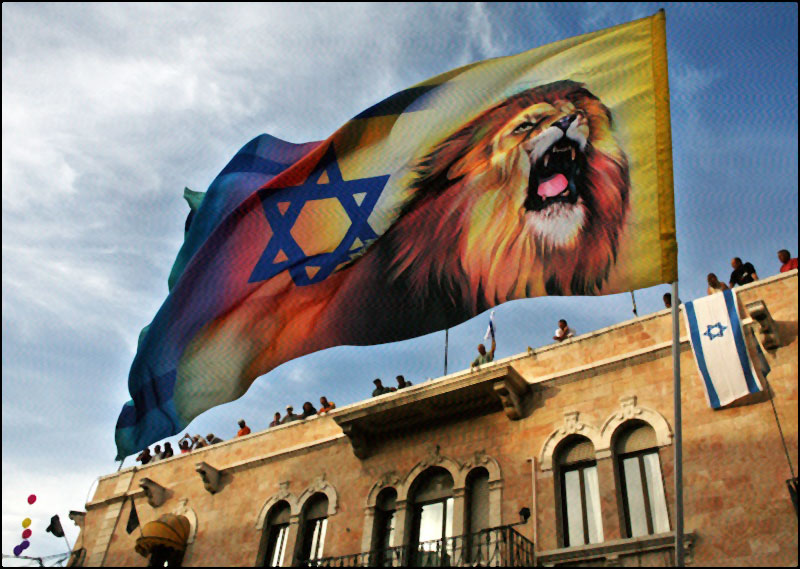


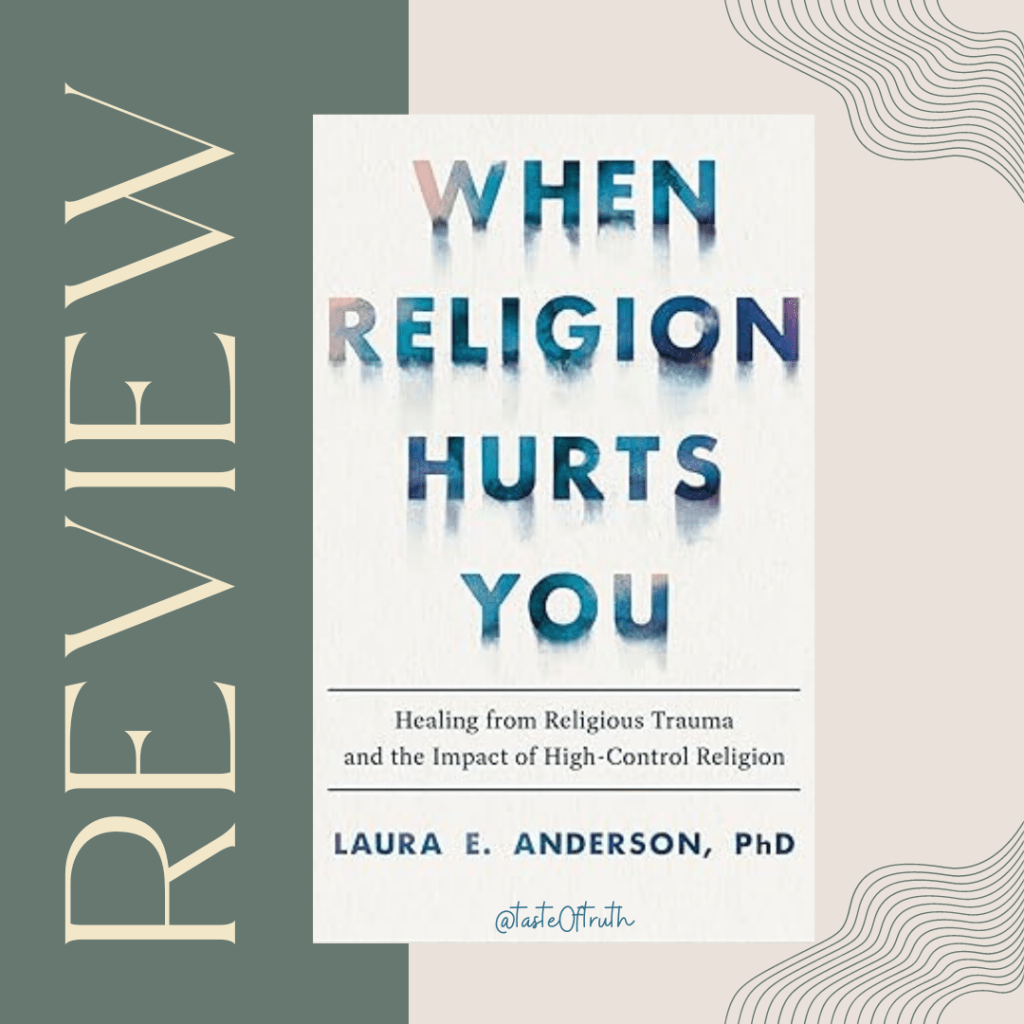




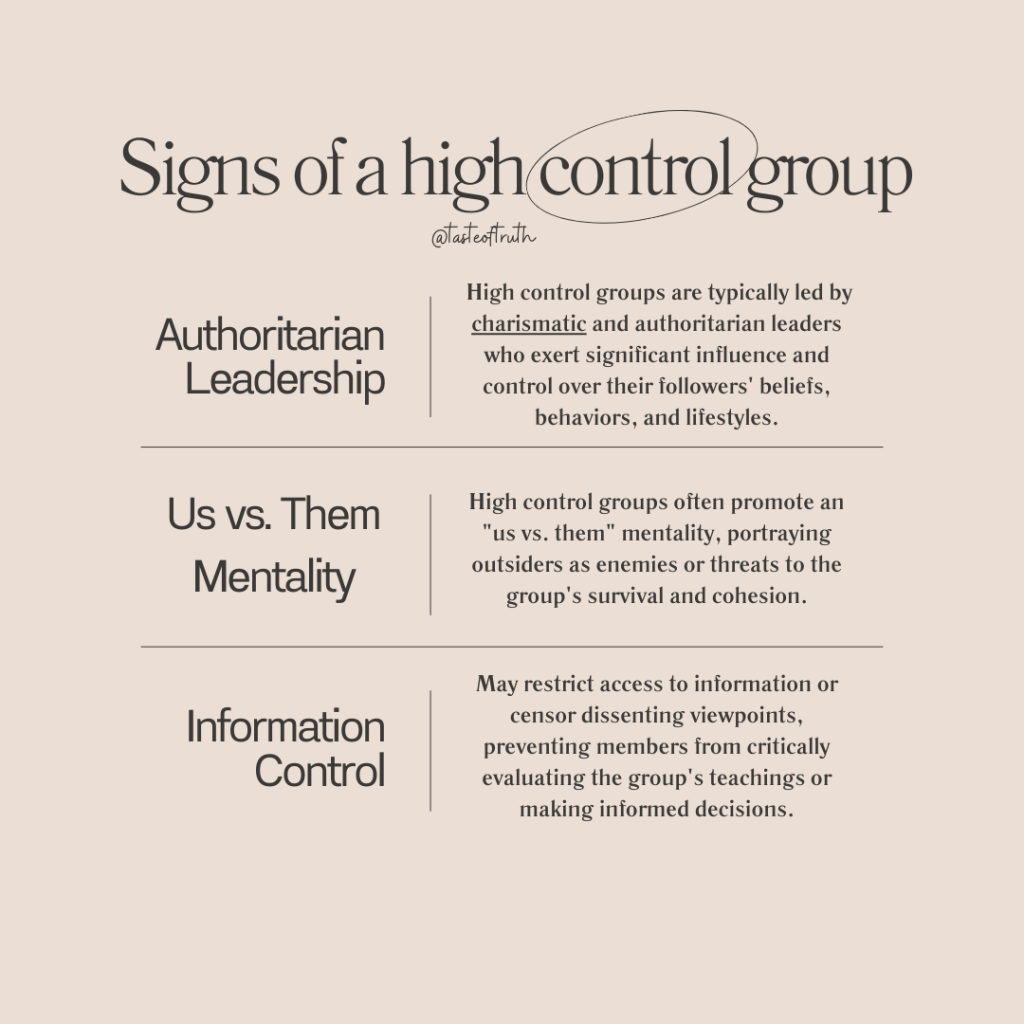
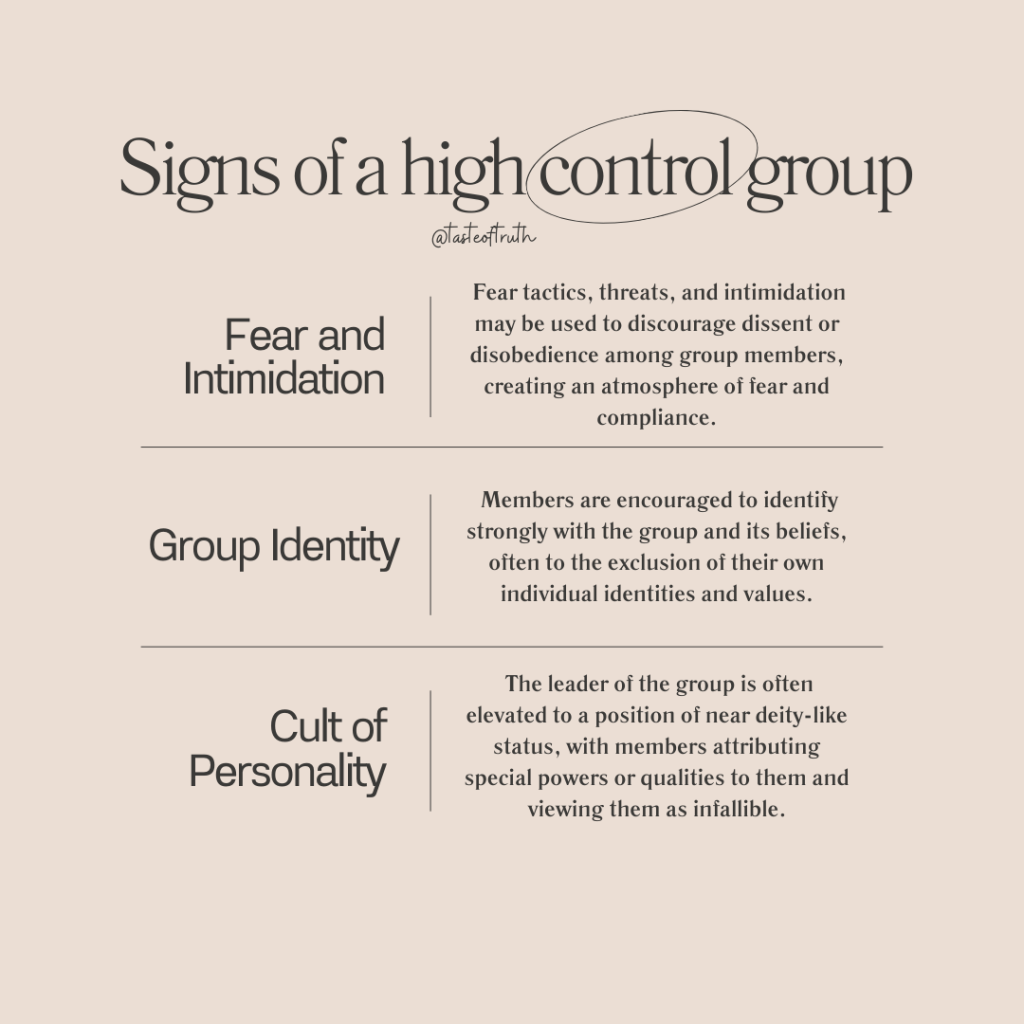
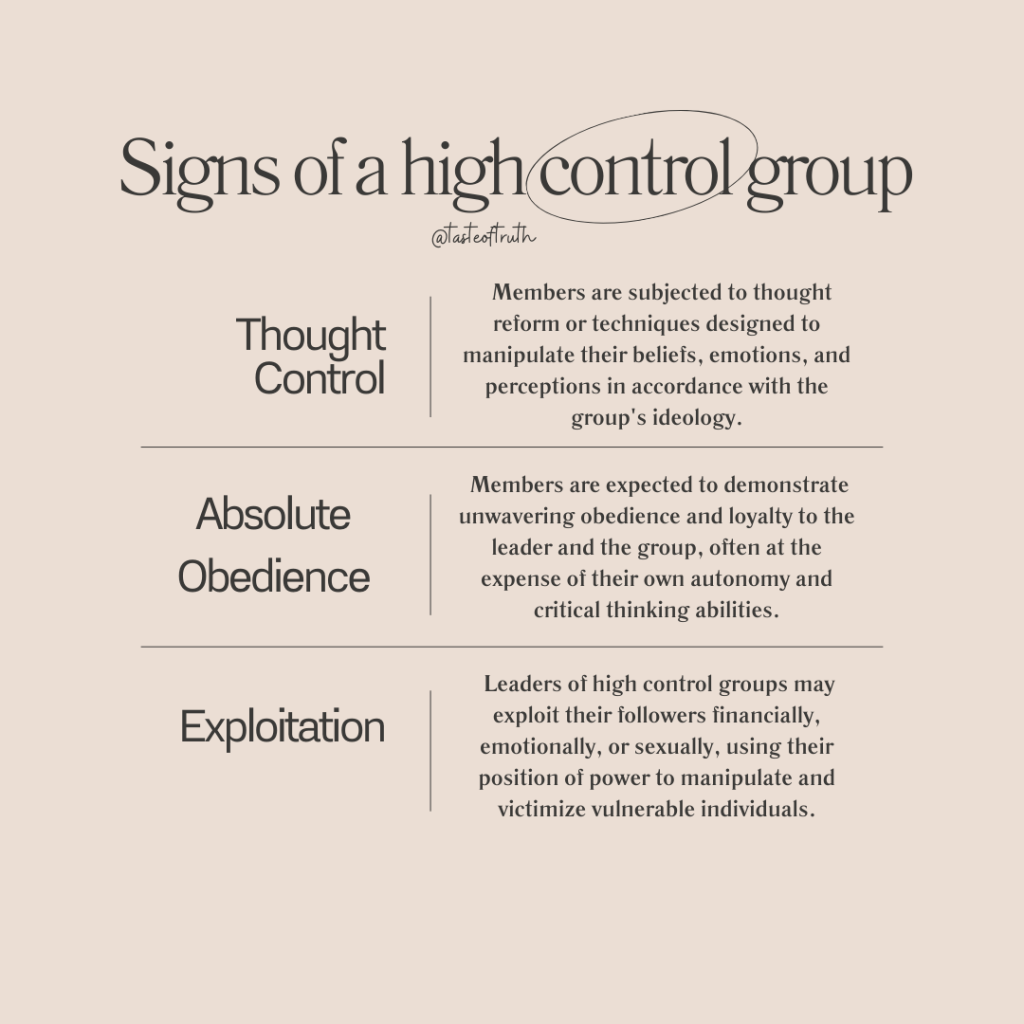
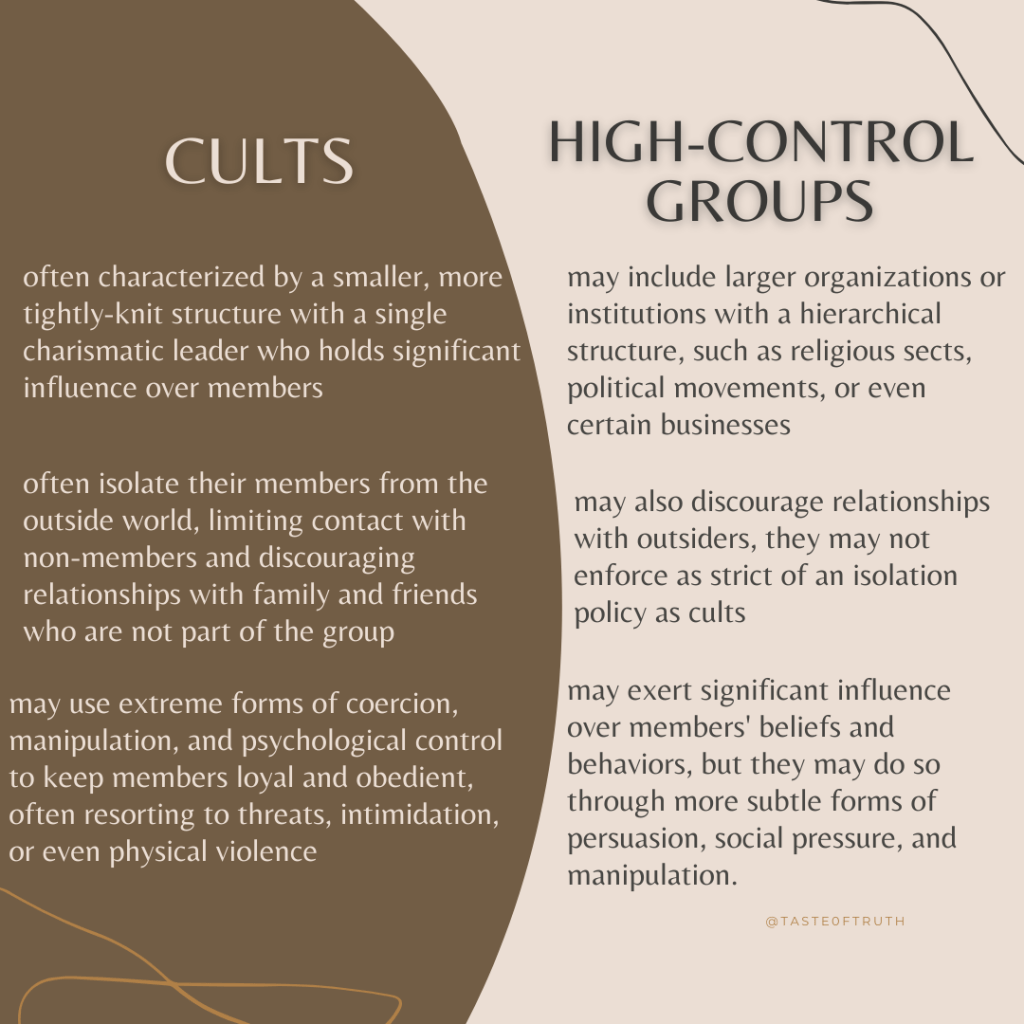

 Taste0ftruth Tuesdays