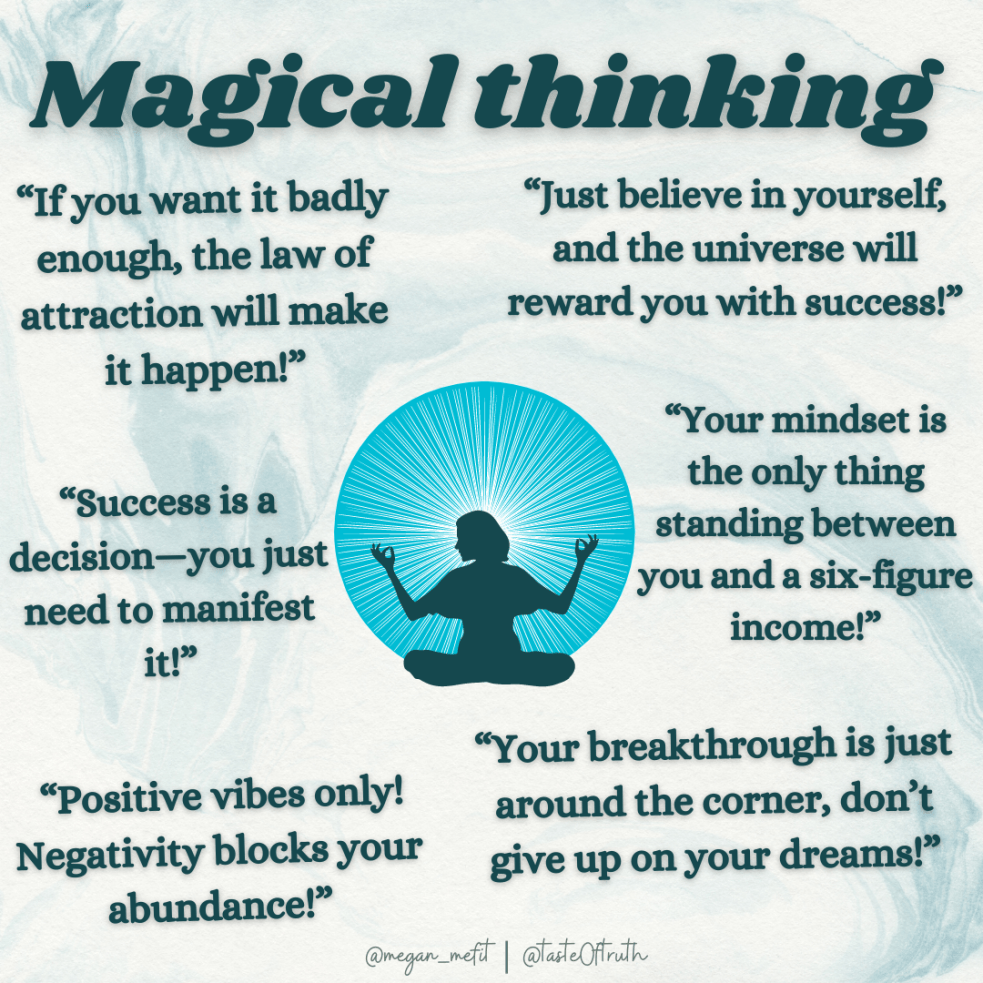
Why MLMs Exploit Magical Thinking

Magical thinking is a quirky psychological phenomenon where people believe that their thoughts, wishes, or actions can directly influence real-world outcomes, despite defying logic or scientific fact. It’s the belief that if you wish for something hard enough, visualize it every day, or think positively, the universe will somehow bend to your will. Sounds empowering, right? But in reality, it leads to a lot of irrational beliefs and behaviors, particularly in high-pressure environments like multi-level marketing (MLM) schemes.

MLMs thrive on this kind of thinking, pushing slogans and practices that dangle the promise of success, wealth, and happiness in front of their members—all through nothing but the power of positive thinking and visualization. “Just think it, and it’ll happen!” But here’s the catch: it never really works like that.

Why Is Magical Thinking Dangerous?

1. False Sense of Control

Magical thinking feeds people this false sense of control over their lives and circumstances. It convinces them that all they need is positive vibes to attract success, which can lead to dangerous complacency. Instead of putting in the hard work, effort, and strategic thinking needed to succeed in any real business, MLM recruits often fall into a trap where they believe success will magically come to them. Spoiler alert: it won’t.

2. Financial Loss

MLMs are notorious for selling the idea that anyone can make it big if they just believe in themselves. It sounds inspiring, right? But it’s a trap. People are encouraged to pour their hard-earned money into products, recruitment materials, and endless training sessions without fully understanding the shaky foundation these businesses stand on. In reality, research shows that up to 99% of MLM participants lose money, but thanks to the allure of magical thinking, they keep going, convinced that their big break is just one more product purchase or recruit away.

3. Emotional Manipulation

MLMs are also masters of emotional manipulation. If you’re not succeeding, they’ll convince you that it’s not the business model that’s failing—it’s you. You didn’t think positively enough, you didn’t manifest hard enough, or you weren’t dedicated enough to your dreams. This emotional burden can leave individuals feeling guilty, ashamed, and like personal failures, even when the deck was stacked against them from the start. The cycle of shame continues as they compare themselves to the shiny success stories splashed all over social media.

4. Detachment from Reality

Magical thinking can lead to complete detachment from reality. When you’re convinced that positive thoughts are all you need, you can easily ignore the mounting red flags. People end up ignoring their dwindling bank accounts, fractured relationships, and mental exhaustion because they’re too busy trying to manifest success. And by the time they snap out of it, the damage is done.

Why Do MLMs Use Magical Thinking?

1. Reinforcement of Loyalty

MLMs aren’t just about selling products—they’re about creating a cult-like loyalty. By pushing magical thinking, they foster a tight-knit community of like-minded believers. This sense of belonging makes it incredibly difficult for individuals to walk away, even when the financial and emotional costs start piling up. After all, leaving the MLM means leaving the tribe—and who wants to be the one to break away?

2. Justification of Failure

When magical thinking is the foundation of your belief system, failure is never about the business model. It’s always personal. Didn’t make the millions you were promised? It’s because you didn’t believe enough. This mindset is a genius way for MLMs to deflect blame, keeping their own reputation intact while making their members feel like the problem lies with them. It keeps the business running without accountability.

3. Encouragement of Recruitment

MLMs thrive on recruitment, and magical thinking is the fuel for the machine. The idea that anyone can succeed if they just think positively or visualize their dreams is a powerful hook for drawing in new recruits. If everyone believes success is inevitable through mental willpower alone, they’ll keep signing up—and bringing others with them.

Red Flags to Watch Out For

• Slogans and Phrases

Be on the lookout for those overly-optimistic, saccharine catchphrases like, “Just believe and you’ll achieve!” or “Manifest your dreams, and they’ll come true!” These slogans might seem harmless at first, but they’re big red flags that magical thinking is being used to manipulate and keep people hooked.

• Focus on Personal Stories

MLMs love to highlight the few personal success stories where individuals “made it,” while conveniently sweeping the 99% of struggling participants under the rug. This selective storytelling distorts reality and feeds the illusion that success is within easy reach for everyone.

• Pressure to Stay Positive

If you feel constant pressure to only stay positive and avoid discussing any challenges or failures, that’s another major warning sign. MLMs don’t want anyone disrupting their “positive vibes” because questioning the business model threatens the entire operation.

• Ignoring Evidence

If an MLM is constantly dismissing scientific evidence or research in favor of anecdotal stories and positive affirmations, it’s time to raise an eyebrow. Facts and figures don’t lie—but magical thinking demands you ignore the hard truths in favor of feel-good fiction.

Conclusion

Magical thinking can feel seductive—after all, who doesn’t want to believe that simply thinking positively can change your life? But in the context of MLMs, it’s a dangerous trap that exploits emotions, manipulates reality, and can lead to significant financial and psychological harm.

Recognizing the power of magical thinking is a key step toward protecting yourself from falling prey to MLM schemes. The next time someone tries to sell you the dream with a hefty dose of “just believe,” remember: real success comes from strategy, effort, and critical thinking—not wishful thinking. Stay sharp, and always dig for the facts behind the hype.

If you’re looking to dig deeper into the topic of magical thinking, MLMs, and their psychological impacts, here are some top-notch resources that will give you the depth and insight needed to fully understand the scope of this issue:

1. Books

  • “Merchants of Deception” by Eric Scheibeler
    • A former high-ranking member of an MLM, Scheibeler exposes the dark side of the industry, shining a light on the manipulative tactics, including magical thinking, used to keep participants hooked and financially invested.
  • “Ponzinomics: The Untold Story of Multi-Level Marketing” by Robert FitzPatrick
    • FitzPatrick’s book is one of the most thorough resources available on MLMs, dissecting the psychological manipulation that fosters the illusion of success, including how magical thinking plays a role in perpetuating these business models.
  • “Influence: The Psychology of Persuasion” by Robert B. Cialdini
    • While not specifically about MLMs, this classic book on persuasion provides a solid foundation for understanding the psychological tactics used in MLMs, including magical thinking. The book covers how people are influenced by emotional appeals and irrational thinking in decision-making.
  • “The Confidence Game: Why We Fall for It… Every Time” by Maria Konnikova
    • This book dives into why people fall for scams, cons, and magical thinking, explaining the psychological elements at play, such as the desire for control and emotional manipulation—key tactics used by MLMs.

2. Podcasts

  • “The Dream”
    • This investigative podcast explores the world of MLMs, breaking down the psychological manipulation, emotional appeals, and magical thinking used to recruit and retain participants. The show offers interviews and personal stories, exposing the inner workings of MLMs in a captivating and digestible format.
  • “MLM: The Broke Podcast”
    • Hosted by a former MLM member, this podcast uncovers how MLMs operate and the manipulative strategies they employ. The podcast touches on magical thinking and the emotional manipulation that keeps participants in these schemes.

3. Academic Articles & Research Papers

  • “Magical Thinking and Superstitions: How Beliefs and Cognitive Biases Drive Irrational Behavior” – by Michael Shermer
    • This article explores the psychological underpinnings of magical thinking and how it relates to belief systems. Shermer’s work is helpful for understanding the cognitive biases MLMs exploit.
  • “The Dark Side of Positive Thinking” by Gabriele Oettingen (Psychological Science)
    • Oettingen’s research critically examines the idea that positive thinking, often promoted in MLMs, can lead to worse outcomes when people fail to back it up with realistic planning and action, a key aspect of magical thinking.
  • “The Fantasy of Success: MLMs and the Psychology of Unrealistic Optimism” by Kim Korteweg (Journal of Business Ethics)
    • This study looks at the role of unrealistic optimism and magical thinking in MLM recruitment and retention, providing a scholarly perspective on how these psychological tricks keep participants engaged.

4. Documentaries & Films

  • “Betting on Zero” (2016)
    • This documentary follows hedge fund manager Bill Ackman’s quest to expose Herbalife as a pyramid scheme. It highlights how MLMs, including Herbalife, use magical thinking to maintain their recruitment and selling operations, and the devastating impact it has on participants.
  • “LuluRich” (2021)
    • A documentary series about the rise and fall of LuLaRoe, this film touches on the magical thinking that drove people to invest thousands into the company based on promises of riches and financial freedom. It dives into the personal stories of those who fell victim to the MLM’s tactics.

5. Articles and Blogs

  • “MLMs Use Magical Thinking to Sell Dreams” (The Atlantic)
    • This article delves into the connection between magical thinking and MLM success, explaining how the industry’s use of vision boards, affirmations, and other positive-thinking tactics lure people into believing they can manifest wealth.
  • “Why People Keep Falling for MLM Scams” by Amanda Montell (Cosmopolitan)
    • Montell breaks down the psychological manipulation MLMs use, including magical thinking, and how they tap into emotional vulnerabilities, especially for women seeking financial independence or a sense of community.
  • “Multi-Level Marketing and the Cult of Magical Thinking” (Psychology Today)
    • This blog post by a psychologist explores the mental traps of magical thinking, including how MLMs leverage these tactics to keep people hooked, even when they’re losing money.

6. Research Studies & Psychology Databases

  • American Psychological Association (APA)
    • The APA has various articles and studies on cognitive distortions, belief systems, and the psychology behind magical thinking, which are key to understanding how MLMs manipulate thought patterns.
  • PubMed/NIH Studies
    • If you’re looking for peer-reviewed research, searching PubMed for articles on cognitive biases, emotional manipulation, and the psychology of MLMs can provide high-quality, evidence-based insights.

These resources will give you a comprehensive understanding of how magical thinking, emotional manipulation, and psychological tricks are intertwined with MLM schemes. Whether you’re writing, podcasting, or just seeking to educate yourself, these tools will sharpen your perspective on the dangers of MLMs and the allure of magical thinking.

The Illusion of Control: Neuroscience of Fundamentalism and Diet Culture

Welcome back Wellness Warriors, and truth seekers!

As we have been discussing all of Season 2, Fundamentalist thinking doesn’t just reside in religious circles—it also permeates wellness and healing spaces. Just as high-control religions exploit human vulnerability, so does diet culture.

I’ve had my share of blindly following extreme health regimens recommended by practitioners, ignoring my own discomfort along the way. It became clear that fundamentalism can crop up in various aspects of life, and part of healing is about recognizing and addressing these tendencies within us.

We have discussed how high control religion and diet culture both capitalize on the brain’s tendency to interpret things in a binary black-and-white manner by presenting clear-cut rules, guidelines, and belief systems that simplify complex issues into easy-to-follow directives.

In this post, we’ll exploring deeper into how the brain’s craving for control and the dopamine boost it triggers can explain why people may transition into high-control environments or swing from one extreme to another. Such as moving from a loose, permissive belief system to a strict, rule-bound one, or from an unrestricted eating pattern to a rigid diet.

The Illusion of Control and Dopamine

The concept of the “illusion of control” ties deeply into our brain’s reward system, particularly through dopamine, a neurotransmitter crucial for motivation and learning. When individuals believe they have control over situations, even when that control is illusory, their brains can release dopamine. This release can provide a rewarding feeling, reinforcing the behavior or belief that leads to this sense of control.

The brain’s craving for control plays a crucial role in how individuals respond to structured systems, be it in religion, diet culture, or Multi-Level Marketing (MLM) schemes. When we encounter a belief system or set of teachings that offers clear, structured guidance, it triggers a sense of control, even if that control is illusory. This perceived control is neurologically rewarding because it leads to the release of dopamine, a neurotransmitter associated with motivation and the reinforcement of behaviors of control over one’s body and health, triggering dopamine release and creating a feedback loop that encourages continued adherence. Similarly, religious fundamentalism often offers clear-cut guidelines on how to live, providing the same sense of security and control, thus reinforcing the behavior.

This perspective not only sheds light on why people might gravitate towards fundamentalism or diet culture but also opens up a discussion on the broader implications of how our brains can be influenced by the promise of control, even when that control is more perceived than real.

What Causes the Illusion of Control

The illusion of control is driven by several factors and provides psychological benefits.

In health and wellness, people often adhere to strict diets or exercise routines, believing they control their weight or fitness, even though genetics and other factors also play a role. This illusion of control can be comforting and encourage adherence.

Similarly, in religion, individuals may follow rigid rules or rituals, thinking they control their spiritual outcomes or moral status, which provides a sense of security and boosts self-esteem.

When did the concept of the illusion of control originate?

The concept, first described by psychologist Ellen Langer in 1975, was initially seen as a way to maintain self-esteem by attributing success to oneself and distancing from failure. Recent research suggests it results from misjudged causality, where people’s sense of control is distorted by their actions rather than actual influence.

Fundamentalism and Structured Belief Systems

Fundamentalism, with its rigid doctrines and absolute truths, can offer a powerful sense of control, especially for those who have previously encountered ambiguity or lack of structure. These rules provide a clear framework for living, reducing the anxiety that comes with uncertainty, and delivering a dopamine-driven sense of reward that reinforces their commitment to the system. This appeal to control can be understood through several key aspects:

1. Structure and Certainty

Fundamentalism provides a clear and structured framework for understanding the world and one’s place within it. This structured approach often includes strict rules, definitive answers, and a well-defined moral code. For individuals who have experienced the fluidity and unpredictability of hyper-charismatic or New Age movements, the stability offered by fundamentalist systems can be particularly attractive.

In fundamentalist belief systems, every aspect of life is often governed by established doctrines. This comprehensive structure can reduce the anxiety associated with uncertainty and ambiguity, offering a predictable environment where individuals feel they know the correct course of action. This sense of predictability can be a significant source of comfort, as it replaces the confusion and complexity of previous experiences with clear-cut answers.

2. The Illusion of Control and Dopamine

The dopamine-driven reward system plays a crucial role in why fundamentalism is appealing. When individuals adhere to the strict rules and guidelines of fundamentalism, their brain releases dopamine, providing a sense of satisfaction and reinforcement. This dopamine release occurs because the rigid structure of fundamentalism offers a perceived sense of control over one’s life and environment.

This sense of control, even if illusory, can be neurologically rewarding. The anticipation and experience of control lead to the release of dopamine, which reinforces the behavior and belief that adherence to fundamentalist teachings is beneficial. Over time, this feedback loop strengthens individuals’ commitment to the belief system, as the dopamine-driven rewards make the structured environment feel more gratifying and secure.

3. Regaining a Sense of Agency

For those coming from less structured or more ambiguous belief systems, fundamentalism can represent a way to regain a sense of agency and direction. After experiencing a lack of clarity or guidance, individuals may find the definitive answers and rules provided by fundamentalism to be reassuring. The shift towards a more structured belief system can be seen as an effort to reassert control over one’s life and decisions.

Fundamentalism’s clear boundaries and absolute truths provide a stark contrast to the uncertainty that may have characterized previous experiences. This transition can be particularly appealing for individuals seeking to regain stability and predictability. The rigid nature of fundamentalism offers a form of control that feels tangible and dependable, even if it is ultimately based on a set of beliefs rather than empirical evidence.

4. Community and Belonging

Fundamentalist communities often emphasize conformity and collective adherence to their doctrines. This communal aspect can further reinforce the illusion of control by providing social validation and support. Being part of a group that shares the same rigid beliefs can enhance the sense of belonging and reinforce the perceived control individuals feel.

The social reinforcement within fundamentalist groups contributes to the illusion of control by making individuals feel supported and validated in their adherence to the teachings. This communal validation can strengthen their commitment to the belief system, as the positive feedback from the group further activates the brain’s reward system.

5. Cognitive Dissonance and Commitment

Once individuals have invested significant time and energy into a fundamentalist belief system, cognitive dissonance can make it challenging to question or abandon their beliefs. The discrepancy between their initial expectations and any potential contradictions or failures within the system can lead them to double down on their commitment.

The illusion of control provided by fundamentalism makes it psychologically difficult to admit that the system may not offer the promised stability or certainty. This cognitive dissonance drives individuals to reinforce their adherence to the system, as admitting any flaws would undermine the very control and certainty they sought to obtain.

The Illusion of Control in Multi-Level Marketing (MLM) Schemes

Similarly to fundamentalist belief systems, MLMs leverage the illusion of control by presenting themselves as opportunities for individuals to take charge of their own success. Participants are led to believe that their efforts directly determine their earnings and advancement within the company. This illusion can be highly appealing, giving people a sense that their hard work and decisions will lead to tangible rewards.

The prospect of achieving success and the belief that one’s actions are under their control can trigger dopamine release in the brain. When individuals see small successes or receive positive feedback, it reinforces their belief in their ability to control their destiny, making them more likely to continue participating despite setbacks.

MLMs often provide structured guidelines, training, and motivational materials that create a sense of control. Participants are given specific strategies to follow, which can make them feel like they have a roadmap to success. This structure reinforces the illusion that they are in control of their outcomes, even when success largely depends on recruitment and team performance.

MLMs frequently emphasize personal responsibility and self-improvement. They promote the idea that success is a result of individual effort and perseverance, subtly shifting blame for any failures onto the individual rather than the system itself. This reinforces the illusion of control by making participants believe that if they follow the system closely enough, they will succeed.

The social aspect of MLMs, including group meetings, motivational events, and social media communities, can amplify the illusion of control. Participants often see others achieving success and feel motivated by their peers, which can strengthen their belief in their own ability to control their outcomes.

Once individuals have invested time, money, and effort into an MLM, the illusion of control can make it difficult for them to step away. The cognitive dissonance created by the gap between their expectations and reality can lead them to double down on their commitment, further reinforcing their belief in their control over their situation.

The Role of Power in the Illusion of Control

Powerful individuals—including CEOs, politicians, religious leaders, and MLM leaders—often overestimate their control over events beyond their expertise. This inflated sense of control can lead to hubris, risky decisions, and an all-or-nothing approach. For example, a wellness guru who believes they can control all aspects of health through strict regimens may push extreme diets or unproven supplements, driven by the illusion of control. Similarly, a religious leader might impose rigid doctrines, believing they can control or influence every aspect of followers’ lives. This overconfidence and all-or-nothing mindset can result in extreme actions and decisions, as seen when individuals adopt overly restrictive health practices or dogmatic religious rules, ultimately leading them to lose touch with reality.

Appeal to Vulnerable Groups

Studies suggest that no one is immune to the illusion of control—under certain circumstances. Research shows that those who are personally involved in actions are among those most likely to overestimate their influence on the outcome. In addition, the behavior of pathological gamblers is driven by the belief that they can beat the odds of what is demonstrably determined purely by chance.

There are people known to be at low risk of susceptibility to illusory control: those who are depressed. Numerous studies show that depressed people are virtually invulnerable to the illusion of control. They have been found to have less distorted views than the non-depressed across a wide array of perceptions and judgments‑a state of mind that has been labeled depressive realism. They are more likely to see the futility of taking action to influence outcomes. When vulnerable individuals meet a group that offers definitive answers provides the certainty and structure these individuals crave, making them more likely to adopt and adhere to the teachings.

Effects of the Illusion of Control

A sense of control is an adaptive trait linked to better health outcomes, including reduced risk of mortality and diseases, improved physical and cognitive function, and higher life satisfaction. It promotes positive behaviors like exercise and good sleep and enhances optimism and a sense of purpose.

However, the illusion of control can also lead to magical thinking, poor decision-making, and risky behaviors such as gambling, as it may encourage unrealistic beliefs and prevent thorough analysis of situations.

In Summary

Reflect on how the illusion of control might be influencing their own choices and beliefs. Consider whether a sense of control is driving your decisions in areas like health, religion, or business ventures. Understanding this psychological mechanism can empower you to make more informed choices and break free from patterns that may not truly serve your well-being. Share your thoughts and experiences in the comments or join the conversation on our social media channels to explore these ideas further.

Plus, join us this week on the podcast, as we talk with @mburtwrites a talented author and advocate in children’s literature, about faith, parenting styles, and mental wellness. Share your thoughts or join the conversation—let’s explore the impact of the illusion of control together! 💭

🎧here

RESOURCES:

Books:

  1. “The Illusion of Control: Why We Overestimate Our Ability to Control Events” by Ellen J. Langer
    • A foundational text by the psychologist who first described the illusion of control.
  2. “Thinking, Fast and Slow” by Daniel Kahneman
    • This book delves into various cognitive biases and heuristics, including the illusion of control.
  3. “The Power of Habit: Why We Do What We Do in Life and Business” by Charles Duhigg
    • Explores how habits form and the role of dopamine in reinforcing behaviors.
  4. “The Dopamine Diet: The Complete Guide to Lose Weight, Boost Your Energy, and Live a Happier Life by Rebalancing Your Brain Chemistry” by Neil W. Dhingra
    • Focuses on how diet impacts dopamine levels and overall well-being.

Articles and Papers:

  1. “Illusion of Control” | Psychology Today
    • An overview of the illusion of control and its psychological underpinnings. Read here
  2. “The Truth About Dopamine and Your Brain” | Psychology Today
    • Explains dopamine’s role in motivation and reinforcement. Read here
  3. “Biology of Motivation, Dopamine, and Brain Circuits That Mediate Pleasure” | SpringerLink
    • A scientific paper detailing dopamine’s role in motivation and reward. Read here
  4. “The Illusion of Control in the Financial Markets” by E. J. Langer
    • Examines how the illusion of control affects decision-making in financial contexts. Read here

Online Resources:

  1. TED Talks
    • Search for TED Talks on cognitive biases and the role of dopamine for accessible explanations and examples.
  2. Coursera and edX
    • Look for courses on psychology, neuroscience, and behavioral economics that cover these topics in depth.
  3. YouTube Channels
    • Channels like CrashCourse and Khan Academy often have videos on psychology and neuroscience that touch on related concepts.

These resources should provide a comprehensive understanding of how the illusion of control and dopamine influence behavior across different contexts.