The holidays are here, and while it’s the season of joy, connection, and maybe a few too many late nights, it’s also the perfect time to start preparing for the 365 Easy Challenge kicking off in 2025. And let’s face it: sleep is the foundation for everything we’ll tackle together next year.
Did you know women are more likely to struggle with insomnia than men? It’s not just in your head—it’s science. Hormonal fluctuations (hello, PMS, pregnancy, and menopause) wreak havoc on your sleep cycles, making restful nights feel like a luxury you can’t afford to miss.
But here’s the real kicker: poor sleep doesn’t just leave you feeling groggy. It messes with your mood, metabolism, and even your muscles. Whether you’re juggling holiday chaos, prepping for a fresh start in January, or just trying to function, running on empty isn’t the answer. Let’s dig into why quality sleep is essential—and how to actually get it.
Why Sleep Matters More Than You Think
Inflammation & Immunity Sleep is your body’s built-in anti-inflammatory agent. Without it, inflammation skyrockets, leaving you vulnerable to chronic diseases and poor recovery from workouts or injuries.
Mental Clarity Brain fog isn’t just an inconvenience; it’s a sign your brain didn’t get its overnight “detox.” Sleep clears out waste products like amyloid plaques, which are linked to neurodegenerative diseases. Think of it as housekeeping for your mind—skip it, and you’re living in clutter. Braig fog + thyroid connection!
Hormonal Harmony From cortisol to melatonin to estrogen, sleep keeps your hormones in check. Messy sleep = messy hormones, which can mean mood swings, weight gain, and irregular cycles.
Circadian Rhythm & Beyond Your body runs on a 24-hour clock. Disrupting it—whether with late-night scrolling or inconsistent sleep times—throws everything off, including digestion, energy levels, and even hunger cues.
Sleep & Exercise: The Sneaky Saboteur
Think sleep doesn’t impact your workouts? Think again. Poor sleep leads to:
Slower reaction times (hello, clumsiness).
Increased injury risk (because you’re tired and uncoordinated).
Longer recovery times (muscles can’t repair without rest).
Heightened fatigue (making you feel like you’re dragging through every rep).
💡 Quick fix: Research shows a 45-minute afternoon nap can improve performance and lower perceived effort. Translation: naps aren’t lazy; they’re strategic.
Bedtime Hacks for Better Rest
Dim the Lights Block blue and green light from screens, lower the brightness, and dim the room 1–2 hours before bed.
Chill Out Literally—lower your bedroom temperature to around 65°F (18°C). Cooler temps signal your body it’s time to rest.
Silence & Darkness Total darkness (blackout curtains or a sleep mask) + white noise or earplugs = your best chance at uninterrupted rest. My favorite sleep track
Stick to a Schedule Consistency is key. Aim to go to bed and wake up at the same time—even on weekends.
Don’t Force It Wake up in the middle of the night? Get out of bed briefly to reset instead of tossing and turning.
Level Up Your Sleep with Bedtime Gummies
Let’s talk about a bedtime treat that actually works: Tart Cherry Gummies. Packed with melatonin and glycine, they’re a natural way to ease into deeper, more restful sleep.
Why Glycine Rocks:
Helps you fall asleep faster.
Improves sleep quality and efficiency.
Eases symptoms of insomnia.
Recipe:
1 cup tart cherry juice
1 cup water
4 tbsp beef gelatin
Maple syrup (to taste)
Bloom the gelatin in half the juice for 3–5 minutes.
Heat the remaining juice, then combine.
Pour into molds or a dish and refrigerate.
The Takeaway
Sleep isn’t a luxury—it’s a lifeline. From balancing your hormones to enhancing your brainpower, it impacts every aspect of your health. If you’re still treating it like an afterthought, it’s time to flip the script.
Now, tell me: what’s your biggest sleep struggle, and which hack are you going to try first? 💤
Today, let’s talk about the deceptive allure of “before and after” photos in the fitness industry—and draw a parallel to how spiritual testimonies can also manipulate emotions and perceptions.
The Fitness Industry’s “Before and After” Photos
In the fitness world, “before and after” transformations are marketed as proof of the efficacy of programs and products. These photos promise more than physical change; they sell a narrative of personal triumph over adversity. But behind these glossy images lie often overlooked truths: strategic lighting, posing, and digital enhancements that create an illusion of rapid, effortless transformation. This manipulation plays on our desire for quick fixes and can leave us feeling inadequate when our own progress doesn’t mirror these idealized images.
Many fitness marketers use various tricks to enhance these photos, such as manipulating lighting, posture, and even the time between shots. Sometimes, the “before” photo might be taken in the morning and the “after” photo later the same day, with the person tanned, flexed, and using better lighting. Studies have shown that such photos can significantly influence people’s perceptions and motivations, often leading to unrealistic expectations and disappointment (Trainer Josh) (Visual Culture).
The Emotional Manipulation of Spiritual Testimonies
Similarly, spiritual testimonies often follow a formulaic structure designed to evoke specific emotional responses. They typically begin with a depiction of a troubled past—perhaps addiction, loss, or despair—followed by a dramatic turning point: a moment of conversion or spiritual awakening. These stories, while often sincere, can omit the complexities and doubts that accompany genuine spiritual journeys. They paint a picture of faith that is pristine and unwavering, reinforcing the belief that divine intervention leads to miraculous change.
I’m eager to explore a phenomenon that emerged in Summer 2022: “Not So Secret Societies.” This podcast intertwined QAnon conspiracies with Christianity, making waves in spiritual communities. One of the hosts, Kara, bravely shared her testimony of converting from New Age spirituality, where she encountered spirits as a medium. Her journey to embracing Jesus was emotional, filled with tears, and profoundly impactful. Many of us listening felt convicted, realizing the spiritual implications and our own paths.
Join me as we unpack these complex intersections and reflect on the profound shifts in belief and perception. Let’s delve into how narratives on social media can reshape worldviews and influence personal journeys.
Understanding the Emotional Impact
Kara’s testimony likely resonated deeply due to its emotional narrative of spiritual transformation—from New Age spirituality to Christianity. Testimonies often appeal to emotions and personal experiences, making them powerful tools for persuasion. Stories like this appeal to emotions by highlighting profound experiences and struggles, which can resonate deeply with listeners seeking meaning or spiritual fulfillment.
The narrative of converting from New Age beliefs, where spiritual entities are often seen positively or neutrally, to Christianity, where demons are viewed as real and malevolent, creates a stark contrast. This binary worldview can lead listeners to feel they must choose between good (Jesus) and evil (Satan).
Joining a group like Not-So-Secret Societies, which merges QAnon conspiracy theories with Christianity, can create a sense of belonging and purpose. Kara’s testimony might have reinforced group identity by framing her conversion as a rejection of perceived darkness and alignment with a community of light-bearers.
Psychological Mechanisms at Play
Cognitive Dissonance: Kara’s story may have triggered cognitive dissonance in listeners who resonated with her previous beliefs in New Age spirituality. This discomfort can drive individuals to align with her new perspective on Christianity to resolve conflicting beliefs.
Confirmation Bias: Listeners may selectively interpret information that supports Kara’s narrative, reinforcing their own beliefs while discounting contradictory evidence.
Psychological Vulnerabilities and Exploitation
Vulnerabilities in Seekers:
Existential Uncertainty: Many individuals experience periods of questioning and uncertainty about life’s meaning and their place in the world. Narratives like Kara’s offer a clear path and sense of purpose, which can be appealing during times of existential crisis.
Emotional Needs: Feelings of loneliness, isolation, or a lack of community drive individuals to seek belonging and acceptance. Conversion stories often promise a supportive community and emotional fulfillment.
Desire for Spiritual Fulfillment: Some seekers may feel spiritually unfulfilled or disconnected from their current beliefs, prompting them to explore alternative spiritual paths that offer a deeper sense of connection or transcendence.
Exploitation by Manipulative Tactics:
Emotional Manipulation: Conversion narratives often leverage emotional storytelling to evoke sympathy, empathy, or fear. By presenting a dramatic transformation from darkness to light, storytellers appeal to listeners’ emotions and foster a sense of urgency to follow suit.
Fear-Based Messaging: Some narratives use fear tactics, suggesting dire consequences for not embracing the presented belief system. This can create a sense of vulnerability and heighten the perceived importance of making a decision.
Promises of Belonging and Acceptance: Groups like Not So Secret Societies capitalize on the human need for community by promising acceptance and belonging to those who adopt their beliefs. This can be particularly compelling for individuals who feel marginalized or disconnected from mainstream society.
Recognizing Manipulative Tactics
Selective Storytelling: Narratives like Kara’s often present a selective portrayal of personal experiences to support a specific worldview. Encourage listeners to look for missing perspectives or contradictory evidence that may be omitted.
Appeals to Emotion: Emotional appeals can cloud judgment and hinder rational decision-making. By recognizing emotional manipulation tactics, individuals can maintain objectivity and evaluate information more critically.
Community and Identity Formation
Joining groups like Not So Secret Societies offers a sense of belonging and community based on shared beliefs and experiences. Kara’s story likely strengthened group identity by framing her conversion as a move towards spiritual enlightenment and away from perceived darkness.
Exploring the Broader Implications
Social Media’s Role in Recruitment: Podcasts and social media platforms amplify narratives like Kara’s, reaching a wide audience quickly and effectively. Algorithms and sharing mechanisms on platforms can contribute to the virality of compelling stories, enhancing their influence. Online communities, including those blending conspiracy theories with spirituality, create echo chambers where members reinforce each other’s beliefs. Exposure to consistent messaging can solidify beliefs and increase susceptibility to ideological conformity.
Ethical and Moral Dimensions: Consider the ethical implications of blending religious conversion narratives with conspiracy theories. How do these narratives shape individuals’ perceptions of reality and influence their behaviors? Combining religious conversion narratives with conspiracy theories raises ethical concerns about misinformation, manipulation, and the impact on individual autonomy. It prompts discussions about the responsibilities of content creators and platforms in promoting critical thinking and fact-checking.
Cultural and Societal Context
Cultural Shifts and Crisis Narratives: Consider how broader cultural shifts, such as societal crises or rapid technological changes, contribute to the appeal of narratives that promise clarity and certainty in uncertain times.
Societal Instability: During periods of societal upheaval or rapid change, individuals may seek stability and certainty in their beliefs. Conversion narratives that promise clarity and moral absolutes can provide a sense of security amid uncertainty.
Technological Advancements: The rise of social media and digital communication platforms has democratized information dissemination but also facilitated the rapid spread of ideological content. Narratives can gain traction quickly and reach a global audience almost instantly.
Historical Precedents:
Religious Revivals: Throughout history, religious revivals and spiritual movements have often been sparked by charismatic leaders or compelling testimonies of personal transformation. These movements have shaped public discourse and influenced societal norms.
Political and Social Movements: Ideological movements, whether religious, political, or cultural, have historically used persuasive narratives to mobilize followers and challenge existing social structures. Understanding historical parallels can provide insights into current trends.
Media Literacy and Critical Thinking
Promoting Media Literacy:
Fact-Checking and Source Evaluation: Encourage listeners to critically evaluate the credibility of sources and information presented online. Teaching fact-checking skills empowers individuals to distinguish between reliable information and misinformation.
Questioning Assumptions: Emphasize the importance of questioning assumptions and biases when consuming media. Critical thinking involves examining underlying motivations and potential agendas behind persuasive narratives.
Long-term Impacts and Responsibilities
Impact on Individual Beliefs:
Worldview and Identity Formation: Exposure to persuasive narratives can shape individuals’ beliefs and identities over time. Conversion stories may influence how individuals perceive themselves and their place in society, impacting their values and behaviors.
Psychological Well-being: Consider the potential psychological effects of adopting new belief systems based on persuasive narratives. Individuals may experience cognitive dissonance or emotional distress if their beliefs conflict with their previous worldview.
Responsibilities of Content Creators:
Ethical Guidelines: Content creators, influencers, and platforms have a responsibility to uphold ethical standards in content creation and dissemination. This includes transparency about sources, avoiding misleading or exaggerated claims, and respecting the diversity of beliefs and perspectives.
Promoting Critical Awareness: Encourage content creators to promote critical awareness among their audiences. This involves fostering open dialogue, encouraging respectful debate, and acknowledging the complexity of social and ideological issues.
Conclusion and Call to Action
Encouraging Dialogue:
Open Discussion: Foster open dialogue among listeners about the impact of persuasive narratives and the role of social media in shaping beliefs. Encourage respectful debate and exchange of ideas across ideological divides.
Community Engagement: Promote community engagement as a means of supporting individuals who may be questioning or reevaluating their beliefs. Provide resources for further exploration and encourage listeners to seek diverse perspectives.
Personal Reflection:
Critical Self-reflection: Spend time thinking of your own susceptibility to persuasive narratives and ideological influences. Encourage them to cultivate critical thinking skills and
Welcome back to Taste0ftruth Tuesdays Wellness Warriors, Health Detectives, Nutrition Ninjas and Truth Seekers! ⛓️💥 In this blog and podcast episode, we’re breaking free from the chains of diet culture and diving into the refreshing waters of body-neutral fitness!
Embracing Performance Goals: Discover how focusing on what your body can do, rather than how it looks, can revolutionize your fitness journey.
Body-Neutral Bliss: Learn how to find peace with your body through a body-neutral approach to exercise, celebrating movement for movement’s sake.
From Rules to Freedom: Say goodbye to restrictive diets and hello to intuitive eating and joyful movement.
Tune in as we unpack the myths of diet culture and celebrate the liberating path to body-neutral fitness! Remember, you’re not just dropping out of diet culture—you’re leveling up to a healthier, happier you!
Listen 🎧
Raise your hand if you’ve ever felt the pressure to change your body to fit into society’s standards of beauty. 🙋♀️ Well, you’re not alone! For years, I found myself trapped in a cycle of dieting and exercising, all in pursuit of the elusive “perfect” body.
But no matter how hard I tried, I just couldn’t seem to make any lasting progress. Sound familiar? That’s because we’ve been sold a lie – the idea that our worth is tied to the number on the scale or the size of our jeans. But guess what? It’s time to break free from that toxic mindset and embrace a new approach to fitness and nutrition.
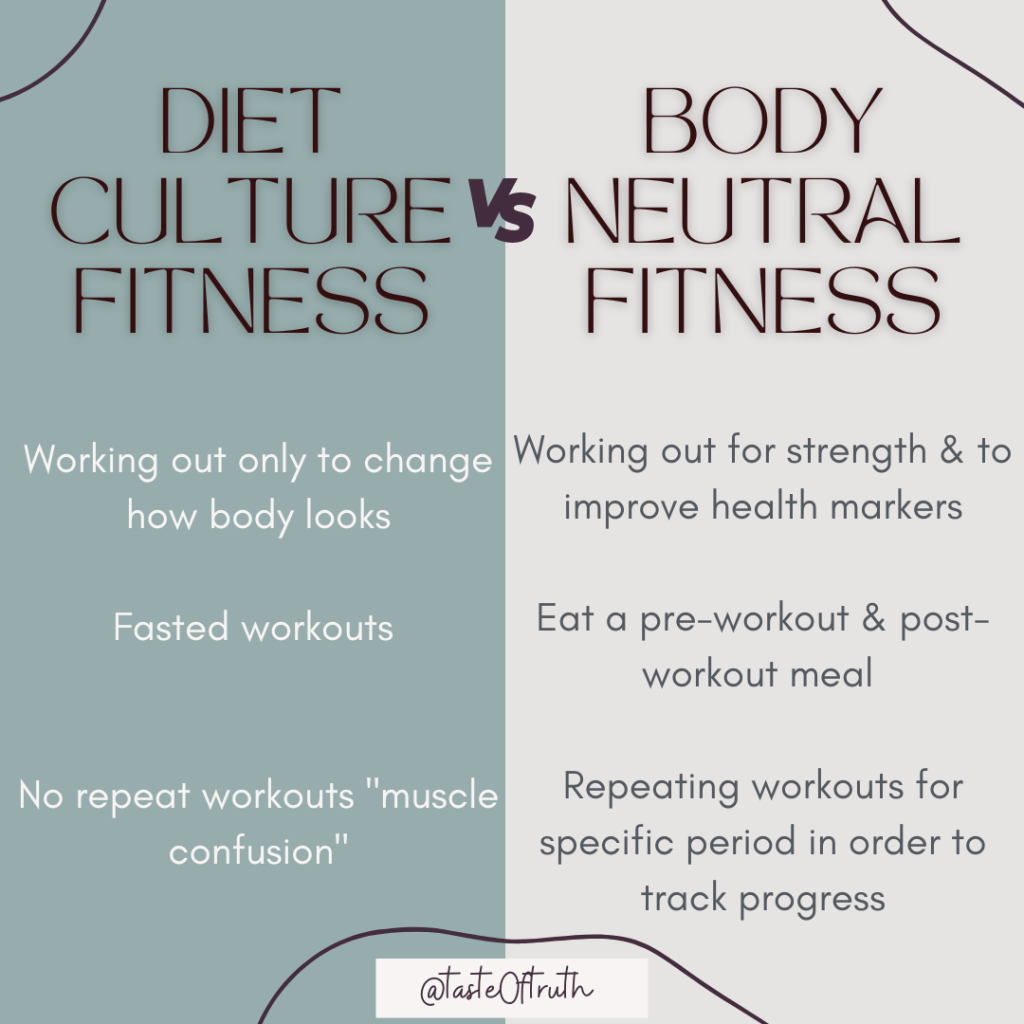
I want to go over common trends I see that I refer to as “diet culture fitness” and then we will compare it with what I recommend “body neutral fitness” ….
Diet culture places value on our weight and size over our health. it promotes messaging that tells us what foods “good” & what foods are “bad.” it glorifies restriction & willpower and ignores our wellbeing.
Diet culture is supported by a multi-billion-dollar industry that pushes weight loss through every medium possible. Diet culture tells all of us that we are not small enough, strong enough, or lean enough.
DIET CULTURE IS HARD TO IGNORE.
So, how can one be against diet culture but fine with a diet? it starts with terminology >>
A DIET merely refers to the foods & drinks we habitually consume. a diet can be a specific, structured way of eating or just our normal daily intake.
The term “DIETING,” is often where the idea of weight loss comes into play. Dieting is (usually) used to describe eating with the purpose of losing weight, which requires a calorie deficit.
>> I am anti-diet culture because i believe that food is not meant to be associated with guilt and shame.
>>I am anti-diet culture because i do not believe that reaching a specific weight, shape or size is ever more important than our physical or mental wellbeing.
However, I do believe that it is ok to want to change your diet.
It is ok to have aesthetic goals, especially when we can learn to work towards them in a healthy & sustainable manner. It’s about wanting to shift from old negative eating patterns and thoughts to new behaviors that leave you fueled and healthy.
I believe that it is ok to want to look & feel your best & addressing your nutrition and relationship with food is often the best way to do so. Your diet is not bad. restriction, shame, guilt, & obsession are
So, what’s the secret to lasting change? It all starts with shifting our focus from aesthetics to performance. Instead of obsessing over how our bodies look, let’s celebrate what they can do! Whether it’s mastering a new yoga pose, hitting a new personal record at the gym, or simply feeling more energized and alive, performance-based goals are where it’s at.
This ultimately means changing the values and the why behind your goal setting:
Instead of: “I want to lose the cellulite off my legs.”
Try: “I’d like to improve my technique and increase my strength in squats, leg press and deadlifts.”
The intention behind Body Neutral Fitness movement is:
Enhance strength & overall performance
Boost confidence & find purpose
Build stamina for effortless hiking
Improve balance, coordination, & mood
Enhance health & blood markers
So, WHAT’S THE BOTTOM LINE?
Body neutral fitness is so much more fun, and having fun gets more done! An approach that emphasizes setting and achieving performance goals works better for cultivating a healthy mindset towards fitness which is more sustainable over the long term than an approach that emphasizes aesthetics only.
Whatever your performance may be, shifting the focus changes your mind about your body, which can then remove the limits around what your current body/self can experience.
So, let’s get back to those trends:
👉Swipe👉
What is biofeedback and why is it so important?
This refers to the physiological responses that will bring awareness to our bodily processes and internal health. Sleep, hunger, stress, energy, stress, cravings, recovery, etc. Because optimal health is so much more than just physical! If we track these markers, we can begin to see some underlying causes or maybe issues on why your workout program may not be properly supporting you.
😐Stress: How are your stress levels? How do you manage them?
😋Hunger: Do you wake up hungry? Are you always thinking about food?
💩Digestion: Do you experience painful bloats? do you have regular bowel movements?
😴Sleep: How much sleep are you getting? Do you sleep through the night? How many hours? Do you wake up feeling rested? Does your energy dip mid-afternoon?
🛋️Recovery: Are you taking adequate rest days? Do you feel sore for days after your workouts?
🌀Menstrual Health: Are you missing your period? Do you experience painful cramps or any other PMS symptoms?
🍴Cravings: Do you find yourself struggling with these?
Oftentimes, clients that are experience negative biofeedback, there is an underlying cause that needs to be addressed, BEFORE we can actually focus on a physical transformation goal.
💤Improper sleep or stress management can lead to hormone imbalances that inhibit recovery.
😖Digestive issues can be a sign of chronic stress, low stomach acid and food intolerances.
🥺Mood, focus and libido changes may be linked to under-eating, hormonal imbalances, gut issues, etc.
One of the many variables within fitness program creation is “training volume” (How much you’re doing in a specific time. That can be per workout and within the program like per week/per month). In order to properly prescribe this, a coach needs to understand their clients: fitness level, goals, age, work capacity, recoverability, nutritional status, injury history and life stress. If your coach or fitness trainer didn’t ask you any of these things, that may be something worth looking into.
While physical changes are often used to measure progress, monitoring how you FEEL in response to your nutrition and exercise program is also important. It provides insights to how your metabolism is performing and which possible variables to manipulate in order to see improvements. 💪
🩺NOTE: Assessing biofeedback does NOT replace the need for lab work or medical attention.
ALL-OR-NOTHING Mindset
🧠Diet culture thrives on the All-or-Nothing-mentality. I think this is one of the hardest habits to become aware of and try to replace. I don’t know if anyone else can relate to needing a brain reframe, but typically when clients come to me, they say: “I want a body reset!” and I try to tell them: “You know what, it’s probably your brain that needs the reframe. There are more tips and mindset tricks I want to share with you over the course of season 2.
I want to close say that perfectionism is a TRAP, that so many of us that will get caught up in, within spiritually, and diet and nutrition. And when we slip up, which will always happen, it will feel easier to throw in the towel when we are stuck in all or nothing mentally, on the whole shebang. I think this is one of the most common self-sabotaging behaviors that I see, and this is what I hope to continue the conversations on in this season.
Thank you again for listening/reading and I am looking forward to next’s week’s episode! Until then, maintain your curiosity, embrace skepticism, and keep tuning in! 🎙️🔒





 Embracing Performance Goals: Discover how focusing on what your body can do, rather than how it looks, can revolutionize your fitness journey.
 From Rules to Freedom: Say goodbye to restrictive diets and hello to intuitive eating and joyful movement.
 Tune in as we unpack the myths of diet culture and celebrate the liberating path to body-neutral fitness!
 Remember, you’re not just dropping out of diet culture—you’re leveling up to a healthier, happier you!


 Taste0ftruth Tuesdays