When Morality Binds and Blinds: Lessons from Charlie Kirk’s Death

Hey hey my friends, welcome back to Taste of Truth Tuesdays. Today’s episode is going to be heavier than usual, because I want to process something that has been shaking me to my core over the past week, the brutal death of Charlie Kirk.

Now, I need to start here: I did not agree with Charlie on everything, especially not his theology. You know me, I don’t subscribe to the idea that morality begins and ends with the Abrahamic scriptures. That’s a hard pass. But I also can’t deny the impact Charlie had on me. I spent years watching him debate, learning from the way he sharpened his arguments and stayed composed with people he deeply disagreed with. He’s one of the people who actually inspired me to study the Constitution, socialism, and to pay more attention to what’s happening politically.

So when I heard he was brutally murdered, I cried. It was horrific. And then, when I looked online and saw people celebrating his death? Saying he deserved it because he was a white, conservative, Christian man? That was gutting. Not just emotionally but morally. 

In fact, let me show you a comment I received. This person told me she couldn’t believe I was mourning the death of a Trump supporter, that he had ‘spewed so much,’ and then announced she was unfollowing and blocking me.

That’s the climate we’re in. Not just disagreement, but outright dehumanization.

That kind of reaction, the dancing-on-the-grave energy, it’s not just tasteless. It’s a reflection of how far moral tribalism has gone. She is a perfect example of what I saw when I was navigating ex-Christian and ex-evangelical spaces. It is the same trend there: conservatives painted as villains, ridiculed, dismissed, treated as less-than. 

Folks in my parasocial networks would send me podcasts or Instagram pages that were just openly disrespectful and overgeneralizing, like mocking anyone who leaned right was simply part of the healing process. And I remember sitting there thinking… how are you even friends with me if you despise people like me so much?

It’s like the hatred is so baked into the zeitgeist, people don’t even notice they’re doing it.

I’ve already done an episode on the radical left and why I left the left in 2020. Back then I saw the extremism ramping up with Black Lives Matter, with pandemic policies, and yes, with those shocking poll results in 2022, where a significant portion of Democrats said they believed unvaccinated people should have their kids taken away or even be put into camps. 

https://www.rasmussenreports.com/public_content/politics/partner_surveys/jan_2022/covid_19_democratic_voters_support_harsh_measures_against_unvaccinated?

That was the moment I realized this wasn’t just about public health.  It was about authoritarianism cloaked in moral righteousness.

And I want to tie that moment to this moment. Because what we’re seeing with Charlie Kirk’s death is the exact same kind of moral righteousness, just flipped.

This is where Jonathan Haidt’s book The Righteous Mind comes in and yall know I bring this book up a lot, but today it’s essential. 

Haidt’s big idea is that morality isn’t one single thing. It’s made up of six different foundations, like taste buds of the moral sense. Let me walk you through them:

  1. Care vs. Harm – the instinct to protect others from suffering. Progressives tend to emphasize this one the most.
  2. Fairness vs. Cheating – concern for justice, reciprocity, equal treatment. Again, heavily weighted on the left.
  3. Loyalty vs. Betrayal – valuing group solidarity, patriotism, belonging. This resonates more on the right.
  4. Authority vs. Subversion – respect for tradition, leadership, order. Again, more prominent for conservatives.
  5. Sanctity vs. Degradation – ideas of purity, sacredness, things that must not be defiled. Religion is one form, but health and nature can trigger it too. Conservatives score higher here, but you see progressives activate it around food purity or environmentalism.
  6. Liberty vs. Oppression – the drive to resist domination and protect freedom. This one cuts across both sides but is framed differently, the right fears big government, the left fears corporate or systemic oppression.

Now, how does this help us explain what we’re seeing?

Progressives, whose moral taste buds are dominated by Care and Fairness, look at Charlie Kirk and say, ‘He caused harm to marginalized groups, he propped up unfair systems.’ So when he died, they felt justified in celebrating. Their moral taste buds told them: this is justice.

Conservatives, on the other hand, lean more heavily on Loyalty, Authority, and Sanctity. Charlie embodied loyalty to the nation, respect for conservative traditions, and yes, defense of the sacred. So his death wasn’t just tragic, it was an attack on everything sacred to them. That’s why you’re seeing these martyrdom narratives, even AI videos of Charlie in heaven with other ‘heroes of the faith.’ It’s moral psychology in action.

👉 And this is also the perfect moment to point out the formula behind Psy-Ops. Because these martyrdom narratives aren’t just spontaneous. They follow a pattern of influence:

(Stimulus + Feeling) – Conscious Awareness × Repetition = Belief.

That’s the formula. You feed people a stimulus, in this case, AI imagery of Charlie Kirk as a martyr. You attach it to a strong feeling: grief, anger, hope. By doing so, conscious awareness is bypassed, people aren’t stopping to analyze, they’re in raw emotion. And then you repeat it over and over. Before long, it’s not just an image, it’s a belief. This is why these videos are so powerful, they’re not just content, they’re psychological conditioning.

In the book Free Your Mind, which we discussed in our previous podcast episode, Chapter 9 emphasizes the importance of getting ideas in writing—but it also highlights the unique power of images. As the book notes:

“An image tells a thousand words, and seeing is believing. You tend to be more easily persuaded by images than by words, and video is even more persuasive. On the other hand, reading leaves more breathing room for critical thinking.”

Images can define ideas and stick in our minds in ways words alone often cannot. A single powerful metaphor or visual statement can leave a lasting impression. Take Donald Trump’s political career, for example: it wasn’t only shaped by complex and abstract immigration policies, but also by concrete, visual symbols—a border wall, or the image of him standing with his fist raised, signaling defiance after the attempted assassination. Mental images grab our attention and viscerally anchor themselves in our minds. They’re persuasive tools that can move political movements forward.

Psychologists agree. This phenomenon is known as the picture superiority effect: images are far more memorable than words. In one study, participants were shown a mix of 612 images and words for six seconds each. When asked later which they recognized, 98% of the pictures were remembered, compared to just 90% of the words. Another study of news broadcasts found that only 16% of stories were remembered when heard over the radio, versus 34% when watched on television.

The takeaway? Images are not just memorable-they shape perception.

Seeing really is believing.

And here’s Haidt’s main takeaway: morality binds and blinds. Both sides feel righteous, but both sides are blinded. The left is blinded to the humanity of someone they disagreed with, so they cheer for his death. The right is blinded to pluralism and nuance, so they sanctify him and risk sliding into Christian authoritarianism.

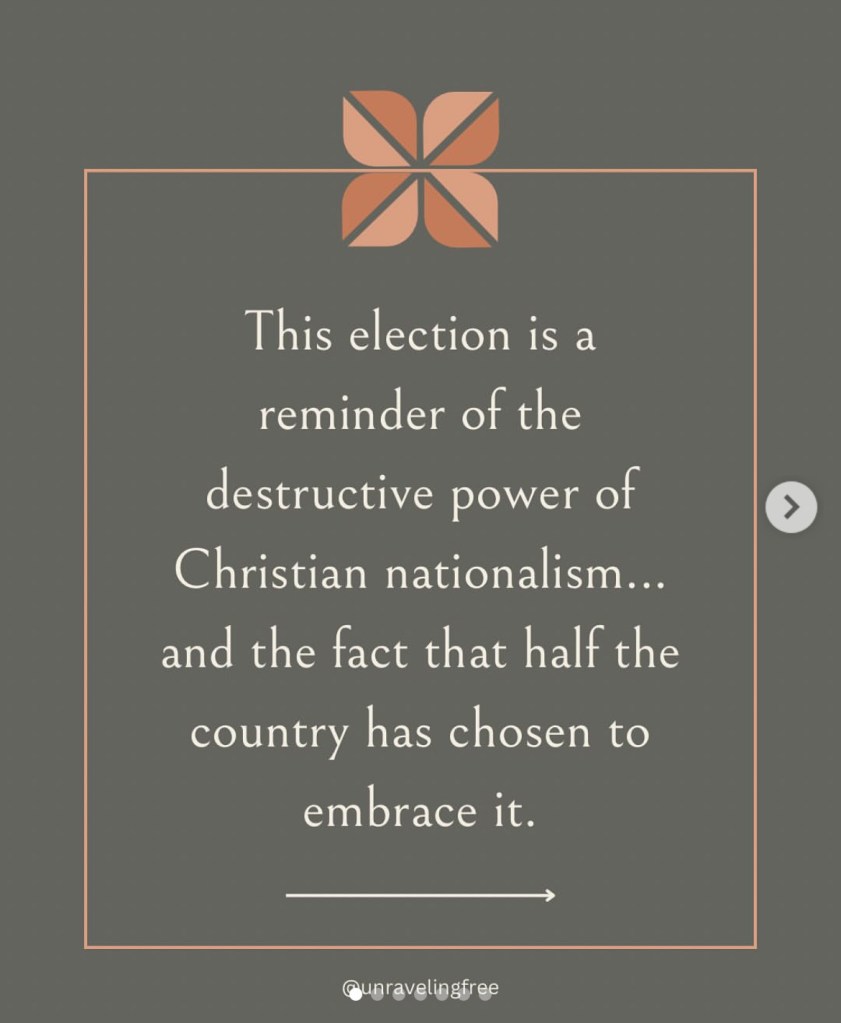
And let’s pause here…because this rise in religious fervor is deeply concerning to me. I used to push back when people warned about Christian nationalism. I thought it was overblown. But watching Gen Z churn out martyr videos of Charlie Kirk, watching this wave of revivalist passion roll in, I can’t deny the potential for backlash anymore.

It’s not just reverence – it’s symbolism, its revivalism, its identity politics wrapped in scripture. And that’s where my alarm starts.

Take the Noahide Laws movement. People often describe it as returning to a universal moral code. On its face, sure, that sounds appealing. But when morality is rooted in a particular scripture or identity, it often becomes a tool to say: ‘these norms are non-negotiable, and dissent or spiritual alternatives are forbidden’ That’s when spirituality crosses into political power-building.

Listen to this clip from Ben Shapero on the Daily Wire.

And we’re already seeing it creep into policy. 

The administration just passed an executive order on ‘Eradicating Anti-Christian Bias.’ Protecting religious freedom is vital, yes. But there’s a difference between protecting believers from discrimination and making laws where Christian sentiment is immune from critique or satire. 

The White House posted a video mourning Charlie Kirk concluding with:

“1 Corinthians 5 and 15 provide compelling evidence (not only intrabiblical but also extrabiblical) that Jesus Christ was a real historical figure. He lived a perfect life, was crucified, rose on the third day, and is Lord and God.”

If you still don’t see how Christianity and faith in Jesus, a figure who probably never existed—is both holding this country back and enabling Zionism, it’s time to wake up.

We’ve already seen new laws against so-called antisemitism that start to look a lot like blasphemy laws. How long before similar protections are extended to Christian sentiment?

This matters because young people might get swept into this revivalist Christian / Abrahamic framework without realizing it. 

It reduces room for spiritual alternatives, for pluralism, for traditions like panpsychism or animism, worldviews that see all of reality as alive, interconnected, and worthy of respect. That feels more universal to me. Less tied to tribal texts, less prone to turning spirituality into a weapon of the state.

History has shown us that religious revivalism mixed with nationalism and state power is a dangerous cocktail. It binds, but it also blinds. And that’s why I can’t jump on board with this new wave of Abrahamic revivalism being fueled by Charlie’s death. My skepticism sharpens right here.

So here’s where I land: I grieve. I grieve for a man who influenced me. I grieve the way his life was taken. But I also grieve the way his death is being used  by some to celebrate evil, by others to canonize him into sainthood. Both sides reveal how morality binds and blinds. And if we don’t wake up to that, we’ll keep swinging between authoritarian extremes.

And I want to close with a reminder from Jonathan Haidt himself. He wrote:

“Social scientists have identified at least 3 major forces that collectively bind together successful democracies: social capital (extensive social networks with high levels of trust), strong institutions, and shared stories. We are now at the greatest level of political polarization since the 1860s. It’s more necessary than ever to return to these 3 forces in every way we can, individually and as a society.”

That’s where I want us to go. Beyond tribal stories of vengeance or martyrdom, back toward trust, strong institutions, and stories that unite rather than divide.

One of my new favorite YouTubers https://youtu.be/UQ02zhLmkTM?si=96o2gTReXl-nvClS

So, maintain your curiosity, embrace skepticism, and keep tuning in.

Further Reading & Sources

The Real Handmaid’s Tale Isn’t in America

Between Liberation and Collapse: Why We Need to Talk About the Middle Path

Welcome back to Taste Test Thursdays, where we explore health, culture, belief, and everything in between. I’m your host, Megan Leigh and today, we’re asking a question that’s bound to make someone uncomfortable:

What if the very institutions we tore down as oppressive… were also protecting us?

We live in a time of extremes. On one side, you’ve got Quiverfull-style fundamentalists preaching hyper-fertility and wifely submission like it’s the only antidote to modern decay. On the other, we’ve got a postmodern buffet of “do what you want, gender is a vibe, all structures are violence.”

And if you’re like me—having navigated the high-control religion pipeline but also come out the other side—you might be wondering…

“Wait… does anyone believe in guardrails anymore?”

Because spoiler: freedom without form becomes chaos. And chaos isn’t empowering. It’s destabilizing.

I truly believe that structure and boundaries can actually serve a purpose—especially when it comes to sex, gender, and human flourishing.

This isn’t a call to go backward. It’s a call to pause, zoom out, and ask: what’s been lost in our so-called progress? Let’s dig in.

The Panic Playbook

This past summer, the media went full apocalyptic. You couldn’t scroll, stream, or tune in without hearing it: Christian nationalism is taking over. Project 2025 is a fascist manifesto. Trump is a theocratic threat to democracy itself. The narrative was everywhere—breathless Substacks, viral TikToks, and cable news countdowns to Gilead.

But while progressives were busy hallucinating handmaids and framing every Republican vote as the end of America, they were also helping cover up the biggest political scandal since Watergate: Biden’s cognitive decline.

This blog isn’t a right-wing defense or a leftist takedown. It’s a wake-up call. Because authoritarian creep doesn’t wear just one team’s jersey. If we’re serious about resisting tyranny, we need to stop fearmongering about theocracy and start interrogating the power grabs happening under our own banners—especially the ones cloaked in compassion, inclusion, and “equity.”


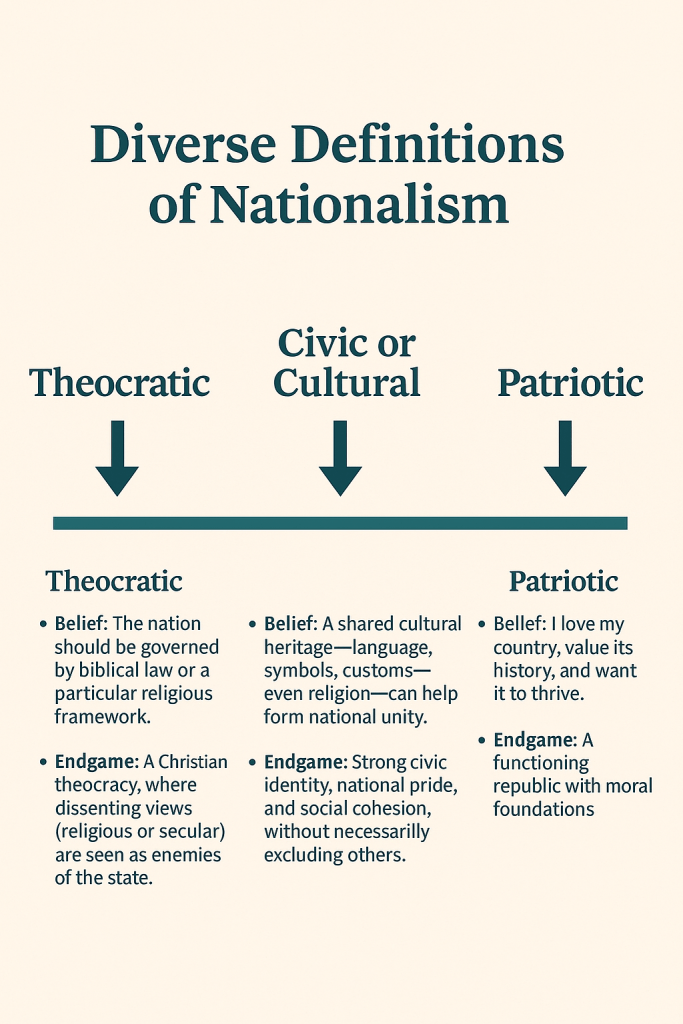
Not All “Christian Nationalism” Is the Same—Let’s Break It Down

The term “nationalism” gets thrown around a lot, but it actually has different meanings:

🔸 1. The Theocratic Extreme
This is the version everyone fears—and with good reason.

  • Belief: Government should follow biblical law.
  • Goal: A Christian theocracy where dissent is treated as rebellion.
  • Associated with: Christian Reconstructionism, Dominionism, and groups hostile to pluralism.
    📍 Reality: This is fringe. Most evangelicals don’t support this, but it’s the go-to boogeyman in media and deconstruction circles.

🔸 2. Civic or Cultural Nationalism
More common, less scary.

  • Belief: Shared culture—language, customs, even religion—can create unity.
  • Goal: Strong national identity and cohesion, not exclusion.
  • Seen in: France’s secularism, Japan’s cultural pride, and even Fourth of July BBQs.
    📍 Reality: This is where most “Christian nationalists” actually land. They believe in the U.S.’s Christian roots and want to preserve those values—not enforce a theocracy.

🔸 3. Patriotism (Often Mislabeled as Nationalism)
Here’s where it gets absurd.

  • Belief: Loving your country and its traditions.
  • Goal: A moral, thriving republic.
    📍 Reality: Critics lump this in with extremism to discredit conservatives, centrists, or people of faith.

Why It Matters

Lumping everyone—from flag-waving moderates to dominionist hardliners—into one “Christian nationalist” category fuels moral panic. It shuts down real dialogue and replaces nuance with hysteria.

You can:

✅ Love your country
✅ Value strong families
✅ Want morality in public life

…without wanting a theocracy.

Let’s Define the Terms Critics Confuse:

  • Dominionism: A fringe movement pushing for Christian control of civic life. Exists, but not mainstream.
  • Quiverfull: Ultra-niche belief in having as many kids as possible for religious reasons. Rare and extreme.
  • Christian Nationalism: Belief that the U.S. has a Christian identity that should shape culture and law. Vague, often misapplied.

And What It Isn’t:

  • Pro-natalism: A global concern over falling birth rates—not just a religious thing.
  • Conservative Feminism: Belief in empowerment through family and tradition. Dismissing it as brainwashing is anti-feminist.
  • Family Values: Often demonized, but for many, it just means prioritizing marriage, kids, and legacy.

Not all traditionalism is fascism.
Not all progressivism is liberation.
Let’s keep the conversation honest.


Hillary’s “Handmaid” Moment

Hilary Clinton🎧 “Well, first of all, don’t be a handmaiden to the patriarchy. Which kind of eliminates every woman on the other side of the aisle, except for very few. First, we have to get there, and it is obviously so much harder than it should be. So, if a woman runs who I think would be a good president, as I thought Kamala Harris would be, and as I knew I would be, I will support that woman.”

This quote from Hillary Clinton caused predictable outrage—but what’s more disturbing than the clip is the sentiment behind it.

In one breath, she managed to dismiss millions of women—mothers, caretakers, homemakers, conservative politicians, religious traditionalists—as unwitting slaves to male domination. Clinton doesn’t leave room for the idea that a woman might freely choose to prioritize home, faith, or family—not because she’s brainwashed, but because she’s pragmatic, thoughtful, and in tune with her own values.

To Clinton, there’s one legitimate type of woman in politics: the woman who governs like Hillary Clinton.

This framework—that conservative, traditional, or religious women are “handmaidens”—isn’t new. It’s a familiar talking point in progressive circles. And lately, it’s been weaponized even more boldly, as Clinton revealed in another recent statement:

“…blatant effort to basically send a message, most exemplified by Vance and Musk and others, that, you know, what we really need from you women are more children. And what that really means is you should go back to doing what you were born to do, which is to produce more children. So this is another performance about concerns they allegedly have for family life. Return to the family, the nuclear family. Return to being a Christian nation. Return to, you know, producing a lot of children, which is sort of odd because the people who produce the most children in our country are immigrants and they want to deport them, so none of this adds up.”

This is where modern feminism loses its plot. If liberation only counts when women make certain kinds of choices, it’s not about freedom then.


The Pro-Natalism Panic—and the Projection Problem

🎧 “Although the Quiverfull formal life isn’t necessarily being preached, many of the underlying theological and practical assumptions are elevated… and now, you know, they’re in the White House.”
Emily Hunter McGowin, guest on In the Church Library podcast with Kelsey Kramer McGinnis and Marissa Franks Burt

There’s a subtle but dangerous trend happening in the deconstruction space: lumping all traditional Christian views of family into the Quiverfull/Dominionist bucket.

In a recent episode of In the Church Library, the hosts and guest reflected on the rise of pro-natalist ideas and Christian influence in politics. Marissa asks whether the ideology behind the Quiverfull movement might be getting a new rebrand—and Emily responds with what sounds like a chilling observation: echoes of that movement are now in the White House.

But let’s pause.

❗ The Quiverfull movement is real—but it’s fringe. It’s not representative of all evangelicals, conservatives, or even Christian pro-family thinking.

Yet increasingly, any policy or belief that values marriage, child-rearing, or generational stability gets painted with that same extremist brush. This is where projection replaces analysis.

Take J.D. Vance, often scapegoated in these conversations. He’s frequently accused of trying to turn America into Gilead—even though he has three children, supports working-class families, and hasn’t once called for a theocracy. His concern? America’s birthrate is in freefall.

That’s not theocracy. That’s math.

Pro-natalism isn’t about forcing women to give birth. It’s about grappling with a demographic time bomb. Countries like South Korea, Hungary, and Italy are facing societal collapse because too few people are having children. This isn’t moral panic—it’s math.

Even secular thinkers are sounding the alarm:

Lyman Stone, an economist and demographer, emphasizes: “Lower fertility rates are harbingers of lower economic growth, less innovation, less entrepreneurship, a weakened global position, any number of factors… But for me, the thing I worry about most is just disappointment. That is a society where most people grow old alone with little family around them, even though they wanted a family.”

Paul Morland, a British demographer, warns: “We’ve never seen anything like this kind of population decline before. The Black Death wiped out perhaps a third of Europe, but we’ve never seen an inverted population pyramid like the one we have today. I can’t see a way out of this beyond the supposedly crazy notion that people should try to have more kids.”

We have to be able to separate structure from subjugation. There’s a world of difference between saying “families matter” and forcing women into barefoot-and-pregnant obedience.

When we flatten every traditional idea into a fundamentalist threat, we not only lose clarity—we alienate people who are genuinely seeking meaning, stability, and community in a fragmented culture.

If we want to be intellectually honest, we must distinguish:

  • Extremism vs. Order
  • Oppression vs. Structure
  • Religious Tyranny vs. Social Cohesion

And we should probably stop pretending that every road leads to the Handmaid’s Tale.


Protective Powers: What Louise Perry and Joan Brumberg Reveal About Institutions

Let’s talk about The Case Against the Sexual Revolution by Louise Perry. Perry is a secular feminist. She’s not nostalgic for 1950s housewife culture—but she is asking: what did we actually get from the sexual revolution?

Here’s her mic-drop:

“The new sexual culture didn’t liberate women. It just asked them to participate in their own objectification with a smile.”

We built an entire culture around the idea that as long as it’s consensual, it’s empowering. But Perry argues that consent—without wisdom, without boundaries, without institutional protection—leaves women wide open to harm.

She points to:

  • Porn culture
  • Casual hookups
  • The normalization of sexual aggression and coercion in dating

These aren’t signs of liberation—they’re signs of a society that privatized female suffering and told us to smile through it.

Perry doesn’t say “go full tradwife.” But she does say maybe marriage, sexual restraint, and even modesty functioned as protective constraints—not just patriarchal tools of oppression.

We traded one form of pressure (be pure, stay home) for another (be hot, work hard, never need a man). Neither version asked what women actually want.

Now flip over to The Body Project by Joan Jacobs Brumberg. This one blew my mind.

She traces how, a century ago, girls were taught to cultivate inner character: honesty, kindness, self-control.

By the late 20th century? That inner moral development had been replaced by bodily self-surveillance: thigh gaps, clear skin, flat stomachs. Girls now focus on looking good, not being good.

She writes:

“The body has become the primary expression of self for teenage girls.”

Think about that. We went from teaching virtue to teaching girls how to market themselves. We told them they were free—and then handed them Instagram and said, “Good luck.”

So again, maybe some of those “oppressive” structures were also serving as cultural scaffolding. Not perfect. Not painless. But they gave young people—especially girls—a script that wasn’t just: “Be hot, be available, and don’t catch feelings.”

Brumberg isn’t saying go back to corsets and courtship. But she is saying we’ve lost our moral imagination. We gave up teaching self-restraint and purpose and replaced it with branding. With body projects. And now we wonder why depression and anxiety are through the roof??

We dive deeper into these subjects in these two podcasts:


Why the Fear Feels Real—And Why It’s Still Misguided

Look, I get it.

If you’ve escaped religious trauma, purity culture, or spiritual abuse, the sight of a political figure talking about motherhood as a virtue can feel like a threat. Your nervous system registers it as a return to oppression. The media confirms your panic. And suddenly, a call for demographic survival starts sounding like a demand for forced birth.

But your trauma doesn’t make every policy that triggers you authoritarian. It just means you need to slow down and check the data.

Because ironically, the real threats to bodily autonomy and family structure? They might not be coming from traditionalists at all.


🏛 The Progressive Power Grab You’re Not Supposed to Question

Another frustrating comment made by Kelsey Kramer McGinnis in a recent podcast was the need to “decenter nuclear families” and the dismissal of concerns about an “attack on nuclear families” as mere panic. But here’s the thing—this fear isn’t fabricated. It’s not fringe. It’s rooted in observable cultural trends and policy shifts. You can’t just wave it away with smug academic detachment.

Whether you support the traditional family structure or not, the erosion of it has real consequences—especially for children, social stability, and intergenerational resilience. Calling that out isn’t fearmongering. It’s an invitation to discuss the stakes honestly.

Let’s set the record straight: The desire to shape culture, laws, and education systems is not the sole domain of religious conservatives. Dominionist Christians aren’t the only ones with blueprints for a theocratic society. Progressive activists also seek to remake the world in their image—one institution at a time.

This isn’t a right-wing “whataboutism.” It’s an honest observation about how ideological movements—regardless of political lean—operate when they gain influence.

Let’s take a look at what this looks like on both ends of the spectrum:

🏛 Dominionism (Far-Right Christian Nationalism)

Core Belief: Christians are mandated by God to bring every area of life—government, education, business—under biblical authority.

Tactics:

  • Homeschool curricula promoting biblical literalism and creationism.
  • Campaigns for Christian prayer in public schools or Ten Commandments monuments in courthouses.
  • Promoting the idea that America was founded as a Christian nation and must return to those roots.
  • Electing openly Christian lawmakers with the explicit goal of reshaping law and public policy to reflect “biblical values.”
  • Supporting the Quiverfull movement, which encourages large families to “outbreed the left” and raise up “arrows for God’s army.”

📘 Progressive Institutional Capture (Far-Left Activism)

Core Belief: Society must be dismantled and rebuilt to eliminate systemic oppression, centering race, gender, and identity as primary moral lenses.

Tactics:

  • Embedding DEI (Diversity, Equity, Inclusion) frameworks into public schools, universities, and corporate policy.
  • Redefining gender and sex in school curricula while often sidelining parental input or community values.
  • Elevating “lived experience” over objective standards in hiring, curriculum design, and academic research.
  • Weaponizing social media and institutional policies to punish dissenting views (labeling them as “harmful,” “unsafe,” or “hateful”).
  • Using activist lingo to obscure government overreach (“gender-affirming care” vs. irreversible medical intervention for minors).

🔄 Shared Behaviors: The Race to Capture Institutions

Despite their stark differences in values, both dominionists and far-left activists behave in eerily similar ways:

  • They seek cultural dominance through schools, law, media, and public policy.
  • They view their moral framework as not just legitimate but necessary for a just society.
  • They suppress dissent by pathologizing disagreement—branding critics as “anti-Christian,” “bigoted,” “transphobic,” “groomers,” or “domestic extremists.”

The battleground is no longer just the ballot box. It’s the school board meeting. The state legislature. The HR department. The university curriculum. The TikTok algorithm.

Colorado’s HB25-1312 — The “Kelly Loving Act”

Signed in May 2025, this law expands protections for transgender individuals. Fine on the surface. But here’s the fine print:

  • It redefines coercive control to include misgendering and deadnaming.
  • In custody cases, a parent who refuses to affirm a child’s gender identity could now be framed as abusive—even if that child is a minor in the midst of rapid-onset gender dysphoria.

Is it protecting kids? Or is it using identity to override parental rights?

Washington State’s HB 1296

This bill guts the Parents’ Bill of Rights (which was approved by voters via Initiative 2081). It:

  • Eliminates mandatory parental access to children’s health records (including mental health).
  • Enshrines gender identity and sexual orientation in a new “Student Bill of Rights.”
  • Allows state-level monitoring of school boards that don’t comply.

And the cherry on top? It was passed with an emergency clause so it would take effect immediately, bypassing normal legislative scrutiny.

This isn’t some abstract culture war. These are real laws, passed in real states, stripping real parents of their authority.


A Marxist Framework Masquerading as Compassion

Some of these changes echo critical theory more than constitutional liberty.

Historically, Marxist and Maoist ideologies viewed the family unit as an oppressive structure that needed dismantling. Parental authority was often seen as an extension of capitalist control. In its place? State-affirmed loyalty, reeducation, and ideological uniformity.

Now, it’s not happening with red stars and gulags—it’s happening through rainbow flags and DEI seminars. But the power dynamics are the same:

The family becomes secondary to the state.
Dissent becomes dangerous.
Disagreement becomes “violence.”

This is how authoritarianism creeps in—wrapped in the language of safety and inclusion.


What Real Theocracy Looks Like

If you need a reality check, read Yasmine Mohammed’s Unveiled. Raised in a fundamentalist Muslim home, where women had no autonomy, no basic rights, and no freedom. She was forced into hijab at age 9, married off to an al-Qaeda operative, and beaten for asking questions. Women cannot see a doctor without a male guardian, they are forced to cover every inch of their bodies and are denied access to education and even the right to drive. That’s theocracy. That is TRUE oppression.

Now contrast that with the freedom that women enjoy in the West today. In modern America, women have more rights and freedoms than at any point in history. Women can run around naked at Pride parades, express their sexuality however they choose, and redefine what it means to be a woman altogether. The very idea of a “dystopia” here is laughable when we consider the actual freedom women in the West enjoy.

Yet, despite these freedoms, many liberal women still cry oppression. They whine about having to pay for their student loans, birth control or endure debates over abortion restrictions. This level of cognitive dissonance—claiming victimhood while living in unprecedented freedom—is a slap in the face to women who actually suffer under real patriarchal oppression.

What’s even more Orwellian is how the left, in its quest for inclusivity and justice, is actively stripping others of their freedoms. They preach about fighting for freedom of speech while canceling anyone who disagrees with them. They claim to be champions of equality while weaponizing institutions to enforce ideological conformity.

Bottom line: If you think Elon Musk tweeting about birth rates is the same as what Yasmine went through? You’ve lost perspective.

To revisit my conversation with Yasmine:


Fear Isn’t Feminism

If your feminism can’t handle dissent, it was never liberation—it was just a prettier cage.

We have to stop mistaking fear for wisdom. We have to stop confusing criticism with violence. And we absolutely must stop handing our power over to ideologies that infantilize us in the name of compassion.

Let’s be clear: Gilead isn’t coming. But if we’re not careful, something just as destructive might.

A world where parents are powerless.
Where biology is negotiable but ideology is law.
Where compliance is the only virtue, and questions are a crime.

The Courage to Be Honest

What I’m suggesting isn’t fashionable. It doesn’t fit neatly in a progressive or conservative box. But I’m tired of those boxes.

I’ve lived in Portland’s secular utopia and inside a high-control religious environment. I’ve seen how each side distorts truth in the name of “freedom” or “righteousness.”

But what if true liberation is found in the tension between the two?

The most revolutionary thing we can do today is refuse to become an extremist.

Not because we’re afraid.
Not because we’re fence-sitters.
But because we believe there’s a better way—one that honors the past without being imprisoned by it and faces the future with clear eyes and moral courage.


Maintain your curiosity, embrace skepticism, and keep tuning in. 🎙️🔒

— Megan Leigh

📚 Source List for Blog Post

1. Hillary Clinton Quotes

  • Quote 1 (on being a “handmaiden to the patriarchy”):
    [Reference: “Defending Democracy” podcast with historian Heather Cox Richardson, May 2024]
    No official transcript published — you’re using a direct audio clip for this one.
  • Quote 2 (on pro-natalism and immigration):
    [Source: Same podcast — “Defending Democracy” with Heather Cox Richardson, 2024]
    Partial reference via The Independent article

2. Louise Perry


3. Mary Harrington


4. Demographer Paul Morland


5. Lyman Stone


6. Dominionism & Quiverfull Movement


7. Recent Legislation Affecting Parental Rights

Breaking down the Power Play:  Women’s Suffrage, Christian patriarchy, and Trad Wife Propaganda

This week, I’m diving headfirst into the turbulent intersection of women’s suffrage, the resurgence of Christian patriarchy, and the trendy ‘trad wife’ movement. Buckle up as we unravel how these historical battles and modern movements collide, revealing their surprising connections—from the ongoing struggle for gender equality to the modern reinvention of traditional roles. Prepare for a journey through past and present that challenges conventional wisdom and ignites critical conversations.

🎧Listen here!

My Deconstruction Journey

In recent months, I’ve explored how radicalization, conspiracies, and religion have shaped my life. In Episode 5 of my podcast, we tackled the “crunchy hippie to alt-right pipeline,” but now it’s time to shine a light on the radicalization of the left—a topic often overlooked. Why did I go from progressive circles to mingling with Trump supporters and Christians? This shift was marked by a range of events and trends reflecting broader changes within progressive movements and their impact on American politics and culture.

Black Lives Matter Protests and Social Justice Movements

The murder of George Floyd ignited the Black Lives Matter (BLM) movement, but what often goes undiscussed is the scrutiny BLM faced over fund management. Allegations of financial mismanagement emerged in 2021, raising questions about how substantial donations were handled. The movement also brought the call to “defund the police” into the spotlight, advocating for reallocating funds to social services and community programs. However, cities like San Francisco, which initially reduced police funding, faced rising crime rates and eventually reinstated funding in 2022, acknowledging that some defunding measures had not achieved their intended outcomes.

Increased Political Activism and the Role of Cancel Culture

The 2020s saw a rise in intersectionality and identity politics, aiming to address overlapping forms of oppression. However, this sometimes led to contentious debates over ideological purity and inclusivity, particularly in online activism. Cancel culture became prominent, with debates over holding public figures accountable for perceived offenses. While some view it as necessary for social justice, others argue it suppresses free speech and stifles constructive dialogue.

Vaccine Hesitancy and the Crunchy-to-Patriarchy Pipeline

My reluctance to receive an experimental vaccine led to severe ostracism, as those hesitant about COVID-19 vaccines often faced dehumanization and cancel culture. This harsh treatment highlighted how cancel culture can suppress nuanced debate and alienate individuals with genuine concerns.

Dr. Stanley Plotkin, a prominent figure in vaccinology, and some of his colleagues recently published an article that has drawn significant attention. The article acknowledges that vaccines are not as thoroughly studied as previously claimed, particularly in terms of safety, both before and after they are licensed. This has raised concerns among critics, who argue that for decades, the public was assured that vaccines underwent rigorous safety testing.

Key points from the article include the admission that prelicensure clinical trials often have limited sample sizes and short follow-up periods, which may not fully capture long-term safety data. Additionally, there are currently no dedicated resources for post-authorization safety studies, relying instead on annual appropriations approved by Congress. This lack of resources for ongoing safety monitoring has been criticized as inadequate, particularly given the widespread use of vaccines.

This revelation has been met with strong reactions, especially from those who have long questioned the rigor of vaccine safety studies. They argue that these acknowledgments confirm their concerns that vaccine safety has not been as thoroughly investigated as it should be.

Read the paper here

In a previous episode, we scratched the surface of the Trad Wife and Stay-at-Home Girlfriend Movements. These movements, advocating traditional gender roles, see them as spiritually fulfilling and empowering, rejecting modern feminism while embracing modern cultural influences. We discussed the fear tactics within this online content that manipulates users by promoting apocalyptic scenarios and moral decay. Today, we’re diving deeper into this topic.

Historical Context and Kitchen Design

Before delving into the 19th Amendment, let’s explore the evolution of kitchen design as a reflection of changing gender roles and societal expectations:

  • Post-Civil War to Early 20th Century (1865-1930s): Kitchens transitioned from being managed by enslaved people to paid workers, with labor-saving appliances emerging and the housewife ideal taking shape.
  • Mid-20th Century (1930s-1960s): The post-WWII era emphasized suburban living and reinforced the housewife’s role as a symbol of the American dream, driven by economic prosperity and suburban expansion.
  • 1974 Bill on Women’s Financial Independence: The Equal Credit Opportunity Act granted women the right to open bank accounts and obtain credit cards in their names, a significant step towards financial equality.

Today’s ‘trad wife’ movement glamorizes the mid-century housewife as a personal choice, not a patriarchal trap. But let’s be real—this nostalgic comeback is less about empowerment and more about rolling back feminist progress, cherry-picking conservative values to fit a romanticized narrative. It’s time to call out the toxicity and acknowledge that the nuclear family ideal doesn’t have to be a patriarchal prison.

Connecting Women’s Suffrage and Christian Nationalism

This week marks the anniversary of the 19th Amendment, a milestone for women’s rights. However, despite granting voting rights, many women of color continued to face disenfranchisement. The rise of ideologies challenging this progress, such as Nancy Pearcey’s claim that women’s suffrage was a net loss, reflects a broader trend of dominionism and Christian nationalism. Pearcey’s book, The Toxic War on Masculinity, embraced by right-wing fundamentalist figures, has been criticized for its logical fallacies and misrepresentation of research.

A Critique of Nancy Pearcey’s The Toxic War on Masculinity

Pearcey argues that the expansion of women’s roles and rights has led to a “war on masculinity,” promoting binary gender stereotypes and overlooking intersectional perspectives. Critics point out that Pearcey’s use of John Gottman’s research is misleading. Gottman’s studies indicate that emotionally intelligent husbands succeed in both egalitarian and hierarchical marriages, but Pearcey omits that her argument falls apart when complementarian men abandon hierarchical behaviors, exposing a significant ideological bias in her work.

Contextualizing These Views

These views reflect a broader conversation within conservative Christian circles about gender roles. Figures like Joel Webbon and Doug Wilson argue against women’s suffrage from a theological standpoint, emphasizing traditional gender roles and critiquing the expansion of women’s public and political presence as contrary to biblical principles. The Southern Baptist Convention’s conservative shift and the rise of New Calvinism further illustrate this trend, as these movements emphasize male-led church governance and promote traditional gender roles.

Motivations Behind the Movements

Supporters of traditional values aim to uphold stability and traditional family roles, rejecting modern feminism and valuing a nurturing home environment. Fear tactics are prevalent in online content that merges wellness with extreme ideologies, manipulating users by promoting fear of worldly dangers, apocalyptic scenarios, or spiritual consequences.

Historical Precedents: Satanic Panic and Moral Panics

Movements like the Satanic Panic of the 1980s and ’90s stoked fears of occult influences, leading to widespread moral panic. Similarly, today’s online narratives can exaggerate or fabricate threats to bolster ideological adherence, using fears of societal collapse or moral decay to urge followers towards conservative values.

Personal Reflections: Manipulation and Belonging

I remember the day I was first drawn into evangelical Christianity. It wasn’t through logic or a carefully reasoned argument; it was through the power of a story—a testimony, to be exact. The speaker shared a dramatic tale of transformation, from the depths of despair and darkness into the light of salvation. Her voice trembled with emotion, and tears glistened in her eyes as she described the overwhelming peace and joy she found in Christ. I was captivated. It wasn’t just a story; it was a call, a plea for me to experience the same miraculous change.

The manipulation was subtle but powerful. The emotions stirred within me were intense, almost overwhelming. I felt a sense of urgency, as if my own life depended on making the same decision she had. It was as though I could feel the darkness closing in on me, and the only escape was to step into the light she described so vividly. Fear played a significant role in this manipulation. I was warned of the dire consequences of rejecting this path, of the eternal damnation that awaited those who turned away. This fear was not just for my soul but for my life here and now. I was told that without Jesus, I would continue to live in confusion, loneliness, and despair.

What made it all the more compelling was the promise of belonging. I had always felt somewhat out of place, disconnected from those around me. But here was a community that promised acceptance, a family where I would always belong. The concept of biblical femininity and submission was introduced as a path to fulfillment, as a way to finally fit into a role that had been designed specifically for me by God. I was told that by embracing my role as a submissive wife and mother, I would find true happiness and purpose.

But looking back, I realize how these tactics exploited my vulnerabilities. The emotional manipulation, the fear-based messaging, and the promise of belonging were all tools used to mold me into someone I wasn’t. They weren’t concerned with my true self; they wanted to shape me into their image of the ideal Christian woman—submissive, obedient, and unquestioning.

What’s more disturbing is how these tactics aren’t unique to evangelical Christianity. I’ve since learned that similar strategies are employed in other religions, such as Islam. I’m sure you’re like me, and have heard that it is the fastest growing religion, but have you looked into the pew research into why? There’s a growing pressure on women within some Islamic communities to recruit other women. They shower potential converts with love, bombarding them with messages of acceptance and sisterhood. It’s all designed to draw them in, to make them feel special and chosen. Once they’re in, the pressure to marry and fulfill their role as a wife and mother can be intense. Just as I was drawn into a community that promised to complete me, these women are often led to believe that their worth is tied to their role within the family and the broader religious community.

The parallels are striking. Both exploit the human need for connection and purpose. Both use emotional manipulation and fear to control and convert. And both can lead to a loss of self, where the individual’s identity is subsumed by the demands of the group.

Reflecting on my experience has been painful, but it’s also been empowering. I now see how I was manipulated, how my fears and desires were used against me. And I’m committed to helping others recognize these tactics for what they are—tools of control, not pathways to truth.

Delving into Christian Interpretations of Morals and Values

As we wrap up today’s discussion, let’s delve into the complexities surrounding Christian interpretations of morals and values, particularly through the lens of historical and cultural relativism. Critics of biblical revelation question the reliability and authenticity of the biblical manuscripts, highlighting the human elements that have shaped the text’s transmission and interpretation.

Read more here on why I think Biblical Inerrancy is harmful.

When it comes to contentious issues like abortion, the selective interpretations of scripture used by some pro-life Christians illustrate a broader trend of reconciling faith with personal and societal values. Historically, Christian views on abortion were more diverse and often more permissive, with significant shifts occurring in the 1970s with the rise of the Religious Right.

Reflecting on these issues, Niel Van Lewen pointed out an intriguing observation: the pro-life stance might often function more as a signaling mechanism than a genuine, consistent commitment to protecting life. This dichotomy suggests that pro-life evangelicals might seek to pass laws protecting unborn embryos while avoiding practical measures—like universal daycare—that could significantly reduce the number of abortions.

This illustrates the ethical and scriptural inconsistencies surrounding the pro-life stance. By examining these discrepancies, we gain a clearer understanding of the challenges inherent in reconciling pro-life advocacy with practical, compassionate approaches to supporting life.

The Trad Wife Controversy: Unpacking Traditional Values in Modern Contexts

The discussion around traditional values and gender roles is gaining momentum, and the “trad wife” movement sits at the heart of this debate. One prime example that brings these ideals to light is the Ballerina Farm controversy, a social media phenomenon showcasing a curated version of traditional domestic life. This aligns closely with the trad wife ideals, which have faced criticism for romanticizing a regressive view on gender roles.

The Ballerina Farm Controversy: Empowerment or Regression?

Ballerina Farm presents a vision of traditional domestic life that resonates with many who see it as an empowering choice. However, it also faces criticism for glamorizing roles that are deeply rooted in patriarchal norms. Houseinhabit, a popular commentator, argues that Ballerina Farm isn’t about regression but about choice. She suggests that Hannah Neeleman, the face behind Ballerina Farm, embodies success measured not by corporate titles but by personal contentment and family harmony, grounded in her faith. This perspective emphasizes that true feminism should respect the diverse paths women take, fostering understanding rather than division.

The Patriarchal Norms Behind the Ideal

While Houseinhabit’s perspective is important, it’s crucial to examine the patriarchal underpinnings of such movements. Practices that might seem problematic to outsiders—like Daniel’s rushed engagement and control over Hannah’s education—are often normalized within their cultural context. These actions reflect broader adherence to patriarchal values, including homeschooling with a Christian Mormon syllabus, underscoring a commitment to traditional gender roles.

Mormon Influencers: A New Recruitment Strategy?

Adding another layer to this discussion is the role of Mormon influencers in social media recruitment. Recent research reveals how the LDS Church uses social media to attract new recruits, with influencers, particularly families, promoting Mormonism on platforms like Instagram and YouTube. This strategy leverages the appeal of traditional family values and domestic harmony to attract a broader audience. The Church’s use of influencers as a recruitment tool highlights the appealing aspects of traditional lifestyles while potentially overshadowing the complexities and criticisms associated with these roles.

Media, Tradition, and Patriarchy

This interplay between traditional values and modern media illustrates a broader societal pattern where the presentation of traditional roles can obscure their roots in patriarchal structures. Media portrayals, while sometimes uncomfortable, are not about dehumanizing individuals but about revealing systemic issues. Often, patriarchal norms are defended as personal choices, overlooking the deep societal influences at play. If gender roles were reversed, these issues might become more apparent, prompting a need for more nuanced discussions on how traditional values intersect with contemporary gender dynamics.

My Experience with Patriarchal Ideologies

Critically evaluating such content is essential, as these narratives can have far-reaching implications for personal beliefs and societal attitudes. From my own experience with evangelical Christianity, I was involved in a biblical counseling program that reinforced patriarchal control, severely limiting my autonomy. In one workbook, I was given an excerpt from The Excellent Wife by Martha Peace, which outlined ways a wife should glorify her husband. The expectations included:

  1. Asking your husband about his goals for the week.
  2. Organizing household duties meticulously, prioritizing your husband’s needs over everything else.
  3. Talking about him positively to others, regardless of the truth.

These teachings were not just fringe ideas but central resources within Biblical Counseling, the Southern Baptist Convention, and many non-denominational churches. This ideology, deeply woven into church communities, perpetuates a system where a wife’s identity and value are entirely subdued under her husband’s goals and image.

The Harmful Implications of Patriarchal Ideologies

  1. Idolatry of the Husband: Obeying a husband is equated with obeying God, placing the husband in the position of an idol. This subordinates divine will to a human figure, distorting spiritual faith and leaving no room for a wife’s autonomy or moral agency.
  2. A Warped View of Womanhood: Women are seen as more susceptible to deception, and their rightful place is akin to a ‘slave’ who should expect no recognition. Basic human desires, like wanting to be treated with kindness, are labeled as ‘idolatrous.’
  3. Enabling Abuse: The book glorifies suffering within marriage as a form of righteousness, encouraging women to endure cruelty and manipulation. This traps women in dangerous, often life-threatening, situations by positioning divorce as rebellion and making church discipline the first recourse instead of contacting authorities.
  4. Stigmatizing Mental Health Care: Seeking professional help is equated with a lack of faith, alienating women from essential support systems that could help them navigate emotional and psychological challenges.

These ideas, while well-intentioned, perpetuate a system where the wife’s identity and value are entirely subdued under her husband’s goals and image. The dangerous implications of this ideology are not confined to overtly religious communities. Similar themes of female submission are found in movements rejecting modern egalitarian values in favor of a constructed ideal of natural order, which often masks deeply patriarchal and oppressive beliefs.

The Bigger Picture: Understanding the Trad Wife Trend

The trad wife trend isn’t just a nostalgic yearning for the past; it’s a deliberate effort to reinstate rigid gender roles that diminish women’s rights and freedoms. By critically examining resources like The Excellent Wife and drawing connections to broader social and cultural trends, we can better understand and challenge the insidious nature of this propaganda.

For those still in the church, it’s crucial to stand up against these harmful teachings. From my own experience, gender norms that emphasize tenderness over assertiveness hinder a woman’s ability to address unfair treatment effectively. Women submitting to their husbands is a dangerous ideology. Research shows that conservative, highly religious men are far more likely to perpetrate intimate partner violence. Hypermasculinity is one of the most powerful predictors of men’s likelihood to commit assault, and couples where the husband dominates decision-making processes are more likely to experience lower marital satisfaction.

Liberation and Progress

The liberation of women from oppression is crucial for fostering a more equitable and just society. When women are fully liberated, they can contribute their talents, perspectives, and skills to all aspects of life, including politics, economics, and culture. This liberation not only benefits women individually but also leads to societal progress by dismantling systemic barriers and promoting inclusivity.

Conclusion: Opening the Dialogue

I invite you to join the dialogue about gender, family, and cultural norms. Have you observed or encountered these dynamics? As a collective, we cannot ignore the role of algorithms and social media in amplifying compelling narratives and creating echo chambers. Understanding the motivations behind these movements allows us to engage in meaningful dialogue and advocate for continued advancements in gender equality.

Through my journey of deconstructing abuse within the church, I’ve realized that complementarianism, often presented as a theological stance, is fundamentally patriarchal and a root cause of oppression and abuse. Navigating these dynamics helps us grapple with the complexities of today’s ideological landscapes and invites us to critically evaluate how historical precedents and technological influences continue to shape our beliefs and societal structures.

Thank you for joining me in this exploration of faith, ideology, and societal change. Let’s continue to question, reflect, and engage with the world around us. And as always, maintain your curiosity, embrace skepticism, and keep tuning in.

https://www.forbes.com/sites/traversmark/2024/01/06/a-psychologist-explains-the-dangers-of-the-tradwife-movement/?sh=42f211f79c3b

19th Amendment to the U.S. Constitution: Women’s Right to Vote (1920) | National Archives

19th Amendment ‑ Definition, Passage & Summary | HISTORY

Women’s Equality Day: Celebrating the 19th Amendment’s Impact on Reproductive Health and Rights – Center for American Progress

Overview of the Nineteenth Amendment, Women’s Suffrage | U.S. Constitution Annotated | US Law | LII / Legal Information Institute (cornell.edu)

Women’s Suffrage Was a Net… LOSS?! | The New Evangelicals (youtube.com)

https://bethallisonbarr.substack.com/p/maybe-i-agree-with-pearcey-after

https://www.pewresearch.org/religion/2015/04/02/religious-projections-2010-2050/

Beyond the IBLP: Unveiling the Shared Roots of Evangelicalism & Spiritual Trauma

The Institute in Basic Life Principles was founded by Bill Gothard, is known for its strict, authoritarian teachings on Christian living and family roles, often leading to significant emotional harm.

In the deconstruction space, there’s a troubling tendency to focus exclusively on extreme cases of spiritual abuse, such as those from the Institute in Basic Life Principles (IBLP). While it’s crucial to address and understand these severe experiences, it’s equally important to recognize that spiritual and religious trauma can manifest in many forms beyond such high-profile examples.

While IBLP is a notable example of spiritual abuse, its practices reflect broader trends within evangelical Christianity that also emphasize control, guilt, and fear.

Unveiling the Shared Roots

The roots of evangelical Christianity are deeply entwined with guilt, fear, coercion, and deception, a legacy that can permeate all levels of faith practice. This issue isn’t confined to one group or doctrine; rather, it echoes through the broader history of evangelicalism, including the violent and tumultuous period of the Protestant Reformation.

Guilt and Fear: Evangelical teachings often emphasize human sinfulness and the need for constant repentance, creating an environment where guilt and fear become central. The pressure to meet unattainable moral standards can lead to chronic anxiety and self-doubt. Believers may struggle with feelings of inadequacy and unworthiness, which can erode self-esteem and lead to long-term psychological trauma.

Coercion: Many evangelical doctrines employ coercive tactics to ensure conformity and compliance. This can include manipulating believers through promises of divine favor or threats of divine punishment. Such coercion often pressures individuals into adhering to strict beliefs and behaviors, stifling personal autonomy and fostering a sense of control and manipulation.

Deception: The evangelical tradition can sometimes perpetuate deceptive teachings, presenting religious doctrines in a way that omits or distorts critical truths. This can include selective scriptural interpretations or misleading teachings about the nature of God and salvation. When individuals later confront these deceptions, they may experience profound disillusionment and betrayal, further contributing to their trauma.

Historical Context: The Protestant Reformation, a pivotal event in evangelical history, was marked by violent conflict and intense upheaval. The brutality and extremism of this period set a precedent for how religious movements can become entangled in aggression and intolerance. This historical backdrop adds another layer to understanding how evangelical Christianity, in its various forms, can inflict spiritual harm.

By acknowledging this broader context, we can better address the diverse experiences of trauma within the Christian faith and work towards healing that encompasses all who have been affected.\

Let’s look at the parallels:

1. Control and Authority:

  •     Evangelical Teachings: Evangelical groups often emphasize strict adherence to biblical authority and teachings, which can lead to high levels of control over personal beliefs and behavior.
  •    IBLP: The IBLP, founded by Bill Gothard, is known for its rigid set of rules and teachings that govern nearly every aspect of life, including family dynamics, education, and personal conduct.

2. Use of Guilt and Fear:

  •     Evangelical Teachings: Evangelicals may use guilt and fear of eternal damnation to enforce moral behavior and adherence to religious practices.
  •     IBLP: The IBLP uses fear of divine punishment and guilt to maintain control, emphasizing strict obedience to its principles and teachings.

3. Isolation from Dissenting Views:

  •     Evangelical Teachings: Evangelical communities might discourage or isolate members who question or deviate from core beliefs, often labeling dissent as dangerous or sinful.
  •     IBLP: The IBLP isolates its members from outside influences and encourages avoidance of those who criticize or question its teachings.

4. Emphasis on Obedience:

  •     Evangelical Teachings: Emphasis is placed on obedience to God’s commands and church teachings, which can sometimes discourage critical thinking and personal questioning.
  •     IBLP: stresses strict obedience to its guidelines as a sign of faithfulness, often at the expense of personal autonomy and critical reflection.

5. Authoritarian Structure:

  •     Evangelical Teachings: Many evangelical groups have a hierarchical structure where church leaders wield significant authority over members’ beliefs and practices.
  •     IBLP: The IBLP has a centralized authority with Bill Gothard’s teachings at the core, and his directives are followed unquestioningly by adherents.

6. Focus on Family Roles:

  •     Evangelical Teachings: Traditional evangelical teachings often emphasize distinct roles within the family, typically with a strong patriarchal structure.
  •     IBLP: The IBLP advocates for a strict family hierarchy where the father is the ultimate authority, and family roles are rigidly defined.

7. Handling of Dissent and Criticism:

  •     Evangelical Teachings: In many evangelical communities, dissent or criticism of church doctrine or practices can lead to significant social and spiritual consequences. Those who voice doubts may be labeled as troublemakers or heretics, and their concerns are often dismissed or invalidated.
  •     IBLP: The IBLP is known for its strong stance against criticism. Those who question or criticize its teachings are often ostracized or labeled as spiritually immature or rebellious. This approach helps to maintain a homogenous and compliant membership base.

8. Emphasis on Personal Purity and Moral Behavior:

  •     Evangelical Teachings: Evangelical teachings often place a high value on personal purity and moral behavior, with a strong focus on abstaining from behaviors deemed sinful, such as premarital sex, substance abuse, or other forms of moral failing. This emphasis can create a culture of judgment and fear of falling short.
  •     IBLP: The IBLP emphasizes extreme standards of moral behavior and personal purity, with detailed guidelines on how members should conduct themselves in all areas of life. The focus on maintaining high moral standards can lead to guilt and self-policing among members.

9. Economic and Social Expectations:

  •     Evangelical Teachings: Some evangelical communities have specific expectations regarding financial contributions to the church and adherence to tithing practices. Members may be encouraged to prioritize church-related financial support over other expenses.
  •      IBLP: The IBLP also has expectations regarding financial and social behavior, including guidelines on how families should manage their finances and interactions. Members are often encouraged to support the organization financially and align their social activities with its teachings.

10. Role of Testimonies and Personal Experiences:

  •      Evangelical Teachings: Evangelical communities often emphasize personal testimonies and experiences as evidence of spiritual truth. Individuals are encouraged to share their personal stories of conversion or miracles as validation of their faith.
  •      IBLP: The IBLP similarly relies on personal testimonies and experiences to validate its teachings. Success stories and positive outcomes are used to promote the effectiveness of its principles, while negative experiences are often dismissed or attributed to a lack of adherence.

11. Intervention in Personal Choices:

  •      Evangelical Teachings: Evangelical teachings may extend into personal choices such as dating, marriage, and career decisions. Members might receive guidance or pressure to make choices that align with church teachings or leadership directives.
  •     IBLP: The IBLP provides detailed guidance on personal choices, including dating and marriage, often imposing strict rules on how these aspects of life should be approached. Members are expected to follow these guidelines closely, with deviations viewed as problematic.

12. Cultural and Social Isolation:

  •      Evangelical Teachings: Evangelical communities may promote cultural and social isolation from secular society, encouraging members to avoid influences that are seen as contrary to their faith. This can include limiting exposure to secular media, secular education, or interfaith interactions.
  •      IBLP: The IBLP promotes a high degree of cultural and social isolation, encouraging members to avoid secular influences and limit interactions with those outside the organization. This isolation helps to reinforce adherence to IBLP teachings and prevents exposure to alternative viewpoints.

13. Psychological and Emotional Impact:

  •     – Evangelical Teachings: The pressure to conform to strict religious standards can lead to psychological and emotional stress, including anxiety, guilt, and fear of failure or condemnation. Members may struggle with self-esteem and mental health issues as a result of these pressures.
  •     – IBLP: The IBLP’s emphasis on strict adherence to its principles can also have significant psychological and emotional impacts, including stress, guilt, and fear of not measuring up to its standards. This can lead to long-term emotional and psychological difficulties for members.

In examining the similarities between evangelical teachings and the Institute in Basic Life Principles (IBLP), it becomes clear that both systems employ similar methods of control and influence.

Evangelicalism often emphasizes strict adherence to biblical authority, use of guilt and fear, and isolation of dissenting views, which can significantly impact personal beliefs and behavior.

Similarly, IBLP’s rigid rules and central authority exert profound control over its members, using fear and guilt to enforce compliance. Both systems focus on obedience and maintain hierarchical structures that can suppress critical thinking and personal autonomy.

Understanding these parallels sheds light on the broader patterns of spiritual trauma that can arise within high-control religious environments.

Whether within the confines of IBLP or the wider evangelical world, the use of control, guilt, and isolation can have lasting effects on individuals.

Recognizing these patterns is crucial for fostering awareness and support for those affected by such environments. As we continue to explore and address these issues, it is essential to advocate for more compassionate and open approaches to faith and personal growth, free from undue control and fear.