Tier by Tier: How the Left Radicalizes Its Own

A conversation with Karlyn Borysenko on why understanding the Left’s internal factions matters now more than ever.

Welcome back to Taste Test Thursday—my bonus series (or maybe just another excuse to drop a second episode mid-week 😉)

Prelude to Collapse: The War Within

Anti-ICE riots, open declarations of war, and the revolution you’re not supposed to notice
.

Thanks for reading Taste of Truth! Subscribe for free to receive new posts and support my work.

Before we dive into today’s main topic, I have to share something with yall.

Here’s the tea you might have missed: Simone Biles, once the queen of female athleticism, just decided to throw female athletes under the bus. She went scorched-earth on Riley Gaines—a woman who had the nerve to say basic biology matters in sports.
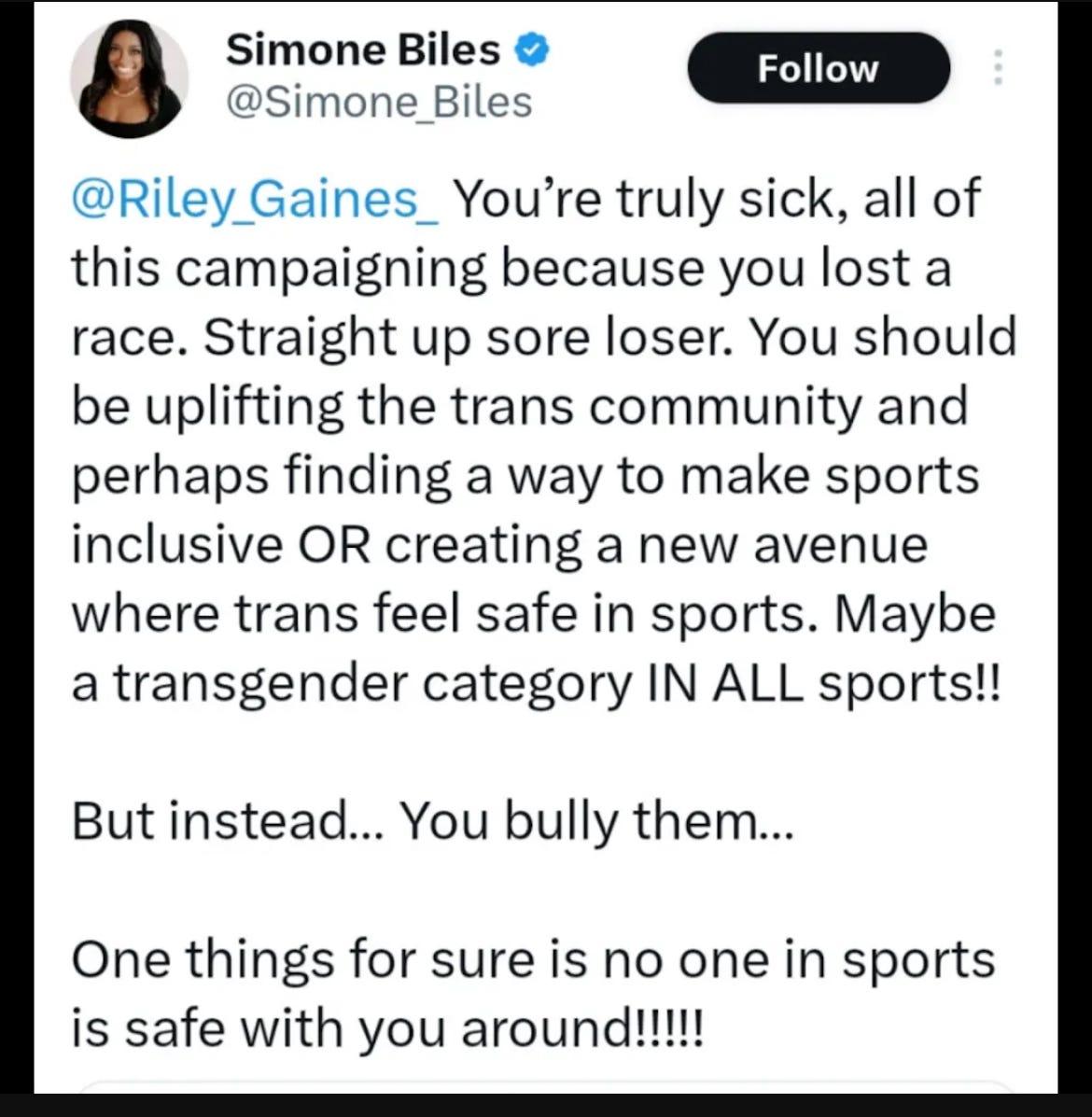
Simone’s stance? Basically, “Step aside, ladies. Men who say they’re women get to play too. Deal with it.”

Yeah, that crushed a lot of dreams. Every young girl who looked up to Simone for grit and talent got served a big, ugly dose of woke betrayal instead.

But wait, the drama didn’t stop there. The comment sections exploded with some of the wildest, most ridiculous takes you’ll ever see:

People claimed things like:

  • “Trans women are actually weaker than cis women,” ignoring every major study, physiology, and real-world athletic results.
  • “You’re just obsessed with genitals,” as if biological reality is some kind of personal fetish.
  • “Stop bullying! Simone Biles was just being inclusive,” even though Simone personally attacked another female athlete and told her to “pick on someone your own size”—which was clearly a jab at men, flipping the narrative.
  • “Only one trans woman has ever medaled in the Olympics, and it was in a team sport,” using tiny sample sizes as “proof” while ignoring decades of male athletic advantage and the ongoing displacement of female athletes.
  • Claims that acknowledging biology is “bigotry” or “hate,” which is a classic deflection to avoid actual debate.

What’s striking is how none of this is about facts or fairness—it’s about protecting an ideology at all costs. That’s the Bulldozer at work: steamrolling science, reason, and women’s rights in the name of feelings and group loyalty.

This isn’t just about sports. It’s a microcosm of a larger, coordinated push to erase distinctions and rewrite reality. The same movement that’s burning flags, tearing down institutions, and pushing radical social change also demands that we deny biology and silence dissent.

If you think this sounds wild, it’s because it is.

And it’s happening everywhere.


In cities like Los Angeles, Austin, and New York, something is boiling over—but you won’t see it clearly if you rely on mainstream media. Violent riots outside ICE offices. Masked agitators throwing bricks and firebombs. American flags burned in the street while chants echo: No borders, no nations, no more deportations.

It’s not just civil unrest—it’s ideological warfare.

The Revolutionary Communists of America recently made it explicit. On their official channels, they didn’t just critique policy—they declared war on the United States. Not metaphorically. Not rhetorically. Literally.

For the radical left, capitalism isn’t just an economic system; it’s the system—the root of all oppression. The force that creates every hierarchy, every disparity, every injustice.

When they say systemic racism, they don’t mean individual prejudice or even discriminatory laws-they mean the entire capitalist structure that, in their view, was built to privilege some and exploit others.

And still, mainstream outlets call it “activism.”

These aren’t fringe events. They’re pressure points in a much larger movement: one that uses radical ideology to attack the very concept of law, order, and national identity. Immigration is just the entry wound. The deeper goal is to dissolve the nation-state, abolish prisons, defund police, and destabilize every Western institution—starting with the family, borders, and biological reality itself.

They want the system to burn.

They just want you to feel guilty for noticing.

This isn’t liberalism. It’s not even progressivism. It’s an ideological virus that blends Marxist collapse fantasies with postmodern identity theory—what some have rightly begun to call Queer Marxism. And it’s spreading, not through military coups or overt revolution, but through activist groups, academic institutions, union politics, and nonprofit networks.

We call it the Bulldozer.

Because it doesn’t just push for justice.

It erases categories, flattens distinctions, and leaves nothing but rubble behind.


🧭 Where This Started For Me

How the modern Left radicalizes through language, identity, and psychological control

Once upon a time, I considered myself a proud progressive. I believed in equality, compassion, and social justice—values I still hold. But over the years, I began to notice a shift: the language of empathy was being used to silence people. The banner of inclusion began to look more like a gatekeeping badge. The people preaching tolerance were often the least tolerant of dissent.

I entered the movement through the doorway of compassion. But I didn’t understand, at the time, that it led to a staircase. A funnel. Tier by tier, the path narrowed—not toward a better world, but toward radicalism. And once inside, the pressure to conform only grew stronger.

Today, much of what passes as “progressive” isn’t about progress at all. It’s about compliance. It’s about scripts. It’s about moral absolutism enforced by social shaming. What began as genuine concern for the marginalized has metastasized into an ideological machine—one that feeds on sincerity, weaponizes pain, and punishes nuance.

That’s why I’m excited to share this conversation with

Karlyn Borysenko, a voice that’s become indispensable in making sense of what’s really happening on the modern Left.

Karlyn is a bold, unapologetic critic of collectivist ideology. An organizational psychologist turned independent journalist, she brings sharp wit and deep psychological insight to her investigations. She’s not just analyzing theory from the outside—she’s been inside the radical inner circles. Through her work on Decode the Left, Karlyn infiltrates socialist and communist meetings, documents activist materials, and translates their coded language into something the average American can understand.

Her work has helped many—including me—see what’s been hiding in plain sight.

In our 30-minute interview, we discuss:

  • Her recent article: Democrats Are Not the Same as Communists. Know the Difference
  • What May Day organizing reveals about the Left’s summer strategy
  • How her infamous “Spy Streams” expose internal tactics and contradictions
  • Her book A Brief History of Racism, and why history matters more than ever now

But before we jump into that conversation, I want to lay a foundation. This post is both a companion and a continuation—an exploration of how well-meaning people get pulled into radical ideologies, how activism gets hijacked, and why naming this process matters.

The Bait: Branding with Virtue

Progressive branding thrives on moral urgency. It co-opts legitimate concerns—racism, sexism, homophobia—and repurposes them as litmus tests. Agree with our solutions or you’re the problem.

I began to question this during the rise of Black Lives Matter. But when I asked reasonable questions about BLM’s funding, its leadership, or its goals, I was told that even asking was racist. It wasn’t enough to be “not racist.” You had to be “anti-racist” in a very specific, approved way.

This wasn’t justice—it was dogma.


The Switch: From Inclusion to Compliance

At the same time, in the wellness and spiritual communities I trusted, I saw the language of healing twist into something coercive. Phrases like “decolonize your practice” and “center marginalized voices” began as invitations—but morphed into rules.

There was no room to push back. Questioning the narrative meant you were part of the problem. Even trauma healing became politicized. The very spaces meant for introspection and healing became echo chambers.

Instead of curiosity, we got shame. Instead of conversation, we got scripts.


The Funnel: Tier by Tier Toward Radicalism

Karlyn Borysenko’s framework Mapping the Modern Left helped make sense of something I had felt but couldn’t articulate: a tiered escalation of ideology.
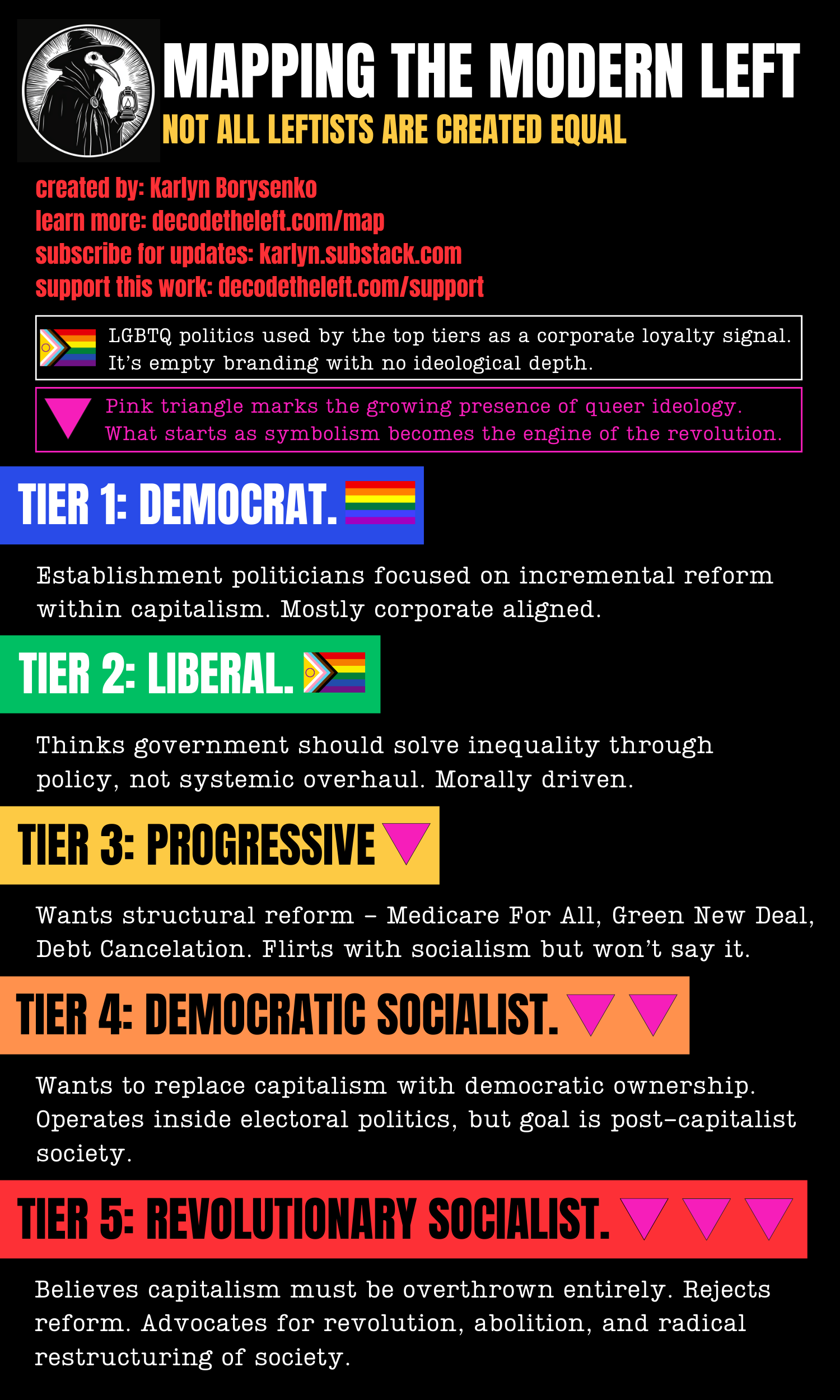
From empathy to entropy: How ideological movements erase meaning and dissolve reality

The modern Left doesn’t just want change—it wants a revolution.

It isn’t about lifting up the marginalized. It’s about obliterating the boundaries that hold society together—gender, family, biology, even objective truth. In this worldview, distinction itself is oppression.

Gender is violence.
Borders are fascism.
The family is a cage.
Biology is a lie.
Truth is power, and power must be redistributed.

Language becomes fluid. Categories dissolve. Womanhood becomes a costume. Masculinity becomes pathology. Childhood becomes political property. “Liberation” now means detaching people from anything stable or inherited—be it tradition, biology, or even their own identity.

And all of this is done under a banner of inclusion.
This ideological bulldozer doesn’t advertise itself as destruction.
It wears a rainbow sticker and smiles.

But that rainbow is no longer just a symbol of tolerance. It’s become the uniform of a new moral order—one that does not believe in reforming society, but in erasing and rebuilding it from ideological rubble.

To understand how this happens, you need to understand the spectrum of the modern Left—and how it collapses into itself under the weight of its own ideology.

❝ Not all leftists are created equal. ❞
But they’re treated that way—by media, by educators, by corporations, and even by confused voters.

From Tier 1 (corporate Democrats) to Tier 5 (open revolutionary socialists), there is a clear progression:

  • The slogans get more radical.
  • The policies become less about reform and more about control.
  • The language of empathy becomes the weapon of erasure.

By the time you hit Tier 5, “equity” no longer means fairness—it means forced sameness.
“Liberation” no longer means freedom—it means obedience to the ideology.
“Compassion” no longer means understanding—it means submission to the narrative.

This is why it matters to draw clear distinctions between liberals, progressives, socialists, and revolutionaries.
Because the Bulldozer’s first move is to blur all those lines—until every rainbow flag, every DEI committee, every social justice curriculum becomes a Trojan Horse.


The Trojan Horse

Democratic Socialists and the slow march through institutions

Democratic Socialists don’t throw bricks—they shake hands, campaign politely, and quote Bernie Sanders. They reject the optics of violent revolution, but their endgame is the same: the death of capitalism, the toppling of “oppressive systems,” and the remaking of society through collective control.

Instead of storming the gates, they infiltrate. School boards, city councils, union leadership—they operate like ideological missionaries, cloaked in the language of reform. They speak of “economic justice,” “solidarity,” and “participatory democracy.” But behind the rebranded slogans is the same old Marxist blueprint: dismantle private property, weaken law enforcement, and centralize economic power under collectivist principles.

Strategy: Cultural subversion. Institutional capture.
Goal: Dismantle capitalism through political power and social engineering.
How They Show Up: Labor organizing, tenant unions, co-op movements, policy think tanks.

Example

A DSA-backed city council member campaigns on tenant rights and rent control. Once elected, they introduce proposals to defund the police, establish “people’s budgets,” and replace merit-based hiring with DEI quotas. All under the banner of “equity.”

Major Players

  • Democratic Socialists of America (DSA) – boasting over 90,000 members and growing influence in state legislatures.
  • Working Families Party – a political organization that cloaks socialism in populist rhetoric.
  • Jacobin Magazine – the glossy PR firm of soft socialism.
  • People’s Policy Project – crafting white papers that sanitize radical redistribution schemes.

These groups are the useful professionals. The respectable radicals. They are the bridge between normie liberals and revolutionary anarchists. And they often don’t even realize they’re playing that role.


The True Believers

When revolution is the only answer

Then there are the purists—the radicals who reject democratic socialism as too soft, too compromised. These are the revolutionaries who don’t want reform. They want collapse.

To them, every institution—from the police to the family to the very idea of gender—is a pillar of oppression. And those pillars must be burned to the ground.

Violence is not a last resort. It’s a moral imperative. They call it “direct action.” They organize online, use encrypted channels, and treat molotov cocktails like communion.

Strategy: Agitate. Destabilize. Destroy. Rebuild from ideological ashes.
Goal: Overthrow capitalism and traditional Western structures entirely.
How They Show Up: Riots, black bloc formations, propaganda zines, “mutual aid” front groups.

Example

The George Floyd riots were framed as peaceful protests, but cities burned, federal courthouses were firebombed, and police precincts were taken over.

This wasn’t protest. It was trial-run revolution.

Major Players

  • Revolutionary Communists of America – unflinching in their anti-Americanism and pro-collapse rhetoric.
  • Haymarket Books – publishing far-left literature on race, labor, and abolition.
  • Antifa – not a formal group, but a loosely affiliated movement of anarchists who believe violence is speech.
  • CrimethInc. – anarchist media collective advocating sabotage and social revolt.
  • It’s Going Down – a digital hub for anarchist propaganda and riot coordination.
  • Tempest Collective / Firebrand Collective / Pinko Magazine – pushing Marxist, intersectional, and abolitionist agendas under the radar.

These aren’t outliers. They set the moral tone for the entire activist ecosystem. Even mainstream liberals are afraid to publicly denounce them. Why? Because the language of revolution—phrases like “abolish the police” or “disrupt the nuclear family”—has already trickled downstream into the DEI statements of schools, nonprofits, and corporate HR departments.


Death by Distortion

What connects these factions—whether polite socialists or masked anarchists—is not just a hatred of capitalism, but a rejection of distinction itself.

They believe:

  • Truth is power
  • Gender is fiction
  • Biology is oppression
  • Order is violence

In their world, there is no such thing as “woman”—only a fluctuating identity to be claimed or discarded. There is no moral hierarchy—only power struggles between oppressors and the oppressed. There is no reality—only narrative.

And this matters, not just in theory, but in your everyday life:

  • Children are told they were “assigned” a gender.
  • Women’s sports and scholarships are being erased.
  • Therapists fear losing their licenses for affirming biology.
  • Teachers hide “gender transitions” from parents.
  • Pride parades feature kink, nudity, and communist banners.

This is what happens when Queer Theory and Marxist revolution combine: identity becomes a tool, the body becomes political, and all stable truths are dismantled in the name of liberation.

But what’s left after the bulldozer passes through?

Just rubble. Confusion.


A Chilling Parallel: Psychiatry, Eugenics, and Modern Control

We’ve been here before.

In the early 20th century, American psychiatry and genetics embraced eugenics. Under the banner of science and progress, they sterilized alcoholics, the disabled, the poor, and the “unfit.” The roots of Nazi atrocities were inspired, in part, by American policies.

What began as “science” became ideology. And then became tyranny.

Today, we see a similar pattern. Radical identity politics now overrides biological facts. Science is cherry-picked. Individual concerns are dismissed as bigotry. Dissent becomes dangerous.


A Political Religion

The modern Democratic Party doesn’t act like a political party—it functions like a religion.

Belief is required. Doubt is punished. Apostates are shunned.

Masculinity is vilified. Womanhood is politicized. Kids are taught that biology is bigotry. Therapists are scared to speak. Teachers walk on eggshells.

This isn’t about progress. It’s about power.


Real-World Consequences

  • Women’s sports are being erased.
  • Speech is being policed.
  • Gay conservatives are told they don’t count.
  • Pride Month has become a political litmus test.

Even Pride itself has been hijacked—from a movement for freedom into a vehicle for ideological conformity. As journalist Brad Polumbo put it: it’s not enough to be gay anymore—you must also be leftist.


Why I Speak Out

Some people assume I’ve “become conservative.” And maybe I have—at least compared to where I started. But to me, it’s not about labels. It’s about clarity. About being honest.

I still care about compassion, justice, and fairness. But I care about truth too. And truth doesn’t require threats.

I speak out because I’ve seen what ideological manipulation does to good people. I’ve seen friends shrink themselves, walking on eggshells, terrified to be seen as bigots.

I was there once. But I’m not anymore.


đŸŽ™ïž Now, My Conversation with Karlyn Borysenko

This conversation is an eye-opener—especially if you’re just beginning to question what’s really going on behind the messaging.

Let’s get into it.

SOURCES

A Brief History of Racism – Kindle edition by Borysenko, Karlyn. Politics & Social Sciences

Karlyn Borysenko – YouTube

Democrats Are Not The Same As Communists. Know The Difference.

Her LATEST book! Debunking The Communist Manifesto: An Unapologetic Takedown of Marxist Nonsense – Kindle edition by Borysenko, Karlyn, Marx, Karl, Engels, Friedrich, Moore, Samuel. Politics & Social Sciences

BREAKING: Communist Group Declares War On America

I’m gay, but I’ll pass on Pride Month – Washington Examiner

Decode The Left with Karlyn Borysenko

What Intersectionality Means and Why Racism Means Private Property To The Left

The Real Handmaid’s Tale Isn’t in America

Between Liberation and Collapse: Why We Need to Talk About the Middle Path

Welcome back to Taste Test Thursdays, where we explore health, culture, belief, and everything in between. I’m your host, Megan Leigh and today, we’re asking a question that’s bound to make someone uncomfortable:

What if the very institutions we tore down as oppressive
 were also protecting us?

We live in a time of extremes. On one side, you’ve got Quiverfull-style fundamentalists preaching hyper-fertility and wifely submission like it’s the only antidote to modern decay. On the other, we’ve got a postmodern buffet of “do what you want, gender is a vibe, all structures are violence.”

And if you’re like me—having navigated the high-control religion pipeline but also come out the other side—you might be wondering


“Wait… does anyone believe in guardrails anymore?”

Because spoiler: freedom without form becomes chaos. And chaos isn’t empowering. It’s destabilizing.

I truly believe that structure and boundaries can actually serve a purpose—especially when it comes to sex, gender, and human flourishing.

This isn’t a call to go backward. It’s a call to pause, zoom out, and ask: what’s been lost in our so-called progress? Let’s dig in.

The Panic Playbook

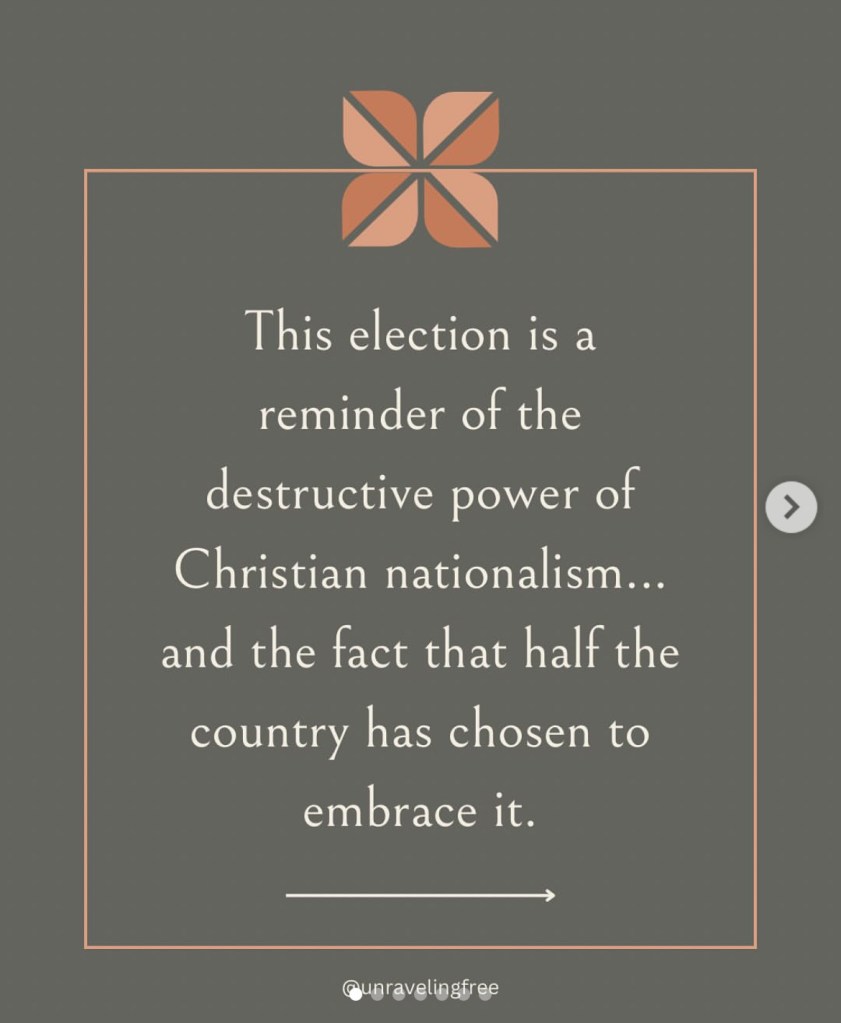
This past summer, the media went full apocalyptic. You couldn’t scroll, stream, or tune in without hearing it: Christian nationalism is taking over. Project 2025 is a fascist manifesto. Trump is a theocratic threat to democracy itself. The narrative was everywhere—breathless Substacks, viral TikToks, and cable news countdowns to Gilead.

But while progressives were busy hallucinating handmaids and framing every Republican vote as the end of America, they were also helping cover up the biggest political scandal since Watergate: Biden’s cognitive decline.

This blog isn’t a right-wing defense or a leftist takedown. It’s a wake-up call. Because authoritarian creep doesn’t wear just one team’s jersey. If we’re serious about resisting tyranny, we need to stop fearmongering about theocracy and start interrogating the power grabs happening under our own banners—especially the ones cloaked in compassion, inclusion, and “equity.”


Not All “Christian Nationalism” Is the Same—Let’s Break It Down

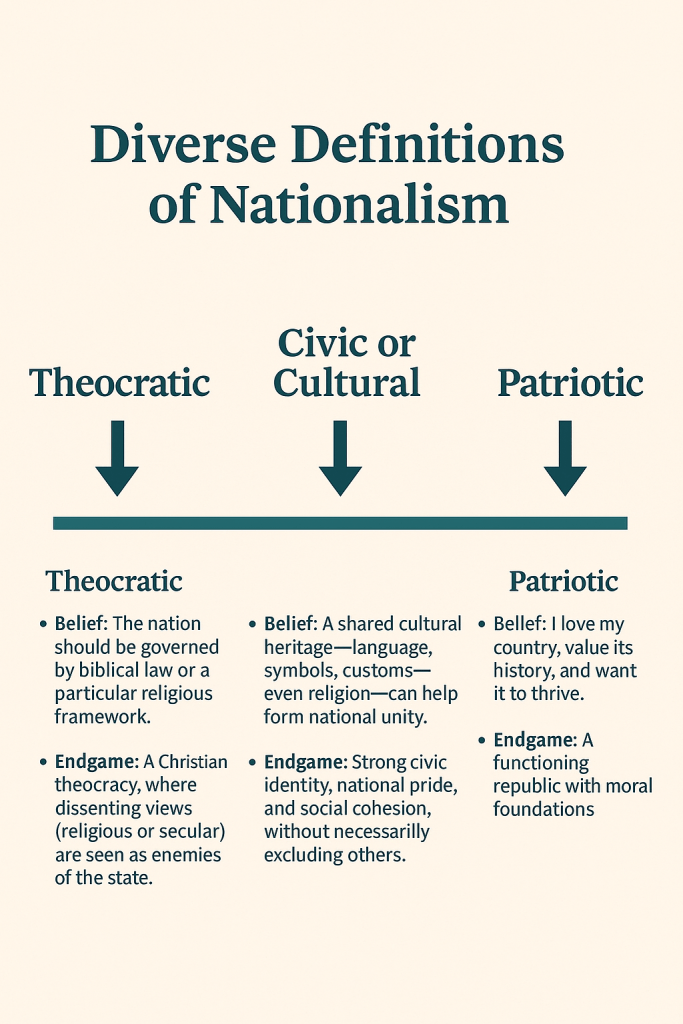
The term “nationalism” gets thrown around a lot, but it actually has different meanings:

🔾 1. The Theocratic Extreme
This is the version everyone fears—and with good reason.

  • Belief: Government should follow biblical law.
  • Goal: A Christian theocracy where dissent is treated as rebellion.
  • Associated with: Christian Reconstructionism, Dominionism, and groups hostile to pluralism.
    📍 Reality: This is fringe. Most evangelicals don’t support this, but it’s the go-to boogeyman in media and deconstruction circles.

🔾 2. Civic or Cultural Nationalism
More common, less scary.

  • Belief: Shared culture—language, customs, even religion—can create unity.
  • Goal: Strong national identity and cohesion, not exclusion.
  • Seen in: France’s secularism, Japan’s cultural pride, and even Fourth of July BBQs.
    📍 Reality: This is where most “Christian nationalists” actually land. They believe in the U.S.’s Christian roots and want to preserve those values—not enforce a theocracy.

🔾 3. Patriotism (Often Mislabeled as Nationalism)
Here’s where it gets absurd.

  • Belief: Loving your country and its traditions.
  • Goal: A moral, thriving republic.
    📍 Reality: Critics lump this in with extremism to discredit conservatives, centrists, or people of faith.

Why It Matters

Lumping everyone—from flag-waving moderates to dominionist hardliners—into one “Christian nationalist” category fuels moral panic. It shuts down real dialogue and replaces nuance with hysteria.

You can:

✅ Love your country
✅ Value strong families
✅ Want morality in public life


without wanting a theocracy.

Let’s Define the Terms Critics Confuse:

  • Dominionism: A fringe movement pushing for Christian control of civic life. Exists, but not mainstream.
  • Quiverfull: Ultra-niche belief in having as many kids as possible for religious reasons. Rare and extreme.
  • Christian Nationalism: Belief that the U.S. has a Christian identity that should shape culture and law. Vague, often misapplied.

And What It Isn’t:

  • Pro-natalism: A global concern over falling birth rates—not just a religious thing.
  • Conservative Feminism: Belief in empowerment through family and tradition. Dismissing it as brainwashing is anti-feminist.
  • Family Values: Often demonized, but for many, it just means prioritizing marriage, kids, and legacy.

Not all traditionalism is fascism.
Not all progressivism is liberation.
Let’s keep the conversation honest.


Hillary’s “Handmaid” Moment

Hilary Clinton🎧 “Well, first of all, don’t be a handmaiden to the patriarchy. Which kind of eliminates every woman on the other side of the aisle, except for very few. First, we have to get there, and it is obviously so much harder than it should be. So, if a woman runs who I think would be a good president, as I thought Kamala Harris would be, and as I knew I would be, I will support that woman.”

This quote from Hillary Clinton caused predictable outrage—but what’s more disturbing than the clip is the sentiment behind it.

In one breath, she managed to dismiss millions of women—mothers, caretakers, homemakers, conservative politicians, religious traditionalists—as unwitting slaves to male domination. Clinton doesn’t leave room for the idea that a woman might freely choose to prioritize home, faith, or family—not because she’s brainwashed, but because she’s pragmatic, thoughtful, and in tune with her own values.

To Clinton, there’s one legitimate type of woman in politics: the woman who governs like Hillary Clinton.

This framework—that conservative, traditional, or religious women are “handmaidens”—isn’t new. It’s a familiar talking point in progressive circles. And lately, it’s been weaponized even more boldly, as Clinton revealed in another recent statement:

“
blatant effort to basically send a message, most exemplified by Vance and Musk and others, that, you know, what we really need from you women are more children. And what that really means is you should go back to doing what you were born to do, which is to produce more children. So this is another performance about concerns they allegedly have for family life. Return to the family, the nuclear family. Return to being a Christian nation. Return to, you know, producing a lot of children, which is sort of odd because the people who produce the most children in our country are immigrants and they want to deport them, so none of this adds up.”

This is where modern feminism loses its plot. If liberation only counts when women make certain kinds of choices, it’s not about freedom then.


The Pro-Natalism Panic—and the Projection Problem

🎧 “Although the Quiverfull formal life isn’t necessarily being preached, many of the underlying theological and practical assumptions are elevated… and now, you know, they’re in the White House.”
– Emily Hunter McGowin, guest on In the Church Library podcast with Kelsey Kramer McGinnis and Marissa Franks Burt

There’s a subtle but dangerous trend happening in the deconstruction space: lumping all traditional Christian views of family into the Quiverfull/Dominionist bucket.

In a recent episode of In the Church Library, the hosts and guest reflected on the rise of pro-natalist ideas and Christian influence in politics. Marissa asks whether the ideology behind the Quiverfull movement might be getting a new rebrand—and Emily responds with what sounds like a chilling observation: echoes of that movement are now in the White House.

But let’s pause.

❗ The Quiverfull movement is real—but it’s fringe. It’s not representative of all evangelicals, conservatives, or even Christian pro-family thinking.

Yet increasingly, any policy or belief that values marriage, child-rearing, or generational stability gets painted with that same extremist brush. This is where projection replaces analysis.

Take J.D. Vance, often scapegoated in these conversations. He’s frequently accused of trying to turn America into Gilead—even though he has three children, supports working-class families, and hasn’t once called for a theocracy. His concern? America’s birthrate is in freefall.

That’s not theocracy. That’s math.

Pro-natalism isn’t about forcing women to give birth. It’s about grappling with a demographic time bomb. Countries like South Korea, Hungary, and Italy are facing societal collapse because too few people are having children. This isn’t moral panic—it’s math.

Even secular thinkers are sounding the alarm:

Lyman Stone, an economist and demographer, emphasizes: “Lower fertility rates are harbingers of lower economic growth, less innovation, less entrepreneurship, a weakened global position, any number of factors… But for me, the thing I worry about most is just disappointment. That is a society where most people grow old alone with little family around them, even though they wanted a family.”

Paul Morland, a British demographer, warns: “We’ve never seen anything like this kind of population decline before. The Black Death wiped out perhaps a third of Europe, but we’ve never seen an inverted population pyramid like the one we have today. I can’t see a way out of this beyond the supposedly crazy notion that people should try to have more kids.”

We have to be able to separate structure from subjugation. There’s a world of difference between saying “families matter” and forcing women into barefoot-and-pregnant obedience.

When we flatten every traditional idea into a fundamentalist threat, we not only lose clarity—we alienate people who are genuinely seeking meaning, stability, and community in a fragmented culture.

If we want to be intellectually honest, we must distinguish:

  • Extremism vs. Order
  • Oppression vs. Structure
  • Religious Tyranny vs. Social Cohesion

And we should probably stop pretending that every road leads to the Handmaid’s Tale.


Protective Powers: What Louise Perry and Joan Brumberg Reveal About Institutions

Let’s talk about The Case Against the Sexual Revolution by Louise Perry. Perry is a secular feminist. She’s not nostalgic for 1950s housewife culture—but she is asking: what did we actually get from the sexual revolution?

Here’s her mic-drop:

“The new sexual culture didn’t liberate women. It just asked them to participate in their own objectification with a smile.”

We built an entire culture around the idea that as long as it’s consensual, it’s empowering. But Perry argues that consent—without wisdom, without boundaries, without institutional protection—leaves women wide open to harm.

She points to:

  • Porn culture
  • Casual hookups
  • The normalization of sexual aggression and coercion in dating

These aren’t signs of liberation—they’re signs of a society that privatized female suffering and told us to smile through it.

Perry doesn’t say “go full tradwife.” But she does say maybe marriage, sexual restraint, and even modesty functioned as protective constraints—not just patriarchal tools of oppression.

We traded one form of pressure (be pure, stay home) for another (be hot, work hard, never need a man). Neither version asked what women actually want.

Now flip over to The Body Project by Joan Jacobs Brumberg. This one blew my mind.

She traces how, a century ago, girls were taught to cultivate inner character: honesty, kindness, self-control.

By the late 20th century? That inner moral development had been replaced by bodily self-surveillance: thigh gaps, clear skin, flat stomachs. Girls now focus on looking good, not being good.

She writes:

“The body has become the primary expression of self for teenage girls.”

Think about that. We went from teaching virtue to teaching girls how to market themselves. We told them they were free—and then handed them Instagram and said, “Good luck.”

So again, maybe some of those “oppressive” structures were also serving as cultural scaffolding. Not perfect. Not painless. But they gave young people—especially girls—a script that wasn’t just: “Be hot, be available, and don’t catch feelings.”

Brumberg isn’t saying go back to corsets and courtship. But she is saying we’ve lost our moral imagination. We gave up teaching self-restraint and purpose and replaced it with branding. With body projects. And now we wonder why depression and anxiety are through the roof??

We dive deeper into these subjects in these two podcasts:


Why the Fear Feels Real—And Why It’s Still Misguided

Look, I get it.

If you’ve escaped religious trauma, purity culture, or spiritual abuse, the sight of a political figure talking about motherhood as a virtue can feel like a threat. Your nervous system registers it as a return to oppression. The media confirms your panic. And suddenly, a call for demographic survival starts sounding like a demand for forced birth.

But your trauma doesn’t make every policy that triggers you authoritarian. It just means you need to slow down and check the data.

Because ironically, the real threats to bodily autonomy and family structure? They might not be coming from traditionalists at all.


🏛 The Progressive Power Grab You’re Not Supposed to Question

Another frustrating comment made by Kelsey Kramer McGinnis in a recent podcast was the need to “decenter nuclear families” and the dismissal of concerns about an “attack on nuclear families” as mere panic. But here’s the thing—this fear isn’t fabricated. It’s not fringe. It’s rooted in observable cultural trends and policy shifts. You can’t just wave it away with smug academic detachment.

Whether you support the traditional family structure or not, the erosion of it has real consequences—especially for children, social stability, and intergenerational resilience. Calling that out isn’t fearmongering. It’s an invitation to discuss the stakes honestly.

Let’s set the record straight: The desire to shape culture, laws, and education systems is not the sole domain of religious conservatives. Dominionist Christians aren’t the only ones with blueprints for a theocratic society. Progressive activists also seek to remake the world in their image—one institution at a time.

This isn’t a right-wing “whataboutism.” It’s an honest observation about how ideological movements—regardless of political lean—operate when they gain influence.

Let’s take a look at what this looks like on both ends of the spectrum:

🏛 Dominionism (Far-Right Christian Nationalism)

Core Belief: Christians are mandated by God to bring every area of life—government, education, business—under biblical authority.

Tactics:

  • Homeschool curricula promoting biblical literalism and creationism.
  • Campaigns for Christian prayer in public schools or Ten Commandments monuments in courthouses.
  • Promoting the idea that America was founded as a Christian nation and must return to those roots.
  • Electing openly Christian lawmakers with the explicit goal of reshaping law and public policy to reflect “biblical values.”
  • Supporting the Quiverfull movement, which encourages large families to “outbreed the left” and raise up “arrows for God’s army.”

📘 Progressive Institutional Capture (Far-Left Activism)

Core Belief: Society must be dismantled and rebuilt to eliminate systemic oppression, centering race, gender, and identity as primary moral lenses.

Tactics:

  • Embedding DEI (Diversity, Equity, Inclusion) frameworks into public schools, universities, and corporate policy.
  • Redefining gender and sex in school curricula while often sidelining parental input or community values.
  • Elevating “lived experience” over objective standards in hiring, curriculum design, and academic research.
  • Weaponizing social media and institutional policies to punish dissenting views (labeling them as “harmful,” “unsafe,” or “hateful”).
  • Using activist lingo to obscure government overreach (“gender-affirming care” vs. irreversible medical intervention for minors).

🔄 Shared Behaviors: The Race to Capture Institutions

Despite their stark differences in values, both dominionists and far-left activists behave in eerily similar ways:

  • They seek cultural dominance through schools, law, media, and public policy.
  • They view their moral framework as not just legitimate but necessary for a just society.
  • They suppress dissent by pathologizing disagreement—branding critics as “anti-Christian,” “bigoted,” “transphobic,” “groomers,” or “domestic extremists.”

The battleground is no longer just the ballot box. It’s the school board meeting. The state legislature. The HR department. The university curriculum. The TikTok algorithm.

Colorado’s HB25-1312 — The “Kelly Loving Act”

Signed in May 2025, this law expands protections for transgender individuals. Fine on the surface. But here’s the fine print:

  • It redefines coercive control to include misgendering and deadnaming.
  • In custody cases, a parent who refuses to affirm a child’s gender identity could now be framed as abusive—even if that child is a minor in the midst of rapid-onset gender dysphoria.

Is it protecting kids? Or is it using identity to override parental rights?

Washington State’s HB 1296

This bill guts the Parents’ Bill of Rights (which was approved by voters via Initiative 2081). It:

  • Eliminates mandatory parental access to children’s health records (including mental health).
  • Enshrines gender identity and sexual orientation in a new “Student Bill of Rights.”
  • Allows state-level monitoring of school boards that don’t comply.

And the cherry on top? It was passed with an emergency clause so it would take effect immediately, bypassing normal legislative scrutiny.

This isn’t some abstract culture war. These are real laws, passed in real states, stripping real parents of their authority.


A Marxist Framework Masquerading as Compassion

Some of these changes echo critical theory more than constitutional liberty.

Historically, Marxist and Maoist ideologies viewed the family unit as an oppressive structure that needed dismantling. Parental authority was often seen as an extension of capitalist control. In its place? State-affirmed loyalty, reeducation, and ideological uniformity.

Now, it’s not happening with red stars and gulags—it’s happening through rainbow flags and DEI seminars. But the power dynamics are the same:

The family becomes secondary to the state.
Dissent becomes dangerous.
Disagreement becomes “violence.”

This is how authoritarianism creeps in—wrapped in the language of safety and inclusion.


What Real Theocracy Looks Like

If you need a reality check, read Yasmine Mohammed’s Unveiled. Raised in a fundamentalist Muslim home, where women had no autonomy, no basic rights, and no freedom. She was forced into hijab at age 9, married off to an al-Qaeda operative, and beaten for asking questions. Women cannot see a doctor without a male guardian, they are forced to cover every inch of their bodies and are denied access to education and even the right to drive. That’s theocracy. That is TRUE oppression.

Now contrast that with the freedom that women enjoy in the West today. In modern America, women have more rights and freedoms than at any point in history. Women can run around naked at Pride parades, express their sexuality however they choose, and redefine what it means to be a woman altogether. The very idea of a “dystopia” here is laughable when we consider the actual freedom women in the West enjoy.

Yet, despite these freedoms, many liberal women still cry oppression. They whine about having to pay for their student loans, birth control or endure debates over abortion restrictions. This level of cognitive dissonance—claiming victimhood while living in unprecedented freedom—is a slap in the face to women who actually suffer under real patriarchal oppression.

What’s even more Orwellian is how the left, in its quest for inclusivity and justice, is actively stripping others of their freedoms. They preach about fighting for freedom of speech while canceling anyone who disagrees with them. They claim to be champions of equality while weaponizing institutions to enforce ideological conformity.

Bottom line: If you think Elon Musk tweeting about birth rates is the same as what Yasmine went through? You’ve lost perspective.

To revisit my conversation with Yasmine:


Fear Isn’t Feminism

If your feminism can’t handle dissent, it was never liberation—it was just a prettier cage.

We have to stop mistaking fear for wisdom. We have to stop confusing criticism with violence. And we absolutely must stop handing our power over to ideologies that infantilize us in the name of compassion.

Let’s be clear: Gilead isn’t coming. But if we’re not careful, something just as destructive might.

A world where parents are powerless.
Where biology is negotiable but ideology is law.
Where compliance is the only virtue, and questions are a crime.

The Courage to Be Honest

What I’m suggesting isn’t fashionable. It doesn’t fit neatly in a progressive or conservative box. But I’m tired of those boxes.

I’ve lived in Portland’s secular utopia and inside a high-control religious environment. I’ve seen how each side distorts truth in the name of “freedom” or “righteousness.”

But what if true liberation is found in the tension between the two?

The most revolutionary thing we can do today is refuse to become an extremist.

Not because we’re afraid.
Not because we’re fence-sitters.
But because we believe there’s a better way—one that honors the past without being imprisoned by it and faces the future with clear eyes and moral courage.


Maintain your curiosity, embrace skepticism, and keep tuning in. đŸŽ™ïžđŸ”’

— Megan Leigh

📚 Source List for Blog Post

1. Hillary Clinton Quotes

  • Quote 1 (on being a “handmaiden to the patriarchy”):
    [Reference: “Defending Democracy” podcast with historian Heather Cox Richardson, May 2024]
    No official transcript published — you’re using a direct audio clip for this one.
  • Quote 2 (on pro-natalism and immigration):
    [Source: Same podcast — “Defending Democracy” with Heather Cox Richardson, 2024]
    Partial reference via The Independent article

2. Louise Perry


3. Mary Harrington


4. Demographer Paul Morland


5. Lyman Stone


6. Dominionism & Quiverfull Movement


7. Recent Legislation Affecting Parental Rights

The Ideological Capture of Mental Health: A Whistleblower’s Story

How ‘Decolonizing Healing’ Became a Weapon of Social Engineering

The other week in our episode, Escaping One Cult, Joining Another? The Trap of Ideological Echo Chambers—When ‘Cult Recovery’ Looks a Lot Like a New Cult, I first introduced this idea: people leave high-control religion thinking they’ve found freedom, only to land in another rigid belief system.

And today, we’re diving even deeper.

Why does this happen?

Because humans are tribal.

Political scientists have long found that our opinions are shaped more by group identity than by rational self-interest. As Jonathan Haidt explains in The Righteous Mind, politics is deeply tribal—we’re hardwired to align with groups, not necessarily because they offer truth, but because they provide belonging.

As I’ve been navigating the deconstruction, ex-Christian, ex-cult communities, I’ve noticed for many, the radical progressive left becomes their new “safe” community, offering a clear moral hierarchy—oppressed vs. oppressor, privileged vs. marginalized. It mirrors what they once found in their faith.

But here’s the problem: the partisan brain, already trained in “us vs. them” thinking, doesn’t become freer—it simply finds a new orthodoxy.

John McWhorter has argued that woke ideology functions like a religion:

  • Instead of original sin, there’s privilege, marking some people as morally compromised from birth.
  • Instead of prayer, there’s public confession of biases and activism as penance.
  • Instead of heaven, there’s a utopia achieved through systemic change.

This framework offers a sense of moral clarity and belonging—but like any fundamentalist movement, it cannot tolerate dissent. As McWhorter warns,

“What we’re seeing isn’t a quest for justice but a demand for unquestioning orthodoxy.”

And that’s why so much of the deconstruction space looks less like healing and more like indoctrination.

“Systemic racism.” “Oppression.” “Intersectionality.”

These words dominate the language of social justice activism, but what do they actually mean? If you take them at face value, you might think they’re about fighting discrimination or ensuring equal opportunity.

But if you really listen—if you really follow the ideology to its core—it all comes back to one thing: capitalism.

For the radical left, capitalism isn’t just an economic system; it’s the system—the root of all oppression. The force that creates every hierarchy, every disparity, every injustice.

When they say systemic racism, they don’t mean individual prejudice or even discriminatory laws—they mean the entire capitalist structure that, in their view, was built to privilege some and exploit others.

And here’s the part that’s honestly exhausting—watching the same deconstruction folks preach about “decolonizing healing” and “Christian nationalism” in the same breath while pushing trauma support for religious survivors—all while being knee-deep in Critical Race Theory.

It’s one thing to acknowledge past harms. But this ideology just piles on more depression and anxiety without offering real solutions.

Let’s get real: this isn’t healing. It’s more of the same toxic division and victimhood—repackaged as activism.

And if you think I’m exaggerating, just listen to this clip from my interview last season with the founder of Tears of Eden, a nonprofit supporting survivor of spiritual abuse:

Katherine Spearing: (Timestamp 4:32)
“Now, like, one of the things that I have committed to—who knows how long it will last—I don’t listen to white men. Like, I don’t listen to white men’s podcasts, I don’t listen to white men on TV, white men sermons, I don’t read white men’s books, and I miss ZERO things by not listening to white men. There is amazing material created by BIPOC, queer-identifying people, women—I miss ZERO things not listening to white men. And we, as a culture—especially in fundamentalist spaces—have platformed white men as voices of authority and trust.”

Now let’s take Nikki G. Speaks, who also works with Tears of Eden. Her book frames Christian nationalism as the root of systemic oppression, defining it in a way that casts anyone with conservative values or moral convictions as complicit. And it’s not just an argument—it’s being packaged as trauma recovery. Just look at how it’s marketed:

“Hearing the same controlling language in our laws that I heard in church feels like a step backward in my healing.” “It’s like my trauma has left the church and entered our government—it’s a reminder of how pervasive these beliefs can be.”

This isn’t about healing—it’s about turning political disagreement into personal trauma. And this is just one example of how therapy spaces are being used to enforce ideology rather than foster true recovery.

Let that sink in.

This is what is being promoted under the guise of “healing.”

This isn’t about liberation. It’s about swapping one dogma for another, one form of control for another. And the worst part?

It’s being fed to people who have already been deeply wounded, offering them more alienation and resentment instead of real recovery.

This is where intersectionality comes in.

Coined by KimberlĂ© Crenshaw in the 1980s, intersectionality originally described how different forms of discrimination—race, gender, class—could compound. But in the hands of modern activists, it’s become something much broader—a blueprint for how capitalism oppresses everyone.

Race? Capitalism’s fault.
Gender? A hierarchy created by capitalism.
Policing? A tool of capitalism to protect property and maintain order.
Disability? Even that, they argue, is socially constructed through a capitalist framework that determines who is “productive” and who isn’t.

The goal isn’t reform—it’s destruction. Private property, free markets, law enforcement, even objective truth itself—everything is viewed as an extension of capitalism’s oppressive grip. And because the U.S. Constitution protects that system, it too is labeled a racist, colonialist document that must be overturned.

This is why, no matter what progress is made, America will always be deemed a racist society by those who see racism and capitalism as inextricably linked. And if you think this sounds extreme, just wait—because the next frontier, Queer Marxism, takes it even further. This emerging ideology argues that capitalism didn’t just create economic classes but created gender itself. That masculinity and femininity aren’t just cultural norms, but capitalist inventions designed to uphold oppression.

The radical goal? Not just to redefine gender—but to abolish it entirely.

Today, I’m joined by someone who saw this ideology take over firsthand.

Suzannah Alexander is the writer behind Diogenes in Exile and a self-described whistleblower. Her journey took a sharp turn when she returned to grad school to pursue a master’s in clinical Mental Health Counseling at the University of Tennessee. Instead of a rigorous academic environment, she found a program completely entrenched in Critical Theories—one that didn’t just push radical ideas but actively rejected her Buddhist practice and raised serious ethical concerns about how future therapists were being trained. Believing the curriculum would do more harm than good, she made the difficult decision to leave.

Since then, Suzannah has dedicated herself to investigating and exposing the ideological capture of psychology, higher education, and other institutions that seem to have lost their way.

Today, we’re pulling back the curtain on what’s really happening in academia and the mental health field—how radical ideologies are shaping the next generation of therapists, and what that means for all of us.

This isn’t just about politics.

This is about the fundamental reshaping of how we think about identity, human nature, and even reality itself.

Buckle up—this conversation is going to challenge some assumptions.

Let’s get into it.


The ‘Shell Game’ of Autonomy vs. Collectivism

In the counseling profession, the ACA (American Counseling Association) Code of Ethics emphasizes autonomy as a fundamental value. Counselors are meant to respect the autonomy of their clients, allowing them to make decisions based on their own needs, values, and beliefs. However, there’s a disturbing contradiction in the way this value is applied.

Suzannah points out a glaring issue: while the ACA Code of Ethics pushes for autonomy on an individual level, the broader agenda within counselor training increasingly prioritizes societal goals—often driven by collectivist ideologies—over the well-being of the individual client. She likens this contradiction to a “shell game,” where one thing (autonomy) is promised, but what you get is something entirely different: an emphasis on societal goals and moral frameworks that favor groupthink over personal decision-making.

From Competence to Conformity: The New Standard for Counselor Training

In Suzannah’s story, she highlights how counseling programs have made a troubling shift from evaluating students based on competence—their ability to effectively help clients—to assessing whether they’re willing to “confess, comply, and conform.” This process, Suzannah describes, is what she terms “ideological purification.”

This ideological purification isn’t about developing professional skill; it’s about enforcing a prescribed set of beliefs. Under the influence of CACREP (Council for Accreditation of Counseling and Related Educational Programs) standards, students are now pressured to align their personal values and beliefs with certain ideological standards. For Suzannah, this was most evident in how multicultural counseling courses and other required coursework increasingly centered around critical race theory, intersectionality, and social justice activism.

Suzannah asks: How can this ideological shift affect students who resist, and what happens when they’re coerced into aligning with values that aren’t their own?

The danger here is twofold: students who resist this ideological conditioning may find themselves marginalized, pushed out of programs, or forced into an uncomfortable position where they feel pressured to abandon their own beliefs. This, Suzannah argues, creates a chilling atmosphere for anyone who doesn’t conform to the prescribed worldview.

Ideological Purity in Counselor Training: What’s at Stake?

Suzannah’s personal experience with CACREP’s “dispositions” exemplifies the pressure to align personal beliefs with ideological standards. She shares that this led to her being placed on a “Support Plan”—essentially a probationary period where she was expected to prove her ideological compliance. This was compounded by verbal abuse from professors who seemed intent on forcing her to adopt a specific worldview, regardless of her personal or professional integrity.

Suzannah reflects: How did this ideological enforcement affect her professional integrity? The pressure to abandon her personal beliefs and adopt prescribed values made her question whether counseling, a field that should center around helping individuals find their own path, had become more about enforcing conformity than fostering autonomy.

The Impact of Ideological Capture on Effective Therapy

Suzannah’s concerns go beyond her own experience; she warns of the long-term consequences of this ideological capture on the broader counseling profession. As the training process increasingly focuses on ideological purity rather than competence, it undermines the very foundation of therapy—trust, autonomy, and the ability to genuinely help clients.

Suzannah argues that when counselor training programs force students to abandon their personal beliefs, they create a system where the ability to genuinely help clients is compromised. Counselors may find themselves unable to offer support that reflects the true diversity of their clients’ experiences—particularly those who may not share the same ideological framework. This ideological conditioning poses a real threat to the integrity of the counseling profession as a whole.

The Long-Term Consequences: A Dangerous Path

The future of the counseling profession, as Suzannah warns, is in jeopardy if this trend of ideological conformity continues. What once was a field designed to support individuals in navigating their personal struggles is at risk of becoming another ideological tool, where practitioners are forced to conform to an orthodoxy rather than providing true, individualized care.

As Suzannah explains, the core values of counseling—such as autonomy, respect for the individual, and the ability to help clients work through their unique experiences—are being overshadowed by an agenda that prioritizes ideological purity. If this trend continues, it may lead to a future where counselors are more concerned with political correctness than the well-being of their clients.

The Final Question: Is Healing Possible in This New Environment?

Suzannah’s story raises critical questions about the future of counseling and mental health support in an increasingly ideological landscape. How do counselors maintain their professional integrity in a system that demands conformity? How can clients receive true support when the professionals meant to help them are being trained under such an ideological framework?

The answers to these questions will shape the future of mental health care. If the trend of ideological capture continues, it may very well reshape the profession into something unrecognizable—an environment where therapy becomes just another vehicle for ideological control, rather than a space for healing and personal growth.


Have thoughts on this? Join the conversation! If you’ve experienced the impact of ideological conformity in mental health training or therapy, share your story in the comments or send us a message. The more we understand the forces shaping mental health care, the better equipped we are to fight for a future where autonomy and true healing are at the center of care.

Links:

Further Reading

Consent Isn’t Enough: The Harsh Truth About “Sex Work”

Beyond the Glamour: The Dark Reality of the Sex Industry

Welcome back to Taste of Truth Tuesdays. Today’s episode is one that I’ve both been eager and hesitant to share. While I’ve spoken about my journey through faith, fitness and personal transformation that there’s one chapter I’ve largely kept private until now….

For most of my life, I was fed a specific narrative: go to college, get a degree, build a career, and don’t worry about prioritizing marriage or family. Financial independence was the ultimate goal.

After graduating college, I moved from Virginia to Portland, Oregon, to chase my career as a personal trainer, lifestyle coach, and professional circus performer. My income relied on clientele, and while I had busy seasons, nothing was ever truly stable. But with inconsistent income and the ever-present pressure to make ends meet, I found myself in a space that many glamorize but few truly understand—the world of sugar dating.

At first, it didn’t seem that different from the casual dating I was already doing—except now, dinner was covered, and there was a financial incentive. But the deeper I got, the more I realized how unstable and unsafe it was. Most of these men didn’t care about you as a person; they just wanted no-strings-attached access to your body. And when I found myself in situations where I wasn’t in control—where boundaries were ignored, protection was negotiable, and at times, I left empty-handed even after doing my part—I started to see the cracks in the ‘empowerment’ narrative. I remember one night, sitting in my car after being verbally and physically assaulted, I realized I had no one to report it to. No way to warn the next woman. That’s when the illusion fully shattered for me.

That’s why today’s conversation is so important. I’m joined by Sloane Wilson from Exodus Cry, an organization dedicated to exposing the truth about sexual exploitation and advocating for survivors. We’re unpacking the hard truths about the sex industry, the myths that keep women trapped in it, and the cultural shifts that have normalized what should never be considered “just work.”

But we’re also diving into something deeper, faith. Both Sloane and I have gone through our own journeys of deconstruction and reconstruction. She’s seen firsthand how the church can mishandle encountering survivors and how delicate and complex these situations can be.

The Reality of “Sugar Dating”

Some nights felt harmless—like having dinner with a businessman who just wanted company and conversation. But most nights? They were anything but that. The truth is, the fantasy of sugar dating—mutually beneficial, long-term arrangements with financial stability—was just that: a fantasy. Most men weren’t offering monthly allowances or ongoing support. They wanted pay-per-meet agreements—no strings attached, no safety net, just transactional sex. And when survival depended on it, I found myself scrambling to secure the next “daddy.”

I struggled to assert myself, especially in two key areas: insisting on protection and ensuring I was paid upfront. That put me at immense risk—both for my health and my safety. One night, I was forced into acts I didn’t consent to, verbally assaulted, and then left empty-handed. Sitting in my car afterward, I realized something chilling: there was no one to report it to. No way to warn the next girl. No system to hold these men accountable.

Some men had hidden home cameras, recording our time together without my consent. Others were forceful, rough, and used sex toys in ways that crossed every boundary I had. And yet, as awful as those experiences were, I knew I was lucky—because it could have been so much worse.

Most of these men pushed to move conversations off the platform as quickly as possible, demanding explicit photos before agreeing to meet. When you’re in a financial bind, it’s hard to say no. That’s how exploitation thrives—through desperation.


The Trap of a “Luxe” Illusion

Looking back, I wonder—why didn’t I just walk away? Why couldn’t I see, from the beginning, that this wasn’t sustainable? I wasn’t like most women in the industry. I was white, college-educated, and didn’t even have student debt shackling me. My financial stress came from my own reckless spending—maxed-out credit cards and the relentless costs of bodybuilding, a sport I was pouring everything into. So why, with all the options I had, did I keep chasing this?

I think part of it was desperation. The MLM-like promise of sugar dating had me convinced that if I just worked harder, played the game right, and landed the right arrangement, I could have financial security and independence. I put more energy into curating the perfect sugar persona than I ever did into building my personal training business. And maybe, just maybe, I was chasing the mirage of someone close to me—someone who had made sugar dating “work.” I saw her succeed, and I kept believing I could, too.

But there’s another layer. One I don’t love admitting (and one my mom will absolutely deny.) My mother praised me for it. She told me, “I wish I had done this when I was your age.” That kind of validation messes with your perception of right and wrong. It made it seem like I was onto something genius, like I had cracked code other women were too scared or too moralistic to try. Was I subconsciously trying to prove something? Was I filling the void left by emotional neglect?

Or was it just my own damn fault?

That’s the thing about these choices—they never come down to just one reason. It is always more complex. It wasn’t just the financial stress. It wasn’t just my upbringing. It wasn’t just the influence of someone I admired. It was all of it, tangled together, keeping me locked in place. And it took me years to realize that no amount of effort or strategy would turn sugar dating into the safety net I desperately wanted it to be.


The Lie of “Sex Work is Work”

For a long time, I believed the mantra: “sex work is work.” It’s the rallying cry of the sex-positive movement, a phrase meant to legitimize the industry. Prostitution is often called “the oldest profession,” but historically, it has always been a last resort for survival. Women don’t enter this industry because it’s empowering. They do it because they have no better options.

The real harm in prostitution isn’t just about bad working conditions or societal stigma. It’s about dehumanization. When sex is reduced to a transaction, people become commodities. And when we treat people like products to be bought and sold, we strip them of their dignity.

Louise Perry, in The Case Against the Sexual Revolution, makes this point powerfully. She argues that the sex industry’s only real defense is a hollow, commodified version of “liberation”—one that insists, “Everyone consents, everyone is an adult, the women enjoy it, so who are you to judge?” But when consent is the only moral standard, we ignore the broader ethical issue: that people are being treated as means to an end. Consent alone does not erase coercion, exploitation, or harm.

In our postmodern culture, we’ve rejected objective morality and replaced it with a consumerist approach to sex. If both parties “agree,” then anything goes. But this is a dangerous slope—one that allows predatory men to exploit desperate women under the guise of empowerment.


Insights from Recent Research

New research exposes the blurred lines between sugar dating and traditional sex work. A study published in The Journal of Sex Research found that over one-third of sugar babies have engaged in other forms of transactional sex work, such as escorting or stripping. This challenges the narrative that sugar dating is different or “classier” than prostitution. The reality? It operates on the same fundamental exchange.

The study also found that sugar benefactors reported an average of over six arrangements, indicating a revolving door of sugar relationships. For these men, sugar dating is just another avenue for purchasing companionship and sex.

Beyond the emotional toll, sugar dating carries serious legal and personal risks. Legal experts warn that these arrangements can lead to blackmail, coercion, and threats—especially when expectations aren’t met. Many women find themselves in vulnerable situations with no real recourse. The illusion of control is just that—an illusion.


The Flawed Narrative Around Sex Work and Deconstructing Purity Culture

In the deconstruction space, there’s a growing trend of equating sexual liberation with empowerment while rejecting any critique of the sex industry as moral panic. A popular post circulating on International Sex Workers Day exemplifies this mindset, arguing that deconstructing purity culture requires deconstructing any negative views of sex work. The claim? Sex work and sex trafficking are entirely separate, and many big Christian anti-trafficking organizations wrongly conflate the two to push an agenda. The post insists that if a person is not forced, defrauded, or coerced, they are simply making a free choice to engage in sex work. But this argument is deeply flawed when examined through historical context, real-world data, and the experiences of women who have lived through it.

The Demand Problem: Why Legalizing Sex Work Doesn’t Protect Women

One of the most critical oversights in this argument is the failure to acknowledge that sex work is a demand-driven industry. As Louise Perry outlines in The Case Against the Sexual Revolution, countries that have legalized prostitution have seen an increase in trafficking. Why? Because legalizing the industry normalizes the demand for paid sex, and when there aren’t enough willing participants, traffickers step in to fill the gap. Studies show that in places like Germany and the Netherlands, where prostitution is legal, trafficking rates have skyrocketed because the market rewards pimps and exploiters. The idea that sex work can be fully separate from trafficking ignores the economic reality that supply follows demand.

Linda Lovelace’s experience in Deep Throat is a perfect example of this. The film was a massive success, grossing over $600 million, and was hailed as revolutionary at the time. But years later, Lovelace revealed that she had been coerced into performing in the film under violent and abusive conditions. Her book Ordeal exposed the hidden abuse within the industry—an industry that thrives precisely because there is a market for extreme, degrading content. This isn’t an isolated case; countless women have echoed similar stories after leaving the industry, only to be dismissed while they were still in it because they were expected to uphold the “liberation” narrative.

The Exploitation Behind the Industry

Another major flaw in the sex-work-as-liberation argument is the lack of accountability within the industry itself. MindGeek, the corporation behind the world’s largest pornography sites, has faced multiple civil lawsuits for monetizing non-consensual content—including child sexual abuse, rape, revenge pornography, and voyeuristic recordings of women showering. Reports from December 2020 revealed that the platform was infested with videos depicting abuse and that it profited from some of the darkest corners of human sexuality.

The industry thrives on the illusion that all participants are willing, yet it repeatedly fails to ensure consent. The reality is that the vast majority of those in sex work come from backgrounds of financial instability, trauma, or coercion—not from an empowered, freely chosen career path. The notion that sex work is “just another job” ignores how uniquely dangerous, exploitative, and often inescapable it can be.

The Broader Issue: Normalizing Harm Under the Guise of Liberation

This same pattern of dismissing harm under the banner of liberation isn’t exclusive to the sex industry. I recently came across another example in the deconstruction space where an account that advocates for women’s sexual empowerment was documenting her abortion experience on National Abortion Day. She filmed herself taking the abortion pill as if it were nothing—a casual, almost celebratory act. But this kind of messaging erases the medical realities and risks associated with the abortion pill. It ignores the fact that women absolutely should get an ultrasound before taking it to determine gestational age and rule out ectopic pregnancy, which can be fatal if left untreated. Reducing such a serious medical decision to a political performance trivializes the real consequences that many women face.

This connects back to the issue with sex work: the rush to de-stigmatize everything labeled as “empowerment” often leads to a dangerous lack of critical thought. If deconstruction is about questioning harmful narratives, then why aren’t we allowed to question the harm within the sex industry? Why does rejecting purity culture mean embracing an industry that, time and time again, has been built on coercion, abuse, and exploitation?

Deconstructing purity culture shouldn’t mean abandoning discernment. If anything, it should mean taking an even closer look at these industries and asking hard questions about who truly benefits from them. Because when we actually listen to the stories of women who have left sex work, the pattern is clear: what is sold as empowerment often turns out to be exploitation in disguise.

Healing & Advocacy

Looking back, my perspective has completely shifted. The journey out of the sex industry has been long and complicated, but I’m grateful for the clarity I have now. Organizations like Exodus Cry work to expose the realities of the commercial sex trade and fight for real change. And voices like Louise Perry’s are crucial in dismantling the harmful myths that keep this industry alive.

The sexual revolution promised liberation, but for many women, it delivered exploitation instead. The more we normalize the commodification of sex, the more we enable the very systems that harm us. It’s time to rethink everything we’ve been told about “sex work” and start asking: Who really benefits from this industry? Because it’s certainly not the women inside it.

If you’ve ever questioned the narrative around sex work, if you’ve been curious about the reality behind sugar dating, or if you want to hear from someone who’s been there—I invite you to tune in.

It’s time to move beyond the glamour and face the truth.

Resources: