
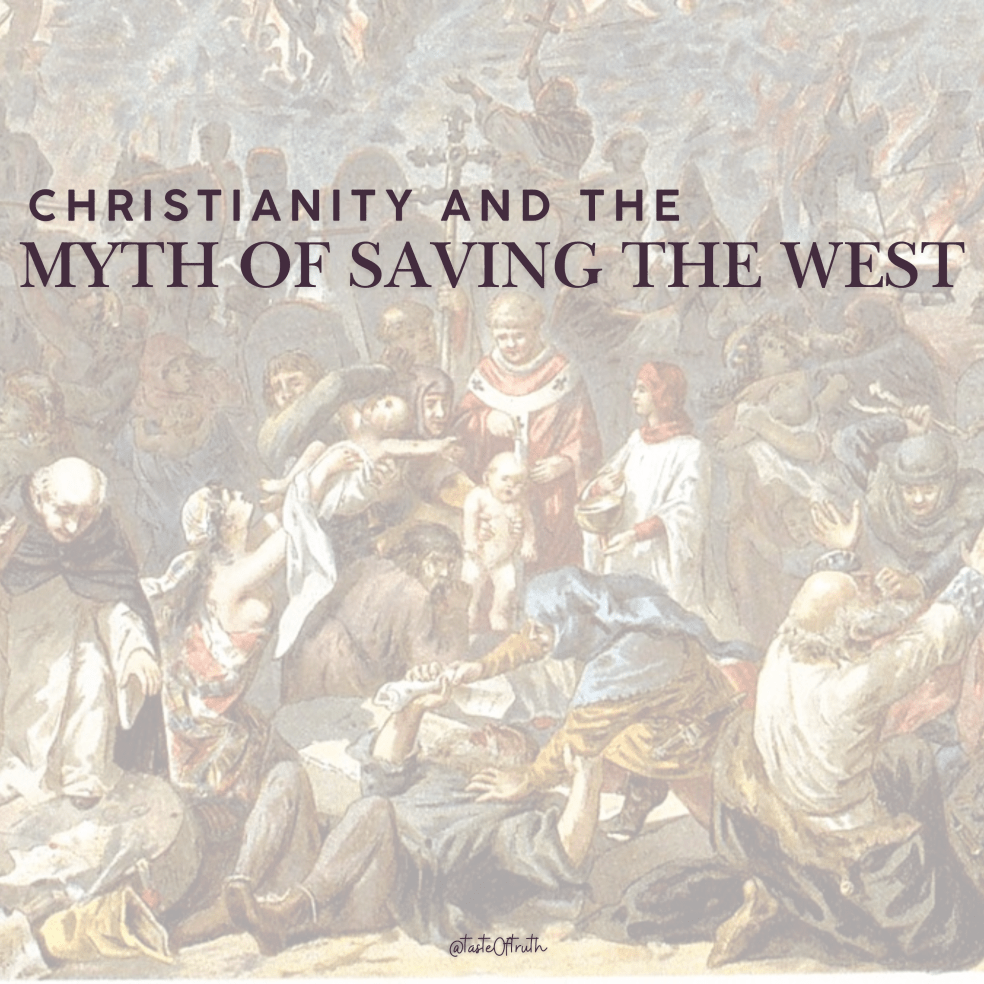
A historical documentary blended with a personal reckoning and a cultural warning
This one has been sitting with me for a long time.
Six months, maybe more. Notes in the book margins. Tons of screenshots. Quotes stacked in my notes folder. Books half-highlighted and folded pages revisited. Every time I thought I was ready to write it, I wasn’t…
Because this isn’t just about history. It’s about a story we keep repeating with confidence: that Christianity saved the West and what happens when you actually slow down to examine that claim.
The claim that Christianity civilized Europe. Christianity gave us human rights, pluralism, rational inquiry, restraint. And if Western civilization feels unstable today, the prescription is simple— return to Christian moral supremacy.
I find myself increasingly tired of hearing it.
Tired of watching “Judeo-Christian values” invoked as shorthand for liberty. Tired of hearing that our freedoms, our intellectual life, our legal architecture all flow directly from the Bible. Tired of the way paganism is casually used as a synonym for barbarism, ego, domination — while Christianity is cast as the moral counterweight, the conscience that civilizes power.
A recent example sharpened that fatigue. Leighton Woodhouse published an opinion piece in The New York Times titled Donald Trump, Pagan King. The framing was familiar and rhetorically smooth. Paganism was associated with appetite, force, and unchecked authority. Christianity appeared as restraint, humility, moral seriousness. The implication was subtle but unmistakable: whatever is broken in our politics represents a departure from Christian virtue.
The structure of this narrative is ancient. Pagan equals raw power. Christian equals moral discipline.
But that framing rests on an assumption that deserves far more scrutiny than it receives. It assumes that Christianity is the moral software of the West. Before it, there was chaos; after it, civilization.
The deeper I have gone into late antiquity, through Catherine Nixey’s The Darkening Age, Charles Freeman’s analysis of intellectual narrowing, Ramsay MacMullen’s documentation of coercive conversion, and through primary sources from both Christian and pagan voices— the more that tidy civilizational story begins to unravel.
Because when Christianity gained institutional dominance, what followed was not the natural flowering of pluralism and inquiry. It was very opposite.
And for us to truly understand, we have to begin this story before Christianity held power.
A World Before Monopoly
The Greco-Roman world was not a utopia. It had power structures, that were often violent, and deeply unequal. But it operated within a religious and intellectual framework that functioned very differently from exclusive monotheism.
Roman religion was additive rather than subtractive. One could honor household gods, civic gods, the imperial cult, foreign deities, and philosophical conceptions of the divine without renouncing the others. Orthopraxy mattered more than orthodoxy. What counted was correct ritual performance, not exclusive belief. The pax deorum (the peace with the gods) was maintained through observance, not doctrinal conformity.
Philosophically, multiplicity was the norm. Stoics, Epicureans, Skeptics, and Platonists argued openly about cosmology, ethics, and the nature of reality. Protagoras could admit uncertainty about the gods without being erased from the record. Cicero articulated natural law grounded in reason and universality long before Christianity gained political authority. Debate was public. Rhetorical training was a civic skill. Argument was like oxygen at the time.
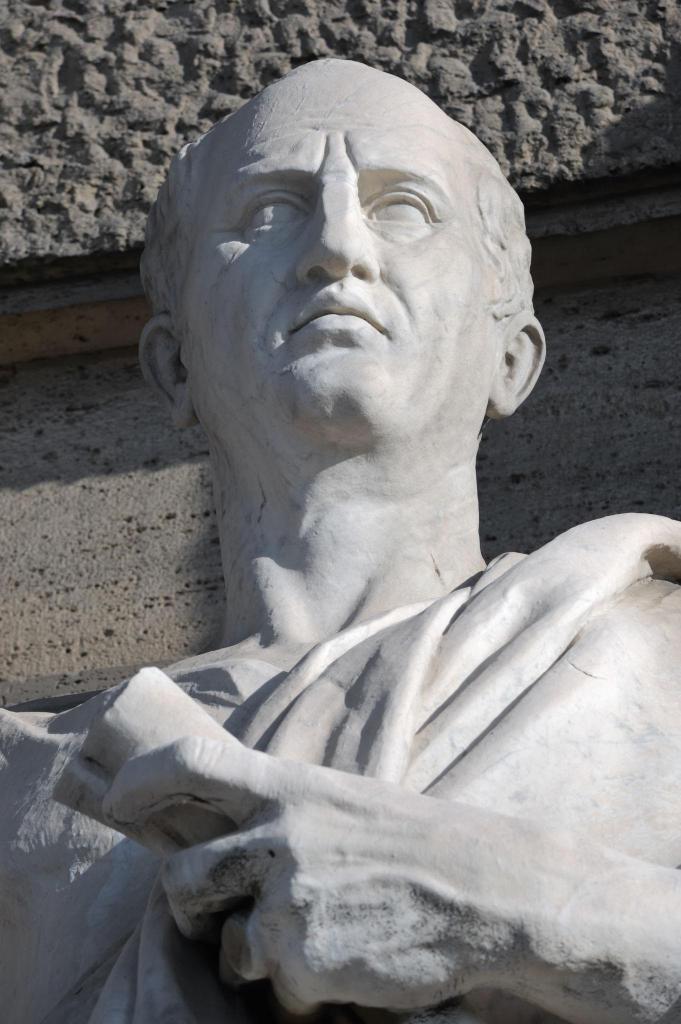
The Roman legal system developed sophisticated structures of administration and legislation that would profoundly shape Western law. None of this depended on exclusive revelation. It depended on human reasoning operating within a plural environment.
Rome suppressed what it perceived as politically dangerous. It was capable of cruelty. But structurally, it tolerated metaphysical competition. Truth was not framed as singular and jealous in the way later Christian orthodoxy would insist.
Christianity did not enter this world as one more school of thought among many. It entered with a different moral architecture. Not “add Christ to the pantheon.”
But “burn down the rest.”
That distinction is not merely cosmetic. It is foundational to understanding the real history.
The Architecture of Exclusivity
The Hebrew scriptures that Christianity inherited contain a recurring moral posture toward rival worship. Altars are to be broken down. Sacred groves burned. Idols smashed. “You shall have no other gods before me” is not a suggestion of preference; it is a declaration of exclusivity. Rival worship is not seen as a mere mistake; it is corrupting.
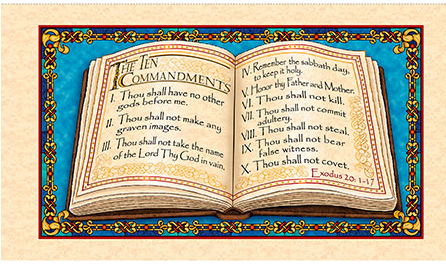
When confined to private devotion, this posture functions as identity formation. When fused with state power, it moves from conviction to coercion.
For the first three centuries of its existence, Christianity lacked imperial authority. It survived in the margins of society. The decisive shift came when Christianity aligned with imperial power under Constantine and his successors.
Estimates vary, but many scholars place Christians at roughly ten percent of the empire around the year 300. The exact percentage is debated (ancient demographic modeling is necessarily approximate) but the trajectory is clear. Within a few generations, that minority became the ruling faith. By the end of the fourth century, imperial law assumed Christianity as normative and increasingly treated rival ritual as illegal.
This demographic reversal was not merely theological. It was political.
Once exclusivist theology acquired enforcement capacity, differences in beliefs was no longer merely error. It was threat.
In the 380s and 390s, imperial edicts against non-Christian ritual multiplied. In 399, a Christian emperor issued a decree stating:
“If there should be any temples in the country districts, they shall be torn down without disturbance or tumult. For when they are torn down and removed, the material basis for all superstition will be destroyed.”
The language is bureaucratic. The effect was not.
These edicts provided legal cover for demolition. Bishops lobbied rulers for stricter laws. Congregations became demolition crews. Rival worship was framed as superstition whose material foundation had to be eradicated.
As Ramsay MacMullen demonstrates, once rival belief is conceptualized as spiritually dangerous, compromise becomes morally suspect. In a plural system, rivals are mistaken. In an exclusivist system, rivals are demonic. And demons are not debated. They are expelled.
This is the mechanism. And it becomes visible in stone.
The Destroyers and the Image of Wisdom
Once theology fused with imperial authority, enforcement did not remain theoretical. It moved outward into public space. It moved into cities. It moved into stone.
Catherine Nixey opens The Darkening Age not with doctrine but with an image. The choice is deliberate. Arguments can be abstract. Statues cannot.
The Temple of Athena in Palmyra had stood for centuries. It was not a relic in a museum. It was part of a living civic landscape. Its columns had watched merchants pass through the city, soldiers march under banners, pilgrims move between worlds. Within it stood Athena— goddess of wisdom, of strategic intelligence, of disciplined thought. She represented more than devotion. She embodied the classical inheritance itself: philosophy, rhetoric, ordered reasoning, the cultivation of mind.
When the destroyers arrived, what they attacked was not simply stone.
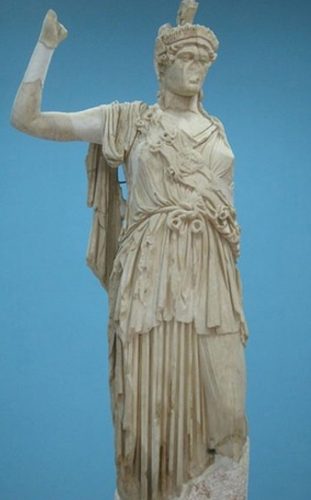
Nixey describes a man entering the temple with a weapon and striking the back of Athena’s head with such force that the goddess was decapitated. The violence did not stop there. Her nose was sliced off. Her cheeks crushed. Her once composed face mutilated with intention.
And yet her eyes were left intact.
Those eyes still exist.
They look out from a ruined face that once symbolized wisdom.
This was not accidental vandalism. It was theology enacted physically. The old gods were not to be debated, not to be reinterpreted, not to be absorbed into new meaning. They were to be neutralized. Their presence was dangerous. Their very material existence was a threat to salvation.
The word often used for this period is triumph. Christianity triumphed over paganism. But triumph over what? Over multiplicity? Over a world in which philosophical disagreement could exist without annihilation? Over the idea that wisdom might not belong exclusively to one revelation?
The violence at Palmyra was not isolated. Temples across the empire were damaged, repurposed, stripped of ornament, or demolished. Some were converted into churches. Others were dismantled entirely. Sacred spaces that had structured civic and religious life for centuries were rendered spiritually illegitimate almost overnight.
What makes the image of Athena more destabilizing is its repetition.
In 2015, Islamic State militants bulldozed the ancient Assyrian city of Nimrud because it was deemed idolatrous. The reconstructed remnants of Athena were attacked again. Beheaded again. An arm sheared off again.
Different century. Different scripture. Different empire.
Same logic. When rival sacred presence is conceptualized as contamination, destruction becomes purification.
This is not about equivalence between traditions. It is about structure. When any Abrahamic framework defines truth as singular, exclusive, and threatened by proximity to rivals, pluralism becomes fragile. Once that framework acquires political power, fragility becomes enforcement.
And enforcement does not stop at statues.
Hypatia and the Enforcement of Certainty
If Athena represents symbolic erasure, Hypatia represents human cost.
Hypatia of Alexandria was not an obscure mystic. She was a philosopher, mathematician, and teacher in a city long known for intellectual life. Alexandria had been home to the great library and to competing schools of thought for centuries. Hypatia occupied a visible position within that tradition.
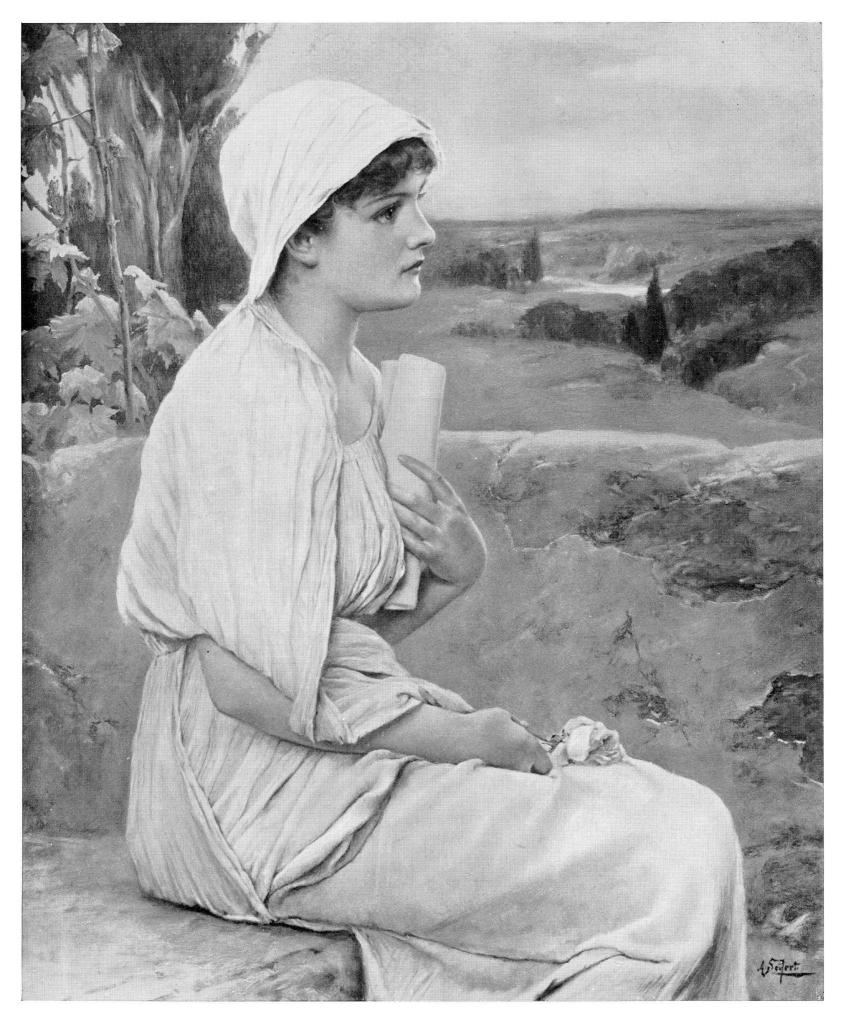
By the early fifth century, Alexandria was also home to a group known as the parabalani — often translated as “the reckless ones.” Officially devoted to acts of charity, they functioned in practice as muscle for ecclesiastical authority. By some estimates there were hundreds of them in the city. Roman legal documents describe them using the word terror.
Hypatia lived in the same civic space as these enforcers.
Her murder was not random street violence. It occurred within an atmosphere already shaped by escalating Christian authority and shrinking tolerance for rival influence. When exclusivist theology defines truth as singular and civic order as dependent upon that truth, intellectual figures outside that structure become destabilizing.
Hypatia was stripped, beaten, and killed by a mob associated with Christian zeal.
Her death did not mark the beginning of violence. It marked the normalization of it.
Once difference is framed as corruption and corruption as emergency, elimination becomes defensible.
This pattern appears again and again in late antiquity. Pagan philosophers were exiled. Schools were closed. Public debate narrowed. The emperor Justinian would eventually close the philosophical schools of Athens entirely. Inquiry did not vanish overnight, but the atmosphere changed. What had once been competition became suspicion.
And suspicion reshapes a civilization quietly before it reshapes it violently.
Fear as Teacher
One of the most revealing threads in the historical record is not the destruction itself but the emotional atmosphere that made it possible.
Demonology was not marginal superstition. It structured perception. Pagan temples were described as inhabited by malevolent spirits. Sacrifices were not merely mistaken rituals but demonic feasts. The world itself became morally charged terrain.
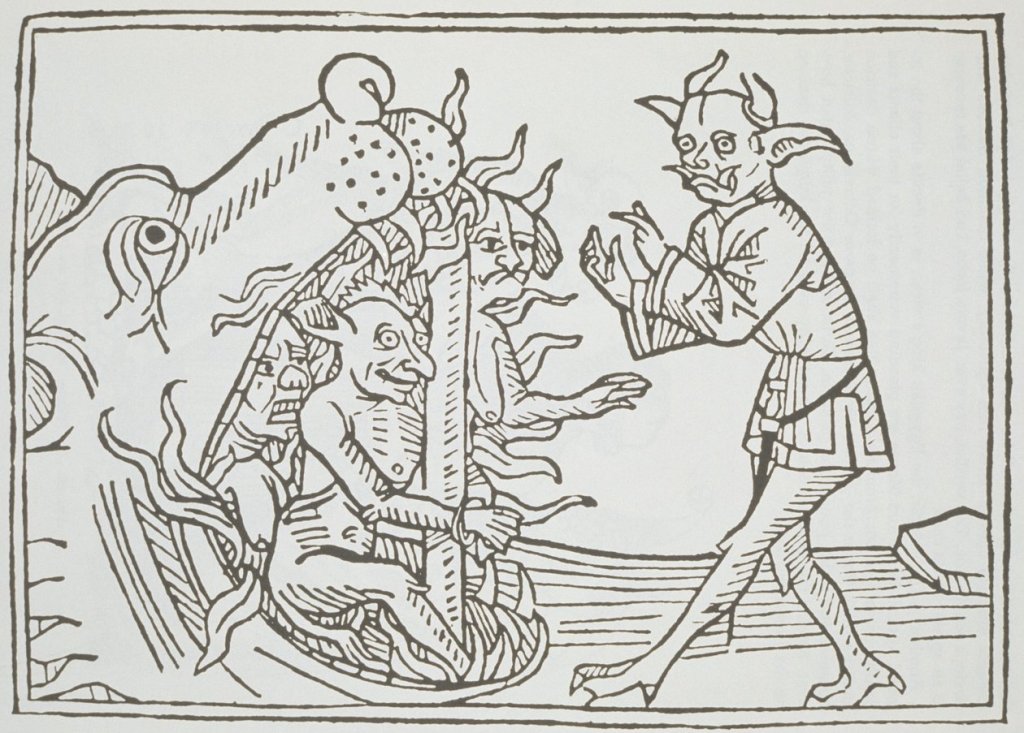
Christians wrote anxious letters asking whether they could sit in places pagans had sat, use baths used on feast days, drink from wells near deserted temples, eat food that might have been associated with sacrifice. The fear was not symbolic. It was visceral.
Augustine’s response: that it was better to refuse contaminated food with Christian fortitude even if one starved, reveals a hierarchy of values. Survival could be negotiable. Purity could not.
John Chrysostom’s sermons described eternal punishment in sensory detail: rivers of fire, venomous worms, inescapable bonds, exterior darkness. Fear was not incidental rhetoric. It trained the imagination to view error as catastrophe and proximity to rival belief as existential threat.
When fear becomes formative, pluralism becomes psychologically intolerable.
And when that psychology is paired with law, narrowing becomes institutional.
The Disappearance of Thought
The destruction of statues is visible. The destruction of thought is quieter.
One of the most devastating aspects of late antique Christianization was not merely the smashing of temples but the narrowing of what was considered worth preserving.
The ancient Mediterranean world once contained the greatest concentration of written knowledge humanity had yet assembled. The Library of Alexandria, even allowing for scholarly debate about its exact size, symbolized an ambition toward accumulation. Knowledge was not singular. It was expansive. It was contradictory. It was messy.
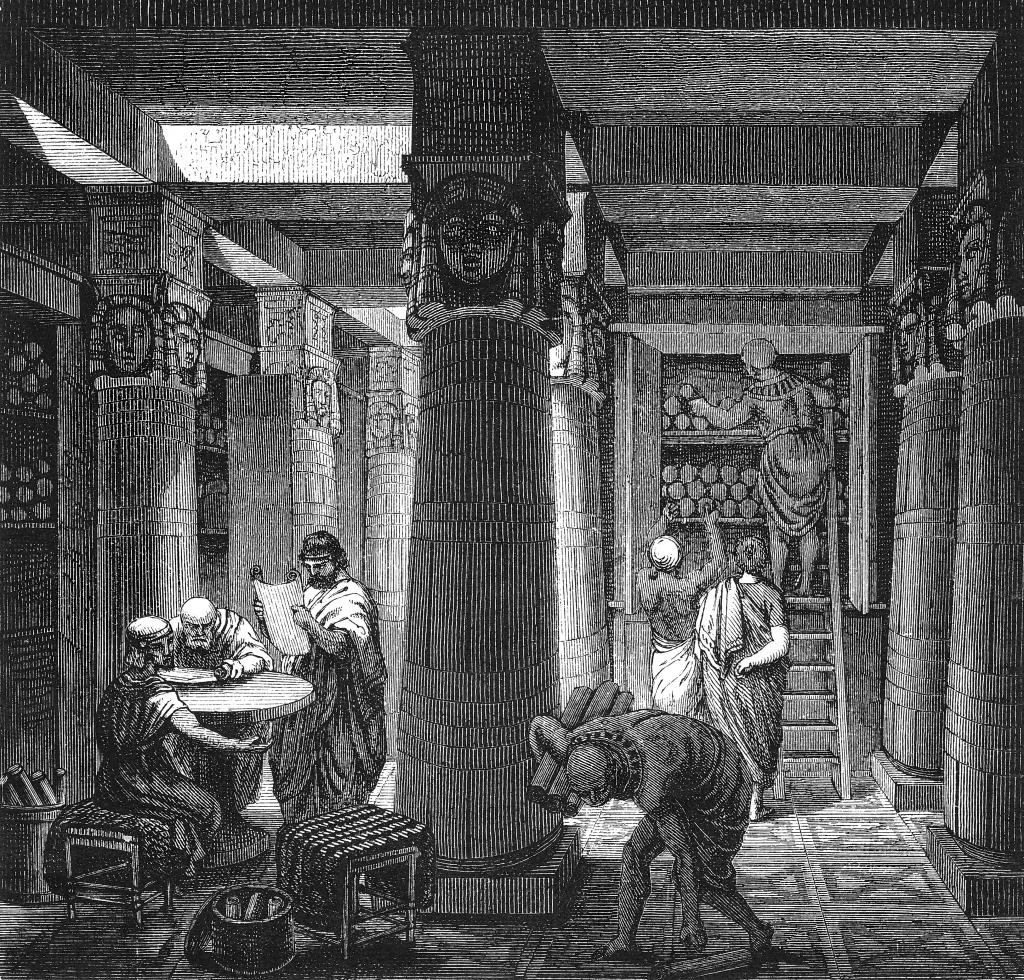
What remains of that intellectual inheritance is fragmentary.
By some estimates, only about one percent of Latin literature survives from antiquity. Entire authors are known only by name. Entire schools of philosophy survive only in hostile summaries written by opponents. Whole lines of speculation disappeared not because they were refuted but because they were not copied.
Copying is survival.
In the late antique world, the people doing the copying increasingly operated within Christian institutions.
And institutions preserve selectively.
“Stay clear of all pagan books!” reads the Apostolic Constitution. The warning is not casual. It reflects a moral anxiety about contamination. Texts are not neutral. They are spiritually charged. Exposure to the wrong argument is dangerous.
Celsus, one of the few pagan critics whose voice survives, accused Christians of discouraging inquiry. He mocked the posture: “Do not ask questions; just believe.” His tone is sharp, even sarcastic, but the anxiety is real. In Greek philosophy, reason was virtue. Inquiry was sacred. Faith, as unexamined assent, was the lowest epistemic posture.
Even Origen, writing within the Christian tradition, conceded the problem with striking bluntness, remarking that “the stupidity of some Christians is heavier than the sand of the sea.” The anti-intellectual reputation of early Christianity was not a later invention. It was noted by contemporaries.
The tragedy of Democritus crystallizes this narrowing.
Democritus — the philosopher often described as the father of atomic theory — wrote extensively across cosmology, mathematics, and ethics. He proposed a universe composed of atoms and void centuries before modern physics. And yet none of his works survive intact.
Not one.
What we know of his thought survives because it was partially preserved inside a single poem, Lucretius’s De Rerum Natura, which itself survived precariously through a single manuscript discovered in a German monastery centuries later.
The physicist Carlo Rovelli has called the total loss of Democritus’s writings “the greatest intellectual tragedy to ensue from the collapse of the old classical civilisation.”
An entire philosophical lineage survived by accident.
That should unsettle anyone who claims Christianity simply “preserved learning.”
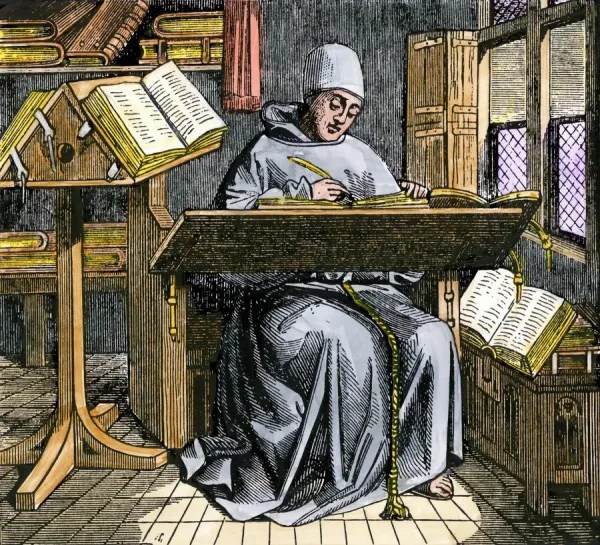
Yes, monasteries copied texts. But copying is filtration. Texts deemed dangerous, frivolous, obscene, or spiritually corrupt were less likely to be preserved. When a civilization narrows its moral boundaries, its archive narrows with it.
Charles Freeman, in The Closing of the Western Mind, argues that the most significant shift was not physical destruction but the narrowing of acceptable modes of thought. Public philosophical debate gradually gave way to appeals to authority and revealed certainty. Disputes were settled by councils backed by imperial power. Orthodoxy was defined not by open inquiry but by boundary enforcement.
The world did not stop thinking overnight. But the conditions for free competition of ideas shifted.
And once intellectual diversity contracts, recovery takes centuries.
The Martyr Myth and Moral Insulation
The martyr narrative sits at the emotional center of Christian self-understanding. It does more than preserve memory. It defines identity.
The story is familiar: early Christians were persecuted by a pagan empire. They were imprisoned, tortured, executed for their faith. They endured without retaliation. They did not conquer. They survived.
There is truth in this. The Great Persecution under Diocletian was real and brutal. Scriptures were burned. Churches destroyed. Christians were imprisoned and executed. No serious historian denies that.
What modern scholarship questions is scale and continuity. The most severe empire-wide persecution lasted roughly a decade. Other persecutions were local, sporadic, and uneven across regions. They were not a continuous three-century campaign of systematic eradication.
Martyr literature itself expanded over time. Detailed analysis of saints’ calendars reveals duplication, embellishment, and narrative layering. Some figures appear under multiple names. Some accounts contain anachronisms or miraculous flourishes that complicate their historical reliability.
The historian G. E. M. de Ste. Croix observed that later martyr literature increasingly displayed what he called “a contempt for historicity.”
That line matters. Because it signals a shift: suffering was not only remembered. It was shaped.
And shaped suffering serves a purpose.
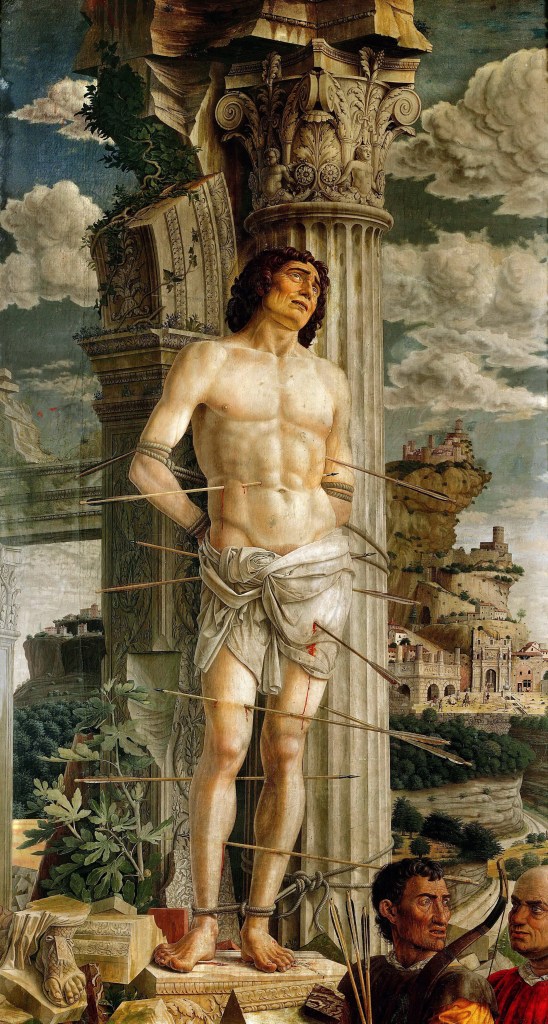
Once Christianity aligned with imperial authority, the martyr narrative did not recede. It hardened into interpretive insulation. The same tradition that now authorized temple closures and school shuttings still understood itself as historically persecuted.
The story generates moral asymmetry: whatever Christians do can be framed as response, not domination.
And the function of the martyr narrative did not end in late antiquity. In modern apologetics, it often operates as proof. The logic runs like this: the apostles would not have died for something they knew was false; early Christians endured torture rather than recant; therefore, their testimony must be true.
But willingness to suffer proves sincerity, not metaphysical accuracy. People across religions have died for beliefs that contradict one another. Martyrdom establishes conviction. It does not establish truth.
This is why the martyr story is so stabilizing. It allows a movement to wield authority while retaining the self-image ofinnocence. It transforms power into protection and critique into persecution.
When temples were outlawed and philosophical schools shuttered, the tradition exercising authority did not see itself as conqueror. It saw itself as guardian of truth under threat.
If you are always defending truth, enforcement feels righteous.
The Last Pleas for Coexistence
One of the tragedies of this period is that the archive becomes overwhelmingly Christian. The winners preserved their own voices. The losing side survives in fragments.
But some fragments remain.
Libanius, a pagan orator in the fourth century, watched as temples across the empire were damaged, repurposed, or destroyed. His speeches are not the rantings of a fanatic. They are the anxious observations of a man watching his world contract. He describes sacred spaces falling into ruin, rituals forbidden, property seized. He notes opportunists dividing temple lands for personal gain under the cover of piety. What Christian historians later frame as triumph, Libanius experiences as loss.
Then there is Symmachus.
In 382 CE, the Christian emperor Gratian ordered the removal of the Altar of Victory from the Roman Senate House. For centuries, senators had offered ritual observances there before conducting civic business. It was not merely religious decoration; it was part of Rome’s public identity.
Symmachus wrote an appeal for its restoration.
His language is remarkable for its restraint. He does not demand dominance. He does not threaten revolt. He argues for coexistence.
“We look on the same stars,” he writes. “The sky is common. The same world surrounds us. What difference does it make by what pains each seeks the truth? We cannot attain to so great a secret by one road alone.”
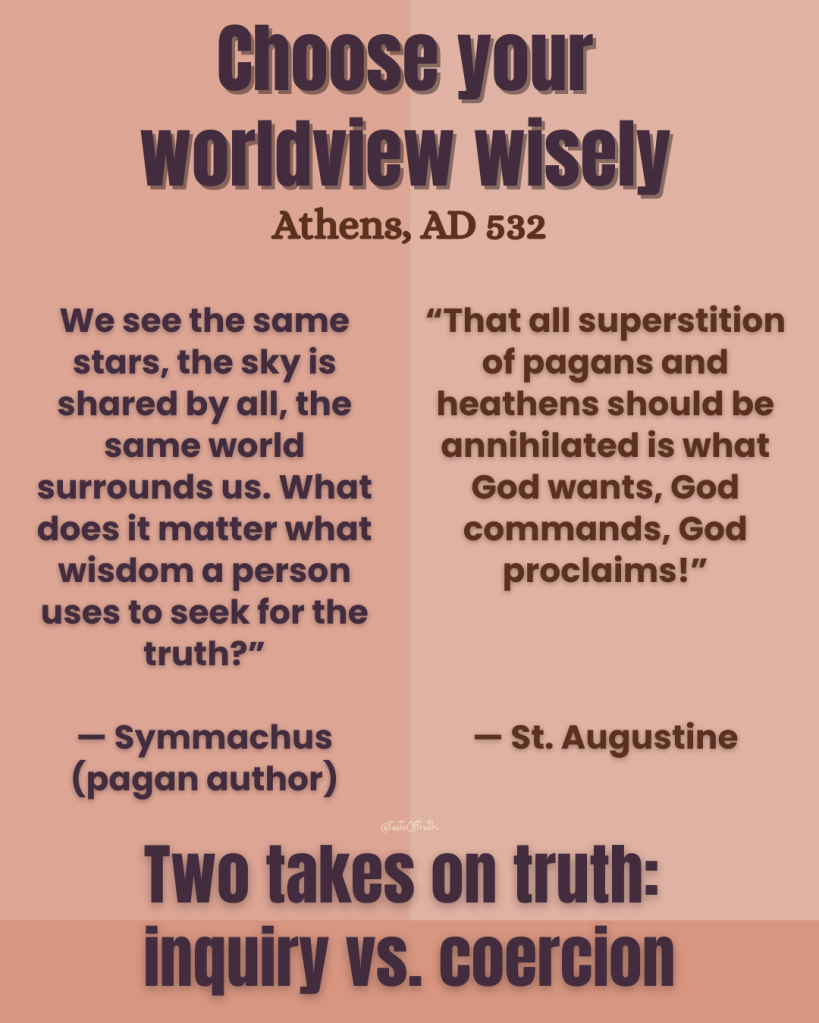
It is difficult to imagine a clearer articulation of pluralism in the ancient world.
He closes not with hostility but with humility: “We offer now prayers, not conflict.”
He lost. The altar was not restored. The plea for multiplicity was overridden by certainty.
This moment matters because it reveals a collision between two moral architectures. One sees truth as approached through many paths. The other sees truth as singular and threatened by rival proximity.
Symmachus represents not pagan decadence but civic pluralism. He is not asking to suppress Christianity. He is asking for coexistence.
The answer he receives is enforcement. The narrowing was not accidental. It was structural.
The Long Return of Pluralism
The narrowing of late antiquity did not permanently extinguish intellectual life. But it did change its conditions. For centuries, inquiry moved within theological boundaries defined by ecclesiastical authority. Councils determined orthodoxy. Deviation could be punished. Philosophical speculation survived, but often cautiously, often cloaked.
What we now call the Enlightenment did not arise as a natural extension of Christian supremacy. It arose within tension — sometimes quiet, sometimes explosive — with religious monopoly.
Beginning in the Renaissance, Europe experienced a gradual rediscovery of classical texts. Manuscripts long buried in monastic libraries re-entered circulation. Lucretius’s De Rerum Natura, preserving echoes of Democritus’s atomism, resurfaced. Greek philosophy was studied not merely as commentary on theology but as intellectual inheritance in its own right.
The recovery of classical thought did not instantly dissolve Christian authority. But it reintroduced plurality into the bloodstream of European intellectual life.
The Enlightenment sharpened that reintroduction.
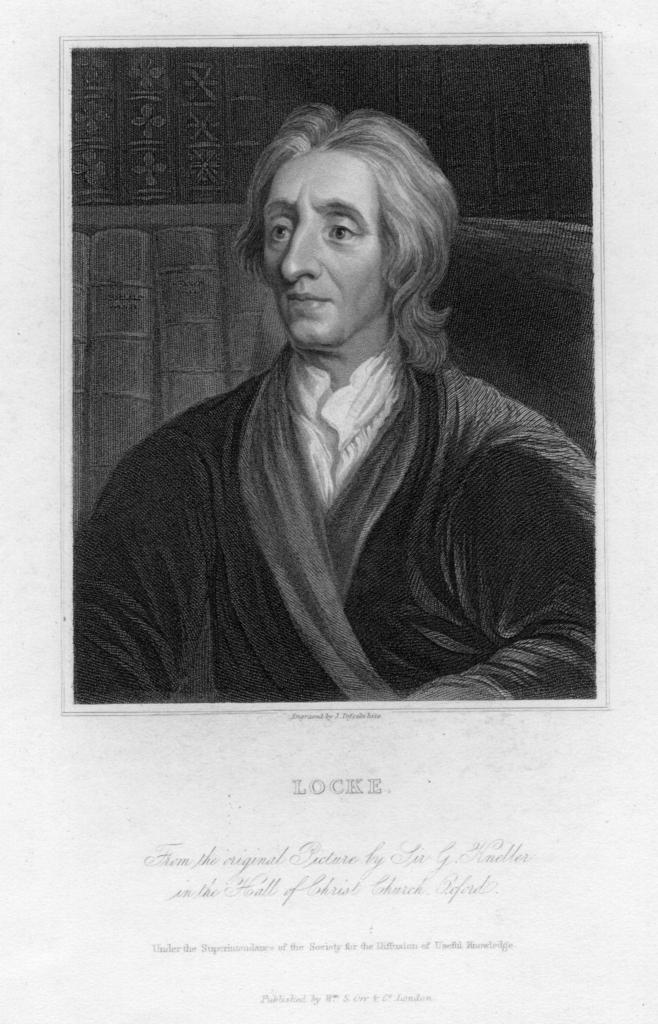
Thinkers like John Locke articulated natural rights grounded not in revelation but in reason and shared human nature. Locke’s arguments for religious toleration did not emerge from biblical exclusivity; they emerged from a recognition that coercion in matters of belief corrupts both faith and civic peace.
Montesquieu analyzed the separation of powers not as a theological doctrine but as a structural safeguard against concentration of authority. His framework was explicitly concerned with preventing tyranny — whether monarchic or clerical.
These ideas did not descend seamlessly from medieval orthodoxy. They developed alongside, and often in resistance to, religious entanglement with state power.
When we reach the American founding, the tension becomes explicit.
The framers of the Constitution were deeply literate in classical thought. They read Cicero. They read Tacitus. They studied Roman republicanism. They were steeped in Enlightenment political theory. They feared concentrated power, including ecclesiastical power.
The Constitution contains no reference to Jesus Christ. It prohibits religious tests for office. The First Amendment forbids establishment of religion and protects free exercise. This was not a casual omission. It was intentional architecture.
The American experiment was not a biblical republic.
It was a republic designed to prevent religious monopoly.
Thomas Jefferson provides a particularly revealing case. Jefferson famously produced his own edited version of the Gospels, physically cutting out miracles and supernatural elements. The result, often referred to as the Jefferson Bible, retained ethical teachings while discarding divine intervention.

This was not the act of a man seeking to found a theocracy.
It was the act of a man separating moral philosophy from revealed absolutism.
Jefferson’s project reflects a broader Enlightenment impulse: to preserve ethical insight while disentangling it from exclusivist authority.
Roger Olson’s theological scholarship further complicates the claim that Christianity simply “gave us” pluralism. Olson emphasizes that Christianity was never doctrinally uniform in its early centuries. Orthodoxy was consolidated through contest, suppression, and boundary enforcement. The unity later invoked as civilizational foundation was itself the product of narrowing.
The Enlightenment did not grow naturally from that narrowing. It reopened debate.
It reintroduced skepticism as virtue.
It separated church and state not to destroy religion but to protect civic plurality.
If Christianity had already secured pluralism, the Enlightenment would have been unnecessary.
The fact that it was necessary tells us something profound.
Pluralism survived not because exclusivity reigned, but because exclusivity was restrained.
Did Christianity Give Us Human Rights?
At this point, the most common objection surfaces.
Even if there were excesses. Even if there was narrowing. Even if temples fell and texts disappeared. Christianity still gave us the concept of human dignity. Christianity laid the groundwork for human rights.
The claim sounds intuitive because Christian theology does contain a powerful moral idea: humans are made in the image of God. That idea has inspired reformers and abolitionists and activists. It matters.
But the existence of moral language is not the same thing as institutional pluralism.
The Stoics articulated a form of universal human rationality centuries before Christianity held power. Roman law developed ideas of legal personhood and universality that would influence later legal systems. Cicero’s natural law did not depend on revelation.
Christianity contributed to moral discourse. That is true.
But the institutional protection of dissent: the right to disagree publicly, to publish heterodox ideas, to worship differently without legal annihilation… did not emerge during periods of Christian monopoly. Those protections developed when religious authority was structurally limited.
Rights require restraint of power.
And historically, the moments when Christianity was most fused with state authority were not the moments when pluralism expanded.
What This Feels Like From the Inside
What unsettles me most about this history is not simply that it happened. It is that I recognize the mechanism.
I have lived the internal version of it.
Burn the books. Throw away the tarot cards. Remove your new age spirituality material. Avoid contamination of demonic entities. Guard the mind. Monitor the thoughts. Stay pure.
When you inhabit Christianity long enough, the anxiety internalizes. You become your own enforcer. You police your curiosity. You treat rival ideas not as intellectual challenges but as spiritual threats.
When I read about Christians in late antiquity asking whether they could sit where pagans had sat or drink from wells near deserted temples, it was too relatable.
The narrowing does not begin with demolition crews. It begins with fear.
Fear reshapes perception. Fear shrinks curiosity. Fear frames difference as danger.
Scale that fear across institutions and you have late antiquity.
Scale it across a nation and you have something far more consequential.
The Warning
This is why the rhetoric of Christian supremacy unsettles me.
Not because Christianity has contributed nothing to Western civilization. It has shaped art, music, law, charity, moral imagination. That is undeniable.
Much of this period is still narrated as civilizational triumph rather than suppression. As the academic John Pollini notes, “modern scholarship, influenced by a Judeo-Christian cultural bias, has frequently overlooked or downplayed such attacks and even at times sought to present Christian desecration in a positive light.”
But the claim that Christianity saved the West collapses complexity into myth. It erases the plural foundations of Greco-Roman thought. It erases the Enlightenment’s deliberate separation of church and state. It erases the long struggle to restrain religious monopoly.
Reformers like John Calvin did not argue for a secular state. In his Institutes, Calvin insisted that magistrates had a duty to suppress blasphemy and false worship.
Pluralism did not emerge from supremacy.
It survived by limiting it.
When modern commentators frame Christianity as the sole guardian of civilization and paganism as barbaric force, they repeat a frame older than they realize. They invoke a story in which exclusivity is equated with order and multiplicity with chaos.
History suggests something different.
Civilizations are stabilized not by monopoly but by constraint. Not by erasing rivals but by tolerating them. Not by conflating revelation with law but by separating the two.
If we forget that, if we mythologize exclusivity as the foundation of freedom, we risk mistaking that narrowing for renewal.
And that is not a mistake history makes gently.
aaaand that’s all I have for you today folks. If you’ve been here for a while, you know this is what Taste of Truth Tuesdays is about. Not tearing down for sport. Not defending tradition out of reflex. But slowing down long enough to ask: Is the story we’re repeating actually true?
and As always…
Maintain your curiosity.
Embrace skepticism.
And keep tuning in.
Endnotes
- Leighton Woodhouse, “Donald Trump, Pagan King,” The New York Times, February 11, 2026.
(Referenced as an example of contemporary framing of paganism versus Christianity.) - Catherine Nixey, The Darkening Age: The Christian Destruction of the Classical World (Boston: Houghton Mifflin Harcourt, 2017).
Charles Freeman, The Closing of the Western Mind: The Rise of Faith and the Fall of Reason (New York: Knopf, 2002).
Ramsay MacMullen, Christianizing the Roman Empire (A.D. 100–400) (New Haven: Yale University Press, 1984).
See also Ramsay MacMullen, Christianity and Paganism in the Fourth to Eighth Centuries (New Haven: Yale University Press, 1997). - On Roman religion as orthopraxic and plural in structure, see:
Mary Beard, John North, and Simon Price, Religions of Rome, Vol. 1 (Cambridge: Cambridge University Press, 1998).
Jörg Rüpke, Religion of the Romans (Cambridge: Polity Press, 2007). - Cicero’s articulation of natural law appears in De Re Publica and De Legibus. See:
Cicero, On the Republic and On the Laws, trans. James E. G. Zetzel (Cambridge University Press, 1999). - On late fourth-century anti-pagan legislation, see:
Theodosian Code 16.10 (various edicts restricting sacrifice and authorizing temple closures).
For analysis: Michele Renee Salzman, The Making of a Christian Aristocracy (Harvard University Press, 2002).
Ramsay MacMullen, Christianizing the Roman Empire. - On the debated scope and frequency of early Christian persecutions:
Candida Moss, The Myth of Persecution (HarperOne, 2013).
G. E. M. de Ste. Croix, Christian Persecution, Martyrdom, and Orthodoxy (Oxford University Press, 2006).
These works challenge the traditional narrative of continuous empire-wide persecution and note embellishment in later martyr literature. - On the parabalani and Hypatia:
Socrates Scholasticus, Ecclesiastical History, Book VII.
Christopher Haas, Alexandria in Late Antiquity (Johns Hopkins University Press, 1997).
Edward J. Watts, Hypatia: The Life and Legend of an Ancient Philosopher (Oxford University Press, 2017).
Roman legislation regulating the parabalani appears in Theodosian Code 16.2.42 and related laws. - On the Altar of Victory controversy and Symmachus:
Symmachus, Relatio 3 (Petition for the Restoration of the Altar of Victory).
Ambrose of Milan’s response in Epistle 17–18.
See also: Michele Renee Salzman, The Making of a Christian Aristocracy. - On demonology and late antique Christian perceptions of paganism:
Peter Brown, The Rise of Western Christendom (Blackwell, 1996).
Catherine Nixey, The Darkening Age.
Brown discusses the moralization of the inner life and late antique anxiety regarding contamination and spiritual danger. - On the survival rate of classical literature:
It is widely acknowledged among classicists that only a small fraction of ancient literature survives.
See: Anthony Grafton, The Footnote: A Curious History (Harvard University Press, 1997).
James J. O’Donnell, Avatars of the Word (Harvard University Press, 1998).
The exact percentage is debated, but the scale of loss is undisputed. - On Democritus and the loss of his works:
Diogenes Laertius, Lives of Eminent Philosophers (Book IX).
Carlo Rovelli, Reality Is Not What It Seems (Riverhead Books, 2016), where Rovelli refers to the loss of Democritus as a major intellectual tragedy.
Lucretius, De Rerum Natura, as the principal ancient source preserving atomist philosophy. - On the closure of pagan philosophical schools under Justinian:
Procopius, Secret History.
Edward J. Watts, The Final Pagan Generation (University of California Press, 2015). - On Enlightenment political theory and religious toleration:
John Locke, A Letter Concerning Toleration (1689).
Montesquieu, The Spirit of the Laws (1748). - On Thomas Jefferson’s edited Bible:
Thomas Jefferson, The Life and Morals of Jesus of Nazareth (commonly known as the Jefferson Bible), completed in 1820.
See also: Edwin Gaustad, Sworn on the Altar of God: A Religious Biography of Thomas Jefferson (Eerdmans, 1996). - On early Christian theological diversity and consolidation of orthodoxy:
Roger E. Olson, The Story of Christian Theology (InterVarsity Press, 1999).
Bart D. Ehrman, Lost Christianities (Oxford University Press, 2003) (for broader context on early doctrinal diversity).
 Taste0ftruth Tuesdays
Pingback: The Fragility of Freedom – Taste0ftruth Tuesdays