7m Mandate: TikTok’s Dance with Dominionism

Unveiling the 7 Mountain Mandate (7M) of the TikTok Dance Cult

The 7 Mountain Mandate (7M) is a concept in some Christian dominionist circles that posits that Christians are meant to dominate the seven spheres or mountains of society: religion, family, education, government, media, arts and entertainment, and business.

The belief is that by gaining influence in these areas, Christians can bring about societal transformation that aligns with their religious values.

What is Christian Dominionism?

Christian dominionism is a belief system that advocates for Christians to govern all aspects of society, including politics, law, and culture, based on biblical principles. This ideology is rooted in the idea that God’s law should be the foundation for governance and that Christians are mandated to take dominion over all areas of life.

Key Points of the 7 Mountain Mandate:

  1. Religion: Emphasizes the importance of spreading Christian teachings and principles within religious communities and institutions.
  2. Family: Focuses on promoting traditional Christian family values and structures.
  3. Education: Seeks to influence educational systems to include Christian teachings and values.
  4. Government: Advocates for Christians to hold governmental positions and influence policy to reflect Christian values.
  5. Media: Encourages Christians to engage in media to shape public perception and discourse in line with Christian principles.
  6. Arts and Entertainment: Aims to infuse arts and entertainment with Christian themes and messages.
  7. Business: Promotes ethical business practices based on Christian values and seeks to gain economic influence.

Shekinah Church

Shekinah Church is typically associated with charismatic Christian movements and emphasizes the presence and glory of God (Shekinah). The term “Shekinah” is derived from Hebrew, referring to the divine presence. Churches with this name often focus on intense worship experiences, miracles, healing, and prophetic teachings.

Key Characteristics of Shekinah Churches:

  1. Worship: Highly expressive and emotional worship services that seek to usher in the tangible presence of God.
  2. Miracles and Healing: Emphasis on supernatural occurrences such as healing, miracles, and prophetic words.
  3. Prophetic Ministry: Strong focus on the prophetic, with teachings and practices that involve hearing and speaking God’s will.
  4. Community: Often foster a close-knit community with a shared sense of mission and spiritual experience.
  5. Charismatic Leadership: Typically led by charismatic leaders who are seen as specially anointed by God.

Connection between 7M and Shekinah Church:

Many churches that align with the 7 Mountain Mandate share characteristics with Shekinah Churches in their charismatic approach to worship and ministry. They often emphasize a holistic approach to faith that seeks to permeate all aspects of life and society.

Christian dominionism poses significant risks to the foundational principles of a pluralistic, democratic society. It can undermine the separation of church and state, suppress individual rights, promote intolerance, and impact education and legislation in ways that can be detrimental to social cohesion and democratic governance. Recognizing and addressing these dangers is essential to maintaining a fair and equitable society for all.

Dangers of Christian Dominionism

  1. Erosion of Separation of Church and State:
    • Dominionism blurs the line between religion and government, challenging the principle of separation of church and state. This can lead to laws and policies that favor one religion over others, undermining religious freedom and pluralism.
  2. Suppression of Individual Rights:
    • When government policies are based on specific religious beliefs, individual rights and freedoms, particularly those of religious minorities, non-religious people, and marginalized groups, can be threatened. This can result in discrimination and reduced protections for those who do not adhere to the dominant religious ideology.
  3. Undermining Democratic Principles:
    • Dominionism often involves a hierarchical and authoritarian approach to governance, which can conflict with democratic values such as equality, freedom of speech, and the protection of minority rights. This can lead to an erosion of democratic institutions and norms.
  4. Promotion of Intolerance:
    • By promoting a specific religious worldview as the basis for all aspects of life, dominionism can foster intolerance towards those with different beliefs and lifestyles. This can exacerbate social divisions and conflict.
  5. Impact on Education:
    • Dominionist influences can lead to the promotion of creationism and other religious doctrines in public school curricula, undermining scientific education and critical thinking. This can have long-term negative effects on students’ understanding of science and their ability to engage in evidence-based reasoning.
  6. Legislation Based on Religious Doctrine:
    • Policies and laws influenced by dominionist ideology may impose specific religious morals and values on the broader population, affecting issues such as reproductive rights, LGBTQ+ rights, and women’s rights. This can lead to the restriction of personal freedoms and civil liberties.
  7. Global Implications:
    • The influence of Christian dominionism is not limited to domestic policy but can also affect international relations and foreign policy. For example, it can shape attitudes towards other countries and international conflicts based on religious beliefs, potentially leading to biased or unilateral decision-making.

Understanding cult awareness, Christian nationalism, and brainwashing is crucial for safeguarding individual autonomy, protecting democratic principles, and promoting social cohesion.

Cult Awareness: Cults can manipulate vulnerable individuals through coercive techniques, exploiting their trust and autonomy. By raising awareness about cult tactics and behaviors, we empower individuals to recognize warning signs and seek support.

Christian Nationalism: Christian nationalism poses a threat to religious freedom, democracy, and social harmony. By recognizing and addressing the influence of Christian nationalist ideologies in politics and society, we can uphold secular governance and protect the rights of all individuals, regardless of their religious beliefs.

Brainwashing: Brainwashing techniques can be used to manipulate individuals’ thoughts, beliefs, and behaviors, leading to harmful consequences. By understanding how brainwashing works and promoting critical thinking skills, we can empower individuals to resist manipulation and make informed decisions.

Together, awareness of cult tactics, vigilance against Christian nationalist agendas, and promotion of critical thinking serve as powerful tools in safeguarding individual autonomy, protecting democratic values, and fostering a more inclusive and resilient society.

Addressing Christian Nationalism: Action Steps

  1. Promote Education and Awareness:
    • Educate communities about the dangers of Christian nationalism and its impact on democracy, religious freedom, and human rights.
  2. Advocate for Secular Governance:
    • Support policies and initiatives that uphold the separation of church and state, ensuring that religious beliefs do not influence government decisions.
  3. Encourage Interfaith Dialogue:
    • Foster conversations between different religious groups to promote understanding, tolerance, and cooperation.
  4. Combat Discrimination and Exclusion:
    • Advocate for inclusive policies that protect the rights of religious minorities, non-religious individuals, and marginalized communities.
  5. Strengthen Democratic Institutions:
    • Support efforts to strengthen democratic institutions, uphold the rule of law, and protect democratic principles from religious influence.
  6. Promote Civic Engagement:
    • Encourage active participation in civic life, including voting, community organizing, and advocacy for policies that promote equality and justice.
  7. Hold Leaders Accountable:
    • Hold political leaders accountable for their actions and statements that promote or enable Christian nationalist agendas.
  8. Support Grassroots Movements:
    • Join or support grassroots movements that work to counteract Christian nationalism and promote secular governance and pluralism.
  9. Engage in Peaceful Protest:
    • Participate in peaceful protests and demonstrations to raise awareness about the dangers of Christian nationalism and advocate for change.
  10. Build Coalitions:
    • Collaborate with like-minded organizations and individuals to build coalitions and amplify efforts to combat Christian nationalism and promote democratic values.

 Dive into this week’s podcast episode exploring radicalization, conspiracies, and brainwashing tactics!  High control religions employee these techniques which can significantly influence and control their members’ thoughts, emotions, and behaviors, creating a closed system that is resistant to outside influence and critical thinking. 

🎧Listen here!

💡 By raising awareness of cult tactics, staying vigilant against nationalist agendas, and promoting critical thinking, we can safeguard individual autonomy and protect democratic values. 

Together, let’s build a more inclusive and resilient society! ✊ 

#AwarenessIsKey #CriticalThinking #SafeguardDemocracy 

Faith Unbound: Navigating the Process of Disentanglement

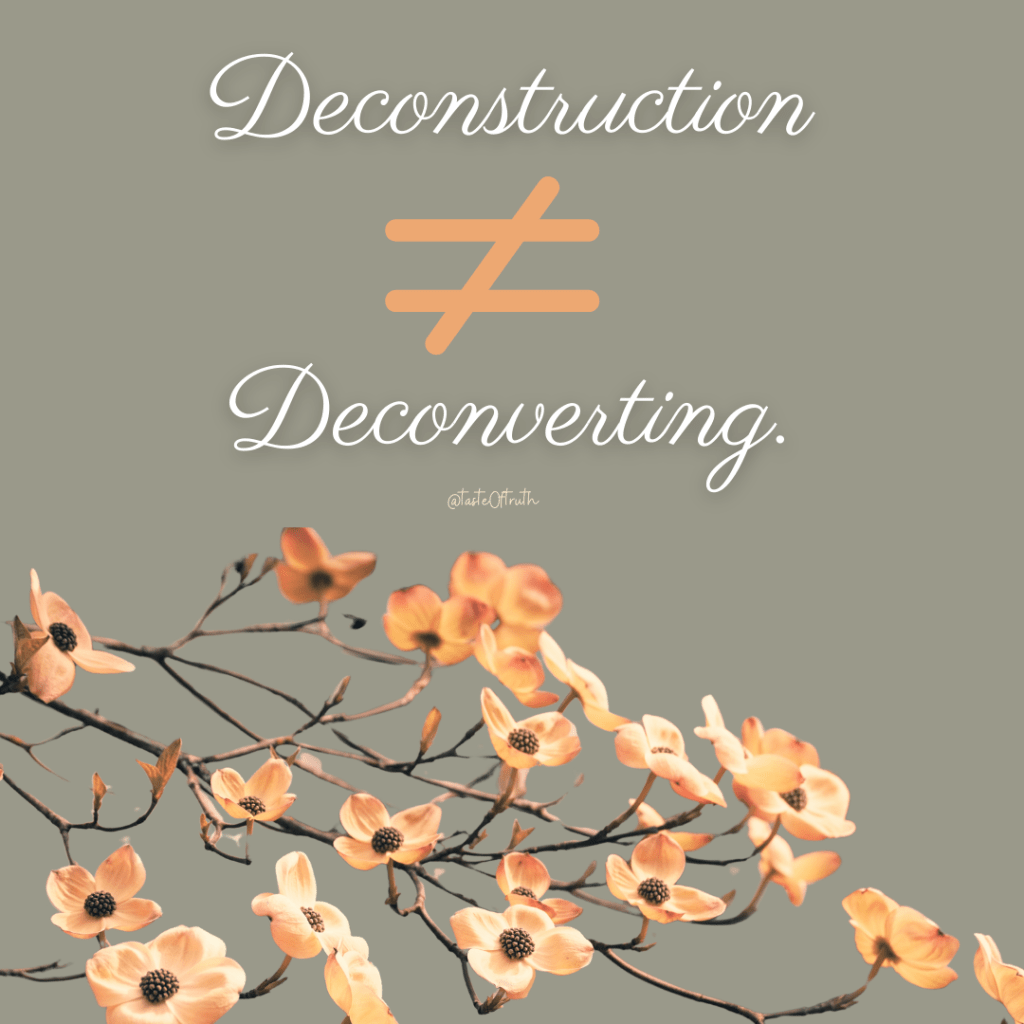
Deconstruction is a scary world, but it doesn’t have to be. Deconstruction does not have to mean deconverting. (But it might and that’s okay too! 😉)

The deconstruction of Christianity is something I’ve heard of since stepping into the world of theology, but I never thought I’d find myself smack dab in the middle of the movement.

Disentangling or Deconstruction is a phenomenon where individuals, often within the Christian faith, critically reevaluate their beliefs, doctrines, and practices. This process involves questioning and challenging long-held assumptions, teachings, and traditions within Christianity, with the goal of arriving at a more authentic and personally meaningful understanding of faith.

Apologetics like Alisha Childers, Mama bear Apologetics or pasters like John Mark Comer are doing piss-poor jobs articulating “why” we are deconstructing and it’s truly offensive and only adding more fuel for the fire.

Is deconstruction the enemy of Christianity like Alisa, Mama Bear Apologetics, and so many others assert? please read Liz Mall’s take on this……

or listen (click here!)

There were numerous aspects that led me to begin unraveling, the real smack upside the head, realizing I was within a spiritual abusive biblical counseling relationship and program, that led me to notice the brutal similarities of abuse within IHOPKC, the scandals within the Grace Community Church & ACBC Biblical/Nouthetic counseling….

Unveiling the Shadows: Exploring Abuse and Ideology in Religious Communities

  1. Introduction:
    • Introduction to the podcast episode’s theme of uncovering abuse and harmful ideologies within religious communities.
    • Brief overview of my entire faith journey to provide context on where we started, where we were, and how we got here.
    • Exploring the Gray Area: Between Cults and High-Control Environments
    • END TIMES OBSESSION–Prophecy Belief in modern American culture concludes that while Christian fascination with the end of the world has existed for a very long time, but only recently have evangelicals label contemporary events with great self-confidence as the fulfillment of biblical prophecies heralding the End of Time has been particularly intense. Since the publication of C.I. Scofield’s edition of the King James Version in 1909, premillennial dispensationalism came to dominate evangelical thought. Also known as Dispensationalism, which can be hard to define, but one of the telltale signs is the date setting historicism of those like Hal Lindsey which I mentioned on my testimony podcast, episode who identify current events as the fulfillment of biblical prophecies.
    • The rise of the Holiness movement, Pentecostalism and fundamentalism marked a monumental development in American Evangelicalism. While these three movements were never entirely aligned in view theology, very different, they share a stress on the dangers of the world, the comforts of separated piety, the centrality of evangelism, and an expectation of the End.
    • As I was isolated during 2020-2022, I believe the process of radicalization and conversion to religion often intertwines with the allure of conspiracies. As individuals seek answers to complex questions and meaning in their lives, they may become drawn to radical ideologies and conspiratorial narratives that promise a sense of belonging, purpose, and empowerment. These ideologies may offer a simplistic worldview where the believer is part of an exclusive group that possesses hidden knowledge and is tasked with a righteous mission.
    • Conspiracies can provide a framework for interpreting the world and understanding perceived injustices or challenges. They often exploit feelings of fear, uncertainty, and distrust, portraying religious or ideological adversaries as sinister forces working against the believer’s values and identity. In this context, religion may offer a sense of community, moral guidance, and a framework for understanding the world that resonates with the believer’s conspiratorial worldview. (However, it’s important to recognize that not all individuals who embrace radical conspiracies end up converting to religion, and vice versa. Each person’s journey is unique and influenced by a combination of personal experiences, psychological factors, social influences, and external circumstances. Additionally, the relationship between radicalization, conspiracies, and religion is complex and multifaceted, with many variables at play.)
    • Generation Joshua, often called “GenJ” by its members, is an American Christian fundamentalist youth organization founded in 2003 that aims to encourage youth participation in government, civics, and politics toward conservative Christian values. Paul and Morgan are Mad About Being in the Dugger Documentary | Tim Whitaker | The New Evangelicals
    • Dangers of the “Trad Wife” movement on Instagram
    • The doctrine of inerrancy is an innovation of the nineteenth century. Rogers and McKim argued that the Princeton theologians of the nineteenth and early twentieth centuries, most notably B.B. Warfield, created the doctrine of inerrancy, which teaches that the Bible is entirely without error in all that it affirms. I bet you didn’t know the FACT that the inerrancy of the Bible–the belief that the Bible is without error–is a contentious topic among mainstream Christianity! Check out this book Five Views on Biblical Inerrancy (Counterpoints: Bible and Theology) 
  2. Purity Culture:
  3. John MacArthur Situation:
    • Discuss the implications of John MacArthur’s involvement, ACBC and the potential harm caused by authoritarian leadership within religious organizations.
    • Discuss MacArthur’s dismissive response to Wendy’s accusations, the confrontation and revelation of Paul Guay’s abuse, GCC’s inadequate response to the abuse, MacArthur’s involvement and contradictory statements, MacArthur’s public shaming of Eileen Gray, the elders’ dismissal of Gray’s abuse allegations, David Gray’s conviction and MacArthur’s support, Alistair Begg’s controversial advice and MacArthur’s response, and the lack of accountability for MacArthur’s actions.
    • Explore various forms of abuse, including emotional, psychological, and spiritual, and the LACK OF ACCOUNTABILITY OR REFORM happening within churches and religious institutions.
    •  MacArthur’s views on slavery are HORRIFIC–listen here.
    • WHY IS IT protocol for the Church to Put a Marital Rape Victim under Church Discipline? Truly horrific protocols within the patriarchy.
  4. ACBC Biblical Counseling:
    • I was enrolled in Change that Sticks, an abusive ACBC biblical counseling program that stripped me of autonomy and treated any mental health condition as SIN that needed to be repented of, and not a real condition. Biblical counseling is dangerous, unethical and immoral.
    • Identification of manipulation and control tactics used in biblical counseling settings to exert emotional and psychological control over individuals.
    • We should consider the potential harms of relying solely on biblical counseling methods without considering professional mental health resources.
    • Call to action for religious leaders and communities to prioritize the safety and well-being of their members and address instances of abuse with transparency and accountability.
    • The key here for me to understand was that gravitating to fundamentalism after experiencing hyper-charismatic or the new age movement can make sense. Particularly during times of stress and uncertainty, we can gravitate towards the need for a sense of control & structure. The strict rules and structure create a perceived sense of safety, which is also another form of the prosperity gospel. Do these spiritual disciplines read the bible, pray, repent, etc for God’s blessing.  
  5. Mark Driscoll:
    • Overview of the rise and fall of Mark Driscoll, a controversial figure within evangelical Christianity.
    • Exploration of the allegations of abuse, authoritarian leadership, and ethical misconduct associated with Driscoll and his former church, Mars Hill Church.
    • Reflection on the lessons learned from the Mark Driscoll saga and the importance of holding religious leaders accountable for their actions.
  6. Learning more about Dominion theology & Christian nationalism. They are related but distinct movements within Christianity, both of which emphasize the idea of Christians playing a prominent role in shaping society and culture according to their religious beliefs. Prominent adherents of those ideologies include Calvinist Christian reconstructionism (Doug Wilson, Costi Hinn, John MacArthur, John Piper, Charlie Kirk) Charismatic and Pentecostal Kingdom Now theology, (7 Mountain Mandate) and the New Apostolic Reformation. How insane is it that this conservative group THRIVES on calling out “false Christians” and making a mockery of Pentecostals, while they are part of the very same theology, if not WORSE, because Council of Biblical Manhood and Womanhood/complementarianism is patriarchal and misogynistic at heart, and all of this is connected to the Lordship Salvation controversary (a rabbit hole you need to go down) and to my next point:

8. Critique of Nancy Pearcey’s book “Toxic War on Masculinity” and its assertions about masculinity and culture.:

  • Absence of evidence: The lack of empirical evidence to support the claims made in Pearcey’s book, particularly regarding the alleged “war on masculinity.” We should consider the potential consequences of promoting ideological narratives without empirical support.
  • Oversimplification of Gender Issues: Critics argue that Pearcey’s book oversimplifies complex gender issues by framing them as a “war on masculinity.” They suggest that this framing perpetuates a binary view of gender and fails to adequately address the diverse experiences and identities of individuals across the gender spectrum.
  • Perpetuating Gender Stereotypes: Critics contend that Pearcey’s characterization of masculinity as under attack reinforces traditional gender stereotypes and norms, which may contribute to harmful social expectations and restricts the freedom of individuals to express their gender identity authentically.
  • Lack of Intersectionality: Some critics argue that Pearcey’s analysis lacks intersectionality, as it fails to consider how factors such as race, class, sexuality, and disability intersect with gender to shape individuals’ experiences and social realities. This omission may result in a limited understanding of the complexity of gender dynamics.
  • Ideological Bias: Some critics suggest that Pearcey’s perspective reflects a conservative or right-wing ideological bias, as she tends to frame gender issues within a traditional Christian worldview. This ideological framing may alienate readers with different religious or philosophical beliefs and limit the book’s appeal to a narrow audience.
  • Nancy claimed in the book and on a podcast interview that women’s suffrage was a net loss!!!!! This is part of Dominion Theology

9. Right-Wing Fundamentalists aka Dominion Theology/Christian Nationalism

Key features of fundamentalism include:

•Literalism: Fundamentalists often interpret Scripture texts in a literal or strict manner

•Inerrancy: Fundamentalists typically uphold the belief in the inerrancy or infallibility of the Bible, viewing them as the ultimate authority in matters of faith and practice. Aka Biblicists

•Separatism: Fundamentalist movements may advocate for the separation of believers from secular society or from other religious groups deemed to be impure or heretical.

•Moral Conservatism: Fundamentalists often promote traditional moral values and social norms, opposing practices or lifestyles they perceive as contrary to their religious beliefs.

•Resistance to Change: Fundamentalists are often resistant to change and innovation within religious doctrine or practice, viewing such developments as departures from true faith.

•Intolerance: Fundamentalist groups may exhibit intolerance towards individuals or groups who hold different beliefs or lifestyles, leading to discrimination, ostracism, or even violence towards perceived “outsiders” or “heretics.”

•Dogmatism: Fundamentalist ideology tends to promote rigid, inflexible interpretations of religious or ideological principles, discouraging questioning or exploration of alternative viewpoints.

•Anti-intellectualism: Critics argue that fundamentalism can foster distrust or rejection of scientific knowledge, critical thinking, and scholarly inquiry, leading to a rejection of evidence-based reasoning and a preference for simplistic, black-and-white thinking

The concept of scriptural inerrancy is often associated with conservative or evangelical Christian theology, although it has been debated and interpreted in various ways within different theological traditions. Some theologians interpret inerrancy to apply only to matters of faith and salvation, while others extend it to include historical, scientific, and other factual claims made in the Bible.

Critics of scriptural inerrancy argue that it imposes an unrealistic and untenable standard on the Bible, ignoring the complexities of its historical and cultural context and the presence of apparent contradictions or discrepancies within its texts. They suggest that a more nuanced understanding of the Bible’s inspiration and authority is needed, one that acknowledges the human element in its composition and transmission.

Literary Criticism: Critics may approach the Bible as a collection of literary texts rather than divinely inspired scripture. They may analyze its narratives, poetry, and teachings from a literary perspective, examining themes, motifs, and rhetorical techniques without presupposing divine authorship or inspiration.

The authorship of 1 Timothy, along with 2 Timothy and Titus, is a subject of debate among scholars. While traditional Christian belief attributes these letters to the Apostle Paul, some scholars raise questions about their authorship based on linguistic, stylistic, and theological differences compared to Paul’s undisputed letters. These scholars suggest that these letters may have been written by a disciple of Paul or someone writing in Paul’s name.

-Linguistic and Stylistic Differences: Some scholars note that the vocabulary, grammar, and writing style of 1 Timothy differ from Paul’s undisputed letters. They argue that these differences suggest a different authorship or a later date of composition.

-Theological and Ecclesiastical Developments: Critics point out that 1 Timothy contains instructions regarding church organization, leadership qualifications, and pastoral duties that reflect a more developed ecclesiastical structure than was present in Paul’s time. They suggest that these developments may indicate a later date of composition.

  • Analysis of prominent figures in evangelical Christianity, including David Wolcott, Alisha Childers, and Frank Turek, who are associated with right-wing fundamentalism.
  • Exploration of the ideological positions and beliefs espoused by these individuals and their impact on religious communities.
  • Consideration of the broader societal implications of right-wing fundamentalism and its intersection with politics and religion.

10. Conclusion:

  • Summary of emphasizing the importance of addressing abuse and harmful ideologies within religious communities.
  • Call to action for listeners to advocate for accountability and transparency within religious institutions and to support survivors of abuse.
  • Invitation for further exploration of these topics in future episodes of the podcast.

RESOURCES MENTIONED:

Other resources to consider:

  • “The Bible Tells Me So: Why Defending Scripture Has Made Us Unable to Read It” by Peter Enns – Enns explores how the Bible’s messy and diverse nature challenges the notion of inerrancy and offers a fresh perspective on understanding its authority.
  • “Inspiration and Incarnation: Evangelicals and the Problem of the Old Testament” by Peter Enns – In this book, Enns examines the challenges of reconciling modern scholarship with traditional views of biblical inerrancy, particularly in relation to the Old Testament.
  • “The Evolution of Adam: What the Bible Does and Doesn’t Say about Human Origins” by Peter Enns – Enns explores the theological implications of accepting scientific understandings of human origins while still affirming the authority of scripture.
  • “Misquoting Jesus: The Story Behind Who Changed the Bible and Why” by Bart D. Ehrman – Ehrman explores the history of textual transmission and the ways in which scribes, translators, and interpreters have shaped the biblical text over time, challenging the notion of a perfectly preserved and inerrant scripture.
  • “The Human Faces of God: What Scripture Reveals When It Gets God Wrong (and Why Inerrancy Tries to Hide It)” by Thom Stark – Stark examines instances in the Bible where God’s character and actions appear contradictory or morally problematic, challenging the idea of a completely consistent and inerrant scripture.
  •  The Invention of the Inspired Text: Philological Windows on the Theopneustia of Scripture by John C. Poirier 
  • The Creationist–The evolution of Scientific Creationism by Ronald L. Numbers
  • The Story of Christian Theology by Roger E Olson
  • The Essentials of Christian thought by Olson