Tier by Tier: How the Left Radicalizes Its Own

A conversation with Karlyn Borysenko on why understanding the Left’s internal factions matters now more than ever.

Welcome back to Taste Test Thursday—my bonus series (or maybe just another excuse to drop a second episode mid-week 😉)

Prelude to Collapse: The War Within

Anti-ICE riots, open declarations of war, and the revolution you’re not supposed to notice….

Thanks for reading Taste of Truth! Subscribe for free to receive new posts and support my work.

Before we dive into today’s main topic, I have to share something with yall.

Here’s the tea you might have missed: Simone Biles, once the queen of female athleticism, just decided to throw female athletes under the bus. She went scorched-earth on Riley Gaines—a woman who had the nerve to say basic biology matters in sports.
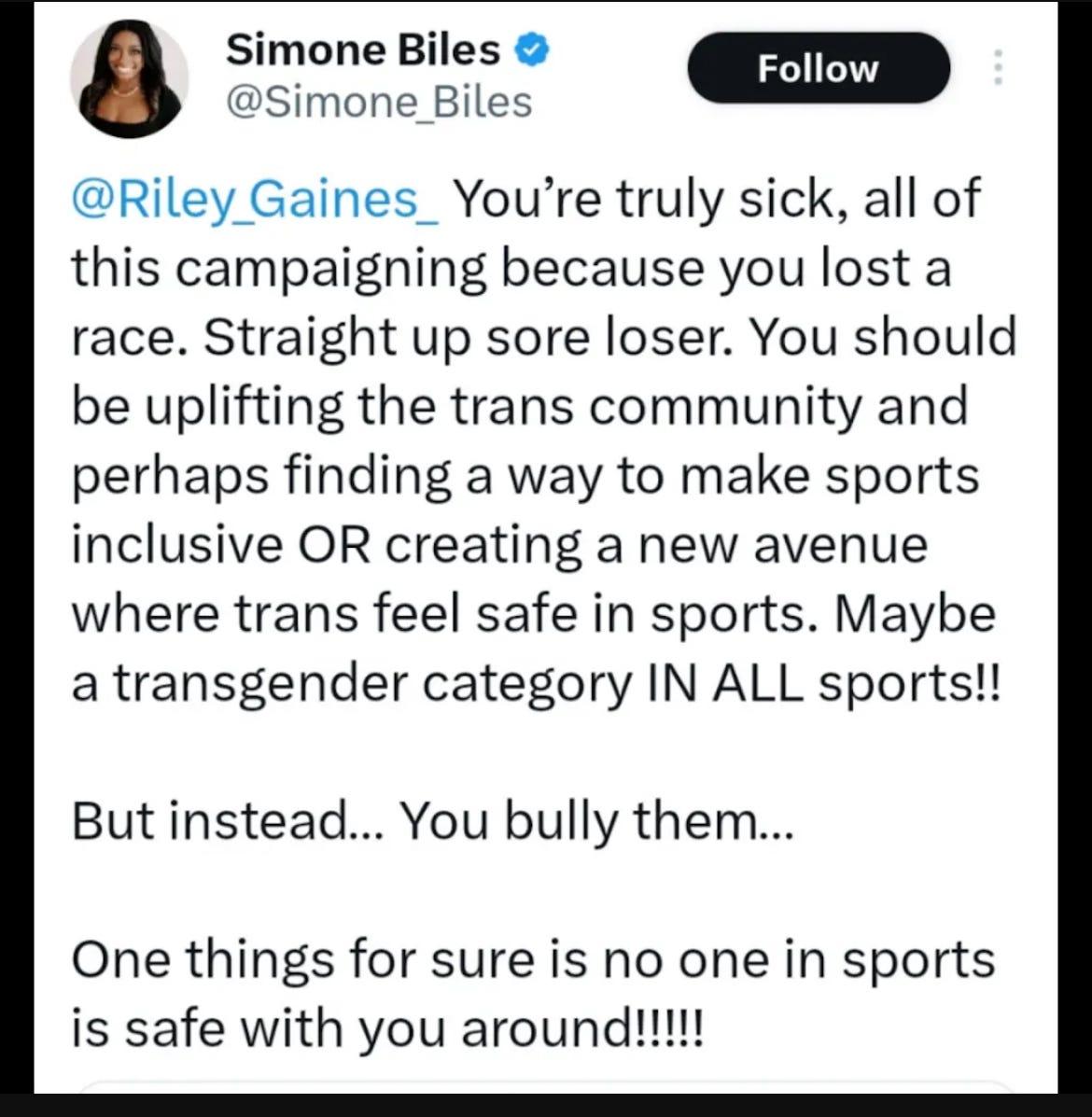
Simone’s stance? Basically, “Step aside, ladies. Men who say they’re women get to play too. Deal with it.”

Yeah, that crushed a lot of dreams. Every young girl who looked up to Simone for grit and talent got served a big, ugly dose of woke betrayal instead.

But wait, the drama didn’t stop there. The comment sections exploded with some of the wildest, most ridiculous takes you’ll ever see:

People claimed things like:

  • “Trans women are actually weaker than cis women,” ignoring every major study, physiology, and real-world athletic results.
  • “You’re just obsessed with genitals,” as if biological reality is some kind of personal fetish.
  • “Stop bullying! Simone Biles was just being inclusive,” even though Simone personally attacked another female athlete and told her to “pick on someone your own size”—which was clearly a jab at men, flipping the narrative.
  • “Only one trans woman has ever medaled in the Olympics, and it was in a team sport,” using tiny sample sizes as “proof” while ignoring decades of male athletic advantage and the ongoing displacement of female athletes.
  • Claims that acknowledging biology is “bigotry” or “hate,” which is a classic deflection to avoid actual debate.

What’s striking is how none of this is about facts or fairness—it’s about protecting an ideology at all costs. That’s the Bulldozer at work: steamrolling science, reason, and women’s rights in the name of feelings and group loyalty.

This isn’t just about sports. It’s a microcosm of a larger, coordinated push to erase distinctions and rewrite reality. The same movement that’s burning flags, tearing down institutions, and pushing radical social change also demands that we deny biology and silence dissent.

If you think this sounds wild, it’s because it is.

And it’s happening everywhere.
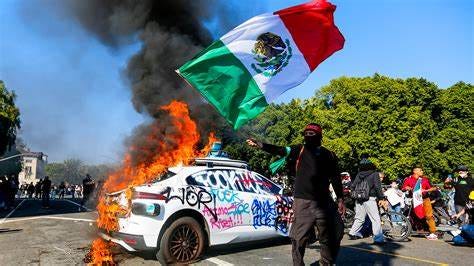

In cities like Los Angeles, Austin, and New York, something is boiling over—but you won’t see it clearly if you rely on mainstream media. Violent riots outside ICE offices. Masked agitators throwing bricks and firebombs. American flags burned in the street while chants echo: No borders, no nations, no more deportations.

It’s not just civil unrest—it’s ideological warfare.

The Revolutionary Communists of America recently made it explicit. On their official channels, they didn’t just critique policy—they declared war on the United States. Not metaphorically. Not rhetorically. Literally.

For the radical left, capitalism isn’t just an economic system; it’s the system—the root of all oppression. The force that creates every hierarchy, every disparity, every injustice.

When they say systemic racism, they don’t mean individual prejudice or even discriminatory laws-they mean the entire capitalist structure that, in their view, was built to privilege some and exploit others.

And still, mainstream outlets call it “activism.”

These aren’t fringe events. They’re pressure points in a much larger movement: one that uses radical ideology to attack the very concept of law, order, and national identity. Immigration is just the entry wound. The deeper goal is to dissolve the nation-state, abolish prisons, defund police, and destabilize every Western institution—starting with the family, borders, and biological reality itself.

They want the system to burn.

They just want you to feel guilty for noticing.

This isn’t liberalism. It’s not even progressivism. It’s an ideological virus that blends Marxist collapse fantasies with postmodern identity theory—what some have rightly begun to call Queer Marxism. And it’s spreading, not through military coups or overt revolution, but through activist groups, academic institutions, union politics, and nonprofit networks.

We call it the Bulldozer.

Because it doesn’t just push for justice.

It erases categories, flattens distinctions, and leaves nothing but rubble behind.


🧭 Where This Started For Me

How the modern Left radicalizes through language, identity, and psychological control

Once upon a time, I considered myself a proud progressive. I believed in equality, compassion, and social justice—values I still hold. But over the years, I began to notice a shift: the language of empathy was being used to silence people. The banner of inclusion began to look more like a gatekeeping badge. The people preaching tolerance were often the least tolerant of dissent.

I entered the movement through the doorway of compassion. But I didn’t understand, at the time, that it led to a staircase. A funnel. Tier by tier, the path narrowed—not toward a better world, but toward radicalism. And once inside, the pressure to conform only grew stronger.

Today, much of what passes as “progressive” isn’t about progress at all. It’s about compliance. It’s about scripts. It’s about moral absolutism enforced by social shaming. What began as genuine concern for the marginalized has metastasized into an ideological machine—one that feeds on sincerity, weaponizes pain, and punishes nuance.

That’s why I’m excited to share this conversation with

Karlyn Borysenko, a voice that’s become indispensable in making sense of what’s really happening on the modern Left.

Karlyn is a bold, unapologetic critic of collectivist ideology. An organizational psychologist turned independent journalist, she brings sharp wit and deep psychological insight to her investigations. She’s not just analyzing theory from the outside—she’s been inside the radical inner circles. Through her work on Decode the Left, Karlyn infiltrates socialist and communist meetings, documents activist materials, and translates their coded language into something the average American can understand.

Her work has helped many—including me—see what’s been hiding in plain sight.

In our 30-minute interview, we discuss:

  • Her recent article: Democrats Are Not the Same as Communists. Know the Difference
  • What May Day organizing reveals about the Left’s summer strategy
  • How her infamous “Spy Streams” expose internal tactics and contradictions
  • Her book A Brief History of Racism, and why history matters more than ever now

But before we jump into that conversation, I want to lay a foundation. This post is both a companion and a continuation—an exploration of how well-meaning people get pulled into radical ideologies, how activism gets hijacked, and why naming this process matters.

The Bait: Branding with Virtue

Progressive branding thrives on moral urgency. It co-opts legitimate concerns—racism, sexism, homophobia—and repurposes them as litmus tests. Agree with our solutions or you’re the problem.

I began to question this during the rise of Black Lives Matter. But when I asked reasonable questions about BLM’s funding, its leadership, or its goals, I was told that even asking was racist. It wasn’t enough to be “not racist.” You had to be “anti-racist” in a very specific, approved way.

This wasn’t justice—it was dogma.


The Switch: From Inclusion to Compliance

At the same time, in the wellness and spiritual communities I trusted, I saw the language of healing twist into something coercive. Phrases like “decolonize your practice” and “center marginalized voices” began as invitations—but morphed into rules.

There was no room to push back. Questioning the narrative meant you were part of the problem. Even trauma healing became politicized. The very spaces meant for introspection and healing became echo chambers.

Instead of curiosity, we got shame. Instead of conversation, we got scripts.


The Funnel: Tier by Tier Toward Radicalism

Karlyn Borysenko’s framework Mapping the Modern Left helped make sense of something I had felt but couldn’t articulate: a tiered escalation of ideology.
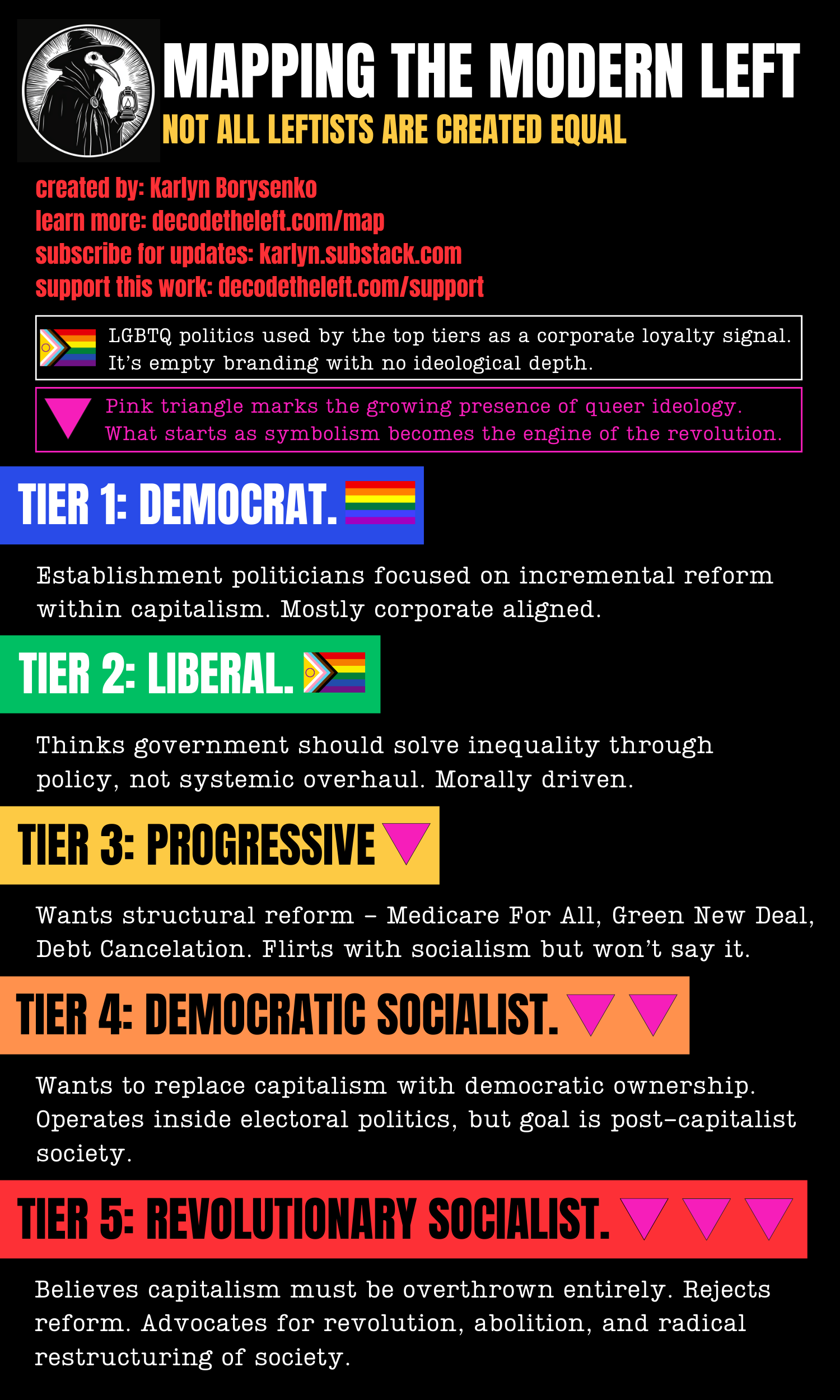
From empathy to entropy: How ideological movements erase meaning and dissolve reality

The modern Left doesn’t just want change—it wants a revolution.

It isn’t about lifting up the marginalized. It’s about obliterating the boundaries that hold society together—gender, family, biology, even objective truth. In this worldview, distinction itself is oppression.

Gender is violence.
Borders are fascism.
The family is a cage.
Biology is a lie.
Truth is power, and power must be redistributed.

Language becomes fluid. Categories dissolve. Womanhood becomes a costume. Masculinity becomes pathology. Childhood becomes political property. “Liberation” now means detaching people from anything stable or inherited—be it tradition, biology, or even their own identity.

And all of this is done under a banner of inclusion.
This ideological bulldozer doesn’t advertise itself as destruction.
It wears a rainbow sticker and smiles.

But that rainbow is no longer just a symbol of tolerance. It’s become the uniform of a new moral order—one that does not believe in reforming society, but in erasing and rebuilding it from ideological rubble.

To understand how this happens, you need to understand the spectrum of the modern Left—and how it collapses into itself under the weight of its own ideology.

❝ Not all leftists are created equal. ❞
But they’re treated that way—by media, by educators, by corporations, and even by confused voters.

From Tier 1 (corporate Democrats) to Tier 5 (open revolutionary socialists), there is a clear progression:

  • The slogans get more radical.
  • The policies become less about reform and more about control.
  • The language of empathy becomes the weapon of erasure.

By the time you hit Tier 5, “equity” no longer means fairness—it means forced sameness.
“Liberation” no longer means freedom—it means obedience to the ideology.
“Compassion” no longer means understanding—it means submission to the narrative.

This is why it matters to draw clear distinctions between liberals, progressives, socialists, and revolutionaries.
Because the Bulldozer’s first move is to blur all those lines—until every rainbow flag, every DEI committee, every social justice curriculum becomes a Trojan Horse.


The Trojan Horse

Democratic Socialists and the slow march through institutions

Democratic Socialists don’t throw bricks—they shake hands, campaign politely, and quote Bernie Sanders. They reject the optics of violent revolution, but their endgame is the same: the death of capitalism, the toppling of “oppressive systems,” and the remaking of society through collective control.

Instead of storming the gates, they infiltrate. School boards, city councils, union leadership—they operate like ideological missionaries, cloaked in the language of reform. They speak of “economic justice,” “solidarity,” and “participatory democracy.” But behind the rebranded slogans is the same old Marxist blueprint: dismantle private property, weaken law enforcement, and centralize economic power under collectivist principles.

Strategy: Cultural subversion. Institutional capture.
Goal: Dismantle capitalism through political power and social engineering.
How They Show Up: Labor organizing, tenant unions, co-op movements, policy think tanks.

Example

A DSA-backed city council member campaigns on tenant rights and rent control. Once elected, they introduce proposals to defund the police, establish “people’s budgets,” and replace merit-based hiring with DEI quotas. All under the banner of “equity.”

Major Players

  • Democratic Socialists of America (DSA) – boasting over 90,000 members and growing influence in state legislatures.
  • Working Families Party – a political organization that cloaks socialism in populist rhetoric.
  • Jacobin Magazine – the glossy PR firm of soft socialism.
  • People’s Policy Project – crafting white papers that sanitize radical redistribution schemes.

These groups are the useful professionals. The respectable radicals. They are the bridge between normie liberals and revolutionary anarchists. And they often don’t even realize they’re playing that role.


The True Believers

When revolution is the only answer

Then there are the purists—the radicals who reject democratic socialism as too soft, too compromised. These are the revolutionaries who don’t want reform. They want collapse.

To them, every institution—from the police to the family to the very idea of gender—is a pillar of oppression. And those pillars must be burned to the ground.

Violence is not a last resort. It’s a moral imperative. They call it “direct action.” They organize online, use encrypted channels, and treat molotov cocktails like communion.

Strategy: Agitate. Destabilize. Destroy. Rebuild from ideological ashes.
Goal: Overthrow capitalism and traditional Western structures entirely.
How They Show Up: Riots, black bloc formations, propaganda zines, “mutual aid” front groups.

Example

The George Floyd riots were framed as peaceful protests, but cities burned, federal courthouses were firebombed, and police precincts were taken over.

This wasn’t protest. It was trial-run revolution.

Major Players

  • Revolutionary Communists of America – unflinching in their anti-Americanism and pro-collapse rhetoric.
  • Haymarket Books – publishing far-left literature on race, labor, and abolition.
  • Antifa – not a formal group, but a loosely affiliated movement of anarchists who believe violence is speech.
  • CrimethInc. – anarchist media collective advocating sabotage and social revolt.
  • It’s Going Down – a digital hub for anarchist propaganda and riot coordination.
  • Tempest Collective / Firebrand Collective / Pinko Magazine – pushing Marxist, intersectional, and abolitionist agendas under the radar.

These aren’t outliers. They set the moral tone for the entire activist ecosystem. Even mainstream liberals are afraid to publicly denounce them. Why? Because the language of revolution—phrases like “abolish the police” or “disrupt the nuclear family”—has already trickled downstream into the DEI statements of schools, nonprofits, and corporate HR departments.


Death by Distortion

What connects these factions—whether polite socialists or masked anarchists—is not just a hatred of capitalism, but a rejection of distinction itself.

They believe:

  • Truth is power
  • Gender is fiction
  • Biology is oppression
  • Order is violence

In their world, there is no such thing as “woman”—only a fluctuating identity to be claimed or discarded. There is no moral hierarchy—only power struggles between oppressors and the oppressed. There is no reality—only narrative.

And this matters, not just in theory, but in your everyday life:

  • Children are told they were “assigned” a gender.
  • Women’s sports and scholarships are being erased.
  • Therapists fear losing their licenses for affirming biology.
  • Teachers hide “gender transitions” from parents.
  • Pride parades feature kink, nudity, and communist banners.

This is what happens when Queer Theory and Marxist revolution combine: identity becomes a tool, the body becomes political, and all stable truths are dismantled in the name of liberation.

But what’s left after the bulldozer passes through?

Just rubble. Confusion.


A Chilling Parallel: Psychiatry, Eugenics, and Modern Control

We’ve been here before.

In the early 20th century, American psychiatry and genetics embraced eugenics. Under the banner of science and progress, they sterilized alcoholics, the disabled, the poor, and the “unfit.” The roots of Nazi atrocities were inspired, in part, by American policies.

What began as “science” became ideology. And then became tyranny.

Today, we see a similar pattern. Radical identity politics now overrides biological facts. Science is cherry-picked. Individual concerns are dismissed as bigotry. Dissent becomes dangerous.


A Political Religion

The modern Democratic Party doesn’t act like a political party—it functions like a religion.

Belief is required. Doubt is punished. Apostates are shunned.

Masculinity is vilified. Womanhood is politicized. Kids are taught that biology is bigotry. Therapists are scared to speak. Teachers walk on eggshells.

This isn’t about progress. It’s about power.


Real-World Consequences

  • Women’s sports are being erased.
  • Speech is being policed.
  • Gay conservatives are told they don’t count.
  • Pride Month has become a political litmus test.

Even Pride itself has been hijacked—from a movement for freedom into a vehicle for ideological conformity. As journalist Brad Polumbo put it: it’s not enough to be gay anymore—you must also be leftist.


Why I Speak Out

Some people assume I’ve “become conservative.” And maybe I have—at least compared to where I started. But to me, it’s not about labels. It’s about clarity. About being honest.

I still care about compassion, justice, and fairness. But I care about truth too. And truth doesn’t require threats.

I speak out because I’ve seen what ideological manipulation does to good people. I’ve seen friends shrink themselves, walking on eggshells, terrified to be seen as bigots.

I was there once. But I’m not anymore.


🎙️ Now, My Conversation with Karlyn Borysenko

This conversation is an eye-opener—especially if you’re just beginning to question what’s really going on behind the messaging.

Let’s get into it.

SOURCES

A Brief History of Racism – Kindle edition by Borysenko, Karlyn. Politics & Social Sciences

Karlyn Borysenko – YouTube

Democrats Are Not The Same As Communists. Know The Difference.

Her LATEST book! Debunking The Communist Manifesto: An Unapologetic Takedown of Marxist Nonsense – Kindle edition by Borysenko, Karlyn, Marx, Karl, Engels, Friedrich, Moore, Samuel. Politics & Social Sciences

BREAKING: Communist Group Declares War On America

I’m gay, but I’ll pass on Pride Month – Washington Examiner

Decode The Left with Karlyn Borysenko

What Intersectionality Means and Why Racism Means Private Property To The Left
Beyond the Echo Chamber: How the Quest for Truth Became a New form of Dogma

Bonus Episode: Reflections on the Election Cycle – A Message for the Deconstruction Community

Welcome to today’s deep dive into a topic that’s been stirring within me for months. If you’re new here, let me explain the deconstruction space, or the deconstruction community—a movement that’s gaining momentum for those of us disentangling ourselves from rigid, fundamentalist beliefs. This process is supposed to be healing and, ideally, a source of growth, but it’s not without its share of controversy. That’s what we’re here to talk about.

In my podcast episode titled Faith Unbound: Navigating the Process of Disentanglement—or rather, Deconversion after my own journey took a deeper turn—I discussed my initial discovery of this space back in February. At that point, I’d begun to question my former beliefs, and the deconstruction community felt like a safe haven. After 6-7 months in, I’m seeing patterns that are unsettlingly familiar. The community has been valuable, yet I’ve grown concerned as it increasingly mirrors the same kinds of rigidity and tribalism many of us were trying to escape.

My posts and Instagram reels have hinted at this frustration, but I’m here today to pull these thoughts together more fully. Moving away from one dogma only to embrace another feels to me, like a new form of entrapment. The craving for certainty and “the right side” is strong, and without realizing it, we’re swapping one rigid system for another. In this space that’s supposed to champion open-mindedness, judgment and exclusion seem to have replaced curiosity and true critical thought.

It’s a reminder that true growth and change happen only when we’re open to different perspectives—not quick to label those who disagree with us as enemies. As the philosopher John Stuart Mill argued in his 1859 work, On Liberty, Free speech is essential for discovering the truth. He believed true understanding and truth itself emerge only through open debate and free expression. This highlights the complexity of truth, it’s only when differing perspectives clash that ideas are refined and strengthened. Let’s explore how that idea relates to today’s topic.

Setting the Stage: The Political and Psychological Landscape

Before we dig into the deconstruction community, let’s set the stage with something I found really interesting. Back before the 2024 election, journalist Mark Halperin expressed some serious concerns on Tucker Carlson’s podcast (cue the BOOs and HISSS from all the progressives–I hear you!) about what would happen if Trump were to win a second term. He predicted widespread psychological distress, especially among Democrats, which would affect everything from mental health to social interactions. And, wow, did that hit the mark.

Since Trump’s victory, movements like the 4B movement have surged among women on social media, particularly in response to reproductive rights concerns and conservative gender roles. Originating in South Korea, the movement’s name, “4B,” stems from “B,” shorthand for “no” in Korean, symbolizing “No sex, No dating, No marrying men, and No children.” Recently, the movement has sparked a 450% increase in Google searches in the U.S., with many calling it the “4 Nos” or referencing “Lysistrata” for its radical stance against traditional gender expectations. I’ve shared my thoughts on traditional gender expectations in a previous episode.

The Blue Bracelet Movement: Solidarity or Performative Gesture?

Following the 2024 election, white women supporting Kamala Harris have rallied around an unexpected symbol: a blue bracelet. For many, it represents allegiance, a small but visible way to signal “I’m not with them” to women who voted for Trump. But like other quick-fix political symbols, it’s raising questions: Does this bracelet truly contribute to progress, or is it merely performative—a way to sidestep deeper, tougher conversations within their communities?

The trend echoes past symbolic movements like 2017’s “pussy hats,” which aimed to unify and empower but were later criticized for their lack of sustained action. Today, similar critiques have emerged around the bracelet, with critics suggesting it’s more of a comforting gesture for its wearers than a true commitment to change. Some Black activists and allies have pointed out that symbols alone aren’t enough; they want allies willing to challenge and change the beliefs of those around them, including friends and family who may hold differing views.

Could the Blue Bracelet Movement become a lasting emblem of allyship or fade as a passing trend? Its fate rests on whether those wearing it step up to engage in hard conversations and meaningful action.

Misinformation and Its Impact on Abortion Laws

But let’s get back to deconstruction—and something that’s been coming up a lot lately, particularly within that space: misinformation about abortion laws. Here’s the thing: there is no federal abortion ban in place. I repeat, NO federal abortion ban.

The Trump administration’s role in the overturning of Roe v. Wade has sparked fierce debates on both sides, but it’s important to clarify that the administration never stated it aimed to eliminate abortion nationwide. Instead, the ruling simply returned the power to regulate abortion to individual states. Some conservative figures have even used quotes from Ruth Bader Ginsburg to suggest she supported a more gradual, state-based approach. However, Ginsburg critiqued the federal approach, arguing a more state-focused shift could have garnered broader public support for gender equality. Polls consistently show that while many Americans support the legality of abortion, most also favor restrictions—especially in later stages of pregnancy. This nuance, however, often gets lost in campaign rhetoric, which is typically framed in absolute terms to galvanize voter turnout. But as we’ve seen, such messaging has not always yielded the intended results, revealing the complexity of public opinion on this issue.

Yes, the Roe v. Wade decision was overturned, but all that did was give states the power to regulate abortion. Some states have restrictions, sure, but no federal law is imposing a nationwide ban. And without a massive shift in Congress and the courts, it’s unlikely that will happen.

I don’t think it will. Trump himself has spoken out against that. His wife has spoken for protecting these in some way, shape or form. We have other folks coming over from the Democratic Party under this Unity Party bracket. I just don’t think that they’re going to force Christian nationalism, and abortion bans across the entire nation. I guess we’ll see.

Then, there’s this idea going around that women won’t be able to access life-saving procedures if they have a miscarriage. This is just false. In fact, most states with abortion restrictions still allow medical treatments for miscarriages, like dilation and curettage (D&C), which are essential to protect a woman’s health. What’s actually being restricted are elective abortions—not necessary procedures.

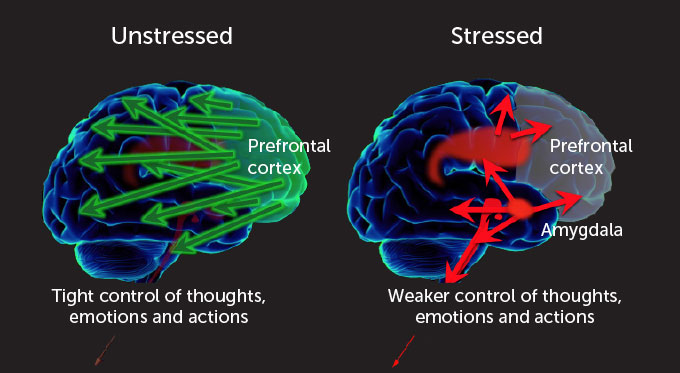
But here’s where things get really tricky. The spread of these exaggerated claims taps into the emotional centers of our brains. If you remember our previous episodes, we talked about amygdala hijacking—the brain’s response to fear and anxiety. When we hear these alarmist claims, it triggers that fear-based reaction, shutting down our ability to think rationally. Instead of focusing on the facts, we’re just reacting emotionally.

The Dangers of Misinformation

Let’s talk about the danger of this. Misinformation, especially when it involves highly emotional issues like reproductive rights, isn’t just harmless chatter—it’s psychological warfare. It keeps people in a constant state of anxiety, preventing them from thinking rationally. The real issue? People are more likely to believe in the fear-based narrative than to actually check the facts. They’re too busy being triggered emotionally.

This plays directly into the hands of the fearmongers. It becomes easier to control a population if you can make them afraid, right? And what do we see happening? Misguided campaigns around “miscarriage care,” the spread of exaggerated stories, and people feeling like their rights are under direct attack. It’s chaos. And it’s all based on misinformation, yet the ones who are screaming the loudest about misinformation are the very ones spreading it.

Can you already hear the echoes of evangelicalism? This brings me to the concepts of Jonathan Haidt’s the Righteous Mind: Why Good People Are Divided by Politics and Religion because they apply here. Haidt explains how our moral intuitions drive our beliefs and politics, often dividing us along different moral foundations.

Many folks in the deconstruction space, now lean left, where values like care and fairness are paramount. Meanwhile, conservative values like loyalty and authority are often viewed as suspect, fostering an “us vs. them” mentality that can feel righteous but alienating. Ironically, in striving for freedom and empathy, the deconstruction space sometimes ends up falling into the same black-and-white thinking it critiques.

In tandem, Greg Lukianoff and Jonathan Haidt’s book The Coddling of the American Mind offers a useful framework for understanding these shifts, identifying “Three Great Untruths”: 1) “What doesn’t kill you makes you weaker,” 2) “Always trust your feelings,” and 3) “Life is a battle between good people and evil people.” These untruths, they argue, create fragility, discourage critical thinking, and foster a tribal mentality—traits that increasingly characterize the deconstruction space and parts of the progressive left.

It’s ironic to me that some people leave evangelical Christianity thinking they’re free, only to stumble into a new form of dogma within the deconstruction space. My experience is different—I didn’t grow up in the church but was recruited during the pandemic. Having lived outside of purity culture, I feel fortunate not to carry that baggage. While I empathize with those navigating their journeys, it’s tough to see them act as critics and bullies. Let’s unpack these dynamics by exploring three key untruths in this space.

1. The Untruth of Fragility: “What doesn’t kill you makes you weaker.”

For many, deconstructing from fundamentalist beliefs took resilience and a willingness to confront discomfort. Yet, in today’s deconstruction space, there’s an emphasis on avoiding ideas seen as “unsafe” or “harmful”—typically anything that deviates from progressive orthodoxy. and I mean, I genuinely felt this way. I think that might be somewhat of a trauma response. I was like, I hate the patriarchy. I must stand up against this. This is harmful. This is dangerous. And there is a lot of data proving that this isn’t true, whether we want to look at the history of the ancient church or just, you know, the research data that I’ve shared in previous episodes but my point–this fragility, reinforced by social media algorithms, cultivates an environment where disagreement feels threatening rather than enriching.

This approach mirrors the fundamentalist rejection of “dangerous” secular ideas, where dissent is demonized. The irony is that what began as a call for open-mindedness has become a kind of brittle certitude, one that isolates rather than connects. Instead of learning resilience, we’re re-teaching fragility, limiting our growth and deepening the ideological chasm.

Protestors outside a Temple of Satan

2. The Untruth of Emotional Reasoning: “Always trust your feelings.”

Fundamentalism often equates strong feelings with truth—“If I feel it, it must be right.” In the deconstruction space, there’s a similar emphasis on emotional reasoning. If something feels offensive or unsettling, it’s treated as harmful. This approach is amplified by social media, where outrage and personal offense are rewarded with visibility.

Haidt’s work reminds us that emotions shape our moral judgments but don’t always lead to truth. Reacting purely on feeling closes off critical thinking, creating echo chambers where alternative perspectives are rarely considered. Instead of fostering deeper understanding, emotional reasoning entrenches our biases, fueling judgment rather than curiosity.

3. The Untruth of Us vs. Them: “Life is a battle between good people and evil people.”

The most divisive untruth is the idea that the world can be split into “good” and “evil” camps. This is evident in how some in the deconstruction community approach politics and social issues, painting conservatives or moderates as morally inferior. We see a rigid, “with us or against us” mentality, where anyone who questions progressive narratives is labeled “deplorable,” “harmful,” “Trash”, “Nazi” or worse.

Haidt’s research reveals that moral division is natural; we all tend to view those who disagree with us as misguided or even morally flawed. But when we approach every difference as a moral battleground, we close off true dialogue. Coming from a high-Calvinist church—one of the most cult-like, fundamentalist circles you can get into—I know what it’s like to think the rapture is imminent or to believe that if you don’t say all the “right” words exactly, you’ll burn in hell. My journey has taken me from being pro-choice in Portland, OR, having had three abortions myself, to joining an abolitionist movement to outlaw abortion. I haven’t even spoken about the profound pain and regret I carry about this. Yet here I am, reflecting on how divisive our society has become, with so little room for understanding across political lines. In the deconstruction space, you’d expect a shared empathy after leaving behind rigid belief systems, but instead, the culture seems to mirror the very exclusivity and “us vs. them” mentality of evangelical spaces.

Living in Portland, surrounded by ideologies that often pushed the limits of what I felt was morally comfortable, I wrestled with the impacts of various movements. I started to question whether certain messages of empowerment—like third-wave feminism—truly uplift or, instead, encourage behaviors that commodify women’s bodies and promote sexualization from a very young age. And while sex work has become a celebrated concept under the mantra “sex work is real work,” my own painful experiences in that industry make me see things differently. To me, it’s not empowering; it’s the opposite. Instead of championing it, I believe we should work to dismantle the industry.

It’s not just isolated concepts; there’s a broader pattern of glorifying “anything goes” hedonism and dismissing traditional values in the progressive space, which I find deeply troubling. Living in that environment left me with a raw understanding of how damaging these ideologies can be, leaving permanent scars. I grieve over the three abortions I’ve had. I cry because, despite being told it was just “a clump of cells,” I knew it was more than that. Watching the left demand “trust the science” while denying that life begins at conception feels twisted to me.

Moreover, there’s a deep, dark history in the advocacy of reproductive rights that gets glossed over—like the disturbing eugenics past of Planned Parenthood’s Margaret Sanger. Are we just going to ignore that?


Since the last election ended with a Trump landslide victory, rather than sparking any self-reflection, this moral absolutism seems to have intensified. The comments sections on many deconstruction accounts reveal the same tribal thinking they claim to oppose. Instead of creating bridges, we see entrenched sides, instead of open-mindedness, we see judgment.

 Look, I’ve been there. I was a proud Democrat in the past. I voted for Obama. But now, as an independent, I’m calling it like I see it. Democrats need to take a good hard look at themselves if they want a chance at victory. Blaming the electorate isn’t the answer. You cannot keep denying biology and pretending men. Along in women’s sports, restrooms or prisons. The idea that kids should undergo irreversible changes. It’s misguided and is absolutely out of touch. The open border agenda. It’s hurting American workers, pushing down wages and driving up the cost of housing. When will you start protecting your own people instead of pandering to these extreme policies? Discriminating against whites, Asians and men and the name of countering past wrongs is not only setting us back, but it’s racist in itself. Abandoning merit-based selection is wrecking our economy and opportunities for everyone. I mean, you cannot let people camp, defecate and shoot up in public spaces and expect things to improve. The average voter is seeing all of this and they’re rejecting it. If Democrats want to win again, they need to rethink their approach and get back to reality. Enough is enough.

The Pipeline Problem: How Social Media Radicalizes

This divide is worsened by social media, where algorithms favor outrage and tribalism, pulling people toward extreme ideologies. Just as researchers have observed a “crunchy hippie to alt-right pipeline,” there’s a similar dynamic at play in progressive spaces, where folks in the deconstruction space are drawn into radical social justice ideologies that feel every bit as dogmatic as evangelicalism.

In this progressive pipeline, identity politics becomes a weapon, and moral purity is enforced through a power/victim binary that discourages complexity and invites fear of being labeled an oppressor. This kind of ideological purity resembles the control and certainty we experienced in evangelicalism, only now with a new political coat of paint.


And this leads me into the horseshoe theory suggests that the far-left and far-right, though seemingly at opposite ends of the spectrum, often mirror each other in attitudes and tactics. This theory, initially presented by French philosopher Jean-Pierre Faye, proposes that the extremes of any ideology may end up behaving similarly—both tending toward authoritarianism and totalitarian thought despite their stated differences. Although this theory has its critics, the broader concept of ideological mirroring holds up in our analysis of what’s happening in the deconstruction space. At first, it was all about freedom—breaking away from oppressive systems, rejecting dogma, and embracing openness. But ironically, as people deconstruct their faith, they can fall into a similar trap: from being free thinkers to members of a new ideological cult.

Basically, when you leave fundamentalism without fully deconstructing dogmatic thinking, you risk trading one rigid ideology for another. Without cultivating humility and empathy, we will perpetrate the very same cycles of judgement and exclusion.

The Path Forward: True Openness and Curiosity

What’s the solution here? Jonathan Haidt’s insights remind us that real dialogue begins by understanding the values behind other people’s beliefs, even if we disagree with them. Progress and healing require that we listen beyond the labels, engaging in good faith rather than moral grandstanding. If we are to avoid replicating the very structures we’re deconstructing, we need to make space for differing perspectives and approach them with curiosity.

So, this means you cannot demonize conservatives, you cannot call everyone that voted for Trump a bigot, racist, misogynist. There’s something wrong with that thinking. You have been sold these three untruths. It’s a tired accusation that doesn’t hold up when you look at the numbers. Trump support among white voters did drop from 57% in 2020 to 49% in 2024. But the kicker is his support among black and Latino voters actually went up from 38 to 42%. So, against all odds, Trump is doing something that the Democratic Party has failed to do for decades. He’s making the Republican Party more diverse than has been in 60 years. Let’s cut out the divisive name calling and start acknowledging the reality of his growing appeal across different communities.


Real change happens when we go beyond just labeling others and instead build spaces where critical thought can flourish—even when it’s uncomfortable. This is my message to the deconstruction community and beyond!

It’s simple: stop pretending that we have all the answers. True freedom of thought is not about certainty. It’s about curiosity. It’s about asking the tough questions, not just parroting whatever’s trendy on social media or echoing the louder voices in your ideological group.

We need to do away with the binary thinking that divides us into “good” or “evil,” “us” or “them,” and start embracing true diversity of thought. Only by having those uncomfortable, nuanced conversations will we ever break free from the ideological cults—whether they’re rooted in religion, politics, or even deconstruction itself.

So, as we wrap up today’s episode, remember this: It’s time to get real. Misinformation is everywhere, and sometimes, it’s coming from the very people who claim to be fighting it. Whether it’s the left, the right, or the deconstruction space—don’t get caught up in the hype.

Thanks for tuning in to Taste of Truth Tuesdays. Until next time, keep questioning, keep learning, and never, ever stop thinking for yourself.