

How Social Media Is Rewiring Our Brains
Welcome to Taste of Truth Tuesdays—the podcast where we dive into hard questions, challenge the status quo, and explore the wild, messy journey of life. I’m your host, Megan Leigh, and wow… here we are. The finale. 🎭
It’s hard to believe we’ve reached this point, but just like any great adventure, sometimes you’ve gotta know when to step back, take a breath, and let the journey settle. But before I hang up the mic, we’re going out with a bang—talking about something that’s taken over our minds, our lives, and—let’s be real—our souls: social media.
Now, don’t roll your eyes just yet. I know, I know—you’re probably thinking, “Oh, great. Another episode on social media. Can’t wait for more doom and gloom.” But stick with me. We’re not just talking about your Instagram algorithm or the latest TikTok trend. We’re diving deep into the brain science behind our scrolling obsession, the way social media messes with our mental health, and—hold on to your hats—the role it plays in shaping our very identities.
So, buckle up, because this is the episode where we reclaim our time, our attention, and—if we’re lucky—our sanity.
It’s time to get real. Let’s unravel the truth about how social media is rewiring our brains… and what we can do about it.
Social media: It started as a fun way to connect, share cat memes, and stalk your high school crush’s wedding photos. Ah, the good old days, right? Over the years, it has morphed into something far more insidious—a time sink, an anxiety amplifier, and, for many, an addiction.
We’ve all felt it: that pull to check our phones every five minutes, the sudden rush when our post gets shared, the quiet frustration when we can’t get the perfect shot for the ‘gram. But these reactions aren’t accidents. They’re carefully crafted designs by tech giants who know exactly how to keep us coming back for more. Let’s begin by diving deep into the science behind the scroll…..
The Science Behind the Scroll
The tech companies behind Instagram, TikTok, and Facebook have cracked the code on how to get us hooked—and it’s all about the brain’s reward system.
Every like, comment, or share triggers a dopamine release. That’s the same brain chemical activated when we eat chocolate, win a prize, or, frankly, get any form of instant gratification. Dopamine feels good, and your brain remembers that. Over time, your brain starts to associate social media with that feeling of pleasure, and bam—you’re hooked. This is the kind of addiction we’re talking about.
According to recent studies, social media addiction is particularly prevalent among younger demographics. Approximately 40% of users aged 18 to 22 report being addicted to social media. This trend continues into the age group of 23 to 38, where 15% admit to addiction.
But the consequences go deeper than wasted time. This constant stimulation has been linked to:
- Decreased attention spans: You know that feeling when reading a full page of a book feels like climbing Mount Everest? That’s your brain, rewired by quick-hit content.
- Cognitive overload: The endless stream of content leaves little room for deep thinking or creative problem-solving.
- “Brain rot”: This TikTok trend perfectly sums up the mental fatigue, fog, and disconnection many of us feel after hours online.
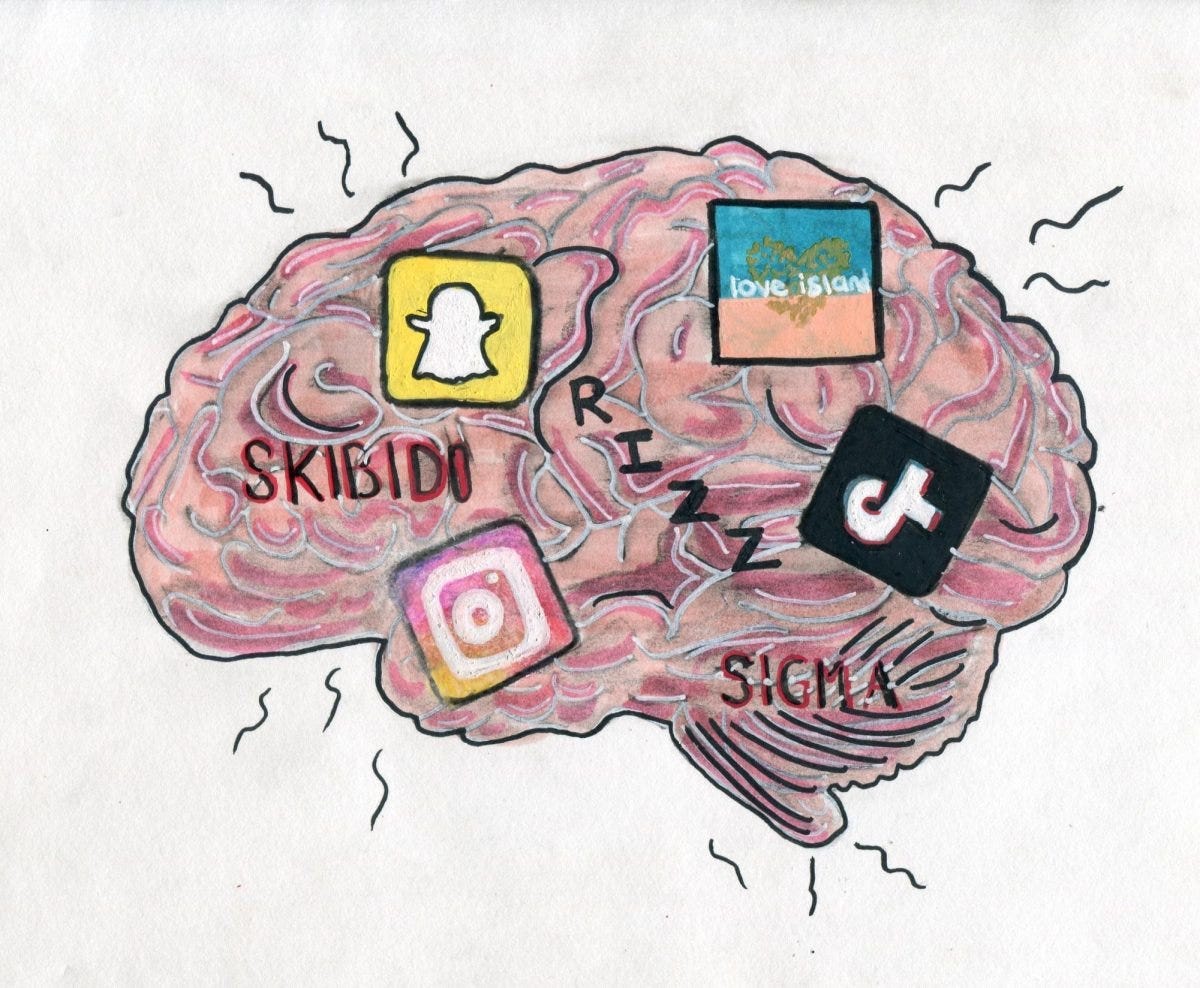
And this isn’t just some accidental byproduct. Jonathan Haidt, in his book The Righteous Mind, highlights the complexity of our moral and psychological wiring. He argues that human brains aren’t just wired for truth or objective reasoning. We are, at our core, designed to belong—to feel like part of the group. The “we’re right, they’re wrong” mentality? It’s not just a political tactic. It’s part of our psychology. Our social groups, whether online or in person, reinforce this mindset by creating echo chambers of validation and us-versus-them narratives.
Haidt’s quote on this rings true here:
“Our brains are more like lawyers arguing a case than scientists seeking truth.”
The constant validation we get from social media platforms taps into this dynamic—we’re more interested in being right and fitting in than in evaluating the facts or considering alternative perspectives. This is why social media can be so dangerous for our mental health. It’s not just about being addicted to the likes; it’s about how we’re rewiring our brains to crave validation over truth and connection.
Unveiling the Influence: Social Media’s Role in Recruitment and Brainwashing
Throughout Season 2, we’ve explored social media’s pervasive impact. From its role in shaping our perceptions to its influence on our behaviors, the digital realm’s grip is undeniable.
Social media wields considerable influence in radicalizing individuals and indoctrinating them into high-control religions, MLM schemes, and even ideological movements. The speed and reach of online platforms have amplified some of the most extreme, fringe ideas—turning them into mainstream conversations. A prime example of this is the social contagion of trans ideology, where a once niche and academic discussion about gender dysphoria has rapidly become a cultural movement that shapes public perception and (unfortunately) policy.
As platforms have expanded, the lines between identity, ideology, and community have blurred. Individuals seeking validation or belonging often find themselves drawn into conversations that are not just about personal identity, but about deeply entrenched political narratives. This creates fertile ground for ideological recruitment, where the promise of solidarity and empowerment can quickly morph into a dogmatic worldview.
But it’s not just about identity politics or radical gender ideologies. Social media also plays a pivotal role in radicalizing racial narratives. What were once niche, academic discussions about systemic racism, implicit bias, and social justice have now been thrust into the mainstream. These conversations, once confined to university lecture halls and activist circles, are amplified in real-time, shaping cultural narratives. This has created a new, all-encompassing cultural force.
The rise of radicalized racial narratives and the widespread adoption of a “prejudice plus power” definition of racism online has altered how these conversations unfold. The Internet lowers the cost of group action, making it easier for movements to organize, but also more vulnerable to collapse under scrutiny. While these conversations can be valuable, the speed at which they spread leaves little room for nuance, making the discourse more polarized and susceptible to manipulation.
The same strategies used by high-control groups, MLMs, and radical ideologies are now being leveraged in these public online spaces. Emotional appeals, the promise of community, and a collective sense of identity are powerful tools, but they also trap individuals in narrow, divisive worldviews. The social contagion effect of these movements, whether it’s trans ideology or the racial justice discourse, can lead to rapid shifts in beliefs that feel almost impossible to resist, especially when everyone around you is also influenced by these same narratives.
How Social Media Impacts Mental Health
It’s no secret that social media takes a toll on mental health. But let’s get specific.
- A 2020 study in Cyberpsychology, Behavior, and Social Networking found that excessive use is directly correlated with higher levels of anxiety and depression.
- A 2018 British study revealed that social media disrupts sleep patterns, which are crucial for mental well-being.
- And those carefully curated Instagram feeds? They lead to a nasty habit of social comparison, where we measure our real lives against someone else’s highlight reel.
The result? A vicious cycle of feeling “less than.” Even when we know that influencer’s perfect morning routine is staged, it’s hard not to feel like we’re falling short.
As a military spouse, I’ve felt this firsthand. In the loneliest seasons—new city, no community, husband busy working, social media felt like a lifeline. I craved connection, and Instagram was always there. But what I found wasn’t real friendship. It was hollow validation—likes, emoji reactions, and disappearing DMs. A digital sugar rush with zero sustenance.
Eventually, I had to get brutally honest with myself: social media had become my coping mechanism. I wasn’t reaching out to real people—I was scrolling through their highlight reels, mistaking proximity for intimacy.
Here’s the friendship test I use now: Did you know about their vacation before they posted the beach picture? If not, are you actually close?
Somehow, we’re more “connected” than ever, yet we’ve never felt so alone. That’s the connection conundrum.
As humans, we’re wired for belonging. We want to be seen, heard, loved. But seeing people online—and being seen by them—isn’t the same. It doesn’t satisfy the soul. It’s like eating fast food when what we really need is a home-cooked meal. We’re being fed, but we’re not getting nourished.
And that’s the scary part. People are starting to wonder what’s wrong with them. Why do I feel so empty? Why do I still feel lonely after a scroll session? But it’s not you—it’s the system. Social media has rewired our sense of connection. We think checking someone’s profile counts as keeping in touch.
But here’s the truth: it’s not enough. It was never meant to be.
The Lies Social Media Tells Us (And What Happens When We Stop Believing Them)
Inspired by Carly Burr’s “The Social Media Shift”
Social media is built on illusions—on selling us a version of reality that makes us feel just dependent enough to keep coming back. But Carly Burr cracks that illusion wide open in The Social Media Shift, revealing the deeper psychological and social conditioning behind our screen habits.
Let’s bust a few of the biggest myths that keep us stuck:
Lie #1: “I’ll lose connection.”
Platforms want you to believe they’re the glue holding your social life together—but that’s marketing, not truth. As Burr points out, real connection isn’t algorithmically filtered. It’s not passive. It’s intentional. It’s messy. It shows up in the awkward pauses of a phone call, the unsaid comfort of sitting beside someone, or a handwritten birthday card instead of a story reply.
The dopamine hit of a like isn’t the same as being seen.
Lie #2: “I’ll lose friends.”
Okay, but let’s talk about the quality of those friendships.
Social media keeps us tethered to past versions of ourselves—people we haven’t seen in a decade, relationships that faded for a reason, or mutuals we don’t even talk to. Burr argues that the constant stream of “updates” creates a false sense of closeness, making us feel socially exhausted while still emotionally empty.
Letting go of these weak ties isn’t loss. It’s liberation. You create space for depth over breadth—real conversations, real community.
Lie #3: “I’ll miss out.”
Ah yes, FOMO—the bread and butter of the scroll. But Carly flips this on its head with the concept of voluntary disconnection—not as retreat, but as rebellion. When you step away from the curated highlight reels, you stop comparing your real life to someone else’s filtered one.
This is the beginning of JOMO—the Joy of Missing Out.
Imagine the freedom of opting out of the noise so you can tune into your creativity, your actual priorities, and the people in the room with you. Spoiler alert: You’re not missing out—you’re waking up.
If this is what social media does to fully developed adults—those of us with matured brains, responsibilities, and years of analog life under our belts—then what happens when the same platforms are handed to kids?
Enter: Generation Alpha.
A generation being raised on screens, where digital stimulation replaces real-world experience, and curated identities form before self-awareness even sets in.
Let’s talk about the kids. Because this isn’t just a personal problem anymore—it’s a cultural crisis.
Generation Alpha & the Screen Trap: Childhood Rewired
Generation Alpha—kids born between 2010 and 2025—aren’t just growing up with technology. They’re growing up inside it.
Unlike Millennials or even Gen Z, who eased into the digital world, Gen Alpha was handed iPads before they could speak in full sentences. Their lullabies come from YouTube. Their friendships are filtered through emojis and DMs. The result? Alarming trends in social development: reduced face-to-face interaction, emotional dysregulation, increased narcissism, and shrinking independence.
Parents, this is a wake-up call.
You don’t need another expert to tell you what you already feel in your gut: handing a toddler a tablet to keep them quiet isn’t harmless. Kids need eye contact, boredom, dirt under their nails—not dopamine loops and digital pacifiers. For thousands of years, parents raised kids without screens. This is not impossible.
In The Anxious Generation, psychologist Jonathan Haidt breaks it down: the brain’s reward system (aka dopamine central) develops early, but the self-control center—the prefrontal cortex—doesn’t fully mature until about age 25. So, when kids are handed infinite-scroll devices packed with peer comparison, algorithmic manipulation, and curated realities, it’s like giving a toddler the keys to a sports car and pointing them toward a cliff.
Haidt calls screens “experience blockers.” Instead of learning through play, climbing trees, exploring neighborhoods, and negotiating playground politics, today’s kids are navigating TikTok trends and selfie angles. We’ve traded real-world resilience for digital performance.
“When you remove thousands of hours of unsupervised play, real-life social interaction, and physical exploration—and replace it with filtered selfies, infinite scroll, and a feedback loop of online validation—you don’t just rewire childhood. You rewire the brain.”
— Jonathan Haidt, The Anxious Generation
And that’s exactly what we’re seeing: a generation more anxious, more depressed, and more disconnected than ever before.
This isn’t about shaming parents—it’s about reclaiming childhood. Because what’s at stake isn’t just screen time. It’s the architecture of the next generation’s minds.
From Screen Time to Screen Stardom: The Rise of Kid Influencers
But it’s not just about passive consumption anymore. Increasingly, kids aren’t just watching content—they are the content.
Welcome to the unsettling world of kid influencers. Platforms like YouTube and Instagram have turned childhood into a brand opportunity, with children as young as five raking in sponsorship deals, building fan bases, and performing for millions.
And behind the ring lights and carefully edited vlogs? A growing wave of exploitation.
A recent Netflix documentary pulls back the curtain on this world, spotlighting the case of Piper Rockelle—a child YouTuber whose life has been shaped by online fame. What the documentary uncovers is deeply troubling: blurred boundaries, lost innocence, and kids caught in a perpetual performance loop for clicks, clout, and cash.
These children aren’t just growing up on camera—they’re growing up for the camera.
The pressure to maintain a digital persona, please followers, and produce viral content creates a toxic cocktail of emotional distress and identity confusion. They’re rewarded not for who they are, but for how well they perform. And the cost? A real, grounded childhood, full of uncurated, unsponsored experiences.
We’ve moved from screens blocking real-world development to screens broadcasting their absence.
What started as a parenting shortcut has morphed into a monetization machine—and the kids are paying the price.
How to Reclaim Your Life from Social Media
Ready to take your brain back? Here’s how to kick the scroll addiction and get your attention span (and your life) back on track—without moving to a cabin in the woods.
What Your Morning Scroll Is Doing to Your Brain
When we first wake up, our brain is gently humming in alpha and theta waves—those dreamy, creative states where intuition, introspection, and problem-solving flourish. Think: peaceful forest glade at sunrise.
But the moment your thumb reaches for your phone? Bam—dopamine starts firing, cortisol spikes, and your brain is jolted into high-beta wave activity. Translation? You’ve just swapped a meditative meadow for the chaos of a Vegas casino floor—bright lights, ringing bells, constant stimulation.
And we wonder why we feel frazzled before we’ve even had coffee.
1. Set Boundaries with Your Devices
• Start and end your day screen-free. The first and last hour of your day should belong to you, not your feed. Use that time for reading, stretching, journaling, or making actual eye contact with a human or a pet.
• Silence the dopamine drip. Turn off notifications for non-essential apps. That buzz you feel when you get a like? It’s manufactured.
• App timer yourself. Even five-minute limits can break the spell.
2. Give Your Brain (and Eyes) a Break
• Try the 20-20-20 Rule: Every 20 minutes, look at something 20 feet away for 20 seconds. This not only reduces eye strain but helps reset your nervous system and disrupt the scroll trance.
3. Declutter Your Digital Space
- Unfollow with intention. If an account makes you feel less-than, anxious, or enraged, you don’t owe it your attention.
- Hide the candy. Move social apps off your home screen—or delete them entirely. Make mindless checking inconvenient.
4. Prioritize Analog Experiences
- Reconnect with real-life hobbies. Gardening, painting, cooking, journaling—anything that grounds you in the physical world.
- Create with your hands. We’re wired for tactile engagement. Knitting does more for your nervous system than 1,000 likes ever will.
- Start small. Spend just 30 minutes this week doing something screen-free that brings you joy. Bonus points if it’s outside.
5. Use Technology Intentionally
Before you open an app, ask yourself:
“Is this productive or passive?”
Reading an article that educates you? Great.
Doom-scrolling through drama accounts?? Not so much.
Pause. Choose. Proceed.
As we navigate social media, it’s crucial to develop critical thinking skills that help us evaluate the flood of information we encounter. This isn’t about censorship, but about cultivating the ability to separate fact from fiction, identify bias, and question what’s being presented to us. The power of algorithms and viral content means we are often exposed to extreme or misleading viewpoints. By sharpening our ability to critically analyze media, we can better protect ourselves from manipulation while still engaging with important issues in a thoughtful way.
And that’s a wrap-not just on Season 3, but maybe, just maybe, on Taste of Truth Tuesdays entirely.
I started this podcast to explore the hard questions, challenge the dominant narratives, and create space for curiosity and critical thinking. And I’ve loved every gritty, gut-honest, mind-expanding moment with you. But here’s the truth I can’t ignore: the very platforms that help us spread ideas and connect also fracture our attention, distort our sense of reality, and leave us more addicted than aligned.
So, if this is the end, it’s not because I’m out of things to say—but because I want to live what I preach. I want to reclaim my time. I want to make art, grow food, write slowly, and have real conversations without an algorithm eavesdropping.
If you’ve walked with me through this journey—thank you. From the bottom of my heart. You’ve made this sacred.
And if this is goodbye, it’s also an invitation. To stay curious. To remain skeptical. To turn down the noise and tune into your own voice.
This isn’t the end of my voice, but it might be the beginning of a different kind of truth-telling—one that doesn’t require a platform to feel real.
So, for one last time…
Maintain your curiosity,
Embrace skepticism,
And keep tuning in-
Even if it’s just to your own soul.
Thanks for reading Taste of Truth! Subscribe for free to receive new posts and support my work.
Sources:
1. Hagar, Ashley, and Hisham Bensaadat. “‘iPad Kids’ Are Shaping the Future of Education.” Seattle Spectator.
2. NPR. “How Young Is Too Young for a Smartphone?” August 6, 2019.
3. Twenge, Jean M. “The Sad State of Happiness in the United States and the Role of Digital Media.” World Happiness Report 2019.
4. Andreassen, Cecilie Schou, et al. “The Relationship Between Addictive Use of Social Media, Narcissism, and Self-Esteem: Findings from a Large National Survey.” Addictive Behaviors, Volume 64, 2017, Pages 287–293.
5. Keles, Betul, et al. “A Systematic Review: The Influence of Social Media on Depression, Anxiety and Psychological Distress in Adolescents.” International Journal of Adolescence and Youth, 2020.
6. Royal Society for Public Health (UK). “Status of Mind: Social Media and Young People’s Mental Health and Wellbeing.” 2017.
7. Rosher, Jenna, and Kief Davidson, directors. Bad Influence: The Dark Side of Kidfluencing. Netflix, 2025.
Netflix. “The Program: Cons, Cults, and Kidfluencers.” (documentary on kid influencer culture, 2024).
 Taste0ftruth Tuesdays